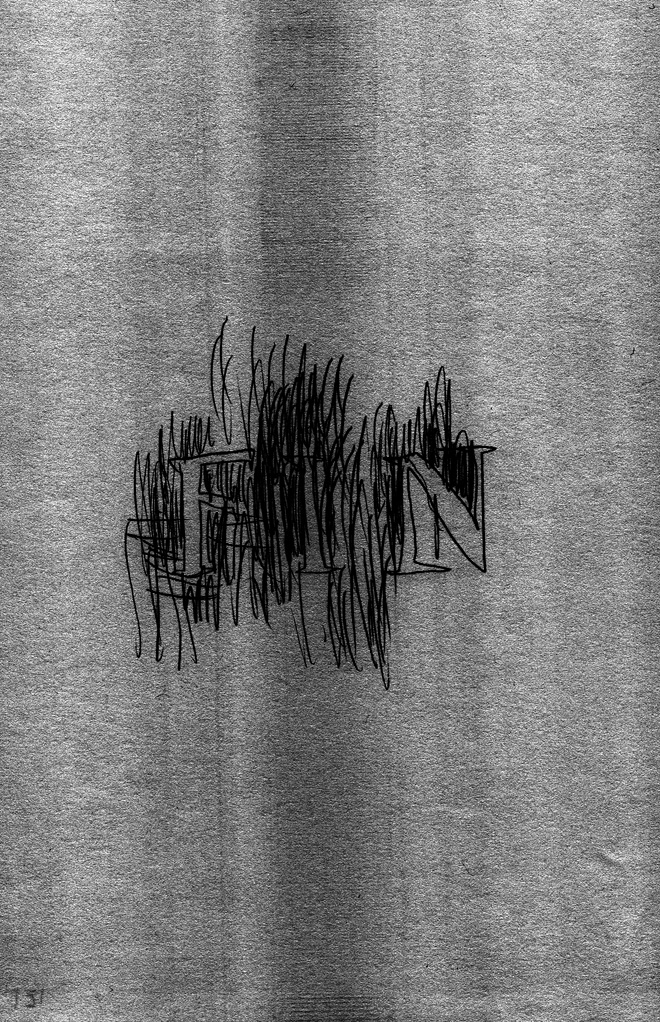
DWYCK: Open Sesame


The critical reception of Craig Thompson’s major new book Habibi has been somewhat dismaying. Sometimes, and — I am happy to say — more than occasionally these days, one reads comics criticism of such quality that one is perhaps fooled into believing that the form is finally receiving its due, that we have moved beyond the facile ideological critiques and “story vs. drawing” discussions of yesteryear. But then something like this book comes out and reality bites.

To start with the former issue, parts of the comics intelligentsia seem to be developing an unhealthy obsession with ideological readings of comics. To the extent where a given work is weighed entirely according to an ethical consensus and found wanting because of “problematic” content, most frequently of racist, sexist, or politically offensive nature. Anything else that the work might have to offer tends to be ignored and the notion that something might be good, even great, despite – or even because – of its problems seems inadmissible.

This site has become affected by such thinking in the last year or so to the extent that opening a random article will more likely than not bring the goods. Examples include the endless arguments over Robert Crumb’s racism (in which ‘satire’ has been held up as an inefficacious fig leaf by his defenders), the overblown accusations of sexism directed against Eddie Campbell in our roundtable on his work, the rather one-sided focus on Chester Brown’s choice to depersonalize the prostitutes he depicts in Paying for It, or most recently the discussion of Craig Thompson’s Orientalism in Habibi, which perhaps found its most vicious form in Suat’s review of the book.

I am not necessarily denying that the works in question, or indeed comics history more broadly, are haunted by such issues, nor am I arguing against choosing them as an avenue of criticism — Nadim Damluji’s examination of Habibi is a good example of a considerate approach, while Noah’s obliteration of certain recent DC books offers righteous polemic. The problem, rather, is that such criticism is often informed by a kind of ideological Puritanism that has gained traction in our current culture of taking offense — a Puritanism often blind to aesthetic quality, resistant to uncomfortable discourse, and prone to censorious action.

In the case of Habibi, it seems to me facile and unproductive to harp for too long on its sexism and Orientalism. Yes, it offers both and it suffers from it, but why does that have to be the full story? It is simultaneously, and obviously, a book so generous in intent and so voracious of ambition, that such criticism risks coming off as petty and, more importantly, ends up lacking in resonance.
Does Habibi successfully realize its sprawling ambition? No, it is a bit of mess, frankly, almost claustrophobic in its efforts to cram meaning into a formal structure unprepared for it. There is a distinct unease in the work between its conceptual and formal concerns, an attempt to stretch intellectually within a cartoon framework driven by stereotype and concerned with stylistic élan.

As was the case with Thompson’s paragon Will Eisner when he switched to graphic novel mode in the late seventies, Habibi is marked by an insistence on the value of the archetypes of traditional cartooning as a vehicle for the communication of sophisticated ideas. But where Eisner was suggesting untapped potential, Thompson’s cartooning is retrospective, barely transcending pastiche; where Eisner was concerned with paring down his visual storytelling to eliminate the kind of stylistic excess he had practiced in his classic Spirit strips, Thompson has his cake and wants to eat it too, letting his line run away with the narrative; most importantly however, Eisner’s mature cartooning, for all its faults, is animated by a genuine, mostly unpretentious effort to communicate truthfully, whereas with Thompson, whatever earnestness motivated him, the work smothered in conceptual intent.

Which brings me to the other issue I have with the critical reception of Habibi, and comics in general: the lack of sensitivity to how the visuals are integrally determinant of the work. Critics tend not to look beyond the surface qualities of the drawing in comics, and then proceed to discuss whatever conceptual issues are at stake without devoting much attention to how those issues are manifested visually. Even a cursory examination of the reviews published so far of Habibi should demonstrate this. Only a few have been entirely positive and several have been strongly negative in the conceptual assessment of the book and its ‘writing,’ but the majority of the reviewers have nevertheless taken time to commend the ‘art.’

Despite his strong misgivings, Damluji praises Thompson’s “stunning artwork,” and Fatemeh Fakhraie — while stating that she has no choice but to hate the book — “admits” that it is “beautifully drawn,” but does not engage that part of her experience much further. In their ambivalent takes at the Comics Journal Chris Mautner and Rob Clough both call the cartooning “visually stunning,” while the latter adds “amazingly beautiful” and praises Thompson’s “astonishing” attention to detail; Charles Hatfield, for his part, describes his drawing as “gorgeous” in his equally equivocal assessment in the same place.

In his notes on the book, Sean T. Collins isolates the “art” in one of fifteen bullet points, calling it “lush and lovely on a surface level,” and describing how Thompson’s line “swoops and curves in a fashion he’s explicitly compared to handwriting.” In her critical examination, Tansim Qutait also picks up on this, describing the book as a “…beautifully crafted volume, the ornately decorated pages broadening possibilities for expression in the graphic novel form, as the calligraphy adds an innovative third dimension to the duality of image/text,” without further detailing why or how that would be the case (calligraphy and comics have a long common history). And Michel Faber of The Guardian grandstands against a paper tiger that would have serious comics aesthetes scoff at technical chops, calling the book “an orgy of art for its own sake.”

You cannot argue with taste, but the uniformity of the reaction strikes me as notable. Belying Faber’s theory, comics have generally been and continue to be valued for the technical accomplishment of the art. Thompson is certainly technically accomplished, but these critics seem to overlook that his virtuosity “…is a conventional sort of virtuosity,” here used “in the service of a conventional exoticism,” as Robyn Creswell puts it in his New York Times review of the book. Or as Suat describes it more bluntly, it “…lacks the emotive and stylistic range to capture the pain and suffering he is depicting (almost everything takes on the sensibility of an exercise in virtuosity or an educational diagram).”

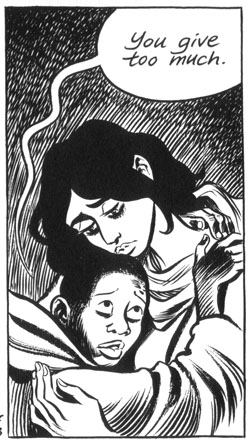
Rarely, if ever, does Thompson’s visualizations of his characters support the book’s implicit assertion that it is more than broad melodrama (which it nevertheless is, or could have been, but more on that presently). Wide-eyed Dodola alternates between wonder, despondency, anger, and bliss through the book, as if following Suat’s educational diagram.
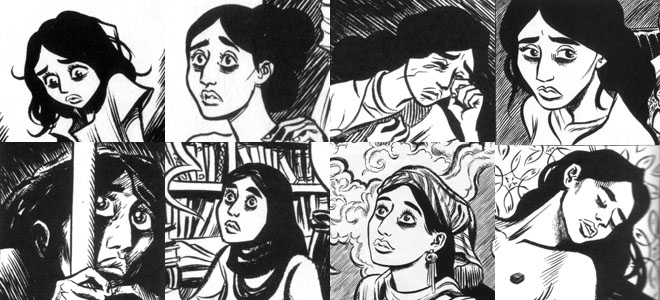
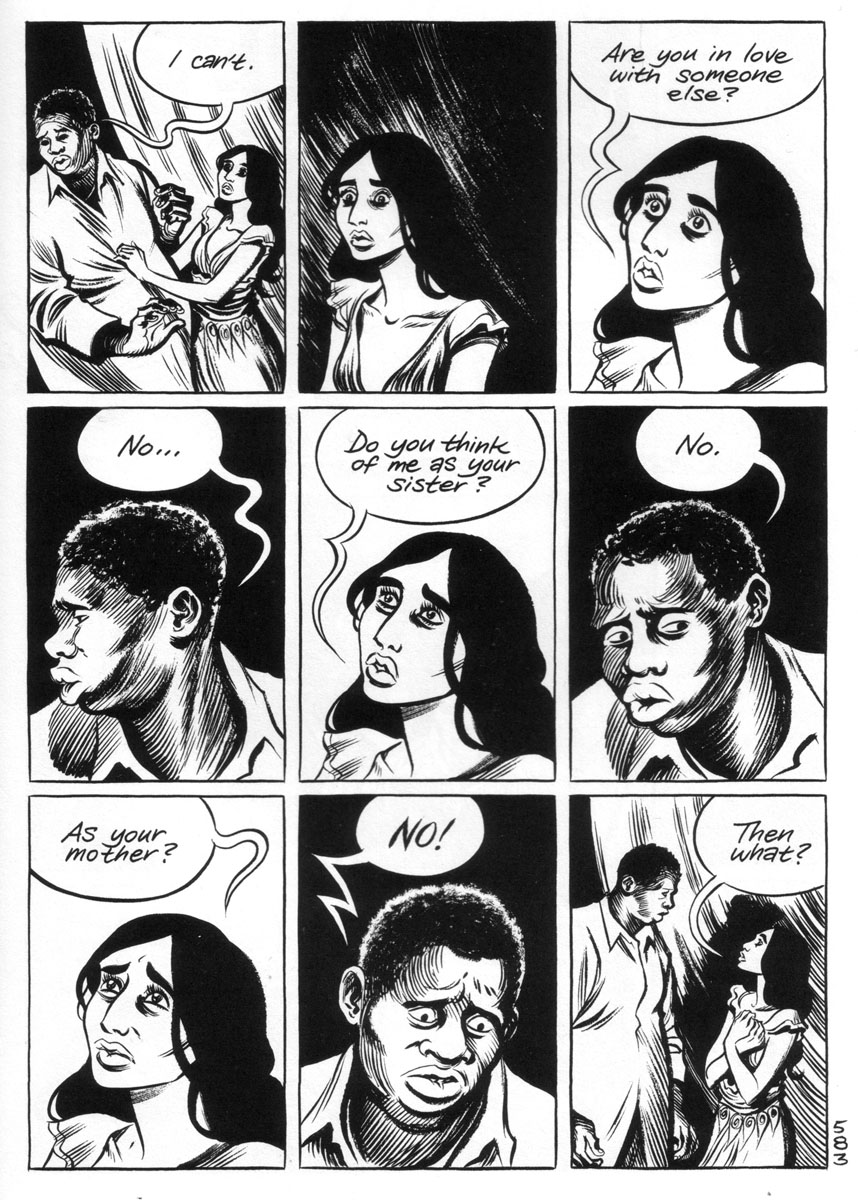
The implied complexity of her emotion as she finally proposes a sexual union with her former charge Zam, after many years of separation, is for example undermined entirely by a banal progression from surprise to pity and doubt that simultaneously overstates and flattens the plea for redemption we are supposed to feel. Doughboy Zam’s evasive maneuvers and flitting baby eyes — supposedly a reckoning after years of denying his sexuality to the extent of self-castration — is not any more persuasive.
Secondary characters fare even worse: as several critics have noted, there is nothing to distinguish the sultan beyond central casting, which makes him hard to care about even as a villain. (This is emphatically not the case with the better of Thompson’s nineteenth-century models in Orientalism: compare for instance Delacroix’ chilling portrayal of the tyrant Sardanapalus). And the characterization of walk-on characters, such as the slaves encountered in the market by the fisherman Noah, is often embarrassingly rote, as if Thompson were not even trying.
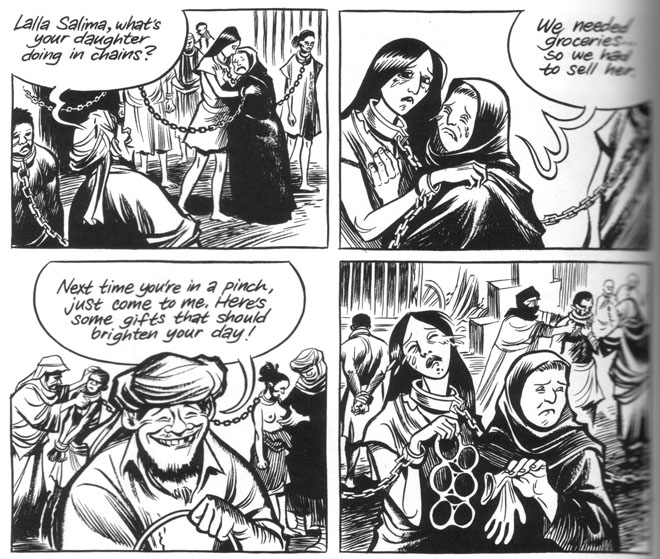
As previously noted, I suppose he is following Eisner here, but his proposition that these stereotypes — the stuff of kitsch illustration — can carry his ambitious attempt at reconciling typology and psychological realism is unconvincing.


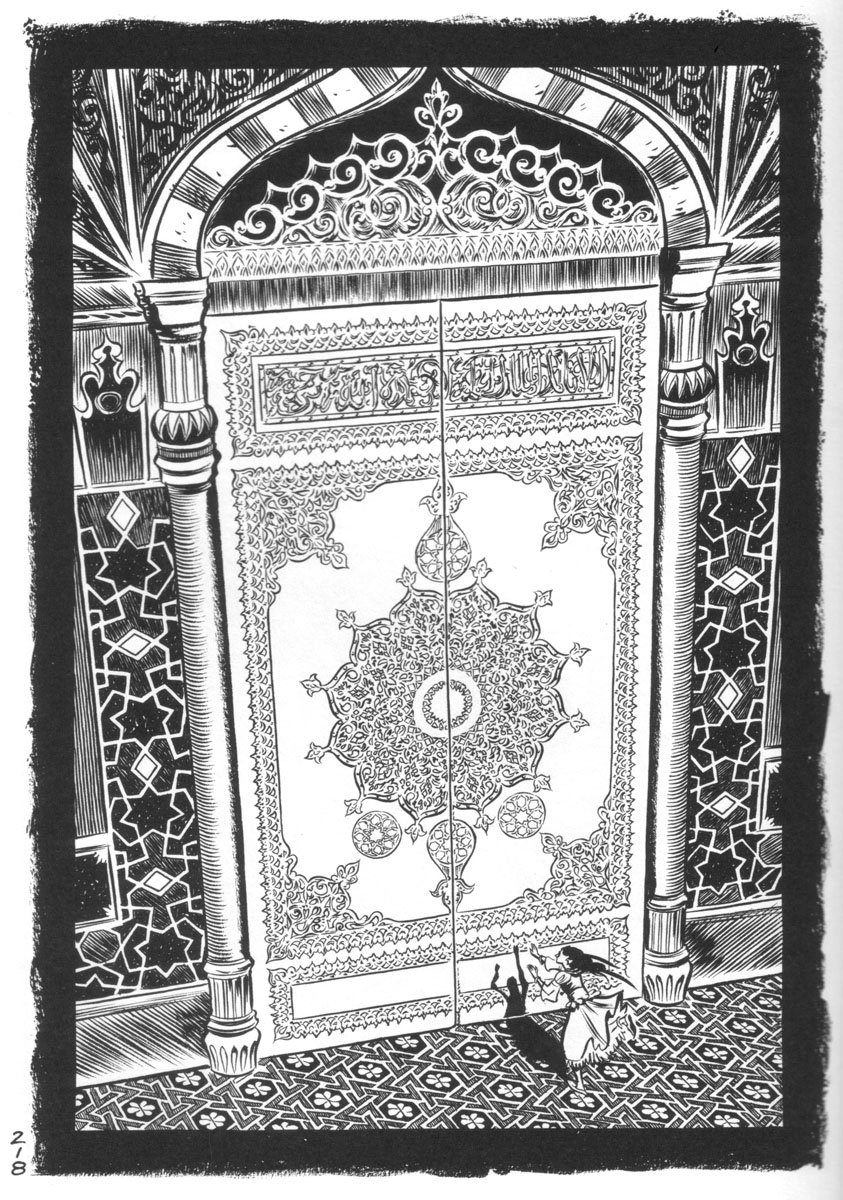
The same goes for his much praised ‘calligraphic’ line. His explication of the word ‘Bismillah’ in the Qu’uran for example is deftly wrought, but his examples sit uncomfortably on the page, one diagram after the next, rather than being woven together harmoniously the way one encounters in good calligraphy. And the line is rather mechanical, incapable of surprising us – every stroke is in its place, and we know where it is headed. Compare Thompson’s other great paragon, Blutch, who for all his faults invariably retains a spontaneity of rendering, a reflexive laxity of control that enables surprise error and insight.
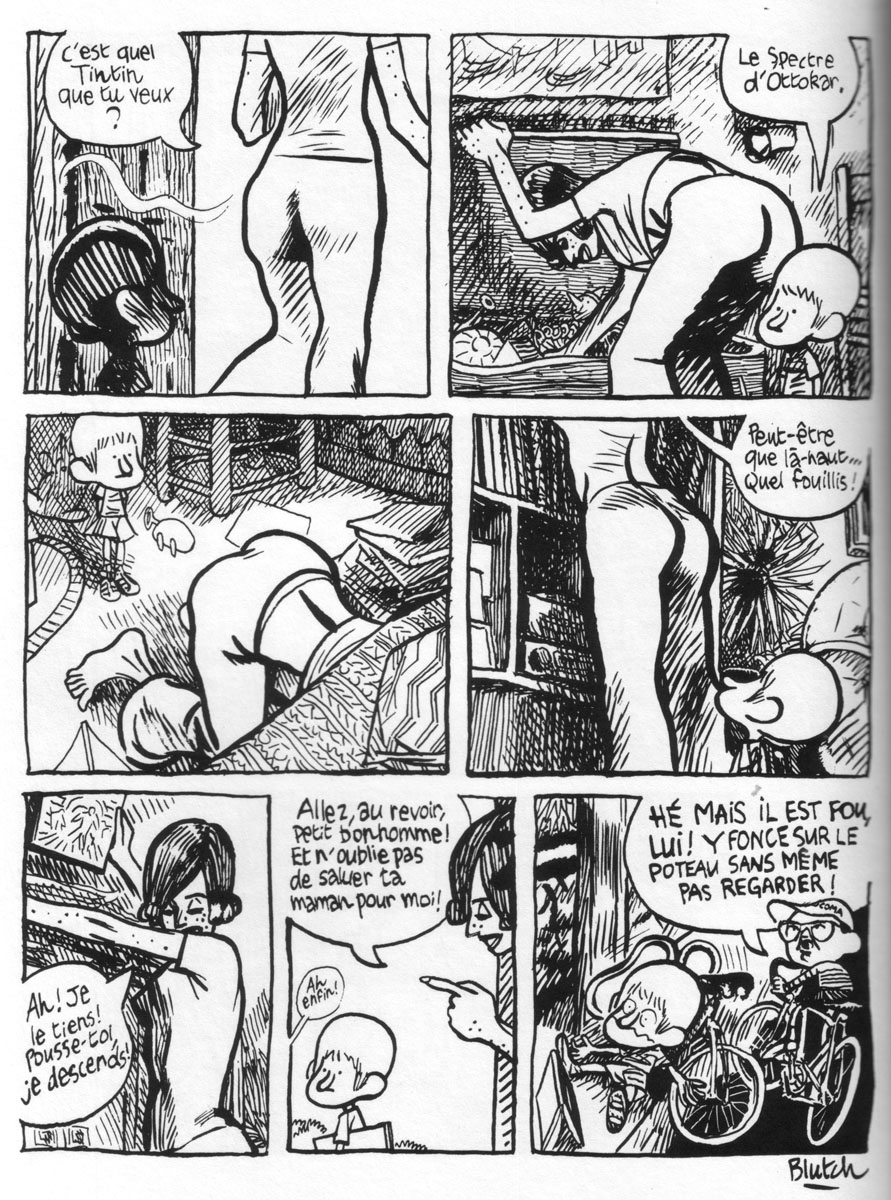
From Blutch's Le Petit Christian (collected 1998)

If this comparison with one of the masters seems unfair, one need look no further than a considerably less facile cartoonist than Thompson, who also just published a big book of comics (Big Questions): Anders Nilsen. Though less secure, often laborious, and marked by errors, his line moves with a nervous jumpiness that makes us wonder what meaning it holds, where it is going.
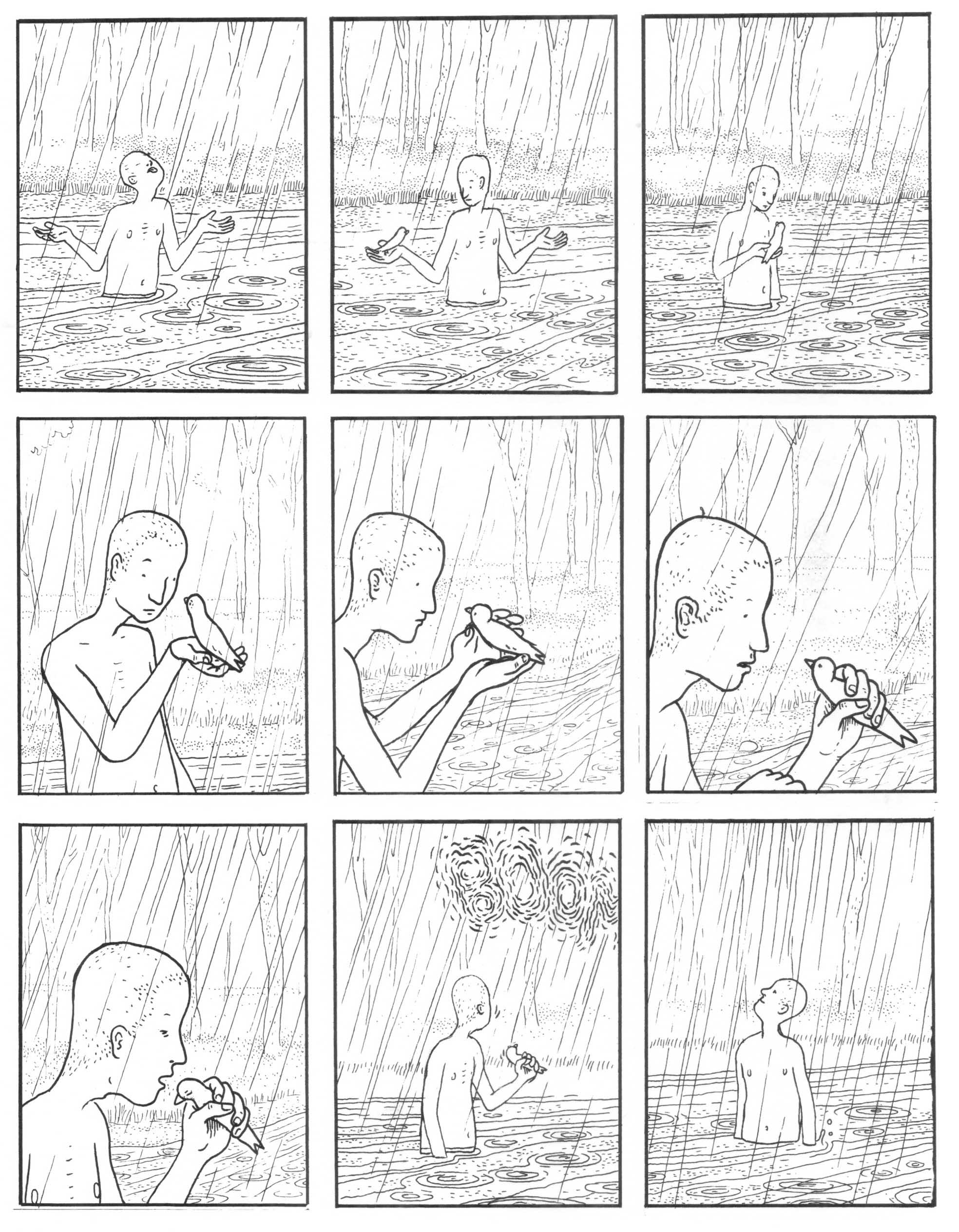
From Anders Nilsen's Big Questions (collected 2011)

Thompson’s range, similarly, is limited. He uses the same lines to delineate the curve of a sand dune and bodily effluvium.
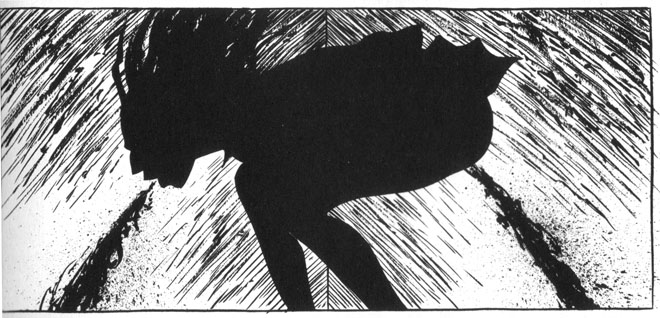
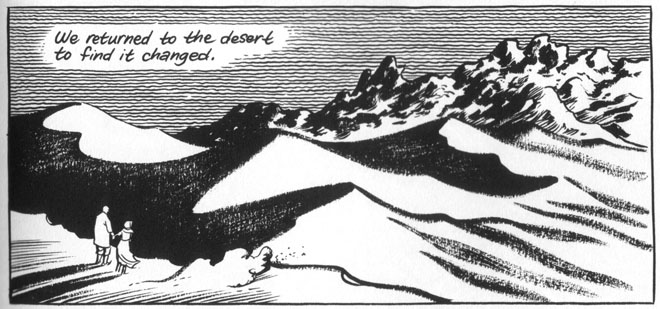
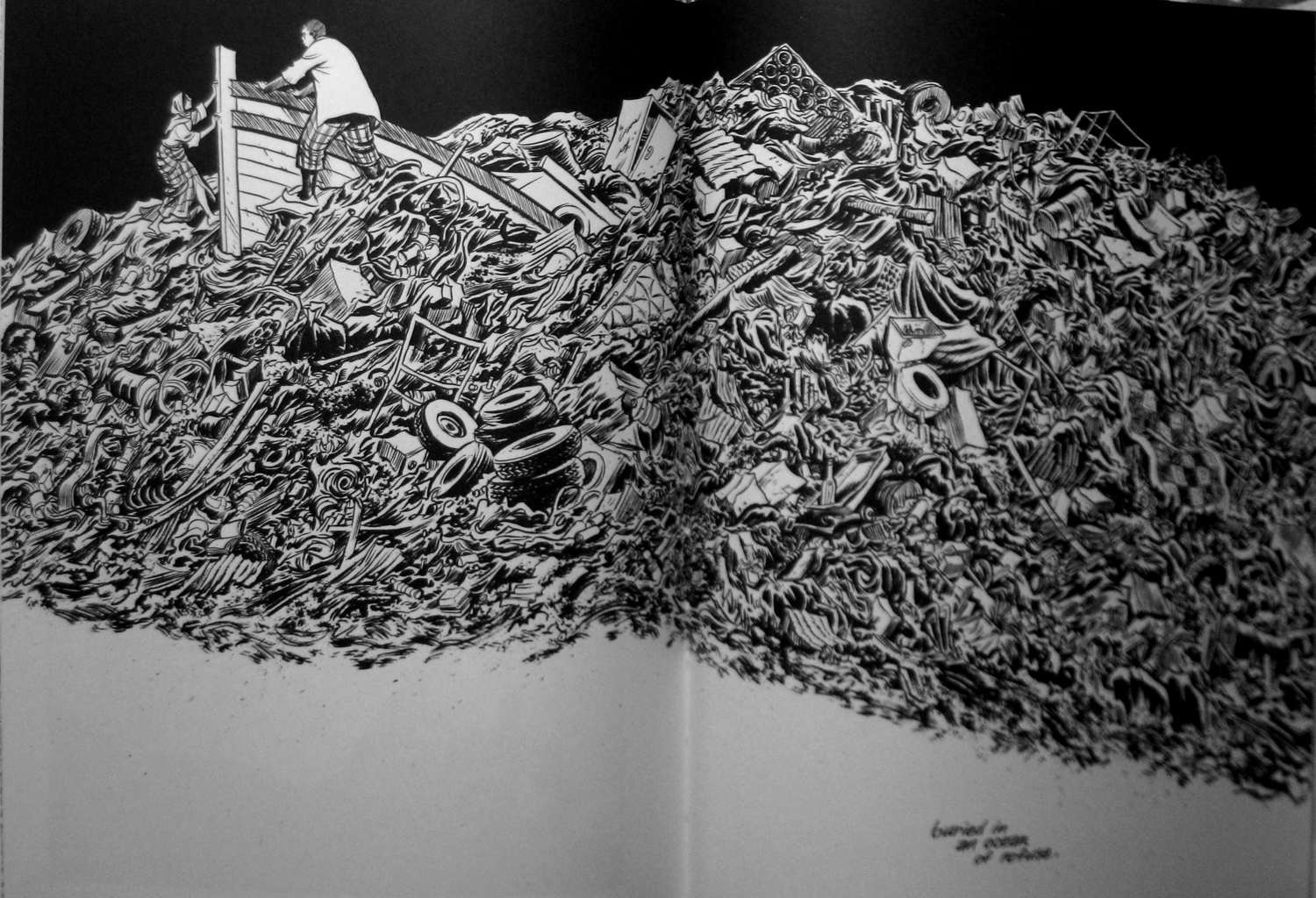
Everything is the same graceful brushstroke, as if that were the main point. The effect is strangely antiseptic in a work that concerns itself so intently with filth and pollution — its mountains of garbage seem designed to wow us more than anything else.
Also, Thompson’s depiction of the great modern metropolis of Wanatolia is bereft of the grimy presence he describes elsewhere, a lifeless construction, all unpacked from the same box: one might argue that this carries a conceptual point about the barrenness of Empire, but it still fails to evoke the environment our heroes will be moving through for the rest of the chapter. Blandness also requires suggestiveness to be recognized as such.
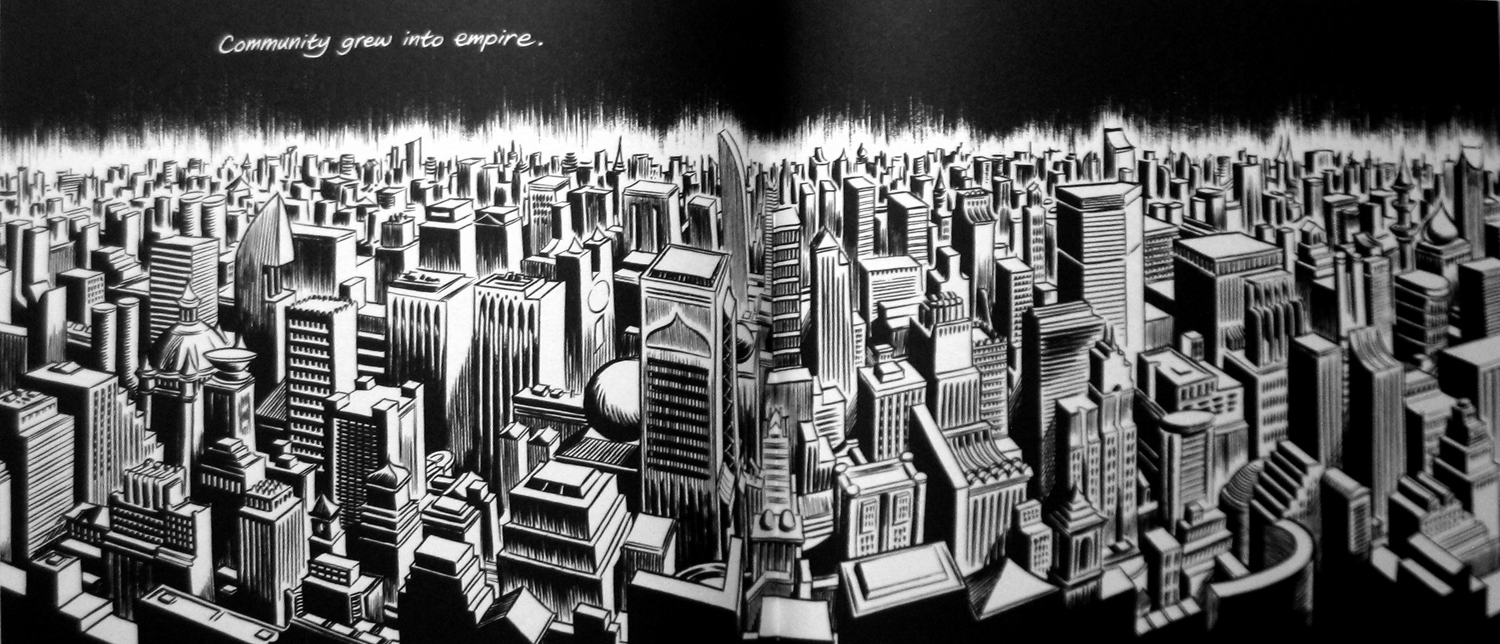
At the risk of repeating myself, my overarching point about comics criticism here is that if one wishes to criticize Habibi’s writing and subject matter, it seems a missed opportunity not to recognize that the problems identified inhere as much in the visuals as in anything else. Merely to describe the art as ‘beautiful’ and otherwise ignore its importance to the work is ultimately doing Thompson — and more fundamentally the comics form itself — a disservice.

Thompson’s deadening control of line and resort to stereotype are part and parcel of the deliberation he brings to his writing and conceptual presentation: everything is there for a reason and he makes sure we know it, even if we sometimes wonder whether that reason is particularly well digested. And in a way you cannot but admire Thompson for his ambition and efforts — Habibi is a smorgasbord of ideas, generously laid out for the reader by a highly talented cartoonist whose enthusiasm is certainly infectious but also, and ultimately, smothering.

Where the work really shines for me is in the passages marked less by overt intent and more by instinct, which was also the case in his previous, autobiographical book, Blankets, in which the uneasy and tentative, if also undeveloped, treatment of the author’s relationship with his brother was by far the most compelling aspect of the story. In Habibi, this unease is primarily located in the treatment of sexual anxiety and transgression, which borders on the obsessive and even the sadistic. It is almost as if Thompson enjoys torturing his characters, especially through sexual humiliation, in a way that suggests meaning beyond the narrative itself.

In Blankets the same themes were treated much more timidly; here, there is a fascinating excess on display. This ties in to the very masculine display of Thompson’s brushwork — executed in what he has described as the “virile” tradition of Blutch and other European cartoonists, from Edmond Baudoin to Christophe Blain (more on that here) — and for which he has employed the tired metaphor of the mark as divine seed more than once, including at the beginning of Habibi. Importantly, it also energizes nervously Thompson’s patently male gaze. A more mature exploration of this tension — a tension fully worthy of his talent and aspiration — would seem to me a fruitful direction for his future work.
__________________
Editor’s Note: This is part of an occasional roundtable on Orientalism and Habibi.

Update by Noah: I try to respond to some of Matthias’ points here.
Let’s Talk About Nothing

This first appeared on Splice Today.
________________

In the primordial blogs and antediluvian websites where rock critics lurk and prey upon one another in an endless Darwinian struggle of tooth and snark, the steaming red meat of contention over the last few years has been rockism. Rockism is essentially a more or less deadly insult, directed at those critics (like, say, Jim Derogatis) who fetishize indie rock authenticity and gritty individuality and don’t like Mariah Carey because she includes ads from Elle in her CD packaging. Facing off against rockism are the adherents of popism (like, say, me) who embrace the fluid jouissance of transitory pleasures and guiltless booty-shaking, and don’t like Bruce Springsteen because everyone tells them they have to. Popists like to accuse rockists of being racist, sexist, uptight poseurs. Rockists like to accuse popists of being shallow, trend-following, tasteless poseurs.

For those who enjoy the spectacle of atavistic struggle, the rockist/popist survival-of-the-fittest donnybrook has actually generated a lot of entertaining copy, from Kalefa Sanneh’s Rap Against Rockism to Jody Rosen’s The Perils of Poptimism. My favorite broadside from the struggle, though, has to be Carl Wilson’s 2007 book, Let’s Talk About Love: A Journey to the End of Taste. Wilson, a blogger and critic for the Toronto Globe and Mail, doesn’t necessarily fit comfortably into either rockist or popist camps, but his book is clearly inspired by a popist aesthetic. His project is to redeem the woman who Simon Frith called “the most loathed superstar I can remember” — Celine Dion.

Wilson picks Celine not because he likes her and no one else does, but rather because he hates her — and, because, contra Frith, that makes Wilson unusual. Though I personally don’t know anyone who likes Celine, and though you may not either, the fact is that no one sells records the way Celine sells records. For Wilson, this is part of her fascination. Celine stinks of democracy — of “grannies, tux-wearers, overweight children, mobile-phone salesmen” as one critic put it in the Independent. Like most Canadians, liberals, and rock-critics, Wilson has an instinctive mistrust of elitism, and he can’t help feeling that his own hatred of Celine is less about her intrinsic worth than it is about placing himself above the drooling masses. This conviction is only strengthened as he goes out to interview actual Celine Dion fans. One of these is Sophoan Sorn, a Californian film-maker and former Vietnamese refugee, who Wilson says struck him as “one of the nicest people I’ve ever talked to.” Wilson goes on to say that, “Not only does [Sophoan’s taste] seem as valid as my own, utterly incompatible tastes, I like him so much that for a long moment his taste seems superior. What was the point of all that nasty, life-negating crap I like?”

It’s not quite so easy to utterly abandon one’s viewpoint, as Wilson finds. “You don’t know what an egotistical control freak your taste can be until you try to turn traitor,” he muses. He admits, with some regret, that he’ll never like Celine the way many of her fans do. But he does manage to find a way, if not to love her, then at least to rationalize her. He argues that critics too often act as if the point of music is to sit still and be aesthetically dissected. This works, he argues, for bands like Sonic Youth, but makes much less sense for an artist like Celine, who produces “lousy music to make aesthetic judgments to” but whose songs “might be excellent for having a first kiss, or burying your grandparents, or breaking down in tears.” He adds that aesthetic distinctions are necessary for enjoyment, but he argues that critics need more humility, and a willingness to admit that they are arguing from a subjective and culturally determined place. In short, Celine is useful for her audience in specific, practical ways — condemning her through absolute standards is elitist, potentially oppressive, and compromised.

Wilson’s argument for Celine, is, therefore, on its surface, a basic statement of enlightenment, utilitarian tolerance (Celine is useful, she hurts no one — who are we to criticize?) It’s also a particularly clear statement of how those values end up in a post-modern rejection of judgments in general as absolutist. Underneath this conscious clarity and fair-mindedness, though, the book has another, less fully spelled out agenda — one which surreptitiously gives the book much of its energy.

In the period where Wilson was researching and writing about Celine, his marriage had come apart. Wilson mentions this forthrightly enough, and even links it to his burgeoning, on-off appreciation of Celine. For example, when he saw Celine’s Vegas show, he says, part of the reason he was able to enjoy it was that “Celine helped me feel that big, dumb emotion on some gut level.” His personal turmoil allowed him to see the point of Celine’s blatant sentimentality.

That doesn’t seem to be the entire story, though. In recounting his trip to Vegas, during which he was lonely and miserable, Wilson mentions as part of his litany of discomfort with his surroundings: “I am entirely too shy to hire prostitutes.” That casual tie between self-definition and shame is not explored immediately…but later it becomes one of the important themes of the book. While listening to Celine’s Let’s Talk About Love alone in his room, Wilson is intensely embarrassed — as, presumably, he would have been had he hired that prostitute. He is afraid people will hear what he has in his room, and judge him for it. What follows is probably my favorite passage in the book:

Yes, it was vain not to want the neighbors to hear me playing Let’s Talk About Love….But the worst part was feeling ashamed to feel ashamed…. Try it yourself: Pick some music you find particularly unattractive and crank it up every day for a couple of weeks. Or go out for the evening wearing clothes you find ugly, and not in a funny way Before having a dinner date over, hang a painting from a Christian-art sale over your bed….Shame has a way of throwing you back upon your own existence, on the unbearable truth that you are identical with you, that you are your limits. Which immediately makes the self feel incomplete, unjustified, a chasm of lack. It’s the reverse of the sense of self-extension that having likes and dislikes usually provides. It is humbling.

Wilson, then, is arguing that part of the benefit of listening to Celine is a sense of shame. He presents this shame as enforcing the boundaries of the self; increasing his consciousness of who he is and can’t escape. But surely the experience is not just about enforcing boundaries, but about destroying them. Wilson’s book is about changing himself; he starts as someone who hates Celine, and becomes someone who doesn’t. There is a transformation, and that transformation involves shame, and, indeed, degradation. In Bataille’s formulation, Wilson is violating a taboo in order to obtain sacred experience; he is bathing in the filth of democracy in order to be changed.

Perhaps it’s only coincidence, but to me at least, the juxtaposition in the quote above of Celine, dating, and Christianity seems suggestive. I don’t think it’s fair to psychoanalyze; to say — “Well, Wilson’s interest in Celine is inspired by his desire to escape from his self in the wake of a failed marriage.” But I think it is fair to point out that Wilson has constructed the book in part as a story about revelation and healing. He needs to be somebody different, and part of the way he does that is by becoming a person who can appreciate Celine Dion.

Wilson’s book, then, turns out to not really be a polemic in the rockist/popist internecine war. Instead, it’s a statement of faith — though of faith in what isn’t entirely clear. Democracy, perhaps? Art? Celine herself? Perhaps, more abstractly in the transformative power of aesthetic choices? Terry Eagleton comments in Reason, Faith, and Revolution that “certain of our commitments are constitutive of who we are, we cannot alter them without what Christianity traditionally calls a conversion, which involves a lot more than just swapping one opinion for another.” Wilson seems to be almost inverting this, proposing, or hoping, that if we can but treat our opinions as constitutive of who we are, we can experience a conversion merely by changing them.

As I said, the emotional commitment and the yearning in Wilson’s book are what give it its power and, indeed, its beauty. The single most affecting scene in the narrative is when Wilson remembers his now ex-wife singing Buddy Holly to him at the beginning of their relationship: “Oh Boy,” featuring as both corny weakness of taste and sacrament. At the same time, though, it’s hard not to feel — in Wilson’s longing, his shame, and his tentative renewal — a thinness and almost a self-parody. At the end of the book, he rather lamely admits, for example, that the Beatles and Louis Armstrong are better than Celine Dion on the basis of the fact that those artists “appeal to people across taste divides” — as if no one hates the Beatles, right? He also confesses — with his tongue not nearly far enough in his cheek — that Celine’s continuing, unassailable uncoolness is what may “give him the heart to go on.” Thus, after 160 odd pages of intense thought and deliberation, Wilson is left with no basis for aesthetic judgments except the extremely dubious one of popular approval, and no grounding for his own spiritual health other than critical disapproval. He has journeyed to the end of taste, and there he has found only arid clichés and a vapid contrariness.

Or, to put it another way: the only way you can experience a sense of shame and guilt is to play Celine Dion loud enough for the neighbors to hear? I mean, really? Haven’t you ever, I don’t know, betrayed a friend? Insulted a loved one? Told an untruth? Wilson is thoughtful enough to realize that a sense of sin — of the worthlessness of the self — is necessary for conversion. But as a tolerant but definitive atheist, and as a rock critic, he seems able to conceive of that sin only in terms of relatively banal aesthetic faux pas.

Terry Eagleton notes that “It is culture, not religion, which is now for many men and women the heart of a heartless world.” Art, Eagleton argues, often functions as a kind of displaced theology. This aesthetic theology is spread variously among denominations, like rockism and popism, and these denominations espouse competing values, such as democracy or tolerance or authenticity. These differences in values certainly matter; our aesthetic choices are bound up with who we are, what we believe, who we love, and what we want to become. But such distinctions are also limited — a band may save your life, in some sense, but it isn’t going to save your soul, or the world. Celine may be good, or she may be bad, but she’s not the Cross. Beyond taste, there are only those things that will not accept the condescension of your aesthetic pronouncements. You can call that reality, or truth, or God, or, for those of us who are atheists, the absence of God. In any case, it judges you, not the other way around. To forget that is to start worshipping idols, which means that you are outsourcing your spiritual and emotional life to another sinner, and are living a lie. Liking or disliking Celine is not a moral issue. Wilson treats it as one, which is why his book has so much passion, love and heart — and why, despite all that, his journey can lead nowhere.

Utilitarian Review 12/17/11

On HU

In our Featured Archive post Alex Buchet talks six degrees of Ezra Pound.

I review the self-erasing Hollywood flick Prince of Persia.

Caroline Small’s Godard roundtable continued this week. We should have a couple more posts (one of them at least of epic proportions), and we’ll finish up on Monday.
 
Utilitarians Everywhere

At the Washington Times I talked about shopping in the Wal-Mart music section.

On Splice Today I review Amy Winehouse’s posthumous album.

I participated in the Atlantic’s best films of the year effort with a short review of The Interrupters.
 
Other Links

Robert Stanley Martin on James Baldwin’s Go Tell It On the Mountain.

Salon has an interesting piece on Tibet in comics.

Dr. Nerdlove on nerds and male privilege.

A terrifying 80s Yugoslavia music video.

E.D. Kain convinces me I should vote for Ron Paul.

And C.T. May with a skeptical take on Christopher Hitchens.
 

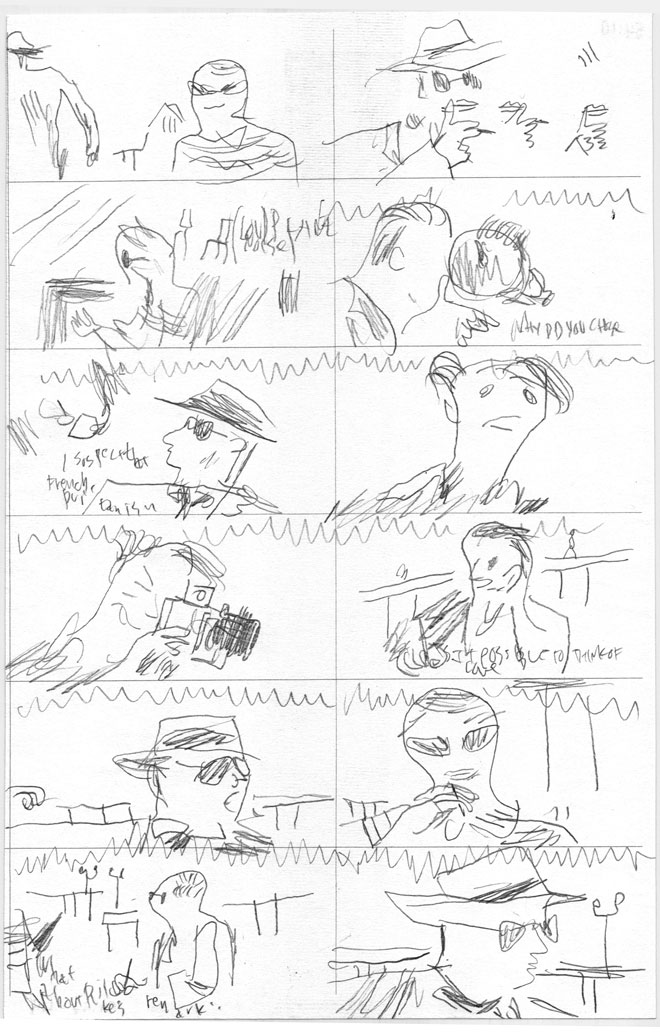
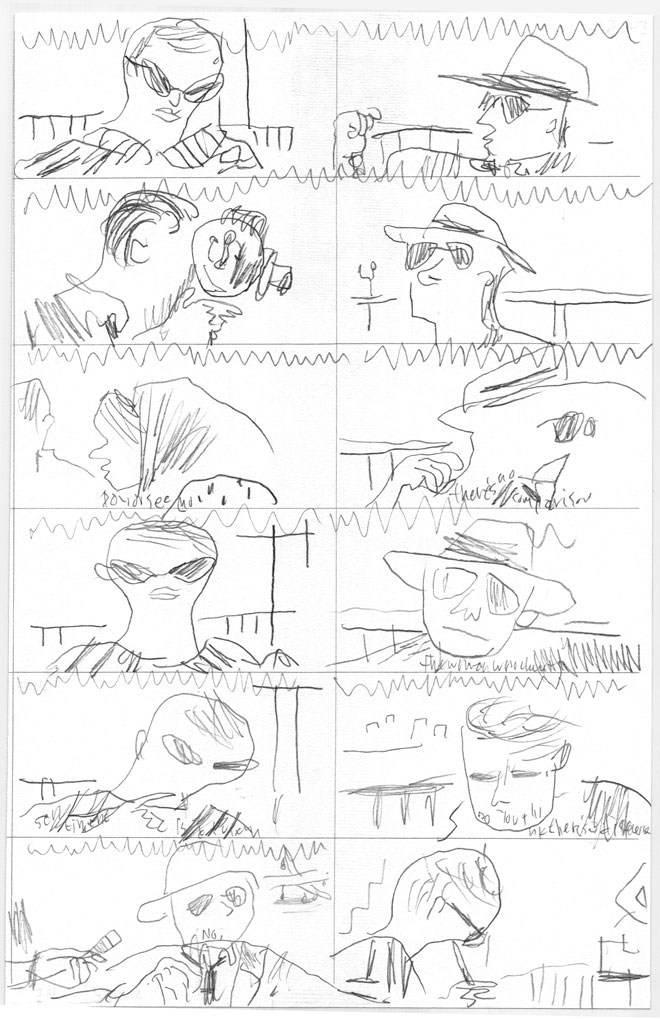
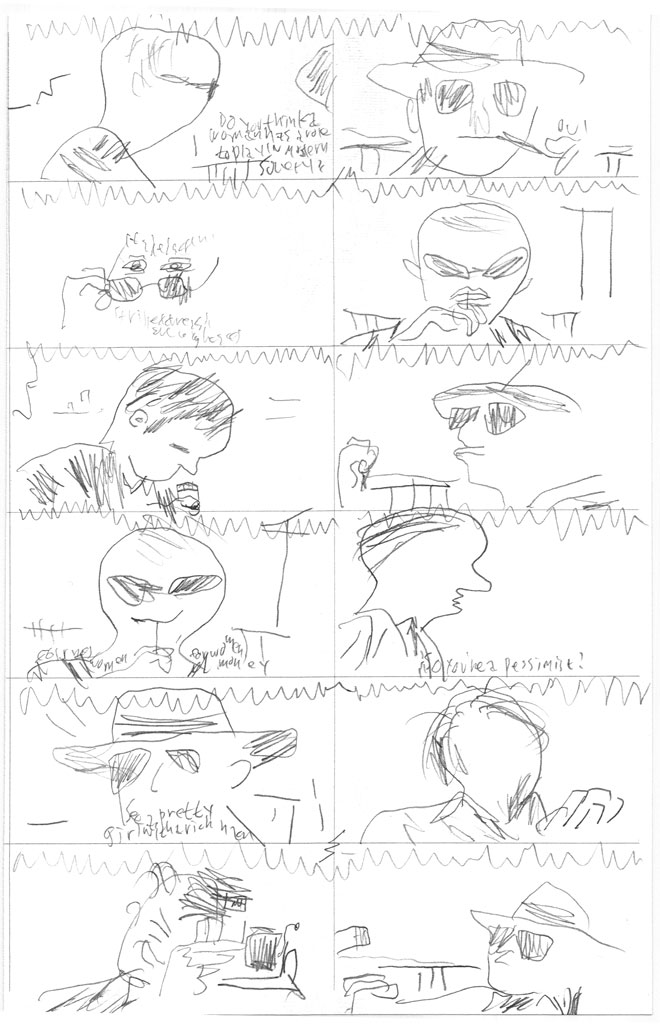
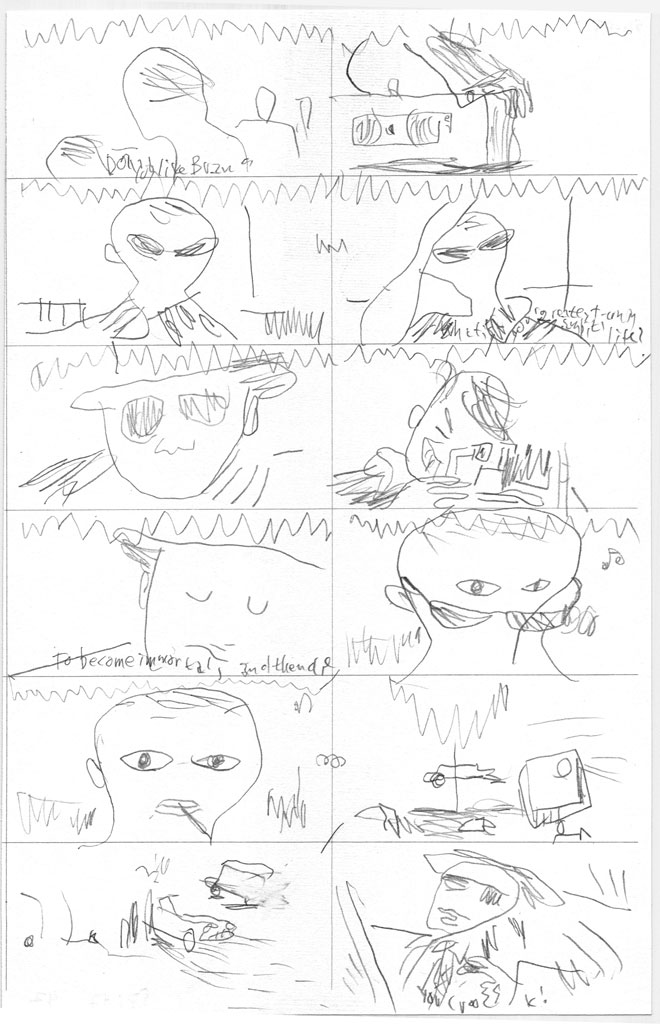
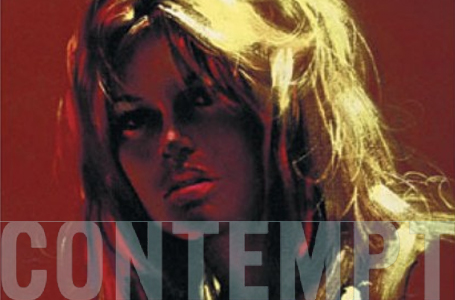
Contempt: A Visual Reading and Other Loose Ends

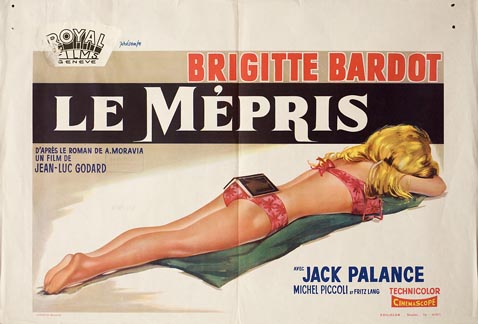
Lucien Goldmann, a Marxist critic, said that Contempt, a film by Jean-Luc Godard (1963): “is about the impossibility of loving in a world where The Odyssey can’t be filmed.” (In a world without gods.)  It’s an imaginative interpretation, and a surprisingly reactionary one coming from a Marxist critic commenting on the work of a Marxist director, but it links two of the picture’s themes: 1) the end of the couple Camille (Brigitte Bardot) and Paul Javal (Michel Piccoli); 2) the difficult relation between art and commerce; i. e.: the creative differences between director Fritz Lang (himself) and producer Jeremy Prokosch (Jack Palance).  The problem with Goldmann’s thesis is that he reached a totalizing conclusion starting with a particular example, but, mixing gods to the equation, the film invites such an universal statement.   

Apparently the reason why Camille starts to despise Paul is more down to earth than hinted above: she feels used by her husband. When Jeremy Prokosch hits on her Paul does nothing until it is too late (he even encourages his advances ignoring her supplicating eyes). Godard himself said that Camille is like a vegetable

“acting  […] by instinct, so to speak, a kind of vital instinct like a plant that needs water to continue living.”

Contempt is a tragedy (George Delerue’s score never let’s us forget it; Paul to Camille:

“I love you totally, tenderly, tragically.”)

and that’s why Lucien Goldmann isn’t that wrong. The events are linked together in a fabric weaved by the fates. Paul Javal was a hack who sold his wife the moment he sold himself. Camille doesn’t rationalize her reactions, but she’s a victim of the commodification of human relations.

The gods no longer exist, so, they can’t influence the lives of humans, but, in a capitalist world, money took their place reigning supreme over everything. That’s why Jeremy Prokosch says:

“Oh! Gods! I like gods! I like them very much. I know exactly how they feel.”

To which Fritz Lang replies:

“Jerry, don’t forget: the gods have not created men; men have created gods.”

If men created gods and destroyed them, they can also destroy capitalism.

It wasn’t the first time that Paul was an hack either. He previously wrote Totò Against Hercules. We can only imagine a comedic peplum (Totò, Antonio Gagliardi, was an Italian comedy actor). Contempt’s producer Joseph E. Levine did produce Hercules in 1958 though. He may very well be the target of Godard’s satire. Prokosch is a caricature, obviously: showing him lusting after a nude female swimmer in Fritz Lang’s The Odyssey is a comment on his producer’s insistence to show Brigitte Bardot’s body in the film (Paul:

“cinema is great: we look at women and they wear dresses, they participate in a film, crack, we see their asses.”)

Contempt is full of self-referential and autobiographical details like the one above. Another is Brigitte Bardot wearing a black wig to look like Anna Karina, Godard’s wife. Paul is clearly Godard’s alter ego: wearing a similar hat (as shown in his cameos) and a similar admiration for American films (Camille:

“I prefer you without hat and without cigar.”;

Paul:

“It’s to imitate Dean Martin in Some Came Running.”)

While being on the terrace of villa Malaparte Camille waves at some point. At whom? The paparazzi who infested the surrounding bushes?…

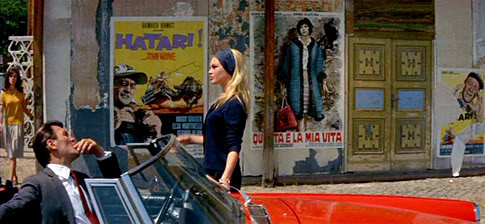
At the beginning of the film, at Cinecittà Studios in Rome (sold by Prokosch to a chain of malls), we can see film posters of Godard’s own Vivre sa Vie (To Live Her Life) and his favorite films also produced in 1962: Hatari by Howard Hawks, Vanina Vanini by Roberto Rossellini; and 1960: Psycho by Alfred Hitchcock. We may draw two conclusions from this list: 1) not everything that money touches is crap; 2) the Italian film industry wasn’t as dead as it seemed because masterpieces continued to be created.  This means that the reading of the images gives some nuance to an otherwise seemingly boneheaded message.  

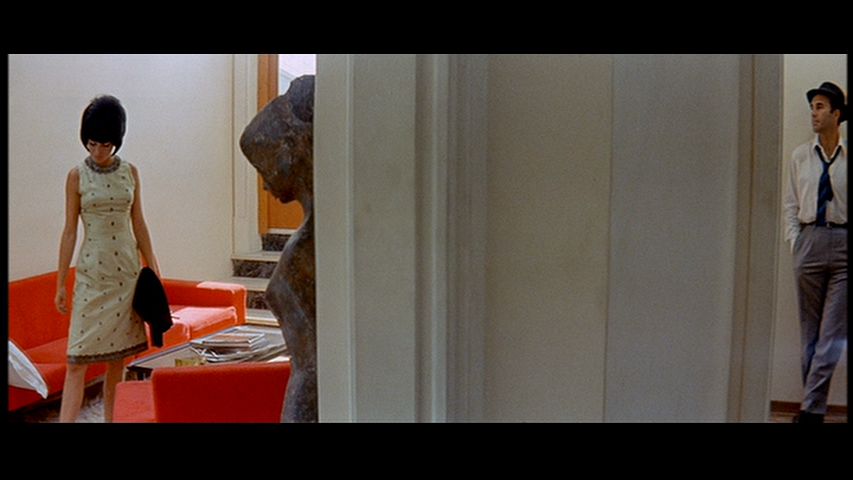
Camille being trapped between the posters of a film in which men hunt and a film about a sex worker. It’s no wonder that she wears a dark color. More about that, later…

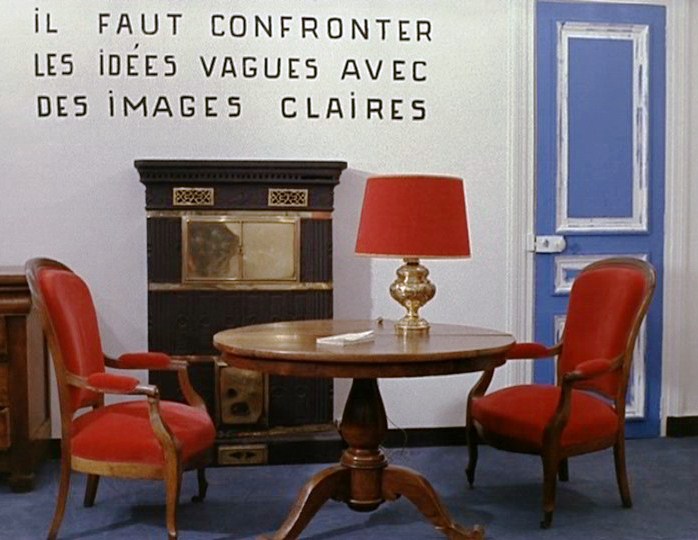
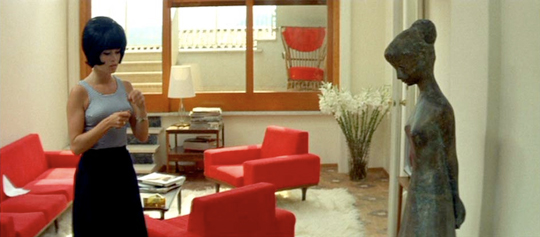
In the above image, taken from Godard’s La Chinoise (1968)  we are invited to confront vague ideas with clear images. The image is clear enough to me: it shows a bourgeois interior with red furniture. Red being the symbolic color of communism the contradiction is self-evident, but how many viewers do the reading? In a logocentric culture, what’s shown to us is automatically hidden.

Being a commercial product directed by an avant-garde director means that Contempt self destructs. Godard even mocks the choice of CinemaScope, a format that, in the words of Fritz Lang:

“Is not suitable for Men. It’s suitable for serpents and funerals.”

And yet… it allows the most interesting formal device of the film. CinemaScope is the format of epic action movies so something unusual was bound to happen when put in the service of domestic drama. In the central act of this three part play (some may argue that it is the most interesting) Camille and Paul are shown in a maze of walls and doors. (The door without glass that Paul opens to enter a room while returning through the wide opened hole is a Keatonian gag. Ditto Camille absent mindedly passing under a ladder to avoid doing the same on her return when she realized what she had just done.) The couple is shown like mice in a lab experiment, the architectural obstacles between them being symbols of their gradual estrangement. Godard even shows a book about opera and an image of the interior of an opera house to further hint at how ridiculous his producers’ ideas of grandeur are (or as an omen of tragedy). In the duly famous conversation between Camille and Paul with the white lamp between them Godard forces the wide format to behave like a more intimate close up framing refusing to do what would be obvious: to show both actors at the same time.

Another great device used by Godard is color. He uses it (especially the clothes’ colors) as symbols. We know Godard’s attraction for primary colors. In Contempt they’re codified as indifference (yellow, but also green), antagonism, communism (red, but also orange), fate, fight, Neptune (blue). All those colors are shown at the beginning of the film (as filters) to contradict the love scene. Or, in a Deleuzian image-time manner to flash-forward what’s already written in the fates’ tapestry script. The living room in Camille and Paul’s house has blue chairs, a white lamp and an orange couch (it’s almost bleu, blanc, rouge, the French flag; France is viewed as a nation divided). The examples of the use of colors as symbols are too many to cite here: it’s in the orange couch that Camille discovers that Paul is a member of the Italian Communist Party. This turns his selling out to capitalism even more unforgivable of course (being Paul Godard’s alter ego it’s obvious how self-loathing this scene is; ditto Paul using a bath towel to look like a toga in Levine’s peplum). On the other hand the Italian Communist Party was an important member of what was called back then eurocommunism, that is, a revisionist mild version of hardcore communism. We may thus read Paul’s betrayal as a more profoundly political one. Ditto the singer in orange and red at the theater singing a pop song to the masses around her (24000 baci24000 Kisses – by Adriano Celentano with the lyrics detourned to include the word “politics”) . In the same sequence Fritz Lang quotes “poor” BB – a pun between Bertolt Brecht’s initials and Brigitte Bardot’s nickname:

“Every day, to earn my daily bread/ I go to the market where lies are bought/ Hopefully/ I take up my place among the sellers.  […] Hollywood.”)

At the end of the film Prokosch’s red Alfa Romeo (Camille:

“get in your Alfa, romeo.”)

has an accident against a blue oil (!) truck. Prokosch, Neptune’s tool, is dressed in red while Camille, a willing sacrificial victim on the altar of capitalism is dressed in blue. (Fritz Lang:

“Death is not the end.”

It isn’t because the film has an epilogue.)

This use of color influenced John Cassavetes in Opening Night (1977). A film about theater as Contempt is about filming. In it actress Myrtle Gordon (Gena Rowlands) fights with a red dress (life and youth) against the forces of aging and decay (black).  

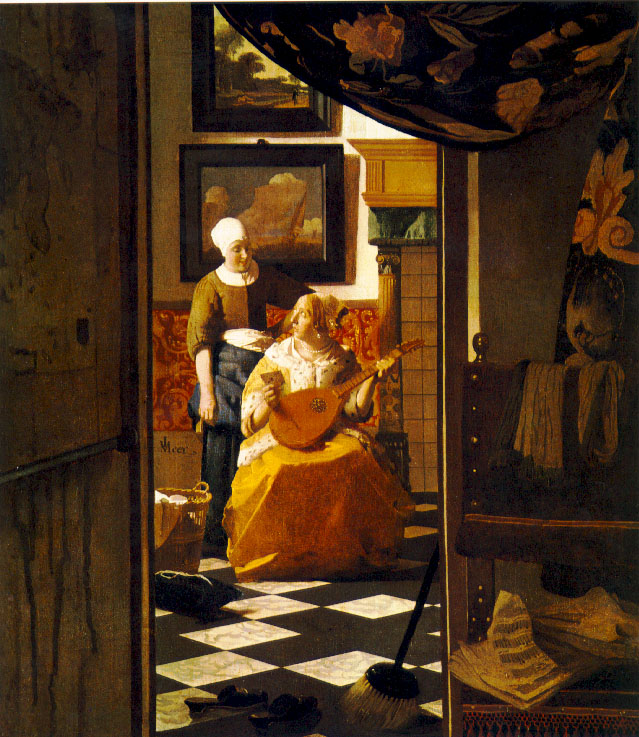
Godard, like Johannes Vermeer frames domestic drama to give us the feeling of peeking some secret that we’re not supposed to witness.


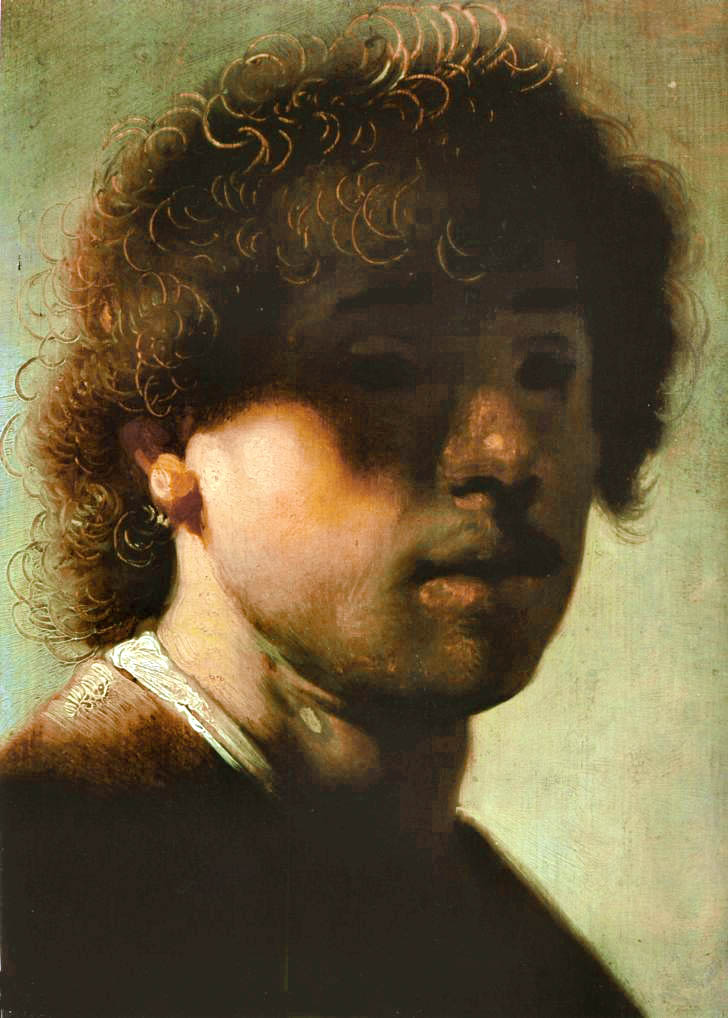
Like Rembrandt Godard uses shadow to a dramatic effect: showing melancholia and distress…

The opening shot ends with Raoul Coutartd’s camera pointed at us, the viewers, while a voice over quotes Michel Mourlet (not André Bazin as stated):

“The cinema substitutes for our gaze a world more in accordance with our desires. Contempt is a story of that world.”

What are these desires, then? The camera asks… Do we want tragedy and catharsis like the old Greeks did in their theater? Or do we want unresolved disturbing truths? Godard’s film ends with the death of Camille and Prokosch, victim and tool of an inhuman system. The last sequence being shot in Contempt of the diegetic The Odyssey ends with a victorious Ulysses, as he arrives at his homeland, Ithaca. He is facing the sea (Neptune), to tell him that, against all odds, he fought and beat him. In this story outside a story the

“truth 24 frames per second”

could never do that. (Another cinephile reference in Contempt is Viaggio in Italia – Journey to Italy – 1954 – by Roberto Rossellini, in which a troubled couple finds redemption. The same thing doesn’t happen in Contempt, of course.) The last words belong to Jeremy Prokosch and Francesca Vanini, yes, Vanini (Georgia Moll): after being reminded by Paul that Fritz Lang fled Germany because he didn’t want to have anything to do with the Nazis, the former simply put it:

“This is not 33, it’s 63.”

(There’s no escape.) Plus: Francesca to Paul:

“You aspire to a world like Homer’s, but, unfortunately, that doesn’t exist.” 

Betatown

 
Some shapeless face speaking about robots,
And boredom quivering in the jowls of art
Flop like salmon in the brain cells of the heart.
Oh tragic face of fish, who knows not which was what’s.
 
In memory a flickering, a future passed like prunes
As detectives loomed and knitted new trench coats.
Grad school will keep you ever young, the careful notes
Ring like leaky bivalves in the analog spittoons.
 
_________________
The Godard Roundtable index is here.
Images of Asses

Contempt opens with a naked Brigitte Bardot asking her beaux Paul (diagetically) and you (extra-narratively) whether you like her butt. Specifically, she asks Paul ((Michel Piccoli) whether he can see various body parts in the (off-screen) mirror, and what he thinks of them. He is (as who wouldn’t be?) appreciative.

The scene is charmingly sexy. It’s also a tease, in more ways than one. Camille (that is, Bardot’s character) doesn’t ask what Paul thinks of her; she asks what he thinks of her image. Of course, we’re looking at the real Camille, not the image — except, of course, of course, we aren’t looking at the real Camille, because there is no real Camille — just an onscreen image of Bardot. The flirtation here, then, is not just Paul playing with Camille, but Godard playing with both of them, and with the idea of image and reality. The scene is less a love letter from a man to a woman than a love letter to the beautiful image of an ass.

The rest of Contempt is almost as self-reflexive as that opening scene. Paul, a theater-writer, is given the opportunity by the crass American producer Jerry (Jack Palance) to rewrite a script about the Odyssey by Fritz Lang (playing himself.) Paul is deeply ambivalent about working on the screenplay; Jerry is a bore, and Lang, who Paul deeply respects, doesn’t want the script changed. In the course of Paul’s vacillations, Jerry casually hits on Camille and Paul himself makes a half-hearted pass at Jerry’s translator/assistant. Somewhere in there, Camille decides she no longer loves Paul. In fact, she despises him.

In a review of the film a few weeks back, Robert Stanley Martin argued that Contempt is about the collapse of communication in a marriage. As Robert says:

Paul is essentially declaring himself a whore, and it’s clear that his seeing it as being for Camille’s benefit leads him to blame her for his situation. He doesn’t stand in the way of the producer’s efforts to come on to her, and he humiliates her further by letting his attention (and hands) wander to the producer’s pretty assistant in her presence. She drops every hint she can that she doesn’t want him to do this job. She even tells him how much happier she was when they didn’t have money and he was hacking out crime novels for a living. But she’s relying on rapport to tell him how she feels; telling him outright means their love isn’t strong enough to do the job. His resentments stand in the way.

That’s a basically naturalistic reading of the film — for it to work, you have to be willing to believe, at least provisionally, that Camille and Paul’s relationship is real. And, at least for me, that wasn’t really possible. A love that could vanish as suddenly and hopelessly as Camille’s love vamished — over the course of a few hours, as both Paul and Camille say — wasn’t really a love to begin with. It was just an image, or a trope.

In fact, Camille’s contempt for Paul seems to be almost entirely a convenient reflection of his contempt for himself. No sooner does Paul accept a check from Jerry than he’s thrusting Camille into a sports car with the oleaginous producer. She’s less a wife than a masochistic fantasy; a dream of defilement. The delirious, endless scene in their apartment — in which the camera shoots the pair passing through doors and hallways or exchanging places in the bath, setting the table and clearing it without eating — has the too-vivid timelessness of a dream. Nothing gets said or understood not because communication between two people has failed, but because that apartment is a skull and there’s only one person in there. Perhaps that one person is Paul; perhaps (as is suggested when Bardot dons a black wig making her resemble the filmmaker’s wife Anna Karina) it’s Godard. But it’s not Camille.
Godard certainly thinks about the way that Camille is a thought. Throughout the film, both Jerry and Paul reimagine the story of the Odyssey in an effort to justify their own view of their relationship with Camille. Jerry speculates early on that Penelope was actually unfaithful to Odysseus; a not-very-subtle wish that Camille will be unfaithful to Paul. Later, Paul imagines that Odysseus stayed away from Ithaca for so long not because he couldn’t get back, but because he had marital troubles and didn’t want to come home. He also grabs a gun and talks briefly about Odysseus murdering Penelope’s suitors, clearly flirting with the idea of killing Jerry.

You could argue that the film is critiquing Jerry and Paul; that it’s undermining or ridiculing their efforts to make Camille their own narrative Pygmalion. Certainly there’s some of that going on; Paul, for example, actually drops that gun without realizing it and someone has to give it back to him — his gangsta dreams are profoundly ridiculous. But, at the same time…Jerry’s dreams do come true; Camille is unfaithful with him. And while Paul doesn’t kill his rival, the film — which is at least somewhat linked to Paul’s consciousness — is happy to do it for him. Jerry and Camille are killed in a gratuitously melodramatic, feebly ironic car crash after they tootle off together, finishing off Paul’s job and his relationship in a single bitterly masochistic ecstasy of revenge.

I was talking about this essay with Caro by email a little bit, and she argued that the unreality of Godard’s characters was not a weakness, but a meta-commentary. “The film is not…about lived reality, but filmed reality,” she said. “So the depiction is of the meaning of the depiction of woman on camera, of man on camera, not about men and women.” Clearly, there’s a lot of truth to that. We’re not supposed to look at Paul, or even at Godard, but at the film of Paul or of Godard. They aren’t asses, but images of asses. You are not meant to identify with them so much as you are meant to contemplate their assness.

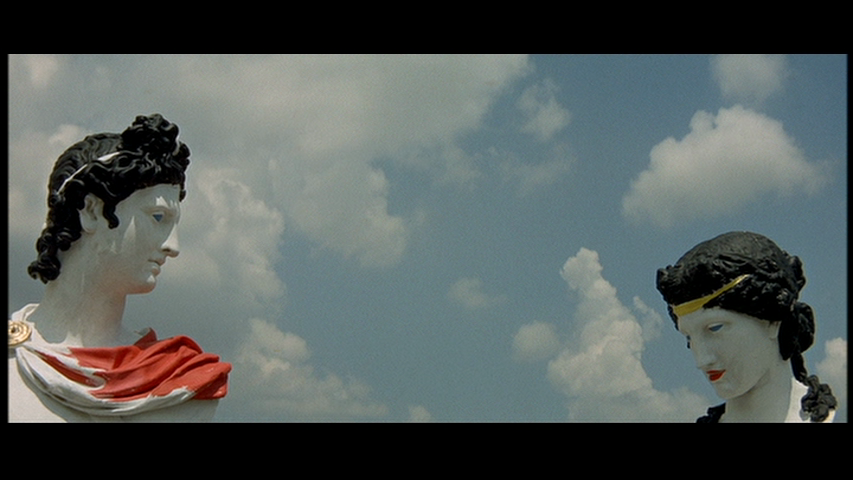
But a contemplation of assness is not necessarily, or not only, the same as a critique of assness. Indeed, often, as with Bardot in the opening scene, the contemplation is a pleasure. From its opening shot of a camera on a dolly filming through its sudden interpolations of dramatic shots of statuary to the on-again, off-again dramatically swelling soundtrack to the avuncular presence of Fritz Lang, to that virtuoso dialogue in the apartment, Contempt is boisterously, seductively enamored with its own image. Godard certainly is aware that the woman-as-image, as projection of male sado-masochistic desires and fears, is itself an image. But that image-of-an-image is still irresistibly alluring. Bardot in a wig is a joke about the filmmaker turning Bardot into his wife — but that doesn’t change the fact that he’s turning Bardot into his wife. Camille dead in a convenient car crash is an ironic comment about male ego and filmic wish fulfillment — but the self-referential knowingness just fetishizes the self-reference on top of the wish fulfillment, savoring not the beauty of the dead woman, but the beauty of the reflection of the dead woman. However many lenses you look through, Camille is still a thing in his dream, and contempt is still a pleasure.
_____________
The index to the Godard roundtable is here.