
Yesterday Was Always Better

I promise this will be the last post for a while where I troll my proprietors. Unless they keep pissing me off, I guess.

In case you missed it, Gary Groth, the editor of the Comics Journal, has a Welcome to TCj.com post on the main page.

The essay is basically an unctuous exercise in self-hagiography. Gary reminisces about the good old days, slaps his knees, and bellows, “Eh! I just don’t get this new-fangled blogging! Why, I’m going to show those young whippersnappers how to criticize if I can only get my darned ear-trumpet out of my…eh, what part of me is that, anyway?”

I joke, but really, it’s a depressing spectacle in a number of ways. Most obviously — well, Gary really is somebody I admire, as I noted in my last post. He wasn’t a formative influence or anything, but he’s a good writer and a smart guy. His magazine took a chance on me when I didn’t have much of a name for myself, and while that was mostly Dirk, it was Gary who gave him the rope to do it, and I’m grateful to both of them. They took another chance bringing this blog here, for that matter, and I appreciate that as well.

Moreover, between the bouts of self-congratulation and maudlin reminiscing, Gary actually has a point. He and TCJ really do have a good deal to offer to folks who write and/or read about comics. There’s a roster of critics, like R. Fiore and Gary himself who haven’t had much of an online presence, and they’ll certainly be welcome. Having the Journal content free and online will be a boon to both casual readers and researchers. The long-term perspective on criticism and the comics industry which Gary has is not unique certainly (Tom Spurgeon and Johanna Draper Carlson have both been critics for a while, to name just two examples) but that doesn’t mean it’s not worthwhile.

So yeah, Gary and the Journal bring a lot to the table. But they will both offer less — and possibly a lot less — if Gary spends all his time online preening over his past accomplishments and sneering at everyone who doesn’t have the good luck to be him.

I doubt Gary noticed the irony, but at one point in his article he quotes this aspirational paen to comics, penned back in those days when Nobody But Gary And A Few Other Like Minded Visionaries Took Them Seriously. The quote’s by Richard Kyle.

The commonplace world is built of iron fantasies, a place where yesterday was always better.

In the commonplace world, all new arts are trash. In Elizabethan times, it was commonplace to say that Shakespeare’s theatre was trash. And then it was the novel’s turn: the novel, they said, was trash. And then the film came along. First it was the silent film, and the commonplace was that it was trash — until the sound film emerged. Then the silent film suddenly became an art, as the theatre and the novel had, and it was the sound movie that was trash. Today, all film is becoming art. What’s trash today, then? Comics, of course. But now that the newspaper strip is ailing, the commonplace is that it may be art. Those comic book stories, though, they’re surely trash…

As Gary says, it’s a nice quote. Though, you know, if Gary had actually read it, he might have been reluctant to write this a few paragraphs later.

Very little writing on the Web is of any real critical worth — or even pretends to be— and there is no journalism to speak of. I have never assiduously followed comics blogging, but so much of what I’ve read feels dashed off — amateurish, shallow, frivolous.

That web writing — that’s surely trash.

Not to go out on a limb to defend writing on the web or anything. There’s a lot that’s not very good. On the other hand…you know, virtually everyone who’s written for the sainted Journal in the past ten years is on the goddamn web. Not just Robert Stanley Martin and Bill Randall, but Jog, and Shaenon and Alan David Doane, and Sean Collins and Chris Mautner and Steven Grant and on and on. If you don’t know how to use google, that’s not the blogosphere’s fault.

On the other hand, if you’re talking amateurish, how about posting sixteen lines of tag-spam, completely filling the top of your new website’s screen with a list of boring crap, presumably because you simply don’t know what the fuck you’re doing? If you’re talking shallow, how about admitting that you don’t really read blogs, and then broadly condemning them on the basis of that? If you’re talking frivolous, how about an entire two-page post devoted to discussing how awesome you and your friends were back in the day?

Let me put it to you simply, Gary. If you’re in the room, you’re not cooler than the room. The Internet isn’t going to fall on its knees and worship your tag-spam just because you’ve been doing the comics criticism thing for a while and now you’ve blessed it with your presence. Which isn’t to say that you don’t have a lot of goodwill; you absolutely do. I don’t know tons of people in the blogosphere, but everyone I do know, even folks who are more or less your competitors, wants you to succeed. And, yeah, being a curmudgeon is part of your charm — don’t stop with that. But, for a moment or two, you might think about whether you, in fact, know it all, or whether it’s possible that, in this new venture you’re undertaking, you could, just maybe, have something to learn. With love, with respect, with hope even, I ask you, stop being a horse’s ass. We need you to do better.
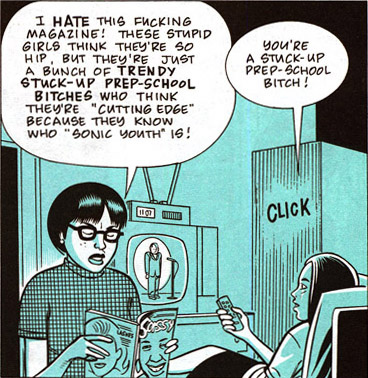
Gluey Tart: Ghost World Roundtable

We Hooded Utilitarians agreed to do a roundtable on Ghost World weeks ago. Months, maybe. As if I’d keep track of something like that. The point is that I now have to write something, and I don’t want to.

I don’t like Ghost World, but that isn’t the reason I don’t want to write about it – as everyone knows, few things are more enjoyable than climbing up on the old soap box and bursting forth with a bell-like chorus of disgust or, ideally, righteous indignation. Or, to put a finer point on it, I like to vent. I like to read the venting of others, so long as a certain level of intellectual rigor is maintained. I am comfortable with the negative.

The problem is not that I dislike Ghost World, but that Ghost World makes my stomach hurt. It gives me an icky, slimy feeling. I find it annoying, repulsive, and kind of boring, in more or less that order. It is also ugly, really grindingly ugly.

But not accidentally ugly. This is an important note, albeit a side note, for me. Ghost World intends to be ugly and repulsive. It aims high, and it succeeds. So we will pause to acknowledge this. It is also supposed to be hip and funny and, you know, real, man, and in those areas, I think it fails miserably. Well, I guess it is hip, actually. If hipsters say it’s hip, that makes it hip, by definition. Who am I to argue? I’m willing to give the world at large that point.

What Ghost World is not, however, is funny or real, in the sense of creating characters that seem like fully fleshed human beings. You know, as in real. The supposed humor of this book escapes me completely. I am not a dour and humorless person, by the way. (Just the other day I watched the first six episodes of “Big Bang Theory” and I laughed and laughed. Johnny Galecki! So geekalicious!) Nor am I a Puritan or someone who is too old and uptight to get it. I write porn, for Christ’s sake (well, not for Christ’s sake, obviously) (or not, I guess, but no, it really isn’t), and I was more or less the target audience for Ghost World when it was created. I felt the same way about it then. I pulled it off the shelf in 1997-ish – I have always been willing to consume that which is marketed to me – and I read the first couple of stories, flipped through the rest, skimming dispiritedly, and put the book the hell down, wanting nothing else to do with it.

And that’s pretty much exactly what happened when I tried to read Ghost World again last week. (Hey, I do research. I may not have a real name, but I do have standards.) The main issue, or me, is that I do not recognize the main characters. I don’t recognize them as high school girls, but that is probably secondary to the fact that I don’t even recognize them as human. They are not so much characters as collections of anecdotes that are intended to be cool and ironic. Makes the whole thing fall kind of flat. Here’s the thing. I understand that I might not be quite the right sort of person for this book – I might not have exactly the right background to really feel the characters. Except that a) I should be, and b) it shouldn’t matter. I was a disaffected, oddly dressed and coiffed, shockingly acerbic teenage girl through much of the eighties. I was “edgy.” (God, I hate that word.) So, there’s that. But, whatever. I don’t think it matters. I have managed to appreciate stories about assassins and pirates and brooding nineteenth-century English nobles trundling bleakly across the moors, and I have very little practical experience with any of that. If the characters are well-written, I can work with it. They don’t even have to be human. Dog POV? Panther? Bring it on. Enid? Not so much.

In fact, my major reaction to Enid is WTF? I mean, some of the details ring a bell. We’ve all slept with gross losers for reasons that were, and remain, fairly obscure to everyone. And who doesn’t enjoy Satanist-spotting? A while back, I was partaking of a high-fat Indian buffet with a friend, and we noticed the people at the next table were doing an interview for a music magazine. The reporter said – quietly, gently – “It must be hard for you sometimes.” And the metal guy, who was eating samosas double-fisted, as if the reporter was perhaps buying lunch, said, “Yeah, man. It’s hard to be a Satanist at Christmas.” Golden, right? See, I have random things in common with Enid, but she never gels as an actual character for me. Dan Clowes might or might not be pleased to know that Enid and Rebecca remind me a little of the tertiary disaffected youth characters in Lost Souls (who probably have names but are only there for atmosphere so no way in hell am I looking it up). I’m referring to Poppy Z. Brite’s vampire book. I know what that means to me, but I’ll let you make of it what you will.

Here is when I should tie everything together and, ideally, make a point of some kind. Cicero’s rules for rhetoric demand it, and you, having followed me this far, deserve it. Sorry about that. I’ve shot my wad. I think Ghost World is unpleasant in a way that winds up being pointless because there’s no there there (since I’m referencing the classics). I don’t mind rolling in the gutter, but I want to get something out of it. Understanding. Comfort. Titillation. Something. I get none of that from Ghost World. All I get is irony, and straight irony, not even chased with Diet Coke, just kind of makes me feel dirty (not in a good way) and irritated. I do look forward to reading the posts about why people like Ghost World. And, even more, I look forward to not thinking about Ghost World again for another twelve years.

Update by Noah: The entire Ghost World Roundtable is here.

Ghost World Roundtable

We’re going to kick off a roundtable on Dan Clowes’ Ghost World shortly. Our regular bloggers (that’s Richard, Suat, Kinukitty, Vom Marlowe, and me) will all weigh in. In addition, blogger and critic Charles Reece has very kindly agreed to join us. Charles blogs, mostly on film, at Amoeblog. You may also be familiar with his writing if you frequent the Comicon message boards, where he is a frequent poster.

So I believe Kinukitty will be posting shortly. Don’t touch that RSS feed, as they say.

TCJ.com/fail; (Or, Let’s See If I Can Get Myself Fired Right Off the Bat)

Note: This post was destroyed due to blog glitches. I’ve managed to replace the texts, but many of the links no longer exist. My apologies.
________________________

So, I should start off by saying that I have a ton of respect for everyone involved in TCJ. Dirk Deppey’s one of my favorite writers on comics; Michael Dean has been great to work for at the print Journal; Kristy Valenti is incredibly smart, pleasant, and hard-working, and a fine writer as well. I don’t know Gary personally, but I’ve enjoyed reading him over the years, and I greatly admire his work as an editor and a publisher. I’m very grateful, and, indeed, flattered, that such a smart and talented group of people found something of value in this blog, and were interested in hosting it. I’m looking forward to being here for a long time (I mean, presuming this post doesn’t get me fired.)

I also want to say that there are a lot of things that I think tcj.com has gotten right. Most notably, I think TCJ has done a great job in getting an exciting and interesting group of writers together. I’ve been a big fan of Shaenon Garrity’s for a while, and it’s great to see her blogging regularly. I wasn’t familiar with Anne Ishii, but she seems like a spectacular choice — and much-appreciated evidence that the Journal is taking manga seriously. Same with the addition of Roland Kelts. Eric Millikin is also a very smart and inventive pick. I’m looking forward, too, to promised essays from Tom Crippen (who I was lucky enough to have writing at HU for a while), Matthias Wievel, Charles Hatfield, Kim Deitch, and Ben Schwartz, great writers all.

In addition, it’s worth noting that the website really could be worse. TCJ has avoided the cardinal website mistake of being so cute that your page is completely unmanageable. The page isn’t dripping with mystery meat gimmicks; you don’t have to guess whether the link to the print edition is under Charlie Brown’s maudlin head or whether it’s instead under Enid Coleslaw’s. There are a couple of miscues, sure (”Blood & Thunder” isn’t going to mean anything to anyone who hasn’t read the print journal guys, which means it’s not going to mean anything to anyone. The link should just be to “Message Board”, okay?) Overall, though, things are labeled in a reasonable way. That’s definitely worth something.

So if I like all that, what am I complaining about? Well, let’s start at the beginning….

I’m probably just not imaginative enough, but I’m having difficulty coming up with ways in which the rollout could have been more botched. Johanna Draper Carlson has a good summary of the issue #300 mess, which I’m not going to harp on further here. But even setting that aside, the opening days of tcj.com have been…well, let’s call it unfortunate. Instead of an actual official announcement with attendant hoopla and excitement, the launch was spilled quietly by blogger Rob Clough. (Not that that’s Rob’s fault; I doubt anyone told him not to.)

In addition, the launch itself was made from Beta. This had a number of unfortunate effects.
First, excitement was somewhat muted, since the site wasn’t *really* ready — I saw at least one blogger (I can’t remember who) write that TCJ was “sort of” launching, which isn’t the kind of thrilling introduciton you want, I don’t think. Second, the fact that the site was in Beta meant that there were a lot of details to fix…and fixing them meant that portions of the site were going up and down and all around for more than a week. As of this writing, things are still pretty massively fucked-up actually. Thus, at the very moment when tcj was presumably hoping for a major influx of traffic, lots of stuff didn’t work. This was especially problematic in regard to Dirk’s blog Journalista, which, in theory, should have been able to direct lots of people to the new site but which instead was relegated to a kind of half-life on the tcj.com main page while it’s old tcj.com/journalista address went in and mostly out of service.

In short, tcj.com launched before it was ready to go. I can think of various explanation for why they might have done this (promises to advertisers seems the most likely), all perfectly reasonable, just as the decision to pull TCJ #300 because of vendor concerns was reasonable. However, the upshot of these reasonable decisions is that readers end up irritated.

And I think that that’s kind of a big problem. Not because the opening was fucked up; I mean, that’s bad, but the launch is just the launch; the website is hopefully going to be around long enough that people will forget that. But the psychology behind the launch worries me.

Basically, it’s not clear to me that tcj has figured out how to think like its readers. Or, to put it another way, it’s very unclear who this website believes it’s talking to.

The great thing about the internet is that it’s easy to find the stuff you’re interested in, and only the stuff you’re interested in. I can go to the Atlantic website, for example, and read Andrew Sullivan without having to even look at a whole range of other bloggers who annoy or bore me (I’m talking about you Jeffrey Goldberg.)

Again, this is the Internet’s strength. And so what does TCJ.com do? It puts all it’s bloggers and writers and essayists in a single, streaming blog, regardless of whether they’re likely to attract the same readers. There’s a ton of content, but it’s not focused content. It’s not catering to the super-hero crowd, obviously; it’s not catering to the manga crowd — but it’s not really resolutely snobbish like Comics Comics, either. And though there’s not a focus, it’s also not organized in a way that makes it easy to find the bits you want to look at. For just about everyone, I think, the noise to signal ratio on tcj.com is going to be very high. It’s great to have Anne Ishii writing — but are the manga fans who are presumably her audience even going to be able to find her in the scrolling wall of unrelated text that is TCJ.com? (And yes, you can click on her name on the side and get all her posts…but that presumes you know you’re looking for her. You want to be appealing to people who aren’t necessarily already familiar with your content, not just those who are.)

There is some recognition that this is a problem, I think. It’s why all the posts are cut off after a paragraph or so with that annoyingly automated “Read More” link. In theory, the idea is that if everything’s truncated you can just scroll past and find what you want. In practice…well. Many of the posts are fairly short, but not so short that they get in under the “read more” break. So you’re constantly going past stuff you don’t want to read to find the one thing you do, and when you get there you read down until the “Read More” snaps you off in the middle of a sentence, and then you click the link and you get, not a whole essay, but just another 20 lines of text or whatever. Add in the giant flashing ads on the side, and…yeah, it’s just not a how I want to read my Internet.

In addition, the website often presents things in a way that make sense to the writers and editors, but not necessarily to the readers. For instance, the homepage shows two lists, one of bloggers and one of essayists. Okay. But…what is the practical difference for readers of the site? As a writer for tcj, I know that these groups are treated differently in certain ways — but why do readers give a shit? It’s all content going through the same sluice.

_______________________

So…what to do? Well, in the short term I’d first try to see if I could tone down the flashing ads. I’d also see if I couldn’t figure out a way to make there be more of a clear visual break at the end of posts; as it is, the post text goes right into the little notation about RSS feeds and so forth, which is really and unexpectedly distracting. I’d also think about giving writers more control over the Read More placement, and I’d try eliminating it altogether for shorter posts. There’s just no reason to go to Read More when you’re only writing 300-500 words. (Robot 6 is one example of a group blog which seems to have figured out a better Read More compromise length — and to be just in general better designed for readability.)

In the longer term, I’d think hard about giving some folks separate blogs. Ken Smith is an obvious candidate, as his interests and everyone else’s are fairly distinct. A more or less manga-themed blog with Anne and Shaenon and whoever else fits seems like a decent idea as well.

And just overall, I’d separate bloggers out from essayists. Though as I said they aren’t clearly differentiated now, they should be. Blogging is really about self-publishing; the attraction of a blog, for readers and for writers, is the sense that you’re having a conversation, with little filtering. Having all the blogs go through the mainpage, and having them split up with essays, really dilutes and muffles the sense of individual voices and idiosyncratic interests which is what people go to blogs for. That’s especially the case if bloggers really are being asked to keep posts to under 500 words, as Rob said.

Essays, on the other hand, are ideally more formal and more curated…and, again ideally, should be teased and promoted rather than just dropped into a blog format. Splice Today, where I occasionally write, has a pretty good, no nonsense way to present essays which is somewhat bloglike, and could serve as a model. Or the Onion AV club, where you have a menu of essays could work. Basically, if you have an essay, you want to put it out there as a completed piece you’re proud of. And, you know, you want to keep it in one or at most two big chunks, grouped together, not in 5 scattered and dismembered segments.

And there should definitely be a menu of recent stories, or perhaps a scrolling list of popular stories (Splice Today does this) so that there’s some easy way to see what’s recent or important without going down the whole damn page.

Also, and finally, I’d think hard about how on earth I was planning to make money. Maybe tcj has cracked the code for surviving off of internet ad sales, but…well, I’m a little skeptical. The short-term goal needs to be upping subscription to the print Journal, surely. Don’t, then, for god’s sake, put your link to the journal subscription up in the ad banner. Put it down somewhere in editorial. And put it on our lowly subdomain too, for God’s sake. We want to help!

Even if, you know, we’re out on our collective ears tomorrow.

Technical Difficulties

We seem to be experiencing various technical problems; comments and permalinks send you to 404 page not found, in particular.

I’ve contacted the appropriate authorities, so hopefully this will all be sorted out soon. Thanks for your patience.

Utilitarian Review 12/12/09

Utilitarian Review is a weekly round-up of post on HU, links to other things I or other bloggers have published this week, and some random links as well.
_________________________________

On HU

This week started off with my discussion of the great surrealist artist Leonora Carrington and her drawings for the novel “The Hearing Trumpet.”

Kinukitty posted a lengthy appreciation of Tomoko Hayakawa’s The Wallflower.

Richard Cook posted a review of Brian Azzarello and Victor Santos’ Filthy Rich.

Ng Suat Tong talked about the original art market for comics.

And finally Vom Marlowe reviewed the first volume of Adam Warren’s Empowered.

Utilitarians Everywhere

At Comixology I have a longish review of Yuichi Yokoyama’s Travel.

In Yokoyama’s work, too, the viewpoint swoops and swerves, now with a skier on a high mountain pass, now underneath the train. There is certainly a celebratory, joking tinge to Yokoyama’s impossibly mobile camera. But there is also something ominous. In one sequence from the book, our protagonists’ train passes another going in the opposite direction. A whole page is devoted to the faces on the other train. They are shown in four tiers of three blocks each; all are streaked with violent motion lines; all are the same shade of grey as the window frame, all stare intently outward at the viewer. The scene is oddly disturbing; the repetition of the faces, the repetition of the expressions; the lines going through them, the grid — it’s dehumanizing, as if the faces are not people at all, but manikins, or masks.

On the TCJ.com main page I reviewed Fumi Yoshinaga’s Ooku: The Inner Chamber.

At Splice Today I reviewed Arie Kaplan’s book about the Jews and comic books, from Krakow to Krypton.

Over at the Knoxville Metropulse I reviewed the new Animal Collective ep, Fall Be Kind.

At Madeloud I reviewed Miranda Lambert’s Revolution.

In the hidebound print-based media department, I have a couple of album reviews out in the latest issue of Bitch magazine.

And former Utilitarian Bill Randall has a review on the tcj.com main page of the hipster mess that is I Saw You.

Other Links

Matt Thorn has a withering essay about how much current manga translators suck.

Shaenon Garrity has a post on the Tcj.com main page about Power Girl’s explication of her boob window. I also enjoyed Shaenon’s post about Fumi Yoshinaga.

_______________________________

Music For Middle Brow Snobs: Luk Thung Apocalypse

For those new to HU: Music For Middle Brow Snobs is a weekly feature in which I post a downloadable mix. It’s free, so enjoy — and if you like an artist consider buying their music and/or finding some other way to contribute to their continued existence.
___________________

As some of you may be aware, I’ve become somewhat obsessed with Thai pop music recently, especially luk thung (somewhat misleadingly referred to as Thai country music.) So I thought I’d do a playlist devoted to the topic.

1. Pamela Bowden — Poo Kai Kai Loong (E-nang Dance 2)
2. Aump Nuntiya and Boonta Muangmai — Ruk Song Paen Din (Wong Kalamae)
3. Aump Nuntiya and Boonta Muangmai — Num Tah Lon Bon Tee Norn (Wong Kalamae)
5. Peter Sareewong — Yug Yai Yug Lek (Loog Thung Super-Hit Volume 2)
6. Pamela Bowden — Kor Pen Nang Eek (Kaew Ta Duang Jai)
6. Sithiporn Soontorapod —Nong Mae Khon Mai (Look Thung Super-Hit Volume 2)
7. Sunaree Rachaseema — Ban Ro (Sunaree Classic Hit)
8. Sunaree Rachaseema — Krai Nor (Sunaree Classic Hit)
9. Duangjan Suwannee — Yung Ruk Yung Ror (Mai Kla Mee Ruk)
10. Yui Yaryer — Roo Tan Na (Yui Yum Yum vol. 7)
11. Cathaleeya Marasri — Sao Muang Noni (Ruam Hit Pleng Duam)
12. Cathaleeya Marasri — Bon Kae Buer (Ruam Hit Pleng Duam)
13. Jintara Poonlab — Gig tarng jai (Jumbo HIt)
14. Siriponr Umpaipong — Tum-naeng Tee Mai Tong Karn (Bow Ruk See Dum)
15. Siriporn Umpaipong — Rean Korn Mae Sorn Wai (Bow Ruk See Dum)
16. Jing-Reed-Kao Wongtewan — Num Tah Fah (Dance) (Hudcha Dance)

Download Luk Thung Apocalypse.

Last weeks’ download is here.

If you’re interested in obtaining any of these albums, your best bet is probably ethaicd. Their catalogue isn’t always entirely updated, but I’ve gotten surprisingly good customer service.