Lovers — I Am The West

Lovers
I Am the West
[Pop Heart Records]

Sometime in the oughts, folk and shoegazy pop crossbred, creating a sparse, drony, soundtrack for coffee-shops gently orbiting the moon. Is this Chan Marshall’s fault? And has somebody named it already?

In any case, whoever’s responsible, and whatever it’s called, I’m all for it. As are the Lovers; lead singer and writer Carolyn Berk’s tunes range from mid-tempo to slow. Everything’s a dreamy trudge; a nice fuzzy blanket of sound, sprinkled with sweet little songwriting shivers: a touch of harmony here, a dollop of strings there. I go back and forth on which is my favorite tune…but Let’s Stay Lost is certainly a contender. It has a syncopated keyboard and drum intro, ending in a half beat of silence before Berk comes in with a hooky, strolling vocal line “You and me babe/we got lost in the same maze,”; a couple more couplets and then there’s another voice, singing long held “ahhhhs” — and then you get to a fantastic, weird, bridge, with the bandmembers doing sunny, almost Beach Boys harmonies while somebody plays what sounds like a banjo. “Stay Another Night” is great too; it’s got the slow grace of Dylan’s ballads, plus a goofy keyboard burble halfway through and some fuzz feedback at the end — plus that banjo again. I love banjo.

The only downside is that Berk’s lyrics are sometimes a little too clever for their own good. “Your eyes are two deep pools of mud” is funny,; following it with “Maybe I got stuck/Baby I got stuck” is kind of beating a dead metaphor around the bush. Even if you’re occasionally tuning out the words, though, this is a thoroughly enjoyable album.

I Dub Thee: Shoefolk?
Or Maybe: Birkenstockgaze?

Break to Gobble

Most of your utilitarian bloggers are going to be taking off this week, so things will be a bit quiet around here — though there will still be content of some sort, never fear.

Shortly after the holiday I’m told we may be moving over to our new location at TCJ.com. I’ll pass along more details when they’re available….

Utilitarian Review 11/21/09

On HU

I started this week off with a post on how superdickery has changed through the ages.

Richard wrote about mediocre French mainstream title Spin Angels.

Suat wrote about living with Walt Kelly original art.

Kinukitty wrote about the somewhat squicky yaoi title Two of Hearts.

Vom Marlowe discussed the mediocrity which is X-Men.

And this week’s music download features lots of gospel and thai music.

Last week’s droney mix can still be found at the link.

Utilitarians Elsewhere

Bill and Tom have moved off HU, of course, but I thought I’d mention that they both have great articles in the most recent, and last, Comics Journal, #300, available in a store near you hopefully.

Tom argues that Alan Moore has fallen prey to his own rampant geekery.

Alan Moore is a product of that time, maybe its best. If you want some recycled pop fantasy, I think you’re better off with “Whatever Happened to the Man of Tomorrow?” than you are with Star Wars. In fact I’d say his big titles of the 1980s, Watchmen most of all, are the only examples I’ve come across of really fine, substantial works devoted to recycling other-reality entertainment staples. But something went wrong. His Watchmen became Watchmen the movie, which is bad enough. What’s worse is that Moore wrote Lost Girls and League of Extraordinary Gentlemen and — well, just about every comic he’s turned out since 1989 or so. If I had to think of reasons to say why Alan Moore was great, I’d have a hard time finding anything from his comics work of the past 20 years. There’s issue 12 of Promethea, but then there’s the rest of Promethea. There’s From Hell, but no, not really. He hasn’t stopped being a genius; only a genius could fail in the way he does, with such energy and ambition, such amazing fireworks. But when I put one of his comics down, I have to remind myself to pick it back up. I think his post-’89 comics are stunted. No matter how big he tries to be, he winds up being small.

Bill, meanwhile, argues for the uniqueness — and probable transience — of the anime/manga invasion of the U.S.

In 2000, you could name the people and companies working to bring manga to the West on one hand, maybe two. Now keeping up with just the English-language commentators has become a full-time job. A few of the writers, like Jason Thompson, Xavier Guilbert and the chaps at Same Hat! Same Hat!, deserve careful reading. Most of the rest barely need a skim. Which is not necessarily a criticism if you have 3,000 people writing about the same book, what are the odds most of them will say the same things?

What happens instead is that they say the same thing in different places. There is no one essential place to read about manga in English. Instead, the trickle of information from 30-plus years ago became a healthy flow. Then, as with everything in the current age, the forces behind it pool into isolated spots. Each one hosts a dialogue or a tribal area or even an intellectual prison; each speaks to a particular subjectivity. One could tip the pen to Postmodernism, were that movement not first passé and second ironic. Manga and its fans have favored bald emotions, putting them closer to New Sincerity, or the Reconstructivists, or whatever the movement after pomo ends up being called. It seems less like forward progress through the history of ideas than an atomization.

Meanwhile, on the Internets, I have an essay about the new Twilight movies over at Reason.

If Edward represents agelessness as a perfect fantasy, Jacob Black represents aging as a horror-film disaster. As you almost certainly know from advance publicity (and if you don’t, here comes the spoiler,) Jacob discovers partway through the film that he’s a werewolf. Lycanthropy, as it turns out, is adolescence on steroids. Jacob loses control of his emotions, grows hair where he shouldn’t, starts hanging out with the wrong crowd, and begins thinking so loudly that all his friends can hear him.

In choosing between Jacob and Edward, Bella is choosing between growing up, with all its dangers and messy unpredictability, and staying a faery child, forever young and lifeless. In the end (here’s another spoiler), without much of a fight, she opts for immortality. Thus, the Twilight series isn’t so much a coming-of-age story as a refusing-to-come-of-age story.

And finally I have a brief review of the new Leona Lewis album over at Metropulse.

Other Links

Matthew Brady pointed me to this unpublished black and white Wonder Woman story with art by Harry Peter and script possibly by William Marston. It’s a treat.

And your Thai luk thung/morlum video of the week, sung by Siriporn Umpaipong.

And what the hey, here’s another one by Ajareeya Bussaba. Adorable caterpillars.

Music For Middle-Brow Snobs: How Far Am I From Thailand?

Gospel, thai, and some other stuff….

1. Five Blind Boys of Mississippi — How Far Am I From Canaan? (Five Blind Boys of Mississippi 1947-1951)
2. Soul Stirrers — I’m a Soldier (Kings of the Gospel Highway)
3. Spirit of Memphis Quartet — Jesus Jesus (Kings of the Gospel Highway)
4. Swan Silvertones — Working on a Building (Kings of the Gospel Highway)
5. Sensational Nightingales — Sinner Man (When Gospel Was Gospel)
6. Marion Williams — Traveling Shoes (When Gospel Was Gospel)
7. Marion Williams — Sit Down Servant (Gospel Soul of Marion Williams)
8. Thomas A. Dorsey with Sallie Martin — I’ll Tell It Wherever I Go (Precious Lord)
9. J. Robert Bradley — The Day Is Past and Gone (All God’s Sons and Daughters)
10. June Christy — Shadow Woman (Ballads for Night People)
11. Pamela Bowden — Ao Kwam Kom Kuen Pai Ting Mae Kong (The Bitterness of Leaving Mae Kong) (Kaew Ta Duang Jai)
12. Pamela Bowden — Nong Chum Wan Nee Pee Chum Wann Na (Kaew Ta Duang Jai)
13.Mangpor Chonticha — Mai Dai Am Chan Rork (I Can’t Get) (Mae Krua Hua Kai)
14. Mangpor Chonticha — Pee Lhuang Yah Luang Nong (Mae Krua Hua Kai)
15. Mazzy Star — Blue Flower (She Hangs Brightly)
16. Gene Loves Jezebel — Dream a Big Dream (VII)
17.Teenage Filmstars — You Mystify Me (Buy Our Record, Support Our Sickness)
18. Teenage Filmstars — Jeepers Creepers (Buy Our Record, Support Our Sickness)

Download How Far Am I From Thailand?

And if you missed it, you can download last week’s droney mix here.

Face Down in the Mainstream: Astonishing X-Men, Grumpy Vom is Grumpy

Astonishing X-Men #30 by Ellis, Bianchi, et al.

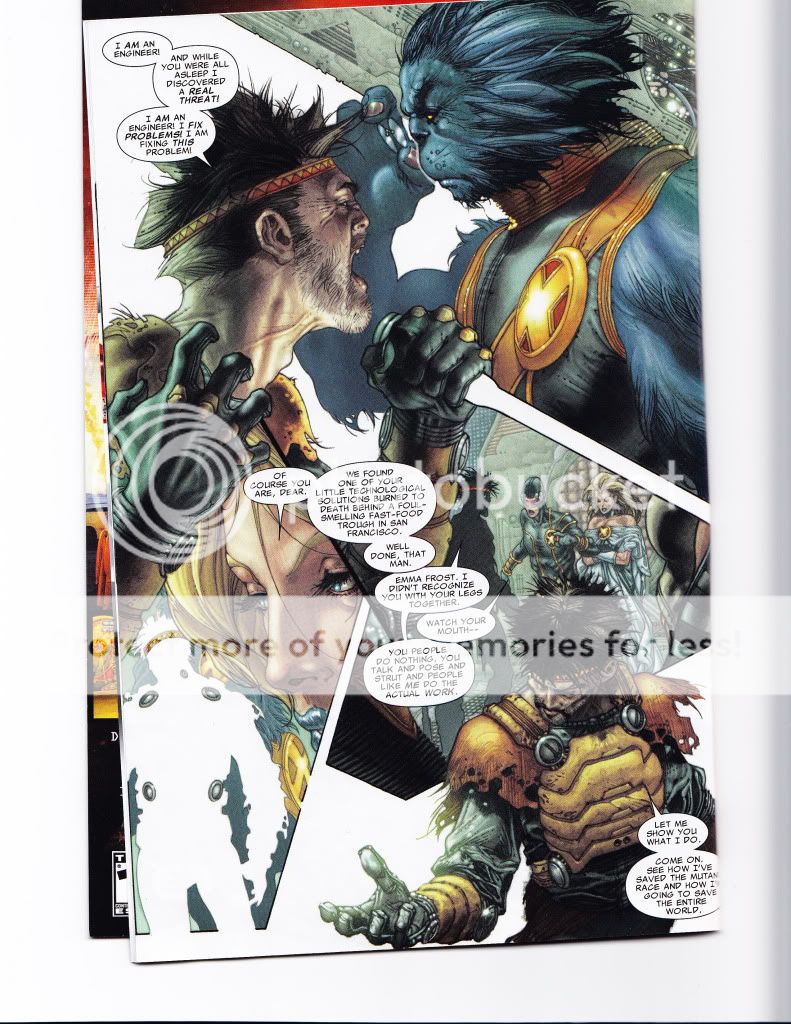
I picked this up because the art looked cool. And, you know, the art is cool. The inks are interesting, with washes as well as lines and a very grimy palette of off green and brown and blue. The anatomy is well-done overall. The facial expressions, while not perfect, are realistic. There are some clear artistic patterns like large pouty lips. There are attempts to make the layout interesting by using weapons as layout lines. See?

Pretty, isn’t it?

But it was not enough.

For one thing, the art is very realistic. It’s not picture perfect (blue lion mutants with glasses don’t actually exist), but it’s styled to be real. The artist likes to include things like red lines in the eyes, to show the craziness of the villain or spittle flying to show that people are shouting.

Unfortunately, the craziness comes off more like caaaaaaaarrrraaaaaziness and the spittle just seems sort of gross. The story is just–irritating, and the art could be so awesome, and yet it doesn’t all mesh the way a visually told story should.

Instead of making me look forward to more or compensating, the art just reinforced those parts of the story that pissed me off. The basic plot is that the X-Men have found the source of some fake mutants. Their ex-fellow, Forge, has gone bastshit (as one does) and started to make fake mutants to combat evil warriors from an alternate dimension. They’ve denned Forge in his lair in order to stop him.

And Forge proceeds to act like a cartoon villain, right down to the rolling red eyes and the spit and the dramatic gestures and weird poses. It’s sad. I actually felt bad for the guy.

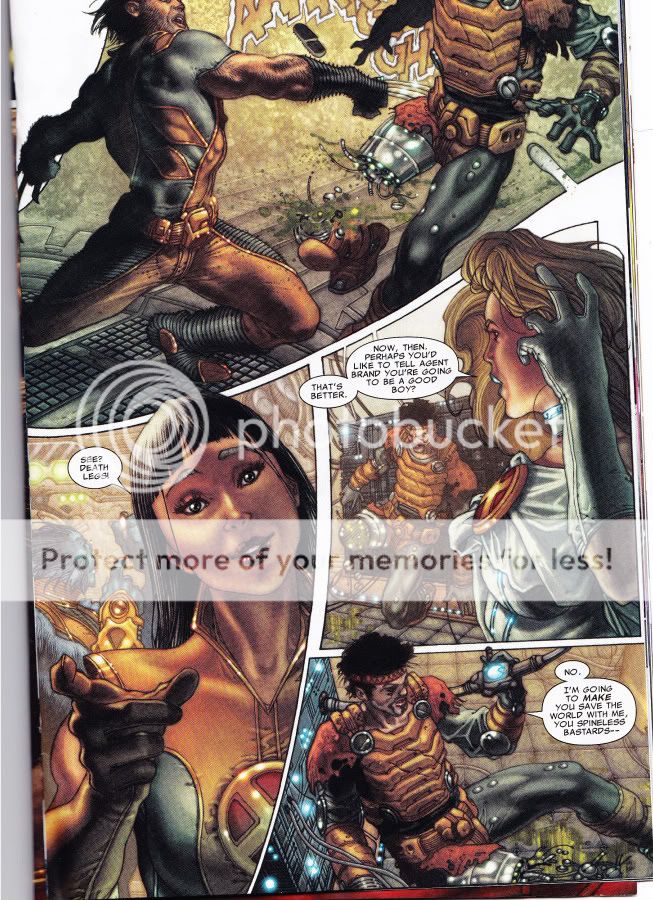
Especially when they cut off his leg and then laugh about it. I mean, jeez, people. Aren’t you the heroes? Wasn’t this guy your old pal?

(And maybe Forge really is a terrible person worthy of laughter, but really, people. Cutting off someone’s leg and then laughing is just bad form. Tacky! Yes, he had some mutant-dampener in it, but I don’t care. Show a little respect!)

The X-Men battle the fake-o mutants with no trouble. Forge wanted to lure the X-men into dealing with the cause of the interdimensional warriors by mounting an attack via a large cube (as one does). The X-Men tell Forge off, then whack off his leg in response. Which is gratitude for you, I guess.

You’d think, after the random amputation and cracks about how dumb/crazy Forge is to believe that the interdimensional warriors are a Threat To Humanity As We Know It, that they’d all just leave. But no. The blue lion guy has his girlfriend nuke the place from orbit, just to be sure. Which blows up the special cube and therefore through it to the interdimensional warrior scout dudes’ homeworld, which, blue lion now explains, is probably toast.

Well, that’s nice, isn’t it? I mean, clearly Forge was blood-thirsty and crazy for trying to send a couple of mutant warriors through to make sure no one messed with our Earth. So much better to just toss in a great big old world destroying bomb without bothering to make contact.

Gluey Tart: Two of Hearts

two of hearts
Two of Hearts, Kano Miyamoto, 2008, Deux Press

Cat reaction shots. I love gratuitous cat reaction shots.

And you know what else I like? Romantic tales with damaged people who help each other heal. Which is what this story is about. There’s an older guy who suffers from writers block – which is, of course, a manifestation of his inability to have a real relationship. (Of course, everybody suffers from writers block, and of course people who aren’t able to really connect with their deepest emotions write books all the time, but we’ll let that slide because there’s no need to be obstructionist.)

So, what we mostly have here is a sweet little story about two people finding each other. There’s the blocked writer, Haruya, and there’s a magnificently fucked up high school boy, Maki. Maki has OCD and a stutter and crippling shyness and some very difficult personal circumstances, and he’s really quite appealing. Haruya is kind of letting his life drift by but is obviously a pretty good person, as he’s moved to go far out of his way to help Maki when he happens to run across him. Their interactions are pleasantly ambiguous, initially, and their growing relationship is satisfying.

Except. This is another one of those yaoi titles with a bizarre rape scene (or near rape – they get interrupted just before they get to the full monty) that just leaves you scratching your head. It seems to come from a “guys are different” kind of place, but it doesn’t play right. The motivation is extremely sketchy, and no one reacts anything like appropriately. “Oh, sorry I was getting ready to rape your emotionally damaged boyfriend who’s still in high school – Oh, don’t worry about it.” “Sorry my friend tried to rape you; he’s just upset because he’s been in love with me for years and I’ve been ignoring it – Oh, that’s fine, then.”

This weird lack of concern over what should be a seriously traumatizing event is part of what ruins the ending for me. Miyamoto is so determined to make everything heartwarming and sweet and happy that she goes overboard. Everybody is going to be fine, all the problems be damned. I like a dazzlingly romantic ending as much as the next yaoi fan, but this time, the happy-ever-after is cloying. There were some interesting complications, and suddenly everything is – all right. Maki is able to get it on with Haruya and straighten out his life. The rapist is able to help Haruya write that prize-winning novel everyone knew he had in him, and to move on with his life and find someone who loves him. Haruya is able to realize that he loves Maki and to work past his emotional distance, write brilliantly, and love selflessly. Just all of a sudden, like Miyamoto got fed up with the whole thing and decided she needed to wrap this up and move on to the next manga. Which might well have been the case – and I’ve been there, Kano, I really have.

So, is it wrong for me to be disgruntled in the midst of all this comprehensive bliss, just because I find it kind of under-motivated and sudden? I don’t know. There’s a lot to enjoy in this story, and it will not leave you weeping, even if you’re in a state where you’re feeling sorry for yourself and you’re getting overly emotional and sniffly over the whole Jon and Kate Gosselin saga (so brilliantly, ably, and thoroughly covered in Us Magazine). I wouldn’t have bothered to tell you about Two of Hearts if I didn’t think there was something special about it. But – you know. There are problems. Forewarned is forearmed.

Oh, right. The cat. It’s a stray that Haruya takes in and grows to love. Get it? Yes, of course you do. It’s still pretty cute, though.

two of hearts

Original Art: Living with Comics Art

As with any hobby, collecting comics original art has its own complexities which take in both the aesthetics and economics of the form.

The latter aspect is one of the most hotly debated topics in the hobby because of the escalation of prices of original art over the last few years – prices which which have been barely affected by the ongoing global recession (more on this at a late date).

With regards the aesthetics of original art (i.e. an original page of comics art viewed in isolation on a wall), the academic Andrei Molotiu has written an approach to this in The International Journal of Comic Art (IJOCA) the main points of which I might bring up sometime in the future.

That article uses Molotiu’s own collection as a frame of reference. I should say here that much of the writing concerning original art tends to focus on the individual writer’s personal collection if only because of the lack of public access to most of the art in question. Not only are public collections of comic art small in number, even fewer have sufficient depth to allow for the study of a broad range of cartoonists. In fact, the vast majority of important pieces lie in private hands. There are exceptions of course. The large collection of original art from Little Orphan Annie under safekeeping at Boston University and the complete art to Amazing Fantasy #15 for example.

Viewing a piece of original art can sometimes reveal circumstances not immediately apparent on a simple reading of the final product (i.e. the comic itself). For example, some might find the number of corrections and white out marks on this page by Frank Miller from The Dark Knight Triumphant worthy of interest.

The fact that people own small panels from the same comic which are likely to be Miller’s reworking of some scenes as well as possible corrections to Klaus Janson’s inking might also be of note historically speaking.

At the risk of stating the obvious, pages from The Dark Knight Returns are some of the most expensive pieces of art in modern comics. Pages from Walt Kelly’s Pogo on the other hand are cheap. Certainly much cheaper than a page from The Dark Knight Returns but also considerably less expensive than art from some other classic strips like Flash Gordon, Krazy Kat or Prince Valiant etc.

[A Pogo Sunday from an upcoming Heritage Auction which is another site to find high quality scans of comics original art.]

Most of Kelly’s strips have not seen publication for a few decades which obviously contributes to their lack of visibility and desirability. Only a person with access to a sizable collection of vintage newspaper cartoon sections would be apprised of the bulk of Kelly’s run.

Pogo is, to me, one of the greatest strips ever published. A full Sunday is available at a fraction of the price of other more illustration-based strips or even the estimated price of a Calvin and Hobbes daily – a strip which it influenced significantly and to which it compares very favorably. This relates to supply and demand. Not only is art from Calvin and Hobbes much more desired than art from Pogo, the supply is virtually non-existent (though there’s this example by one of the biggest collectors in the hobby) because of Bill Watterson’s understandable reluctance to sell his art work.

One of the pleasures of “living” with a piece of art is that you begin to notice details which you would not in a 2-3 minute gallery appraisal (online or otherwise). Most readers would probably have read through an average Pogo Sunday like the one below in a matter of minutes (if not less). Take a moment to read it now.

As most readers will know, while Pogo is of particular note for its political content, it began life as a children’s comic in Dell’s Animal Comics. The example above reflects the strips more light-hearted origins. Even so, it reveals a great deal of Kelly’s craft.

For one, there’s the extensive wordplay which may not register, in all its fullness, on a simple Sunday morning read through. The constant exposure to the Pogo Sunday above (which hangs in my apartment) has made me even more acutely aware of the density of Kelly’s technique.

In the fourth panel of the strip, we have Miz Beaver commenting on “the finest mess of pies..ever seed” in anticipation of what is to happen later in the strip – something which would require more than a single reading to pick up (And who has actually asked the question of her? Are we the readers asking with anything but our eyes?).

In the sixth panel, Albert breaks into a soliloquy on the seasons declaiming, “Off I spring, as prettily as a summer zephyr…” , as he launches into one of his cricket hops. In the eighth panel, Miz Beaver exclaims, “Oh dear, always they go Splobsh”, almost as if she had some experience in the bespatterment of pies, while the last 2 panels of the Sunday suggest a reference to the economics of the same. The pies are noted to be “a mite tart but tasty”, not only referring to their slightly acidic taste (def: 1 : agreeably sharp or acid to the taste 2 : marked by a biting, acrimonious, or cutting quality) but also a synonym for that type of confection. And let’s not forget that Albert is using the word in relation to a female baker who has recently laid out her wares.

Perhaps most complex of all is Albert’s complaint in the third panel where he states, “My Ma was cricket champeen of Ol’ Gummidge-on-the Wicket”. Gummidge-on-the-Wicket is an obvious reference to a cricket ground and nothing to do with insects. Nor is it named after any notable first class cricket ground but is ostensibly some Anglicized village in the middle of the Okefenokee Swamp in the Southern United States. If anything, the name of the cricket ground has more to with the nature of Albert’s mother. One online encyclopedia defines “gummidge” as:

“Gummidge a peevish, self-pitying, and pessimistic person, given to complaining, from the name of Mrs Gummidge, a character in Dickens’s David Copperfield (1850).”

And here we have the Wikipedia entry which I have not confirmed myself since I read David Copperfield far too many years ago to remember the character’s exact nature:

“Mrs. Gummidge – The widow of Daniel Peggotty’s partner in a boat. She is a self-described “lone, lorn creetur” who spends much of her time pining for “the old ‘un” (her late husband). After Emily runs away from home with Steerforth, she changes her attitude to better comfort everyone around her and tries to be very caring and motherly. She too emigrates to Australia with Dan and the rest of the surviving family.”

The crickets which appear in over half the panels remain silent bemused observers throughout, pacing along with Pogo while not demonstrating any of their own hopping skills.

Beyond the dense wordplay, there are certain elements which can be seen only upon viewing the original art. There’s the carefully hand-drawn title “Pogo” which contrasts with the occasional title paste-ups which occur in some of Kelly’s Sundays.

There are the ubiquitous blue pencils which were used to sketch in the script in many of Kelly’s strips and his careful arrangement (or rearrangement) of word balloons.

A pencil sketch which does not correspond to the final inked version is used to delineate Albert’s flight (a change of heart or merely a guide?) …

… and later, Kelly corrects the disposition of one of Miz Beaver’s pies to allow for a more accurate trajectory with respect to a previous panel.

Something else which might not be apparent from a simple reading of the final printed strip is Kelly’s effortless technique which is devoid of hesitation, a single inking correction or white out.

A simple and somewhat insignificant Pogo Sunday like this one may not have the endless fascination of a truly great painting or etching but it still affords a reasonable amount of pleasure whenever I glance at it each day.