Find comics in libraries! Now possible!

The Library of Congress and OCLC (the people who bring you Dewey Decimal, among other things) have made a change to the way books are cataloged that makes it easier to find comics.

I will skip the obscure librarian geekery and get to the part that is interesting.

Have you ever tried to find a movie in a library? Have you naively entered “Star Wars” into the search box and been deluged with books, VHS videos, weird audio adaptations of the movies (on tapes), audio adaptations of the books (on CD), and so on? You know how you can narrow your search to just DVDs? (Of course it will turn out that some shlub has checked out The Empire Strikes Back and has it overdue, but never mind that.)

Now you will be able to find graphic novels and comics the same way! It used to be that you could search for comic strips–like Peanuts–but the precise folks over at the Big Library of LC don’t like to label graphic novels and manga as comic strips because they’re not comic strips.

Assuming your library has a robust catalog, you will be able to find out, for instance, how many graphic novels your library has (total), whether they have graphic novels on certain topics (like dogs or relationships or autobiography), and if they have a specific work in graphic novel format.

I think this is very cool, because it’s a formal acknowledgment of the form, but mostly because it allows people to find the works.

For more information, see the OCLC Technical Bulletin 257: MARC Format Update.

Gluey Tart: Tale of the Waning Moon

waning moon
Tale of the Waning Moon, Hyouta Fujiyama, 2009, Yen Press (Hachette Book Group)

I like Hyouta Fuyiyama. I liked Ordinary Crush and Sunflower and Freefall Romance and probably Lover’s Flat, although I don’t remember anything about that one. I think I liked it, though, because I remember that I read it, and the memory doesn’t tarnish my feelings for Fujiyama, so I’m sure it was fine. This book – Tale of the Waning Moon – is nothing like those books, though. Well, that’s not true. It’s like them in that the blond uke looks pretty much the same in every book – but I see that as a feature and not a bug. Besides, if we were to rule out titles in which the characters looked just like other characters in previous books, we wouldn’t be able to read multiple series by Kazuya Minekura, or Sanami Matoh. And that would be a damned shame.

Tale of the Waning Moon is not a modern love story, like Fujiyama’s other manga. She wrote this for a supplement to a video gaming magazine and thought it would be fun to do a fantasy role-playing game sort of thing. (Or so she said in the end notes, and I have no reason not to believe her. Why would she lie?) The story does read as a fantasy role-playing game. It’s set in an alternate universe where people journey on foot or horseback for days through forests, and shit like that. I have to give her credit because reading this book feels really a lot like playing a video game, which is kind of a cool thing she’s done. Don’t you think? Unfortunately, I fucking hate video games. That’s really my problem, though, and not yours.

And I basically like the book anyway. The premise is simple – elegant, even, if you don’t mind sheer lunacy (that’s a pun, by the way, what with the moon thing – oh, never mind) and a little sort-of non-consensual sex to get the ball rolling. As it were. (Wow. I’m on fire.) The story stats off with a bang (there I go again!), with the cute blond uke – Ryuka, in this incarnation – getting, er, manhandled by Ixto, the spirit of the third-quarter moon. Not the waning gibbous or the half moon, mind you. The third-quarter moon. Then we find out how Ryuka got himself into this situation. He got drunk because his girl left him for someone with more money, and then he accidentally went off to a magical hill to throw up. Because on this hill (it is said), once a year, when the night is most filled with stars, if one speaks his wish out loud, it will be granted. Fortunately, Ryuka doesn’t say, “Oh, my God, I’m so sick I wish I could die,” as perhaps you and without a doubt I would have done. Instead, he wishes for someone to love, who will love him in return. Nice, huh? Good Ryuka! I was proud of him.

waning moon

And then Ixto descends, and Ryuka’s troubles really begin. He rejects the choices presented to him by the cards of fate because they’re all men, and that won’t do because he’s straight. (Ha, ha, ha! Poor, silly Ryuka! Like we haven’t heard that before!) All right! Ixto says, since this is apparently (and obscurely) the go ahead to ravish Ryuka, basically against his will (although there is not exactly a lot of struggling), and put a spell on him so that will make Ryuka’s body need to travel and seek Ixto out. And the yaoi video game begins. Ryuka gets lost in the forest, gets help from Ixto’s moon cat boy (who has ears and a tail and a little medieval cross-dressing go-go outfit and is supposed to be cute and sexy, I think, but consistently squicks me right out), meets all the attractive men who were pictured on the cards of fate, gets into trouble, is almost kidnapped, etc. etc. You know how it goes. Adventures are had. Additional rapes are narrowly avoided. The horse turns into a handsome man. It could be the story of any of us, really.

waning moon

And, somehow – maybe because I’m such a sap – I did begin to like the budding romance between Ryuka and Ixto. (Yup; that sap thing is a good call. Also, I’m obviously not overly worried about the non-con situation. It strains one’s willing suspension of disbelief, but did I mention the story also features a horse turning into a handsome man?) There are a couple of genuinely sweet scenes between them, and you start to feel a genuine longing and affection. So much that I find myself sad to see that volume 2 may be a long time off. I went to the Yen Press Web site and didn’t see a sequel in their upcoming titles (through mid-2010). This was just published last year in Japan, so maybe the second collection isn’t done yet? I don’t know. If it shows up, though, I’ll buy it. Cat boy and all.

Kafka vs. Malcolm X — Heavyweight Championship!

David Zane Mairowitz and Robert Crumb
Kafka
Fantagraphics
B&W/softcover
176 pages/$14.95

Though they share a superficial interest in the grotesque and neurotic, R. Crumb and Kafka are very different artists. Crumb’s work is confessional, satiric, and expansive — his sexual hang-ups, prejudices, and passing fancies are splashed about with a visceral, muddy abandon. Kafka, on the other hand, is a controlled and understated writer. He meticulously combines this particular mundane detail with that incongruous notion until, in excruciating slow motion, reality crumbles away in dry, granular flakes.

Having Crumb illustrate Kafka’s biography was, therefore, a risky move — and, as it turns out, a disastrous one. Rather than trying to find a way to adapt his style to Kafka’s needs, Crumb simply blasts ahead with his own tropes, turning Kafka’s sly, ambiguous parables into gag-fests, complete with lovingly rendered gore, big-butted Fraulein’s, scrawny protagonists, and ironically retro splash pages.

Not to be left out, writer David Mairowitz also does his bone-headed best to turn his subject into his collaborator. For Mairowitz, Kafka’s life and art must, like Crumbs, be obviously and everywhere intertwined, and if the facts don’t fit, well, to hell with them. Mairowitz is, for example, desperate to link Kafka’s writing with his Judaism, so he sententiously retells that hoary folktale about the Golem — only to end by admitting that there’s no evidence that Kafka even knew the story

Most irritating though, is Mairowitz’s knee-jerk tendency to treat Kafka’s art as a confessional expression of neurotic symptoms, rather than as conscious craft. For example, Mairowitz notes that Kafka did not want an insect pictured on the cover of “Metamorphosis,” the famous novella in which a man turns into a bug. Mairowitz explains this reticence by descending into inane psychobabble, speculating that rejecting the picture was a way for Kafka to mentally“contain…the horror of the transformation” or that it was necessary because “the line between [Kafka’s] feelings about his body in human form and its ‘insecthood’ was not all that clear.” In the first place, what rot. And, in the second, couldn’t we at least consider the possibility that one of the most careful writers in the history of the world made his aesthetic decisions for, y’know, aesthetic reasons?

Don’t get me wrong: I’m sure that the links between Kafka’s Judaism, his psychology, and his art, have been analyzed in many insightful volumes. This just isn’t one of them. If you can’t get enough of Crumb being Crumb, then by all means, pick this up. But if you want to know about Kafka’s life…well, I’d try Wikipedia.

__________________

Andy Helfer and Randy DuBurke
Malcolm X: A Graphic Biography

It’s nice to see a comic that doesn’t fit easily into any of the medium’s established markets. A sober biography of Malcolm X probably won’t leap off the shelves of direct market outlets; nor is it likely to be a big hit with bookstore-frequenting manga fans. Instead, this book seems designed for young readers in some sort of quasi-educational setting; perhaps a public or high-school library?

Be that as it may, writer Andy Helfer has done an admirable job. The mythologizing that often accompanies Malcolm biographies — including the Spike Lee picture and even the Autobiography itself — is absent. Instead, Helfer is careful to stick to the facts where they’re known, and to point out instances where they aren’t. For example, he tells us that Malcolm’s father’s death may have been caused by white people directly — but probably wasn’t. Moreover, Helfer discusses controversial topics (the Nation of Islam’s black supremacist beliefs, for example) without any editorial hand-wringing. He respects Malcolm and his readers enough to let the latter draw their own conclusions.

Helfer’s even-handed treatment does have its downside. There’s little sense of why Malcolm was so inspiring to so many — a problem exacerbated by the fact that (perhaps for copyright reasons?) no extended excerpts from his speeches are provided. Nor do the pictures add much spark; artist Randy DuBurke’s heavily-shadowed style is muddy rather than evocative. In some cases DuBurke seems to be basing his drawings on photos; in others, he merely apes the appearance of old newsprint. In either case, his dull compositions and poor anatomy often border on the ludicrous. In DuBurke’s version of the famous photograph in which Malcolm holds a rifle and stares out a window, the man’s head is too large for his body, making him look like some bizarre puppet.

Still, overall, the text carries the day. Given the current equation of “Muslim” with “intolerance”, I was particularly struck again in this telling by Malcolm’s trip to Mecca, in which his exposure to the egalitarian ideology of Islam leads him to accept that white people are human beings. That the story manages to delicately and thoughtfully raise such issues is a tribute to both Malcolm and Helfer. Even if I’m not sure who this book’s audience is supposed to be, I hope it finds one.

______________

Both of these reviews first ran in The Comics Journal.

Not-so-Strange Tales

Internet wisdom says there are two types of comic creators. The first are the soulless, toe-sucking, corporate hacks who care only about earning their work-for-hire paychecks while pandering to emotionally-stunted fanboys. The second type are the indie creators: beautiful souls who suffer for their art in poverty and obscurity even as they transform pure Beauty into sequential images.

But, hell, even the indie guys need some spending money every now and then, which is how Strange Tales came into being. Strange Tales is a 3-part anthology series where indie creators get to play in Marvel’s sandbox, though outside any recognizable continuity. Most of the entries are short stories running only 4-5 pages, though Peter Bagge’s “Incorrigible Hulk” is part of all three issues. There are about 9 tales per issue (and I have no intention of reviewing them all individually, because I am lazy), all of them either satires or spoofs.

“Incorrigible Hulk” is arguably the main draw of the series, but it’s actually one of the least entertaining tales.

Photobucket

Bagge’s art just doesn’t really grab me, and most of the jokes aren’t very funny. The story tends to drag even though each installment is only a few pages.

I found Junko Mizuno’s take on Spider-Man and Mary Jane to be far more amusing, as well as just plain odd.

Photobucket

It’s unquestionably the girliest take on Spider-Man I’ve ever seen. It’s like Spider-Man wandered into the universe of Strawberry Shortcake. (The first two scans were from issue 1, all further scans are from issue 2).

Not all of the creators use their limited space to write short stories. One of the better jokes was Jonathan Hickman’s “Help Wanted” advertisement posted by Galactus.

Photobucket

But a hotmail account? Galactus seems more like a gmail guy to me. I particularly like the art, which has the sleek, professional look of a military recruitment ad.

There doesn’t seem to be any specific criteria for what gets included in Strange Tales. For example, some of the stories seem like they’re targeted at younger readers. Jacob Chabot’s short story, “Lookin’ Good, Mr. Grimm” could easily have appeared as a backup story in an all-ages book like Marvel Adventures Fantastic Four.

Photobucket

Yet in the very same issue, there’s a Brother Voodoo story by Jim Ruge that riffs on classic blaxploitation, with the obligatory drugs, sex, and violence.

Photobucket

Like many anthologies, quality in Strange Tales varies considerably from story to story. None of the tales were outright hilarious, but a few elicited a chuckle from me. Others, however, were a chore to read through (there’s not one, but two dismal stories featuring MODOK. If you can’t find genuine humor in this clown, then you’re just not trying). Additionally, there are vast differences in tone, age-appropriateness, artistic style, and affection for the subject matter. Strange Tales lacks any integrating concept that is more substantial than indie creators working on Marvel properties. As an anthology, it makes for an uneven and unsatisfying read.

To further understand why Strange Tales is such a disappointment, I think it’s useful to compare it to DC’s recent anthology series, Wednesday Comics. The most obvious difference is format. Strange Tales is a typical comic book, while Wednesday Comics was published as a newspaper with each strip taking up a full page. Theoretically, Wednesday Comics is much more daring, but in practice very few of the creators really knew how to take advantage of the format, leading to stories where nothing of interest would happen each week. The more conservative format of Strange Tales works well enough for most of the creators, but it doesn’t provide much space for storytelling.

Another difference is how the creators deal with corporate superhero properties. The creators working on Wednesday Comics clearly had much more respect for their subject matter. Most of the strips were typical superhero stories that showed the expected amount of reverence for the “modern myths” of DC. That’s the nice way of saying that most of the strips were boring and had no sense of humor. Strange Tales, on the other hand, is all about satire and mockery with varying degrees of nastiness. Now, I’m not particularly offended when someone makes fun of Iron Man, so Strange Tales would presumably be right up my alley. Unfortunately, much of the humor falls short, and there are few things as aggravating as reading bad comedy.

But all the differences between Strange Tales and Wednesday Comics seem insignificant compared to one major similarity; they’re both about the same old characters that have been appearing in Marvel and DC comics for decades. And from what I’ve seen, indie creators are no more capable than genre hacks at bringing new ideas to an old table. Whether you’re worshiping Batman or mocking Spider-Man, there just isn’t much to say that hasn’t already been said.

Blue Beetle: Shellshocked

Keith Giffen, John Rogers, Cully Hamner, et. al.
Blue Beetle: Shellshocked
DC Comics
Color, 144 pages
ISBN: 1-4012-0965-3

This latest iteration of Blue Beetle is a riff on the old Lee/Ditko Spider-Man, complete with reluctant high-school protagonist. Since Ditko was involved with the creation of Blue Beetle as well, this borrowing seems appropriate. Moreover, the writing team tweaks the tropes enough to keep things interesting. Jaime (our hero) is a more level-headed, and less despised figure than Peter Parker was. His relationship with his family is more stable, too, and we’re treated to a delightfully natural “coming-out” scene in which Blue Beetle somewhat shame-facedly reveals his secret identity to his parents. At first his Mom is upset; then she takes him to the hospital for X-rays.

The series is full of such nice touches. As you’d expect from a Keith Giffen project, the story-telling is well-paced and the dialogue sparkles. The border barrio setting isn’t entirely convincing, but it’s a nice change from the usual Anglo, big city super-hero world nonetheless. And I also appreciate the creative teams’ refusal to indulge in either good-evil Manicheanism or the ruthless “realism” typical among major titles. Instead, most everyone in Blue Beetle has complex and understandable motivations. The main villain, La Dama, for example, is both a crime lord and Jaime’s friend’s aunt. She’s involved in various shady plots (such as baby-kidnapping), but she loves her niece, and she’d just as soon negotiate with Jaime as attack him.

In fact, nobody in the series seems especially interested in fighting — and as a result the super-battles are peculiarly unmotivated. Almost every clash is the result of misunderstandings, perhaps most preposterously in a cameo by a group of Ents (yes, from Tolkein) who unaccountably believe that Blue Beetle has “wronged the green.” Unfortunately, these half-hearted set-pieces suck up a lot of space. Jaime’s parents are absent from most of the last part of the book, for example, even though they are much more compelling (to me and I believe to the creators) than the obligatory super-heroics.

The real weak point, though, is the art, which is standard-issue mainstream fare — that is, dreadful. Hamner’s drawing is mediocre, his design of the Blue Beetle armor is butt ugly, and his layouts are boring when they’re not an utter mess. To make matters worse, the computer coloring somehow manages to be both garish and muddy. Overall, the visuals have to be endured rather than enjoyed, which makes this a hard comic to recommend, despite the writing’s pleasures.

____________
This review originally ran in the Comics Journal.

Face Down in the Mainstream: Spider-man!

Marvel Adventures Spider-man (ISSN: 1548-5056) #55
Tobin, Camagni, and Sotocolor

Geekery question: The title page lists Jacopo Camagni as pencils, but doesn’t list any further artists besides Sotocolor for color. Does anyone know who does the inks? Is it Camagni?

I admit, I’m a little leery of Spider-man comics. Between the truly terrifying Spider-man lip glosses (who would put lipstick from spider-human mutations on their lips? Marvel, get a grip!) and my short but rage inducing brush with Amazing Spider-man’s innards, I was nervous when I got a suggestion last week from Tucker Stone that I should check out a Spider-man comic.

Now, usually I shop for my comics at the Borders, and thus was the case for this week’s haul. I dutifully pawed over the shelves, looking for the correct iteration of Spidy that was recommended. Fantastic? Awesome? Something-something Spider-man…I’d forgotten my list. Ah! I saw a fetching looking number with old skool inks and a limited pallete cover, and thought: Ah-ha! This must be it. I read the first few pages to check. Cute art: check. Funny: check.

I hauled it home and read it on the porch, with the dog at my feet, and laughed and laughed.

It turned out that I’d bought the wrong comic, but that’s OK. I’ll take my list with me next time.

Now, to re-iterate briefly the purpose of my column, since I haven’t been as clear as I should be. I’m a comic-loving manga addict, who has enjoyed some American comics in the past (Sandman), but who has never found and been addicted to a mainstream, superhero comic, despite knowing about and loving both superheroes and comic art of many types. I’m looking for a comic that stars a woman, that’s currently running, and that is awesome. Manga often run into the double digits or more (a volume is roughly a year’s worth collected) and I’ve hopped into the middle of many a manga, so I’m pretty good at catching on to what happens in a regularly told story. Some American comics are, shall we say, designed to require the person reading to collect all four or whatever, and so sometimes lose me. I think this is dirty pool, especially if the comic isn’t honest about it. I’m looking to fall in love, not have a long run of terrifying blind dates whose only redeeming quality is that I can tell my friends about them at our next bar night. /too long explanation of column digression

But back to Spidy.

This comic is hilarious and awesome. I had no idea who anyone was, besides Peter Parker, but I caught on fast, and had a rollicking good time. This comic has some of the best body language art I’ve ever seen. Check out the first page:
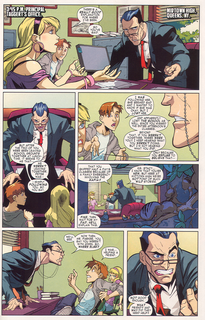
The principal is so menacing and Peter is such a doofus, the way he’s leaning back but still trying to defend himself, and the girl in the background is so sulky teenager. How is this not awesome?

Plus, the squirrels! Hee!

The comic has a great story format, too. It starts at the end, the time that Peter and Gwen are getting into trouble at school. Then it skips to the beginning of the day and tells us how they got there. It’s not new, but it’s clever and fun.

The start of Peter’s day is shown below. One of the things that I love about this comic is how wonderful the art is for all of the characters. It draws me in and makes me suspend my disbelief. It’s a lot easier to believe that Spidy can climb walls when his world looks so real:
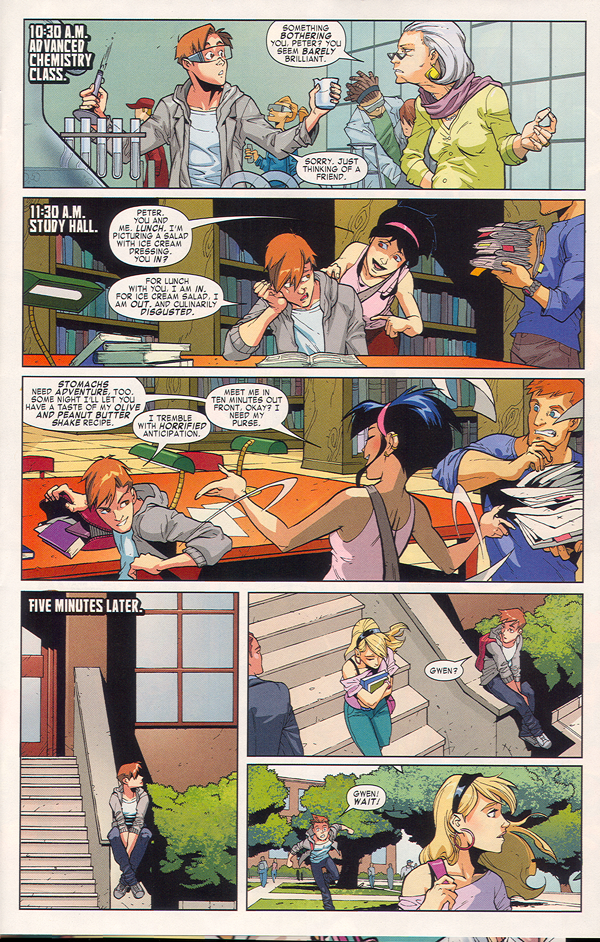
The chemistry teacher is spot-on. She looks like a chemistry teacher I had once. And they really do pay attention, this artistic team, to the way people look and dress. That awful lime green is really in right now and it’s being paired with purple.

Peter’s friend, Chat, isn’t a superhero, but she’s fun and wonderful. She’s the brunette with the terrible taste in salads above.

The plot isn’t all that new: A baddie tries to kidnap Gwen, who is the daughter of a cop, and Spidy has to save her. She’s not completely helpless, though, which I appreciated. She’s the one who suggests climbing the building to get away from the cops who are radioing in their location and also tells Spidy what to do.
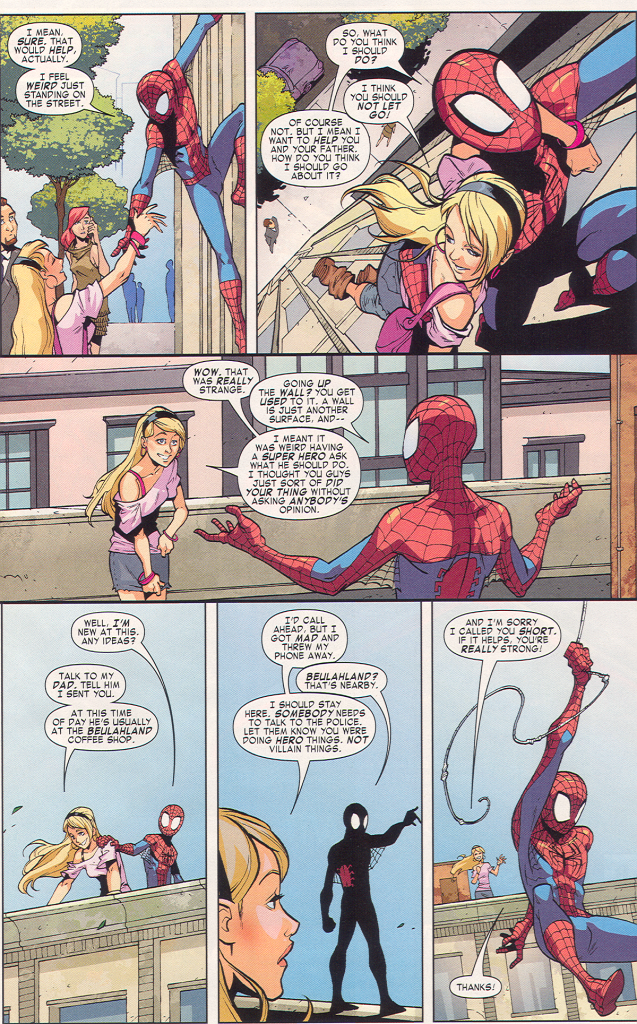
But what I really love about this page? After getting off the building, Gwen pulls down her skirt.

That’s what real girls do. We don’t leave our fannies exposed to the air for random fanboys to gawp at our panties. We pull down our skirts, so we don’t flash anyone and so we’re not cold. I loved this, because it’s so natural and so real. Gwen is a great girl and I really like her. What the realness of the comic allowed me to do is see her as a real person. At one point, when she’s running up some stairs, I thought Hey, cute boots. The chances of me thinking that in most comics I’ve read so far are nil. (Maybe Batwoman, but that would be in a Hey cute fetish boots way, which is not the same.)

Removing the voyeuristic sleaze that I always seem to feel when I read these comics was a great relief. There’s a kind of internal guard that always remains up. When I get together with just women, I relax my guard a bit. Reading this comic was a bit like that. I had some trust that this cool Gwen and this cool Chat wouldn’t suddenly be tied up in weird racy costumes and semi-tortured for the titillation of the reader. No, they’re characters who the writers respect, not objects. I found it relaxing.

The plot goes as plots go: Spidy gets to confront the baddie, with a bit of help, and there’s a cool fight. Then he has to go back to school and face the music. We wind up at the principal’s office at the end, and Spidy is just a kid again, getting in trouble for something the adults don’t understand. It’s fun and funny and great action.

Highly recommended. I will be buying the next issue, and the next after that, and the next after that.
