Manporn Ho!

Eagle-eyed blog watchers may have noticed that we have added a fifth hood to our utilitarians (or perhaps a fifth utilitarian to our hood? Yes, that probably sounds better.) What was I saying?

Right. We are very pleased to welcome the delightful and talented Kinukitty to our roster. Kinukitty will be writing a column entitled “Gluey Tart: Adventures in Manporn” focusing on yaoi, shonen-ai, and related pretty boy topics. The column will be (at least in theory) weekly, and should appear every Thursday (which is tomorrow.)

For those of you who must, must, must find out more about Kinukitty instantly, you can go to her livejournal wherein is archived her own personal manporn slash effusions. You can also hop over to the Gay Utopia and read her essay about why young girls need more manporn plus another piece of slashy goodness on the same site.

Kinukitty will have more to say on her own behalf tomorrow. Give her a nice welcome then, won’t you?

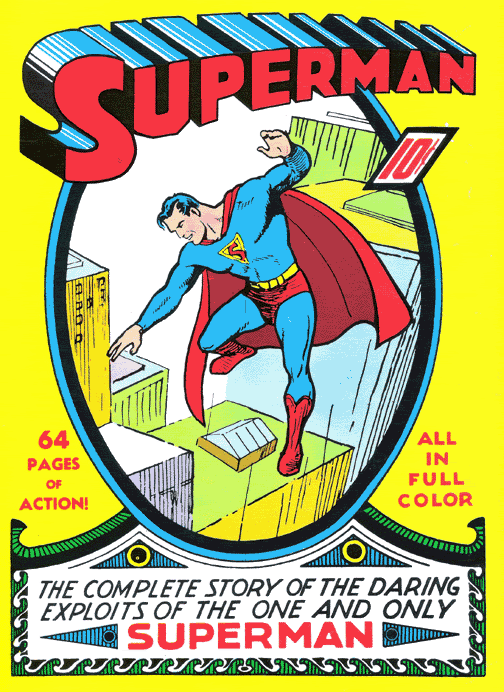
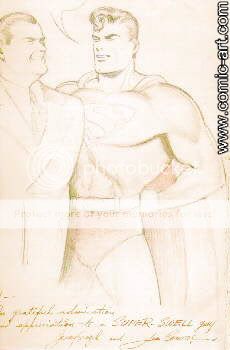
The Japanese Superman

I did a couple of posts about Matt Thorn’s classic essay, The Face of the Other, in which he explains:

I have given presentations on manga to Western audiences many times, but regardless of the particular themes of my talks, when the floor is opened up for discussion I am invariably asked the same question: “Why do all the characters look Caucasian?” You may have asked yourself the same question.

I answer that question with a question of my own: “Why do you think they look Caucasian?” “Because of the round eyes,” or the “blonde hair,” is the common response. When I ask then if the questioner actually knows anyone, “Caucasian” or otherwise, who really looks anything like these highly stylized cartoons, the response may be, “Well, they look more Caucasian than Asian.” Considering the wide range of variation in the features of persons of both European and East Asian descent, and the fact that these line drawings fall nowhere remotely within that range, it seems odd to claim that such cartoons look “more like” one people than another, but I hope you will see by now that what is being discussed has nothing to do with objective anatomical reality, but is rather about signification.

Still, this can be a hard sell;a cartoon character with wide eyes looks white to us; it’s hard to believe they look Japanese to the Japanese. As commenter awb says:

The article seems to be telling me not to believe my lying eyes. I think he is saying that people are trained to accept the western european look as “standard” or even preferred and because Japan was never dominated by a western society the see themselves as the “standard” and therefore their manga is reflective of that. But, jeez, they don’t look asian! Yes, there are some Japanese without the folds on their eyes and those with frizzy hair but is he telling me the vast majority don’t?

After a whole thread of my constant nagging, awb did eventually (and perhaps just to shut me up) agree to accept Matt’s expert opinion that the Japanese see the manga characters as Japanese. But…it’s not that easy to shut me up. And, moreover, I’ve thought of a really good example to explain how it is possible for the Japanese to see the round-eyed manga characters as Caucasian. So, I give you….the Japanese Superman.
Photobucket

Photobucket

Photobucket

Photobucket

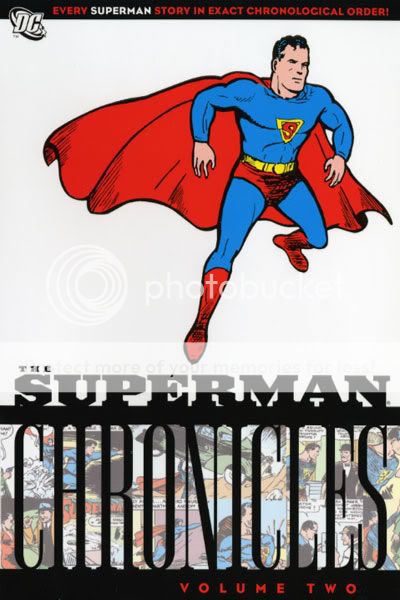
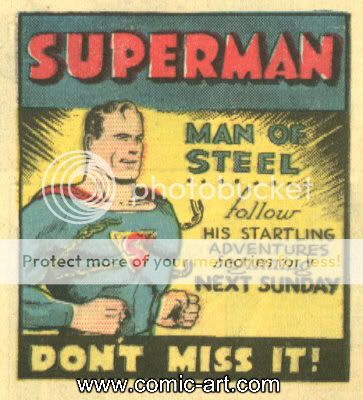
That’s the original Joe Shuster version of Superman, of course. And if you’ll look closely, you’ll see that…he looks Japanese. He’s got dark hair. He’s got narrow slanting dark eyes. Shuster’s ideal man is Asian. An inferiority complex, perhaps?

No, of course not. Even though Superman iconographically “looks” like he could be Asian, we see him as white, because of the context and because our iconographic default is “Caucasian”, even when, as in this case, the signs actually point somewhere else. In Japan, it works the same way, but in reverse; Japanese is the default, and if you want to represent, say, a Caucasian, you have to take some specific steps to get there.

So why is Superman stylized like that? I don’t have any idea, really…but I’d like to think it’s for the same reason that manga characters look “white”. That is, there’s iconographic influence. Tezuka borrowed his iconography from Disney; it’s not impossible to believe that Shuster got some of his iconography from a generalized Art Nouveau illustrational milieu, which was in turn heavily indebted to Japanese prints. Those older prints represent Japanese faces in a way similar to what we still (perhaps influenced by those very prints?) think of as iconographically Asian.

Update: In comments, Tom undoes my elegant theory with a tiny little squiggle. Darn it.

Update 2: But…Mitch defends the Japaneseness of the design. Phew!

Most Coldhearted Name for a Rock Group

I had no idea this is how Joy Division got its name. Alan Moore says in the From Hell source notes that Victorians called prostitutes “Daughters of Joy” because it was easier to pretend that prostitutes did their work out of sheer enthusiasm than to admit the ghastliness of lower-class economic conditions. Moving onward thru history:

… we arrive, by grim and etymological process, at Joy Division, the name given by the Third Reich to those female Jewish concentration camp detainees assigned to the prostitution detail.

Wow. At least, as yet, there isn’t a movie on the subject, one not starring Natalie Portman and a blond male ingenue with sensitive features to play the Nazi.

What’s Going on With Netley?

I’m rereading From Hell because of the TCJ column I plan to do about Watchmen. Sorry to say, the book is hard going this time around. Maybe my blood sugar is low.

Last night I finished the classic fourth chapter, in which the villainous Dr. Gull tours London sights and expounds on their hidden significance to his coachman, Netley. Meanwhile, Netley gets more and more queasy-like in his guts, until finally he has to vomit. Dr. Gull is eating grapes, and later he will feed poisoned grapes to his victims, but these grapes aren’t poisoned and he doesn’t give any to Netley. Maybe he slipped something into Netley’s food when they had lunch at the tavern, enough to give his system a shake but not to kill him. But why?

Most likely the situation comes clear later in the book. For now, though, I feel like I have one more gnat flying around my head. When I’m digging a Moore work, I love seeing how all the mysteries, plot threads, and symbols juggle themselves together. But right now I just feel hapless and irritated.

Neil Gaiman’s Wife

Who is she? There isn’t really a lot of information to be had, and apparently that’s how the Gaimans prefer it. Fair enough, and thanks to Mary Warner of the blog Woo Woo Teacup Journal for gathering what was out there. She posted her findings here, and basically they’re a series of links to various scant mentions of his wife by Mr. Gaiman. The first link is to an online journal entry in which Gaiman says this: “my wife is happier to be a shadowy and mysterious figure in the background, or something.”

For the record, Mrs. Gaiman’s name is Mary T. McGrath, she’s American, and the couple got married before Gaiman hit it big. They have a son and two daughters, with one of the daughters still pretty much a kid and the other children both grown up and pursuing careers (Google for the son, film production in Hollywood for the daughter).

Nonpowered Superheroes

There’s Batman, there’s the Guardian, there’s Green Arrow, Hawkeye, and (sort of) Captain America. Also the Falcon and the Manhunter, I believe. In fact I’m sure there’s a lot of them, though only because there are so many superheroes in general. My guess is that the nonpowered heroes tended to crop up in the ’40s and became less commonplace during the Silver Age and after, though the examples above show that they didn’t die out.

This is leaving aside all the Batman satellites. In the interest of franchise homogeneity, anyone who wants to be Batted cannot have special powers. Though, given the number of people who keep getting superpowers, and the number of people who want to be Batman’s crimefighting associate, and the difficulty of Batman’s line of work, you’d think there would be at least some people with superpowers who’d be trying out for the role of girl-Robin or the Silver Bat or whatever. (My thoughts on Kathy Kane, and commenters’ very informative remarks about Bat-training, can be found here.)

I don’t count Iron Man as nonpowered, though he couldn’t have got into the Legion of Superheroes: they think gizmos are cheating. Of course, where you draw the line between Batman’s ton of gimmicks and Tony Stark’s armor could be the subject of much debate. But I’m sure the line’s there someplace.

Gaiman’s Sandman Heroines Not Real Good

UPDATE: I changed the post’s heading in honor of Anonymous, who I believe may be the ghost of Lionel Trilling.

************

A while back in Comments I said this about Neil Gaiman:

IMO he’s done a couple of good female characters (Element Girl, for example), and a couple more with decent schtick (Death, Thessaly), but his female leads tend to be hard to tell apart, at least in the Sandman series. For instance, what’s her name, Rose Hunter, or that other one, Barbie. They struck me as placeholders for the imagined Vertigo reader.

But his men aren’t all that great either, except when it comes to schtick.

Judging from some of the other Comments, there are people who can tell Barbie apart from Rose Walker and Rose Walker apart from Lyta Hall. I can’t, beyond such obvious markers as age, height and maternity status. Lyta had her kid taken away and is mad as hell, but I guess Rose would be too. Barbie is adrift and mopes around; then again Lyta doesn’t have much to say for herself until her kid gets yanked, and then she’s mainly just gritting her teeth. Barbie paints her face; Rose writes in her journal. I can’t remember anything any of them said. In The Kindly Ones, Rose writes in her journal that she’s a cold sort of bitch. Well, all right, but she didn’t seem that way in The Doll’s House or even Kindly Ones. She didn’t seem much of anything except a skinny kid with decent bone structure.

Above I refer to the girls as “placeholders for the imagined Vertigo reader” or, more properly, the imagined Vertigo reader’s imagined ideal self. That’s tough to prove, except for the moping, the face painting and journal writing, the low body fat and pleasing cheekbones, and the flattering sense of being important for reasons that are rationally undefinable (I’m a dream vortex!). So I’ll let it lie.