Eeyore weirdness

Incidentally, there seems to be some sort of weird bug/virus going around blogger posting the words “eeyore is cute.” We seem to have had a blip of it here. So hopefully it won’t happen again, but if you were wondering what it was, that’s what it was.

Update: Aha! Bill has found out what’s going on. Just an internal bug, I guess…..

Neither Abstract nor Comics. Discuss

Andrei Molotieu very kindly decided to include my work in an anthology of abstract comics (called…Abstract Comics) that should be coming out this summer from Fantagraphics. There’s a blog up with more information here.

Anyway, folks are posting art and such up on that blog. I’m cross-posting mine below:
_________________________
This is something of a collaborative piece. I drew directly on some photocopied conceptual illustrations done by my good friend Bert Stabler for a video project The Intangible Under Umbra. (Scroll down and you can see an excerpt; I did the voice for the talking brain plant thing.) The drawing itself is based on one of Bert’s surreal Peanuts pastiches (this one, in fact.)

Anyway, a lot of explanation for a fairly small drawing. Here ’tis.

Photobucket

Childish

The Onion, by way of Daniel Radosh:

STOCKHOLM—In recognition of her groundbreaking work treating life- threatening diseases of the privates, renowned hoo-ha specialist Dr. Victoria Lazoff was awarded the Nobel Prize in Lady Medicine this week.

The thing is, Lady Medicine would be a good name for an Alan Moore superheroine.

UPDATE: Thought of another: Alterity Girl

And another! High Horse. That could be a superhero based on Moore himself, since he’s a big, long-legged fellow who likes to get high and who enjoys the occasional fit of moral dudgeon.

Better Money Shots

I’ve mentioned in a few places (most recently here) that Japanese comics artists are in my view by and large better than American ones. I should probably expand that to just be “Eastern artists” or maybe “Japanese and Korean artists.” I just started the series Dokebi Bride, by Korean creator Marley. So far, I’m liking it, if not loving it. I’m a little wavery on some of her drawings of people; the occasionally look awkward in a way that doesn’t seem thematic or intentional. However, when she needs to pull out the big guns and draw something that really rocks you back….

Photobucket

Even with my shitty scan, that’s pretty impressive.

On the other hand, here’s one of mainstream comics’ leading lights:

Photobucket

I think both of these images are supposed to be doing similar things. They’re supposed to be spiritual/aesthetic money shots, inspiring awe, reverence, and wonder. In Marley’s, it’s the summoning of a dragon spirit; in Quiteley’s, it’s the contemplation of Superman’s sacrifice/inspiration.

I don’t know. Maybe somebody out there prefers the Quitely drawing. I don’t hate it or anything, but compared to the dragon, it seems fairly unambitious and staid, relying on fairly pat cues (goodness = light!) to convey its spiritual oomph. I think it’s going for a 30s constructivist/socialist feel, probably as a homage to the characters roots — which is fine, but the use of it doesn’t seem especially adventurous, which leaves it feeling cliched, almost advertising. You look at it and think “tum ta-daaaah”, which I guess is the point, but how exciting is that, really? Whereas I feel like Marley is much more full-bore about her embrace of traditional printmaking; the dress the woman is wearing, for example, is beautifully detailed; the dragon’s horns and hair are carefully designed; the use of scale is very nicely managed…. She’s just a better artist and better at using that art to convey the emotions and themes of her story.

Or maybe I’m just sick of super-heroes and prefer water spirits. I don’t know. I can say, though, that I looked at that Marley picture and said, “holy shit,” which happens to me somewhat frequently when I’m reading manga (like YKK for example), but just about never when I read contemporary mainstream stuff. Make of that what you will.

Update: I know somebody out there was hoping this was about hentai. Sorry about that.

Update 2: Follow up post here.

Best Cynical Interjection

It’s by David Horowitz, a right-wing publicist who gets impatient with his side’s “over-the-top hysteria” about the red reign of Chairman Obama:

I have recently received commentaries that claim that “Obama’s speeches are unlike any political speech we have heard in American history” and “never has a politician in this land had such a quasi-religious impact on so many people” and “Obama is a narcissist,” which leads the author to then compare Obama to David Koresh, Charles Manson, Stalin and Saddam Hussein. Excuse me while I blow my nose.

Bonus pleasure: Brendan Nyhan, the very earnest left-of-center moderate who linked to the post, cannot figure out the “blow my nose” bit.

Bound to Blog: Wonder Woman #1

So I have threatened on a number of occasions to blog my way through the entire William Moulton Marston/H.G. Peter run on Wonder Woman. I still don’t know if I’m going to make good on that, but at least we’ll give it a try. Starting this week, I’ll try to post on one issue each Thursday without fail unless I have something better to do, pledging to stop only when I have reached Marston’s last issue or when I feel like it.

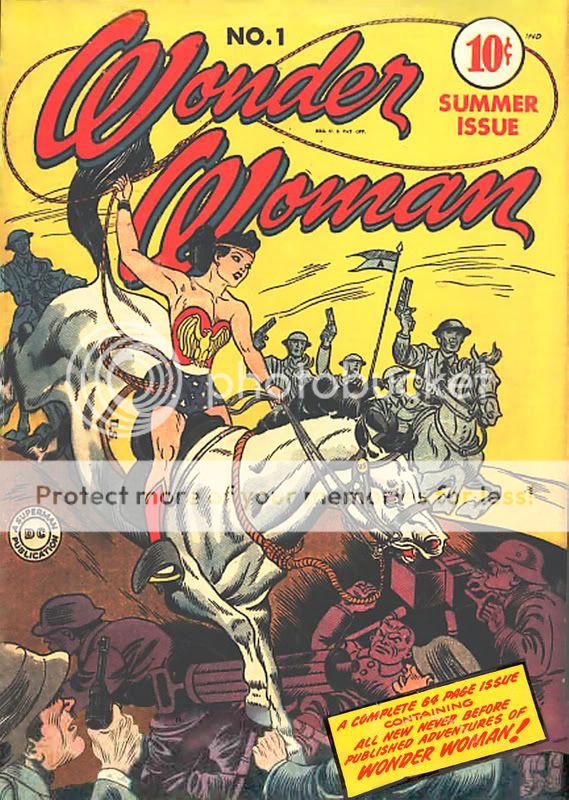
So both longtime readers may remember that I already have spilled a lot of electrons writing about Wonder Woman #1 (here, here, and here. Most bloggers might say, hey, I’ve covered this, let’s move on to 2. But those most bloggers are not neurotic-completist me. If I’m doing a series where I blog about every Wonder Woman issue, I’m going to start with #1, damn it. Bring on the cover!
Photobucket

So…what’s to say that hasn’t been said? As I mentioned in the previous three posts, the first story in this issue is pretty amazing. This isn’t WW’s first appearance (she’d been appearing in Sensation Comics since 1941, the previous year) but for her own debut title Marston created what has become her more or less canonical origin (retold with some variations by George Perez in the 80s and by the WW animated movie, to name just two I’ve seen.) Compared to Superman or Batman or Spiderman, Wonder Woman’s origin is more complicated, and more unhinged by about a factor of five. Rocketed from a doomed planet? Pshaw. Parents murdered? Please. Bathed in radiation? Ha. How about created-out-of-clay-by-the-leader-of-a-race-of-loving-warrior-woman-and-then-brought-to-life-by-the-divine-will-of-Aphrodite?

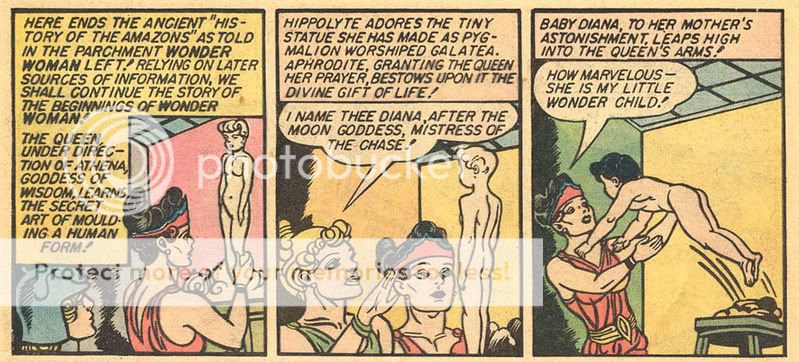
That made out of clay bit still kills me, incidentally. It’s a genius fusion of Golden Age off-hand nonsense and Greek myth. It also has some surprising emotional resonances.
Photobucket

Those three panels are really, to me, heart-breaking, though it’s so compressed you’ll miss it if you blink. Athena teaches Hippolyta how to sculpt, and what Hippolyta chooses to create is the image of a child. She wants a kid, in other words, but she can’t have one, and so she becomes obsessed with the image she has created. She prays, and a miracle occurs; the baby comes to life. With Peter’s art, the moment that Diana is “born” is ritualized; the mother and daughter both stiff, shown in the moment before they touch in a frozen tableau, rather than in the moment when they embrace. The whole sequence seems very poignant to me; it reminds me a little bit of the end of Grant Morrison’s Animal Man, where Buddy’s family is magically resurrected — or of the end of Shakespeare’s Winter’s Tale, with its unexplained resurrection. The power in all three moments is in having the heart’s desire granted, and in the recognition that the heart’s desire just doesn’t actually get granted in this way. Love demands miracles, and a creator granting a miracle to a creation is sometimes an act of love. That’s at least provisionally part of what the Christian faith is about (a connection both Morrison and Shakespeare make.) Marston’s vision is more pagan — and, perhaps coincidentally, more female.

In Morrison and Shakespeare, men pray for the resurrection of their wives/lovers, and their wish is granted. Here, though, a woman prays to have a child. That prayer is also linked explicitly to artistic creation. Often in various misogynist discourses, you get a contrast between the creation of the artist (done by men) and the creation of children (done by women). But Hippolyta is both artist and mother; the two roles aren’t separable. The love of artist for art object, and of mother for child, are commensurate rather than opposed. Aphrodite is god of both.

I think this does a few things. Most obviously, it emphasizes Hippolyta’s femininity. She may be a warrior queen and an artist, but she’s still a woman. In contrast, the Wonder Woman animated movie that came out this year ended by essentially reprimanding Hippolyta for turning her back on children and men and family; for not being feminine and loving enough. But for Marston, you don’t need men to have family, or even, it seems, children. Women can be sculptors and warriors and Aphrodite is still their patron.

Another aspect of this scene is that it makes a fairly clear analogy between Marston and Hippolyta. After all Marston, like Hippolyta, creates Diana; and brings her to life — and I don’t think it’s too much to say, especially considering that the character was based on Marston’s wife and their lover, that he brings her to life through his love. In general, most commentators (including myself) tend to see Marston’s investment in WW as, you know, sexual; revelatory of the kind of women he wants to be with, and of the way he wants to be with them. But the link with Hippolyta suggests that Marston’s interest seems not only romantic, but aspirational; he doesn’t just want the women he portrays; he wants to be them.

That’s fetishistic too, of course; male sexual fantasies about being women are pretty common — and probably have something to do with the cross-gender identification in exploitation flicks that Carol Clover talks about in “Men, Women and Chainsaws” (though Clover herself doesn’t really make this point.) Even if it is a fetish, though, Marston goes interesting places with it. If you see him as Hippolyta in this sequence, what he wants is to be creative, like women, and a creator of children, like women, and loving, like women. It’s an idealized view, clearly, which can be problematic – but it’s not an idealized view that seems especially limiting for women in the usual ways; Diana starts out on the pedestal, after all, but she gets off it fairly quickly. Hippolyta isn’t barred from masculine activities. Indeed, in many ways Marston seems to want to be a woman as a fantasy of being more, not less masculine — stronger, more competent, even more artistic in traditionally male ways. Marston’s comic, in other words, situates male and female readers in pretty much the same way; both are supposed to look on Wonder Woman and the Amazons as ideals to emulate (both are also supposed to look at Wonder Woman and the Amazons erotically, I think..but that’s a discussion for another day, maybe.)

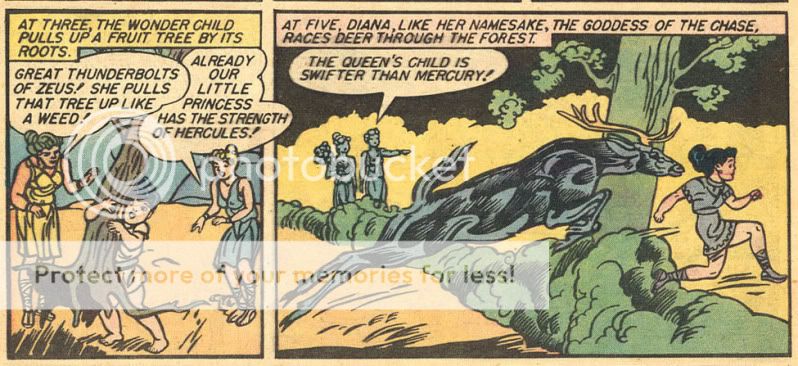
I also think it’s worth pointing out how odd it is in a super-hero comic to have the kind of celebration of child-hood that Marston provides. I’m thinking of the two panels that follow the three above:
Photobucket

The ostensible purpose, of course, is to show how strong and great Diana is — stronger than Hercules! Faster than mercury! Etc etc. But — not to be too gloppy — to a parent, every child is a wonder child. Diana is amazing, not just because she’s a super-hero, but because she’s a kid. Most male superheroes are all about being orphaned, outcast, alone, agonized, cut off by their powers and their origins. WW’s origin, on the contrary, is all about community; she has a hundred mothers who love her. If that sounds kitschy…well, yep. That second panel above in particular is both sublime and sublimely hokey. I love the elongated deer so outdistanced it doesn’t even get any motion lines, and the way it’s sleekness contrast with the frilly tree leaves above. The effect is strange, especially since the deer’s anatomy isn’t quite right; it looks like medieval drawings of horses where they didn’t have stop motion photography to show them how those creatures actually ran. At the same time, the outdoor scene, the stiffness, the indecently healthy child, all also suggest garage-sale art; something you’d find with “We love our happy home,” scrawled across it — if, you know, you’re happy home was an island populated by an all-female band of warriors.

One of the implications of this is that her story is all about security. Ground zero for her is a happy home. That’s not that unusual for girl’s fiction, I don’t think (Cardcaptor Sakura, for example, doesn’t have family angst; I don’t think Sailor Moon does either.) But in the world of comics, more geared to boys, it’s very odd, and writers tend not to know how to deal with it. (Greg Rucka’s Hiketeia is a particularly flagrant violation.)

As this suggests, the relative lack of angst in Diana’s origin is probably meant to appeal to girls to some degree. But I bet it’s also meant to appeal to, and probably to educate boys — to provide a different vision of heroism that didn’t involve clinging to outcast status and perpetrating bloody revenge.

I was reading an all ages Jeff Parker Marvel Avenger’s comic to my son recently. Giant-Girl (Janet Van Dyne) has run amok (one of those mind-control things) and the team goes to consult her father to see if he can help. Anyway, Dad starts explaining G-Girl’s origin, and at one point, Storm, I think, interrupts and says something like, “So then Giant Girl swore to avenge her mother’s death by fighting crime?” And the dad says “What? No, no. My wife’s fine. She’s away on a ski trip right now. Janet just likes to help people.” I think Marston would approve of that.
———————-

All right; so next week we’ll go to number 2. And I’ll do my best to cover more than five panels.

TCJ’s Best of — Now WIth More Manga!

I thought I’d reprint my best of list from the current issue of the Comics Journal.TCJ #296, just in case anyone was interested.

_____________________________

As I say every year about this time, I don’t actually make any effort at all to keep up with new releases, so this is more a list of things I happened to see and love this year than an actual best-of.

Ai Yazawa’s Nana #8 (Viz Media) is my favorite volume of the only ongoing series I follow.

Hitoshi Iwaaka’s Parasyte was one of the first manga I read, and it’s still a marvel — I haven’t seen all the volumes of the ongoing Del Ray reissue yet, but the translation is definitely superior to the earlier TokyoPop edition.

Ariel Schrag’s Potential (Touchstone) is a reissue of one of the best (and most underrated) comics of the last couple of decades.

Lilli Carré’s The Lagoon (Fantagraphics) is a great first book by an extremely talented artist; a lyrical mind-fuck of time, identity, and genre.

Lyrical mind-fuck also describes the opera/graphic thing/poem/performance that is Dewayne Slightweight’s The Kinship Structure of Ferns (self-published). Seeing Dewayne perform it live is something else, but for the vast majority of folks who missed it, the hand-bound book comes complete with a play-along CD of his original music.

Dame Darcy’s “We Are the Fae and There Is No Death,” from Meatcake #17, is a horror story masquerading as a fairy tale, and is also about as beautiful an example of either as I ever hope to see in comics form. It made me wish Darcy would adapt some Lovecraft or Poe…though I’ll settle for the illustrated version of Wuthering Heights she promised us a few years back.

Spider-Man and the Fantastic Four: Silver Rage (Marvel) actually came out at the end of 2007, but what the hey. Artist Mike Wieringo’s art is okay as super-hero fare goes, but Jeff Parker’s smart, goofy, all-ages writing is the thing. He’s more-or-less single-handedly restoring my faith in the super-hero genre.

Also helpful in that regard is Showcase Presents: The Brave and the Bold, reprinting the series’ classic 1970s heyday in 500-page plus black-and-white phone books. Volume 2 came out at the tale end of 2007, and while it’s a bit uneven, at it’s best it’s stunning. It would be worth getting for Bob Haney’s brilliantly nutty scripts alone, much less the eye-popping art by the likes of Nick Cardy and Jim Aparo. Issue #104, “Second Chance for a Deadman?” is probably the best Batman story ever written, for my money. Volume 3 of the series, which should be every bit as good, is scheduled for December 2008.

Dan Walsh’s inspired alterations of Garfield comics at www.garfieldminusgarfield.net made me laugh so hard I got hiccups. Basically, Walsh simply removes the titular cat from the strip, leaving Garfield’s owner, Jon, talking to himself in an arid suburban wasteland. Thanks to Davis’ good humor — and his eagle-eye for promotional opportunities — the site has spawned a book, Garfield Minus Garfield from Ballantine which features excerpts from the site, as well as a few détourned strips by Davis himself.

Mr. Door Tree at Golden Age Comic Book Stories this year published a jaw-dropping portfolio of illustrations by Dugald Stewart Walker for the 1918 book “The Boy Who Knew What the Bird Said”. I’d never heard of Walker before, but he is now one of my favorite artists; his fairy-tale illustrations are unbelievable. Unfortunately, that post seems to have been deleted. As of this writing, there is another selection of Walker’s art on the site at this address

Finally, and most self-indulgently: my favorite comic of 2008 was Edie Fake’s “Call the Corners,” which he created as his submission to the online forum The Gay Utopia, which I organized and edited. “Call the Corners” is a single, enormous image; onscreen, you scroll down it, following an elliptical message, more poem than narrative. It’s influenced by Fort Thunder and by tattoo art, but the synthesis is completely unique. I was deliriously happy to be able to publish it — it sort of made me feel my existence was justified, at least for this year. You can find it here.

______________

Like pretty much every other hipster drone, I like to preen myself on the eclectic idiosyncrasy of my taste. Normally, therefore, I’d be thrilled to report that, unless I missed something (which I could have), of the nineteen other folks who contributed lists, none of them picked any of the books I did. Not one. This is me taking a victory lap….

Okay, done now. But in every apple there is a thorn, in every worm a cloud…or something like that. The point is, I figured nobody else was going to choose Edie Fake or Dugald Stewart Walker, and I wasn’t surprised to see that nobody else picked Parayte, but I was really hoping that Lilli Carré would get more love. I mean…Fantagraphics-issued, totally alt-comics friendly, weird, beautiful book. Maybe it came out too late in the year? (I got an advance copy because I wrote this ecstatic review for the Chicago Reader.)

I also wanted to talk a little bit about the manga coverage. Last year I noted that the Journal’s best of list was very, very light on the manga coverage. I think the journal has actually done better with manga coverage in general since then, and this year’s selection seemed to be somewhat more manga friendly. Partly that’s because Johnny Ryan picked almost entirely manga for his list. Kristy Valenti had a few selections as well, too. (Bill didn’t choose any manga, I don’t think — presumably because, as he mentioned a bit back, he doesn’t really read manga in translation so much.) Another factor is that there were two big arty manga releases that made a lot of people’s lists — Travel by Yuichi Yokoyama (which might have made my list if I’d read it at that point — I have a review of it forthcoming in the Journal) and Red Colored Elegy (which I haven’t read.)

As a sort of balance, there was less coverage of mainstream American super-hero stuff in the lists this year than last, I think. Someone (Rich Kreiner, I think) picked a couple of DC’s reprint collections, but other than that, if you weren’t Grant Morrison, you didn’t show up on anybody’s scorecard. So, really, the pulpier regions of manga and the mainstream both got similarly short shrift, making it less a “the journal doesn’t care about manga” thing than the more familiar “Journal not all that into pulp, necessarily” thing.

I must say, I also just wondered in general…best of lists in March? Why? I mean, I understand why it’s worthwhile or interesting to have Kim Deitch and Lynda Barry and Johnny Ryan say what they’re into at any time of the year. But someone like me — I don’t know. Best of lists seem like the whole point is to be timely and newsy, and if it’s not that, is there really a reason to bother? It seems like the Journal’s competitive advantage is in having longer, in depth pieces, not short, news driven lists (unless those lists are from industry figures, like Kim Deitch and Lynda Barry and so forth.)

But, on the other hand, it’s not like I know anything about marketing. And I read through the lists and enjoyed agreeing (always happy to see somebody fawn over Clamp) or disagreeing (somebody chose that crappy Howard Zinn comic?!), or just learning about something new.

There were also a couple of really nice longer articles in this issue about topics I know nothing about: Matthias Wieval wrote about French comics, and Tim Kreider had a long essay about Bill Mauldin. Matthias has a new regular column in TCJ, apparently, which sounds like it’ll be great. And I don’t remember seeing Tim Kreider’s stuff before, though I hope he keeps writing for them.