
Sex and the Sensitive New Age Guy

Tom recently sent me an email asking me to explain why I hate contemporary literature and why I care about sexism. Not sure anyone else is interested, and confessional literature is always dicey, but since I’ve had a special request:

As far as contemporary literature goes, I’ve explained myself more or less here and here. For a while there I was trying to be a poet and reading a lot of poetry, which gave my hatred for the contemporary literary scene bite and drive. These days I pretty much just avoid it, which makes me happier, but means I don’t have quite the same impetus to write at length about it.

For the sexism; I don’t know that I am actually any more interested in, or opposed to, sexism than your average everyday liberal, Oberlin educated SNAG. My mom worked full time; my dad, as a professor, had more flexible hours, so he was more or less the primary caregiver. Both of them always made it clear that this arrangement was fine, and that sexism of any sort was wrong. I remember standing up to a couple teachers in high school when they made some cracks about girls not being as smart as guys. The other boys in class were aghast, but I was definitely thinking, “You can’t say that about my mom!” I don’t know…that’s one of the things I’ve done that I’m definitely proud of, but though I’d like to line up those data points and end up with “Noah Berlatsky: Champion of Women’s Equality!” I don’t think it would necessarily wash.

As Tom noted, I do write a fair bit about sexism and feminism. That has something to do with my liberal politics, certainly, but it also has a lot to do with my interest in…well, me. In my experience, at least, feminists tend to have the most interesting things to say about masculinity, just as black writers tend to have the most interesting things to say about race and whiteness. If you look at my two longest pieces on sexuality (here and here, they both use feminist theory to talk about masculinity — especially about masculine sexuality, and the relationship between masculinity and desire. Both are me trying to figure out why I get pleasure (of various kinds) from certain genres, and trying to figure out how that plugs into various social and political concerns. (This is true of the Wonder Woman blogging as well; I think my next essay for comixology will make that more clear.)

The above is something of a psychological explanation, and is perhaps unduly demeaning (as psychological explanations tend to be.) I could also explain my interest from a more ineffable aesthetic perspective, I guess; much of my favorite artwork and writing deals with gender and sexuality, and trying to understand it or interact with it has led me to write or think a lot about those topics.

I mean, I don’t want to disavow any political commitment. Obviously, I hope when I write about or use feminism that I’m doing something to advance the cause — perhaps by revealing some of the ways sexism works or how sexuality and sexism can be tied together or teased apart in our imaginations. But I guess I feel like women — or anyone really — would do well to mistrust men who claim to be leading the fight or to be acting out of especially altruistic motives. Sex and gender ulimately interest me because, like most people, I’m interested in sex, and, like everybody, I have a gender.

So that’s my best effort at a response. If it seems self-indulgent or tedious…well, I would encourage you all to blame Tom.
Just Saw Watchmen Again

I’m doing a column about it for TCJ, so two viewings were necessary. (Here for my first viewing. Here for Noah’s thoughts on Laurie.) This time I brought a pad and kept notes, mainly of sound effects and camera movements that annoyed me. They’re constant. I’ll put it this way: right before the WOMP!! when Rorshach kicks in a door, you get the two-second sheee-ooom of his foot traveling. Every action in the film gets a sting. Close the kitchen door: Wuhmm! Drop a matchbook on the table: Wunnk! The film cannot communicate a moment in any other way. Pretty soon, if you’re sensitive, you start to feel a bit teary; the nervous system never gets a moment to reknit. At least this time I knew what was coming and could roll with it.
Another example of how everything in the film gets treated the same way: little Rorshach punching the neighborhood kid who was picking on him. Not only does the punch get the same big-sound sting as an adult superhero’s punch, little Rorshach delivers his punch like one of the adults, with the same straight-line trajectory. The punch is treated like a devastator, but the kid is too small to be dangerous in that way. The book’s little Rorshach confined himself to the desperate-clawing-away side of the enterprise, which is far more plausible. The movie includes the clawing away but feels that the clawing most be accompanied by a thunder fist. Any fight, in the movie’s terms, is an encounter involving thunder blows. 
Worst casting: I’ll say it again, Matthew Goode as Ozymandias. He doesn’t have the chin or the shoulders, any other considerations aside. Every time he shows up, there’s a hole in the screen.
Nice surprise: Ms. Akerman does a decent job in the dinner scene between Laurie and Dan.
Nicer surprise: Jeffrey Dean Morgan is really quite good as the Comedian. He really swings his Keene riot scene (“The American dream came true”) and his bedside scene with Moloch.
I saw the film at an 8:15 showing on Friday and the place was nearly full up. Counted walkouts by about a dozen people, including a clump of little kids who’d been in the front row and had enough around when Ozymandias was explaining his scheme. The guy sitting next to me really hated the film and made some asides to his companions about “this bullshit.” Once the credits started rolling, people had their coats on and broke for the gates.
Box Office Mojo says that after three weeks Watchmen’s world box office is $161,172,305. Budget was $150 million, so okay. The movie still had a huge second-week dropoff, and it’s not at all a good movie, but I’d rather Watchmen’s film version be sort of a success and not a flop.

What a Bitch!

It’s a meeting of titans, Prince Philip and Simon Cowell. They’re both pissy, slender men with a lot of money and little patience. But one of them is royalty and the other feels he’s been disrespected. In fact he reports that the prince called him a “sponger.” Buckingham Palace responds that the prince categorically denies it: “He has said he does not know enough about Mr. Cowell to make any sort of comment.”

Conservatives Are Funny

They really are. The right, or large portions of it, has a great sense of humor. But it’s a humor that’s directed outward. They don’t laugh at themselves, they laugh at others, and very well they do it.

Now big names on the right are trying to show they can laugh at themselves. But the only way they can think of doing this is to put on a silly garment and get photographed. Without the garment, one assumes, they would figure there was nothing at all silly about them.
The left is different. They’re supposed to be humorless, and it’s true they often get pissy about the things the rest of us get up to. But in my experience they tend to laugh themselves. The first time I heard the term “p.c.” it was in college, as in “Yep, tonight we’re eating real p.c.” when the rice and lentils were being served. I was reminded of this when reading Bechdel’s big new Dykes collection. So many of the strips make fun of the lesbians just for being left-wing lesbians with left-wing lesbian attitudes, eating habits, etc.
I’ve read my share of right-wing prose and I’ve known a few conservatives in my time (some fine people, some not), but I can’t remember ever hearing a conservative make fun of himself/herself for being a conservative. They might say there’s nothing funny about conservative beliefs because (in their view) conservative beliefs make so much sense. But left-wingers take their beliefs seriously too. I would guess it’s the matchup between the person and the belief that strikes left-wingers as funny. All these sweeping principles about the earth in balance and the global revolution of the poor, and what they come down to is serving lentils. Whereas conservatives, at least our modern-day variety, tend to feel that they and their principles make a fine match. Turning the course of history from collectivism to freedom — why, sure, that’s right up my alley (my theoretical conservative says) and it does me credit that I take on the job.
When I was in Florence, I was struck by all the people who wanted pictures of themselves standing next to Michelangelo’s David.  Without them, they figured, the photo would be incomplete. Reminds me of conservatives. 

Stan’s Babe-o-Dome, b (FCR addendum)

I was writing about Stan Lee’s hot-chick covers of the 1940s and mentioned P. G. Wodehouse. I see some resemblances between the two fellows. They’re cheery and upbeat and they see their job as entertainment, pure and simple. In person Wodehouse was very shy; no one could call Stan shy, but he is fairly private. The Raphael-Spurgeon bio tells how, back in the 70s, Stan decided he would take the guys at Marvel out for drinks; once at the bar, Stan realized he had nothing to say to them and slipped away. The reason he took them out drinking was that he heard that Carmine Infantino would take the fellows at DC out to dinner once a week. I don’t think anyone would call Infantino especially charming, and Stan is especially charming. But Infantino liked being with the gang and Stan, from appearances, would much rather be with his wife and daughter and, these days, his grandkids.

Stan and Wodehouse also showed a certain difficulty in coming to grips with unpleasant facts. Mike Ploog tells a story of his Marvel days when he asked Stan for a raise and a regretful Stan explained how in the current economic climate, etc., and then Stan began showing pictures of his latest fancy sports car. Ploog made the obvious point that there was a degree of unfairness here, and an abashed Stan immediately saw he was right. I would guess that, for the brief moments that he looks back, Stan really wishes he had stuck up for Kirby about the art and that he hadn’t been so quick to bill himself as “creator” of all his Marvel co-creations. Wodehouse certainly wished he hadn’t made those broadcasts on Nazi radio, and my only excuse for bringing Nazis into this is that Wodehouse actually did make such broadcasts and they were as harmless as broadcasts on Nazi radio can be. But as actions go it was beyond dumb. It was unthinking, and the same (in a very different arena) for Stan’s complacency about how well he was making out when others at Marvel were not being treated nearly so well. 

Turning out happy, happy entertainment, entertainment as happy and carefree as a Wodehouse book or one of those babe covers, may require a certain temperament: not just good cheer but a sharp disconnect from reality. A decent tv sitcom is grittier than Wodehouse or Stan at his most Stan-ish. The problems get wrapped up, but at least they’re there. (Which isn’t to say Wodehouse is somehow inferior to How I Met Your Mother. Wodehouse is great. At what he does he is inferior to no one, and what he does is worthwhile. But it’s a very specialized stock in trade. Stan’s babe covers aren’t really so great, but whatever.)
This disconnect from reality, when I consider it, feels to me as if it were connected to the unsocialized aspect of Wodehouse’s and Stan’s personalities. That’s why I used the phrase “Babe-o-Dome” in the head, emphasis on “Dome.” The larkiness in their works makes you (or me, anyway) think of isolation just because it’s so air weight, so free of anything at all that might run counter to larkiness. Stan’s babes capture the one moment of joy you feel at the sight of a pretty girl. What a bright moment that is, and what a small moment it is compared to everything that comes after.  

The Keys to the Batmobile

Zhinxy is threatening to review the entire Knighfall saga. Don’t know if she’ll manage it…but I hope so because, because….

Everybody will run in different directions when I snap this rod. Whoever finds and captures the flag first will get first crack with the pieces of said rod at the giant, looming paper-rose cowl pinata pictured above my head, while the others sing a song of their choosing.

Should the flag-finder NOT break the pinata and scatter the goodies inside – Which include the keys to the Batmobile, passwords to the Bat-Computer, and no Smarties, on my honor – We go in order of How Many Times You’ve Been In The Cave. Should NONE break the pinata, the next goer will be determined in a round-Robin paper-rock-scissors battle…

It’s even funnier with the picture. So click over there why don’t you?

FCR 4ish: do men with unisex names write better women?

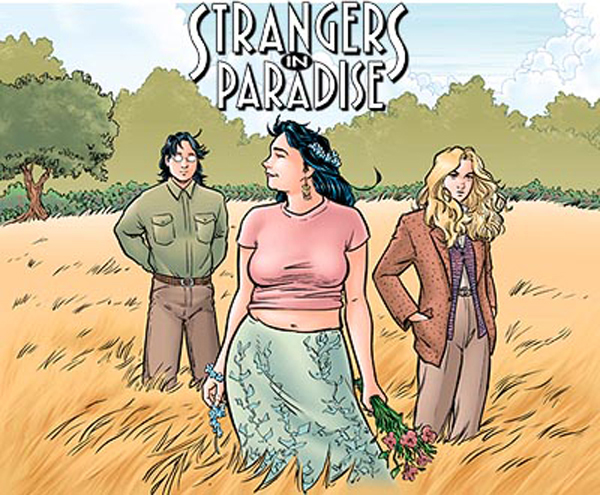
Terry Moore’s Strangers in Paradise was one of the first “alternative” comics I read when I was a teenager getting tired of Marvel (I bought it after reading the preview in Cerebus). I picked up around the middle of “I Dream of You,” I think, so fairly early in the run. I followed the series faithfully all through high school, painted Katchoo on my graduation mortarboard (and got the photo published in the lettercol!), angsted and argued over the characters, and decided with my best friend that she was Katchoo (but taller) and I was Francine (but gayer).

In short, it was the perfect graphic addiction for the kind of teenage girl I was. Later, I grew up, started hanging out with comic snobs (you know, the kind of horrible people who write for The Comics Journal), and found out my SiP love was stupid and misguided and didn’t I know Moore stole everything he knew from Jaime Hernandez?

I have to confess, I never read any bros Hernandez until last year or so, when another comics snob (allright, so I’ll name-drop) lent me the whole run of those giant Love and Rockets phonebooks, two by two, over the space of a year. The comic snobs may have a point with the ripoff thing. Hopey is Katchoo but moreso, and Francine has Maggie’s daffiness, voluption, and super-heterosexuality-with-one-teeny-exception. Both storylines could be called an exercise in fanny, in that they’re well-realized women in a women’s world, created for straight male gratification (at least the creators themselves are clearly getting off on drawing so many and varied hot women). And no one could dispute that Hernandez has it all over Moore in terms of artwork.

But I don’t really know that Moore is just a poor man’s, or middlebrow girl’s, Hernandez. If I had to pin it down, I would say Locas (if that’s the term for the Jaime parts of L&R) is better fanny, but SiP is better chick-lit.

One of the notable things about SiP is that it always had a very large female following, and those women, going by the lettercols and my own experiences, were disproportionately the type who “didn’t read comics” except of course Archie when they were little. Even today, SiP will always be one of the first works mentioned in message board threads of “what comics can I get my girlfriend into?” (of course, responders almost never follow up with “what kind of books does she like to read?” as if women were, you know, individuals, with divergent tastes. But I digress.)

I’m too lazy to google, but I don’t recall that L&R comes up in those threads more often than most popular comics do (because anyone who knows a woman who’s liked a comic, or is a woman who’s liked a comic, will mention that comic, and the list inevitably and logically ends up all over the map). I think the height of L&R’s popularity was before my time, but by the time I was aware of it, its boosters were all Comics Journal reading types who want to educate me about Important Comics.

Now, I never would have read and loved L&R if not for those people, and I am a sucker for anything anyone tells me is Culturally Important. But we run an iconoclastic blog here, and suburban Archie-reading housewives will always win out over comics scholars, at least until Archie moms make up the majority of our readers. So why does Moore capture that demographic better than Hernandez?

Mostly because SiP is a straight-up soap opera, whereas Locas is only an homage to soap operas (of both the telenovelistic and professional-wrestling varieties) among other things. Maggie and Hopey have a semi-fraught relationship, where Hopey expresses frustration and jealousy over Maggie’s straight crushes and Maggie is hurt when Hopey viciously puts her down as a cover for her feelings of love. But those moments are very by-the-way, and usually played for laughs rather than drama. They do fall out and get back together occasionally, but it doesn’t really seem to matter why.

SiP was, what, fifteen years of will-they-won’t-they, while Maggie and Hopey’s sex life is more do-they-don’t-they, serving the cause of male titillation rather than suspense. You don’t ache for the women’s relationship to go to the next level, cause implicitly it has, and it was no biggie…. you just kinda hope Hernandez will get around to drawing the nitty-gritty. You want Katchoo and Francine to have sex because, the way the story’s set up, it will change everything.

Most importantly, SiP is both plot-driven and episodic in exactly the way TV soap operas are. The proportions of love triangles, scheming villainesses and flawed heroines and how they will all be changed forever drives every issue. This is great for getting a devoted, strongly identifying readership. But like soap operas, it gets really boring and repetitive and forced when it becomes clear that the creator is too attached to his characters to let them go. Which is why I quit reading years before, apparently, Francine and Katchoo Did It (and my sister insists that in her universe, SiP ended after “I Dream of You”).

Locas is a weaker soap opera, but ultimately a much more satisfying work to read straight through, because Hernandez doesn’t seem very invested in What Happens Next. He likes the locas, he likes their friends and surroundings, and he likes writing stories about them in all sorts of genres. He creates plot arcs, but he’ll nonchalantly scrap them (Maggie loves Rand Race, Hopey has a baby, etc.) when he gets bored of them, and may or may not revisit the continuity years later (note, of course, that I read all of the phonebooks of Locas together, one time, rather then following each issue over ten years like SiP, and this colours my readings). Background figures become stars and then fade out again, settings and tone drastically change around the characters.

On a superficial reading, it seems like Hernandez is just exploring whatever interests him, but what interests him ends up being more interesting than will-they-won’t-they, will-this-change-everything-forever. On the downside, the sheer virtuosity of Locas, and the people who recommended it to you in the first place, can give you the impression that there must be something else going on, something symbolic, or Literary. Maybe you’re supposed to be Learning Something from the characters, rather than lusting after them.

What a drag, man. Bring on the busty bisexuals in denial.

(disclaimer: i’m all strung out trying to finish drawing an issue, so please forgive all the hysterical italicizing and the Portentous Caps.)