Moore Girls (Female Characters Roundtable 1b)

After I wrote this post about Laurie Juspeczyk, I got to thinking about Alan Moore and female characters more generally. And it occurred to me — is there a male writer in any genre out there who has written about such a diversity of female characters, and with such thoughtfulness, as Moore has? From army grunts to policewomen to monster-lovers to cavewomen to spies to cab drivers to mystic saviors… I’m sure there are people out there who have a comparable record, but examples don’t exactly leap to mind. (Jack Hill, maybe…though his career was so short he didn’t really get a chance to compile a comparable record. Charles Schulz in his way, perhaps.)

It would be one thing if it were just the main characters — Halo Jones, Laurie, Abby, the women in From Hell, Promethea, Evie, and on and on. But the thing about Moore is that more often than not he’s got a whole cast of female characters in each work. Virtually every character in Halo Jones is a woman; you can only see Laurie as the token women in Watchmen if you ignore her mother, and Joey, and Joey’s girlfriend, and the Comedian’s Vietnamese girlfriend, and the Silhouette. Top 10 has a ton of major female characters, from lesbian cops on the prowl to conservative Christian cops to the main baddy of the original series. Even “Whatever Happened to the Man of Tomorrow” — there’s Lois, but there’s also Lana, who actually gets to sacrifice herself to save Superman, a nice, and even moving reversal.

Not that every female character is brilliant, and he’s perfectly capable of stumbling over the odd misogynist trope or stereotype. Shooting Batgirl in the stomach to add to her dad’s angst was a low point, (and one Moore has since expressed regret about, I believe.) And the more erotic stuff he’s done in recent years hasn’t worked out especially well; Mina Harker could have been a lot more interesting if Moore hadn’t gotten obsessed with having her screw and screw and screw…and the less said about Lost Girls maybe the better. But when you look at his work as a whole, you really get the sense of someone who respects and cares about women. He doesn’t idealize them, he doesn’t turn them into guys, he doesn’t constantly point out how clever he’s being in treating them like people (as Brian K. Vaughn is prone to do.) Instead, he just has all these really interesting, complicated, fallible people, who can surprise you and themselves (as the bitter, tough-as-nails Sally does in loving Eddie Blake, for example, or as the noble Halo Jones does in coldly murdering her lover.)

Of course, women write intelligent, rounded male characters all the time, so it is somewhat grading on a curve, I know. But with that caveat, I’ll admit it; I find Moore’s willingness and ability to not write women like idiots kind of inspiring. It’s like he’s single-handedly trying to prove that American (and or British, I guess) comics by men don’t have to be synonymous with misogynist douchebaggery. Maybe he doesn’t always succeed, but, as a guy who spends way too much time thinking about comics, I really appreciate the effort.

Update: Several folks in comments point out that my sweeping condemnations are too sweeping, citing the Hernandez Brothers, Neil Gaiman, and Grant Morrison as other male writers who have created a range of interesting female characters. I’ll accept that..

Ted Hughes … What a Fucking Douche!


Did you know that Ted Hughes left Sylvia Plath with two little kids when he walked out? I guess most people who care about Sylvia Plath would know that. But I don’t care about Sylvia Plath, so it was news to me. Jesus Christ, Hughes was a fucking douche. You’d have to be to make me sympathize with the spindizzy who wrote The Bell Jar.

In other news, their son just killed himself “forty-six years after the suicide of his mother.” Oh, the sad harmonies of time. He was a marine biologist at the fucking University of Alaska but had quit, or taken a leave of absence or something, “to make pottery in his home studio.” He was really depressed, apparently. I can’t say I blame him, considering his fucking mother killed herself in the next room when he was two or something.

Hughes’s next wife, the one he left Plath for, also gassed herself. Instead of just leaving a couple of little kids without parents in a cold London winter, she took that extra step and actually killed her little daughter while killing herself.

Here’s what Plath wrote about her little boy at some point before offing herself: “You are the one/ Solid the spaces lean on, envious./ You are the baby in the barn.” Well, Jesus. If my mom said that about me, I’d slap her face. But she’s got class and a sense of responsibility. I’m lucky to have her, taken all in all.

Fuck, how much does it take not to be some kind of poetic fucking asshole?

UPDATE:  And my mom tells me she thinks Sylvia Plath was actually a good poet. Score one for human complexity.

Watchmen and Peter Greenaway

Jog has a pretty hilarious post imagining Watchmen directed by Peter Greenaway.

Personally, the Watchmen I want to see is a BBC miniseries version; maybe 24 episodes, great acting by decidedly uncomely actors, campy, embarrassing costumes, bad special effects, poorly blocked fight scenes — basically Watchmen as Dr. Who.

I’m probably the only one who finds that idea appealing, though….

Stop Hating on Laurie Juspeczyk! (Female Characters Roundtable Part 1)

There were lots of things to hate about Watchmen the movie, but for me the most revelatory was what was done to the Silk Spectre. As I noted here and here, the Watchmen movie thoroughly disemboweled the character of Laurie Juspeczyk, replacing her with a standard-issue brain-dead supermodel in latex.

The fact that Snyder chose to lobotomize the main female character wasn’t surprising — that’s Hollywood, after all. But what did startle me was how much I minded. When I was 16, first reading the Watchmen books, my favorite character was undoubtedly Rorschach, both for his cool-as-shit bad-ass violence and for his traumatized, tragic commitment to a noble, if nonsensical, moral code. Somewhere in the intervening twenty years, though, Rorschach got a lot less interesting, and watching the movie from which she had been excised, I realized that Laurie had for some time been my favorite character in the book. You don’t know how much you’ll miss someone till they’re gone, I guess.

I got a second shock on seeing the reaction to the Silk Spectre character in the reviews. Pretty much everyone noted that the character in the movie sucked. But I’ve seen a lot of people argue that Laurie in the comic was lame as well. For example, in
comments, looking2dastars said:

…not only was the part of Silk Spectre II not given much to do but the character was probably the worst developed out of the next generation of heroes. It was the same way in the comic, where the main thrust of Laurie’s story is that her entire identity has never been her own. Her mother tried to turn her into a younger version of herself and when Laurie began to rebel against that, she defined herself entirely by her romantic relationship. Even after she breaks free of John, she immediately falls into the same pattern, attaching herself to Dan.

Or, as another example, Spencer Ackerman argued that:

Laurie is the most functional character in the film, where in the comic, she’s one of its most broken. Laurie Juspeczyk resents her mother, is desperate for a father, and is unable to function as a normal human being.

This perspective — that Laurie is uniquely dysfunctional and uninteresting, and that her character is uniquely defined by her relationships with others — is so far from my own experience of the character that I have trouble believing that we all read the same comic. In the first place, to say that Laurie is “among the most broken” characters seems to be willfully blind. Of the six main protagonists, Rorschach is a sexually stunted homicidal nutcase, completely trapped by his childhood trauma. Adrian is a megalomaniacal mass-murderer. The Comedian is a vicious amoral rapist, thug, and murderer. Jon is isolated and cripplingly passive — if there’s anyone who’s defined by others, it’s him. He lets his father choose his career for him, not once but twice, and when his girlfriend leaves him, his mature, adult reaction is to *go to Mars*. Moore suggests pretty strongly that Dr. Manhattan’s alienation and passivity can be read as psychological; he’s that way because that’s who Jon Ostermann is, not because of his super-consciousness. Next to these folks, Dan and Laurie’s garden-variety neuroses seem like pretty small beer.

Along those lines, it’s certainly true that Laurie is seen interacting with others more than, and that those relationships are more important to her than, is the case for most of the other characters. But that’s because she’s *normal*. For most people, human relationships are a big deal. It’s only for sociopaths like Rorschach and the Comedian and Adrian that other people don’t matter.

That’s not to say that Laurie’s relationships are all healthy. She has an extremely tangled relationship with her mother, complicated by an absent father, and her story in the comic is very much about coming to terms with that and figuring out who she is and who she wants to be — in accepting responsibility for her own actions. Or, to put it another way, *Moore* doesn’t define Laurie by her relationships, but *Laurie* often does. Most conspicuously, rather than admit that she rather likes being a super-hero, she blames her mother for forcing her to dress up against her will. There’s a lovely scene in which she tries to pull the same thing on Dan, telling him she put on the costume to help him out with his sexual and personal frustrations — to which he replies, with great amusement, that she’s full of shit.

A lot of Laurie’s character is tied to her absent father. Her stepfather, she notes, was mean to her and constantly bullying. She notes that that’s “probably why I’m edgy in relationships with strong, forceful guys…;” but it’s also why she seeks them out. Jon is pretty clearly the ultimate father-figure; the great blue god who will make all the troubles go away. Laurie’s reaction to stress is often to wish for someone to make it all okay — Jon functions as a kind of super-protector, teleporting away everyone who makes her uncomfortable, swooping in to pick her up when she’s depressed after the jail-break. He’s the surrogate, all-powerful parent she never had…or that she did have, considering his distance.

The trick with Laurie is that, what she’s hiding from herself, what she wants Jon to protect her from, isn’t her weakness, but her strength. She clings to an image of herself as wounded and needy, but there are lots of indications that that’s not really who she is at all. On the contrary, the Laurie who comes across throughout much of the book is absolutely able to take care of herself — she’s a tough, take-no-bullshit fighter, with a nasty mean-streak. She walks out on Jon, for example, for exactly the right reasons; he’s treating her badly, and she’s sick of taking it.

She also, incidentally, has a wicked sense of humor. There are lots of funny moments in Watchmen, but Laurie is one of the few characters who is actually, consciously, and repeatedly witty. When she’s rescuing the tenement dwellers from the fire, and one of them asks her if she’s with the fire department, she snaps out, “Listen, I’m smokey the bear’s secret mistress. Now will you please just move or throw yourself over the side or something?” Her byplay with Dan about how “Devo” he looks is laugh-out loud funny, too. Moore seems to have loved writing her dialogue, which sparkles throughout. After Jon leaves earth and the military tosses her out, and Dan suggests she go to her mother, she tells him, “Oh, she’d love that. I’d sooner sleep on a grating. Nah, I’ll get by. It just burns my ass to be so damn disposable.” It’s just a throw away, but I love the mix of profanity, self-awareness, and self-revelation. (And incidentally, when she goes to the Red Planet, the line is supposed to be “Oh, shit. I’m on Mars” — which suggests disbelief and an almost resigned wonder, not “Oh wow, I’m on Mars” as in the movie, which suggests that the character sees interplanetary star-hopping as a kind of amusement park ride)

Of course, it makes sense that Laurie is funny. She’s the Comedian’s daughter. It’s interesting that, in the handful of comments I’ve seen accusing Laurie of being dependent on other characters, nobody has pointed out how, throughout the book, we subtly and poignantly see her father in her. Laurie’s earthiness and her no-nonsense attitude echo her father’s; during the roof rescue, it’s Dan who’s the calm and reassuring one; Laurie’s busting people’s chops for their own good — mirroring the dynamic between Dan and the Comedian when they handled the ’77 riots . Laurie’s smoking also links her and her father. In one flashback, we see her Dad helping her to light a cigarette. After she mistakes the flame-thrower button for the lighter and nearly sets his basement on fire, Dan tells her that the Comedian made the same mistake. And then there are visual echoes, like this:
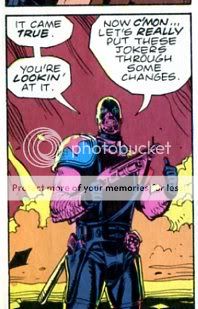
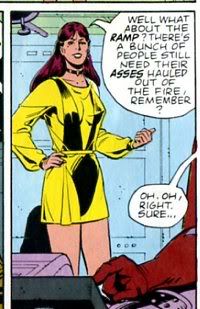
Photobucket

Photobucket

Finally, in her final panel in the book, Laurie is shown speculating about getting a new costume with protective leather and a mask, and perhaps a gun. She also says “Silk Spectre” is too girly and she wants a new name. The implication is that she’s going to become the Comedian.

I guess you could use this to say that she’s just racing to another father figure; defining herself in relation to someone else, etc. etc. But the point here is that she’s not *going to* a father figure. She’s becoming a father figure herself — or accepting the part of herself that is strong, like her father. In discovering who her father is, Laurie seems able to let go of her anger that he wasn’t there for her growing up, and at her need to be weak in order to draw him (or someone like him) back to her. In doing so, she’s able to forgive her mother…or perhaps to realize that there isn’t anything to forgive. “You never did anything wrong by me,” she tells her mom. Directly, she’s telling her mom that sleeping with Eddie Blake was okay — but she’s also saying that she’s not mad at her mom for pushing her to be a super-hero. A few panels later, Laurie’s telling Dan that she’s not going to have kids until she’s had some more adventures. Accepting her parents, she’s able to love her Mom, and be (at least in part) her father.

She’s also able to sleep with somebody who really has nothing to do with either of them. It’s true that at times Laurie turns to Dan for comfort and help — notably after she’s seen the destruction of New York, and she asks him to make love to her. But he also turns to her; it’s she who makes the first move in their relationsip, and she who figures out a way to aleviate his malaise; she saves him by putting on her costume. You could see it as a typical wish fulfillment nerdy loser guy – sexy girl dynamic, I guess — except that Dan, while a nerd in some ways, is hardly a loser — he’s incredibly physically tough; he’s a scientific genius, he’s wealthy, he’s caring and thoughtful, and while his fashion sense is not ideal, he’s quite good looking (“why Mr. Dreiberg, you’re ravishing.”) You can totally see why she likes him, as well as vice versa. I think it’s definitely the case, too, that she is in a lot of ways more butch than he is…though he can be kind of commanding and domineering as well. Ultimately, it doesn’t seem like either of them has to wear the pants (or tights or whatever) in the relationship; they seem like partners and friends. I don’t think it’s any more correct to say that she’s defined in relationship to Dan than it is to say that he’s defined in relationship to her. That is, it’s somewhat correct for both; they’re a couple. They’ve chosen to be together. That’s not a sign of weakness or a lack of character development. It just means that, in contrast to Rorschach or even Adrian, they’re adults.

Laurie convinces Jon to come back to earth by demonstrating to him the improbability of human life; the unlikelihood that this man would love this woman, and so produce this particular child. For Moore, in other words, the miracle of human life is a miracle of *relationships.* That’s why Jon smiles when he sees Laurie and Dan sleeping together at the end; love and the way people create one another is, for him, the beauty of life. People are miraculous because they are made of, or come out of, other people. In accepting her parents, in admitting how she is connected to them, Laurie is able to accept herself, and make choices about what she wants to take and leave from each. Finding that she’s not alone, she realizes that she doesn’t need a savior, but can instead be the hero she was pretending not to be all along.

__________________

This is the first entry in a roundtable on female characters in comics. Tom, Miriam, and Bill will be along with posts on the topic as the week goes along.

Update: I have a follow-up post on Alan Moore’s female characters here

Update:Looking2dastars feels I mischaracterized his comments. His objections are here.

Great Name!

Check out the start of this cite:

Steffie Woolhandler, M.D., et al., “Costs of Health Care Administration in the United States and Canada,” New England Journal of Medicine, August 21, 2003.

Hah!

You Still Can’t Wear the Venus Girdle, But Maybe You Can Hold It for a While

In my last post on the Wonder Woman animated movie, I talked a little about how I felt the film wasn’t very comfortable with femininity. I was thinking about that a bit more, and it struck me again how very few female characters WW meets, and how much that tilts the movie. Basically, WW runs into a little girl who is being prevented from playing pirates, and the sexed up Etta Candy who is ickily dependent on men and on her own sex-kittenish charm. Neither of those two characters is on screen for any time at all, really. So what you’re left with is Amazons (who are tough and manly for the most part) and guys like Steve Trevor and Ares representing man’s world.

As I suggested in my earlier post, this isn’t the way things worked in Marston, where WW was always surrounded by female characters, both Amazon and human. But it also wasn’t true in what I think was probably the (distant) second best take on the WW character; Geoge Perez’s run on the series. I talked about some of my problems with that run here. But the one thing Perez really did right was to have lots of female characters. Etta Candy as a loyal, courageous, slightly older and still chunky military career woman; Julia, a late fiftiesish Greek scholar; her (Kitty Pryde-influenced) teenaged daughter Vanessa; Myra, the quite-but-not-entirely head of an advertising agency…they were all interesting, well-developed characers, with distinct personalities and (even more rarely for super-hero comics) body types.

What was especially nicely done was that Diana was, if anything, *more* interested in these woman than she was in Steve, or in men in general. And she found them interesting not only because they were sisters, or similar to her, but because they were *different.* There’s one line where she comments that Etta is as thick as two of her…but it’s not a dis, she’s fascinated. Perez doesn’t make Diana actually fall in love with any of the women (or with anybody, for that matter), but the excitement at strangeness she feels is a close analog, I think, to romantic excitement — the sense of difference, or unknowability, which is part of what makes love exciting.

You get just a touch of this in the movie, when Diana first sees the crying child and starts to talk about how there are no children on Paradise Island. But it’s pretty much dropped to focus instead on her relationship with Steve — indeed, the whole interaction with the girl seems more about getting Steve a couple of good quips and developing the Diana-is-disillusioned-with-man’s-world meme than it is about exploring Diana’s relationship with kids. Whereas, in Perez, Diana’s relationship with the teenaged Vanessa is a big part of the series — much bigger than her relationship with Steve Trevor, who is more of a marginal character.

Perez seems to have figured out something that the movie didn’t — which is that Wonder Woman goes to man’s world not for men, but for women. Steve Trevor always had a “well, there has to be a romantic interest” afterthought kind of feel; it was WW’s interactions with women that really had some oomph behind them for Marston.

Trina Robbins has an interesting article about WW in which she argues along similar lines:

Girls have needed, at least in their fantasy lives, a safe place to be with other girls, where they could express themselves without being threatened by boys. British girls’ magazines seem to have recognized this need. In my study of four British girls’ magazine annuals, from 1956, 1958, and 196325, I found comics in which the protagonists, usually students from all-girl schools, interacted with other girls, and any male in the stories is usually a villain. In a typical story from 1958, three school girls dress up as “The Silent Three,” in hooded robes and masks26, to help a younger girl whose dog has been stolen by a wicked man, who hopes to use the dog to retrieve a hidden paper that will lead to treasure.

In “Staunch Allies of the Swiss Skater,” from 1956, two British schoolgirls, vacationing in Switzerland, befriend a young Swiss ice skater, buying her a dress to wear for a skating contest. When the girl’s cruel uncle locks her up, forbidding her to enter the contest, they free the girl and find a paper proving he is an impostor, masquerading as her dead uncle “to steal the legacy her mother left her!” One of the contest judges knew the real uncle and would have recognized him. In the end, a British girl hugs the skater and says, “Your troubles are over, Odette dear. You’re free – free to skate!”

American girls’ comics from that period are very different. Instead of the sisterhood themes of the British comics, the American comic stories usually revolve around the theme of the eternal triangle — two girls, one of which is the protagonist, fighting over the Token Boyfriend. Patsy Walker and Hedy Wolfe fight over Buzz Baxter, Betty and Veronica fight over Archie Andrews, and so on. In the women’s community of Paradise Island, girls did not have to have boyfriends; they could be “free – free to skate!”, or free to be themselves and to interact with other girls.

Obviously, and as Robbins notes too, there are lesbian implications here if you want them. But whether or no, the decision in the movie was to make Diana’s most important relationship be with Steve — and Hippolyta’s most important relationship be with Ares actually — it’s because she is spurned by Ares in particular that she closes the Amazon’s off from men for 100s of years, as opposed to other versions of the story, where the personal betrayal (by Hercules, not Ares) is much less emphasized. Men just take up a lot more emotional space than seems warranted in a Wonder Woman story, basically. Perez figured out a better balance.

________________________

Before I leave the wonder woman animated movie forever, I wanted to acknowledge this post at Comic Fodder. Ryan has a couple of thoughtful comments.

Noah Berlatsky live blogged his viewing of the Wonder Woman movie, which I think is kind of a bad idea. Going MST3K on any movie is pretty easy and gets you in the mode of “what can I make fun of” rather than any actual critical analysis of the darn thing. And in your riffing, you can wind up saying really stupid things about how people from the South must hate Abraham Lincoln.

After live blogging, he did post a fairly strong rebuttal to the movie, which i found far more readable, even if I don’t necessarily agree. But he DOES offer up a thoughtful sort of challenge to the filmmakers as per how they could have handled some of the sequences. I’m not sure he noted that the film was actually directed by, voice directed by (and had input from Simone)… all women. That’s not to say women can’t fall into the same traps as male directors, but it does make one pause when considering some of the accusations lobbed the way of the movie.

As far as the Steve Trevor thing: Overall, and on reflection, I think it was actually a nice move by the movie to have the main character be a southerner and not comment on it overtly. So…not my best moment. Apologies.

As far as the movie being made by women…I didn’t look up the creators names, though I assumed it might be a possibility.
Obviously, it’s somewhat problematic for a guy to go around telling women they’re not sufficiently feminist. But then, to go back and say “oh, it’s all right now that I know they’re women!” would be pretty condescending. Damned if you do, damned if you don’t…so I might as well just stick with my original assessment: it still seems like a movie that raises its feminism mostly to cut it down, which is way too kind to its frat boy main character, which generally is dumb and even dishonest about gender issues, and which is quite uncomfortable with femininity.

______________

Other posts in which I explain why no one is as cool as Marston:
One Two Three Four Five, Six, Seven and Eight, Nine.

Update: I’m starting a reread of all the Marston Wonder Womans; first one in the series is here.