We Like Liars That Seem Likable

A great deal has been said and written about the lying our public figures do, recently. After the “misremembering war events” scandal that brought Brian Williams down, Bill O’Reilly has been subjected to scrutiny over his claims of witnessing combat during the Falklands War. This past week, Secretary of the VA Bob McDonald has been criticized for claiming to a homeless man to have been in Special Forces – he was not. Chris Kyle, of course, is remembered as a hero by many, despite having a demonstrable record of lying about events (much of this occurred post-moral injury, when Kyle was suffering from PTSD). Hillary Clinton lied about being shot at by snipers and is polling stronger than any other potential Democratic candidate for President in 2016. Army veteran (who should goddamn know better) and Democratic Senator Richard Blumenthal lied about serving in Vietnam. Republican Congresswoman and military veteran (who should also know better) Joni Ernst has received criticism over calling herself a “combat veteran” using a very broad definition of “combat.”

People lie. There seems to be a fairly broad consensus along the political spectrum that politicians lie a great deal – whether you believe that “your” people lie less or less harmfully probably goes a ways toward establishing how one votes in an election (having become fairly disillusioned, I recently registered Independent, abandoning the Democratic Party). This explains why a state populated primarily by Democrats would elect Richard Blumenthal over his Republican rival, despite his – well – lying about combat. This explains why Democrats are happy to forgive Hillary for lying about being in combat (misremembering is not something that happens when you’ve been under sniper fire once), and why Republicans think that Joni Ernst should be given the benefit of the doubt for her admittedly less egregious (but still fairly stupid) description of having been in combat, when she was posted to Kuwait, quite far from combat. In this case, her description of herself as a combat veteran is less annoying than her repeated and ongoing defense of that untruth.

I should also point out that most combat veterans, myself included, don’t feel that combat experience gives one special insight about life that one would covet, save that combat is a situation to be avoided at all costs. When one considers that politicians who experienced combat throughout history continued to encourage or abet warfare, it’s impossible to conclude that there’s any real utility to combat as a morally didactic lesson, save potentially on an individual level.

It’s slightly different with journalism, in that, technically, in order to call oneself a journalist it’s important that one adhere to certain unwritten but widely-obeyed rules: don’t get involved in a story, don’t plagiarize, don’t lie. O’Reilly has already said he’s not a journalist, and has no credibility with people who aren’t a certain type of conservative – this seems to have insulated him from the brunt of the fury that resulted in Brian Williams’ demise.

And that’s fascinating! Williams, by defining himself as a journalist, made himself more vulnerable to truth-criticisms from people that watch his program than O’Reilly. (For the record, I was fine with him continuing as an anchor – anyone who thinks journalists, who are human, don’t directly or indirectly lie [routinely] should be banned from ever voting)

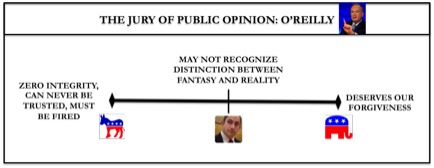
I wanted to compare how various public figures seem to be judged on their military lies, so I threw together a basic chart and mapped public perceptions of journalists and other truth-tellers onto it.

What I found was… well, not shocking at all, really. O’Reilly’s posse sticks up for him and he won’t be fired despite having lied I’ve put myself on the spectrum (right in the middle there) because if one is going to make a claim about a thing, well, have the sack to tell others where you fall.)
 

o'reilly

 
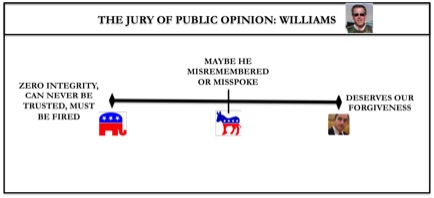
And Williams, who has a more discerning audience that is willing to entertain shades of gray, suffers by comparison:
 

william

 
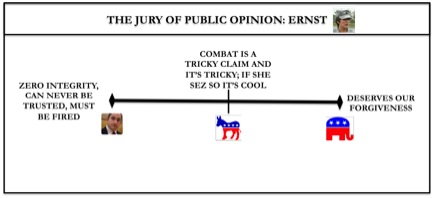
And just to see how that works out with politicians – there’s the Republican case of Joni Ernst, who has claimed (playing off a credulous public’s unfamiliarity with battle and sympathetic media) that she was in combat because she was in a combat zone. Which is exactly like me saying I got the shit kicked out of me once at a bar because there were a group of guys at the end of bar muttering and looking over at me and I was really worried about getting the shit kicked out of me. Someone who had once gotten a severe ass-whipping would probably take issue with my claim, as I do hers. Let’s see if she’s going to be fired or held to account or not (remembering that this is a question of whether or not someone’s worthy of the trust, confidence, and respect of the public):
 

ernst

 
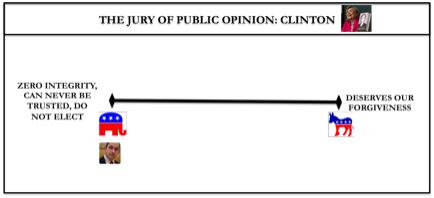
Looks like Ernst is gonna be okay – the Republicans have her back (not surprisingly), and the Democrats / media don’t feel like evaluating her claims on their merits, and calling a liar a liar. Of course, if they did that with Ernst, they’d have to do that with Hillary Clinton, the putative fundraising frontrunner for 2016, and – don’t forget – maybe our first female president. What does it matter if she happened to lie about – well, anything?
 

clinton

 
I’m also down on Clinton because of that “we need to go into Iraq” thing she did, which if anyone remembers, was basically responsible for all the horrors we see in the Middle East today – a place that used to be filled with sensible dictators who were amenable to bribes and arms deals and could be relied on to limit their war crimes to 25,000 or 30,000 dead every decade – a tiny fraction of the dead since we became involved over there. But it looks like she’s going to walk, too.

In conclusion, the lies that get told to us by our political leadership don’t seem to matter as much as the lies that are told by people who call themselves “journalists,” which may or may not involve abiding by a set of agreed-upon rules to tell stories in a certain way. And while “liberals” or “progressives” tend to evaluate journalists and people outside their group more generously than “conservatives,” both groups are equally bad at applying rigorous scrutiny to their politicians.

So it goes.

Misandry Everywhere

I’ve written a fair bit here and there about misandry and discrimination, prejudice, and violence directed against men. It seemed like it would be useful to have all the links collected in one place…so here they are, in roughly chronological order. I think this is everything, but if you see something I’ve missed, let me know.

Misandry and the Trayvon Martin Case

Misogyny Hurts Men Too

When Men Experience Sexism

On stereotypes of men in Orange Is the New Black

An interview with genocide scholar Adam Jones, who does a lot of work on violence against men.

What Hollywood Needs Is Fewer Strong Male Characters

On Andrea Dworkin, hating men, and the patriarchy.

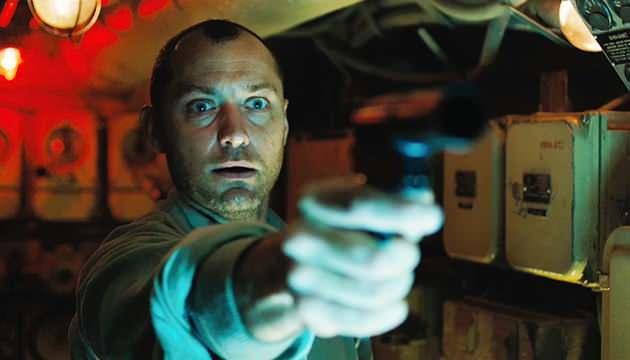
On the film Black Sea and the disposability of working-class men.
 

45b2fba2bd0e5a6899d730316b13bfc4fd2e2b51

Utilitarian Review 2/28/15

On HU

Featured Archive Post: Comics vs. fashion editorials.

James Lamb on why superhero diversity isn’t enough.

Me on Static and how if you see racism you’re a supervillain.

Tom Syverson on The Bachelor, hysteria, and the pain of being an object.

Chris Gavaler on Paradise Lost, the first superhero story.

R.M. Rhodes on the contribution of art director John Workman to Heavy Metal.

Me on X-Men: Days of Future Past and the coming post-racial genocide.

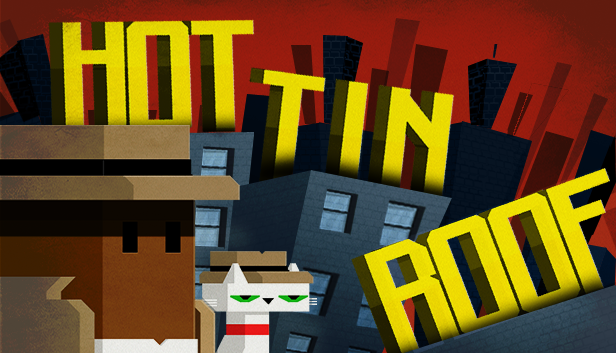
Shonté Daniels reviewed the game Hot Tin Roof.
 
Utilitarians Everywhere

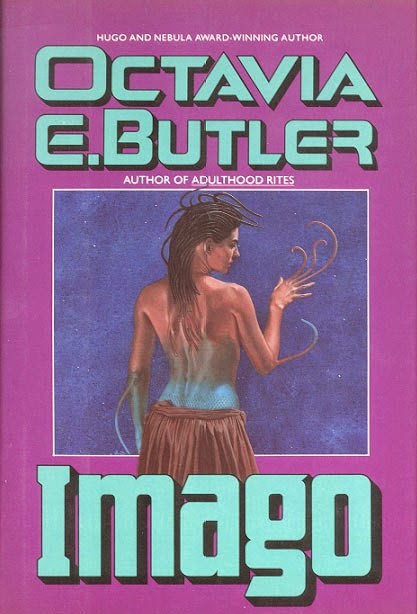
At the New Republic I wrote about the limits of diversity and how Octavia Butler created the greatest black superhero.

At Ravishly I wrote about:

—I interviewed Dee of blackrocktumblr about genre, rock, and race.

—I wrote about our forthcoming dog.

—I write about how writers aren’t romantic heroes.

At Splice I cheered Rahm not winning because he is a terrible mayor.
 
Other Links

Kenya Golden on Amber Rose.

Alyssa Rosenberg on barriers to the entertainment industry getting more diverse.

C.T. May on Harlequin and feminism.

New Open Mike Eagle EP
 

Imago

Batman Never Goes Bad

joker_surf

 
Various people had informed me that the Batmobile drove off a cliff in the third season of the Adam West TV series. Budgets plummeted, single episodes rather than two-parters became the norm, direction was lost, and sadness reigned even among the giggling villains. Matt Yockey argues that the growing political turmoil of the 60s made it harder for the show to sustain its delicate balance between conservatism and satirizing conservatism, leading to incoherence, dwindling market share, and falling quality.

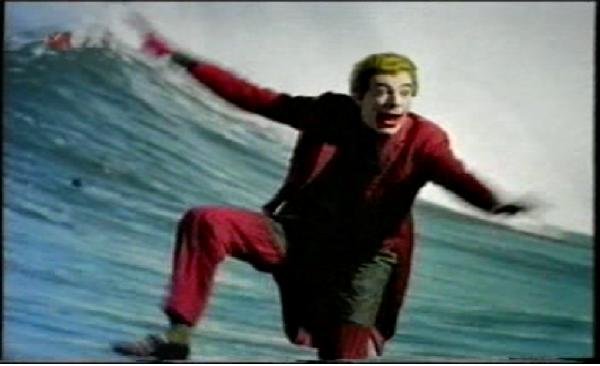
At least as far as the last goes, it ain’t necessarily Bat-so, though. The low points of the series aren’t in the third season, I don’t think — nothing is clearly worse than the first episode of the 2nd season, or than the limping crossover with the Green Hornet. There are certainly weak moments — the three-part trip to Londinium, largely composed of half-hearted jokes about how the British are so British, is pretty crappy, and the special sexism episode where Nora Clavicle takes over the police department is just about as offesnive as Chief Screaming Chicken. But, on the other hand, the shorter episode length and the sense of improvisatory confusion lends some episodes a manic genius rare in the rest of the series. The Joker surfing episode is particularly brilliant, abandoning all pretense of coherence as the Joker uses a machine to sap the abilities of a pro-surfer and challenges Batman to a surf-off because supervillains want to rule the beach? The whole episode seems like an excuse to get Chief O’Hara to declare, “Cowabunga, B’gora!”

So, if the quality doesn’t fall off, particularly, why do people insist it does? Hard to say…though I think there’s an impulse to try to find some aesthetic reason, or (with Yockey) some historical reason, or really any reason at all for the show’s meteoric ascent and equally meteoric fall. Everyone loved it, so the show must have been doing something right — then everybody stopped loving it, so the show must have been doing something wrong.

I do think popularity often has something to do with quality or aesthetic choices — but what or why is often hard to figure. Maybe Batman grabbed the zeigeist just right as Yockey suggests, and then the times passed it by. But then again, maybe people just got tired of it. Capitalism is prone to bubbles of various sorts; for a second there everyone wanted Batman, the way everyone wanted mortgage securities or tulips. Then people stopped wanting them. The tulips were never worth anything to begin with; Batman never changed in quality. But the market revalued them because that’s what the market does. It’s sort of like the Penguin infecting all the cash in Gotham city with a beetle-carried sleeping sickness. It doesn’t have to make much sense.

Noir Minus Shooting People

MainCapsule616x353

Hot Tin Roof gives you a cat, a gun, and makes you figure out the rest

Hot Tin Roof: The Cat That Wore a Fedora by Glass Bottom Games is a noir themed 3D side-scroller starring Private Investigator Emma Jones and her feline partner, Franky. With Jones’ all purpose revolver, the two scour all over to solve the slew of unsolved cases that have plagued the world of Tin Roof.

The game is an innovative blend of mystery, platforming, puzzles and exploration. It finds inspiration in games like Metroid and Castlevania yet carves its own identity in with its 3D, noir roots sultry smooth jazzy shadow lighting and snarky dialogue. This is the most enjoyable part of the game, exploring Tin Roof and its civilian characters. It was fun and playful while maintaining a sort of seriousness I expect in a noir drama. Think less like Rockstar’s L.A. Noire and more “Radio Daze,” the Rugrats episode where Tommy, the masked detective, solves the mystery of “The Maltiese Woodchuck”.

The game rewards you for exploring outside of the beaten path, but going off the beaten path sometimes leads to a lot of confusion and aimless walking. Hot Tin Roof‘s world isn’t exactly easy to comprehend, and unfortunately there is no map system in the game. It’s a large enough world, with enough twists and turns, to make getting turned around incredibly easy. Similarly, the game doesn’t provide a solid way to point the player toward progress.

Hot Tin Roof does have a tip system to help you if you’re stuck, but even then those tips aren’t always useful. Further, tips can only be accessed at the police department, so heading back to get a tip is not always convenient. Hot Tin Roof relies on the player’s patience and intelligence to figure out where to go next, but unfortunately my patience wore thin quickly. The game does very little hand holding, which is great when you want to work through a puzzle on your own, but a little nudge now and then would have been appreciated.

I also faced a few issues with small bugs. Towards the end of the game, when I caved and checked a forum to figure out what to do, I discovered that there was a bug that prevented a conversation from starting that would have helped me know where to go next. There were other dialogue related bugs, where conversations were either cut off or didn’t pop up at all, but the developers have been routinely patching the game, so the minor problems I faced are already fixed.

Issues aside, there is still a lot to enjoy about this game. Jones’ revolver wasn’t perfect, but it was a fun tool to play with. Reloading the revolver felt slow at times. There is a shortcut to instantly reload, but it only reloads one specific bullet into each chamber. Sometimes a puzzle required different kinds of bullets to complete, so if I wanted, for instance, two bubble bullets and two fire bullets, I’d have to reload those manually. Since the gun is crucial for the entire game, reloading did lose its luster after the first few times.

But on the plus side, I never had to kill an enemy, and that actually felt really good. Rather than shooting baddies or pointing the gun at enemies to intimidate them, I used the gun to reach high places, burn boxes or find invisible items, among other things. Using a gun as everything but a weapon allowed the game to keep its not-so-serious noir charm. And hey, gathering new clues did feel rewarding, especially if I found them without having to hunt for too long. I may not have always known what I was doing, but neither did Jones, so we had that in common.

Hot Tin Roof does a great job of creating a world I want to solve crimes in. It requires intelligence, curiosity, and most importantly, patience, to solve all the mysteries Tin Roof face. The game is missing a few key mechanics like a map and hinting system that could have prevented the game from being infuriating at times, but even without it I found enjoyment in the city of Tin Roof. There were a few splendid moments where I felt like a real detective, running around gathering search and arrest warrants to capture the poor chump who thought they could get away Scot-free.

The Coming Post-Racial Genocide

maxresdefault
 
X-Men: Days of Future Past proves Bryan Singer’s genius as a director. You wouldn’t think that racial genocide could be boring, but Singer manages to make it so. Partially he does it through the standard repertoire of tedium; lax dialogue; a convoluted plot that goes nowhere in particular before flopping over and giving up; a style that leaves even moderately talented actors like Hugh Jackman and Jennifer Lawrence adrift and disconnected from any recognizable plot arc or emotion. The narrative calls for Jackman’s Wolverine to be mellow lest he zap out of the past into the future; he responds by alternating between bland-face and stressed-face throughout the film; you can hear the audible click as Singer asks him to switch them.

The central failure of the movie, though, is that it systematically tries to erase the thing it should be about. The storyline is about a future in which the X-Men are hunted down and killed by an inimical human race. It’s a movie about genocide. And yet, the mechanics of genocide figure nowhere in the film. Not a single person expresses hatred or prejudice towards mutants; even the evil scientist Trask, who builds the killer Sentinels, seems to have no particular dislike of mutants; instead he seems to see them as a convenient bonding moment for humanity; a way to unite the human species against a common foe. Trask is Ozymandias and he has no more ill-feeling towards the X-Men than Ozymandias had towards his giant squid. The closest anyone in the movie comes to an expression of racialized disgust at mutants is a nurse who comments to a disguised Mystique that having blue skin might make you feel bad about your appearance. Hardly the stuff of Nazi propaganda, there.

Just in case you missed the point that the genocide is really nothing personal, the script goes out of its way, over and over, to let you know that there were lots of good humans who fought with the mutants against the killer Sentinels. Also, to let said regular humans were thought to to be likely to have mutant kids. This then is a mutant genocide in which humans neither hate mutants nor really single them out for harm. And yet, it’s not like the film is especially squeamish in other matters; Wolverine murders several people in casual cold blood. Video game body count death tolls are fine, apparently, just as long as no one really means anything by it.

Over the course of the film you get to see Sentinels murder various X-Men multiple times. Each murder is then erased by mucking about in the past, so you get the visceral rush of seeing folks dismembered without having to worry overly about the consequences. That seems to be the movie’s whole purpose; to enjoy genocide unmixed with any historical or ideological resonance — to turn the Holocaust into an inoffensive special effects extravaganza. In the future, the movie promises, the past won’t matter, and superpowers will reign down death divorced from animus, or even really from brain functioning. Drones will watch drones blow up without hate, or apology. Or interest.

That Time When Heavy Metal Went Quarterly

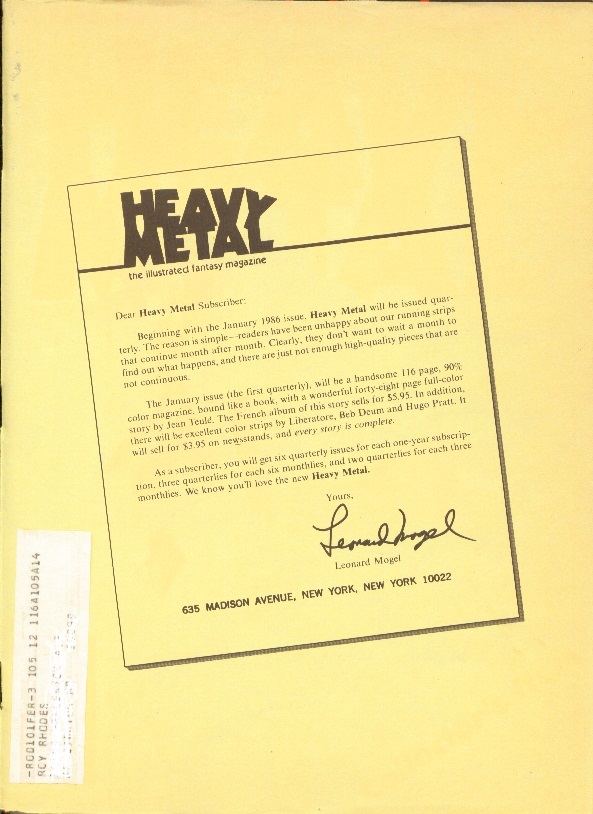
When subscribers received their copy of the December 1985 Heavy Metal in the mail, they were greeted with a letter from publisher Leonard Mogel, printed on the paper mailing wrapper, informing them that with the next issue, Heavy Metal would be moving from a monthly publication schedule to a quarterly schedule. The reason provided was simple: readers were unhappy with the fact that the stories in the monthly version of Heavy Metal continued from one month to another. Quarterly publication allowed the magazine to increase the page count from 96 to 116 pages, add perfect binding and to publish complete stories in each issue. Oh, and the cover price went from $2.50 to $3.95 (the equivalent of jumping from $5.40 to $8.53, adjusting for inflation).

Having read every issue of Heavy Metal through 1986, I’m not entirely convinced that “the audience wants complete stories” was the whole reason for the shift in publication frequency. Looking at the individual magazines that were published in the years before the shift, it’s easy to spot how a combination of cost-cutting measures and behind-the-scenes change in staff might have also contributed. Having said that, “readers want complete stories” was convenient and easy to explain and a lot more audience-friendly than “we’ve had some staff issues.”

And boy, did they have staff issues in 1984 and 1985. But in order to explain the full impact of those staff issues, we have to go all the way back to the January 1978 issue of Heavy Metal, when John Workman became the magazine’s second Art Director. In that January issue, Workman was co-credited as Art Director with Harry Blumfield, who had been working in the position since the first issue. In February, Blumfield was gone and Workman was in.

Workman’s influence was not obvious at first, but over the course of the next two years, he built up the quality of the production. When editors Sean Kelly and Valerie Marchant were replaced by Ted White in 1980, Workman survived the transition. He also survived when Ted White left at the end of 1980 and was arguably one of the mainstays holding the staff together during the transition. Throughout this period, Workman’s name lingered near the middle of the credits on the masthead, never getting higher than fourth. This is significant, because I believe where the individual ranked on the masthead was indicative of where they fit into the staff hierarchy; whether or not this is true, it seems clear that members of the staff at the time believed it to be true.

In fact, Leonard Mogel’s name appears at the top of the masthead throughout most of 1981, reflecting a more active involvement in the day-to-day activities at the time. Julie Simmons-Lynch is credited as the editor, but it was obvious that she didn’t have the same kind of hands-on relationship with the production as Kelly/Marchant or White. They needed someone to pitch in and take care of operations.

Accordingly, in the March 1981 issue, a new name appeared on the masthead – Brad Balfour, Contributing Editor. His editorial efforts were largely forgettable, but Balfour was a terrible interviewer and badly botched an interview with Richard Corben which ran in June, July and August of that year. This series precipitated an angry full-page letter from Corben, who demanded that the letter be printed in full, with no edits. This letter appeared in the September 1981 issue, the same issue that was dedicated to the Heavy Metal movie that was released on August 7th of that year. It was not the best use of editorial synergy and was largely reflective of the state of the magazine in 1981.

In addition to the movie, which brought in hordes of new readers, the other major event of 1981 was the release of an entire special issue, dedicated entirely to Moebius. This Moebius special featured (among other things) an introduction by Federico Fellini and the first few chapters of The Incal, a serial written by Alejandro Jodorowsky and drawn by Moebius. Workman and his team did a lot of the heavy lifting for this issue and Workman was given top billing in the masthead. Perhaps coincidentally, Mogel’s name was no longer on the masthead for the December 1981 issue of Heavy Metal and Workman’s name was second, right underneath Simmons-Lynch and above Contributing Editor Balfour. Workman’s name remained in this position on the masthead until he left in 1984.

Workman’s contribution to the magazine was everywhere and, thus, only truly obvious after he left. He contributed a lot to the look and feel of the individual issues, producing spot-art and the occasional one-page story when it was necessary to fill a gap. Although he was never credited as an editor, he was the Art Director in a publication dedicated to art and the magazine was better off having an Art Director in such a prominent role in the leadership.

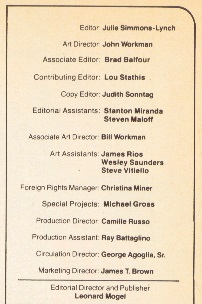
The February 1982 masthead had some major changes. In addition to Brad Balfour becoming an Associate Editor, there were some new names, most notably Lou Stathis as Contributing Editor and Steven Maloff as Editorial Assistant. Since October 1981, Stathis had been working on Dossier – the spiritual heir to the columns that White had added when he was the editor in 1980. In this incarnation, Dossier was focused largely on music, with healthy digressions on movies, books and video games. There were far more writers than White had in 1980 and the topics bounced all over the place.
 

feb82

February 1982 masthead

 
Balfour was the first real editor of Dossier, but Stathis took over when he was promoted to Associate Editor in May 1982. As for Balfour, he was credited with “Special Projects” and disappeared from the masthead entirely in October 1982. Maloff was promoted to Contributing Editor in July 1982 and not a lot else changed in Heavy Metal leadership for the next two years.
 

dossier NOV 83

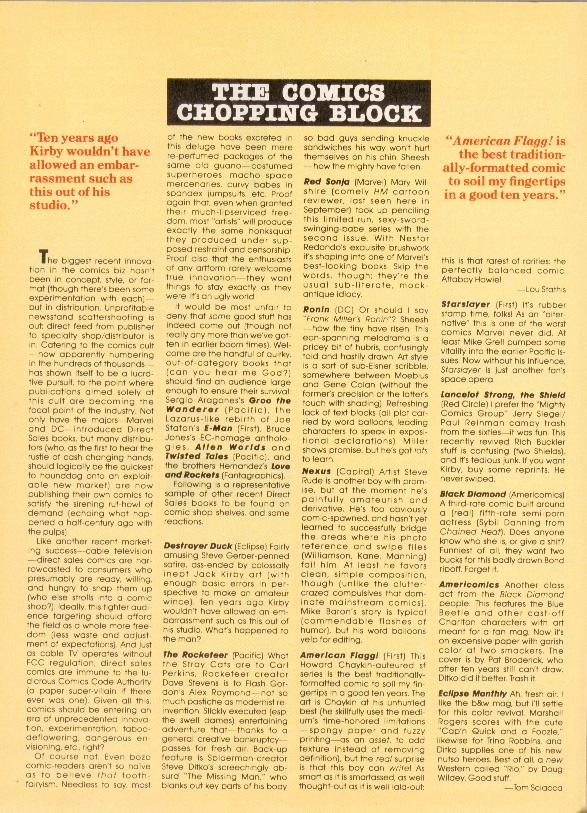
Dossier November 1983

 
I would argue that this incarnation of Heavy Metal, with Workman, Stathis and Maloff, was one of the best periods of Heavy Metal, full stop. When Stathis wasn’t busy picking fights on the letters page (sample response: “Yeah, but I’ll bet your dick has to hunt and peck when it types.”), he was turning Dossier into a powerhouse review section that also ran interviews with all kinds of creative types, from Jerry Lewis to Jack Davis and everyone in between.

For his part, Workman was busy turning Heavy Metal’s visual content into something legendary. In addition to long-running series like Rock Opera by Ron Kierkegaard, The Bus by Paul Kirchner, Tex Arcana by John Findley, and I’m Age by Jeffery Jones, Workman also put together a series called June 2050. This featured one-page vaguely science fictional stories by various comics luminaries including Dick Giordano, Chris Browne, Drew Friedman, Rick Veitch, Bill Dubay, Len Wein, Todd Klein, Rick Geary, Howard Cruse and Pepe Moreno.

It’s not clear where Steven Maloff’s influence can be seen during this period.

In 1982, Heavy Metal released a second special issue, their first Best Of. In 1983, they decided that they had enough material to produce a 13th issue, which was branded Even Heavier Metal. Both of these were masterminded by Workman and it’s interesting to note that neither Stathis or Maloff were credited in Even Heavier Metal (I don’t have Best Of #1) – presumably because there was only comics and art-related material on offer. This changed in 1984, when Son of Heavy Metal was released. Here, Maloff was credited as Associate Editor, the only masthead that shows him with this particular title (he was promoted to Managing Editor in July 1984).

1984 was not a particularly good year for Heavy Metal, production-wise. In January, Bird Dust, a story by Caza was reprinted (a first, for a magazine with so much content that it felt compelled to print 13th issues three years running) – it had originally been printed in the November 1977 issue, two issues before Workman began. In April, the cover price went up to $2.50, the first price hike since February of 1980. The next month, in June, 16 of the 96 pages of the magazine changed from the usual glossy paper to newsprint; this was ameliorated somewhat by printing Dossier and Tex Arcana, a black and white feature, on the lower-quality paper. Coming so close upon the heels of the cover price hike, the lowered paper quality hints strongly at money problems.

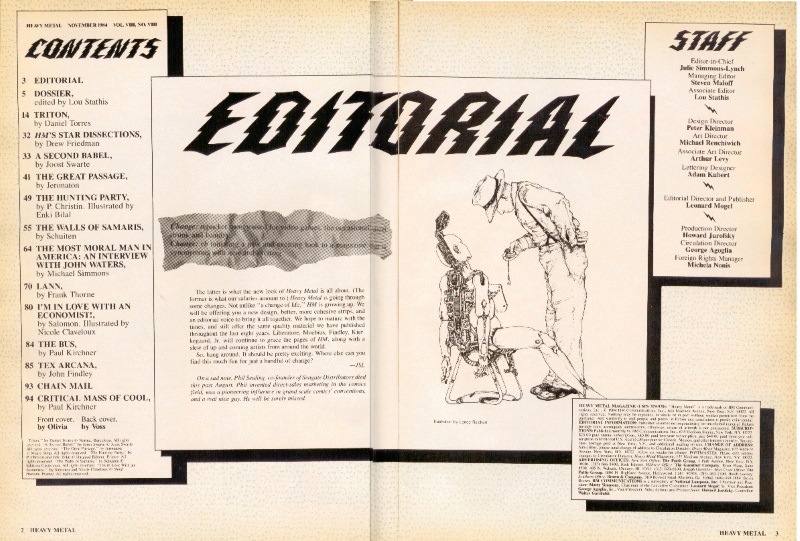
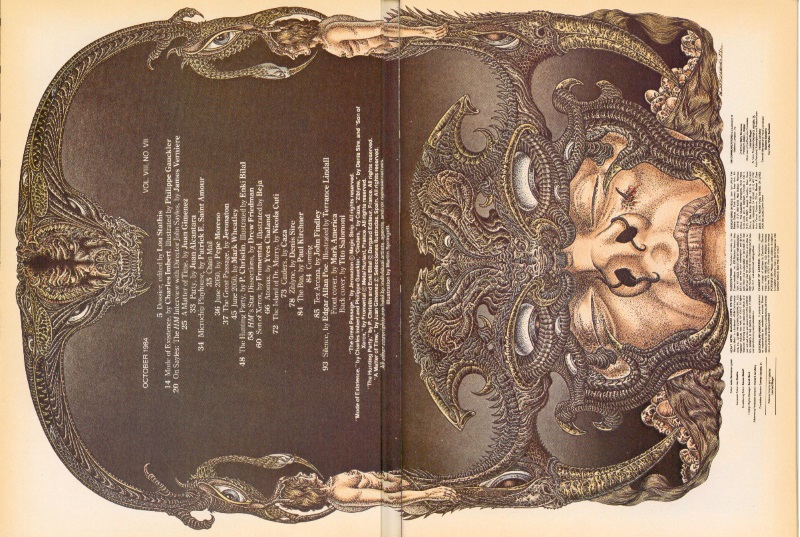
And then John Workman left the magazine. The October 1984 issue was clearly laid out by Workman, although his name does not appear in the masthead and neither does his staff. It’s not entirely clear if the departure was planned or unplanned, but there is a clue in the masthead. Steven Maloff, who had been credited as Managing Editor since July 1984, was temporarily demoted back to Contributing Editor in this masthead, which is almost hidden on the credits page. It’s very subtle, but it’s absolutely a message of some kind in Maloff’s direction.
 

oct84_editorial

October 1984 editorial

nov84_Editorial

November 1984 editorial

 
Indeed, the very next month, Maloff’s name was now above Stathis in the masthead, where Workman’s name resided since 1981. There was clearly some kind of power struggle and Workman lost. The magazine was not better off without Workman – the production quality of the magazine dropped significantly in that single month and never really recovered. It was Balfour all over again, only this time they didn’t have a movie bringing in new readers or John Workman providing support.

There is no better indication of how bad things got, production-wise, than the 13th issue from 1985 – Bride of Heavy Metal. Workman was long gone by the time this came out and the little details that Workman put into the special issues he produced are not here. And instead of providing distinct credits, the whole issue was “Compiled by the Staff of Heavy Metal magazine,” which is as vague as it gets.

As bad as 1984 was, 1985 was worse. My copy of the February 1985 issue has a major printing error – the registration lines from the red ink don’t quite line up in one of the signatures, an issue that hadn’t been seen in years. In April, Maloff took over editing Dossier from Stathis. In May, the paper quality dropped again, including four bright white pages that were a step up from newsprint, but a step down from the normal glossy paper and tended to let the art from the other side of the page bleed through. In June, the whole magazine had switched to this new paper stock, replacing both the newsprint and the glossy paper. And, in July, Stathis was completely off the masthead. Maloff was now in charge of the magazine, for better or for worse.

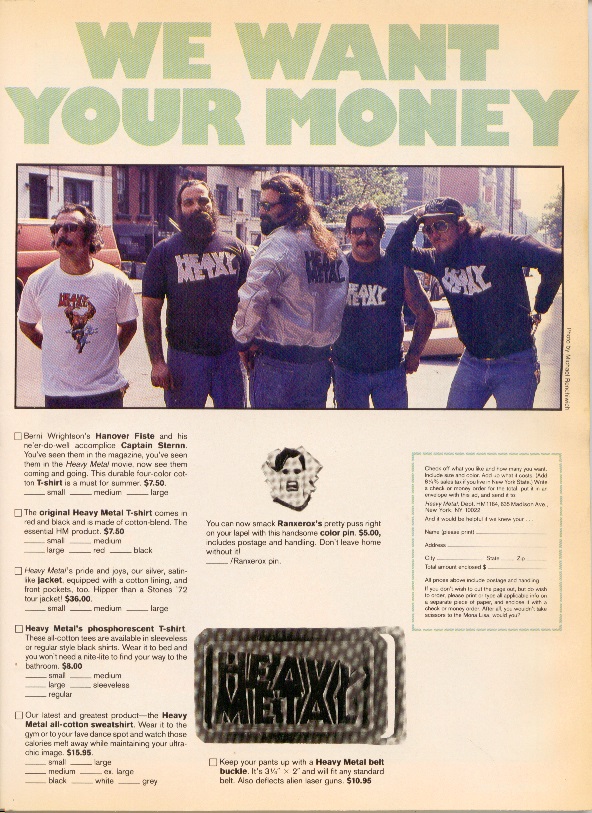
One of the lesser ideas that Maloff introduced in July 1985 was a full page of trivia questions called Trivial Metal. In that issue, the answers were not provided and it was run as a contest – readers were encouraged to send in answers with a chance of winning a sweet satin-like jacket with the Heavy Metal logo printed on the back. The contest aspect of Trivial Metal didn’t last long and, by the next issue, the answers were printed upside down on the same page as the questions. This continued for another issue and, in October, the feature was not there. In November, neither was Maloff.
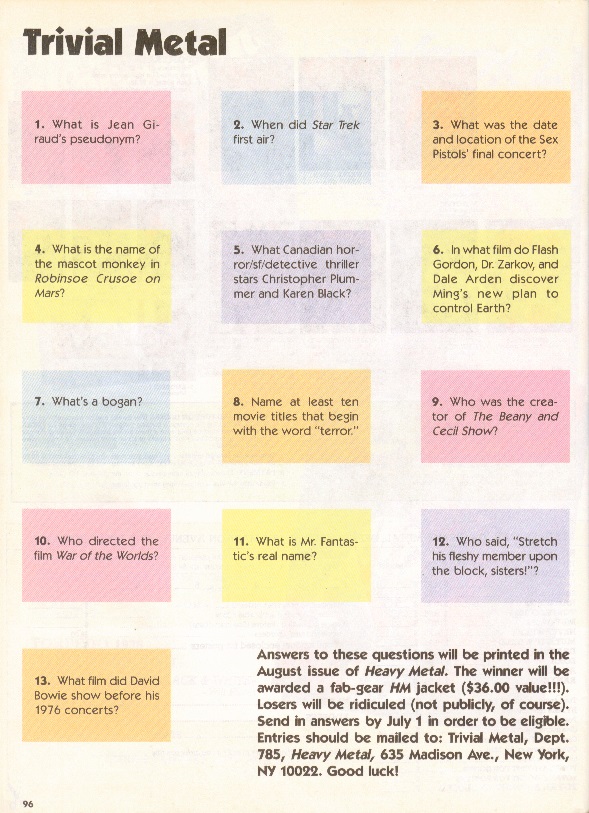
 

trivia JUN 85

Trivia June 1985

sweet satin-like jacket

 
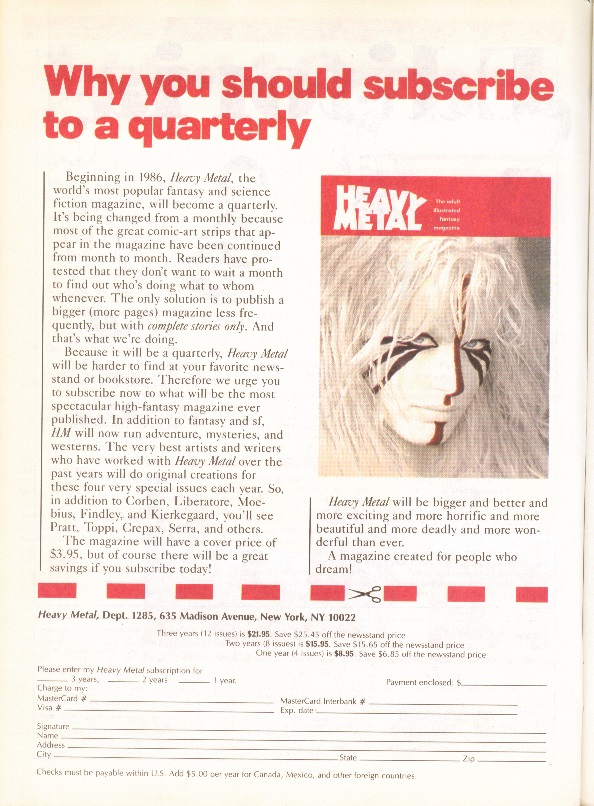
His position was not filled, exactly. Michela Nonis had been promoted to Production Manager in April 1985 and, absent Maloff, became the default bigwig. It’s difficult to tell if going quarterly was her idea or not, but it was certainly a decision rapidly made. The September 1985 issue has a subscription ad that features a good deal for a three year subscription, which pretty clearly indicates that the staff thought they were going to be publishing a monthly magazine for the foreseeable future. There were no subscription ads in October and, in November, the last installment of Dossier published seven interviews – clearing out the backlog of interviews that they had stocked up over time.

The subscription ads and editorials in the December 1985 issue leaned very heavily on the idea that readers had been clamoring for complete stories in every issue for years and the change in format was completely not a last-minute decision by a staff that had run out of ideas for ways to cut costs. This was clearly propaganda, but propaganda that was easier to promulgate than explaining how they’d lost their star Art Director in a power struggle over whose name got to be on the masthead of the 13th issue a year earlier.
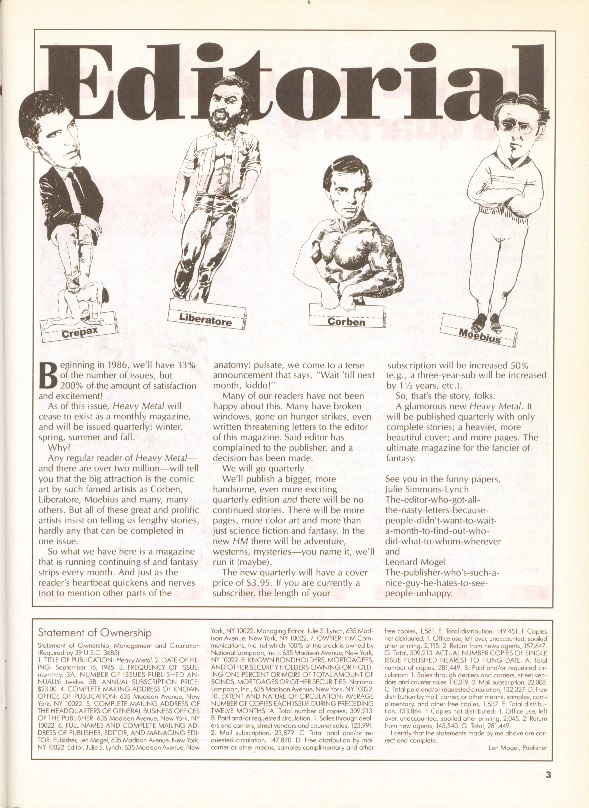
 

editorial DEC 85

December 1985 editorial

subscription DEC 85

December 1985 subscription

wrapper DEC 85

October 1984 subscription

 
I’m convinced that the loss of John Workman led directly to the transition of Heavy Metal from a monthly magazine to a quarterly magazine. True, each of the new issues contained only complete stories, but that was not necessarily a good thing. In January 1983, at the height of the Workman/Stathis years, the magazine boasted fifteen features, not including Dossier. Five of them were short – half-page or single-page comics, but the range and quality of the material was extensive. The first issue of the new format boasted seven full-length features. One featured short, episodic stories and the other offered novellas that were promised to be stand-alone (ie, no sequels).

In addition, there was a certain frisson that came from reading several serialized comics right on top of one another, anthologies being sort of the entertainment equivalent of eating a multi-layer cake or club sandwich. There were a lot of weird, conflicting flavors, true, but the experience was richer for it. Reading two (or more) serials at the same time over the course of several periodical installments creates an associative memory between the two (or more) stories, an effect that can only be achieved through sequential episodic serialization. Complete, non-sequential stories offer a pale echo of the same experience, but cannot (by definition) offer the experience of following a serial across multiple installments.

Publishing quarterly didn’t last. After three years, Heavy Metal changed their publication schedule again in 1989, moving to bimonthly and eventually being sold to Kevin Eastman in 1992. In nearly nine years as a monthly magazine, over a third of all Heavy Metal issues to date were published between 1977 and 1985. It was a strong brand that spawned a movie, innumerable branded clothing options and a number of imitators (the so-called ground level anthologies, most notably Epic Illustrated, which coincidentally folded in 1986). It was a mainstay on the magazine rack, month in and month out. Dropping the frequency of publication really limited its visibility in a big way.

In my opinion, the biggest loss was Dossier, which didn’t fit the new format. The Dossier section turned readers on to any number of great bands, songs, albums, movies, authors and other entertainment options they might not have otherwise been exposed to. Dossier had the potential to become a monthly guide to cool, weird stuff for a certain kind of reader with access to a decent record store. Lou Stathis was a contrary proto-goth with a severe aversion to dickheads, but he had great taste in music.

In 1986, as the publication frequency changed, there was an attempt to spin Dossier off into a weekly newsletter called Heavy Metal Report. I can find no information about this spinoff online (and my father, who I inherited my collection from, was clearly not interested because he had no copies). The loss of this review section remade Heavy Metal into more of a pure comics magazine, significantly disconnected from contemporary pop culture.

At SPX, Joe McCulloch reminded me that the stories published in the quarterly years were actually pretty good. A Corto Maltese story by Hugo Pratt, the introduction of Druuna by Eleuteri Serpieri, an old Moebius story and a new Enki Bilal story were all printed in the first year. In fact, one of the few things that survived both the departure of John Workman and the switch from monthly to quarterly was the overall quality of the comics stories. Not every story was a winner, but when they were good, they were very, very good. Moving forward, there were just fewer of them, complete in every issue.