Action Comics No. 1 was the Big Bang of the Golden Age of Comics, the start point for superhero history. Unless you count the actual Big Bang, which was about fourteen billion years earlier. Or, if you favor a different species of evidence, more like six thousand. Genesis 1:2 opens with a black hole: “the earth was formless and empty, darkness was over the surface of the deep,” followed by God’s “Let there be light,” the Biblical Big Bang.
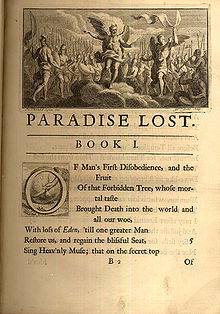
Milton doesn’t give an exact date in Paradise Lost, but he says God created Earth just after booting Satan out of heaven:
There is a place
(If ancient and prophetic fame in Heav’n
Err not) another World, the happy seat
Of some new Race call’d Man, about this time
To be created like to us, though less
In power and excellence, but favour’d more
Of him who rules above;
That’s Beelzebub, one of Satan’s lieutenants, talking. He thinks attacking Earth is a better military strategy that storming Heaven. When Satan flaps across the void to check out God’s latest creation, Milton likens it to the wonder of looking upon “some renown’d Metropolis / With glistering Spires and Pinnacles adorn’d.”
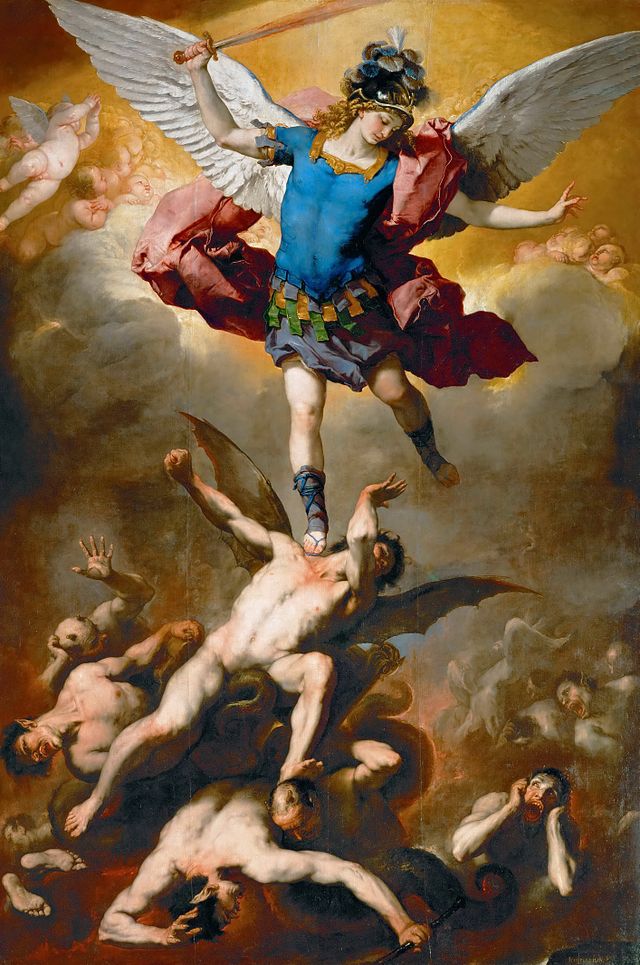
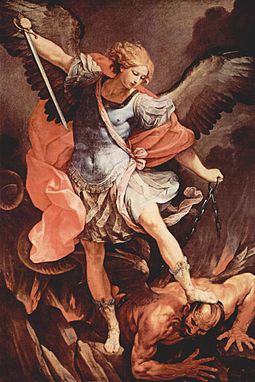
Paradise Lost is basically a superhero comic book, with long slug fests between Lucifer’s League of Fallen Angels and Archangel Michael’s Mighty Avengers. My father remembers hearing the tale from the nuns in his school. He emailed me about that recently:
“Have you ever commented in your writings on what I consider the archetypal superhero plot, one that has its origin in the Bible? I’m referring to the story of archangel Michael being called on to save heaven from being taken over by Lucifer by having a violent confrontation with Lucifer and vanquishing him. This story is so embedded in the western religious psyche that to this day Catholics still pray to St. Michael to ‘defend us in battle’ with Lucifer.”
It’s not the sort of question you might expect from a retired research chemist, but my father only entered the field because he had his brother’s textbooks after his brother became a priest instead. My father’s colleagues were all theoretical physicists, but he preferred working alone in his lab. He said his job was playing Twenty Questions with God. Every day he had time for one: Does it have something to do with . . .
“The reason I think the Michael/Lucifer story is of critical importance is that it injected into the human psyche the concept of the need of an ubermensch (not a collective effort) to defeat evil and save the people. Ever since people are continually looking for such a person, most of the time to their eventual detriment when they believe they have found one. I believe this powerful subconscious longing in the western world for a superhero to save us from evil originated from the Michael/Lucifer story.”
“That’s pretty good, Dad. I hadn’t thought of Michael as the original superhero. I may have to flagrantly steal your insight.”
“I would be delighted if you chose to. An interesting part of the Michael/Lucifer myth is that it is not spelled out in any detail in the Bible. There is only a brief snippet about Michael slaying dragons in Revelation and that’s it – nothing about a great battle between Michael and Lucifer. In the long version, as I learned from the nuns, Lucifer is portrayed as the greatest and most brilliant of the angels. In his great pride, he decides to challenge God as the ruler of heaven. So God dispatches Michael to battle Lucifer, which he does, defeats him and sends him down to the lower regions. (Why an all-powerful God didn’t take on the job himself was never explained.) This long version came down through the centuries strictly through oral tradition. The fact that it has been retold countless times for probably over two thousand years demonstrates, I believe, its powerful grip on the human imagination.”
When I looked up Revelations 12, I couldn’t help imagining how Jack Kirby or Steve Ditko would illustrate the passages. The New Testament author even divides his script into panels. You just need some caption boxes:
[7] And there was war in heaven: Michael and his angels fought against the dragon; and the dragon fought and his angels, [8] And prevailed not; neither was their place found any more in heaven. [9] And the great dragon was cast out, that old serpent, called the Devil, and Satan, which deceiveth the whole world: he was cast out into the earth, and his angels were cast out with him.
I’d assign Rev. 20 to Neal Adams or Bill Sienkiewicz:
[1] And I saw an angel come down from heaven, having the key of the bottomless pit and a great chain in his hand. [2] And he laid hold on the dragon, that old serpent, which is the Devil, and Satan, and bound him a thousand years, [3] And cast him into the bottomless pit, and shut him up, and set a seal upon him, that he should deceive the nations no more, till the thousand years should be fulfilled: and after that he must be loosed a little season.
Daniel 12:1 makes Michael sounds like a superhero too: “At that time, Michael, the great heavenly prince, the grand defender and guardian of your people, will arise.” Thewarriorprince.us, a website devoted to him, says his “prime duty is to guard and defend the people of God collectively, and those who invoke him individually, from Satan and his demons, as well as their wiles and attacks.” And, according to Milton, those chains he uses on Satan are adamantine, basically Wolverine’s claws. No wonder God made him team leader:
Go Michael of Celestial Armies Prince,
And thou in Military prowess next Gabriel, lead forth to Battel these my Sons
Invincible, lead forth my armed Saints
By Thousands and by Millions rang’d for fight;
Equal in number to that Godless crew
Rebellious, them with Fire and hostile Arms
Fearless assault, and to the brow of Heav’n
Pursuing drive them out from God and bliss,
Into thir place of punishment, the Gulf
Of Tartarus, which ready opens wide
His fiery Chaos to receave thir fall.
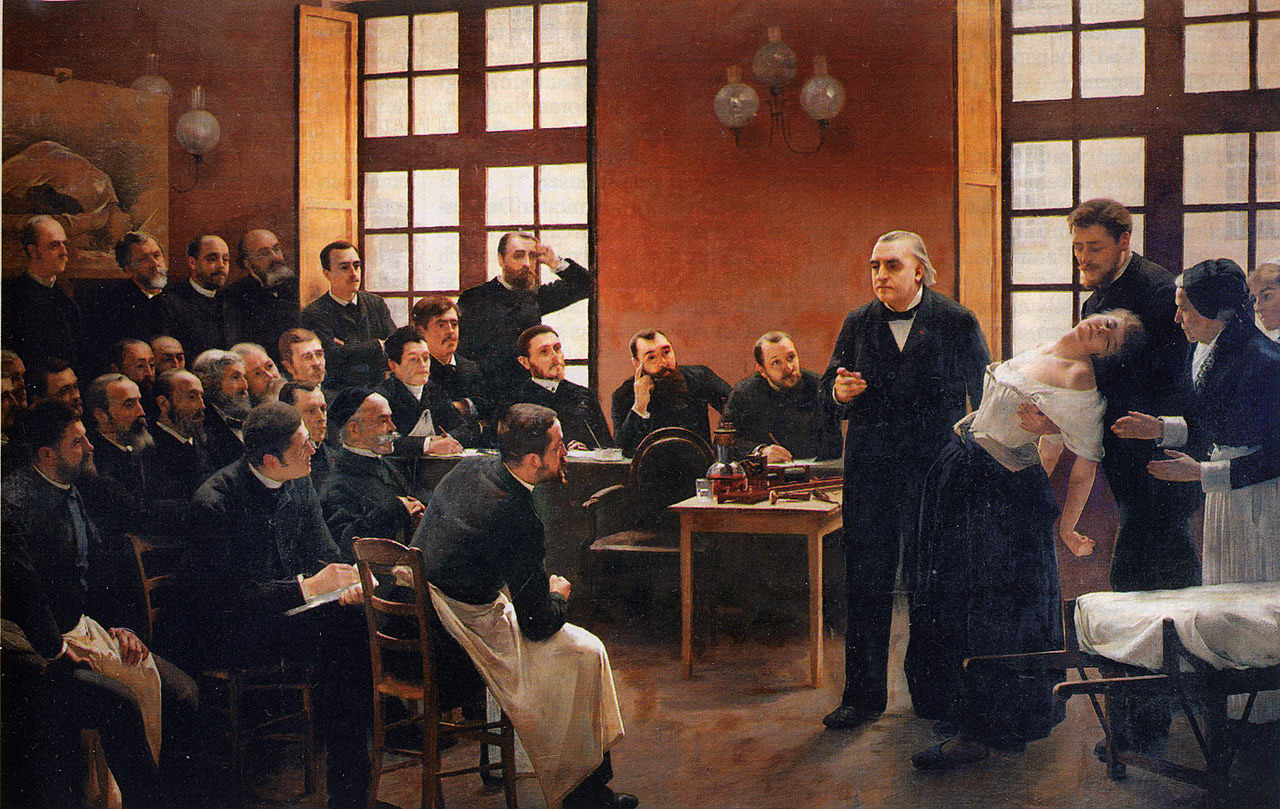
Over the last few weeks, Brooklyn’s Morbid Anatomy Museum has held a series of lectures on the historical context of hysteria and the often bizarre treatment of hysterical patients. In her first talk, Asti Hustvedt, author of Medical Muses: Hysteria in Nineteenth-Century Paris, described in fascinating detail the transformation that hysteria underwent as a result of the work of revolutionary neurologist Jean-Martin Charcot.
Charcot’s innovation was in re-characterizing hysteria from an intrinsically feminine form of madness to a neurological disorder like any other, capable of affecting both men and women alike. His research at the famed Pitié-Salpêtrière Hospital in the late 1800’s was dedicated to studying and popularizing this new approach. Though they didn’t last long, his ideas about hysteria changed the way we thought about the human mind and gender, laying significant basis for the Freudian revolution just a few decades later.
Obviously sensing he was onto something, Charcot became known for putting on public events in which his hysterical patients would literally “perform” their symptoms for spectators. Charcot would personally select patients with the “best” symptoms to present, inducing the outrageous and shocking behavior through hypnotism and other quasi-occult practices. In this way, suffering from severe hysteria became a twisted form of celebrity.
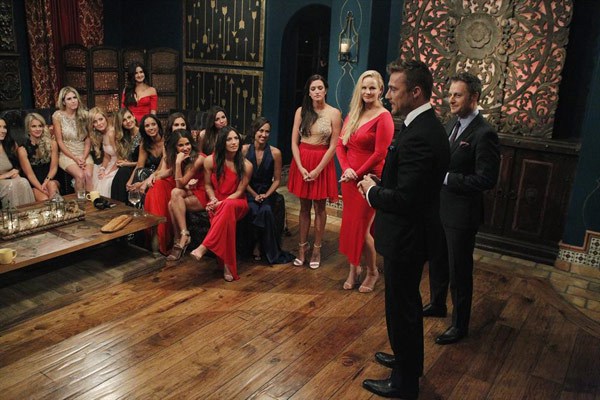
The other night, with Hustvedt’s discussion fresh in my head, a provocative thought occurred to me. Charcot died in 1893, but his popularization of hysterical femininity as celebrity is still with us today. Inducing and performing hysterical symptoms form the basis of much of what we call “reality TV.” Nowhere is this more apparent than on ABC’s The Bachelor.
Put another way: Chris Harrison is the cultural reincarnation of Jean-Martin Charcot, and the Bachelor Mansion bears a striking similarity to the Salpêtrière, transported from nineteenth-century France to modern-day Los Angeles.
Let me explain.
Throughout this discussion, “hysterical” should not be construed in its common, disrespectful sense as simply an “out of control” woman. I’m sensitive to the fact that the concept of hysteria has been historically misinterpreted, abused, and put to obviously chauvinist ends.
s used here, “hysterical” is no insult. I am not attacking or judging the women on The Bachelor, and I also do not want to oversimplify them as people. My analysis represents simply one view of one aspect of their individual personalities.
I am using the term “hysteria” in its strictly psychoanalytic sense. Hysteria has been described in various ways by differing schools of psychoanalysis, but each of them seem to associate it with gender identity and the need for love.
Freud founded psychoanalysis based on his study and treatment of hysterical women, initially linking it to repulsion over childhood sexual experiences or fantasies. But over the years, Freud’s conception has been significantly refined.
For example, Hendrika Freud (no relation) describes the hysteric’s situation as this: I want to be loved, and how can I be loved? Slavoj Žižek formulates the hysterical question as a crisis of sexual-symbolic identity: What is it about me that causes you to say I am a woman? Darian Leader remarks that while men resent women’s bodies for not “speaking” to them, “hysterics are in general women whose bodies do in fact speak.” Christopher Bollas says that the hysteric lacks “an unconscious sense of maternal desire for the child’s sexual body –especially the genitals.” Melanie Klein links the feminine propensity for hysteria with jealous aggression and guilt that young girls often feel toward the maternal body.
But more specifically for our purposes, consider the view of French psychoanalyst Jacques Lacan and his disciples. According to translator and practicing Lacanian psychoanalyst Bruce Fink, “the hysteric seeks to divine the Other’s desire and to become the particular object that, when missing, makes the Other desire…the [hysterical] subject constitutes herself, not in relation to the erotic object she herself has ‘lost’, but as the object the Other is missing.”
In other words, in the clinical Lacanian sense a hysteric is someone who cancels out a portion of her subjectivity in an attempt to become the object-cause of desire for some Other –in our case, the Bachelor.
Fink uses feminine designations purposefully. The history of psychoanalysis confirms that the historical association between hysteria and femininity is no mere anachronism or prejudice, but says something deeper about the relationship between culture and mind. Freud struggled for his entire life to divorce the two, but as noted by Juliet Mitchell in Feminism and Psychoanalysis, in the end he found himself back where he started: either something about hysteria was inherently feminine, or something about femininity was inherently hysterical.
In her book Mad Men and Medusas: Reclaiming Hysteria, Mitchell says, “every context which describes hysteria links it to gender –but not, of course, always in the same way. Historically, the various ways in which gender differences and hysteria are seen to interact should tell us something both about gender…and about hysteria.”
Thus, the paradox that so agonized Freud is at least partially resolved if we focus on Lacan’s hysterical structure. According to this view, the historical and structural link between hysteria and femininity is simply a result of the extent to which women have been asked to become objects of male libidinal desire across cultures and throughout time.
With this view in mind, let’s go back to our conception of The Bachelor as a modern version of Charcot and the hysterical performances of the Salpêtrière. It is not enough to merely remark that it is fun or interesting to see women acting hysterical on TV. The question, of course, is why are they acting that way?
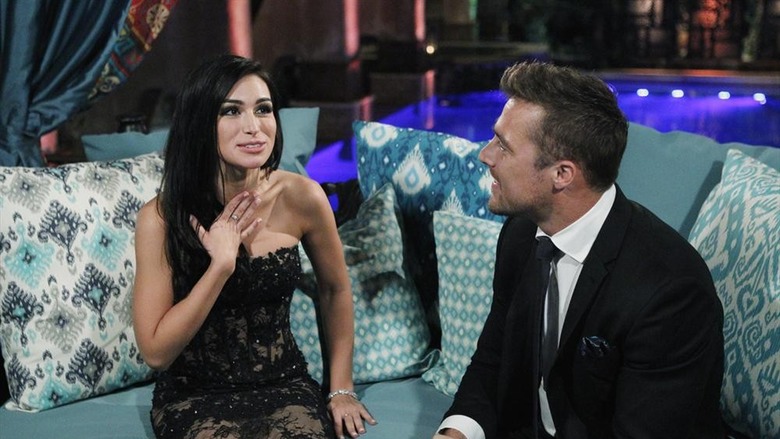
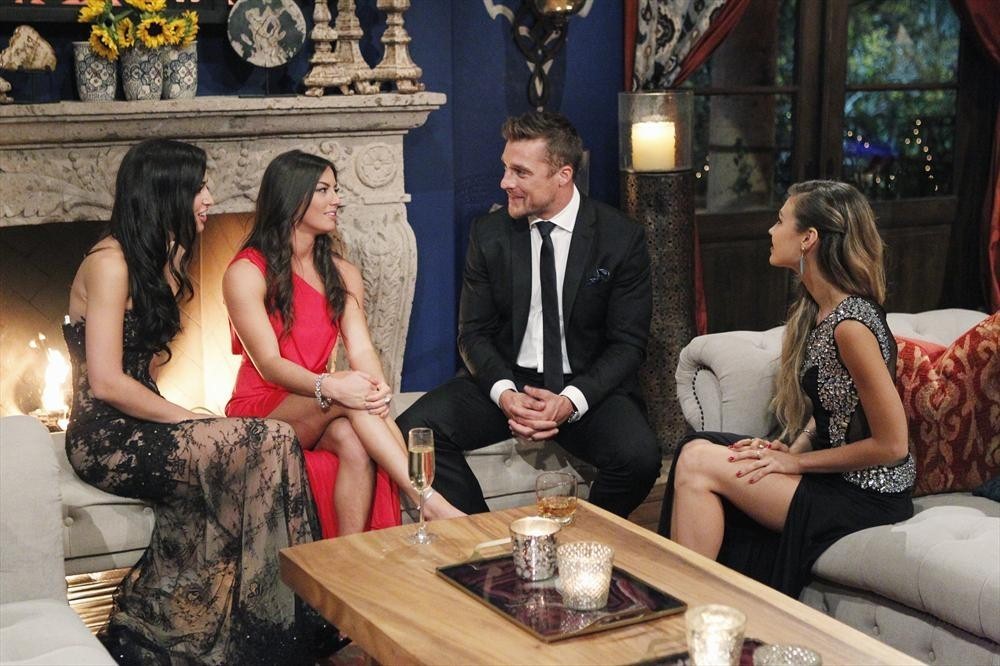
The Bachelor’s formula is as simple as it is effective: anoint a Bachelor, round up a number of single women and put them in a situation in which they’re asked to “win” the Bachelor’s heart. Ask them to dedicate themselves fully to attracting an idealized Other, to transform their identities into the object-cause of desire for that Other –in other words, adopt precisely the Lacanian structure of hysteria.
If we follow Lacan, adopting the object-cause means canceling out at least some, and perhaps too much, subjectivity in the process. Bollas offers a similar view from the point of view of object relations theory, arguing that “the hysteric’s ailment, then, is to suspend the self’s idiom in order to fulfill the primary object’s desire…the hysteric’s primary object will be the object-in-waiting that the hysteric must find in order to be recast as the other’s object of desire.” As the show aptly demonstrates, adopting this psychic posture can have disastrous consequences for one’s emotional health.
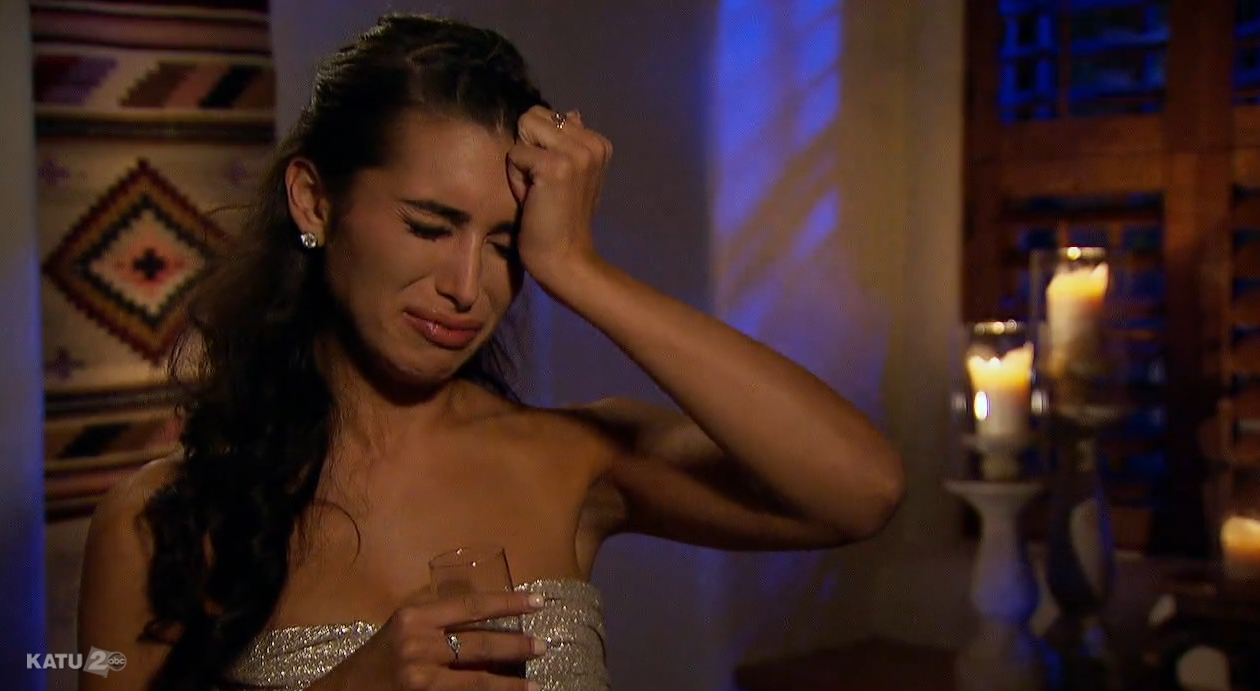
Thus, it’s no surprise that the institution of The Bachelor cultivates a smorgasbord of hysterical behavior in its contestant-victims: extreme jealousy, decentered identity, over-attachment to a functional stranger, histrionic behavior, and a lot, a whole lot of crying.
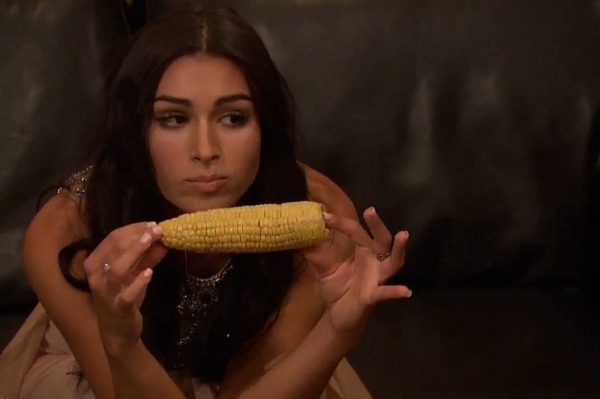
On this most recent season, no contestant modeled this account more consistently than Ashley I. Variously referred to as “the Kardashian” or “the virgin,” Ashley has displayed far and away the most frantic, bizarre, and irrational behavior of the season. She identifies closely with Disney princesses; she puts on ostentatious evening attire to sulk by herself and eat corn on the cob; she looks daggers at the other girls and adopts an annihilative stance; she runs away from the Bachelor in shame only to immediately reverse direction in desperation; each moment a prelude to tears. At her most passionately hysterical she becomes emotionally disintegrated, radically oscillating between sobs and bursts of dark laughter.
As indicated by her nickname, Ashley has never had sex and never had a long-term relationship. This fact, not altogether completely uncommon or extraordinary, seems to dominate the entirety of her personality.
But what is the value of Ashley’s virginity, and who values it? When Mackenzie hears about it early on, she expresses jealousy at the perceived advantage it gives Ashley. Virginity is frequently treated not as an aspect of Ashley’s personality so much as an object of libidinal exchange. We rarely hear what virginity means to Ashley. Instead, we hear Ashley worrying and speculating about what her virginity means to the Bachelor. (Compare Becca, also a virgin and the complete opposite of Ashley on this point.)
What I’m proposing here is that a major part of Ashley’s self is alienated in the Bachelor’s desire. Her sense of desire is one step removed from her, because it only accrues to her once filtered through the Bachelor’s desire.
Lacking the subjectivity necessary to own her own desire and instead devoted entirely to inhabiting the object-cause of the Bachelor’s desire, Ashley’s whole personality seems to be on the verge of collapse. That kind of dramatic tension is what makes Ashley and other Bachelor alumnae so compelling to watch. Love her or hate her, Ashley is a striking example of what happens when you structure too much of your personality around being the thing you think the other wants. All of us can relate to that.
Surprisingly, it wasn’t Ashley but Kelsey who actually experienced a collapse on a recent episode. Faced with the imminent possibility of being sent home, Kelsey forcefully confronted the Bachelor with an intimate story of personal loss. This was supposed to be her ace in the hole, a last-ditch gambit designed to ensure her desirability for at least a few more weeks.
But it didn’t work. Something told her that the Bachelor still wanted to send her home.
Ostensibly freaking out that he’s about to send a widow packing, the Bachelor panicked and canceled the night’s cocktail party in favor of standing outside on the balcony and staring into the bleak, abyssal night sky. Kelsey, suddenly overcome by anxiety, began rambling profusely to the other girls. Suddenly, she disappeared to a secluded corner of the mansion and was soon found lying on the floor, whimpering and writhing in anguish, in need of medical attention.
Some of the other women accused Kelsey of “faking” the attack, but that interpretation makes so little sense strategically that I am forced to assume the opposite. Whatever label you’d like to use, it appeared to me that Kelsey was experiencing extreme psychic pain at the moment.
Kelsey’s breakdown was about the hysteric’s relationship to rejection. Fink notes, “the hysteric constitutes herself as the object that makes the Other desire, since as long as the Other desires, her position as object is assured: a space is guaranteed for her within the Other.”
But what if the Other stops desiring? What if the Bachelor still wants to send you home? Psychically, the result is catastrophic: you disappear. As Žižek once put it, because “she is nothing but ‘the symptom of man,’ her power of fascination masks the void of her nonexistence, so that when she is finally rejected, her whole ontological consistency is dissolved.”
In other words, consider our understanding that becoming an object-cause of desire for the man involves a certain annulment of feminine subjectivity. Thus, when rejection approached and Kelsey’s feminine “mask” was pulled back to reveal the canceled subjectivity beneath, she suffered absolute existential devastation.
The “symptoms” (if the reader will permit me that word) suffered by Ashley and Kelsey may seem tame compared to the convulsions, somnambulism, and practically supernatural abilities of Charcot’s classical hysterics. But consider that some psychoanalysts and commentators have proposed that hysteria still exists today in concealed or muted form.
As Elaine Showalter discusses in her book Hystories: Hysterical Epidemics and Modern Media, things like chronic fatigue and multiple personality disorder may have roots similar to those of hysteria. Only fifteen years ago, Bollas called for a reassessment of hysteria in the psychotherapeutic community based on his view that hysterical patients are frequently misdiagnosed as borderline personalities.
But more broadly, hysterical behavior may be found anywhere a person –a woman, usually –is somehow motivated or forced to become the object-cause of desire for someone else.
Today, it’s easy and typical to think of hysteria as either a historical curiosity of the pre-Freudian and early Freudian world, or a chauvinist label applied to women considered “difficult” by patriarchal society. But as psychoanalysis and The Bachelor tell us, hysterical femininity is still with us –and it will be until normative concepts of femininity radically change, until feminine identity is allowed and encouraged to take up the position of sexual subject.
Last week I wrote a short post about Static Shock in which I argued that the book was mediocre genre product, but that at least it was mediocre genre product that made a gesture at diversity. Better non-racist mediocrity than racist mediocrity, I argued.
I still think that’s more or less the case…but is Static really not racist? It does have a black hero, definitely — but then, there are the black villains.
In particular, there’s Holocaust, the evil mastermind behind the first arc. Holocaust is a gangster, but he’s not just a gangster. He’s a gangster with a racial grievance. He tells Static that the hero is insufficiently appreciated. He adds that those on top in the world got there by “luck” — and not just luck, but privilege. “It’s connections. Who you know. Who your daddy knows. It’s birthright.”
But Holocaust, again, is the bad guy. His critique is part of his evilnness. The equality he wants is the opportunity to get cut in on the business of the Mafia; his vision of social justice is equality in the criminal underworld. He’s essentially a right-wing caricature of civil rights advocates; Al Sharpton as brutish, deceitful thug. When Holocaust starts to kill people, Static sees him for what he is, and abandons his evil advisor to return to his superheroic independent battle for law and order. The possibility that law and order might itself be part of a structural inequity is carefully kicked to the curb, revealed to be the seductive philosophy of an untrustworthy supervillain.
You couldn’t ask for a much clearer illustration of J. Lamb’s argument that the superhero genre is at its core anti-black, and that it therefore co-opts efforts at token diversity. The genre default is for law and order. Law and order, in the world outside superhero comics, is inextricable from America’s prison industrial complex and the conflation of black resistance struggles with black criminality. Static, a black hero, is defined as a “hero” only when he aligns himself with the white supremacist vision that sees structural critique as a cynical ruse.
I think it is possible for superhero comics to push back against that vision of heroism to some degree. Grant Morrison’s Doom Patrol does in some ways, for example. But Static is hampered by its indifferent quality; it’s not interested, willing, or able to rethink or challenge basic genre pleasures or narratives. Notwithstanding a patina of diversity, it seems like a superhero comic really does need to be better than mediocre if it’s going to provide a meaningful challenge to super-racism.
J. Lamb left this comment on my post about Static Shock and diversity in mediocre genre product; I thought I’d highlight it here.
 
“C’mon Noah, just drop the empty rhetoric and empty assertions about “quality” and simply concede my initial point: any conceivable writer writing a black superhero comic character is going to be told by a concerned person that they are doing it wrong.” – Pallas
I disagree with this assertion.
People are, as always, encouraged to write comics and other pop culture material that can be judged on its own merits. The difficulty I sketch above involves my assertion that writing a non-White superhero protagonist necessitates some interaction with/ consideration of the notion that the superhero concept itself is racialized. We’re talking about a genre developed when Jim Crow segregation provided the unchallenged public policy state and local American governments applied to Black citizens. We’re talking about a genre developed when successful navigation of American race politics for Black people likely meant that they or someone they know would endure domestic terrorism imposed by fellow citizens and unchallenged in the courts. Why must we believe that a literary genre developed during this time has not racial component, when practically all other American popular culture of the era does?
For me, it’s completely immaterial that the Milestone creators respected the superhero concept enough to offer Black superheroes; McDuffie et al. and their contributions should not be defied by present day observers. Icon’s an alien posing as Black Republican who adopts Superman’s public interaction (demigod savior/ crimefighter) to assist lower income Black Americans whose choices he often disdains. Where the books reflect on respectability politics and reduced economic opportunities for the Black underclass, the material works (at least in the issues I’ve read.)
But when Icon cannot envision better conflict resolution solutions outside of punching the living daylights out of metahumans he doesn’t like — when Icon reverts to the moral position of a stereotypical superhero — the material’s innovation dies, and you’re left with run-of-the-mill 90’s superhero fights. That’s less interesting, and done better elsewhere.
It’s not about who characters like Rocket, Icon, and Static represent, or who the intended audience for their comics may have been (Moore wrote Watchmen for adolescent boys, too.) The question for any comic creator interested in developing a character of color should be “How does this character define their connection with this particular identity, and why should it matter to me?”
A serious attempt at answering this would prevent characters who are tangentially (insert minority status here) from standing in for meaningful diversity in panel, and would force comic narratives to stop ignoring meaningful diversity in favor of an inker’s burnt sienna hues alone. I’ve yet to find a superhero comic that accomplishes this feat effectively; just because the Milestone folk tried does not mean they succeeded.
So of course creators and their work will be evaluated, sometimes harshly. I recognize that for many, my position is heresy. But since Milestone, we’ve seen material like Captain America: Truth and Ms. Marvel and others. Gene Yang’s writing Superman soon, and David Walker will take on Cyborg. Plenty of comic creators will attempt to prove the superhero concept compatible with meaningful identity politics, and I wish them well. But too often the desire to see oneself in panel and on screen, the hope that at some point a person can stride into a comic book shop or turn on the CW and find a person of color in the gaudy lycra and skintight spandex of the superhero with neon strobes flashing from their fingertips overrides all other considerations among progressive comic fans. I oppose this.
Pallas, it’s completely fair to pan any comic for not being “super complex society changing treatise” serious about race. I should not have to assume that the characters of color I read about are only paint job Black. If so, then the audience for superhero diversity has all the ethical standing as the audience for an Al Jolson blackface revue, and I’m not paying $3.99 US for burnt cork comics.
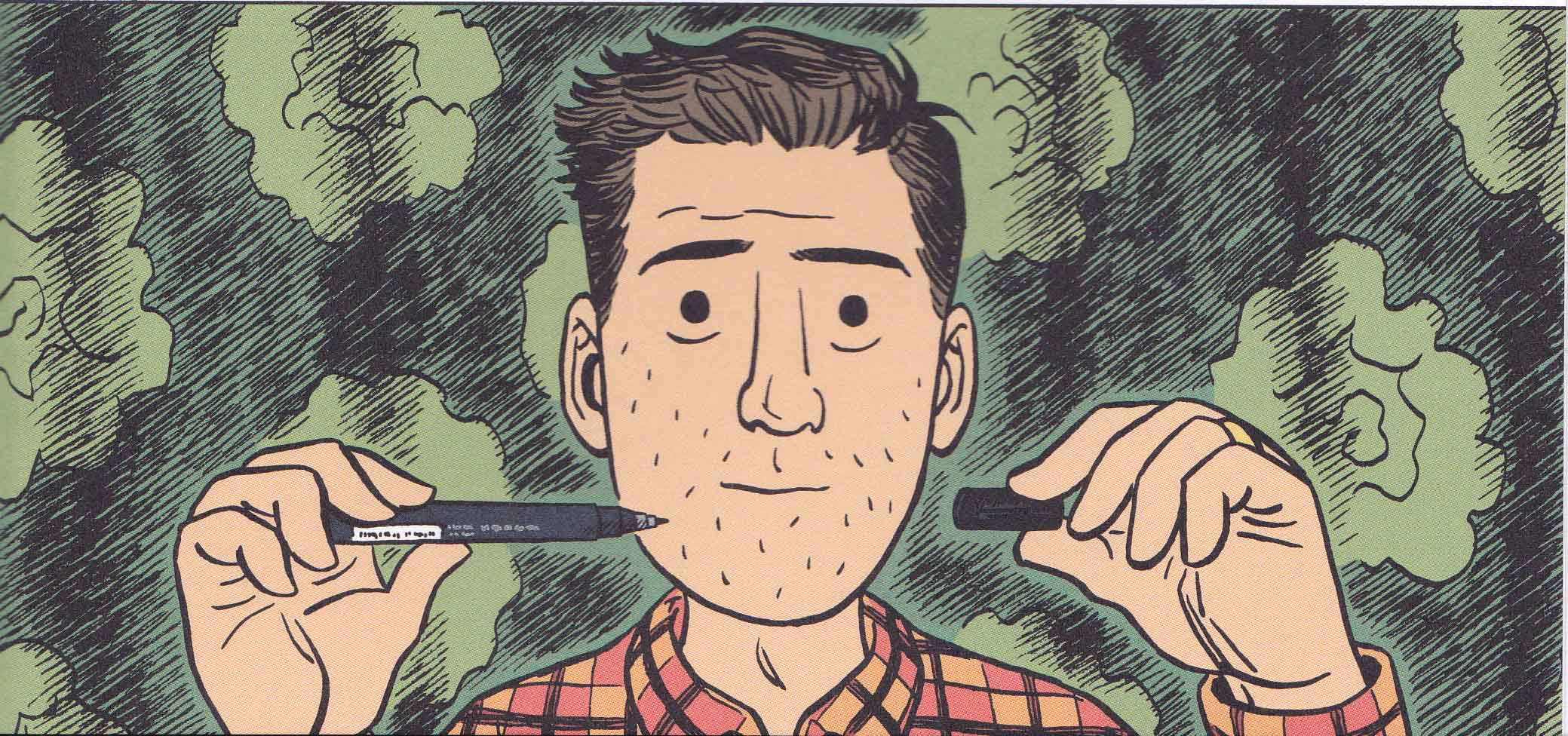
Sam Zabel is suffering from a terminal case of writer’s block. He also thinks, not without reason, that he is a talentless hack churning out inferior versions of late Golden Age superhero comics to the strangely obliging masses. If only he was as accepting of his lot as the other hacks who have prospered mightily at the offices of Marvel and DC; if only he was able to earn a living doing comics like Pickle, one time home of that classic of alternative comics, Hicksville.
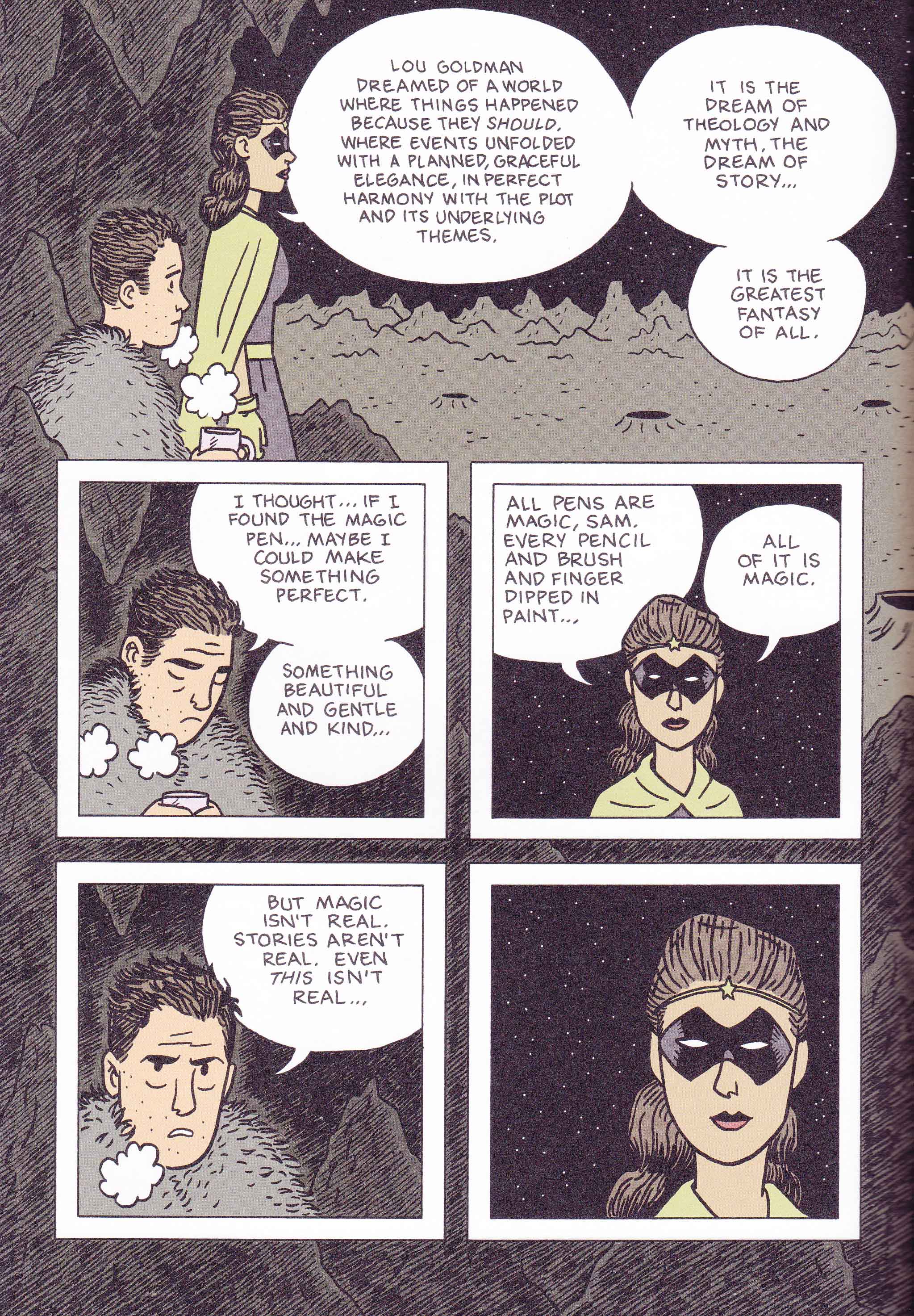
The panacea to this obstruction, that pill for renewed creativity (as in Hicksville), is other comics. The “magic pen” of the title is merely an excuse to explore and retread (selectively) the history of comics—from the innocent sexism of the non-superhero golden age to the somewhat more sexually liberated climes of an all-female pirate comic (a kind of Paradise Island with eye patches and peg legs). Mayhem, fight scenes, and assorted lessons on creativity are all offered up with a sense of harmless fun and deference to easy readability.
The conceit here is that a number of comics of differing vintages and genres have been drawn with a magic pen. These comics if given the breath of life draw the reader into them, allowing them to inhabit their fantasy worlds. Zabel finds just such a comic in a used book shop, unattended and unloved but seemingly placed there for the singular purpose of reinvigorating his person and artistry. By tale’s end, we are gently apprised—as with all fantasies about the creation of art—that all pens are magic and we need only put them to paper to concoct these “inhabitable” worlds.
Horrocks seems as eager as Scott McCloud once was to syncretize and reconcile the comics form with the long history of art itself. In one of the final scenes in the book, the protagonists of his tale are brought back to the “the beginning”; to the first pen, a finger dipped in red ochre doodling on a cave wall and hand stencils produced by spitting pigments on to an outstretched hand—all this as it once was in places like Cueva de El Castillo and Chauvet cave.
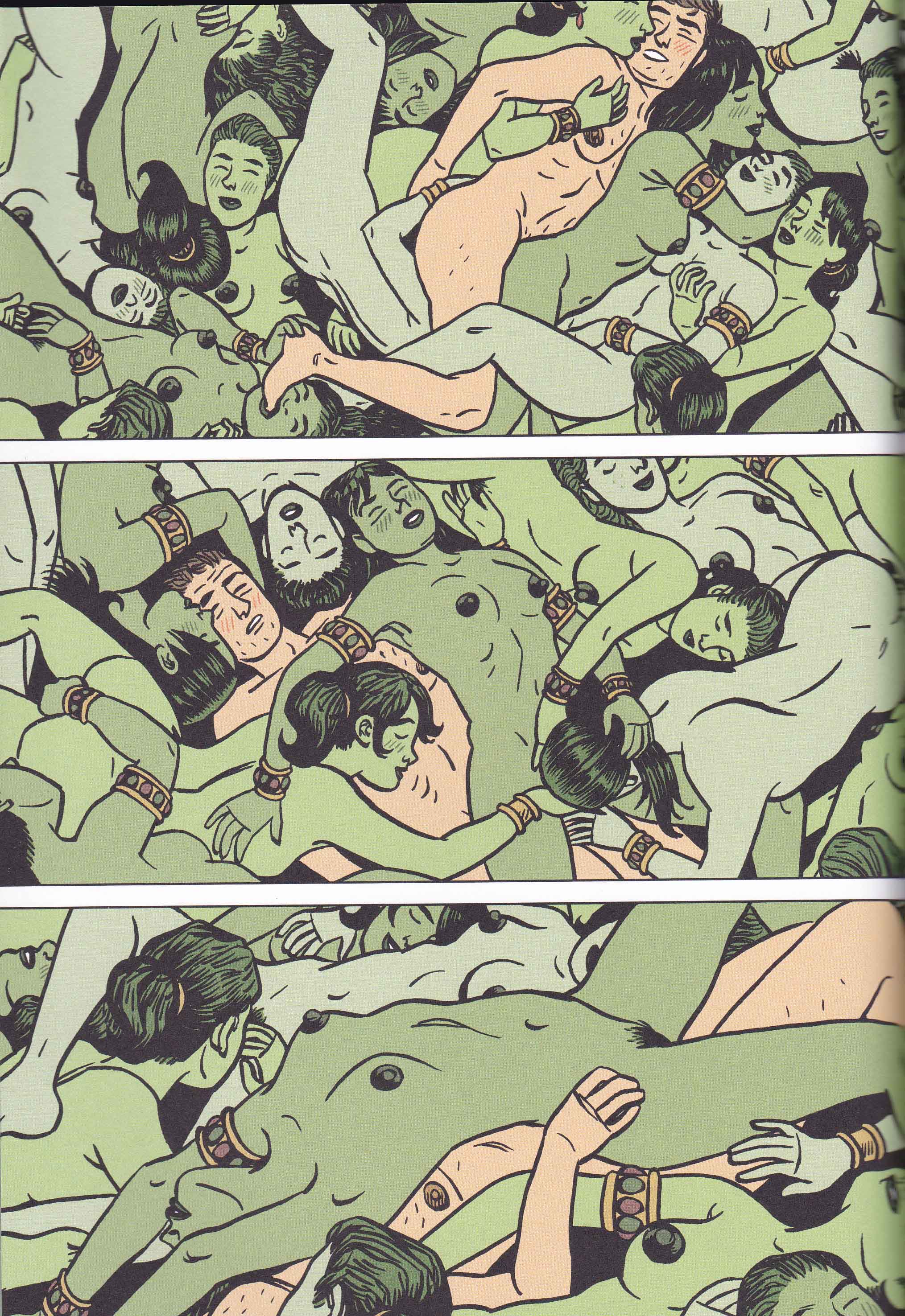
Horrocks affection for the comics form is well known but Sam Zabel also reveals his boundless passion for the naked female body. The first world that Zabel gets sucked into is that of a comic called, The King of Mars —a kind of third-rate Barsoom where the inhabitants are expecting a god king-creator. As such, they quickly latch on to Zabel as the most likely suspect. The women here are all green and sex-starved. To some this will seem unexpected and liberating, to others almost interminable in its execution. And while opinions can differ, there is something to be said for the idea that “less is more.”
But this too might be part of Horrock’s divine plan, that jumble of suffocating nakedness being a metaphor for the excess that extinguishes creativity. A pity then that the nudity here is so unalluring, so lacking in temptation and passion. Seldom have so many naked women been deployed in the service of a comic so thoroughly unerotic.
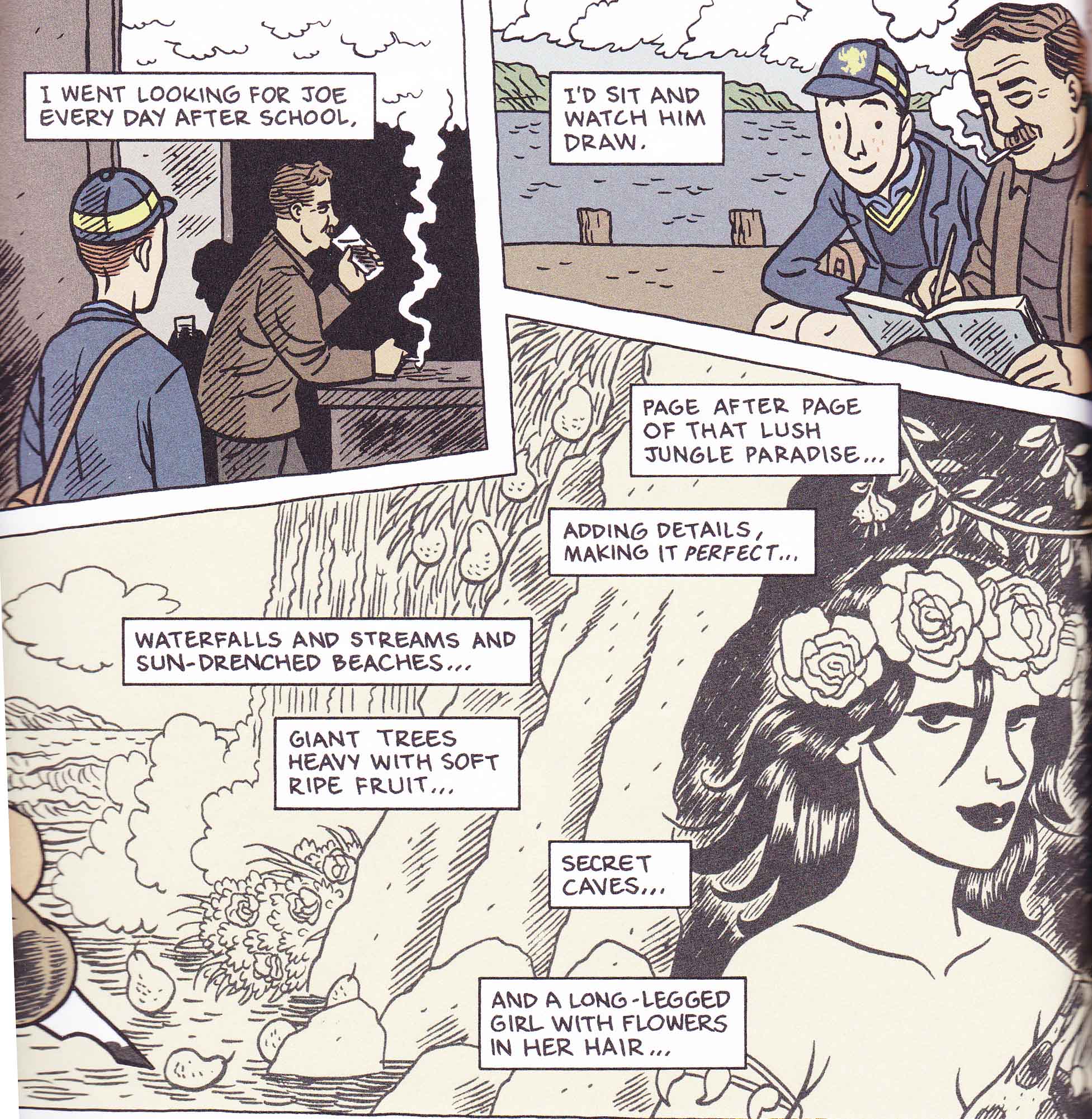
All of this is a function of Horrock’s far greater gifts as a writer than as an artist. In Horrock’s survey of the exquisite prurience of pre-Code comics, his almost unvarying line and its distinct lack of sensuality is a very great handicap. At one point in the comic, Horrocks does appear to be attempting a different style…
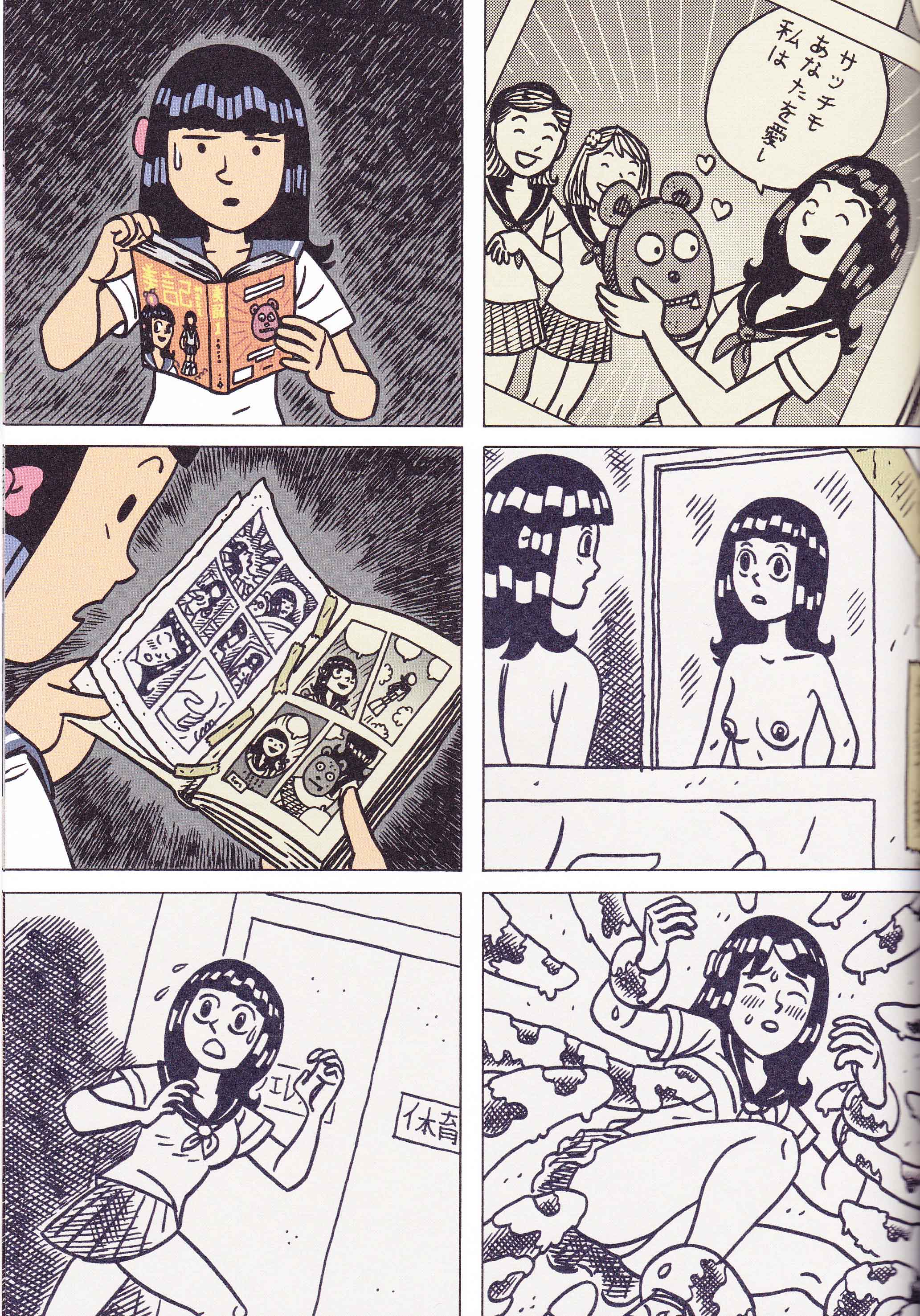
…which gives the reader some hope that a Jungle Girl will appear with all the skill of the illustrators of old (or at least the crudely rushed pen work of the early Sheena) but this is not to be. Horrocks doesn’t have the ability to emulate the line of an Alex Raymond or even an Iger Studio artist. Nor is this the kind of bravura display of cartooning where one might expect to find “normal” characters inhabiting the worlds of a Fletcher Hanks; which means that any sense of mystery or delight in the archaic remnants of a different age rest solely in the minds of the reader. While Horrocks attempts to emulate the compositions and use of negative space of rough drawn horror manga classics, Miki (Zabel’s Japanese school girl guide through the “magic pen” comics) is never quite convincing; she will never look like that cross between Sailor Moon, Doraemon and Astro Boy which she is supposed to be.
The fantasy worlds of the comics Zabel is drawn into are as flat and unexciting as the dumpster truck he finds himself in when ejected from those worlds. If an “eyeball” seems like an interesting mode of interplanetary transportation, its actual deployment on the page leaves something to be desired. One need only compare the fertile world building creativity found in the likes of the reinvented Prophet comic or Farel Dalrymple’s Wrenchies to notice the lamentable gap in accomplishment.
While Sam Zabel and the Magic Pen works on a certain level as a reassuring tale of a mid-life crisis expunged, it also creates a simplistic notions of right and wrong fantasies, or at least divisions between fantasies which are generally safe and those which are dangerous.
In this schemata, the John Carter-Buck Rogers-Flash Gordon fantasies of old are of the generally harmless variety while the hentai worshiping otakus are not to be trusted—and are perhaps even to be blasted into a reformed Jungle Girl comic to get their asses whipped. It is an easy formulation since it conforms to popular taste and morality in such matters. It is the hentai otaku who hides his wares on a subway train and not the fan reading Edgar Rice Burroughs. I suspect that most people would much rather be caught reading A Princess of Mars on the train then the tentacle rape fantasies of Hokusai and Kuniyoshi.
At one point in the comics, Horrocks presents one of the foundations of his comic, that…
“even a comic book can shape the real world, contributing to the culture, encouraging attitudes and assumptions…”
Not for Horrocks then are notions that we are all predestined products of familial and genetic destiny. How art actually shapes culture and attitudes is, however, altogether less certain and barely broached in the pages of the comic; all we can gather on this issue from Horrocks is incidental and second hand. Suffice to say that the villain of the tale is a cartoonist who has tipped pages of his deranged rape (?) fantasies into several more sedate and juvenile manga. He is, in other words, a sociopathic sexual deviant the likes of which we see every other week on American primetime TV.
Which leads one to wonder which ideas have the greatest influence—the sexual fantasies of a marginalized group of readers or the vastly more popular works of the golden age of pulp; the embarrassing sexual fetishes of a select few or the John Carter stories of the 21st century —like this one, which makes plain the colonial template upon which the Martian fantasies were based.
Sam Zabel and the Magic Pen could be described as a post-modern, vaguely autobiographical meta-comic, but it also remains safely conventional —I suspect more by accident than through any concerted planning. Thus the exoticization of manga—the short skirts, school girl uniforms, panty shots, and general deviance – is less the result of xenophobia then of simply reaching for the easiest examples at hand. The effortless rehabilitation of the sexist Kiwi cartoonist of the early twentieth century is contrasted with the irredeemable villainy of the hentai reader and fantasist simply because every story needs an explosive climax and a moral. Horrocks challenge to this easy equation is that Sam Zabel and the Magic Pen is a veritable hentai comic in itself, a phallic object with a PG-13 label—innumerable pairs of naked breasts are on display but only one dick-sucking scene as far as I can tell.
It seems that a sizable number of white male confessionals of this modern age tend to lead back to Portnoy’s Complaint—that “disorder in which strongly-felt ethical and altruistic impulses are perpetually warring with extreme sexual longings, often of a perverse nature.” The impotency of Philip Roth’s protagonist is replaced by Zabel’s writer’s block. We can add to this the defiant sexuality often of an embarrassing nature (if one considers fantasies about fucking several Orion slave girls at once to be embarrassing) and other assorted masturbatory revelations. There are no prostitutes in the comic but cradle snatching is elevated to its preeminent place in our great sequential art form. All this mixed in with a few snippets on the artistic impulse and various ethical considerations.
The main difference would appear to be that where Portnoy remains self-pityingly pathetic, Zabel finally gets to reunite with his family. Where “Portnoy” gets to write a famous novel, Zabel/Horrocks finally has a new long form comic after years of silence. After all, isn’t this the way all pulp fantasies end—happily ever after?
“The central question, in a way, is asked out loud by Sam halfway through: “Do we bear a moral responsibility for our fantasies?” The book sets out to have a conversation about that question.”
“I’m totally fascinated by wish fulfillment fantasies: how they work; their strange familiar contours; the weird mix of yearning, pleasure, embarrassment and shame we feel about them; what happens when they become “property” — a franchise or brand. Obviously, that’s a big part of the history and landscape of comics, but I think it’s also an underrated element in so-called “literary fiction” and “serious” art.The Magic Pen gave me an opportunity to unpack some of my own ambivalence about wish-fulfillment fantasies, but it also helped me find my way back to their power and joy.”
“The big shift for me was to stop giving myself such a hard time about my work. I had spent years feeling very uncomfortable with my drawing, because it was so clumsy and inept. I tried to draw like other people; the first issue of Atlas (Drawn & Quarterly, 2001) is full of my attempts to draw like Edmond Baudoin, Blutch, Tibor Gergely and other artists I admire. But it’s kind of a mess. The reality is, I can’t draw like other people, I can only draw like me. Luckily, no one else can draw exactly the way I do, either.”
When I discovered Weird Love #3 on the shelf at my usual comics joint, I didn’t hesitate to pick it up. I may still spend most of my comics dollars on superheroes, but I always look through the indie shelves for stuff to try out. Truth is, when it comes to indie comics I am much more likely to wait for the trade collecting individual issues, while there is something about the serialized nature of the Big Two comics that is part of their appeal to me. I know this is probably backwards since indie presses (when they’re really “indie”) could probably use my monthly money while I am just another sucker to Marvel and DC, but it is what it is. Let’s hope that my buying Weird Love when it comes out every other month is doing a part in keeping it around.
IDW’s Weird Love #4, featuring the amazingly named “Too Fat to Frug.”
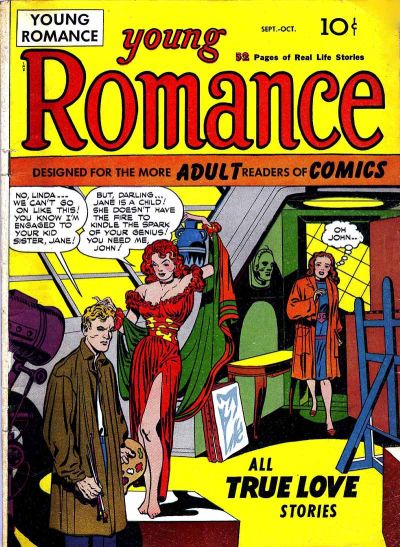
Anyway, I knew nothing about Weird Love, but I imagined (and hoped beyond hope) that it was some transgressive re-imagining of the romance comic genre, but what I found turned out to be even better. Instead, it was refurbished reprintings of rare romance comic stories from the 1950s and 60s. From a genre that—according to Michelle Nolan’s Love on the Racks: The History of American Romance Comics—once boasted over 140 different romance titles being published at once, editors Craig Yoe and Clizia Gussoni chose the strangest of them and delicately re-furbish the art from copies (since in most cases the original art is long gone). Upon reading the stories in Weird Love #3 (and the ones in issues #4 and #5, as well), I started to get the impression that what made them “weird” was not their transgressive aspects (if any), but the dissonance between their rigid adherence to idealized depictions of heteronormativity and the contemporary moment’s shifting social mores. What the stories in Weird Love soon made clear to me—and I went and sought out some of the classics of the genre in the form of reprints of Jack Kirby and Joe Simon’s Young Romance for confirmation—was that the heteronormative values these romance comics reinforce are really friggin’ queer. I don’t say queer to mean homosexual, as in the political and pejorative usages, but I mean strange. I mean, not adhering to the categories of “normal.”
That the ideal depictions of sexuality and heterosexual relations could change so dramatically in the last 5 or 6 decades underscores the socially constructed nature of sex and gender, the fluidity of what appear to be their ahistorical categories, and the inextricability of “normalcy” from adherence to social codes based on the simultaneous (in)visibility of sex that, in the words of Michael Warner in the introduction of Fear of a Queer Planet, “testifies to the depth of the culture’s assurance (read: insistence) that humanity and heterosexuality are synonymous.” (And I would add, white heterosexuality, but sexuality and race intersect in complex ways, beyond a simple blog post, so if I don’t get back to it, don’t think I forgot or didn’t think of it.) That the assumptions embedded in the stories were once (and to some cases still are to varying degrees) normative shows how strange heterosexuality really is.
The final panel to “Thrill Crazy” gives us the story’s moral, in case we missed it.
For example, Weird Love #5 includes a story entitled, “Thrill Crazy” (which originally appeared in Love Journal #11 from December 1951), in which Marsha’s desire to be popular leads her to drink alcohol and end up at a “necking party,” whose “unwholesomeness” made her “feel ashamed and unclean!” She witnesses her friend have a breakdown from the anxiety of running with that teen gang, and nearly succumbs to that fate herself. Lucky for her, in the end a “worthy man”—a hardworking local boy who warns that no good will come of the company she keeps and comes to her rescue on the night of the necking party—deigns to love her despite her having gone astray. In the end she learns that “just going to a movie” with him is an appropriate amount of excitement, and a lot safer for her virtue. These stories are knots of sexual contradiction. This is what I mean by the simultaneous visibility and invisibility of sex: the stories can only allude to and cannot ever name feminine desire for sex, but their built on that desire and the resistance to it that virtue demands. The customs around heterosexual cultural practice are weird and sometimes even destructive, and the heterosexist assumptions that inform them harm straight people, too.
Consider, the Edith sub-plot in the most recent season of Downton Abbey. She has to hide away her child, because otherwise people would know that she had had sex before marriage with a man she planned to marry! It would ruin her and devastate her family! It is absurd, of course—especially when looked at in light of Edith’s pain at being separated from her child who may never know her. (That a family of what is essentially the peasant class, has to take in the aristocrat child is something else entirely—gendered class exploitation). Everyone knows that people have sex and that sometimes (often) have it before being married, and yet it must remain invisible, despite underwriting our relationships and our very existences. In the era of the TV show, to say it is present invites condemnation. This is not to say that women are not still shamed and scorned to varying degrees for having children out of wedlock, but there is much much less insistence to pretend at “normalcy”—a curbed sexual desire equated with moral character—to the degree that you’d deny the very existence of your child. Still, none of the romance comic stories I have been reading would dare include such a racy topic as the unwed mother.
(from “Too Fat to Frug”)
Instead, Weird Love #4 reprints the incredibly titled story, “Too Fat to Frug.” I can only assume the play on frug (to suggest “fuck”) was lost on the censor board because this comic has the Comics Code seal on it. In it, sexy go-go dancer Sharon’s inability to control her jealousy drives her man away and leads her to the kind of emotional overeating that “disturb[s]” her “glands” making her permanently fat, losing her dancing gig and the ability to attract any men of quality. “Luckily” for her, a nice chubby guy takes a shine to her, leading to the moral: Even fatties can find love. I mean, I think that is what I am supposed to take from it. Sure, one could read it as a positive body image supporting story, except that her fate is clearly cast as tragic. She’s a loser who has to make the best of her own failure. The story’s less obvious, but no less present, lesson is that if Sharon had learned to control her emotions and not second-guess her man’s ogling another woman, she might not have suffered her embarrassing fatness.
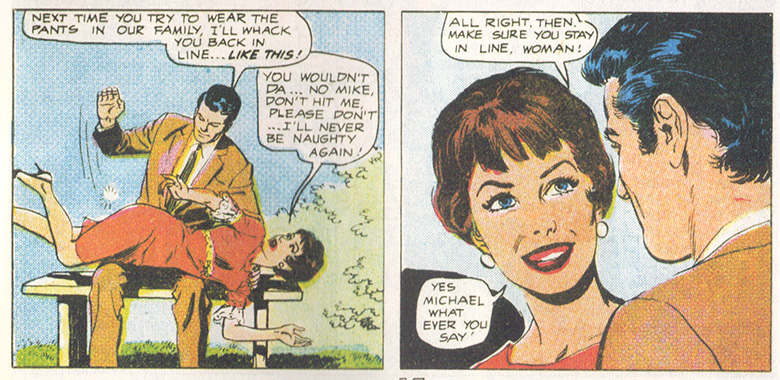
Another of my favorite Weird Love stories is, “You’re Fired, Darling” where Doris the office manager is forced to fire her boyfriend, Mike, who is terrible at his job. Despite his anger, he eventually comes to realize what she already knew, that he was a lot more suited to physical labor and working on a construction crew with his uncle, so he comes back to her—but makes sure to give her a spanking to teach her a lesson her for trying to “wear the pants.” In the end, she expresses her relief to have Mike be “masterful” and take charge, so she doesn’t have to be in the anxious and “unnatural” position she was in as his boss. This kind of submissiveness—for which the women are grateful—is a common conclusion to these stories. Looking back from 2015 this idealizing of such submissiveness becomes a kind of peculiar fetish. The fact that this is normal desire is precisely what seems so strange in the present day.
Throughout these stories women tend to be infantilized, even as the constant reminder to guard their “virtue” reinforces their primary value as sex objects. This is notable in how even young girls are sexualized. They are either dangerously attractive for which they are to be blamed, or pityingly unattractive to the degree that even as a child it is noteworthy how difficult it will be for them to find husbands. The shape of heteronormative romance as traced in these stories is so contradictory and confining, that it is impossible to not imagine the broadly queer possibilities that lie all around it.
Of course, it also bears mentioning that the vast majority of these stories (if not all—the credits of these stories are lost in some cases) are written and drawn by men, but written in a confessional first-person, so these male storytellers are ventriloquizing the desires of women and their despair when their unwillingness to conform is punished, showing them the error of straying. Or, if a woman isn’t actually punished then—as in the classic “There’s No Romance in Rock n’ Roll (originally from True Life Romance #3 from 1956) —the protagonist discovers a real mature man whose very presence recasts the her early love, rock n’ roll, into childish noise! So while I call these strange attitudes towards heteronormative love “idealized,” I can’t claim that these attitudes were necessarily shared by women. Instead, they were thought by the male creators to be attitudes their female readership should identify with, both in the desire to rebel and to eventually righteously conform. Over and over again, the rebellious spirit of women is evoked in order to highlight the need for them to be tamed by their relationship with the right man.
The Simon and Kirby stories reprinted in the Young Romance anthology reinforce this and really are no less weird even thought they are not collected under the Weird Love title.
These comics—quoting Michael Warner again— “assert the necessarily and desirably queer nature of the world.” We don’t want to be trapped in static definitions of sexuality and gender, especially given the ways they intersect with all other aspects of life. The love depicted as ideal in these comics occupied a world without race until some Young Romance stories of the 1970s, and to my knowledge, none of them addressed gay love except in the most oblique terms. We need a queer world. A world that leaves room for non-compliance, non-conformity, for forms of loving that not only defy categorization, but break up and smash the categories that can sometimes be hidden within.
&nsp;
I
t is easy to see why Lichtenstein was attracted to the isolated panel for his work. (from “Love, Honor and Swing, Baby!” – Just Married #67, October 1969 – and Weird Love #3)
Something I really love about reading these comics is just how nicely individual panels are suited for collected as examples of isolated absurdity that might otherwise go unnoted in so-called “traditional” forms of love. So many times, one weird scene defamiliarizes the heteronormative, making it so strange as to be laughable, worthy of mockery. As each issue of Weird Love comes out, I find myself going to the scanner to capture examples. (And you will occasionally be able to find more examples after this post is live on the We-Are-In-It tumblr).
The history of romance comics has also reinforced for me how the market for comic books has shifted in the past and could continue to shift if the major publishers did not use the industry’s arrested state of development as an excuse for peddling the same old thing. Claims that they must play to the market ignore the relative lack of competition and thus how they shape that very market by what they offer. As comics legend Dick Giordano once explained, by the late 1970s the material in romance comics became too tame for “sophisticated, sexually-liberated women’s libbers” (his use of “women’s libbers” is highly suggestive of what he thought about this change). Feminine desire that matched what women might actually feel and experience could not be written to circumvent the Comics Code Authority at the time. But if that is the case, the question then becomes, now that the CCA is a thing of the past and mainstream comics are full of many things that the censor board once disapproved of, what keeps the Big Two from exploring that market again?
The jury is still out about the current state of the comics buying public but signs point to significant and growing numbers of women. Recent announcements by Marvel and DC seem to directly address this realization. But while it seems like the superhero cadre is playing catch up, I wonder if this shift in comics demographic will lead to a shift in the diversity of comic genres themselves. I am not trying to suggest that more women readers will lead to a return of romance comics (though I’d love to see what a modern romance comic might look like), but the fact that DC comics published Young Romance until 1977—not really all that long ago (in my fucking lifetime!)—demonstrates that difficult to imagine changes can happen in a relatively short period of time. I mean, who in the late 50s would have predicted the resurgence of superheroes on the horizon?
Furthermore, there is still a strain of romance influence that entered the superhero genre that can occasionally be seen in the cape and cowl titles. The influence is all over the place; from Superman’s Girlfriend, Lois Lane repeatedly paying for her obsession and schemes, to that splash page from Fantastic Four Annual #6, where Kirby draws the Richards with the radiance of the final “happily-ever after” panel of a romance story. It is probably most clear in the drawing style John Romita Sr brought to Amazing Spider-Man when he took over for Ditko in 1966. There are even characters that still survive from the romance days. Patsy Walker, Marvel’s Hellcat, started out as a teen romance comic character, and when Marvel’s predecessor Timely Comics was cutting back on all their titles in the late 50s, Patsy’s three titles were still selling at phenomenal levels. I do not think it is overstating the case to say that Patsy Walker may be the most important character in the Marvel Universe, because without her success there may have been no comics division for Stan Lee and Jack Kirby to transform into what we know as Marvel Comics.
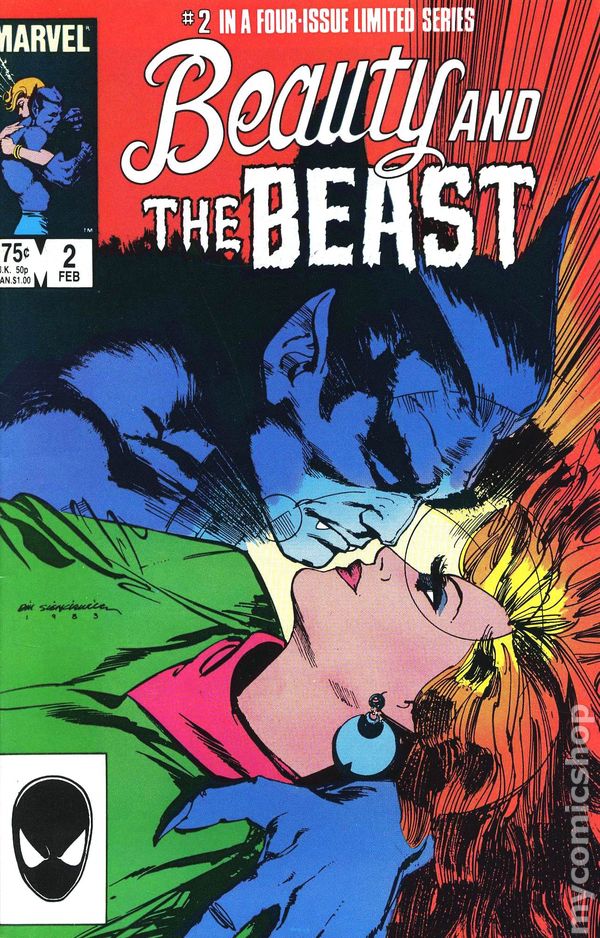
Bill Sienkiewicz’s cover for issue #2 definitely calls to the romance genre.
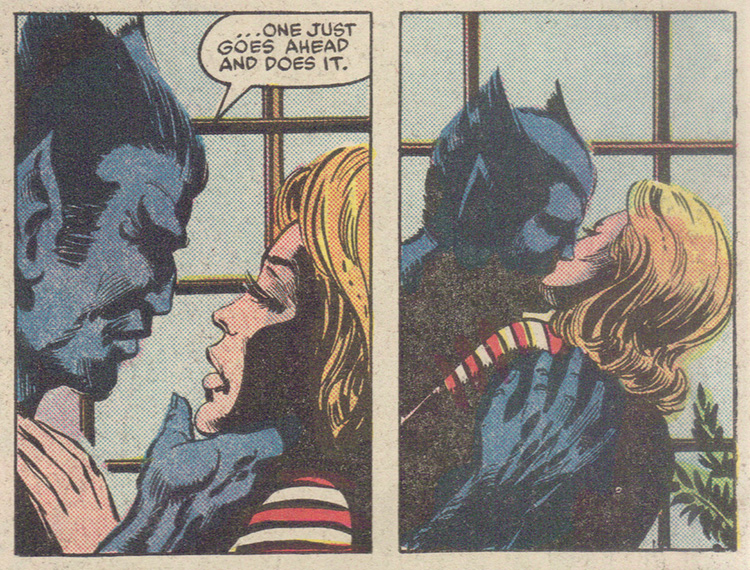
But perhaps the best example is Ann Nocenti’s 1984 limited series Beauty & the Beast. The Dazzler-focused series especially strikes me as the kind that really could have indulged the freakier side of the superhero concept, but then again I was also very upset when Grant Morrison walked back Beast’s admission of sexual confusion. I long ago imagined him into a long-term “open secret” type gay relationship with Wonder Man, so his queer possibilities were a part of my understanding of the character since about age 10.
Beast acting beastly in Beauty and the Beast #2
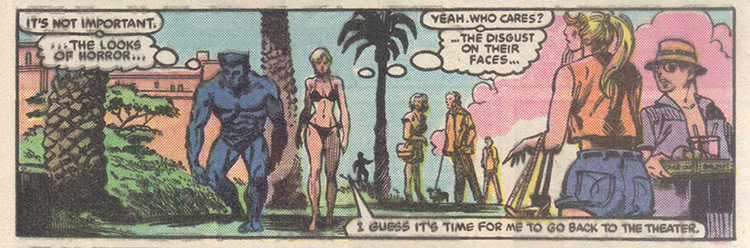
The first issue in particular has a structure that seems to pay homage to the romance comic stories of old. In it, Alison Blaire, the Dazzler, has been recently outed as a mutant, leading her to hang out with shady characters that party every day of the week in pursuit of revitalizing her career, further ruining her already ruined reputation. A full page montage covers the common romance comic trope of her indulgence and resulting indignity. The Beast, Hank McCoy, former X-Man and Avenger, fills the role of the love interest, acting as impulsively aggressive and entitled to Dazzler’s attention as any romance comic Romeo. The putative hero’s jerkiness is justified by the female protagonist’s straying. Wonder Man has a guest appearance in order to impugn Alison’s virtue and declare her lacking “self-respect.” Despite these problems, to me, Beauty and the Beast succeeds at doing what X-Men comics have long tried to do, make effective use of the mutant metaphor—not as a stand in for race or queer sexualities, but as stand in for the strangeness of these characters themselves, for the queerness possible within a cisgendered heteronormative framework. What is Beast if not a furry’s dream? How else are we to interpret the vicious whispers of strangers that see them together in public and judge them as immoral and disgusting, if not as a sign of the strangling confines of “the normal?”
Hank and Alison feel disapproval for their relationship wherever they go. (from Beauty and the Beast #3).
The Beauty and the Beast limited series (which, by the way, Rachel and Miles X-Plain the X-Men covered in episode 35: “Post-Disco Panic” of their awesome podcast) is very unevenly written and drawn, but highlights a line of force, a thread sewn through from the strange kinds of stories found in IDW’s Weird Love series to the bizarre relationships in a world of rock people, shape-changers, elastic men and invisible women. I think the world is ready for a romance-themed superhero comic. There has been some attempts at this (like 2009’s Marvel Divas, which, like the old romance comics was written and drawn by dudes and which I’ve only ever heard bad things about), but imagine a title given even a tenth of the kind of support bullshit like Age of Ultron or Axis crossover events gets. One can dream, I guess.
I am going to continue to delve into my new obsession. I think these old stories despite their frequent patriarchal foundations are important, not only because of their commonly beautiful art and storytelling, but also because they serve as a reminder of how strange the once most-accepted norms really are.