Utilitarian Review 1/17/15

Wonder Woman News

My book was (finally!) released this week. There were a number of reviews and interviews and such.

The Atlantic printed an excerpt adapted from the book’s intro.

Alex Deuben interviewed me at Comic Book Resources.

Paul Semel interviewed me at his site.

Suzette Chan reviewed the book at Sequential Tart.

Tim Hanley reviewed it at The Comics Journal. (Tim had a little more to say at his blog here.

Sheryl Kirby reviewed my book and Jill Lepore’s together.
 
On HU

This was a kind of overwhelming week on HU. We had a bunch of posts about my Wonder Woman book release, and then everybody wanted to write about Charlie Hebdo.

So Wonder Woman first:

I interviewed Carla Speed McNeil about how Marston/Peter’s take on gender inspires her.

I posted a gallery of images from my book.

Kailyn Kent wrote a review of my book and talked about how boring super-hero movies are.

I interviewed Trina Robbins about her love of the Marston/Peter comics (and got her to admit there’s a lot of bondage in them!)

And now Charlie Hebdo:

Kim O’Connor, listens as comics speaks to you.

Michael Kupperman on cartooning for the NYT and being edited by hobbits.

Marguerite Dabaie on Arab cartoonists whose repression has been sidelined in the Charlie Hebdo discussion.

Caroline Small on satire and empathy and the disconnect between the two.

Ben Saunders on why Charlie Hebdo should not be blamed for the attacks.

Bert Stabler on why Joe Sacco’s Charlie Hebdo cartoon was wishy-washy and awful.

Janell Hobson on how racism is, and is not, lost in translation.

Whew! It’s been nice to have so much interest, but a bit exhausting too. It’ll be nice to get back to just posting once a day and I presume being ignored by most of the internets.
 
Utilitarians Everywhere

At Pacific Standard I wrote about plus-sized models and the gaze of the sociologist.

At Ravishly:

— I wrote about how even in death, you can have privilege.

—I did a list of great women of gospel.

— I wondered whether a romance novel needs a happy ending.

— I wrote about the Adam West Batman and manly violence.

At Splice Today

— I explained that the Senate is not undemocratic.

—I endorsed Romney for President.
 
Other Links

There’s too much here already; no more links this week.

A Year in the Merde

Well, it’s been a long week. The hagiography has come and gone, the backlash has come and gone, balanced views have been proposed and interest is fading. What remains are protests in the Middle East against the caricature of the Prophet in Wednesday’s issue, and islamophobic violence in France (with one minor but heart-warming exception). One complicated answer that seems to remain, though, is “can an openly anti-racist magazine be racist at times, through carelessness and insensitivity ?” I am probably not in a position to say, but here is a look at one year of Charlie Hebdo covers.

52 pictures, then. From January 8th to december 31st 2014, Charlie Hebdo covered the news, with their now-(in)famous brand of vulgarity and cynicism. The hope is that, with a segment this size, we can investigate the techniques used to represent racial minorities, and especially the Muslim community. After all, they have been constantly under attack, haven’t they ?
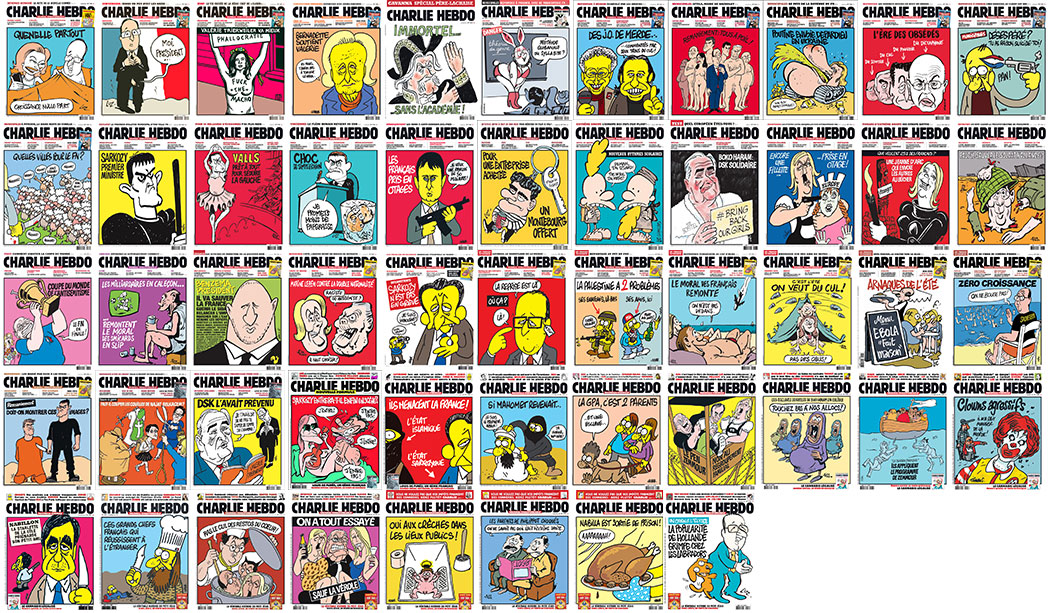
 

OneYear

 
Well, not really. Out of these 52 covers, none is directly about Islam or the French Muslim community. In fact only one is about religion, it dates back to December and makes a joke about the far right trying to push Nativity Scenes in public buildings for Christmas. Eight, however, reference djihadism, but more on that later.

So what ARE the covers about, if they’re not about religion? Well top of the list, with eleven covers, is the Le Pen family, head of the far right party Front National. Clearly, they have been Charlie Hebdo’s most consistent targets over the years. The magazine has never stopped shedding light on their hypocrisy, racism and what they see as the self-hurting stupidity of their electorate (many of whom are very poor people who would suffer from the FN’s anti-welfare program). Second is president François Hollande who is also pictured eleven times, though often not as the main subject of the image. Then comes Prime Minister Manuel Valls and other members of his government, who total 8 covers. Former president Nicolas Sarkozy closes the top with seven covers. The rest are about current events, from plane crashes and ebola to Gerard Depardieu’s tax evasion and school reform. So what are we left with to assess the racism of Charlie Hebdo ? Mainly three groups: political figures who are not white, racial minorities among background characters, and the treatment of djihadism.
 
Political figures
 
Politicians

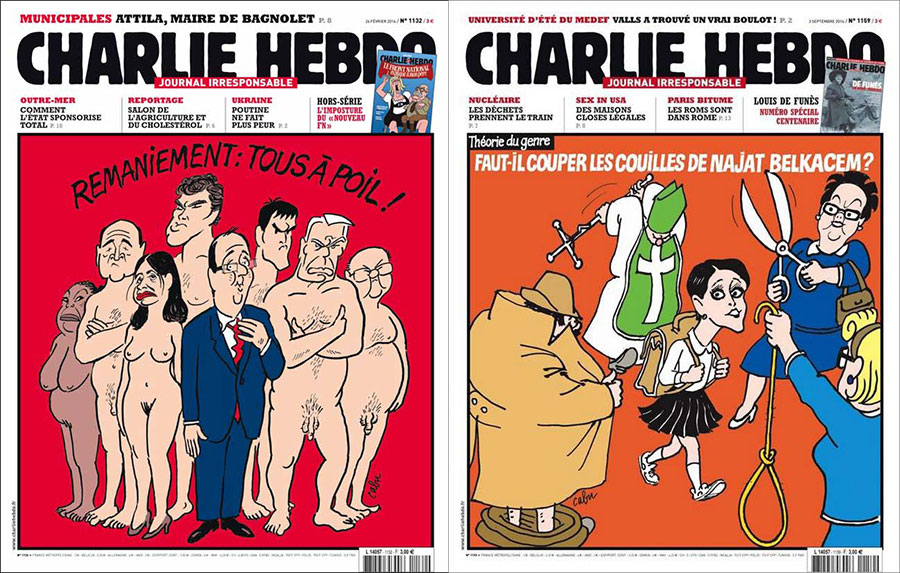
Left: Government reshuffle : they drop it all !
Right: Gender theory : should we cut Najat Belkacem’s balls ?

 
Only two non-white political figures appeared on the cover of Charlie Hebdo in 2014. Najat Belkacem and Christiane Taubira. Both are simple caricatures, without any racial stereotypes involved. But is the fact that only two non-white politicians are represented a sign of racism in itself? Since members of the government other than Prime Minister Valls only appear on three pictures, two is actually not that bad. And since their newsworthiness derives from being favorite targets of the right, their both being women and non-white says more about the French right than about Charlie Hebdo. Christiane Taubira, however, was the subject of a highly controversial cover back in 2013, so it’s probably worth looking into it.
 
Taubira, a radical leftist and former independentist from Guyana, is Hollande’s Justice Minister. As such, she was in charge, in 2013, of the bill that would open marriage rights to gay couples, which has made her the archenemy of the religious right. It doesn’t take long for the attacks to take on a racist “undertone”, culminating in a nauseating joke posted by a member of the Front National (FN) on her facebook page, showing two photos, one of a baby ape in a pink dress and one of Taubira, with the legend “At 18 months. Now.”

For years, Marine Le Pen, daughter of the infamous creator of the FN, has been working on her party’s image, superficially cutting ties with the most violent branches, and recentering her message on fighting the so-called islamification of France in the name of French secularism. At the heart of the rebranding is the use, on most of the communication, of the expression “Rassemblement Bleu Marine” (“Navy  Blue Union” or “Navy Blue Gathering”), instead of the FN name.
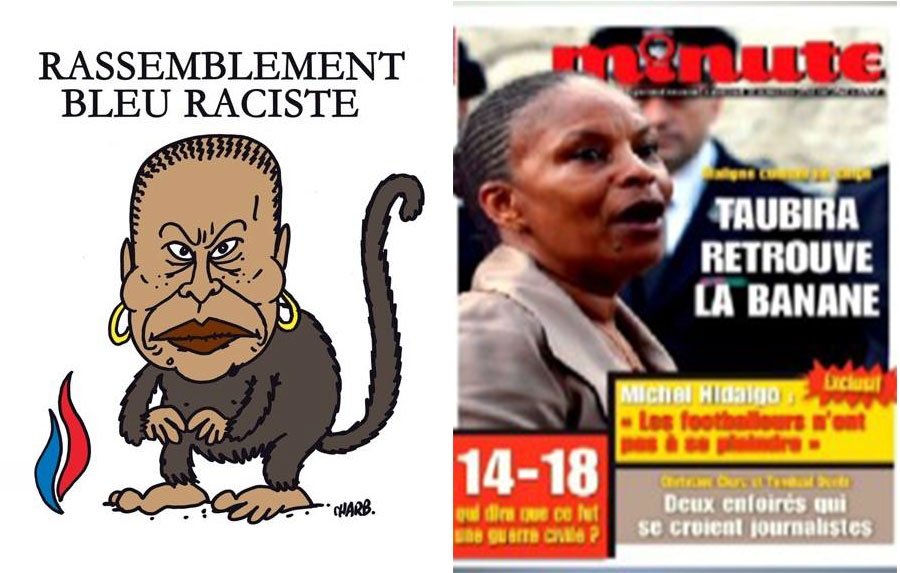
 
Taubira
 
When the scandal of the monkey joke broke, Charlie Hebdo immediately used it to point out that, despite all its rebranding efforts, the National Front was still at heart a violently racist movement, as they’d never stopped saying. Above the image of Taubira as an ape, they renamed the super-party “Racist Blue Gathering”. On the left, the red-white-blue flame of the FN served as a reminder that the ties with the movement’s past were far from cut.

Was the racist representation of the minister still a mistake, though ? Some time later, the far right magazine Minute created its own cover on Taubira. “Clever as a monkey, Taubira gets her banana back.” (“having the banana” or however one can translate it, is a French expression that means “to look happy”). When Minute was brought to justice for racial insult, and cited the Charlie Hebdo cover as a precedent, Charlie chief editor (and author of the cover) Charb responded : “[the difference is that] by repeatedly associating Ms. Taubira’s name with the words “banana” and “monkey”, the far right hopes to pass a racist slogan, a colonialist insult off as a popular joke.” It’s been pointed out that in a way, Charlie Hebdo’s image participates in the “repeated association”, and Charb’s explanation of the problem might be a sort of admittance of this. After all, as Charlie cartoonist Luz explained in this interview, in order to be able to push the envelope, the Charlie Hebdo staff has always allowed itself to make mistakes. There are laws in France against racial insult and pushing racial hatred. Unlike right-wing pundits who constantly turn their trials into publicity stunts and themselves into victims of political correctness, Charlie Hebdo has always accepted trials for racism as justice doing its work of sorting out whether they had gone too far this time or not. Which they were found to have, in a very few, but existing, cases.
 
Background characters
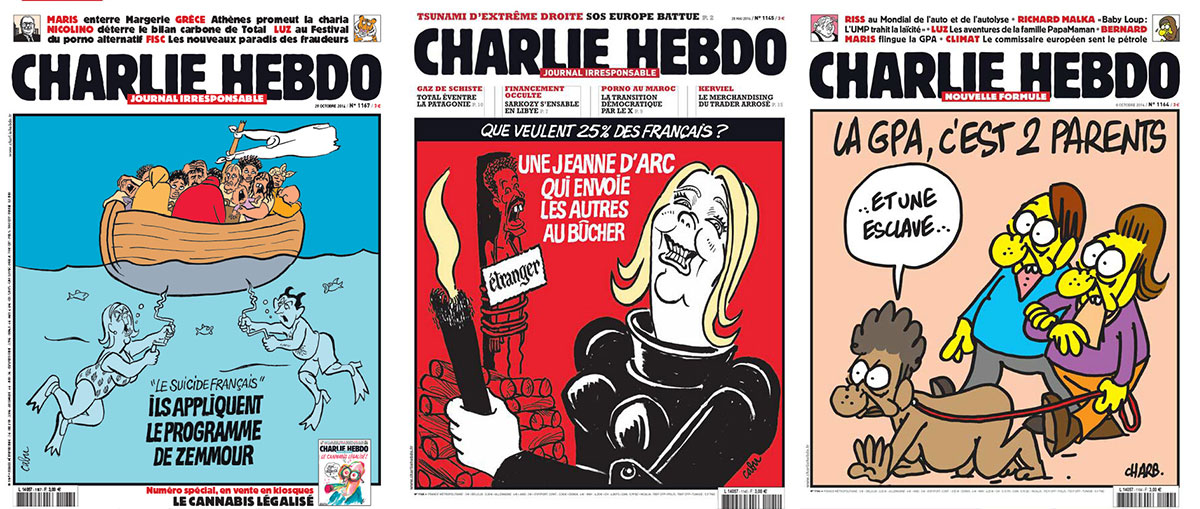
 
Background_characters

Left: French Suicide: they apply Zemmour’s book’s program
Middle:What do 25% of French voters want? A Joan of Ark who sends others to the fire
Right: Gestational surrogacy: it’s 2 parents. ‘And one slave…’

 
Again, only three instances, but they do provide some controversial material. The most benign, by Cabu, shows Nicolas Sarkozy and Marine Le Pen drilling holes in a small boat full of refugees. The people on the boat represent various origins, with some cultural and racial shorthand, but the general tone is one of empathy for the refugees. In the second one, interestingly also by Cabu, the “foreigner” (as his sign says) is represented in a manner much more reminiscent of openly racist caricature. The contrast with the previous image illustrates how Cabu uses racist imagery specifically to illustrate the racist nature of Le Pen’s program. “What do 25% of voters want?”, the legend asks. “A Joan of Ark who sends others to the fire.” The final image, by chief editor Charb, is by far the most shocking. The text explains the image, but doesn’t make it any easier to watch : “Gestational surrogacy : It’s 2 parents, 1 slave”. The subject is clear : is people renting other people’s bodies an ethical hazard? Still, the shock value of the image is unrivaled in 2014, even by the “Boko Haram sex slaves” cover. The reason it is so shocking, however, even to the casual Charlie reader, is because there’s only one like it.

In one of his twitter essays, Jeet Heer defined the risk of using racist imagery as satire. “I think what is true of Crumb is also true of Charlie Hebdo: the anti-racist intent of shocking images blunted & reversed by repetition.” The thing is, contrary to the impression given by small selections of the most offensive cartoons, such shocking images as the “2 parents, 1 slave” are not repeated at all. There is just a handful of really offensive material in a given year, and it’s not the same subject each time. They may value their irresponsibility, but they also know how to manage shock value.
 
Djihad : the great big joke

Here we are, then. The section where attacking extremists means attacking Islam, which means attacking Muslims, which means bullying minorities. First, let’s get rid of the ones that only mention djihadism to make jokes about Prime Minister Valls. That’s two.
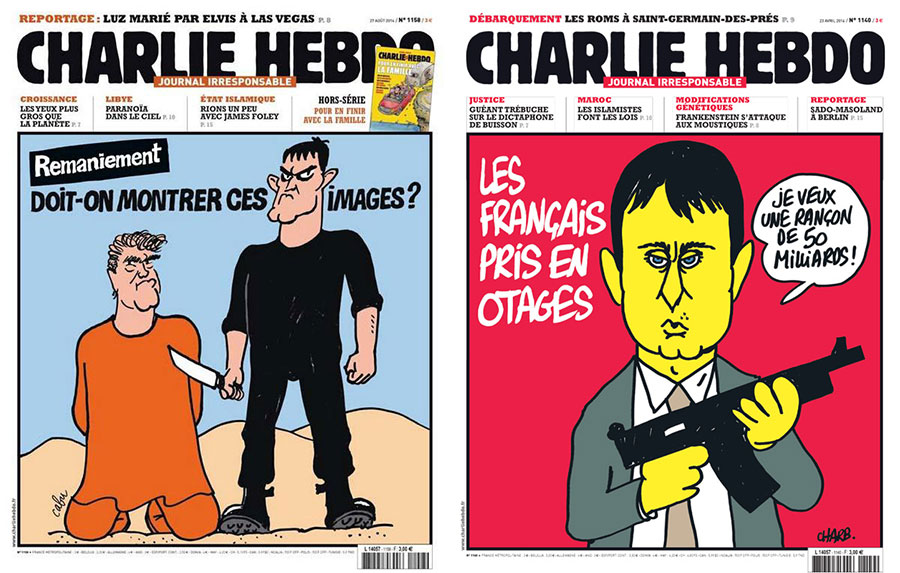
 
Djihad1

Left: Government reshuffle : Should we show these images?
Right:French hostages : ‘I want a €50bn ransom’

Dominique Strauss Kahn holding a #BringBackOurGirls sign with a lecherous look, or the return of Nicolas Sarkozy compared to the threat posed by ISIS are also only incidentally about djihadism.
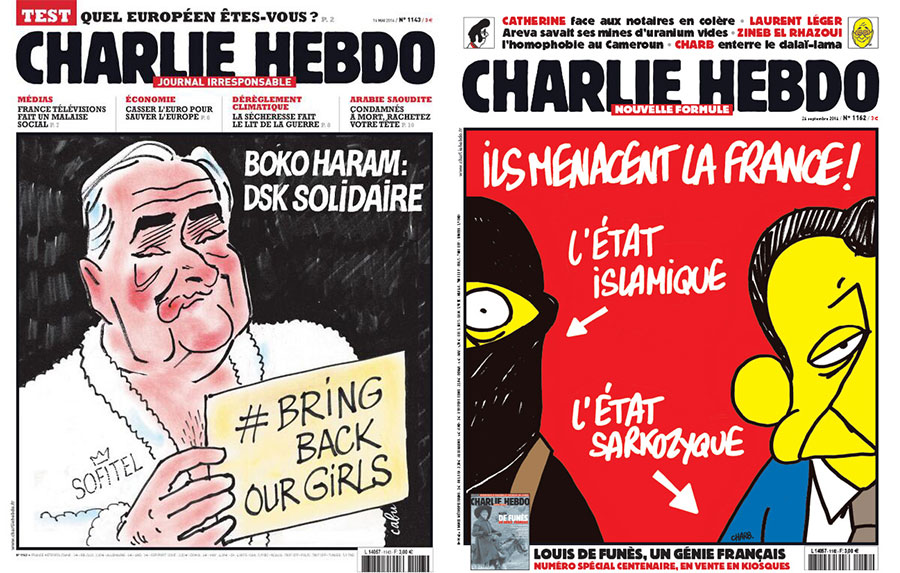
 
Djihad2

Left: Boko Haram : DSK expresses solidarity
Right:The threat to France! Islamic State / Sarkozyk State

 
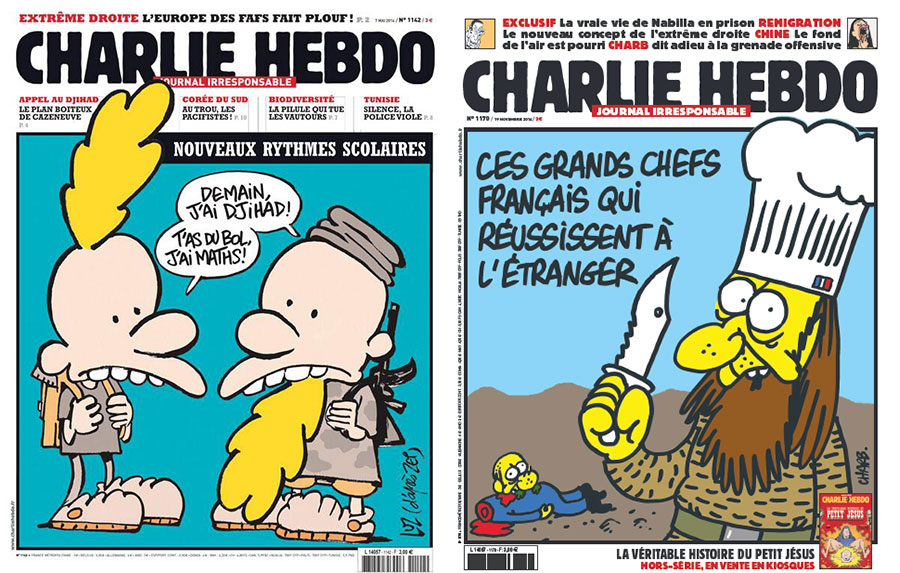
A strange one is the Titeuf cover. School reforms have inspired to Luz a weird joke where the iconic haircut of the famous (in France) children’s comics character is used as an Islamist’s beard. It may reference child soldiers in war zones, or religion at school, but it’s most probably a purely visual, message-free joke. The second one also blends a favourite newspaper headline with terrorist imagery for a rather benign result.
 
Djihad3

Left: School reform : ‘Tomorrow, I have Djihad!’ ‘You’re lucky, I have maths!’
Right: Those French chefs who find fame abroad

 
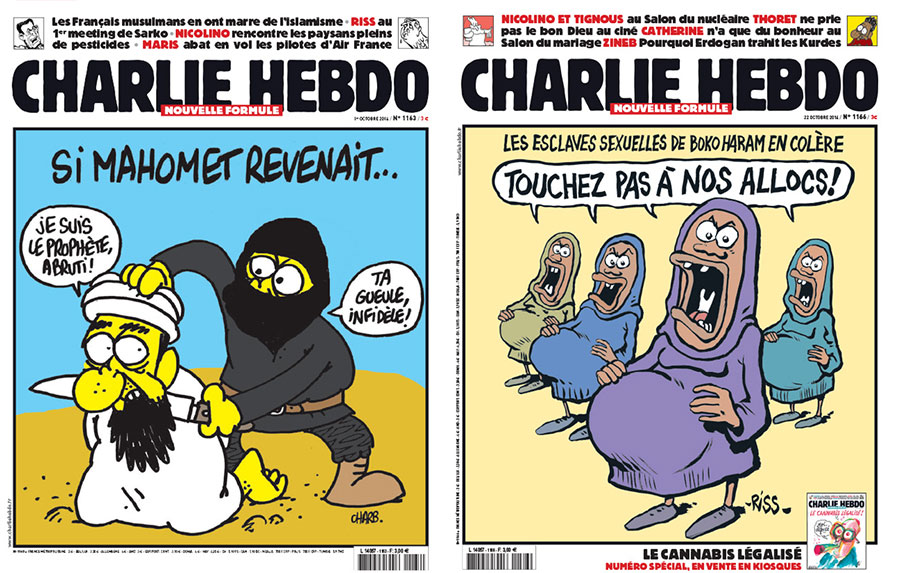
And finally, there are the two covers of 2014 that have been featured in selections of racist Charlie covers. The first one is fairly straight-forward, and is only offensive as it features Mohammad. The joke itself is about how the djihadists have deformed His message so much they wouldn’t even recognize him if he came back today. Which seems far from islamophobic.
 
Djihad4

Left:If Mohammad came back: ‘I’m the Prophet, you moron!’ ‘Shut up, infidel!’
Right:Boko Haram’s sex slaves are angry: ‘don’t you touch our welfare!’

 
The second one is the hardest to explain to a foreign audience, because it features two specificities of the Charlie Hebdo humour that here blend awkwardly. The first is the conflagration of two pieces of news : the crimes of Boko Haram in Nigeria, and the attacks on the welfare system in France. The second one is the use of racist imagery in pictures that denounce racism (as seen above with Cabu’s Joan of Ark cover). The French right (and the European right in general) often point the finger at immigrants to explain why the welfare system costs too much. It’s an easy rhetoric because everybody agrees that we spend too much on welfare, but nobody wants cuts to the help they themselves receive, so blaming the usual suspects is a popular choice. Therefore, as Terry Drinkwater summarized on Quora : “Fairly straightforward, innit?  The absurdity of raped and pregnant Boko Haram sex slaves acting out the welfare queen stereotype parodies the absurdity of the welfare queen stereotype.” What obviously didn’t help the cartoon to be understood as anything but racist is Riss’s rough and dirty style, which owes more to Reiser than to Cabu and Wollinsky. Little can be said about that, as it seems very much a matter of cultural taste. It does increase the insensitivity of the joke, though, admittedly.
 
Racism and Charlie Hebdo’s attacks on political Islam
A name that has been missing from most discussions is Zineb El Rhazoui. She certainly isn’t the only immigrant who has worked at Charlie Hebdo, from star cartoonist Riad Sattouf to their Kabyle copy editor Mustapha Ourrad, who was killed during the attack. She is however the magazine’s most virulent voice against political Islam. Looking again at the covers, here is a list of articles penned by El Rhazoui : “Tunisia, on the way to an atheist exodus”, “Morocco : the Islamists make the laws”, “Tunisia : quiet, the police is raping”, “Porn in Morocco : democratic transition through sex”, “When Muslims laugh at Islam”, “Mohammad, soon to be caricatured in Muslim countries?”…

Again, these are just a handful of articles among many that cover America, North Korea, Antisemitism in France, Islamophobia in Germany, etc. This list shouldn’t give the impression that Islam is the magazine’s favourite subject. As Luz, author of the “Charia Hebdo” and “All is forgiven” covers, explained a while back, “As atheists, it’s obvious that living in a traditionally catholic country, we’re going to attack Catholics more than Muslims, and the clergy more than God.” Similarly, Jul said : “It’s much easier to create violent cartoons about Christians, probably because we live in a Christian country. You can’t make fun of a minority religion the way you make fun of the majority one.”
 
Religion

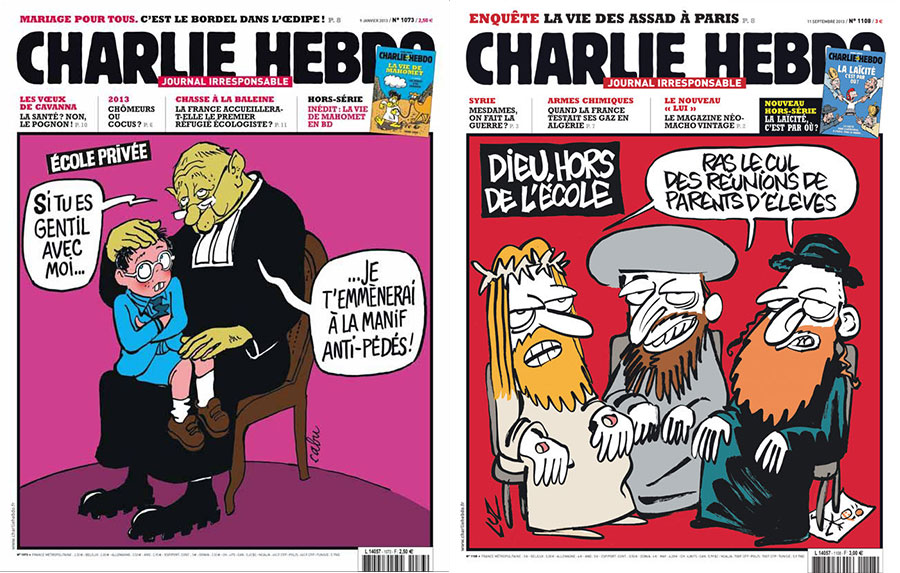
Left: Private school : ‘If you’re nice to me… I’ll take you to the anti-gay protest!’
Right: God out of school : ‘So sick of parent-teacher meetings!’

 
As a leftist magazine, however, promoting the secularist fights for civil rights in the Muslim world is very much part of Charlie Hebdo’s mission. First, because they feel a connection to the minorities who fight theocratic tendencies in their countries. Unlike in the US, where civil rights were fought for by religious figures such as Martin Luther King and Malcolm X, in France they have always been fought for by secularists against the religious right. Just last year, the Catholic sphere organized an incredibly violent opposition to gay marriage, which inspired a flurry of Charlie Hebdo covers on Christianity and homosexuality (see the first image above). The second reason why secularists’ struggles in Muslim countries is an important subject is because it counters the “clash of civilization” narrative that the racist right is trying to impose in France. It is a way of showing that the real struggle does not oppose Christian and Muslim societies but rather civil liberties against theocratic instincts, in every society.

Zineb herself has explained as much in a long response to a Swiss newspaper which had accused Charlie Hebdo of racism back in 2011 (quoting articles she had written while not referencing her anywhere). What is racist, she proclaimed, is to consider that people in Muslim countries are somehow impervious to enlightenment. That holding Muslims to the same level of expectations as Western countries in terms of democracy is asking too much. Herself a civil rights activist who spent most of her life fighting the oligarchic and theocratic nature of the Moroccan monarchy, she certainly feels that the ostracized minority that fights for democratization in Arab and Middle-Eastern countries deserves more support than those who would try to have religion gain the same level of untouchability in France as it enjoys in more pious societies.

Zineb’s response is apparently only available in French, but Olivier Tonneau wrote a “Letter to my British Friends” that explains in length the French radical left’s position on Islam. Charb also wrote on the absurdity of giving religion too big a part in identifying members of French society: “I can’t stand people asking ‘moderate Muslims’ to express their disapproval of terrorism. There’s no such thing as ‘a moderate Muslim’, just citizens with a Muslim heritage, who fast during Ramadan like I celebrate Christmas. They do act: as citizens. They protest with us, vote against rightist idiots… It would be like asking me to respond ‘as a moderate catholic’ just because I was baptized. I’m not a moderate catholic. I’m not a catholic at all”. A statement in which a lot of religious people probably wouldn’t recognize themselves, but one that does explain a lot of Charlie Hebdo’s perceived insensitivity.

So… That’s it. Race – and religion – in Charlie Hebdo’s 2014 covers. It feels a little anti-climatic. Where are all the most offensive jokes? Naked Mohammad? The “Untouchables 2”? Well, they date back to 2013, 2012, and hide disseminated among hundreds of other pictures about DSK’s arrest in New York, Israel bombing Gaza and anti-semites reaping the benefits in France… More airplane crashes, more attacks on the Le Pens, a whole lot of penises and a whole lot of good and bad jokes. You can find them all here. And if you have a hard time finding the worst ones, well the truth is, they were also hard to find at the time. Because Charlie Hebdo, “a glorified zine” as Luz himself calls it, never had a large readership. And it’s perhaps the biggest misunderstanding about France and these cartoons : nobody ever gave a damn about them, unless they saw some political gain in having an opinion.

Lost in Translation

We are halfway into the month of January, and already the year 2015 has unleashed unspeakable violence – whether we look to the horrific massacre of the Charlie Hebdo cartoonists, police officers, and Jewish hostages in Paris, France or to the unimaginable carnage that left 2,000 villagers dead in the northeastern region of Nigeria. Both attacks were fueled by radical Islamists, including the infamous Boko Haram, who kidnapped over 200 schoolgirls last year, an act that helped launch the widely popular #BringBackOurGirls hashtag on Twitter. Yet, international outrage has galvanized massive support for the Charlie Hebdo victims with a #JeSuisCharlie movement rising to protect freedom of speech and other beloved Western principles, while a lesser movement is struggling valiantly to promote #AfricanLivesMatter, politically connecting this sentiment to another popular hashtag: #BlackLivesMatter.

While some may wish to de-racialize these narratives with the so-called colorblind #AllLivesMatter, the unequal attention to these world events simply reinforce that not all lives matter, least of all those who are not afforded the white privilege of the French journalists who were unjustly murdered – no matter what one may have thought about their questionable cartoons that seemed to racialize its French minority population of Muslims and people of color. Nonetheless, the memorialization of Charlie Hebdo reinforces how much more white lives are valued. That some took to Twitter to create #JeSuisAhmed, in memory of the Muslim police officer also killed in the attacks, is a gesture reminding us that the value of marginalized peoples is never taken for granted. As Noah Berlatsky noted, “Who is remembered and who is memorialized has everything to do with race, with class, with where you lived and who, in life, you were.”

Of course, we can rationalize inequalities in media coverage – why the “world” seems to care about France over Nigeria, or why English speakers are questioning whether or not the Charlie Hebdo cartoons are “racist” or not, or even if we should criticize murdered victims who can no longer speak for themselves. Perhaps the violence in Africa seems more “routine,” in comparison to what takes place in Europe, hence more focus on Paris. And perhaps English speakers are “misinterpreting” Charlie Hebdo cartoons as “racist” and “Islamaphobic” since we are not translating the French correctly. Yet, such reasons given seem to suggest an unequal flow of information, as if “African violence” and “Muslim irrationality” are the only acceptable explanations for why violence happens (and why we should care more about France than about Nigeria).

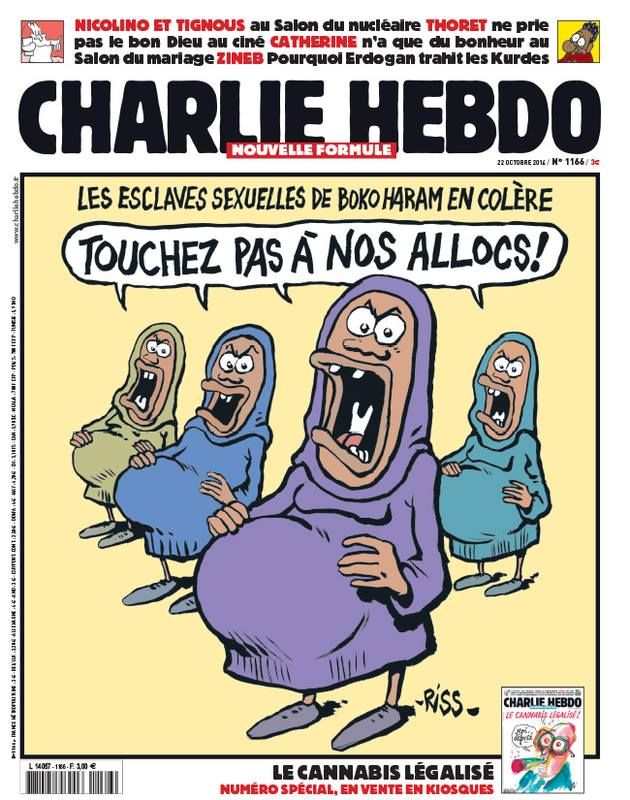
However, it is to these points that I want to take note of a particular cartoon featured in Charlie Hebdo, one that has drawn the most criticism for the publication’s racial politics. Here I refer to the cartoon depicting Boko Haram’s kidnapped girls in Nigeria.
 

CHARLIE-HEBDO.0

 
As French-speaking translators have informed us, the text reads: “Boko Haram’s sex slaves are angry,” while the visual depicts head-covered girls yelling “Don’t touch our welfare!” And as Max Fisher suggests, the cartoon functions on two layers: “What this cover actually says … is that the French political right is so monstrous when it comes to welfare for immigrants, that they want you [to] believe that even Nigerian migrants escaping Boko Haram sexual slavery are just here to steal welfare. Charlie Hebdo is actually lampooning the idea that Boko Haram sex slaves are welfare queens, not endorsing it.”

Such explanations may provide us with contexts and subtexts, but they are nonetheless steeped in apologia, conveniently overlooking the visually demeaning drawing of the girls or the racialized subtexts associated with African or Orientalist sexual savagery, coupled with a transnational narrative of black and immigrant women unfairly using the state’s resources (how interesting that conservatives here and abroad tend to speak the same racial language). Regardless of Charlie Hebdo’s own politics, the visual narrative recycles stereotypes and could easily be appropriated for white supremacist narratives.

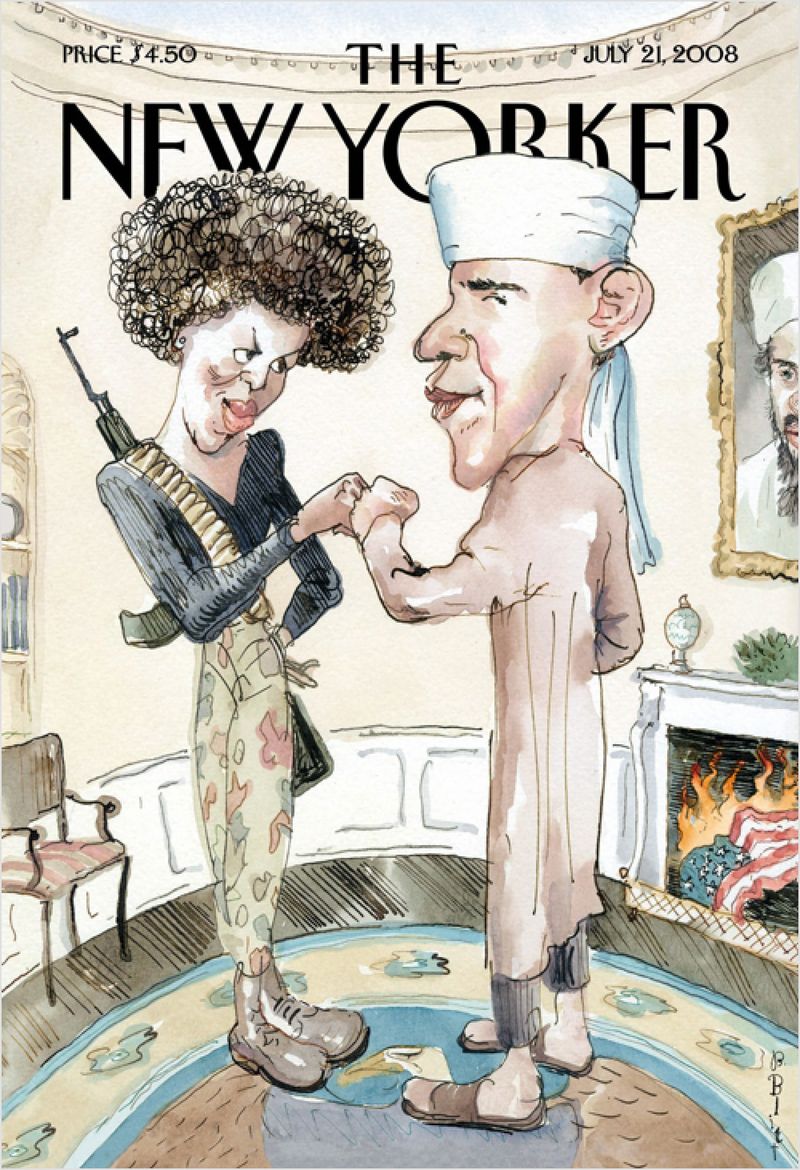
Fisher juxtaposed this satire alongside another parody – the New Yorker’s satirical takedown of Republican fears of the Obamas’ “secret black nationalist Muslim” plans during the 2008 presidential campaign.
 

002485946.0

 
Fisher then argued that “most Americans immediately recognized that the New Yorker was in fact satirizing Republican portrayals of the Obamas, and that the cover was lampooning rather than endorsing that portrayal.” This really highlights the problem of unspoken white privilege and power, as Fisher conveniently forgets that the New Yorker too came under attack – especially from communities of color who saw in the satire a failed use of racial imagery to poke fun at racism.

Why is it that the black or brown body becomes the vehicle for racial humor when the objects of ridicule – the white people presumably targeted for their racial bigotry – remain invisible in these satirical narratives? When recycling racial stereotypes – which both The New Yorker and Charlie Hebdo have done – do linguistic texts and subtexts hold the same equal power as the visual text, which holds heavier historical weight? Not all members of society (specifically communities of color who continue to feel their marginality in various social institutions) read these visual narratives in the same way. After all, if even in the U.S. certain Americans didn’t find the New Yorker cover funny – though we speak the same language and have access to the same cultural and political frames of reference – then what gets “lost in translation” when exposed to other local texts, contexts, and subtexts? Whose voices remain silent?

I specifically think of this when considering the actual creation of the Charlie Hebdo Boko Haram cartoon. I have a difficult time imagining a black woman cartoonist of any nationality – French, British, American, Nigerian – creating such a cartoon in jest. I also have a hard time seeing such a woman hired by the staff at Charlie Hebdo, and even if she were and found the courage – as the sole “token” black woman at the paper – to speak up to her colleagues and say, “Hey guys, this cartoon isn’t funny, and here’s why,” would her white male colleagues let her speak? Would they hear what she had to say? Would they drown her out with their insistence on “free speech” and “the right to offend,” or would they sincerely listen to suggestions on how their takedown of French political right racism could be, you know, clever (as racial stereotypes never are) and how the offense could be more effective in a “punch up” or “punch across” rather than “punch down” kind of way?

And therein lies the problem: the unequal flow of perspectives and unequal participation. Whether we point to white conservativism or white liberalism, these narratives hold cultural weight, even those that insist – because they may be on the “right” side of antiracism politics – that they could never get their racial politics wrong, even when they don’t interrogate the ways that they may hold or perpetuate racial privilege and power. The views of others remain in the margins, including our pain and suffering.

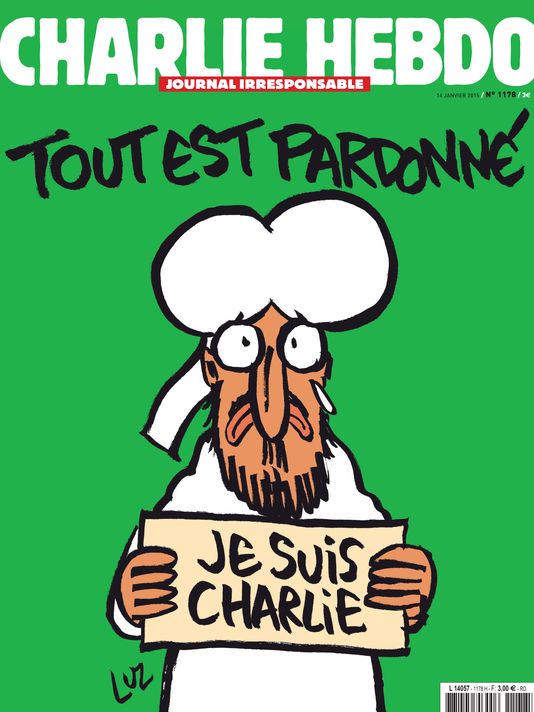
Charlie Hebdo’s latest cover features the Prophet Muhammad holding a “Je Suis Charlie” sign with a single tear rolling down his cheek as the text reads “All if forgiven”; the satire is quite apt and heartfelt and, most importantly, captures a kernel of truth in the moment.
 

635566811767752862-AFP-536711811

 
On the other hand, the Arab stereotyping of the prophet distorts truth and has reconstituted him as a French creation of the cartoonists’ own making, no longer connected to the religion or culture that prompted their satire in the first place. That is the nature of stereotypes, which have the effect of erasing altogether the very peoples and cultures they were intended to represent.

In closing I want to return to the scene of Nigeria, in particular Boko Haram’s alleged use of a ten-year-old girl to carry out a suicide-bombing attack. I can’t help but think this is the most cynical ploy and a deadly play on satire. What else is Boko Haram expressing but their utter contempt for and mockery of the West’s “Bring Back Our Girls” movement? They implicitly know that our rhetorics are empty and our raced and gendered messages constantly show our disregard for women and girls of color. They know that black girls’ bodies will only serve as mere objects of parodic visuals or Twitter hashtags without any real actions demonstrating that their lives matter. Somehow, these global understandings of whose lives matter don’t get lost in translation.
________
For all HU posts on Satire and Charlie Hebdo click here.

“How wonderful, a woman’s world”: Trina Robbins on Wonder Woman

Editor’s Note: This is the week my book, Wonder Woman: Bondage and Feminism is released. I’ve put together a week-long roundtable to celebrate.
_________

Longtime comix artist Trina Robbins is also one of Wonder Woman’s biggest fans; she’s talked and written on numerous occasions about her love of the Marston/Peter comics in particular. I interviewed her after she’d read (at least some of) my book.

Trina: So you should know I’m only in the middle of your second chapter. It’s a bit of a slog. You do have a good sense of humor and I like some things about your writing. You just so over-analyze that it just becomes a slog.

Noah: (laughs) Well, that’s the academic thing, you know.

Trina: I know. Thank god I’m not an academic.

Noah: All right…well, could you talk a little about what you like about the Marston/Peter comics?

Well, as a kid, I foudn the mythology extremely liberating. And I’m still into the mythology. And of course people like Brian Azzarello obviously knows kowing nothing about mythology or just doesn’t care.

I mean, for me, Jewish girl, brought up in a not super orthodox home, for me Judaism was very boring. At the synagogue they spoke Hebrew, which I didn’t know. One God, and this very boring and very patriarchal guy with a white beard. I didn’t like that at all. And I couldn’t relate to it. And Wonder Woman had goddesses. A whole pantheon of gods and goddesses. The gods weren’t particularly nice, but the goddesses were wonderful. And this was so liberating for me as a kid to read this. It was almost as though Marston had given us permission to believe that there was something other than the patriarchal bearded guy.

And also just the concept of Amazons. I think I was introduced to the concept of Amazons in Wonder Woman. This whole tribe of beautiful women alone on an island, no men. You have to understand that as a girl…boys were threatening. Not all boys, I had some nice male cousins. But in general they were threatening. They were bigger than me, and they tended to be a little nasty — women were wonderful. I grew up during the war when women wore bright red lipstick, and most of the guys were off at war anywhere. And women were much more interesting. It’s interesting because I’m totally heterosexual, but these are just the feelings I had.
 

Figure 25

 
An island full of women in pretty little dresses and they were all beautiful. It was just a wonderful thing to me. And as for the rest, what little girl doesn’t want princesses. She was an Amazon princess. So that’s what I saw in it. I saw stories in which women are all the ones who are the active ones. Not just Wonder Woman, but the Amazons and the HOliday girls, they’re active participants, they all fight the bad guys. It was wonderful for me.

Noah: One of the things we’ve disagreed about before is on how much bondage there is in the comics, and how important bondage is in them.

Trina: Well the thing is, as a kid I didn’t even notice the bondage. It went totally over my head. Obviously there are people who noticed it. I think they tended to be grownups. You know, like that soldier who wrote to Marston [about how he was a bondage fetishist and therefore loved Wonder Woman.] But I didn’t see it. Or if I did see it, I looked at all the other comics. It was traditional in Golden Age comics for people to get tied up. I’ve just been scanning in Girl Commandos drawn by Jill Elgin, and they always get tied up in each comic.
 

Figure 23

 
Noah: Tim Hanley recently counted how much bondage there was in Wonder Woman, and found it was more than in most other comics of the era…

Trina: Obviously he’s right, because he counted, and numbers don’t lie. But I didn’t see that, I can tell you. Because in all the other comics people got tied up too, and I didn’t count!

Noah: I’m curious about the lesbianism in the comics and what you think about that.

Trina: Not many people have talked about that except for Frederic Wertham in Seduction of the Innocent. And he’s a riot. The connections he makes with Holliday equals gay are just hilarious.

But of course there are hints of lesbianism. But for me it was more about women interacting with other women. In the British girls comics it’s always girls saving other girls. But if you look at the comics for the same period for the same age, it’s always the love triangle. Betty and Veronica fighting over Archie. It’s almost as though they’re trying to show, look we can do comics about girls, but don’t worry, they’re not lesbians.

Noah: Marston was not worried about that.

Trina: But as a kid I just thought, how wonderful. How wonderful, a woman’s world.

Noah: Marston would be quite happy with that, I’m sure.

I wondered if you had thoughts on the relationship between Olive and Elizabeth and Marston?

Trina: Well, definitely they were polyamorous. And I think it’s pretty probable that Elizabeth and Olive were lovers.

It’s very funny because…Spain Rodriguez, I don’t want to speak ill of the dead, and he was a dear friend of mien — and he’s still a dear friend of mine, even though he’s no longer with us. But he was so funny, he used to say, “See, he lived together with two women!” As though, ha, ha, he wasn’t a feminist. And I was like, Spain, if Susan would let you, wouldn’t you like to live with two women?”

Noah: It wasn’t like he was living with them without their consent.

Trina: Exactly.

Noah: I presume…I mean they lived together afterwards. It doesn’t seem like it was just…

Trina: They weren’t doing it just for him, or they would have moved away after he died. Of course.

Noah: I know you had harsh words for the Azzarello run on Wonder Woman…

Trina: It’s not just…he’s so arrogant! He’s so fucking arrogant. There was this one shot, it was a Wonder Woman run shot which was about Wonder Woman as a girl. It was intended to be some kind of parody of the Stan Lee comics of the 60s. Which of course doesn’t make sense anyway, since it’s a DC character and it’s completely different. But he doesn’t even know as a writer and a historian — he’s trying to make it old fashioned, so he has Princess Diana use the term “shan’t.” Well, by 1955, no one was saying “shan’t”.

And then in case you thought that he was not trying to be an arrogant asshole…you know how the old Marvel comics, Stan Lee would give everyone nicknames like “Jolly Jack Kirby.” So he signs his name as Brian “Kiss My” Azzarello.” That’s his statement. The innermost circles of Hell for him.

Noah. You really didn’t like his Wonder Woman run.

Trina: (laughs) You could tell.

I loved what Gail Simone did. Her white gorillas were the equivalent of the Holliday girls I just loved what she did.

“Punching down” versus “sinking to their level:” why choose?

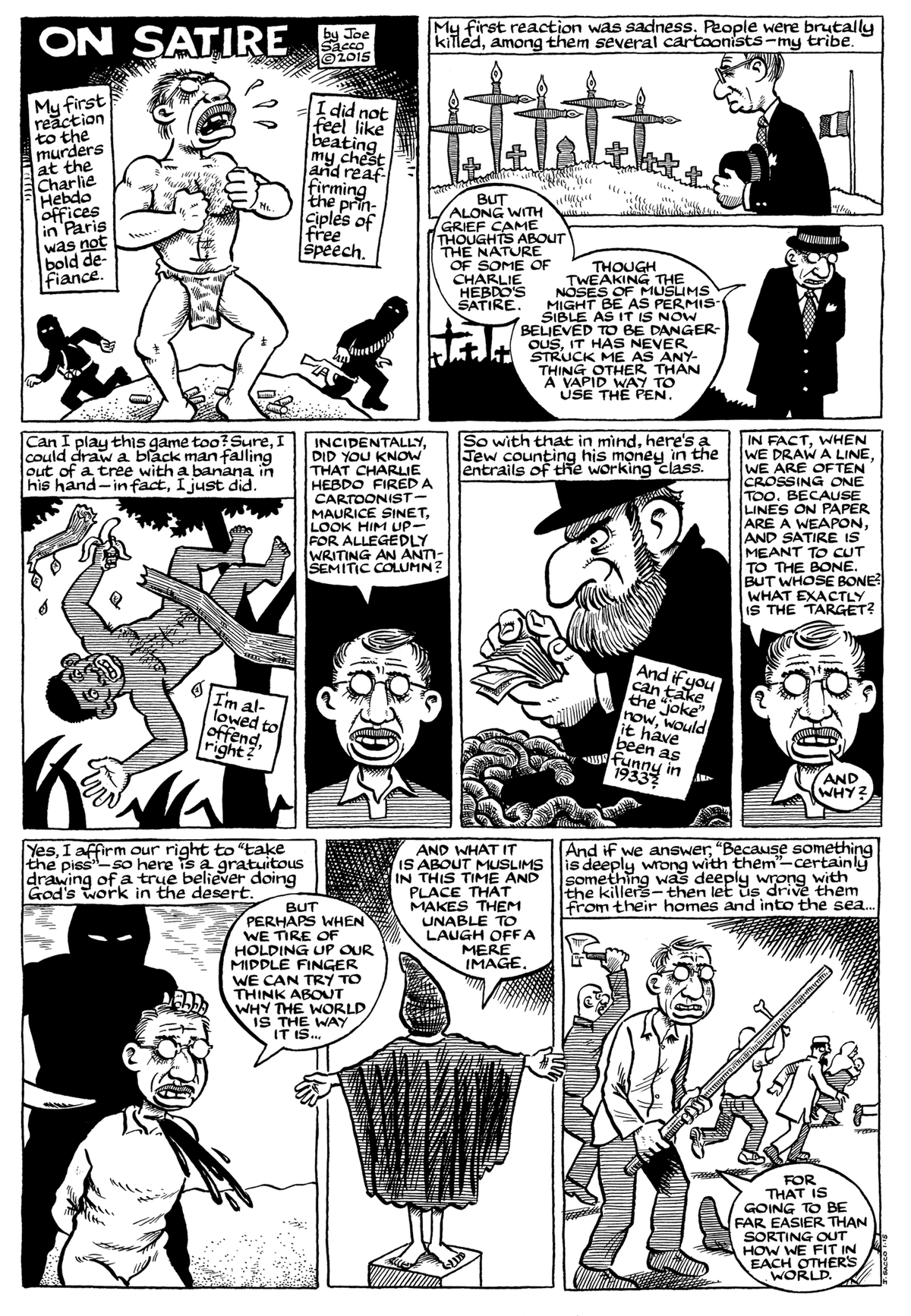
Everyone seems to love “On Satire,” Joe Sacco’s cartoon for the Guardian responding to the Charlie Hebdo massacre, but some may not. Some may detest “On Satire” because the cartoon was reverent toward the victims. They may think Charlie Hebdo‘s Muhammad cartoons justified the attack, or were straightforwardly racist. On the other hand, some may detest Sacco’s cartoon because it portrays a mob chasing Muslims. Knowing that he made an earlier ethnographic comic about Palestine, they may suspect Sacco of trying to distract viewers from the real business of condemning Islam wholesale, stepping up drone attacks, and leveling Gaza.

For my part, however, I detest it for being so thoroughly middle-of-the-road and ambivalent even as it affects a seemingly bold, seemingly nuanced stance on an subject that is not simply abstract “issues,” but a messy, bloody conflict with a long history. Allow me a condensed close reading.
 

joesaccoonsatire1200

 
First panel: Oh, Joe Sacco is passionate to be sure, but he is not hotheaded! He is sincere and reverent, and looks good in a loincloth.

Second panel: Pens made into crosses, how very poignant, yet so visually klunky. Hey, you know who kills lots of journalists? The U.S. But their victims mostly aren’t Christian, so you’d have to figure out how to make a laptop into a crescent and star, so never mind. And there were Muslim Charlie Hebdo victims too, but whatever.

Third panel: Walks away still musing metonymically on “the pen.” If only it were a clever reference to Le Pen, but it isn’t.

Fourth panel: Black man falling out of a tree with a banana but no loincloth, with a big branch suggestively hiding his indubitably endowed groin, equals not racist because aware of its racism! Why don’t you just burn one of those pen-crosses on his lawn? Oh, because he lives in a tree. Ooo, Joe Sacco is such a firebrand, I can’t wait to see an anthropomorphized Koran going down on a pig!

Fifth panel: “The More You Know,” the less you worry about offending Israel. France actually has laws on the books prohibiting hate speech, and it has recently used those laws to shut down anti-Semitic Twitter users. Now hundreds of French troops are deployed protecting Jewish sites. Where are the troops protecting Muslims? Why don’t you look THAT up?

Sixth panel: The professor plods on- remember anti-Semitism? Subtext: perhaps Muslims are anti-Semitic, perhaps? And by the way, what is this about the evil Jew preying on the “working class?” Stalin was a genocidal anti-Semite, but in the West the conflation of Jews and Communists should be so familiar as to be unworthy of mention. Get your hate straight. And of COURSE anti-Semitism matters in 2015, just like in 1933- France has had dozens of hate attacks against Jews in the last few years.

Seventh panel: More rambling prattle, but I’m getting distracted by Sacco’s face– are those eggs with eyelashes strapped to his head?

Eighth panel: Again, so brave! Martyred for his bold stance on reasoned meandering ambivalent equivocation. “But perhaps when we tire of holding up our middle finger we can try to think about why the world is the way it is…” So mature, so stoic, so profoundly deserving of the royal “we.” Sure talks a lot for a guy with a severed larynx.

Ninth panel: Abu-Ghraib Joe sez, “What is it about Muslims?” Wait, what is what about who? Who tortured who again? Traumatized prisoners say the darnedest things!

Last panel: Oh, I get it! “Drive them from their homes,” sort of like Israel right? He is part of an angry mob now– Israeli settlers? the IDF? Right-wing European nationalists? Well, there’s no hilarious stereotype to explicate that tragic-ish image- you just figure out that the woman being chased has a headscarf, the guy being chased has a beard and a taqiyah, and there’s Joe Sacco looking tough and angry again, this time holding a club while ironically continuing to mouth reasoned platitudes. But wouldn’t “sorting out how we fit in each others’ world” be illustrated better by the Prophet getting a back-door fist-bump from Gene Simmons of KISS—a Jew who genuinely doesn’t give a fuck who he offends?

But seriously, did Sacco say, “What is it about Muslims?” Not “some Muslims,” not “jihadi Muslims” or “fundamentalist Muslims” or whatever, but “Muslims in this time and place” (so qualified, yet so totalizing). The issue here is all about context. Explicit context: the jungle Negro and the hook-nosed moneylender are inoffensive because we are told not to be offended. Implicit context: the reader is not a Muslim, and can relate to crosses and complaints about those Muslims nowadays. Ignored context: radicalized Muslims are responding to a state of indiscriminate, cowardly, automated, endless imperial warfare. Arbitrary murder is answered by arbitrary murder.

And there is no reason to think that the cartoonists at Charlie Hebdo were unaware of the threats made to the lives of American cartoonists drawing the Prophet, as well as of the infamous Danish Muhammad cartoon (which the CH staff can be seen discussing on video). They absolutely deserved to draw their cartoons and not lose their lives, BUT what if they deliberately took a risk based on principle? What if they chose a stance that put them in the line of fire? Is that foolish or brave? Are they martyrs or casualties of war? Don’t ask Joe Sacco.

Writing in Slate on French secularism, or laïcité, Rachel Levy points out that in French public schools, “Muslim girls can’t wear their veils, Jewish boys can’t wear their kippot, and Christians can’t draw attention to their crosses.” As a country that has always had religious fanatics and never, despite strenuous fantasizing, a substantial monoculture, Americans don’t readily identify with a political stance that curtails expression of personal beliefs. And yet, America has the enormously successful Family Guy, a show that I think tops South Park, Ed The Happy Clown, Angry Youth Comix, or any Ralph Bakshi movie for unfettered omnidirectional contempt and bile. In France, culture is taken seriously enough to enforce bans on clothing, whereas in the U.S., to paraphrase Slavoj Zizek, culture is what people believe in without taking it seriously.

This is where I come from in trying to explain my repulsion at Sacco’s nonspecific sanctimony. France embraced African-American expatriates, but seems committed to marginalization of religious minorities. America elected a black President, but also keeps imprisoning black men, or just executing them in the street, or in Wal-Mart (maybe they all just fell out of trees?). Plus Americans can’t make art about serious ethical issues without being mealy-mouthed and pompous, unless it’s just a TV show and is thus divorced from any larger meaning. Saudi Arabia, from which the Charlie Hebdo attacks (like the 9/11 attacks) may have been planned, is the country with the most repressive Islamist regime in the world, and is also our key Arab ally. These three seemingly distinct places share one philosophy: money talks. And if all you have to offer by way of protest are overexplained, hyperqualified, utterly trite faux-provocations, that bullshit walks.
________
For all HU posts on Satire and Charlie Hebdo click here.

Resuscitating Wonder Woman

Editor’s Note: This is the week my book, Wonder Woman: Bondage and Feminism is released. I’ve put together a week-long roundtable to celebrate.
________

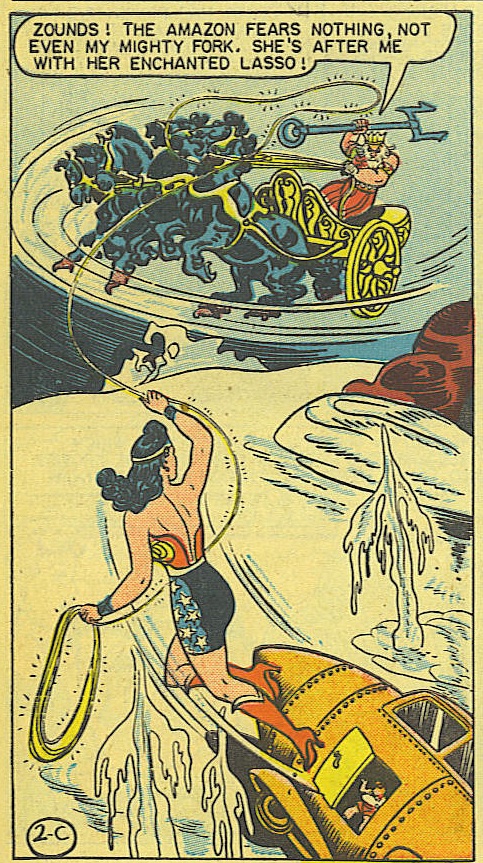
Figure 9

 
There’s long been talk about how superhero stories are getting ambitious. The histories and planetary layouts of comic book universes, once created haphazardly, are solidifying into un-breachable canon. Characters from diverse series will “cross over” and team up during climactic event episodes. Meanwhile, film adaptations attract talented, occasionally brilliant, actors, and pack in enough pseudo-philosophy and current polemics to merit thoughtful reviews, (or at least avoid outright dismissal.) Captain America fights military surveillance, dancing around his own imperial baggage. The Nolan Batman trilogy harnesses fearful imagery of mental illness and the Occupy movement to apologize for its own elitist and authoritarian nature, which it presents as perversely anti-heroic. Guardians of the Galaxy seems aware of its own ridiculousness, and so avoids stigmatization as overt camp. The cinematography, special effects, costume and set design are top-notch. The appearance of being an ambitious film counts more than the internal logic of the final work. It counts more than actual narrative ambitions, like championing a truly underdog protagonist, envisioning utterly alien societies and technologies, or portraying good and evil in an insightful way. Contemporary superhero narratives indulge in emotionally disconnected escapism, sexuality and violence, all carefully leavened with inside jokes and buddy comedy. These films, and their comic source material, feature all the bells and whistles of ambition, while being safe projects at heart. It’s a sad day when a quippy, trigger-happy raccoon (with a heart of gold) surprises audiences —he’s written exactly according to Marvel formula.

Some of this might be endemic to the superhero genre; in the words of Noah Berlatsky in a recent piece in The Atlantic,

“Tony Stark [of Iron Man] invents new magical energy sources three times before breakfast, but he uses them mostly to punch Thunder-Gods in the head, rather than, say, to completely transform the world’s technology and economy.”

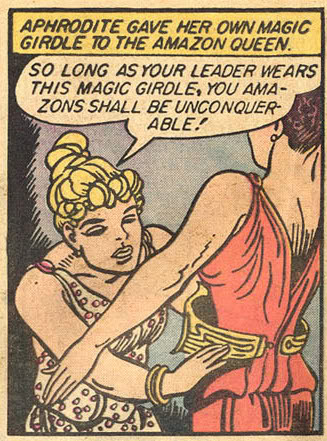
It didn’t have to be this way. Noah’s recent book, Wonder Woman: Bondage and Feminism in the Marston/Peter Comics, 1941-1948, records an alternative which had been present at the dawn of superhero comics. Unlike Superman, the original Wonder Woman comics were not a personal fantasy of power and assimilation, born already calibrated to the yearnings of depression-era, immigrant, and wartime youth. The Wonder Woman comics were an intentional manifesto, meant to instill radical concepts of femininity, masculinity, sexuality and heroism into children. Noah’s book elucidates William Marston’s radical philosophies and agendas, which informed every aspect of the forties run. If not for the kaleidoscopic visuals and zany scenarios, the barely-sublimated kinkiness and infectious fun, Wonder Woman might have been remembered as being propaganda designed to re-educate America’s youth. Instead, Marston and artist Harry Peter created one of the most original and unclassifiable comics in history. Despite its initial success, publishers didn’t know what to do with it, and America came out of the war more sexually repressed than it had entered. The Marston/Peter run hangs off comics history like a forgotten evolutionary branch. The indomitable Diana of the original comics faded away, and less interesting archetypes convergently evolved to take her girdle, to fit DC’s limited ‘heroine’ niche.

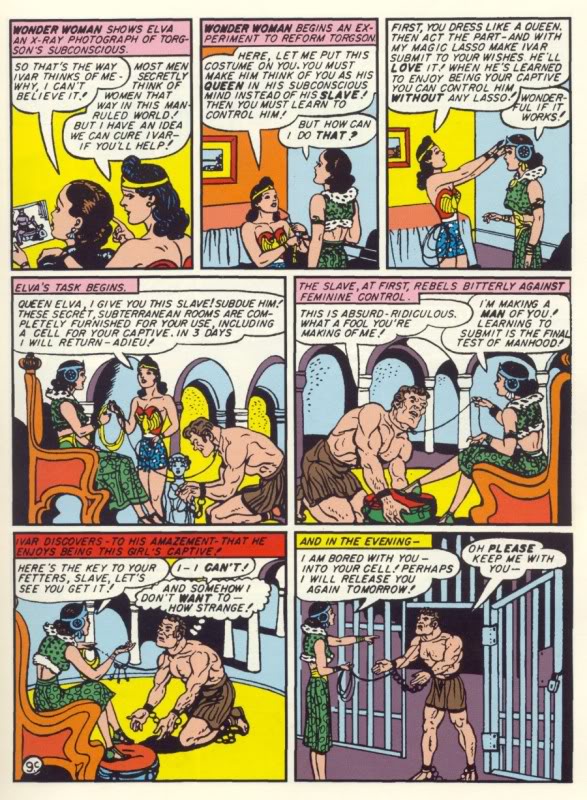
Even a casual glance at the original Wonder Woman issues elicits curiosity, if not alarm, as they depart from the standard procedure of most superhero work. The forties Wonder Woman comics featured a great deal of bondage, and a cavalcade of sexual reversals. Many villains are introduced as one gender, and then transform into or are revealed to be another. Occasionally their gender identity is never fully resolved. Wonder Woman binds enemies with her magic lasso, which makes them obedient to her will, but only after being bound and made helpless herself. The male protagonist, Steve Trevor, repeatedly injures himself, begins the series comatose, and is at points slung over the shoulder of a villain and kidnapped, yet he is never portrayed as being dithering or pathetic. Marston and Peter obsessively repeat classic melodramatic scenarios of bondage and hysterical emotion, while constantly changing who is doing what. This fetishizes the action, blends characters like a Venn diagram, and causes the linear narrative to coil in on itself, disrupting the temporal logic.

This entanglement allows all characters to participate in what Marston called the two “normal, strength-giving emotions” of inducement, or dominance, and submission, Marston’s key to a happy ending. An eminent psychologist of his time, Marston theorized that the world would be a better place if people learned to accept and practice both dominance and submission, as opposed to harshly overpowering others. Neither dominance nor submission was considered the superior state, and Marston links both in a pleasurable, loving cycle that ultimately leads to world peace.

Yet Marston and Peter don’t let the confounding cycle of bondage continue forever; Wonder Woman ultimately re-educates the villains, sometimes impressing the importance of love-leadership (and being sexually dominant,) on oppressed female characters. Marston intended Wonder Woman to be the model of female leadership. She is boisterous, positive, friendly and even-keeled– an athlete, adventure lover, caretaker, and confident romantic. Wonder Woman throws herself into the fray of battle one minute, while openly crushing on and nursing a wounded Steve Trevor the next. Marston saw no contradiction in these actions, nor in Steve’s vulnerability and strength. Wonder Woman anticipates the multi-dimensional “strong” female characters found with greater frequency today, although this chain was broken by decades, where Wonder Woman was treated like a glorified pinup.

Noah’s book resuscitates these largely forgotten, original comics by examining them as carefully and closely as they deserve, and by meeting Marston and Peter’s work on its own terms. Noah matches the recursivity of the comics with an interweaving analysis of Marston and Peter’s three major concerns: “feminism, pacifism and queerness—or, if you prefer, bondage, violence and heterosexuality.” As Noah explains, “For Marston, these topics were all inextricably intertwined… the book presents not so much a linear argument as a braided exploration, in which the same ideas and obsessions recur in slightly different formations and slightly different perspectives.” As not being strictly formal opposites, bondage and feminism may be the least intuitive pair of the bunch; fortunately, Noah starts there.

Noah argues that the comic’s sexualized fixation on disempowerment, binding, abuse, and manipulation resonates with women and girls, who have been traditionally disempowered in patriarchal society. The representation of subjugation matters as much to women as denunciation of it, (and possibly more,) an idea Noah supports through the theories of several respected literature and media scholars. The Marston/Peter comics have been criticized for eroticizing the bondage of women for a male audience, although Marston’s writings show that he deliberately geared the comics to be read by children of both genders, and at least some evidence indicates they were. Marston and Peter also turn bondage on its head, displaying male victims and female abusers. Noah makes the case that readers simultaneously desire and identify with both men and women, victims and abusers, which highlights a peculiar, and radical piece of Marston’s vision: he denounced rape and abuse as the greatest of evils, but preached the healthy pleasures of reciprocal, consensual, bondage. “Marston, [assistant writer] Murchison, and Peter want to provide these pleasures to everybody, even, or perhaps especially, to the most oppressed and the most wounded.” Noah writes, “That remains a rare ability and an extremely precious one… We can condemn child abuse or we can acknowledge children’s sexuality, but we have enormous difficulty doing both at once.”

Wonder Woman: Bondage and Feminism… also articulates what is problematic about Marston’s theories, often bringing dissenting voices into the mix. Noah largely supports and expands upon Marston’s ideas with a diverse range of supporting sources. This is brave, especially when Marston casually reconciles themes that many consider mutually exclusive. The chapters on pacifism and queerness contain many theoretical surprises, including alternative visions of the proper functioning of education, motherhood, and sexual orientation. Noah also contributes great ideas of his own. His exploration of gendered responsibility and heroism, and how expectations change for female characters, is both inspired and concise, and hopefully destined to enter into wider discussions of superheroism. Best of all, Noah does a great job of showing that these ideas clearly appear in the Wonder Woman comics themselves, and are not projected onto it by later minds.

Marston didn’t shy away from advocating a new world order ruled by a new order of women, and he casts the net of his imagination widely. Noah does well to bring a wide variety of scholars from many disciplines, tackling each component of Marston’s broad vision piece by piece. Occasionally, this diversity scatters the argument. Readers may question why Noah includes some voices, and not others: he extensively draws on Anne Allison, a scholar of post-war Japanese domestic life, and even then, on a very limited spectrum of her work dedicated to mother-son incest urban legends, (and a bit about lunchbox making.) Allison’s observations parallel the Wonder Woman comics in interesting ways, but an example of ‘matriarchal rule’ closer to the comic’s original context might have served better. I would have also appreciated a second, corroborating source. On the same note, is Pussy Galore the only available example of male fantasy lesbianism? Her significance to the discussion of Wonder Woman’s homosexuality feels both sketchy and undeserved. The most egregious cameo would be Luce Irigaray’s The Sex Which Is Not One. No matter how well her ideas match the argument, statements like “woman has sex organs more or less everywhere,” will seem anatomically preposterous to many, especially when left to float outside a considerate introduction to her work. Distracted by moments like this, a skeptical reader could disengage from the greater point.

My chief criticism of Wonder Woman: Bondage and Feminism is that there should have been more evidence from indisputably relevant and more general sources, and the argument should have relied less on isolated examples. Wonder Woman: Bondage and Feminism is not a case for the application of Marston’s ideas, as much a case for their remembrance and relevance, particularly within comics and feminist scholarship. As the book stands, Marston’s ideas, freshly unearthed, may be unfairly vulnerable to re-burial, simply because of missing or dismissible evidence.

This would be tragic, considering that Wonder Woman: Bondage and Feminism illustrates the terrible stakes in making Wonder Woman the afterthought of DC Comic’s line. Noah details two contemporary runs of the Wonder Woman comics, one disturbingly anti-female, the other well-meaning but inane. I would have appreciated a run-down and time-line of the character’s entire development, particularly George Perez’s re-launch of the character in the mid eighties, as Noah goes against the grain in labeling it as trivializing. I would have also liked a discussion of why, after the close of WWII, Wonder Woman repeatedly targets imaginary misogynist dystopias, often on alien planets. The forties run seems equally split between war-propaganda and planetary colonization, and this schism seems rich for exploration.  Most of all, I felt the book skipped over an examination of early twentieth century melodrama. Was Marston’s obsession with bondage an exaggeration of existing bondage tropes, sawmills, train tracks, and all, that filmmakers repeatedly inflicted on the female daring-doers of popular cinema? How much of Wonder Woman comes from The Hazards of Helen?

These criticisms essentially come down to a wish the book had been longer, which I realize is a backwards compliment. I wish this because I too am convinced that the Marston/Peter Wonder Woman comics are relevant today. People love superheroes, perhaps now more than they ever did. The current popularity of superhero entertainment has lasted longer than their initial explosion in the forties. I hope there is room in mainstream entertainment for risky visions of what it means to be a hero. Even more, I hope there is room for visions like Marston’s, who was willing to embrace paradox, and attempted to describe the wonderful, ineffable, irrationality of love.

Charlie Hebdo Is Not To Blame

In the wake of the tragedies that have occurred in Paris over the last few days a number of commentators, some traditionally left-leaning and some more obviously right-wing, have suggested that the cartoonists at Charlie Hebdo contributed to the climate of extremism that led to these attacks. The arguments often take the form of a double assertion: first, that the cartoons in question were flagrant or “unnecessary” violations of the Muslim prohibition against images of the Prophet; and second, that these violations were motivated by Islamophobia and racism. The conclusion, merely implicit in some commentaries and more explicit in others, is that because the cartoonists at Charlie Hebdo were also racist bullies they bear a degree of culpability for what happened; consequently, they also make poor martyrs for either the profession of satirical cartooning or the right to free speech.
 

635566811767752862-AFP-536711811

The cover of this week’s edition of Charlie Hebdo.

There are several problems with this argument, however. Most troublingly, to imply that the cartoonists at Charlie Hebdo contributed to the radicalization of Muslims by repeatedly violating an important tenet of Islam reduces the wide range of Muslim opinions on this specific issue to the extreme position held by the terrorists themselves. To take up this position is to fail to understand that the so-called “prohibition against images of the prophet” is actually already a radical interpretation of Islamic doctrine. No such prohibition exists in The Qu’ran. In fact, significant numbers of Muslims do not hold to this supposed prohibition, and even among those who do, interpretations of the precise meaning and purpose of the relevant phrases in the hadith literature are diverse. (On this topic, see here.

But there are other reasons for resisting the argument that the cartoonists at Charlie Hebdo were somehow responsible for creating the climate of extremism that led to this incident. The more I learn about the work at Charlie Hebdo (and I admit I have more research to do in this regard), the more I am convinced that this implication is unjust and unfair.

I am a British-born academic who has lived in the United States for over two decades; I am largely ignorant of contemporary French culture, and I confess I am only now becoming even superficially familiar with Charlie Hebdo (just like most of us, I suspect). But from what I have been able to ascertain in my preliminary investigations, while the cartoonists at the magazine were commenting satirically upon religious extremism, they were not creating it. The extremism was already there. They were calling it out — perhaps in a foolhardy way, perhaps courageously, and with varying degrees of mean and clever wit — but they were reacting to something that was already present in the culture, and that was being fostered by even more negative, reactionary, and ill-intentioned forces based outside France. (Indeed, no matter what one thinks of the Charlie Hebdo cartoons, any role they could have played in radicalizing these particular terrorists is surely outweighed by Said Kouachi’s months of training in Yemen under a branch of Al Qaeda.)

Nor does it seem correct to accuse the editors at Charlie Hebdo of racism, as some have done. Experts who are better informed than me with regard to the history and culture of French comics (the brilliant Bart Beaty, for example) tell me that, on the contrary, the editorial position of the magazine was consistently anti-racist. This is not to say that a case against individual cartoons could never be made; caricature is an art-form built on principles of exaggeration and abstraction, and the point at which the visual “shorthand” of the cartoonist becomes a stereotyping technique cannot be fixed, but will vary from situation to situation and viewer to viewer. Nevertheless, any such case would have to be made within the larger anti-racist intentional context of the magazine, and nuanced accordingly. I’ve yet to read such context-sensitive work; it is not a feature of those denunciations of Hebdo as “racist” that I have seen. Nor does there appear to be any evidence that the editors at the magazine regarded the Muslim community in general with hostility. In fact, there appears to have been at least one person of Muslim heritage on the staff at Charlie Hebdo who was killed in the attacks: Mustapha Ourrad, a proofreader.

Yes, Charlie Hebdo published work that was profoundly hostile towards religious extremists within Islam; it was similarly hostile towards other religious authoritarians, too (which is probably why rightwing Catholics like Bill Donahue have been willing to suggest that the cartoonists were essentially asking for it). Indeed, the general stance of the magazine appears to have been one of gleeful contempt for religious and political hypocrites of all stripes. Certainly, the boost that explicitly racist politicos like Le Penn are currently seeing in the French polls in the wake of these events would have horrified Charlie Hebdo’s editor Stephane Charbonnier, a life-long left wing activist who was (according to the New York Times) raised in a family of French communists. In fact, I think Charb would be commissioning some bitterly ironic anti-fascist cartoons in the wake of the current xenophobic rightwing groundswell — if only he were here to do so.

In other words, the cartoonists at Charlie Hebdo seem to have been exactly what you might expect satirical cartoonists in the French tradition to be: mockers of pomposity and demagoguery of all kinds.

I think I understand the motivations of at least some of the critics of Charlie Hebdo, even if I do not agree with their assessment of the magazine. They are concerned, rightly, that Muslims of good will should not be held responsible for these crimes or bullied into silence; and they are concerned, rightly, that ongoing incidences of the victimization of Muslims in France, Britain, America, Palestine, and elsewhere should not be overlooked or worse yet, justified, in the wake of this outrage. And they are right because at a time like this it is obviously very important that Muslim voices (in particular) are heard, in all their diversity. Indeed, it is absolutely necessary that Muslims of good will should be welcomed to the table, so that we can repudiate vile, greedy fools like Rupert Murdoch when they spew their poison and ignorance into the world.

But surely it must be possible to include Muslim perspectives on this kind of violence without accusing the cartoonists of Charlie Hebdo of political insensitivity (a criticism that seems to misunderstand the very point and purpose of satire), let alone deliberate racism (a charge that thus far appears to me unjustified)? Instead, and perhaps more productively, we could chose to emphasize that a man of Muslim heritage worked and died alongside the cartoonists at the magazine; that another Muslim man, a police officer named Ahmed Merabet, died defending the cartoonists at the magazine; and that yet another Muslim man, Lassana Bathily, saved several hostages from another terrorist at a Kosher grocery the next day. If we keep reminding people that members of the Muslim community were victimized here, and others also acted heroically, that will go some way towards making the reactions of people like Murdoch seem absurd, and make productive dialogue between social groups more possible.

In sum, and while there is no doubt much more that could be said, I think the suggestion that the cartoonists at Charlie Hebdo are in any significant way culpable for the climate of extremism that led to these tragic events is unfair not only to those cartoonists but also to the many members of the Muslim community who would never in a million years respond to a cartoon — however offensive they deemed it — with a bullet. It also just puts the cart before the horse. After all, if a right wing Christian were to shoot Andreas Serrano for making “Piss Christ” I would not repudiate blasphemous artists for unnecessarily provoking radical Christians; instead I would ask what forces were at work to make some Christians feel that murdering artist-provocateurs was a necessary and acceptable defense of their faith. I wouldn’t think the act was somehow the responsibility of Christians everywhere, but neither would I blame Serrano himself — for all that “Piss Christ” is more readily legible as a desecration of a religious icon than any of the cartoons at Charlie Hebdo I’ve seen. (And I am aware that Serrano himself declares the work to be devotional.)

I write these remarks in the hope that they will be interpreted not as an attack upon those with whom I disagree, but in what I hold to be a spirit of fairness both to the dead and to the living, of all faiths and of none.
_______
For all HU posts on Satire and Charlie Hebdo click here.