Atari Comes Back, Maybe Sort Of

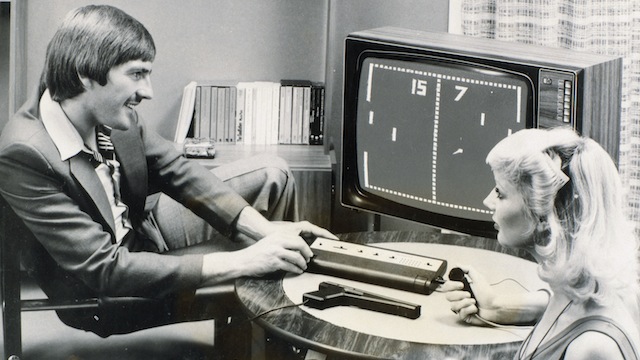
Steve Heighway playing Pong, 26 September 1977.

Atari was once the most successful home video game companies in the world. That sounds impressive, but the fact that it was once one of the only home video game companies in the world is far more noteworthy. When a company leads the way like Atari did, it can be difficult for anyone else to gain traction as a worthwhile competitor. Unfortunately for Atari, that wasn’t the case in the video game industry.

While many of us hate to see something that holds such a sentimental value decaying because of its lack of monetary value, over the years we looked through our fingers and felt a twinge of guilt as the company was continuously overshadowed by other giants. Nintendo and other console/PC developers came onto the scene and, eventually, the name Atari was nothing more than a memory.

But Atari is more than a memory, and those who think otherwise may be surprised to hear that the company hasn’t disappeared over the years. As it turns out, they’ve just been waiting to make a comeback, albeit in a smaller fashion.

Most CEOs take on a failing company in hopes of bringing it back to its glory days, but Atari CEO Fred Chesnais isn’t one of them. In fact, he’s more than willing to leave those days in the past. Instead of setting Atari up for failure by trying to regain their share in the console market, the new executive is setting his sights on more realistic goals for the company’s future. And he’s starting by abandoning the branch that made them successful in the first place—consoles.

Earlier this year Chesnais told WIRED that he realized it’s time to “let other people be Atari.” Instead of trying to build the brand back to what it was, he’s allowing other studios who are already in touch with today’s audience to license the brand as a way of attracting more attention.

Instead of classic action or adventure games, Chesnais has chosen to steer the company down a new path in gaming. Earlier this year, they entered a partnership with FlowPlay, a social gaming studio that helped Atari create their own social casino gaming platform—Atari Casino. Set to launch next month, Atari Casino is reported to have one outlet for those looking to play with virtual money and another for those who wish to play with real money in states where the practice is allowed.

On paper, it’s a smart move for the company. Statista shows that the online gambling market has seen a steady rise in profits since 2003, a trend that they’ve predicted will continue into and beyond 2015.

However, that isn’t to say that they won’t face steep competition in their new market endeavors. Chesnais may be willing to let other gaming console companies “be Atari,” but there’s already an existing company that holds such a title for the online gaming community. Betfair, an online gaming group based out of the U.K., has already established itself as the world’s largest Internet betting exchange. It’s also currently available in U.S. states where gaming is legal. Thus, if Atari chooses to move forward in online gaming, they will soon find themselves going up against such industry giants.

Gaming isn’t the only market Atari has decided to dip its toes into. While working on targeting adults through their online gaming, the company is also in the process of making attempts to connect to a younger audience. This is, of course, an age group that the company initially attracted during their heyday with console games.

Chesnais believes that in today’s market, gaming companies are no longer competing against one another—they’re competing for the user’s time. And because two of the biggest time-pulls among the age group are social media and video-sharing sites, such as YouTube and Vine, Atari is looking to create their own, similar content through a project called Atari TV.

Established earlier this year, the first installments of the program feature a daily video blog called The Real Pele, which followed the soccer star throughout the World Cup in Brazil.

However, Atari’s ability to make a name for themselves in that market could prove to be just as difficult as their goal to enter online gaming. Each video that they’ve posted to their account only has a few thousand views, and subscriptions to the channel have remained in the low hundreds. With over 100 hours of content uploaded to their site every minute—that’s according to Expanded Ramblings— getting their share of the traffic could be harder than they anticipated.

It’s been challenging for Atari thus far to gain some headway, and it looks like it will continue to be so for some time while they press on and work in the shadows of their competitors. However, at least they won’t be in the shadow of their previous successes. It will be an uphill battle, but entering a new industry gives them an opportunity for a fresh start and, hopefully, a brighter outlook for the future.

There’s no denying that new projects from the company will likely lack the same enthralling aspect that the games of its past, but I can’t help but feel I owe them at least another look. It, if nothing else, will alleviate some of sympathy or pity I feel. They gave me Pong, so the least I can do is give them a little bit of my time. Who knows, maybe I’ll be pleasantly surprised.
A Whiff of Bat-Wake Should Arouse Her


97960-131216-penguin

 
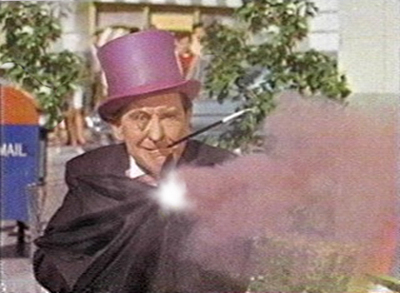
The 60s Batman TV show is full of gas. Joker gas, Penguin gas; Bat gas — heroes and villains alike are constantly being knocked unconscious with colorful whiffs of floating fragrance. Guns show up occasionally, but they’re largely useless — knocked from hands instantly or (in the memorable Ma Parker episode with Shelly Winters as the bad guy) the villains aim is so bad that firearms are irrelevant. The real danger is from gas — whether its sneezing powder, a black cloud to hide an escape, or that trusty, never failing knockout draft.

So why gas? I think it may serve a similar function to Wonder Woman’s lasso in the original Marston/Peter comics. Marston used bondage as a way to have conflict without violence. Similarly, the gas allows people to be rendered quietly inert without resorting to bullets or any kind of conflict that will leave a mark. There are fights between Batman and the villains, it’s true — complete with goofy bang! kerpow! special effects. But there’s a difference between seeing the superheroes battle the villains in a goofy choreographed slapstick-fest, and watching the Penguin pistol-whip some inoffensive receptionist. Gas is colorful, flamboyant, and (as depicted here, anyway) gentle. It lets the villains be villainous while still being funny.

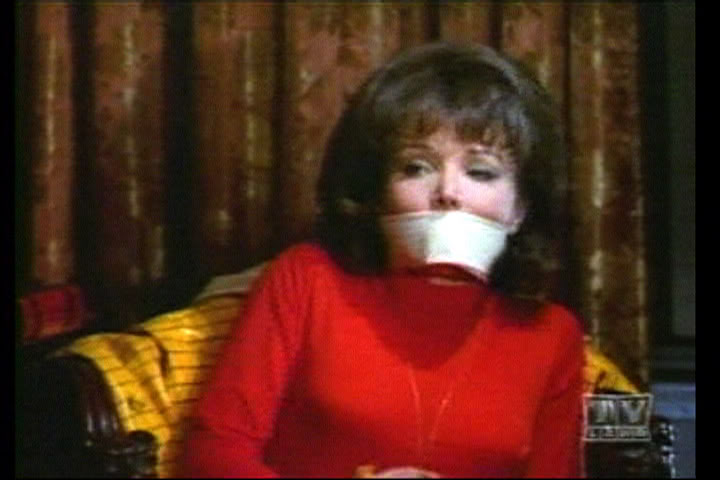
Wonder Woman, of course, used bondage not just because it was non-violent, but because it was sexy — violence was deliberately replaced by sexuality. Batman’s gas isn’t as directly erotic — but there’s still a whiff of something there, maybe. Batman using the bat-gas to knock out the Bookworm’s moll, for example, and render her helpless, seems to have some overtones — which are both denied and highlighted when Batman insists that Gordon accompany him and the moll ot the Batcave in order to avoid the appearance of impropriety. The gas also seems like it’s a variation on, or related to, the various mind-control potions and nostrums and techniques that float through the series — the Penguin brainwashes Alfred, Tut (thinks he) brainwashes the Batman, Catwoman flips Robin’s moral code. This kind of domination again suggests Marston’s series, with its games of top/bottom and eroticized command. For that matter, Batman and Robin are tied up an awful lot in the show — not as much as Wonder Woman, certainly, but enough to raise those painted-on Bat eyebrows.

The Batman writers weren’t ideologically committed to substituting sex for violence in the way that Marston was. But the combination of a desire to avoid too much bloodshed and the need for conflict pushes them towards some of the same solutions Marston developed — with some of the same results. The TV show looked for ways to pantomime violence — and when violence is turned into a patomime, you end up hinting at BDSM, whether intentionally or otherwise.
 

Batman-TheBookwormTurnsFrancineYork

The Bookworm’s girl (Francine York) in bondage.

Utilitarian Review 12/6/14

News

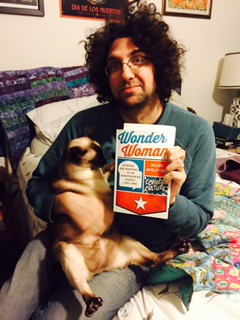
I’ve got an actual physical copies of my Wonder Woman book in my hands.
 

FullSizeRender

 
I have a cat; I have a book; I’m a real author.

The official release date is set for January 14. You can preorder now!

On HU

Featured Archive Post: on Matt Marriott, the great Western comic.

Me on the sexiness of the Adam West Batman.

Me on meta-ersatzness in the 60s Batman.

Donovan Grant on Superman and Atticus Finch.

Chris Gavaler on superheroes and pirates.

Tom Syverson on Jason Aaron’s settings.

Qiana Whitted on how comics represent Ferguson.

Me on Kathleen Hale and trolling.
 
Utilitarians Everywhere

At the Atlantic:

—I argued that as a writer finding your voice is overrated.

—I dumped on Star Wars and sci-fi without a future.

At Pacific Standard

—I argued that white people need diverse books too.

—I reviewed Marsha Weissman’s new book about the school to prison pipeline.

At Ravishly.com, I wrote about Outlander and the romance of infidelity.

At Splice Today I talk about the Louis Armstrong fallacy, and the idea that the success of a genius disproves discrimination.

Two of the Shmoop study guide’s I worked on are online.

Here’s one for Salem’s Lot

And here’s one for Solaris.

Other Links

C.T. May on being molested by his acupuncturist.

Jack Shafer on TNR and new media. The comments about Atlantic writers are going to leave a mark.

Max Fisher on the New Republic and the Beltway’s race problem.

Tressie McMillan Cottom on racists getting fired.

The Worst Is Yet to Come


The_Archer_(Art_Carney)

 
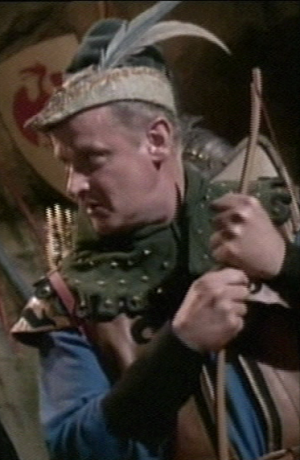
We finished the first season of Batman, and started the second…and holy jumping the shark, Batman. The two initial episodes with the Archer were by far the worst in the series.

It’s hard to pinpoint exactly what went wrong. There were a number of funny jokes — the Pow! and Bam! were replaced with “Poweth!” and “Bameth!” to reflect the Archer’s pseudo-Shakespearian diction, for example, and there’s a great line where Alfred is imitating Batman and Robin tells him to stick out his chest and be virile. But the episode as a whole just had no snap or joy; the actors seemed lost, wandering from campy bit of dialogue to campy bit of dialogue like tired, underpaid drones.

If I had to identify one thing that really undoes these episodes, I’d point to the villain. Art Carney, as the Archer, is pretty flat — again, the thees and thous are the main joke, but he doesn’t have anything like the manic goofball energy of Frank Gorshin as Riddler or Victor Buono as King Tut, nor Burgess Meredith’s bravado mugging.

More than that, though, the Archer is too effective. He’s got a pack of trick arrows (a la Green Arrow) and they all work really well; the first thing he does is to legit take out Bruce Wayne and Dick Grayson from afar and steal their stuff. He goes on to mount a very reasonable plot involving robbing the Wayne foundation with the help of an inside man. Along the way, he turns the citizens of Gotham against Batman and Robin. He just comes across as a real, legitimate threat, with achievable, fairly well-conceived goals.

This throws everything out of whack. Most Bat villains are way more interested in goofiness for its own sake than in criminality; in subsequent episodes, Catwoman steals a catalog for reasons, or King Tut reanimates beatles trapped in amber to create a secret mind control formula and then has Chief O’Hara dance on a flagpole. The plot zigs and zags around the villain’s obsessions and neuroses, rather than around their actual efforts to steal something. That allows Batman and Robin to race from here to there more or less inefficiently and still save the day, because there wasn’t a whole lot of day to be saved anyway.

The show at its best is really a kind of masquerade; it’s a dress-up game, where everyone pretends that they’re good and/or evil; it’s a collaborative pantomime of bat nonsense. In the Archer, episode, though, the Archer doesn’t quite seem to be in on the joke; he actually wants the money. He’s bad according to genre conventions, rather than using the genre conventions to signal “bad” while wandering off to play with beetles or leave riddles scrawled on bat undies or what have you.

There were other problems too — the soundtrack, usually a delight, was weird and off, as just one example; the sets and backgrounds looked fake and clunky in a half-hearted way, rather than winningly, as with Tut’s preposterously ersatz crocodiles. But the show’s real incompetence is in making the Archer competent. Real villains are boring; they take the joy out of life.

Hating the Anonymous Haters

This is one of those posts I wrote for another site, but then it didn’t work out. So here it is; slightly off-brand for HU, but so it goes.
___________________

Anonymity makes the Internet ugly. This is common-sense online wisdom, and there’s research to back it up. A 2014 article by Arthur D. Santana examining newspaper comment threads found that “Non-anonymous commenters were nearly three times as likely to remain civil in their comments as those who were anonymous.” Non-anonymous forums significantly reduced abusive comments, or, as Santana put it, “there is a dramatic improvement in the level of civility in online conversations when anonymity is removed.” Anonymity makes people meaner; it creates less civil, more toxic communities.

This is the context in which Kathleen Hale’s recent article about an anonymous reviewer was published at The Guardian. Hale is a writer and the author of the novel No One Else Can Have You. Her article is about one of the novel’s critics, an anonymous online reviewer who went under the alias of Blythe Harris. Harris, Hale claims, was notorious among authors on the Goodreads book discussion website for her negativity and for abuse. Hale cites one instance in which Harris and her followers targeted a supposedly 14-year old reviewer, swamping her with abuse and profanity (whether the 14-year-old was really 14 is open to question.) Hale’s lengthy essay goes on to describe how Hale tracked Harris down and unmasked her.
 

18052934

Hale acknowledges that her obsession with Harris’ reviews and criticism wasn’t healthy; in the first sentence of the essay she characterizes herself as a “charmless lunatic.” But she also seems proud of her success as a “catfisher.” In online parlance, a “catfish” is someone who creates a fake identity online in order to deceive others, especially potential romantic partners. Harris, here, is the anonymous catfish — she’s a deceptive troll, and Hale reels her in and brings her down. Hale admits to being obsessive and pitiful, but the narrative presents her as a bit heroic too. She’s taking a stand for bullied authors and against the uncivil, anonymous hordes.

The problem is that, reading the essay with just a little bit of skepticism, Hale doesn’t come off as the good guy in this interaction. She presents her “lunatic” behavior as funny, obsessive, quirky, and sad — “Over the course of an admittedly privileged life,” she says, “I consider my visit to [Bythe’s] as a sort of personal rock bottom.”

But what she doesn’t say is that, if you identify with Harris for a moment, the stalking behavior is terrifying. Hale uses her influence as an author to get Harris’ personal information, including her address and work phone. She shows up at her house. She calls her workplace multiple times. And then, she writes an article in an international venue in which she shames and vilifies the woman she has stalked. The Guardian says that some of the names in the piece were changed— but Blythe’s online name is not changed, and her real name appears to have been used as well (at the least, there is no clear statement that the name was changed.) Even just printing the name Blythe uses online is problematic; attacking someone in a mainstream forum can send angry readers swooping down on their social media accounts in droves. The article itself is effectively an extension of a campaign of harassment aimed at someone whose main sin was that she didn’t like Hale’s book and didn’t use her real name online.

Again, there is evidence that anonymity is associated with incivility and bad behavior. But anonymity doesn’t cause incivility, or, at least, it’s not the sole cause. Santana’s report noted that 30% of non-anonymous comments on the news stories they surveyed were uncivil. Anonymous users are responsible for a lot of abuse online, but by no means for all of it. Personally, some of the most memorably unpleasant interactions I’ve had on the Internet have been with people using their real names — in some cases, with established journalists.

More, there are some good reasons why a writer online might want to be anonymous. As Supreme Court Justice John Paul Stevens wrote, “The decision in favor of anonymity may be motivated by fear of economic or official retaliation, by concern about social ostracism, or merely by a desire to preserve as much of one’s privacy as possible.” To provide just one example, there are incidents of teachers being fired for expressing controversial opinions online; any teacher, therefore, has good reason to hide his or her identity in online forums. For that matter, as author Bree Bridges commented on twitter ,” “Why would a reviewer EVER use a fake name?” implored the author currently stalking the hell out of one. “I can’t think of one reason.”” Hale’s article demonstrates exactly why a reviewer might want to use a pseudonym. If you can avoid it, you don’t want an obsessive stalker like Hale to know who you are or where you live.

Hale’s article raises the disturbing possibility that anonymity may lead to less civility — and that decrying anonymity may also lead to less civility. Some people, clearly, feel empowered by anonymity to hurl abuse and threats, as the ongoing death threats against women in the gaming industry demonstrate. But at the same time, the association of trolling with anonymity, and the use of terms like “catfishing” makes people like Hale (and apparently her editors at the Guardian) feel like they are entitled to stalk and shame people they disagree with online. Decrying anonymous trolling, and the association of anonymity with deception and bad actors, can be used to justify further harassment and abuse aimed at the supposed bullies.

Hale’s essay unleashed a firestorm of criticism from book writers and bloggers (some examples are here and here. A number of blogs organized a blackout on reviews of new releases in an effort to bring attention to the fear many reviewers feel that they might be targeted by authors. Hopefully Guardian Books and other publications are paying attention. Just because a writer is anonymous doesn’t mean that it’s okay to stalk, harass, and humiliate them. Even though anonymity is often used for incivility online, a pseudonym, in itself, doesn’t make you a legitimate target.

How Do Comics Represent Ferguson?

2011-12-30_police_application-55db4646

Public outrage over the killing of 18-year-old Mike Brown in Ferguson, Missouri continues to amass its own tragic iconography. Handprints transform the so-called universal sign of surrender into a stronghold of dissent: “Hands up, Don’t shoot.” Hashtag memorials shape the interconnectivity of social media into a pictorial chorus of text: #BlackLivesMatter #JusticeforMikeBrown #ShutItDown. I think about my own son at two years old and already curling his brown fingers into Spider-Man web shooters, and vainly I hope that the right counter-visual will fix what’s wrong, or at least begin to impair what Matthew Pratt Guterl, refers to as “the familiar grammar of racial sight, through which a wallet becomes a gun or a Harvard professor becomes a burglar.”

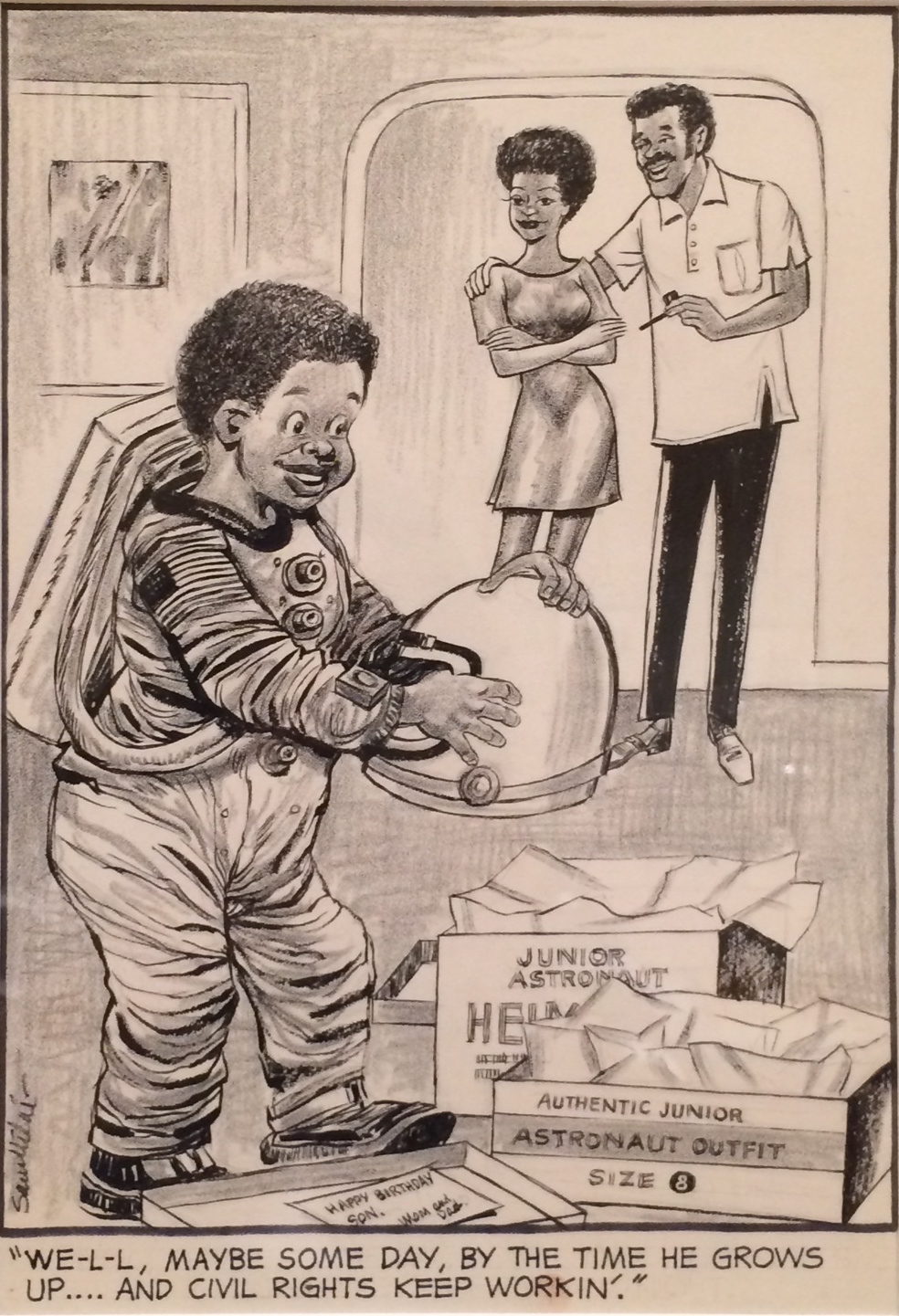
I also had the chance to consider how the call for racial justice registers through image when I toured the exhibit on “The Long March: Civil Rights in Cartoons and Comics” at OSU’s Billy Ireland Cartoon Library & Museum last month. Among the stately commemoration of landmark firsts – including incredible pages of original art from Pogo, Wee Pals, and Green Lantern/Green Arrow – the corner of the room displaying the editorial cartoons seemed louder and more demanding in their effort to picture the raucous discord of the moment. We can learn a great deal from the way Pittsburgh Courier cartoonist Sam Milai uses the Junior Astronaut Helmet as a visual metonym for the aspirations of a middle-class African American family (below), only months after Neil Armstrong walked on the moon:

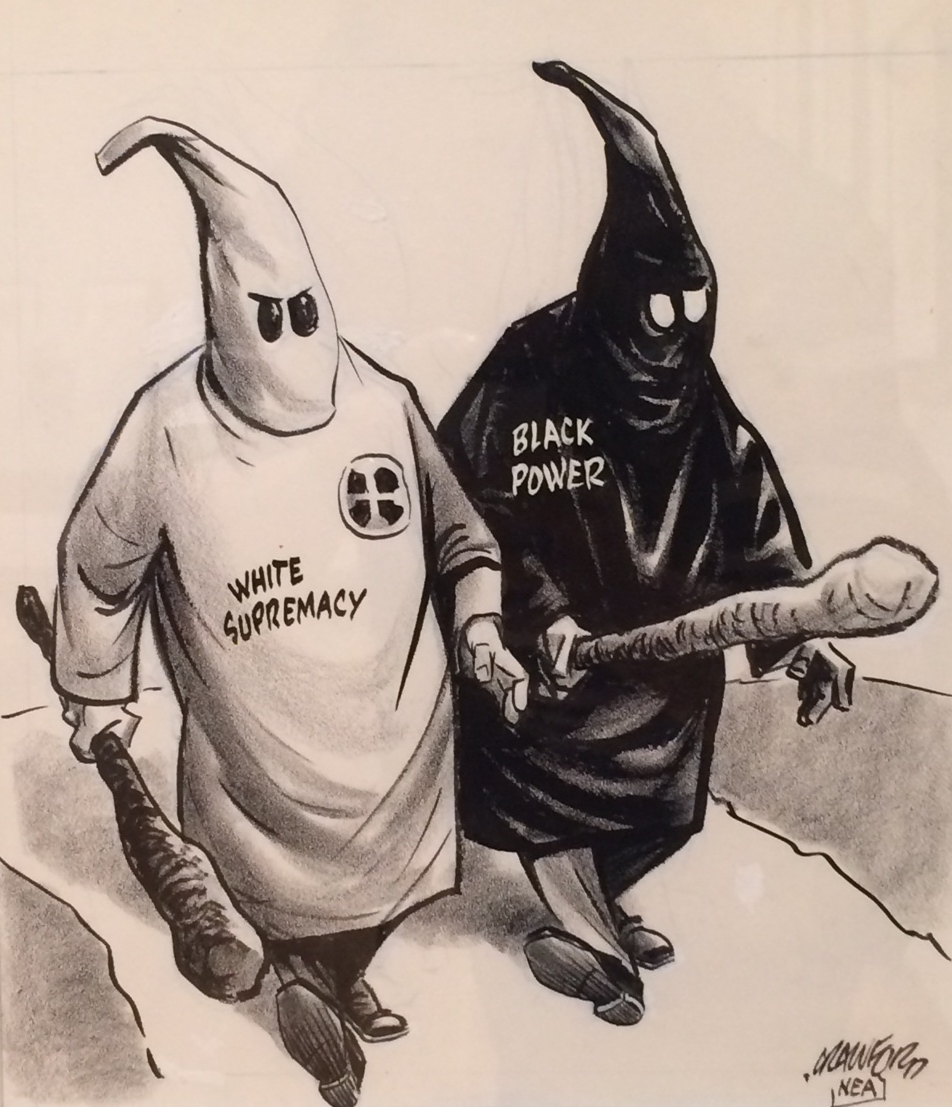
In another image, Bill Crawford speaks to fears over militant Black Nationalism in a cartoon that invokes the Ku Klu Klan to set the boundaries of acceptable (and respectable) protest in 1968:

So I’m interested in what editorial cartoons and other comics have to say about Ferguson. What images are deployed to convey the stakes of the debate, the challenge to people and institutions of power, and the costs of the status quo? Nationally-circulated examples can be found in features like Michael Cavna’s recent Comics Riffs column in the Washington Post on “15 of the Most Striking #Ferguson Cartoons so far…” while cartoonist Daryl Cagle is also maintaining an extensive archive on editorial comics about Ferguson on his website, The Cagle Post.

What surprises me when I browse through these cartoons, however, is how unsatisfying many of the images are, or rather how limited they appear to be in their imaginative scope. In the wake of the grand jury’s decision not to indict Officer Darren Wilson for Mike Brown’s murder, many of these editorials seem to recycle the familiar visual codes and contexts of justice denied. The irony of depicting Lady Justice, Uncle Sam, Martin Luther King, Jr., or President Obama with their hands up, unarmed, or being shot is frankly worn thin. (Though I admit to being fascinated by the current trend of depicting King as he appears in his national monument, which gives him the foreboding presence of an establishment figure or institution, rather than a fellow activist.)


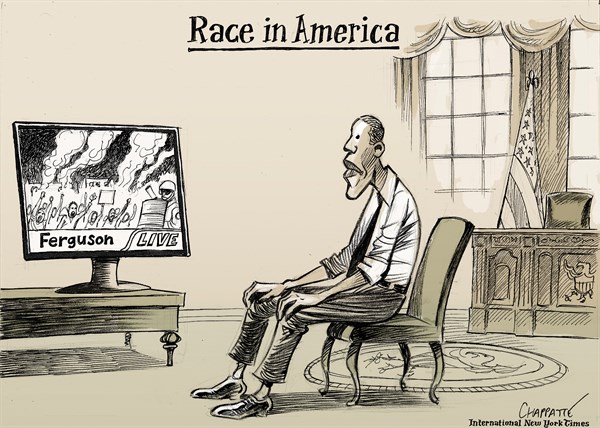
Patrick Chappatte’s “Race in America” (above) is much more compelling.  President Obama is depicted in the center of the sepia-colored cartoon silently watching the Ferguson protests on TV. I’m struck by juxtapositions here, beginning with the President’s quiet reflection in an empty room against the noise and chaos of the live feed. While the Oval Office seal and desk mark his distance from the populace, he is seated on the edge of the chair, close to the screen. And finally, the fact the President is a black man watching racial injustice play out before him brings the title of the cartoon into conversation with multiple registers of power and powerlessness. There is contemplation, sadness, or is that disappointment? I like the understated complexity of this piece.

Several of the comics adapt iconography commonly associated with the racism and state-sanctioned bigotry of the American South. Among these, I appreciated Matt Wuerker’s efforts to complicate the way we think about privilege by replicating the familiar “White” and “Colored” entrances of Jim Crow alongside a new door marked “Blue” with an escalator accessible only to law enforcement.

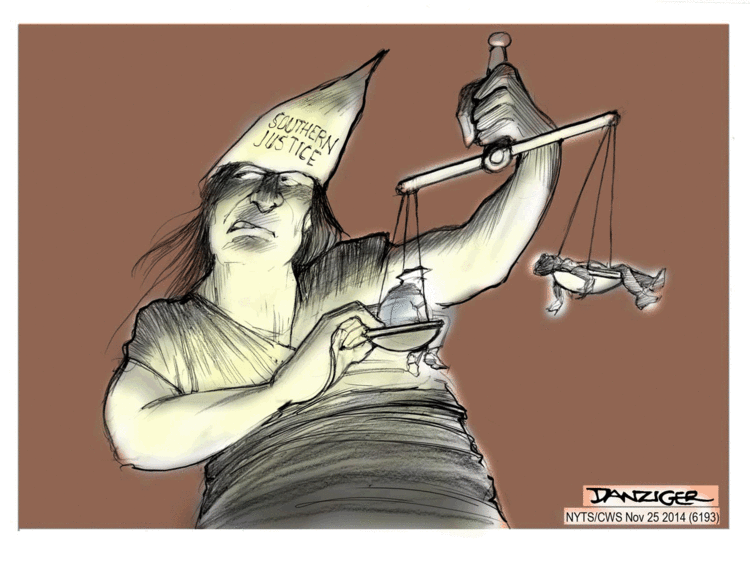
Particularly problematic, however, are the comics that lean on images of the Ku Klux Klan like a visual crutch to characterize the nature of the treatment Mike Brown and his family have received. What role does region play in such a national epidemic of injustice? When I raised this concern among friends, I was reminded of the Klan’s national reach, especially in Midwest states like Indiana in the earlier 20th century. St. Louis, in particular, seems to defy geographic labels and has been called “the most northern Southern city and the most western Eastern city.” Cartoons such as Milt Priggee’s “Ferguson hood” or Rainer Hachfeld’s “Ferguson 24/11” may therefore have a point in placing the Klan hood over Uncle Sam and Lady Justice to condemn white supremacist rule beyond the Mason-Dixon line. But I don’t think the same can be said for a cartoon like “Southern Justice” by Jeff Danzinger (below). He appears to draw a more direct line between racial violence in the South and the circumstances under which an unarmed black youth could be murdered in 2014 without repercussion. It is perhaps because the Klan iconography is so highly charged that the kind of analogy attempted in Danzinger’s piece (or in Bill Crawford’s earlier cartoon) can be too easily muddled.

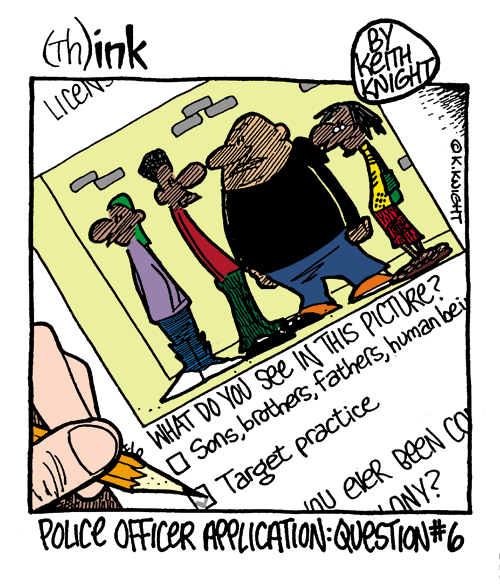
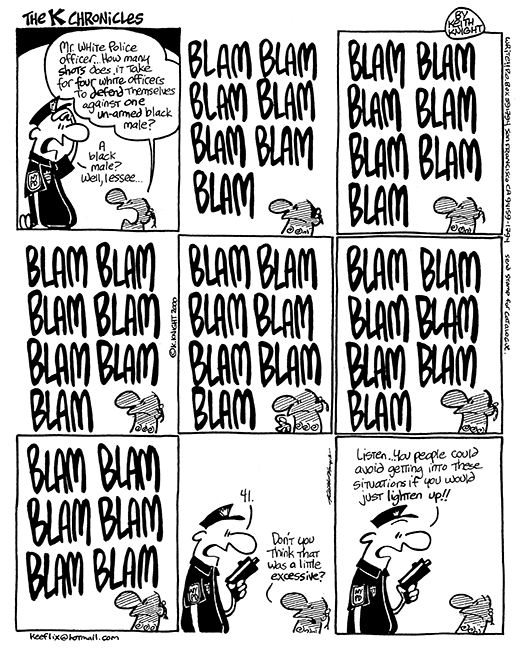
Finally, I want to call attention to cartoonist Keith Knight who, along with Matt Bors, is producing some of the sharpest satire about race and police brutality today.  (Many of their comics are collected at Daily Kos.) Knight’s work on Mike Brown so far includes “Blacker Friday”, “Sign of Progress?” and “White Riot.” He has been chronicling enough of these incidents that his comics about the shooting death of other black men such as Amadou Diallo, Oscar Grant, Trayvon Martin and Eric Garner are specific to each case and yet, virtually interchangeable. The cartoon at the top of my post titled “Police Application” first appeared in 2011, while the comic below was published in 2003.

Knight never takes his eye off the “familiar grammar of racial sight” and the disservice that this way of seeing does to our nation. In the comic called “41 Shots,” the way he places the famous Tootsie Pop commercial against the relentless visual BLAM of every bullet fired into Amadou Diallo’s body grows more chilling with each panel. Likewise, the hand in the parody of the “Police Application” cartoon is faced with what should be an easy question, but instead makes a devastating choice in refusing to see the humanity of people with black skin. Knight has turned all of these cartoons into a traveling exhibit – “They Shoot Black People, Don’t They?” – to call attention to the need to hold state and local law enforcement accountable, as he explains in this strip. He begins by saying, “every time I do a cartoon about police brutality, I hope and pray that it’ll be the last one I’m compelled to draw…”

So do I.

*

You Are Where You Are: Jason Aaron’s Settings

syverson1


“It is folly to believe that you can bring the psychology of an individual successfully to life without putting him very firmly in a social setting.”

-Tom Wolfe

A few months ago, writer Linn Ullman (daughter of director Ingmar Berman and actress Liv Ullman) talked to The Atlantic about her understanding of setting in narrative approach. Inspired by the short stories of Alice Munro, Ullman said:

Those precious few settings where something happened are where meaning resides—they contain the story, they are the story. Yes, I think that, to Alice Munro, story is place—the two are that deeply connected. You do not have a story of a life without an actual place. You can’t separate one from the other.

Reading that interview, I was struck by how applicable this is to comic book storytelling. One of the major strengths of the comic book medium is its unique capacity for placing readers squarely within a specific setting, a characteristic that feeds directly off the primacy of the medium’s visual dimension.

Unlike film or books, static page layouts allow a reader of graphic fiction to dwell equally on minutia and panorama, to experience the past alongside the present. With other forms of fiction, we’re always looking at or thinking about one thing at a time; temporally, we’re constantly caught up in the “now” of the narrative.

But graphic fiction generally has no “now” per se; rather, a typical comic book page viewed holistically is a representation of a certain big picture, i.e. an expression composed with a certain temporal simultaneity and visual dexterity between high and low abstractions of detail.

There are few comic book writers today that demonstrate this with greater aplomb than Jason Aaron.
 

syverson2

 
In the past several years Aaron has emerged to be one of the most successful scribes of the comics world, due in large part to his “one for you, one for them” approach to the business. Like other prominent Marvel writers such as Ed Brubaker and Matt Fraction, Aaron is able to balance his spandex work with personally meaningful projects.

After garnering an Eisner nomination in 2007 for his Vietnam graphic novel The Other Side, Aaron pitched Scalped to DC/Vertigo. Initially conceived of as a Scalphunter reboot, Scalped quickly blossomed into an epic, beautiful Western-Noir saga about one community’s struggle with economics, circumstance, family, racial identity, morality, violence, spirituality, authority, and just about everything in between.

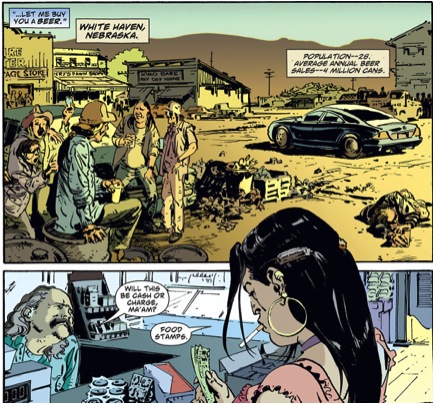
The most striking thing one feels opening an issue of Scalped is the immediacy of its setting. Aaron’s story takes place on the Prairie Rose Indian Reservation, located in the dusty, desolate plains of South Dakota. With enormous help from the book’s remarkable artistic staff, including detailed pencils from R.M Guera and warm sepia tones from talented colorists like Giulia Brusco, Scalped teems with human life like no other comic I’ve seen before.
 

syverson3

 
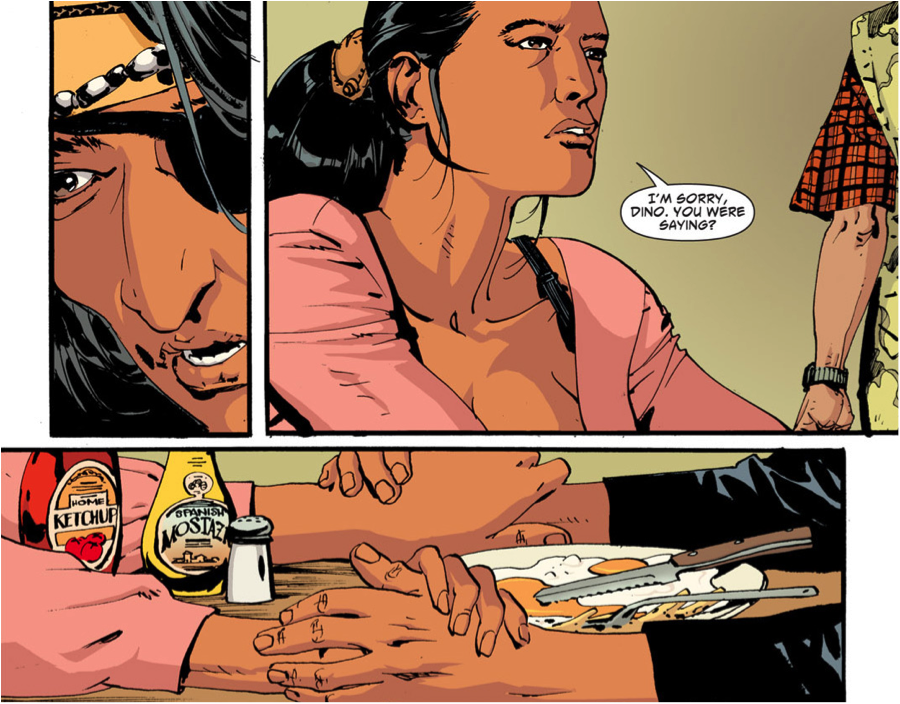
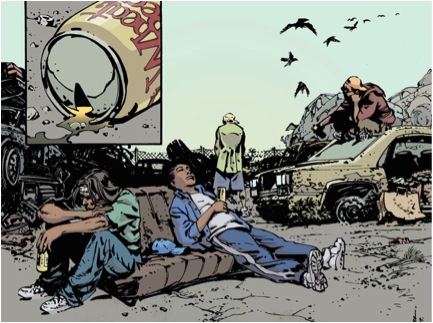
A great example of this is issue #10, which serves as a heartbreaking and poetic ode to ethnic ambivalence. “My Ambitionz Az a Ridah” focuses on Dino, a young and disaffected fuckup who’s grown weary of his crummy rez lifestyle. Like all teenagers everywhere, he longs for escape and fetishizes the idea that he is somehow different, and thus truly alone, in his environment.

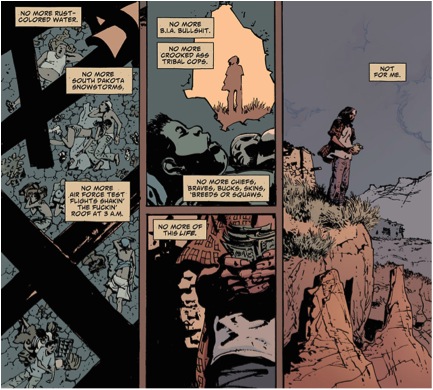
Dino fantasizes about leaving as he slogs through a typical day, and his narration eventually takes the form of a laundry list of precious details about his home.

“No more living in the ass-end of nowhere in a tiny little piece a’ shit house with mice in the attic and black mold on the walls. And eight other people sharin’ the space. No more livin’ without cable TV. Without cell phones. Without the internet. No more jigglin’ the rabbit ears for my fat-ass uncle so he can sit on the couch and watch westerns all day.”

The issue is a masterful depiction of how interdependent personal depression is with social deprivation; external misfortunes are directed inwardly as self-hatred, and again redirected outward as rage against one’s community.
 

syverson4

 
But the clever hook of the issue is how Dino’s resentment eventually transforms into a kind of guilty affection for reservation life. Given the opportunity to leave for good, Dino decides to stay. He sees that abandoning the things he hates about his life would mean abandoning the things he loves too. It’s as if for a moment he comes to understand, however vaguely, what Erik Erikson emphasized as the inter-penetrability of character and culture:

“For we deal with a process ‘located’ in the core of the individual and yet also in the core of his communal culture, a process which established, in fact, the identity of those two identities.”

In this issue and throughout Scalped, we don’t see conflict occurring within a particular setting, but rather that setting is the conflict insofar as character and culture form a dialectical relationship. When the series concluded in 2012, Aaron told Wired:

The selling point of the book was always the setting. Plot-wise, there’s nothing particularly groundbreaking about Scalped. It starts off as something we’ve seen plenty of times before…the twist was always the setting: a modern-day Native American reservation. Given that, the reservation always had to be a character in the book.

So for Aaron, setting isn’t just about placing characters in a context in which they can bump up against each other. Rather, it’s about creating a place that is itself a character, one that interacts with other characters and undergoes its own meaningful story arc.
 

syverson5

 
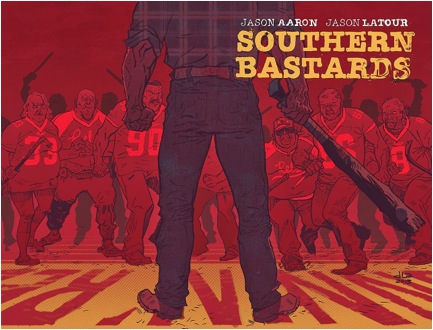
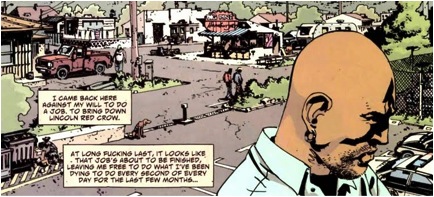
Aaron’s newest title Southern Bastards also demonstrates this emphasis on setting. Like Scalped, the title has its protagonist returning to his hometown after a long and very deliberate absence. Both stories feature characters in the process of rediscovering a now-alien environment that nonetheless forms the unconscious basis of their personality, however much their conscious ego wants to deny it. The trick to communicating this sophisticated treatment of setting is in the details.

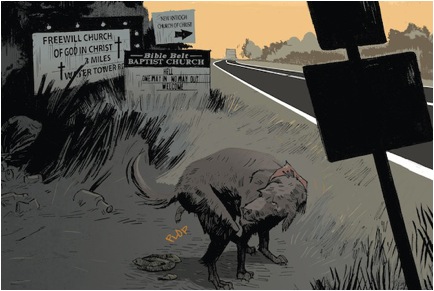
Consider the first page of the first issue. We’re shown a small grass clearing at the threshold between an interstate highway and the woods that line it. Around the perimeter we see crooked signs for several different Christian churches; Freewill Church of God in Christ is three miles away on Water Tower Road, and Bible Belt Baptist Church boasts the slogan “HELL: ONE WAY IN AND NO WAY OUT. WELCOME.” In the center of it all is a mangy dog taking a spiteful shit on the ground.

This tells you nearly everything you need to know about Craw County, Alabama.
 

syverson6

 
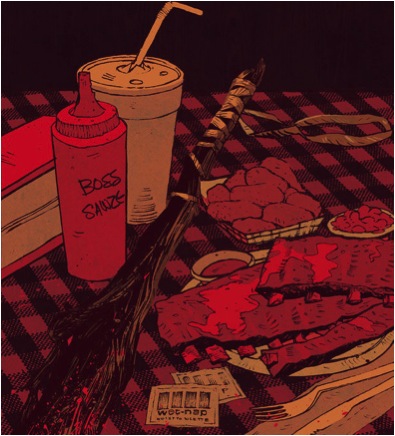
As the series progresses, Aaron continues to paint Craw County as a mosaic of very specific details: every small business seems to be owned by a man named Coach Boss; a rib joint waitress named Shawna offers sweet tea and fried pie; a redneck goon has tattoos that combine Confederate and Satanist imagery; a dead father’s club is symbolic of lost phallic potency; and references to football are everywhere.

This is similar to what Tom Wolfe has said about the way he wrote about New York City.

“I realized instinctively that if I were going to write vignettes of contemporary life, which is what I was doing constantly for New York, I wanted all the sounds, the looks, the feel of whatever place I was writing about to be in this vignette. Brand names, tastes in clothes and furniture, manners, the way people treat children, servants, or their superiors, are important clues to an individual’s expectations.”

Likewise, Aaron wisely declines to merely talk about Craw County. Rather, he and artist Jason Latour are committed to showing us Craw County, slowly, through a series of tiny revelations.
 

syverson7

 
At the heart of both Scalped and Southern Bastards is the way in which individuals position themselves with respect to their originology. Resentment for where we come from is rooted in a gnawing discomfort with who we come to be. Aaron’s characters see the past as exerting a kind of gravitational force over them. It follows them around and makes demands in the form of guilt. This is as true of their towns as it is of their parents –in Scalped it’s Dash’s mother and in Southern Bastards it’s Earl’s father, both figures giving body to the invisible landscape of repressed unconscious. It is our origin that always threatens to swallow us back up, particularly when, like Dash and Earl, we’ve spent so many years trying to get away from it. To appreciate this level of characterization, it’s essential we be put in meaningful touch with setting.
 

syverson8

 
All of this is to say, if you haven’t checked out Jason Aaron’s work, in particular his non-superhero stuff, you really need to. Setting is important in all forms of fiction, but I hope with the above I’ve at least begun to point out how comics accomplish this like no other form can.

As serious fans of the comic book medium, it’s important that we pay attention to the things that comics can do that other forms of storytelling cannot. Today, it’s more important than ever to recognize that comic book storytelling is far more than mere Hollywood blockbuster precursor –it’s an essential and unique medium in its own right.