The Dishonourable Woman

The-Honourable-Woman

Let me attempt to describe the experience of watching the BBC’s widely acclaimed 8 part mini-series, The Honourable Woman.  Imagine walking into a five star restaurant and being ushered to your seat by a beaming maitre d’ with a cultivated English accent. The immaculate dinner service is laid out on a pristine white tablet cloth and the wine is served to you in fine crystal goblets. The initial tasting seems quite promising. Then you take a full mouthful of the fine red wine and it leaves you with the distinct impression of pure unadulterated piss. The only thing that could have possibly made this experience more memorable is if a cockroach had crawled down your throat as you swished the wine around in your mouth. Was this a mistake? Did you do something to offend the gods or the owners of the restaurant? Did you deserve it? (maybe) Or is this all they’re capable of—excellent table settings in the service of excrement.

The Honourable Woman is the brain child of Hugo Blick who was also responsible for the somewhat overrated crime drama, The Shadow Line. It stars Maggie Gyllenhaal as a Jewish heiress named Nessa Stein who witnesses the brutal assassination of her father as a child. He is ostensibly killed by radical Palestinians in revenge for selling arms to Israel. Now fully grown and the CEO of her father’s company, she is in the final phases of a plan to lay a fiber optic cable network throughout the West Bank. But that enterprise only forms one part of her larger project of altruism and reconciliation. Her educational foundation (run by her brother) also funds a series of universities throughout Israel with a mind to providing equal access to higher education for both Arabs and Jews.

Yet her righteousness and sense of ethical obligation is of an even high order then is shown by these acts. As is revealed in later episodes (but well telegraphed to viewers from at least the second episode), she was kidnapped and raped during a visit to Gaza some 8 years back, and forced to have the child of her Palestinian rapist.

For some inexplicable reason, a number of reviewers have highlighted Nessa’s sense of agency and ability to outwit the various machinations of the organizations which circle her (MI6, the CIA, the Israelis, and various shadowy Palestinian organizations). Nothing of the sort occurs in The Honourable Woman.
honourablewoman1_2985939b

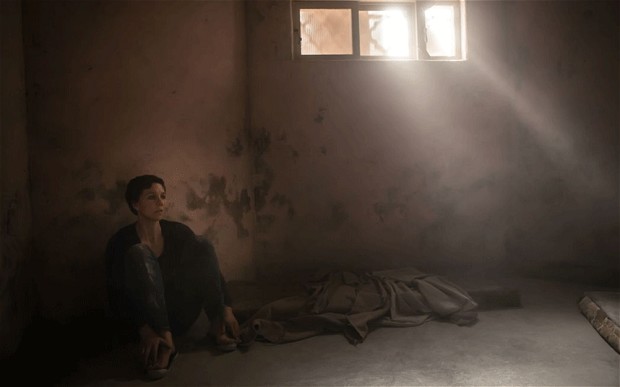
Nessa is persistently caught on the back foot and is almost always at the mercy of her tormentors. This is by no means a subset of the “realism” which Blick presumes to have foisted on his audience, for Nessa is entirely positioned as a self-sacrificing martyr. She is twice kidnapped, twice raped, physically abused on several occasions, betrayed at every point, constantly threatened with murder, and so thoroughly psychologically tormented that she sleeps in a safe room every night. She faces all of this with the equanimity of a modern day saint; all cropped hair and rays of light shining down on her stained, anguished face like the light of God.

In her sexual torment, she joins a select group of female saints, for there are precious few of these who are recorded as having been raped (though no doubt many were). It is no coincidence then that Gyllenhaal frequently appears to be channeling Falconetti in Dreyer’s The Passion of Joan of Arc, one of the few saints to have been thus abused. In the penultimate episode of Blick’s concoction, Nessa even wears a white pant suit to a groundbreaking ceremony in Hebron just as was Joan’s wont.  She is very nearly offered up to the flames when a bomb goes off at the same ceremony, the shrapnel tearing into her back leaving the marks of a flagellant.

Nessa initially resists her rape at the hands of her Palestinian kidnappers but then quietly lies down and accepts her fate when she sees her friend being assaulted. Years after this, she is date raped while in a depression fueled alcoholic haze. This she seems to accept, at least at first, with a drunken pragmatism. The MI6 minder/friend who ensures her swift medical care even asks her if she has been engaging in high risk behavior over the years. When questioned by the Palestinian leader behind her rape (and her brother and father’s deaths) as to her lack of desire for revenge (as is his own desire), she babbles through tears that she has often asked herself this question following her innumerous scourgings,  and has concluded that she “deserve[s] it.” It certainly helps that said evil Palestinian mastermind resembles nothing less than a James Bond villain with an intravenous line substituting for a white Persian cat and wobbly optics.

I’ve seen some talk concerning this drama’s subtlety and convoluted plotting. The first point, at least, can be quickly dispensed with. If the foregoing description hasn’t already made this clear, Blick’s ideas are wielded like cudgels.  For instance, we understand that Nessa has daddy issues because her father scrutinizes her from the heights of a family video projected on her study walls even as she fucks a MI6 mole (presumably a subset of her high risk sexual behavior).

Any talk of complex plotting certainly demands a lengthy harangue if not frequent slaps with a large wet fish. If there is one reason why the central conspiracy would never occur to the average viewer, it would be because it resides in that fantasy land lying between ignorance and pure imbecility.

The plot deserves to be spoilt quite thoroughly. In short, in the final episode, the United States is revealed to be working in concert with the Palestinians (I don’t know who; maybe Fatah and various other rogue groups) to create a climate receptive to Palestinian Statehood right under the noses of the Israelis. Following the bombing in Hebron, the U.S., who masterminded this false flag operation with the Palestinians, will no longer veto any U.N. applications with regards the recognition of the Palestinian state.

Yes, you heard that right—the writers of The Honourable Woman have the U.S. (or at least its Secretary of State) working with the Palestinians to thwart Israel in a false flag operation. This would be the same United States which opposed Palestine’s full membership in UNESCO in the face of overwhelming support (107-14) in 2011; the same United States which cast the single “No” vote in July 2014 on the issue of investigating war crimes committed in Gaza; the same United States which voted overwhelmingly to send more funding to Israel for the Iron Dome missile defense system and to allow Israel to raid its arms stockpiles to rain more misery on the Palestinians.

To add even more salt to the wound, one of the closing scenes has a news report stating that China and Russia might veto said U.S. plans not to oppose Palestinian statehood. Let me see, this would be the same China and Russia which have voted “yes” to Palestinian recognition, “for” UNESCO membership and “for” non-member observer state status. Care to guess how the U.S. voted on all these issues? These two nations also voted decisively to support the investigation into war crimes in Gaza in 2014. But do we really have any right to be surprised at this in a delusionary world where rape is martyrdom, and a device to give depth and agency to women? The asinine logic on display here derives from the same place as those who feel that Schindler’s List was about Nazis saving the world from Jews.

6586579-low_res-

Zionist commentators are of course horrified at the abuse meted out at Israel in The Honourable Woman.  But let us count the ways in which the state of Israel has been denigrated.  Firstly, Jews are portrayed as arms merchants which is certainly an injustice since Israel doesn’t traffic in arms. The Israelis (Shin Bet? Mossad?) are also shown tapping into Palestinian cell phone traffic through Nessa Stein’s fiber optic cable which is of course absolutely disgusting and unthinkable! The Israeli representative in London also admits to plans to capture and interrogate a Palestinian businessman who is making deals with the U.S. Secretary of State, but guess what? They’re so ineffectual that they’re beaten to the punch by the nefarious U.S.-Palestinian cabals running amok throughout London. The latter elite agents fake the suicide of one of their own in order to silence him. These same Palestinians have the ear of politicians and secret agents throughout the English speaking world, which must explain why U.S. and U.K.  have been such “fine” supporters of their cause through the years.

The Palestinians have it much easier. They’re portrayed as drug addled rapists, general haters of women, mass murderers of their own countrymen, criminal masterminds consumed by vengeance, and as generally confused with regards to morals. Nice Palestinians? I don’t think they exist in the world of The Honourable Woman. The only good Palestinian in Blick’s masterwork of blockheadness is a dead Palestinian or at least a silent one. Even the Arab-Muslim hating worlds of Homeland and 24 didn’t hit rock bottom quite so hard. The BBC is often said to have a balance issue with regards Palestine, but on the basis of the dramas which they have commissioned, I think we can safely say which side of the scale they have their thumbs on.

There is a more charitable way to read Blick’s drama, and that is to see in it a call for reconciliation and a (wishful) metaphor for Israeli-Palestinian relations. This is most clearly seen in the narrative path taken by Nessa’s Palestinian confidant, Atika. Atika turns out to be a vengeful subversive lying in wait to do harm to Nessa and her family. Among other things, she leads Nessa’s brother to his doom in the penultimate episode of the series. Yet her demands for violent compensation stop short of Nessa’s rape (which she tries to stop) and she is the only person with sufficient compassion to care for the product of that assault.  In the final act, she is killed while saving Nessa and her kidnapped child from some fellow conspirators less enlightened (presumably) than herself.

If viewed from a biblical standpoint, both Nessa and Atika can be seen as scapegoats with the former “offering” sent into the wilderness (for Azazel, see Leviticus 16:8) and the latter given as a blood sacrifice to God. This explains Nessa’s constant position of suffering in this farce as well as her sense of culpability; they are acts of contrition on behalf of the nation of Israel. Yet the twisted nature of the characterizations and political drama overwhelm any such noble intentions. Any fixation on this line of reasoning will inevitably lead the viewer to wonder why the only “saint” allowed for in The Honourable Woman is a Jewish one.

The Honourable Woman is certainly sufficient cause for the donning of sackcloth in shameful repentance, and no doubt obscene enough to earn a host of Emmy and BAFTA nominations come award season. It is an embarrassment for all involved whatever their declared political leanings—a beautifully composed addition to the annals of degenerate propaganda.

Alice and Freda Forever, Whoever They Are

51pnwOH6kIL._SY344_BO1,204,203,200_Identities are made out of stories, and stories are made out of identities. That’s certainly the case in Alexis Coe’s new book, Alice and Freda Forever, about 1892 century Memphis murder of Freda Ward by her lover and fiancé, Alice Mitchell. Alice and Freda were both well-to-do young women; they’d met at the Higbee School for Girls. Freda had agreed to marry Alice, but their families had discovered the plan and put a stop to it. Alice feared Freda would forget her and perhaps marry a man. So she stole her father’s razor and slit her ex’s throat; she was stopped before she could kill herself as well.

The murder was a massive story at the time — the O.J. Simpson trial of its day — precisely because of the identities of the killer and her victim. “Journalists knew that the story would be far less consequential to readers if the murderer and victim had been male, not white, or of lesser economic means,” Coe says. Identity for the public at the time was the story — as it is, in a different way for us. Would Coe, or her readers, be interested in this particular trial if it weren’t for the fact that Alice and Freda were lesbians?

Alice and Freda planned a same-sex wedding before the term, or even the concept, existed. As a result, it’s easy to identify with them; they seem like they’re part of a familiar story. But that familiarity can be deceptive. A firm lesbian identity didn’t really exist for Americans in the 1800s. As Sharon Marcus says in her book Between Women (focusing on England, but the general argument seems to apply to the U.S. as well), passionate same-sex relationships between women in the Victorian Era were accepted and even encouraged as part of a normal, mainstream heterosexual identity. Those relationships could include kissing, hugging, passionate declarations of love, and even, on occasion (as with Freda and Alice) sex. But people at the time didn’t organize any of those actions into an identity. Same-sex relationships between women were not policed, or codified. As a result, for most practical purposes, they were invisible.

If Alice had murdered someone in the 1950s, when homophobia was widespread and virulent, her violence probably would have been blamed immediately on her dangerous deviant lesbianism. But in the 1890s, Coe reports, people seemed to have difficulty even understanding the relationship between Freda and Alice. Their plan to marry was seen as impossible. One psychological expert, foreshadowing future anti-marriage-equality argument asked her incredulously how she could think of marrying Freda when the two of them couldn’t have children.

Those psychological experts were there in the courtroom less to evaluate Alice than to make sense of her; they weren’t figuring out if she was sick so much as they were figuring out what to do with her. Just as the Oscar Wilde trial a couple of years later solidified homosexual identity in England, the Mitchell trial — haltingly, hesitantly — took steps towards creating and defining a lesbian identity. That definition, at this point, was medical and marginal. The defense argument, which prevailed, was that Alice’s love for Freda was a sign of insanity. To buttress that argument, the lawyers made her love for Freda into her identity, playing up her childhood interest in sports and her later lack of attachment to men. She was masculine, disordered, and wrong. The argument was that her identity was not (jealous) murderer, but (lesbian) madwoman. The jury bought it — and so gave her a story that ended, not on the gallows, but in an insane asylum (and a few years later, in death, though whether by tuberculosis or drowning suicide remains unknown to this day.)

Coe is very sensitive to the ways in which Alice’s identity and her story wrap around one another. As an upper-middle class white woman, Alice’s range of movement and actions were extremely limited. Her plot to dress and pass as a man to marry Freda seems, from what Coe could determine, to have had little to do with a trans identity, and much more to do with economics. White women of Mitchell’s class weren’t supposed to, or allowed to, work, and Alice and Freda needed an income if they were going to live together as a couple. On the other hand, Alice’s race and resources ensured high powered lawyers and a sympathetic jury — luxuries which certainly wouldn’t have been afforded to anti-lynching activist Ida B. Wells, who, as Coe discusses, was forced to flee Memphis at around the same time as Alice’s trial. White Memphis found it easier to empathize with a white killer than with a black opponent of murder.

Even as she points to the ways in which Alice’s race and class shaped her story for her contemporaries, though, Coe can’t help but write her own narrative around our current reading of Alice’s identity. Very near the end of the book, Coe describes how Alice, before being sent off to the asylum, asked to be allowed to visit Freda’s grave.

We will never know what Alice was thinking at Elmwood that day, and neither did the journalists who watched from afar. But they did report what they saw, and what they wrote seemed believable: Alice dropped to her knees and, for the woman she loved without shame, wept openly.

It’s a moving scene — not least because, in that reference to “without shame”, Coe connects Alice to the current gay rights struggle, and its narrative of pride and identity. There’s no question that Alice was a startlingly brave young women, willing to own her own love and work towards a life that her family, and society, could barely conceive of or imagine. She was heroic. And yet, at the same time — she murdered her lover out of jealousy. If she were a man, she would be seen as participating, not in the narrative of gay rights, but in the long, ugly, misogynist narrative of domestic violence, in which the infidelity of a wife (and Freda was to be a traditional wife, Alice’s letters make clear) gives the husband the right to kill. That’s not to criticize Coe, who certainly doesn’t downplay or excuse Alice’s crime. It’s just a reminder that people often don’t fit neatly into the identities we use to tell their stories, nor into the stories we use to create their identities.

Inside Gozilla’s Rotting Carcass

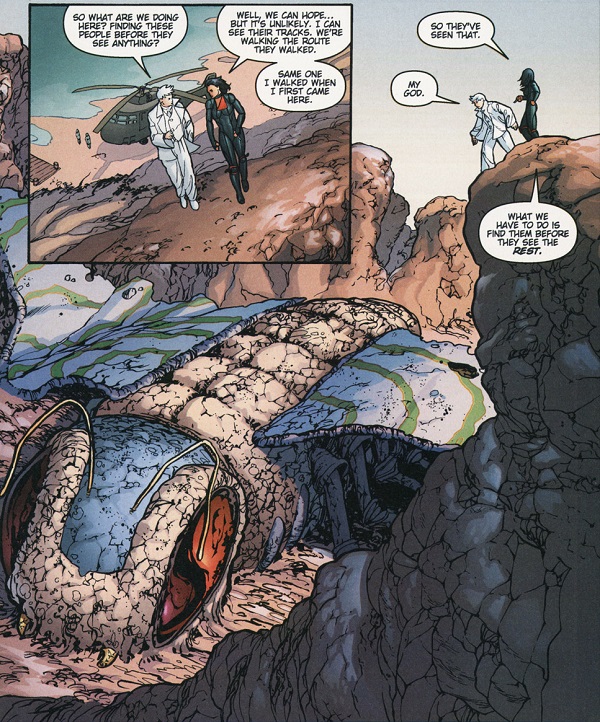
In 1999, Warren Ellis, John Cassaday and Laura DePuy explored the Godzilla imagery in the second issue of Planetary, “Island”. The series was still in the process of codifying its relationship to its readers and was very open about its objectives and methods. It sought to present the archeology of fiction by conflating the narratives of popular texts and their very existence as popular objects, and having the heroes of the series excavate and interpret these condensed remains.
 

mothra in planetary

The carcass of Mothra, in Planetary #2 (May 1999)

 
Thus, when the Planetary team meets Godzilla, they also encounter Godzilla, the cultural phenomenon. The history of the monster merges with the history of the monster genre and the demise of the latter mean the former have turned into rotting carcasses. In the series, these rotting carcasses are to be found on Island Zero, where the Planetary team is summoned in order to stop a sect, whose members intend to feast on the corpses of the Kaijus. By the time the team arrives, the members of the sect and the local Japanese soldiers have killed each others, positioning the heroes as spectators. Only at the end of the issue does the reader get a modicum of explanation, through a piece of expository dialogue:

Jakita Wagner: It all started the day after Hiroshima. […] We can’t say it was an atomic bomb. We can’t say these things are radioactive mutants. I mean, that’d be stupid. […] But five years later, island zero was populated by great monsters. They died off for some reason. They never left the island and they died.

The parallels are obvious, and even readers with a passing knowledge of the daikaiju genre are likely to notice the similarities between its history and Jakita’s story: the Japanese giant monsters movies appeared after World War 2, with Godzilla in 1954, and the giant pterodactyle Rodan (a stunning sight in the last page of the Planetary issue) in 1956, then spawned a popular series of films until the mid-70s before a prolonged eclipse; although the genre was very popular in Japan, it also remained profoundly insular, exotic imports in the rest of the world, it “never left the island”. The “five years later” reference does not quite match, though it could be a reference to 1948 Unknown Island, a little known RKO film by Jake Bernhard, in which a group of adventurers stumble a lots island populated by (giant) dinosaurs, in the form of cheap costume-wearing extras.
 

Unknown Island (1948) trailer

 
Planetary thus transmuted the history of the genre – a history shaped by Western perception, which means the 80s renaissance of Godzilla, which was barely distributed abroad, can be ignored – into a history of the dead monsters on Island Zero. This strategy, which the series applied to a variety of popular genres and cultural objets, has been since praised by critics and academics as a challenging, complex and satisfying bridge between meta-fiction and popular texts.

I suspect that in the last few years, this conflation of Godzilla and Godzilla has become the default mode of engagement with the character. This is at last what the two most recent film incarnations of the King of the monsters suggest. Indeed the most interesting sequences of both Godzilla Final Wars (Ryuhei Kitamura, 2004) – the final Japanese entry in the franchise – and Godzilla (Gareth Edwards, 2014) both introduce the history of the franchise in the diegetic world. In both cases, this insertion occurs during the opening credits, setting the tone for the whole film.

During the credits of Godzilla Final Wars, excerpts from previous films in the franchise are intertwined with rolling dates, from 1954 to the present. The status of these images is not made explicit, but the construction of the sequence connects the chosen excerpts to suggest a continuous narrative rather than a collage. The movies blend into each others, are presented out of chronology, accompanied by prominent dates (1960, etc.) which do not correspond to any film, and create an artificial continuity. Godzilla is thus presented as having been a continuous presence since 1954, a description which can only be applied to the cultural phenomenon it represents, and is incompatible with the premise of most of the movies compiled in these sequences. Godzilla’s death at the end of the first movie, but also the various reboots, are glossed over, the better to repurpose existing images. Plots, foes and stories are briefly cast aside in order to foreground the cultural icon trough its five decades of existence, archetypally stomping over cities and soldiers. Though the movie itself includes numerous homages – and even a match versus the 1998 Emmerich version – it never develops this idea explicitly.
 
In Gareth Edwards’s Godzilla, the process is slightly less overt. As in the case of Godzilla Final Wars, the credit sequence opens with images of an atomic blast footage, before inserting Godzilla into actual footage from the 1950’s atomic tests in the Bikini islands. 1954 is only mentioned later in the film, in a passage of blunt exposition. Nevertheless, popular-cultured spectators are expected to understand that the discovery of the creature roughly coincides with the date of Honda’s first film.

True, this is a revisionist reading of the origin of the creature and of the American role in particular. In Edwards’s films, based on a script by Max Borenstein the tests did not disturb Godzilla, they were an attempt to destroy the creature. However, this history again acknowledges the age of the franchise, its historical origin. Incidentally, this is also, as in the case of Planetary, an example of redacted, or secret history. We are invited to re-read what we thought we knew: we thought we were familiar with the Bikini tests, we thought we knew Godzilla, but a new light will be shed on both.


Godzilla (2014), opening credits

 
Although both films purport to be modern takes on the king of monsters, it is striking that they both emphasize the age of the franchise and its now removed point of origin. In doing so, they acknowledge the fact that the Godzilla franchise – a familiar series of cultural objects, with a well-established connection to the atomic trauma in Japan – is bigger than any specific movie. The success of both endeavors is predicated on the existence of an audience eager to connect with the franchise as a whole rather than with a specific film or series of films. The story of the Japanese Godzilla may have been rebooted in 2000, but it is hard to conceive of a spectator going to see Final Wars with no awareness of the previous films. Neither film is a period piece, though: Godzilla is at once current and historically grounded, as if some of Planetary’s erudition and esteem for its readership has seeped into both productions. Still, while Planetary made the exploration of the link between history and stories the center of its narrative, the movies contain it in a space where they can still claim plausible deniability. The ambiguous space of the opening credit seems perfectly appropriate to negotiate this tension.

The comparison with the 1998 Roland Emmerich version is enlightening. That film tried to imagine a modernized origin, one which would transpose the story of the original films with no respect for the film as film. It is hard not to see this as another expression of the changing conception of the audience among mass media producers. The subculture connoisseur may not be the target audience, but he or she is important enough to warrant the creation of these two opening sequences.

More generally, this embrace of history also sheds a light on the cultural status of various icons of popular culture. Godzilla is a 1954 creation and the movies acknowledge it, yet it seems unimaginable to have a major Superman or Batman film taking the thirties as a point of origin (Captain America is a somewhat complex exception here, since the character is both of the forties and the sixties). DC did produce a short film doing for Superman what the opening credit of Godzilla Final Wars tried to achieve, but crucially, it was distributed separately from Man of Steel, thus maintaining a clear distinction between the character in the story and the character in cultural history.
 

Superman at 75


It may be that Superman and the other superheroes have a less overt relation to their historical points of origin. It may also be that these characters haven’t been consistently used a mass-media franchise over the course of their existence – Superman Returns did touch on the tension between diegetic and non-diegetic time. It may be the fact that explaining a 50+ year-old Godzilla is more acceptable than a 70+ year-old Batman. Or it may be that a franchise with a history is less likely to be repurposed as entirely in a different setting as super-heroes have been over the last 16 years.

Gothic Tenderness

This first ran on Splice Today.
________
 
Nick Cave is not known for restraint. His career has been mostly devoted to ravenous gothic excess; to teetering, gibbering show tunes about murder and hell and despair.

Which is why it’s so odd that his best album is also, probably, his quietest. The Boatman’s Call, from 1997, is filled with slow, gentle, piano-based tunes. Most of the lyrics are about love — often, even, about, requited love. “Lime-Tree Arbor,” for example, couldn’t be much more inoffensive.


The boatman calls from the lake
A lone loon dives upon the water
I put my hand over hers
Down in the lime-tree arbor

That’s the first verse. If you’re a Nick Cave fan, you’re probably expecting him to murder her and dump her in the water by the end of the song, or to reveal that she’s a corpse, or something grisly and gruesome. But nope; the lyrical music ripples on as gently as the loon diving down, and Cave’s baritone never wavers in its sincerity. The only thing that happens is that he touches her hand and she touches his. That’s the song.

And yet, somehow, even while sketching an idyll, the gothic excess hovers overhead. In “Lime-Tree Arbor,” the music’s measured tread, the minor colorings, and Cave’s mannered delivery all gesture towards a darker outcome, or at least a darker possibility. “There will always be suffering/It flows through life like water,” Cave declaims, and it flows through the song too, so that the touch of two hands seems like it occurs above, or next to, an abyss. Cave’s trademark hyperbole hasn’t deserted him; it’s just moved to the background, so that he seems to be not so much proclaiming love as clinging to it against a wailing blackness.

This is even clearer in the album’s best song, “Into My Arms.” Built around a simple, semi-classical repeating piano figure, Cave opens by stating with full-on, slow-burning romanticism:


I don’t believe in an interventionist God
But I know darling that you do
But if I did I would kneel down and ask him
Not to intervene when it came to you.

By proclaiming his disbelief in God, Cave paradoxically opens his love song up to the divine. When he declares, “But I believe in love,” it becomes, not a standard pop song trope, but an almost desperate substitution for religion, which is all the more moving, and all the more sexy, because of its desperation. As in Matthew Arnold’s “Dover Beach,” atheism becomes all the more reason to “love one another” — God’s absence sacralizing the human tenderness upon which the world must now rest.

The Boatman’s Call doesn’t so much break with Cave’s past style as it rechannels it. Instead of laughing maniacally with the gargoyles on the rainswept chuch front, for this album Cave puts us inside the church, huddled together on a pew, listening for the storm outside we can’t quite hear. The album’s smallness is every bit as histrionic as Cave’s slavering murder ballads. The theatrically, ironically self-deprecating moroseness which only becomes more sincere because of its own self-conscious artificiality is reminiscent of the Smiths. Though I don’t think even Morrisey has ever managed a song as preposterously bleak and bleakly preposterous as “Where Do We Go Now But Nowhere?”


In a colonial hotel we fucked up the sun
And then we fucked it down again
Well the sun comes up and the sun goes down
Going ’round and around to nowhere.

Ennui becomes as portentous as a gallows dance. “The carnival drums all mad in the air/Grim reapers and skeletons and a missionary bell/O where do we go now but nowhere?” is sung at a funereal pace. The song may be about losing a child, or simply about losing a relationship, but either way, mundane grief bloats and staggers, emotions becoming hypertrophied parodies of themselves and then helplessly collapsing. Excess exhausted and exhaustion as excess roll over each other and whelm and wane, till you can’t tell if you hear a Brobdingnagian bellow from a long way away, or a muted call from your decadent heart.

Best Music of the Year…So Far

SZA_08-15-2013

I asked what folks were listening to way back towards the beginning of the year. We’re 6 or 7 months further on…so what do you all think are the best albums of the year?

Here’s a couple of my picks:

I’m really into this awesome twisted space death metal by Artificial Brains.

 
SZA’s alt R&B floaty psych soul is great:

 
I’m just now falling in love with this Open Mike Eagle track:

 
Jason Eady is the best country album I’ve heard this year:

 
And I really do love the new Sunny Day in Glasgow album, Sea When Absent

So what about you all? What’s your best album of the year so far?

Utilitarian Review 10/4/14

On HU

Featured Archive Post: Deb Aoki on selling manga to grown ups.

Me on cartoonists drawing blindfolded to make high art.

Me on race, class and Iggy Azalea.

Kate Polak on Jeremy Love’s Bayou and the persistence of racism.

Chris Gavaler on being swamped with superheroes.

Kristian Williams on the anti-imperial message of the 2012 Red Dawn.

Kailyn Kent on what Lois Lane was drinking, and wine vs. cheerios.

Michael A. Johnson on Fabrice Neaud and autobiographical comics.
 
Utilitarians Everywhere

At Reason I wrote about a new report which suggests that police engage in racial profiling in prostitution arrests.

At the Awl I argue that H.P> Lovecraft’s racism is the reason to read him.

At Esquire I wrote about Left Behind and Terminator and the joys of apocalypse.

At the Pacific Standard I explained why Gone With the Wind should be out of copyright.

At Splice Today I wrote about

— Gary Hart, Willie Horton, and how campaigns matter.

— Walter Mondale, and how voters don’t care if you promise to raise taxes.

— the New York Times and why you need to make a commitment if you want diverse writers.

For the Chicago Reader a brief review of alt country stalwart Todd Snider.
 
Other Links

John Gray neatly eviscerates Richard Dawkins.

Nicole Rudick on Anya Davidson’s School Spirits.

syvo on Black Adam.

Charles Davis on unpaid internships in the film industry.

Miles Klee on sexism in the alt lit scene.

Tracy Q. Loxley on Fox News and dim-witted misogyny.
 

NUDES_TERMINATOR-02_610

Fabrice Neaud’s Journal and Autobiographical Comics

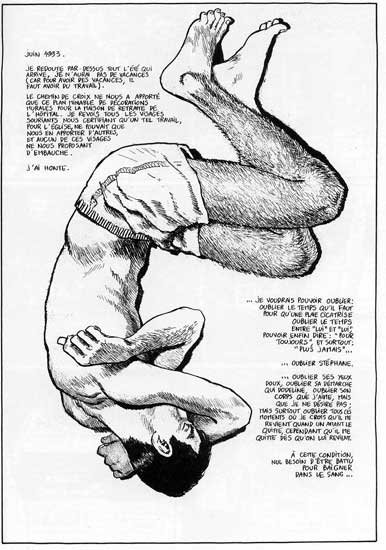
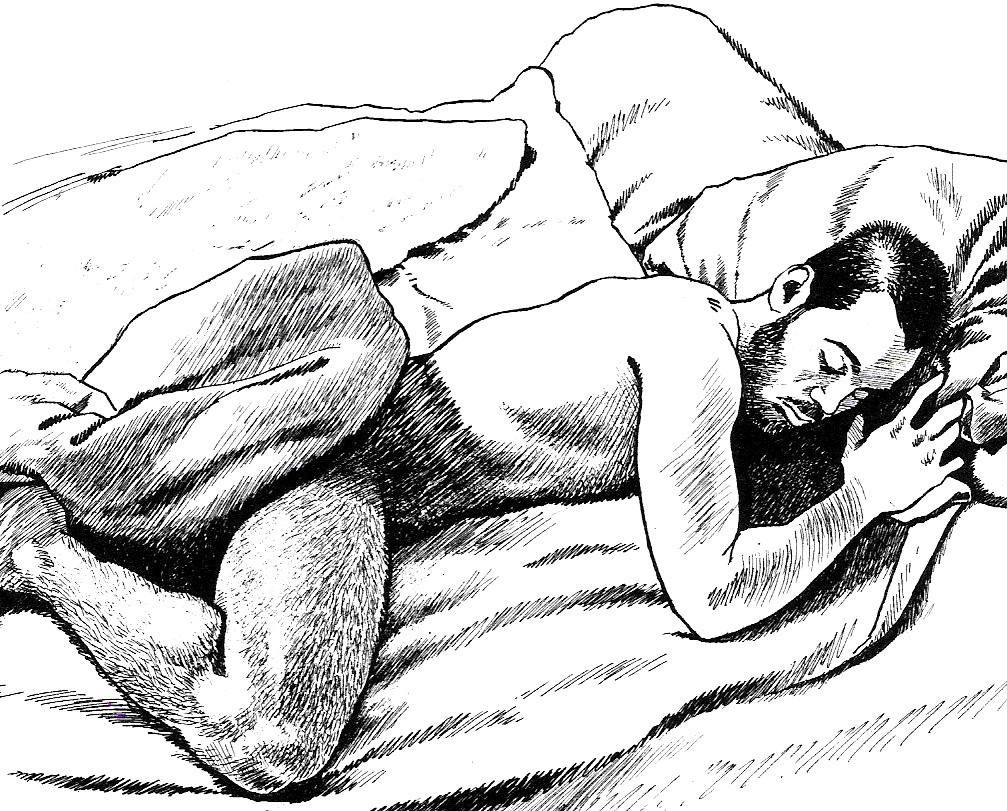
The following post is a barely updated version of a paper I presented at the International Bande Dessinée Society in London in 2007, entitled “Fabrice Neaud’s Face Work.” What drove the paper was two combined hunches, that 1) comics are generally concerned with, and comics are the newest instantiation of, masks as a social phenomenon (presentation of self, social roles, etc.) and 2) Fabrice Neaud’s unique focus on his face, and the faces of others in his autobiographical comics, is essentially a kind of “face work” an artistic effort to portray his “self” through a work on his “face.” I’m not sure how successful my argument was, and it may seem out of date at this point, but I have been thinking about autobiographical comics in more depth lately and I continue to believe that “face work,” while not unique to the comics art form (Proust, for example, was a master of face work while a certain number of comics artists, of course, avoid the face as a focal point), is nonetheless intimately bound to comics as an art form. If this essay seems out of date or irrelevant, I hope, at the very least, that it will encourage readers to become intimate with  Fabrice Neaud’s Journal and, eventually, that editors will consider publishing an English translation. It is, from my point of view, one of the greatest works of autobiographical comics that has been published to date, certainly up there with David B’s masterpiece, L’Ascension du Haut-Mal (1996-2003).
_________

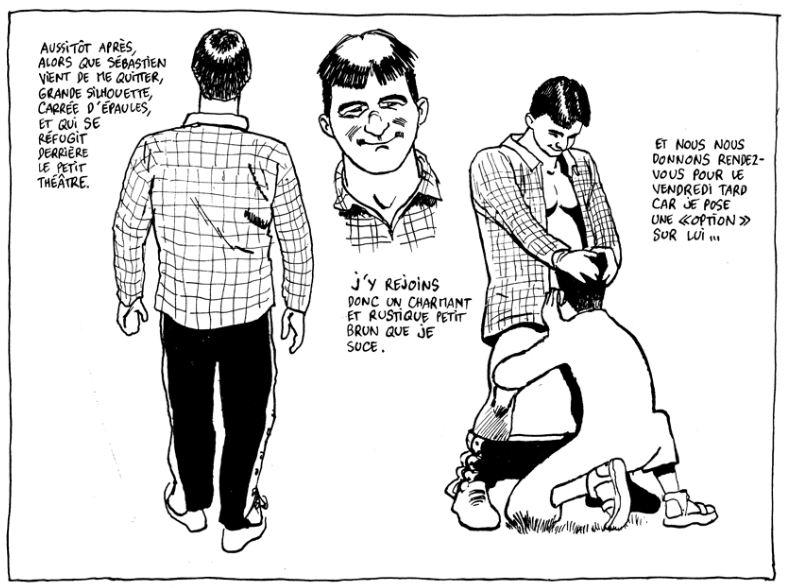
Fabrice Neaud’s autobiographical project, Journal, spans 765 pages total, covering the period of Neaud’s life from February 1992 to July of 1996 with a fifth volume that Neaud finally decided not to publish. What distinguishes this project from other autobiocomix is the fact that Neaud conceives of it as a journal. There is no preconceived unity to the project, no preconceived end. Unique to French BD at the time, Neaud is uncompromising in representing his sexuality. Also, there is a very persistent meta-bd level of discourse throughout the Journal, a constant interrogation of the conditions of representation, which makes Neaud’s work interesting for any scholar interested in the question of autobiocomix.

07 blog-fabrice-neaud 49154451 3c7d007d3628f3703e576552d2b55770 FNeaud3 emile FNeaud2 journal4

The title of this conference, The Innovative Form, inspires all manner of questions about the novelty of the medium. To begin with, “what’s new in BD?” that is to say, what new kinds of things are happening in the medium, but also “what’s new about BD?” that is to say, what is the potential of this form? But of course these two questions are dialectically related: we need innovations in the form before the potential of the medium itself can be fully realized. And I think Fabrice Neaud has some interesting points to make on the question posed by the title of this conference. His own discourse about BD both asserts optimistically the potential of the form and maintains a cautious provisionality as he works to reveal the potential of BD to do new things. In the fourth volume of his Journal he writes the following:

Dans le meilleur des cas, ils [les post-modernists] nous feraient même croire que la bande dessinée est le dernier refuge du dessin académique. Je ne me sens pas pour l’heure capable de démontrer le contraire. Mais j’ai bien l’intuition qu’il s’y passe autre chose, une autre façon de percevoir le réel. Une nouvelle manière de hiérarchiser les souvenirs. (Tome IV)

[In the best case scenario, they (post-modernist academics) would have us believe that comics are the last refuge of academic drawing. For the moment, I am not in a position to prove the contrary. But I sense that something else is happening here (in comics, as an art-form), another way of perceiving the real. A new way of classifying and prioritizing memories. (Volume 4).]

Neaud asserts that the potential of the form lies in its capacity to give a new and singular mode of access to the real. In the case of his own Journal, the question of perception of the real is directly connected to the enterprise of autobiographical self-representation, to the “real” of Neaud’s own life. For Neaud the mode of representation must always remain in a kind of dialectic with the “real” of the “represented,” in this case, his life. Or to put it otherwise, the work he does with the constraints and potentialities of this mode of representation is also part and parcel of a certain work on the self. He explains this process in an interview with Jérome Lepeytre:

Ainsi le journal est-il, en plus d’etre un simple témoignage ou compte-rendu d’un vécu, d’une experience, d’anectotes, un travail formel qui interroge les moyens qu’il se donne et le medium qu’il utilise: la bande dessinée: C’est un laboratoire: laboratoire sur le “moi”, laboratoire sur la vie et laboratoire formel allant jusqu’a utiliser des contraintes “oubapiennes” quand j’en ressens la nécessité.”

[Thus my journal, beyond simply being the account of a life lived, or of a personal experience, or of anecdotes, is a formal work that interrogates its own means of representation and its own medium. Comics are a kind of laboratory, a laboratory of the “self,” a laboratory of life, and a formal laboratory that will go to the extreme of using “oubabien” constraints when I feel the need to do so.]

The Journal is subject to a certain kind of work. More to the point, Neaud conceives of the journal as a laboratory. This is a very strategic choice of words here. A laboratory is a place where work and experience (and I’m thinking of the double meaning of the word expérience in French) come together to produce new perceptions of the real. I also want to underline Neaud’s use of the word travail, because this is where my reading of his Journal begins. For Neaud, it is only through the painful process of work, through an intense engagement with representation, that BD will be able to reveal its novelty, its potential to provide any kind of new access to the real. In the same interview, when trying to describe the singularity of his project, (the open-ended nature of a journal as opposed to an autobiography) he uses the English expression, “enfin, c’est un work in progress … les outils qui servent à l’élaboration du projet sont élaborés au fur et à mesure des besoins de ce projet.” He insists on underlining the contingent and improvisational nature of the project, using a language that makes one imagine Neaud’s work on the journal more along the lines of manual labor. Further on, Neaud describes the way in which the project of the journal has altered his way of “taking notes” sur le vif. Whereas he began by drawing from a written journal, supplemented by photos and a sketchbook (“carnet de croquis”), the work of the Journal has brought him to begin “thinking” within the representational constraints of the form. This is how he describes the process:

C’est-à-dire que nous n’y avons plus simplement des croquis accompagnés de notes écrites, mais bien un prédécoupage direct en sequences, quitte à ce que celui-ci soit extremement sommaire et ne se charge que de légender des cases parfois vides. Ce travail de notes me permet au moins de penser en bande dessinée. Il me parait important de souligner ici ce qui est à l’oeuvre: le travail de la bande dessinée.

[In other words, we are no longer dealing with sketches accompanied with written notes, but rather a direct pre-breakdown into sequences, even if it is true that such a pre-breakdown is cursory and is concerned with not much more than the labeling of often empty panels. This work of note-taking allows me, at the very least, to think in comics. It seems important to me to underline what is at stake here: the work of comics.]

For Neaud the work proper to BD, “le travail de la bande dessinée,” is a way of thinking in the form “penser en bande dessinée,” and it is a working towards the realization of the medium’s potential to reveal a different perception of the real. His description of his work method makes it clear: Neaud’s own perception of reality is filtered through the medium – his initial representations of recent memory are already distributed into panels. As he works on the journal, it works on him.

This “work” then happens in the journal across a broad range of representational fields: rhythm, place, word-image relation, register, symbol.

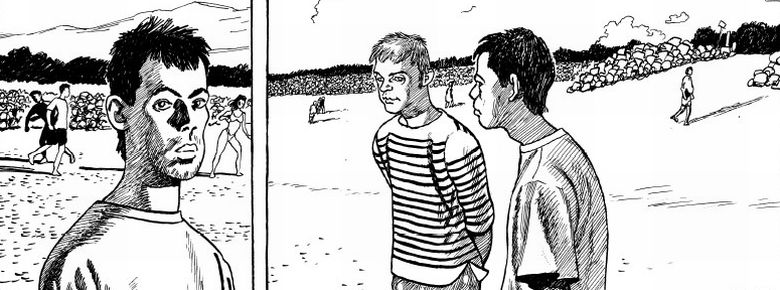
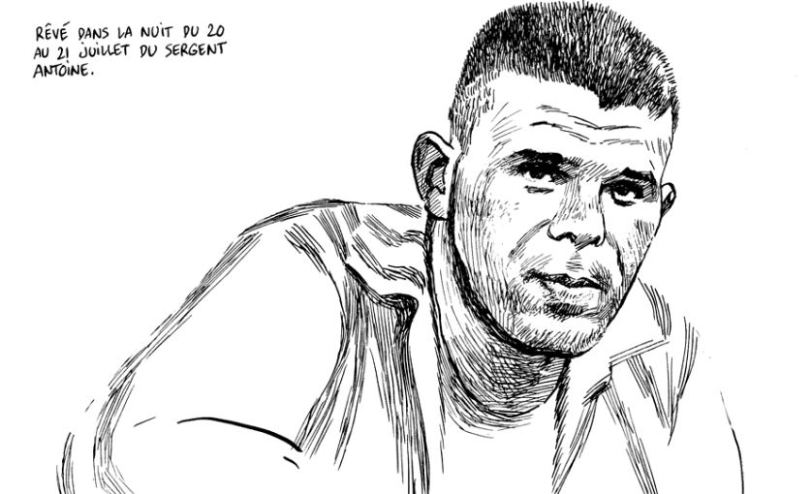
What I would like examine here is Neaud’s work on the face. There is a marked, idiosyncratic, kind of work being done on both the autobiographical face and the face of the love object (called “image” when it is the face of the other) in his Journal. [We might even say that this is the signature of Neaud’s work, this attention given to the face]. It is a kind of work that takes place both on a verbal and visual register. And it is a work that is engaged with the possibility of representing the real of Fabrice Neaud’s life. The face asks, it interrogates, the question of the real. Thierry Groensteen in his preface to vol. I of the Journal refers to Neaud as a face, as “ce visage qui nous interroge” [“this face that questions us”]. What kind of access to the real of the life of Fabrice Neaud does the face of Fabrice Neaud give us? While his more or less realistic (as the French would say, “classique”) style of drawing would seem to promise a relatively straightforward autobiographical representation, the particular attention he gives to his own face, suggests he is concerned with the way the autobiographical face might authenticate self-representation (like a signature), and thus complicates the presumed simplicity of self-representation.

We have from the very first pages of volume I of the Journal a complex discourse on the face. When he writes about his nocturnal sexual encounters in the jardins publiques, he criticizes the safe hypocritical anonymity of the kinds of sexual encounters that take place there, encounters that happens without face. Neaud claims to refuse the anonymity of faces, “je refuse l’anonymat des visages” [“I refuse the anonymity of faces”]. And a few panels later, “je tiens à assumer jusqu’au bout: circuler à visage découvert sans être obligé aux clichés que ceux qui viennent … se sont imposés à eux-même” [“I am committed to claiming my identity to the extreme, to circulating with an exposed face, without being forced to acquiesce to the faces that those who come [to the cruising park] have imposed on themselves”]. Neaud’s discourse on the face is haunted by a metaphorics of masks. As he explains it, while he claims to show his “true” face, in other words to fully assume his homosexuality, he nonetheless also refuses to “wear the mask” of gay clichés. But this is hard to do when faced with an insistent deontologizing heterosexual gaze, a gaze that itself imposes masks on its other. Confronted daily with a heterosexual gaze, he steadfastly refuses to present a legible face – refuses to provide a comfortable or digestible face for the other to have a (faux) ethical encounter with.

The legibility of the homosexual face is presented as a question in the opening pages of the Journal. A sort of “flash back,” the scene takes place in a park, 1975, where the young Fabrice is chased and violently forced to pull his pants down to “show that he’s not a girl.” [And here already at the beginning he is very deliberate in his representation of the face]. This primal scene of the journal returns to haunt another scene that takes place, significantly, also in a park. Discussing his nocturnal wanderings, describing the various types of men who frequent the park in an anthropological (or almost more zoological) manner, Neaud describes a certain type of married man who frequents the park. A set of four panels show a faceless, anonymous man, presumably a married man seeking easy sexual gratification in the safety of his car. When Neaud refuses him, the man insults him, calling him “pédé” [“faggot”]. The insult, is both an interpretation, that is, a reading of the face, and an interpellation, that is, a giving of face. Here he compares these faceless men to his childhood bullies:

Ce sont eux. Ce sont les mêmes qui me traitaient de “tapette” alors qu’ils ne savaient même pas ce que ça voulait dire … tout simplement parce que je n’aimais pas leurs jeux … Ce sont les mêmes qui m’ont fait tant douter quand “tapette” je suis devenu, et que j’ai cru qu’à m’insulter de la sorte … ils l’avaient lu sur mon front.

[“Those are the ones, the same ones who called me a queer even though they didn’t even know what that meant… just because I didn’t like their games… the same who made me doubt myself when I did become queer and who, in insulting me thus, convinced me that they had read it on my forehead”]

[Neaud is haunted by the thought, this childhood conclusion, that his homosexuality is “written on the face.” And here we have a rewriting of the primal scene in which he gets up from of his abject (fetal) position and faces his interpellators returning the insult… But although he able to rewrite the scene and “face” them, his face here is scratched out, de-faced. Why does he do this here? At least one way to read this is as part of a general project to render his face illegible in the face of this interpellation of the heterosexual gaze – here the gaze and the insult are one and the same, by the way]

And this is a general condition of Neaud’s life, both in private and in public, he finds himself fighting constantly against the deontologizing tendencies of the straight people in his milieu. Even his “liberal,” non-homophobic friends expect Neaud’s work to “reveal” a certain truth about homosexuality (the word dévoiler (reveal, unveil) is used a lot in relationship to the word pudeur (prudishness) as though only Neaud, the only gay person in the association, must bear the sole burden of confronting societal taboos). His friend and collaborator Loïc Néhou, now the general editor Ego Comme X, suggests that Neaud might tell the story of his “petites ballades nocturnes” [“little nighttime excursions”]. In a rather funny scene that takes place in Journal IV, Neaud depicts a radio interview in which the radio announcer claims that the subject of his journal is “homosexuality.” Neaud responds violently.

“Sinon, faut dire quand meme que ton sujet principal, c’est l’homosexualité. T’as un message à faire passer? // Je n’ai aucun message à faire passer sur l’homosexualité!! Il n’y a plus grand’chose à dire sur l’homosexualité!! Est-ce que Roméo et Juliette a pour sujet principal l’hétérosexualité? NON! … Je parle de mon quotidien … // […] Et mon sujet principal, c’est plutôt … le portrait de mon modele: “Stephane”!

“In any case, your main subject is homosexuality. Do you want to convey a message [to my listeners]?” / “I don’t have any message to convey about homosexuality. There’s nothing left to say about homosexuality!! Is heterosexuality the main subject of Romeo and Juliette? NO!!! I just write about my daily existence… and my primary subject is more precisely that of my model, Stephane.”

So I would suggest that Neaud’s work on the face resists presenting any kind of intelligibly gay subject, and in resisting the imposed “masks” succeeds in presenting a new perception of the real. In effect, all of Neaud’s most intense face work appears in the chapters of his Journal most explicitly concerned with the question of gay identity. His resistance to and cynicism towards the autobiographical signature is finally impossible to separate from his refusal to produce the effect of an intelligible gay identity in his autobiographical Journal.

On a visual level, the face-work occurs in a number of different modalities. I will describe four of those modalities, although there would be many more, and these could and should be further nuanced:

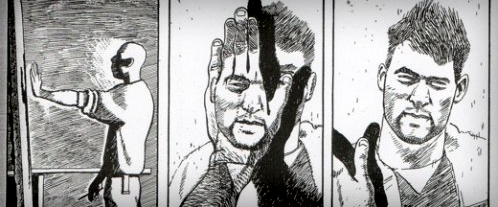
1) The photographic punctum, the “snap” photo effect. Neaud does not hide the fact that he works off of photographs to draw himself and those in his entourage. In fact, in all four volumes of the journal he shows himself photographing those around him. Also at various moments we see him sorting through his archive of slides and printed photographs. In one very memorable panel, he shows himself projecting a slide of his love object. He stands inside of the projection so that his face is distorted, almost monstrously, by the image of his love object’s face projected onto and overlapping with his own. But it is not just through the narrative that we learn about his use of photographs. We can also see it very clearly in his drawing of the face, from his choice of photographs to draw from… Neaud uses a lot of bad, “snap” photography, in which eyes are closed, the face is caught awkwardly in the moment, or made to appear monstrous through unflattering angles, bad lighting, flash, etc.

But why incorporate the photographic into his face work when photography would seem to only reflect the deontologizing gaze of the other? In other words, all of the photos Neaud uses to draw of his own face were taken, that is framed, by others. If Neaud is working to resist the heterosexual gaze, making his face illegible, as I’m claiming here, why use photography? I think the answer lies in the way he uses photography – using it in such a way as to refuse to suture the inhuman eye of the lens. So more than using photography, he marks this use in interesting and even radical ways. By choosing bad, unflattering, snap photos, the autobiographical face is made ugly, not through a process of distortion but on the contrary through the photographic process of representing too faithfully. Making reference to the inhuman eye of the camera lens is one way of resisting the appropriative gaze of the other, because it reveals the extent to which that gaze is subjectivized. It’s like he’s saying “yes, you ultimately frame me, but I can also continue to remind you that you are doing this, that this is not a “natural” process but rather an imposition”. The bad snap shot also highlights the dramatic fleetingness of the moment (rather than “capturing” the moment, the bad snap photograph marks the moment as “past” “dead” already lost… etc. therefore there is no “face” that could be said to transcend time, etc.).

2) Defacement: At various moments throughout the journal, Neaud defaces himself, erasing parts of his face (his mouth or eyes or both), rubbing out his facial features so the face is smudged, scratching it out, or leaving it blank. This is a more “obvious” way of rendering the face illegible and I interpret this particular mode of face work in the vein of a refusal. By defacing the autobiographical face, Neaud is simply saying “no” every time the reader might need or want the attenuation of a face.

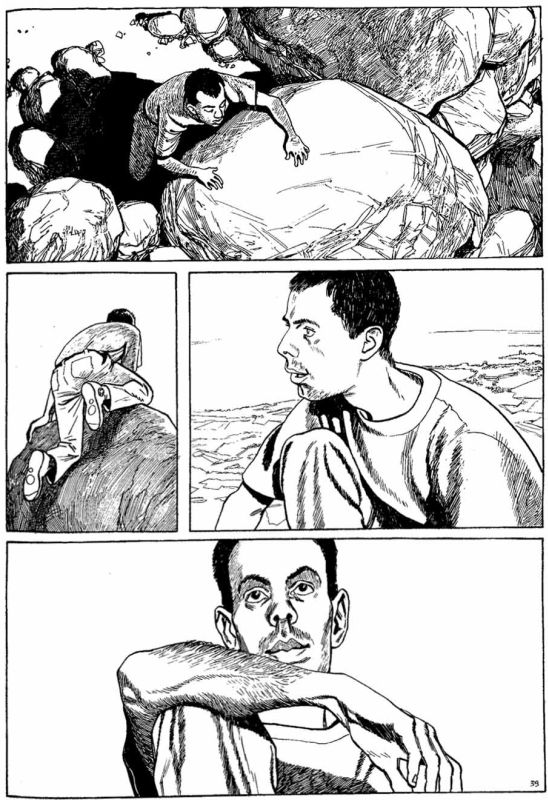
3) Displacement, metonymy: Another modality of face-work could be called the displacement of the face. There are a number of scenes in which the rhythm of the panels creates the expectation of a face when we have, appearing in its place, something else, another body part, a concrete object, a blank panel, sometimes enacting a complete shift of representational orders (like going from faces to mathematical formulas, which occurs in a few panels)… The use of other parts of the body – such as the back of the head or of a hand, or in one case a stomach –where his face is expected.

4) Mask, prosopopeia: the trope of the mask (highly specific to the form and history of comics) in Neaud’s Journal includes his use of caricature, borrowings of representational modes (such as that of Francis Bacon), and his self-consciously recycled repertoire of facial gestures. As much as he claims to “circuler à visage découvert” [“circulate with an exposed face”] he also reminds the reader that there is a process of “masking” that happens in the writing of the journal (a kind of medieval idea, masking in order to unmask, in order to show the true self … this could be said in a way to be the most important aspect to his process of self-representation … and also points to something specific about bande dessinée, that if there were a master trope of bd, it might be said to be prosopopeia, the trope of the mask, the talking mask.)

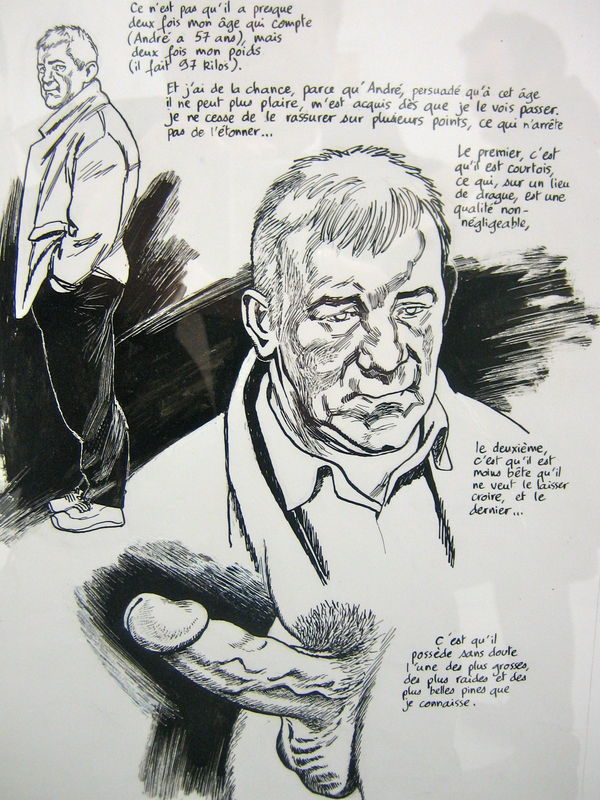
Rather than concluding, I’d like to gesture towards a more critical reading of Neaud [more critical of Neaud, I mean] that would have to do with a different kind of face-work — his work on the faces of others, and more specifically the faces of his love objects (namely Stéphane and Doumé). Recall the radio interview, when Neaud angrily denies that the subject of his journal is homosexuality, he suggests instead that the true subject is more likely his love-object, or as he puts it “Et mon sujet principal, c’est plutôt … le portrait de mon modèle: “Stephane”! [this is in reference to volume one]. I think his use of the word “portrait” (which implies the representation of a face) is significant here. I suspect that his work on face of the other ultimately comes to obscure his work on the autobiographical face. On a purely visual level, his work on the face of the love object (esp. in vols 1 and 3) is most elaborate. He works more on the face of the other. Both on the visual and verbal levels. He deflects the deontologizing gaze of the other by intensifying (and justifying) his own.
_______

I’m sorry to recycle old work but I also hope that there might be some useful nuggets for those interested in autobiographical comics who might not have access to the franco-belgian tradition.