Ryan Standfest on Art Young, Faith, and Black Humor

Yesterday I posted an article about Art Young, faith, and humor. As I mentioned, the article was originally commissioned for Ryan Standfest’s upcoming anthology on black humor.

Unfortunately, Ryan decided he couldn’t use my essay in his book. I found his reasons, and his responses, interesting and thoughtful. I asked Ryan if he’d let me reprint his email discussion of the essay, of humor, and of Art Young, and he very gracefully agreed. Below are his most substantial emails to me on the subject. (I have not included my responses, which are unwieldy since they include revised versions of the essay. Instead I figured I could talk about our differences a little in comments if there seems to be an interest.)
____________________

Hello Noah–

Yes, I’ve read your article, and I’ve actually been wrestling with the direction it took. I must confess that as an atheist I am struggling with the connection you propose between faith and humor. The confusion for me lay primarily in the use of language, I think, that makes use of the concept of “faith” or “belief” in relation to theological matters, rather than finding a more secular use of such concepts in power structures– not necessarily in religion (or the concept of “god,” “evil” or “heaven.”)

At the start of the piece, you had me hooked with regard to the containment or reproach of power and power structures through the use of humor. I think the article is VERY STRONG up until the paragraph that begins with “Yet it wouldn’t be correct to say that Young eschewed faith.” It was with your juxtaposition of the words of the apostle Paul with an image of Young’s, where the piece heads into a territory that I find unconvincing. The juxtaposition feels a bit like an imposition to me, in order to arrive at a final paragraph that states positions that I am not sure I entirely agree with, nor see any evidence to support.

I think it is fair to say that humor may not prevent or deter tyranny (I am intentionally avoiding an abstract and far-ranging concept such as “evil” here), but it certainly puts it and abusive power structures into a context that weakens their position by means of the altering of perceptions. The statement “Humor is not anarchic liberation,” is of course a subjective and highly individualistic reading of humor that is contrary to what many others believe humor to be (see: Dada, Surrealism, the Marx Brothers). Alas, I am not convinced by the notion that you cannot have mockery without believing in something that is not mocked. I think a humorist or a satirist is perfectly capable of mocking something that he or she does not believe in and may in fact not have anything in mind to put in its place. The essence of Black Humor certainly brushes against the nihilistic concept that almost all power structures cannot be believed-in, or accepted. This is what makes it so black.

Continue reading

Emperor and Inferno

Laughter can topple tyrants. Or it’s nice to think so anyway. When the little child guffaws at the naked emperor, we like to believe that said emperor will blush, admit the error of his ways, and put some pants on, rather than, say, hanging the child from the nearest lamppost and covering his own royal unmentionables by bathing in the blood of anyone in the surrounding throng who happened to utter a sympathetic giggle. When John Stewart gets off a particularly pointed jibe, we like to think it matters to somebody, rather than that it’s just going on to dissipate affectlessly into the virtual ether. Philosopher Simon Critchley may say, “I…want to claim what goes on in humour is a form of liberation or elevation that expresses something essential to the humanity of the human being,” but in that initial nervous “I…want to claim,” and in the over-enthusiastic resort to italics he reveals, perhaps that this statement is as much hope as certainty. He adds, “By laughing at power, we expose its contingency”…and then, with fetching inevitability, he starts to talk about the emperor’s new clothes, that parable for skeptics which we are, of all parables, not to take skeptically. [Critchley 47-48]

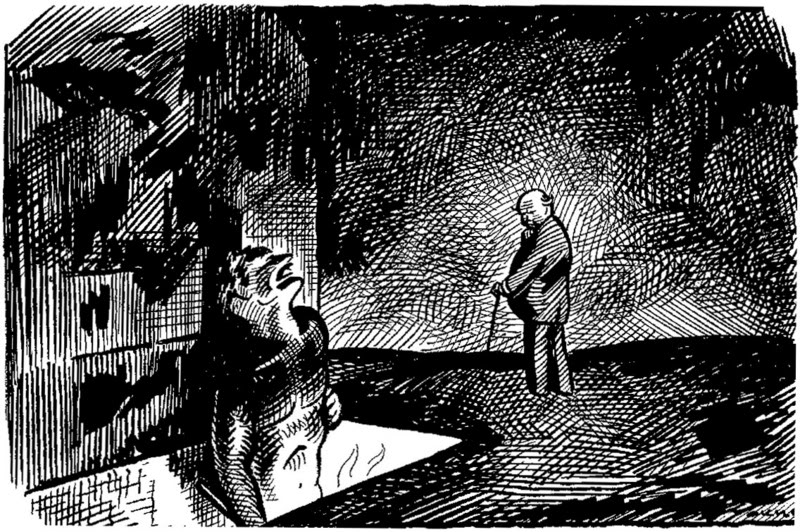
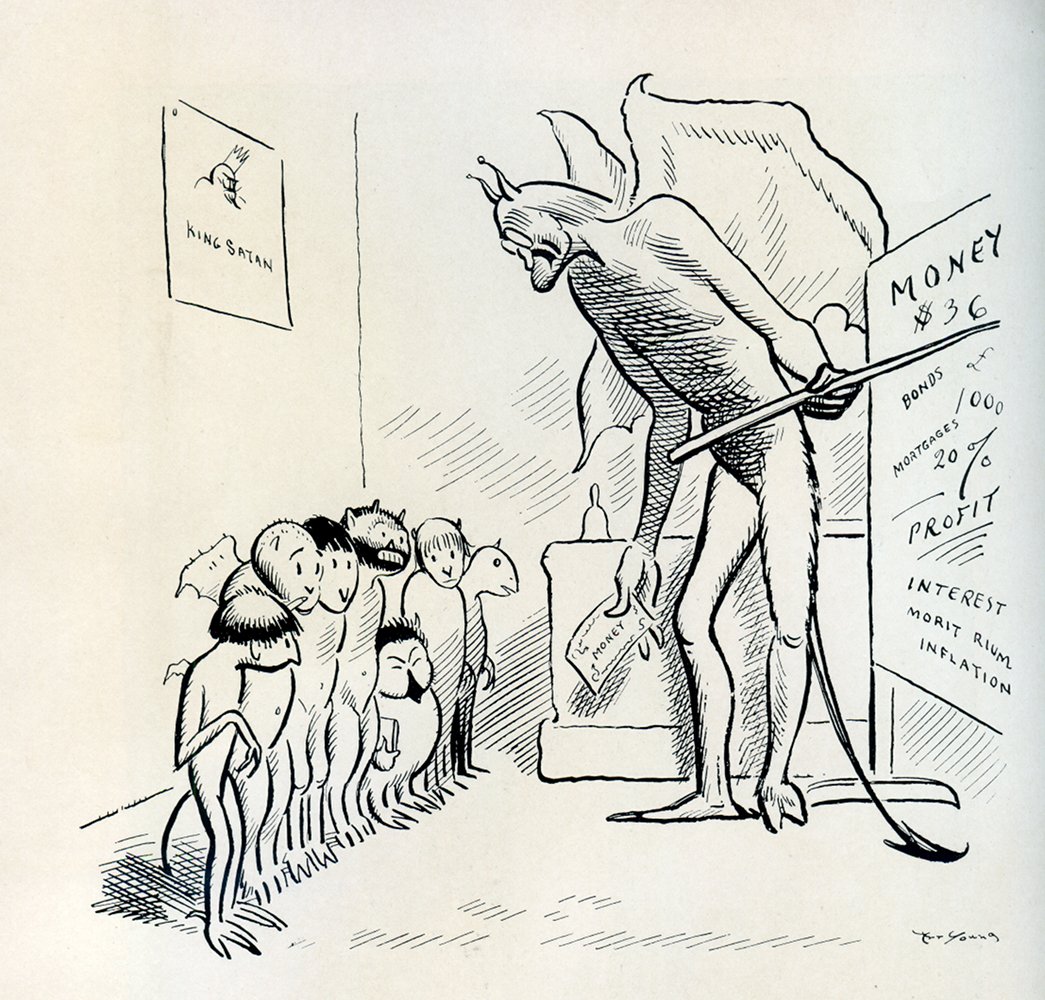
Art Young’s Inferno certainly participates in the hope that the jester might threaten the Khanate. Inspired semi-ironically by Dante and Doré, The Inferno is a description of Young’s journey through Hell, circa 1934. This was actually Young’s third book exploring the pit: the first two were Hell Up To Date from 1892; the second, Through Hell With Hiprah Hunt, from 1901. Both of these were cheerful and non-threatening, focusing on devising witty punishments for modern sins. Unfeeling editors are consigned to red-hot wastebaskets, unattentive husbands are dressed in drag, hobos are forced to bathe, and justice is more or less inoffensively dispensed.

In 1906, however, Young became a convert to socialism. The Inferno, written during the Great Depression, is, then, not a light-hearted fantasy about a just universe, but rather a Marxist panegyric, which explicitly uses its humor to castigate the status quo. As I wrote in a 2006 article for The Comics Journal:

Young reports that “Big Business organizers and Bankers” had been going to Hell in such numbers that they had managed to take over. Satan retains a ceremonial role, but the real power is now vested in an All-Hell Congress controlled by business interests. The new overlords have no interest in punishing the unjust; rather they want to “make money out of Hell.” To this purpose, they establish schools which are “operated like factories to produce standard size thought” and hospitals to which “poor sinners are sometimes grudgingly admitted.” The sophisticated Hellions have even, Young notes, “learned to use the word ‘sorry.’ A gentlemanly Hellion tears out the heart of his brother, spits on it and says, ‘I’m sorry.’” [Berlatsky 133]


Continue reading

Hard to See in the Dark

This was first published on Splice Today.
_________________________

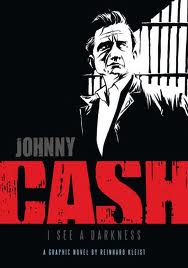
Johnny Cash has been my favorite performer pretty much as long as I’ve had a favorite performer. When I first heard those bleeps on the Folsom Prison album, I was young enough that I actually didn’t know what was being excised. I first learned what “curfew” meant when I asked my parents what Johnny Cash was getting arrested for in “Starkville City Jail.” I’m not certain at this late stage, but I think that same song was the occasion for my first introduction to the concept of controlled substances (“he took my pills and guitar picks/I said, “Wait my name is….”/”Aw shut up”/”Well I sure was in a fix.” And no, I didn’t look the lyrics up.)

As a kid I was, like lots of kids, given to some fairly abstract daydreaming, and Johnny Cash figured in those as well. Specifically, I spent a certain amount of time wondering why people thought musicians in general, and Johnny Cash in particular, were cool. Obviously, Johnny Cash sang about shooting people and getting into fights and getting thrown in jail, and at that time he was associated with the outlaw country movement. But I knew he wasn’t actually an outlaw — he was just a singer. He didn’t even always sing about being a tough guy; sometimes, for example, he sang about political squabbles among bandmates (and yes, “The One On the Right Was On the Left” was how I learned that left and right were ideological as well as directional.) So…if he was just a guy standing up there with a guitar, what was so mysterious or special about that? I turned it over in my head on long car trips while we listened to his cassettes in the back seat, thinking of him standing on stage (I didn’t know he wore black then) and of people watching him, and wondering what, exactly, they saw when they did.

Continue reading

Utilitarian Review 12/10/10

On HU

Busy week this time out.

Erica Friedman started the week out with a post on fashion, fighting, literature and Hana No Asuka-gumi.

Alex Buchet began a massive series on comics contribution to language, looking at Tad, Rube Goldberg, and other early strip artists.

Richard Cook evaluated some hobbit questing tunes.

I explained why I don’t like Pauline Kael.

I reviewed Arie Kaplan’s From Krakow to Krypton about Jews in the comic book industry.

Jason Overby guest posted about the relationship between comics history and comics.

Caroline Small had a follow up comment to Jason’s post.

Sean Michael Robinson discussed the difficulties of marketing Mitsuru Adachi’s sports comics in America.

Alex Buchet continued his series on the effects of comics on language with examples from Popeye, Milt Gross, and more.

Next week we’ve got posts on comics, modernism, and time; Art Young, faith, and humor; Vorticist art, and more.

Utilitarians Everywhere

At Comixology I talk about the weirdness of the superhero Katana.

Female super-heroes can be many things: Amazon warrior, out-of-control telepath, deadly ninja assassin. But whether in swimsuit, bodysuit, fishnets or boob window, they’re almost always cheesecake.

There’s no particular mystery as to why this is. Super-hero comics are male genre literature. Guys like to look at cheesecake. QED. There are some exceptions to the rule — but they’re usually built around genre exceptions as well. For example, the Claremont/Byrne X-Men made some effort to appeal to YA girl readers through the character of Kitty Pryde. Thus, Kitty got to mostly wear civies, rather than the skintight and/or improbably cut-out costumes that were the lot of her distaff teammates. (Not that the internets are above a certain amount of Kitty Pryde cheesecake of course.)

At Splice Today I review a new video anthology of Sid and Marty Kroft’s children’s television shows.

For the Kroffts, childhood is often a suffocating sweetness, a threatening plenitude. In both H.R. Pufnstuf and Lidsville, a boy is trapped in a magical realm from which he spends almost all his time trying (and failing) to escape. The child’s plight is especially unsettling in Lidsville, where the boy in question isn’t really a child. Butch Patrick, who played the protagonist Mark, was 18 when he picked up the role and close to 20 by the time he finished. When he wanders through the magic world of sentient hats, tyrannical patriarchal magicians, and evil doppelgangers, therefore, it doesn’t come across as a child’s adorable game of make-believe. Instead, it looks disturbingly like a young man’s schizophrenic fugue.Jazmine Sullivan neo-soul album.

At Madeloud I review a mediocre techno comp.

Other Links

Karen Green has an interesting discussion of Frank Miller’s 300.

Michelle Smith and Melinda Beasi have a good discussion of the formal qualities of some wordless manga.

R. Fiore on why the Green Hornet movie will suck.

And sometimes commenter Jason Michelitch has his first Splice Today article up about the glory and the limitations of experimental film online.

Comics>Cartooning

Because it kicks ass, I’m reprinting and highlighting Caro’s comment from this post.

To Darryl’s point: for me, “divorcing comics from its cultural history” isn’t about being embarrassed about comics’ history so much as it is recognizing that “comics history” is neither sufficient cultural context for already existing comics nor necessary cultural context for yet-to-be-created ones.

The idea that comics history is both necessary and sufficient — I could put in jargony terms and say that it feels like a caving in to historical determinism. But it’s really more that it gives me no way in.

What L. describes — she says that about creators, but I feel that as a critic too. On the whole, very few comics keep me awake at night the way literature and criticism and theory and Godard films and conceptual art do — not because those things are better than comics-history-inspired comics, but because those are the things I like, and they’re having a different conversation than comics has historically been having.

I pay attention because occasionally, a comic comes along that really intervenes in the stuff I care about (like Feuchtenberger, or the stuff Jason just linked to!) and on the occasions when that has happened, it’s been so extraordinarily worthwhile that it’s worth keeping an eye out.

But for many things, it’s hard for me to muster the enthusiasm to do a real piece of criticism, because the book just isn’t doing anything to keep me awake. No matter how cool the tricks with comics history gets, no matter how nuanced the conversation, it’s just never going to keep me awake, because I’m interested in DIFFERENT histories — pop art, experimental fiction, 20th century theories of language and representation, artistic constructions of subjectivity. I think it’s wrong to say that comics can’t become part of those histories, now, even though they’ve historically not been. (Or, to return to the jargon, how can we expect the dialectic to work without antithesis?)

I absolutely don’t mean that comics-history-inspired comics aren’t doing very interesting things with that history. I don’t mean they shouldn’t exist, or that they’re “less” in any way than other comics. It’s just that, for me, who has no history with comics, comics history can’t on its own provide a foundation for challenging, provocative, mind-changing art, so for comics to challenge me, provoke me, and change my mind, I need there to be SOME comics that deprioritize the specific history of comics in order to engage more actively with those other histories.

That’s why the strength of the term “divorce” feels right to me. Comics’ relationship to their own history often feels like a marriage where one partner’s potential is being really held back in order to protect or build up the ego of the other partner. And I like comics better than I like comics history, so I say “girlfriend, leave!” Comics > cartooning.

What’s “Clark Kent” in Yiddish?

This essay first ran on Splice Today.
_________________________

One of the smartest books I’ve ever read about ethnicity is James Loewen’s Mississippi Chinese. Like the title says, it’s an academic study of Chinese immigrants in Mississippi during the first half of the twentieth century. Specifically, it tries to explain why virtually all of them ended up working as shopkeepers in black neighborhoods. The answer turns out to have next to nothing to do with racial or ethnic predilections or talents, and everything to do with specific social factors. In other words, the Chinese didn’t run stores because they had some sort of gene which made them good salesmen. They ran stores in black neighborhoods because (a) the only way such stores could be economically feasible is if the shopkeeper lived above the shop, and because of racism white people wouldn’t live in black neighborhoods, and (b) African-Americans had difficulty being storekeepers themselves because they had strong community taboos against dunning their neighbors for debts. Thus, because of racism on the one hand and community solidarity created by oppression on the other, there was a particular space available for non-black, non-white immigrants — and the Chinese stepped into it.

I’ve long hoped to find a similar study which would explain why Jews were so dominant in the comic industry. I’d hoped Arie Kaplan’s From Krakow to Krypto would provide some answers — and it didn’t completely disappoint. Kaplan points out that because of prejudice, Jews were effectively barred from advertising illustration, newspaper cartooning — from every commercial artistic outlet, that is, except for comic books, which were considered to be such dreck that nobody cared who worked on them. In this, Kaplan suggests, comics were like Hollywood movies, or comedy, or music: entertainment occupations so low caste that the usual barriers to entry did not apply.

Bringing up music, though, points to a lacuna in the thesis. After all, there were other low caste folks in New York in the thirties, forties, and fifties when Jews were moving into the comics business. I’m pretty sure African-Americans weren’t welcomed with open arms into the world of commercial illustration; why then weren’t they, too, being funneled into the low-class funnybooks?

I can think of a couple of answers to this, but the most likely ones aren’t especially flattering to comic-bookdom.. Perhaps that’s why Kaplan avoids them; certainly, he seems determined to discuss race only when it’s possible to do so while patting the industry loudly on the back (Matt Baker and the Black Panther both make — shall we say, token appearances?) Similarly, though Kaplan’s book does touch on the exploitation comics creators faced, it doesn’t do much to put this in a specifically Jewish context. Did publishers take advantage of shared ethnicity to build trust and more effectively screw their underlings? How important were Jewish social networks to staffing these companies? How did that affect the way the companies were run?

Of course, just because the issues which interest me don’t interest Kaplan isn’t to say that the book is worthless. On the contrary, From Krakow to Krypton covers the history of Jews in American comics — which is more or less the entire history of American comics — with bright efficiency. In only 200 pages or so, Kaplan hits Golden Age superheroes, EC, the Silver Age at Marvel and DC, the undergrounds, and more — and even finds time to mention Michael Chabon way, way more often than necessary. No doubt experts in the field will find the tour cursory, but I learned lots of fun facts, whether big (I’d always thought Gardner Fox was responsible for updating the Flash…duh) or small (Clark Kent was based on Cary Grant! Buffy was based on Kitty Pryde! Neil Gaiman is Jewish!) In addition, the tome is lavishly and carefully illustrated. My favorite image is the adorable Jack Kirby drawing of the Thing in prayer shawl and yarmulke, but the Al Jaffee self-portrait with upside-down head is a close second. Certainly, with all the information and all the art, the book seems very reasonably priced at $25.00.

The main weakness is, inevitably, the boosterism. The constant reiteration of how great Jews and comics are and how far they’ve come had grown wearisome long, long before I reached the last page — and, indeed, long before I opened the volume. I do understand the impulse to cheer on the tribe, but the success of comics isn’t ultimately about culturally validating the Jews, or vice versa. If we want to understand Jews, or comics, or how the two relate to each other, at some point we’re going to need a history that is a little, or a lot, more ruthless.