Utilitarian Review 7/17/10

On HU

Matthias started the week off with a discussion of the Argentine comic strip Mafalda by Quino.

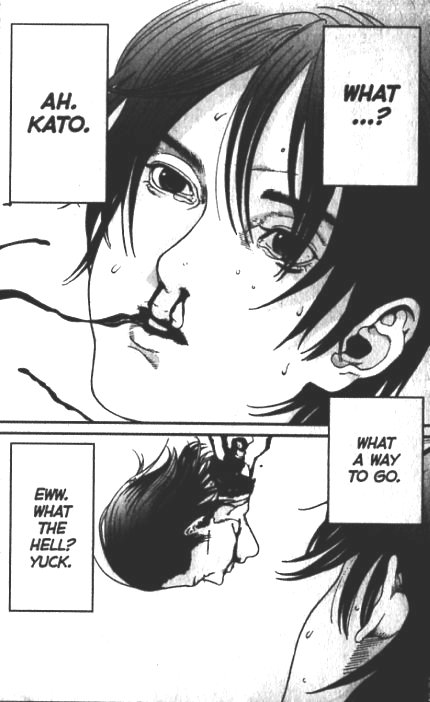
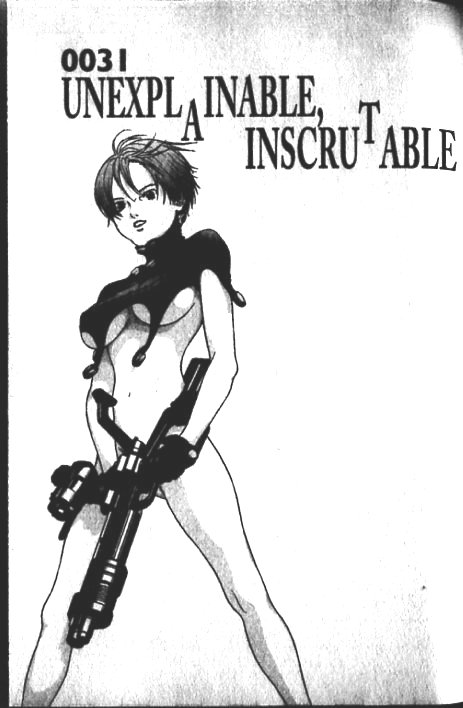
I wrote about the aphasiac power fantasy of Gantz.

Richard Cook talked about Wonder Woman, new costumes, and patriotism.

Suat wrote an extensive post comparing R. Crumb’s Genesis to other works of Biblical illustration.

Vom Marlowe discussed the squick factor in Mick Takeuchi’s Bound Beauty.

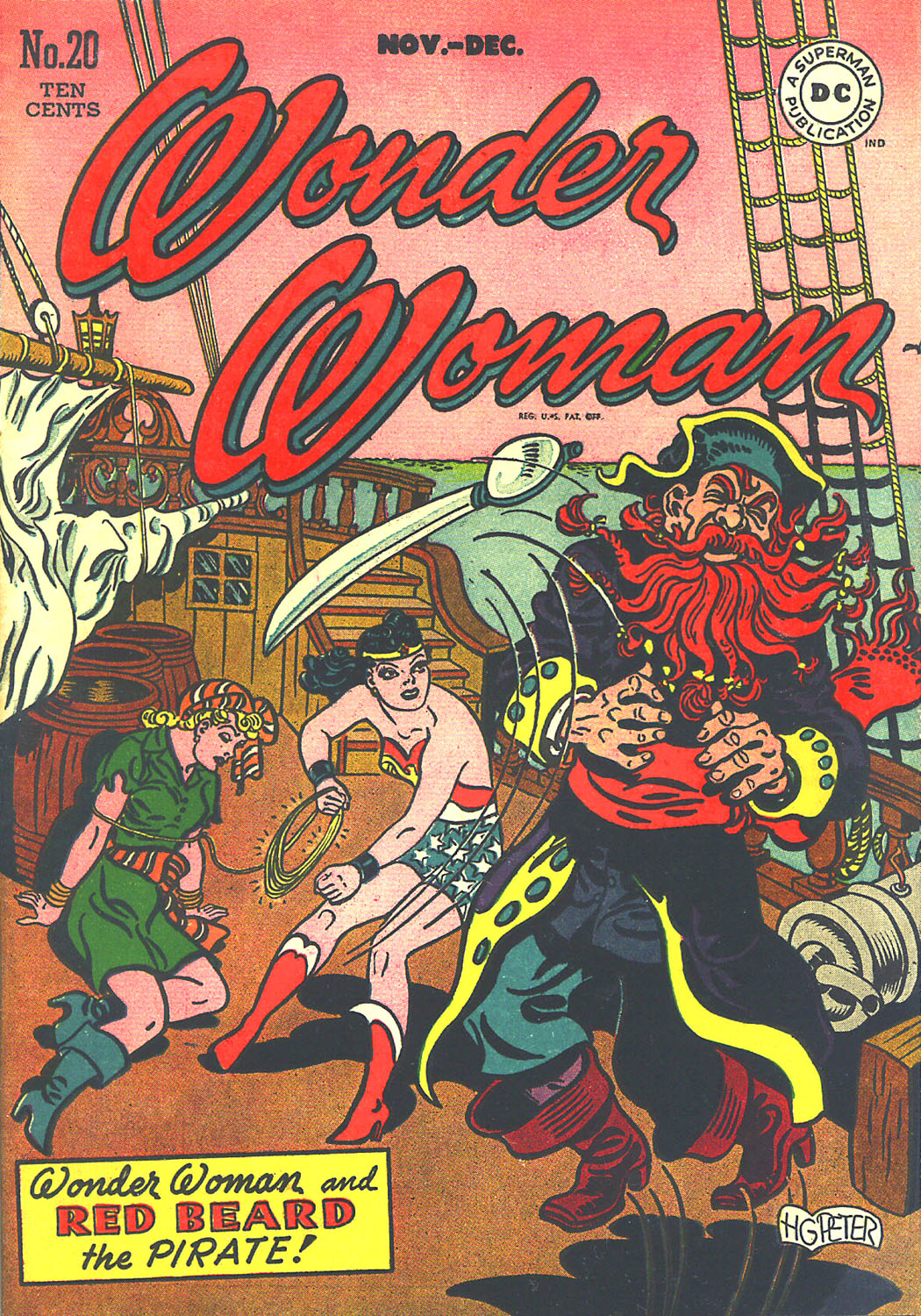
And I returned to my Bound to Blog run through all of the Marston/Peter Wonder Womans with a discussion of Wonder Woman #20.

Utilitarians Everywhere

At his own blog the Metabunker, Matthias Wivel provided a balanced appreciation of Harvey Pekar.

He hasn’t always been served equally well by his collaborators and seems to have been somewhat insensitive to the visual side of comics, leaving too many of his stories to the deadening hands of mediocre artists. But when it worked, it worked beautifully: notably Frank Stack brought the emotional turmoil of Our Cancer Year (1994) to life, and Crumb of course animated Cleveland and its inhabitants as only he could. A case in point is the story “Mr. Lopes’ Gift” (1978), which suggests a whole life in the fragments given us by Pekar. Crumb’s portrayal of a man he had probably never seen is empathetically real, providing the world for us to read in furrowed brow of this construct.

On Tcj.com, Matthias wrote about David Prudhomme’s Rebetiko.

As chance would have it, I have two articles up this week about the television show Bones. First at Comixology I talked about an episode focusing on super-heroes.

Superheroes are sometimes regarded as modern day myths; archetypes harking back to ancient heroes like Gilgamesh who famously wore his underwear on the outside and engaged in curiously vigorous male-bonding activities with his youthful ward Enkidu.

Gilgamesh aside, though, the whole ancient myth thing is maybe obscuring the fact that superheroes have much closer cousins than Hercules. Cousins like, for example, Sherlock Holmes. Absurdly dedicated, supremely skilled guardians of right who bring evil-doers to justice — switch the moustache for the helmet, or even just paint the first on the second, and how much difference is there really between Iron Man and Hercule Poirot?

And at Madeloud I talk about the black metal episode of Bones.

Also at Madeloud I review an album of Nigerian disco.

Finally, as I mentioned yesterday on the blog, Caro had an extended, um, discussion with the folks over at Comics Comics yesterday. Tim Hodler and Frank Santoro were part of the back and forth, and I burbled some too. Here’s one of the less incendiary bits from Caro:

I’ve heard and read this argument many times — that comics generate medium-specific, unique “new insights and ambiguities” that are comparable to those of fine art and literature. I’ve heard it over and over from the writers here and from other enthusiasts about the artistic possibilities of comics. But when critics like Suat put these comics in specific, detailed, analytical conversation with the high bar set by fine art and literature, they generally fail to measure up. And they generally receive comments, like the ones Ed Sizemore made over on HU, that the comparisons are unfair. This is contradictory: either comics are good enough for the comparisons and will stand up against them, or they’re not. Critical evidence tends toward “not.”

Other LInks

Kristy Valenti has an interesting article about volume and women in comics.

From Bookforum, I think this is a good, albeit short, review of Best American Comics Criticism.
Bound to Blog: Wonder Woman #20

It’s been a long time since I last worked on the Bound to Blog series, in which I was blogging my way through every issue of the original William Marston/Harry Peter run on Wonder Woamn. The last issue I wrote about was the squickily racist Wonder Woman #19, way back in November shortly before we left the blogspot address. So (as you can probably figure out) that puts us at #20.

So…with a good eight months or so of anticipation, was it worth the wait? Well, no, not really. This issue is decidedly weak tea. In a lot of ways it’s a rerun of the lackluster Wonder Woman #17, which was also focused around time travel and which was also disjointed and not especially spirited.

The issue still looks great, of course. I love that cover, with Redbeard (Redbeard! hah!) looking absolutely enormous through the miracle of shaky scaling, ridiculous beard flapping every which way. And check out those gnarled hands — they each look big enough to cover WW’s entire head.

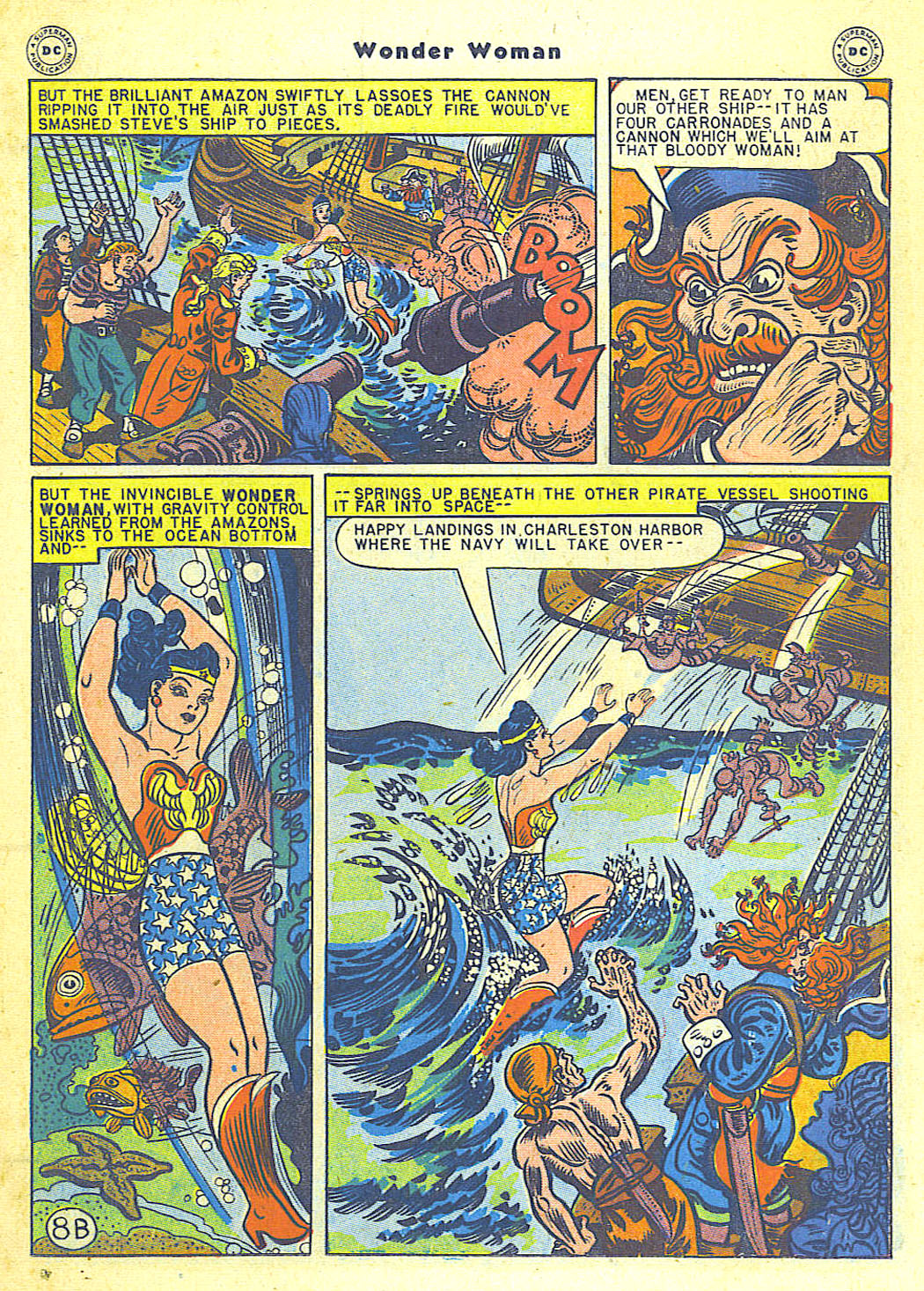
I think this is the best page in the book.

Redbeard’s face in the upper right corner is fantastic, with those elaborately curving eyebrows, the half-moon irises, that magnificent nose. WW sinking thorugh the water with the giant fish behind her is also hard to resist (Peter has used the fish trick before, but it never gets old for me.) And I love the way in the last panel the ocean spray mirrors the stars on WW’s shorts. And the guys falling out of the ship, with their elongated arms making them looks more dynamic and twisted as they drop….and Redbeard’s beard again in that final panel. It’s just a solid sequence all around.

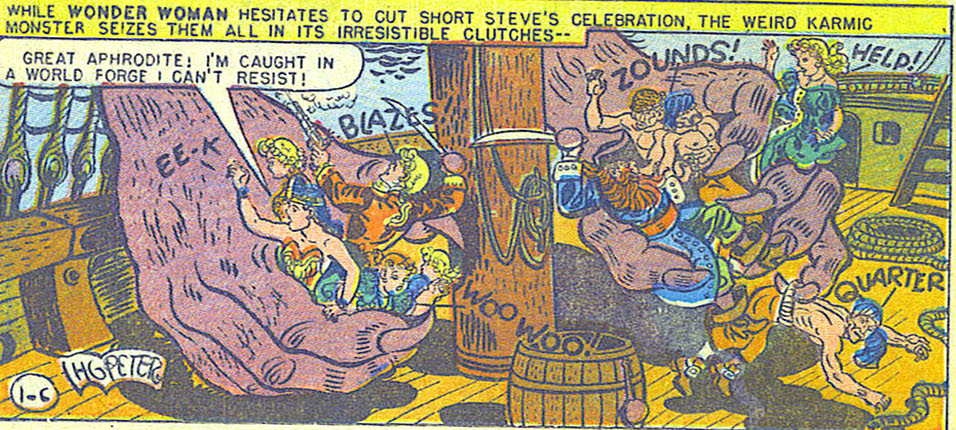
I really like this too:

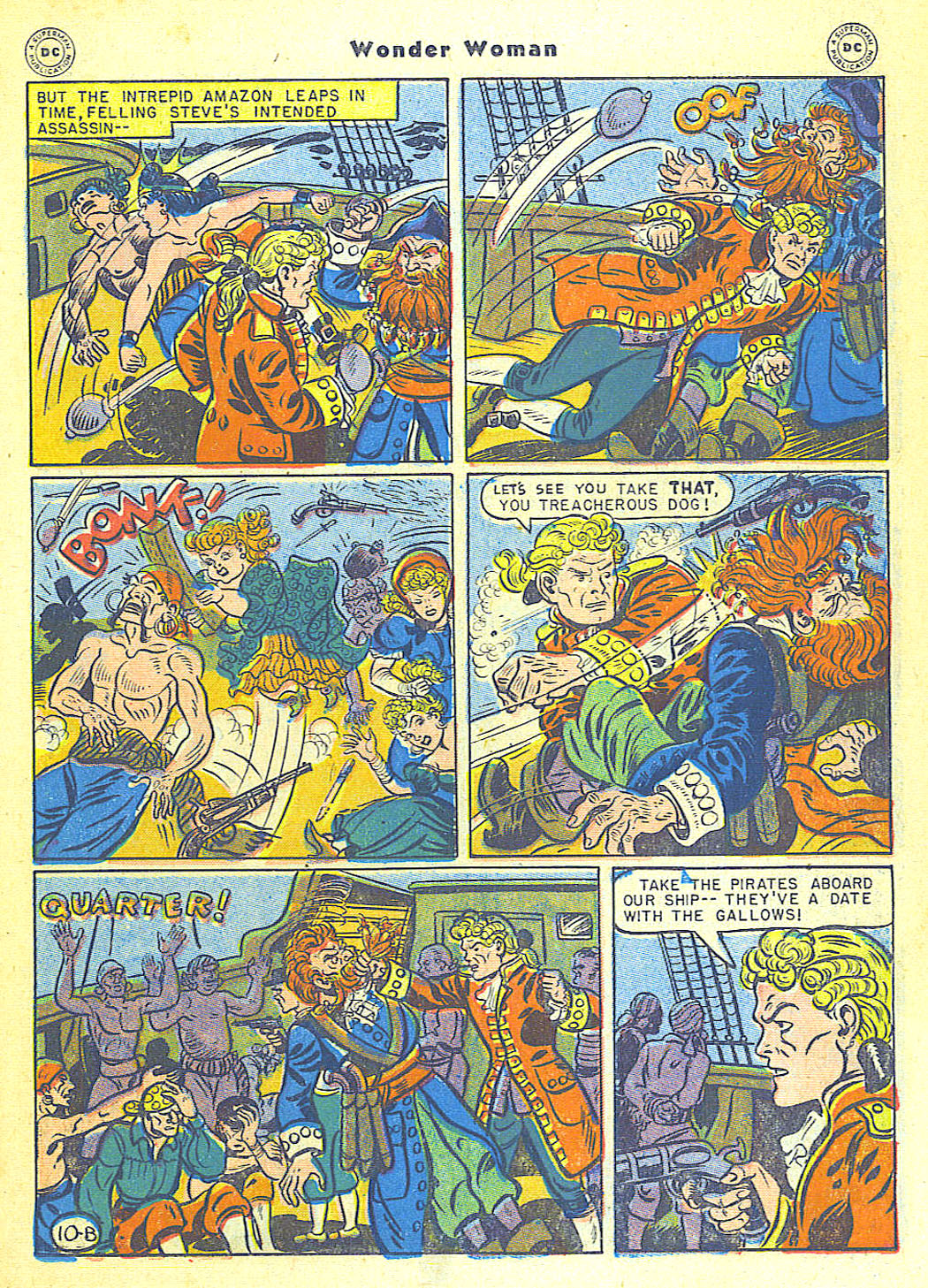
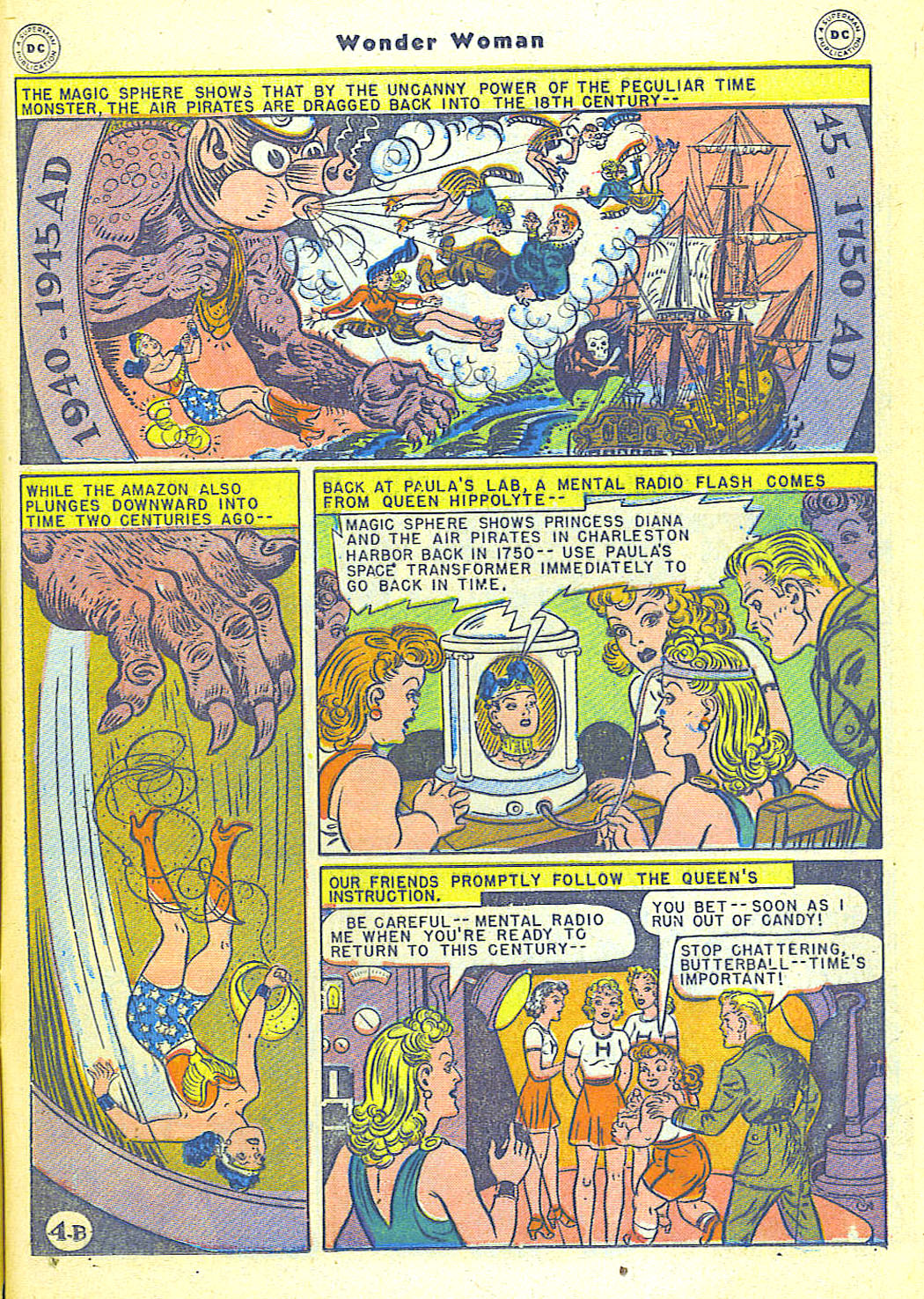
Those are the hands of a giant time monster (I’ll talk a little more about him ) shortly). And they’re great hands. But what I’m really enjoying here is the way Peter dispenses with speech bubbles, just writing “Zounds!” and “Help!” and “Quarter!” directly on the art. There’s an analogous effect here, in one of his silent sequences, which includes a couple well-placed “Bonk”s and the like:

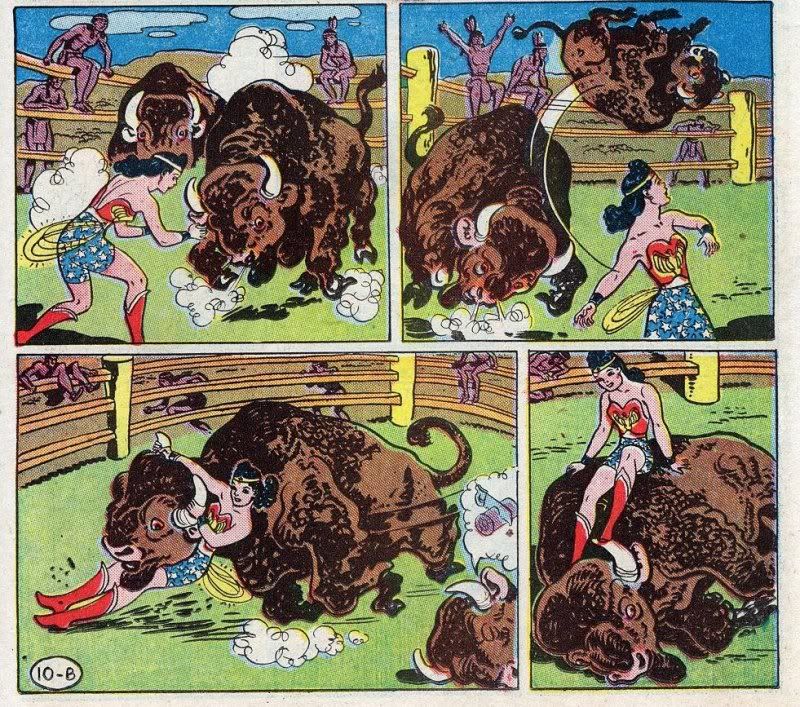
This is an interesting shift for Peter; when he did wordless bits in earlier issues, they were mostly without sound effects as well — for instance, in this bullfight the knocked out bull snores with an image rather than a sound effect. It’s clear, in other words, that Peter is still experimenting, still trying to do new things with the comics form.

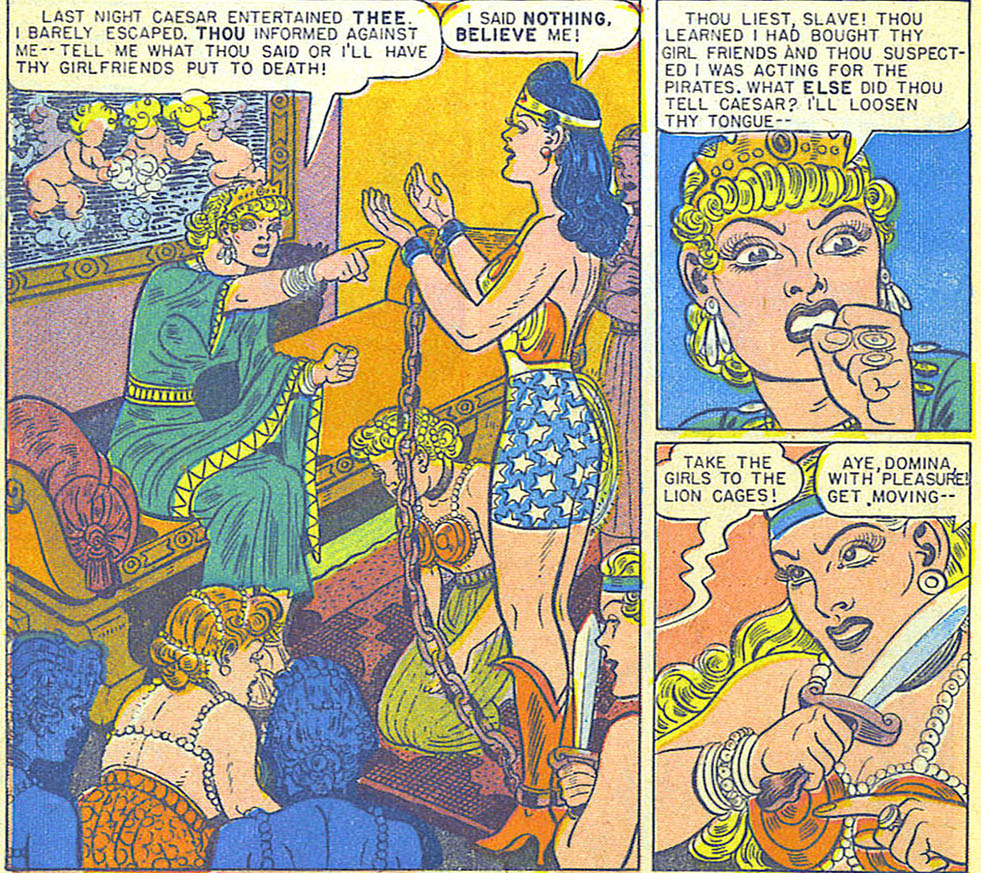
Here’s another nice moment:

The hothouse B & D lesbian seraglio, complete with the veiled and ample Etta in the foreground, is of course hard to resist — but what really makes the panel is the picture within the picture, with the quickly sketched, golden-haired, (entirely?) nude winged cherubs hovering together suggestively — mirroring the triptych of the mistress and the two kneeling slaves in front of it.

There are a couple of interesting narrative points as well. WW gets her bracelets welded together, robbing her of her powers…but Marston cheats and lets her do a bunch of feats of super strength anyway. He offers the excuse that even without her Amazon abilities, she’s still no weakling — but really you get the sense that it was just helpful to the plot — and maybe too that he couldn’t quite stand having her helpless.

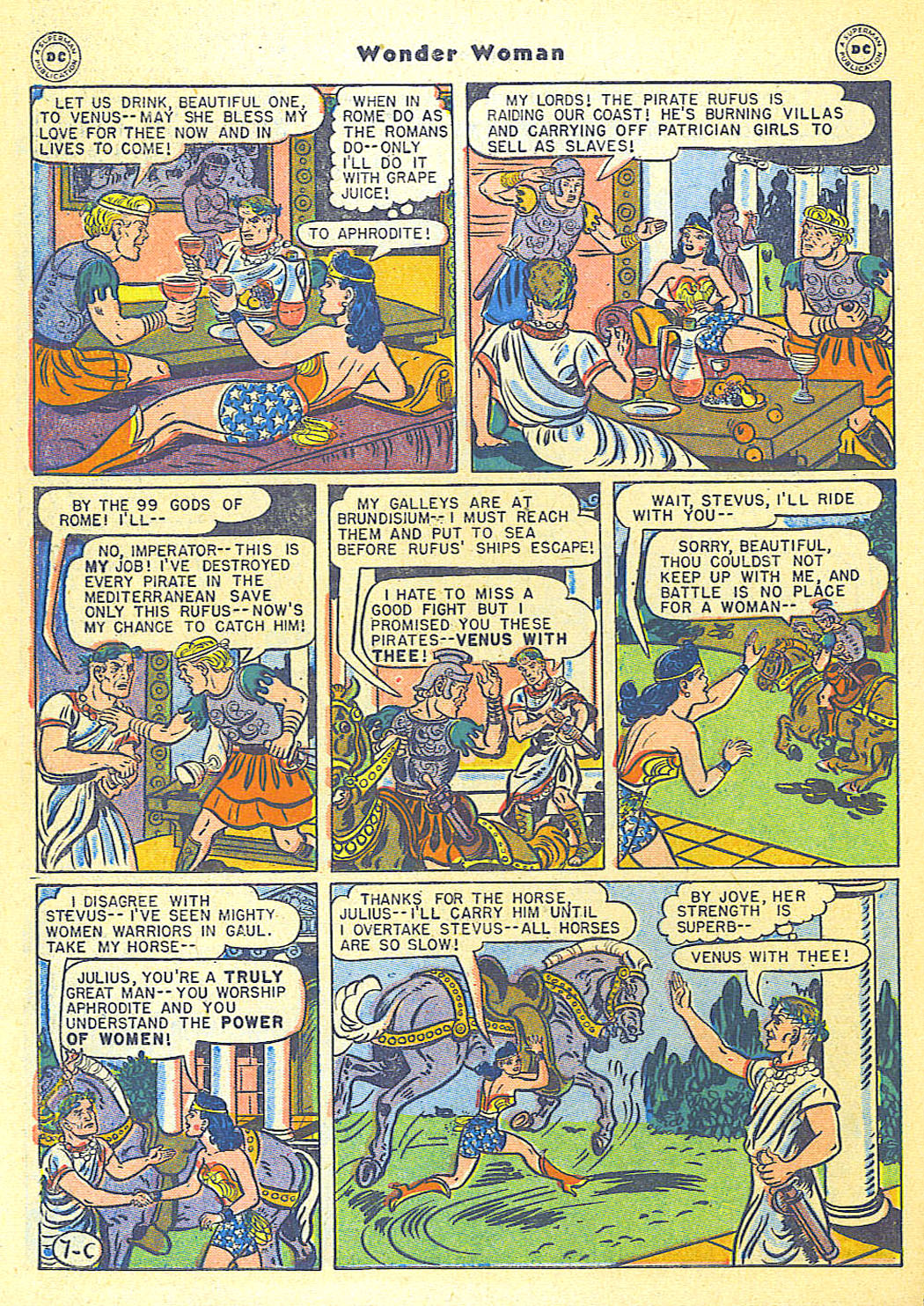
There’s also some back and forth with Julius Caesar:

Marston wrote a whole erotic novel about Julius Caesar, and he’s clearly borrowing from himself. In the book, as here, Caesar worships Venus and understands women, which is the source of his greatness. And in the book, as here, Caesar is really pretty dull and I wish Marston would talk about something else.

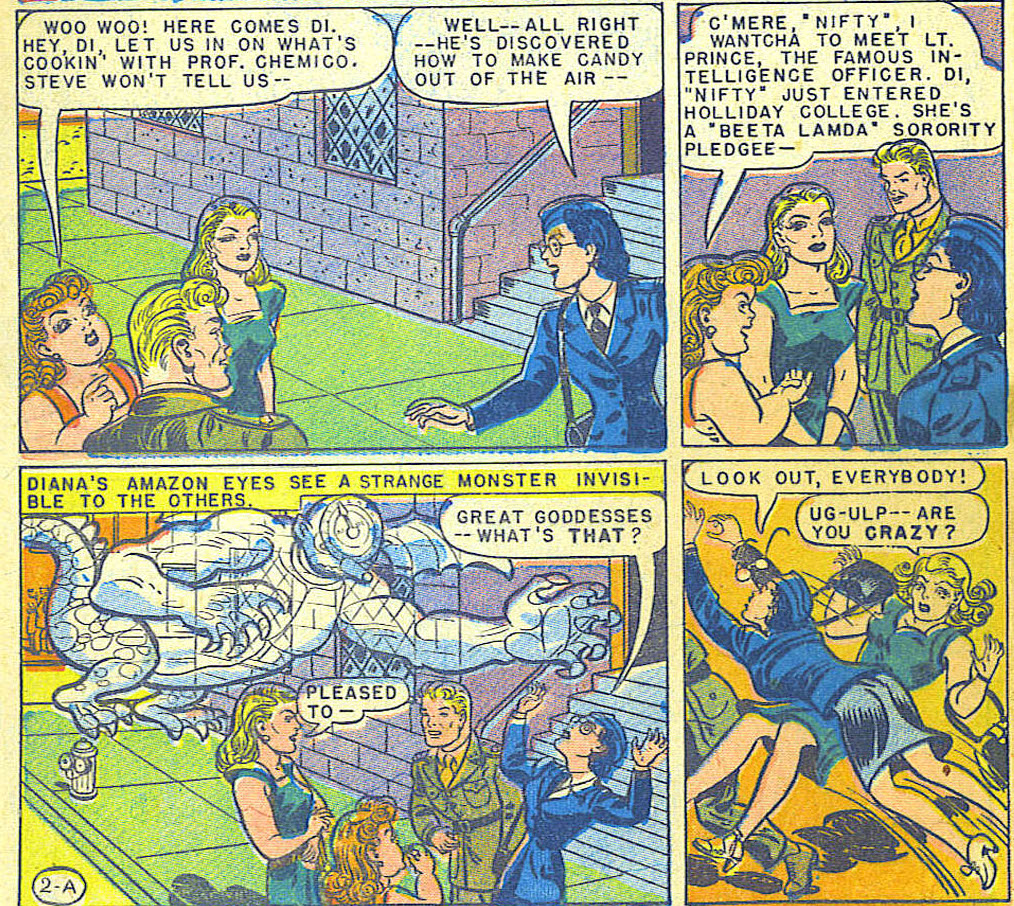
Like this:

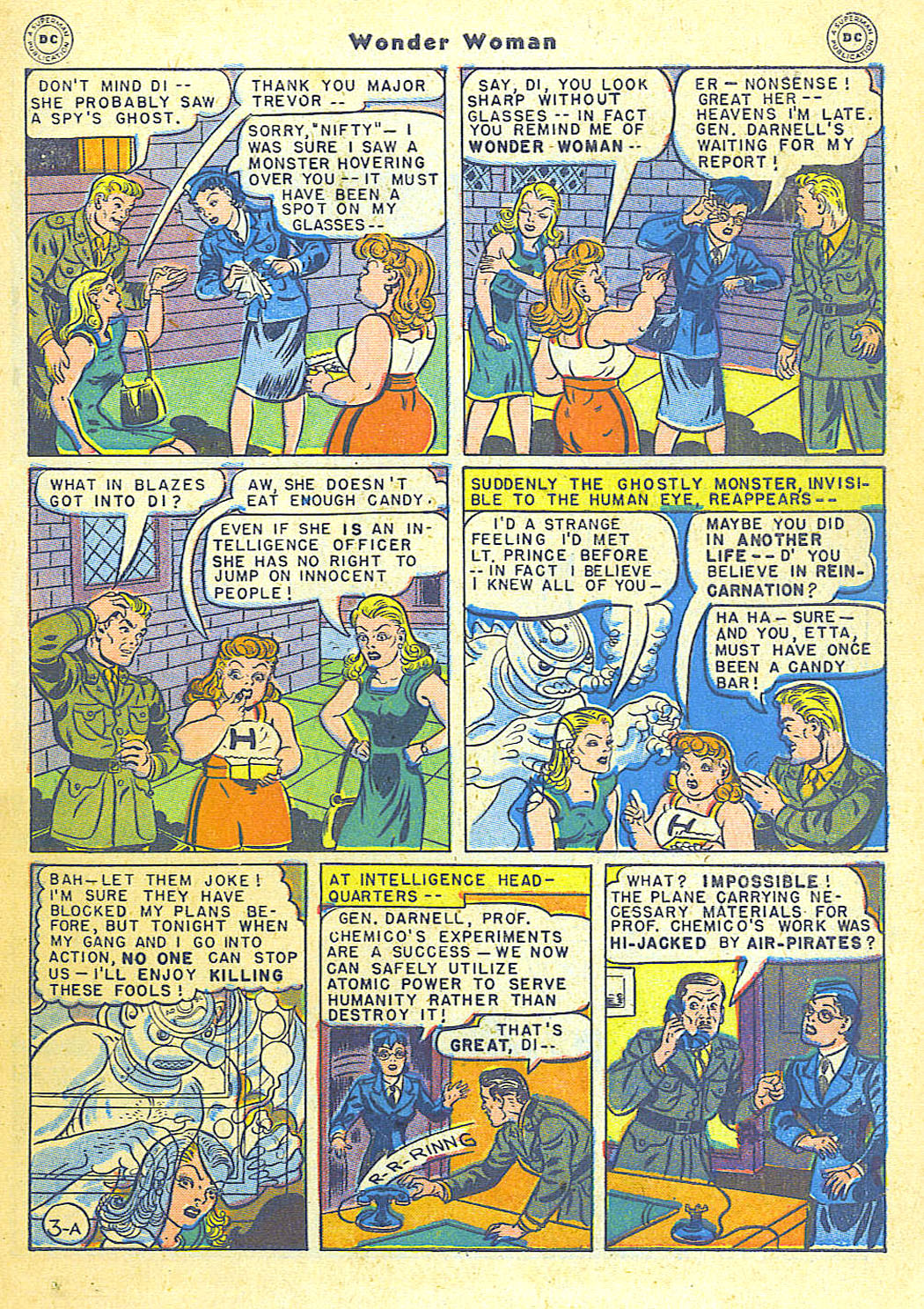
This sequence occurs right at the beginning of the story, and it’s maybe the oddest and most fraught moment in the comic. Peter draws Nifty with extra oomph even for him; her tight dress and low neckline certainly seems to have caught Steve’s attention in that second panel. But, of course, it’s not Steve who reacts to her most strongly, but Diana. A giant ghostly monster materializes (with a ridiculously prominent (ahem) nose)…and Diana leaps upon Nifty…incidentally giving us a fetching shot of her rear, just in case we’d forgotten what a butch woman and a femme woman wrestling mean to Marston.

Diana’s sudden burst of enthusiasm/passion knocks off her glasses — almost allowing Etta to pierce her double-identity. And as soon as Diana scurries off, we learn that Nifty has a double identity of some sort too — she’s the leader of a “gang,” and also apparently the avatar or other self of the weird monster with the phallic nose.

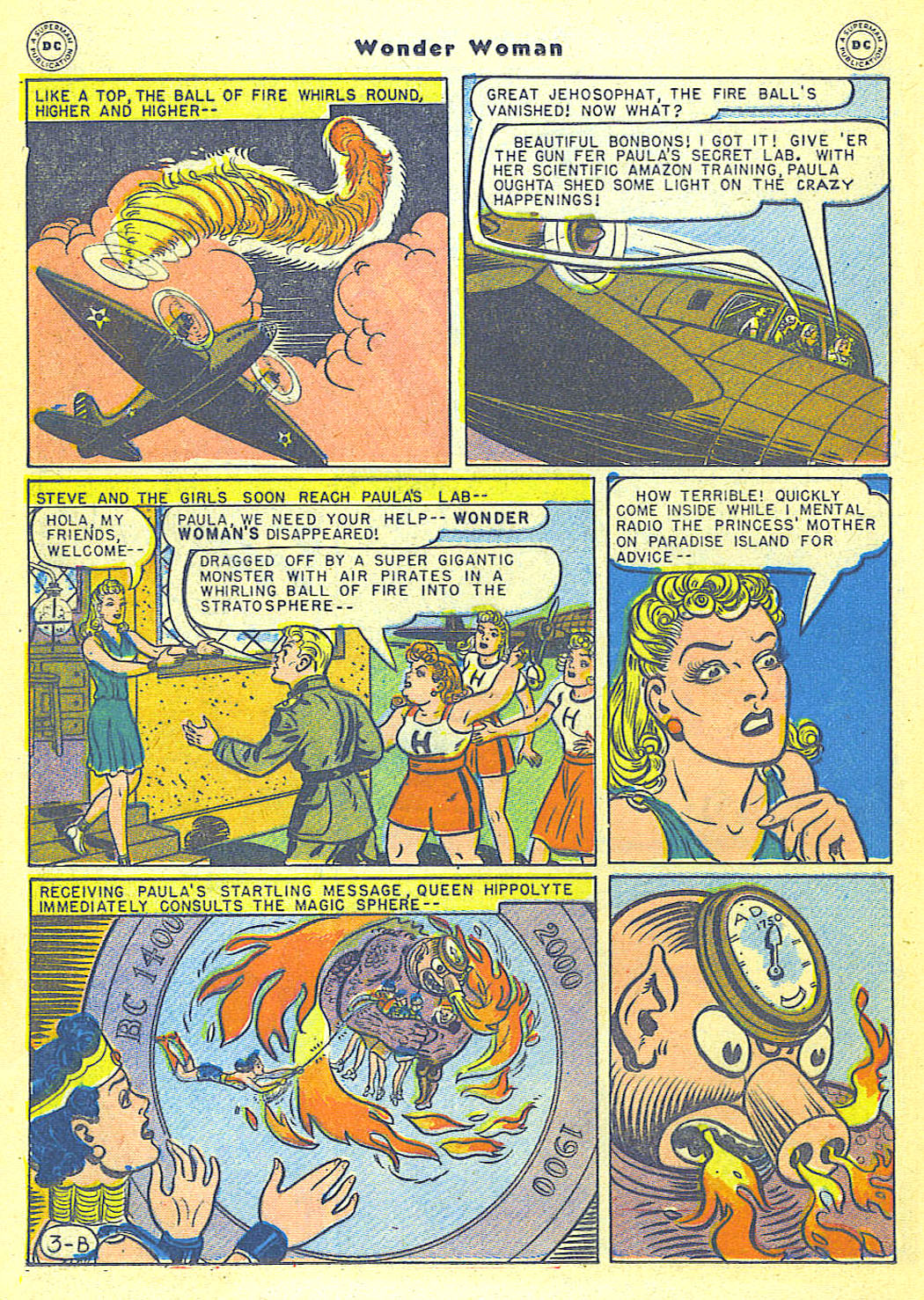
Marston, then, seems to be circling around ideas of doubling and ideas of lesbianism; Di and Nifty have a bond of attraction/repulsion which is tied to their split selves. Furthermore, the monster is a “time monster”, pulling Nifty back into the past so that she can have revenge. Connecting the past, violence, and disassociation of the self strongly suggests trauma.

There are a lot of ways to go from here. Marston could have examined the idea of bifurcation/trauma and its relationship to patriarchy/incest, as he did in issue 16. Or he could have gone further into the Diana/Nifty relationship and female bonding as a powerful, potentially dangerous force, which can either be used on behalf of patriarchy or against it (I talk about this more here. Or, you know, he could have just let us see a whole lot more of the crazy monster and given us more background on how it related to Nifty, since that’s the easily the nuttiest idea in the book,and the one with the most potential for ridiculous/unlikely/entertaining elaboration.

But he doesn’t do any of those things. Instead he gets wrapped up in how cool Caesar is and we never find out what the deal is with the Time Monster, or why Nifty is bonded to it, or what it wants. At the end there’s a kind of half-hearted suggestion that it was summoned by Nifty’s desire for revenge — directly contradicting earlier suggestions that it was itself pushing Nifty towards desiring revenge. I guess you could see the monster as an avatar of maleness; when women embrace violence, they are possessed by the patriarchy or some such. Again, though, Marston usually makes these points pretty explicitly when he’s paying attention. This one feels like he was mostly just going through the motions.

Empty Head

In his review of Monster, Noah advises us that he would “rather pursue the trashier Gantz, which manages to be a lot more thoughtful and truthful about morality by the simple expedient of not idolizing its central characters.” Having read a few more volumes of the series, I would suggest that Noah mistakes base instincts, unfiltered onanism and self-indulgent stupidity for those more virtuous attributes.

That’s Suat, suggesting, in his sweetly understated way that I don’t know what I’m talking about.

So after reading the first 20 or so volumes of Hiroya Oku’s Gantz, have I seen the error of my ways? Well, not exactly.

Suat argues in his review that Gantz is bargain-basement wank material for clueless adolescents, composed of little more than pallid violence, pallid titillation, and pallid nihilism.

It would be easy to imagine this manga being put together by a bunch of sexually deprived nerds huddled around a computer screen but, no, I’m going to be kind here and just call them a group of over-sexed wankers. Gantz is clearly aimed at young males with a history of gaming, buying gravure idol magazines and indulging in H games. Nothing particularly unusual or pathetic here. Everyone can do with a bit of interactive porn now and then, but let’s not mistake this for great entertainment much less great art.

I wouldn’t call Gantz great art necessarily — I think I’m somewhat less interested in that kind of ranking than Suat is in any case. But at least in its early volumes, Gants does have a sense of pacing and atmosphere which I found compelling.

Tucker Stone gets at the book’s appeal a bit when he notes that:

Gantz is the true heir to Peter Parker, and… this–sleazy violence in Matrix jumpsuits–is where you turn if you’re looking for a contemporary Spider-Man comic. It’s 2010, and responsibility is an advertising tagline. Nowadays, a fresh-from-puberty kid with great power would use it to kill anybody that messed with him (every volume so far) and fuck Angelina Jolie (which he did in volume 8.)

For Tucker, this is, like Spider-Man and super-hero comics in general, a power fantasy — but a power fantasy pushed somewhere different than you usually find in super-hero comics. Tucker argues that the difference is one of exploitation: Gantz has more explicit sex and more explicit violence than Spider-Man does. This is true — but I don’t know that that’s especially interesting in itself. After all, most super-hero comics these days are dripping with explicit sex, explicit violence, and various other fluids. Fine-tuning the power fantasy for older, more decadent readers is a tried and true strategy at this point.

What’s different about Gantz is not that the power fantasy is nastier, but that it exists in a kind of blank fugue. You see this from the manga’s first scene — which is also probably the best sequence in the series. High-school student Kei, the book’s hero, is standing on a train platform reading a girly mag and sneering internally at his fellow commuters. Suddenly he notices that a childhood friend, the extremely tall Masuru, is standing next to him. Kei doesn’t speak to his former friend…and then a bum falls off the platform and onto the tracks. Masuru leaps down to help him, but can’t lift him by himself. He looks up, notices Kei, and calls him by name. Kei, who doesn’t like Masuru, finds himself crawling down to aid him almost despite himself — because he likes Masuru more than he thinks? Because he feels like the other commuters expect it of him? It’s entirely unclear even to him — and then the train comes and he and Masuru are hit and die. And then they wake up in an apartment with a bunch of random other people and a dog sitting around a black sphere.

The appeal of the opening is that the sci-fi elements — the transportation after death, the mysterious black sphere — are exactly as inexplicable as the inside of Kei’s own skull. Kei really doesn’t understand himself anymore than he understands how he ended up in that room. He’s dislocated both internally and externally. Peter Parker’s life was transformed when he was bitten by that spider — but Kei? Who was he before he died? Where was he going? Who was he connected to? Nothing, nowhere, no one. This is adolescence as a transition from emptiness to emptiness, growing out of the aphasia of childhood into the aphasia of adulthood.

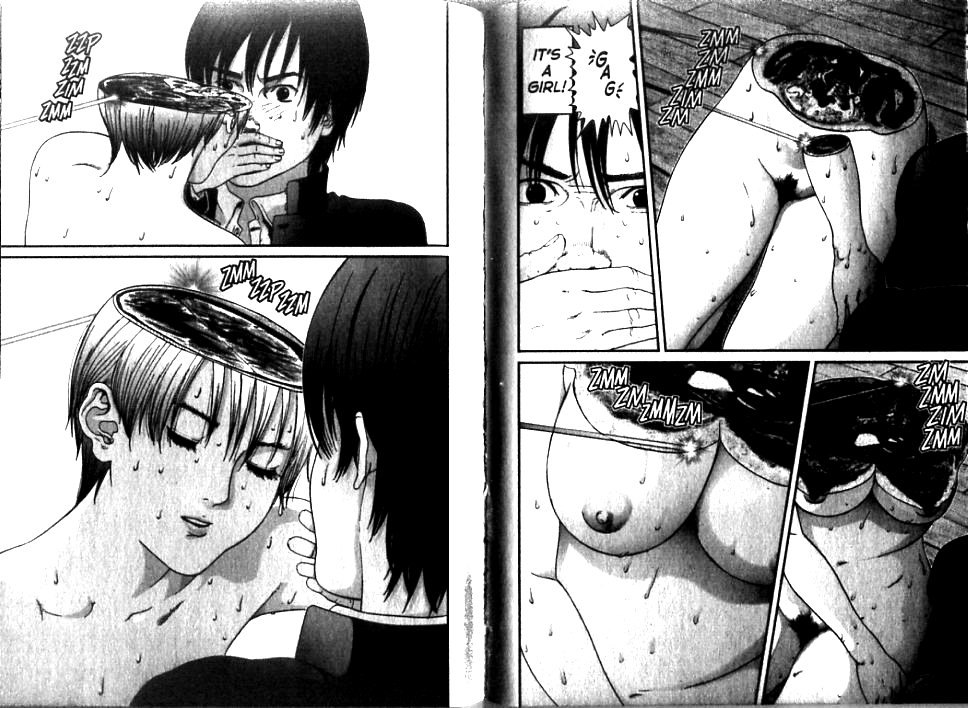
The series is unsettling, then, not because it’s especially brutal or sexually explicit, but because the brutality and exploitation take place in a kind of contextless void. For example, Kei, Matsuro, and the others gathered together by the sphere are all issued futuristic guns and ordered to go out and shoot various aliens. But the guns work on a delay; you pull the trigger and nothing happens for a few seconds, and then (sometimes) your target blows up. The violence here is just standard movie violence…but the time lapse is weird. It gives the battles a slowed-down, dreamlike feel, like the rules of physics have been changed and the characters are sitting staring at their navels as they drift off into space.

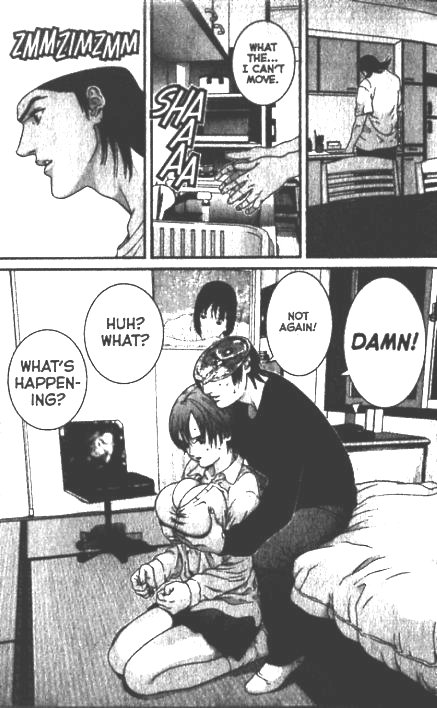
Kei’s sexual relationships work in a similarly disjointed way. Soon after he finds himself in the room with the sphere a naked girl appears literally out of thin air and falls into his lap; soon thereafter a dog licks her pussy; then sometime later she moves in with Kei and let him feel up her tits for reasons which are really unclear; somewhere in there he falls in love with her; she announces that she loves Matsuro; then at one point the two of them are walking down the street and they run into her exact double. Then later he asks a girl who looks like Angelina Jolie to have sex with him and she does.

Reading the first volumes maybe makes this a little more coherent, but not much. Emotional declarations and sex acts wander out of the blue and then wander back into it, like someone forgot to write random bits of the narrative and then was too lazy to go back and fix it. Oku’s insistent breast fetish becomes, in this context, just another way in which sex is severed from actual interaction — the gratuitous T&A pin ups sprinkled liberally throughout aren’t any more of a non sequitor than most of the events of the story itself. The overall effect is of a pulpier, clumsier Philip K. Dick or Murakami — and the pulp and the clumsiness make it in some ways more odd, not less.

Gantz doesn’t just feel like careless writing, but like a view of reality as carelessly written, in which people’s motivations and even their selves are incoherent. The way the sphere reconstructs the characters — building them up plane by plane so you can see their innards forming as they corporate — is a metaphor for how the book treats people in general — as weird shells built from blood out of nothing. The computer enhanced art only adds to the effect; the characters look too smooth, uncannily isolated from their backgrounds and each other, like they all exist completely independently, never touching either each other or their world.

If Gantz had ended after a couple of arcs — even (especially?) if it had just been cancelled in the middle of a storyline — it would be perfect in its disassociative imperfection. Alas, the remorseless grinding of the plot turns the protagonist from a confused and ineffectual cipher into a standard issue hero, blasting the bad guys, wowing the girls, and generally behaving like Spider-Man with a little more sex and violence. He gets a boring girlfriend who loves him, forms emotional connections, learns the virtues of self-sacrifice and leadership, and generally adopts a persona which is hollow in a much more predictable way. There is a certain poetic logic to having Kei mature from a vacuous nobody into an anonymous trope — but poetic or not, once the anonymous trope is firmly established (certainly by volume 9) there ceases to be much reason to continue to read.

Utilitarian Review 7/10/10

On HU

We started out the week with Kinukitty’s review of the fetishy yaoi Kiss Your Hair.

For July 4, Richard Cook provided a history of Captain America in covers.

Erica Friedman talked about her childhood love for Classics Illustrated (and in comments various Utilitarians debate the worth of Jane Austen.)

Ng Suat Tong discussed Jim Woodring and the world of the Unifactor.

Alex Buchet discusses his own racism in light of Tintin’s.

I discussed the relationship between interviews and criticism, prompting an epic attack in comments from our esteemed proprietor, Gary Groth. Jeet Heer and Tom Spurgeon throw a few punches as well.

Vom Marlowe and her mother explain why Wonder Woman’s new costume sucks.

Caroline Small discusses the art deco illustrations of John Vassos.

And Robert Stanley Martin’s Frazetta thread went on and on and on, with further contributions from Robert, Jesse Hamm, Domingos Isabelinho, Charles Reece, and others. As those who read the TCJ message board have grown to expect, Mike Hunter appears to be the last man talking at the end….

Utilitarians Everywhere
At the Chicago Reader I discuss what’s wrong with experts.

Willie Sutton was famously quoted as saying that he robbed banks “because that’s where the money is.” We go to experts because they’re the ones with the expertise. Sure, we figure out that water is wet and the floor is hard on our own, but it’s not long after we’re up and walking that we start relying on outside sources for information. Electricity turns the lights on, seat belts save lives, the earth is round—for most of us most of the time the basic assumptions of our lives are based on expert knowledge. Which is to say that a lot of what we think we know isn’t knowledge at all, but faith. When the laptop stops working most of us call the tech guy out of childish hope, just as a medieval peasant with a poisoned well might look for a witch to burn.

At Splice Today I express some mild appreciation for the new Kylie Minogue album.

So I hate it, right? Well, not exactly. This album is not good, but I don’t resent its existence. In part, that’s because of the resolute lack of pretension; Aphrodite is rote, but it isn’t going for anything but rote. Kylie isn’t trying to share her pain like Keyshia Cole; she’s not trying to be edgy like Lady Gaga; honestly, she doesn’t even seem like she’s trying to be sexy. You wouldn’t think you could declare, “I am Aphrodite!” without some concupiscent intent, but Minogue pulls it off through sheer plastic anonymity. This is the goddess of love as showgirl Barbie.

Other Links

I enjoyed this article about word balloons in manga and American comics.

Dyspeptic Ouroboros: First Thing We Do, Let’s Burn All the Interviews

Jeet Heer has a post up about Why We Need Criticism. His basic premise, as near as I can tell, is that criticism is just people talking about art — so whether or not we “need” criticism, we’re unlikely to get away from it.

I don’t have any problem with that per se, but…well, look at this:

If we define criticism narrowly as analytical essays on an art form or particular works of art, then it’s true that criticism is a minority interest. But if we define criticism more broadly as any discussion of art or works of art, including conversations and the response of artists themselves to earlier art, then criticism is as unavoidable and essential as art itself. To be more concrete, some of the best comics criticism has come in the form of interviews done by artists like Gil Kane, Robert Crumb, Art Spiegelman, etc. As Joe Matt mentions elsewhere in the discussion, he turns to interviews in The Comics Journal before anything else. Without these interviews, our entire sense of comics would be very different. (my emphasis

For Jeet, the ultimate justification for criticism seems to be that artists do it. A second post privileges the criticism of artists even more strongly when Jeet says “you can learn more about art history by listening to Gary Panter and Art Spiegelman talk than from reading a shelf-full of academic books”.

I don’t deny that artist interviews can be interesting and valuable. And some artists, like James Baldwin and T.S. Eliot, were first rate critics as well. But…looking to interviews and artists for criticism is like looking to critics for art. It’s not totally crazy, but it’s not the best strategy either.

Criticism is a genre of writing. It’s a craft and an art, with its own history and its own integrity as a discipline. That doesn’t mean it has to be professionalized — on the contrary, I’d prefer that it weren’t. But it does mean that to write criticism, it does help to be interested in criticism, just as to write comics it helps to be interested in comics. When Gary Groth conducts a long interview in which he nails down where artist x was and who he worked with for every month of his life over the past four decades — that’s great and worthwhile work, but the result is not exactly criticism as criticism is generally understood. When Alan Moore makes some off the cuff remarks about Steve Ditko, that’s cool and Alan Moore is an insightful guy — but it’s not the same as an actual essay with an actual thesis which actually attempts to engage with a critical tradition.

So…who cares anyway? If folks wants to read interviews instead of criticism, where’s the harm exactly? If Jeet thinks people will get more from a Comics Journal interview than form one of his own essays, why should I kick?

Well, two reasons. The first has to do with this, again from Jeet:

“The simple fact is that because of the intellectual poverty of most writing on comics, infected as it is with fannish boosterism and journalistic glibness, the interview form has been the crucial venue for comics criticism and comics history. ”

For Jeet, then, interviews fill a critical gap. Comics journalism is so bad that we need interviews to save us.

Unfortunately, Jeet has this exactly bass ackward. It isn’t interviews that are saving us from critical poverty. It’s the fetishization of interviews that has led us into this critical difficulty to begin with. Critical comicdom is obsessed with interviews not because there’s nothing else, but because, historically, critical comicdom comes out of the fanzines. The reliance on interviews as critical touchstones is the result of “fannish boosterism” — and it’s also a cause, as critics scuttle around gathering up pearls of wisdom from the horse’s mouth rather than kicking the horse in the teeth, prying off the skull, and making out of it a thing of horror or beauty or ridicule of their own. And as for “journalistic glibness” — substituting five or ten sentence sound bytes by famous artists for an “analytic essay” seems to me to fit the bill.

And the second reason that substituting artists for critics is not ideal is that, besides being bad for criticism, it’s not especially good for art. One of the things criticism does is open up the conversation, both directly, by making artists communicate with people who have different interests and backgrounds, and indirectly, because ideally critics are connected to other critical communities, which are connected to other artistic communities. If you are always turning inward to have artists interpret themselves for an rapturous audience, you end up with a closed circuit — a world in which R. Crumb is not just a talented cartoonist, but a major Biblical scholar; a world in which a shelf full of books about, say, Buddhist ink painting won’t teach you as much about art history (or about the right art history?) as a few hours listening to Gary Panter.

I’m not saying that people should respect criticism. Criticism, like art, deserves not respect, but unremitting hostility. The real problem with Jeet’s discussion is not that he elevates art over criticism, but that he allows his fannish enthusiasm to cast a nostalgic glamour over both. Unless art and criticism are separated, it’s impossible to hate either with sufficient malice. Clubby amity is for interviews; what we really need from criticism and art is more and higher quality loathing.

Update: In reply to some comments below, I have a follow-up post here.

Utilitarian Review 7/2/10

On HU

We’ve been busy on HU this week. We started out with Domingos Isabelinho’s discussion of Frans Masereel.

Guest poster Stephanie Folse (aka telophase) compared the visual language of manga and comics.

Guest poster Robert Stanley Martin provided a warts and all assessment of Frank Frazetta.

I provided a belated conclusion to the Komikusu roundtable by comparing the promotion of lit comics with the promotion of awesome manga. In a follow-up post I discussed my own ignorance.

Guest poster Alex Buchet wrote a three part series on race in Tintin. A fourth part to come next week.

And if any one is interested — disco mix!

Utilitarians Everywhere

The new Twilight movie came out this week, and I wrote several essays about Twilight to celebrate.

First at Splice Today I speculated on what Andrea Dworkin would think about the Twilight phenomena.

In short, the millions of tweens trooping in lockstep to the Cineplex to see the latest Twilight saga installment might as well be trekking over Dworkin’s corpse. It’s a wonder she doesn’t just rise right out of the ground, fangs bared, spitting blood, and personally castrate both Robert Pattison and Taylor Lautner with a rusty cleaver out of pure spite.

At the Chicago Reader I talk about class in Twilight:

If Edward is the aristocrat who treats Bella like a delicate queen, Jacob is the swarthy, sweaty working-class hero who won’t take no for an answer. Edward is obsessively safety-conscious and will barely allow himself to kiss Bella for fear that he’ll lose self-control and bite her neck. Jacob, on the other hand, literally overpowers her when he wants a smooch. In human form, he gives Bella a chance to be a little bit wild, riding motorcycles, diving off cliffs, and generally getting in touch with her inner delinquent. When he turns into a werewolf, Bella risks her safety just by being with him, since he has less control over himself than the proper, uptight Edward.

Also at the Reader, a capsule review of the film is here.

Other Links

This is old, but I just found it: Melinda Beasi on Twilight fandom.

An old friend and sometime commenter here, Bryan Erwine has a very entertaining article up about Superman vs. Muhammad Ali.

And this is a fun skewering of the MSM.