
Wonder Woman Must Change!

Denny O’Neil, Mike Sekowsky, others
Diana Prince: Wonder Woman vol. 1-4
DC Comics
$19.99 each

Photobucket

Wonder Woman is virtually impossible to write well. The problem isn’t that the concept is dumb — on the contrary, the difficulty is that it’s not dumb enough. Most superheroes are artistic nonentities. Superman, Batman, Spider-Man, Wolverine — they’re defined by their powers and their backstory and maybe by one or two dabs of easily reproduced personality (Batman’s grim; Spider-Man’s down on his luck, Wolverine’s mean.) You can put them in different narratives because they aren’t integrated into any narrative. They aren’t the product of a coherent individual aesthetic in the first place, so imposing a different vision on them isn’t especially hard.

Wonder Woman’s different. Her creator, William Moulton Marston (with the help of his wife, Elizabeth Holloway Marston, and their lover, Olive Byrne) created the character to fulfill very specific political and sexual fantasies. Marston wanted to create a strong icon of femininity, so girls would be inspired to embrace feminine virtues, like love and… submissiveness. The result was Wonder Woman, a powerful heroine of justice who would preach about female empowerment in one panel, bash a bad guy in the second, and find herself trussed up like a turkey in the third. Harry G. Peter rendered Marston’s inspirational, fetishistic fantasies in one of the most distinctive styles of the golden age; his stiff figures, active lines, frilly imagery, and distinctive stylization gave Wonder Woman an outsider-art look somewhere between Fletcher Hanks and Henry Darger.

Together Moulton and Peter created a comic that had self-conscious ideological and aesthetic content. They set out, quite deliberately, to reconcile and explore binaries involving fetish and feminism, submission and strength, peace and violence, masculinity and femininity. Those contradictions, and the passion with which they were handled, give the early Wonder Woman stories an energetic, absurd sublimity like very little else in super-hero comics. But those same factors have made it extremely difficult for anyone else to use the character. Just as the most obvious example: how do you present Wonder Woman as an icon of strong womanhood when her costume is a ridiculous swim suit tricked out with fairly explicit bondage iconography (the rope, the metal bracelets)? Or, as another for instance, if Wonder Woman’s mission is supposed to be to bring peace and love to man’s world, how do you make that work with the fact that she spends most of her time hitting people? Moulton had specific answers to these questions because he was a crank and, I would contend, because he was a great artist. But if you’re not both a crank and a great artist, and you try to write Wonder Woman, you’re pretty much screwed. Which is why, while lots of people have written great Batman stories or Superman stories, I have yet to see a great Wonder Woman story written by anyone other than William Moulton Marston.

The one possible exception to that is “Wonder Woman’s Rival,” by Denny O’Neil and Mike Sekowsky. Initially published in Wonder Woman #178 way back in 1968, it’s the first story O’Neil and Sekowsky worked on, and thus the first entry in DC’s four volume “Diana Prince: Wonder Woman” reprint series.

Those four volumes are, by the by, utterly lacking in any contextual material; there’s no introduction, no commentary, no nothing. But, from what I’ve been able to determine from other sources, it seems that in the late ‘60s Wonder Woman was not selling especially well. DC was therefore open to letting Mike Sekowsky, the new editor and artist on the title, take some chances with the character. As a result, O’Neil and Sekowsky clearly feel liberated from any need to treat Wonder Woman with reverence or even respect, and the result is exhilarating. O’Neil turns in a script which is positively mean-spirited in its desecration of the Wonder Woman mythology. Steve Trevor, upright military man, is portrayed as a slimy, brutish, insecure Neanderthal. One particularly ludicrous scene shows him adopting hippie lingo to pick up some anonymous and much younger girl. Later, when he’s arrested on false murder charges, he behaves like a whiny baby-man, sneering at Wonder Woman when she, obviously heart-broken, is forced to testify against him. Meanwhile, Wonder Woman herself is depicted as deeply, weirdly insecure; “I’m not a woman, but a freak,” she cries after Steve has rejected her.

This is the last thing Moulton would have had the character say, obviously; for him, Wonder Woman was a paragon, not an aberration. But I think the outburst pretty clearly captures O’Neil and Sekowsky’s position; they want nothing to do with this nightmarishly outré heroine, nor with her ridiculous costume, nor with her unworkable mythos. Instead, they want to groove, baby. In an antithesis to Wonder Woman’s usual World War II honor-and-military associations, O’Neil sends the plot cavorting through hippie hang-outs, and sprinkles it with wannabe up-to-the-minute patois like “the fuzz frowns on chicks cruising in this pad solo” and “Yeah, man! We need some hens for a party!” Sekowsky, too, seems to be having the time of his life; the art is relentlessly modern retro-chic, with over-saturated psychedelic colors and bold, off-center constructivist layouts. The high-point is a full-page makeover sequence, where Diana Prince, preparing to infiltrate the burn-out underworld, goes on a shopping spree to get that happening look. Sekowsky uncorks everything he’s got: full-bore kaleidoscope effects, fabulous fonts, and dramatic patterned clothes. “Wow!” Diana declares when she’s done. “I…I’m gorgeous! I should have done this ages ago!” I guess, in O’Neil/Sekowsky’s world, Diana always secretly thought that the stars made her ass look big.

Photobucket

The comic is a mess, continuity-wise; Wonder Woman seems to completely forget that she even has a magic lasso when she’s interrogating people, for example. But that’s part of the charm; O’Neil and Sekowsky seem, not only not to care about the character, but to actually be contemptuous of her and her milieu. “Wonder Woman must change…!” Wonder Woman herself mutters at the end, and you get the sense that O’Neil and Sekowsky really believe it. They. Want. To. Do. Something. Else! They’re going to be modern, they’re going to be hip, they’re going to be different, and no stupid canon left to them by some decade-dead crank is going to stand in their way.

Alas, while a barbaric yawp is certainly good fun, it’s hard to build on it for the long term. O’Neil and Sekowsky are great when they’re gleefully leaping about on Marston’s corpse. As soon as they try to create something of their own, though, things quickly go to hell.

In issue #179, O’Neil, in the space of about three pages, strips Diana of her powers and sends Paradise Island into another dimension. Shortly thereafter, he shoots Steve Trevor, putting him safely out of the way in a hospital bed, where he is quickly and summarily forgotten (you never even learn if he recovers or not.) So far, so good. Wonder Woman is now Diana, a non-super civilian, struggling to adjust to her new humanity.

But then O’Neil introduces I Ching (groan) a blind (groan) martial arts master (groan) who trains Diana in his techniques while spouting (you guessed it) wise parables that appear to have been lifted directly from fortune cookies. Diana and her attendant master/racial stereotype then head off to battle Dr. Cyber, a typical evil genius whose sole distinguishing characteristic appears to be that she is a woman. Along the way, Diana encounters and semi-falls for a disreputable private detective named Tim who is just about as familiar as I Ching, though less viscerally offensive.

Sekowsky took over the writing chores himself with #182, zapping Wonder Woman back to Paradise Island for a sword-and-sandal battle royale. As the title staggers on, there are a few other one-shot exercises — a fantasy adventure, a ghost story, a couple of street-level helping-the-colorful-neighbors-with-their inner-city problems stories — interspersed with further campaigns against the inevitable Dr. Cyber. The different genres allow for some playful stories: one comic has an entertaining battle with a witch summoned by some neighborhood kids; another, by the irrepressible Bob Haney and Jim Aparo, features the bizarre appearance of a pint-sized “Amazon guardian angel” with whom Diana communes in a Gotham alley.
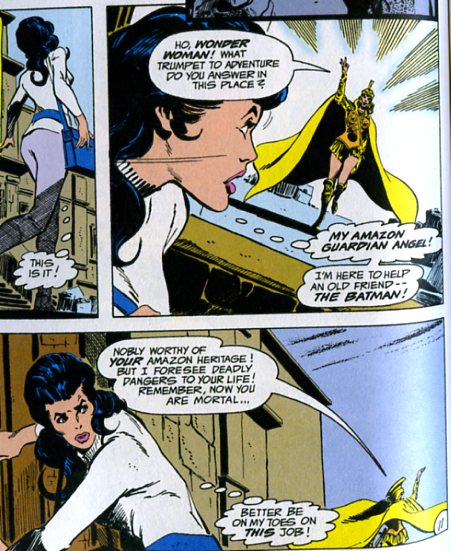
For the most part though, there’s little effort to experiment, either for thrills or laughs. Instead the four collected volumes read suspiciously like hack-work, created by folks who aren’t paying too much attention for an audience that they distantly hope isn’t paying too much attention either. Nobody, for example, ever bothers to give Diana a personality. Sekowsky supposedly based her wardrobe on that of Diana Riggs in The Avengers…but it wasn’t the clothes that made Mrs. Peel, but the wit and sophistication. Diana has neither of these, nor, indeed, any consistent character at all. There is one interesting issue where she’s presented as advocating torture; a vicious Diana Prince might have been kind of fun. But the trope is dropped, and Diana drifts back to the blandly heroic default.

Not that it’s all bad. A Rober Kanigher-penned Superman/Wonder Woman team-up, where Wonder Woman and Lois Lane vie for Superman’s love, has the requisite Superman-is-such-a-dick Silver Age appeal — plus you get to watch Supes and WW dance together at a space-age hippie shindig (Supes sets the floor on fire — darn super powers.) Sekowsky’s Wonder Woman/Batman team-up seems to reignite his creative juices somewhat, with Bruce Wayne alternately leering over Diana and worrying about his male ego (“I can’t let a woman and a blind man rescue me!”) Throughout the run, too, Sekowsky’s art remains enjoyable; he has a gift for pretty female faces, and the fact that Diana stays in civies gives him a chance to design a plethora of outfits for her. But even he never really regains the dynamism of that first issue, with its hippie coloring and in-your-face modernism.

Sekowsky eventually got moved off the title; Denny O’Neil came back for a bit, and finally sci-fi master Samuel R. Delaney showed up for two issues. In the first of these, Fafhrd and the Grey Mouser make a cameo because, apparently, Delaney wanted to prove that he could be boring with a whole range of other’s copyrighted properties. In the second story, Diana has her consciousness raised by a women’s lib group. I guess this last was somewhat controversial, and seeing Wonder Woman utter the words “for the most part, I don’t even like women!” is definitely jarring. But the whole thing’s so stupid anyway it’s hard to get too exercised about it. To say Delaney was phoning it in here is a disservice to telecommunications technology. The scripts read more like he leaned out the window and casually hawked them out between brushing his teeth and shaving.

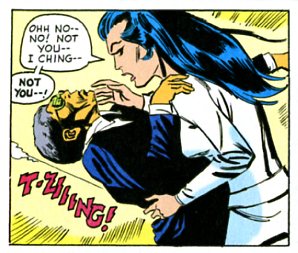
The final story in volume 4 is the predictable reboot. Robert Kanigher, who’d written Wonder Woman stories through much of the fifties and sixties, came back to write another, while Don Heck supplied some strikingly awkward and ugly art. I Ching gets shot by a sniper, which is a lot less satisfying than you’d think it would be. Diana gets amnesia, Paradise Island is inexplicably back from its dimension- hopping, Wonder Woman regains her “special outfit.” It’s all so rote it’s hard to see why they even bothered; obviously continuity doesn’t really matter, so why even pretend to have a transition issue? Couldn’t you just put her back in the swimsuit without any explanation at all? Who would care?
I guess maybe somebody would have. Gloria Steinem cared that Wonder Woman had lost her powers, apparently; she’s supposed to have been the one responsible for getting DC to go back to the original, powered-up, scantily-clad version of the heroine. Soon thereafter WW was once more regularly appearing in tied-up bondage poses on her covers, something Sekowsky had kept to a minimum. A return to submissive cheesecake probably wasn’t exactly the outcome Steinem had hoped for, but you fool with Marston’s character at your own risk. O’Neil and Sekowsky had the right idea in trying to get as far from the original version as possible…even if, unfortunately, that was the only idea they had.
____________________

This essay first appeared in the Comics Journal.

Update: This is the latest in a series on post-Marston takes on Wonder Woman. The rest of the series can be read at our old blogspot address here.
Utilitarian Review 1/23/10

On HU

This week was devoted to a roundtable on Clamp’s xxxHolic. Guest posts, lots of comments, and pretty scans abound if you missed it.

Also, this week’s music download is here.

Last week’s doom metal playlist is here.

Utilitarians Everywhere

On Madeloud I review Hamsoken’s Foul Harvest.

On tcj.com I review a collection of James Bond comic strips.

On Metropulse I review a collection of 60s Cambodian pop.

Other Links

Marc Singer has a balanced essay about using Scott McCloud’s Understanding Comics in a classroom setting.

Music For Middle-Brow Snobs: Bleeps From Outer Space

1. Ros Sereysothea — Shave Your Beard (Electric Cambodia)
2. Arareeya Bussaba — Katah Kor Jai (Katah Kor Jai)
3. Ouijai DanEsan — Yai Chim (Pua Pee Der Nong)
4. Johnny Cash — W-O-M-A-N (Rockabilly Blues)
5. Gospel Writers —Same Man (Fire In My Bones)
6. Rev. John Wilkins —Let the Redeemed Say So (Fire In My Bones)
7. Boyd Rivers — Fire Shed In My bones (Fire In My Bones)
8. Betty Davis — 70s Blues (They Say I’m Different)
9. Lady Gaga — Teeth (Fame Monster)
10. Quarta 330 —Bleeps From outer Space (5: Five Years of Hyperdub)
11. Ikonika — Please (5: Five Years of Hyperdub)
12. A Sunny Day in Glasgow — Miss My Friends (Ashes Grammar)
13. A Sunny Day in Glasgow —Starting at a Disadvantage (Ashes Grammar)
14. Rotary Connection — A-Muse (Black Gold)
15. Lee Ann Womack — Painless (There’s More Where That Came From)

Download Bleeps From Outer Space.

Contentious Manga Criticism

Since Suat made a plea for contentious manga criticism I thought I’d point him (and maybe others) to some possible weekend reading.

At our old address, me, Bill Randall, Tom Crippen, and Miriam Libicki participated in roundtables on YKK and Helter Skelter. Both include harshly negative assessments, name-calling, hair-pulling, and small arms fire. Or at least some subset of those things. Watch especially for the “comics journal will eat its own” guest spot by Dirk Deppey.

xxxholic Roundtable Round Up

I thought I’d end the xxxholic roundtable by highlighting some of the more interesting comments it generated, both here and on other sites.

Starting off, Kristy Valenti had a longish and thoughtful defense of the series.

I personally enjoy xxxHolic very much. The first few volumes made it as an honorable mention, paired with Petshop of Horrors, on my 2006 TCJ best of lists: at the time, I praised their low-key, late-night cable horror-anthology feel (something that the critics in this roundtable have also identified, as a fault) and wrote, “these are not significant works by any means, but they are good reads and an interesting study in rhythm and narrative structure.”

I find this rhythm to be key to xxxHolic (I realize that a strong argument can be made that if it doesn’t grab you from the beginning, it’s not worth your time, but xxxHolic, in particular, is quite the slow-burn: as Melinda pointed out, it founders a bit for a while, and shifts gears, but then it begins to build to the show-stopping, stunningly drawn Vol. 12 (though no, the philosophical and existential themes in Vol. 12, and of the work overall, are not particularly novel or complex (one’s ability to affect one’s own destiny, how even our tiniest actions affect ourselves and others, hence the butterfly motif (which: not new)); but I appreciated the getting there. My patience was rewarded).

There’s a certain coldness, or distance, about the work which is tonally in concert, considering that it’s concerned with the supernatural and the inhuman. Equally, my attachment to xxxHolic isn’t particularly sentimental: it’s the only thing I’ve ever read from Clamp that I liked, and I don’t particularly even care for the characters (well, Yuko is entertaining), even 13 or so volumes in. I also wasn’t able to stomach Tsubasa.

That’s why I find it somewhat perverse to review only the first three volumes of this series (or for the majority of the critics to have only read the first three volumes). I realize it’s from a practical standpoint, and I realize that a strong argument can be made that if it doesn’t grab you from the beginning, it’s not worth your time, but I do hope that one forthcoming roundtable participant has read the series to date and will look at the first three volumes in retrospect.

Narratively, xxxHolic is a genre work in which I derive pleasure, as a reader, from seeing the ways in which genre conventions are or are not fulfilled, side-swiped, or discarded in favor of other genres. (Suat explains that there much better works in this genre; I submit that it’s no accident that I followed xxxHolic for as long as I have because I can get it for free at the public library.) And I confess that, after having my eyes assaulted by hundreds of hideous comics with absolutely zero literary or artistic merit, sometimes I find it aesthetically soothing to look at lovely art for art’s sake.

Matthias Wivel had several interesting comments discussing his lack of interest in manga. For example:

I wonder too about the blandness of most manga criticism, but my focus was clearly narrower: it basically concerned what I can’t help but see as an idealisation amongst certain critics of shojo and yaoi especially, simply because, it seems, they’re different from American comics.

Inspired by this enthusiasm, I’ve tried to read a bit of it, and definitely recognise the mastery of, say, Ai Yazawa, but at the same time it’s not only clearly targeted at a completely different audience than me to an extent where I can’t sustain even my intellectual enthusiasm for it, but it also only goes so far.

What I’ve read — and perhaps it’s not a sufficient amount — has been rather formulaic, even if driven by a different (and initially fresh-seeming) cultural coding than the one that makes a lot of American and European comics so instantly dull.

At the same time, like Suat, I find much more to think about, much greater emotional resonance when I read a comic by Dan Clowes or, say, Yoshiharu Tsuge. A comic not only more clearly directed to me, but one invested by much more careful attention to emotional reality.

This prompted a reply from Vom Marlowe:

“A comic not only more clearly directed to me, but one invested by much more careful attention to emotional reality.”

I think that says more about your perception of emotional reality than it does about the comics.

I hate to point out the elephant in the room, but you know, what a lot of this boils down to is that Matthias and Suat are arguing that girls comics aren’t getting criticized hard enough, that if they were held to the same standard as the lit comics, more critics would be saying the comics suck.

This is the same argument that is leveled against romance novels all the time. There’s a reason that almost all deep-level romance novel criticism takes place in female-dominated, frequently locked realms. That’s because if you do it in the “mainstream” the criticism tends to boil down to: Girl stuff (like, say, romance itself) is icky (or emotionally shallow). I hear that enough already, and I’m really not interested in hearing it again. If I thought romances were emotionally shallow, I wouldn’t be reading them. Arguing that they’re worth reading is EXHAUSTING.

I’ll just say that I actually read a LOT of good, thoughtful, fierce criticism of shojo, and most of it is in locked spaces where the boys aren’t allowed.

Pallas provided a really sharp assessment of the differences between Japanese and American comic art:

This is so subjective. Its kind of apples and oranges. Clamp’s art suits the stories they do- I think if they were assigned Captain America: the Return #1 to draw, it would be a disaster.

I think that many American comics tend to have more complex character designs and more complex backgrounds- certainly, the use of color alone adds a lot of complexity. I get the impression the ideal in American art is closer to realism than the ideal in a lot of manga.

I think there’s a number of shoujo with very muddled storytelling- some shoujo creators try to do action oriented material but fail at it, because the minimalism that can work for emotional storyline doesn’t necessarily work for an adventure. (Are Clamp fight scenes ever engaging? I remember absurd proportions in Tsubasa fight scenes ticked me off. Actually, I’ve barely read Sailor Moon, but I got the impression it would fall into the muddled fight scene category.)

I think that you can argue that American comics are far more “plot” oriented while manga is more “emotion” oriented.

Its interesting that I think Takahashi it at least somewhat impressed with the art in American comics:

Question: Do you read American comics?

Takahashi: There are a number of titles that I collect. One of them is, of course, Spider-Man.

Question: Using Spider-Man as a reference, what do you think are the differences between manga and American comics?

Takahashi: Hmmm… In a certain sense, the quality, the art of American comics is very high. I think the element of storytelling through images is strong with American comics. Japanese manga are really… manga can be created even without drawing any action into them. Even boring everyday things, such as portraying that it’s a really hot day or that something is really hungry- even just that is enough for manga. I guess it’s a difference of how people see the world, what people think makes a story. I believe that’s where the difference lies.

And Shaenon Garrity chimed in:

Argh…I have so many nerdy, nerdy thoughts on this subject. To me, American comics, even most “art” or “literary” comics, are very external and plot-oriented in their storytelling. This is even true of comics that go in for a lot of visual experimentation; Acme Novelty Library, for instance, never gets inside the characters’ heads in a visual/visceral way, and in fact all its brilliant formal tricks seem designed as distancing mechanisms, like the comic-book equivalent of a Stanley Kubrick film.

Which is a perfectly legitimate approach, of course, but one of the things that draws me to manga is that even the most formulaic genre work is so internal and character/emotion-oriented. By comparison, manga makes American comics look dry, disengaged, and emotionally stunted. I guess a lot of American comics readers see the emotional intensity of manga as silly or shallow or embarrassing, but my reaction is the opposite; to me, American comics are shallow and silly for shying away from any deep depiction of the characters’ internal lives.

Look at the Takahashi quote above: she comes from a comics tradition where a character being hot or hungry can be depicted in a visually rich, exciting way. To me, that’s interesting and worthwhile, and a “genre story” that successfully captures such moments is possibly more interesting than a “literary” work that stays safely confined to the cerebral level.

Elsewhere on the interwebs, David Welsh responded to the accusation that manga critics are too nice. And Bill Randall, in response to the same discussion, posted his decidedly not nice review of Yoshihiro Tatsumi’s Good-Bye.

There’s lots more of interest in comments; among others, Melinda Beasi (whose own lengthy discussion of xxxholic on her own site is here) chimes in frequently. Thanks again to Kate Dacey and Adam Stephanides for their guest posts, as well as to all the commenters and readers. Again, if you missed it, you can read the entire roundtable here.

Update: Melinda Beasi provides some more thoughts on the roundtable and on manga reviewing.

Update 2: Coffee and Ink weighs in with a scathing assessment of the roundtable.

xxxholic Roundtable: xxxPorn

This is the latest post in a roundtable on Clamp’s xxxholic.
______________________

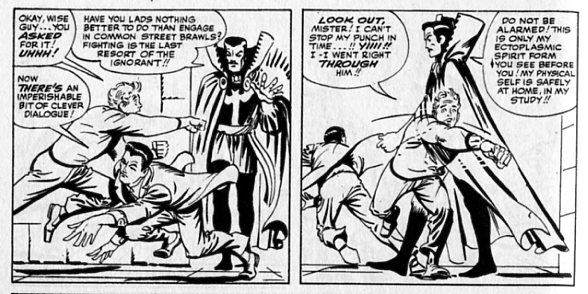
That’s a sequence from the Lee/Ditko Spider-Man Annual #1. I first saw it when I was 8 or so, and it’s stuck with me to this day. Not that I especially loved it or hated it — it’s obviously a fairly bland and pointless sequence.

That very blandness, though, was what arrested me. I couldn’t figure out why I was reading this. Okay, there’s a Spider-Man story…and then Dr. Strange shows up, and walks through four panels — and then he leaves. At other points in the story, Thor passes through in a similar way, as do the Avengers, as do the Fantastic Four. I think I knew even back then who all these characters were, but having them used in this way, for background cameos, left my eight-year old self completely non-plussed. What was the point? Was I supposed to enjoy this? How come?

Of course, I get it now. Dr. Strange walked through so that they could put “Special Guest Stars: Thor! the Avengers! Dr. Strange!” or some such on the cover. It’s a bait and switch.

Or is it? Not exactly, I don’t think. It certainly is a marketing gimmick, but the gimmick isn’t a cheat. Yes Dr. Strange is promised, and you barely get Dr. Strange at all. But I don’t think that’s likely to have been a disappointment to the readers. Rather, the very gratuitousness of the cameo — the fact that Dr. Strange doesn’t do anything and really has no reason for being there — is the point of the whole exercise. He’s trotted out so Marvel loyalists can basically say, “Hey! I know Dr. Strange! There he is! Right in the same world as Spider-Man! Whoo hoo!” The exercise is validated by the little frisson of pleasure you get from catching an allusion. If Dr. Strange were actually part of the plot, if Lee and Ditko had to explain what he was doing there and why he was involved, he wouldn’t work nearly as well as fan-service. He’s an extra bonus for true-believers — the crossover equivalent of a panty shot. The cutesy crassness isn’t a bug; it’s a feature. You pander to let your audience know you’re pandering. It’s a way of saying, hey, plot, theme, character…who cares? The point is that I know you’re reading, you reader you, and I’m looking out for you. Kawaii lecteur,—mon semblable,—mon frère!

This kind of crossover porn has largely been replaced in American superhero comics by continuity porn — an altogether more depressing line of country. But at least for the first three volumes I read, xxxholic keeps things old school: the series is filled with allusions to other Clamp titles, but those allusions are all deliberately and even egregiously shallow. A glimpse of Cardcaptor Sakura’s staff shows up here; a purchase is made from Legal Drug there, little fuzzy bunny things show up from some other Clamp series there.

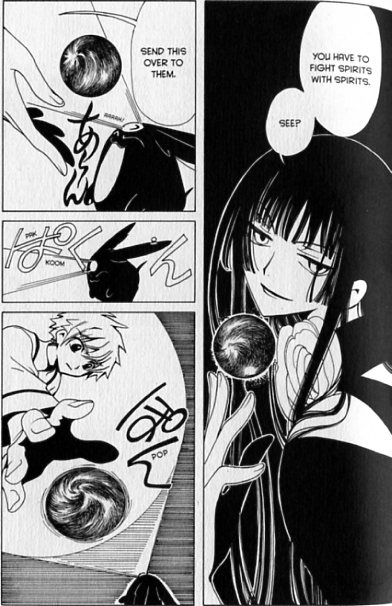
Even when Clamp flirts with continuity (as when characters from the simultaneously serialized Tsubasa pop in for an inter-dimensional walk-on) it’s very circumspect. Obviously, Clamp would like you to go buy Tsubasa as well as xxxholic, but they’re not going to be pushy about it. Instead, they’re going to be cute:

Yes, the little bunnies are a kind of dimensional vortex; you feed a useful item to the black bunny in xxxholic, it pops out of the mouth of the white bunny in Tsubasa. Watch bunnies ingest and egest from multiple angles when you collect them all!

There’s a kind of brilliance in that; the Dr. Strange cameo is cutesy in a somewhat sublimated, nudge-nudge way . So why not just drag that out in the open and have the container be as cutesy as the content? Clamp is better at being Stan Lee than Stan Lee ever was, in some sense. The clubby Marvel in-group of true believers could never attain the insular hothouse fervor of the fan-fic doujinshi circles that spawned Clamp.

I can admire that about Clamp. There’s something almost awe-inspiring in the way they combine the blatant enthusiasms of the amateur with the absolute polish of a professional. They give their audience what they want, and they do it without the audible grinding of gears you always got from those old Marvel comics. When Dr. Strange trots across the page, you can see Stan behind him pushing; the whole thing smells of greasepaint and pasteboard. In Clamp, on the other hand, the crossovers slide across the page so sinuously that if you’re not in the know you’ll never see them. Kinukitty, for example, had to point out the Legal Drug reference to me.

Even though I’m impressed with the craft, though, I have to say that, overall, I still agree with my eight year old self. I mean, yes, I enjoy hearing a familiar sample in a hip hop song, and I liked some of League of Extraordinary Gentleman. But there’s more happening in hip hop or Alan Moore than just dog whistles and secret handshakes. I don’t really open a comic to see Dr. Strange trotted out clumsily, or Legal Drug trotted out subtly. I don’t really want to be nudged by the writer and told that he or she knows these characters too, and isn’t that great. I don’t go to art to be inducted into a club — or, I don’t know, maybe this is just the wrong sort of club for me. In any case, the crossover porn in xxxholic had more or less the opposite effect on me from what was intended. Instead of convincing me want to go out and read the other Clamp series referenced, it made me want to avoid them all, even those, like Cardcaptor Sakura, that I had already read and enjoyed.
______________________

I also wanted to respond to Suat, who, along with Matthias Wivel in comments wondered why critics in general, and me in particular, weren’t harder on mainstream Japanese comics and more appreciative of American literary comics. Suat suggested the leniency might be attributable to some kind of Japanophiliac “cultural forbearance”; Matthias countered with the theory that it was a species of hipster contrarianism. (Update: Altered somewhat for clarity.)

Of course, my last mainstream manga review wasn’t lenient at all. In fact, it was so unlenient it prompted Suat to intimate that my perspective might actually be racist.

But the real point, I think, is that there’s a tendency when you don’t agree with someone on aesthetics to assume that they’re putting you on. Oh, you can’t possibly like Mariah Carey more than Dirty Projectors, you’re just saying that to be contrary. This despite the fact that Mariah Carey actually has a bigger audience than the Dirty Projectors overall, and therefore you might reasonably conclude that liking her more is the default position, and liking the Dirty Projectors the contrarian one….but I digress.

Anyway, I explain at some length starting here some of the reasons that I find shojo more appealing than American literary comics. Also, just on a basic level, I tend to be more impressed with the craft in manga than with that in American comics, though obviously there’s a lot of individual variation. Japanese illustration is an amazing tradition, richer in many ways than the Western one, and it shows.

Despite all that, though, I still don’t like xxxholic much.