No Past, No Present, No Future

Zot! 1987-1991: The Complete Black and White Collection
Scott McCloud
Harper
black and white/ 575 pages
softcover/$24.95

Zot! is timeless. The story of a super-powered, improbably good youth from a dimension very close to ours, its landscape is the landscape of nostalgia — a funnybook past of futuristic wonder which becomes brighter and more exciting the more it recedes. Zot is all the super-hero comics from your childhood as you remember them, rather than as they actually were — with the excitement and the goofy villains and the action; without the fusty clubhouse odor, or the grinding, bleary sound of middle-aged men pandering to children, and doing it badly. Alan Moore and Frank Miller made super-heroes more adult by giving them sexual hang-ups and nasty dispositions. Scott McCloud, contemporaneously, made them more adult through a self-conscious, insistent wonder — the very insistence of which introduced a kind of adult uncertainty, an acknowledgment of illusion and eventual loss.

The Moore/Miller, R-rated path to super-hero maturity is still very much alive in comics like Marvel Zombies, or, for that matter, All-Star Batman and Robin. Zot!’s take, on the other hand is — still, and somewhat surprisingly, very much alive. In its quiet way, Zot! was, if not an inspiration, then at least a forerunner of a whole school of intelligent-naif storytelling. There’s a little bit of McCloud in the Morrison/Quitely All-Star Superman, certainly. And Alan Moore’s Tom Strong even looks like Zot, down to that skin-tight red shirt.

Moore and Morrison both justify their fetishization of the funnybook past through complicated — or, if you prefer, batshit crazy — theories about the mystical significance of fictions. For Moore, dumb super-hero adventures are, literally, magical; for Morrison they’re analogues for the structure of reality. McCloud likes to talk about his formalist and system-building tendencies too – in the volume’s copious notes, he eagerly explains that his characters are based on the Jungian functions of the human mind. But, compared to the Kabbalah-spouting, pomo paranoiac crankiness of his successors, he’s just a piker — or, more accurately, just a humanist. There’s no shamanic, theological reference point for McCloud. Zot!’s too-perfect-to-be-true, sunlit future-past is a story with literary ambitions, but not with cosmological ones.

As a result, McCloud can sometimes be what Morrison and Moore almost never are: low-key. Especially in the black-and-white comics collected here, heroic fantasy has never looked so much smaller than life. Arch-enemies come back from the dead to attend a New Year’s party; friends catch up on small talk while super-battles are waged just off-panel; everybody on earth, it seems, takes interdimensional portals completely in stride. The art, too, is winningly erratic, with detailed, cross-hatched backgrounds populated by frankly stiff figures. In the notes, McCloud frets about his artistic limitations, but to me, at least, the amateurishness is charming, and sometimes more than charming. A half-page picture of Jenny (McCloud’s normal-girl protagonist) asleep in the water, with a diving Zot reflected in the pool that covers her lower belly, is sensual and clunky — sensual, in fact, because it’s clunky. The sexuality of the image is displaced by the mediocrity of the draftsmanship; Jenny really doesn’t look real enough to reach out and touch, and that distance infuses the image with an awkward poignancy.

McCloud’s technical limitations don’t always serve him well, of course. Especially when Zot’s world drops out and we’re stuck on earth, the author’s weaknesses as a storyteller are sometimes painfully apparent. Bereft of super-villains, we’re stuck with nerds with hearts of gold, evil jocks, the closeted lesbian, the alcoholic mother, the divorcing parents, the jerky older brother who comes through in a pinch. Reading the second half of the volume is like going through a YA problem-novel checklist.

When Zot is on its game, though, the amazing and the mundane, the clichéd melodrama and the pedestrian detail, are constantly wrong-footing each other. Zot’s comic-book world and Jenny’s more realistic one bump one another off-course, so that the reader can look at, and appreciate, both from unfamiliar perspectives. The best example of this is probably the moment when Zot, Jenny, and some other friends watch the New Year’s celebration on Zot’s earth. The year changes from 1965 — to 1965. Nobody on Zot’s earth realizes that the new year is the same as the old; only Jenny and the folks from her (or our) world notice that time is essentially standing still. It’s an odd and unsettling metaphor for the way super-hero comics constantly erase their pasts in order to maintain their eternal futuristic presents; a kind of mini-ret-con. Zot’s world suddenly seems much less substantial, its goodness and excitement built on amnesia. But where Grant Morrison would embrace this meta-fictional insight, McCloud just leaves it there; the characters are curious about the oddity of a world without history, but that’s about it. No further apocalyptic revelations follow; it’s just another inexplicable fact about Zot’s world, like space-travel or invisibility. It’s fun to think about, but it doesn’t have to lead anywhere in particular.

The anti-climax of this revelation is nicely done, and certainly fits with McCloud’s general tone. But at the same time, there’s an audible “thunk” as he lets the issue drop which reverberates uncomfortably backwards and forwards through the book. The contrast between history and historylessness seems like it is, or should be, at the core of the series. The past is what gives weight to moral actions; without it there’s no right, no wrong, and no love. Zot’s lack of memory, his innocence and self-certainty should, logically, also be his cruelty and uncanniness. Various characters do pay lip service to Zot’s egotism, but again, McCloud never really follows up — there’s never a moment when Zot does something that could actually be construed as mean. The closest he comes is when he agrees to do a Cola commercial for money. But then he apologizes. And gives all the money to charity.

McCloud does try to “educate” Zot — the hero fails several times in the course of the book, and each occurance is treated as an emotional end-of-innocence. One instance, in which a young girl is introduced and then gratuitously killed off in order to give Zot an excuse for rampant emoting, is particularly unfortunate. But unfortunate or not, none of these episodes really makes any difference; Zot comes back each time as cheerful and self-confident as ever. Moreoever, not only does Zot seem unaffected by his experiences, but the book does as well. The reader is supposed to accept Zot as a moral innocent even as his past is silently and continuously erased.

The difficulty here is not that Zot isn’t sufficiently real. It’s that he’s insufficiently unreal. He’s stuck with the cheerful verisimilitude of Superman, when he needs a bit more of the creepy unhumanness of Peter Pan. McCloud toys with this perspective only once, when Zot asks Jenny casually if she’d like to have sex. The scene has an eerie, prelapsarian tinge — a hint that total innocence has some very disturbing implications. But the comic quickly pulls back; Zot’s just a nice, forthright kid, y’all. He even carries around condoms! Everything’s safe and above-board here.

Zot’s perfecttion should, in short, have a dark side. McCloud isn’t willing to give him one and as a result the series goes subtly but decisively out of whack. A major theme of the last half of the book is that Jenny wants to go live permanently in Zot’s world. This is presented as a terrible idea — running away from her problems, turning her back on the beauty of the world, etc. etc. etc. But all of these counter-arguments sound a lot like special pleading. The fact is that running away is a sound strategy for dealing with one’s difficulties; it’s not foolproof or anything, but on the whole it works better than holding on to them. And if Zot’s world is just a kind of egalitarian paradise — like Sweden with rocket cars — then why not move there? Jenny can even visit home whenever she wants. What, exactly, is the big deal?

Perhaps the big deal has to do with losing your past, and therefore your soul. In his concluding notes, McCloud remarks that Zot! is “a world where looking back and looking forward are one and the same. The far flung future, the distant past, and every moment in between.” That sounds like fairie; eternity is flattened out, nostalgia suffuses reality, and all the happy, super boys never grow up. To be out of time is to be dead. Zot! circles around this insight and then, with a whoosh of rocket boots and an impish smile, it flies away.
________________

This review first appeared in The Comics Journal.
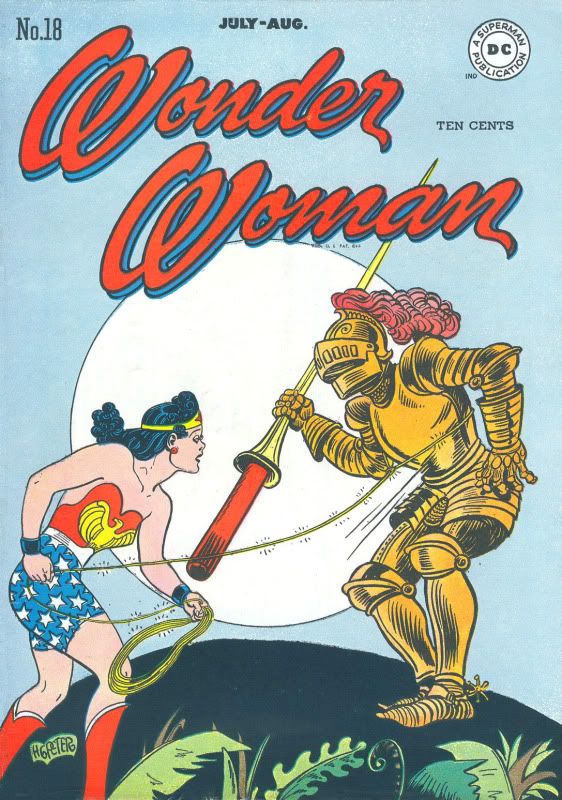
Bound to Blog: Wonder Woman #18

That’s a kind of generic cover for Peter; the knight’s certainly nicely drawn (love that plume), but overall it’s fairly static and boring by his standards. Part of that may be that it’s trying to be coy: Marston/Peter have a secret return villain, and they don’t want to give it away. But here I come spoiling it 60 years later: the villain in this issue is:

Dr. Psycho!.

Remember him from Issue #5? Little dwarf guy? Hated women so hypnotized them to cause them to send forth ectoplasm so he could take on different shapes? How could you forget, right?

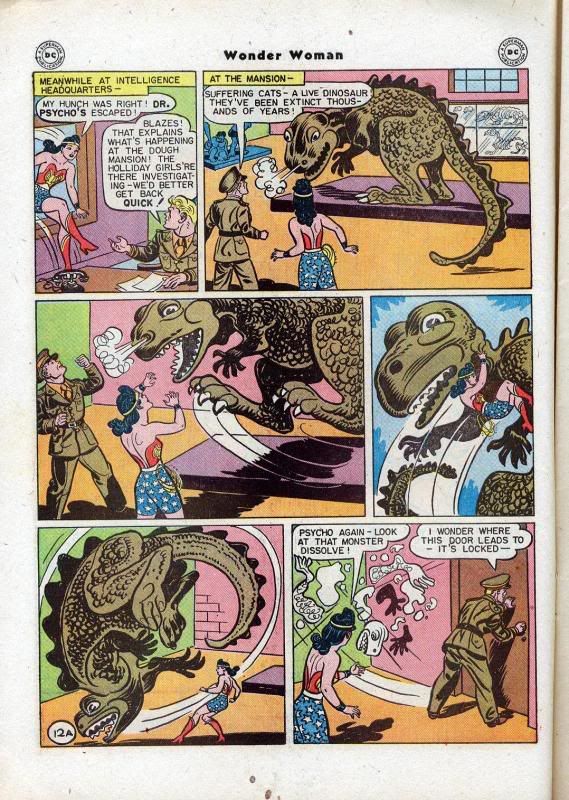
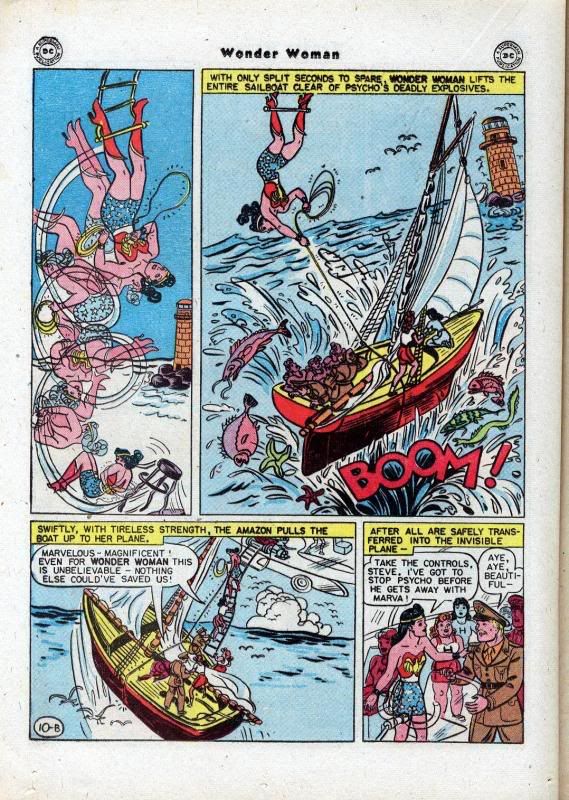
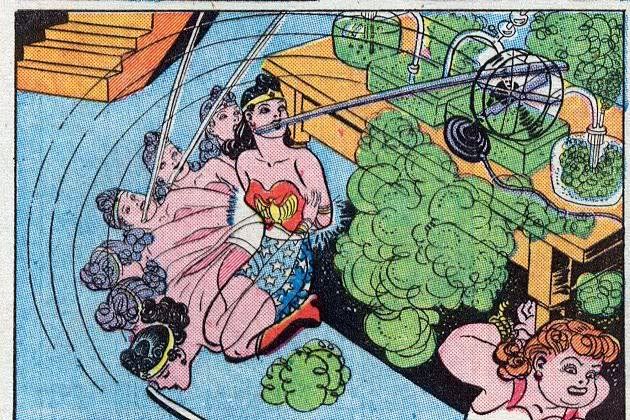
Well, anyway, as so often happens with sequels, this one isn’t nearly as much fun as the original. No giant space kangas, for instance. No battle with Ares (who was originally using Psycho to prevent women from getting involved in the war effort.) Instead, there’s a much less convoluted plot involving Psycho trying to wreak revenge on WW and her pals. There’s as always some nice art, and Marston/Peter do seem committed to the wordless sequences now:
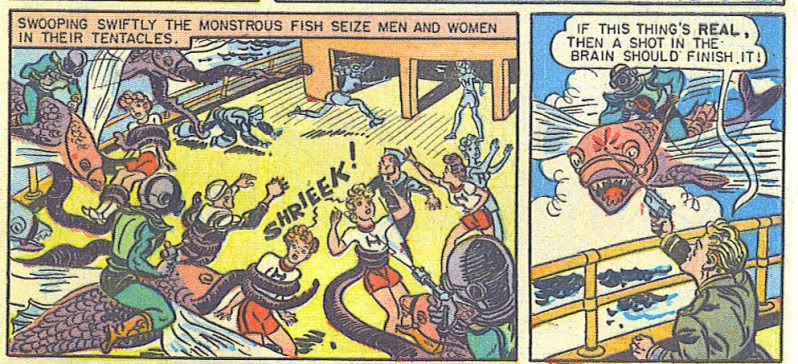
That last one, with Peter showing the movement through ghost images as WW throws herself into a backflip with her hands tied behind her back, is pretty spectacular. Despite such moment, though, this one isn’t the best of all possible Marston/Peter efforts.

But even mediocre Marston/Peter has some pretty interesting stuff going on. In particular, this one made me wonder about that all important question: Is the phallus female? (I know you’ve always wondered.) To answer that, we’re going to make a detour and talk about John Carpenter’s Christine.

Christine is about Arnie Cunningham, a nerdy, sweet high school kid who discovers a sentient car named Christine. The car possesses him, and he turns into a cool fifties greaser type, who’s attractive to girls and emotionally inaccessible and really dangerous. I talked briefly about Christine a ways back:

Christine the car is, of course, supposed to be a woman…but any car is obviously literally genderless, and the secretive nature of his relationship with her, plus her violence and the fact that, hey, she’s a car…if she’s a woman, she’s awfully, awfully butch, is all I’m saying. Arnie,of course, gets more and more manly and tough and evil the more time he spends with the car — which on the one hand suggests that, hey, he’s got a girl now, so he’s a man — but on the other hand suggests that he becomes more of a man by caring less and less about girls. Yeah; total agonized male fantasy of being simultaneously consumed by femininity and consumed by masculinity; the orgasmic collapse/reification of male identity — being castrated so you can turn into a penis (at the close Arnie is penetrated by a piece of glass from Christine’s windshield, caressing her one last time before he dies. Being violated by her, having her in control, is what makes him most male; emotionally inaccessible, commanding, finally murderous. Christine is ultimately masculinity itself, which possesses Arnie; but at the same time that masculinity is feminine — since it doesn’t reside in a particular body, and ambiguous genders are always coded feminine.

Christine in the movie functions as a phallus; before he gets her, Arnie is a typical feminized nerd; when he gets her, he becomes a manly embodiment of pitiless law, hunting down those who attack his car, or who steal his girl, or who just look at him funny, really. So Christine is what makes him a man. But she’s also, obviously, a woman, or at least feminized, which suggests that what makes you a man is a woman.

That’s not all that odd a concept…the whole point of the trophy girlfriend, for example, is that you demonstrate your manliness by walking around with a female status appendage. But Christine pushes the idea to an unusual extreme; Christine isn’t just a status symbol; she’s actually the source of power — not so much a sign of the phallus as the phallus itself. That’s part of the anxiety in the movie. Ta-Nehisi Coates has talked at various points about the idea that misogyny stems in part from male fears of being rejected, or being unable to deal with the emotional vulnerability inherent in having a relationship with a woman who can accept or reject you. I can see that…but at the same time I think there’s also an anxiety around the fact that women hold the keys to masculinity;men are forced to rely on women to prove that they are as men. Arnie puts himself in thrall to female power, and while that makes him a man, it also makes him a monster.

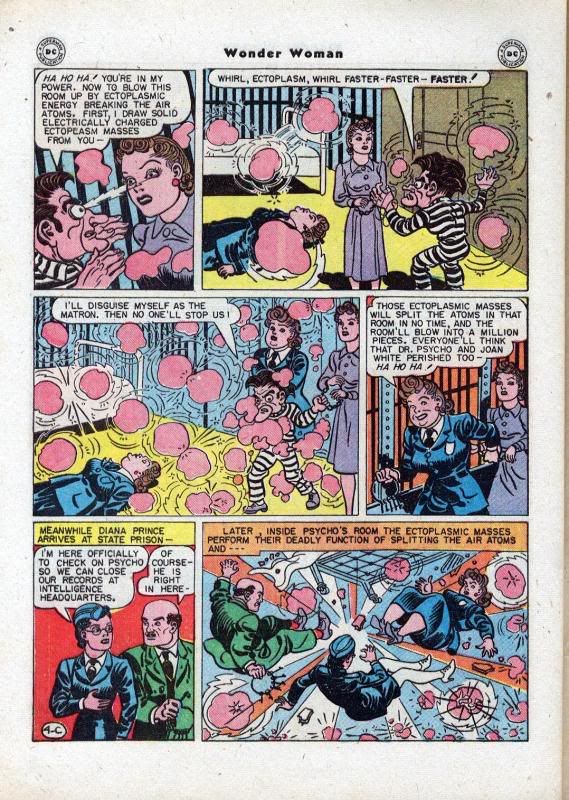
So, back over to Dr. Pyscho. As I mentioned, Psycho’s power, like Arnie’s, actually derives from women. The ectoplasm he uses to change form comes out of his female mediums. And you can tell it’s female, because it’s pink!

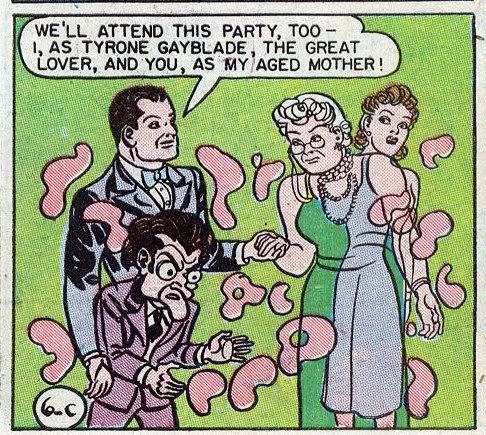
Psycho, like pre-Christine Arnie, isn’t very masculine. He needs to tap into female power to turn himself into a man’s man such as….Tyrone Gayblade, the great lover!

There’s a certain logic to that; if male power comes from women, then it should be queer (this is the case in Christine too, where Arnie’s secretive relationship with Christine reads as gay in certain ways, as I mentioned above.)

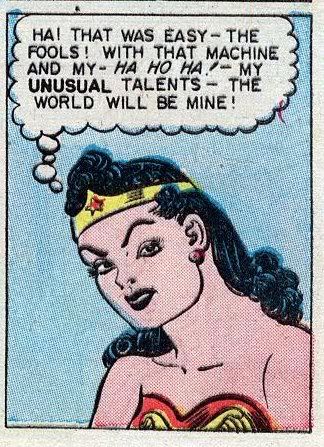
The kind of power Psycho gets from the women is also arguably female in nature. In the first place, he keeps turning himself into women, inlcuding the paragon of womanhood herself:

I bet that Marston really enjoyed the chance to write briefly about an evil WW…and perhaps especially about a man masquerading as an evil WW. (There’s another duplicate WW story here. At the same time, it’s interesting that the WW double didn’t show up on the cover. Duplicate WW clones of various stripes would become an obsession for Silver Age writers — a way, maybe, for creators to express their distaste and distrust of the character, or perhaps just their indifference by throwing oodles of generic clones into the plot. Marston, on the other hand, tosses the idea off and moves on to something else. There is a note or two about how the military brass mistrusts WW briefly because she appears to have stolen their secret weapon…but it’s treated as an aside, whereas in the Silver Age it would have been the main focus of the story. Marston isn’t interested in having people hate WW; she’s not Spider-Man. The point is everybody loves her! That’s what being a hero is all about, damn it.

Where was I?

Oh, right.

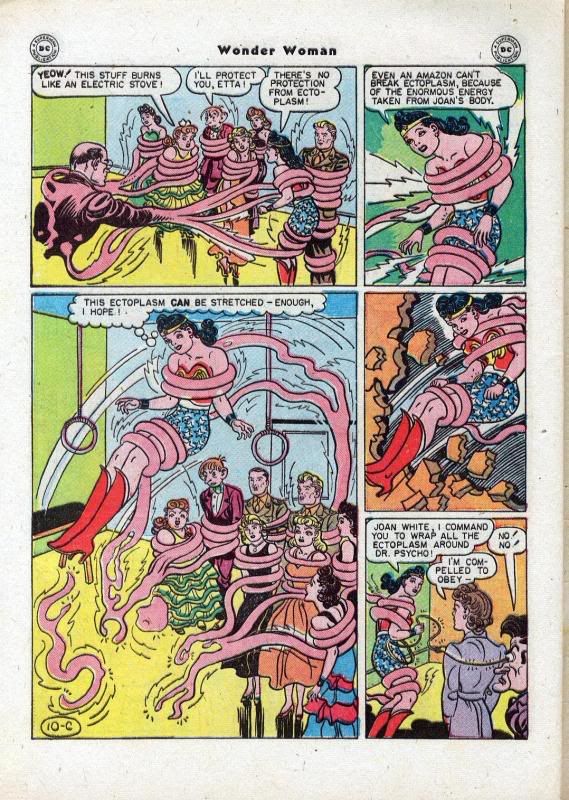
So Psycho gets to be a powerful guy by deriving power from women. Partly, that means that he’s more manly. Partly, it means he’s more queer. Partly it means he’s more female. But above all, it means he’s got the phallus:

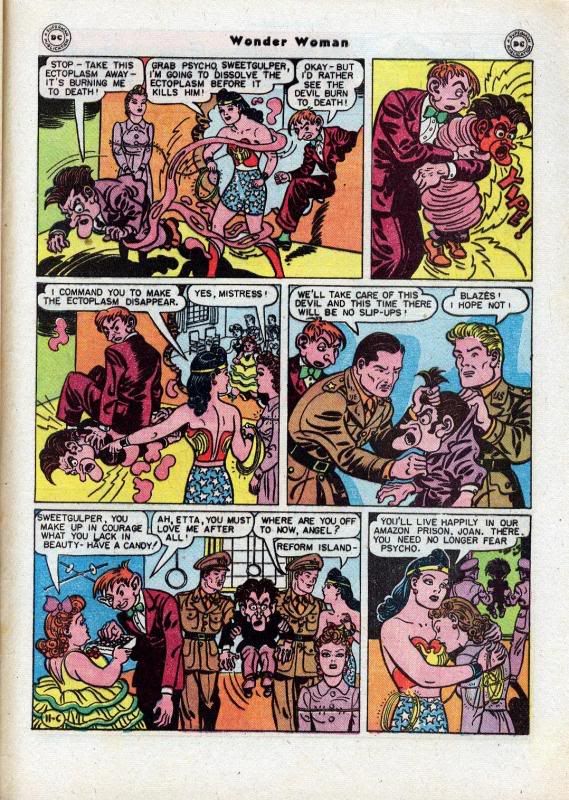
I love that; the pastor who is about to perform a wedding dissolves into pink, ropy, sticky tendrils, binding the wedding party in sticky bondage goo. Luckily, though, WW is more of a man, and more of a woman, than Psycho, so she can turn the phallus on him:

Great panel at the end: “You’ll live happily in our Amazon prison, Joan.” Joyful bondage, hooray!

As in Christine, there’s some anxiety here — but it seems more connected to male power than to female power. In Christine, the female power corrupts the man (turning him into an uber man); here, it’s more like the man corrupts female power (turning it into a phallus.) The wedding turns into an abject nightmare of goopy penis tentacle rape because the man is in control; once WW reclaims the ectoplasm for femininity, all is well.

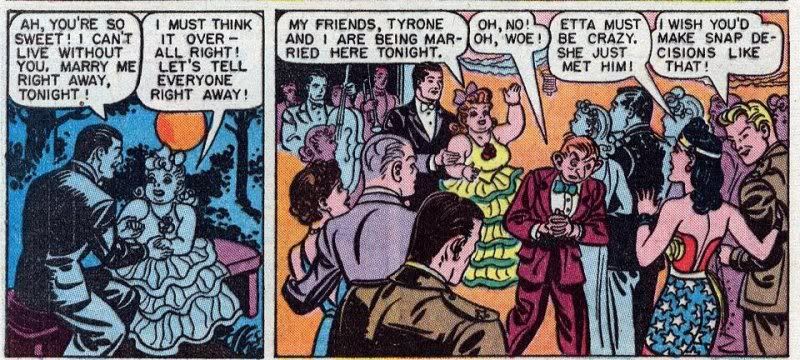
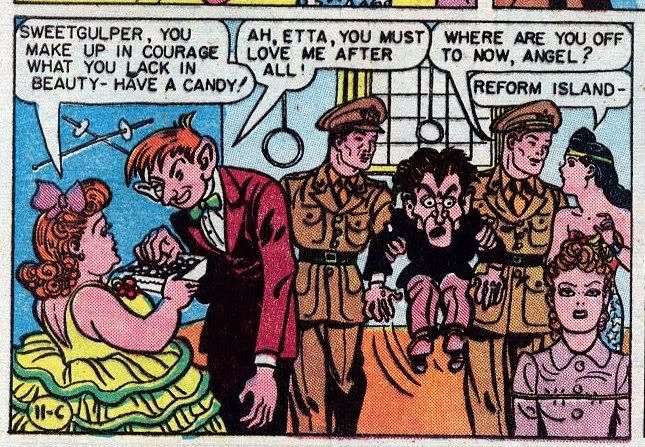
You may be wondering who’s getting married, incidentally. Why, it’s…Etta Candy and Tyrone Gayblade!

Who knew Etta was so eager to get married? It does seem kind of out of character for our butch, independent, entirely orally oriented comic relief. But on the other hand, Etta doesn’t seem especially distressed when things don’t pan out.

Easy come, easy go. And yes, her long-suffering, nerdy, dominated suitor is named Sweetgulper.

Oh, and I couldn’t leave this issue without showing you this:

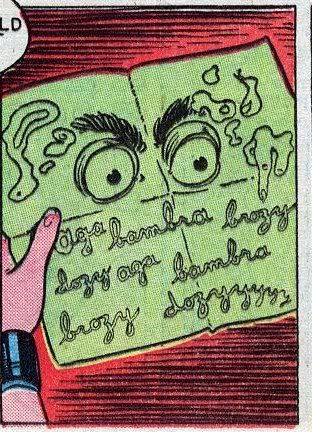
Psycho hypnotized one of his mediums by drawing his own eyes on a piece of paper and sending it to her. He really is tricky.

____________________

Just as a final thought: Greg Rucka used Dr. Psycho in his run on the issue. Basically, he turns Psycho into a mental rapist, controlling women with the power of his mind for sexual thirlls. The fact that Psycho’s power derives from women is entirely lost…making the character a lot more rote and boring, I think. Also, you know, there aren’t pink strands of ectoplasm everywhere. Which seems like a missed opportunity.

Bound to Blog: Wonder Woman #17

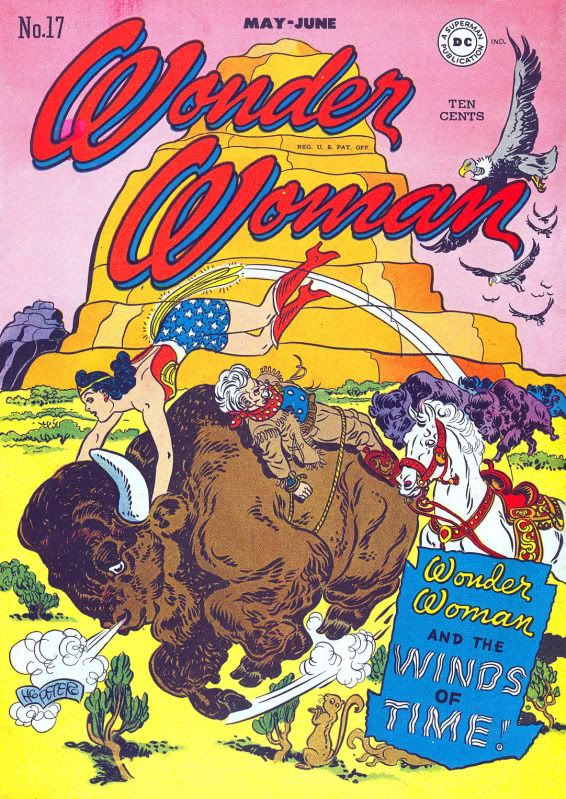
Marston and Peter’s Wonder Woman 16 may have been the best of the run so far, both in terms of the unusually ominous story and the adventurous art. #17 starts out well, with a marvelous cover.

Peter uses almost all of his favorite tricks here: the bison is out of scale, so WW looks almost like a doll, and even the horse seems bizarrely tiny. The motion lines are incredibly dynamic…in part because the circle is split up, I think. He also uses some of his scribbly linework for the bison’s breath…and that little cue cartoony squirrel is hard to resist. Plus, it looks like we’re going to get WW in the wild west, which sounds like it has potential. The last time travel episode, with evolving gorillas and dinosaurs and Steve turning into a cave man, was pretty great, so I was optimistic that a second might work as well.
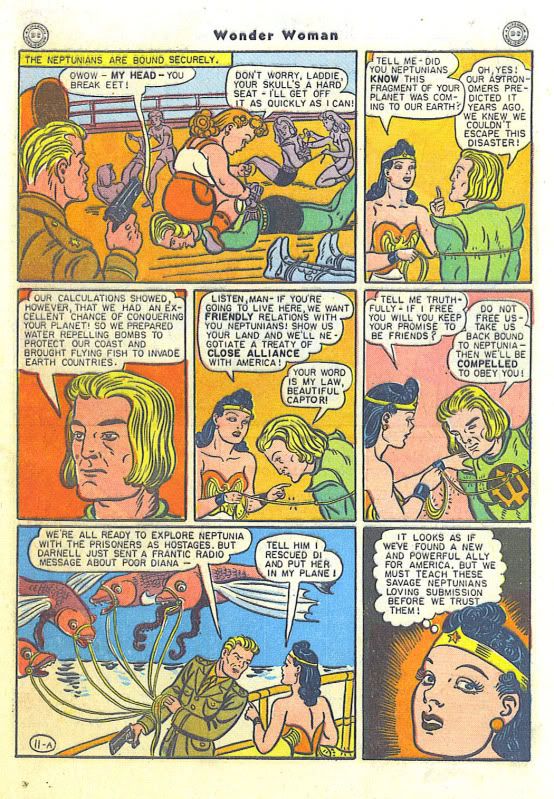
Unfortunately, after that cover, the issue itself is pretty much…eh. Part of the problem is that the entire plot is built around a scientist Lana, her love for the no-good Carl, and WW and the Holiday girls’ efforts to cure her of same. Lana’s confusion is such that it causes her to whip up time winds which cause all and sundry to fall back into the past and relive former lives in roman and colonial times…but even such full-bore nuttiness can’t disguise the fact that this is a pretty staid man-done-her-wrong plot. Marston’s fetishes are kept mostly under wraps (as it were); Lana triumphs simply by getting rid of the bad guy in her life, not by teaching him the joys of bondage and loving submission. The feminism is less conflicted, but also a good bit duller. Or maybe the problem is just that pure, naive Lana is not a particularly sparkling protagonist; whether as modern scientist, Roman maiden, or pioneer daughter, her trust in her blandly evil boyfriend and love for her blandly gruff father are equally uninvolving. You can see why Marston didn’t care enough about her to even bother tying her up.
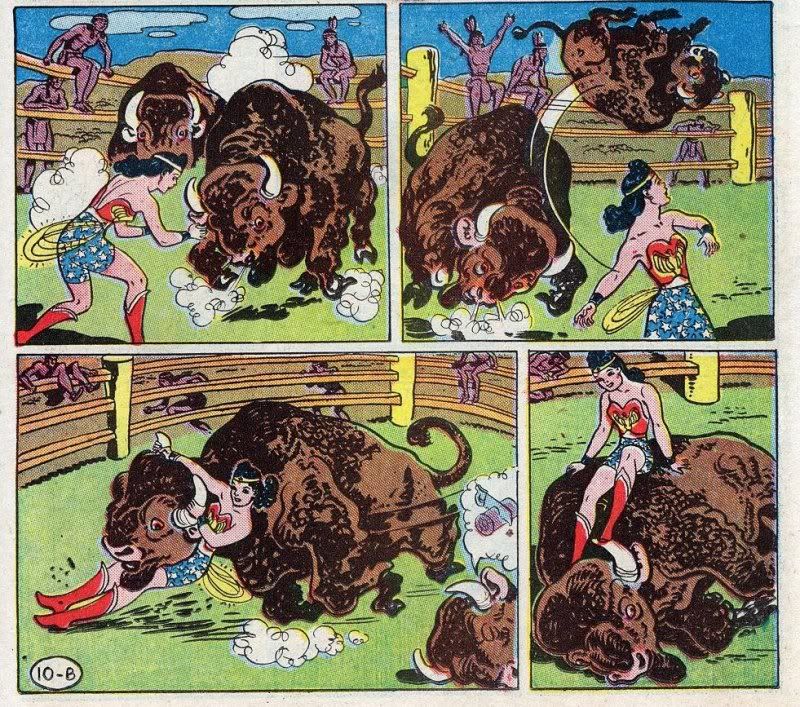
As is often the case in this series, as Marston goes, so goes Peter; the artist doesn’t seem nearly as inspired as in his last couple of outings. Still, there are a couple of moments. The duo does some more experimenting with wordless action sequences, and again the effect is lovely:

This is an interesting moment too.

Wonder Woman is using a pole to pick up a fan so the blades can cut the ropes tying Etta. I’m not sure the sequence entirely works; it’s hard to figure out whether WW is supposed to be moving up or down in that first panel, and the way the image is cropped, cutting off the end of the pole and the bottom two-thirds of Etta, seems awkward. But, again, I like the experiment with wordlessness, and the use of mutliple, Flash-like images of WW to convey motion is intriguing. Again, I wonder if this is something we’ll see more of in future issues. (I know we’ll see more of bound WW manipulating objects with her teeth — Marston lives for that.)

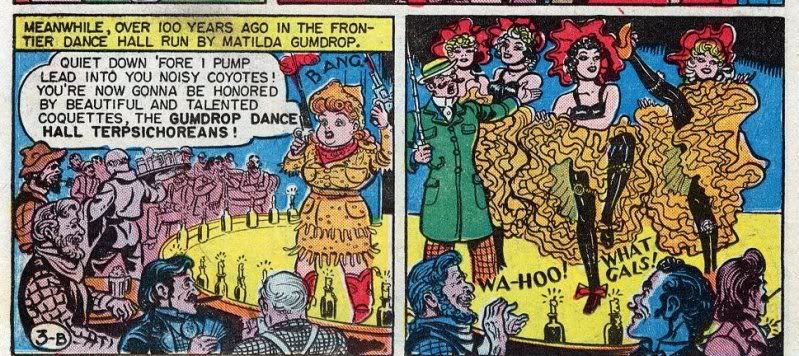
Going into the past also allows Etta to fully embrace her butchness:

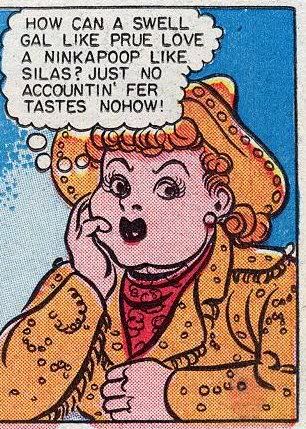
Yep; in a past life, Etta was a gun-toting madam…er, that is, cantina owner. I like this intimation of jealousy as well:

Peter also makes Etta rather handsome there. The borderline men’s attire suits her. (More evidence that Marston doesn’t necessarily see women in drag as evil.

And…yeah, I think that’s really about all I’ve got to say here. You can tell the issue wasn’t firing on all cylinders because I’m not having to stifle the impulse to reproduce every single page. Peter’s art is still worth looking at, but there’s little evidence here of the breath-taking double page layouts that made last issue so stunning. But that’s the way it goes sometimes. We’ll see hope for better on the next one….

Bound to Blog: The Private Life of Julius Caesar

Marston published his one novel, The Private Life of Julius Caesar, in 1932, nine years before he started his Wonder Woman series.

It’s…pretty bad, honestly. Marston’s cloying prose, which can be kind of charming when sprinkled about amongst pretty pictures, is well-nigh intolerable over 300-plus pages.

“I love you dear,” she said simply, “it’s an awful funny feeling — as though you were blown up with feathers that tickle you inside from head to foot! I never felt that way before. Do — you love me — a little?”

See? Even a sentence or two is too much.

Moreover, the Mary Sue aspect of his version of Julius Caesar is gag-worthy, not to mention deadly dull. Caesar sleeps with this slave girl, Caesar saves that slave girl, Caesar fights off twenty men, Caesar pardons that evil-doer, everybody hails Caesar, and on and on. The ruthless, battle-hardened, ambitious tyrant ends up as a invincible do-gooder, motivated mostly by chivalric gallantry towards the fairer sex.

That chivalry gets at the heart of why this early Marston vision is so much more irritating than his work on Wonder Woman. In “Caesar”, as in WW, Marston is devoted to showing the superiority of all things female. Caesar himself is repeatedly described as effeminate (high voice, delicate, etc.), and that effeminacy is clearly meant to demonstrate his superiority) Further, Julius Caesar (like WW after him) is a worshipper of the God of Love (Venus, in this case), and Marston’s goal is to show that all the great things Caesar did were inspired by women. For instance, Caesar broke the strength of the pirate fleets because they captured one of his loves; he made Octavius his heir rather than Brutus at the behest of his female political advisor and lover, a British barbarian princess, etc. etc. There are other girl-power notions tossed about…for instance, it’s revealed that women are more disciplined and effective (and perhaps even stronger) galley slaves than men (is that girl power exactly? well anyway…)

But, of course, effeminate or not, and lover of women or otherwise, the protagonist is still male, and the whole “man is inspired to great deeds by woman” narrative is just a lot more tired, and a lot less feminist, than having women cut out the middle, er, man, and just do the great deeds themselves. Marston very much wants to turn chivalry into feminism — to make the case that love of and fetishization of women translates into power for women. Unfortunately, that’s just pretty much nonsense; love and fetishization are as likely as not to translate into oppression, not power…and if that weren’t true, you’d have a Julia Caesar on the throne, not a Julius.

The historical setting, in other words, is a real problem. The feminist and imaginative strength of WW, I’d argue, is that it’s aspirational — it’s a utopian vision. That freedom is what gives it its ideological force (“women can do anything!”) and its vertiginously nutty dream logic (flying octofish! gorillas evolving into apes! peace-bestowing venus girdles! etc.) In writing about actual people and events, though, Marston is more constrained…to using a male ruler, for example, rather than the numerous female ones he would sprinkle about in his WW stories. (He does have a female barbarian princess, but we don’t get to see her do much ruling.) And, you know, no seal men, or magical lassoes, or invisible airplanes, or space kangaroos, or…well, you get the idea.

Perhaps even more importantly, the historical setting is bad for Marston because dealing with the real world simply isn’t his forte. As a thoroughgoing crank, he’s best when expounding the nuttiness occurring between his ears. When it comes to real gender relations, or how people actually interact with each other in any situation, or how power actually works — he kind of doesn’t know jack. Visionaries can certainly make great visionary art…but you don’t want Henry Darger writing “The Prince.” Oh, sure, it sounds kind of fun in the abstract…but the Private Life of Julius Caesar demonstrates pretty conclusively that, in practice, it doesn’t work out so well.

Though it is a failure in most senses (aesthetically, entertainment wise, etc.), “The Private Life of Julius Caesar” does provide a couple of interesting insights into Marston’s thinking. He doesn’t like eunuchs, for example…and the utter absence of male homosexuality from a milieu in which it did in fact exist suggests, perhaps, a level of discomfort there as well. Most telling, maybe, is the lesbianism, which is a lot more explicit in this than in the WW stories. For example…

“Woman is made for love. She knows how to love, and how to be loved. Consequently, if a loving couple is composed of two women, it is perfect.”

There are several examples of such loving female couples in the book…and though there aren’t sex scenes, per se, there is at least one instance of impassioned canoodling. After reading this, it becomes very, very difficult to believe that Marston was unaware of the lesbian implications of Paradise Island, or of his other female-only communities in general. And, yes, it also suggests fairly strongly that the polyamorous relationship between Marston, his wife Elizabeth, and their live in friend Olive Byrne was a triangle that was, shall we say, aware of lesbianism as a possibility.

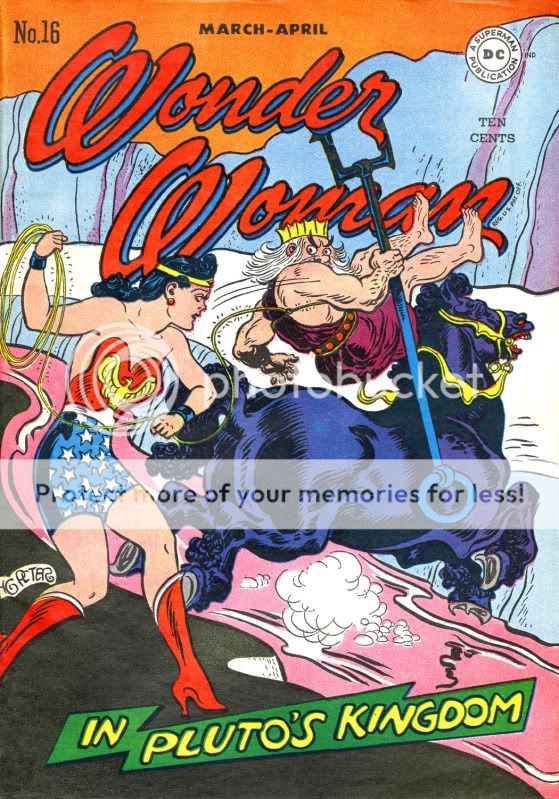
Bound to Blog: Wonder Woman #16

This is really an amazing issue. As I intimated in the last post, Marston and Peter seem to be getting more and more adroit at integrating layout and narrative, and there are some absolutely stunning spreads in this issue.

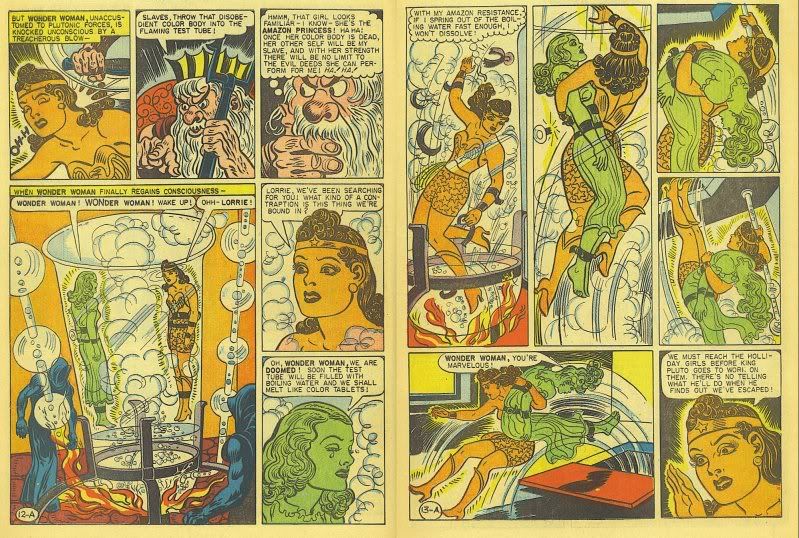
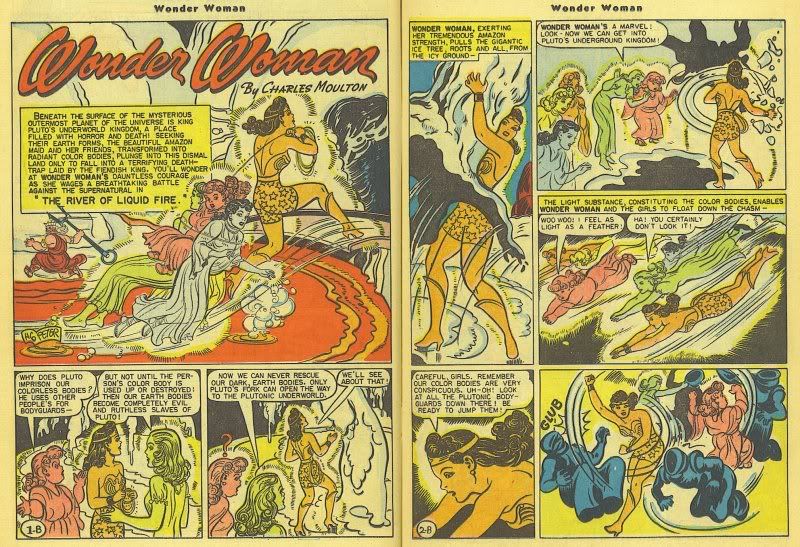
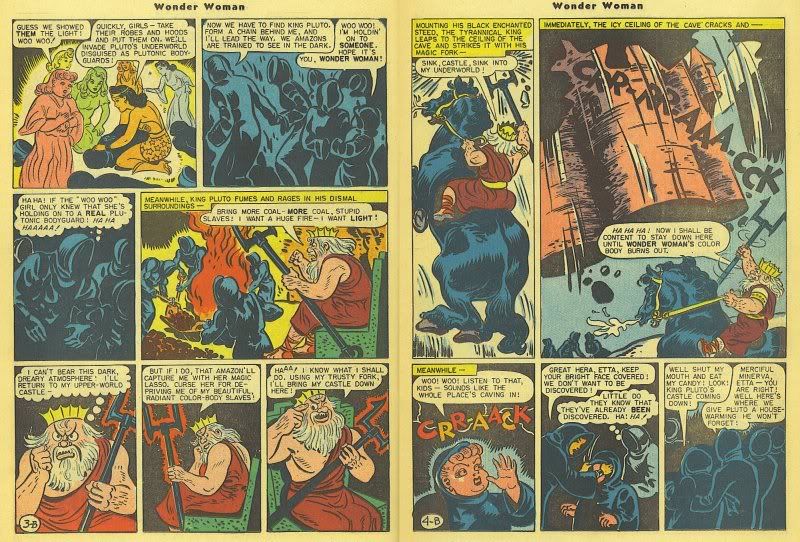
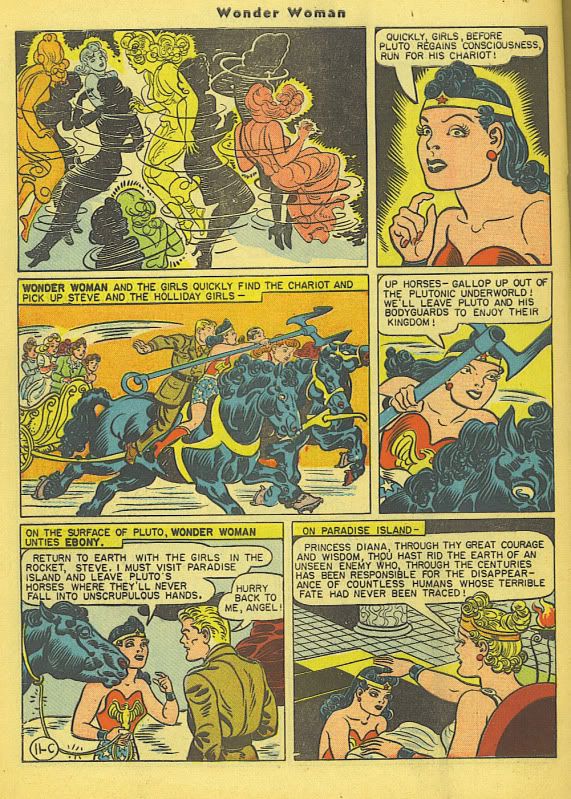
The color here is amazing, and the diaphanous, ghostly bodies really show off Peter’s supple lines. There’s a great contrast, too, between the airy grace of the female figures and the caricatured, cartoony old man (that’s the evil Pluto) at the top of the first page. Peter has also loosened up his layouts again, using bigger and fewer panels, and dividing them up in more varied ways than has been his wont up till now. Also notice in the upper right of the second page, there’s actually a wordless action sequence. I think that’s the first one in the series, and it’s really a joy to see Peter working without all those cumbersome text boxes for once. There’s another wordless sequence later in the comic; hopefully we’ll see more of it in later issues as well.

Also, so many great details here. The weird test tube with those evil black figures lurking around it, all against that gorgeous orange background…Peter’s use of motion lines is lovely as always….and the movement of the green girl in WW’s arms is perfectly done; she looks entirely limp and yet rigid a the same time, with her stylized hair and gown flowing out behind WW.

I think this one may even be better:

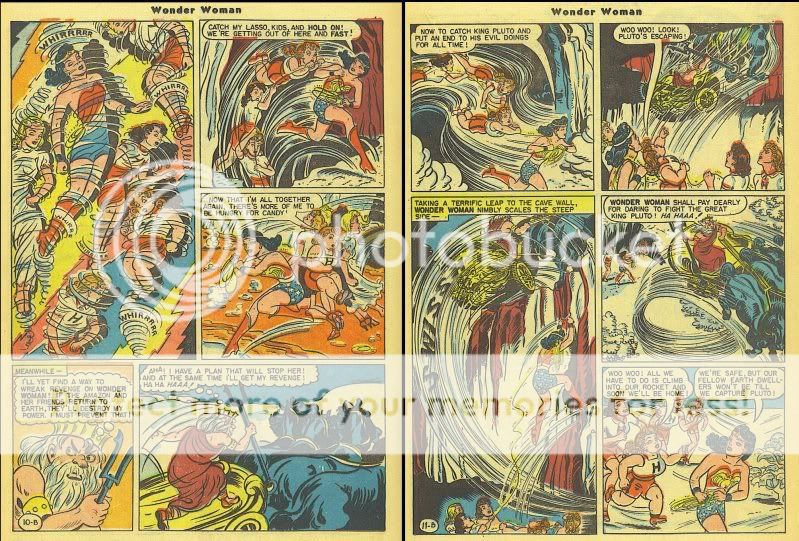
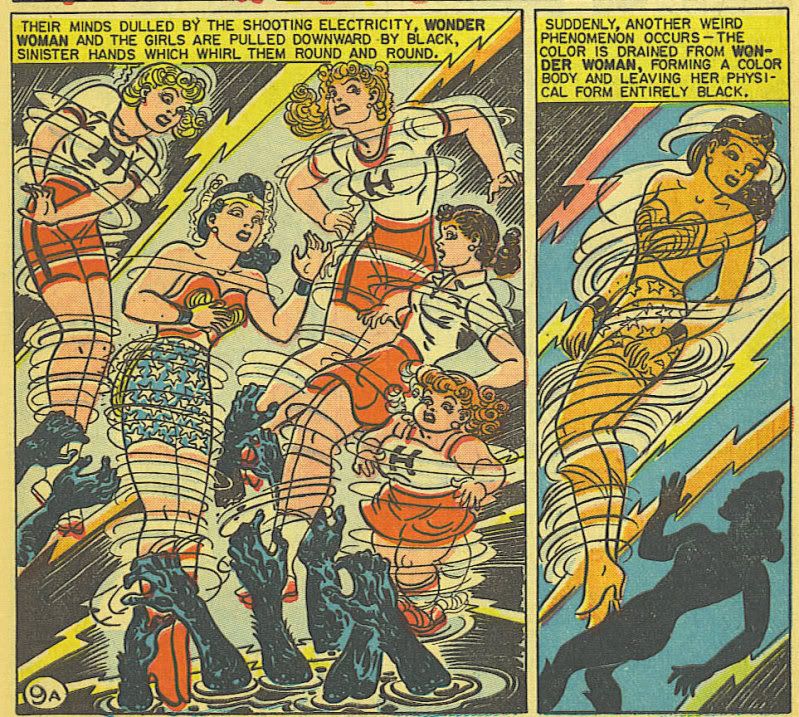
Again, the motion lines become an intense design element; it’s almost like you’re looking at rapids with all the racing, turbulent patterns going every which way and yet still managing to form a coherent whole. The upper left panel, with WW and the Holiday girls spinning semi-conscious in cocoons against that weird abstract colored background is especially fine — and, of course, with its hints of helplessness and semi-involuntary transformation, intentionally fetishized.

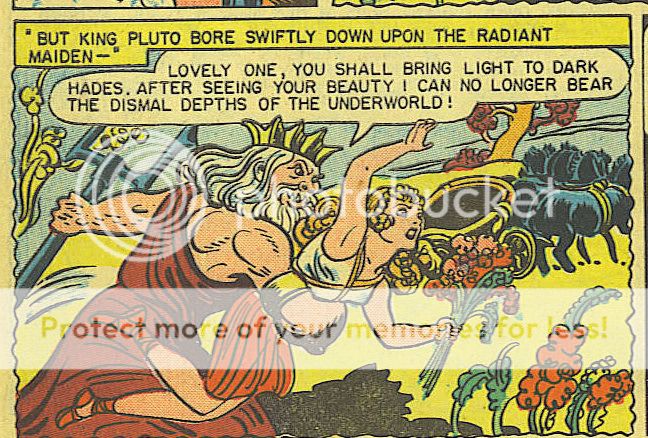
If Peter has outdone himself, Marston also turns in a fine story, somewhat more ominous and dark than usual In traversing the planets and the Greek gods, he’s inevitably come to Pluto, and so he gets to retell the Persephone rape legend

and replay it using one of the Holiday girls as the unfortunate Persephone.

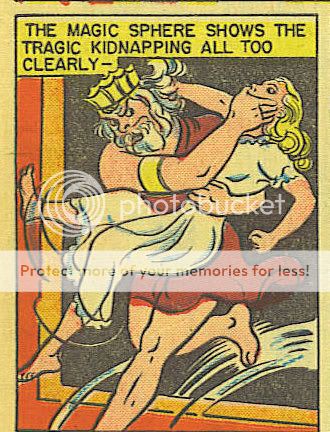
This is preceded by a suggestive sequence:

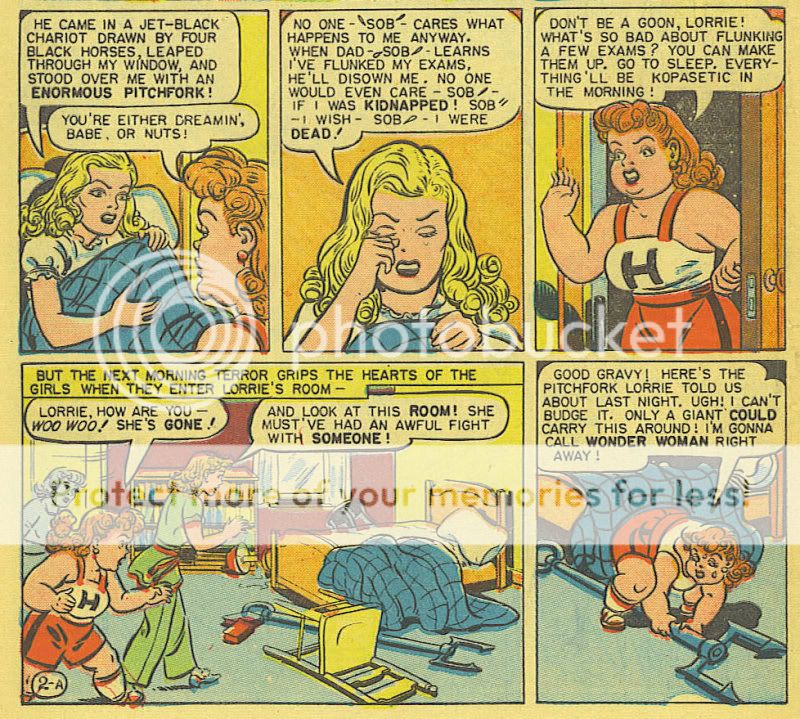
You have the threatened rape, the disbelief of the other girls…and then the tearful evocation of fatherly displeasure, followed by the actual rape, complete with discarded phallic accoutrement. We’re treading around issues of incest and abuse, with Pluto taking the part of rapist/ogre/father.

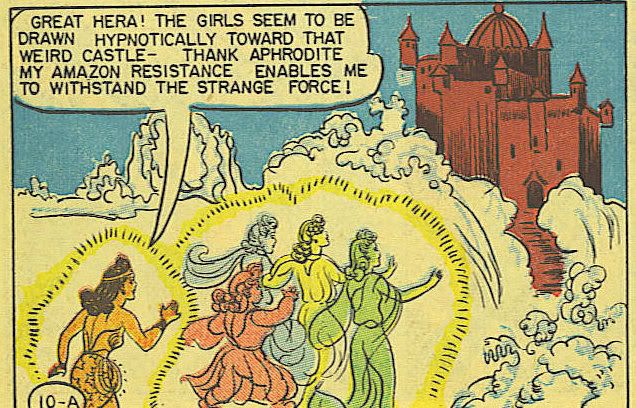
That would explain in part, too, some of the more ominous submerged themes in the issue. When they get to the planet Pluto, for example, the Holiday girls and WW are confronted by black, groping hands. The hands hold them while they are split apart into spiritual light bodies and physical black bodies.

So bifurcated, the girls are held under Pluto’s thrall:

What happens at that point is a little unclear, but if I understand right, Pluto uses the light bodies as decorations in his castle while the dark bodies becomes his hollow, robed servants. In any case, the separated forms are definitely in his service, and easier to destroy than whole selves.

Thematically, the evil black hands, the split between beautiful beloved colorful spirits and despised hollow black drones, the narrative quest to reunite the two — it all seems like it’s dealing with sexual trauma, and the subsequent sense of estrangement from, and loathing of, the self. It’s mixed in, too, with Marston’s odd theories about the power of colors (theories I don’t pretend to entirely understand), and with his usual male/female binaries (the spiritual forms actually seem more female than the abandoned physical, blackened shells — which makes sense since masculine/feminine is more archetype than physical reality for Marston.) The result is a narrative that veers vertiginously between (literally) colorful fantasy and a disturbing darkness, with a sense that love can slide from one into the other at a moment’s notice. For instance, look at these successive pages:

The color palette kind of tells you everything you need to know, almost without even reading it.

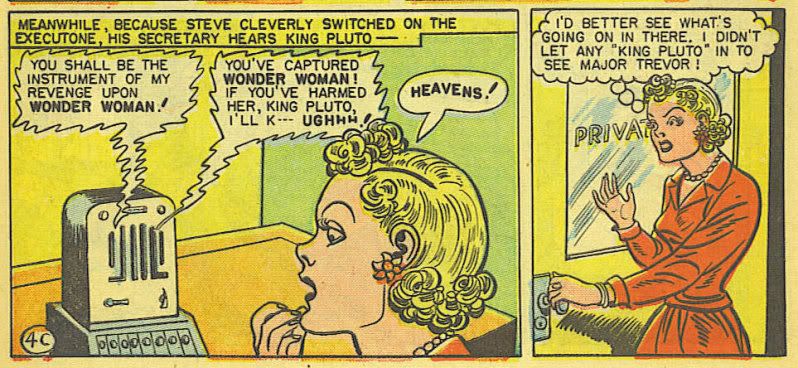
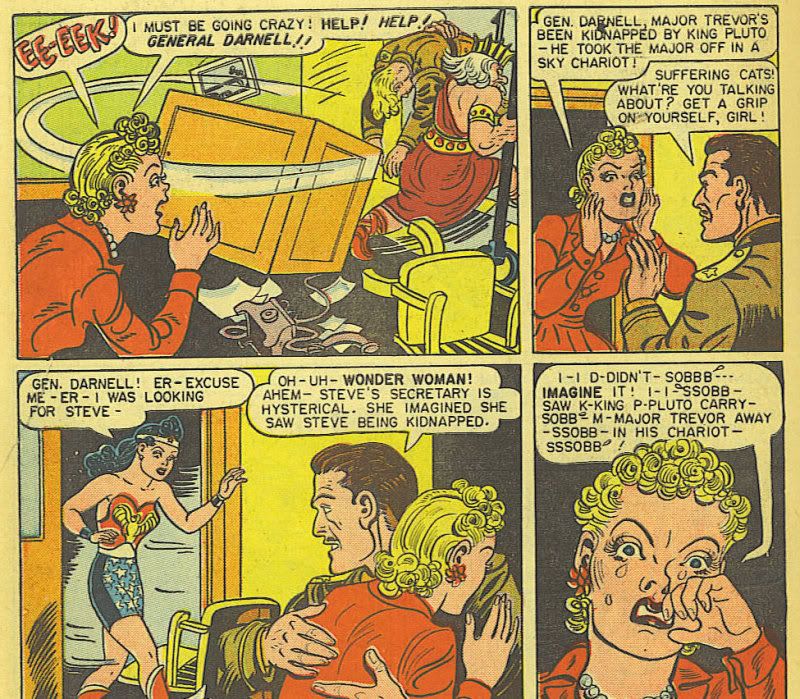
There’s another telling sequence late in the book I think. Pluto comes to steal Steve away. The story spends an unusual amount of time not on Steve’s reaction, but on his secretary’s:

Narratively, there isn’t a need for all this; why do we care about the secretary’s reaction, after all? And why is she quite so thoroughly freaked out? (I mean, yes, I’d be freaked out too, but in terms of the stuff that happens on a regular basis in this comic, this is pretty small beer.) I think the answer to both questions, maybe, is that this is important, and she’s freaked out, because it’s a primal scene…and more importantly, a primal scene as site of abuse. It’s not just a kidnapping; it’s a rape, and a rape linked to childhood abuse and perversion (it’s a male on male intergenerational rape, after all.) The secretary, in effect, is necessary because you need not only the rape, but *the witness to the rape*; not only the (child) abuse but the traumatized child-adult.

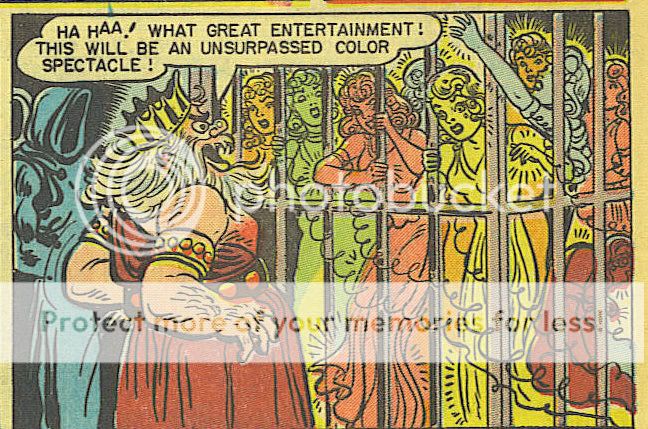
Given Marston’s usual ways, I think it’s valid to wonder if he’s fetishizing father/daughter rape. There’s probably a touch of that in a scene like this:

At the same time….I think I’d argue that this sort of scenario (submerged rape themes, submerged incest themes) probably has a fair amount of appeal for girls as well as for dirty old men…especially when the girls are as clearly the heroes, the older men are as clearly the villains, and the incest/rape is as sublimated as is the case here. Relationships between fathers and daughters — or, perhaps more to the point, between patriarchy and daughters — are definitely fraught. The patriarchal power is desirable and exciting, and yet (and because) it’s forbidden for girls. Marston’s providing a way around that; he’s saying that you can be like Wonder Woman, and keep hold of the danger and the excitement and the sex without having to split against yourself and become a patriarchal thrall/ornament. There’s a sense, in other words, in which I think Marston’s fetishization of feminism is appealing not only to men, but to women as well, since women, like men, are invested in both sex and power relations as desirable commodities.

Which isn’t to say that it’s not a tricky and uncomfortable issue. Freud started thinking about female incest and rape fantasies in the context of his own female patients, most of whom were the daughters of his colleagues. They all claimed they’d been raped by their fathers. Freud was like, well, of course, their fathers didn’t rape them, because they’re my friends, so…women must have incest fantasies. Which is bullshit; I have little if any doubt that his patients were in fact raped by their fathers. And yet…at the same time that they do actually get raped and abused, by their fathers and others,…many women also do have actual rape fantasies, and fetishized relationships with (sometimes abusive) father figures. Marston’s story here seems to be about acknowledging and enjoying those fantasies (or even those realities) in order…I don’t know, maybe not to transcend them, but to not let them cripple you. In this context, it’s interesting that for Marston the reintegration is actually sexualized as well:

I said above the Marston seemed to be sexualizing the helplessness of the transformation…but on second thought, I wonder. Maybe it’s the duality itself that he finds sexy; the image of women as both spirit and flesh, sexual and ethereal, merging into one? Instead of breaking women apart into virgin and whore and fetishizing the severed bits, Marston is excited by the integration; the fact that women can be both and neither and more than the sum of their parts. Pluto is misguided not only in his morals, but in his aesthetics and his cheesecake; women are most beautiful when they’re whole, not when their cut into bits and used as catspaws of the patriarchy.

And, of course, at the finish, WW is riding a stallion and clutching the uber-phallus/triton, vanquishing the evil father and taking his place…and then kneeling in loving submission before the over-mother, who promises that rape has been vanquished…at least until you turn back to the first page to read it again.

Bound to Blog: Wonder Woman #15

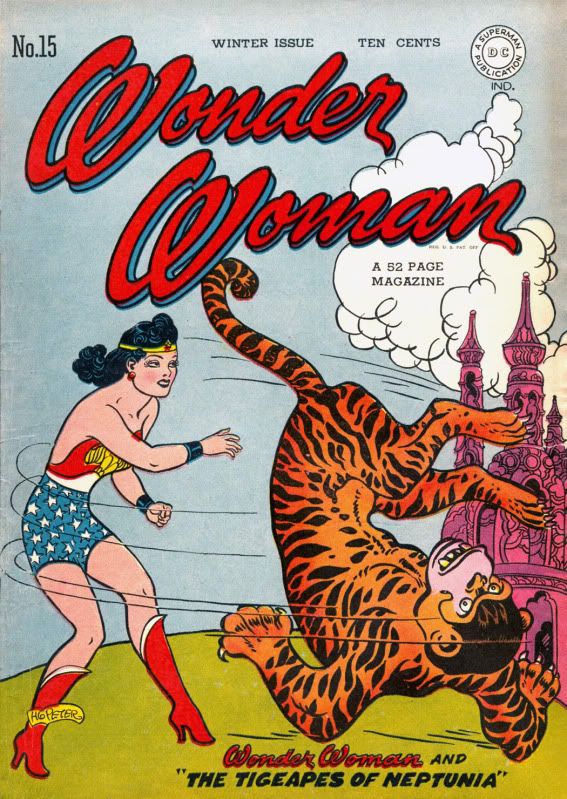
As I said earlier in the week, Wonder Woman #14 was okay but not great. For this one, though, Marston and Peter are back to form, with a tale that starts right out with preposterous and just snowballs from there. You know you’re in for a ride when the coverpage features a tigeape….

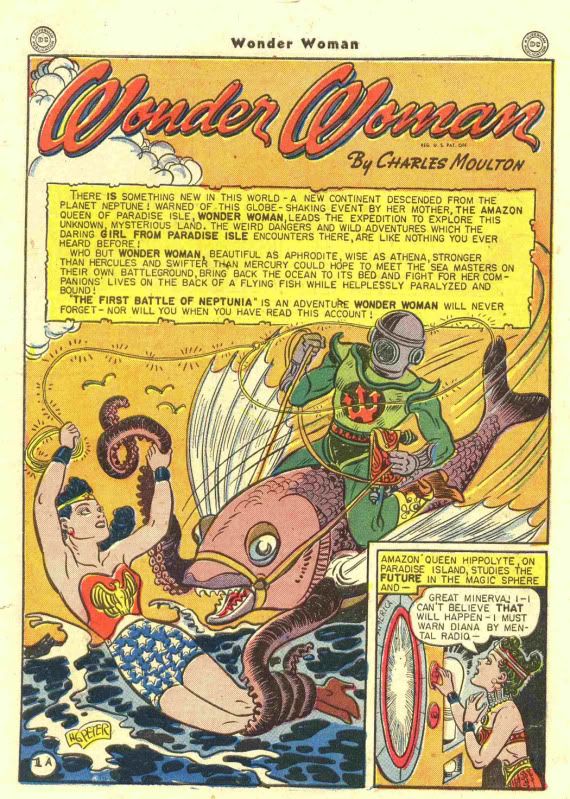
And the splashpage features a flying fish with octopus tentacles being ridden by a knight.

So anyway, the story begins with a giant chunk of the planet Neptune falling to earth as a new continent. You’d think that such an apocalyptic event, probably heralding the end of life on earth as we know it, might be the basis for the entire comic that follows…but, nah, not really. Continents hitting the planet just cause a few buildings to shake; not a big deal really. Instead, the really cool adventure happens when we go to visit that new continent and discover that..well, see for yourself:

And furthermore:

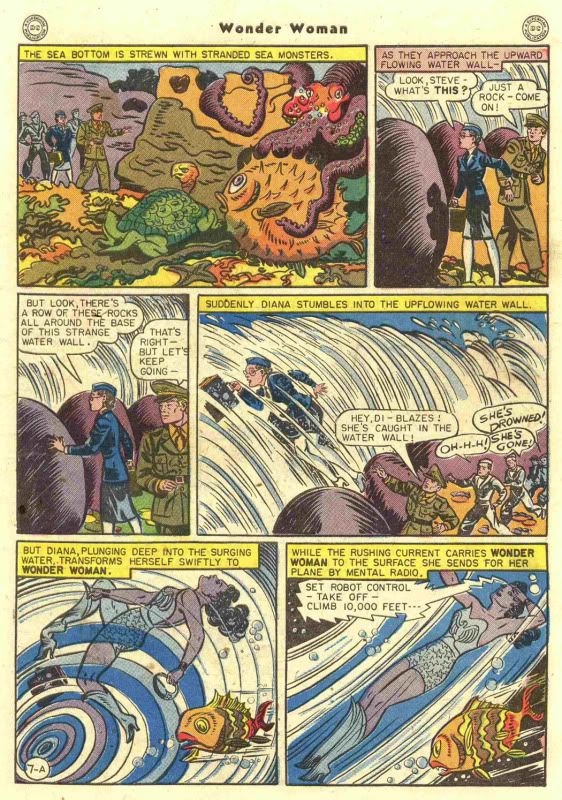
You have to adore the way Diana looks all hunched up and startled when she falls into the water…and also the fish swimming by her as she changes to WW…and the purply swirls. Underwater scenes just really bring out some of Peter’s best work, I think because of the chance to do all the swirling patterns and lines…and the undersea creatures of course. What a perfectly beautiful page.

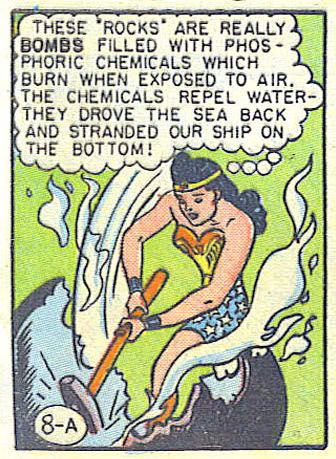
You’re probably wondering why on earth the ocean water has parted and formed giant walls. Have no fear, all is explained:

There are tons of pseudoscientific explanations just like that throughout this issue, and every one is a keeper. Where does Marston get this stuff? The man’s a genius, I tell you.

Anyway, no sooner has WW gotten the ship back afloat than the crew (including the Holiday Girls, who, as always, have come along on the dangerous military mission) are attacked by those octoflyingfish we saw on the splash page

WW and crew defeat the flying fish, which are controlled, as it turns out, by good looking guys from Neptune.

This is a lovely page, I think, by the by; I think it’s partially the color palette that gets me; all those oranges and yellow oranges. But I also like the way that it’s sparse but balanced. And, of course, the toothy flying fish floating off to the side at the bottom are pretty hysterical.

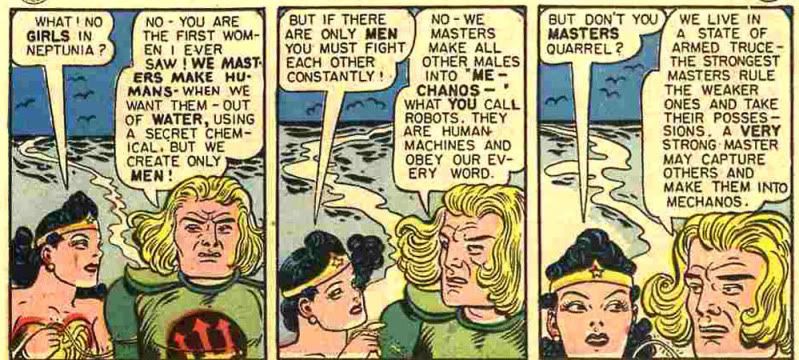
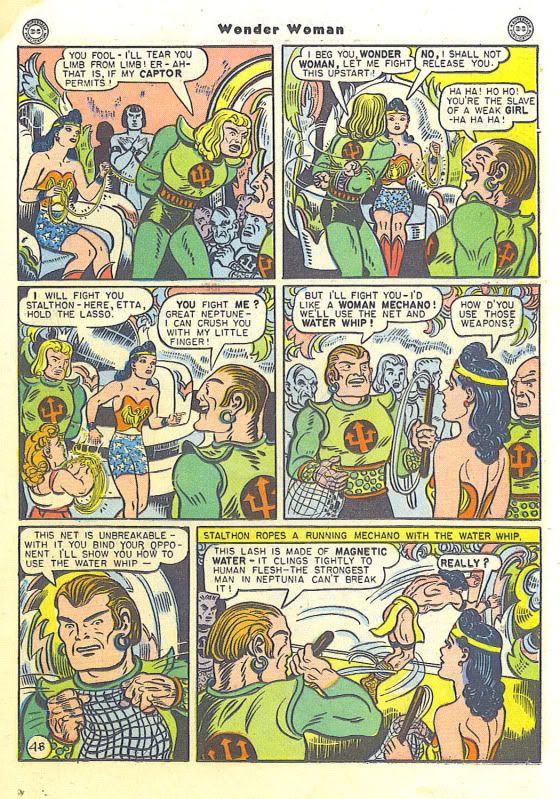
WW and company take the Neptunians back to their home continent (strangely undamaged by its trip through space,) and while chitchatting they discover why it is that the Neptunians are so mean and unpleasant:

I like the way Marston just has WW state flat out that men will just fight, fight, fight if there aren’t women around. And the Neptunian doesn’t even really contradict her; he just explains that there’s no war because most of the men are turned into robots. It’s moments like this that you realize that Marston never did have a moments doubt; there was never an instant where he thought, “You know, almost no one agrees with me…maybe it’s just not true that women should rule over men.” This was a guy who was very secure in his worldview.

Here’s another stellar page:

Again, there isn’t any one thing or panel in this page that leaps out at you, but it works as a lovely whole, with lots of active lines and a unified, pleasing color palette. The filigree in the background, much of it obscured by the word balloons, lends a subtle, baroque feel to the whole image. It’s pages like this that make me want to compare Peter to Winsor McCay; he’s not as explicit about it, but he really does, like McCay, seem to see the page as an aesthetic unit, and work with it as such. It’s not something that is done very often or very well, especially not in super-hero comics of this era.

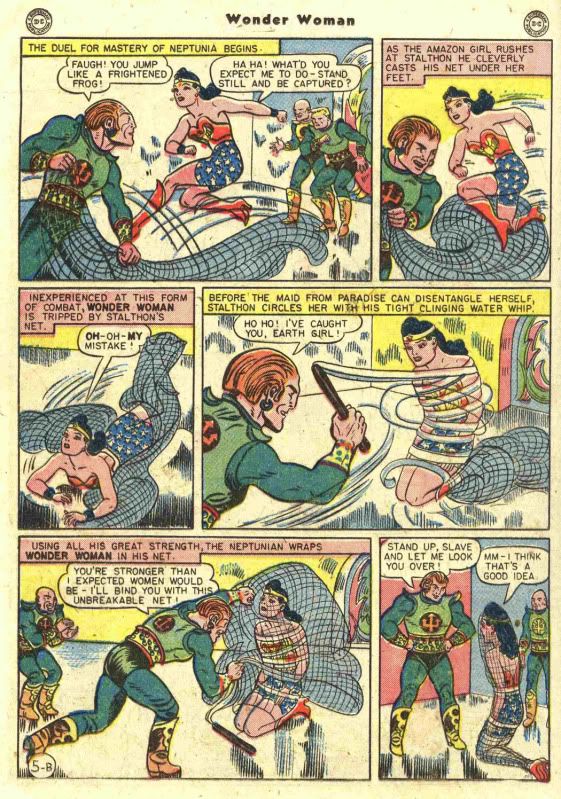
Here’s another, maybe clearer example;

The net there is used as a design element; the mesh pattern flowing through the different panels gives a dynamic sense of movement and unity to the page. The spiraling and shifting pattern is emphasized by the simple tiered layout — which itself has a nice rhythm (long, short, short, long, long short.) I think Les Daniels said at some point that Peter had trouble with page design early in the WW run. If that was ever true (and I think there is something to it) it’s certainly not the case by this point.

All right; repressing the urge to just post every single page of this book now…they’re all pretty much amazing….repressing, repressing…okay, more or less successful. Let’s move on to another awesome pseudo-science explanation:

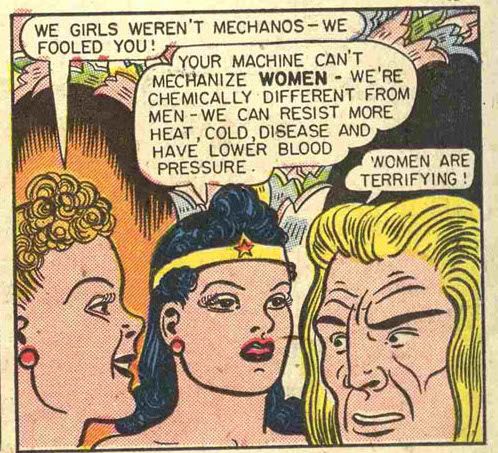
They turn men into machines by robbing them of salt, because salt is what gives you flavor, doncha know. But the best part is…it doesn’t work on women. And why not? Witness:

Again I ask…why isn’t DC taking these panels and printing them as posters, damn it?

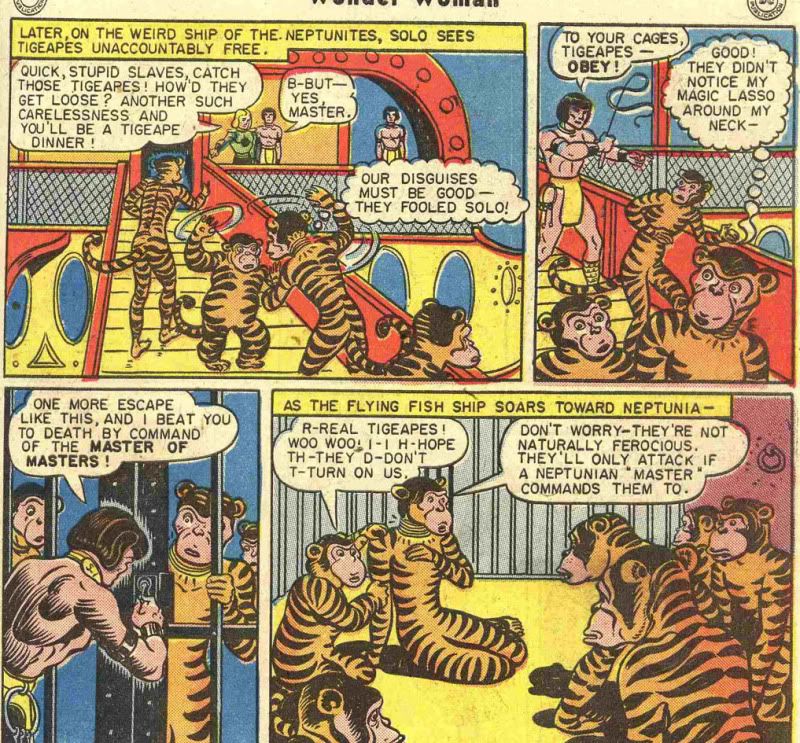
The Neptunians are so terrified of women now that they make a pact with the U.S. offering to become a vassal state if the Americans will guarantee that no women can come onto the Neptunian continent. The U.S. agrees…and so to keep tabs on the devilish Neptunians, WW is forced…to wear drag. Of a sort. I’d wondered before if Marston ever provided examples of good-girl cross-dressing (he has several of his villainesses cross dress.) This issue has the closest we’ve gotten so far, as WW and the Holiday girls dress up as at least nominally male tigapes.

Not really conclusive, but maybe another datapoint to suggest that Marston didn’t seem to see cross-gender dressing as particularly or innately evil. And it’s certainly more evidence for the fact that he just found dressing up in general hot; the Tigeape costumes were first donned during a sorority hazing ritual, which is one of Marston’s favorite things. (HIs academic research involved sorority hazing rituals, so of course his interest was strictly scholarly. Of course.)

Also, add “furry” to Marston’s impressive list of kinks. Of course, furries weren’t even invented when WW was penned…but he Marston was a pioneer in this, as in many things….

The comic ends happily ever after when the Neptunians plot is foiled and the island is given over to women to govern.

If only our actual political leaders were that docile. Go forth, WW, and teach unto Dick Cheney the loving submission. Barack Obama too, just as long as I don’t have to read the slash.

Bound to Blog: Wonder Woman #14

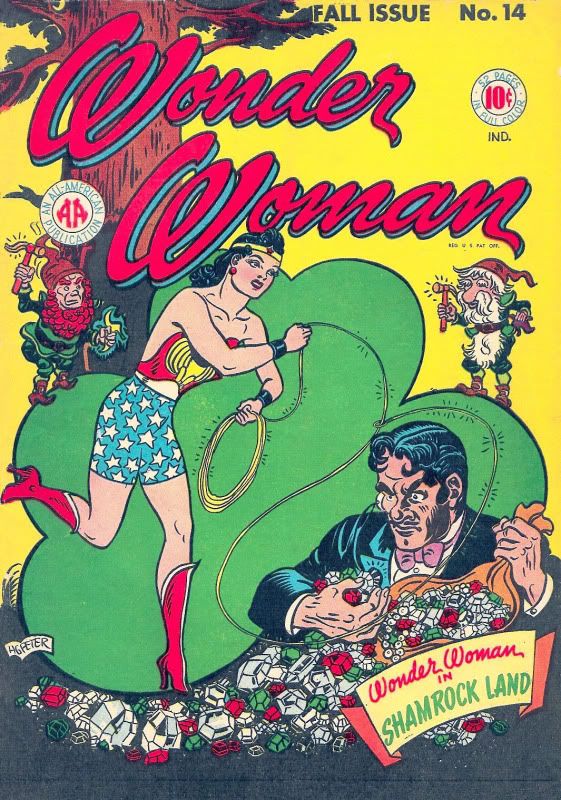
I’m actually doing a bit of catch-up here; I’ll have at least three and maybe four Bound to Blog posts up this week. Starting with:

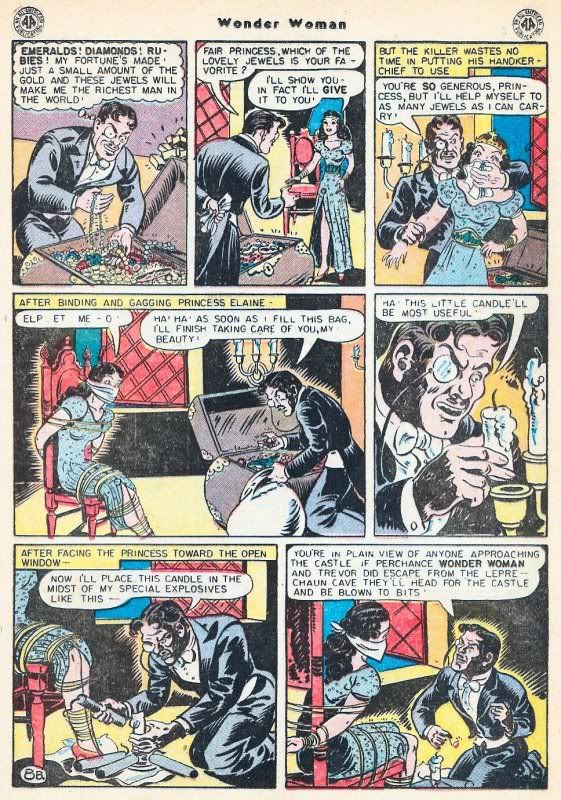
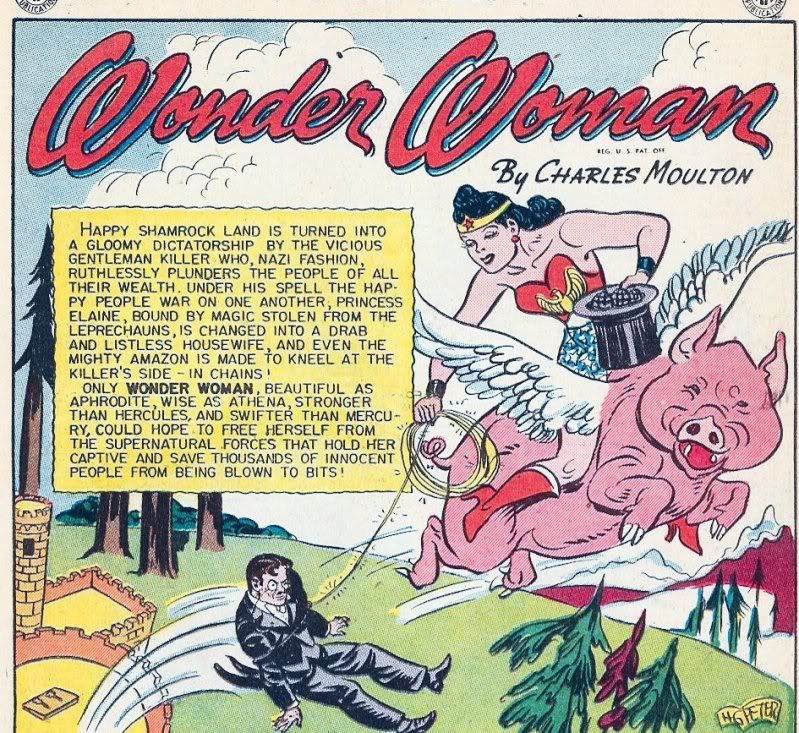
Yep, it’s just like the teaser says: Wonder Woman in Shamrock Land. And while I love that cover — complete with bizarre scale variations, weird amorphous clover blob, bright yellow background, and a guy cut off at the waist in the best spirit of constructivist design — the story isn’t maybe as good as it might be. Part of it is the villain— the well-dressed cropped guy on the cover there. He’s called the Gentlemen Villain or something, and he’s so bland that I can’t even remember his name even though I just read the thing. He performs all the usual Marston villainy (forcing women to serve him, throwing around grenades — Marston loves grenades) but it feels pretty rote — perhaps in part because it’s mostly just in the interest of stealing stuff. I’ve seen some writing on this series that’s suggested that Marston was freed up by the end of the war…but there’s definitely something to be said for evil Nazis as enemies.

Or, you know, maybe Marston just wasn’t feeling all that inspired. Or maybe leprechauns just don’t hold that much appeal for me. I don’t know. I even felt like a lot fo the art wasn’t really all that exciting, especially compared to Peter’s ravishing work last issue.

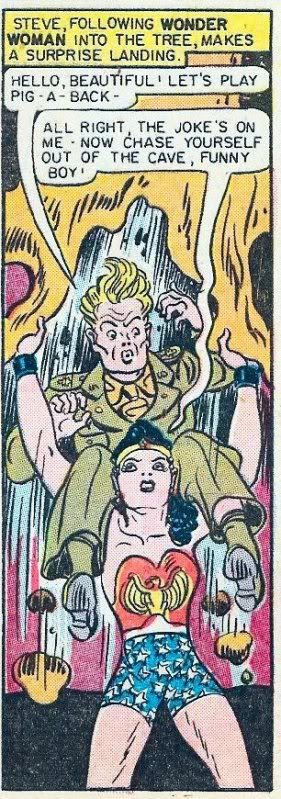
Not that the book doesn’t have its moments. This is a great panel.

Marston definitely joins R. Crumb in having a thing for piggy-back rides. I assume it’s the masochistic implications that make it appealing for both of them; getting a piggyback is infantilizing and polymorphously (rather than explicitly sexually) intimate. WW emphasizes the mother/child aspect by calling him “funny boy” too. Their expressions are both priceless; Steve looks like his eyebrows are going to attain independent lift-off, and WW looks genuinely cranky.

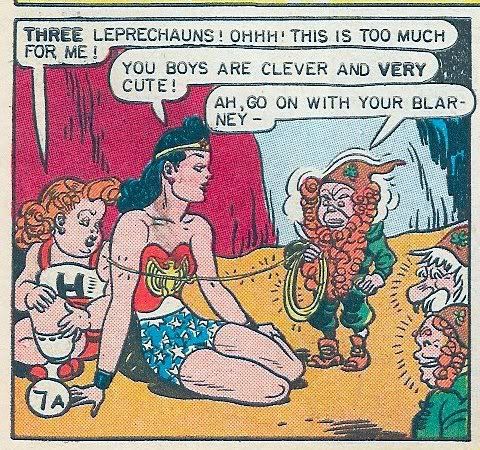
Here’s a queasy moment as WW flirts with a leprechaun who has captured her:

Ick.

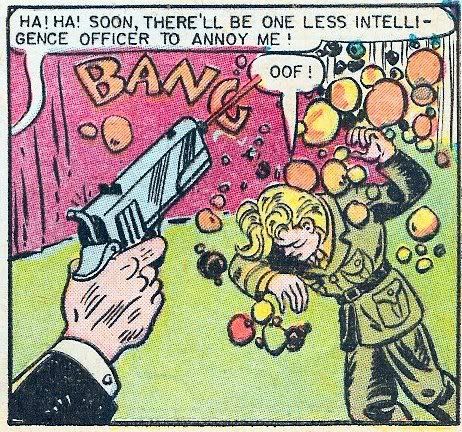
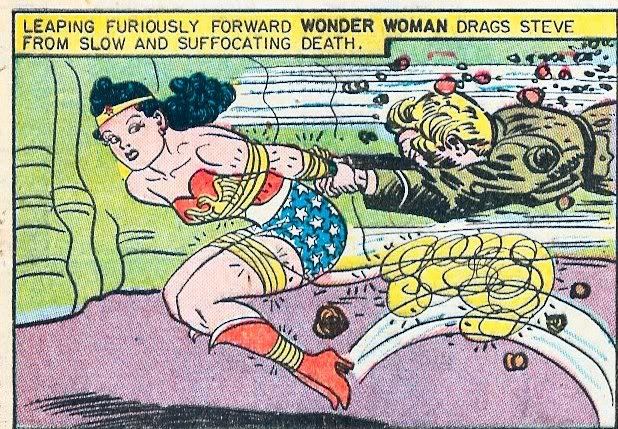
I like the fact that this looks more like Steve is being showered with bubbles than like he’s being buried alive:

I love the scribbly halo of WW’s lasso in this one:

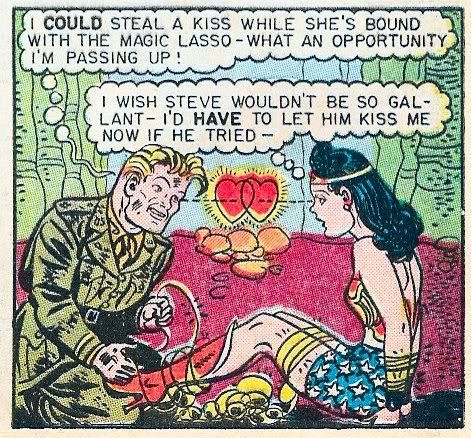
And here’s the valentine day’s card. Steve has an opportunity to make WW kiss him since she’s trussed up in the lasso…and oh, she wishes he would…but he’s just too galant. It’s both romantic and fetishistic, innocent and winkingly kinky, in a way that reminds me of a certain amount of shojo:

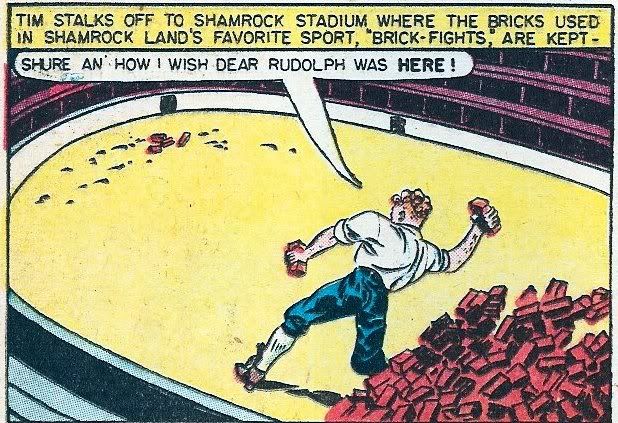
This is a bizarre bit: are the Irish especially well known for throwing bricks? Or is this just something Marston made up?

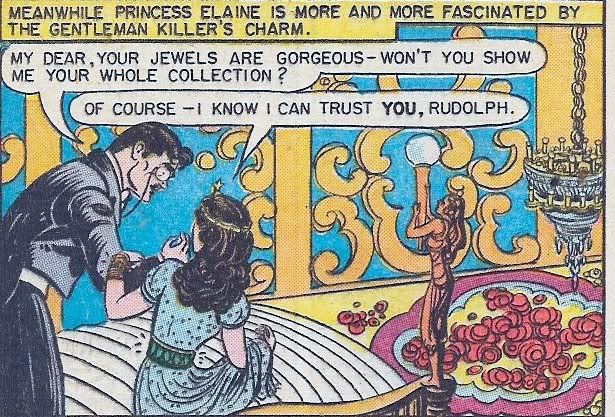
And this is probably the best panel in the issue; I love the designs on the wall there, and the way the Princess Elaine looks impossibly diminutive. The white curved lines of the couch are really nice too; the ones to the right of Elaine almost seem like motion lines, actualy, giving the whole panel a sort of fantastical energy and motion.

The enormous bee as design element here is pretty great:

And the weird inky shadows here are very nicely done; it gives it almost a noirish feel, which is unusual for Peter (I wonder if he used a different assistant on this one or something?)

Oh, man, I’d almost forgotten the flying pigs. That pig looks so happy….

Men! They hate roses and make you sew!

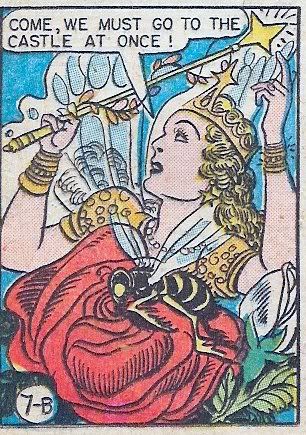
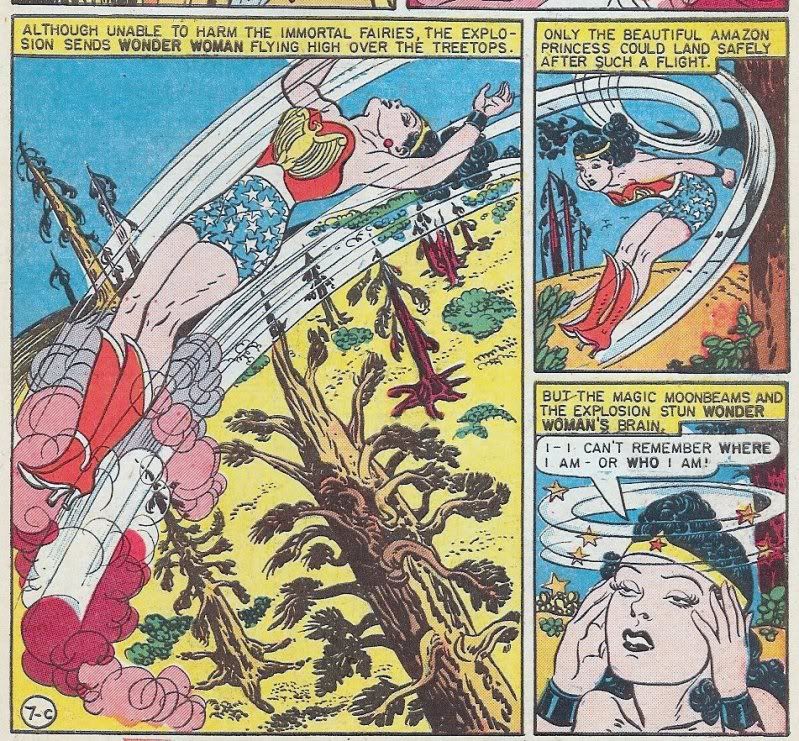
Also… this is an oddly suggestive panel.

The way WW is arched with her arms thorwn back, and the energizing effects of the motion lines… And then you’ve got those weird veiny, phallic trees beneath her — we’ve definitely wandered out of Leprechaunland for a moment and into a Freudian dreamscape. And, of course, in the next panel, the excess of passion has given her amnesia. (I can’t actually remember if she’s gotten amnesia before, but it seems like a natural kink for Marston, fitting in nicely with the mind control and the dominance (fetishizing the obliteration of personality and the sense of control.))

So yeah, there’s a lot of individual things that work great; just overall it doesn’t quite fit together as well as it might. Thinking about it a little more, I think that maybe the Irish mythology just isn’t as well integrated as the Greek myths he sometimes uses, or as the more fantastic mole men or seal men or whatever settings. He seems to mostly see the Irish myths as an opportuniy for slapstick, maybe; in any case, it doesn’t jibe with his cosmic gender interests the way Mars and Venus and so forth do. The loss of the war setting also makes the whole thing seem a little directionless; instead of an epic battle between good and evil, it’s just some thieving schmo wandering around doing bad. I think the WW run really benefits from having the contrast between Marston’s set-in-stone binary crankitude and his scattershot, anything goes scripting (much the way that Peter’s art has a tension between extreme stiffness and extreme fluidity.) Marston’s ideology is certainly still present here (there’s a lot of mention of loving submission,) but it never solidifies thematically the way it does in many of the issues. But so it goes; they can’t all be gems, I guess. Hopefully Marston and Peter’ll be back on their game next issue.