Phallus Dei 5: Shambling On

Man Thing Part One;Man Thing Part Two;Man Thing Part Three; Man-Thing Part Four

________________

In his last post, Tucker refused to say anything about Man-Thing #3, preferring instead to talk about his experience caring for killer attack dogs. This was a wise move; I would rather hear about killer attack dogs than about Man-Thing #3. Nor do I want to hear about Man-Thing #4, in which we learn that Foolkiller has a tragic backstory. Even less do I want to discuss Man-Things 5 and 6, in which Steve Gerber introduces us to a sad clown, which is theoretically interesting, you see, because it is a clown who is sad, which is ironic. And also poignant. With a tragic backstory.

And yes, Man Thing #7 has a tragic backstory too. It’s the backstory of Man-Thing himself, actually. Remember, Man-Thing was once…a man! And in this issue renegade conquistadors slosh him with the water of life, causing him to almost remember his past, and to regrow one human hand. That’s kind of a squicky image….But you know, really, I look deep into my heart of hearts and…yeah, I still don’t care.

These comics suck. Not in an apocalyptic or interesting or surprising way; not in a way that’s even much fun to laugh at. They suck in a rote, boring way. They suck because Steve Gerber, like masses of other writers for television, stage, and screen, thinks the key to entertaining drama is pop psychology and predictable, feeble irony. If you’ve got a preacher, he’s got to be a hypocrite; if you’ve got a rich guy, he has to be a heartless bastard. If you’ve got a clown, he has to be sad. Put enough of these startling reversals together and you’ve got a story with a meaningful human moral. Add in suitably portentous contrivances (the sad clown is dead, but his ghost rises and makes a bunch of random passersby, including the oddly acquiescent Man-Thing, re-enact moments from his sad past) and maybe, if you’re lucky, somebody’ll even think you’re profound.

So there’s Steve Gerber for you; meaningful human morals and pretentions to profundity. Which would be fine, if Gerber had ever actually experienced a single thought about meaning or morals or, for that matter, humans. But he hasn’t. He’s got nothing to say, jack. He might as well be the mindless, shambling Man-Thing for all the brain activity you can detect in these pages. Calling a developer “F.A. Schist” is the sort of thing he passes off as clever. He’s the hectoring, droning drunk you can’t shut up, except he doesn’t even have that much character. The drunk at least tends to have a pungent urgency about him. Gerber manages to be bland even in his crankery.

It is frustrating that there are some indications (such as the Wundarr story that Gerber could write entertaining comics if he’d just chuck the serious messages and go for laughs. But what’s really annoying is that Man-Thing as a concept was originally pretty good. That first issue, and the seven-page Len Wein/Neil Adams follow-up really had something going for them. They were vicious and mean, built around revenge and senseless death and violence and bodily disfigurement. They even had good cheesecake. They were solid exploitation pulp, with some nifty ideas and whacky visuals. And Gerber took that and turned it into tired TV melodrama. All I can say is, fuck him.

I suppose I should talk about Mike Ploog now. Ploog did the art for Man-Thing 5, 6, and 7. He has a very strong reputation…but I have to say, I’m not exactly seeing what all the fuss is about. He tends to make Man-Thing thinner and more hunched. I think the ultimate result really is to make him cuter. I can’t really get worked up about it one way or the other, in any case. Ploog does have a talent for exaggerated faces, which is kind of balanced by the fact that his more ordinary faces tend to look awkward and unexpressive. Certainly, in terms of rendering and layout, he doesn’t seem anywhere near Gray Morrow’s level. If anything, I’d rate him slightly below Val Mayerik, the completely unheralded penciller who was doing Man-Thing before Ploog came on board.

I don’t know. I may be being overly harsh because I am thoroughly sick of this crap, and I’ve got what? twelve issues to go or something? Perhaps some titles were just never meant to be collected into big honking anthologies….

Update: More Tucker on Man-Thing Action!

Bound to Blog: Wonder Woman #9

wonder woman

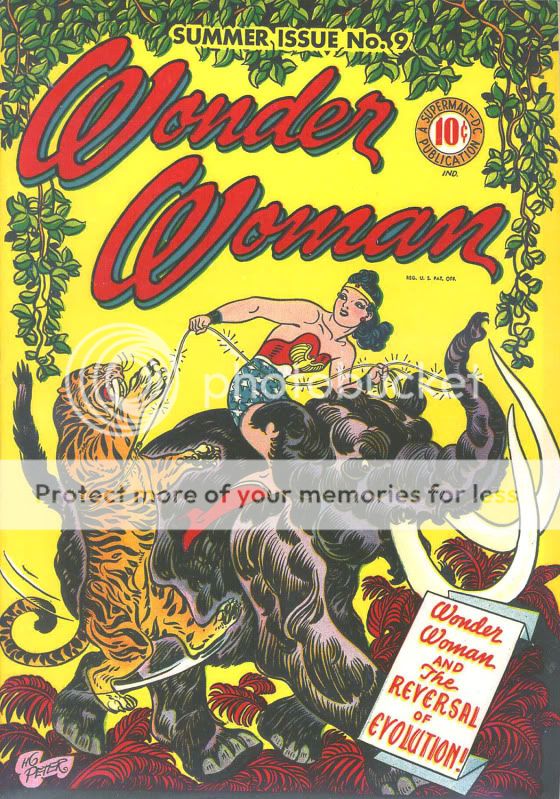
Another Peter animal cover. I really can’t get enough of those.

This issue is insane. I mean, sure, you could say that about every issue I guess…but this one really goes the extra mile of nuttiness.

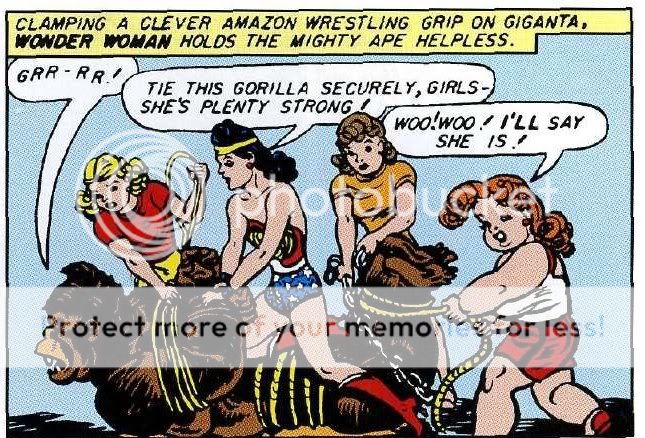
I mean: gorilla bondage.
wonder woman

Need I say more?

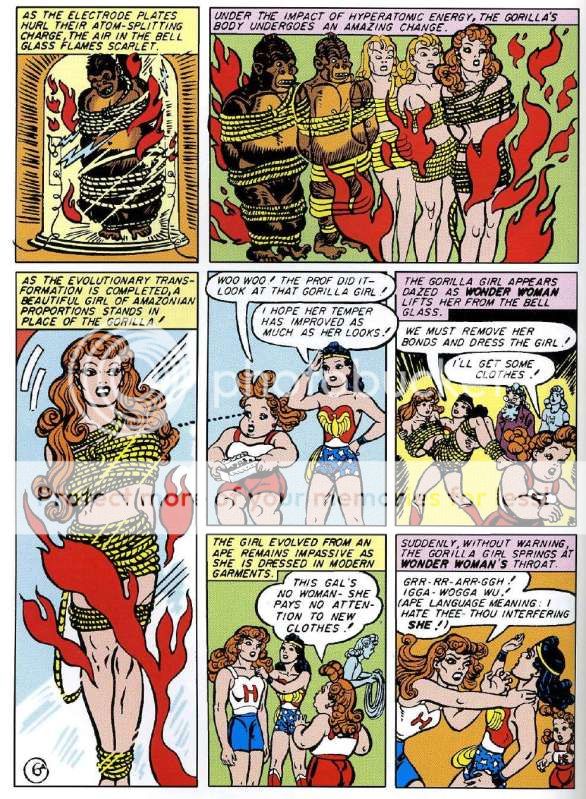
All right; so the plot, such as it is, is that Professor Zool of Holiday College has invented an evolution machine, which he pithily calls “The Evolutionizer.” He gives it a test run on a convenient rogue gorilla:
wonder woman

This is the first issue, I think, where Peter’s layouts start to loosen up a little; and the effect is really impressive. That big panel shot of the gorilla woman with the stylized flames, naked except for the rope — I bet Marston studied that carefully. Peter emphasizes the voyeuristic aspect too in the next panel, where Etta’s so impressed that her line of sight busts through the panel borders, and WW seems a bit lascivious as well.

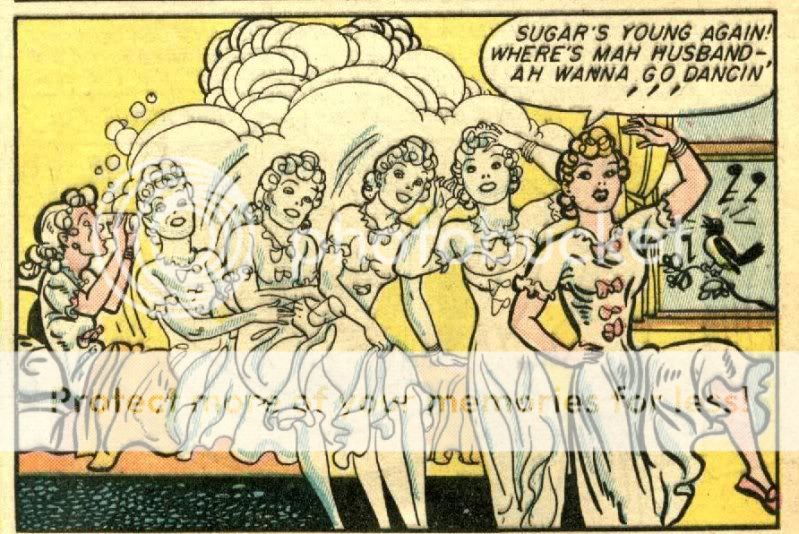
Maybe even more striking, though, is that image at the top of the gorilla evolving. It recalls this image from #7:
Photobucket

I’ve talked a lot over these posts about the relationship between Marston’s fetishes and his feminism. I think there’s obviously a connection there between his fetishes and his utopianism as well. The idea of people, and particularly women, becoming more evolved or perfected is exciting to him…and yes, he thinks turning a gorilla into a human is really hot. I think there’s some sense that he’s thrilling to the idea of a women retaining animalistic characteristics, which is a fairly standard issue fetish (just think Tigra.) But I think it’s also exciting because of the control aspect; the sense of seeing someone change and directing the change. Sociological and psychological liberal do-gooding turns him on.

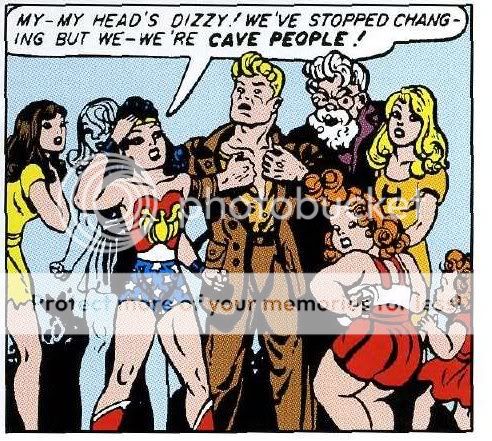
Though devolving is fun too.
wonder woman

Steve pulling open his shirt as he turns into Neanderthal Steve is fairly priceless, as is Etta posing like a semi-monkey person.

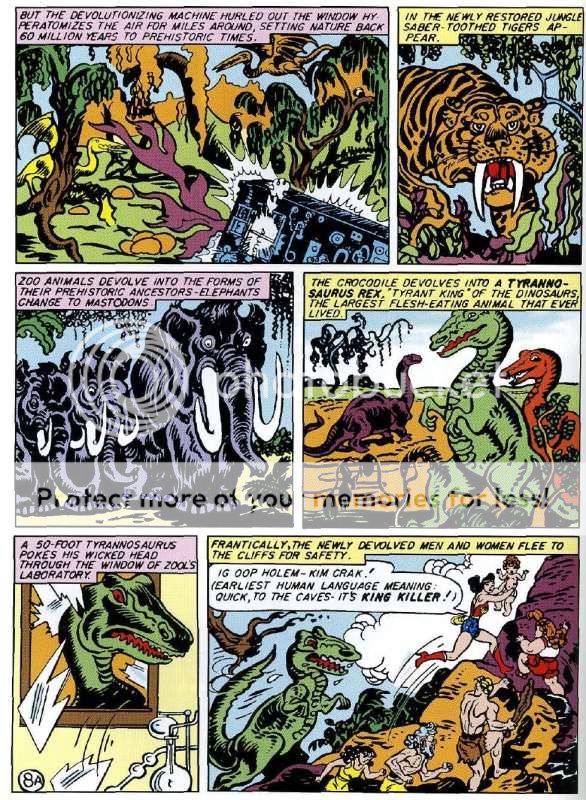
And, hey, WW throws the devolver out the window, and that means everyone can get in on the act…as the entire world (or just the immediate neighborhood? It’s kind of unclear….) is sent back to the past, where we’ve got some beautiful prehistoric fauna for Peter to draw the heck out of:
Photobucket

And how about this:

wonder woman

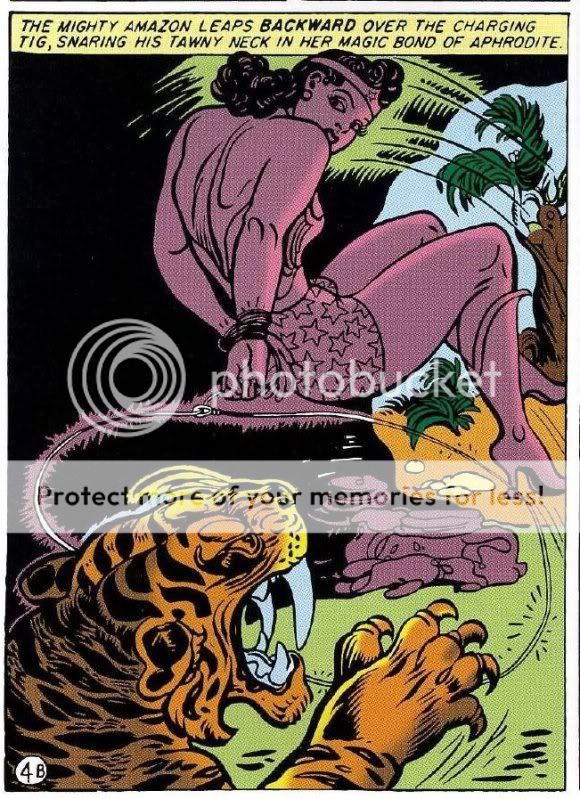
Yes, you got that right, kiddies; that is Wonder Woman lassoing a tiger backwards with her hands tied behind her back. I’m sorry, but that is fucking bad ass. Peter gives the image what is I think his biggest non-splash panel so far in the series, and it so deserves it. In the first place, the color balance is lovely; making WW a uniform grey really makes the tiger pop.  And the tiger itself is unreal; cutting it off at the edge like that makes it appear enormous, and I love the paw; all misshapen bulging knuckles and giant claws. I am in general a fan of Peter’s shoulder-blades and back muscles, and he uses them to fine effect here. Most of all, though, WW’s expression just perfect as she peers over her shoulder. She’s not worried, not even all that intent, just kind of blasé, with that little Elvis sneer, because hell, she lassoes tigers backwards all the time.

Obviously, this is more off the cuff than Alan Moore’s Rorschach stunts or even than Frank Miller’s Dark Knight why-do-I-wear-a-target-on-my-chest, but it has some of the same “holy shit!” pulp cool about it. It’s not something Marston and Peter generally manage, or even try for in quite this way, but they do nail it here.

Did I mention it’s really hot, too? Or have I just been reading too many of these things?

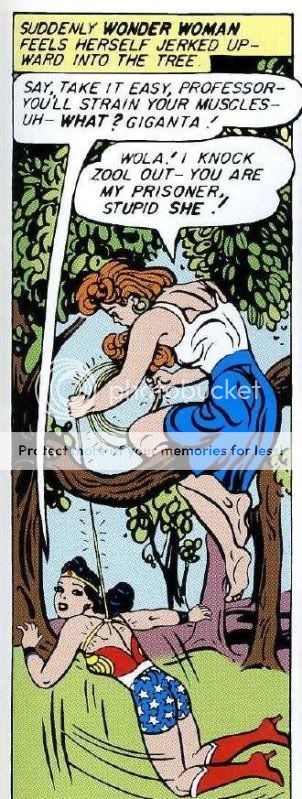
Anyway, speaking of inappropriate interests, back in the evolutionary past there are — what do you know? — evil masculine tree people who like to tie women up. Giganta (that’s the gorilla-turned-woman) learns a trick or two from them and…well, you know what happens.
wonder woman

That’s a superb panel too. It’s the linework on Giganta’s dress, and the way she’s hunched and her crossed legs, and that tree just underneath her in the background, that looks like it was scribbled by a child.

Even beyond catering to his usual fetishes, though, Marston is clearly having a blast and a half; the devolution gives him and Peter an opportunity to dabble in some broad slapstick….
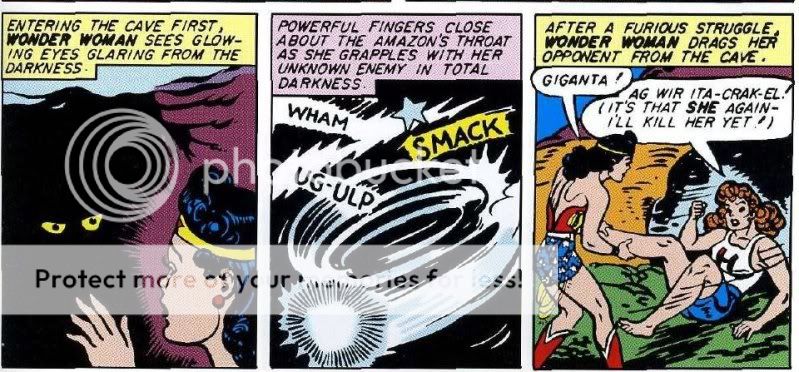
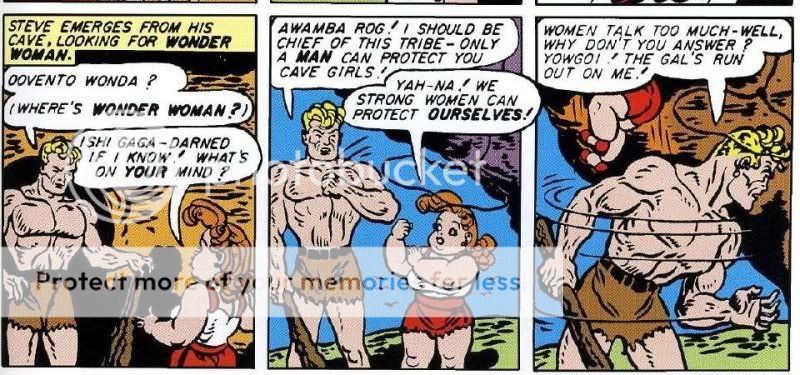
wonder woman

wonder woman

As you can see in that second example, Peter delights in having the characters talk in a ridiculous pidgin caveman dialect. He also, and a little uncharacteristically, decides to mock both ends of the gender war. Etta claims women are strong enough to care for themselvs; Steve says women need men to protect them; both have their pretentions to competence slapped down with vaudeville aplomb. (Though, of course, in the end women win, since it’s WW who saves the day.)

Anyway, eventually they re-evolve, though not all the way. Instead of getting to modern times, they end up in — well, let WW tell you:
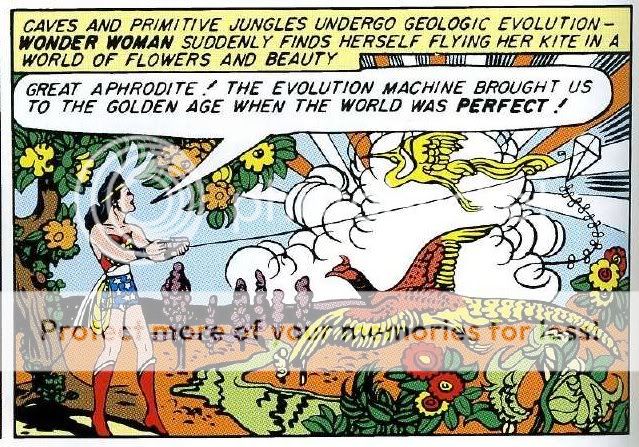
wonder woman

Yes, it’s the evolutionary golden age when everything was perfect. The sun always shines, birds flit about, the rich live in hovels because they’ve given all their goods to the poor, Etta loses weight, and Steve is transformed into a bishonen Edwardian metrosexual.
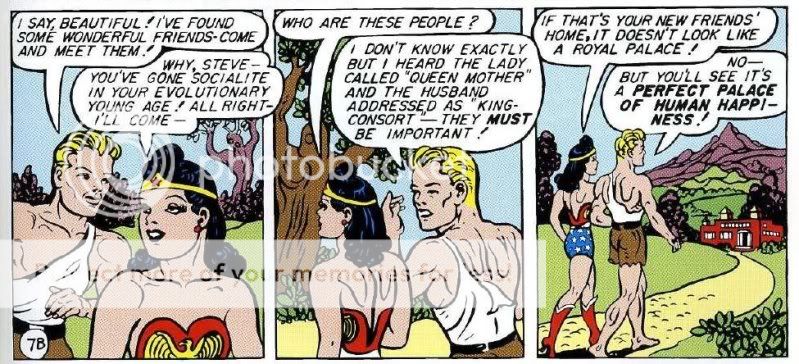
Photobucket.

It’s hard to know exactly what Marston is thinking here. Surely his grasp of history isn’t this poor, right? I said right?

Be that as it may, I assume this era he’s talking about is supposed to be the much-vaunted but probably entirely fictitious anthropological matriarchal age. In any case, the golden age is, of course, ruled over by women, who are wise and good, but who, unfortunately, don’t yet understand the joys of forcible restraint.
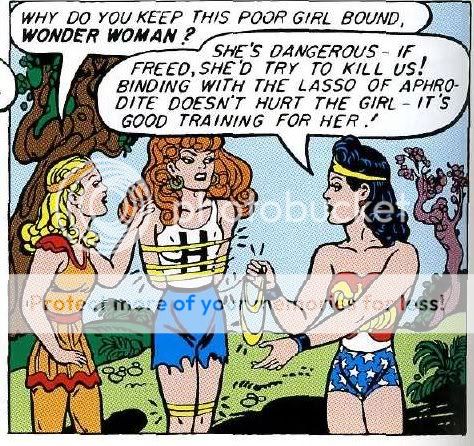
wonder woman

So Giganta gets free and wreaks havok, the upshot of which is that men decide they want to rule instead of women, on the grounds that men are stronger than women. So WW beats the tar out of the lead male guy who has a caveman forehead. However, that doesn’t quite settle things:
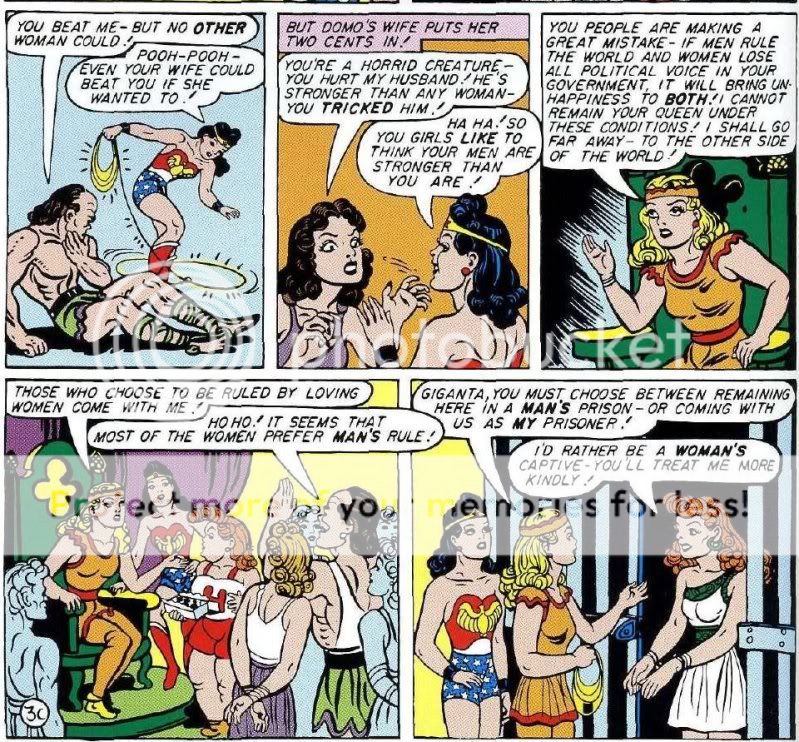
wonder woman

For Marston, women are actually stronger than men, but they like to pretend that men are stronger, presumably for romantic/sexual reasons.

From a feminist perspective, you can see where this might be maybe a problematic position. On the one hand, Marston is claiming women are superior (even in physical strength.) On the other, he seems to be arguing that their oppression is their fault.

There’s an article I stumbled on over at the League of Substitute Super-heroes (I couldn’t find the author’s name) which goes off on this point:

On a more complex level, Marston was not a feminist because he believed women were the keepers of men through their sexuality. Ignoring the rampant heterosexism in such an idea (not to mention the disturbing idea of blaming others as an entire group for the behaviours of other individuals or groups) making women responsible for men’s problems is a trait Marston shares with most misogynists, whether they are the Promise Keepers, backlash “Femme-Puppets” 2 or even the religious wowsers who would be deeply opposed to Marston and his lifestyle if the man was alive today. He believed that, “Normal men retain their childish longing for a woman to mother them” and that “[a] woman’s charm is the one bond that can be made strong enough to hold a man against all logic, common sense, or counterattack.” This is a dangerous position to hold in regards to gender relations, though in Marston’s case, one probably borne more out of ignorance and privilege than outright malice. To come out in the 21st century and tell a domestic abuse victim that all she needs to do is use her “feminine allure” more on her husband is mind-boggling, but from Marston’s point-of-view, it would be the chosen response. Never mind that victim-blame is the great feeder of the mentality that causes most domestic violence and gender-related violence in society. The manifestation of this attitude in the Wonder Woman comic series was the tokenism of Steve Trevor, always being “rescued” by his girlfriend, much the same way as Lois is always caught by Clark after plummeting through the air for a bit as she is so often found doing. Both cliches are two sides of the same misogynistic coin.

As I said, there’s definitely something to that. But on the other hand…I mean, Marston seems to be suggesting, at least in this comics sequence, that domestic abuse victims should slug their husbands and tie them up…which maybe wouldn’t work ideally either, but isn’t quite as squicky, at least (or differently squicky, anyway). In addition, a big part of the point here really seems to be an argument about false consciousness. That is, Marston identifies the problem as women downrating themselves (for whatever reason); he wants women to realize that they’re as good as men, or better than men. And he’s also got a very explicit statement that women need to have political power for everyone’s sake…which was the argument women used towards the beginning of the century when they were trying to get the vote (women’s vote was supposed to abrogate a number of moral evils, including drink — temperance and suffrage were closely linked.)

I actually think that claiming women are morally superior to men is a really problematic strategy for feminism — I don’t think it’s true, for one thing, and the distance between rhetoric and reality can be painful. The suffragette movement in England, for example, ended in unhappy success; they did get the vote, but he social transformation they promised because of that didn’t happen, which caused a fair amount of bitterness within the movement. Though, on the other hand, the promise of moral rejuvenation was an effective one in rallying groups who might not otherwise have been interested in women’s political fortunes…basically, all radical movements have to overpromise if they’re going to succeed.

Feminism, or any movement for oppressed people, has always got a tension around the issue of victimization. On the one hand, of course, you need to point out that you are victimized, and emphasize the injustice and how it needs to be changed. On the other hand, nobody likes to see themselves as a victim, and if you emphasize victimization too much, you can end up arguing that your oppression has essentially broken you and made you incapable of equality (this is what happened to slaves following the Revolution; the argument about oppression ended up being used against them; it was claimed they “weren’t ready” for freedom, an argument which was used to justify another hundred years of oppression.) So you need to have a positive vision too; you need to say “Black is Beautiful,” or women are moral beacons, or whatever — you have to say that your particular experience or essence is valuable. But if you go too far in this direction, then it becomes unclear what you’re complaining about, exactly…if oppression hasn’t harmed you, if you’re better off than your oppressors, then why should the oppressors even consider themselves oppressors?

So, yes, Marston is pretty far out on one end of that debate, and it causes real problems when he tries to analyze oppression. And it’s worth pointing that out. But on the other hand, what he really sees himself doing in WW, I think, is encouraging girls to value themselves, and I think that, you know, that’s probably a worthwhile goal as well. Improving self-esteem in girls could even have positive effects on domestic abuse statistics down the road, at least arguably.

Also, I have to say, Steve being rescued by a woman is pretty different than Lois being rescued all the time by Superman. The essence of sexism is disproportion. It means something different to have genre conventions fulfilled (by having a man rescue a woman) and to violate them (by having a woman rescue a man.)

And, anyway, Steve isn’t always rescued by his girlfriend. Sometimes Etta rescues him.

Well, I’ve nattered on kind of endlessly. Let’s finish up; everyone eventually evolve all the way up to ancient Greece, at which point Wonder Woman meets her mom before she (WW) was born, which is sweet, I think. Also, Steve is hunted as a husband by hordes of rope-wielding Amazons.
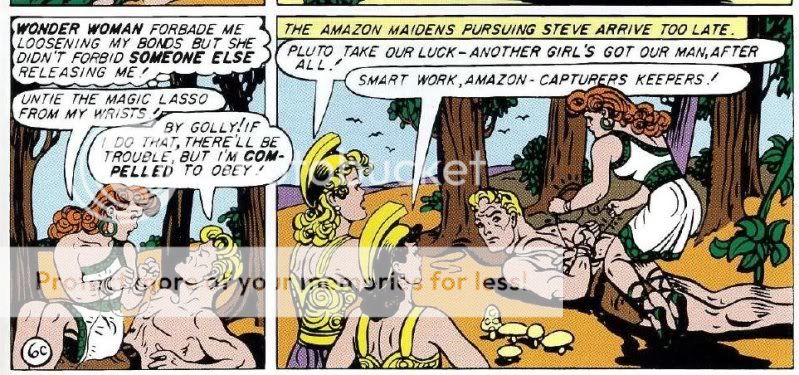
wonder woman

I like Giganta’s reasoning there, too; masochists love legalistic loopholes in their bondage contracts. Or that’s what Deleuze tells me.

Oh yeah, and Wonder Woman fights Achilles and beats him. And then she unties Steve:
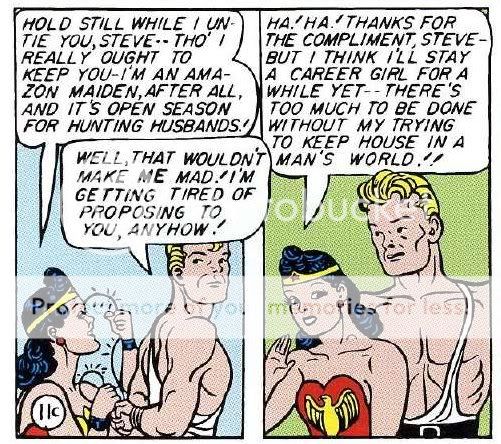
wonder woman

That’s a cute, sexy little flirtation: I can almost see there why one commenter on an earlier post said that Steve and WW actually seem to like each other. Though, of course, the punch line is that you can’t both save the world and get married. That’ll show me for defending Marston’s feminist bona-fides, I guess. Did he really believe that wives needed to stay home and tend to their husbands? On the one hand, both his wife and their mistress worked at various points. On the other hand; his female President in WW#7 and his female ruler in this issue both appeared to be unmarried. I guess when you’re married you need to keep your husband in line full time; it’s only when you’re not tied down to one guy that you can go off and rule them all. Though the mole men seemed to eventually agree to some sort of collective government by their wives…. And his golden era includes a proviso that men and women divide work in and out of the home equally….
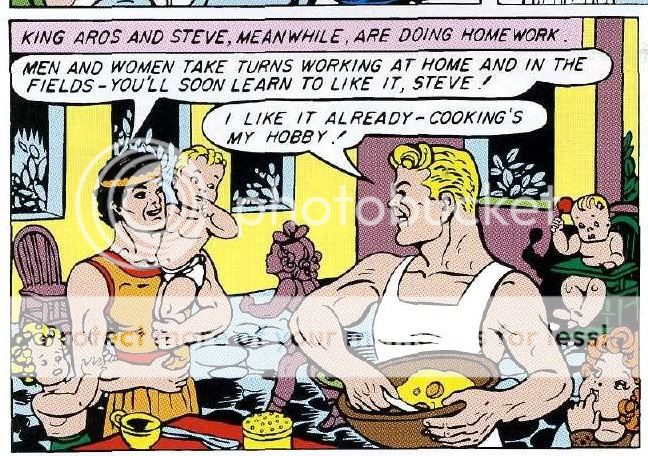
wonder woman

In any case, I’ll try to pay a little more attention to Marston’s views on marriage in the issues I’ve got left — only 19 to go….

Phallus Dei Part 3: Very Special Man-Thing

We’re following up on some Tucker Stone on Man-Thing action. At the conclusion of his review Tucker laments that he didn’t get to review Fear #15 because it looked like Man-Thing fought fighter jets and that seemed like it might be cool. He doesn’t and it isn’t.

Fear #15
Writer: Steve Gerber
Penciler: Val Mayerik
Inker Chic Stone

At the end of my last post I wondered aloud how exactly Steve Gerber was going to save us from creeping genre confusion. Was he going to just embrace the obvious and make Man-Thing the horror title it clearly wanted to be? Or would he manage to mix horror and super-heroics or melodrama or whatever in some way that wasn’t obviously stupid?

And the answer is…neither. Gerber just chucks the horror tropes altogether. And it’s still stupid.

I guess I’m supposed to be appreciating the Silver Age goofiness, and it’s certainly true that the narrative veers all over the place. Continuing over from last issue, we start with everyone in the world going insane. Then we’ve got Man-Thing being shot by rural yahoos, then on to magic ritual, a flashback to an Atlantean sorceress, the sudden appearance of a wizard complete with goofy wizard hat so you can spot him, unlikely mystical quest, monster fight monster, good monster win, victory, the end.

So as I said, pretty crazed. And yet, Gerber manages to take this zany, cobbled-together plot and make it really tedious. It’s true that the story is a heterogeneous mish-mash. But when, say, Bob Haney put together a heterogeneous mish-mash he did it with verve and panache; you felt like he was bouncing form idea to idea because he’d thought of something so funny and delightful he just had to drop it in. Ghost peg-leg pirates; Batman turning into a mad scientist, Spanish kids calling the Dark-knight detective Bat-Hombre; rallies for robot rights — the man was having a blast. (And it didn’t hurt that he worked with a number of brilliant artists like Nick Cardy and Jim Aparo. Mayerik’s okay, but he’s certainly not in that class.)

Whereas with this Gerber story, it’s more like a Hollywood movie assembled by committee that never managed to gel — Superman IV, for example, or Judge Dredd. The individual bits aren’t exciting or clever; they’re boring. The Atlantean sorceress, for example, is just Jor-El in a two-piece, warning everyone that the world’s going to end. The wizard who suddenly appears has no discernible personality — he just has “to make certain you were the ones!” Yep, that’s a news flash. The main character, Jennifer, is as bland as her good looks ; now she’s spouting courageous drivel, now she’s weeping because Man-Thing is dead — who gives a shit? Even the prurient touches are lame:

man thing

Nice crotchface there, Jen. Good to know you’re comfortable with that.

In short, this feels like hack-work…except for a couple of moments. The first is on the second page; Gerber explains, straight-faced, that one sign of the demonic possession of the earth is that “rock-hurling protestors demand that the President resume the war!” The second is further on; Jennifer and Man-Thing find the sacred tome (isn’t there always a sacred tome?) when suddenly:

Photobucket

man thing

And that’s it; the elf disappears, big evil monster appears, and we’re back to formulaic drudgery. Blink and you’d miss it, but for two or three panels there we’re in Flaming Carrot or Cerebus territory. There’s at least a little more of that coming, thank God. First though, we’ve got to endure….

Fear #16
Writer: Steve Gerber
Penciler: Sal Trapani
Inker Chic Stone

From Hollywood schlock to a Very Special Issue of Man-Thing. The bad men are trying to pave paradise and put up a parking lot. The noble Indians fight back, Man-Thing stands around and drips. Everything drips, for that matter. Soggy ideologies slosh back and forth like stubborn, intolerant hamburgers wrestling with proud, game corn tortillas for possession of your lower intestine, which is sacred to both. But do not be afraid, for if you are, the arrugala with the big nose will shoulder all aside and burn a hole in your pasty white sphincter. Or, as Michael Kupperman famously put it, “The tribes of my people used to cover the land, as numberless as the buffalo. Now we are dead and inside your sticks of chewing gum.”

Fear #17
Writer: Steve Gerber
Penciler: Val Mayerik
Inker Sal Trapani

The title here is “It Came Out of the Sky!”, and it opens with three and a hlaf pages of Man-Thing in single combat with the spacecraft from Action Comics #1. We learn where Man-Thing’s ears are (in his forehead) before he finally cracks the thing open revealing…the second backstory flashback in three issues that retells the damn Jor-El narrative. This time it’s not a semi-nude Atlantean witch, but a dude named Hektu who does the useless warning schtick. The sun! The sun! It will explode! Ha, ha, he’s crazy. I know…let’s build a rocket..yadayadayada. It’s a straight, retelling…until:

man thing

Yep, the Kents are portrayed as small-minded rural hicks. It’s a stereotype, sure, and an obvious thing to do in a way…but it’s also bracingly mean-spirited and, most of all, completely out of nowhere. There’s nothing in the Jor-El retelling to indicate that it’s a satire and not a dopey retread. Indeed, it is a dopey retread, complete with melodramatic voice over (“It is the weight of a lifeless hand…that pulls the lever down…and sends the ship skyward!”) It’s like Gerber was telling a standard issue, derivative comic retread, and then all of a sudden said, “You know what? Fuck this.” And hey, presto, we’ve got anti-Kents and then, next page, we’re introduced to Wundarr! a Superman who grew up alone in the spacecraft, pops out of it, sees Man-Thing, and thinks the shambling monstrosity is his mother.

That’s the joke; a developmentally-challenged Superman. And you know what? It’s pretty funny. Wundarr can’t control his muscles so he bounces around spastically, leaping about the swamp, smashing up the construction equipment of the evil developers (yes, they’re still around), staring vacantly into space, tipping over into the muck face first, accidentally killing an alligator, and finally trying to cuddle with ol’ mother Man-Thing. This last precipitates the big super-power battle in the center of town…until Man-Thing gets tired and wanders off. Wundarr is sad…and then scared that his Mom is abandoning him. Of course, Man-Thing can’t tolerate fear, and so he slaps the man-kid, leaving a slight burn on Wundarr’s cheek, and then lumbering off.

Along the way you’ve got lots and lots and lots of hyperactive voice-over. Neither Man-Thing nor Wundarr can actually talk, and though Mayerik has a grand old time drawing Wundarr’s goofily clueless expression:

man thing

we can’t really expect Marvel readers to read facial subtleties. So we’ve got captions like:

“But the Ma-Thing has mistaken Wundarr’s accident for an attack — and so stalks menacingly toward him — to retaliate! Can this be? Will even his ‘Mother” be mean to him? Yes! Yes! “She” is going to hurt him!”

You’ve got to love that “‘she'” in quotes especially. Cause, without the quotes, you might start to think that Man-Thing is actually a “she” right?

In a way, it’s kind of entertaining; what happens to a Marvel writer if he can’t explicate everything endlessly through speech bubbles? He goes insane! But at the same time… this is a nifty story with some clever ideas and a loopy sense of humor…wouldn’t it be great if it were being told by someone who could write? Someone who, say, could have figured out a way to do something interesting with the Jor-El retelling, so you’re not just bored and irritated for three pages; somebody who didn’t have to underline every potentially poignant moment with three or four exclamation points.

It’s like, you’ve got an Alan Moore story with Stan Lee storytelling; there’s a funny, original, and even subtle tale here, but the voice and the pacing are just for crap. It reminds me of the last time I went to see the Flatlanders actually. For those who don’t know, the Flatlanders were an early 80s hippie country band; great spaced out playing, lovely melodies. Anyway, they got back together because they could make a buck, presumably, and their new material is dreadful, but of course they played a lot of old stuff as well, which was enjoyable…except they had hired The Worst Drummer in the World to perform with them, and there they are singing their pretty, ragged, spacey melodies, and over everything is this guy basically hitting his kit with his forehead: Thump! (pause) Thump! (pause) Thump! Each beat sits there as if to say, yep, I’m a big stinking turd, and the next one’s coming predictably right — Thump! Yep, there it was.

Okay, you got me. I’m just stalling. I don’t want to go on to:

Fear #18
Writer: Steve Gerber
Penciler: Val Mayerik
Inker Sal Trapani

It’s another Very Special Issue of Man-Thing. This time there’s a bus accident, and the bus is filled with rejects form last night’s lousy late night movie. There’s the nurse with the heart of gold! The wounded child! The tough and manly All-American Nam vet! The disillusioned student protestor with the heart of gold! The drunk-driving salesman who caused the whole thing, the bastard!

And is there conflict? Oh yes, there is conflict. But Man-Thing follows them around like a good puppy and protects them until the bad salesman kills everybody except the nurse and the kid and then Man-Thing kills the bad salesman because that’s what good monsters do. And it’s all so heartwarming that it brought a tear to my eye…oh, wait, I just have conjunctivitis. Never mind.

Perhaps I’m missing something obvious, but…who wants to read this? You pick up a Man-Thing title with some giant gloppy, dripping monster on the cover, you’re saying to yourself…y’know, I’d really like to see a sixth-rate stage play about the human passions boiling just below the surface in my fellow sufferer, with a heartwarming finale about the way love and tenderness can bridge the gap between man and thing? Or are you maybe saying instead, I want to see some havoc, I want to see mayhem, I want to see people brutally killed, I want to see guts and brains and dismemberment and mean-spirited nihilism?

I’m willing to work with Gerber to some extent. Okay, he’s not into carnage. I’ll settle for goofiness. I’ll settle for a decent story. But this…this is just egregious crap. This is a hack writer who isn’t even a decent hack; a preening twit spouting empty-headed platitudes: “Mary, Look around you! It’s not just me! It’s our whole blasted country! We all hate life!” Yes, I hate life, and the reason I hate life is that I’m reading your pompous, boring-ass shit.

All these irritating, incredibly trite characters? Man-Thing. should. kill. them. That’s what horror is for, damn it. The whiny hippie who says he hates life should piss himself and beg and beg and beg for mercy as Man-Thing rips his still-beating pansy heart from his rib-cage. The manly Nam vet should have a poignant scene where he talks about being tortured by Charley and how glad he was to escape, and then, in the next panel, he should get his leg torn off and bleed hideously to death. The nurse should reach out to Man-Thing and ask him to please save this innocent child’s life, and then Man-Thing should smother the kid to death as she watches and then snap her sanctimonious neck. And the evil, uber-patriotic drunk driver, who killed all those people? Well, Man-Thing should…um…

Aw, fuck it. The drunk driver can escape. He’s a lot less annoying than the others anyway.

_________

Tucker’s back tomorrow with more, as we all wonder why this is a cult classic, anyway.

Update: And Tucker’s next post is up.

Phallus Dei: A Man-Thing Rises

A while back Tucker Stone and I blogged our way through a volume of Bob Haney’s The Brave and the Bold. We called the series The Cowardly and the Castrated because back then we were just wee little girlie bloggers, and the other bloggers made fun of us, yes, even Matthew Brady and Jog. They wiped eye-snot on our Hal Jordan ofrendas and made us ingest our entire painstakingly obtained collection of Alan Moore beard clippings — which had to be even more painstakingly and even humiliatingly retrieved with the use of a powerful magnifying glass, forceps, and twenty pounds of prunes.

But that’s all in the PAST!! Our sinews are new, our nether orifice is rectilinear, our hit counts are UP, and we are ready to ask that immortal question (without even a slight pause to ponce): WHOM IS YOUR DADDY!

Savage Tales #1
Writer: Gerry Conway and Roy Thomas
Artist Gray Morrow
1971

So with a name like Man-Thing, you shouldn’t be surprised when you get some action. Still, even Peter Wood or Randy North would have to be impressed at how fast we’re into the muck here. Sure, there’s a little three-page tease where we’ve got the big fella wrestling with an alligator (not that that isn’t kind of hot in itself) but then we’re right, right there:

man-thing

Yep. You can tell she’s bad ’cause you can see her bits; you can tell he’s a cad ’cause he’s got hair on his tits. And thus endeth my rap career. But you get the point; sure, it’s the 70s and all, but no girl like that is gonna wear some abbreviated piece of ephemera and throw herself at a guy with +5 body foliage and galloping neuroses unless she plans to be holding a cigarette and selling his secret formula to the plug-uglies within a page or two.

man-thing

Oooh, why that….ooooh! She just totally castrated him! Darn femme fatale. But no worries! He will regain his manhood by injecting the super-soldier formula he has stolen from Captain America!

man-thing

And, presto! It works! Up from the depths he comes (as it were), and his nose is way, way bigger than her cigarette. Those manipulative pretty girls, getting into car crashes and falling out of their clothes just to tease us! Well let’s see how they like a little rape fantasy, huh?

man-thing

Stupid good looks; that’s what let’s them control us, huh guys? But we’ve had our way with her now, and she’ll never rob another man of his precious fluids.

man-thing

And afterwards, as the caption sententiously wonders, “Why did you feel …soft towards her at that last moment?” Why indeed? Don’t worry, though…you just need a minute or two and I’m sure you’ll be ready to go again. And soon, as your consciousness fades away utterly, you need never be soft again; like Jason in Friday the 13th, losing your mind and your manhood makes you paradoxically more masculine. It takes a thing to be a man.

Photobucket

That’s the last panel of our Man-Thing tale, and it’s really nicely done; you can see the poignant confusion in those beady little eyes. Man-Thing is the phallus, but he’s also a wounded child…which emphasizes again just how much he is the law. The law inhabits bodies which are mockeries, because all bodies are mockeries before the law—which is why defacement is such a perfect punishment.

I mentioned off-hand the way this origin mirrors Captain America’s; I think they even use the phrase “Super-soldier formula” a couple of times. One of the things Stan Lee did at Marvel was to figure out how seamlessly the the horror genre and the super-hero genre could fit together. The Thing, the Hulk, Man-Thing; all suggestively named shambling shibboleths; castrated weaklings whose naughty severed portions rise up and walk and start kicking ass and taking names. Whether the big needle turns you into an upright American or a giant veiny monolith, it’s really, in some sense, all one and the same. Male Freudian fantasy is male Freudian fantasy. Yes, Captain America is a more straightforward dream of power, good against evil, whereas Man-Thing passes through masochism and self-pity in order to justify seizing the phallus and wreaking havoc. But we’re still talking about bifurcated selves; weaklings feeling a prick before transforming into the vengeful law.

Gray Morrow’s art is great, by the way. Trusty Wikipedia says it was originally in black and white, which is certainly what it looks like; the grey washes are nicely done (though we may be losing a little detail in the reprinting? It’s kind of muddy — not that that’s not appropriate in some sense.) He draws some fine, basic cheesecake and good drippy tactile vines. Nice pacing and clean, imaginative layouts, too:

man-thing

I like the way the last inset panel breaks up the bigger shot of Man-Thing against the moon; it makes the sky seem to stretch up and up, isolating our muck monster dramatially.

Oh, and if you’re wondering which came first, the scientist falling into swamp with secret formula who turned into Man-Thing or the scientist falling into swamp who turned into Swamp Thing…it was Man-Thing. Roy Thomas and Len Wein were roommates at the time, and Wein seems to have more or less shamelessly ripped off Man-Thing for Swampy. Or so says Wikipedia, anyway. That’s why, in later issues, we learn that Man-Thing can only burn you if you feel fear or have downloaded copyrighted material in the last 24 hours.

Astonishing Tales #12
Writer: Roy Thomas and Len Wein
Pencillers: John Buscema and Neal Adams
Inkers: Dan Adkins and Neal Adams
1972

Astonishing Tales #13
Writer: Roy Thomas
Pencillers: John Buscema and Rich Buckler
Inker: Dan Adkins
1972

That first Swamp Thing tale [Update: I mean Man-Thing of course, darn it] had an elegance that I associate with good exploitation fare — rape-revenge stories or slasher films, where the formula has the iron inevitability of a folk tale. These Astonishing Tales stories are from only a year later, but elegant they ain’t. Most of the two-parter is basically a Kazar story with decent art by John Buscema, and Roy Thomas basically writing whatever pops into his head — Kazar fights security guards in an airport? Sure! Sabre-toothed tiger vs. alligator? Why not! Just so long as Kazar can keep referring to himself in the third person, it’s all good. Highlight quote: “Ka-Zar is strangely appeased by this thing you call…gumbo.” No, really. It’s in there, I swear. Other favorite moments are the revelation that Shield asked one of its top scientists to pimp herself out in order to uncover an AIM spy. Keeping it classy guys.

The Man-Thing on Ka-Zar action is fairly entertaining as well:

man-thing

This is the moment where we figure out that the Man-Thing is attracted to/burns up anyone who feels fear. In this sequence,, it’s fairly clear that fear has gendered implications. Those who fear are emasculated, and so Man-Thing can destroy them — the first burning in issue #1 was an obvious rape, and his later assaults are also, I think, rape-like. But once Ka-Zar decides to man up, the gender dynamics switch, and we get a super-hero/super-villain fight, where the homoerotic tensions are worked out through violence rather than through violation. (I know Ka-Zar isn’t quite a super-hero officially…but I feel bad for him. It’s okay, Ka-Zar. Wearing no shirt, wearing tights; it’s all good.)

Where was I? Oh yeah. I know I claimed above that super-heroes and horror were effectively the same, but perhaps I spoke too soon. Because trying to squish Man-Thing and Ka-Zar into one big savage ball of fun does point up some of the genre differences. Most obviously, (as I did suggest above) horror tends to embrace masochism less equivocally. When Ka-Zar first confronts Man-Thing, he’s behaving like he’s in a horror storyline; he’s scared and about to be victimized. The catharsis is in identifying with his fear and anticipating his defeat. But then he remembers that he’s a super-hero, damn it…and he’s back to battling the villain in grand manner, even if he’s tightsless. There’s something of the slasher movie switch, where the final girl gets to battle back against the slasher and eventually overcome him…but it happens too fast, here, and Ka-Zar is too all-fired competent. Basically, in slasher films, the payoff is in the fear, the vulnerability,and the triumphant reversal of roles. In super-hero action, the payoff is in never really being in danger; the invulnerability. The Man-Thing/Ka-Zar battle flirst with the one, then with the other, and ends up confused. It’s an interesting confusion though; you don’t usually get to see super-heroes lose their shit the way Ka-Zar does for a second here.

The real centerpiece of the storyline, though is a seven page feature written a year earlier (again, says Wikipedia) by Roy Thomas and drawn by Neal Adams. It’s dropped into the narrative wholesale, as a flashback. Thomas seems a lot more focused in these older pages, the 2nd person narration is completely over-the-top, “You shambled along silently — struggling to pierce the cobwebs cloaking your mind –where did you know the old woman from?” It’s so incessant and so purple that it ends up sounding definitely mocking; like we’re supposed to be laughing at the fact that this scientist has been reduced to a mentally deficient shambling mound of sludge. It’s also, as a stand alone story, significantly more brutal; Man-Thing kills a bunch of people in an effort to protect the scientist who may be able to help him…and then she gets pointlessly and viciously killed. (They claim she’s just in a coma for the latter story, but I’m pretty sure she was originally headed to the grave.) Neal Adams’ art is also more explicitly exploitative than John Buscema’s, in several senses; his violence is a lot more visceral:

man-thing

And his cheesecake is more toothsome.

man-thing

All in all, these seven pages are more of a piece with the first story; they’re mean-spirited horror rather than triumphant action-adventure. Unfortunately, the reproduction is also, as you can see, for shit. Not sure why this should be; it was originally printed in black and white, but it just looks like we’re losing a ton of detail. A real shame.

Fear #10
Writer: Gerry Conway
Artists: Gray Morrow and Howard Chaykin
1972

Wikipedia says that Chaykin did the pencils here and that Morrow is the inker. In any case, the art is very nice…and the storytelling is much smoother than in the Ka-Zar clunkfest. Even the omnipresent voice-over has been pared away, and instead we get silent cinematic sequences like this:

man-thing

Unfortunately, while the execution is improved, the narrative itself is hard to get behind. That baby that Man-Thing catches was dropped by some abusive hick who hates the kid because it comes between him and his improbably hot wife, Billie-Jo. After looking deep into the baby’s eyes, Man-Thing feels the psychic connection, and becomes his infantile avatar. He hunts Daddy down, reduces him to whiny terror in satisfying Oedipal fashion, and then burns his face. And then…a miracle occurs! Now that the big bad patriarch has been castrated, his wife loves him again,— and being punished has also, we are told, “somehow awakened the surviving humanity” in his soul. Awww.

The fantasy of dad disciplined and domestic harmony restored could work in some circumstances; it’s how Jane Eyre gets resolved, more or less. There’s a magical, fairy-tale, day-dream logic to it — the child’s wish to become powerful and make Mom and Dad love each other again.

The problem is…well, I keep thinking about what would happen if this were Friday the 13th, right? If Man-Thing were Jason, he might well stumble on the same backwoods husband and wife duo, staples of horror genre exploitation that they are. And when Jason found them…he’d slaughter them! And that would be the right thing to do, because they’re insufferably irritating white trash caricatures, with his neanderthal assholery and her ineffectual whining and their mutual dysfunctional relationship. I don’t want them to make it up and become better people because (A) I don’t believe for a second that they would do that in the first place, and (B) they’re so clearly idiotic stereotypes that it insults my intelligence to pretend that they can achieve salvation through any method other than the scythe. Basically, it feels like the creative team here is trying to turn horror into sentimental fantasy romance, and you can hear the gears grinding.

So far, then, we got one quite decent straight horror tale, one clumsy but somewhat entertaining effort to fuse horror and super-heroic action, and one smoother but ultimately more annoying effort to fuse horror with melodrama. I’m not sure how Steve Gerber is going to rescue this exactly, but I hope he finds a way; there’s a big book left, and if I have to keep reading stories like that last one, I’m going to be pretty cantankerous by the time we’re done.

Update: More Man-Thing blogging tomorrow at The Factual Opinion by Tucker, then back here on Wednesday.

Update 2: And Tucker’s follow-up post is now online.

Bound to Blog: Bonus Marston Crankery

As long as I’ve been blogging my way through the William Moulton Marston/Harry Peter original run on Wonder Woman, I thought I’d see if I could unearth some of Marston’s other writing as well. Thanks to my trusty University library, I managed to unearth what’s probably his best known essay: “Why 100,000,000 Americans Read Comics,” published in 1944 in the American Scholar, the magazine of Phi Beta Kappa.

As you’d expect from Marston, the essay is somewhat bizarre: a mix of unabashed hucksterism, earnest utopianism, insightful criticism, and what I can only assume was calculated subterfuge. He starts out by claiming that 70 million people read comics every month; a number he gets by taking 18 million (the number of comics magazines sold each month) and multiplying by 4 or 5, since that’s the number of readers who look at every magazine according to “competent surveys.” Then he adds in the figures for the number of kids who read comics…40, 600,000, according to other competent surveys, I guess. Loosely adding all those numbers together gives him something like the 100 million readers of the title — though since he gives no citations for any of his figures, I’m forced to assume that he may well just be pulling them out of his ass.

Be that as it may, Marston goes on to defend comics from their detractors. He does this, not on artistic grounds, but on the basis of popularity and what I think can be technically described as “pseudopsychological nonsense.”. “Eight or nine people out of ten get more emotional ‘kick’ out of seeing a beautiful girl on the stage, the screen, or the picture-magazine page displaying her charms in person, or via camera or artist’s pen, then they drive from verbal substitutes describing her compelling charms. It’s too bad for us ‘literary’ enthusiasts, but it’s the truth nevertheless — pictures tell any story more effectively than any words.” You have to admire the way he slips almost accidentally into the sex element…and then disavows his own interest almost instantly. Who me? I’m a literary enthusiast. You think I write picture stories about scantily clad women in bondage because I like that sort of thing? No, no. In my free time, I get all my kicks from E.B. White.

Anyway, Marston goes on to give a brief history of “picture stories,” starting with the ancients — he was the Scott McCloud of his day, I guess. He bolsters his theories here by gratuitously name-dropping an article by Mr. M. C. Gaines, Marston’s publisher on WW, and presumably a man not immune to flattery.

Marston’s historical arguments may be shaky, but his analysis of his contemporaries is quite astute:

The third comics period began definitely in 1938 with the advent of Superman and constitutes a radical departure from all previously accepted standards of story telling and drama. Comics continuities of the present period are not meant to be humorous, nor are they primarily concerned with dramatic adventure. Their emotional appeal is wish fulfillment. There is no drama in the ordinary sense, because Superman is invincible, invulnerable. he can leap over skyscrapers, fly through the air and catch air-planes, toss battleships around, or repel bullets with his bare skin. Superman never risks danger; he is always, and by definition superior to all menace.

Superman and his innumerable followers satisfy the universal human longing to be stronger than aall opposing obstacles and the equally universal desire to see good overcome evil, to see wrongs righted, underdogs nip the pants of their oppressors, and, withal to experience vicariously the supreme gratification of the deus ex machina who accomplishes these monthly miracles of right triumphing over not-so-mighty might….”

In short, Marston sees Superman as a Mary Sue; a character that gratuitously and obviously fulfills the desires of the young reader. But where Mary Sues these days are generally seen as immature aesthetic disasters, Marston sees in them an opportunity for, as he says, “moral educational benefits.” Marston argues that:

What life-desires to you wish to stimulate in your child? Do you want him (or her) to cultivate weakling’s aims, sissified attitudes. Your youngster may not inherit the muscles to do 100 yards in nine seconds flat, or make the full-back position on an All-American football team. But if not, all the more reason why he should cultivate the wish for power along constructive lines within the scope of his native abilities. The wish to be super-strong is a healthy wish, a vital, compelling, power-producing desire. the more the Superman-Wonder Woman picture stories build up this inner compulsion by stimulating the child’s natural longing to battle and overcome obstacles, particularly evil ones, the better chance your child has for self-advancement in the world.

Marston adds that kids don’t believe that good will triumph over evil, nor that God will make everything all right in the end…but they do understand a hero pounding a bad guy to pulp. Thus, heroes can teach morality — “The Superman-Wonder Woman school of picture-story telling emphatically insists upon heroism in the altruistic pattern. Superman never kills; Wonder Woman saves her worst enemies and reforms their characters.”

Marston admits that comics do have some faults…though none that he can’t fix:

It seemed to me, from a psychological angle, that the comics’ worst offense was their blood-curdling masculinity. A male hero, at best, lacks the qualities of maternal love and tenderness which are as essential to a normal child as the breath of life. Suppose your child’s ideal becomes a superman who uses his extraordinary powers to help the weak. The most important ingredient in the human happiness recipe still is missing — love. It’s smart to be strong. It’s big to be generous. But it’s sissified, according to exclusively masculine rules, to be tender, loving, affectionate, and alluring. “Aw, that’s girl stuff!” snorts our youn gcomics reader. “Who wants to be a girl? And that’s the point; not even girls want to girls so long as our feminine archetype lacks force, strength, power. Not wanting to be girls they don’t want to be tender, submissive, peaceloving, as good women are. Women’s strong qualities have become despised because of their weak ones. The obvious remedy is to create a feminine character with all the strength of a Superman plu all the allure of a good and beautiful woman. This is what I recommended to the comics publisher.

My suggestion was met by a storm of mingled protests and guffaws. Didn’t I know that girl heroines had been tried in pulps and comics and, without exception, found failures? Yes, I pointed out, but they weren’t superwomenthey weren’t superior to men in strength as well as in feminine attraction and love-inspiring qualities. Well, asserted my masculine authorities, if a woman hero were stronger than a man, she would be even less appealing. Boys wouldn’t stand for that; they’d resent the strong gal’s superiority. No, I maintained, men actually submit to women now, they do it on the sly with a sheepish grin because theyr’e ashamed of being ruled by weaklings. Give them an alluring woman stronger than themselves to submit to and they’ll be proud to become her willing slaves!

Marston goes on to assert that Wonder Woman won a popularity contest over “seven rival men heroes,” a success he attributes not to the writing or drawing but rather to Wonder Woman herself, or rather to “the wonder which is really woman’s when she adds masculine strength to feminine tenderness and allure. The kids who rated Wonder Woman tops in an otherwise masculine galaxy of picture story stars…were saying by their votes, “We love a girl who is stronger than men, who uses her strength to help others and who allures us with the love appeal of a true woman!”

So there’s the latest formula in comics — super-strength, altruism, and feminine love allure, combined in a single character.”

There are several interesting things in all that, I think. First, Marston seems to view Wonder Woman as almost exclusively for boys. Wonder Woman was designed to help boys by legitimizing their desire to submit; Wonder Woman was voted tops because boys love to see a strong woman with, ahem, feminine allure and “love appeal.” It’s an odd argument for a couple of reasons. First, it seems really needlessly obtuse; after all, if Wonder Woman beat seven male heroes, might the reason not have been that the seven male heroes simply split the guy vote, while girls (with no one else to choose) voted overwhelmingly for the female hero? And second…it’s very hard to believe that Marston was in fact, this obtuse. The Wonder Woman stories are just not, by any stretch of the imagination, addressed exclusively to boys. They’re filled with exhortations to girls to be strong, to trust in themselves, to trust in their femininity, and to take control of men. In addition, they make extensive and quite clever use of traditionally female genres, especially fantasy adventure.

In short, Marston definitely wrote for girls as well as for boys — it’s part of the reason so many girls, from Gloria Steinem to Judy Collins, have testified to enjoying his work. So…why not say as much? That seems the more natural argument after all — emphasize that Wonder Woman is a role model for girls, and maybe stay away from the masochistic talk about how boys like to be slaves. Perhaps he just couldn’t help himself, I guess…or maybe he thought that to the American Scholar’s middle-brow readers, his feminism would actually be less acceptable than his (muted) fetish? In any case, I’m certainly curious to know if he ever talked about a female audience for his comic, or about what he hoped to teach girls. I do finally have that Les Daniels book, so perhaps there will be some hints in there….

One last thing: I was caught off guard by the use of “sissified.” Most of the other language here (“allure”” for instance) is familiar enough from the Wonder Woman comic. But I don’t remember ever seeing him call anyone a “sissy.” It’s a weird word for him to use, inasmuch as he seems to really like it when men are sissies — like the llittle girlie men in Wonder Woman #8 for example. Again, hopefully I’ll find some more of his prose and see if I can’t figure out more clearly what he thinks he’s doing, exactly. I mean, I guess my question is, does he really worry about men being sissies? Or is it more than he knows that men worry about being sissies, and they need to find an excuse not to do that? It sort of sounds like he believes the second; that women need to be strong so that men will no longer worry about being weak when they are loving. But then, are men not weak when they submit to a strong woman? Or is the whole appeal that they are weak?

Ah well. Who cares when the essay has…two Harry Peter drawings!

It’s fun to see them in black and white, actually. The first of them makes the explicit feminist statement that Marston was leery of:

wonder woman

The second is pretty hysterical:

wonder woman

The black and white makes this look more cartoony and less children’s-booky than the comics themselves. You can perhaps see Peter’s versatility even more clearly though. WW is stiff and iconic; elegant and posed. The editor, though, is an animated caricature, rushing up from behind the desk with motion lines and smoke out of his phallic pipe; limbs bents, clothes ruffled.

I just checked the Daniels book; it’s not going to tell me who did the coloring for the series I don’t think. Instead we’ve got lots of pictures of — Wonder Woman dolls! Fucking Chip Kidd….

Bound to Blog: Wonder Woman #8

Photobucket

Good lord is that cover fantastic. Peter’s animal drawings are always among the absolute best things he does; the wavery lines are so tactile, and the liberties he take with anatomy, halfway between cartooning and those Renaissance prints where it was clear they’d never seen a rhinoceros, or whatever, but damned if they weren’t going to draw the best of whatever bizarre rhinoceros-like thing had gotten lodged in their heads…I don’t know, it’s late and I’m babbling, but the misshapen ears on that boar, and the look of confusion in its little pig eye, and the way its hooves just sort of stick out stiffly, like it doesn’t know what to do with them… Dayenu, as my people say. But the rest of the drawing is fabulous too; I love the way the motion lines are a compositional device, drawing the attention just off dead center. and WW’s position is really lovely; it’s stiff and weird, like all Peter’s drawings, but there’s also a sense of actual movement. And the back muscles on the gladiator ; they’re not right, but the lines are so mobile that they seem righter than right…and the pattern on that kilt. I love Peter’s red swirly things, these perfect art nouveau patterns dropped into his insane outsider-art compositions.

Also, I like that Peter has chosen to draw this so it looks like Wonder Woman is assaulting some anonymous gladiator with a giant pig. I think (from the interior) that that is actually Steve Trevor, and she’s saving him…but you sure wouldn’t know that to look at it.

Anyway, the plot: it has something to do with the lost continent of Atlantis, which is, improbably, underground. It’s ruled by extraordinarily large and powerful women, which gives Peter a chance to have a lot of fun with scale:

wonder woman

Tiny little baby sailor men. Cute!

Not surprisingly , exact relative sizes are awfully unclear, but in theory the Atlantean men (or “manlings”) are supposed to be unusually small and weak. It’s like that episode of Star Trek the Next Generation, where the crew lands on a planet with powerful women who oppress their male compatriots, and we all learn that sexism is bad because, after all, guys, you wouldn’t like it if it were done to you, right? Except, of course, Marston does like it when it’s done to him. You can almost hear him chuckling maniacally in the background. Helpless sailors! That’s hot! hot! hot!

I talked a little in the discussion of Wonder Woman #7 about how Steve is really played as a himbo; a dumb, hunky slab of cheesecake for the young female reader. There’s certainly more evidence for that here, as you see in the panel below, where Clea, the evil ruler of Atlantis, has Steve brought before her in an interesting ceremonial outfit:

wonder woman

“…sacred serpents! He’s as big as a woman!” indeed. What exactly is she seeing under that loin-cloth that made her start prattling about snakes, I wonder?

Of course, a woman wouldn’t actually have a bigger snake than Steve…except, in Marston, she really might. Marston isn’t just interested in straightforward role reversal, as the Star Trek episode was. He’s interested in something a bit more…queer. With that fabulous headdress and the outfit out of burlesque, Clea might as well be in drag, and Steve’s outfit…well, say no more. As I’ve mentioned before, WW is in some sense Marston’s ideal self; he wants to be a goddess. Part of being female, naturally enough, would be desiring men. In this scene, I think Marston both desires and desires to be both Clea and Steve. The excitement is in the slippage from identity to identity and desire to desire; in the severing and subsequent circulation or diffusion of the phallus. In masochism, the appeal is that you escape the law and your identity in relation to the law in order to become someone and something else — including the phallus itself. That’s what fetishizing the female body is; it’s turning a woman’s body into the phallus — the source of authority and power. So when Clea says “He’s as big as a woman!” she’s actually comparing his phallus to *the* phallus; she is, in other words, fetishizing him right back.

I’ve talked about the agonized, repressed gay content in Cerebus before (to speak of another swords and sandalsish example.) The investment here seems very different though…basically, because, while I guess it might be considered repressed in some sense, it’s just not especially agonized. For Cerebus, holding onto male identity involves a rather desperate rejection of femininity…a rejection which, in turn, carries connotations of homosexuality (if you don’t like women, what do you like?) This quandary has no power over Marston. It’s true that the Steve-Clea relationship and/or the Steve-Marston relationship can be seen as queer…but Marston doesn’t shy away or run scurrying from the implications. He embraces them:

wonder woman

That’s flirting behavior, that is. And sure, he’s punished for it and sentenced to die because he’s just too, too flamboyantly strong. But that’s an excuse, not for torment and agony, but for a expulsive release of testosterone and romping with boars. And, of course before Steve can be crushed by a “mammoth peccary”, as Marston puts it, he’s quickly rescued from phallic immolation by the arrival of Marston-in-drag, aka Wonder Woman.

wonder woman

This sort of thing makes it awfully hard to take seriously Marston’s half-hearted gestures at traditional romance comics tropes…are we really supposed to believe WW and Steve are shy with each other after they’ve rolled around in their underwear with pigs?

wonder woman

Anyway, I also like this scene, where Clea wanders around with a suggestive hose spraying her unsuspecting adversaries as they swoon ecstatically.

wonder woman

Or this one, where WW has concealed herself in a intriguingly shaped projectile:

wonder woman

And then there’s Etta, who’s butchness and artificiality — Parker makes her more and more distorted and dwarfish as the series goes along — could, I think, also be read as a kind of transvestite drag. Certainly, she’s carrying around a big-enough phallic substitute here:

wonder woman

And then there are moments like the below.

wonder woman

WW has frequently been read (starting with Frederic Wertham) as a lesbian fantasy, whether for women or men. The fact that it could almost as easily be read as gay fantasy (again for men or (shades of yaoi) for women) has gotten a lot less attention. The point, though, is less that it’s gay, or straight, or lesbian, or all three, than it is the sloughing off of stable identity in the interest of deliriously clunky role-playing. Thus, in the above image, Marston surely gets off on the idea of two women together, but he’s also as surely identifying with both of them; he’s viewer and role-player, excited by both the lesbian connotations and by the sublimated male impersonation. As Linda Williams writes in Hard Core, her classic study of pornography, sexual identity in masochistic scenarios is “an oscillation between male and female subject positions held simultaneously, in a play of bisexuality, at the level of both object choice and identification.”

The obsession with identity play is also indicated by Marston’s obsession with masks and concealment:

wonder woman

wonder woman

wonder woman

wonder woman

wonder woman

That last one doesn’t include a mask, of course, but it is a case of dual identities and role-playing. Wonder Woman is in her Diana Prince disguise; meanwhile the Atlantean Princess she’s talking to is disguised (not super-effectively, I’ll grant you) as a college football enthusiast. Moreover, the disguises are, I think, meant to be sexy or exciting in large part because of gender ambiguity. Both costumes are butch; Diana in her severe military uniform and the Atalantean in her football outfit. And not satisfied with that, Marston has to hand her the biggest phallic cliche in the book:

wonder woman

Yep, she’s smoking a cigar there. This scene could be lifted, almost as is, and put in a cross-dressing screen comedy of the day, where the joke would be that the agressive, giant, cigar-smoking woman and her uncomfortable, nerdy companion are actually both men. Or it could be dropped into a women in prison movie, and the butchness would connote lesbianism. For Marston it’s both, more or less; the shivers of pleasure come from imagining himself as the powerful, phallus wielding woman and imagining himself dominated by her as the nerdy Diana is…or dominating her, as WW inevitably does:

wonder woman

Of course, we all know that Marston loves, loves, loves everyone to submit to loving authority. But he also loves role-playing, which means he loves drama…and you don’t get a whole lot of drama if everyone is submitting lovingly. Like most masochists, Marston may say he wants to be dominated, but he also wants to rebel — so there can be more domination and more rebellion and etc. etc. It’s not enough for Marston to have the weakling manlings of Atlantis be subjugated; he has to have them rebel and dominate their captors so they can be tied up again too.

wonder woman

It’s interesting in this context how theatrical Peter’s art is; everything looks like it could be taking place on stage. He almost always shows the action form the mid-distance, so entire bodies are visible; close-ups are few and far between. The costumes and backgrounds look more like dress-up and stage sets than like real life. The king with the crown and the cigar really looks like a diminutive gangster playing dress up on a throne too big for him. And the stiffness of Peter’s figures generally suggests tableaux; the scenes look frozen and staged even at their most action adventurey:

wonder woman

The paracutes in that second panel come out of the volcano like jack-in-the-boxes; the motion lines don’t so much rush them from the opening as anchor them to it. And that last panel; the center parachuting pirate almost seems to be posing for the camera . The men in the foreground act as a kind of cinema audience — their hands are even raised as if they’re about to clap.

As long as I’ve worked my way back around to Peter’s art maybe I’ll finish with these:

wonder woman

wonder woman

I love those arrows tieing themselves in knots around the plane, and that adorable, tiny, misshapen whale on the map. I just ordered the Les Daniels WW book, and I’m hoping it’ll maybe tell me a little more about Peter’s background and his relationship with Marston. You can’t help but wonder what he thought about all this stuff; he certainly embraced the fetish aspects enthusiastically enough. But then, maybe he would have been just as happy drawing miniature cetaceans….