Omega Cereno

In my ongoing march through the post-apocalypse, I saw Omega Man last night, and boy, was it not especially good. Charlton Heston’s emotional range goes from stoic to constipated; faced with the end of all civilization, he spends most of his time laconically wisecracking and randomly taking off his shirt. It all makes a sort of sense, I guess; if he were a more responsive actor, he might notice the Giant. Fucking. Plotholes. Scattered every few feet. As it is, the fact that the bioplague trasforms innocents into, not zombies or vampires, but hooded melanin-challenged medieval Luddites just slides right off him. Oh right, you can see him saying. Those crazy Russians engineered a bacteria which turns us all into murderous robed hippie flower-children. Damn commies; I always knew they were behind all that environmentalist crap. Well, time to take off my shirt…..

Meanwhile, a couple of hundred years earlier, as they say in the comics, Melville wrote Benito Cereno, which, I realized as I read it, is really to all intents and purposes a horror story. In the story an American captain boards a damaged Spanish ship. The Spanish captain (Benito Cereno) seems oddly distant and damaged; strangely despotic, yet unable to effectively rule over the black slaves who seem to have the run of the ship. And what’s the deal with Cereno’s black bodyservant, anyway? The whole story is basically a series of paranoid foreshadowings, giving way at the end to shocking revelations and a couple of extravagant gross-outs. As in horror, too, the plot hinges on innumerable doublings (between Cereno and the manservant and Cereno and the American captain) and displaced and anxious intimacy. The American’s ship is called “The Bachelor’s Delight,” and I’m sure that there are tons of academic papers about the relationship in the story between masculinity and race. Basically, the story, obviously written from a white perspective, associates black men with hypermasculinity (they’re silent, efficient, violent, etc.), and then expresses its massively anxious desire for that masculinity through images of death, apocalypse, and paranoia. Or in other words, it’s a great story because its willing to explore the terror that’s (ahem) aroused by masculine bodies and desires. Omega Man, on the other hand, is pretty blithely and worshipfully heterosexual; Charlton Heston never really has a compelling moment of weakness; at one point he’s even compared, jokingly but not really nearly ironically enough, to God. He can’t really ever do anxious, just stoic, so the whole thing just seems stupid. Horror in this tradition is really about loss of self, especially compromised masculine identity. The title of “Omega Man” suggests it’s about the Last Man, but it’s not — instead, when Heston does offer the ultimate sacrifice it’s as a completely unambiguously gendered Christ, ushering in a world as stable and dull as the Man himself. Benito Cereno also dies at the end of his story…but his death is less about heroics than it is about self-compromise and being unable to face oneself.

So, yeah, Herman Melville, better than Charlton Heston. No one’s really surprised, I guess….

Dark Water

I just saw the Japanese movie Dark Water. I’ve been watching a lot of American horror movies recently — I saw George Romero’s Crazies a couple of weeks ago for example — and I like them a lot, but I never really find them all that scary. Crazies, for example, was good predictable fun; the horrible infection spreading through town driving everyone insane; the government fucking everything up; the townspeople reacting in more or less the worst and most violent ways possible; lots of bitter ironies; random interpersonal conflicts — you know the drill. It’s all about violent payoffs and loud breastbeating and watching the world dissolve into chaos, whee!, violating various taboos along the way. Good clean fun, plus the very sexy Lynn Lowry makes an appearance. What more can you ask for?

Dark Water, on the other hand, is PG. The world does not descend into chaos; there’s not really any violence to speak of, and the apocalypse certainly doesn’t beckon. And it completely freaked me out. It made me so anxious I had trouble watching the whole thing, and afterwards the world seems like an even bleaker and lonelier place.

I’m not sure exactly how the movie managed to do this. Part of it is that it latches on to feelings of parental anxiety rather than sex. The mother-daughter pair is in danger of being separated by a custody battle, and the mother’s terror at this prospect is mirrored in a truly petrifying ghost story. Over and over again in Dark Water, the mother (Yoshimi) loses her daughter (Ikuku) and goes running to find her, generally through the claustrophobic corridors of a dark, rickety building. Every time it happens the tension gets more and more unbearable, and every time it happens a little more of the supernatural creeps in — a child’s red bag that shows up again and again, water pooling in more and more unlikely places, a head glimpsed for a moment on a video screen, a brief vision…. There’s an accretion of details, leading up to the climactic terrifying moment when the child is the wrong child, and the victim is the wrong victim, followed by an extended denoument that is deeply unsettling. The vacillation between the eerie interludes and moments of normality is very well done; instead of an accelerating blast of terror, the movie moves in cycles, and the result is that you’re never quite sure when the horror is going to start; it all leaks through into the everyday world. The end, too, doesn’t have any of the winking comfort of a lot of American films; this isn’t one of those instances where you’re rooting for the monster. Not that the ghost isn’t sympathetic — she is — but she’s also unknowable; an emotional dislocation. The movie really isn’t about a monster at all; it’s about the uncanniness of death and loss. There isn’t even really grief here; just a blank shadow, like water, covering up memory and love.

Yeah; it’s a beautiful movie, but don’t watch it unless you want to be depressed for a while.

Hideously Inexpressible

Canonical writers of popular fiction — Stevenson, Wells, Conan Doyle, Poe— are usually renowned for lucid prose, deft allegory, vivid description, and, most of all, a mastery of pacing. H.P. Lovecraft is a titanic — or as he would say, a Cyclopean — exception. His prose is a clotted, lumbering mush, as if a septuagenarian academician had decided to rewrite “The Fall of the House of Usher” as an anthropological treatise. His use of allegory and myth is so preposterously labored it makes Joseph Campbell look coherent and insightful. His descriptions have all the obfuscatory imprecision of a Hillary Clinton stump speech. His pacing is, um, inutterably amorphous. His plots grind out with audible squeals and protests — standard suspense tropes slowed down till they become first laughable, then abstract. Foreshadowings don’t so much slither up as they thump to earth like pratfalls; surprise twists leap out like barbituate-stunned glaciars; even climactic chase scenes are methodically borified with extraneous matter and irrelevant observations. Lovecraft makes the mystical mundane and the exciting dull — he is Golden Age pulps’master pedant.

He’s also one of my favorite writers. Lovecraft had an enormously individual imagination and a supergeek’s fascinated enthusiasm with the minutia of self-contained systems. Jammed into a popular framework, his somnolent ineptitude and undeniable creativity combined with a whole closet-full of neurosis to produce a body of work which is charmingly ludicrous, poetically prosaic, and shot through with a quivering, submerged anxiety. Despite the genre trappings that group him with Stephen King, or Poe, he’s really much closer to someone like Henry Darger — an outsider artist transforming Dungeons-and-Dragons-style world-building into art.

Lovecraft’s ham-fisted style and predictable thematic concerns seems like they should be easy to reproduce, and he’s spawned a slew of imitators — from his close friend August Derleth down to, well, me, in some of my more benighted adolescent writing endeavors. But while the outward, abominable trappings are easy to mimic, Lovecraft’s unspeakable core is almost impossible to reproduce without lapsing into self-parody, empty genre exercises, or both.

It’s no surprise, therefore, that the Lovecraft volume of Eureka’s Graphic Classics series fails for the most part to capture the man’s special charms. In fact, the act of turning Lovecraft into comics has so many obvious pitfalls that the attempt seems almost Quixotic. At the most basic level, Lovecraft simply isn’t a visual writer — you can see some beleagured Creative Writing instructor being driven inexorably mad by a young H.P.’s insistence on telling, not showing. If Lovecraft’s hideous creeping nightmares aren’t “unnamable,” they are “indescribable,”,or possibly productive of “visions so extravagant that I cannot even relate them.” When Lovecraft does explain more clearly what he’s talking about, the results generally are…well, see for yourself. Here’s his description of one of the “Great Race,” a group of monstrous aliens in “Shadow Out of Time”

“They seemed to be enormous, iridescent cones, about ten feet high and ten feet wide at the base, and made up of some ridgy, scaly, semi-elastic matter. From their apexes projected four flexible, cylindrical members, each a foot thick, and of a ridgy substance like that of the cones themselves.”

It sounds like he’s describing a giant muppet.

Buried in Lovecraft’s copious prose, descriptions like this can register as kind of silly, but don’t necessarily attract enough attention to undermine the whole. Once you start illustrating them, though, you’re in trouble. Matt Howarth, for example, faithfully draws “The Great Race” as Disneyesque cuddlies — and once you’re forced to actually look at them, the story’s delicate balance between cosmic preposterousness and (in critic Lin Carter’s words) “cosmic immensitude” is destroyed. Howarth tries to compensate by veering towards straight mockery; the protagonist rushes around at the end mouthing wry speech bubbles like “(incoherent shriek)” and “(mindless panic).” I love Lovecraft humor (the shoggoth plush-toys are great), and Howarth’s schtick definitely made me chuckle. But it does seem a little too easy — as if Howarth-the-adapter is using his smart-guy irony to avoid having to actually sweat as Howarth-the-artist.

Even more disappointing are Pedro Lopez’s illustrations for The Dreams in the Witch-House.” A story about the unholy powers of mystically disjointed angles, Lovecraft’s narrative is filled with bizarre vistas and frankly incomprehensible images. As just one example:

“Two of the less irrelevantly moving things — a rather large congeries of iridescent, prolately spheroidal bubbles and a very much smaller polyhedron of unknown colors and rapidly shifting surface angles — seemed to take notice of him and follow him about or float ahead as he changed position among the titan prisms, labyrinths, cube-and-plane clusters, and quasi-buildings….”

Faced with the admittedly fiendish task of rendering this in comics form, Lopez punts – his extra-dimensional landscapes are mostly just a basic black, shoehorned into an uninspired layout of standard panel borders. When he does try for more exciting page organization, it ends up looking like bottom drawer Marvel knock-offs. An image of Gilman, the protagonist, hurtling through space towards some tentacles, a disembodied bridge and a group of bald guys, with close-up insets of the main villains, could almost be a page from Steve Ditko’s Dr. Strange — in an alternate reality where Steve Ditko sucks. This is quickly followed by a sequence in which the evil witch’s arms telescope like Mr. Fantastic — to what narrative or aesthetic purpose, I couldn’t tell you. In any case, with its central spatial themes abandoned, the story is crippled. Perhaps Lopez’s collaborator sensed as much — Rich Rainey truncates the end of the story in such a desultory fashion that the final revelations will be incomprehensible to those who haven’t read the original.

Visualization is the most obvious problem facing a comic-book Lovecraft, but it’s not the only one. For example, there’s the difficulty raised by dialogue — or rather, by its absence. Lovecraft’s stories are told almost entirely through narration; there are long expository block of text, and occasionally long expository monologues from one character to another, but there’s little interaction. In a comic, the urge to switch some of the exposition into speech bubbles is nearly irresistible, but it comes at a cost. Lovecraft’s stories are obsessively inward-focused; the fact that you only ever “hear” one person speak at a time contributes to their cloistered, dream-like stuffiness. Having a bad guy shout, “There he is! Get him! He knows too much!”— as adapter Alex Burrows does in “The Shadow Over Innsmouth” — certainly makes the story more dramatic (or at least melodramatic). But drama isn’t what Lovecraft is about, and adding it diminishes him.

Another challenge has to do with length. Lovecraft’s best and most characteristic stories are his longest ones. In short form, he starts to look just like any other mediocre horror writer — it’s only when the pages mount that he can indulge his gloriously leaden penchant for irrelevant detail and narrative stasis. Obviously, for an adapter, this presents serious problems. On the one hand, you can reprint — largely unchanged— his shorter, inferior works. Or you can adapt the longer classics, tightening them, focusing them — and turning them into shorter, inferior works.

The Graphic Classics volume does include “The Terrible Old Man” — a very brief, very mundane twist-ending shocker, with equally predictable alterna-art by Onsmith Jeremi. But for the most part the volume tries to cope with the more ambitious pieces: the long “Witch House”, the really long “Herbert West” Reanimator”, the stupefyingly long “Innsmouth” and the even longer “Shadow Out of Time.” Inevitably, the result is to conventionalize them, changing them from lumbering monstrosities into (more or less) competent pulp. Robbed of much of its backstory, “The Shadow Out of Time” seems particularly irrelevant. “The Shadow Over Innsmouth” has problems too — Alex Burrows’radically shortens the beginning and middle, and as a result the bulk of the story feels rushed rather than ponderously inevitable. Still, the angled shapes and overwhelming grays of Simon Bane’s art do manage to recapture some of the tales’ muffled claustrophobia. This works especially well at the conclusion, where Burrows slows down, and wisely reprints Lovecraft’s last two paragraphs — among the best things he wrote — virtually in their entirety. The second-to-last panel is particularly striking: we stare directly into the preposterously large, unblinking, and pupilless eyes of a monstrous fish-frog as he drives a bus, — beside him another creature sits in the passenger seat, fanged mouth hanging open, as if in speech. Both wear coats, and the driver seems to have some sort of seaweed comb-over, but the humorous incongruity only adds to the disjointed feeling of alienation — an awareness of an unknowable, monstrous and perhaps Lacanian Other, whose very existence, for Lovecraft, corrupts both the world and the self.

The story that suffers most from excision, is probably “Herbert West: Reanimator.” This is a shame, because the art here is much more effective — zombies are a lot more easy to deal with than alternate dimensions or giant cone creatures. J.B. Bonivert’s sketchy cartoons in Chapter Three looks ugly and cluttered, but Mark A. Nelson’s cross-hatched, boldly composed illustrations in Chapter Four hit the spot, and the mottled flesh on Richard Corben’s corpses — inanimate and otherwise — has a skilled and grisly weight. And, to be fair, from a narrative perspective,“West” isn’t really all that good a story to begin with. Lovecraft disliked it himself —it was written in serialized form, which meant that each chapter had to end with an unLovecraftian bang. In addition, Lovecraft had to review “the story so far” at the beginning of each chapter. And, to top it off, the plot is simply a clunky Frankenstein riff — mad scientist raises the dead — which Lovecraft apparently intended partly as parody. Even as farce, though, it doesn’t come off. It lacks both Shelley’s moral power and Lovecraft’s pseudo-mythological scope, and the gore which was supposed to be over-the-top at the time comes across, in the age of splatter-films, as helplessly quaint.

Still, the original story does have a couple of things going for it. Perhaps the high point is West’s efforts to reanimate the corpse of Buck Robinson, a Harlem boxer. Lovecraft’s racial views were unpleasant, even for his time, and fear of miscegenation and impurity were at the emotional core of much of his work. Sure enough, the vision of a black man from beyond the grave inspired one of his most visceral images of ravenous, animalistic degeneration.

“Looming hideously against the spectral moon was a gigantic misshapen thing not to be imagined save in nightmares — a glassy-eyed, ink-black apparition nearly on all fours, covered with bits of mould, leaves, and vines, foul with caked blood, and having between its glistening teeth a snow-white, terrible, cylindrical object terminating in a tiny hand.”

The story’s other point of interest is a little more subtle, but perhaps more important overall. It involves the relationship between Herbert West and the unnamed narrator. This relationship is never discussed at length, but we do learn that the narrator is West’s “enthralled assistant” in his efforts to raise the dead, that the two set up a practice and even live together, and that, impelled by his search for fresh corpses, West “sometimes glanced witha kind of hideous and calculating appraisal at men of especially sensitive brain and especially vigorous physique.” Moreover, West starts to look at the narrator with this same unholy lust. The narrator begins to fear his companion, and there is some suggestion that, rather than being dragged away by hideous legions from beyond the grave, West may have been killed by his life-long companion in a semi-allegorical homosexual panic.

There’s no proof that Lovecraft was gay, though there’s certainly been a lot of speculation. There is , however, a lot of evidence that he had, shall we say, issues with intimacy. Certainly, the sublimated anxiety surrounding close relationships of indefinite category, bodies, and the creation of life give “Herbert West” its flashes of emotional coherence and resonance. Yet, in the comics version both these and the story’s racial elements are excised.

It’s possible that this is in part due to concerns about political correctness. But probably it has more to do with the logistics of condensation. The implications of the relationship between the narrator and West are spread out over the course of the entire story; it would have taken extraordinary care on the part of adapter Tom Pomplun to have retained them while chopping much of the context. As it is, there are hints — the quote about West’s fascination with living bodies is still present in the final version, for instance. But the narrator’s role in the story is deemphasized throughout, and as he becomes more of a non-entity the question of why on earth he is mucking about with West becomes less pressing. So we’re left with a mildly gory shocker and some nice art, without any of the tale’s half-realized, but much more interesting, depths.

All of these translation problems can be summed up by saying that the Graphic Classics approach is too faithful to the original — which in Lovecraft’s case, ends up meaning not faithful enough. The adapters here dutifully keep to Lovecraft’s words and try to follow his plots and imagery as closely as they can given the differences between straight text and comic forms. I suspect this works well in their volumes devoted to Arthur Conan Doyle or even Stevenson — writers for whom plot and surface are pretty much the point. In Lovecraft, though, it’s all about atmosphere and repressed meaning, and a straight retelling of the story just doesn’t cut it. Instead, you need to completely reimagine the work in order to translate its effects for a new medium — the way David Cronenberg did for William Burroughs’ “Naked Lunch,” as just one example. It would have been great to have seen what Bill Sienkiewitz or Gary Panter or Paper Rad, or a visual artist like Paul Nudd or Masami Teraoka would have made of this material.

Alas, Graphics Classics is too tied to the illustrational approach to embrace surrealism. As a result, many of the best moments in this anthology are the filler drawings, unconnected to any particular story. Giorgio Comolo’s cover is probably what most people think of when they think: “Cthulhu art”: writhing tentacles, disembodied eyeballs, hideously carved masonry, and a big, bad monster who veritably screams “trashy album art!” Jim Nelson’s frontispiece, showing a carving of Cthulhu and attendant monstrosities on a piece of presumably ancient pottery, is less bombastic, but comes broadly from the same “cool shit!” perspective. Though neither of these is overwhelming in conception or execution, they do have an enthusiasm and energy missing from much of the rest of the book — since they don’t have to worry about bashing Lovecraft’s vision into an incongenial form, they’re able to stretch out and enjoy themselves. This is even more true of Maxon Crumb’s odd, semi-abstract illustration of man, window, and vaguely animate conglomeration. On its face, the drawing seems to have as much to do with Bauhaus as it does with H.P. — yet, in its suggestion of menacingly dissolved boundaries, it’s probably the piece of art here that gets closest to Lovecraft’s spirit.

There are a two longer stories that are effective as well — and both are notable for being very uncharacteristic Lovecraft productions. “The Cats of Ulthar” is a short, light, adorably gruesome fable in which virtue (or at least felines) triumph over evil. Tom Pomplun organizes the text so that it essentially works as a children’s book, with cute goth greeting card illustrations rendered by Lisa K. Weber in an appealingly witty style somewhere between Edward Gorey, manga, and Saturday morning cartoons. “Sweet Ermengarde” is even less Lovecraftian — it’s a satiric melodrama which suggests, against all other evidence, that Lovecraft not only had a sense of humor, but was actually witty. The story is presented by adapter Rod Lott and Kevin Atkinson as a stage drama at Miskatonic U and the semi-virtuous heroine with the “beautiful but inexpensive complexion,’ the dastardly villain (who enters riding a hobby horse), the male lead (named Jack Manly) and similar stock characters enthusiastically and amorally betray each other in front of an audience full of shoggoths, sea horrors, mad scientists, and other assorted Lovecraftian monsters.

Both “Ulthar” and “Ermengarde” are a hoot, and the straightforward translation to comics form works seamlessly — which suggests once more that the central problem here is that most Lovecraft stories are a bad fit for the literal approach with which the Graphics Classics crew seems comfortable. Still, the enterprise deserves props for finding any Lovecraft stories that fit their aesthetic. And whatever this volume’s shortcomings, it did encourage me to go back and check out the original stories again. If only for that, I’m grateful to have had the chance to read it.

***************
This was originally published in the Comics Journal in July 2007. If you’re interested in more of my writing on horror, I have a long essay on the Carpenter’s The Thing, Cronenberg’s Shiver, and Tabico’s Adaptation here.

Identity Art

All images ©Edie Fake. Used by permission.

gaylord phoenix title
cover of Gaylord Phoenix #1

Gender is a relative phenomenon. To many red-blooded, sports-loving Americans, any serious interest in a quaint aesthetic medium like comics is likely to brand you as artsy, nerdy, and generally feminized. Similarly, many Wizard-readers and John Byrne devotees view indie comics fans as…artsy, nerdy, and generally feminized. And within the independent comics community itself, aficionados of the blood, scat, and sex of the old-style undergrounds tend to see the new, psychedelic, pastel, collaborative projects of Paper Rad as — you know the drill.

And yet, in many ways the Fort Thunder/Paper Rad axis is one of the more convincingly masculine endeavors in American comics history. Super-heroes, with their bulging muscles, high-camp exterior underwear, and soap-opera plots, are pretty darn gay, as I am not the first to point out. Similarly, the traditional underground’s guilty focus on male arousal and bodily functions reads as an adolescent (and therefore feminized) imitation of manliness, rather than as the real deal. In contrast, Fort Thunder’s intricate formal textures and its improvisatory swagger put it firmly in the bone-headed tradition of male-artist-as-incomprehensible-genius that stretches from James Joyce to Jackson Pollock to Bono and beyond. Forget the day-glo teddy bears (and the fact that some of the Fort clique are women) — Fort Thunder’s art is about the tiresomely agonistic psycho-drama of proving you’ve got it — and, in this context, the thing you’ve got is inevitably going to be gendered male.

Which brings us to Edie Fake and his self-published mini-comic series Gaylord Phoenix. Fake isn’t exactly part of the Fort Thunder crowd — he’s a little too young, for one thing — but he did do some time in Providence, and his work has more than a touch of the Fort’s sensibility. The emphasis of his art is not on realism or narrative clarity, but rather on two-dimensional patterning. Foreground elements — characters, props, even text — are rendered in a simple, child-like manner, while the background designs and page layouts incorporate the sophisticated conventions of modernist abstraction and collage. But while the visual cues may be Paper Rad, much of the action in Fake’s comic is lifted right out of the ’60s underground; there’s lots of sex, lots of grotesque dismemberment, and a queasy tendency to link the two. So, on the surface, Gaylord Phoenix seems to have one foot in the male-gendered avant-garde and one in the male-gendered rape fantasies of the head shop.

Of course, “seems” is the operative word here — that, and possibly “Gaylord.” Fake is a female-to-male transsexual and his take on gender is, umm, queer. Though he uses multiple male idioms, they tend to undermine rather than reinforce each other. The abstraction, for example, distances the sex and violence; when someone’s penis looks like a macaroni tube (or a giant bundle of macaroni tubes), it’s difficult to be titillated by the ensuing action. Similarly, the narrative elements which link Gaylord Phoenix to comics history keep it from functioning as a truly virile avant-garde statement.

In fact, when you read it closely, Phoenix starts to look a lot less like any sort of male-gendered project and a lot more like that most stereotypically female of genres, fantasy romance. The plot centers on the title character, Gaylord Phoenix, who, against a backdrop of otherworldly landscapes, magical creatures, and ominous portents, seeks love and self-knowledge. Like many a romance heroine, Phoenix is possessed of buried powers and is, moreover, subject to fits of amnesia — thus exterior quest and interior journey are bound together by mystery, and the book is ultimately about the magic of becoming a woman.

Or a man. Or something. Gaylord Phoenix seems male, anyway (though his penis does go AWOL on a couple of occasions), and his lovers are either male also or else of no discernible gender. This doesn’t necessarily violate romance paradigms, of course, especially in the age of yaoi and its pretty bishonen boys. Yet, as a romance protagonist, Phoenix does have some serious drawbacks. The stars of romance, as every girl knows, are supposed to be glamorous, or cute, or both. Gaylord Phoenix is emphatically neither — with his giant nose, razor teeth, spindly naked body, and obtrusive body hair, he’s unlikely to be mistaken for Sailor Moon. And while a traditional romance protagonist may be dangerous in a brooding, gothic idiom, he/she still doesn’t generally turn into an evil doppelganger and dismember his/her sexual partner after coitus.

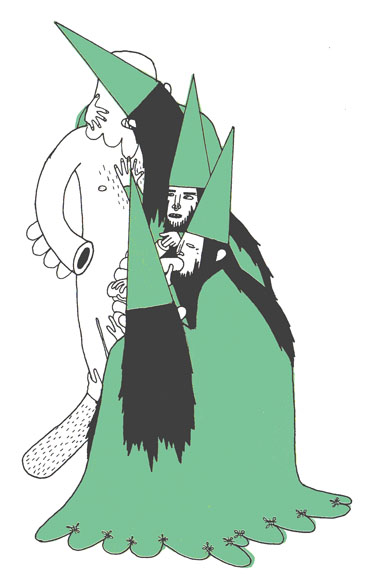
Gaylord Phoenix doesn’t quite jibe as a romance for the same reason it doesn’t quite jibe as anything else. Gender and genre share more than just a Latin root; they’re bound together, and if you violate the conventions of one, the conventions of the other start to unravel as well. The result in Gaylord Phoenix is that, while some individual moments are familiar enough, they never fit together in the way you’d expect. For example, at the beginning of issue 4, Phoenix is summoned through a magic ritual performed by a group of four rather grotesque wizards, all of whom share a single gigantic beard. Phoenix asks them to help him find his evil doppelganger “other.” The wizards tell him “the other lies within you”: a straight-forward, high-fantasy, Jungian Yoda interchange. Then, on the next page, and without missing a beat, the wizard-clump offers “to draw [the other] out” — and proceeds to perform oral sex on our hero.

v-1
Gaylord Phoenix #4

Surreal shifts in genre and tone are a pomo default setting at this point, of course, from the smarmy ironic nudge-nudge of McSweeney’s to the exhilarating ironic bricolage of Japanese post-everything rockers the Boredoms. But that’s not where Gaylord Phoenix is coming from either. In the first place, Fake’s narrative doesn’t have the forced, performative feel of Borges — or of Paper Rad, for that matter. Nor is Gaylord Phoenix ironic. In fact, everything that happens in the story has an elegant, even heart-felt logic. Thus, in the scene with the wizards, it makes perfect sense for them to try to bring forth Phoenix’s “other” through fellatio — remember, the doppelganger manifests after Phoenix has sex. Moreover, throughout the book, and with pornographic inevitability, everyone Phoenix meets wants to fuck him. But though the wizard menage is telegraphed in some sense, it’s still basically asexual-wise-men porn. As such, it caught me completely off-guard, even on my second time through.

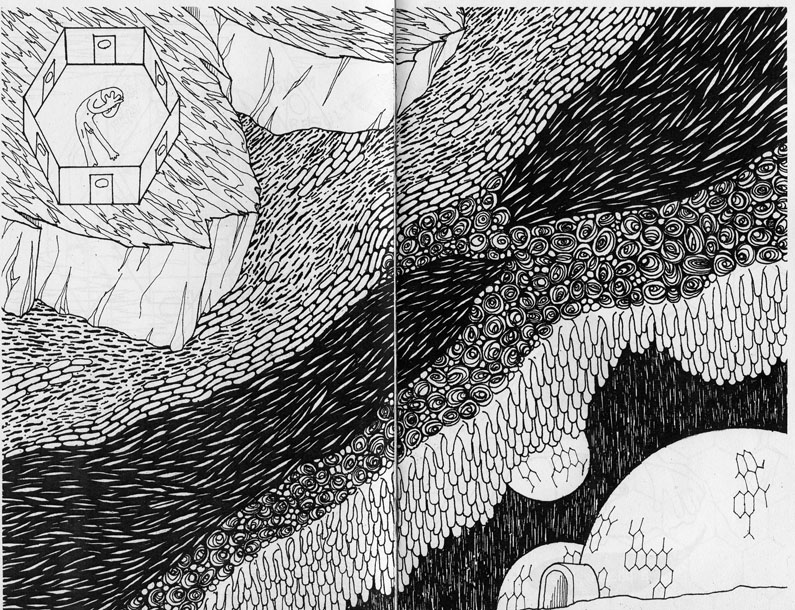
Fake’s use of narrative is deft and surprising. As in dreams, however, while the existence of the plot is important, the twists and turns are not exactly the point. Thus, the summary of issue 1 at the beginning of issue 2 is more than a simple recap. It’s a work of art in itself — a koan stenciled in uneven lines and written in a half-cracked patois (“the gaylord phoenix/born of crystal claw/killed his love on desrt [sic] sand &/ flees to pyramidal city/while his murder dies/ below the earthshell.”) In fact, throughout the series, the parts and the whole don’t so much compete as shimmer and change places. Instead of using traditional panel borders, Fake treats each page or two-page spread as an individual composition. In one image, Phoenix’s headless lover spouts gorgeous, simplified leaf shapes and giant, almost photo-realistic nuts and bolts from his neck stump and tubular penis. In another, a centered, black, ghost-like creature with fangs explodes in a twisting mass of severed tentacles and wounded swordfish from the mouth of a textured volcano; to the sides, forming a kind of background, are masses of intricately and identically patterned fish. In an image from the fourth book, which uses green as a spot color, Phoenix stands in a forest — five black-and-white tree trunks rise up to a mass of black and green geometric leaf shapes which form an impenetrable canopy; a black cloak floats in the air, spouting leaves, while above Phoenix’s head the stenciled text ominously reads, “You are under many spells.”

I could go on. And on. Every time you turn the page — especially in issues 2, 3, and 4 — you’re looking at a different, separately imagined work of art. Obviously, this doesn’t contribute to speed of reading. Instead, the narrative slows down, frozen, as you take in each image. The sequential movement of the book is vitiated; it doesn’t really read like a comic at all. Instead, it’s like pictures from a dream — or an art gallery. Indeed, in both his obsession with design and in his elegant mastery of the boundary between representation and abstraction, Fake seems like a Bauhaus artist who has wandered out of his proper era, a formalist mystic cast adrift in a sea of slapdash, toked-up mini-comics rebels.

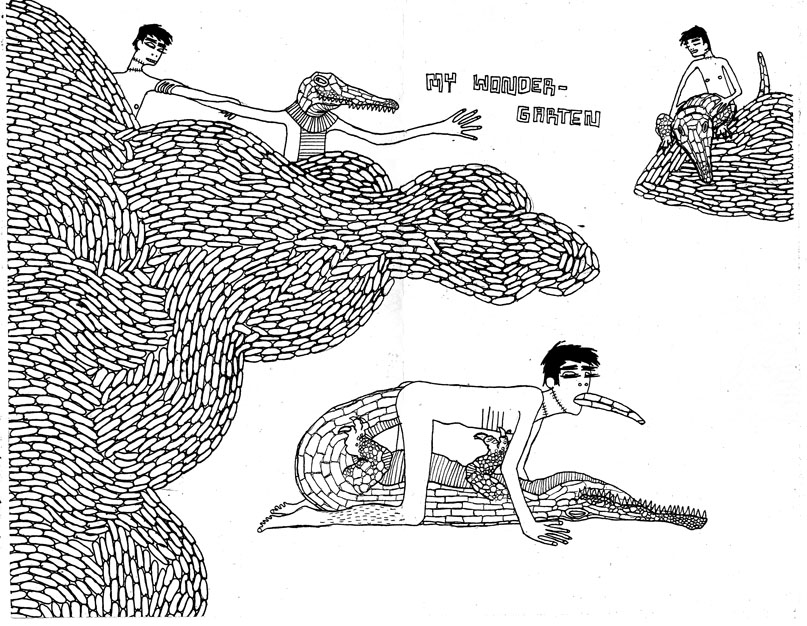
Not that Fake is Paul Klee — or anybody else, for that matter. Gaylord Phoenix is that true rarity, an honest-to-God uncategorizable piece of art. At some moments, the strangeness is deliberately awkward and funny, as in a goofily suggestive scene where the black ghost/sea vapor creature hangs above a psychedelic whirlpool and inquires suggestively, “do you admire my vortex?” At other moments, though, the sense of alienation is haunting, or even oppressive. During a sex scene in issue #2, a resurrected, hypnotized man with visible stitches around his neck has sex with a variably humanoid crocodile. In one ecstatic drawing, the crocodile’s tail goes into the man’s anus and out his mouth. In another, the man is three men, one sitting astride the crocodile, one with the crocodile’s nose in his tube-like, oddly vaginal penis, and one with the crocodile’s tail going into his ass, the tip emerging from his cock. In the background, vaguely organic forms flow and pulse, each tiled with what looks like crocodile scales.

v-2
Gaylord Phoenix #2

These sequences again suggest Fake’s connection with romance. This is a tradition in which identity, gender, and sex are both linked and fluid, leading to the compulsive body-morphing and androgyny in shoujo or the oceanic fusion with nature in D. H. Lawrence’s love stories. Usually in romance, though, there’s something to hold on to (genre tropes and drawing style in shoujo; the realism of Lawrence) which makes the mystical experience of desire seem, well, mystical. For Fake, though, there’s no anchor to which the self is attached before it comes under assault. In the first scene of the first book, Gaylord Phoenix (sans penis) is “exploring the secret grotto” (the unconscious? the womb?) when he is attacked by “crystal claw,” which enters him through his leg and brings his doppelganger (and his male genitalia) into being. There’s no moment when he is himself. On the contrary, his lack of identity — his bifurcation, his memory loss, his sexual ambiguity — is what defines him. Similarly, he and other characters move from landscape to landscape (cave, maze, sea, forest) with the unpredictable suddenness of Alice falling down the rabbit hole. But this isn’t Alice. Fantasy and reality, internal and external, aren’t even provisionally distinguishable. The self and the world are one constantly mutating whole. There is no waking up.

Fake’s disquieting perspective on gender sets Gaylord Phoenix apart even from other queer-positive comics, like Alison Bechdel’s Fun Home. Bechdel’s book is, like many gay narratives, obsessed with the dichotomy between truth and fiction, and with the importance of being faithful to one’s real self. The catch is that the structure, or “self”, of Bechdel’s by-the-numbers memoir is a cluster of clichéd literary tropes: as the old joke goes, the book urges you to be unique, just like everybody else. Gaylord Phoenix, on the other hand, is really and truly bizarre, in part because it seems to deny the possibility, or even the existence, of a separate, distinct inner core.

Fake’s vision is a little closer to that of Lost Girls — in which Alan Moore and Melinda Gebbie imagine a sunlit tomorrow where bodies and pleasures flow deliriously and without restriction. The difference it that, in Gaylord Phoenix, the merging of id, ego and reality is not a hope for the future, but the world as it is, and it’s not exactly a utopia. Who we are and what we want — our relationship to each is like our relationship to dreams, mutable, illusory, and tenuous. For Fake, “queer” isn’t a biological quirk, or a marketing niche, or even an oppressed minority. Instead, it’s an insight: a recognition that the boundaries of our desires, and therefore of our identities, are both arbitrary and fragile. That recognition is sometimes beautiful and sometimes frightening, but it is always there, and it is inescapable. “Help yourself,” Phoenix’s companion tells him at the end of issue four. It’s good advice, offered with love. But it also prompts the question, “Help who?”

v-3
Gaylord Phoenix #3

A version of this essay was first published in The Comics Journal
********
Edie Fake’s website is here.

Edie Fake is participating in a symposium on the Gay Utopia which I’ve organized, and which should be online (hopefully) in late January or early February. Other participants include Dame Darcy, Johnny Ryan, Ariel Schrag, Dewayne Slightweight, Ursula K. Le Guin, Jennifer Baumgardner, Scott Treleaven, and more.

Weird Foot-Man

So my 4-year old son is absolutely, completely, ridiculously obsessed with Spider-Man. I feel this is probably some sort of punishment for my sins as a comics critic. In any case, it has its ups and downs. Specifically, the downs are when he throws himself at my legs every, oh, 15 seconds, shouting, “I’m Spider-Man!” causing me to lurch chinward towards whatever piece of furniture is placed nearby. The ups are when he explains as he’s sitting on the toilet that Spider-Man doesn’t poop real poop; he poops webs.

But actually, the real worst part is the children’s books. Has anyone ever seen these things? There are several series of them. One’s published by DK Readers, and is written and I guess drawn by someone named Catherine Saunders. I’m sure she’s just the front name for a whole committee apparatus, but I must focus my ire somewhere, so I will hate her on general principles. Christ these things are horrible. The art is just ridiculous; the anatomy is so completely fucked up that even my son makes fun of it (one picture where Spider-Man’s leg ends in what appears to be a traumatized zucchini always causes him to look up at me hopefully and ask, “That’s a foot, right Daddy?”) And furthermore — and this is the kicker — there’s no story. None. I guess they just couldn’t be bothered with little things like plot, so instead it’s set up as a kind of Thrilling Encyclopedia of Boredom . “Spider-Man usually works alone, but sometimes even he needs help from his Super-Hero friends.” Now try reading that. A. Hundred. Times.

There’s another series based on the third Spider Man movie put out by HarperCollins which does in fact have a moderate effort at creating a story, and that’s a little better though, really, not much. My son does love them…but why do they have to be so, so bad? He likes Spider-Man videos too, and those are perfectly watchable; decent animation, entertaining action, etc. etc. Why do the books have to be such pieces of crap? I’ve actually been reading some of the old Lee/Ditko comics to him; he loves those too, and reading them doesn’t make me want to scrape out my eyes. If Marvel wants to get parents on board…or, for that matter, kids on board for the long haul…maybe they might consider putting a little imagination, or at least thought, into their customers first contact with their product. I mean, if they can’t find any artists, why not use some of Ditko’s original drawings? Please?

Million Man Talk: Review of Deconstructing Tyrone

A version of this essay appeared in the Chicago Reader a while back.

The image of black men tends to provoke strong reactions in the media, whether pro or con. At the beginning of “Deconstructing Tyrone,” their study of black masculinity, Natalie Hopkinson and Natalie Moore pledge not to get caught up in the antagonistic hype. “The positive-negative thing? We are *so* over that,” they insist.

Even-handedness can certainly be a virtue when approaching a complex topic. But it can easily tip over into a bland refusal to stake out difficult positions — or any positions. The latter seems, unfortunately, to be what’s happening here. The authors are journalists, and they have essentially stitched together a book out of moderately insightful feature articles. There’s one chapter on Kwame Kirkpatrick, the young, black and (allegedly) swinging mayor of Detroit; one on being black and gay; one on females strippers and their dads; one on Buppies raising boys, and so forth. The style is chatty, informed, and ultimately positive, mining the common ground between NPR and Oprah. There are, inevitably, a few forays into more literary territory — in describing video performer Melyssa Ford, for example, the authors inform us that “Her long ponytail sways gently like spring leaves on a maple tree.” Luckily, these moments are few and perfunctory.

Though the book isn’t exactly thoughtful, it does contain a lot of suggestive tidbits. It’s interesting to hear, for example, that gay male style is much more straightforwardly masculine, and much less flaming, than it was a generation ago. It’s interesting to be introduced to Earl Thomas, a professional basketball player who has also made a reputation for himself as an activist poet. It’s interesting to learn that Jay-Z tells white people in his audiences not to chant along to “Nigga What, Nigga Who.” It’s interesting to learn that black men with a high income are less likely to marry than those in the middle-class. And, of course, the interviews with strippers and video chicks are interesting— or, at least, even in the authors’ studiously unexploitative prose, they make sensational copy.

In fact, what’s most frustrating about the book is that it raises so many issues and then leaves them dangling, not only without analysis, but without any sense that analysis is even necessary. The authors spend a certain amount of time discussing media representations of the “down low”; a term for closeted gay black men. But there is no discussion of homophobia in the black community, nor of how important the closet has been , in one way and another to black cultural expression (gospel music wouldn’t be the same without it, as just one example.) Similarly, the book takes several offhand jabs at feminism — but there’s no effort to explore the ways in which feminism has (or hasn’t) failed blacks, and vice versa. A chapter is devoted to interviewing female strippers about their dads — but , beyond a few lame references to a Chris Rock skit, the authors never explain what, if anything, this has to do with race. Certainly, the strippers are black, but their stories of abuse, impoverishment, and the lure of easy money don’t sound much different than those of white sex-workers, from Jenna Jameson on down. The black sex industry may well uniquely reflect black masculinity, but you’d never know it from reading this.

Theory — or at least some kind of point — is important because it gives a book direction; it helps to determine which details are important and need to be developed, and which ones are useless and should be chucked. More than that, though, it gives a work coherence and resonance. Hopkinson and Moore do seem to have a dim sense that they’re adrift, and they’ve tried to rectify the problem by ostentatiously claiming to be using deconstructionism. According to them, deconstruction as a philosophy is meant to “to take apart fake constructions to reach a greater understanding.” In other words, Derrida —an abstruse aesthete who spent his life generating impenetrable prose about unknowability — is here rejiggered as some sort of muckraking newspaperman, battling falsehood in the interest of the uplift. What next? Foucault as advocate of safe sex?

Since they clearly don’t have the slightest idea what deconstruction is, it’s no surprise that, despite the title, Hopkinson and Moore don’t actually use it. Nor do they replace it with any other critical lens. They do occasionally express opinions — they dislike sexist rap videos, for example, they think that “black male-female relationships have become crippled.” (page 103) and they really liked the 1994 Black Male exhibit at the Whitney. But without any intellectual framework, each contention boils down to little more than arbitrary personal preference. For example, the clearest reason the authors can provide for liking the Whitney exhibit is that it was among the first shows to place film stills and news photographs on a museum wall. Whoo hoo. Even when Hopkinson tells the story of a family friend who was convicted, probably wrongly, of murder, she can’t get any moral traction. Instead, the narrative drifts off into the familiar evidentiary minutia of true-crime drama — efficient, entertaining, but not particularly passionate.

In the not too distant past, any book which treated black men as human could have claimed to have a righteous, even subversive, agenda. But that is no longer the case. American institutions — schools, housing, prisons — remain racist and discriminatory. Yet the rise of a fairly stable black middle-class has meant that African-Americans are, at one and the same time, an oppressed minority and just another demographic marketing niche. Race sells, at least to a limited audience. It’s a product as well as a problem.

Hopkinson and Moore probably wouldn’t explain the transformation of racial discourse in quite this way. But they do recognize it and are, in fact, as enthusiastic about it as they are about anything. Thus, they earnestly praise the “Million Man March” because it was a media circus rather than an actual political movement. The march, they say, “launched a new front in black politics in which battles are waged in the realm of perception.” [page 38] This is a comforting thought, surely; changing the world doesn’t require thought, or sacrifice, or discomfort. With apologies to the Beatles, all you need is a PR campaign. Or a 200-page sound bite, as the case may be.

Perception and/or the media were important to the Civil Rights movement too, of course. King and his cohorts were brilliant at manipulating both black and white images, and then beaming them across the world via television. Civil Rights protestors weren’t focused on the images themselves, however, but on what they could get from them — on how they could leverage the perceptions they created into concrete political gains. This is very difficult to do, and especially in the north, it wasn’t always successful. Still, you can’t get anything if you aren’t willing to figure out what you want and develop some sort of strategy, however flawed, for getting there. Hopkinson and Moore seem to think that it they just say something, or anything, then they’re a force for good. Perhaps they’re preaching will entertain the choir. But it’s unlikely to do much more than that.

A Scanner Darkly: The Comic

Richard Linklater’s “A Scanner Darkly” is easily the most straightforwardly faithful Phillip K. Dick adaptation to reach the screen. It adheres closely to the novel’s words, and is suffused with a sense of reverence.

Unfortunately, that’s kind of a problem. Dick’s books were remarkably unfaithful, even to themselves. A typical Dick novel reads as if he’s thinking only about one paragraph ahead of the reader. Narratives dead-end, expectations are ruthlessly ignored, profound insights turn into pratfalls and vice versa. For a writer so enamored of aesthetic messes, a spirited desecration like “Blade Runner” is more in the spirit than Linklater’s sincere homage.

When Linklater does change the material, he consistently dumbs it down. At one point in the novel, Arctor is coldly dissed by his girlfriend Donna Hawthorne; in Linklater’s version, this scene turned into a tender, romantic moment. Even worse is the treatment of the rehab center New Path. Linklater tells us right from the beginning that New Path is evil; Dick saves the information till the end, so that it appears to come almost as an afterthought. And, of course, Linklater adds gratuitous scenes condemning police brutality, complete with some dude in a bullhorn praising freedom. Subtle, Rick.

All of the movies faults are further accentuated in the comic. The movie’s animation was created using computer software to animate over live-action footage; it doesn’t look good onscreen, but the stills used as comic art are absolutely hideous. Nor has anyone made any effort to translate the movie’s effects and rhythm into comic form. The main special effect — a scramble suit which causes the wearer to look like one person after another in quick succession — doesn’t work at all in a static image which lets you see only one set of features. Comic timing is relentlessly ignored; still images seem to have been selected almost at random by a machine. The one concession to comics form — additional narrative text blocks written by Harvey Pekar. are woefully clumsy. A typical one informs us that, as a car speeds out of control, “…high speed chaos reigns….”

In other words, this graphic novel is a pale shadow of a pale shadow. Do yourself a favor — skip the comic adaptation, skip the movie, and just go read (or reread) the novel. Philip K. Dick was fascinated by imposters and facsimiles, but he himself was inimitable.

This review was first published in The Comics Journal a while back.