
I’m kind of swamped at the moment, so blogging will probably be minimal this week.
Tag Archives: Noah
Asterix and the Abstract Formalisms
As I’ve mentioned on the blog, I’m working on a series of abstract drawings based on comics pages from my youth. The most recent one I’ve worked on is a page from Asterix and the Olympic Games.
Copying the page has been a real eye-opener (semi-literally.) I first read Asterix when I was living in England during the third grade (my dad was on sabbatical at the time.) At that time, I probably liked Uderzo’s art well enough, but is was Goscinny’s (translated) stories — the manic, over-heated dialogue, the slapstick, the goofy puns, the running gags — which really appealed. For that reason, some of the later volumes, when Goscinny had died and Uderzo was doing the writing as well as the art — were especially unsettling. Everything looked right, but the writing was completely wrong: it was like seeing a corpse walking. The form was there, but the soul was gone.
Looking at the comic again, the writing is still marvelous, but I’m also amazed at the quality of the art. This sequence in particlar floored me:
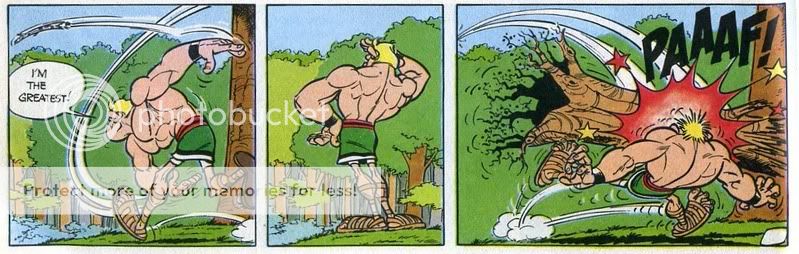
The way the movement lines are incorporated as a composition element is lovely. The character occupying the left side of the panel is neatly balanced by the intersecting lines showing the circle of the hand and the flight of the sapling/javelin. Uderzo also narrows and twists the main big arc; looking at the lines, you can actually see the moment when the throwing hand turns over. The little puff and jump by the foot is eloquent — you can actually feel him hopping forward as he releases the javelin. Everywhere you look in the panel there’s movement, and your eye arcs from one path to the next. The position of the body is also amazingly well done, especially considering that this is a very cartoony figure. The twist of the torso, the slightly separated fingers of that left hand, the jaw lifted to watch the flight, and (again) that amazing little jump with the foot.
The body language in the second panel is perfect too. It’s narrower, so the figure is more centered, and it’s the first panel on the page with no movement lines, emphasizing that it’s a moment of stillness. The curve of the back and the cocky turned-out hand on the hip suggests the outthrust chest and the smirk that we can’t see. It’s a great pause for comic timing —followed by the climax, with all the comic tropes trotted out — stars, giant sound effect, stars, and impact effect. Again, the little detail of the puff of smoke and the movmeent lines by the feet kill me (and him!) The tightened hands are perfect, and I love the way that the left hand and foot are drawn on top of each other, so that at first it looks like his fingers are a blur. That roots on that tree he’s been bashed with are also really nice. And, of course, the movement lines showing the path of the tree mirror the ones in the first panel, as does the whole composition. Throw left-pause-bashed right: it’s a stream-lined, efficient comedic delivery system, professional in absolutely the best sense — as elegant as Bushmiller’s Nancy with, to my mind at least, a lot more energy and panache. After looking at it, I wonder if I should go back to those Uderzo-written volumes just for the art.
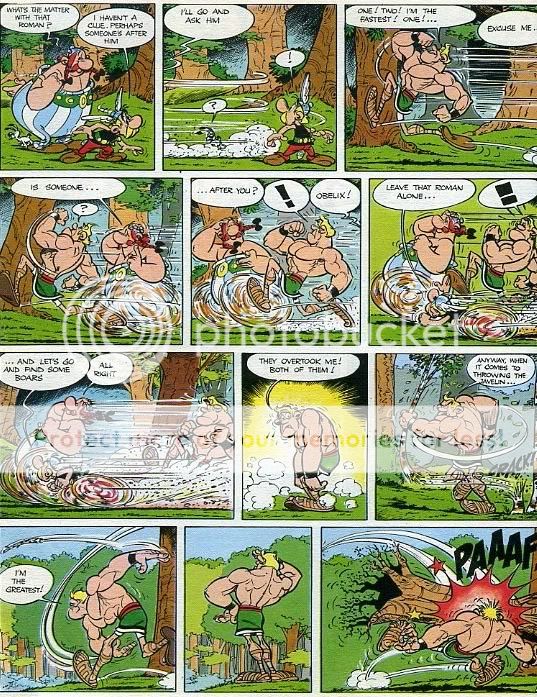
So, yeah, there’s nothing like trying to copy somone’s art to give you an appreciation of their craft (and the limitations of your own.) For those interested, here is the whole page, copyright Goscinny and Uderzo.
And here’s my version:
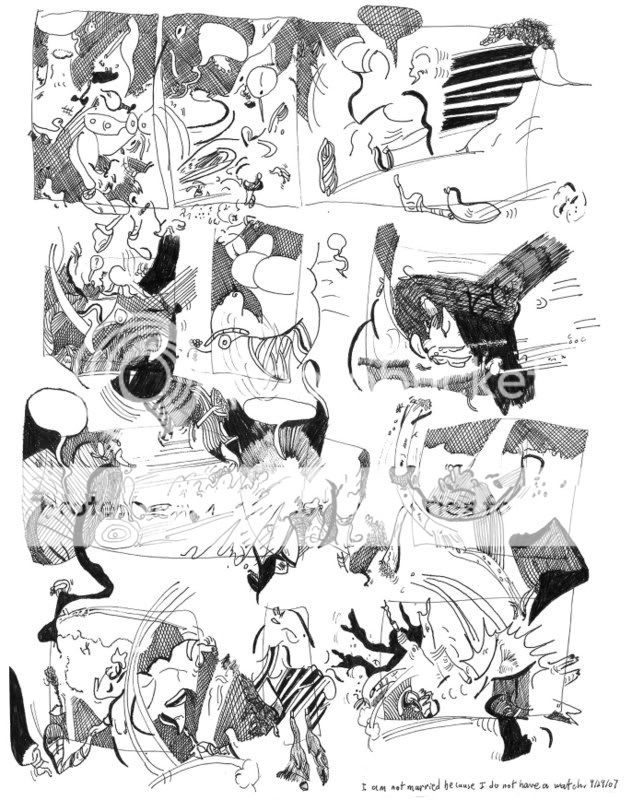
There’s a quote from my son in the bottom corner of mine: it says, “I am not married because I do not have a watch.”
Are Boys Safer?
Poking around the Internet I found this article by J.D. Ho on The Horn Book website which attempts to answer the age-old question why do girls love boys’ love manga. I think the question is a little overdetermined — why is any genre popular, after all? Super-heroes? Sci-fi? Isn’t it a little random that so many people are obsessed with tales about detectives hunting down a murderer? Any genre looks fairly arbitrary once you take a step back from it. As Ho does indicate, shonen-ai stories are extremely well-told and the art is excellent. Does there need to be another reason for people to read them?
In any case, the answer Ho comes up with, like the question, is familiar:
And herein lies the real appeal of boys’ love manga. It postulates that gender fluidity and change are ways we can identify with those who are different from us, experience new things, and, most importantly, achieve things that were impossible before. Just as in As You Like It, changing gender is liberating, an escape from parental strictures, and a means of getting the things one wants. We all need a safe place, a Forest of Arden, where we can try on different identities without consequence, a place where we can resolve our problems and face our fears — and boys’ love manga provides exactly that.
In other words, the appeal is that the reader can pretend to be something she is not, and so transcend her own boundaries and limitations in a safe space. Girls like to imagine boys because boys aren’t girls, and so the identification is safer and more fantastic. I think this line is especially telling:
If female readers are empowered by reading stories in which men are the romantic principals, they may derive the same feeling from stories in which gender is completely irrelevant in other ways.
So for Ho, the point of boys’ love stories and (as the essay goes on to argue) cross-dressing stories is that gender doesn’t matter, or is made irrelevant — it’s a way out of male/female binaries.
That position seems awfully questionable to me. Surely a large part of the appeal of boys’ love manga is that, you know, girls like boys. And if you like boys, why wouldn’t two boys be better than one? The fact that shonen-ai often blends into, or looks towards, the steamy sex in yaoi isn’t an accident these books are erotic. Girls like them because they’re romantic and sexy. If guys like to watch girls having sex (and they do), why wouldn’t girls like to watch guys having romance, followed by sex?
And ditto, for the gender-bending. Yes, experimenting with possibilities is liberating and exciting for the young girl coming of age etc. and so forth. But that liberation and excitement *are* liberating and exciting in large part because they carry a polymorphous sensual charge.
Boys’ difference isn’t safe — it’s sexy. Ho is writing on a site dedicated to children’s books, and I guess it’s understandable that they don’t want to tell the parents that little Sally reads these comics because she gets off on them. But I think she probably does.

Not sure if this is the illustrator or not, but I got this image from here.
Scott Treleavan
My arts correspondent Bert Stabler tipped me off to this artist, who is pretty great. Check out his work:
http://www.kavigupta.com/artists/treleaven/st_images.html
Are You Token To Me?
As long as I’m obsessively blogging about gender issues, I thought I might weigh on the conversation Valerie Dorazo and Dirk Deppey are engaged in. Dorazo argues that more gay characters in comics would be a good thing and that someday gay characters will be (or at least should be) as well, um, integrated into mainstream titles as black characters now are. Deppey responds by saying, eh, who cares?
I think this is basically an argument about tokenism, which makes it also an argument, to some degree, about segregation and isolationism. Dorazo believes that, overall, any more or less positive representation is good. It combats prejudice, normalizes marginalized groups, and leads to greater peace, equality, and happiness for all. And if I got a little sardonic there…well, it’s hard to take it entirely seriously when the model for success in comics is black folks, who remain massively underrepresented as characters, and even more underrepresented as creators. In fact, its hard to think of another segment of the entertaiment industry other than country music in which people of color are so thoroughly absent and marginalized — and this despite the fact that mainstream comics has been engaging in various forms of tokenism for the last what? 40 years or so?
Dirk’s essay, on the other hand, reminded me of a speech I saw by Aaron McGruder at the University of Chicago. McGruder was answering a question about why he had cut all the female characters out of his comic. He said that he had done so because he knew more about male characters. He also said that he didn’t think it made sense to insist that every creator represent or talk about every demographic. He added that in general he would just as soon not have clueless white people trying to write blacks. As an example, he pointed to Smallville, in which Superman’s best friend is black. “What on earth is a brother doing in Smallville?” he sneered.
It’s a pretty funny point, but also a big more double-edged than McGruder may have intended. It’s true that black people are more likely to live in cities than in small towns — but that’s not an accident. Nor is it due to the fact that African-Americans like cities better than do Caucasians or Jews. Rather, black people live in cities because of a history of segregation and racism. As James Loewen quite conclusively argues in “Sundown Towns,” blacks in the north used to be fairly evenly distributed in urban and rural areas. Then in the post-Reconstrution era, race relations became much worse, and blacks in a huge number of small towns were forced out by threats, lynchings, race riots, and other forms of violence. In defense, blacks congregated in cities, where the more anonymous nature of urban living and their relatively large numbers made them impossible to dislodge (though some cities did try.)
In other words, McGruder is mocking the idea of enforced integration, and using as his argument an example which points back to a history of enforced segregation. I think Dirk is doing something similar when he defends super-heteroness on the grounds that, hey, who wants to hear clueless straight dudes talk about gayness anyway? On the one hand, of course, he’s absolutely, and clearly, right. But why are comics writers so especially clueless about this issue? After all, there are a lot of super-hero comics about, say, environmental concerns which, while not especially or necessarily great, aren’t noticeably dumb by the genre’s standards of story-telling.
It seems to me that super-hero comics — in their content and demographics — are especially ill-suited to deal with gender and sexuality. Masculine bonding and masculine fantasy are at the core of what super-hero comics are about. I think that’s why tokenism is going to generally feel like tokenism. To deal with gay issues, you’d really have to work against genre expectations in some fairly conscious and intelligent ways.
So I guess I think that Dorazo is right in suggesting that the exclusion of gays in super-hero comics is telling and kind of icky. And I think Dirk is right in saying that tokenism is not likely to help matters much.
Further natterings on these issues:
Cerebus is gay
super-heroes are gay
if super-heroes embroidered, would it be gay art?
Man and Super-sweater
I’ve been writing a bit about super-heroes and masculinity, so I thought I’d unearth this piece I wrote about the subject, which ran in a somwhat altered form in the Chicago Reader several years back. The essay is a review of an art exhibit by Mark Newport; you can find some examples of his art here and here.
Man and Super-Sweater
Super-heroes, comics, and boys go together like sugar, spice, and girls — that is, they don’t, particularly, but people keep repeating it anyway. Today comics have largely cast off their younger audience; the average reader these days isn’t a boy, but an adult male in his 30s. Super-heroes, meanwhile, are all over both television and film. It’s true that the majority of high-profile American comics still feature super-heroes, but even that may be changing with the recent manga explosion. Yet in popular perception, “comic-book”. still means “super-hero,” “super-hero” still means “comic-book,” and both conjure up images of little Jimmy going to the corner drugstore to pick up the latest issue of “The Mighty Thor” or “Captain Carrot and His Amazing Zoo Crew.”
One unfortunate example of this ongoing pop-culture blind spot is provided by Mark Newport’s current exhibit at the Chicago Cultural Center. On display are nine knitted super-hero costumes, and seven found comic-book covers, to which Newport has added his own embroidery. Newport explained his raison d’etre in an interview with the Sun-Times: “Knitting, beading and embroidery are traditionally thought of as somehow being female. Superheroes are [predominantly] male. In combining the two, I’m playing with gender expectations.”
This is straightforward enough — and therein lies the problem. Many super-hero comics do, of course, involve manly men doing manly things with rippling muscles, preposterously proportioned females, and high-tech weaponry — take anything by Frank Miller, for example. But the genre has been around for seventy years now, and it has produced many other kinds of stories as well. For instance, many of the classic DC super-hero tales from the ‘50s, ‘60s, and ‘70s are fantasies of *dis*empowerment and *im*perfect physiques. A well-known issue of the Flash features our speedster (the victim of a sinister ray) rapidly putting on pounds until he’s simply too fat to run. One of the greatest Mike Sekowsky Justice League covers shows Green Arrow turned into a hideous dwarf and Green Lantern stretched out like Gumby. Better known than these, perhaps, are the great early Spider-Man stories. Borrowing from his experience on romance titles, Stan Lee made Peter Parker an icon of hopeless yearning, frustrated in love, despised at school, misunderstood, alienated, and miserable in both his identities. Steve Ditko’s art was moody, his figures hunched and skinny. All in all, Spider-Man was about as emblematic of virile maleness as Jimmy Corrigan.
Newport doesn’t completely ignore the varied history of masculinity in comic-books. Several of the covers he embroiders were clearly chosen because they presented slightly off-kilter takes on gender: for instance, a 1983 Captain America cover shows an unconscious Cap being rescued by “Bernie America” — his girlfriend in a super-suit. But Newport doesn’t really engage this image in any meaningful way: he simply embroiders over the featured super-heroes’ costume and adds a few touches of color to the design. According to the gallery blurb, the “’preciousness’” of the needle-work is meant to “undermine…the grandeur of super-hero lore” while at the same time emphasizing the themes of protection and love. Whatever the intention, though, his approach is unvaried and simplistic. He might have attempted a dialogue with the pictures, altering them or interpolating new images of his own. Even redoing the entire cover as a pillowcase would have made more of a statement. Instead, unfortunately, Newport takes the art he’s working on and the context in which it was created far too much for granted.
As a result, the covers that Newport is working on overwhelm his artwork. Catwoman #27, for example, shows Batman touching his lips to Catwoman’s forehead. Newport has embroidered Batman’s suit, which is clearly meant to contrast against the sexy Catwoman outfit. The effect is completely spoiled by the utter shittiness of the cover art, however. Mainstream comic drawing has fallen off disastrously since the industry imploded in the ‘80s, and this is a prime example. Catwoman’s anatomy and position make her appear oddly bloated; the texture of her costume is nothing like leather, and her expression is simply bizarre; all in all, she looks like a mildly confused and over-inflated blow-up doll. Similarly, the cover of the fourth issue of Rawhide Kid (a little-read, much-panned Marvel series starring a stereotypically gay cowboy) features the smirking title character straddling a rearing, embroidered horse. What one notices first upon looking at it, though, is not the embroidery or the smirk, but rather that the illustrator appears to have accidentally left out the hero’s skeletal structure.
Newport’s one-size-fits-all method actually seems to work best when the cover art is mediocre; embroidery adds a touch of expressionist mystery to the workmanlike cover of Batman #402, for instance. When the cover art is good, on the other hand, Newport’s additions become downright annoying. Thus, the cover of Batman #329 shows Batman kneeling dramatically in chains, his face twisted in pain. The musculature is well rendered, and the despairing, strained pose looks like something out of Greek statuary. Jim Aparo, the penciller and probably the inker as well, was one of the unsung stalwarts at DC in the ‘70s and ‘80s, and he has put a good deal more imagination into this cover than Newport, who has — you guessed it — added embroidery to Batman’s costume. At this point, Newport’s obliviousness starts to shade into condescension. He seems barely aware that he’s interacting with another artist. His work functions as a monologue, in which he points out the same couple of points again and again, rather than a dialogue with the work he’s cannibalizing. In short, he doesn’t seem to have thought about the craft of the covers he works on, which makes me wonder why I should bother thinking about his.
But while Newport’s embroidered pieces seem half-hearted and presumptuous, his knitted super-hero suits are much more successful. The costumes manage to strike a perfect balance: they’re detailed and accurate enough to almost be intended for real super-heroes, and yet they also seem like they could be intended for real children. Many of the suits end in footies, and most are fastened with large, comfy-looking buttons. Batman’s mask is practically a winter hat with decorative fluffy ears; the Rawhide Kid’s gloves are attached to his sleeves with string, so he won’t lose them. Mr. Fantastic’s costume is ten feet tall, to accommodate his ability to stretch; the arms are normal-sized, however, and against the enormous torso they look like they belong on a toddler’s sweater. While Newport has made some effort to accommodate Reed Richards’ abilities, however, Aquaman is not so lucky; his outfit is clearly not going to be of any use in the water. Iron Man’s woolen armor is even more impractical, though the control knobs on his chest are faithfully represented by two puffs of yarn.
There are a couple of false notes. The Patriot, a character Newport invented himself, is a bit too obvious — the costume is red, white, and blue, and the mask has a mouth hole but no eyes. Similarly, there’s nothing particularly interesting about the costume of the Escapist, a character invented by Michael Chabon for his novel The Adventures of Kavalier and Clay. Like his efforts to alter comic art, Newport’s forays into political commentary and literary hipness fall flat.
The truth is, as a cultural commentator, Newport is a fine designer of super-hero merchandise. The guard at the cultural center said that kids called the show a “Halloween exhibit,” and that’s exactly what it looks like. The familiar uniforms should clearly be on sale to children of all ages — and in the Sun-Times interview Newport notes that he is, in fact, frequently asked to create personalized costumes. Newport always has to decline these commissions, since it takes him two months to make each suit. But the ease with which his work is mistaken for mass-produced consumer schlock suggests that his art is less about undermining cultural expectations than it is about fulfilling them. In the realm of marketing, super-heroes are kind of like dinosaurs — icons of power, largely devoid of any other significance, which are especially popular with children. It’s worth noting, too, that when worn by a child, a hyper-masculine (or hyper-feminine) image is often viewed as cute. Newport’s super-suits are charming for the same reason that it’s charming to see a child dressed as the Incredible Hulk ask you for candy. They’re the greatest underoos ever made. That doesn’t mean they’re worthless — I enjoyed the exhibit and if you have any affection for super-heroes, knitting, or costumes, I’d encourage you to go and take your kids. Whether the show has anything insightful to say about our society’s conception of masculinity, though, is another question entirely.
*********
This review prompted one letter:
In Noah Berlatsky’s review of the Mark Newport exhibition, in making reference to Mark Newport’s alterations on the cover art of Catwoman, vol.3, #27, he writes this comment: “But what I noticed before any of that was the utter shittiness of the illustrator’s draftsmanship. Mainstream comics drawing has fallen off disastrously since the industry imploded in the 80’s,..”
Well, sharp-eyed readers with some knowledge of the comic book industry will notice that the artist responsible for the cover of this issue of Catwoman is Paul Gulacy, who made his industry debut in the 70’s, and is known for his meticulous design and composition. Perhaps Mr. Berlatsky is like the man who has been in the audience of the magic show for too many performances, and now the tricks are beginning to bore him?
Michael Reese
*********
This is embarrassing for me, of course, in that I didn’t recognize Paul Gulacy’s work…but also kind of embarrassing for Paul Gulacy, whose work on that one cover, at least, was not up to his earlier standards. Ah well….
Hey! You’ve Got Your Humanism In My Sexuality!
So I’m trying to put together a blog forum on “The Gay Utopia,” variously defined. I’m still in the planning stages at the moment, but my friend Bert Stabler and I were emailing back and forth about it. My comments were mostly distracted and half-assed (or, less charitably, punk rock.) But Bert put a lot of thought into his side of the debate, so I thought I’d post it for those interested in sexuality, philosophy, or email. (Some of my responses have vanished in cyberspace. And the dialogue starts in media res to protect the innocent and promote Latin.)
******
Bert:
Canceling sexuality (sex without sexuality), for example, is neither particularly primal or capitalist. It’s that weird Augustine immersion in original sin. Well, it’s a little reterritorialist, but it can definitely be counter-homophobic. The power and pleasure dynamics in Sade and Masoch barely need sex to operate, ditto Pauline agape universal-incomplete being-for-the-other love.
************
Bert:
Right– sexuality as a thing you own and represent and observe, a personal Jesus in your genitals. The genitals are much more mysterious as social objects than mere badges of pleasurable entitlement. Homo and hetero, it’s a sorry substitute for gender as a way to confront the world. Gregg Bordowitz says “All sexuality is queer sexuality” — which is true, insofar as it implies all sexuality is meaningless. It’s a synonym for “lifestyle,” essentially, and thus a stand-in and facade for economic, historical, and gender relations. Like “spirituality” attempts to hide “religion.”
Deterritorialization (a Deleuze term) describes the fundamental disintegrative force of (humanist)modernity, in which depth and centrality and “verticality” are turned into a flattened grid, there is iteration and “play,” boundaries are absent, identity is consumed and consumable, everything is marginal. Reterritorialization, a more murky term,(in my head) refers to an attempt to deal with artifacts instead of rhetoric, establish new boundaries and a new relevance for old discredited forms, re-energize large-scale affiliations. Shulamith Firestone is all about saying gender is essential, and looking at concrete social forms, and inventing weird new arrangements for things. Lewis is attempting a reconception of the human and animal cosmology, magical and divine, abjection and beatification. They both seem like reterritorializers to me, which is why they piss off the humanists.
*********
Noah:
Okay; sexuality *is* the identity (or refusal to identify, I guess); sex is actually putting the parts together, or discussing the parts in social isolation. Deterritorialization sounds like humanist deconstruction; weird.
If I remember right, Julia Serrano says that everybody has sexuality (who they want to sleep with); gender traits; and a subconscious sex (what they see themselves as, male or female or indeterminate.) All of them vary and none of them are dependent on each other (though I assume they can affect each other in various ways.)
*******
Bert:
My contention is that deconstruction is an essentially humanist analytical endeavor. A metarhetoric to end-all metarhetorics. Which doesn’t mean I don’t admire it– it’s just that I see it, like humanism generally, as an essentially destructive enterprise. Deterritorialization is not used by Deleuze to refer to humanism– it means taking one mountain and ending up with “A Thousand Plateaus” (the title of a book of his), or taking an arboreal root network and replacing with a rhizome (everything connected to everything).
I find it highly doubtful that “subconscious sex” (A very useful idea) is unconnected to someone’s gender(behavior and perception). Who they want to sleep with seems far less a part of their everyday existence, or anyone’s business.
*******
Noah:
Ah, I hadn’t realized that deconstructionism was now humanism. I’m not sure I entirely buy it, though — nor necessarily the idea that Lewis isn’t a humanist in some sense (I mean, the first humanists were Christians too…) And seeing Firestone as someone who reconstitutes gender seems bizarre, since she seems to want to abolish gender distinctions altogether. But perhaps I can wait for your argument and all will be explained….
I don’t think Serrano is arguing that they don’t have some connection; maybe more that they’re not determinative of each other and can vary in many ways. For instance, a person could see herself as a woman, be attracted to other women, and have many gender hallmarks of maleness (she could dress like a man, work on cars, be large and hairy, etc.) Or any other variations.
*************
Bert:
Post-structuralist does not mean anti-structuralist. Thomas Aquinas was certainly among the first humanists, and would probably have been unimpressed with my manhandling of equivocal terminology. Freewill, the pluralistic coexistence of language regimes, and the particularity of individual experiences was big deal for him, as it was for Lyotard.
Derrida argued with Descartes for being insufficiently precise with his terms. Tirelessly tracing back statements to their assumptions and castrating their ideological underpinnings is entirely in the tradition of rational disputation. Feel free to explain to me how that is not the case. “Justice is the undeconstructible condition that makes deconstruction possible.” Sounds like Kantian ethics to me.
Foucault is another matter. For me, he makes reterritorialization possible, by getting away from ideas and individuals and turning toward history and objects.
Reterritorialization is not about forgetting or purging humanism. But the possibilities created by Christianity, all the contradictions Christ embodies, have resulted in a ruthless and rationalized civilizational pride that He and his earlier interlocutors would deplore.
I would never argue that Lewis isn’t a humanist in some capacity. He loved Plato (though more than Aristotle, I think), but he also believed animals had a moral character (which Aquinas did not). The modern individual is not gendered or created, it is instrumental and fabricated, and Lewis stood against that, as have various justice-minded Christians and non-Christians of the modern era.
Isolationism Now!
************
Noah:
I don’t even know who Lyotard is, unless you’re referring to the gym attire.
You think Lewis believed that the modern individual is fabricated? In what sense? I think Lewis, like most Kantians, had a fairly universal sense of what an individual is. Nor would he have believed that the modern individual is somehow better or worse than other historical individuals (different, yes; worse, no.)
I’m not sure that humanism and rationalism are quite the same kettle of fish. Are economists humanists? Behavioral scientists? I guess if you’re arguing that a belief in human reason is the same as humanism; I generally take humanism these days to mean a sense that human nature is universal and lovable, though. If human reason is the standard, though, I don’t know how you can argue that Firestone isn’t a humanist — she’s a Marxist and a believer in the ability of science to recreate social truths. She’s Jeremy Bentham, basically.
************
Bert:
Jean-Francois Lyotard is the most consumnate of all the postmodern post-structuralists– all universal reified things are false, all particular micro-communities should freely express their individual languages.
Neoclassical economists are clearly humanists. Let individuals make free choices in a market structure reflecting common usefulness. Marx is less clearly a humanist. People act (consciously or unconsciously, it doesn’t matter) in their class roles, sometimes in their class interests, but essentially their production defines them, not their preferences and beliefs.
You could definitely point out that modernity and humanism, in my definitions, are somewhat at odds. Marx is certainly a modernist, as is Freud– but as disciples of scientistic mysticism, neither one really seems to believe in the potential or interiortiy of individuals.
Unlike Jeremy Bentham. If you watch people sometimes, they learn to watch themselves all the time, Shulamith Firestone, on the other hand, despised education and all legalistic forms of social control. What they had in common was a generalized sense of gender semi-equality.
You could compare Lewis and Bentham, since they both believed in animal rights, But there’s not a whole lot more there. Lewis and Freud, ironically enough, share a similar fascination with childhood and the irrational, a belief in essential gender, and a distrust of most people’s ability to comprehend or govern themselves. Lewis also rightly distrusts the professional oligopoly of psychology, and Freudians rightly distrust the mytho-heroic powers Lewis, in his Kantian moments, gives to mankind. But they both react to the excesses and oversights of the Enlightenment by attempting to reinvent transcendence. This is not to say that they don’t have some drastic differences. Or that C.S Lewis wouldn’t prefer talking to Orwell, a rabid humanist, over any feminist who ever lived.
This is really taking up a lot of time. I hope this is something other than racquetball to you.
*********
Bert:
My contention is that using reason to destroy beliefs, leaving nothing but reason, is humanist. The grid, the perfect box, is the most humanist aspect of modernism. All beliefs are extinguished, but the process of perfecting is the phallus. Derrida believes in the ability of reason to find its limits, and he believes n a priori justice. My revisionist point is that his flattening of history, his ultra-skeptical obsession with the text, vanquishing history, is new New Criticism. His extremity as an example seems to make him an exception, certainly to many more conservative writers he appears thus, but humanism is hardly the property of conservatives.
************
Bert:
Another thing… there’s some serious tension between freedom and social engineering within humanism. Horace Mann, “the father of public education,” and Grace Llewelyn don’t necessarily disagree on fundamental values. One of them builds the panopticon, and one of them frees the prisoners once their neuroses are appropriately trained. Unlike Bentham, Firestone sort of dodges both of those. She likes science, but she steers clear of both extolling individual power and social engineering.
Christ is not anti-humanist, mind you. We wouldn’t have individualism without Him. He is the midpoint between the old and new orders, and maybe the best model of what the tension between de- and reterritorialization should strive for.
***************
Noah:
Does Derrida really believe in a priori justice? I know you’ve got the one quote, but he kind of liked to contradict himself. Seeing him as anti-humanist involves seeing reason pushed to an extreme as unreason, which I think is a fair thing to do.
**********
Bert:
The whole idea of deconstruction was inspired by Levinas, who was a big believer in morality without absolutism. Derrida was absolutely interested in ethics, he’s way too capital-P of a Philosopher to be some kind of nihilist. He denied such claim over and over.
*********
Bert:
It depends on what you mean by “where he ended up”– he ended up being even more explicitly political at the end of his life– he protested apartheid and the invasion of Iraq, avoided erasing Heidegger’s Nazi flirtations, etc. etc. Constantly questioning my beliefs doesn’t make you a nihilist, does it?
Derrida didn’t trust authors, just like the New Critics. Intentional fallacy, don’t you know. What does that have to do with being a nihilist?
Derrida is totally pink rick. Destroy your (self-destructive) idols in the name of the freedom to think, create your own reality from all the undigestible shards of history
What the hell is “unreason,” if not an irrational faith? If Derrida had some deeply-held core of faith, I don’t see it. Perhaps you meant that he lapsed into poetry, like Wallace Stevens, or the people writing crank letters to astronomers. But poetry and philosophy have never been terribly distinct to me.
I mean you CAN call Derrida a nihilist. Many people have. It’s a free country. But I beg to “differ.”
I never said Jesus invented humanism, I implied that His influence is central to the form individualism was to take in the West. Freedom and sole property under the law are Greek, but the fusion of soul and free will that we understand as a person is a Christian construction.
Giving birth at home is far more humanist than being tortured by a hospital, but the hospital is clearly a negative effect of the obscenity of humanism.
*******
Bert:
Sexuality can be annihilated, and then the gay utopia is possible.
*********
Noah:
I don’t think it’s eliminating sexuality that makes the gay utopia possible. Often instead the gay utopia is about having a particular sexuality (i.e., omnivorous). I guess it would be possible to call that no sexuality, but Julia Serrano is pretty adamant in arguing that that’s a flawed position…so to speak.
*******
Bert:
I often don’t speak very precisely. What I meant was that the gay utopia is flawed, in its reliance on sexuality, but it seems like not a large step to make it no sexuality. And it doesn’t exist in this post-humanist fantasy world.
How is having no sexuality flawed? The branding of gay people being based on who they have sex with, which straight people never are, is distasteful. Instead finding a safe place in a new moral and gender economy– viewing cathexis as a source of energy rather than sexuality as a source of freedom/resistance– would be an impossible but worthwhile end.
Much like reforming the American nation as a place that uses its resources to restore the livelihoods of its citizenry into the long-term future.
***********
Noah:
Well, it’s probably more about no gender than no sexuality. But the basic problem for Serano is that there’s a gay/queer radical consensus that argues that you need to get out of the binary of gender and, I think, sexuality — you want to be fluid and free in your identity. This sucks for people like a trans woman like Serano, who actually fits into the gender binary quite easily (she identifies as a woman) but are still discriminated against.
Not sure what you mean by cathexis.
********
Bert:
No, damnit! Gender is a concept and therefore fairly stable, gender identity (who you think you are, who you want to boink) is largely chemical, people are imperfect, sexuality (as an representation of sex/gender through identity) is cultural, and has been used oppressively for too long. Says me. I really feel that there are some pretty limited roles for self-representation, and that has a lot to do with the way sex and gender are formed in the brain and the primal scene, and subsequently co-represented in identity.
Cathexis is the redirection of libidinal energy–sublimation, regression, etc.