
defining mary

We’ve just begun our Mary Sue roundtable (Noah here, Tom here) but it’s already clear in the posts and comments that we’re working from several overlapping definitions.

I surf around the fringes of the sci-fi and fanfic internets, so I’d been hearing the term for several years, as well as where it originally came from (Star Trek fan communities). But my personal working definition is not the strict-construction fanfic one, rather one alluded to best in Leigh Dragoon’s tips on breathing life into your characters (written for a sci-fi, fantasy and fanfic reading audience who wanted to branch into writing original fiction), specifically tips 3 and 4:

3. Don’t love your characters too much!

It’s important to love your characters, but try to love them the same way you love your family: don’t be afraid to acknowledge their faults. Everyone wants readers to like their characters, but it’s very easy to make your character a little too likeable. At that point, you are well on your way to creating a Mary Sue. Also, when you’re handing out those flaws, make sure you add in a few good ones! Avoid the Playboy Pin-Up Characterization – eating dessert and watching R-rated movies are not really flaws.

4. That said, avoid Mary Sue/Gary Stu’s siren song. “Luke, it’s a trap!”.

Mary and her male counterpart Gary will pretend to be your best friends. They will lie to you like there’s no tomorrow. The lie they tell most often is, “The more perfect you make me, the more everyone will love me!”.

First off, how many perfect people do you know in real life? I’m willing to bet not a one. Perfect people are boring! Nobody wants to read about someone who is physically flawless, never makes a single mistake, and is loved by the entire supporting cast for no real reason. I’ll be the first to say that it doesn’t help that so many actual published novels and comics are peopled with Mary Sues. A prime example of a “canon” Mary Sue is the hero of Mercedes Lackey’s “Magic’s Price” trilogy, Vanyel Ashkevron, a classic Emo Stu.

In my estimation, Mary Sues happen when the author becomes concerned with making her protagonist likable to readers. Symptoms include overcompetence, unearthly beauty, and other characters taking time out to admire the protagonist’s awesomeness. I don’t think a Mary Sue has to be the author’s self-insertion in the sense that Mary has anything in common with the author, and if the test is “created with likability too much in mind, to the point where the opposite results”, that covers Snapper Sues just as easily.

But you could say that creating a character whose primary purpose is to win readers’ love and adoration is a self-insertion, because Mary is a stand-in for the love the author himself wants to receive. That’s why I find folks like Chris Ware’s, Dan Clowes’ and Adrian Tomine’s self-insertions (either straight autobiographical personae or your standard white*-guy comic-reading loser protagonist) to be just as insufferable Mary Sues in their own way; I’m gonna make this guy such a loser that you’ll hate him because I hate myself so much.

I am, for obvious reasons, very interested in (semi-)autobiographical protagonists as Mary Sues. I think the key to avoiding them is to make a character that doesn’t desperately radiate either “love me!” or “hate me!” vibes, but just manages to be a compelling character among compelling characters. Phoebe Gloeckner’s Minnie is my prime example of this, and as Noah notes, Ariel Schrag’s Ariel pulls it off as well. Schrag herself mentions Art Spiegelman as an influence. I think Maus does it well, but in the new Breakdowns there’s way too much of both love me (do you see now how much of an innovator I was?) and hate me (I’m still a neurotic loser despite my success!).

Speaking of Clowes, it’s been awhile since I’ve either read or seen Ghost World, and neither of them really affected me deeply. But to weigh in on the comic Dan Clowes/movie Steve Buscemi character debate going on in comments here: the way people describe it, in the book he’s not a Mary Sue because 1)he’s not the protagonist and 2)he’s shot down and ridiculed by the protagonists. In the movie he’s not a Mary Sue because 1)he’s not the protagonist and 2)… I saw the movie before I read the book. So the first thing I thought when the Buscemi character was introduced was, “Hey, that’s R. Crumb.”

I didn’t think Zwigoff had him in there because Zwigoff wanted to sleep with teenage girls, rather Zwigoff wanted to be a zaftig teenage girl so he could sleep with R. Crumb. I thought Zwigoff’s earlier, celebrated documentary about Crumb was an amazing story, but the hero worship is palpable, especially as concerns Crumb’s sexual prowess. Aline Kominsky-Crumb has certainly expressed exasperation with that aspect of the doc in interviews.

And as long as this post is just a big mash of comment responses rolled into one… I don’t think, per Tom’s post, that a merely super-confident, super-cool character who garners widespread respect is of necessity a Mary Sue. There are a lot of stories that make use of inhumanly competent characters for non-mary-sue reasons. The one that always comes to my mind is Corwin in Nine Princes in Amber (any other fantasy geeks in the house?). He’s stupidly resourceful because it’s thrilling to watch his resourcefulness, not because it’s just awesome how awesome he is. An overcompetent character can escape sueishness by having flaws or mistakes that cost him as much (or almost as much) as his genius gains him. If Michael Corleone has a downfall, and if the downfall is his fault at all (no, I haven’t read the books, or even seen the movies, shamefully), then he’s not a Mary Sue by my definition.

Hopefully I’ll write a more cohesive post on the theme soon. Or I’ll just keep dredging up arguments from comments. In the game show we call: “Mary Sue or Nary Sue?”

*ok, so in Tomine’s case, he’s vaguely ethnic.
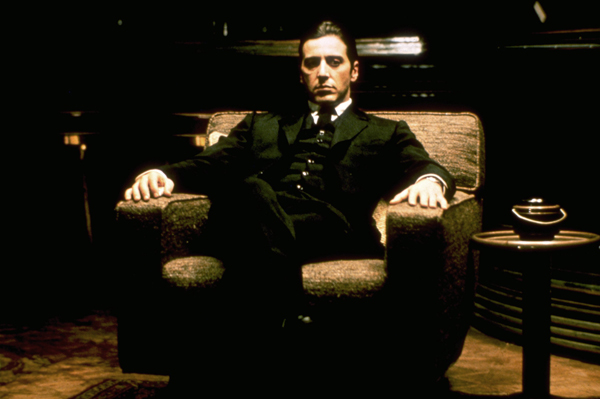
The Name of My Mary Sue Is Michael Corleone

We’re having a roundtable about Mary Sues, with Noah leading the way here. I never heard the term before, but I think I can add an example: Michael Corleone. When the writer seems to gloat over how wonderful a character is, you’ve got a Mary Sue, and the Godfather novel does a lot of gloating about Michael; the movies, though more classy and understated, also adore him. Book and movies remind us over and over that Corleone is cool, controlled, lucid, unflappable, and (when it comes to business) infallible. I was writing here about the character:

… he is a born leader, a paragon of competence and nerve, a decorated war hero and cool-headed tactician. He is the dream self-image of Mario Puzo, that poor shambling yutz who wanted to pretend he was hard, compact and capable.

I think Michael Corleone works as a Mary Sue for a whole lot of people, for myself and a ton of other men born a little before, during, and a long time after World War II. Maybe the younger fellows have lost interest in him; I don’t know. But we’ve got decades’ worth of American males who dote on the Godfather films and the special punctilio of its characters, and especially on Michael Corleone, the paragon and epitome of the Godfather style. 

Notice that Michael Corleone doesn’t quite fit either Mary Sue category described by Mandy in a comment to one of the posts here. Unfortunately I can’t find the post/comment, but if I remember right Mandy says there are two types: the winsome, wonderful Mary Sue who’s adored by his/her fellow cast members, and the brilliantly resourceful Mary Sue with his/her endless bag of gadgets and skills.

Batman and James Bond were examples that came up for the second group. Michael Corleone belongs with them because of his competence, but at the same time he marks a difference. Batman and James Bond know how to do all sorts of things, and they carry all sorts of gadgets, and that’s supposed to be what a second-category Mary Sue is all about. Michael Corleone doesn’t master birdcalls or fingerprint analysis or carry around a laser suitcase. He’s always on top of it, but he doesn’t really do anything.  Starting out, he kills Sollozzo and McCluskey; the act condemns him to a criminal career and proves his competence at the basics of the family business. But after that Corleone is strictly management.

The winsome Mary Sue is all about others’ reactions: the whole reason she exists is to be found charming, courageous, sexy or whatever by the rest of the cast. To borrow a phrase from sociology, she’s outer-directed. The second kind of Mary Sue, the endless-skills variety, is more inner-directed. A second-cat Mary Sue has to know judo and safecracking whether or not people admire him for it. (In practice, of course, people do admire a second-cat MS, but that’s icing as opposed to cake.)  

Michael Corleone is something different, an outer-directed second-category Mary Sue. Operationally, he does nothing but plot strategy and interact with his colleagues, and according to the series he does these things in glorious fashion. But follow along closely and the strategizing starts to look a bit thin. How does he know Tessio sold him out? Because Tessio is smart and selling out the family is the smart move. But if Tessio is so smart, doesn’t he realize that being smart will automatically make him Michael’s prime suspect? Well, no, he’s not that smart. Michael is a master strategist in a world where the author makes sure everyone else spots him 10 points. Michael’s great master strokes are presented as triumphs of brainpower, but all he does is send people to kill his enemies. The brilliance involved here is not too advanced: “I know, dress our guy as a cop! And for Roth, have the guy carry a newspaper under his arm! Nobody will suspect!”  

That leaves interacting, which technically would mean how he deals with other people. But in practice the focus is just as much how he comes across to other people, and also to us. Michael Corleone’s competence is so ideal that it transcends specific abilities and becomes a matter of temperament, and his temperament is right in front of us, on display. He sits there, keeps his poker face, coolly meets our gaze, and you know he’s a competent kind of guy, a “man of respect.” But what if nobody respects him? Like the winsome Mary Sue, he’s a failure unless enough other characters give him the proper reaction. But, boy, they sure do, and for the ones that don’t there’s a hard lesson headed their way.

Action isn’t Michael Corleone’s thing; he behaves, and the behavior itself has got a twist to it. He’s a forceful, dominant personality, but he keeps quiet, sits still and doesn’t throw his weight about. He just takes what’s being given and turns it back, his face unblinking, and in the end he decides all. Senator Pat Geary sneers at him and tries to shake him down, and an hour of screentime later we see Geary broken, a bloody dead girl next to him in bed, and he’s nodding as Tom Hagen tells him the way things are going to be. Michael never raised his voice, never lifted a hand. But he’s deadly, you can tell by looking at him, and his deadliness takes practical form in his command of a deadly organization. His fitness to head that organization is signaled by the cool (no, “steely”) self-command he shows as he faces his enemies and underlings.

Which is convenient for us (for me and my fellow Godfather fans as I imagine them). If we had to be like Sonny Corleone, big James Caan stomping about and shouting, the mismatch would become a bit too much. Michael Corleone does what we do, which is to sit still and watch our mouths, and he turns it into strength, not weakness. The time comes for him to flex that strength, put it into effect, and, well, other people do that for him. Meanwhile, Michael keeps sitting around and coolly measuring out his thoughts and being careful about what shows on his face, and we’re happy. The deal hangs together even if a certain amount of stupidity is woven in. We buy the gimme that Michael is a tough guy who never does anything tough, and the one that has him beating opponents at checkers-level strategy contests. He helps us get by the way we are, which is a powerful incentive to buy a fantasy. And the disincentive, the implausibility, has to do with work, and work is a vague thing to us.

Nowadays most of us work in offices doing jobs that are fairly pointless when considered by themselves. Even if the details can be explained to a nonpracticioner, there’s not much reason to do the jobs themselves, not on their own. They make sense only as component actions of a vast process, one that’s undertaken by no one in particular and benefits nobody we know. We don’t expect to understand other people’s jobs, and we don’t expect them to understand ours. If they did understand, we wouldn’t expect them to be interested. Everyone has his compartment, and what we share outside the compartments is just us, making small talk. Michael Corleone works just fine for us, a dream version of ourselves that is 90% demeanor and 10% a vestigial work element.

The same slippery ground of unrealness travels from beneath our feet to the world of the Corleone family and its operations. It’s all “them” territory, as in “They”ll take care of it.” In our work lives we’re “them,” in the Godfather series the “they” work falls to buttonmen and we’re off with Michael Corleone, lounging quietly in our chair, in command.  As the Godfather series goes on, the actual work of the Corleone family becomes hazy. The killing of Luca Brasi early in I is a big deal because he is an exceptionally good assassin; lose him and the family is crippled. By the time the movie is over, Michael can engineer a string of simultaneous deaths, a miracle round of killings, and we’re barely aware of who does what. Apparently the talent grows on trees. In fact when II ends Michael throws away one of his top assassins to get at Hyman Roth, an enemy who is on the ropes and trying to flee the country. The loss of the assassin is not a huge deal: a setback, possibly, but the family continues right along. 

You can’t be proud of a fantasy like that. A bit of narcissism can work wonders in fiction, but a little too much is way too much. People get cloyed and disgusted, or else they see thru the whole deal at once and recognize how the same old dumb desires are being catered to. The selfishness and tunnel vision built into the deal are pretty awful when you stop to think: the killing of that girl so that Senator Geary can be blackmailed doesn’t even rise to a Barbara Gordon moment; the characters and movie wad her up like Kleenex. And if the Godfather series was just about a brilliant, cool-nerved Mafia leader who always gets his way, it would wear out its welcome pretty quickly. But Michael suffers. Though he’s a Mary Sue step by step, day by day, his big story is all about how he screws up, how he throws away his life. He winds up nowhere, sitting by himself and feeling bad, much like some of us on particular Sunday afternoons but in a far grander edition. He’s not moping, he’s bleak; he’s looking at the devastation he’s wrought, not job interviews he bungled. He has carved his way thru the world, made giant choices (an empire over love, vengeance over family), and now he takes the measure of the soul his actions have given him. It’s really not the same as me on a Sunday afternoon; but it looks the same, and the feelings have a lot in common, and if Michael is suffering I know there’s some kind of seriousness to outbalance and neutralize the vanity of his story’s appeal. His mistake was to love his father too much and to fight too hard in the world, and these are nothing like the mistakes I’ve made, or most people make, but his story still becomes a tragedy, and told well enough the whole dream becomes beautiful.

Grampaw

I missed the good news that Drawn & Quarterly’s bringing over Susumu Katsumata’s short story collection Red Snow. It’s surprising, as nobody remembered his work until Seirinkogeisha put out the collection in 2005. Unlike also-forgotten stablemate Tatsumi, Katsumata can’t claim to be historically important.

His stories are better than Tatsumi’s shorts, though: timeless, bawdy, mysterious, like an earthy Kwaidan. Cartoon figures sneaking bits of pleasure in the grass, water sprites breaking things. They reveal a handmade craft that fits next to the Moomins and Monsiuer Jean.

If timeless, these stories feel old, too. They appeared mostly in the anthology Manga Goraku between 1978-80; the feeling of reminisce echoes Tatsumi’s rue. Both are old men’s manga in their way, best read over milky homebrew and several packs of borrowed cigarettes. In August, under a fluorescent light, while grumbling over back pains.

Not too much to my taste, unlike the also-announced collection of Imiri Sakabashira. I’ve liked Sakabashira’s manga and artwork a good long time. It feels a lot less fusty than either Tatsumi or Katsumata. Actually, it’s more kin to Yo Gabba Gabba. With cigarettes. I’ll give some to the nephew when he’s considerably older.

Another Question: Who’s This Thierry Guy?

I could swear there was a book that analyzed comics as a medium and was written by a European with “Thierry” somewhere in his name. I thought Fantagraphics published it, but the company’s site doesn’t list anything like the book in its section on pure-print titles. Anyone? 

Who Has Catalogued the Watchmen?

I’m doing a column on Alan Moore and Watchmen, and as part of my preparation I just went thru the comic and made notes about the various recurring images and symbols that pop up thru the length of the work. Has anyone else done this? It seems like an obvious step for some geek (aside from myself) to take, and I’d like to backstop my attempt with somebody else’s.

Don’t Italicize the Bolded

I’m reading the Atlantic’s piece about Alan Moore. It seems okay to me, nice writing and whatnot. But when he quotes dialogue, the author italicizes the words that were bolded in the original. I’ve seen a few people do this and the effect is always bad. A comics page is not the same as a text page. Words get bolded on the comics page only to break up the visuals; the emphasized words don’t jump out, they just give the eye enough traction to make it through bits of print that otherwise would be lost amid all the pictures. In straight text the words aren’t going to be lost; put words here and there into italics and they become a bit overbearing. So we get Dr. Manhattan, that limp, far-away personality with one eye on the tachyons, biting his words off like an undergraduate intellectual in mid-debate:

“Time is simultaneous,” he explains in the comic to his girlfriend, Laurie, “an intricately structured jewel that humans insist on viewing one edge at a time, when the whole design is visible in every facet.

What do we call that? Misguided fidelity that produces a mistake.