
We’ve added one more blogger here at HU; Richard Cook, who has been an indefatigable commenter for some time now. We’re excited to have him on board!
Monthly Archives: October 2009
Utilitarian Review 10/9/09
Hoods Here
This week was devoted for the most part to our bande desinee roundtable. Special thanks to Derik Badman for his special guest contribution. Please check out his own blog, won’t you?
Despite my ongoing struggles with mediafire, I did post a mix last week, including Sonic Youth, experimental chinese music, Michio Kurihara, the inevitable Chopin, and other dreamy drony things. Download it now before mediafire makes it disappear in their mysterious way.
Hoods There
Bunch of stuff this week. First, I have an article about why Bob Wills is country and not jazz over at Splice Today.
The point here isn’t that Wills was ripping off Count Basie like Elvis ripped off Jackie Wilson. Rather, that “ripping off” doesn’t really do justice to the pervasive way in which race and marketing have affected American music. Because the fact is that Bob Wills is different from Count Basie. He used different instruments, he played different songs, he didn’t use the same musicians. (Segregation meant he couldn’t have, even if he wanted to.) Those differences could have been less important than the similarities, but, because of history and marketing and race, they weren’t. Similarly, Elvis is different from Jackie Wilson, and contemporary R&B is different from contemporary country. How music gets labeled affects who listens to it, who loves it, who uses it, and, thus, what it is.
My interview with Andee at the amazing San Francisco record store Aquarius Records is online at Madeloud. Here’s an excerpt, including a little bit that didn’t make the published version:
Me: Looking at these lists online, you sort of get the feeling that the store itself must be gigantic. How big is the store? How many records do you have in stock at one time?
Andee: That’s funny. It really does. And I sometimes feel bad when someone finally gets to visit, having come all the way from Japan or the UK, I feel like we should apologize for how small the store is, but almost always, people dig it. It’s small-ISH, but there’s tons of records, cds, plants in the windows, posters and flyers, and crap all over the walls, doors and posts and windows have been painted by artists, there are video games (a Tron, a Rastan and a Joust, and we usually have a Ghosts And Goblins, but that one’s broken), there’s good music playing, it’s just really comfortable and worn and home-y, the way a record store should be. I love places like Amoeba and Virgin and Tower, but that’s a whole different vibe, places like aQuarius are more inviting to just hang out, browse, shoot the shit with whoever is working, play some Joust. I like it like that. As for how many records we have in the store, only a fraction of what’s on the website. we’re usually full to capacity, but the cool thing about visiting is, there’s always plenty of stuff that is NOT on the site, maybe stuff we haven’t reviewed yet, stuff that we were only able to get a few copies, not enough to post on the site, some stuff that just won’t make it on the site, for whatever reason, not to mention TONS of awesome used stuff, and new arrivals and more…..
Also Splice Today has reprinted my review of Julia Cameron’s The Artist’s Way, which ran some years back in the Baffler. (I think it was my first published essay, actually.) And I have a review of a Tommy Cash reissue at Metropulse.
Hoods Everywh…Oh, Wait, Those Aren’t Hoods
A note on this website points out that the deevolutionizer in this issue of Wonder Woman apparently inspired Devo. Who knew?
Diana Kingston-Gabai explains that crossovers still suck.
This is a great fucking essay by Terry Eagleton about what atheists are stupid and god is great, even if he isn’t real.
And so the very act of attempting to close history down has sprung it open again. Both at home and globally, economic liberalism rides roughshod over peoples and communities, and in the process triggers just the kind of violent social and cultural backlash that liberalism is least capable of handling. In this sense, too, terrorism highlights certain contradictions endemic to liberal capitalism. We have seen already that pluralistic liberal societies do not so much hold beliefs as believe that people should be allowed freely to hold beliefs. The summum bonum is to leave believers to get on with it unmolested. Such a purely formal or procedural approach to belief necessitates keeping entrenched faiths or identities at a certain ironic arm’s length.
Yet this value—liberal society’s long, unruly, eternally inconclusive argument—also brings vulnerability. A tight national consensus, desirable in the face of external attack, is hard to pull off in liberal democracies, and not least when they turn multicultural. Lukewarmness about belief is likely to prove a handicap when one is confronted with a full-bloodedly metaphysical enemy. The very pluralism you view as an index of your spiritual strength may have a debilitating effect on your political authority, especially against zealots who regard pluralism as a form of intellectual cowardice. The idea, touted in particular by some Americans, that Islamic radicals are envious of Western freedoms is about as convincing as the suggestion that they are secretly hankering to sit in cafés smoking dope and reading Gilles Deleuze.
This is actually the last chapter of Eagleton’s latest book, “Reason, Faith and Revolution,” which is amazing. Best purchase on Amazon I’ve made in a good long while. If you want to check it out, it’s here.
Zombie: A Mindless Affair
I’m going to be in an art show on October 23. Here are the details:
Zombie: A Mindless Affair
Curated by: Edra Soto
Also Project Wall Space:Irene Perez
ZOMBIE ARTISTS:
C Through Outfit (Erik Brown, Catie Olsen, Carl Warnik and Dawn Reed)
Deborah Boardman
Nate Lee
Jason Mena
Mindy Rose Schwartz
Amanda Browder
Derek Chan
Christopher Simkins
Christopher Smith
Ann Toebbe
Harold Mendez
Paul Nudd
Noah Berlatsky
Vladimir Kharitonsky
Dan Peters
Gretel Garcia
Susannah Kite Strang
Rachel Hewitt
Corinne Halbert
Bert Stabler
Beatriz Monteavaro
Miguel Cortez
Edra Soto
Candace Briceno
Death by Design Co. (Teena McClelland and Michelle Maynard)
The Wiener Girls (Sydney Croskery and Katey Rafanello)
Betsy Odum
Jen Thomas and Bobby Lively
Chris Hammes
Andrea Jablonski
Jeff Libersher
ABOUT: Zombie: A Mindless Affair
Celebrations that invite us to observe a historical occurrence are still strongly practiced in contemporary culture. Halloween, as celebrated is America, profoundly depicts the strongest features from gothic and horror literature, film, TV, and graphic arts. Among the repertoire of traditional characters, the zombie distinguishes itself for possessing the biology and behavior of a normal human being, yet lacks consciousness. This exhibition uses the vernacular of the mythological zombie as a starting point to engage in ideas of death, mindlessness and symbolisms for the occult and inexplicable. The term zombie also intends to address issues referring to the mindless self in a social spectrum: leading and following; acts of automatism and fanatic behaviors.
From 6:30-7:00pm on opening night:
Join author Scott Kenemore, artist Mindy Rose Schuartz and collaborators Teena McClelland and Michelle Maynard from Death by Design Co. in conversation. They will talk about the darkness that enlightens their work. Screening of the film made by Death by Design Co. immediately after the conversation. Moderated by Edra Soto
Opening Friday October 23 from 6pm-10pm
October 23 – November 21, 2009
ANTENA
1765 S. Laflin St.
Chicago IL 60608
www.antenapilsen.com
antenapilsen (at) gmail.com
_______
And, hey, here’s the piece I’m showing for those not in the Chicago area (it’s better in person…no, really! Trust me!)
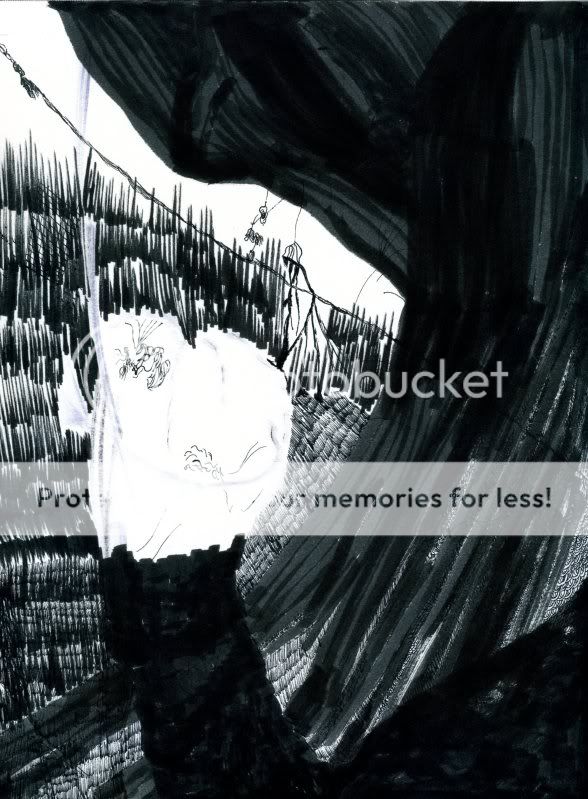
Sequential Surrender Monkey: The Case Against Tin Tin
1. Slapstick
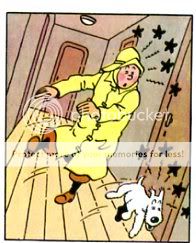
Rereading Tin Tin, what struck me most was just how French it is (or how Belgian, I guess.) Everything’s just so darn greasepaint-precious. “Ooooh hooo hooo…the cursing captain…he fall down and bump ze head! Oh stop — the Thompson Twins, they’re hats, they are pulled down over their eyes so only ze bristley mustachios are showing! Oh, ze little doggie, he is drunk!” In Asterix, the physical humor is explosive and go-for-broke; when you hit the roman soldier, he rockets out of his sandals in a riot of motion lines and explosive puffs; when he lands in the next panels on his head, you get to watch his toes violently twitching. In Tin Tin, on the other hand, the slapstick almost seems to be in quotes, like you’re watching mimes. Motion lines are little curlicues, and the bashed tend to look startled and dizzy rather than actually bashed about. If Asterix is analogous to Bugs Bunny, Tin Tin is Disney; skilled, tasteful, and kind of boring.
2. Characterization
A Wikipedia entry on Tin Tin compares Herge’s characters to Dickens’. It’s not a comparison that serves Herge well. Dickens did use caricature, but those caricatures are multi-layered, encompassing both biting satire and a knowing humanism. In Bleak House, for example, Richard Carstone’s rationalizations around money are both funny and tragic, and feed naturally into his gradual embitterment. Or there’s this passage from the same novel:
“There has been only one child in the Smallweed family for several generations. Little old men and women there have been, but no child, until Mr. Smallweed’s grandmother, now living, became weak in her intellect and fell (for the first time) into a childish state. With such infantine graces as a total want of observation, memory, understanding, and interest, and an eternal disposition to fall asleep over the fire and into it, Mr. Smallweed’s grandmother has undoubtedly brightened the family.”
The Smallweeds here are a very particular kind of stultified; enlivened by the one senile figure in their midst. The joke comes out of that specific contrast.
Herge’s caricature’s on the other hand, seem much more broad and tired. Captain Haddock is a sailor who curses and drinks too much. Professor Calculus is an absent-minded (and deaf) professor. The Thompson twins are bumbling cops. Those are the jokes, and they were pretty old, I have no doubt, even 50 years ago when Herge was writing these. Not that they’re handled poorly or that they aren’t often funny or surprising…but overall, and especially if you read a bunch of them in a row, they start to feel decidedly thin. The truth is that Herge’s penchant for racist caricature and easy anti-semitism wasn’t an accident; virtually all his characters are based around easy stereotypes and fusty gags; it’s just that making fun of sailors looks more innocuous these days than ridiculing the stupidity of black people or the avarice of Jews. Fagin is offensive as well, of course, but he’s also got enough depth and texture that you feel that there’s something to him beyond the anti-semitism…or at least that the anti-semitism is somewhat textured. But when Herge uses a stereotype, as he almost always does, the stereotype is pretty much all there is happening.
3. Art
Herge’s obviously a very skilled illustrator, with an amazing facility and capacity for rendering detail. And in the abstract, I can certainly appreciate a complicated tour de force like this:

But in terms of visceral appeal, though, his art just doesn’t do that much for me. The cleanness and perfection of it, the evennness of the lines; it almost seems produced by machine. For example, compare Herge’s camels:
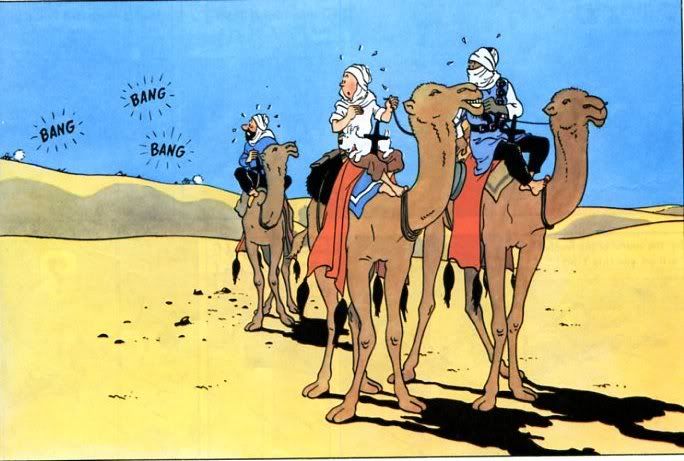
with Harry G. Peter’s elephants.
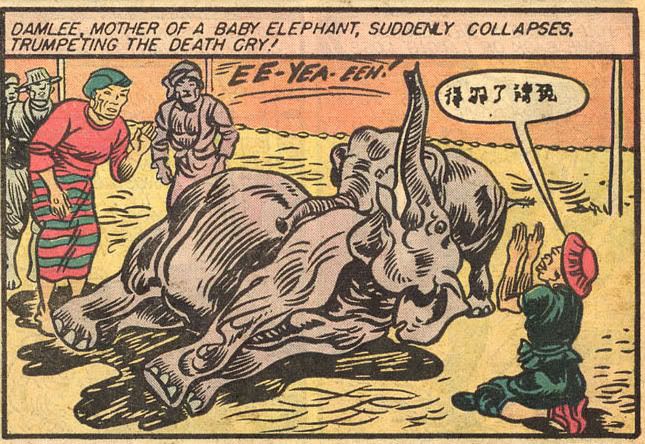
Herge’s drawing is much more correct anatomically, but it’s also much less fun to look at. The camels are too smooth; they have the same weight as everything else. They might as well be boxes, for all the character they have. The bits of personality — the one camels’ smile, the other camel’s knowing look — actually comes across as irritatingly smug. Again, it feels Disneyfied to me — a lack of personality gilded with cutesiness.
4. Layout
Given his status as one of the great figures in comics, it’s amazing how little interest Herge seems to have in the page as an aesthetic unit. He does vary panel sizes to accommodate action, and so he can fit big objects like planes:
And he will use bigger splash panels for effect, as with the camel image above. But in terms of unifying an entire page….he just doesn’t bother. Look at this for example:
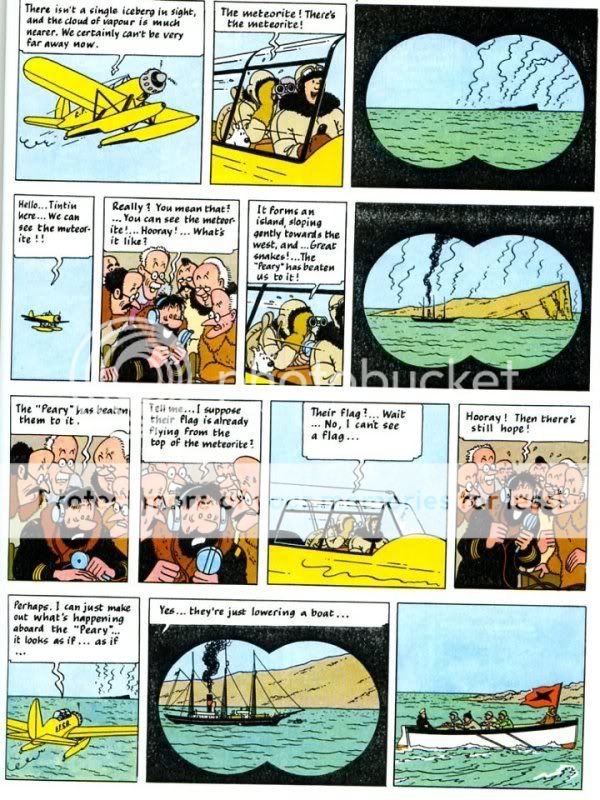
The most striking visual motif on the page is the binocular frame. It’s used in three panels…but that’s pretty much all that can be said for it. Those three images aren’t balanced out in any particular way that I can see; they’re just placed on the page at the point where they logically occur in the narrative.
You really see this in the use of text as well, which sometimes just overwhelms the pictures.

That’s gratuitous as well; that text is just restating things you already know. It’s off-putting, ugly, and unnecessary. I don’t think it’s laziness, — Herge is never less than entirely professional and meticulous, and writing out all those words was probably actually a fairly irritating task. But it does suggest that he doesn’t have much of an eye for, or interest in, design.
_____________________
Overall, then, Herge’s perfectionism and professionalism, which are impressive in small doses, become irritating and burdensome the more you realize that that’s all he has to offer. I remember being a bit bored by them as a kid, and as an adult…I’m maybe even more bored by them. The plots bop along, and there are still some excellent gags: the Thompson twins bizarre affliction — whereby their hair grows excessively fast and changes myriad hues, is visually spectacular and completely ridiculous. And I had forgotten how weird and disturbing some of the dream sequences are. Tin Tin turning into a giant bottle of wine with his head as the cork which Captain Haddock tries to twist out; the weird fever dream of a prophet grasping a picture of a giant spider — such moments come close to thematizing the oppressively flat unreality of Herge’s world. Mostly, though, that flat unreality isn’t disturbing or affecting. It’s just flat.
_______________
You can read the entire roundtable here.
Sequential Surrender Monkey: Le Petit Vampire fait du Kung Fu!

Le Petit Vampire fait du Kung Fu!, Joann Sfar, 2000, Guy Delcort Productions
or, if you prefer,
The Little Vampire Does Kung Fu!, Joann Sfar, 2003, Simon & Schuster
(because, despite the offensive roundtable title, we at the Hooded Utilitarian are all about ensuring your happiness and comfort)
I started reading French comics in high school (which was eons and ages ago, I will freely admit), at the suggestion of my French teacher. Magazines, too. Asterix and Paris Match. I haven’t picked up the latter in a while (although as a sheltered Midwestern teen in the Age Before Internet, damn, it did help to open my eyes to a few things), but Asterix, written by René Goscinny and illustrated by Albert Uderzo, certainly holds up. I have a small stack of French comics that I love, but I no longer read French very often, or very well. I do love me some Paris Vogue, but the secret to fashion magazines is to do the opposite of what you do with Playboy and never, ever read the articles, because that will make you want to kill yourself and take everyone you can reach with you.
So, approaching this roundtable, I had to do some thinking. I hate that. There are a couple of Little Vampire books I prefer to this one (although it does feature nunchucks, the eating and subsequent disgorgement of a small child by monsters, and a bizarre Jewish Zen parable, so I obviously do like it quite a bit), and there is a less amusing but still palatable Le Grand Vampire series, and there’s Donjon, an awesome series by Sfar and Lewis Trondheim. (You are, perhaps, noticing a theme in my post-high school French comics reading. Vampires and dungeons. I will also admit to suffering a certain amount of Goth-damage.) I am writing about the kung fu book, though, rather than any of these other books, because I had an auxiliary English copy of it that I could actually find. I have auxiliary English copies of a number of the vampire books (vampires both big and small), but they have vanished. Poof. Perhaps they flew out the window one windy evening to fly into the dark night sky and skulk around the dense and forbidding Carpathian forest with the wolves, remarking about the children of the night and the beautiful music they make. I wish them well. Fly and be free, big and little vampires!
It is only a minor setback, really; the sort of small frustration we all deal with every day. We do have the kung fu book in English, which means I can figure out what’s going on without getting out my dictionary, and it is in fact a pretty neat book, so off we go.
The plot is bland and soothing, like blancmange. A little boy, Michael, is visited late at night by his friend, the Little Vampire, and the Little Vampire’s posse, three monsters (my favorite is the Frankenstein-ish Marguerite, who loves poop). Michael explains that he’s being bullied at school by a loutish brat named Jeffrey and says he wishes the kid would die. Then the Little Vampire whisks Jeffrey away to his haunted castle so they can visit Rabbi Soloman, the kung fu master. Rabbi Soloman tells Jeffrey he’s left his kung fu book tied to the back of a dragon on top of an Angkor Wat-like temple, just through that door at the end of the hall, and that if Michael will bring him the book they’ll be set. Off Michael goes, getting his butt kicked repeatedly by monkeys, the temple itself (it is hard to climb and he keeps falling off), and by the dragon itself. Eventually, Michael gets smarter and better and he gets the book. Which of course says, “If you have managed to steal this book from the dragon, you are very skilled at kung fu. This book will teach you nothing more.” Because, you know, the only Zen on the mountain is the Zen you bring there. Anyway, now that Michael is all confident and proud and ready to take on the world and shit, he and the Little Vampire find out that the monsters went off and ate Jeffrey.
Zut alors!
The Little Vampire does what anyone would do when faced with this situation – he makes the monsters cough up all the Jeffrey bits, and then they sew him back together. Then they go off looking for a magician to reanimate him. That doesn’t go entirely smoothly, as anyone who’s ever read any cautionary tale about magic would predict. But the ghostly pirate dude who’s kind of in charge takes pity on the boys and lets them off with time served. He gives the little boy, little vampire, and variously sized monsters the means for fixing Jeffrey. This involves what is without doubt my favorite panels of the book:
 ]
]
Moo!
The next day at school, Michael, now a kung fu master, picks a fight with Jeffrey, who remembers nothing of the previous night’s romp. And Jeffrey kicks his ass. It all works out, though, because the girl Jeffrey has a crush on beats Jeffrey up and nurses Michael’s wounds. So, the moral of the story is that it’s better to be an overconfident idiot than an actual martial arts expert. A lesson for all times, really.
Now, I know what you’re saying. “That’s a bit gluey, isn’t it? I can’t read that much treacle; I have blood sugar issues.” Fair enough. The bit at the end makes me gag, and not in a good way. I think the parts are better than the sum thereof, though, and some of the gags are worth the cutesy ending. The monsters coughing up the little boy they ate, for instance – that’s the kind of priceless I’m after. And the cow. God, I love the cow. So, there you go – the other side of Joann Sfar. (Assuming you read Vom Marlowe’s post Monday on The Rabbi’s Cat.)I hope you are moved to go forth and consume French vampire comics, in the language of your choosing.
Sequential Surrender Monkey (Part 3 of 5): Rupert and Mulot’s Le Tricheur
Hi all, Derik of MadInkBeard here. Thanks to Noah for inviting me to participate. For this roundtable, I thought I’d write about a bande dessinee that hasn’t been translated into English (I am such a comics nerd that I actually self-improved on my two years of high school French just so I could read French bd and write about it). The comics (or should I say bande dessinee) duo of Florent Ruppert and Jerome Mulot have made only two appearances in English: a two page spread in Kramer’s Ergot 7 and also a short comic (“The Pharaohs of Egypt”) that was translated at the Words Without Borders site. The latter does give a decent example of their work: long strings of word balloons, protagonists that tend to be less than savory, long sequences of McCloudian “moment-to-moment” transitions with a close attention to body language and movement, dry humor, and layouts that mix really large panels with long sequences of small panels.
I first learned of their work from Bart Beaty’s column at The Comics Reporter where he’s raved about their first two books Safari Monseigneur and Panier de Singe. Le Tricheur (L’Assocation, 2008) is their fourth book. In comparison with the earlier works of theirs I’ve seen, it is a fairly tightly organized narrative set within a detective/police/heist genre framework. The story is told non-linearly through multiple timelines. In a timeline that is in the “present”, a police detective interviews four characters: a private detective (“Short Hair”), an art collector (“Batman” because he wears a Batman shirt), a gallery owner (“Tie”), and his niece (“Handbag”). (Yes, all the characters are given names based on some aspect of their physical appearance.) The longer parts of the book take place in an earlier time and show these characters and their companions through a sequence of actions that are part heist, part revenge play, part art project. The logic, meaning, and interrelation of all the events in the story reveal themselves slowly. Each time I reread it (I’m at my fourth or fifth time through) more elements click into place, more layers start to make sense (admittedly, part of this may have been the accretion of vocabulary words as I looked them up and began to remember them).
The police interview scenes provide the only dialogue or narration in the book (excepting the final epilogue). Ruppert and Mulot make use of long strings of word balloons floating above the characters in tall panels. While most comic artists, when using long conversations, try to mix in changing views of the characters or setting and attempts at body language or facial expression, here, the dialogue is the focus. The characters serve as little more than indicators of who is speaking in the panels. One interesting use they make of these long strings of word balloons is branching off a balloon that acts as a kind of aside to the main string of dialogue.

An “aside balloon”. This is one of the smaller dialogue panels, most are much taller (this is an unusually tall book).
Mixed between these conversations are longer scenes taking place previous to the police interviews. These scenes are told without words of narration or dialogue and tend to use a large number of panels to show characters acting with great detail. Where the interview scenes are all dialogue, these scenes are all action. I say “action” more in the sense of movement and acting than in the “action movie” sense, though, this being a heist type story, it does feature its share of violence (and one completely absurd gun fight).
Most of the action scenes have the quality of animation: using numerous small panels in a sequence of unvarying composition where the only change is the movement of the characters. The artists attention to body language and posture is impressive and expressive, particularly in light of the complete lack of facial expressions. You see, the artists don’t draw faces. The characters all have a kind of wide V line on their face, like eyebrows except more in the center. This cuts off the possibility for facial expression, putting that much more emphasis on the body language. (It also tends to give all the characters an vaguely angry look.) The expression possible without facial expressions or close-ups (they don’t use them) or even variable angles (none of those either) on the characters is quite impressive, all due, no doubt, to the body language in the drawings.
The viewpoint on the characters is set at a consistent visual distance: they are always the same size on the page. When it is necessary or desirable to show more of the background or set the scene, the artists simply enlarge the panel, including the use of the unconventional (in the West at least) “L” shaped panel (see below). This changing panel size on a fixed scene emphasizes the sense of the panel as a window on the world, a small cropped segment of vision which hides all that is outside of view, all that remains unseen and unsaid. This feeling is quite apt for the story itself which slowly reveals flashes of motivation and background outside of the immediately seen actions. You have to pay attention to the small panels, important events pass in a single panel, and many events are elucidated only through earlier or later events/words.

Characters (Hat, Handbag, and Cap) stay the same. Framing changes with panel size.
The relationship between the dialogue scenes and the pantomime scenes is vaguely ambiguous. Are the pantomime scenes the visual representation of the dialogue? Are they thus colored by the narrator? Or are they completely separate, objective views of events which gain some elucidation through the dialogue–dialogue which is not necessarily true. The title “Le Tricheur” is literally, “the cheat,” and there is a certain amount of tricking and game playing going on here. As the story unwinds through the dialogue, the majority of the events seen in the book are revealed as part of a grand plan of the gallery owner, Tie. He has hired almost all the other characters and given them orders as to what they should be doing.
Ruppert and Mulot’s drawing style is all thin, almost scratchy lines, reminiscent of an etching (yet without that gray glow seen in works like those of Frederic Coche). They use no solid blacks and very little tone or texture, yet everything has a realistic appearance. Characters are naturalistic and proportional. Backgrounds are rather simple line drawings, setting and re-setting the scenes in large panels, yet only sketched out by a few brief lines in the smaller panels.

I love the way they draw the strip club in this scene with all the lines representing lights.
What we learn (yes, I’m spoiling it for you, you can skip this paragraph) is that the gallery owner is doing all this as a kind of art project, promotion for his gallery, and revenge scenario. Two hoodlums, named “Hat” and “Cap” (I’m translating these names), are hired to perform strange activities on their own or with the gallery owner’s niece (“Handbag”). Many of these activities bear some close metaphorical resemblance to a series of paintings in the gallery which the owner (“Tie”) shows to his “friend” “Batman” (he wears a Batman t-shirt). Two private detectives (“Beard” and “Short Hair”) are hired to follow and photograph the two hoodlums, thus creating a photographic record of their activities. The story culminates with Hat and Cap breaking into the gallery to steal paintings and kill “Batman”, all of which is recorded by the security cameras. In this way, the gallery owner organizes these activities but also creates an inter-related visual document revolving around the paintings in the gallery and the gallery itself, with twofold goal of art production and revenge.
The comic “Le Tricheur” becomes, in a way, another level of this interaction/documentation as if the comic itself is part of the whole series of actions and representations of actions that fill the book, with Ruppert and Mulot as the real orchestrators of the whole scheme. This image of the two artists as schemers fits with the image of them seen in some of their other projects. For instance, for this year’s Angouleme festival they organized a collective project with 20 other comic artist called “Maison Close.” Wherein they created a scene (a house of prostitution), drew all the background images, and organized the participation of the other artist. All the participants (including the two organizers who act as the proprietors of the house) drew themselves (or their comics stand-in (ie Trondheim as the bird-self from his autobiographical works)) into various interactions with each other on top of the existing backgrounds. If you’re interested in see more of their work, you might visit their website.
Sequential Surrender Monkey (Part 2of 5): The Rabbi’s Cat
(or the HU Bande Dessinée Roundtable Part 2)
I admit it. I bought this for the cat. I read this for the cat. And I don’t really care about much except the cat.
The Rabbi’s Cat by Joann Sfar
Color by Brigitte Findakly
Translated by Alexis Siegel and Anjali Singh
This is an odd little book. It’s sort of a parable style story about a talking animal who has adventures and learns things. In the spirit of the parable, perhaps, it doesn’t make a hell of a lot of sense. Or maybe it’s just too French for me.
There’s this cat, drawn with wonderful inky spontaneity and rough enthusiasm, who eats a parrot and thus learns to talk. The cat happens to live with a rabbi and his daughter in Algeria. As soon as he learns to talk, the cat denies killing or eating the parrot, and thus begins the philosophical discussion of the purpose of having speech. Why have speech if all you do is lie? Or, as the cat does later, tell only those truths that cause pain?
Honestly, I didn’t care. I like philosophy just fine. I’ve read Aristotle and Aquinas and the Baghavad Gita and those lot, and I’m sure they would have been improved by the addition of a cranky and silver-shadowy-gray Oriental Shorthair with Views. And yet, to me, the cat was everything and the philosophy was nothing.
The funny and eccentric art kept me reading, for the most part, but I was sometimes bogged down by arguments and parables, much as the cat appeared to be. Sometimes he would weary of the talk and try to get back to his mistress to be petted or convince her to give him a fish, and I confess, I think he had the right approach.
The cat gains speech and loses it, follows the rabbi, learns of people and religion, laws and rules, different religions, reads, and hangs out with the rabbi’s cousin’s lion. I liked the lion. And the cousin, who liked to go around threatening anti-Semitic waiters with his rifle and his lion.
There’s a bit about a guy with plays what seems to be a banjo and another part that’s about shopping on forbidden days, but I just wanted to know if the cat would get his mistress to love him and care for him and feed him milk. I am a shallow creature, I suppose.
The art is delightful for the most part, and the story is strange and puzzling with those sharp turns fairy tales make, and I’m not sorry I read it. But it does feel very French. Or perhaps Italian, in the style of Calvino’s Italian Folktales. Which isn’t bad. At all. I’m sure.
It’s just that I don’t really feel like being enlightened. I want to sprawl around instead. Lazy as the cat. Who is portrayed as pretty wise in the book, so who knows.
Update by Noah: You can see the entire roundtable so far here.