Thanks to Glaurung, I now know that Marston wrote WW up through issue #28. So, 24 more to go, starting with this one:
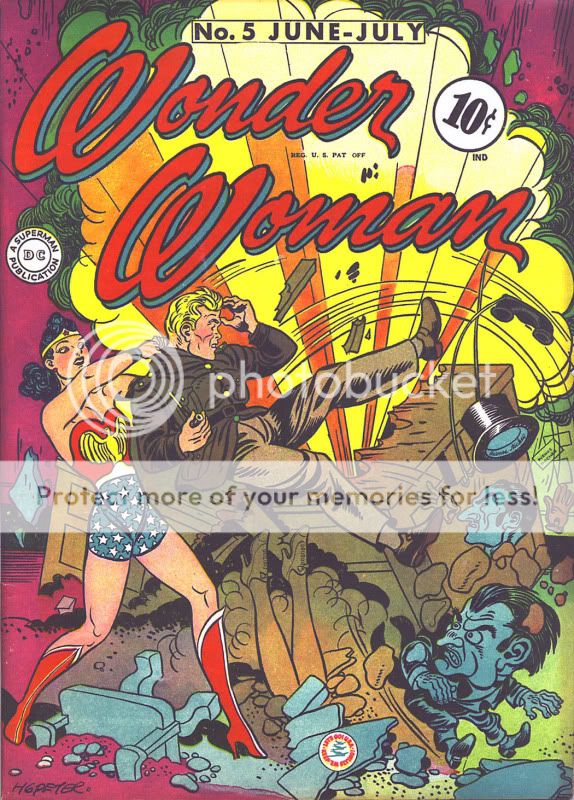
In a post a couple of days ago I mentioned that Marston doesn’t actually seem all that interested in magic, myth and imagination in themselves. It’s true, of course, that WW’s origin is informed by Greek mythology, and that the Amazons are essentially supposed to be ancient Greeks, worship Greek Gods, and so forth. But there’s little effort to mine those myths for mystery, or awe as Neil Gaiman does in Sandman, or as Marley does in Dokebi bride. Instead, Marston mixes magic and science together more or less indiscriminately in the interest of goofy fun and/or catering to his fetishes around mental control, hypnosis, and so forth.
Thus, issue #5 features a villain who is part scientist, part spiritualist, and all…god knows what, really.
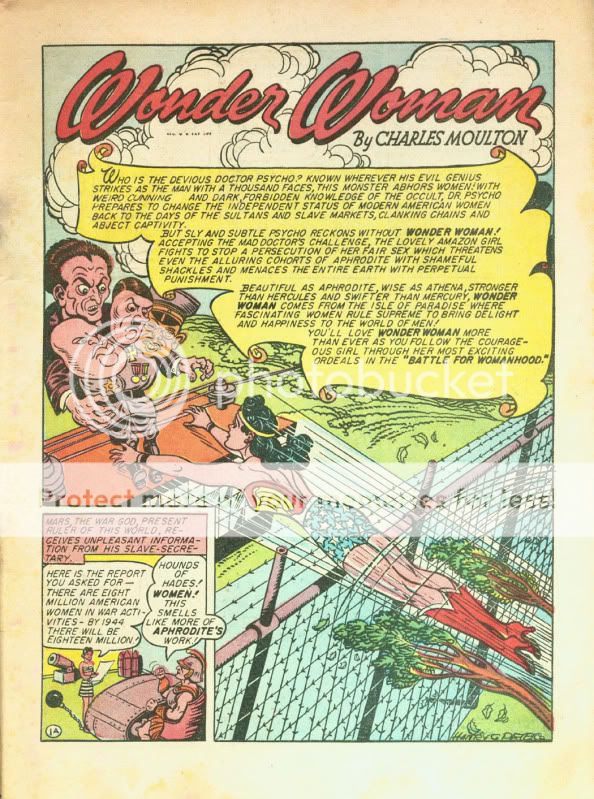
Doctor Psycho is this little scientific genius with a beautifully ugly caricatured face who hates women because his fiance betrayed him and he ended up in jail and then he goes and hypnotizes her and uses her to conduct spiritual experiments and turns himself into an ectoplasmic doppelganger of George Washington who issues oracular pronouncements about the dangers of allowing women to contribute to the war effort. Also somewhere in there he makes his rival in love swallow radium. Oh, yeah, and he’s inspired by Martian emissaries from Ares who don’t want women to contribute to the war effort because then women will become too powerful and will dominate men.
What was I talking about, anyway?
Oh right. So, as I was saying, the point here is that Marston veers back and forth between science and magic — seamlessly isn’t the right word — more like with an unconscious, drunken stagger. In the page below, for example, we start at the top with our villain killing a victim with radiation poisoning, move right on to hypnosis (no explanation for how he learned how to do hypnosis, incidentally) and end up (below the cut) with ectoplasm spilling out all over the place — ectoplasm that Dr. Psycho can use to turn himself into a dead ringer for John L. Sullivan, we learn at the top of the following page.
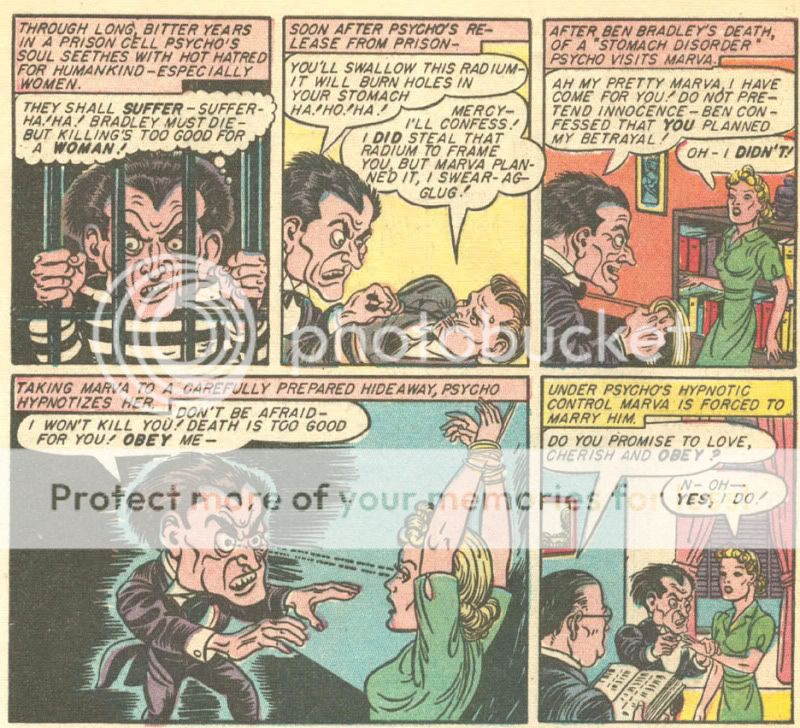
One of the reasons this sort of crazed shifting of gears works so well is the art. Peter is a deceptively supple illustrator; his stiff poses tend to bely how fluid his lines are and how quickly he can switch modes. For instance, in this illustration, where Steve (as per usual) is getting pwned:
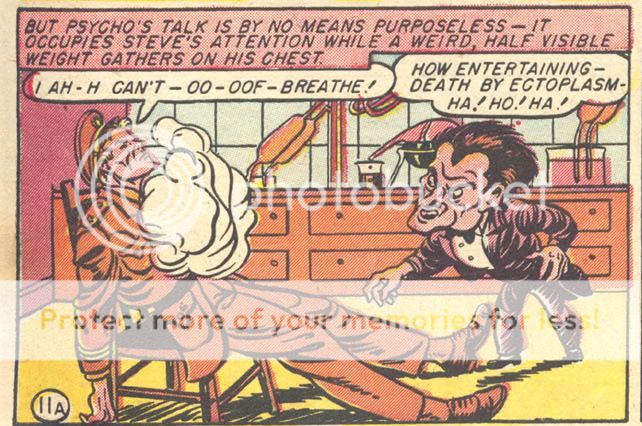
Steve’s body and face are, in typical Peter fashion, stiff and not especially expressive. But then you’ve got Dr. Psycho standing there with his enormous head and preposterous eyebrows, looking for all the world like he’s strolled in from an editorial cartoon. And, of course, there’s the very gestural curly smoke-ectoplasm just sitting there on Steve’s chest. It’s a preposterous image, with different levels of reality clunking against each other apparently unconsciously — it’s almost like an incongruous arrangement of clip art. Except that Peter’s style, his moving hand, really does pull everything together — the lines on Steve’s uniform, for example, have the same tactile motion as the ectoplasm splot. Peter creates a world where both scientific laws and magic seem equally hokey and equally vivid; where anything can become part of the clunky tableaux.
Here’s another example of what I’m talking about:
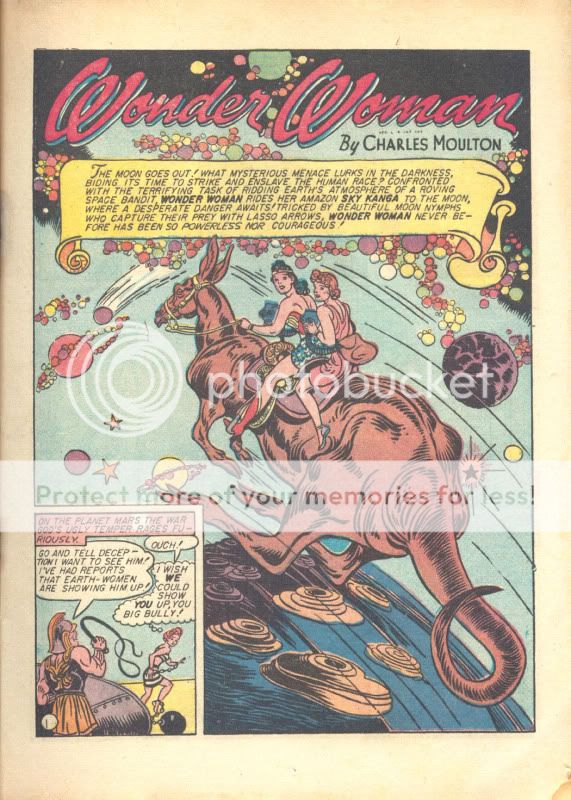
What’s that, you ask? Why it’s Wonder Woman and her scientific genius friend Paula riding a giant Amazon Sky Kanga to the moon in order to rescue the goddess Diana from the cruel grip of Ares. What else would it be? And, more importantly, why hasn’t DC taken this image and blown it up and released it as a wall-sized poster so I can fucking buy one? Because holy shit is that completely, insanely beautiful. The different weight lines making up the space-kangaroo’s hide are just so lovely — and the bizarre way Peter has the creature foreshortened makes it look truly cosmically sized, like it’s head is just disappearing into the distance. It reminds me of some of Winsor McCay’s animal drawings, though clumsier and less finished in a way that really sends me. (Also, I love that whip in the lower left; all one snaky, narrowing line.)
The full-page extravaganza has to be the Sky Kanga image that owns my heart…but it’s a close battle between that and the ones where we see the space kangaroo hanging out next to Grecian architecture. (Did you know the Greeks actually trained kangaroos? For space travel. God’s truth.)
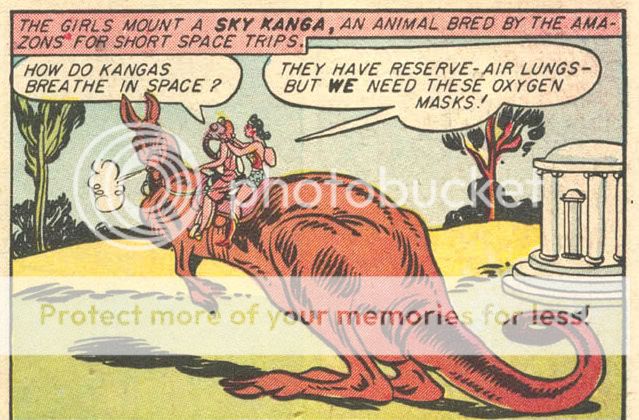
There’s actually a pseudo-scientific explanation for why the Kangaroo is able to fly through space, incidentally; “upper space is not empty but dotted with thousands of gravity-marooned fragments from whirling planets” y’see. So it’s a scientific Grecian sky kanga, rather than a mystical Grecian sky-kanga. But the real point is clearly not any kind of effort at actual scientific verisimilitude (such as with Spiderman, or even Superman), nor mystical wonder, but trippy adventure nuttiness. I mentioned in my last post that Marston’s WW reminds me a lot of the Oz books…and it’s also reminiscent of the Doctor Doolittle stories — in fact, if I recall correctly, Doolittle flies to the moon on the back of a giant moth. I wonder if Marston was thinking of that?
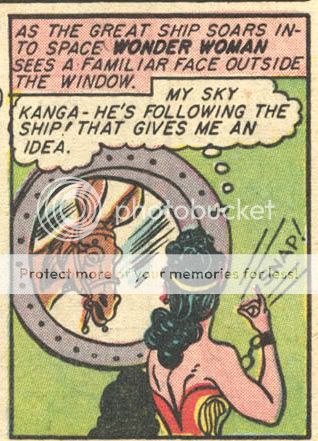
Oh, okay, I can’t resist: more sky kanga porn:
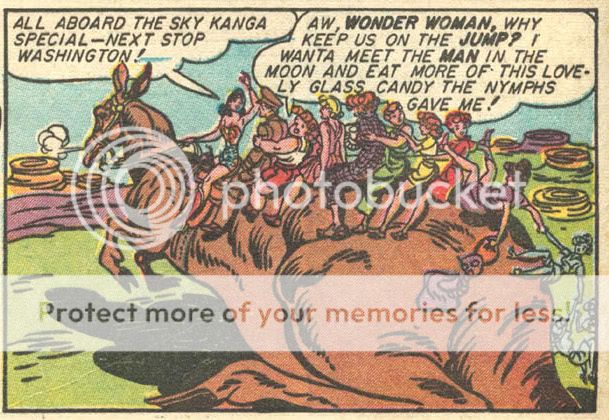
I love how the kangaroo has seemingly grown to about twice the size to accommodate all the people who need to ride on it.
Again, last time I talked a bit about the way that children’s literature can dovetail with eroticism, and how that fits nicely into Marston’s fetishes. And there’s certainly plenty of bondage in this issue too, what with the hypnotism and the mersmerism and scenes of all of Ares’ female slaves on Mars, and Diana’s archers penchant for using arrows that tie you up rather than kill you and so forth. But I think it’s also worth pointing out that writing in a children’s literature tradition is just in general a good way to appeal to children, of whatever gender. Silliness and lots of action; kids like that. Marston gave it to them. Why wouldn’t these comics have been popular? I’m just remembering a Kyle Baker quote where in describing the Hawkman story he was working on, he said, “There’s also action on Dinosaur Island, because dinosaurs are always cool.” I feel like the giant Kangaroo has a similar rationale. Kangaroos jumping to the moon…that’s always cool. (Well, I think it is anyway.)
Along those lines, I was also thinking about the Steve Trevor romance, such as it is. A commenter (I can’t find the exact comment; my apologies) said recently that he really liked the Steve Trevor/Wonder Woman romance, because it seemed like they were really in love; he pointed especially to the fact that Steve always uses terms of endearment like “angel!” to refer to WW.
I have to say, I really don’t see this. For the most part, the romance between WW and Steve seems more notional than actual. Steve does refer to her with excessive endearments…but that just seems part of their general lack of communication. For instance, in the scenes below, Steve’s life has been threatened, and WW is worried…and Steve just keeps laughing and laughing like a jackass.
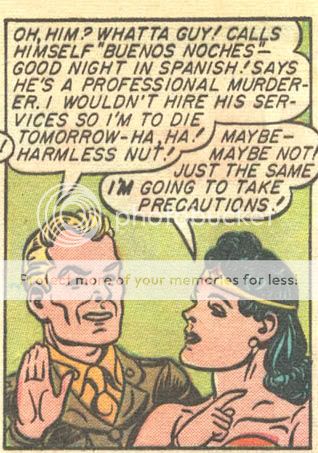
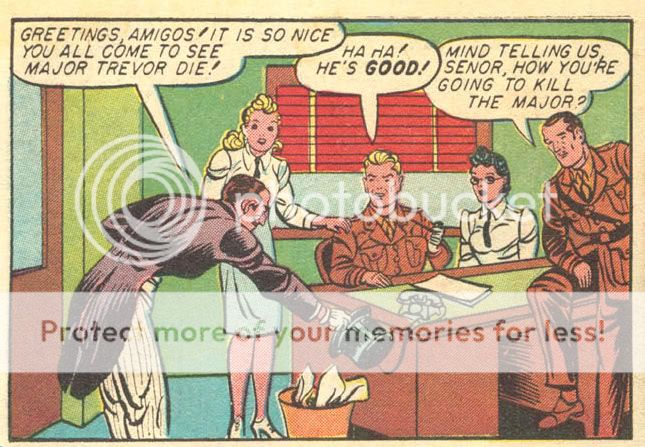
For an actual relationship, that’s deeply wrong; even if he isn’t worried about getting hurt himself, he should be worried about how WW feels.
And despite all the endearments, they never exactly seem all that intimate; even when she rescues him, the closest they get is holding hands at arms length. Not even a chaste kiss:
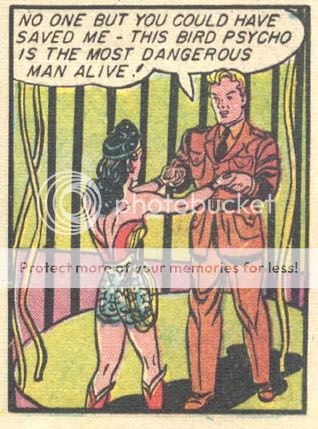
Compare the very next panels, in which WW rescues Dr. Psycho’s wife:
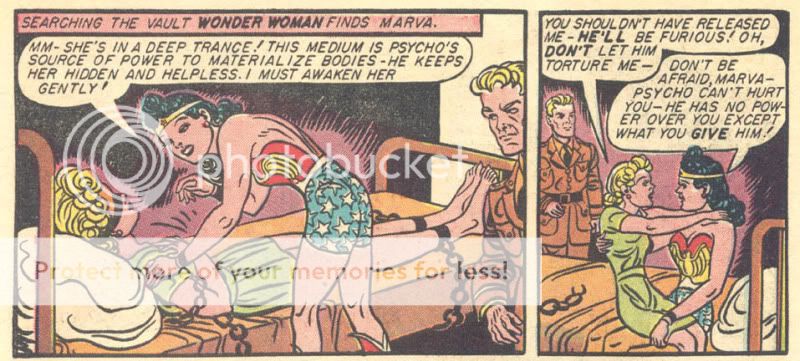
This woman who WW hardly knows gets significantly more cuddling than Steve does. This is typical, I think; WW has plenty of close, even sensual relationships, but they’re all with other women, not with Steve. Here she is with her Mom, for example:
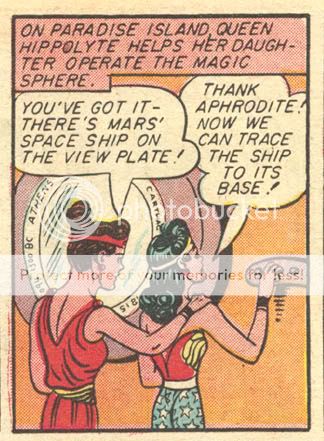
I don’t think I’ve ever seen her share such casual intimacy with Steve. And, then, of course, she’s always getting tied to other women, like her buddy Paula…..
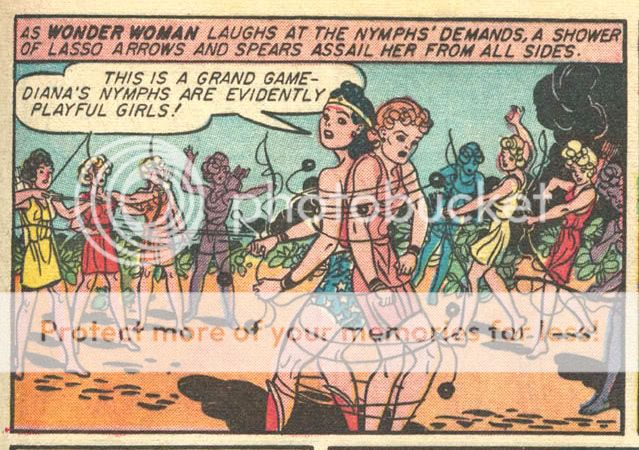
I’ve talked a little in other places about the importance of romance to genre literature for girls. And I think that that holds true. However…I think there is some sort of age cut off there. I mean, from my experience with my son’s classmates, even 4 and 5 year old girls are more interested in marriage and romance, in some sense, than their male peers. But that interest is pretty abstract — you know, they say, “I’m going to marry *that* boy!” but they don’t mean they actually want to marry that boy, or even hold his hand at this stage. As Eric B. said in comments to my much maligned Spider-Girl post
My daughter hates female superheroes that are directly derivative of male superheroes. She likes Wonder Woman ok when the story is decent (a dicey prospect), but prefers The Flash (Silver Age reprints) as her favorite. Perhaps it does make sense to market (and write) a title like “Spidergirl” to young girls…but will they be buying? I’m not so sure. Maybe some 8 year old girls want romance, but I think what they actually want is action, adventure, and humor…just like 8 year old boys. For these things, superhero comics are perfectly fine.
I think young girls do like a bit of romance…but they don’t want you to go overboard with it. Given that, it seems like the Steve/WW romance is just about right; it’s there, but it’s not especially obtrusive or fraught. WW isn’t constantly worrying about whether Steve likes her, or even whether he’s going to find out her secret identity, the way Clark Kent worries about Lois Lane. She doesn’t pine after Steve except in the most perfunctory way; she just saves him and he’s grateful and then she moves on to share intimate moments with her real friends — and just as is the case with most young girls, her most important friends tend to be other girls.
And, when there are close physical relationships with boys, they tend to be worked out through other means:
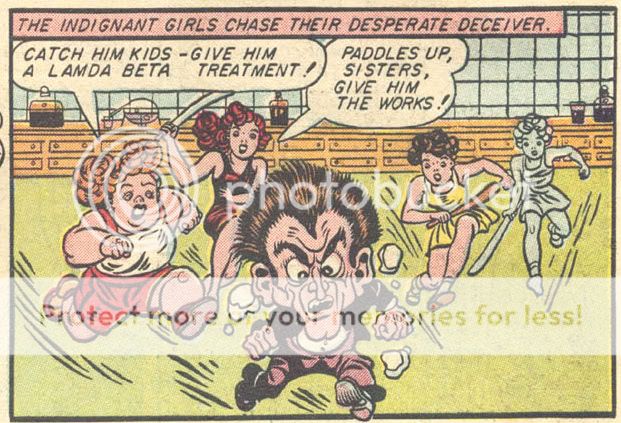
That’s Dr. Psycho coming at you, giant mug dead center, while Etta and the Holiday College gang chases him with paddles.
Again, it’s amazing how competent and generally tough Etta is, and how much she gets to do in these stories. Originally, looking at her, I wondered what the hell Marston was doing. This goofy, obese, monomaniacal buffoon — are we supposed to laugh at her? Identify with her? Or what? But the more I read it, the more it’s clear that the answer is, yes, both. How different is Etta, really, from Cookie Monster — certainly one of the most beloved creations for children? Kids love to eat and fight; Etta loves to eat and fight; ergo, kids would like Etta. She certainly gives Peter a chance to show he can do visual slapstick with the best of ’em:
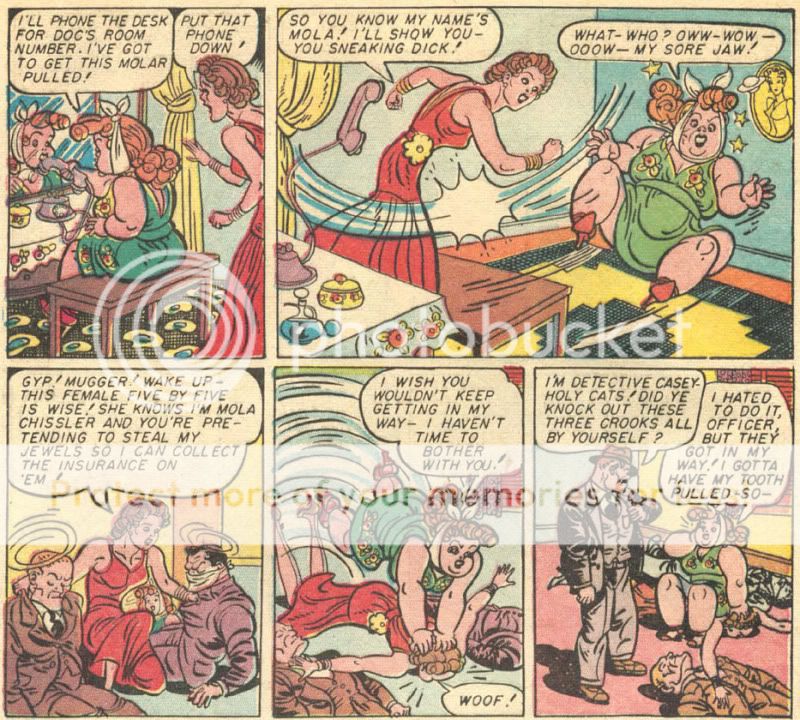
I love those giant swoops, and you can feel that woman’s face hitting the floor. Or how about this:
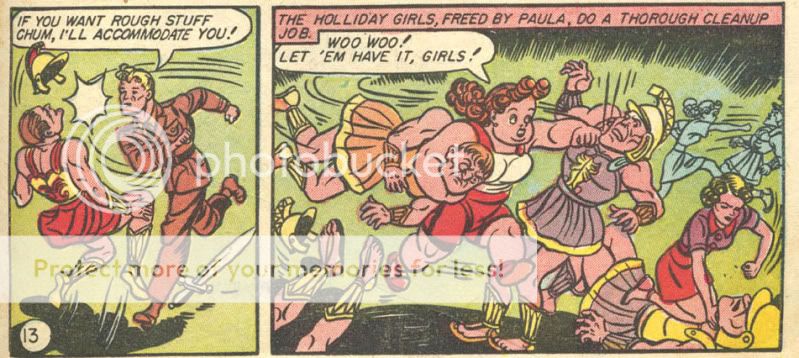
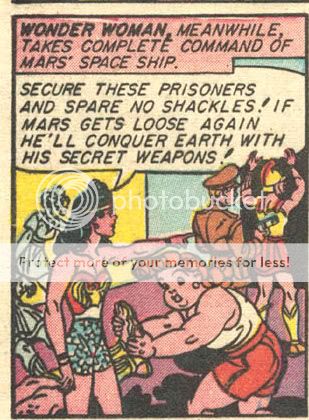
I mean, who would you rather hang out with, poncy Steve with his oh-so-proper “oh, excuse me, I’ll accooooomodate you,” pole so far up your butt that you’ve got perfect posture even in a fist-fight — OR, with Etta, who beats up two guys at once while yodeling and apparently having the time of her life? It’s not much of a contest…which is why it’s Etta who gets to put WW’s lasso back on her hip while Steve is off somewhere in the background playing with his gun.
_________________
I did drift away from talking as much about the bondage in this post. So just in case you’re suffering withdrawal:
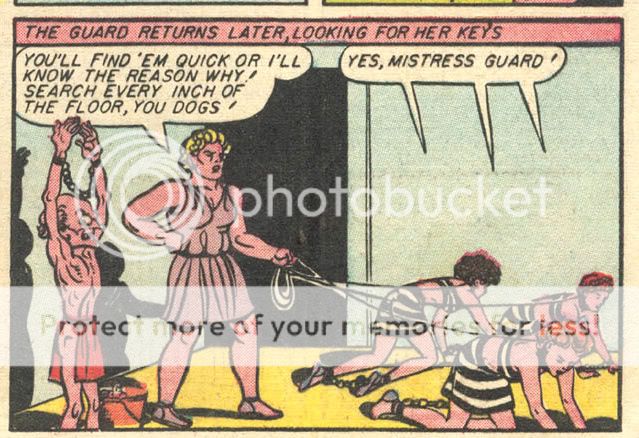
Hopefully that’ll hold you till next week.



