People Hate Me! They Really Hate Me!

Various members of the When Fangirls Attack crowd explain why I was wrong, wrong wrong in this post.

The only thing I really wanted to respond to was that a couple people accuse me of being prejudiced against fan fiction, and (by extension) kind of sexist (since fan fiction is mostly written by women writers.) I just want to say, again, for the record: I have no problem with fan fiction. Some of my closest friends write fan fiction: notably kinukitty, who is now writing a yaoi column for this site — a column which, I am informed, will also probably discuss slash fiction at some point in the not too distant future. In my Gay Utopia project, I included a number of fan fiction related contributions by Kinukitty and others (here; here and here.) I’m a fan of Clamp, a collective that started out doing dojinshi, or fan-fiction Japanese comics. I wrote an essay in praise of Torchwood’s fan-fiction roots.

I think fan fiction, like most genres, is prone to some characteristic weaknesses. I think those weaknesses are exacerbated in super-hero comics, where corporate stewardship tends to pander to the lowest common denominator and excise the more interesting visions (which in fan fiction often involve unexpected romantic pairings.) Given that, my guess would be that there’s WW fan-fiction out there that’s better than most of what has been done with the character since Marston died.

Garfield’s Nine Lives

Garfield: His 9 Lives came out in 1984. We owned it when I was a kid, and I remember even then finding it odd. Now we’ve received an old copy for my kid as a gift…and it seems even odder.

Like the title says, the book tracks Garfield through his 9 lives, starting as a cave cat and ending up as a cat in space. Which certainly makes sense as far as it goes…and several of the segments are, in fact, more or less exactly what you’d expect — that is, they’re Garfield gag strips with a different time setting. Here, for example, cave man domesticates cave cat:

Photobucket

Cartoony style, professionally accomplished basic slapstick schtick — that’s what I expect, more or less, when I go to a Garfield comic. Similarly, there’s a very funny Three Stooges riff in which Garfield is an exterminator, allowing Jim Davis to get a bit more squicky than he tends to in the funny pages:

Photobucket

Other parts of the book, though, are harder to parse. In the first place, little is done with the conceit of Garfield-through-time; almost all of the stories except for the cave cat and future cat ones are effectively set in the present. There is one story where Garfield is a Viking Cat…but then he gets frozen in a block of ice and ends up in 1984 anyway along with his Viking comrades. This sets up a confused and toothless Mad Magazine knock off, as the Vikings meet the modern day world and end up as factory workers, plumbers, and advertising executives. There’s also a prose story about Garfield as a detective (I guess that does seem vaguely set in the 40s…) and a fairy-tale story with slick computer-surreal art which is too saccharine to discuss further.

And then there’s this:

Photobucket

Yes, that’s an incarnation of Garfield as atavistic monster. I don’t have the equipment to scan the entire double-page spread at once, but basically he’s leaping to slaughter his aged owner.

And the twist-ending horror shocker isn’t even the weirdest of the tales. That honor would have to go to the tale which has Garfield as a laboratory animal who is injected with an experimental drug, escapes from his cage….and then changes into a dog. It’s done in a more or less realistic style, and the whole thing is extremely creepy, from the traums of the vivisection to the apparently painful transformation; even the sort of winking ending (he escaped!) seems very creepy — I mean, surely an animal who this happened to would be terribly traumatized. It all seems very far from the jokey world of the Garfield strips; this is more like 2000 AD twist endings…except that crossing it with a children’s comic strip makes it significantly more, not less, disturbing.

Part of what’s going on here is that Davis is giving the folks in his studio a chance to stretch out. For instance, that creepy, atavistic cat above isn’t drawn by Davis, but by Jim Clements, Gary Barker, and Larry Fentz. The saccharine fairy-tale is written and drawn by Dave Kuhn. But then, the oddest stories — the lab animal one, the atavistic cat one, are written by…Jim Davis. The same Jim Davis who has been writing essentially the same Garfield gags (coffee makes you crazy! cats are lazy!) for thirty years. The same Jim Davis who, when asked to talk about his strip, utters bland profundities like “This whole line of work is to make people happy and smile. Getting paid for is it just a bonus.” If you were going to guess, you’d say that Jim Davis hasn’t thought about anything in particular for most of his adult life. And then you find something like this, or Davis’s appreciation of Garfield Minus Garfield and you start to wonder…

Oliphant Watch: The Pig Busts In

This one makes sense, which is a letdown, of course. No pointing and giggling.

Obama has got a ton of things to deal with, what with the breakdown of the financial system and the foundering of America’s automakers. The financial firms and car companies are huge institutions, they have their hands out, and they have shone a good deal of selfishness, so thinking of them as pigs comes naturally enough. Now there is a new, large, very different, and unexpected problem called swine flu — another pig, and it’s busting down the door as Obama says, “What now?” So, yeah, all of that tracks.
We get the message only because the two little nattering figures at the edge of the cartoon bother to fill us in. But that’s a technical blemish, not an example of craziness. The point of the cartoon, though not crazy, isn’t all that interesting — another problem for the president? damn! — but what the hell. That’s still a really good giant pig Oliphant draws for us.
Sorry, Matthew, if you’re reading this. Maybe next time.
(For crazier Oliphant times, click here.)   

Bound for Glory

I’d posted a bit back about Alan Moore’s proposal for Glory. Basically I argued that for the most part Moore didn’t seem to understand what made the Marston/Peter run great; in his proposal he tended to take weird, absurd ideas (like the invisible plane), note that they were weird and absurd, and then go on to suggest changing them in ways that made them more conventional and boring (turning the invisible plane into a more mythologically appropriate, and therefore less goofy, transforming chariot thingee, for example.)

Well, my brother very kindly sent me the three issues of Glory that Moore actually wrote (numbered 0, 1, 2) — and I was pleasantly surprised. I think the actual book is a good bit better than the proposal.

Not that Moore has suddenly figured out the Marston/Peter run. There’s no particular evidence that he has. Rather, it’s that, despite some lip service to the WW history and mythos, he really largely manages to ignore Marston and get on with his own ideas. For instance, I noted that the most interesting part of the proposal seemed to be Moore’s ideas about Glory’s secret identity. WW did have a secret identity in the Marston run, of course, but it always seemed tacked on — there because super-heroes were supposed to have secret identities rather than because it was an integral part of Marston’s politics or fetishes. WW always seemed to be slumming as Diana Prince — presumably because she wanted to be near Steve Trevor…but since WW always hung out with Steve Trevor anyway, the motivation didn’t seem especially coherent.

For Moore, however, the secret identity expands and becomes essentially the entire point of the book (or of the couple of issue he wrote anyway). Glory wants to know what it’s like to be human — which isn’t an original trope, exactly. But the trick is that the person she chooses to become/inhabit, Gloria, is a waitress who’s a schizophrenic. She’s Gloria’s secret identity, and Glory is her fantasy. The tension between those two perspectives is funny and poignant and even a little disturbing, especially at the cliff-hanger ending (never resolved), where the gap between Glory and Gloria, or between imagination and reality, swallows both of them up.

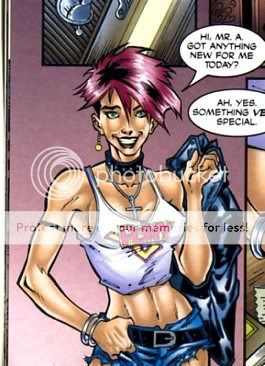
In the proposal, Moore suggested that the comic should be “disingenuous” and “coy” in its portrayal of cheesecake, lesbian subtext, sex, and so forth. I felt that this was really a fundamental misunderstanding of Marston, and overall just not a good way to go. And, indeed, the moments where the series goes that direction are, in general, not of the best. In issue #0, for example, there’s a flashback/retelling of Glory’s history which includes a lot of badly-rendered gratuitous cheesecake which is irritating and dull. And then there’s the cameo by a female comic reader in a half-shirt who a skeevy old book-retailer keeps refers to as “child”, and who behaves more or less like a kid (deferential to old skeevy guy, eager for new book,…she’s an analogue to that comic-reading kid in Watchmen, actually), but who has the hard-bodied, half-shirted, butt-falling-out-of-her-bottoms look of a poorly-drawn pin-up.
Photobucket

On the other hand, the retro-bondage flashback story in issue #2 with cross-dressing, serious butch-femme play, and tongue-in-cheek parodically second-wave sneering at the bonds of matrimony was quite entertaining…though its knowing satire, its exploitation, and its clever plotting with the twist ending is world’s away from Marston/Peter (it reads much more like Moore’s own efforts for 2000 AD, actually, albeit with less explicit violence and more implicit sex.)

In any case, the point is, these are largely aberrations; the bulk of the series doesn’t go for coy or disingenuous or cheesecake especially. Instead, it treats sex and love in an above-board, respectful manner. Gloria the waitress sleeps with a marginal drifter character, and its sweet and sexy and cute (“I like his name and how he talks,” Glory thinks, “I like his bottom.”) Similarly, Hermione, Glory’s companion, has an unrequited crush on her…Moore threatened to mine that for titillation in the proposal, but in the actual comic it’s played almost entirely for bittersweet pathos. Maybe Moore wrote the proposal figuring that Liefield wanted coy cheesecake? In any case, there’s much less of it in the comic than he promised, which is all to the good.

Overall, I think the fact that this isn’t actually Wonder Woman helped Moore a good bit. Glory’s costume is no great shakes, but it’s not the dreaded swimsuit of Americana. She isn’t tricked out with bondage gear. She doesn’t have tons of baggage about, for example, the mission of peace (Moore basically has her going to man’s world initially because Hitler pisses Demeter off by being a jerk, and later just because she feels like it), or feminism (which Moore uses as an off-hand joke a couple of times, but doesn’t otherwise bother with.) There isn’t any need to make any homage to the idea that she’s an icon of any sort. Though he takes some things from the WW mythos, Glory ends up as much less WW than Supreme was Superman. Instead of fetish and feminism, Moore uses the title to talk about magic, imagination, and relationships — his obsessions, not Marston’s at all.

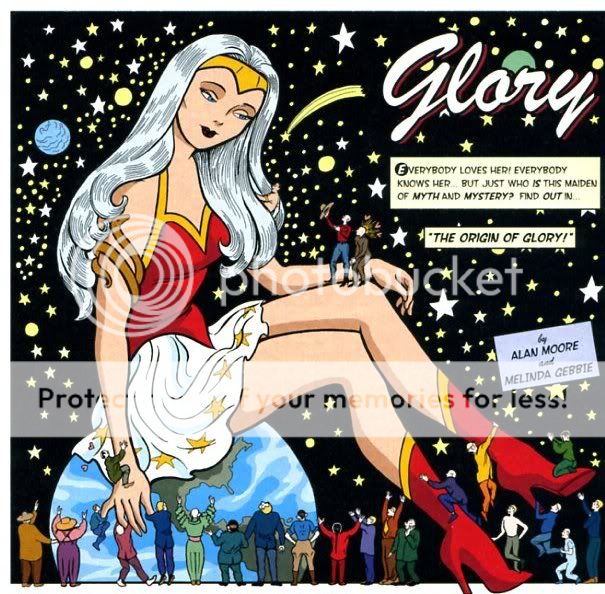
Maybe this is clearest in the retelling of Glory’s origin, illustrated by Melinda Gebbie. The first image of the story is this:
Photobucket

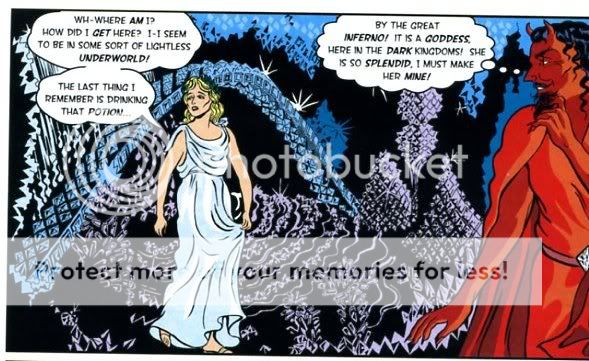
This reminded me of the Ms. cover image where WW is shown as a giant. Here, though, the sexualizing effects of manipulating body size are much more thought through and under control; the children’s book stylized whimsy, the girly outfit, the fashion pose, the skin, and the tiny figures showering her with adulation; she’s powerful, but also a sexual object in a whimsical way. I mean, Marston wasn’t exactly whimsical, I don’t think — more cracked. But this seems like a nice nod to his themes; a way to point to them without pretending to take them as seriously as the man himself did. It is coy, I guess, but almost nostalgically or poignantly so — especially as those very elliptically suggested themes of sexual power and submission don’t really play out in the following narrative at all. Instead, the story Moore tells is actually much more like a Neil Gaiman Sandman tale than like a Marston fever dream — it’s a reworking of the Persephone myth, with Demeter impregnated by a demon in the form of a silver rain about halfway thorugh. There’s no bondage or purple healing rays or caricatured masculine stereotypes anywhere in sight. Gebbie’s artwork does share some traits in common with Peter — a somewhat simplified cartoony style, some frilly filigree, a penchant for stiff poses creating frieze-like compositions. Her faces, though, are much more expressive, and her linework less so. The feel ends up being more conventional and sentimental, as in the image below:
Photobucket

I really like that panel, with the diamond patterns in the back and the demon thinking in Lichtenstein melodrama. We get love and mystery and magic. It’s nothing like Marston/Peter, the putative object of the tribute. But that doesn’t mean it’s bad.

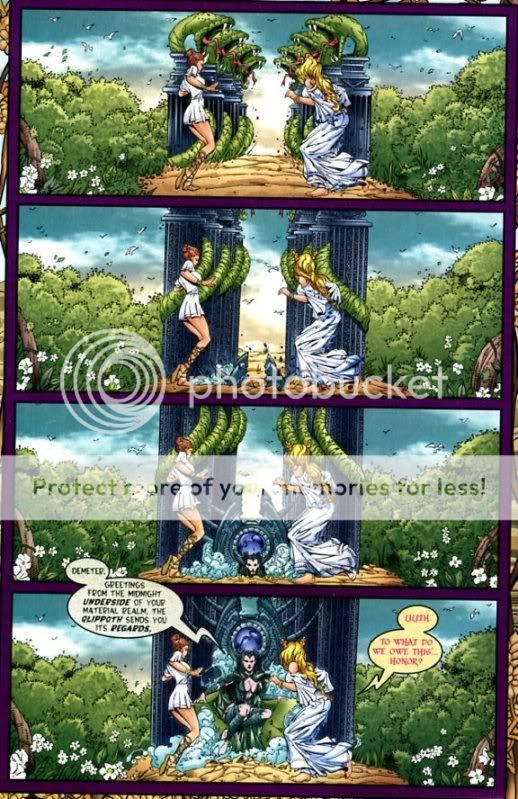
This isn’t to say that Glory is overall comparable in quality to the Marston/Peter WW run. In the first place, other than Gebbie’s eight-page cameo, the art is typical mainstream crap; ugly stylistic nullity mottled in that horrible computer coloring. Moore tries for a couple of Winsor McCay effects and you just want to tell him to stop, man; nobody here has the skill for that. You’re just embarrassing everyone. Give it up.
Photobucket

Art problems aside, Moore’s authorial vision, in this title at least, isn’t nearly as weird, as funny, or, I’d argue, as thoughtful as Marston’s original. What with the flashbacks and the backstories and the diner drama and Glory running off to fight badness every so often…the characterization and plot are clever and fun, but they’re too diffuse to really seem urgent or to add up to all that much. As with Supreme, you get the sense that Moore (like Glory) is slumming; running along and entertaining himself without breaking too much of a sweat. The themes around imagination are things we’ve seen from him before…stories affecting the world, stories breaking into the world, etc. etc. In a couple of sequences, characters in the comic are reading comics, and then the comic within a comic turns around and breaks the fourth wall and talks to the character in the comic…and you think, yep, whatever, Alan — comics are a metaphor for existence. Can we move on now?

The thing is, since I don’t find these ideas that compelling in the first place, I’d just as soon see Moore treat them as toss offs; better that than Promethea, certainly. The air of improvisation doesn’t hurt the book;on the contrary, I like the breeziness of it, and there’s still enough depth to keep things engaging and even affecting. It’s not genius, but it is one of the few versions of WW that isn’t an aesthetic pratfall. Marston/Peter’s character is impossible to deal with, and so Moore, very reasonably, refuses to, and comes up with something else entirely.

_________

One complaint though; Moore puts an Etta Candy analogue in one of his flashback stories…and she’s thin and hot! What’s with that? Did Liefield decreed that there couldn’t be any fat women in his comics, no not even one?

Oh Christ. Just Fuck God in the Ass and Leave Him Bleeding

… a conscious effort to inscribe this “Trek” in the storytelling traditions popularized by Joseph Campbell, in which heroes must suffer loss and abandonment before they rise to the occasion. The filmmakers admit that this is a deliberate homage to their favorite films, like “Superman,” “Star Wars” and “The Godfather Part II.”


From the New York Times via The New Republic’s Plank blog. The article in question discusses what J.J. Abrams has in mind for his reboot of the Star Trek franchise.

The quote is stupid because, as the Plank item points out, Godfather II ends with Michael Corleone’s soul and family in ruins: he is corrupted and he is alone. The Godfather films aren’t about someone being tested and rising to the occasion; they’re about someone getting pulled in, just like it says in that goofy line from Godfather III  (you know, “they keep pulling me back in!”). Michael Corleone isn’t young Luke Skywalker or Clark. He isn’t callow and in need of challenge. From the start, he is a born leader, a paragon of competence and nerve, a decorated war hero and cool-headed tactician. He is the dream self-image of Mario Puzo, that poor shambling yutz who wanted to pretend he was hard, compact and capable. Corleone starts as a hero and always has the gifts of a hero, but he loses his way morally. This process begins, for all reasons, because he loves his father, who happens to be a Mafia chieftain. And that tragedy is the whole point of the Corleone story.

Doesn’t this matter? Can’t J.J. Abrams and the New York Times demonstrate some understanding of one of the most famous movies of our time? The story has nothing to do with Joseph Campbell. Nothing! If you want to feel important while talking about the Godfather films, just say “Shakespearean.” Go ahead, it feels good. You won’t be adding anything, but neither will you be demonstrating your ignorance.

UPDATE:  Another point.  Godfather II begins with Michael Corleone already in his father’s place, a man with wife, kids, and responsibilities. It’s in the first Godfather film that he’s a young man whose life is taking form. Mr. Abrams and the New York Times couldn’t even pick the right film to get confused about.

Two Things I Thought I Knew

I’ve been reading about Watchmen, the book and the movie. In the comic, I always thought the Gordian Knot Company was a bit of a stretch as names go. Yes, the Gordian knot was impossible to untie, but you don’t really think of untying locks,  just opening them; to my mind, rope and metal are too different for one to easily suggest the other. Additionally, the legend of the Gordian knot is known but not widely known, at least not in the U.S. Not a likely name for a small-time consumer service company.

I figured Moore wedged the name in there simply to further his Veidt-Alexander parallels. But no. He said in 1988 that he just thought the name would be funny and that it was only as the book went on that he realized how it dovetailed with Veidt’s monumental self-esteem.
Next, the movie gives us Dr. Manhattan always surrounded by an eye-repelling blue-white glow. I thought the glow was one further effect of the film’s deadly CGI blight. Again no.  Peter Aperlo’s Watchmen: The Movie Companion tells us the glow comes from the little bulbs on Billy Crudup’s motion-capture suit. It was, what do you call, actual-source light or something. Only the big blue muscles were CGI.

Mysteries of Young Women

I live in the section of Montreal near McGill University. There are lots of college kids around. Right now it’s finals and the 2nd Cup is jammed full of kids studying. I’m parked at my little table in a row of other little tables, all of them full except for the one to my left. It has a textbook placed on its far edge and a slim sheaf of papers placed atop the textbook. During the past hour four different people have tried to park themselves at the table. Each time the girl sitting one table over has told them no, “somebody’s sitting there.” But there isn’t. Her friend, who had been there, took off to print something at home and so far has not returned. As mentioned, the coffee shop is jammed and, like the missing girl, the people who want to sit down are students frantic to get ready for big tests.

It amazes me how young women feel entitled to pull stunts like this. I’ve seen them try it at the gym too: “I’ll just wrap my sweater around the handles of this elliptical machine and come back in 20 minutes, and meanwhile Monica will tell all comers ‘somebody’s using the machine.'” My theory is that men don’t go in for such wanton abuses of “saving” because they’re afraid someone will hit them. 
UPDATE:  A fifth character just got turned away. Agitated, I leaned over to the friend and said, “I’ve got to say, this is getting to be a bit unfair.”
The friend: “I know, I know. I agree. I’ll call her.” She gets out her cell phone. So maybe western civilization is safe after all.
UPDATE:  The girl is back. To her friend: “Sorrryyy. Oh, sorrryyyy.” She has one of those lockjaw drawls.