Dirty Projectors: Stillness Is the Move

The earnest retro soul vocals on this Dirty Projectors song fill me with irritation, not at all mitigated by the soulful-flower-children video. I can appreciate that it’s well-crafted, but its egregious effort to inspire me just makes me want to kick things. It’s like “Wind Beneath My Wings” for idiosyncratic indie rockers. Bleh.

I just realized…I think they want to be Sly and the Family Stone a little bit. It’s a worthy ambition, but the comparison is not beneficial.

But the Factual Opinion hive mind says it’s the best song of the year, so go figure.

Action-Packed Buddhism

Saiyuki (vol. 1)
By Kazuya Minekura

In my last manga-related post, I received more than a few reading recommendations in the comments. I plan to give them all a try (eventually), but for this week I took Vom Marlowe’s advice and read the first volume of Saiyuki.

For those of you unfamiliar with the title, Saiyuki is a *very* loose adaptation of the classic Chinese novel, Journey to the West. Rather than a monk traveling West to obtain authentic sutras, Saiyuki depicts the adventures of a monk tasked with preventing the revival of a demon lord, Gyumaoh. As in the novel, the monk is accompanied by three companions, including the Monkey King, Son Goku. Also, the monk is given a dragon that serves as his mount. But instead of transforming into a horse, as it does in the novel, the dragon in Saiyuki transforms into a Jeep (it’s a joke that worked for me precisely because it’s so random).

The story is set in the mountainous fantasy realm of Tougenkyou, (which I presume is like Shangri-la). In Tougenkyo, humans lived peacefully alongside a race of demons called Youkai, but the recent efforts to revive Gyumaoh have caused most of the Youkai to go feral. The monk, Genjyo Sanzo, and his three companions are Youkai as well, but their powers are controlled so they can serve the interests of humanity. The conflict with the Youkai serves as a convenient excuse to include plenty of action, which often takes up the lion’s share of each chapter.

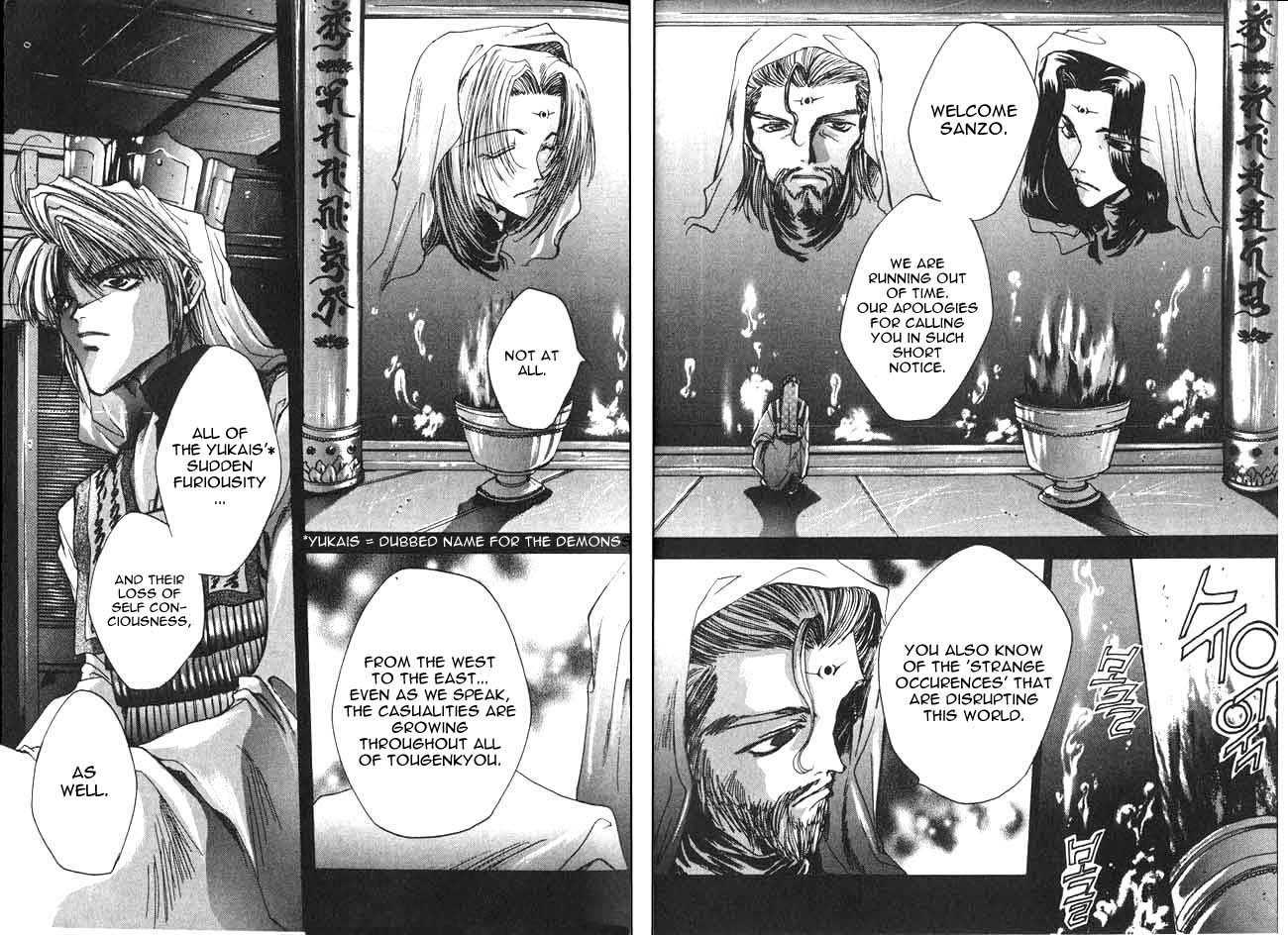
While the plot is simple, I was often confused as to exactly what was going on. Some of this is due to my own ignorance of Eastern myth. For example, when I first read the volume I didn’t understand why Sanzo was taking orders from three giant heads.

After doing a little research I learned that they were the Sanbutsushin, the three aspects of Buddha. There were numerous references to Buddhist mythology (even during the fight scenes), most of which probably went right over my head.

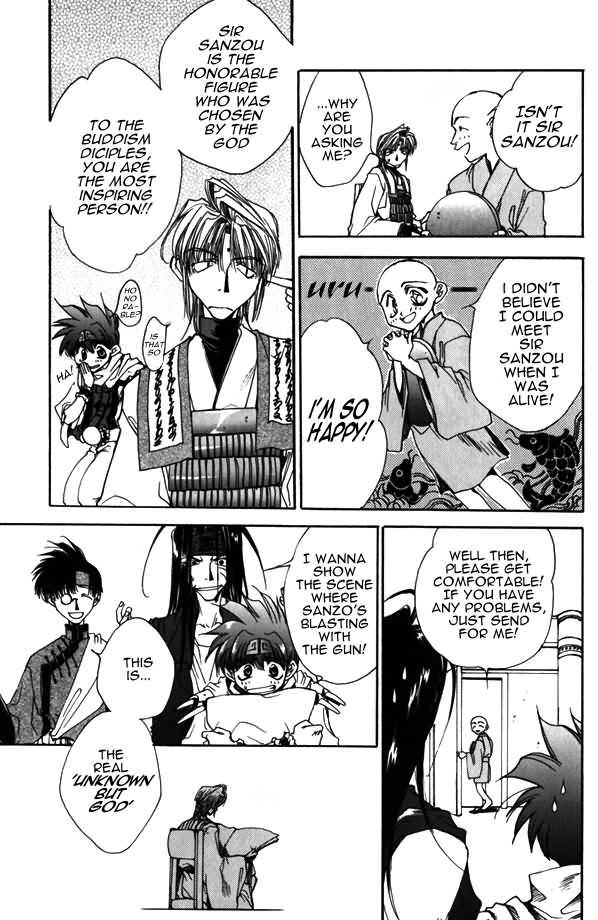
A good deal of my confusion was also due to the amateur translation. I read Saiyuki using Mangafox.com, because I am cheap. But you get what you pay for, because a manga that’s translated for free by fans tends to have numerous spelling errors and grammatical mistakes. While I can’t say for sure, I also suspect that the translation didn’t capture the nuances of the original Japanese prose. Quite of few lines of dialogue felt stilted, and some even bordered on nonsensical.

In the above panel, I can make out the gist of what’s being said, but those lines are pretty damn terrible (and did I mention the spelling mistakes?). Of course, that might be how the manga actually reads in Japanese, but I’m going to give Kazuya Minekura the benefit of the doubt.

Setting my confusion aside, initially I was not very impressed with Saiyuki. The quality of the art (which I discuss below) was uneven. The main characters lacked depth, even by the end of the volume. Now, I understand that this is a shonen manga, heavy on action, light on characterization. But everyone was just so damn archetypal: Sanzo is the stoic leader, Cho Hakkai is the nice guy, Sha Gojyo is the womanizer, and Son Goku is the bratty kid.

About halfway into the volume, however, my opinion started to change. It wasn’t that the characters became substantially more interesting, but that Minekura provided just enough hints that there was more to the story and characters than was immediately evident. There were a few scenes that suggested that the Sanbutsushin are not the flawless embodiment of good, nor are the villains purely evil. There were also brief moments that promised deeper characterization for the heroes. Son Goku, for example, was noticeably hurt when a human girl expressed hatred for the Youkai. Also, the last chapter highlighted that Sanzo is indifferent to the teachings of Buddha, despite the fact that he’s technically a high-ranking monk. I’m not ecstatic about her writing, but Minekura has piqued my curiosity, and that’s enough to get me to try out the next volume (though I’ll probably look for a version that’s been translated by a professional).

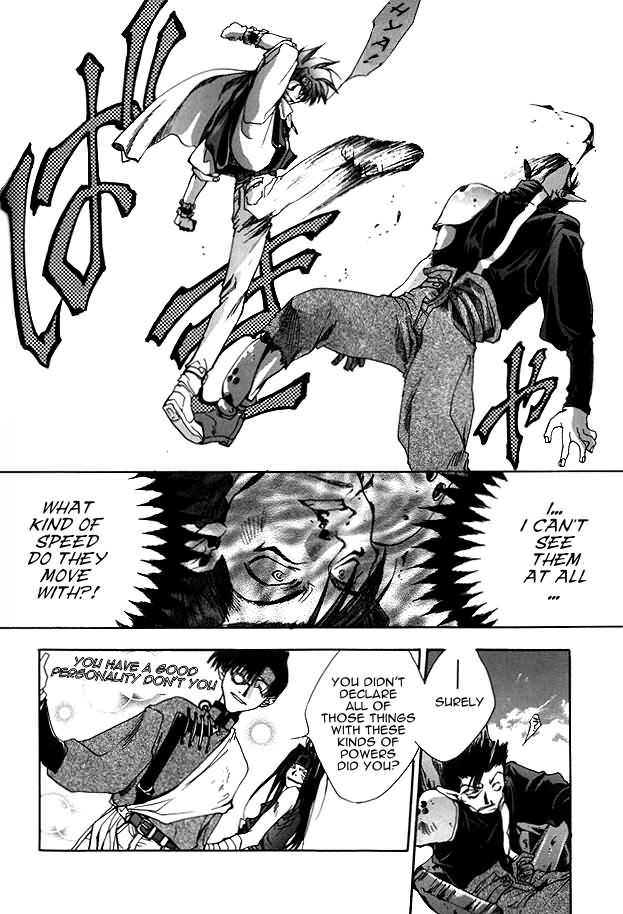
The art is hit and miss. Saiyuki adheres to a style that seems (to my admittedly inexperienced eyes) to be the mainstream of manga and anime: big eyes, angular features, spiky hair, lots of speed lines during fights. I don’t find this style repulsive by any means, but it’s never really appealed to me either. It’s more like something I tolerate if I happen to enjoy a story. Even if I was more appreciative of the basic style, there are a few problems with Minekura’s storytelling. Panel layout during the fight sequences can be bewildering, and spatial relationships are not easy to figure out. And big splashy images are sometimes used at the expense of narrative clarity. On the plus side, Minekura doesn’t hold back on the violence, and she knows how to draw a kick that looks like it hurts.

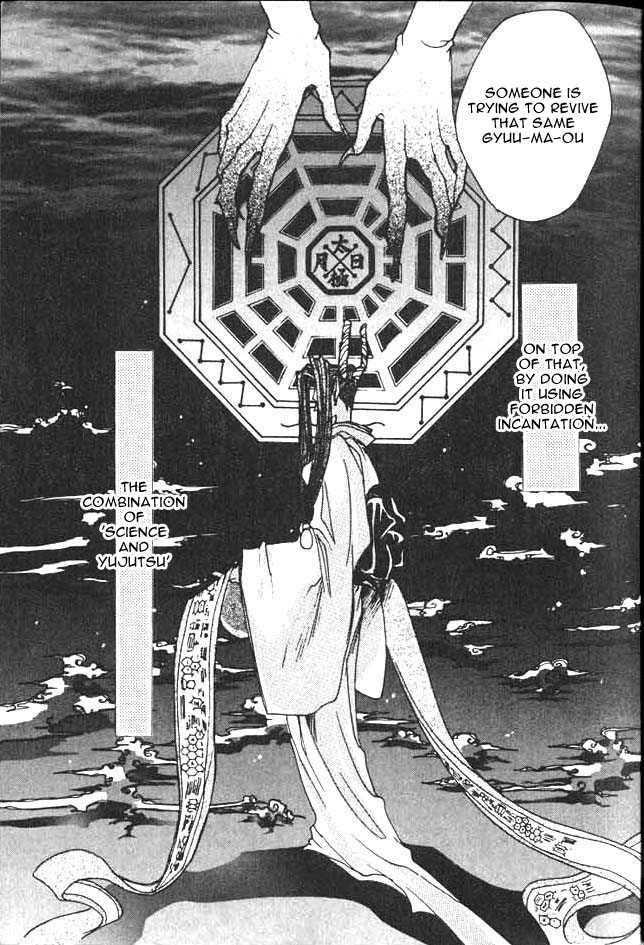
The best moments in Saiyuki are when the book deviates from the typical manga look and instead draws inspiration from traditional Chinese and Japanese artwork. The art becomes much more distinctive, and I get the sense that Minekura is more enthusiastic about these infrequent pages than she is about the lengthier fight scenes.

I particularly like the ethereal quality of the kimono, and the way the hands blacken as they touch the … whatever the hell that is (unless corrected, I’ll call it the evil, octagonal web thing).

To sum up, Saiyuki is a deeply flawed title with the potential to become much better in subsequent volumes. Hopefully, the next volume will read less like a generic shonen story and more like an idiosyncratic blend of Buddhist mythology and road-trip adventure.

Gluey Tart: Age Called Blue

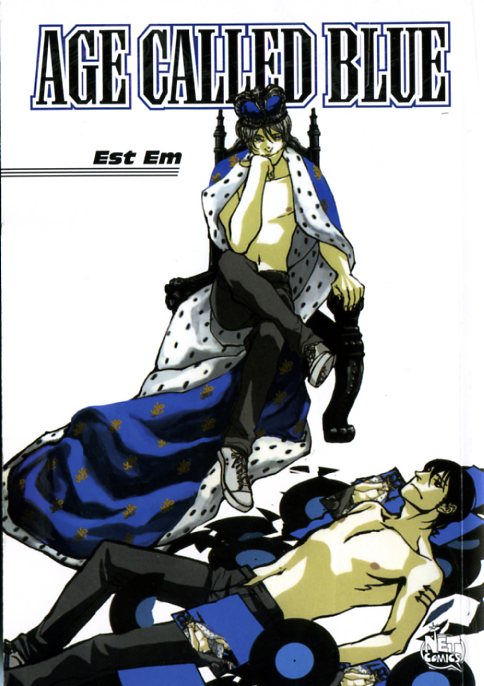
Age Called Blue, est em, 2009, NetComics

I love est em’s drawing style. I’m also fond of her gently melancholy tone. I usually like my yaoi crazy and sweet, because I can be unhappy and angsty all on my own, thanks. But you can’t eat chocolate all the time – even Kinukitty can’t, although I do dream – and sometimes you want something bitter.

Age Called Blue is about rock stars. I’ve only seen one yaoi manga about rock bands, that I remember, and it was not ideal. (Hard Rock by Akane Abe, which was not hot. Or especially interesting.) This seems like a bizarre omission, since rock stars are a fun, sexy topic, and it’s not like there isn’t a huge music scene in Japan. Ironically, the rock stars in Age Called Blue are British. One of those things, I guess.

No point in worrying about what is lacking just at the moment, though, when there’s such a feast on the table. This is a beautiful, sexy book. It isn’t sexy because it’s a non-stop romp of bawdy ass piratery – not that there’s anything wrong with that – but because it’s about intimacy. There’s sex and nudity, but it isn’t on an epic scale. It does mean something, though. The relationships feel very real, even if the settings are not strictly plausible. (Realistic, yes. Real, no.) There are young men and old men, dreams and betrayals, situations that are messy and wistful. Things fall apart, like things do, and people try, fail, wait, and hope.
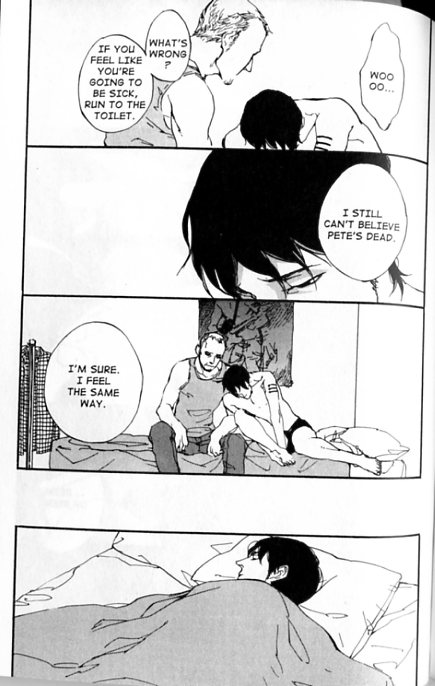
The main story arc, about the band, sort of plots the trajectory of a car wreck (metaphorically, although sort of literally, too), although it isn’t told in order. I’m not usually a fan of that sort of thing because it’s kind of hard to get it right, and it can add a level of confusion that isn’t usually necessary, much less helpful. It’s usually better to just tell the damned story and leave evocative to the couple of people who can handle it. Well, est em gives good evocative, it turns out, and the snippets we get, weaving in and out of the timeline and ending with the beginning, really work. It feels like remembering, the way one memory triggers another in an almost random way that isn’t random at all. There’s also a little bonus two-pager at the very end of the book. It’s the sweetest take on a funeral for a friend that I’ve ever seen. The style is stark and looks almost like a wood-block print, and the feeling is stark, too. Not really sad, though. Sometimes that happens with love.
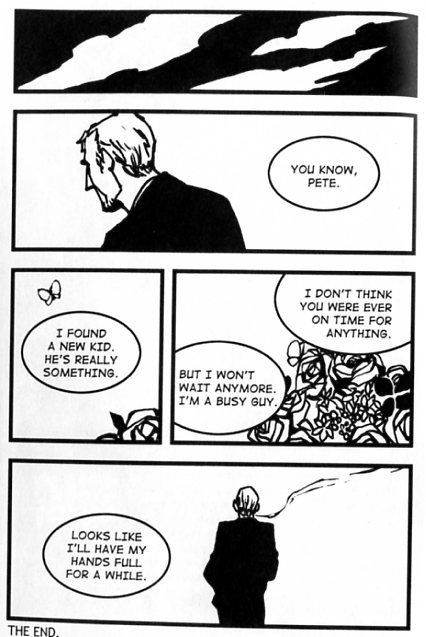
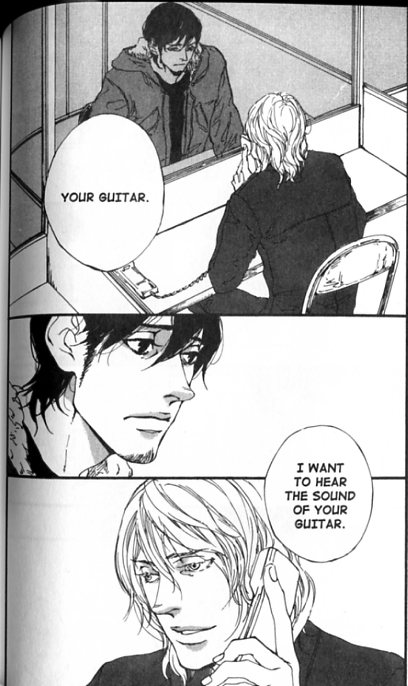
That’s what this story is about. The main characters are a pair of up and coming rockers, the singer and guitar player (of course; that’s sexier than the bass player and drummer, it just is). The singer (Nick) is a charismatic asshole of the sort we’ve all pined after (if we’re lucky) or chased (if we’re less lucky). He drifts through life being all hot and fascinating and hurting everybody. Especially the guitar player (Billy), who actually loves him. I can’t think of a way to really discuss what happens in the story without ruining its revelations, so I’m not going to give any details. I’ll just note that the complications are painful, but the outcome is sweet and even beautiful. The story also focuses on two older men, rock stars who were big years ago but are now past their prime. The interactions and intersections between these four characters is played quietly, but the patterns are pretty.
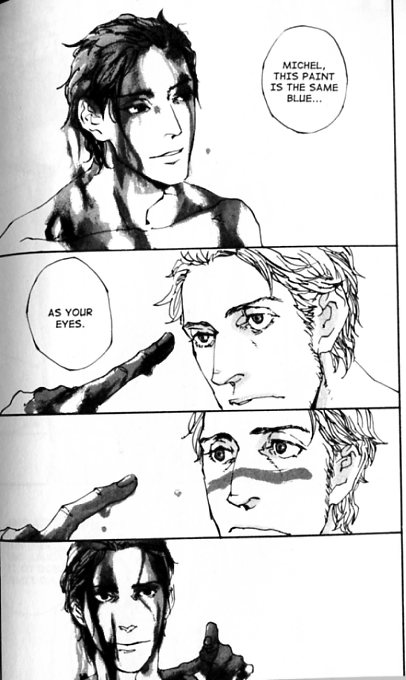
In the first side story, “I Saw the Blue,” the first encounter between the two lovers (French, this time) takes place when Lucian delivers something to Professor Pascal and throws up in the envelope (after it’s empty, at least). Meeting cute, n’est ce pas? There is a four-star scene where the professor – Michel – pours paint over Lucian’s naked body and tells him to roll around on a piece of paper. Lucian tempts Michel to join him (it doesn’t take much, but the way he does it makes me smile stupidly), and they wind up rolling in the paint together. It turns out that Michel is keeping something very important from Lucian, and the scene in which this is revealed is painful. The last scene, though, is subtly hopeful, not for anything more to come of this relationship, but perhaps for another love to grow.
The final side story, “Ni Pukha Ni Pera,” is extremely improbable, and I was shocked when it ended up being not only an embarrassment to everyone associated with it but actually touching. It’s about a friendship that is obviously so deep as to be a little more (I’ve been listening to the fabulous Flight of the Conchords album, I Told You I Was Freaky, so this reminds me of a bit from their song, “Friends”: “My Uncle John had a special friend/They dressed alike, his name was Ben/I’ve never seen two friends like them/They were very, very friendly men”). Friendship porn is standard stuff, obviously. Except that this friendship starts in 1950s Russia, and what stands between them is one man’s yearning to go into space. As in become a cosmonaut (rather than the “Ground control to Major Tom” way), which he does. This one doesn’t end the way you’d expect it to, either. And I’m also a little bit in love with est em’s wistful old men.

And that’s the book. My understanding is that est em prefers that the Romanized version of her name be all lower case, so I will go with that, even if it makes me start thinking about how not even the rain has such small hands. (That was an e.e. cummings reference, for those of you who hate modern poetry or, perhaps, just e.e. cummings, which is fair enough. Although we are actually supposed to capitalize his name, it turns out, despite what the teachers said in high school. Confusing, isn’t it? Annoying bastard.) est em is Maki Satoh, and her pen name is eso to emu, or S&M.

I found that out while trying to find out something about the translation. Age Called Blue was apparently translated by Netcomic’s Soyoung Jung, who translated Dining Bar Akira, which read a little funny to me. I was curious because est em’s previous book, Red Blinds the Foolish, was translated by Matt Thorne, making it something of a gold standard. And he was “supervising translator” for her first book in English, Seduce Me After the Show. I thought this Publishers Weekly interview snippet with Thorne, “Matt Thorne Returns to Translation”, was interesting:

est em, whose real name is Maki Satoh, is a former student and dear friend of mine. Most artists, including est em, have little input in the exporting of their work. So one day her editor told her, “We’re putting out an English language edition of your first book,” and then months later, she mentions it to me. So I freaked out and said, “Are you serious!? When!? Your work’s too sophisticated to be translated by some hack!” So we asked her editor, and learned that the translation was already done, but the editor asked me if I would check it. I ended up pretty much redoing it. For the second volume, I was in from the beginning.

So obviously I had to go reread Red Blinds the Foolish and Seduce Me After the Show, and then reread Age Called Blue to see how the tone compared. (No wonder I never have time to cook or clean or send out Christmas cards.) Anyway, I didn’t have any problems with Age Called Blue, although I did wonder about the lyrics to the song that resonates throughout the main story. Although, you know – rock song lyrics. Who knows.

I looked through the Amazon.com reviews to see if anyone addressed the translation question. No one did, but I noticed a lot of comments to the effect that est em’s drawing is rough, the stories are raw, and the works are an acquired taste. That makes me shake my head sadly. There is a theory that yaoi fans want nothing but empty-headed stories about 18-year-old pretty boys having explicit sex with other 18-year-old pretty boys. Not that there’s nothing wrong with that – I’m a fan. But I think most people can appreciate a beautiful piece of work like this, regardless of their usual tastes and fetishes.

Utilitarian Review 1/9/10

On HU

Lots of bytes through the sluice on HU this week.

To start off, I sneered at the Yeah Yeah Yeahs and wondered about Fantagraphics’ marketing policy (Fantagraphic marketers showed up to explain in the comments.)

I denounced Lady Snowblood, movie and comic, on the grounds that they are evil. Suat came back with a lengthy defense

I defended blogging and even got all emo about it. In another meta moment, I defended my right to think Ganges is boring and sneer at other comics critics and spit bile more or less indiscriminately, damn it.

Kinukitty reviewed the yaoi Dining Bar Akira.

Richard kicked off a new series, Anything But Capes, in which he looks at genres other than super-heroes. He started off by looking at the state of Barbarian comics.

Suat reviewed Ooku, which he doesn’t like as much as me.

I explained what my son has and has not learned from Peanuts.

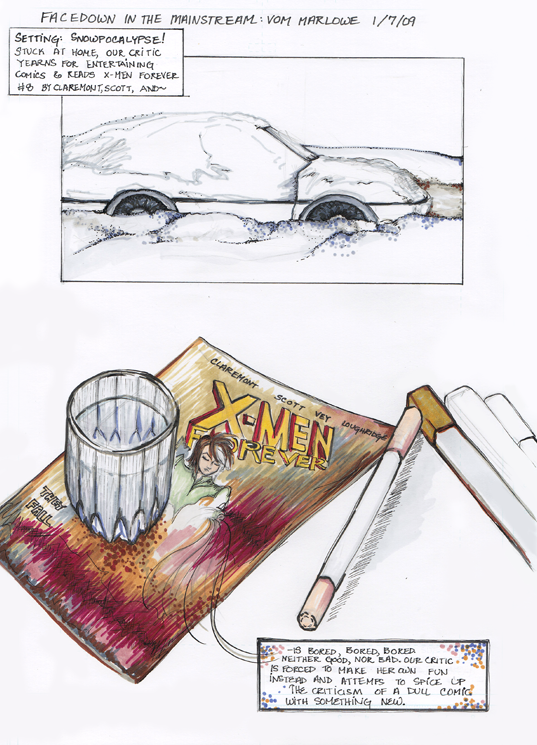
Vom Marlowe drew a comic expressing her disinterest in X-Men Forever.

And this week’s music download features lots of doomy drones and other metal. (Last week’s, if you missed it, features Thai country music (Luk Thung.)

Utilitarians Everywhere

My enthusiastic review of Dokebi Bride is up on Comixology this week.

That departure, I think, points to the core knot at the heart of Dokebi Bride. The book, like many ghost stories, is about grief and dislocation and how the two circle around each other like black, exhausted smudges. The first volume opens with Sunbi’s father carrying her mother’s ashes back from the grave; that volume ends with the death of Sunbi’s grandmother, who raised her and cared for her. The central loss of a parent, and therefore of self, returns again and again through the series, a literal haunting. Sunbi can’t function without putting the past behind her, but the past is everything she is — she can’t let it go. When a fortune teller offers to read her future, Sunbi rejects the offer angrily. “No, I don’t want to know about my stupid future!” she bites out through her tears. “Just tell me what all this means to me! Tell me why they’ve all died and left me, why they’re even trying to take away my memories!”

On Tcj.com I reviewed Strange Suspense: Steve Ditko Archives Volume 1.

Did you read that whole thing? If you did and you enjoyed it, you’re a hardier soul than I. “I got my letter and then I thought about my letter and then I thought about my letter some more and then I used a metaphor: ‘leaden feet’!” That’s just dreadful. And, yes, that’s the one romance story in the book, but the horror and adventure comics are not appreciably better; there’s still the numbing repetition, the tin ear, and the infuriating refusal to finesse said tin ear by leaving the damn pictures alone to tell their own story.

Bert Stabler and I talk about Zizek and art over at his blog Dark Shapes Refer.

I like the idea that you need a transcendent background in order to appreciate, or even allow for, multiplicity. I’m thinking about this a little bit in terms of culture and art, and the impulse that I think most everyone has to want people to consume/listen/read/whatever the right thing. It seems like that’s coming from a place where the transcendent is material; that is, your worshipping the art itself, therefore moral choices become essentially consumer choices. Alternately, you just cut culture and morality apart altogether, and argue that neither has anything to do with the other. Whereas if you have a transcendent ground of some sort, you can say, well, culture connects up to morality and or important things in various ways, and you can talk about it in those terms, but choices about art are not in themselves good or evil.

On Madeloud, I review the soundtrack to the BBC miniseries Life on Earth, which profoundly affected my life when I was, like, 8.

Over at Metropulse, I have a review of avant Japanese guitarist Shinobu Nemotu’s Improvisations #1.

At the same site there’s also a review of the slab of black doom that is
Nihil’s Grond.

At the Chicago Reader I review the fairly amusing gimmick book Twitterature.

Other Links

I enjoyed Tucker Stone’s Best of at Comixology, especially since he picked the right thing for book of the year.

Ta-Nehisi Coates explains why he wants to be able to check “Negro” on his census form.

And finally, Johanna Draper Carlson has a nice summation and round up of links relating to the devil’s bargain between MOCCA and Archie Comics.

Music for Middle Brow Snobs: Angherr Soda

Doomy/drony, plus some prog.

1. Angherr Shisspa — Koenjihyakkei (Angherr Shisspa)
2. Rimfrost — The Raventhrone (Veraldar Nagli)
3. Drudkh — Eternal Turn of the Wheel (Forgotten Legends)
4. Nadja — Dead Skin Mask (When I See The Sun Always Shine on TV)
5. 22:34 14 Jan 2009 — Shinobu Nemotu (Improvisations #1)
6. Gui Boratto — Atomic Soda (Take My Breath Away)

Download Angherr Shisspa.

And if you missed it, you can find last week’s Thai music download here.

Face Down in the Mainstream, Illustrated Edition

This is my first Face Down in the Mainstream post here at our new home, and I assume there are some new readers.  This column chronicles my attempts to find a mainstream comic to read and enjoy.  Said comic must be currently running, not an older trade, and ideally focus on female superheroes, although I’m not going to ignore the more traditional male heroes.  I read comics more for art than words, and I frequently read manga in Japanese without ever knowing what the words mean. Thus far my favorites have been Detective Comics Batwoman and Marvel Adventures Spider-Man.

For the first column in our new digs, I wanted to do something a little special, but as you will see, my options were limited.  But I did what I could.

So, I crafted a whole bunch more pages, but I won’t bore you all further.  The truth is, this first page is about as much as you need to know about how I felt about this comic.

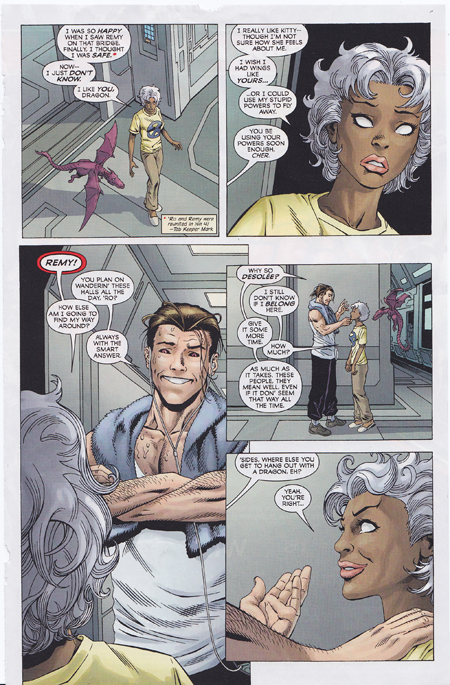
But I do try to do a good job on these little reviews, so here’s the usual textual explanation with images yanked from the comic as examples.  This comic has a nice explanation of the story-up-til this point in the front, and then leaps directly into the action, which is an X-men team battling a giant purple robot.  Despite the purpleness of the robot and the colorful nature of the X-men costumes and faces, this comic is rather bland.  Sure, you have people in  green and yellow tights, but the overall color scheme is simple and in many places, so oversaturated with neutrals that the colors of the suits don’t even pop.

The jungle scene in particular disappointed me.  There was plenty of green and blue, but not much was done with that.  All very flat, alas, and no interesting ink patterns to spice things up.

Here’s a particularly good example of what I mean:

It’s not bad, is it?  It’s just overwhelmingly dull.  A shame.

The story itself chugs along OK.  People do things, other people react, villains plot to take over the world, the X-men try to make sure that the emotionally tender member of their team is OK, and so on.  It’s just—  I didn’t really care one way or the other.

I found the twist at the end utterly predictable, and I’m pretty sure I know where the character foreshadowing is going.  The cute picture of Rogue on the cover, holding the guts of the giant robot, didn’t really come about much in the comic, but it didn’t really not either.  I mean, they do battle the robot and she does win, but there isn’t much struggle to get the victory.  The emotional reactions don’t last much past a single panel (except for Kitty’s, which was caused by events in a previous issue), so it’s hard to take any of them very seriously.  There’s not much sacrifice or bonding or character development, and while the external plot does move forward, I’m not finding any themes or depths.  It’s a villain who wants to take over the world  using giant robots, you know?

So anyway.  Not bad, not good, rather dull.  I’ve got my eye on a few new likely looking suspects in the rack at my local Borders, but first I’ll need to shovel my way out.  *sigh*

Spiritual Enlightenment from Peanuts

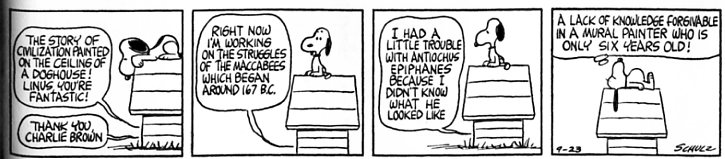
I was reading the 1963 Fantagraphics Peanuts collection to my son (now on sale!) he’s gotten really into them recently. Anyway, there’s one fantastic series of strips where Linus paints a Biblical mural on the ceiling of Snoopy’s doghouse. In perhaps the best, Linus comments that he isn’t sure what Antiochus Epiphanes of the Maccabee story looks like— a lack of knowledge which, Snoopy comments, is forgivable in a six year old.

My son is very curious about how old the Peanuts characters are exactly, so I pointed to the end of the strip and said, “Look, Snoopy says Linus is six, just like you.”

“Linus is six?” he said.

“Yes,” I said. “But he doesn’t act like he’s six really does he?”

“No,” he said. “Because he carries a blanket around and sucks his thumb.”

“Um, right.” I said. “But he also does things that seem older. Like painting a mural on the roof of a doghouse. Could you paint a mural on the ceiling of a doghouse?”

“I could if the doghouse was big enough.”

“I don’t…”

“I could. I can paint. And I could paint a mural about the Hanukkah story.”

As is the way of my Semitic people, I have, of course, done absolutely nothing to further my child’s religious education, prompting my wife, who was sitting nearby, to ask the obvious question.

“How do you know that the Maccabees have anything to do with Hanukkah?”

He looked at us like we were crazy. “Because,” he said, “I saw it on Krypto the Super Dog.”