Slowly Paying For It: God and the Machine

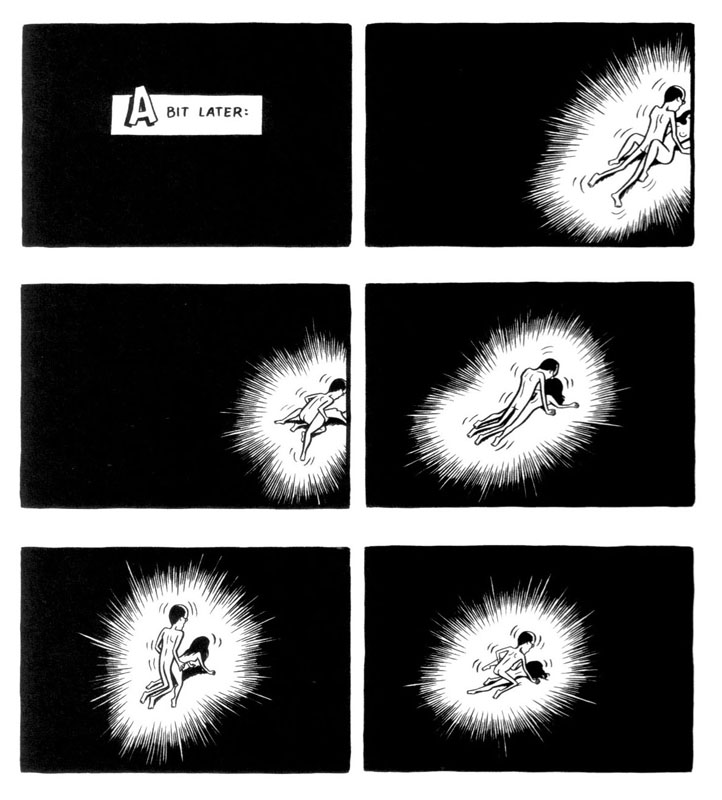
In his discussion earlier today, Matthias Wivel argues that Chester Brown’s Paying For It includes an implied sacred component. Pointing to the use of distant views and the wormhole effect Brown uses in many panels, especially those depicting sex, Matthias argues that Brown presents a God’s-eye view of his own life, universalizing and consecrating his own experiences.

many scenes are viewed from above, from a kind of “God’s eye-perspective.” The peepshow aesthetic of the tiny two-by-three paneling seems to be for the benefit of an omniscient viewer, who at times loses interest and lets the eye wander, decentering the compositions. Chester walks, talks, and fucks under the scrutiny of a dispassionate oculus, darkening around the edges. It is almost as if he is inviting a higher judgment to balance out his own.

Sex scenes are privileged by even greater distance. They are uniformly denoted by a throbbing glow in the dark, blocking out the surroundings (this is worked to hilarious effect in chapter 2—the sequence where Chester keeps stopping, with the banal details of the surrounding room appearing each time). A necessary way of avoiding the interference that overly graphic renditions would create, this approach lends universalism to these scenes, threading them through the narrative as its central, ‘sacred’ constituent.

Brown’s cartooning has struck me as invoking this kind of higher order since at least, and unsurprisingly, his 1990s Gospel adaptations, which routinely employed a similarly elevated perspective, pared-down panel compositions, and suggestive framing to great effect.

It’s an interesting argument…but one that I’m afraid I don’t find especially convincing. I certainly agree that Brown is using a distancing mechanism. But I don’t think that distancing mechanism needs to imply a God or a sacralization. On the contrary, it seems to me that the eye you see through when you look at Brown having sex is not the eye of God, but the eye of porn. It does not provide a deeper insight, or a spiritual glow. On the contrary, the distancing turns Brown and his partners into rutting meat dolls, robbed of inner life or soul (you can’t, notably, see their eyes.) The distancing is not a means of handing control over to a larger power; it’s a way of enforcing control; of nailing human emotions and interactions down like butterflies in a sample case. It’s the expression not of spiritual insight, but of sadistic gaze.

I think this has some interesting implications for Matthias’ other arguments. He suggests that some critics of Paying For It (especially me) have focused on the polemic and failed to respond to the formal successes of Brown’s work. Those formal successes are (in a nice reversal) precisely the spiritual successes; they are the ineffable which give life to the comic. Or, as Matthias says, “[Brown’s] power to imbue any scene with an ineffable sense of meaning is one of his great gifts as a cartoonist, a gift few critics have attempted to critique or explicate, and which Spurgeon addressed sensitively in his review.”

What Matthias doesn’t seem to consider is the possibility that critics haven’t attempted to explicate or critique this gift in reference to Paying for It because the gift isn’t there. Brown’s grids, his simplified figures, the often mechanical stillness of his figures, the cadaverous death’s head of his self-portrait…it’s not, to me, suggestive, or spiritual, or ineffable. It’s ugly, routinized, and intentionally flat, almost desperate in its eschewal of beauty or resonance.

I do agree with what I take to be Matthias’s position that the blankness of the art has a thematic meaning. The art’s frozen distance undercuts Brown’s polemic, calling into question his claim that prostituted sex is joyful or spiritual.

The problem for me is that I don’t have much desire to see ugly, boring truths depicted in ugly, boring art. I’m not that interested in Chester Brown per se, so watching him work out his fairly transparent control issues by systematically draining his art of life and joy doesn’t appeal to me that much. Matthias sees this as a lack of sensitivity to the formal achievement…but surely it could also be simply a different evaluation of that achievement. Matthias sees God in the interstices of Brown’s routinized panels, and declares that those who don’t see Him are insufficiently attuned to the spiritual. Perhaps. But still, I look at Paying for It and what I see is the machine clanking and pistoning, grinding out hollow banality because hollow banality is what libertarians and autobio comics alike use to keep the ineffable at bay.

DWYCK: Sacred and Profane Love


In terms of mainstream culture, Chester Brown’s Paying for It—a diaristic account of his experiences of paying for sex between 1999-2002—has been the most discussed comic of the year. And apart from Robert Crumb’s Genesis, probably the most widely exposed of the past half-decade or so. This is not surprising, since it addresses polemically a difficult and largely unacknowledged but perennially challenging issue: prostitution and the underlying question of how sexuality straddles identity and commodity.
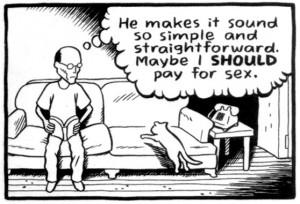
In an pre-publication comment on this site, Noah took issue with an early review by Tom Spurgeon, which he saw as unwilling to engage with the socio-political issues addressed in the book—something he took as emblematic of how comics critics tend to prioritize form over content, simply put. Never mind that his examples of such priorities in comics criticism were highly tendentious, he has a point that there is a holdover from traditional comics appreciation that privileges form, even if contemporary criticism increasingly transcends it.

As it has turned out, however, the reception of Paying for It has generally engaged Brown’s polemics head-on, to the extent—ironically—that the form in which they are presented has been largely ignored. Noah himself has done better than most on this issue. In his review, for example, he makes the important observation that Brown’s dispassionate presentation and robotic self-portrayal can be seen to reflect and inform his ideology and political message.

Beyond that, however, he reveals a lack of sensitivity to Brown’s artistic achievement. In a subsequent comment, he writes about the book: “formally it doesn’t really do very much…but I guess that’s autobio comics for you….”
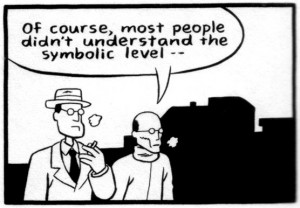
Not only does this go a long way toward explaining why Noah failed to appreciate what Spurgeon was trying to do in his review, it seems to me emblematic of intellectual comics criticism as it is practiced today—a tendency to regard form as a transparent vessel for conceptual issues. To be sure, there is plenty of those to discuss in Paying for It, but I am confident that the reason it provokes interest beyond its superficial provocation, and the reason that I suspect it will retain interest once the discourse it addresses has moved on, is precisely Brown’s personal story and the way he has given it form.

As a polemic, the book is forceful and compelling, but it founds its basically well-reasoned political stance on an idiosyncratic, ineptly argued rationale. Brown’s position that prostitution should be decriminalized but not regulated, though founded in libertarian ideology, is pragmatically rational. Much of the rest of his discourse, however, is less so: not only does the basic premise, that romantically founded relationships are (probably) inherently wrong, seem more of a personal exorcism than a universal truth, but more specific arguments also grate against lived experience. Readers with any knowledge of substance abuse, for example, may find themselves mystified by Brown’s assertion that dependency boils down to rational choice and has no physical symptoms (appendix 17).
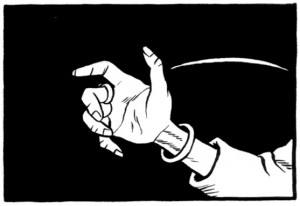
Worse is the naivité he brings to his discussion of such phenomena as pimping and sex trafficking. He assumes that coercion only really concerns illegal immigrants and that any other prostitute subjected to abuse can go to the police anytime and is thus—like the drug addict—in her situation by choice (appendices 12-13). Similarly, his discussions in the notes of whether certain prostitutes he saw were “sex slaves” seems disingenuous, if not outright self-serving, not the least when considered against the admirable honesty with which he describes in the main part of the book the signs of coercion picked up during his encounters (pp. 91-92, 186-88, 207-8, and the accompanying notes).

Dubious in relation to any human relation, the libertarian notion of humans as autonomous engines of dispassionate choice and our bodies as property rather than incarnation (appendix 4) is downright absurd when applied to something as emotionally fraught and psychologically complex as sexuality and its commodification in society. Brown seems to believe that hard currency is some kind of elixir for human relations. Although he clearly does not even contemplate fatherhood, he for instance expects us to accept that his utopia of commodified sex and contractual child-rearing (appendices 3, 18) would somehow make for a healthier, more nurturing environment for children to grow up in.
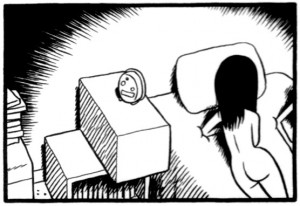
Here lies both the strength and weakness of the book. As political discourse it is at best engaged and thought-provoking, but ultimately simplistic—too reliant on the universal application of personal experience, with a slapdash reading list standing in for actual research. As a memoir, however, it is a deeply involved, stirring examination of how sexuality pervades social action and confounds politics. As several reviewers have noted, one of the book’s main virtues is that it is written by a john who is out, and that it succeeds in humanizing not only that stigmatized demographic, but also sex workers and sex work itself. This in itself is a major achievement.

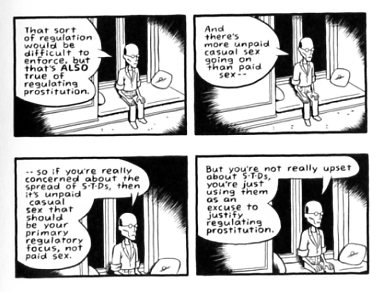
I would thus agree with Spurgeon’s argument that Paying for It, the comics memoir, is richer and more satisfying than the preachy appendix. The concomitant conclusion, that Brown would have done well to leave out the latter, however, is less convincing. The narrative gains in power as a tangled, resonant substructure for the polemic, and the political argument is both bolstered and countered by the lived experience girding it. Where in the appendix Brown is happy to make dogmatic and at times fairly extreme statements, in the comics he allows space for counterarguments, voiced by his friends as well as a couple of prostitutes, one of which—as Noah and others have pointed out—challenges outright his philosophy as lazy, arguing that the kind of hard work that goes into a romantic relationship is required for anything of value in this world.
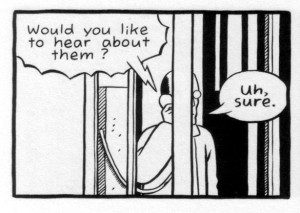
And his description of his own evolution from tentative and sensitive client to experienced, at times rather cynical, customer is revealing not just of his personality, but of how paid sex may affect your appraisal of partners. Even more compromising—personally as well as rhetorically—are such sequences as the one where he describes himself getting off on a prostitute’s exclamations of pain.

And his strategy of obscuring the faces and changing any distinctive features or characteristics of the prostitutes, avowedly done in order to protect their privacy, not only makes manifest on the page the objectification inherent in the book’s subject and ideology, but reveals Brown’s commitment to authenticity. Instead of turning them unrecognizable by changing their appearance, he makes them anonymous. In contrast to colleagues such as Steve Ditko and Dave Sim (though less so with him than one might think), Brown’s instincts as an artist are simply too sound for him to let his work conform narrowly to ideology, no matter how strongly he feels about it.
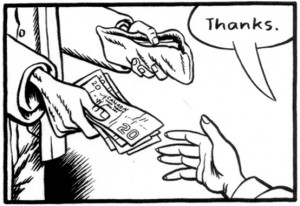
One of his more puzzling statements in the appendix is his view of sex as a ‘sacred activity.’ This cannot be reduced to his libertarian beliefs in individual freedom. Readers familiar with his previous book, Louis Riel (2003), will remember its conflicted protagonist, believing himself to be acting according to divine ordinance and finding that other designs may be confounding his freedom of action. The possibility of free agency is a central concern.

Though it is less overtly spiritually charged, this problem remains somewhere at the core of Paying for It, which sees Brown more pointedly championing his choices in the face of social norms. And although he no longer confesses as a Christian, and has orchestrated his most spartan mise-en-scène yet—a far cry from the vintage texturing of Riel—his images are still imbued with a compelling sense of meaning. One gets the sense that the detachment with which he describes his experience is the same as the one with which he examined the life of Riel.
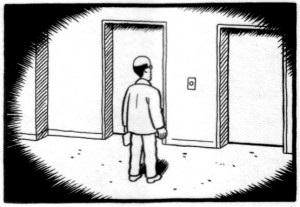
As in that book, many scenes are viewed from above, from a kind of “God’s eye-perspective.” The peepshow aesthetic of the tiny two-by-three paneling seems to be for the benefit of an omniscient viewer, who at times loses interest and lets the eye wander, decentering the compositions. Chester walks, talks, and fucks under the scrutiny of a dispassionate oculus, darkening around the edges. It is almost as if he is inviting a higher judgment to balance out his own.

Sex scenes are privileged by even greater distance. They are uniformly denoted by a throbbing glow in the dark, blocking out the surroundings (this is worked to hilarious effect in chapter 2—the sequence where Chester keeps stopping, with the banal details of the surrounding room appearing each time). A necessary way of avoiding the interference that overly graphic renditions would create, this approach lends universalism to these scenes, threading them through the narrative as its central, ‘sacred’ constituent.

Brown’s cartooning has struck me as invoking this kind of higher order since at least, and unsurprisingly, his 1990s Gospel adaptations, which routinely employed a similarly elevated perspective, pared-down panel compositions, and suggestive framing to great effect. The explosion of the grid in I Never Liked You (collected 1994) and the claustrophobic, petri-dish effect of the gridding in Underwater (1994-97), each in their way seemed to solicit scrutiny from above. In Paying for It, Brown works to great effect the inevitable, often ominous, signification of gestures—frequently singled out in individual panels; the incursion of random passersby in streets backed by theatrically silhouetted buildings; and the suspension of time and motion as Chester and his friends Seth and Joe Matt stride down the street, their talk at an end.
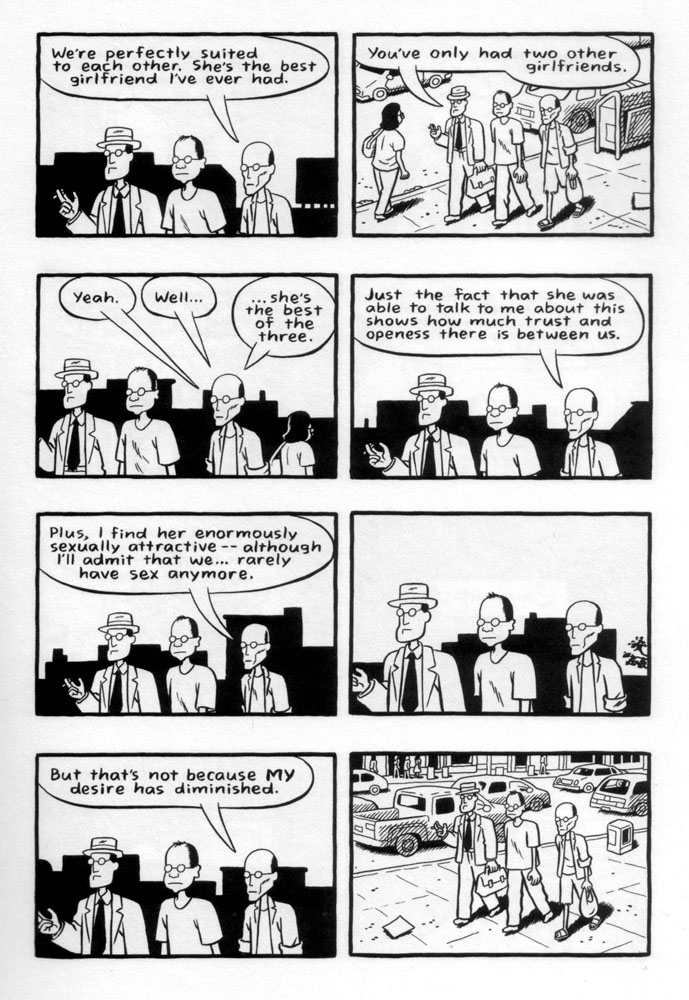
The point is that Brown, contrary to Noah’s dismissal, always achieves a lot with his images and panel-to-panel storytelling. His power to imbue any scene with an ineffable sense of meaning is one of his great gifts as a cartoonist, a gift few critics have attempted to critique or explicate, and which Spurgeon addressed sensitively in his review.

Paying for It is a brave book, groundbreaking in its premise alone, but beyond its polemic it is an unflinching self-portrait, synthesizing its author’s ideology, sexuality, pathology, and spirituality on the page.

Hating America First

This first ran on Splice Today
____________

It appears there’s a chance our Congressional representatives will decide en masse that financial apocalypse is preferable to a possible primary challenge. What this would mean exactly is unclear; I guess the first consequence would be a stock market nosedive. Longer term, presumably, it would involve a downgrading of U.S. debt, which means we’d have to live within our means, which would result in a sudden and vicious fall in our quality of life. Unemployment would skyrocket, production would grind to a halt—we’d be looking at a massive contraction of the economy that would make FDR sit up in his grave and say, “We have nothing to fear but…HOLY SHIT!”

Obviously, this would be bad, and nobody but nobody wants this to happen… not even the wind-me-up-and-I-drool-great-gobs-of-stupid animatronic joke that is Michele Bachmann. If the Dow plunges to 3000, I lose my retirement savings, my kid can’t go to college, and quite possibly my freelancing income will dry up. My wife could lose her job. We wouldn’t be able to make our mortgage payments… though maybe that wouldn’t matter so much if all the banks holding the mortgages collapsed. So we’d have a place to stay at least. But, yes, I would prefer overall to have a retirement and a job and to send my kid to college and just generally for things to continue as they are with my fairly affluent lifestyle in the Greatest Nation on Earth, thank you very much.

And yet. Affluence, Greatest-Nation-On-Earthing, strutting about the globe with my kid’s college fund and my new Prius… is it really all good? Or could there be some upside to financial apocalypse?

If the US did default, as I said, it would mean a huge drop in standards of living, definitely in America, most likely throughout the entire globe. China’s economic boom, fueled in large part by US debt, would come to a screeching halt. People everywhere would buy less and make less. Using fewer resources would be a major boon for the planet. We’re probably too far along at this point to actually do anything about curtailing global warming, but still, it’s hard to believe that the assembled frogs, whales, and plant life wouldn’t appreciate a reduction in emissions, plastic crap, and deforestation. If humans regress to the Stone Age, the only things on the planet that’ll really be upset are humans and, possibly, stones. (Okay, Siamese cats and little lap dogs too. But that’s it.)

The other major benefit of the U.S. buying less of everything is that it would mean, logically, that the US would buy fewer guns. In 2010, the U.S. accounted for 43 percent of the world’s defense spending. It’s a familiar statistic, but its consequences remain staggering. Because of that vast outlay—because, in short, our standard of living is so high that we can’t figure out what to do with our money—we are currently fighting at least three wars, and have troops everywhere on the globe, from Germany to Korea to god knows where else. If a Muslim terrorist shakes hands with a drug dealer in the wilds of Northwest Upper Slabovia, we have the will and the excess capacity to bomb a wedding party somewhere nearby. If a client state defies us by egregiously oppressing its neighbors, we can speak to them sternly and, with a grave shake of the head, send them only twice as many missiles as they asked for.

It’s almost certainly true that the world would be less peaceful if America wasn’t playing global policeman. And, of course, if our standard of living goes down, everybody else’s will too. Still, despite all the good we do outside of bombing wedding parties and arming oppressors, there must be a moment or two when folks in the rest of the world look over at us, sitting on our nuclear stockpiles, and wonder, if only for an instant, how things might be different if we had something to worry us other than our neighbor’s business.

The U.S. isn’t going to collapse because of this debt ceiling nonsense. If we did, it would be bad for me, you, and the vast majority of people on earth. Getting punched in the face would hurt. But that doesn’t mean we don’t deserve to be punched in the face.

Can The Subaltern Draw?: The Case of the Arab Henchman

While I haven’t yet met anybody whose favorite Tintin adventure is The Crab with the Golden Claws (Crab), it is certainly an important text in the scale of Hergé’s overall story about the boy reporter.* For one, Crab is the album in which Tintin meets, is repeatedly almost killed by, and ultimately befriends the perpetually drunk Captain Haddock. As such the album will presumably serve as the first act of Steven Spielberg’s 3-D monster The Adventures of Tintin: The Secret of the Anglophiles. Penned in 1941, Crab is also notable for being the first story Hergé published during Belgium’s occupation by Nazi Germany in the newspaper Le Soir. But what I find most intriguing about Crab (besides its relatively recent Simpsons cameo) is its long and curious history of edits, some of which I will explore today.

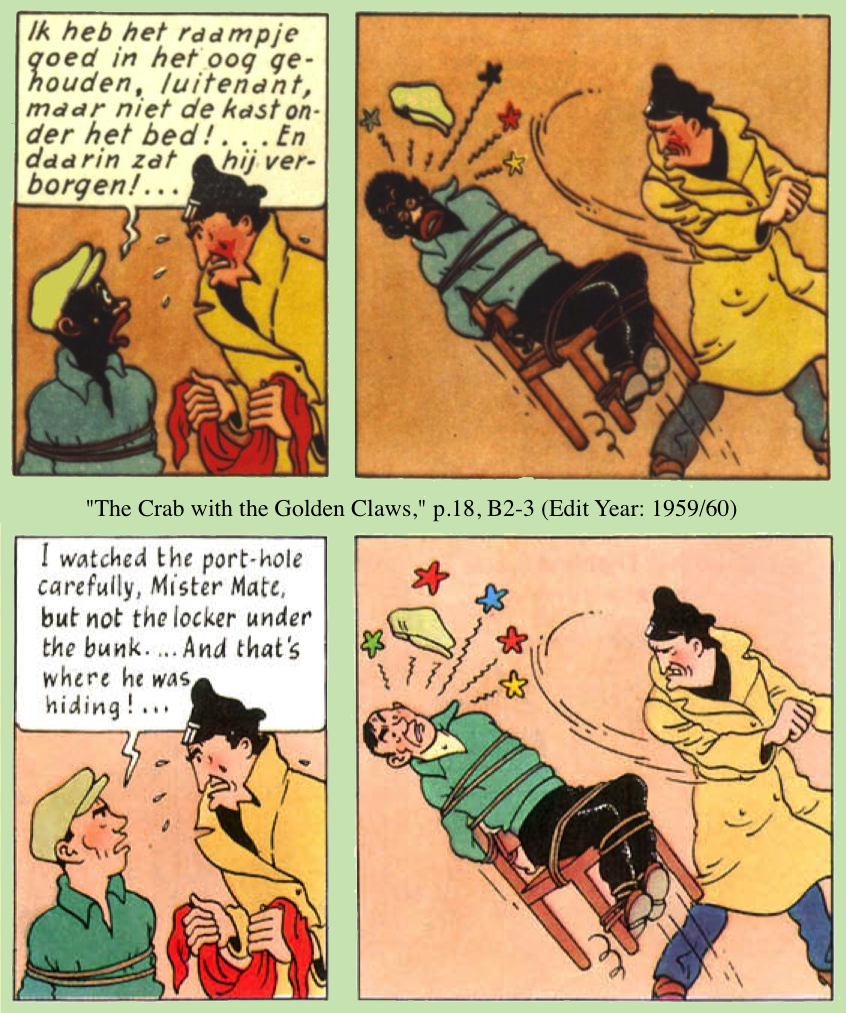
Deckhand “Jumbo” becomes markedly whiter.
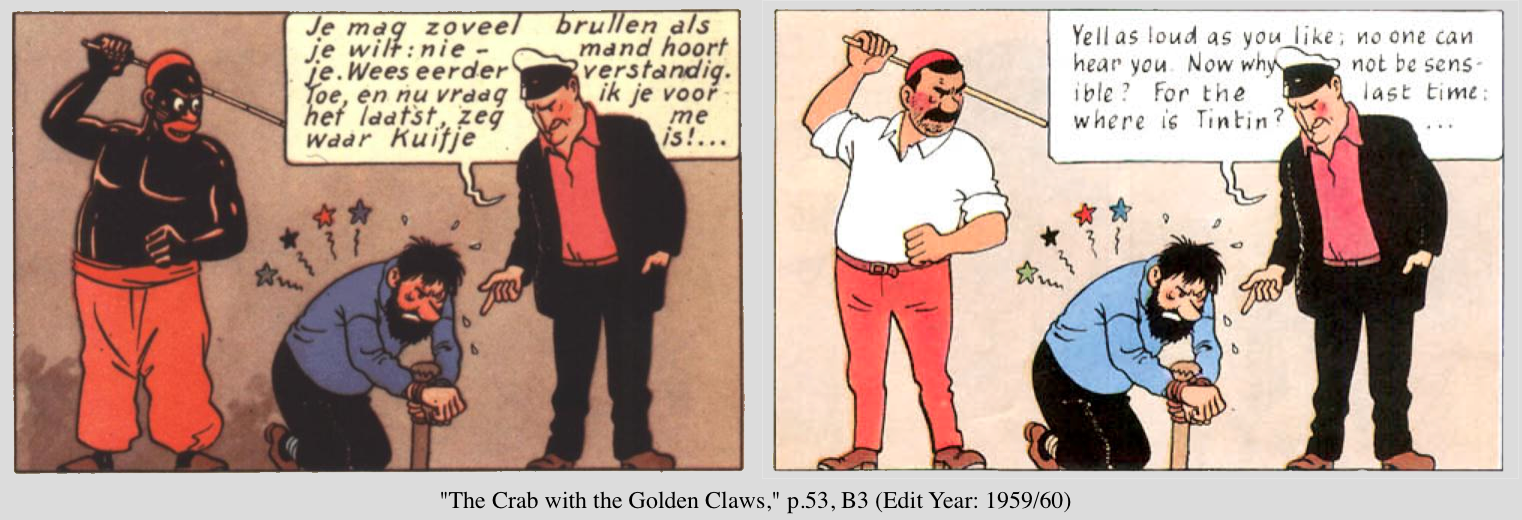
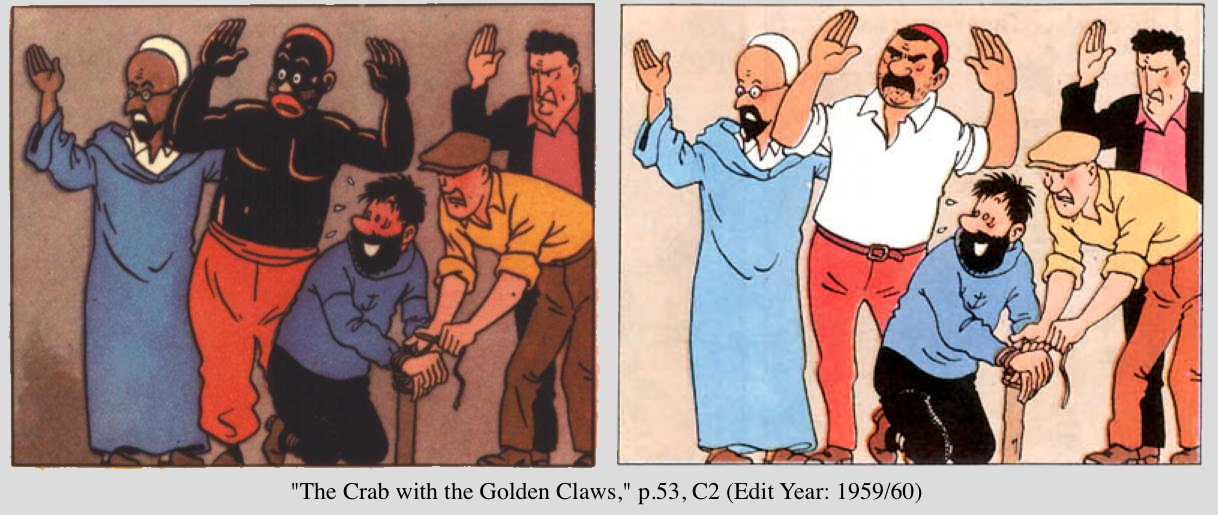
Soon after World Word II, under the request of new publisher Casterman Hergé was asked to color Crab and the other completed black-and-white Tintins in hopes of marketing the comics to a larger global audience. During that process of colorization and reformatting (where Hergé took the liberty to self-edit), the only thing that changed about Crab content-wise was the language in the speech bubbles. However in 1959, Hergé was asked to make revisions to the nearly twenty year old panels at the behest of American publisher Golden Press, who were looking to make The Adventures of Tintin available in the United States. Chris Owens has written an account of Tintin’s move to (and ultimate failure in) the American market in the 1960s on Tintinologist.com in a piece titled, “Tintin Crosses The Atlantic: The Golden Press Affair.” He does a thorough job at highlighting the specifics of the move, so instead of going into all the adjustments (“Snowy” to “Buddy,” no drinking Whiskey from the bottle, etc.) I want to focus particularly on how Hergé adjusted the race of his more problematic characters. As Owens puts it:

Before the translations [into American English] began in earnest, Hergé agreed to redraw several panels for The Crab with the Golden Claws depicting black characters. The US censors didn’t approve of mixing races in children’s books, so the artist created new frames, replacing black deckhand Jumbo with another character, possibly of Puerto-Rican origin. Elsewhere, a black character shown whipping Captain Haddock was replaced by someone of North African appearance.

Put simply, Hergé replaced his black characters with a possible “Puerto-Rican” in one instance (illustrated above) and an Arab in the other. In his wonderful series Tintin in Otherland, Alex Buchet has addressed Hergé’s overall problem with representing “others” and touches on the creators often sardonic response to charges of racism. A typical defense from Hergé in his latter days reads like this quote from a 1975 interview: “In a nutshell, Soviets and Congo were ‘sins of my youth.’ That’s not to say that I disown them, but in the end, if I had to do them again, I would do everything differently for sure, and then all my sins would be forgiven!” (Hergé in His Own Words, 25).

Indeed, in response to these very edits that Golden Press requested him to make for American editions of Crab, Hergé sarcastically stated: “Everyone knows that there are no blacks in America” (Source). While I can spend (and others already have spent) hours parsing Hergé’s half-hearted verbal defense of his “sins of youth,” I rather call to question specifically why he changed the mysterious and speechless henchman featured heavily in the latter pages of Crab from African to Arab.

(Click to Enlarge)

Privately, I’ve come to refer to this textual change as “The Case of the Arab Henchman” and it is a case I often refer to while trying to locate Hergé’s view on non-white people. Considering Tintin was Hergé’s job for the majority of his life, often the best point of entry into the man’s personal beliefs are scattered throughout the pages of the comics themselves. Not to overstate this, but having read both versions of Crab — one with the African Henchman and one with Arab Henchman — it is remarkable how similarly they flow. Put differently, even though he changes the race of a character featured in upwards of 12 panels, nothing feels different narrative-wise. Which forces me to ask why?

(Click to Enlarge)

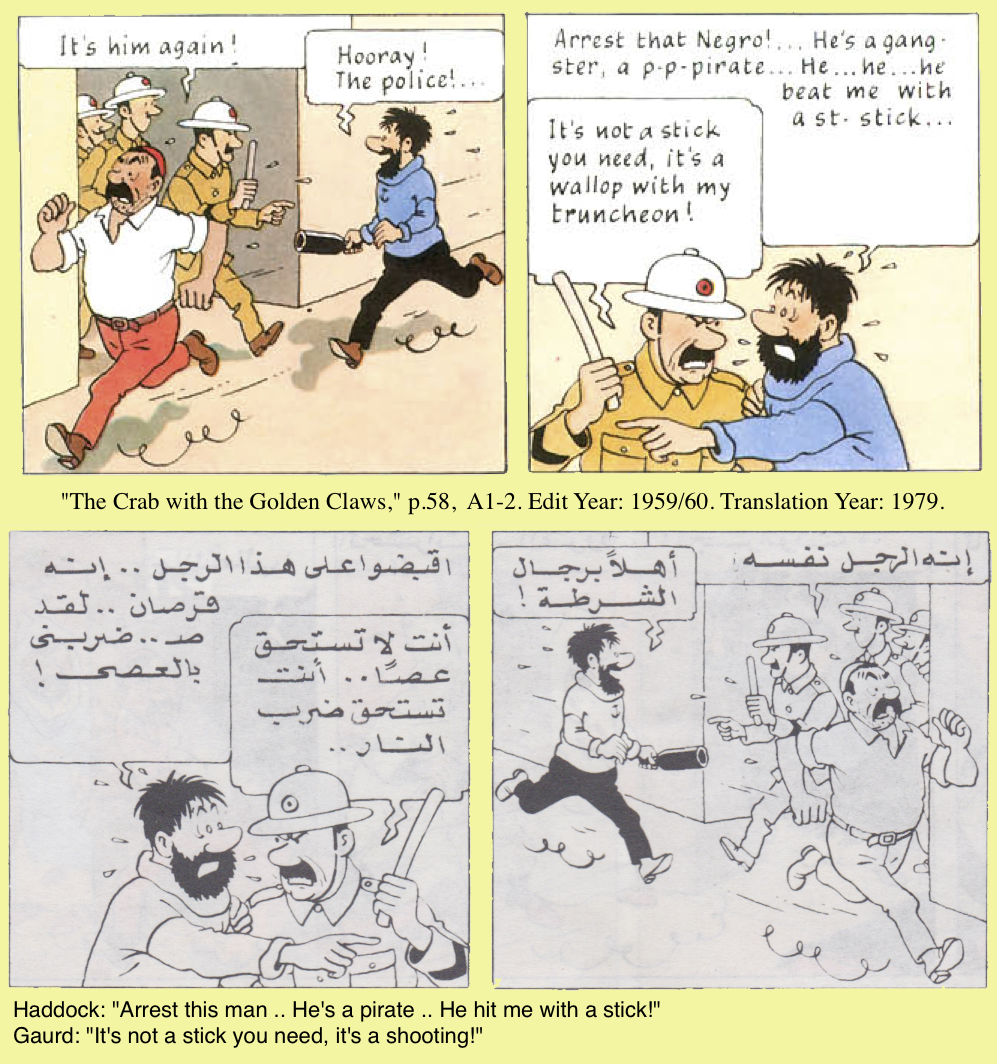
The question Hergé had to answer (probably implicitly) when requested to edit out the nameless black henchman he drew in 1921 for someone new in 1959 was “who can I change this with so that the narrative will maintain its plausibility, but without offending anyone’s sensibilities?” The answer came in the new acceptable stereotype of Arab lackey, which is precisely harmful as most stereotypes are because of its vagueness and interchangeability. To be clear, I’m not saying that this new henchman was a worse stereotype than the old one, or that the original crude depiction shouldn’t have been changed, but I am questioning how this new stereotype was acceptable in a way that the old one was no longer. And while I’m not pointing out anything you can’t find worded better in Said’s Orientalism, I still find the need to point it out pressing, especially considering the Arab henchman was re-presented without question to an Arab audience upon Tintin’s translation into Arabic:

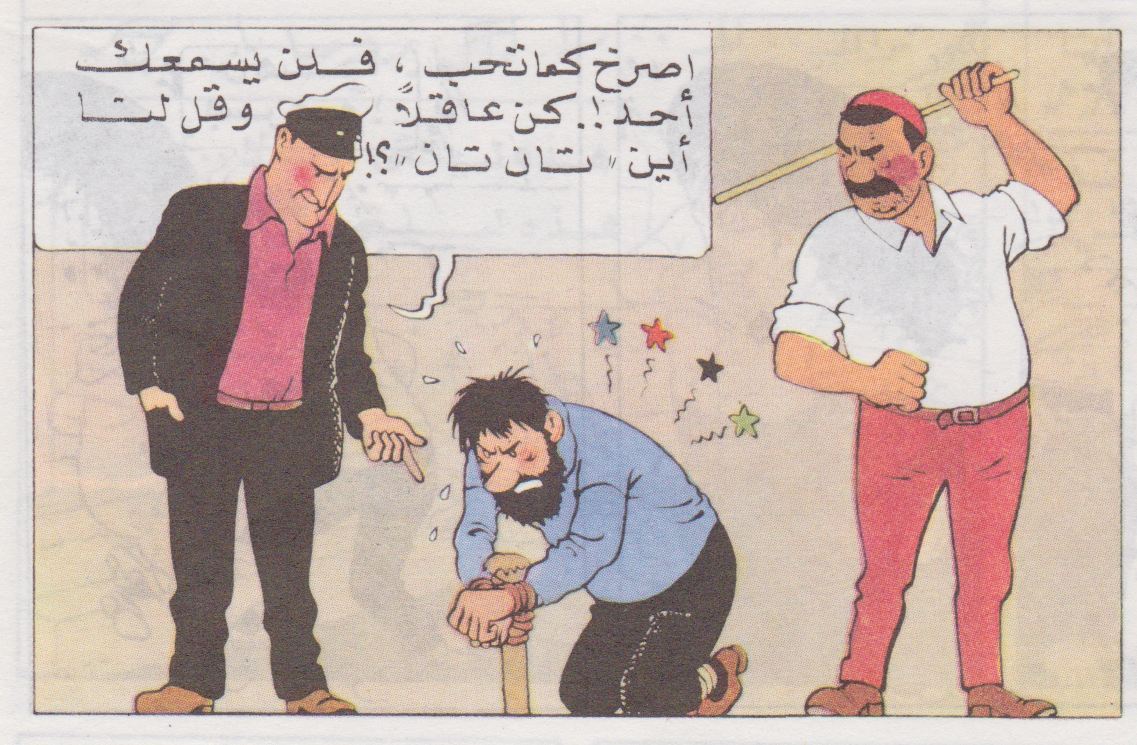
In the 1970s, Tintin was translated (legally) into Arabic by long-running Egyptian publisher Daar el Maaref and thereafter made available in the standard album format for a receptive Arab audience.** During the translation/transition into Arabic, it is important to note a few things were adjusted to fit better culturally among the new readership. However, while the censors of Golden Press were enough to make Hergé change a henchman from African to Arab, there clearly wasn’t enough sensibilities being upset to make the henchman change yet again. The Arab Henchman was accepted, and future generations of Arab children would internalize the mustachioed man whipping their beloved Captain Haddock, hoping for Tintin to interrupt with his gun in the name of justice. Equally intriguing as I’ve reread Crab is what did get changed as Tintin learned to speak Arabic:

I’ll give you a second to re-read the dialogue from the top panels. As it is available on bookshelves today (English readers, check your collection), Captain Haddock calls the Arab Henchman a “Negro.” I was curious to see how this bad bit of editing was translated into Arabic, only to find that it wasn’t translated at all. As you can see (from right to left because that’s how Arabic works), Haddock tells the police to arrest the “man,” not the “Negro.” Therefore it appears the translator/s were aware there was a weird edit in the pages, and their solution (with Hergé’s old age no doubt a factor) was to accept the art and change the words. Elsewhere, the Arabic version of Crab contains another bit of tidy work:

(Click to Enlarge)

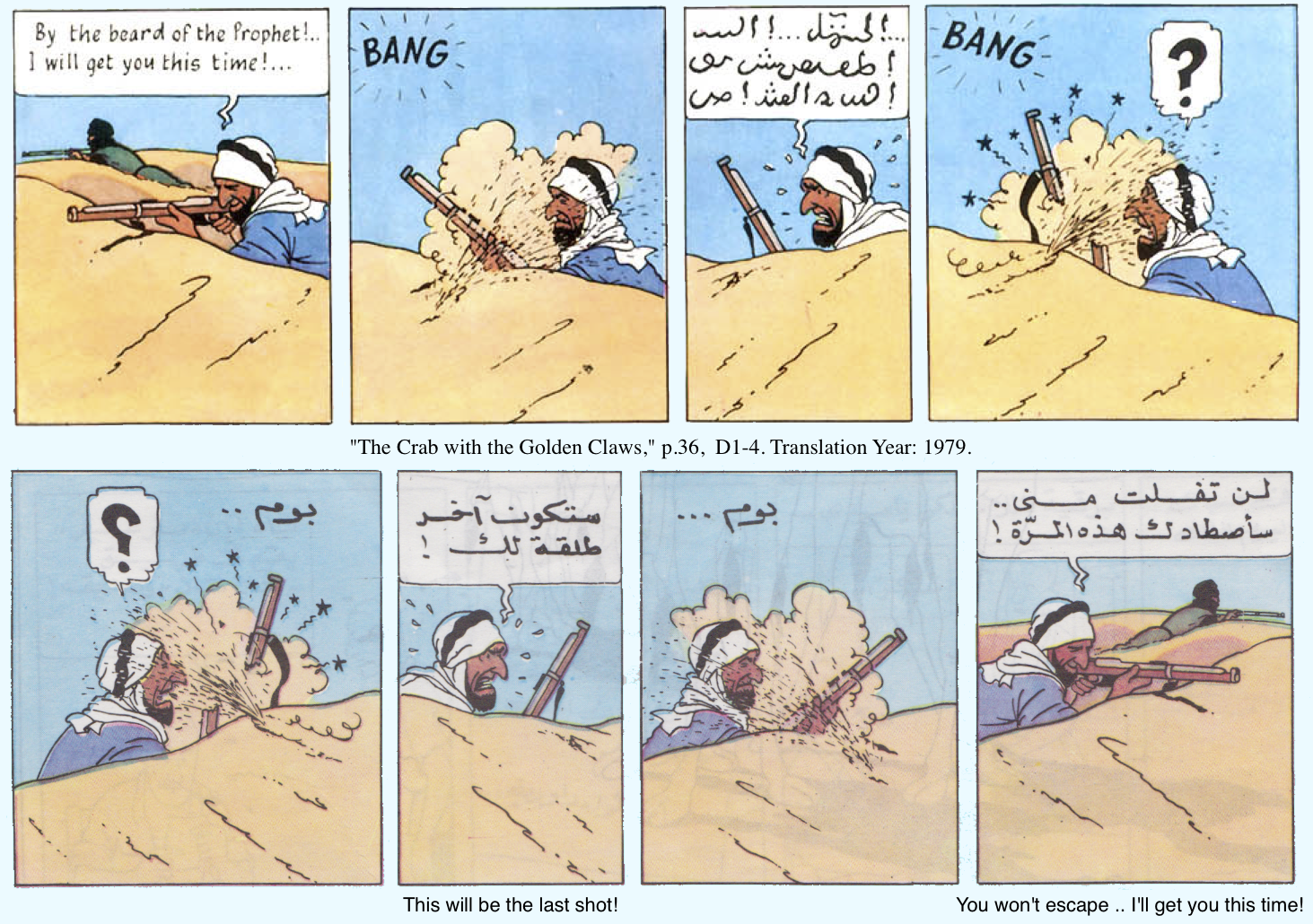
Above in the desert shoot off between Haddock and another unnamed Arab, two distinctive edits are made in the Arabic translation. First, instead of saying “By the beard of the Prophet!” as Hergé supposedly imagined an Arab in combat might, the reference to Prophet Mohamed is replaced with “You won’t escape.” Second, instead of keeping the nonsensical squiggly lines that Hergé used to represent a phrase in Arabic, the translator put actual Arabic text (“This will be the last shot!”). I find these two subtle edits to be a positive element of the Arabic editions of Crab. Instead of accepting Hergé’s stereotyped language decisions for an Arab character (prophet-referencing, fury squiggles) the translator took it upon herself to create language based slightly closer on reality. While these edits don’t produce the same (arguably) culturally-balanced product as Hergé’s famous collaboration with Zhang Chongren in The Blue Lotus, they do help the work take a small step away from being based solely on Hergé’s mind-forged manacles. The translators clearly made a conscious effort in the small wiggle room they had access to, but when faced with a speechless character like “The Arab Henchman,” it seems an eraser is the only way to effectively curb a misguided stereotype.

*To put this in context, I even met someone who named Soviets as their favorite album.

** I should note that Tintin adventures have been available in colloquial Arabic for consumers as far back as 1956 in the pages of Cairo-based Samir Magazine. Although not legal, these translations meant readers were exposed to Tintin well before Daar Al Maaref editions were available.

Utilitarian Review 7/9/11

On HU

Tom Gill with follow up comments on his essay on Tatsume and Tsuge.

This week’s featured archive post: Ng Suat Tong on Chester Brown’s gospel adaptations.

Richard Cook provides a fourth of july Uncle Sam gallery.

Michael Arthur on Shimura Takako’s Wandering Son.

I posted a metal, blues, cock and rock music mix download.

I talked about my disappointment with Jack Kirby’s Jimmy Olsen stories, prompting an interesting comment thread including Matt Thorn, Domingos Isabelinho, Matthias Wivel, Jeet Heer, Jones, Johnny Bacardi, and lots of other folks.

Domingos Isabelinho discussed Andrea Bruno and the crisis of capitalism in Europe.

Robet Stanley Martin talked about Henry Miller and surrealism.

Utilitarians Everywhere

At Comixology I talk about Rogue, critic Susan Kirtley, and Jacques Lacan.

At Splice Today I review Dolly Parton’s new album.

Also at Splice I talks about the upsides of an apocalyptic collapse of America’s economy.

Other Links

Terry Eagleton on the difficulty of being secular.

C.T. May on The Hangover II

Alyssa Rosenberg on Luther, the Wire, and Stringer Bell in love.

Monthly Stumblings # 11: Andrea Bruno

Sabato tregua (Saturday’s truce) by Andrea Bruno

Deregulated financial capitalism immersed Southern Europe in a deep social, economical, and political crisis. The euro’s cohesion is at stake at the moment while PIGS countries (hail racism!), especially Greece, see their sovereign debt credit ratings descend into garbage (PIGS countries are: Portugal, Italy, Greece, Spain; in 2008 the acronym became PIIGS with the inclusion of Ireland). IMF imposed restrictions choke the economy provoking unemployment. On top of that grim scenario Globalization dislocated factories from the so-called first world to become sweatshops in the so-called third world (if you think that slavery doesn’t exist anymore, think again…). Entire communities were destroyed with millions of unemployed people from all over the world (add post-colonial and post-communist to post-industrial) flocking to the major cities in search of a life. This created huge social problems with riots in France, for instance. Riots in Greece are part of everyday life by now…

These are, in a nutshell, our difficult European times. Any artist worth his or her salt should acknowledge them one way or the other. That’s what Italian comics artist Andrea Bruno eloquently does…

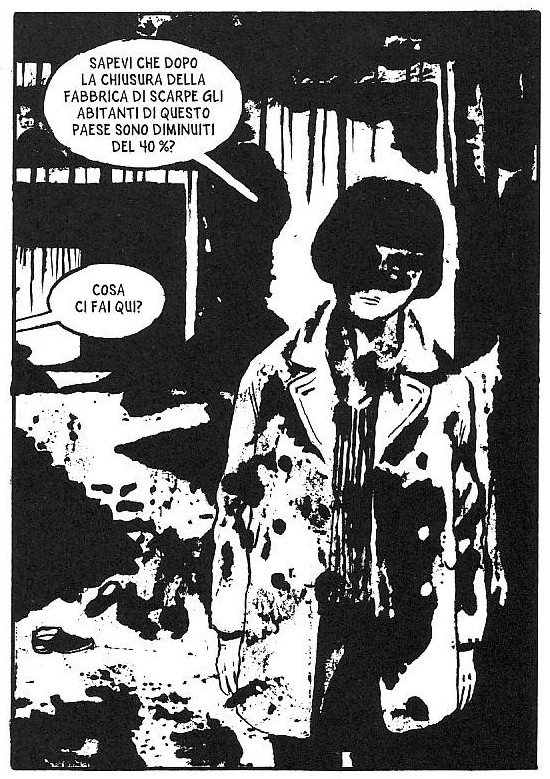
Panel from Sabato tregua (see below). Canicola, 2009. Not paginated. 

Sabato tregua is a big format book (18,5 x 12 inches, give or take) reminding two other similar experiments: French Futuropolis’ 30 x 40 [cm] collection, U.S.A’s Raw, in its first series incarnation (both appeared during the eighties). It was published by the art collective from Bologna, Canicola (“Cannicula,” or the star Sirius which announces the hottest days of Summer). Andrea Bruno had the idea to revive this huge format; another book (Grano blu – blue wheat -, by the great Anke Feuchtenberger), was already published in the same format. In case that you’re wondering, Canicola’s books have a (not very accurate, sometimes…) English translation at the bottom of the page. In the image reproduced above the character that is off-panel, Mario, says (I transcribe from the book’s translation):

What are you doing here?

While Christine, says:

Did you know [that,] since the shoe factory closed[,] the population of this town has decreased by 40%[?]

And, then, she continues:

Once it was a workers’ town, now it’s a thieves’ town. When a robbery happens in the nearby towns, the police come[s] here immediately to start the[ir] search.

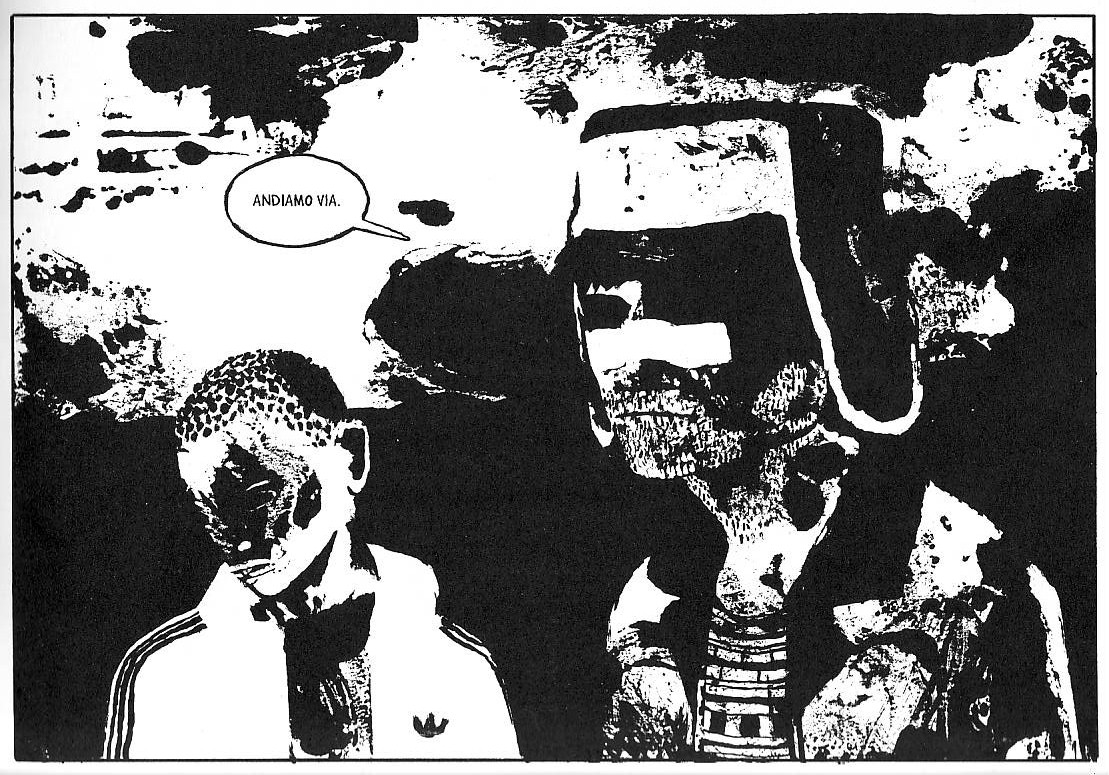
While Christine speaks there’s a three panel zoom in that ends in a medium shot. Conversely Mario’s face is hidden most of the time by melancholic shadows. The same thing happens to other characters, but it’s not only that: Andrea Bruno’s “dirty” style disintegrates the physical world to mirror the disintegration of post-industrial communities.

Sabato tregua: “Let’s go”: a melancholic view of the world under capitalism.

Another disintegration occurs to the story. Andrea Bruno says a few interesting things about this particular aspect of his work:

What do we mean by “linear discourse?” The storyline, the plot may not be the only way to unify a narrative? Maybe images, signs and moods can also become the parts that “sustain” a story and give it an identity. I try not to do “antinarrative” comics, but I don’t like to draw stories that tell it all.

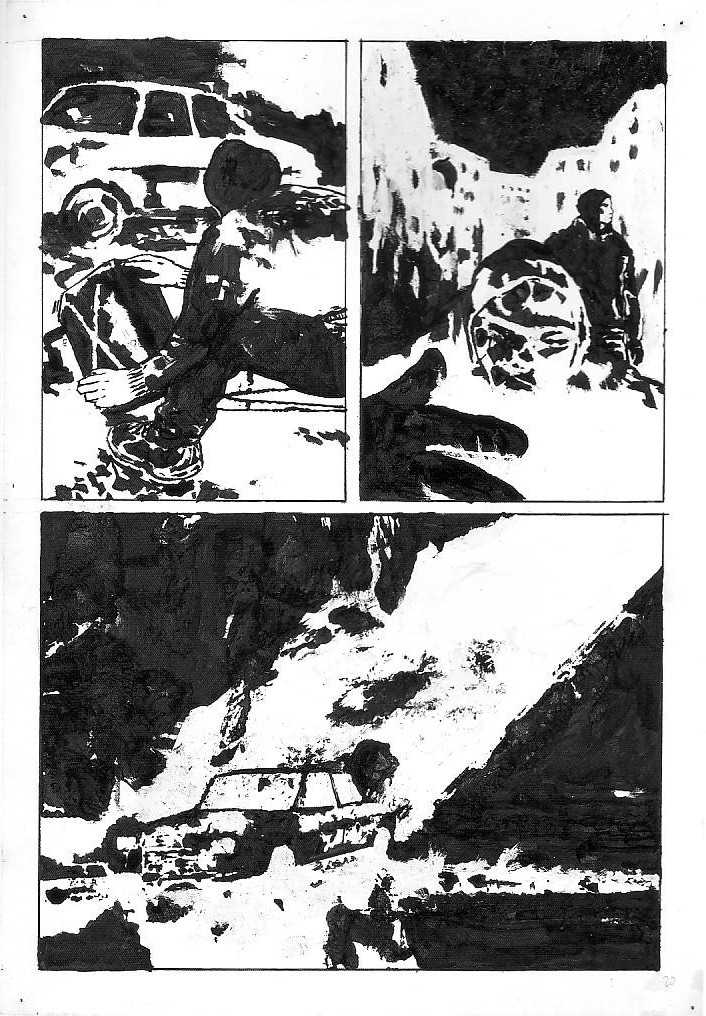
Andrea Bruno presses ink soaked cardboards  to the surface of his drawings. He uses white paint almost as much as he draws and paints with black India ink. The result is a very distinctive graphic style in which chance plays a part, blobs are as important as lines and the white surfaces are as important as the black ones. White, as in Alberto Breccia’s drawings (the old master has to be cited), is pretty much an active part of Andrea Bruno’s drawings, not just negative zones…

Anni luce (light years), original art, Miomao Gallery, 2007. A car is burned during a riot. A violent technique to depict violent acts.

Wherever millions of famished immigrants go xenophobia and racism follows them. Here’s what Andrea Bruno has to say about it:

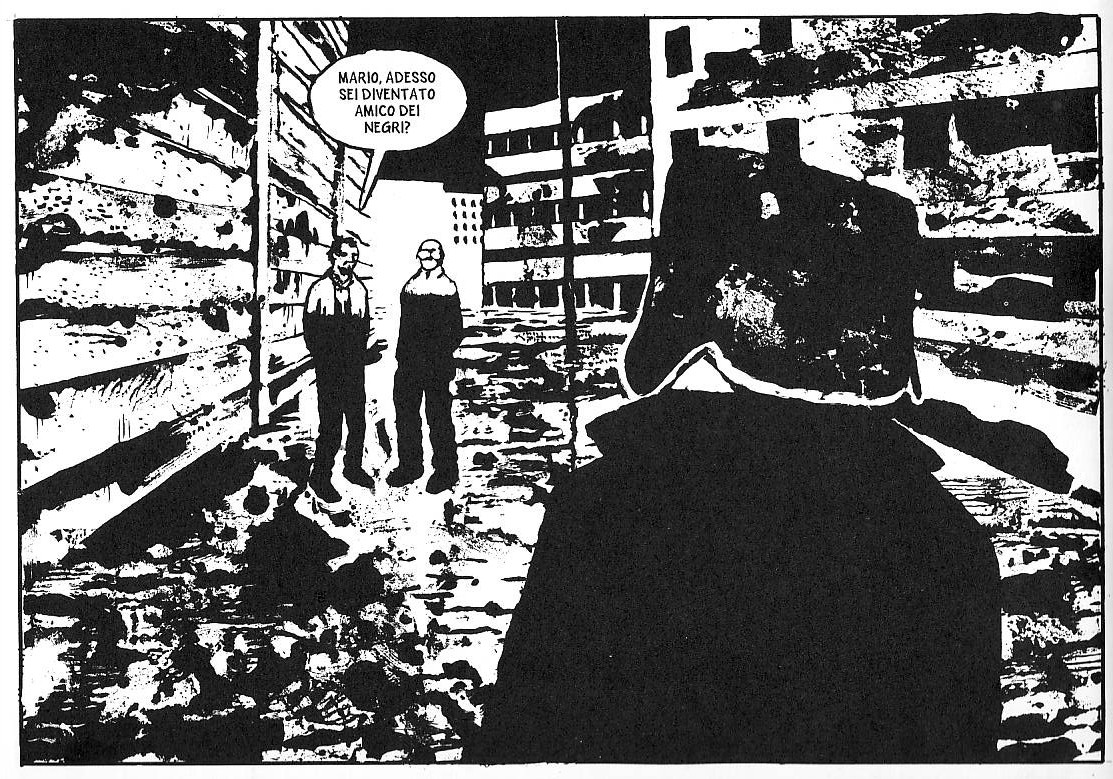
I try to suppress the surface of well being, of the main fashions and customs, to show landscapes and relationships reduced to the bone. The denunciation is not direct, it’s more in the presuppositions than in what I choose to show. I prefer the peripheral vision. Racism and inequality, in my comics, are not denunciated, but appear as ‘normal,’ so to speak.  The effect renders them, maybe, even more hateful.

Sabato tregua: “Mario, [are you] a friend [of the] niggers, now?”

Andrea Bruno appeared in English in Suat’s Rosetta # 2.

Bursting With Boredom

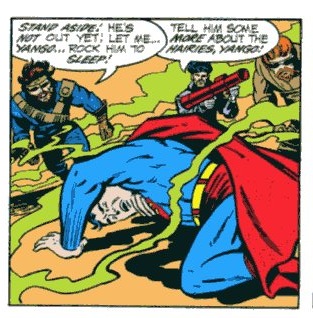
Superman…unconscious?!

Kirby fans often note that his comics are bursting with ideas. And, after reading DC’s two volume 2003 collections of Kirby’s run on Jimmy Olsen, I can’t deny it. Lots and lots of stuff happens in these stories. There’s secret underground hippie biker lost realms, secret government clone projects, green Jimmy Olsen clones, scrappy fighting kids, miniature clones of scrappy fighting kids, gratuitous Scottish accents, extradimensional evil, extradimensional good, alternate versions of Don Rickles, tiny worlds populated by even tinier monster movie rejects,groovy hippie pads, loch ness monsters, evil tycoons, evil mad scientists, and and lord knows what else. Just about every page has enough plot points to keep a typical contemporary comic happy for a year.

And yet. All those ideas, all that frantic creativity — you read one page and it’s charming; you read two pages and it’s impressive — you read a whole comics worth, though, and it starts to get wearisome. Kirby’s stereo has one volume, and that volume is everything plus the kitchen sink plus a four-armed monster and an atomic explosion. Occasionally he throws in schticky banter, not so much as a break from the noise as to make you wish the noise would come back and the banterers would shut the fuck up. And then (mercifully or not) the plot’s back, racing, racing, racing to nowhere in particular.

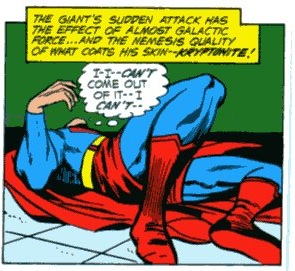
Superman…unconscious?!

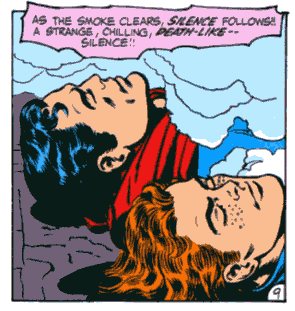
Because, the sad truth is that, for all of Kirby’s ideas, not a one of them goes anywhere or builds to anything or does anything except sit there saying, “Ayup! Here’s an idea!” The result is that, for all the wild rushing and hand waving (literally with the four-armed monster(!!!!)) these books are incredibly, deafeningly tedious and repetitive. Protagonists are beset by antagonist, protagonists are knocked unconscious/otherwise immobilized; protagonists come back and beat antagonists (or occasionally realize that antagonists are good guys.) Repeat. Repeat. Repeat. It goes on and on, remorselessly, through more than 300 pages. Plot development, characterization, a point of any kind — forget it. Fight, setback, victory, fight, setback, victory. Epic.

Superman and Jimmy Olsen…unconscious?!

People often talk about the cosmic scale of Kirby’s comics. Maybe that’s true in some of his other work, but here the cosmic touches look suspiciously like the stupidest kind of fantasy/sci-fi cliches. Evil vs. good; dark vs. light. You can tell the bad guys because they say, “We’re bad guys!” and blow things up, whereas the good guys say “We’re good guys!” and blow things up. Also the good guys banter and the bad guys rant. The ranting is more fun than the banter, but not sufficiently more fun for me to care enough to root for one side or the other.

Marston/Peter were devoted to feminism and fetish; they had a ideological backdrop which informed and gave resonance to their nutty ideas. Bob Haney had a bizarrely idiosyncratic grasp on genre and the holes in genre which made his ideas stumble and bump against each other in a series of pratfalls which were both unexpected and meaningful. But Kirby, at least in the Jimmy Olsen series, has no ideological commitments to speak of, and when he uses genre — as in his use of vampires or werewolves — it’s carefully compartmentalized. The vampires and werewolves are from another world; Jimmy and Supes fight them and eventually help them, but they never really themselves end up in a horror story. Instead they fight, experience setbacks, and then attain victory.

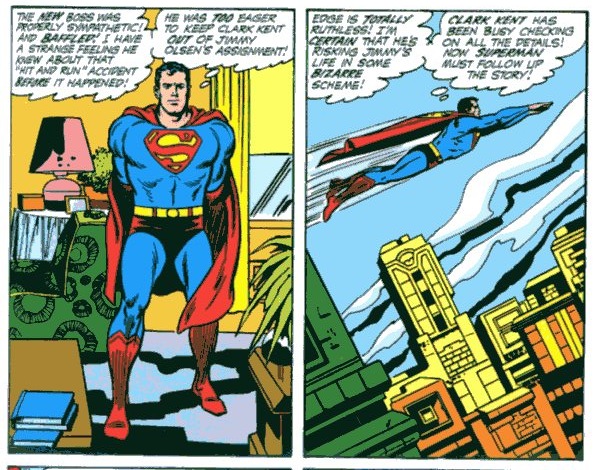
I know what I’m really supposed to like in Kirby is the art. I’ve never really fallen in love with his work, but there are definitely moments here I enjoy. Here for intance:

In the left panel, everything’s blocky and off, even Superman himself. The pose, with arms behind him, makes his silhouette seem off; and even the S on his chest seems squashed and askew. In the right panel, the cityscape is tilted and odd; it looks like a lego city built on an incline. Both images have an odd, lumpiness — a material forcefulness that is not so much contradicted by, as built upon, their imperfections.

And, of course, this is hard to resist:

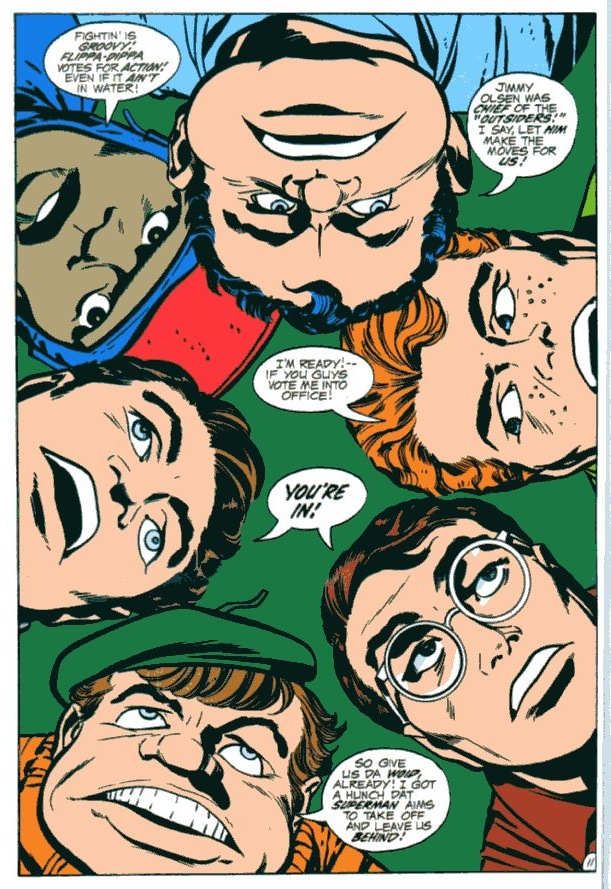
In this power-packed issue — we look up the newsboy legions’ noses!

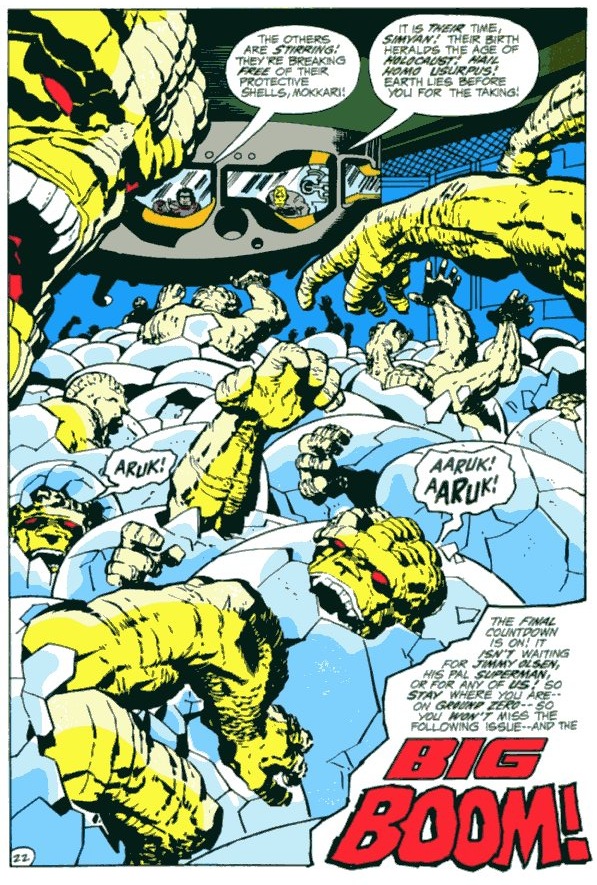
So, yes, I can appreciate that to some extent. And maybe the real way to enjoy these issues is not to read them at all, but just to flip through looking for those goofy Kirby monsters or enjoyably odd perspectives. But I did unfortunately read the thing…and having done so, I”m afraid Kirby’s art, enjoyable as it often is, doesn’t repay me for the couple of hours flushed down the drain. The power of the art, indeed, starts to veer towards self-parody; it seems to be relentlessly trying to convince you that something interesting is happening, to make up for the utter lack, not of ideas per se, but of ideas that have any meaning or consequence. Kirby ends up sounding like one of his typical monstrous creations, screaming “Aaruk! Aaruk!” It’s loud and has an initial novelty, but it doesn’t exactly fill me with admiration for the critter’s volcanic creativity.