A Comment on the Subaltern’s Progress through Habibi

[Part of the Slow-Rolling Orientalism roundtable.]
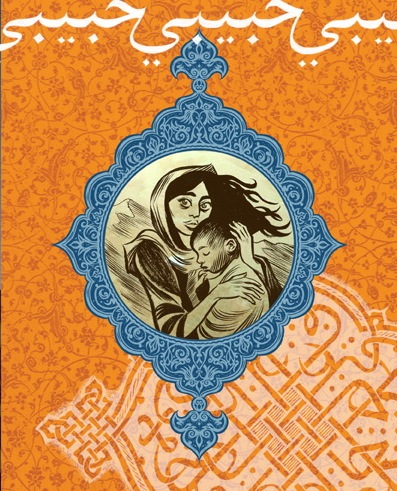
Those looking for a detailed examination of Craig Thompson’s Habibi would do well to read Nadim Damluji’s recently published review on this site.

Nadim’s article had an unexpected side effect. The generous tone of his article convinced me that Thompson’s comic was still worth reading despite its flaws. What that review didn’t prepare me for was the tale’s construction — a collation of tidbits from Islamic art presented in an ad hoc manner in order to denote sincere contemplation. The composition of Habibi seems less governed by concerted purpose than the passing interest of the author who intermittently introduces religious, scientific, and poetic subjects into his work without fully incorporating them into his narrative. Themes are inserted, explained, and discarded in a matter of pages; frequently devolving into distractions and adding little in the way of density to the book as a whole. One imagines a flitting bee, passing from flower to flower ever in search of a suitable subject matter for illustration and juxtaposition, yet bereft of any deep intellectual purpose or real spiritual engagement. The rich thread of narrative weaving and insight is not to be found in this work. Thompson’s characters are caricatures whose actions follow the dictates of a fairy tale less the wonder and the imagination. They are dried husks whose presence is so foul and whose formulaic fortunes are so unbearable as to elicit an all consuming desire to scream.

In many ways, I’m stunned that Nadim managed to get through the comic with so little complaint. I’m certainly amazed at the strength of his constitution or at least his stomach. Perhaps he has taken fully to heart the instructions of the Qu’ran that “…whosoever shows patience and forgives that would truly be from the things recommended by Allah”

As Nadim points out, at least three quarters of Habibi seems to be the product of a mind which chose to pore over images by Ingres, Delacroix, and other assorted Orientalist painters; this as opposed to any adequate political and cultural histories of the Middle East. As Thompson explains in an interview at Bookslut in 2004:

“…it’s a sort of an Arabian folktale of my own making. Not that I have… not that I’m justified in telling such a story; it’ll definitely be filtered through my isolated Western sensibilities. But that’s the stuff I’m reading now, a lot of Islamic art, culture, the original Arabian Nights, the Burton translation. I’m going to go on a trip to Morocco in about a month. I’m just sort of drawing on all these fun, fantastical, exotic elements of Islamic culture.”

And later in another interview at Millions from 2011:

“I trusted the Turkish writer Elif Shafak — she wrote The Bastard of Istanbul — who describes fiction as a way to live other lives and in other worlds. You don’t need to have those experiences directly. It’s almost a shamanistic journey where by tapping your own imagination you access these other roles.  And I trusted that.”

The  comments from 2004 may not tell the full story of Thompson’s creative endeavor but they are revealing. Of note is Thompson’s choice of the Burton translation of The Arabian Nights as opposed to a modern one by a native speaker such as Hussain Haddawy. In the introduction to his translation, Haddawy notes that “from Galland to Burton, translators, scholars, and readers shared the belief that the Nights depicted a true picture of Arab Life and culture at the time of the tales and, for some strange reason, at their own time….Burton’s translation…is not so much a true translation of the Nights as it is a colorful and entertaining concoction.” He proceeds to label an excerpt from Burton’s translation a parody or a self-parody. This is exactly what we get in Habibi. As Thompson explains in an interview at Guernica:

“The late 19th-century French Orientalist paintings are very exploitative and sensationalistic. They’re sexist and racist and all of those things, and yet there’s a beauty to them and a charm. So, I was self-consciously proceeding with an embrace of Orientalism, the Western perception of the East….“Embrace” may not be the right choice of words. The book is borrowing self-consciously Orientalist tropes from French Orientalist paintings and the Arabian Nights. I’m aware of their sensationalism and exploitation, but wanted to juxtapose the influence of Islamic arts with this fantastical Western take.”

Knowing or not, this parody of Middle Eastern culture shows little evidence of irony or cynicism. A charitable reading might suggest that Thompson subverts his source material by revealing the layer of cruelty behind French Orientalist paintings but, as Nadim points out, that sense of barbarism is part and parcel of a scornful ideology which has been promulgated throughout the West and which is accepted as fact today — a view which sees those men and women as objects of fantasy and, more acutely, members of an alien and subhuman world. This is a perception of that society as one which has little to offer the modern world except exoticism and the glories of past ages. It is an experience so infuriating that one would do well to wash out one’s eyes and brains with the novels of Naguib Mahfouz and Orhan Pamuk having taken it in. The works of the latter author in particular would provide an object lesson in how best to traverse the borders of history, myth, and contemporary society which Thompson has chosen to explore.

What follows is a bare bones summary of Thompson’s narrative. As a young girl, our fair heroine, Dodola, is sold by her illiterate and destitute father to a scribe to be his wife. The scribe proceeds to deflower her but she gains some learning through her husband’s occupation. Her husband is subsequently killed and Dodola is seized by bandits, caged, branded, and enslaved. She manages to escape with a young black slave, Zam, who proceeds to fall in love with her. Dodola struggles to find sustenance and swiftly falls into prostitution, selling her body for food while seeking refuge in an ark-like boat stranded in the rolling sands of a vast desert. There our hapless maiden is violently raped by one of her customers. She is then abducted by a sultan of sorts who promptly puts her in his harem where she is shown at toilet, learns to use her feminine wiles, is raped repeatedly, tortured, and finally made pregnant.

This brings us up to about the halfway mark in Habibi and it should be clear from this synopsis that Thompson has been true to his word and purpose as stated in his interview at The Crimson:

 “The focus of Habibi,… is not political or even historical; the power in this tale lies in human passion, sometimes cruel and sometimes sweet, combined with its geometric precision and deep sense of the sacred.”

In other words, Habibi is a kind of pulp novel with the author layering his cake with stylish Arabic calligraphy and stray excerpts from the Qu’ran; a comic following upon the much superior genre works of Christophe Blain (Issac the Pirate and Gus & his Gang) and their tone of contemplative adventure. Lest one has any doubts as to the motivations of the author, it is also peppered with a selection of half-baked feminist grievances bemoaning the fate of Arab women; this not solely evidenced by the perils of Dodola but also visions of a stopped up dam (“She was a slender river, but we plugged her up good!”) and the inclusion of a lover who mutilates his own genitalia because of the shame he feels in his own sexuality (and perhaps in the male sex to which he belongs)

Later, a short retelling of “The Tale of the Enchanted King” (from The Arabian Nights) is labeled racist and misogynistic by Dodola. It is a moment of self-awareness meant to be self-referential and critical, both of those ancient tales and perhaps all that has gone on before. Where Alan Moore chose to elevate the insanity and inanity of The League of Extraordinary Gentlemen so as to mitigate the inclusion of the character Golliwog, Thompson inserts sly winks and homages to Orientalist painters, trotting out caricatures without let or hindrance. What I sense is a certain amount of admiration for the technique of those painters, now ingrained with the pathos of oppressed females and the politics of racism. The seriousness of Thompson’s project is further emphasized by his careful study and deployment of Arabic script. This jumbling up of fantasy and political correctness produces not only an uneasy aesthetic alliance but affirms every negative stereotype produced through years of Western indoctrination; this despite Thompson’s presumed best intentions. While it may be true that Thompson’s cartooning lacks the emotive and stylistic range to capture the pain and suffering he is depicting (almost everything takes on the sensibility of an exercise in virtuosity or an educational diagram), it is sufficient to imbue the proceedings with a certain gravitas. If we are to accept the heroine’s predicament as genuine and emotionally involving, so too must we accept the veracity of Thompson’s view of Arab civilization. There are few if any countermanding examples provided.

The resultant comic is one that will excite every Western prejudice imaginable; not only of a depraved society but one of helpless, abused Arabian women begging to be saved from their bestial male counterparts. Just as the picture of a mutilated Afghan girl on the cover of Time magazine was used to justify the ongoing war Afghanistan, so too does Thompson’s comic inadvertently excite the bigotry of the unsuspecting and the gullible; a side effect which is totally at odds with his project of syncretizing the three major religions of the region. While Thompson displays earnestness in exploring the roots of these beliefs, he is completely facile when exploring their real and far more important differences — in particular the arch and potentially violent disagreements on these similarities. There is no stronger and more problematic symbol of this in our modern age than the Dome of the Rock (and the Foundation Stone contained therein) on the Temple Mount.

Not being a Muslim or of Middle Eastern extraction, it is hard for me to gauge the level of offence Thompson’s comic would cause the average person living in that part of the world. Now I can imagine a comparable comic with a Chinese woman with butterfly lips and dressed in flowing silks, mutilated by having her feet bound, opening her legs in the royal courts, and being bought and sold like live stock. All this before a flash forward to a pollution-ridden metropolis with individuals living lives of quiet desperation built on the foundation of ancient monstrosities. That tale of woe would probably end with our Chinese damsel in the arms of a brawny Caucasian as is the case in classics such as The World of Suzie Wong. In such an instance, I suspect that most modern Chinese would laugh it off as just the work of another ignorant American or an unimaginative, dated satire. From Thompson’s interviews, it would appear that some of his Muslim friends gave his explorations of the underbelly of Middle Eastern civilization a firm thumbs up. As the author puts it in his interview at The Millions:

“There’s a very offensive Islamophobia that happens in the media, especially the conservative media. But then there’s also this overly-PC, liberal reaction to tiptoe around a lot of subjects which I think is its own form of insult, because the Muslims I know are very open-minded people and would rather engage in a dialogue.”

It might be educational if one of these individuals were to step forward to defend the first 400 or so pages of Habibi. It would count for something if some of them found Thompson’s comic a fair and accurate depiction of their culture. For my part, I found Habibi utterly repugnant and well deserving of a place on a list of worst comics of 2011.
 

Manly Strip

This review first appeared at tcj.com. (Apologies for the lousy scans; I did the best I could, but it was pretty bad in this instance.)
________________

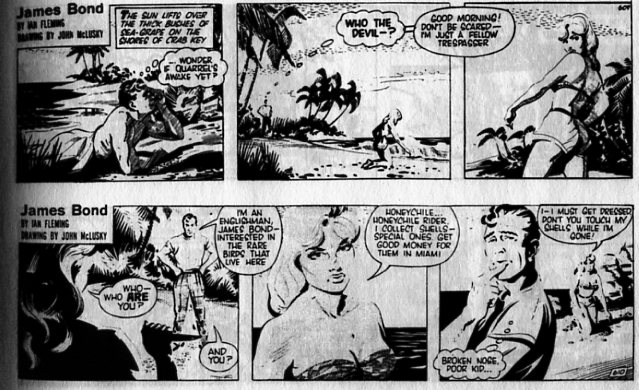
Adventure strip cartooning is basically dead, which makes sense, since I could never figure out how it managed to get up and walking around in the first place. This collection of James Bond newspaper serials from the late-50s and early-60s perfectly captures everything wrong with the form. Instead of a full-throttle adventure romp, you get a plot that stutters compulsively as it desperately tries to bring you up to speed week after week. Instead of pulse-pounding action-sequences, you’ve got images so small you can barely get a motion line in when you throw a punch. And instead of racy, PG-13 innuendo, you’ve got family-friendly not-too-skimpy bikinis — again, drawn at a size that means you need to squint to make an eyeful of the tame fare on offer.

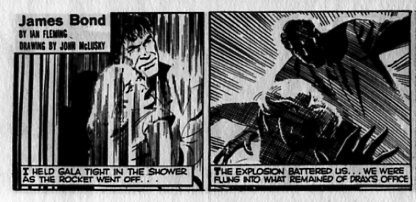
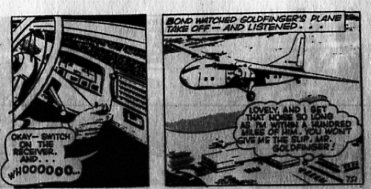
None of which is to denigrate this collection, exactly. John McClusky is a very talented artist, especially adept with detailed linework and shading effects. He rarely gives you a sense of actual action or excitement (which, again, would be awfully hard to do in this format, anyway), but his best work can capture a freeze-frame constructivist drama. Either of these two panels, for example, could be great movie posters:

McClusky is also a fine draftsman, who seems to work very effectively from photoreference. He expertly captures cars, clothes, planes — the world of surface stuff you expect to have presented to you when you’re reading a shallow fantasy of the good life like James Bond.

And, of course, McClusky’s cheesecake, reduced and PG though it is, is thoroughly professional, though a bit lacking in personality. Most of the women in the stories are blandly good-looking, and they start to blur into one another after a while. The one exception is Honeychile from Dr. No. She’s supposed to be a simple nature child, and the slight bit of added characterization seems to frees McClusky to throw in a bit of voluptuous oomph.

All of which basically led me to wish that McClusky had done work which might showcase his talents at a larger size and in a less hamstrung narrative form. But those are the breaks, I guess.

As for those narratives themselves — they are what they are. Produced before the first Sean Connery movies, the touches of humor, technical wizardry, or simply competent plotting those films offered are largely absent here. Instead, Bond escapes death not through cleverness or gadgetry, but mostly through sheer luck; bombs just keep not quite killing him for some reason. He often comes across, no doubt inadvertently, as dumb and bumbling— more like a real spy than like a fantasy one, in other words.

The most noticeable difference between the strips and my (admittedly tenuous) memory of the books is that the strips carefully finesse Fleming’s vicious homophobia. Wint and Kidd from Diamonds Are Forever are here just good friends; Pussy Galore falls for Bond because that’s what girls do, not because he forcibly shows her the error of her lesbian ways. On the one hand, dropping the prejudice makes the strips much more palatable for a contemporary audience. On the other hand — homophobia was kind of what Fleming had to offer. When you remove the compulsive anxiety about manliness, there’s not a whole lot here. Except the art, of course.

Utilitarian Review 10/8/11

On HU

In our Featured Archive post this week, Aaron Costain looked at comics and architectural drawings.

Erica Friedman on the continuing relevance of small presses.

I talk about Eugene Thacker’s In the Dust of the Planet and why we can’t escape the roaches.

Domingos Isabelinho discussed the work of Shannon Gerard.

Eric Berlatsky offered some sample Alan Moore quotes from the forthcoming (Updated: not forthcoming! already released!) volume Alan Moore: Conversations.

Nadim Damluji looked at Orientalism in Craig Thompson’s Habibi

Susan Kirtley discussed the greatness of Lynda Barry.

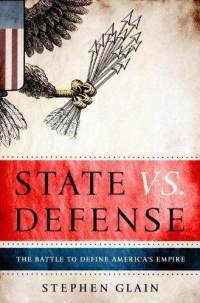
I reviewed Stephen Glain’s State and Defense and linked our empire to our national cowardice.

I looked at Orientalism in Neil Gaiman and P. Craig Russell’s Sandman story “Ramadan”.

And I posted a jangly pop mix download with the Bangles, Beatles, Bee Gees, and more.

Utilitarians Everywhere

For Splice Today I reviewed Kate Beaton’s new Hark a Vagrant! collection.

And also for Splice I looked at Alan Wolfe’s new book Political Evil

Other Links

Robert Stanley Martin reviews Howard Chaykin’s American Flagg over at Pol Culture.

Shannon Smith has a really amusing breakdown of the new Animal Man #1

At Splice Today, Tripp Weber argues that Wikipedia needs advertising.

Craig Fischer talks about Pluto and doubling in his new TCJ column.

Tucker Stone does what he does, and Mr. Terrific sounds horrible.

Music For Middle-Brow Snobs: Bangles and Beets

Inspired by the new Bangles album I’ve put together a jangly pop mix for download. You can download Bangles and Beets here.

1. Massachusetts — Bee Gees
2. Ferris Wheel — Donovan
3. Swim Up Behind Me — Amen Dunes
4. You and Your Sister — Chris Bell
5. Blindsided — Bon Iver
6. Movin’ In On You — Julee Cruse
7. Payne’s Bay — Beirut
8. Razzle Dazzle Rose — Camera Obscura
9. End of Time — Lindsey Buckingham
10. Breaking the Ice — Jeremy Jay
11. Pretty Girls Don’t Cry — Chris Isaak
12. September Girls — Bangles
13. Not This Time — Country Funk
14. The World — the Beatles
15. The Beat Goes On — Britney Spears
16. Open My Eyes — Bangles
17. Anytime — Journey

Just a Thing In Our Dream

Earlier this week, Nadim Damluji wrote a post discussing the painful Orientalism of Craig Thompson’s Habibi. Nadim sums up his argument as follows:

Wanatolia represents the poignant identity crisis at the heart of Habibi: it wants to be a fairytale and commentary on capitalism at the same time. The problem is that in sampling both genres so fluidly, Thompson breaks down the boundaries that keep the Oriental elements in the realm of make-believe. In other words, the way in which Wanatolia is portrayed as simultaneously savage and “modern” reinforces how readers conceive of the whole of the Middle East. Although Thompson is coming from a very different place, he is presenting the same logic here that stifles discourse in the United States on issues like the right to Palestinian statehood. If we are able to understand Arabs in a perpetual version of Arabian Nights, then we are able to deny them a seat at the table of “civilized discourse.”

Thompson self-consciously presents his Orientalism as a fairy-tale. Yet the fairy tale is so riveting, and his interest in the reality of the Middle East so tenuous, that he ends up perpetuating and validating the tropes he claims not to endorse. Here, as so often, what you say effectively determines what you believe rather than the other way around.

Thinking about this, I was reminded of one of Neil Gaiman’s most admired Sandman stories — Ramadan, written in the early 1990s and drawn by the great P. Craig Russell.


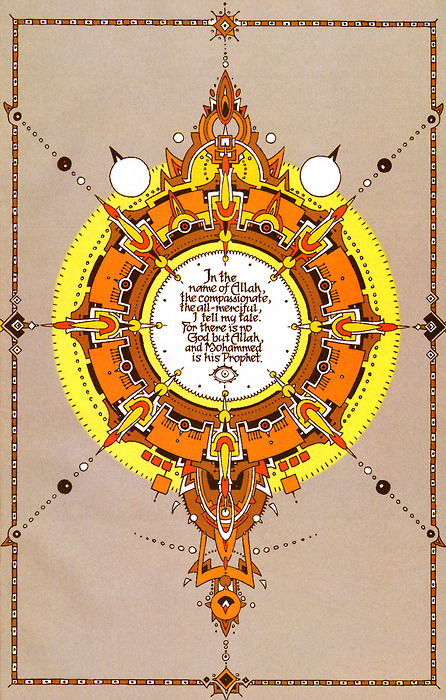
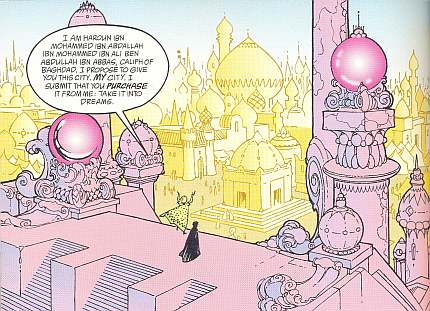
The beautiful opening page of Gaiman/Russell’s “Ramadan”.

I haven’t read Thompson’s Habibi, but from Nadim’s description, it seems that Gaiman and Russell are even more explicit in treating Orientalism as a trope or fantasy. The protagonist of “Ramadan” is Haroun al Raschid, the king of Baghdad, the most marvelous city in the world. Baghdad is, in fact, the mystical distillation of all the magical stories of the mysterious East. Gaiman’s prose evokes, with varying success the exotic/poetic flourishes of Western Oriental fantasy. At his best, he captures the opulent wonder of a well-told fairy-tale:

And there was also in that room the other egg of the phoenix. (For the phoenix when its time comes to die lays two eggs, one black, one white.
From the white egg hatches the phoenix-bird itself, when its time comes.
But what hatches from the black egg no one knows.)

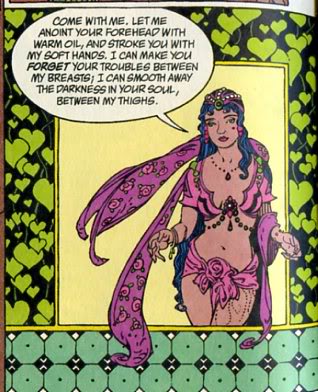
At his worst, he sounds like a sweatily clueless slam poet: there’s just no excuse for dialogue like “I can smooth away the darkness in your soul between my thighs”.

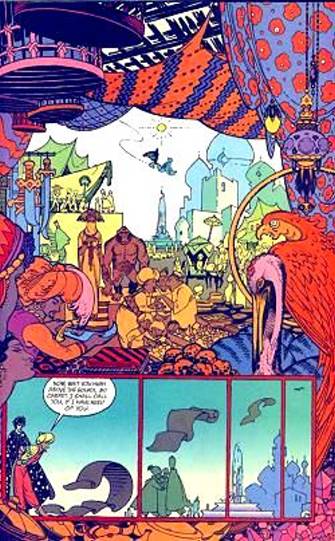
But if Gaiman’s hold on his material wavers at times, Russell makes up for any lapses. Beneath his able pen, the Arabian Nights is transformed into sweeping art nouveauish landscapes, a ravishingly familiar foreign decadence.

As I said, this is all clearly marked as fantasy — both because there are flying carpets and Phoenixes and magical globes filled with demons, and because the whole point of the narrative is that it’s a story. As the story opens, Haroun al Raschid is dissatisfied with his city, because, despite all its marvels, it will not last forever. So he makes a bargain; he will sell Baghdad to Dream, and in return Dream agrees to preserve the city forever. The bargain made, the city vanishes into dream and story. And not just the Phoenix and the magic carpet disappear, but all the marvelous wealth and luxury and wisdom of the east, from the luxurious harems to the fantastic quests. Orientalism, as it is for Craig Thompson, becomes just a story which never was.

Gaiman and Russell, then, avoid Thompson’s error; they do not conflate reality and fantasy. Fantasy is in a bottle in the dream king’s realm, forever accessible, but never actual. The real Middle East, on the other hand, must deal with a grimmer truth; the last pages of the story show Iraq as it was in the early 90s — ravaged by sanctions, brutally impoverished, and generally a gigantic mess by any objective standards (though not, of course, by the standards of the Iraq of a decade later.) In this real Iraq of starvation and misery, the other Iraq is only a dream. As Gaiman says, speaking of an Iraqi child picking his way through the ruins, “he prays…prays to Allah (who made all things) that somewhere in the darkness of dreams, abides the other Baghdad (that can never die), and the other egg of the Phoenix.”

So that’s all good then. Except…whose is this dream of Orientalism, exactly? Well, it’s the Iraqi boys, as I said, and before his, it was Haroun al Raschid’s. But really, of course, it isn’t theirs at all. It’s Gaiman and Russell’s.

Orientalism does have some roots in Arabic stories; I’m not denying that. But this particular conception of the folklore of Arabia as a single, marvelous whole, containing all that is wonderful in the East, in contrast to a sordid, depressing reality — I don’t believe Gaiman and Russell when they say that that’s a thing in the mind of Iraqis. Habin al Raschid giving up his dream is a dream itself, and the dreamer doesn’t live anywhere near Baghdad.

“Ramadan,” then, is a tale about losing a fantastic land to fantasy — but it isn’t Habin al Raschid who loses it. Rather, it’s Gaiman and Russell and you and me, (presuming you and me are Western readers.) Gaiman and Russell are, like Thompson, nostalgic for Orientalism — they know it’s a dream, a vision in a bottle, but they just can’t bear to put the bottle down. Our fantasy Middle East is so much more glamorous than the real Middle East, even the people who live there must despair that our tropes are not their reality. Surely they want to be what we want them to be, democrats or kings, sensuous harem maidens or strong independent women. Thus the magical Arabia and the sordid, debased (but potentially modern!) Arabia live on together in the world of story, comforting Western tellers with the eternal beauty of loss. Our Orient is gone. Long live our Orient.
_______________
Nadim’s thoughts have inspired an impromptu roundtable on Orientalism. which can be read here as it develops.

The United States of Cowardice

This first ran on Splice Today.
_________________

Stephen Glain’s State vs. Defense is a chronicle of America’s post-World War II militarization of foreign policy. Which is to say, it’s a long, depressing slog through stupidity, stubbornness, waste and blood. From Joe McCarthy’s bone-headed, politicized assault on civilian China experts in the State Department to Jesse Helms’ bone-headed, politicized assault on civilian foreign experts of all sorts; from the fictitious Gulf of Tonkin incident to the fictitious WMD’s in Iraq; from the groundless characterization of the Soviets as an aggressive threat during the Cold War to the groundless characterization of China as an aggressive threat today, the United States has for six decades picked up bucket after bucket of bullshit, buried its collective head in the offal and gone staggering blindly off towards empire. At some points in the accounting, you’re forced to wonder why Washington even bothers to invest in weapons. Why not, after all, simply cut out all the middlemen and just physically bury our foes, real and imaginary, in trillions of dollar bills? At least it’s a more effective strategy than SDI.

SDI is still under development, of course, at least as far as I could figure out from the Internet. We also, as Glain notes, continue to have troops in South Korea, “defending…one of the world’s most prosperous countries from its famine-stricken neighbor,” as well as troops wandering around the Sinai Desert “as they had since 1982 as part of a multinational peace-keeping force.” When the Cold War ended and we didn’t have any reason to gratuitously and provocatively violate Soviet airspace with spy planes, the military brass, reluctant to end a program just because it was useless and dangerous, decided to start gratuitously and provocatively violating Chinese airspace. This has resulted in a heightening of tensions that could conceivably, Glain notes rather helplessly, lead to a catastrophic Sino-American war.

Indeed, the overwhelming takeaway from Glain’s book is helplessness. No matter the cost in American lives (to say nothing, of course, of those poor bastards overseas), no matter the cost to our standard of living, no matter the catastrophic foreign policy failures, the empire, it seems, only expands. Even Commanders-in-Chief, in Glain’s account, can do little to stem the inevitable American march towards war. Glain, for example, points out that president after president has been horrified by SIOP, the Pentagon’s Single Integrated Operational Plan for “winning” a nuclear war. In the first incarnation of the plan during the 1950s, “Casualty estimates ranged between 175 million and 285 million Russian and Chinese dead, regardless of whether or not China was party to a Soviet attack [Glain’s emphasis]”. Counting dead in Eastern Europe and resulting fires, the death toll would probably have topped one billion. Eisenhower said the plan “frightene(ed) the devil out of me,”—yet he signed off on it. Kennedy wanted to get rid of it too, but didn’t. Reagan—not a man noted for his soft stand on Communism or, indeed, for his rationality—called SIOP “crazy.” Yet, despite the fact that president after president has condemned it, and despite the fact that the Cold War has been over for more than two decades, SIOP still exists, a sign of America’s apparently insatiable nostalgia for apocalypse.

Glain is excellent at explaining bureaucratic infighting. In one passage he discusses how a supine Condoleezza Rice as Secretary of State failed to back her wonks, with the result that the invasion went ahead without any input from anyone who had any clue about Iraq before the invasion. In another he describes how the oleaginous Richard Perle helped undermine massive arms reduction at the end of the Cold War by encouraging Reagan’s woozy fantasies about the viability of SDI.

Still, Glain’s focus on the upper echelons of policy tends to leave a few questions unanswered. Kennedy and Johnson, Glain shows fairly clearly, didn’t want to escalate in Vietnam, but they did, in large part because they feared political backlash. Obama and Biden made some vague gestures towards attempting a drawdown in Afghanistan, but they were, according to Glain, politically outmaneuvered by their military officers. “For Obama,” Glain says, “there was no alternative to expanding the war, particularly if he wanted to win at least some Republican support for his domestic agenda.”

The question, then, becomes not so much why do presidents want to engage in endless military overseas adventures, but rather, why do we? Despite war after war; despite a humiliating, catastrophic failure in Iraq; despite what appears to be an endless slog in Afghanistan; the American people just can’t say no. Sure, there have been occasional protests; Glain points in particular to the nuclear freeze movement in the 1980s which arguably had a real impact on Reagan’s foreign policy. But in general, and especially since 9/11, we seem as a whole in love with our empire. What is our problem?

I don’t have a definite answer, but I have a guess. Our problem is that we are cowardly, craven shitheads, who spend our lives in desperate fear for our measly, worthless lives. We drop bombs on the innocent and guilty alike, kidnap, torture, and assassinate, and plan to wipe all human life off the earth because we are terrified that somebody might try to kill us.

Don’t get me wrong. I really don’t want to die in a terrorist attack. I am even less eager to have my loved ones die in a terrorist attack. But at some point, you really do need to buck the fuck up. The chances of me or anyone I know getting killed by murderous strangers is infinitely smaller than the chance that I’ll die in a car accident. And it is dishonorable to allow my government to drop bombs on Afghan wedding parties on the off chance that I might possibly be slightly safer. How many people, exactly, need to be reduced to jelly to make up for Americans’ collective spinelessness?

The Right likes to wail about the culture of dependency fostered when you provide some minimal resources to prevent people starving in the street. But nobody wants to talk about the real culture of dependency; the trillions of dollars we spend on our defensive nanny state, assuaging our knee-jerk timidity by swaddling ourselves in weapons of death. Our leaders like to talk about American virtue, but there is no virtue without personal courage. Until we realize that, our terror will continue to be a scourge, and the only question will be whether it will destroy us before, or along with, the rest of the earth.

In Praise of Lynda Barry

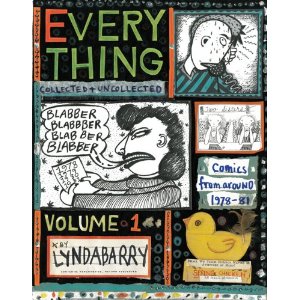
I came late to the Lynda Barry love. I wasn’t cool enough to read her in the alternative weeklies in the eighties and nineties, and it wasn’t until I was a graduate student in English and trying to hide a lifetime of reading comics from my colleagues in the ivory tower that a friend introduced me to One Hundred Demons. Soon after, in a fit of rebelliousness, I began to teach Demons in my “Writing the Memoir” class. Ten years later I have become a kind of addict, consuming all of Barry’s works, and there are a lot of them. Barry writes plays, essays, and novels. She created the ultimate chronicle of childhood experience, Ernie Pook’s Comeek, for over twenty-five years. Lately, Barry has been making do-it-yourself writing and art workbooks, and this month, Drawn & Quarterly will begin re-releasing all of her comics in their original format starting with Blabber Blabber Blabber: Volume 1 of Everything. Get that book. Get all of them.

Why? Well, the writing, to start. Lynda Barry can write, really write. And despite her frequent protestations (and lamentations about spelling) Barry is witty and articulate. Don’t let the wacky penmanship fool you. Who else could come up with the infamous line, “Love is an exploding cigar we willingly smoke?” Barry also excels at more poignant observations, such as, “We never need certain monsters more than when we are children.” Known as a particularly wordy comic artist, Barry’s expertise with language bears attention with careful reading and subsequent re-readings. Barry’s good friend Matt Groening once commented in a 1991 interview, “Lynda’s stuff is just incredible. It’s about as close to literature as comic strips have ever gotten, and I think she’s really on to something new” (94). Not to quibble with a master, but I think Barry’s oeuvre doesn’t come close to literature, it IS Literature with a capital L—words and works of depth, mastery, and emotion, and my appreciation for her only grows over time.

Barry is certainly known for her text, but then there are the pictures, the somewhat controversial pictures. Can Barry draw? Are the shaky, scruffy characters with their elbowless arms and freckles and blemishes indicative of an inferior artist? Does it matter? (Well, to some I suppose it does matter, so for the record, yes, she can draw…and paint…and sing through her teeth, but I digress. In any case, check out the early Spinal Comics from her college years at Evergreen to see a more representational drawing style.) I would argue that if one is to thoroughly examine Barry’s art across many genres, including painting, drawing, and collage, in addition to the range of styles demonstrated in her various comic art projects, it becomes apparent that the coarse, edgy aesthetic most associated with Barry is a very conscious choice, rather than any artistic weakness. Lynda Barry opts to portray her conception of the world in this particular fashion, and the rough, uneven art reflects her chosen subject matter—our messy, horrifying, and wonderful everyday lives.

Still, apart from any artistic merit, what continues to draw me to Barry’s magical alchemy of words and pictures is that when you read Lynda Barry’s work you feel it, not in a removed, esoteric way, but in a wincing, stomach cramped fashion. When I read Lynda Barry I do not laugh very often, but I do cringe in recognition, and I feel the churning of stomach acid as I witness the kids mocking each other in her strip. Through her work I experience the jerk of adrenaline echoing from my old traumas. Barry is the achy, tender pain of my childhood: skinned knees, bee stings, and too many Pop-rocks. Reading Lynda Barry hurts. I feel the ache and remember I am alive. Again, I urge you. Go get those books. Reading them will hurt and you will be grateful for it.