Rorschach, Superstar

A bit back, Sean Michael Robinson talked about a production of the Diary of Anne Frank that interpolated the music of the Carpenters. Sean noted that the production was wonderful, moving, inventive…and also illegal.

Anne Frank’s words, however, and the translation of her words on which we were relying for much of our text, were a different matter, as was the authorized play (Diary of Anne Frank), which provided much of the rest of the text. All of these elements are still under copyright, and will continue to be so for several years. (In fact, copyright in the theater is more restrictive than in almost any other field. You can, after all, read a book or listen to an album any way that you wish once you’ve purchased a copy–but to publicly perform a play one must conform to a dizzying array of limitations set out by the author or the author’s agents–usually, that every word of the play will be performed, i.e. no cuts or insertions without permission, and that the appearance, gender and even staging etc will honor the stated intentions of the author regarding the script and contract.)

Sean’s prescription — with which I agree, is that we need to rethink our insanely restrictive copyright laws in order to make it possible for people to reimagine older works, and create new ones, without having their asses sued off.

This does bring up a rather uncomfortable issue for me, though. Mainly…if I think that art is built out of other art, and that the copyright laws should reflect that, then what exactly is the deal with my recent article on Slate, where I discuss my deep disgust with DC’s Before Watchmen? After all, as Jones pointed out with his usual logician’s obsessiveness, Alan Moore has ripped off everybody from C.C. Beck to H.G. Wells, and probably other people whose names begin with A, X, Y, and Z as well. If I think high school kids should be able to mash up Anne Frank and the Carpenters, and I think that Alan Moore should be able to mash up Dorothy and Wendy and Alice (which is probably not the best word choice there, but onward), then what exactly is the problem with having DC put out a new! Watchmen! prequel! — or for that matter, a Watchmen toaster? Isn’t there some moral inconsistency here?

Possibly. But let me try to think through the differences.

— First, it’s useful to remember the purpose of copyright. According to our Constitution, the purpose is not to protect creators. The purpose is to encourage art. Copyright is supposed to give creators a monopoly on their own works so that they will have a financial incentive to create those works in the first place. If as soon as you write something, everybody else can publish it under their name, then you’re going to limit the people who will write to hobbyists who don’t need the money. (Not that there’s anything wrong with hobbyists, he says as he writes for free on his blog. The point is just that ideally you want to encourage other kinds of writing as well.)

However. Giving someone an infinite monopoly on their work also limits creation. It makes it hard to comment on older works, or to remix them, or to use them as inspiration for newer works. That’s why copyright is limited; so that works will eventually enter the public domain where they can be used by other artists with no strings attached to make things like League of Extraordinary Gentleman…or what have you.

The point is that there’s no particular contradiction between arguing that, on the one hand, Alan Moore is being screwed, or that, on the other hand, basing a work on Bram Stoker — or even on C.C. Beck — is okay. I’m personally in favor of a copyright of about 50 years from date of publication — which would mean Watchmen would still be under copyright, but that a lot of works Moore has lifted from would not be. A fifty year copyright would also put Anne Frank out of copyright…though not the Carpenters.

— Second, even when works are under copyright, I think there needs to be a vigorous fair use provision. Such provisions can include, for example, flat fees for using music (like the Carpenters) without giving the creator veto power over how or where that music is used (which, yes, would mean that idiotic republican presidential candidates could use Bruce Springsteen’s songs if they wanted even if the Boss objected. I think that’s a reasonable price to pay for a vigorous public domain, personally.) I also think that in situations where there is no profit, as in Harry Potter fan fiction, for example, most bets should be off.

Soooo…again, how is all of this different than DC publishing Before Watchmen…or than Marvel using Jack Kirby’s characters (which are certainly on the verge of my 50 year timetable) without paying him?

Which brings us to my last point.

—The issue with DC and Marvel is not that they are creating new work using somebody else’s characters. As I’ve suggested, artists do such things all the time; it’s a big part of how art is made. Without it, we wouldn’t have Shakespeare, much less Alan Moore.

So the issue with DC and Marvel isn’t use of the characters. The issue is, specifically, lousy business practices. Moore and Kirby never got to exploit the copyright for the characters they created; instead, Marvel and DC used crappy contacts, evil industry practices, and disproportions of power to gain the benefits of the law for themselves. So it’s not that Marvel and DC shouldn’t use those characters. It’s that they shouldn’t be able to reap a monopoly windfall for using those characters based on dubious business practices.

And, in a bitter but by no means isolated irony, the excessively insane draconian provisions of our copyright law mean that the creators are actually much more extensively screwed than they would be if copyright were reasonable. If copyright were only 50 years, Marvel would be in the process of losing its rights to its properties one by one — which would mean that anybody could make a Spider-Man movie or an Iron Man movie, which would make Marvel essentially worthless, which would mean it would go out of business — which wouldn’t benefit the Kirby family financially, of course. Still, you’d think his ghost would at least get a kick out of it.

In any case, the point is: the creators working on Before Watchmen are not despicable because they are using someone else’s art to make art, because that’s what all artists do. They’re despicable because they are knowingly helping DC exploit a monopoly that was obtained by fucking over the people who created it — and because one of those fucked over creators has verbally erected the equivalent of a picket line. Hughes, Straczynski, Cooke, et. al. are not thieves. They’re scabs. I hope that’s a comfort to them.

 

In Space No One Can Hear You Vomit

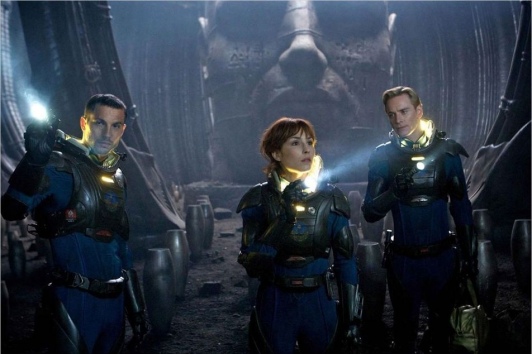
Logan Marshall-Green, Noomi Rapace, and Michael Fassbender in Prometheus

So I’d spent that June 1985 afternoon laying parquet in the future dance-rehearsal room of our Montmartre theater — a quixotic and doomed venture that consumed me and my compadres for two years. The parquet tiles were affixed to the concrete floor by a particularly noxious glue, and I foolishly wore no mask; after two or three hours, my nausea had built up to the point of copious vomiting. So I headed home, expecting the effects to dissipate with rest.

But the nausea continued, for the next three days. I was not only unable to hold down food, but water as well. On the afternoon of the third day I staggered into a clinic, hoping for some healing nostrum to take home — and was immediately hospitalised, with surgery scheduled for the next day; I had appendicitis, which had led to peritonitis and sepsis; my body was poisoning me.

That night, as I lay in bed with a saline drip attached to my arm to reverse my extreme dehydration, I experienced for the first time delirium. It was by no means unpleasant. A haze of uncertain time and odd sensual waves, and curious mental fugues rippling through my consciousness.

And then suddenly that consciousness focussed. I was living the life of a soldier in the Napoleonic period, seemingly cursed to face across the years a mad adversary in duels, wielding rapier, saber, pistol…the intensity of the hallucination was incredible.

Of course, it was no hallucination. The hospital room’s TV was showing director Ridley Scott‘s first feature film, The Duellists, and my fever had thrust me into it.

Ridley Scott directing Keith Carradine and Harvey Keitel in The Duellists (1977)

But how is it that my fever dream never delivered me that same hallucinatory re-incarnation via any of the other TV shows and dramas I watched that night?

Well, ‘fever dream’ is the answer, because fever dreams are what Scott creates at his best, what he seduces us into.

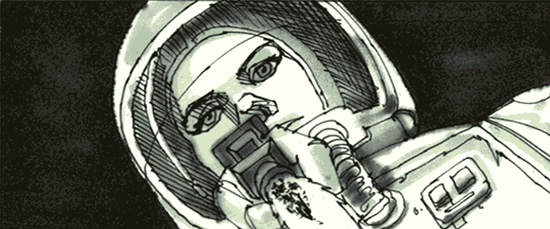
Ridley Scott has always been among the most visually-oriented directors; he studied at the prestigious Royal College of Art in London, and began his career as a set designer for the BBC. An excellent draftsman himself, he exercises over the art direction of his films an almost maniacal attention to visual and aural detail.


Storyboard drawings by Ridley Scott for Alien

This was apparent from his days as an extremely successful director of commercials; nobody who lived through the seventies in Britain (such as I) has forgotten his series of ads for Hovis bread. (Click through for video.) Observe the lushness of the photography and the thorough recreation of a period, hear Dvorak’s 9th Symphony hypnotise you into sentimental yearning. One of these ads was recently voted Britain’s all-time favorite television advert.

At the same time, the bullshit quotient of these commercials was high (what– bullshit in advertising? Stop the presses). Hovis is an admirable and healthful wholewheat bread, but it is, and has been from the start, an industrial product, not the loving fruit of the local artisanal baker’s craft. The golden glow of nostalgia radiating from these commercials is rooted in an imaginary past: the Depression-era North and Midlands of England were grim places indeed; besides, working-class and lower-middle class Englishwomen traditionally baked their own bread well into the sixties. A loaf of Hovis factory bread would’ve been regarded as a luxury.

Still, we willingly let ourselves be lulled by Scott’s dreamweaving. And I maintain that this holds true not just for his ads, but also for Scott’s most successful films. They are often riddled with logical and narrative incoherency, leave questions unanswered and mysteries unresolved– we don’t care. We want the fever dream.

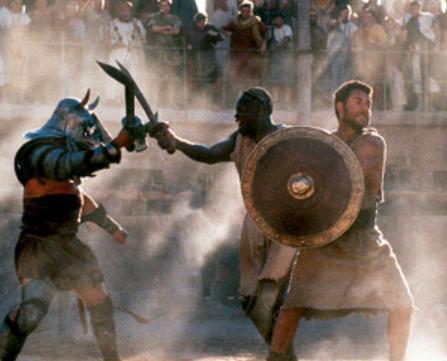
Scott’s great talent is for the creation of plausible worlds. Note: I say plausible, not realistic or even believable. He can create a romanticised Napoleonic age (The Duellists) or an outrageously baroque Roman Empire (Gladiator); an exoticised techno-Orientalist modern Tokyo (Black Rain); a fairy-tale land (Legend); the science-fictional Earth of Blade Runner and Space of Alien; and we are there with him. Because we want to be!

From Gladiator. Note the dust; Scott uses (abuses?) dust and mist lavishly for visual oomph

As a sample of this world-building prowess, consider his famous 1984 Superbowl commercial introducing the Apple Macintosh computer. (Click through for video.) Although it only ever aired once, its impact was extraordinary and resounds down to this day. What we note, behind the rather perfunctory and obvious allegory, is Scott’s skill at implying an entire imaginary world in so brief a span of time.

Scott’s breakthrough film was, of course, Alien in 1979.

It manages a) to show one of the most believable science-fiction worlds ever presented on the screen, and b) to be one of the most frightening movies ever made.

The first is due to Scott’s aforementioned obsessive attention to detail and visual talent. The second is due to his genius for emotional manipulation.

Alien benefited hugely from Scott’s discernment of artistic talent. It’s been said dismissively of him that as a director, he made a great art director; but an art director’s brilliance made the film.

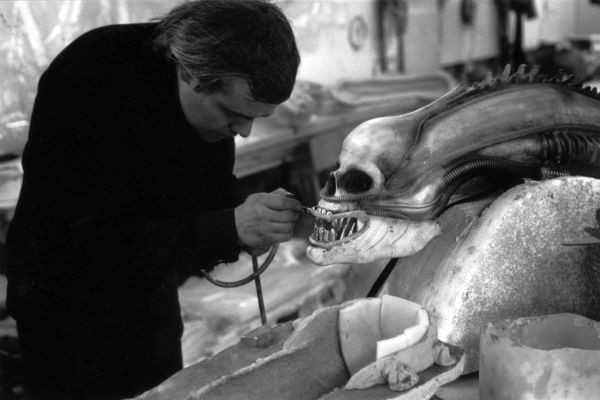
His great coup was to recruit the artist of the grotesque, H.R.Giger, to design the alien monster and the extraterrestrial ruined spaceship.

H.R.Giger building the alien

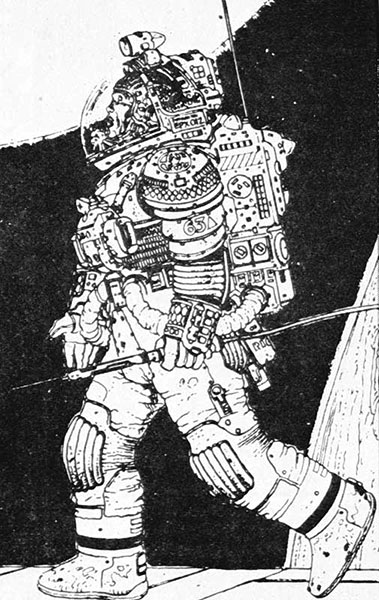
Other marvellous talents were recruited for other aspects of the film, cast like actors; Ron Cobb designed the Earthling spaceship Nostromo, and Jean ‘Moebius’ Giraud designed the spacesuits.


Above: Giraud’s spacesuit design. Below: the suits as seen worn among Giger’s set.

Scott’s gift for manipulation — his dark side, as it were — told him the most effective ways to induce fear and horror. Alien features a nightmarish view of the body’s flesh and fluids. In addition to the usual directorial tools of suspense and pacing, the whole Hitchcockian array, Scott very consciously reaches for the visceral and the subconsciously somatic gripping to create his nightmare.

After Alien, Scott’s science-fiction follow-up was Blade Runner (1982), an adaptation of Philip K.Dick’s Do Androids Dream of Electric Sheep? This was another visual triumph, with Scott again partnering with a design visionary, Syd Mead.

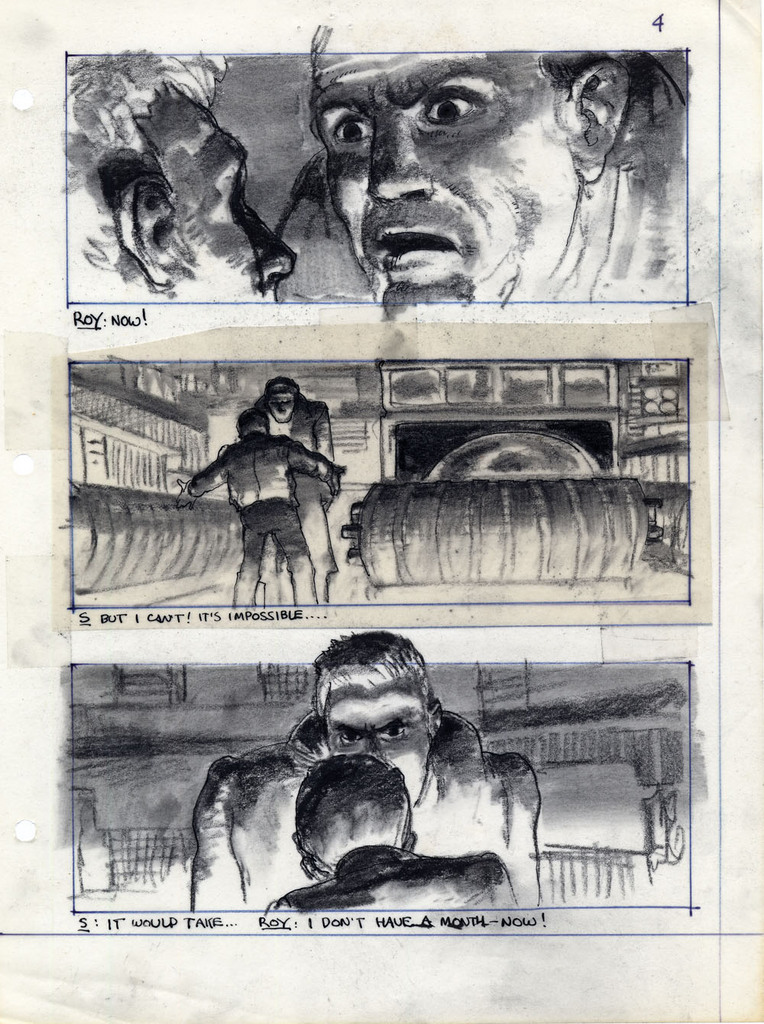
Storyboard from Blade Runner, drawn by Ridley Scott

At the time, Scott declared that the science-fiction film needed its John Ford — that is, a director who could be to the SF genre what Ford was to the Western. And Scott could have well fit the role.

But thirty years passed before he made another science-fiction film: Prometheus.

**********************************************************

Scott’s career during this hiatus soared, creating gems (Thelma and Louise, Gladiator, Black Hawk Down) and duds (Someone to Watch Over Me, G.I.Jane.) The initial box-office failures of Blade Runner and of Legend may have caused him to shy away from the fantastic. He was also vocally displeased with the rather ham-fisted exploitation, by other hands, of the Alien franchise. However, for the past ten years he has been working on a prequel to Alien — only to shy away from that notion in recent years, at least in public.

His and the studio’s coyness about Prometheus has exasperated fans. Is it or isn’t it a prequel?

To answer that question, I was, in the evening of June 1st, Prometheus bound. (Sorry, couldn’t resist.)

So the answer to “is this an Alien prequel” is…?

Yes.

And no.

Yes, for it fits perfectly into the Alien universe, Giger designs and all. No, because the film works perfectly well as a stand-alone. Scott has his cake and eats it; good for him.

Is it a good film? Yes — but only if you are willing to embrace the fever dream — the nightmare. By which I don’t exactly mean the old cliché “check your brain in at the box office and enjoy”.

Science fiction is the most cerebral of genres; but it also works with the unreasoning emotions of awe, wonder and horror — with the sublime. The latter are this film’s strong suits.

Now I want this article to be relatively spoiler-free, so I won’t go into plot details. But, for any savvy SF aficionado, there’s nothing conceptually new on offer here. Von Daniken and Lovecraft seem to be the main inspirational motors. (Lovecraftians will understand this allusion: where Stanley Kubrick’s 2001:A Space Odyssey has been called a shaggy God story, one could call Prometheus a shoggy God story.) The old SF trope of mankind having been seeded on Earth by extraterrestrials has long since run into the problem of Homo Sapiens‘ close genetic kinship with other primates such as chimpanzees and gibbons; to my knowledge, only the writer Larry Niven has worked his way around this inconvenient fact, in his novel Protector. The film ignores this.

There are numerous logical lapses, not just in concept, but in motivation and continuity. The strong, simple storyline of Alien here is complicated by a larger cast and fussy mise-en-scène– people go from ship to ruins to ship to ruins to ship and from chamber to tunnel to chamber to tunnel until the viewer has no sense of place. Many of the characters are stereotypes.

But, you know what? None of these objections amount to much. Let your reptile brain take over, give in to the Scottian dream.

The nightmare works more powerfully than ever off our deep revulsions for the flesh, our imaginative perversions of sex, birth, death, and animality. We are fed one particular abomination that is the ultimate in vaginadentatatentaclepornhermaphroditicmisogynist monsters: it makes the cosmic squid in Watchmen look like a wee twee fairy. This she-he-horror fights its opposite number, an extraterrestrial superphallic Uebermensch, and succeeds in raping him in true classic Alien style. With the usual, unholy, parturient result.

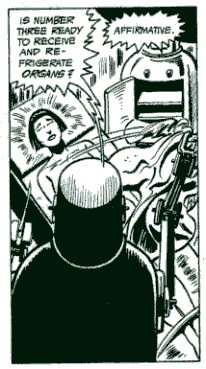
But the most harrowing sequence has one of the female characters, impregnated with an atrocity waiting to burst through her abdomen, racing to have an automated robot surgery pod operate an emergency caesarian/abortion. The extracted monster is a squealing, squirming betentacled mass of boneless flesh, held in the sterile metal grip of the robosurgeon.

Beyond the hideous delights of this sequence, I find it well encapsulates the genesis of Prometheus. We, the audience, are the woman. Inside us resides the secret monster of our Id. Ridley Scott is the robosurgeon, who clinically, mechanically extracts the creature and shows it to us: the creature being, of course, the film.

Some final random notes: the acting level is uniformly above par; great pleasure is derived from Michael Fassbender‘s alternately childlike and malevolent android Dave. He provides an incarnation of the Superego– sandwiching the humans between himself and the Id of the monsters.

This is definitely a star-making turn for Noomi Rapace, as protagonist scientist Elizabeth Shaw. Strength and vulnerability, emotion and will to knowledge, are complexly communicated by her wonderfully expressive features.

Charlize Theron plays yet another ice-queen bitch. Disturbingly, the trailer before the film was for Snow White and the Huntsman, where she plays yet again another ice-queen bitch. Lady better watch out for the stereotype patrol.

The visuals are predictably stunning, and this is one of the very few 3D films I’ve seen that justifies the extra price.

So: welcome to his nightmare, and to yours. Go see it.

++++++++++++++++++++++++++++++++++++++++++++

Scott is not alone in this club of visualists/dreamers. I would group him with Tim Burton, Terry Gilliam and Jean-Pierre Jeunet (all four being graphic artists originally) as cinematic visionaries who triumph over weak story to enthrall us with their worlds; the distant children of Georges Melies.

(In comics, I place Jack Kirby, Steve Ditko, Rick Griffin and Jean Giraud in the same family.)

Still, it should be pointed out that these directors do their best work with quality scripts: The Fisher King for Gilliam, Alien and Thelma and Louise for Scott, Beetlejuice and Big Fish for Burton. And other visualists, such as Jean Cocteau, Stanley Kubrick or David Fincher, have always worked both hemispheres of the brain — investing just as much energy into the writing as into the dreaming. Scott himself has evolved in this direction.

May he continue to do so; he is currently developing a sequel to his other SF masterpiece, Blade Runner. And Prometheus ends with the possibility of a grandiose sequel.

Perhaps science-fiction will have its John Ford, after all.

++++++++++++++++++++++++++++++++++++++++++++

Silly P.S. # 1:
Noomi Rapace was discovered as the star of the Swedish version of The Girl with the Dragon Tattoo, in which she played Lisbeth Salander. The American version stars Rooney Mara.
Those are three cool names!
Silly P.S. #2:
In 1977, I clipped a pretentious review of ‘The Duellists’ and sent it to the Pseud’s Corner column of the satirical magazine Private Eye. They sent me back a cheque for five pounds sterling, enough for a nice dinner at Hamburger Delight.
Thanks for the burger, Ridley!

+++++++++++++++++++++++++++++++++++++

Check out this site for the corporate villainy behind the voyage of the Prometheus
A marvelous blog of science-fiction and fantasy art :
Sci-Fi-O-Rama

Odd Superheroine Out

This first ran on Comixology.
_____________________

Female super-heroes can be many things: Amazon warrior, out-of-control telepath, deadly ninja assassin. But whether in swimsuit, bodysuit, fishnets or boob window, they’re almost always cheesecake.

There’s no particular mystery as to why this is. Super-hero comics are male genre literature. Guys like to look at cheesecake. QED. There are some exceptions to the rule — but they’re usually built around genre exceptions as well. For example, the Claremont/Byrne X-Men made some effort to appeal to YA girl readers through the character of Kitty Pryde. Thus, Kitty got to mostly wear civies, rather than the skintight and/or improbably cut-out costumes that were the lot of her distaff teammates. (Not that the internets are above a certain amount of Kitty Pryde cheesecake of course.)

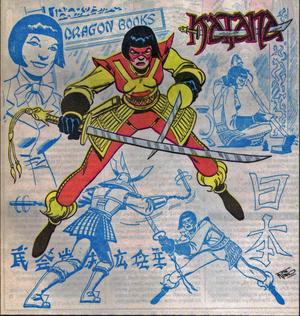
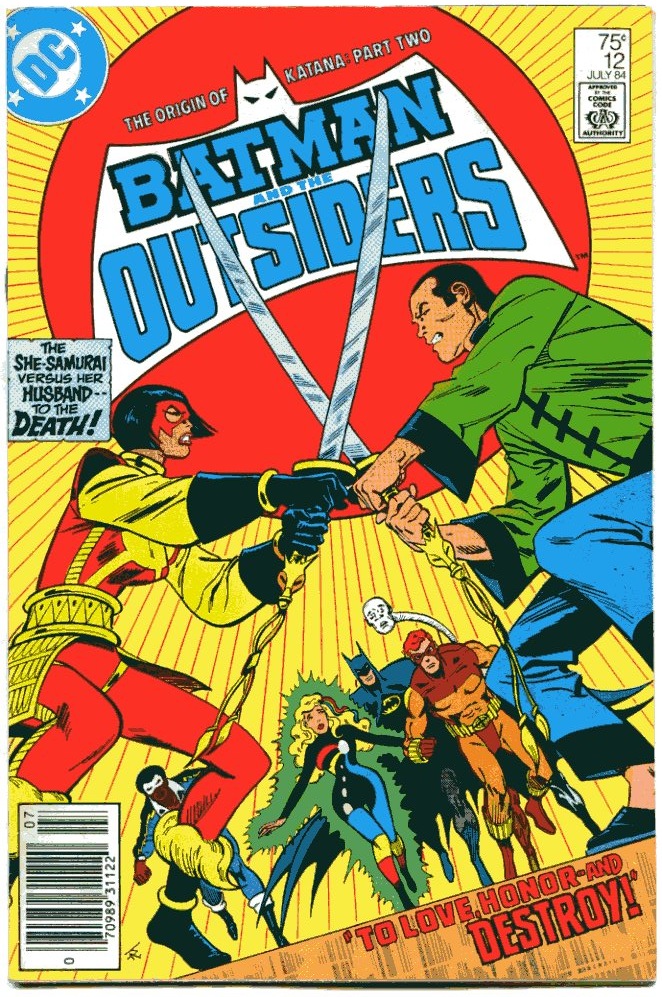
Still, there are a few inexplicable blips. Foremost among them, perhaps, is a minor DC early-80s super-hero who first appeard in Mike W. Barr and Jim Aparo’s Batman and the Outsiders. She was called Katana, and when Aparo drew her she looked, improbably, like this.

That’s a remarkably un-fetishy costume. She’s fully covered, and her blouse isn’t especially tight or revealing: no boob window here. Compared to her teammate Halo, who gets a standard curve-emphasizing form-fitting single piece, Katana seems distinctively to not have gotten dressed with the male reader in mind.

Throughout the series, too, Katana is basically never placed in cheesecake poses or situations. When she gets captured and tied up, for example, there’s none of the bondage imagery you get throughout Wonder Woman’s history. Instead, Katana (or Tatsu, since she’s out of costume in this sequence) is wearing a dowdy hospital gown. She does get stripped down later…but Jim Aparo makes sure we see almost nothing; just a head and shoulders shot from a bizarre ceiling angle, making her look like a twelve-year old boy.

Part of this might be chalked up to Aparo’s particular style; he’s always been more interested in panel composition and shading than in cheesecake for its own sake. But writer Mike W. Barr also played a part in the character’s resolute unsexiness. Katana played the part in the Outsiders that Wolverine played in the X-Men; she’s the bloodthirsty killer with the sharp pointy object, always wanting to dash into danger and slaughter something. While men like Wolverine who play that role are generally just aggressive, the standard script is for women of that type to also be sexually aggressive — a la Elektra, or really anyone else that Frank Miller has ever written. The fact that Katana is Japanese only makes the clichés all the more inevitable; she should be a dragon lady.

But she isn’t. True, she is, somewhat wearisomely, a samurai, since any superhero from Japan has to be either a samurai or a ninja. But she isn’t at all a sexual fantasy. On the contrary, Barr writes her not as a sexual predator, but as a mother. Her tragic backstory involved the death of her husband and two kids, and her closest relationship in the Outsiders is with the amnesiac, innocent Halo, who Katana treats very much as a daughter — going so far as to become her legal guardian. At least through the first couple of years of stories, Katana, still grieving her husband, has no romantic interest at all. In fact, in the two-part origin revelation where Katana’s husband comes back from the dead, Katana actually re-kills him herself in order to prevent him from hurting Halo. The ridiculous vicissitudes of the plot aren’t really worth describing in detail; the point is, Barr goes out of his way to make sure the reader understands that Katana’s primary emotional commitment is to her surrogate daughter first; any men in her life are decidedly secondary.

So, both narratively and visually, Katana deliberately denied the fanboys the flirty cheesecake they wanted. How did they respond?

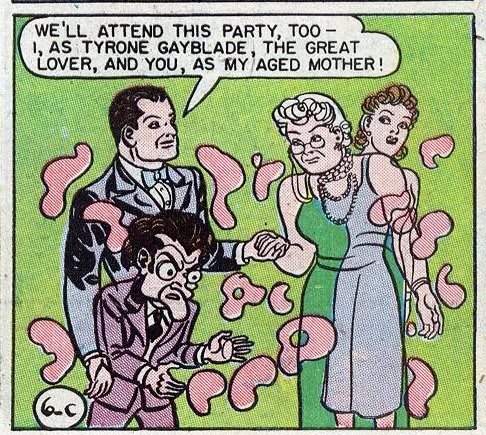
As near as I can tell, they liked her fine. As everyone from Han Solo to Wolverine has demonstrated, a tinge of amorality does wonders for a hero’s popularity; Katana’s willingness to occasionally kill people certainly didn’t hurt her standing.In fact, in the letter columns, she quickly became a favorite figure; Mike W. Barr would often answer mail as Katana, threatening to show various letter-hacks their own lungs and/or other bits. Here, for example, she’s responding to Mr. Peckham, a correspondent who initially thought Katana was too much like Elektra, but then provisionally changed his mind.

“Dear Michael:
Tell Mr. Peckham he may rest easy, at least “for a few more issues.” When he arrives at a final verdict as to my role as Katana, I will arrive at a final verdict as to the disposition of his internal organs. Perhaps the next two issues will influence him favorably. In the meantime, it might be wise to lay in a supply of paper towels and sponges. Yours, Tatsu.”

Despite the positive fan reaction, though, Katana never became a major DC heroine. This was probably mostly due to the fact Barr’s letter-column joshing was by far the best writing he did for the series. His actual scripts were watered down versions of the Wolfman/Perez watered down Clarmeont/Byrne X-Men — and, of course, the Claremont/Byrne X-Men were not unwatery to begin with. Batman and the Outsiders was an uninspired teen book melodrama, stuffed with unmemorable villain teams, stiff character interactions, and final page plot twists that didn’t so much twist as sit there blinking feebly in the wan revelatory half-light. Jim Aparo’s art is always worth looking at…but eventually he backed out for a number of less engaging artists, and then there was really no reason to think about the series, much less read it. The Showcase reprint volume is a massive testament to the fact that DC is willing to reprint any damn thing in a Showcase reprint volume.

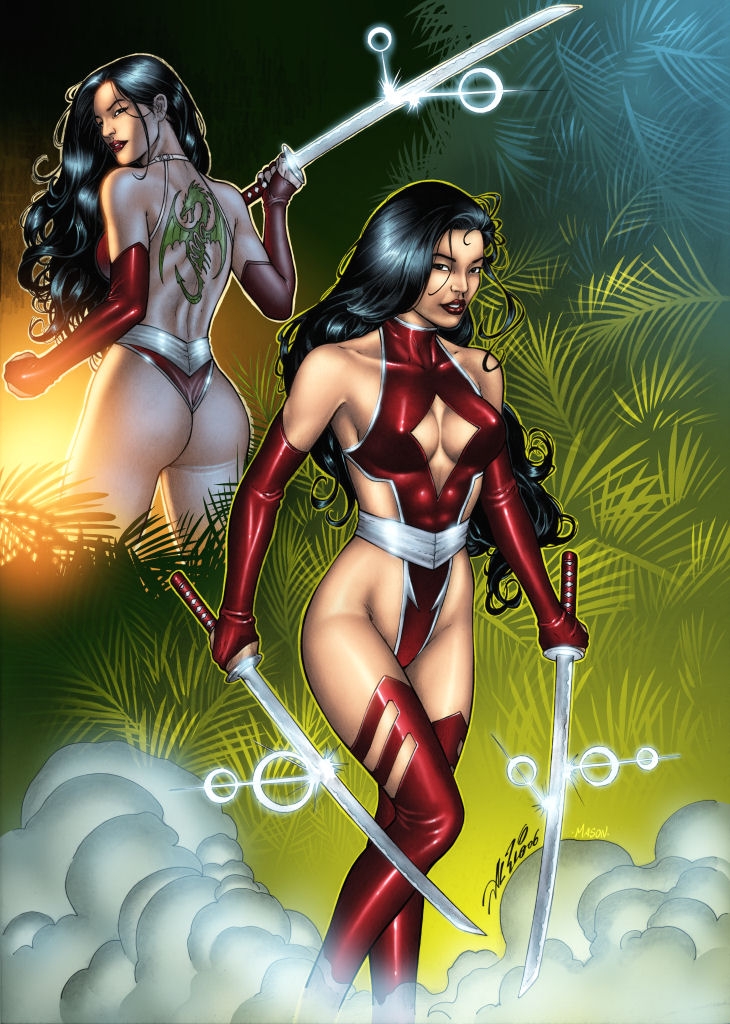
Katana still pops up on occasion — often with a costume redesigned for slightly more va-va-voom. Stil, that hasn’t made her a marquee character. On the contrary, and counterintuitively, she was most successful at the beginning of her run, when, perhaps through an accidental oversight, she looked nothing like a pin-up.

Al Rio reimagines Katana as fanboy wet dream.

Utilitarian Review 6/2/12

At HU

I talk about the mundane blankness of Jason’s Low Moon

I review the autobiography of country great Charlie Louvin.

Ng Suat Tong on comics adaptations of Lovecraft.

Kailyn Kent on Jeff Gabel and gallery cartoonists.

Kurt Buseik on why why Batman is not Green Lantern.

Robert Stanley Martin on Tolstoy and heroes.

Richard Cook on the Smithsonian’s video games as art exhibit.

I talk about Roy Lichtenstein and the heartbreak of appropriaton.

An R&B, blues, and soul download mix.

 
Utilitarians Everywhere

At Slate I explain why Alan Moore is right to be pissed.

At Slate’s double X blog I talk about the first queer superhero not Alan Scott.

At Splice I talk about the surprisingly positive results of Obama’s support for gay marriage.

At Splice I’m disappointed with the new Squarepusher album.

&mbsp;
Other Links

Nice Tucker Carlson hit job by Alex Pareene.

The Reader with some quality snark in the direction of their new owners.

Jones on comics’ crappy coloring.

Charles Reece on Mad Men.

Et tu, Tucker?

Nice Edie Fake cover.

The NYT on Anthony Heilbut’s great new book on (among other things) gospel and gayness in the black church.
 

Music For Middle-Brow Snobs: You Don’t Know Nothing About Love

A soul, blues and R&B mix. Download You Don’t Know Nothing About Love.

1. Anna — Arthur Alexander
2. That’s the Way Love Is — Bobby “Blue” Bland
3. Country Style — Little Milton
4. Take Out Some Insurance — Jimmy Reed
5. Don’t Wreck My Life — Wilbert Harrison
6. Tell It Like It Is — Little Willie John
7. I Apologize — Aretha Franklin
8. You Don’t Know Nothing About Love — Carl Hall
9. Can’t Stay Away — Don Covay
10. You Can’t Hold a Man — Ann Peebles
11. The Babysitter — Betty Wright
12. One More Chance — Little Johnny Taylor
13. Show Me the Way — Ben E. King
14. Ruler of My Heart — Irma Thomas
15. My Heart Cries — Etta James
16. Rainin’ In My Heart — Slim Harpo
17. She Won’t Be Like You — William Bell
18. A School For Fools — Doris Troy
19. A Man Needs A Woman — James Carr
20. You’re Still My Baby — Otis Redding
21. Let The Four Winds Blow — Fats Domino
 

The Origin of Roy Lichtenstein

In comics circles, Roy Lichtenstein is often condemned as a no-talent snob who condescended to comics artists even as he made millions by ripping them off. R. C. Baker in a takedown from last year, for example,not only nails Lichetenstein for his knee-jerk dismissal of his sources, but even sneers at him for his compositions, claiming that Lichtenstein’s “flabby lines, blunt colors, and graceless designs are invariably less dynamic than the workaday realism of the comic pros.” Lichtenstein took the vital, outsider pulp energy of comics and flattened it out into flaccid high-brow capitalist dreck. Rather than elevating commercial product into art, he turned art into commercial product.

This criticism, obviously, doesn’t erase the high-art/low-art binary so much as it flips it. High-good/low-bad becomes high-bad/low-good. Lichtenstein may be a transformative genius or a parasitic hack, but either way he’s defined through his relationship to something else; the thing that is not high art which he is blessing or debasing.

Seeing the current Lichtenstein retrospective at the Art Institute of Chicago calls that narrative into question in some interesting ways. Mainly, the show makes it clear that Lichtenstein didn’t copy pulp because it was pulp. He copied pulp because he copied everything. From his early AbEx experiments which look more like half-hearted imitations of AbEX than like the real thing; to his lifetime of imitating other high art painters from Picasso to Matisse; to a series of bizarre Chinese landscape images which include, for no apparent reason, Lichtenstein’s famous imitation Ben-Day dots; to a series of drawings of his own studio in which Lichtenstein imitates his own most famous imitations — the man was a compulsive aesthetic magpie.

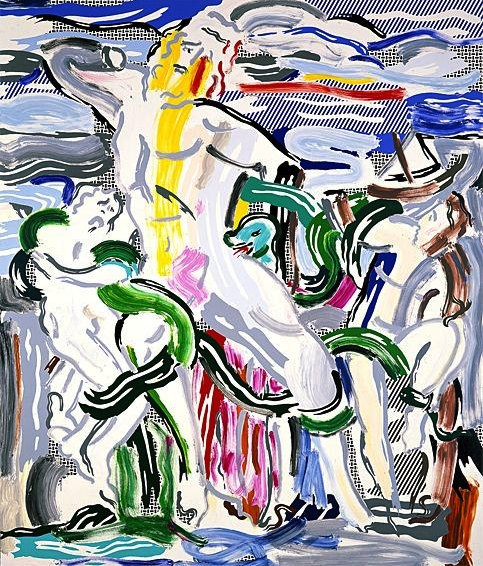
Moreover, the way he treated his non-pulp sources was in many ways similar to the ways in which he treated his pulp sources. For instance, here’s his version of the Laocoon:


I’m not sure that this really comes across in the reproduction, but in the massive original, there’s a stark contrast between the flat moire patterns Lichtenstein uses in the background and the AbExy swoops of paint that define the figures. Lichtenstein also, of course, obscures the characters’ expressions and blurs the narrative action. Some of the energy and pathos of the original are retained, but only in a deadened form. The emotion is presented as thin; a few slashes of paint against a surface that asserts itself precisely as patterned, meaningless surface.

Of course, this is what happens in Lichtenstein’s comics, too. The romance and war panels are lifted out of their narratives. The larger than life emotions end up as merely transparent, flat signs of “larger than life emotions”.


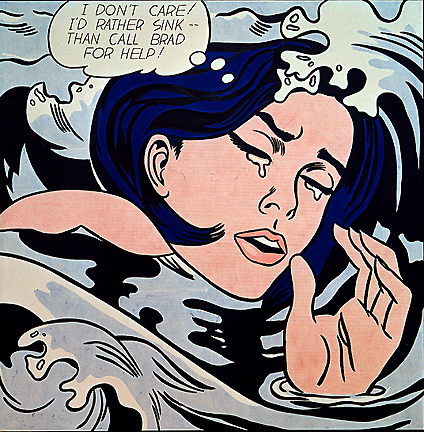
Like Laocoon, the drowning victim here is abstracted from her predicament and inflated; the energy, concentrated and expanded, collapses under its own weight. The panel is just its surface, there is no Brad outside it, and the only thing to do (for good and ill) is to sink.

I think the usual way to read this is as a playful satire of authenticity; a repetition which parodies the original and mocks its melodrama. Often this is seen as a mockery of comics or pulp in particular, but pieces like Lichtenstein’s Laocoon suggest that his target is not so limited. Rather, he seems to be sneering at sincerity and vitality itself — not at melodrama per se, but at emotion. Whether low art romance comics or high art tragedy, both point to depths, and are therefore ridiculous.

I’m sure there’s some truth to that reading…but it’s not necessarily how I see what Lichtenstein’s doing. Rather, at least for me, his work is suffused not so much with contempt as with a kind of etiolated longing. Surely there’s something almost quixotic in those Ben-Day dots; the painstaking hand-crafted effort to replicate the incidental byproduct of mass production. It’s as if Lichtenstein is trying not to ridicule the melodrama, but rather to reclaim it. the replication in this reading is not playful mockery but compulsive failure. He’s trying to frame that originary energy, and is condemned to keep trying and trying until he succeeds, which he never can.

My wife, who is a Lichtenstein skeptic, commented that he’d just had one idea, and it wasn’t all that great an idea, and he’d just kept at it with a numbing regularity. There’s definitely truth to that, and you certainly can see his inability to bottle the energy he alternately/simultaneously mocks and covets as related to his own aesthetic limitations.

You can also see it, though, as part and parcel of the historical moment Lichtenstein was in…and which we’re still in, to a large extent. Late capitalism is not an ideology that cares much about origin myths. Social authority doesn’t come from the divine right of kings, but from the repetitive images of value and community that circulate endlessly without any necessary prototype. Even the Founding Fathers are little more than a subcultural marketing trope at this stage; George Washington is just a cutesy infantilized placemat distributed for fun and profit. Which, not coincindentally, is what Lichtenstein’s version of George Washington crossing the Delaware looks like.


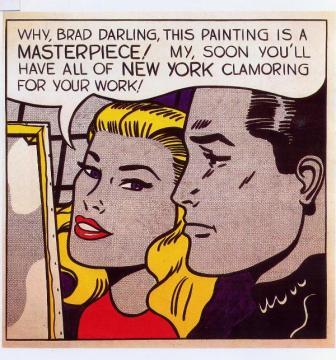
Lichtenstein is obviously a beneficiary and an exploiter of post-modernism…but he also can be seen, perhaps, as a victim of it. Imitation isn’t necessarily flattery, but it almost always has something to do with desire. When he has one of his cartoon women declare , “Why Brad, darling, this painting is a masterpiece!” it may be a sneer at pulp’s idea of high art, but it also seems like a nostalgia for that instantly recognizable work of genius, which that character, and that comic, may believe in, and so perhaps achieve — but which Lichtenstein himself can only wish for.


It’s tempting to see Brad’s sad frowny face as self-portrait; a depiction of that distance and that distress. But of course Lichtenstein is never in his paintings. At best, he’s on the surface.
___________

Folks may also want to check out Kailyn Kent’s recent discussion of Lichtenstein. Scroll down for numerous comments.