I’m not sure but I think I might have forgotten something?
Part III.
Let there be no doubt: DC has treated, and continues to treat, Alan Moore and Dave Gibbons unjustly. They’ve exploited unforeseen changes in the market to violate the spirit, if not the letter, of their contract with the artists. And it should go without saying that Watchmen 2: The Watchmening will be wretched.
Still, again, creators like J.M. Barrie, L. Frank Baum and Lewis Carroll might have been just a little bit unhappy with having their own work turned into hardcore pornography featuring rape, incest, bestiality, miscegenation, self-abuse, sex outside marriage, and vigorous hand-holding.
In theory, this is the penultimate issue of Wonder Woman written by William Marston. in fact, as I’ve mentioned several times already, it seems very possible that many of the stories were being ghosted by this point. As with the last few issues, this is simply not that great.
So rather than belaboring that fact, I thought I’d mention a couple of things here that interested me in light of my recent post about comics and postmodernism. As I noted in that post, comics is built around reproduction of imagery and the reinscription of inaccessible deep time (memory, history, past) as a manipulable surface. I think you could argue that that is the case even in comics like this one from the 40s, suggesting a kind of precocious postmodernism.
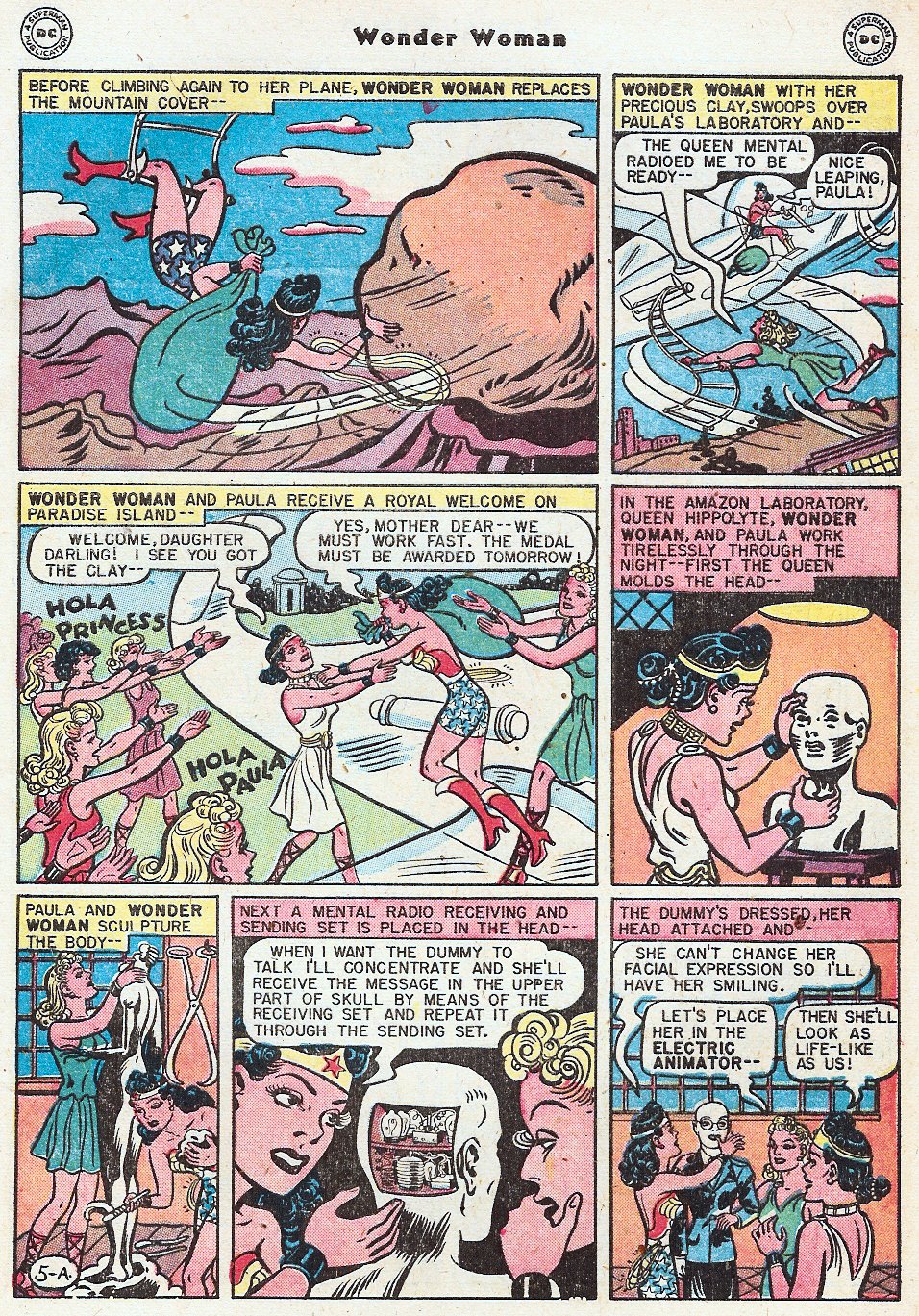
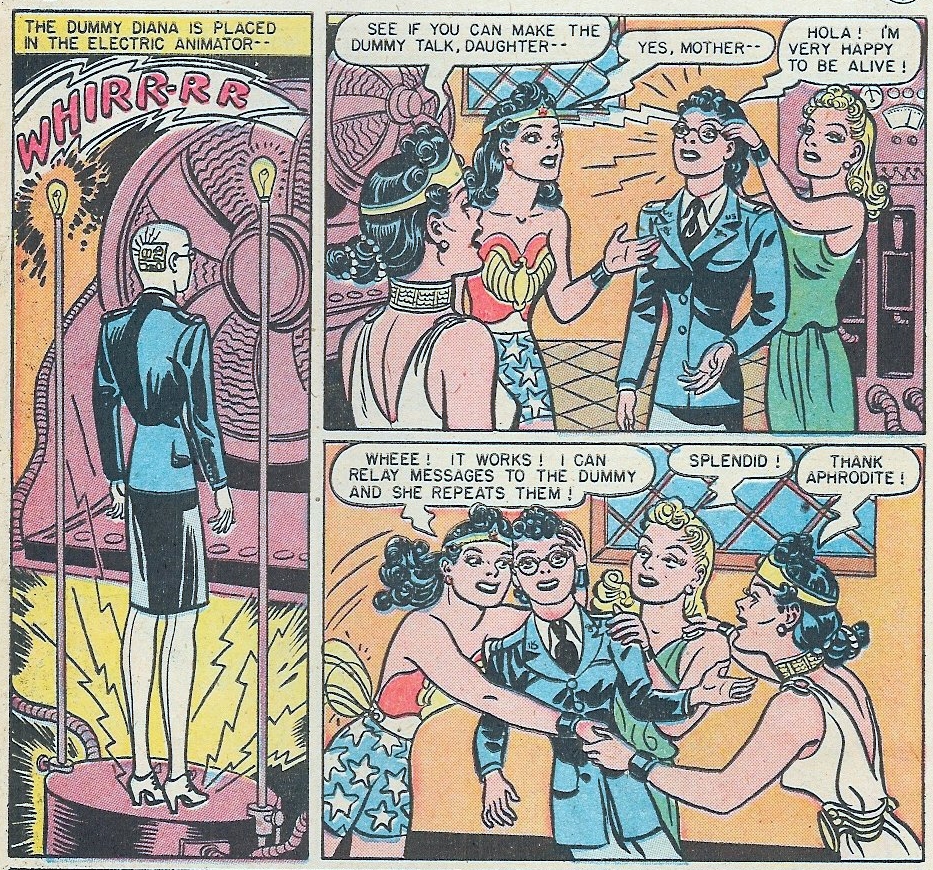
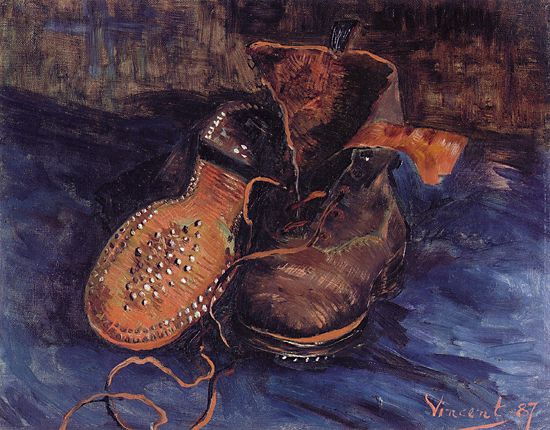
As an example, in the first story in this comic, Diana Prince has been asked to present a medal to Wonder Woman. So WW has to figure out a way for her and Diana, her alter ego, to appear together in the same place. The solution is a technological process involving the extraction of Amazonian clay from a volcano, followed by the molding of a Diana robot/dummy, and the copious deployment of technological gadgetry. In other words, the Amazons use labor, craft, genius, and ingenuity to create a complete, coherent masterpiece — which seems like an essentially modernist solution. The Diana Prince dummy is the pulp narrative equivalent of Van Gogh’s boots).
The nature of the comic, however, pushes against a modernist achievement. The Diana doll not only replicates the real Diana Prince; it replicates itself. The doll is an image, of course, but the image of that image is repeated panel after panel. In the upper right hand panel above, Wonder Woman makes the doll speak “Hola! I’m very happy to be alive!” The doll isn’t alive, it’s only an image of life — but, of course, Wonder Woman isn’t alive either; the speech bubble coming out of her mouth is just as ventriloquized (by Marston, or whoever is speaking as Marston) as the speech bubble coming out of “Diana’s.” The final panel, as Wonder Woman hugs her doppelganger, may in part be the euphoria of a work completed. But it also seems to be the libidinal excitement of the mirror stage, when the child sees and (mentally) embraces its own (false) image. Hippolyta, WW’s mother, of course, looks on proudly as her daughter coos at her own reflection. The celebration is of the self magically and infinitely reproduced, the image reified as product and sent forth into the world to multiply, flowing within and across borders in a delirium of multiplying jouissance.
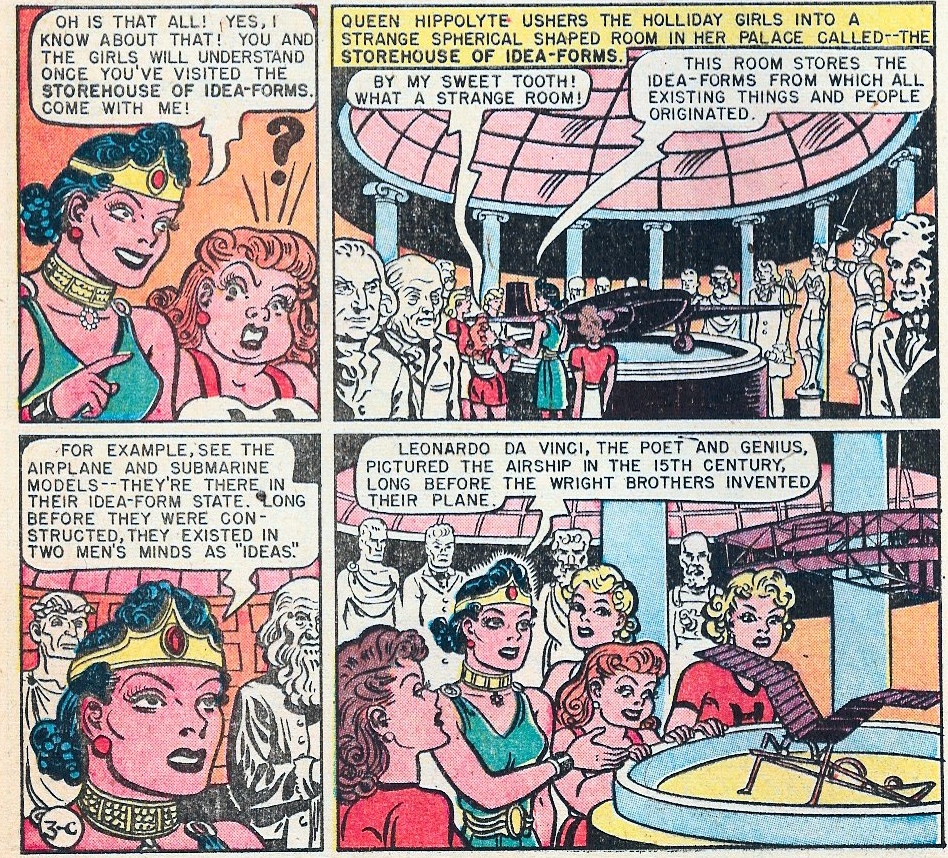
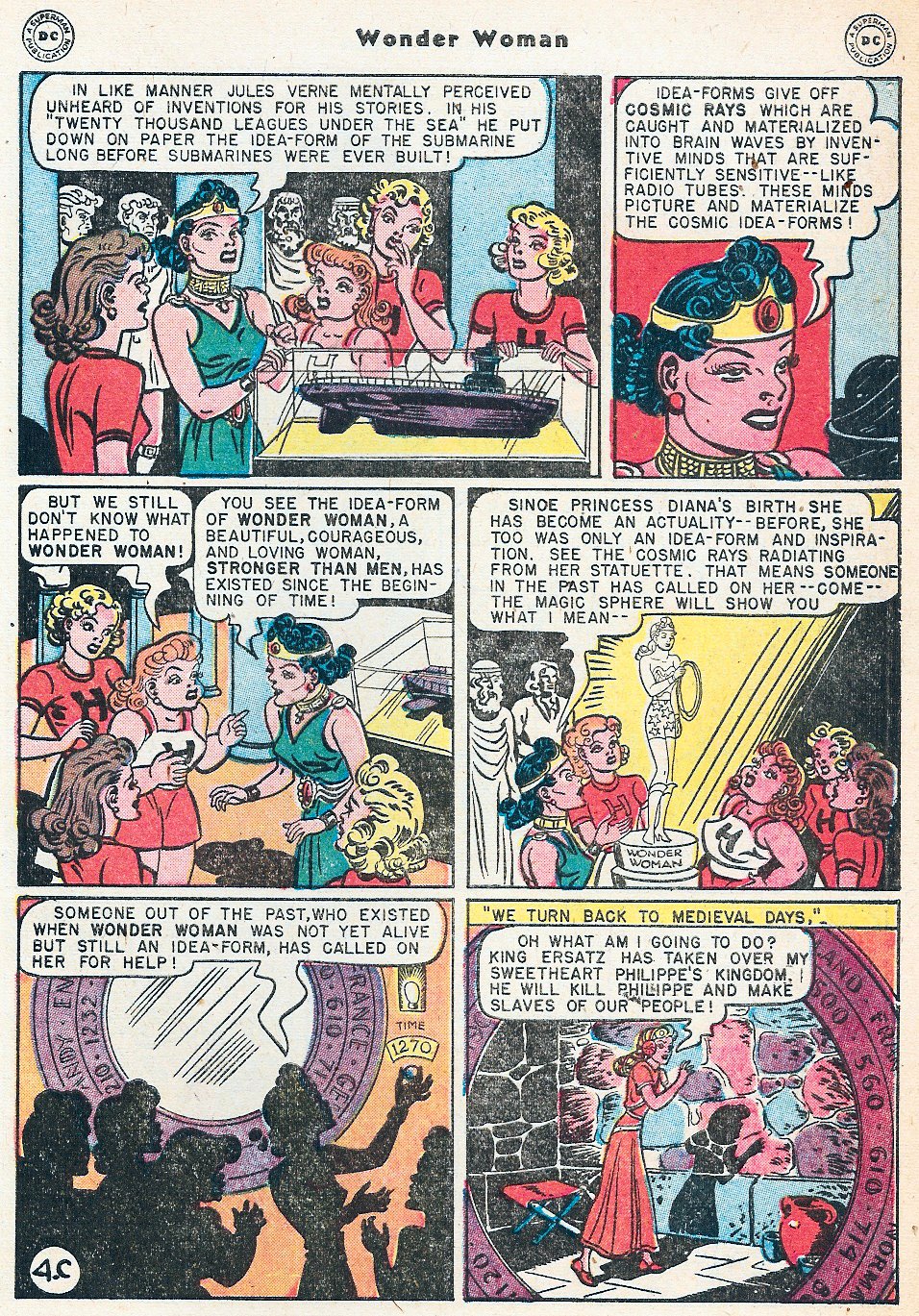
The third story in the volume has an even odder take on creativity and replication. Wonder Woman is flying the Holiday girls to Paradise Island when she is suddenly sucked out of her invisible plane. The girls land the plane, but are understandably concerned. Hippolyta, however, tells them she knows all about WW’s disappearance:
I think Marston must have written this — who else is going to spend panel after panel explicating garbled Platonism? And on he goes:
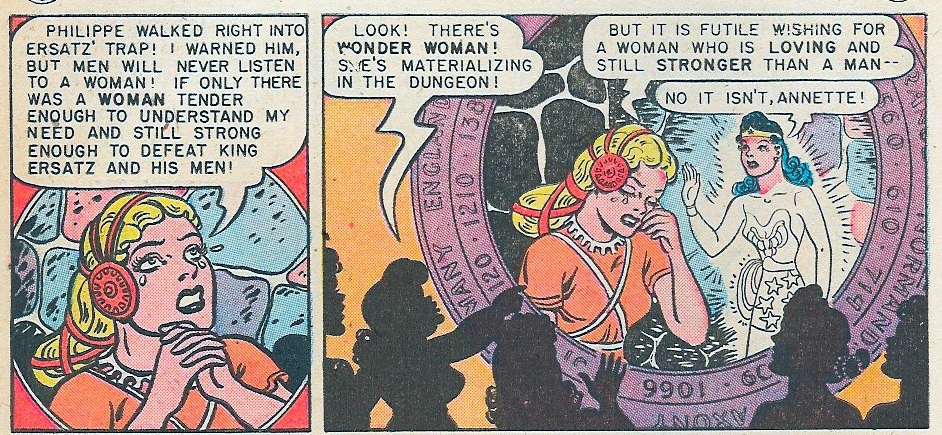
So, according to Marston, idea-forms send out cosmic rays to sensitive minds, reproducing themselves on the brain like film on a screen (Peter’s silhouettes in the bottom right as Hippolyta and the Holiday girls turn to look at the mirror/screen seems suggestive here.)
Plato said we could only see the flickering shadows of reality on the cave wall; Marston has reality beamed into our heads. Idea-forms aren’t the real tragically out of reach; they’re a fecund technology disseminated to all. Wonder Woman herself — a loving woman stronger than men — becomes a kind of viral idea, propagating itself across time and space. More than 70 years after Marston’s death, Alan Moore would create Promethea, an idea of a goddess which inhabits different women at different times. Moore thought Promethea was his own version of Wonder Woman. Based on this story, though it seems like Promethea wasn’t a version of Wonder Woman, but the idea-concept itself. The pomo version of Wonder Woman is simply Wonder Woman.
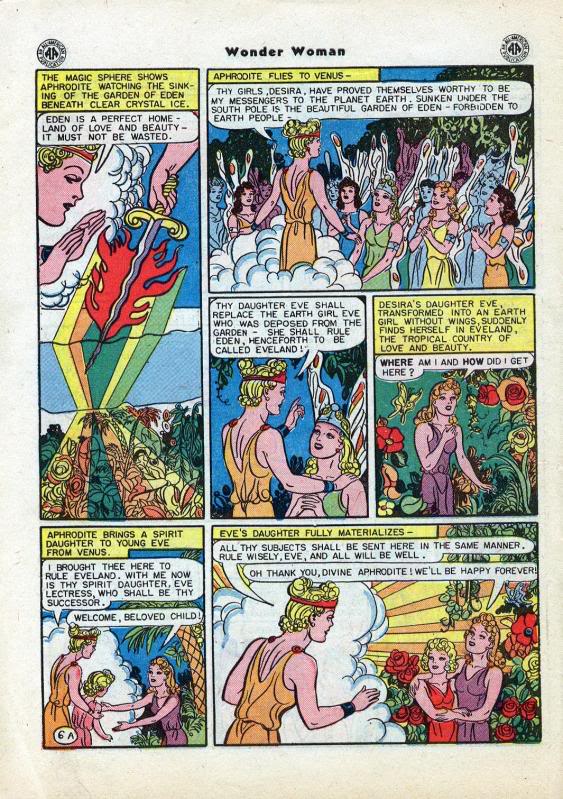
Post-modernism, which turns everything into a fetishized surface, obviously works well with Marston’s own proclivity to fetishize…well, everything. But I also wonder if his early-adoption of post-modernism might have something to do with his queerness — and perhaps his femininity. Certainly, the criticism of post-modernism as surface without depth, as merely decorative, echoes criticisms of female aesthetic endeavors, and indeed of women themselves. When you look at Harry Peter’s art (as in the image from Wonder Woman #13 below), you see pages stuffed with repetitive images of women holding, clasping, and touching each other, a consumable cornucopia of iterated catharsis.
If that also describes our post-modern landscape of bricolage, mash-up and meme, perhaps Luce Irigary should have substituted “postmodernism” for “woman”, and written:
So postmodernism does not have a sex organ? She has at least two of them, but they are not identifiable as ones. Indeed, she has many more. Her sexuality, always at least double, goes even further: it is plural….postmodernism has sex organs more or less everywhere.
Ok, here’s the deal. At Noah’s request I’m publishing here (in blockquotes below) what is largely an unrevised text of a rant I posted on the comixscholars listserv, a rant written as fast as my fingers could type. I would have liked seriously to revise it, but time is, as always, in short supply, and besides Noah says he likes the energy of the original post, so I’ll let it go with just minimal copy-editing and corrections of typos, plus the expansion of a few points I’m not sure were clear enough in the first version.
First, though, I should explain where it came from. When Holy Terror first came out, I didn’t bother to pick it up; no matter how much I’d admired Miller in the past, and how important most of his work from his early run on Daredevil to Batman Year One and Elektra Assassin had been and still is to me, I had been burned too many times since then, especially by the nadir that was The Dark Knight Strikes Again. Nevertheless, I soon found myself in a bookstore, skimming the new book; and though I didn’t purchase it on the spot, it stayed with me, an unscratchable itch to explore it in more depth (it certainly looked better than DKSA—none of those horrid gradients!—or the recent installments of Sin City). I finally gave in, bought it, and meant to review it—but by that time two things had happened: first, consensus had built up online that it was a disastrous career-ender, and hideously paranoid and anti-Muslim to boot; and secondly, Miller posted his notorious blog post fulminating against the Occupy movement, which brought even more contempt rained down upon him. Honestly, at that point I didn’t care about the book so much that I wanted to take the plunge into these muddy waters, and to brave the comment-shitstorm that would have been sure to ensue.
So I decided not to review: yet, even after that decision, I found myself turning back to Holy Terror, and in a strange way my fascination with it grew. And then—and then, two more things happened. A strangely belated discussion about it started a couple of weeks ago on the said comixscholars listserv; and Ken Parille posted a review of the book on the Comics Journal website. Ken’s post was the first I had seen that had something both positive and articulate to say about it (though in the end I didn’t quite agree with him), and that managed to see past its (perceived or real) paranoia and xenophobia to address the substance and artistic achievement of the book itself.
When the thread on comixscholars-l started, I first dipped a toe in with the following remark, appended to a commentary on its supposed “Orientalism” (a question to which I return below):
“Holy Terror” … is an utter mess (and politically abominable, I hasten to add, to shore up my bien-pensant credentials) but in a way kind of a fascinating one. I keep meaning to write about it somewhere.
Ken then chimed in to say he agreed with me, and linked to his TCJ review. However, while I had called it “an utter mess” he discussed it there in terms that made it seem much more conventionally successful: “It’s a fascinating hard-boiled love story, an attractively designed romance set against the backdrop of a post-9/11 America in which love is a disease… Holy Terror’s artistry triumphs over its political will.” He also ended up giving it an A—higher than Habibi, Carnet de Voyage, and Asterios Polyp (relative judgments with which, I should add, I don’t disagree). When the discrepancy between his and my verdicts was pointed out, he explained that he found it a mess ideologically, but successful artistically. This was the immediate cause for my rant, which, none too soon, follows (images added for the sake of clarification):
Now I’m wondering if we read the same book… :) As I said, I do find it fascinating–and I’ll get to that in a second–but it is a mess far beyond just its ideological message. To begin with, the plotting is so rudimentary as not even to deserve to be termed “plotting.” Notice how the book is divided exactly in half, presumably originally for publication in two installments, but also corresponding to the two periods in which Miller is supposed to have worked on it, and easily distinguishable from each other by the utterly different inking treatment (first half, splashy; second half, mostly linework and large areas of solid black). So. First half: Not-Batman chases Not-Catwoman across the rooftops of Not-Gotham City. They fight. They have sex. Bomb explodes. Nail ends up in Not-Catwoman’s leg. It hurts. It really hurts. It really REALLY hurts. We hear about it for pages on end. Flashback to suicide bomber. Same bomb explodes again–NAILS! The city lies in ruins. Not-B and Not-C swear revenge. As does Not-Commissioner Gordon. [Note: I borrowed the “Not-Batman” and “Not-Catwoman” coinage from other reviews I had seen across the web. Indeed, soon after writing the original rant, I googled the two terms, and found a review that contained a sentence extremely close to the one right before this note, including the term “Not-Gotham.” I honestly don’t think I had read that review previously, and maybe it was just a case of serendipity, but I may also have indeed read it, and forgotten all but that one phrase that remained stuck somewhere in the back of my mind. To the writer of said review: apologies for my unintentional borrowing.]
Second half (interspersed with montages of terrorists and various US and international political and public figures): Not-B and Not-C (who has quickly gotten over her wound–and, by the way, may I ask why she’s supposed to be wearing Christian Louboutin sneakers?) swing over the rooftops.
They kill some bad guys, capture one and torture him… He talks and then they blow him up. Meanwhile a Muslim woman is being stoned and Americans are watching “Transformers.” More bombs–Not-Statue of Liberty is blown up. Ex-Mossad agent, whom we know is Israeli because he has the Star of David tattooed on his face (always a good choice, tattooing your country’s flag on your face when you’re trying to be a spy) tells them about the Not-Gotham City mosque, center of terrorism. Bizarre undeveloped subplot about Not-B falling in love with Not-C. Generic Muslim man beating up his wife. Not-C goes into the mosque. Is captured and taken to the leader of the terrorists who turns out to be, umm, Irish? They want to kill her, Not-B swings in and blows their heads off, big scary bomb explodes but somehow they manage to get out. Six weeks later: Not-Commissioner Gordon is shivering in his bed. “No wonder we call it terror.” The end.
There is no narrative arc, no suspense, no attempt to develop the characters beyond the purely convenient labels of their names. All of these things Miller would have been able to do quite masterfully back in the Daredevil or DKR days, but by now any hints in such directions have become nothing but narrative tics, empty gestures. Maybe Batman telling Catwoman that he is falling in love with her might have meant something–a tiny tiny something–if those had been the actual characters speaking, with decades of history behind them, but replacing them with Not-Batman and Not-Catwoman, simple place-holders undeveloped in any way beyond simply being not-the-characters they had started off as being, reveals how whatever romantic punch this narrative element was supposed to carry would have been totally unearned, as it relied *entirely* on the readers’ previous knowledge of the characters. Same goes for Not-B’s constant reference to “my city.” If this had been Batman speaking, ok, it might have resonated with Miller’s earlier work–but since it’s not, it again reveals Miller’s reliance upon shorthand and the readers’ previous emotional cathexes, and it comes off as–I don’t know how to put it exactly, but not plotting, simply the emotional exploitation of stereotypes stored in fans’ psyches.
Then there are all the narrative tricks which, once again, seem like foggy reminiscences of when Miller knew how to tell a story: the thought-captions in the first section come directly from DKR, but, again, seem blank, just storytelling tics that carry none of the psychological weight that they carried two and a half decades ago…
So, what do we have instead? Things happen, done by blank characters who are brought on stage for the sole purpose of enacting a revenge fantasy. For that reason, I suppose, they need have no more personality than figures in a masturbatory, erotic fantasy need have one. The plot again (shorter version): Terrorists do bad things to us. We kill them. The end.
That’s also why, I should add, I was saying there is little actual “Orientalism” in there: the bad guys are as much blank placeholders as the good guys. There is none of the Orientalist texture of, say, “300.” Everything is just… empty.
Further issues with the storytelling? How about the strange crosscutting, in the second half, between Not-B and Not-C’s doings, and the montages of characters from Bush and Cheney to Obama? Is this happening in one night or over a decade? I suppose a sympathetic reading might make one of those strands extra-diegetical, as if the book reflects both the time of its story (one night) and the time of its making (ten years)–but, if so, I don’t particularly see that as intentional on Miller’s part.[Note: on second thought, maybe it is, or maybe the book itself knows, and says, things more clearly than its author might.]
Ok, the positive (not yet the fascinating): yes, there is all the narrative energy in the first half, a mastery of dynamic art, etc.–everything that Ken pointed out–but, while not as bleached out as the narrative tics I was talking about, it still reads like Miller on auto-pilot. All the splashed ink and white-out in the first half seem like an attempt to go in the direction of more “artsy,” painterly artists such as Sienkiewicz or McKean, and it’s fine, well-done, but again, to me not earth-shattering in any way.
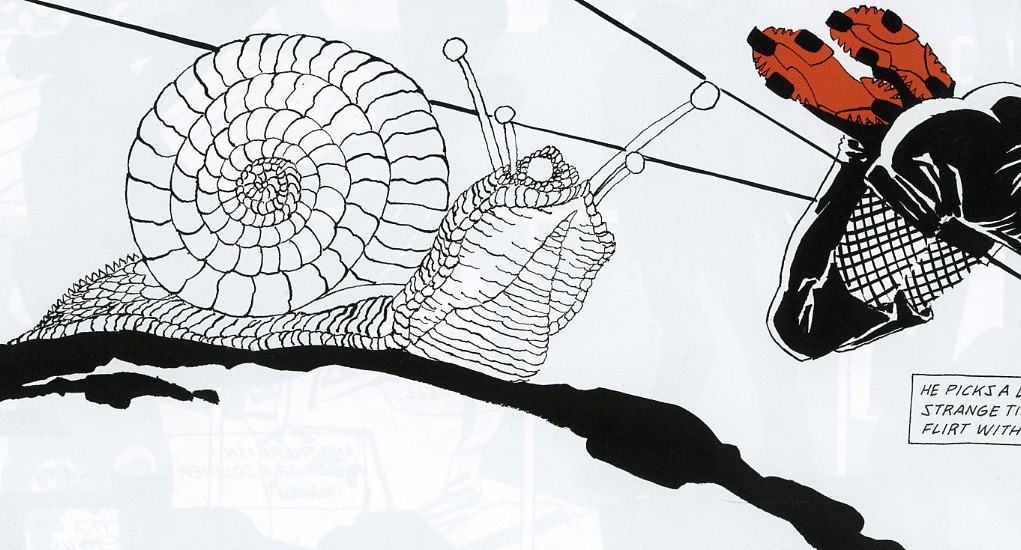
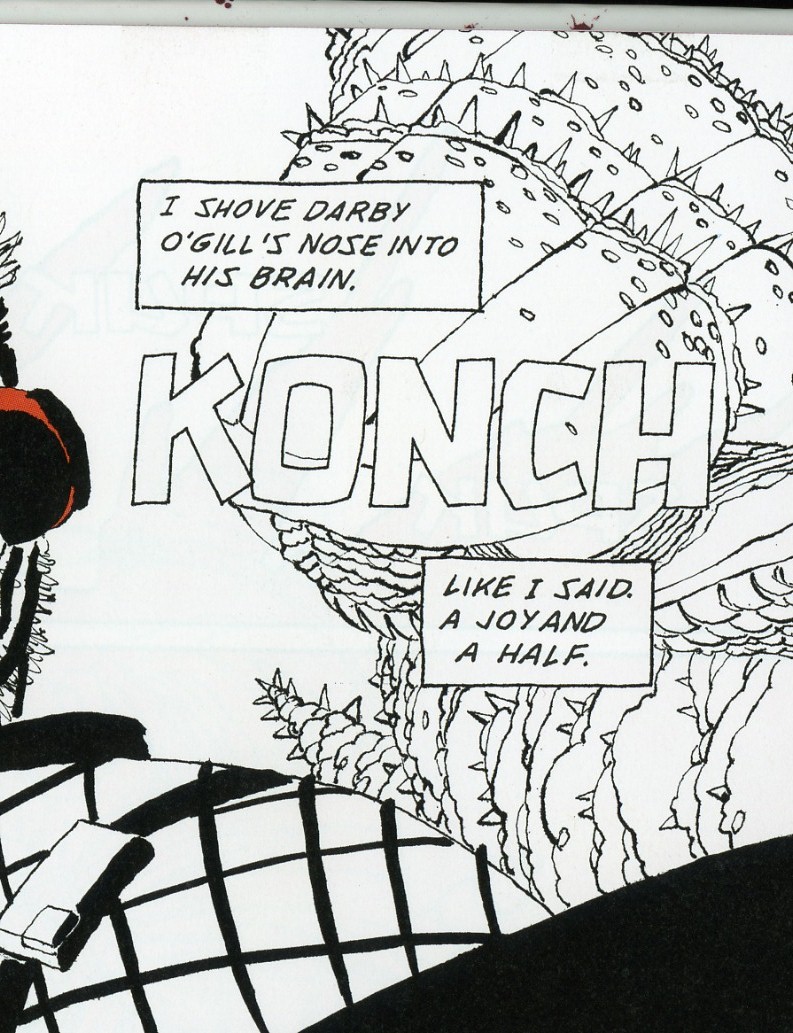
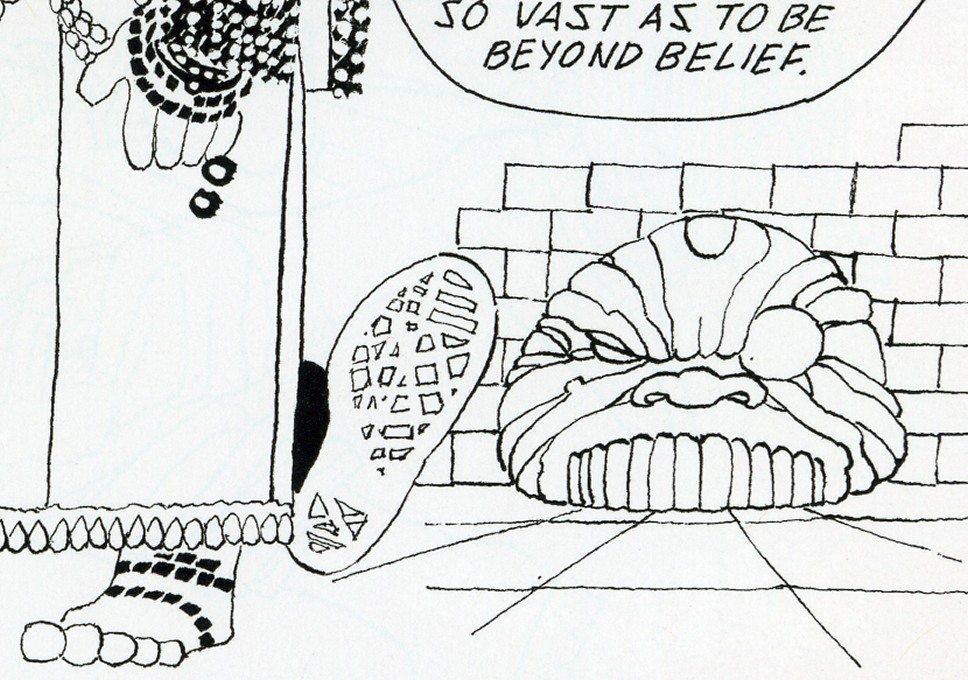
I actually like the second half much better, which does away with such painterly tricks (and which has been criticized, as a consequence, as Miller forgetting how to draw or not giving a damn anymore). And here we are getting to the fascinating part–because, well–there’s that snail. Huh? In the panel of Not-C deciding to go into the mosque, there is a beautifully drawn, purely built out of uninflected lines, snail–a giant snail, obviously, given the perspective of the drawing:
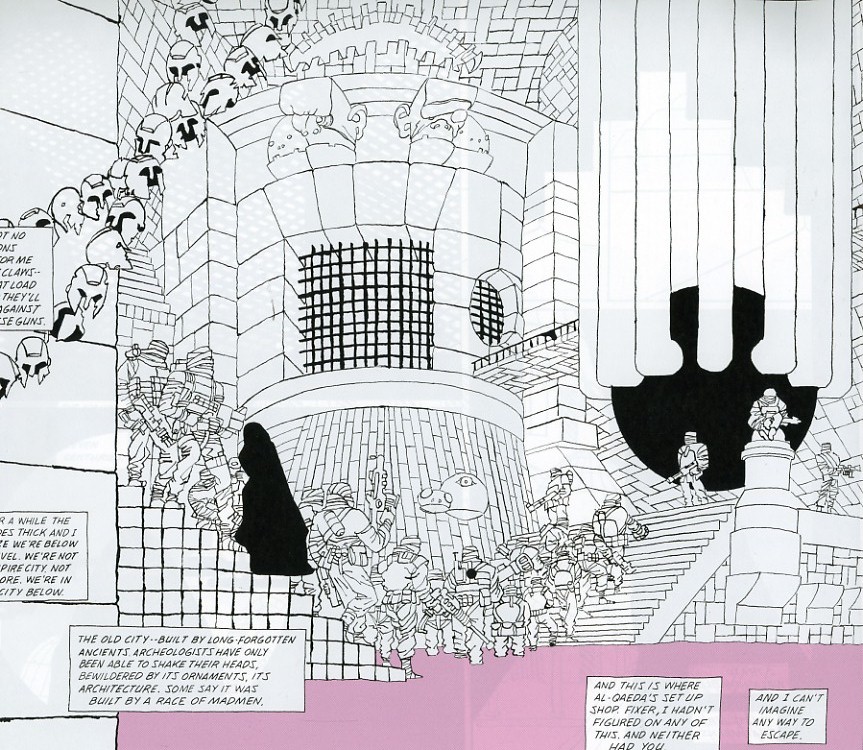
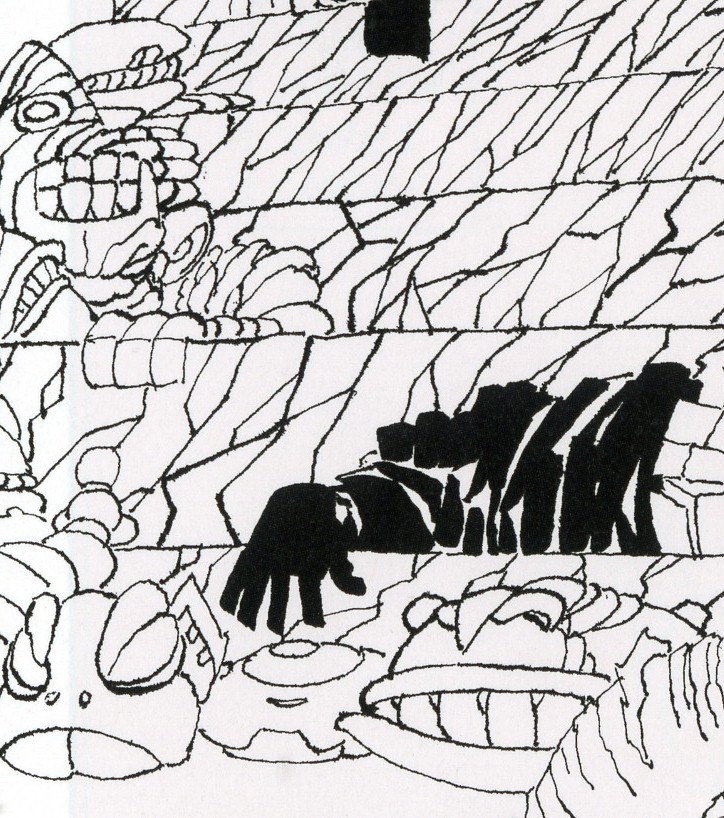
It is in no way given a narrative reason for being there. It just is. At this point, Miller enters a mode of strange narrative excess, going well beyond the requirements of the story–and he continues with it, the snail is not just a one-off. Look at the large, almost page-sized panel of the tower-like structure underground:
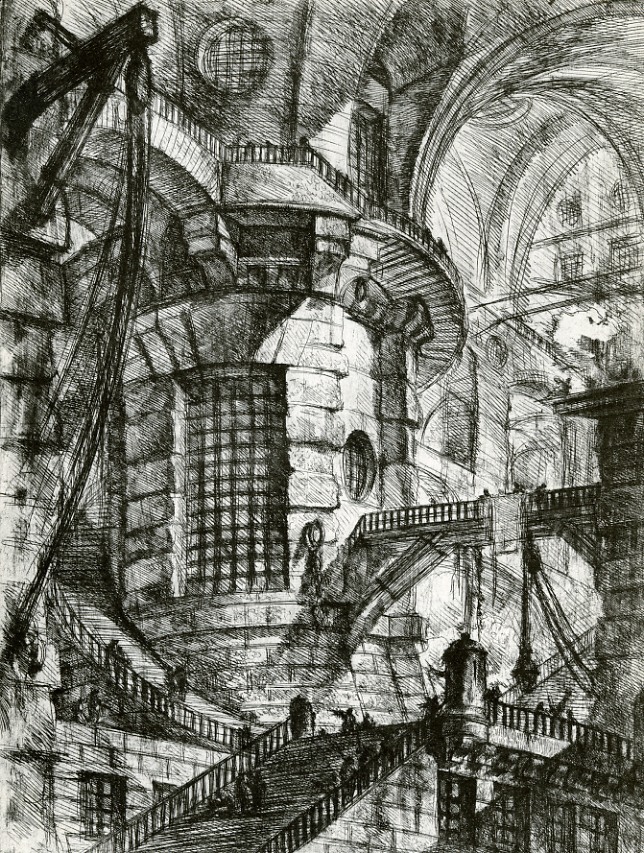
First of all, it’s important to realize it’s a swipe–from one of Piranesi’s “Carceri” (Miller at least gets points for creativity in swiping)–specifically this one:
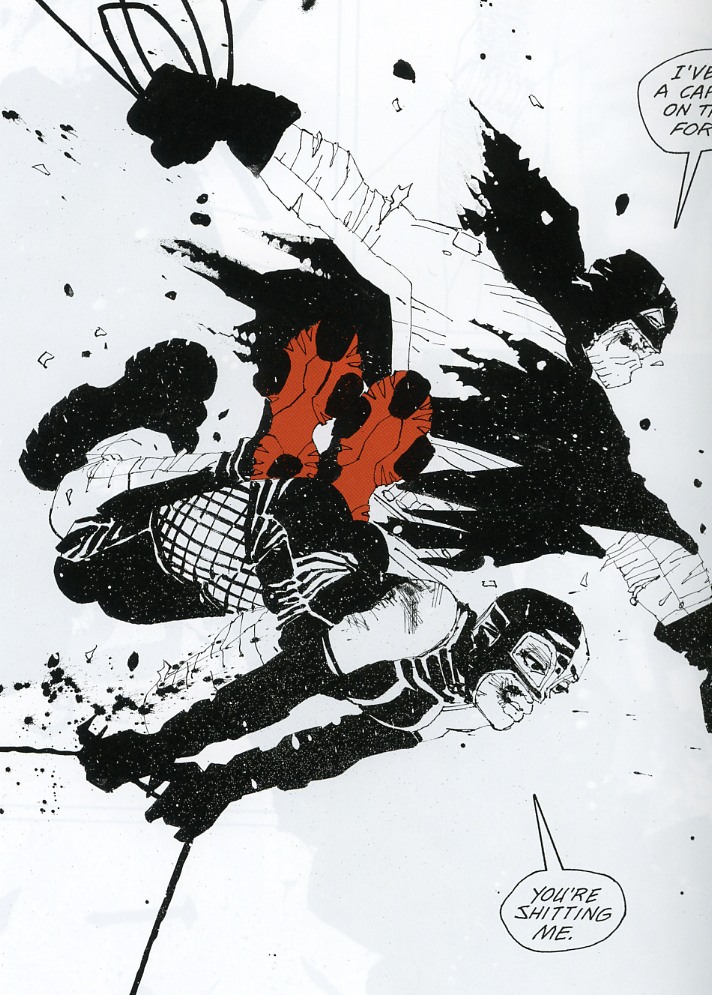
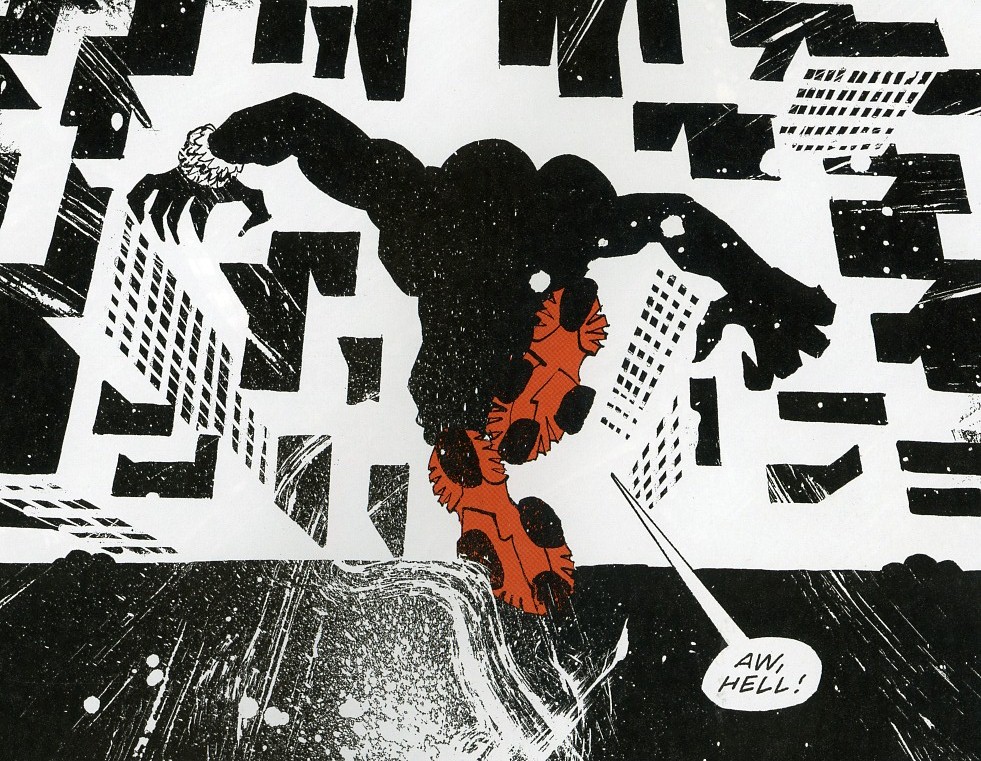
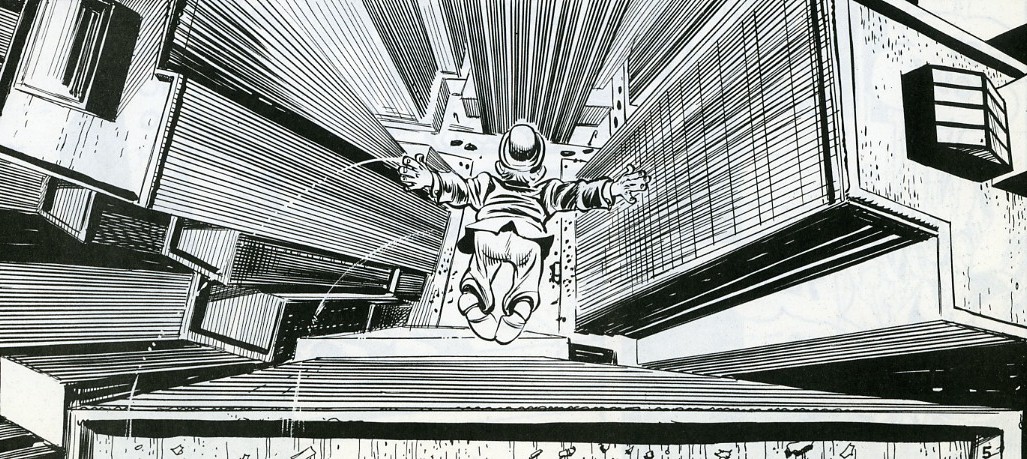
Now, interestingly, this is not the first time that Piranesi has been swiped in comics recently–see the cover of the Act-I-Vate primer–but this is a much more, shall we call it, original kind of swiping. It’s also a much more interesting swiping than the one he practices in the first half of the book, where this panel of Not-C leaping off a building:
is clearly intended to evoke this famous image from “The Story of Gerhard Shnobble,” by Miller’s hero, Will Eisner:
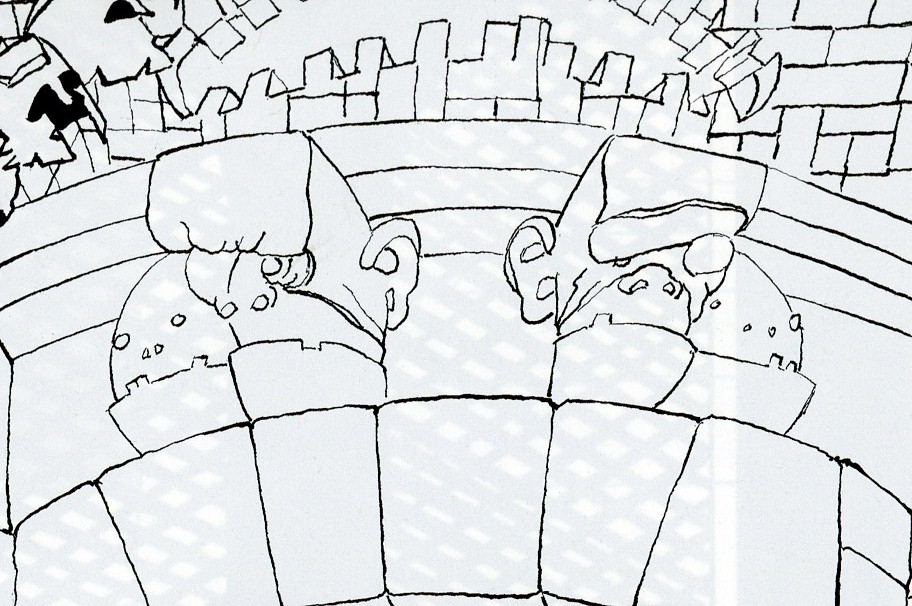
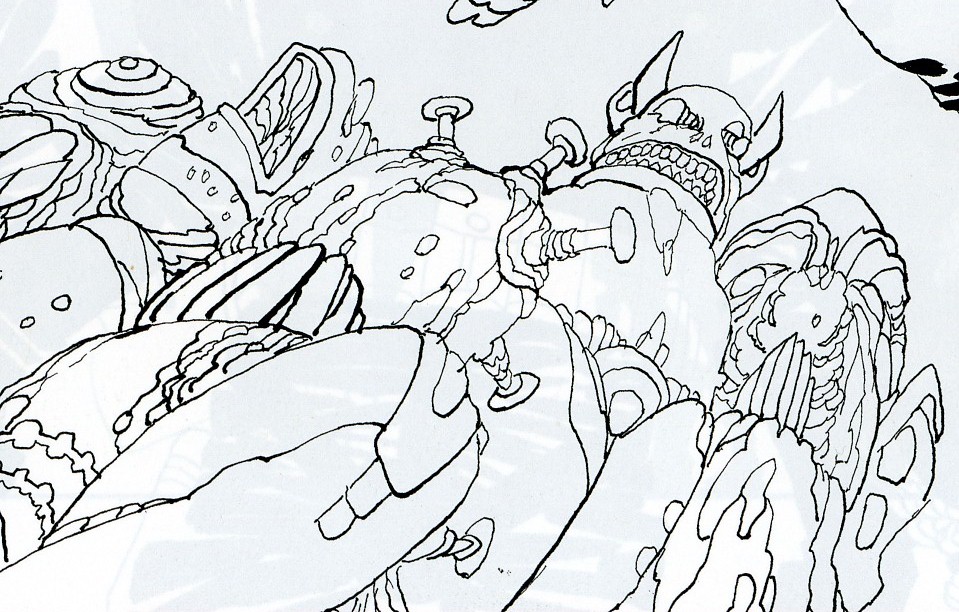
The swipe from Eisner is clear fan-service, intended to give the thrill of recognition to the literate comics reader, and to help Miller claim for himself, one more time, Eisner’s mantle. I don’t think any such kind of knowing reference and recognition is intended with the Piranesi borrowing—it is not an homage, but neither is it done out of laziness or for simple convenience. The image is transformed, worked over too much for that to be the case. Look at the brackets holding up the tower’s cornice: In Miller, they have been replaced by symmetrical pairs of faces–one Gahan Wilson-like, the other best described as Humpty-Dumpty-as-dying-Vader:
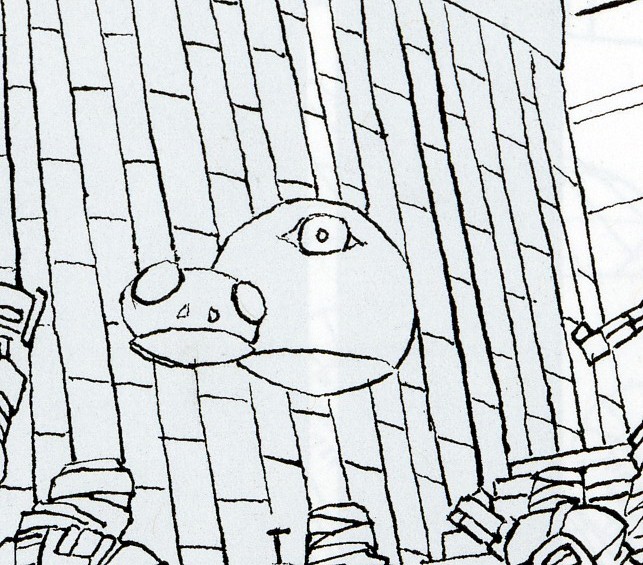
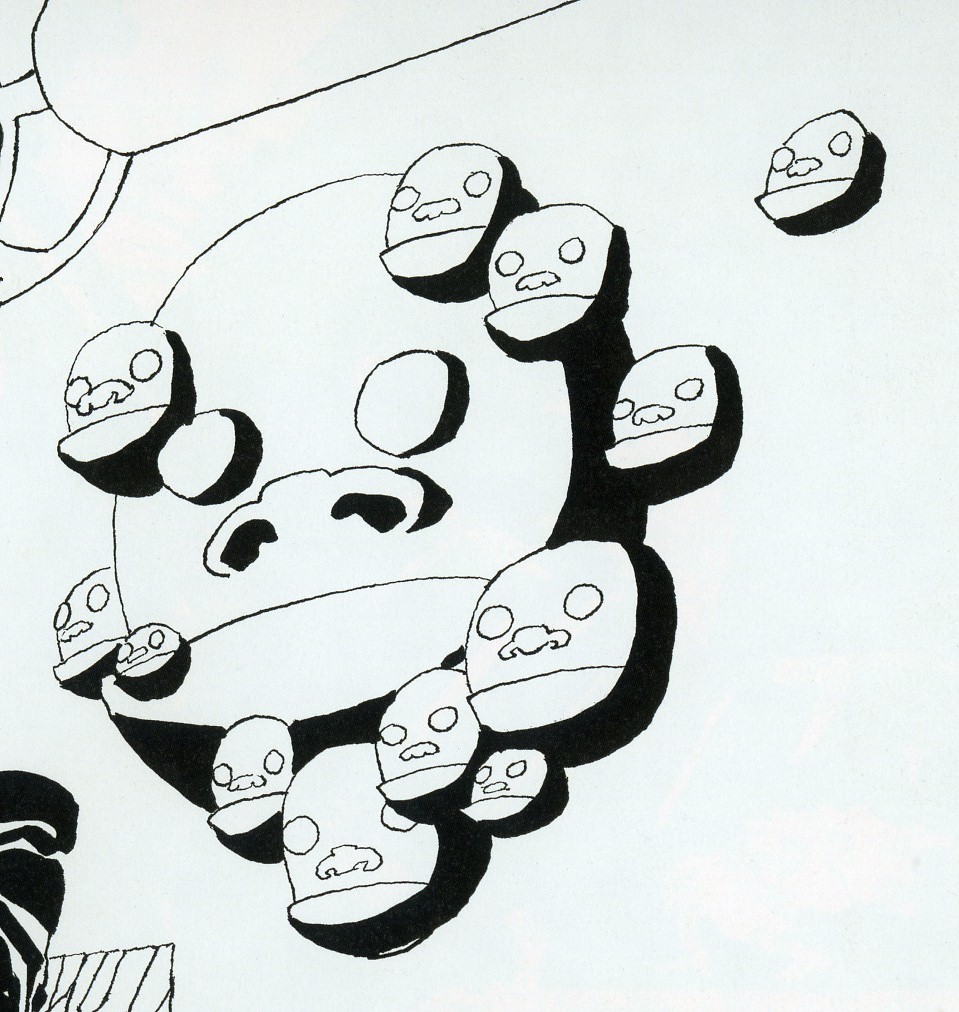
Again, what??? Then there are the strange ovoid faces toward the bottom of the tower:
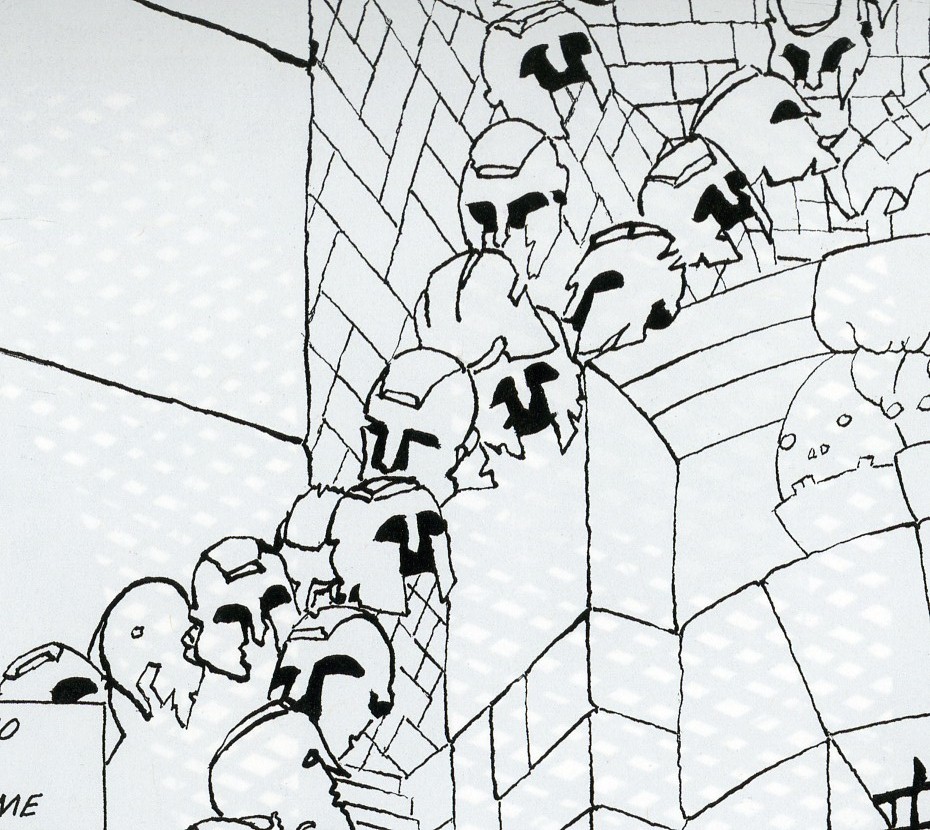
and the double garland of Spartan helmets festooned across the upper left corner of the panel:
Miller makes a gesture toward explanation in a caption (“The old city–built by long forgotten ancients. Archaeologists have only been able to shake their heads, bewildered by its ornaments. Some say it was built by a race of madmen”)–and, if in the context of the book, that seems like just a convenient excuse to doodle whatever he feels like in the images, it’s also strangely self-referential: yes, we too can only shake our heads, bewildered by the book’s ornaments which are completely unrelated to the book’s overt message. “A race of madmen”–and we almost feel that Miller’s gone nuts.
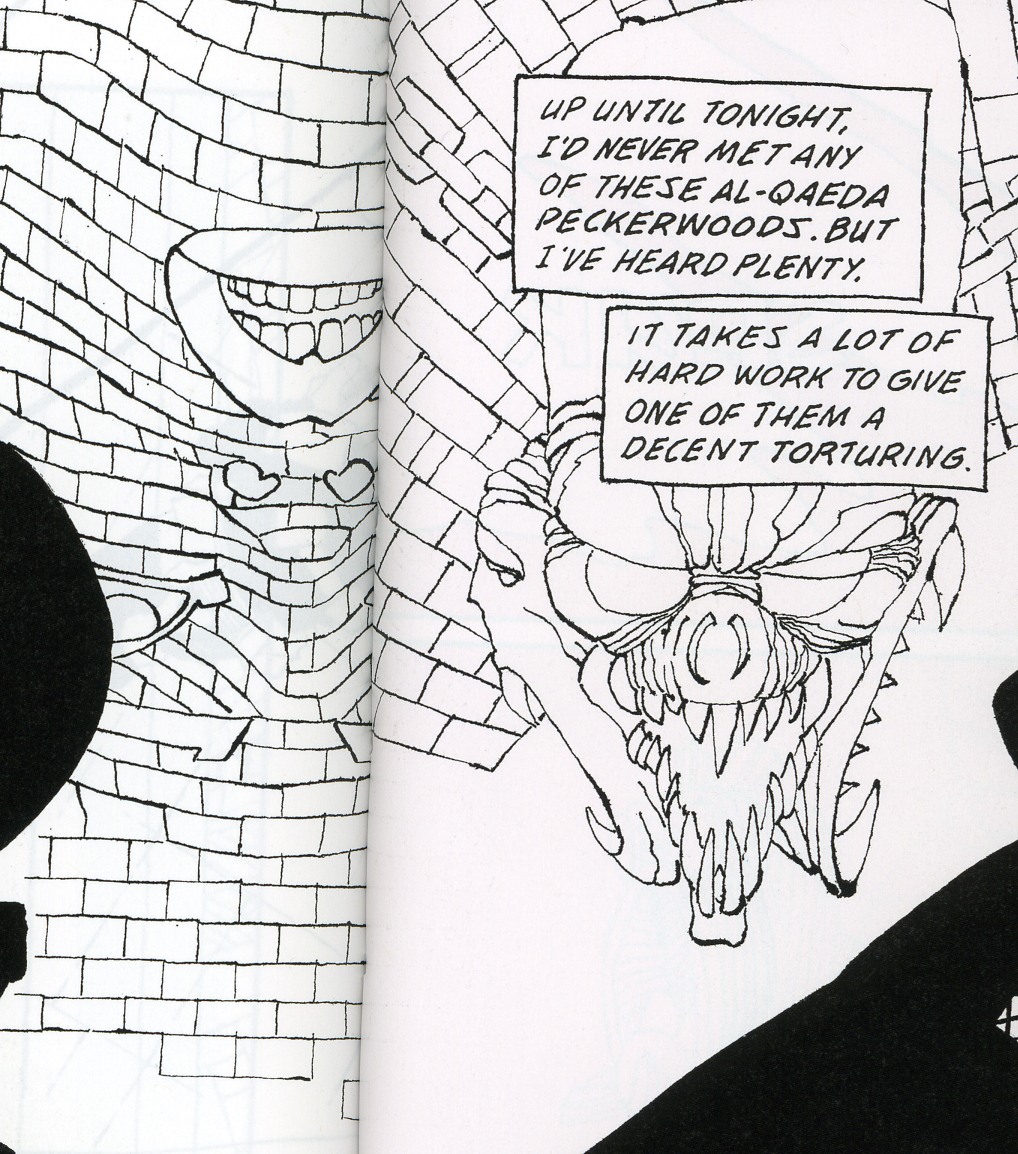
Then–then there are the strange Cheshire cat grins on the brick walls:
the gargoyles and dinosaurs sticking their heads out:
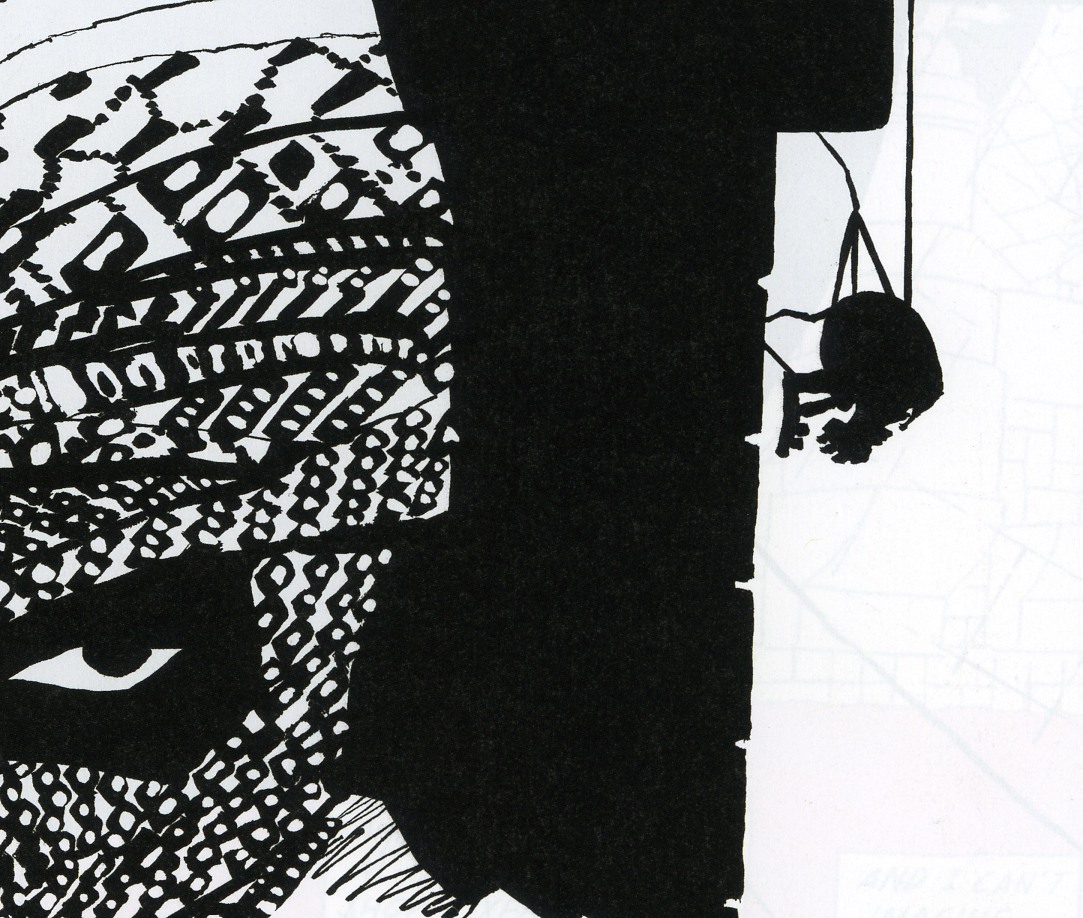
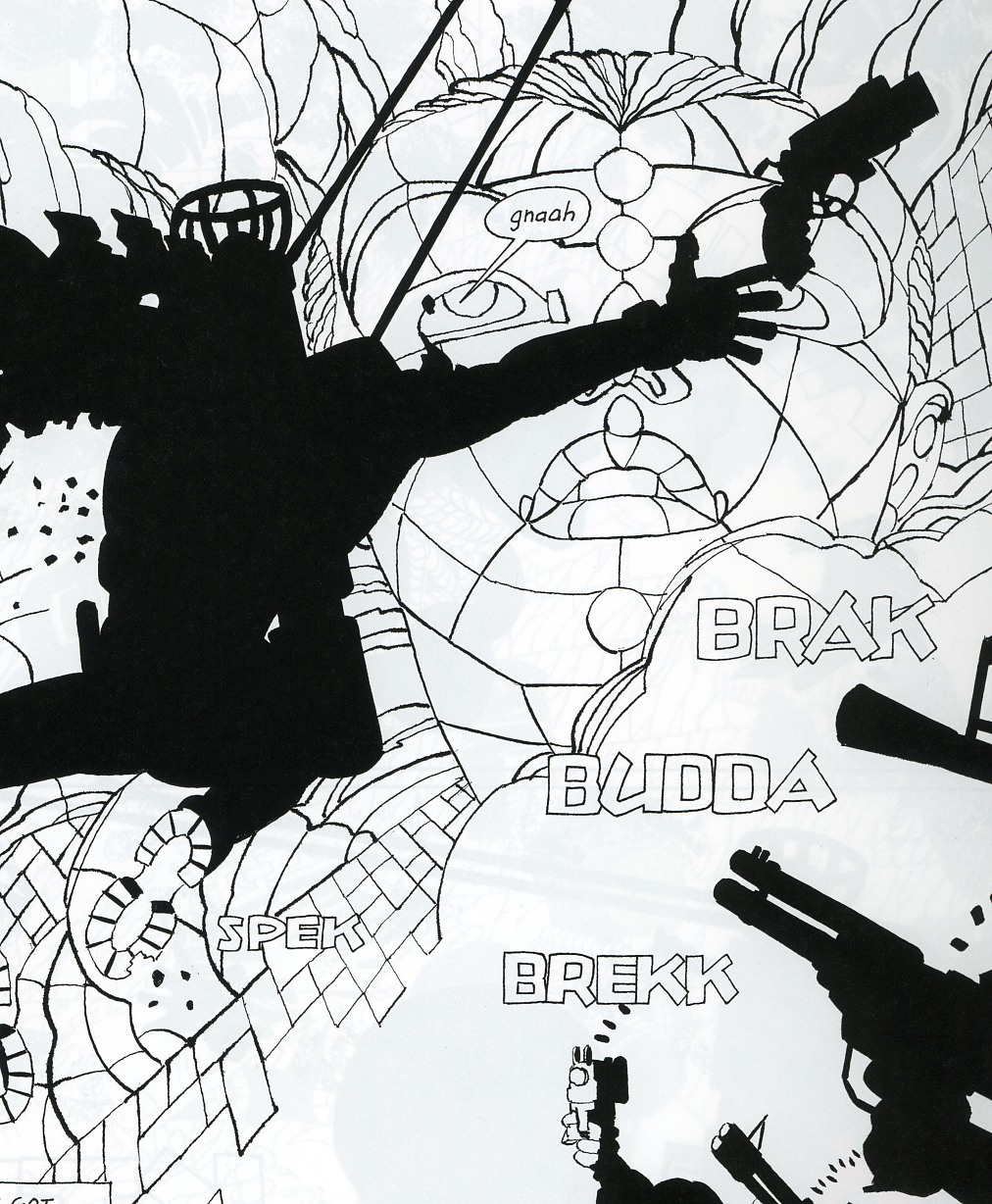
the strange silhouetted ball-with–feet-and-hands rappelling down the wall behind one of the terrorists:
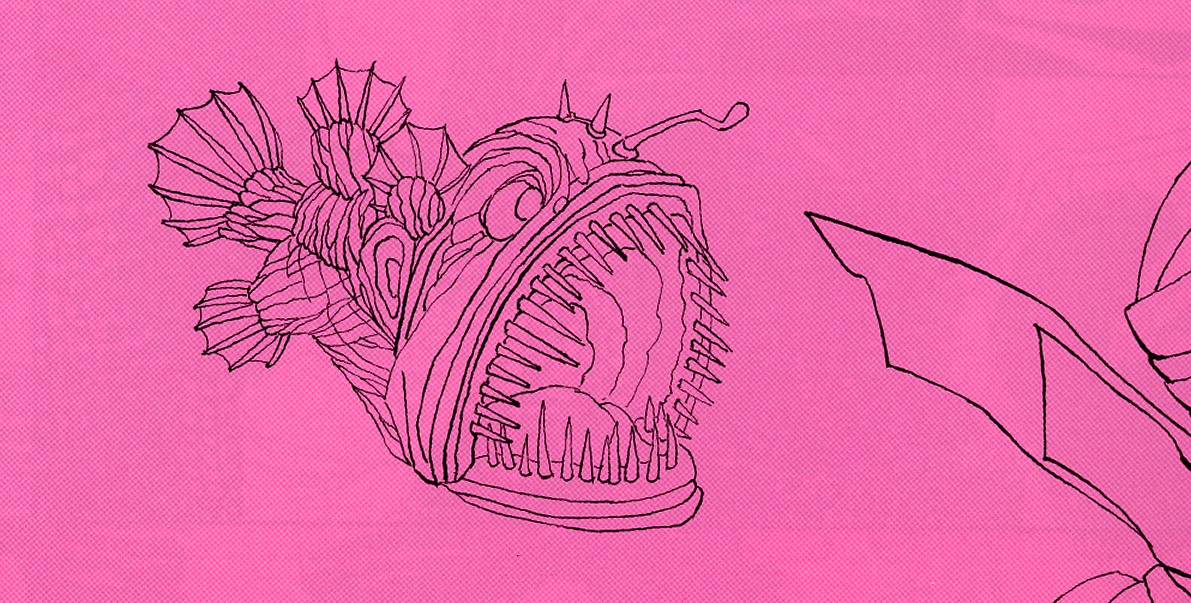
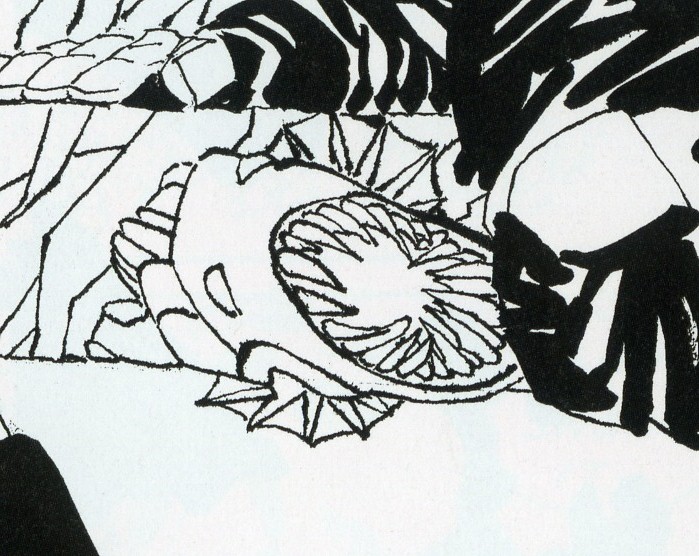
There’s the deep-ocean angler fish in the few feet of water into which Not-C jumps:
There’s the monocled Erich-von-Stroheim-in-The-Grand-Illusion half-face on the ground, behind the short veiled “highly-verbal” Persian-looking guy:
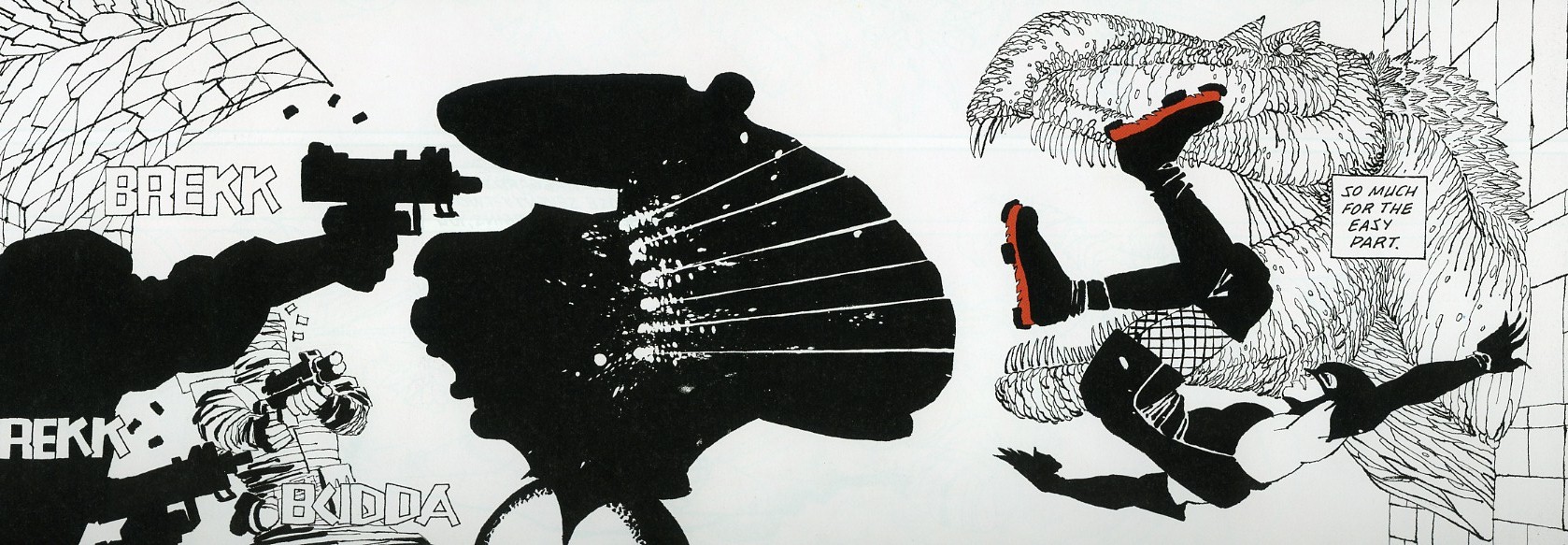
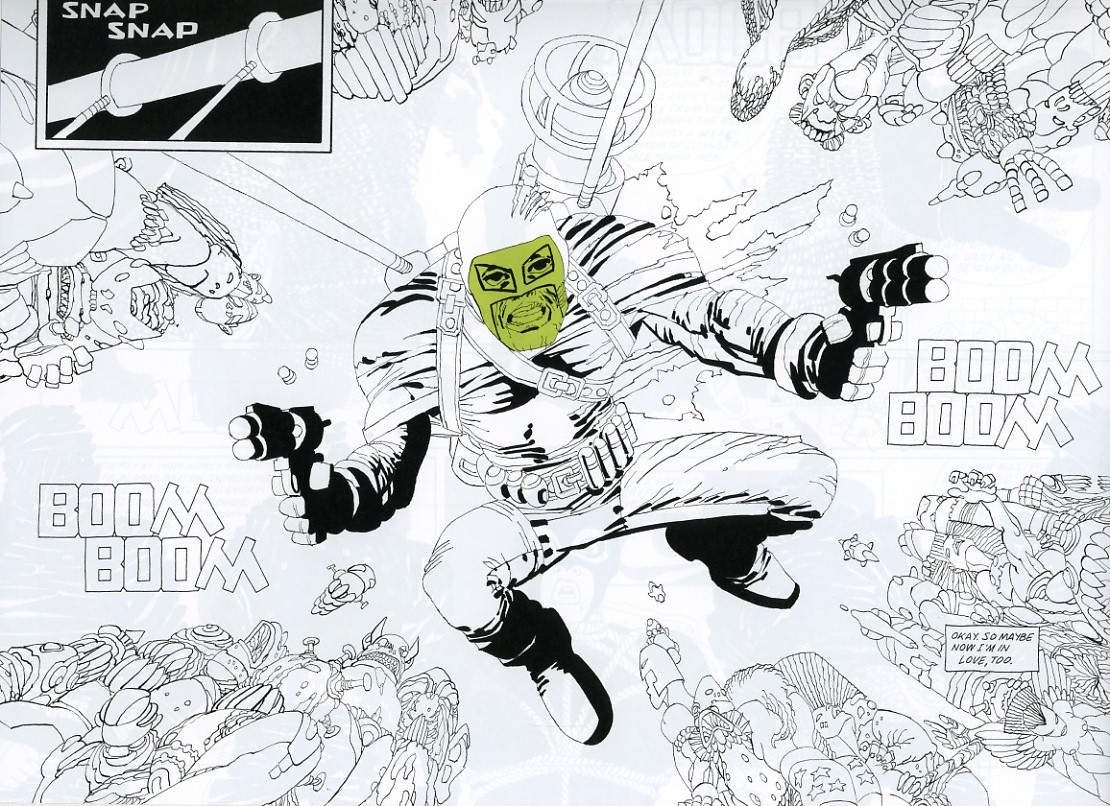
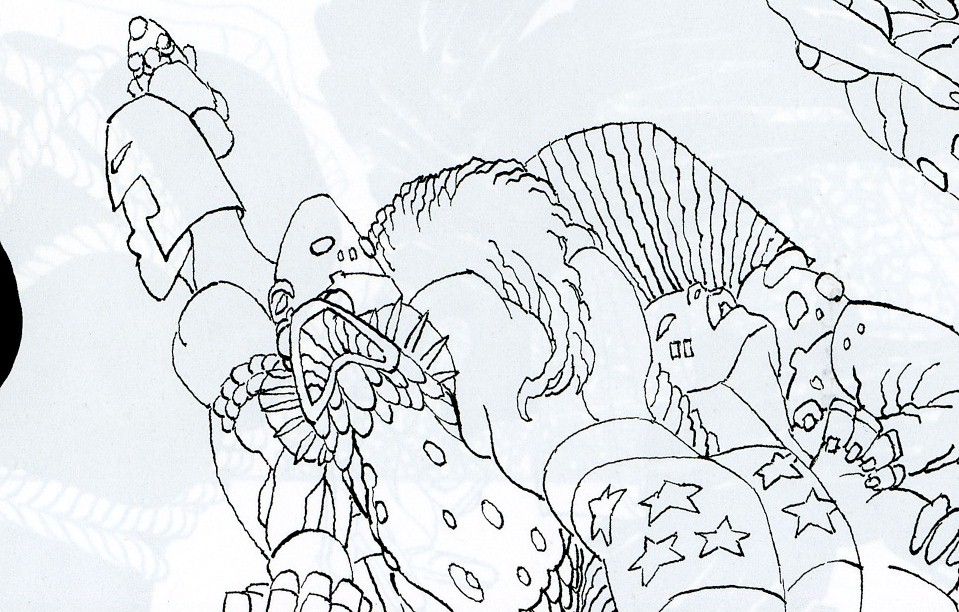
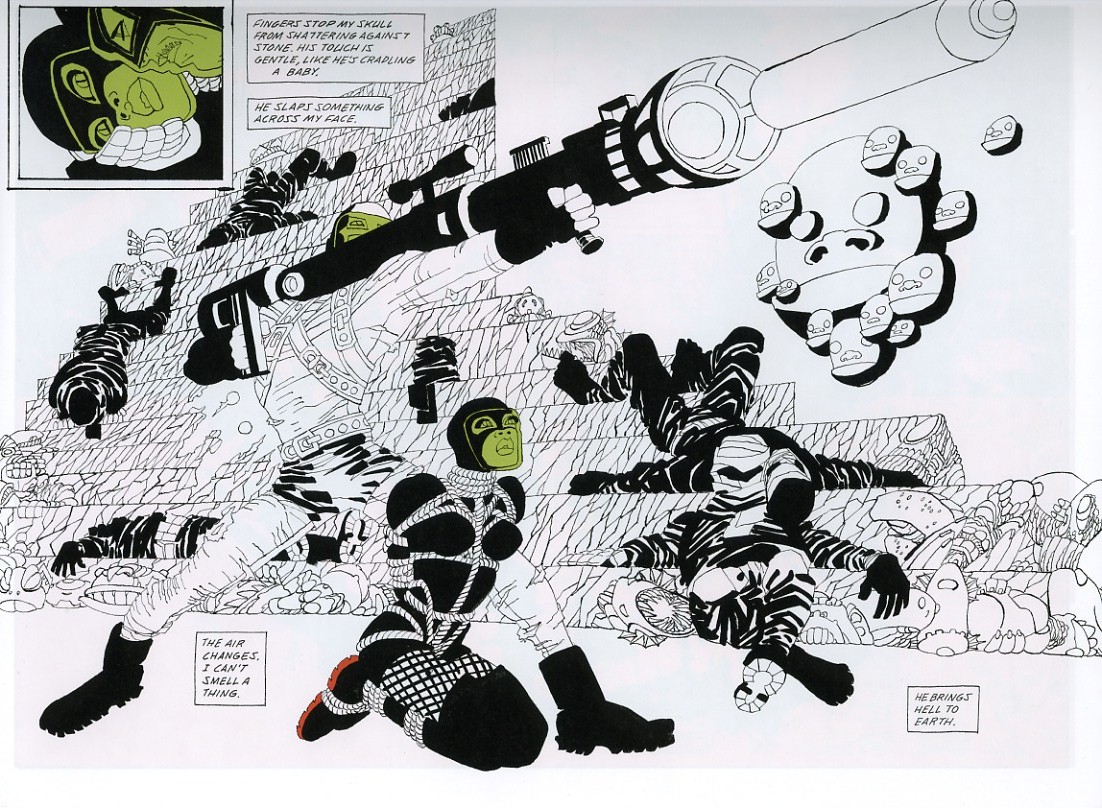
There are the Pop accumulations of figures, including a woman, from the back, in star-spangled hotpants and some kind of viking-monster, in the panel where Not-B leaps in:
There is the monumental statue of Buddha (recalling Bamiyam? But again, why? If the Taliban blew it up there, why would Al Qaeda live with it here?) behind a sound effect of–har har–“Budda”:
There are all those accumulated faces and grins behind Not-B when he fires his bazooka thing:
… and so on.
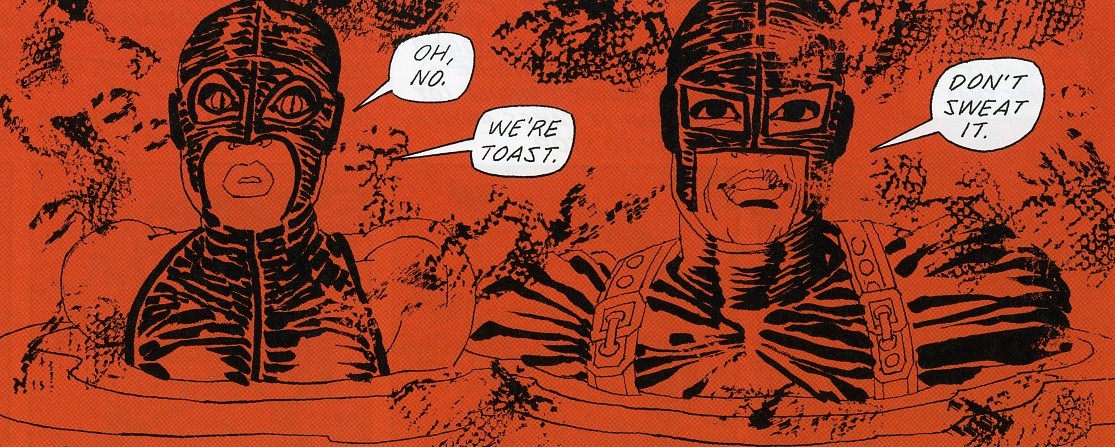
There is, overall, a strange, unsettling kind of image excess over the requirements of the story. It’s as if Miller couldn’t stay faithful to his ideological convictions, or even his hatred of terrorists, and began doodling. Is it some kind of Baroque horror vacui, or–more appropriately, perhaps–some kind of outsider art horror vacui? At times, and mutatis mutandis, it almost reminds me of Rory Hayes. I like how at this point Miller’s mastery fails: the slick paintwork of the first half gives way to the red-background two-panel of Not-B and Not-C waiting for the bomb to explode, that looks so awkward, almost untaught, as to completely negate the slickness of the first half:
It’s a mad, bizarre book. I had hated Dark Knight Strikes Back, thinking Miller had gone crazy, but now I realize it’s just that he had not gone crazy enough. I have no idea where he can go next–but there is a strange breakthrough here (maybe with no exit, with nowhere to go) that is more interesting than any other comic I’ve read this year, and hinting at a kind of artistic madness that most artcomics can only aim toward, but not quite reach.
Whew. I’ll stop here.
And stop I did. After my rant, in response to a post by Charles Hatfield who declared himself so morally outraged by the book and by my discussion of it that he refused to engage it critically formally (even seemed to see it as immoral for anyone to do so), I responded:
Hey, Ken’s response to Holy Terror was much more positive than mine! Why is it mine that warrants this rant?
I’d be happy to explain, at length, what Miller’s work has meant to me over the last two and a half decades–in view of which, at least, he still does warrant my critical attention, whatever his current political positions. I’d also be happy to get into a discussion whether any artist’s political positions that you (or I, for that matter) may disagree with are enough to put their work beyond the pale of critical discussion (Ditko, anyone? T.S. Eliot? Ezra Pound? Seurat, for that matter, who had clear left-anarchist associations? Where do we draw the line?). But I’ll just say that I was addressing the work, not the man, and the work definitely does warrant such critical attention. And given that the work is intended to convey a certain political position, and that many of the elements I discussed actually end up undermining, deconstructing in some way, that position, I’d say it is exactly analyzing it in such “art terms” that can provide a constructive critical, and even political, perspective on the book.
(I’m quoting my response to provide some shield, some defense against similar critiques that may be raised. And, ok, maybe I’m being paranoid too, in a different way.)
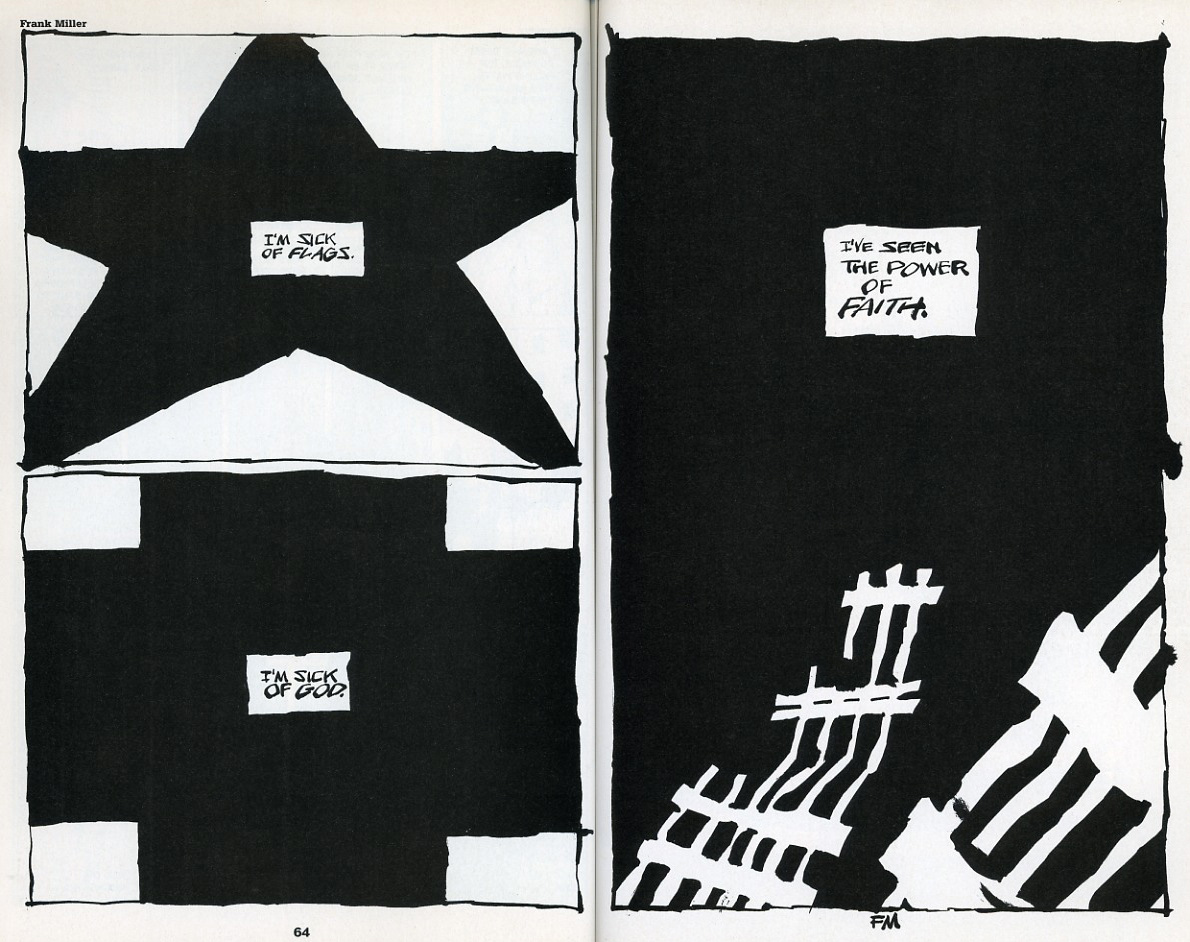
If I were to expand this and properly re-write it, I would emphasize further the strange self-consciousness of the book that I hinted at on one or two occasions: the apparently braided diegetic and non-diegetic strands (the only way it seems to me the book’s temporal contradictions can be resolved) and the comment about “the race of madmen.” Holy Terror feels like a strangely self-knowing book, but one that in the same gesture paradoxically foregrounds the lack of self-reflection on the part of the artist, the contradiction between the resulting work and its intended ideological functioning. I would also tone down my criticism of the rudimentary plot: it more and more seems to me that Miller’s abandonment of the (genre-based, admittedly, I say to preempt any griping) narrative sophistication of his ‘80s work is fully intentional; and the fascinating bizarreries I point out here would have been impossible had such sophistication not been abandoned. I would also compare the book to Miller’s contribution to 9/11: Artists Respond, which refreshingly rejected any and all ideologies:
(Homework assignment: what happened?)
Also, as I’ve been thinking a lot about Kirby lately, I can’t help but feel that the rhetoric of visual excess I use here to discuss Holy Terror is not all that different from what I and others have said to defend the King’s work of the seventies and after. I don’t know if that constitutes some kind of redemption for Miller; I don’t know if connecting the two in such a way is at all legitimate (I am only referring to my own rhetoric, which I do know is strangely similar)—but I know for a fact that my just bringing up the notion is sure to prompt yet another, additional, shitstorm in the comments. (James? Charles?) Have at it, all.
__________________
Editor’s note: Andrei writes more on Frank Miller at his own blog here.
The first major touchstone in Fredric Jameson’s epic 1991 Postmodernism, or The Cultural Logic of Late Capital Capitalism is Van Gogh’s A Pair of Boots.
Jameson refers to this as “one of the canonical works of high modernism,” and goes on to argue:
that if this copiously reproduced image is not to sink to the level of sheer decoration, it requires us to reconstruct some initial situation out of which the finished work emerges. Unless that situation–which has vanished into the past–is somehow mentally restored, the painting will remain an inert object, a reified end product impossible to grasp as a symbolic act in its own right, as praxis and as production.
This last term suggests that one way of reconstructing the initial situation to which the work is somehow a response is by stressing the raw materials, the initial content, which it confronts and reworks, transforms, and appropriates. In Van Gogh that content, those initial raw materials, are, I will suggest, to be grasped simply as the whole object world of agricultural misery, of stark rural poverty, and the whole rudimentary human world of backbreaking peasant toil, a world reduced to its most brutal and menaced, primitive and marginalized state.
Fruit trees in this world are ancient and exhausted sticks coming out of poor soil; the people of the village are worn down to their skulls, caricatures of some ultimate grotesque typology of basic human feature types. How is it, then, that in Van Gogh such things as apple trees explode into a hallucinatory surface of color, while his village stereotypes are suddenly and garishly overlaid with hues of red and green? I will briefly suggest, in this first interpretative option, that the willed and violent transformation of a drab peasant object world into the most glorious materialization of pure color in oil paint is to be seen as a Utopian gesture, an act of compensation which ends up producing a whole new Utopian realm of the senses, or at least of that supreme sense-sight, the visual, the eye-which it now reconstitutes for us as a semiautonomous space in its own right, a part of some new division of labor in the body of capital, some new fragmentation of the emergent sensorium which replicates the specializations and divisions of capitalist life at the same time that it seeks in precisely such fragmentation a desperate Utopian compensation for them.
There is, to be sure, a second reading of Van Gogh which can hardly be ignored when we gaze at this particular painting, and that is Heidegger’s central analysis in Der Ursprung des Kunstwerkes, which is organized around the idea that the work of art emerges within the gap between Earth and World, or what I would prefer to translate as the meaningless materiality of the body and nature and the meaning endowment of history and of the social. We will return to that particular gap or rift later on; suffice it here to recall some of the famous phrases that model the process whereby these henceforth illustrious peasant shoes slowly re-create about themselves the whole missing object world which was once their lived context. “In them;” says Heidegger, “there vibrates the silent call of the earth, its quiet gift of ripening corn and its enigmatic self-refusal in the fallow desolation of the wintry field.” “This equipment,” he goes on, “belongs to the earth, and it is protected in the world of the peasant woman. . . . Van Gogh’s painting is the disclosure of what the equipment, the pair of peasant shoes, is in truth. . . . This entity emerges into the unconcealment of its being;’ by way of the mediation of the work of art, which draws the whole absent world and earth into revelation around itself, along with the heavy tread of the peasant woman, the loneliness of the field path, the hut in the clearing, the worn and broken instruments of labor in the furrows and at the hearth Heidegger’s account needs to be completed by insistence on the renewed materiality of the work, on the transformation of one form of materiality–the earth itself and its paths and physical objects–into that other materiality of oil paint affirmed and foregrounded in its own right and for its own visual pleasures, but nonetheless it has a satisfying plausibility. At any rate, both readings may be described as hermeneutical, in the sense in which the work in its inert, objectal form is taken as a clue or symptom for some vaster reality which replaces it as its ultimate truth.
For Jameson, if the painting is not to be decoration, if it is to have meaning, then it needs to include meaning — which is to say, narrative, or history. The decoration, the burst of color, is merely a surface to be consumed unless it has a context attached to it. That context is both the past (the long path of the immiserated peasant through his life of toil, up to his door, and to the moment when he removes these, his boots); the present (especially in Jameson’s second reading, where the painting creates the peasant woman and the field and the earth around itself) and the future (as the burst of Utopian color, the yearning towards a decidedly material relief.) The painting calls for a story to complete it.
This is obviously a very Marxist reading. But it’s also a comics reading.
At first calling it a comics reading may seem a little startling, because there is often a very strong push in comics crit against ideological readings. Recently on this site, for example, Matthias Wivel argued:
Which brings me to the other issue I have with the critical reception of Habibi, and comics in general: the lack of sensitivity to how the visuals are integrally determinant of the work. Critics tend not to look beyond the surface qualities of the drawing in comics, and then proceed to discuss whatever conceptual issues are at stake without devoting much attention to how those issues are manifested visually. Even a cursory examination of the reviews published so far of Habibi should demonstrate this. Only a few have been entirely positive and several have been strongly negative in the conceptual assessment of the book and its ‘writing,’ but the majority of the reviewers have nevertheless taken time to commend the ‘art.’
Matthias argues that critics “tend not to look beyond the surface qualities of the drawing in comics” — which can not entirely finesse Jameson’s point that drawings are, literally, surface. Matthias goes on to a lengthy and thoughtful discussion of, among other things, Thompson’s line. But the discussion of that line itself seems flattened by Matthias’ circumspect refusal to give it a context. He criticizes Thompson for failing to convey complexity of emotion — but why exactly are we supposed to desire complexity of emotion? He points out the lack of spontaneity in Thompson’s line — but why does it matter if the line is spontaneous or not? Without the ideology that Matthias denigrates, the critique is left foundering in a thin (because untheorized or acknowledged) humanism or else, as Jameson suggests, in the even thinner realm of decoration, where the ink is appreciated in its inkness, a connosieur’s pleasure. (One could, of course, defend connosieurs and decoration — but I don’t know how you could go about doing that without wading into the deeper shoals of ideology.)
To be fair, Matthias isn’t calling for non-ideological readings; just ideological readings which pay more attention to surfaces. But (as is the way with such things) he ends up so chary of ideology that he seems to be paying attention just to the surface — looking so closely at the trees that the forest drops out of the peripheral vision. Jameson insists on looking beyond the image, on saying where it is coming from and where it is going to. For Van Gogh’s shoes to have meaning, they have to be in the world, affected by it and affecting it; they have to be made for walking. Matthias, in contrast, seems at times to want the line to draw a circle around itself, keeping the world, with its messy moral judgments and harumphing ideology at bay.
What’s strange about this tack is that it seems to miss the essence of comicness — to call for a focus on surface when sequential art has that “sequence” right there in its name. The comic book does exactly what Jameson does; it provides the situation for each image, and for each image the situation.
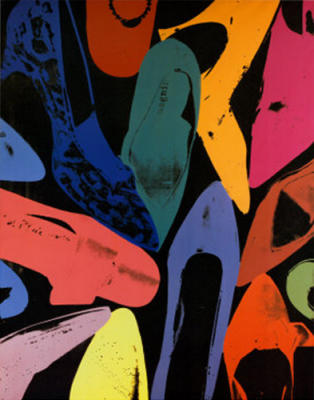
Comics in Jameson’s terms then seem to be what others have sometimes praised them for being; that is, resolutely committed to old-fashioned artistic values — a medium committed to Van Gogh rather than to Jameson’s post-modern exemplar, Andy Warhol:
Now we need to look at some shoes of a different kind, and it is pleasant to be able to draw for such an image on the recent work of the central figure in contemporary visual art. Andy Warhol’s Diamond Dust Shoes evidently no longer speaks to us with any of the immediacy of Var Gogh’s footgear; indeed, I am tempted to say that it does not really speak to us at all. Nothing in this painting organizes even a minimal place for the viewer, who confronts it at the turning of a museum corridor or gallery with all the contingency of some inexplicable natural object. Or the level of the content, we have to do with what are now far more clearly fetishes, in both the Freudian and the Marxian senses…. Here, however, we have a random collection of dead objects hanging together on the canvas like so many turnips, as shorn of their earlier life world as the pile of shoes left over from Auschwitz or the remainders and tokens of some incomprehensible and tragic fire in a packed dance hall. There is therefore in Warhol no way to complete the hermeneutic gesture and restore to these oddments that whole larger lived context of the dance hall or the ball, the world of jetset fashion or glamour magazines.
Yet this is even more paradoxical in the light of biographical information: Warhol began is artistic career as a commercial illustrator for shoe fashions and a designer of display windows in which various pumps and slippers figured prominently. Indeed, one is tempted to raise here–far too prematurely–one of the central issues about postmodernism itself and its possible political dimensions: Andy Warhol’s work in fact turns centrally around commodification, and the great billboard images of the Coca-Cola bottle or the Campbell’s soup can, which explicitly foreground the commodity fetishism of a transition to late capital, ought to be powerful and critical political statements. If they are not that, then one would surely want to know why, and one would want to begin to wonder a little more seriously about the possibilities of political or critical art in the postmodern period of late capital.
But there are some other significant differences between the high-modernist and the postmodernist moment, between the shoes of Van Gogh and the shoes of Andy Warhol, on which we must now very briefly dwell. The first and most evident is the emergence of a new kind of flatness or depthlessness, a new kind of superficiality in the most literal sense, perhaps the supreme formal feature of all the postmodernisms to which we will have occasion to return in a number of other contexts.
Van Gogh’s shoes look like they’ve just been tossed aside by a perambulating peasant; Warhol’s look like they’ve been purchased new from some shop window and then hammered flat. No one has worn them, no one will wear them; they are shoeness without story. If they have an ideology or a narrative, it is the narrative of no ideology and the ideology of no narrative.
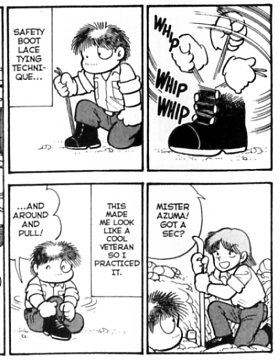
In contrast, consider this sequence from Hideo Azuma’s Disappearance Diary:
The worker’s shoe here is not abandoned as in Van Gogh; instead, it is in its place, on the foot of an actual worker, inside a narrative. The upper right panel, showing Azuma tying his own shoe, wraps itself in time, the hands creating a whirlpool of motion with the shoe an anchor at the center. If the shoe in Warhol is dead and the shoe in Van Gogh points to life, then this shoe is actually alive, tied up with time. Azuma is effectively pulling on the working class identity, with its manual facility and expertise (“this made me look cool like a veteran.”) There is no burst of color, and no utopian vision, but the motion lines and, indeed, the panel progression still energizes the images. The narrative is in the picture and the picture in the narrative; the boot is not just its surface, but, as with Van Gogh, its story.
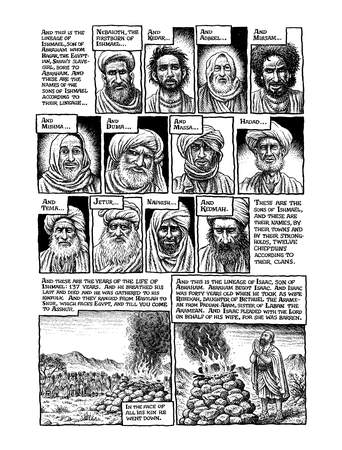
Comics then, can be seen less as an illustration of text than as a narrativizing of illustration — a form which pushes back against the shallowness of contemporary art practice by embracing the old-fashioned narrative and ideological virtues of prose. From this perspective, the achievement of R. Crumb’s Genesis is not giving flesh to every passage in the Bible, but rather giving narrative to every image. There are many, many Biblical paintings and drawings which show us Biblical characters as flesh and blood:
Crumb’s Genesis, however, is much more rare in insisting the the flesh of the Biblical image must be elaborated by the Biblical text itself. Crumb’s Bible is narrative; generations begatting through time, each with its own face that takes on weight only in relation to all the other faces.
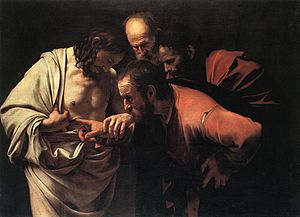
In this sense, Crumb and comics themselves can perhaps be seen as analogous to doubting Thomas. Seeing is not enough; you also need the experience of narrative and the word. If post-modernism proffers the dehistoricized image, comics insists on reinscribing it. Backwards looking in every sense, comics does not exist without the preceding panel, the one that gives the present depth and meaning.
Boots in Space
In Postmodernism, Jameson specifically claims that the distinction between the modern and post-modern is in post-modernism’s spatialization of time.
A certain spatial turn has often seemed to offer one of the more productive ways of distinguishing post-modernism from modernism proper, whose experience of temporality — existential time along with deep memory — it is henceforth conventional to see as a dominant of the high modern.
Thus, Van Gogh’s shoes, imbued with a past and a future, become Warhol’s shows, shorn of history, existing as pure space. Or (though Jameson does not use this example specifically) the painful, crushing sense of a life passing in a stymied claustrophobia in Kafka’s parable of the man at the door of the law is replaced in Borges’ story “The Double” with a miraculous simultaneity, as an older Borges and a younger Borges suddenly exist in the same space, so that time becomes not an unavoidable weight but a sleight-of-hand juxtaposition. As Jameson says, “Different moments in historical or existential time are here simply filed in different places; the attempt to combine them even locally does not slide up and down a temporal scale…but jumps back and forth across a game board that we conceptualize in terms of distance.”
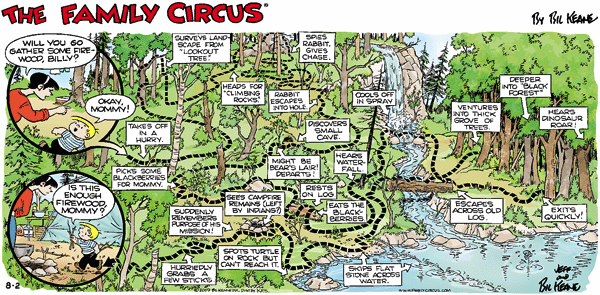
What would it look like if you turned time into space on a metaphorical gameboard? Maybe something like this?
The time of Billy’s journey is turned into a single schematic, a line which we can lightly trace. As Jameson says, different moments are simply filed in different places; the modernist pleasure of recuperation and depth is here replaced with the pleasures of surface and juxtaposition.
From this perspective, comics are not a backwards-looking modernist medium at all, but rather a post-modern engine for flattening time and narrative into space — of making time itself a manipulable, reified product. As an example, the Hideo Azuma boot-tying sequence:
Is the boot really energized and enriched by the narrative? Or does the existence of the narrative as spatial image allow time itself to become a mere decoration? The whipping hands and the boot so simplified it is almost a logo — Azuma presents this not so much as a specific boot in time, but as an iconic representation of a desirable skill, contained in a box and reproducible specifically for public consumption. Van Gogh’s boots were valuable for the life that had lived in them; Azuma’s are valuable because of their own image; they make him “look like a cool veteran.” Time — the working-class narrative of bootness — is flattened, mastered, and packaged for consumption. The boot points not to Marx’s utopian narrative, but to Lacan’s mirror stage; the exhilarating moment of mistaking a reflection for one’s past and one’s future.
You can similarly reinterpret Crumb’s Genesis.
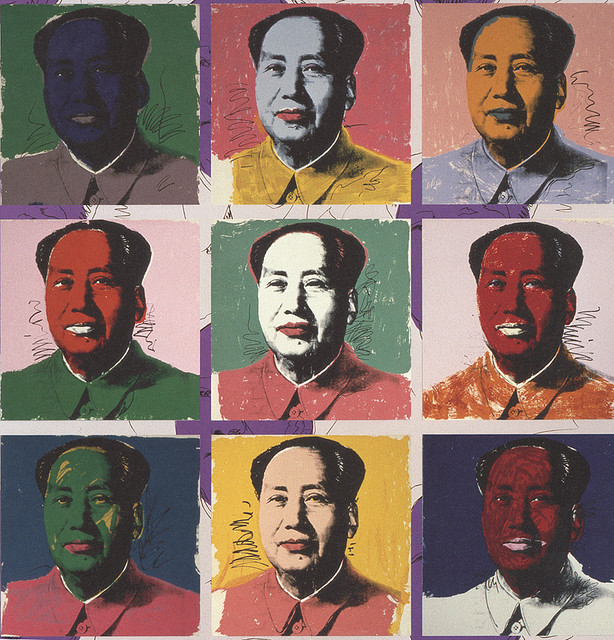
Rather than using the narrative to give life to the image, the steady drumbeat of the images crushes the narrative. Generations are spread out across the page like moths pinned for display, or like collectable baseball cards. Narrative and ideology are systematized and controlled. The mystery of time becomes the fetish of space, patriarchs set together cheek by jowl with a repetitive obsessiveness reminiscent of Warhol himself.
Warhol’s treatment of Mao is more explicitly parodic, but for that very reason it is almost more respectful. Mao and Mao’s image are, for Warhol, worth defacing and worth queering. Crumb’s Genesis, on the other hand, is treated as meaningless — one of the most consequent texts in history becomes a mere decoration, lines on paper. Ng Suat Tong’s is right that Crumb is “watering down” Genesis, but he’s wrong to think that this is a bug rather than a feature. If Crumb’s Genesis has a point, it is precisely the evacuation of content, the rendering of the Bible as merely another surface pleasure, its long history become a mere image no difference from any other that flickers across our optical nerves.
Jameson barely mentions comic book’s in Postmodernism; there’s one throw-away line in which he talks about post-modern bricolage as comic-book juxtaposition (and as schoolboy exercise.) In contrast, he devotes a great deal of time to video art, of which he says:
Now reference and reality disappear altogether and even meaning — the signified— is problematized. We are left with that pure and random play of signifiers that we call postmodernism, which no longer produces monumental works of the modernist type but ceaselessly reshuffles the fragments of preesistent texts, the building blocks of older cultural and social production, in some new and heightened bricolage: metabooks which cannibalize other books, metatexts which collate bits of other texts — such is the logic of postmodernism in general, which finds one of its strongest and most original, authentic forms in the new art of experimental video.
Nam June Paik, Electronic Superhighway
But if video art is the quintessential post-modern genre, perhaps it’s possible to see comic-books as its fuddy-duddy dialectical twin. Where video art fragments, comics reify. Where video art erases, comics embalm. Where video art heightens the ADD of advertisement, comics channels advertising’s depthless, deathless monomania.
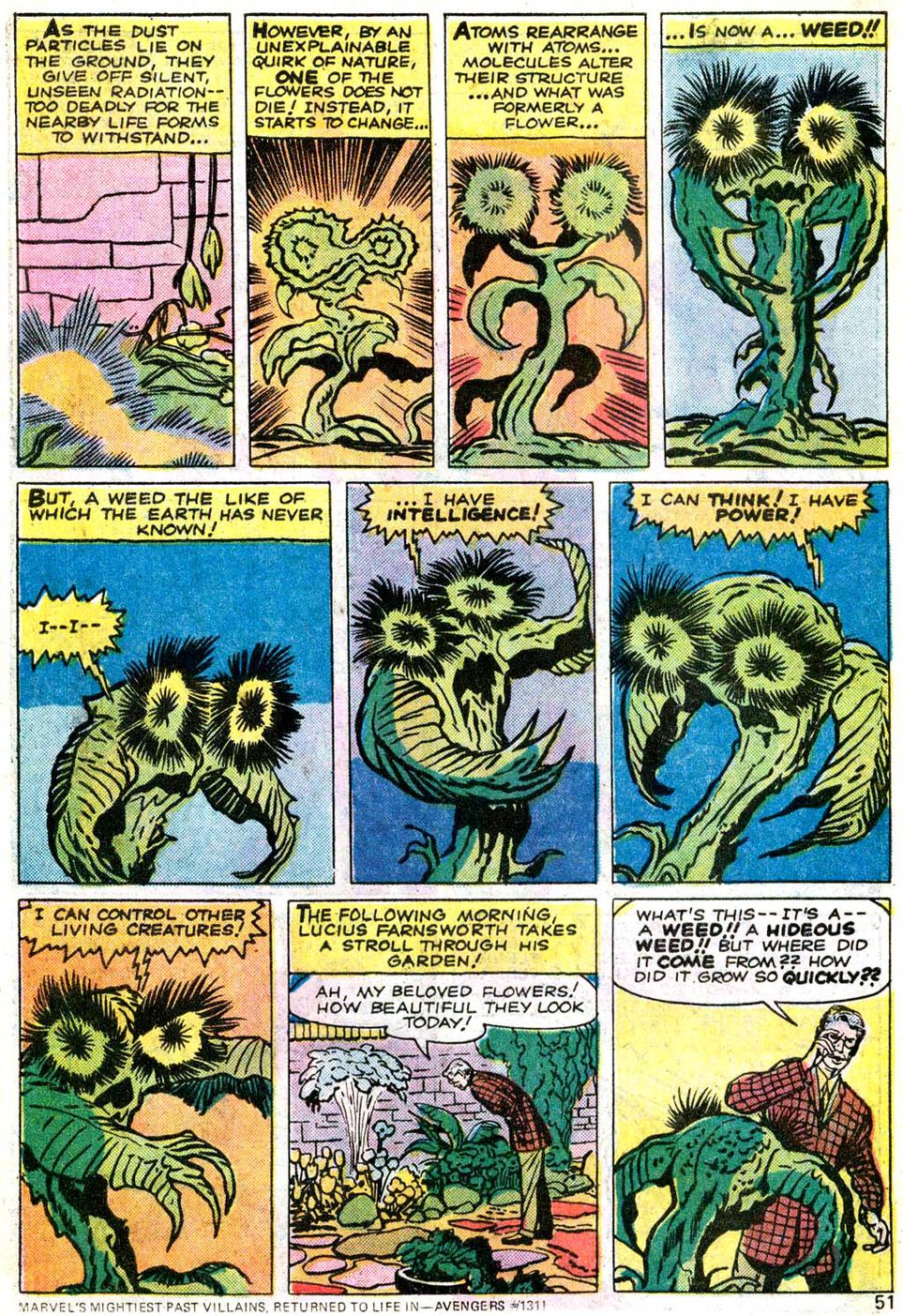
Stan Lee/Jack Kirby “Save Me From the Weed!”
Stan Lee’s advertising huckster sloganeering (“A weed the likes of which the world has never known!”) is the perfect soundtrack for a medium in which time passing is shown by compulsive iconic repetition. Kirby’s helplessly neotonic weed, straining virilely against its roots, is a pre-Internet self-contained viral meme, its image replicating across the page like an embedded video or Warhol’s fecund Maos. Video art fractures identity into a unassimilable riot of images; comics turns repetitive image into identity. The evil weed next to the evil weed next to the evil weed might as well be a series of toys each in its box on the shelf in Wal-Mart, every iteration a pitch for all the others.
Comics’ crass refusal of the past as history, its suffocating nostalgia for and commodification of even the most dunder-headed images simply because they are images, can be a depressing spectacle. Yet, if comics epitomizes some of the worst excesses of the zeitgeist, is that not a sign of its relevance? As Jameson notes, there is no getting outside post-modernism; to the extent that we have a narrative, it is our narrative; to the extent we have a surface, it is our surface. We can mourn the rich texture and context of Van Gogh, but our mourning is itself post-modern, a loss based in our position after the modern has gone. If we pick up Van Gogh’s shoes again:
to illustrate a point or create a narrative, then those shoes become ours, not his. They lose their lodging in the past and find a space in the present, digitally replicated ad infinitum, almost like a comic book.
The Blair Witch Project (1999) is the most likely starting point for the “found footage” sub-genre of horror. If you want to nit-pick, the first film to use the found footage concept was the Italian sleazefest Cannibal Holocaust (1980). But the film never pretended that the found footage (filmed by a “lost” documentary crew) was real in our world. Instead, the documentary footage was contained within a narrative that was clearly fictional. The Blair Witch Project, on the other hand, never stopped pretending. Even the marketing campaign (which included a fake documentary on the “legend” of the Blair Witch) passed the film off as real footage of the filmmakers’ last days.
Since Blair Witch there’s been a steady trickle of these films. They are not a new genre so much as a hybrid genre that steals ideas from older horror movies, and combines them with the conceit that the film depicts real events, or at least that the film was produced by individuals who are actually present within the story (usually amateur filmmakers). This means poor lighting, shaky camera-work, and unknown actors who can pass as normal people. But the films still contain the tropes that moviegoers expect from mainstream horror. After The Blair Witch Project (killer in the woods genre) came [REC] and its inferior American remake Quarantine (pseudo-zombie genre), Diary of the Dead (zombie apocalypse genre), Cloverfield (giant monster genre), Apollo 18 (alien genre), and Paranormal Activity (haunted house genre).
But how real is found footage? If I were being stalked by a ghost/slasher/zombie/serial killer/tropical cannibal, the last thing I would do is record my demise for posterity. No offense to my tiny audience, but I don’t give a flying fuck about entertaining you in my final moments. And who in their right mind would waste time recording the ghost or giant monster that’s trying to kill them (as well as the touching romantic sub-plot during the lulls in the violence)? The common defense of the genre is that we live in the Youtube and cellphone camera age, and the genre simply reflects the fact that we are saturated with amateur video. But amateur footage of protests, crimes, terrorist attacks, etc. tends to be brief, incompetently filmed, and rarely has anything resembling likable characters or a plot. In other words, actual amateur video bares no resemblance to the professionally crafted narratives that lurk underneath the “found footage” concept. And there’s the little fact that it’s impossible to record video of ghosts, zombies, or giant monsters because those creatures don’t exist.
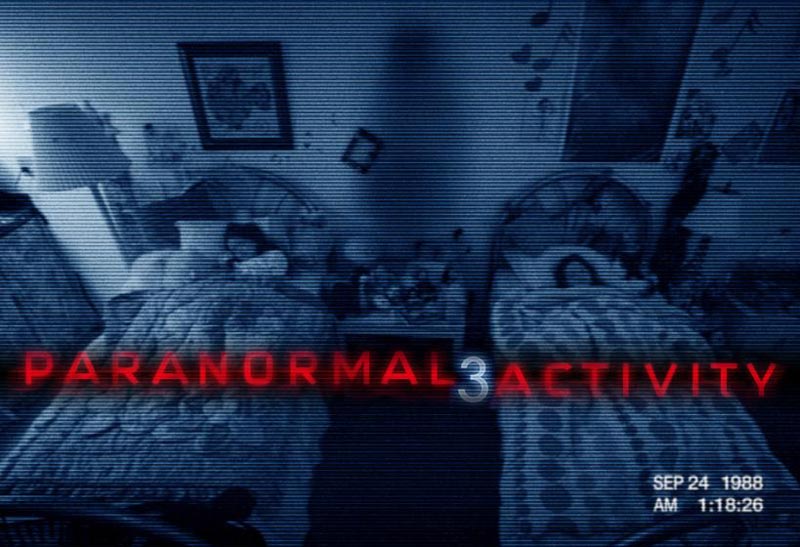
And yet audiences eat this shit up, and I’m right there with them. My favorite set of films in the genre is the Paranormal Activity franchise. The first Paranormal Activity is not particularly innovative. It’s cut from the exact same cloth as a thousand other haunted house movies, and it’s at least as campy as anything starring Vincent Price. But I found it scarier and far more entertaining than The Haunting, Amityville Horror, The Others, or any other haunted house movie that exists in a fictional universe. Paranormal Activity 3 is the perfect example of the genre. The entire premise is ridiculous: a demon is terrorizing a family in 1988, and the dad just happens to be an audio/video expert who rigs his house with video cameras and always walks around with a massive camcorder. The film is unabashedly cheesy, and even includes the old ghost-under-the-sheet gag. But it’s great! The simple plot sucks you in and the old-fashioned scares still work. The viewer quickly forgives the implausibility of a man walking around with a camcorder all the time, because how else would there even be a movie?
It’s not the phony realism that matters, but how that realism connects the audience with a familiar narrative. To put it another way, found footage works not because we belong to the Youtube generation, but because we belong to the Real World generation (youngsters can replace Real World with Survivor or Real Housewives of Who Cares or whatever reality TV series floats your boat). So-called reality TV is quite fake. Real people are encouraged to behave in unnatural ways for the sake of our entertainment. They are less inhibited, more reckless, and generally stupider when in front of the camera. Then a team of professional editors and writers crafts an artificial narrative from countless hours of random shit caught on tape. Through this process reality TV creates the ultimate illusion – that normal people are actually interesting to watch. Normal people can have exciting singing careers, or scheme to win a million dollars, or have lives filled with catfights, hot tub sex, and soap opera drama.
The found footage genre works in much the same way. The pretense that the film is real isn’t so much about fooling people but in bringing the audience further into familiar narratives that they love. The shaky camera and unknown actors create an illusion of reality. Scary and exciting things don’t just happen to movie stars. They can happen to normal people, just like you or me! But this illusion of reality is plastered over a conventional genre film. So the scares are structured in a narrative format that we instantly recognized and appreciate. In movies and in “real life,” a ghost wouldn’t reveal itself right away, but would instead spends several days doing little things to build up the suspense. It would be a disappointment if the “real” haunted house experience lacked the requisite tension and cheap thrills. After all, what’s the point of being haunted by a demon if he doesn’t even do it right?
This originally ran on Comixology.
____________________ “Super-hero” backwards is “noir.” The opposite of the upright avatar of justice with entirely sublimated sexual urges is the morally ambiguous anti-hero driven by money-lust and just plain old lust. The super-hero wears his underwear on the outside and saves the universe; the noir hero curses the universe and is pulled around by what’s inside his underwear. Noir is about shadows and helplessness and the best-laid illicit plans ending up in ruins; super-heroes are about light and empowerment and the best-laid illicit plans ending up in ruins.
Which is to say that, while super-heroes and noir appear at first to be irreconcilable, on closer look they do have a fair bit in common. They’re both male genre literature. They both have a strong moral code enforced by corporal punishment. And they both have, shall we say, ambivalent feelings about women. It makes sense, then, that there’s a long tradition of combining the two, starting at least with the first Batman stories, reaching its high point, I firmly believe, with Bob Haney’s goofily brilliant Batman/Deadman team up in Brave and Bold #101, and continuing on to this day with anything Frank Miller has ever touched (including, of course, Batman.)
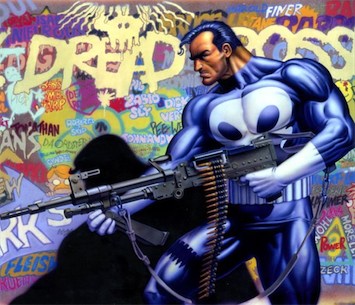
One of the most interesting super-hero/noir mashups I’ve seen is the 1986 Punisher mini-series Circle of Blood by Steven Grant and Mike Zeck. The Punisher has always been only sort-of/kind-of a super-hero. He wears tights, but merely, you sense, because that’s the best way to stay inconspicuous in the hero-ridden Marvel multiverse. He fights for truth and justice, but he does it by shooting people.
Steven Grant is well known for his writing about comics as well as for his comics themselves (he did some guest-writing on my blog not too long ago), and you can see his critical acumen in his script. Basically, where Frank Miller tends to use noir to make his heroes seem even more bad-ass, Grant uses it to question and ultimately undermine the moral certainties on which the super-hero genre is based.
Zeck draws the Punisher as a pumped-up manly-man whose bobble-head is dwarfed by acres of steroidal flesh, and this is a good metaphor for the way Grant writes the character. From the neck down, the Punisher is a super-hero juggernaut, hyper-competently disposing of roomfuls of thugs in classic Bat-mode, or bashing his way through a prison in a fashion reminiscent of the contemporaneous Rorschach.
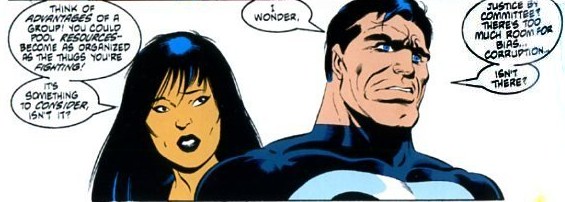
From the neck up, though, the Punisher isn’t hyper-competent at all. Instead, he’s more like the classic noir dupe. Though he has a certain tactical animal cunning, his inner monologue is obsessively repetitive in a way that suggests borderline idiocy — where Batman’s traumatic backstory has, supposedly, made him smarter, the Punisher’s has left him, in Grant’s writing, a monomaniacal mental and emotional basket-case. The Punisher is, like most noir men, childishly easy to fool. He stumbles into traps, is bamboozled by a shady conglomerate called the Trust, and, inevitably, betrayed by a woman. His solve-it-by-shooting-it approach to every problem results in heaps of dead bodies, including that of one child. Said child’s death sends our hero into a self-pitying funk, complete with flashbacks and profound utterances (“It’s got to stop. The poor children.”) which, at least from my perspective, makes him appear more damaged, dangerous, unsympathetic, and unheroic than ever.
The Punisher’s final act in the comic is to allow the woman who betrayed him (Angela) to fall off a cliff. His motivation seems less abstract justice than simple spite, and one has to wonder, as he limps off into the sunset, whether the world wouldn’t maybe be a safer place if the bad guys had won and offed this dangerously imbecilic killing machine. The use of noir here actually, and I think intentionally, calls the whole concept of super-heroics into question. The hired thugs in the series are dressed in the Punisher outfit and actually believe themselves to be the Punisher — and the parallel is quite clear. The Punisher himself, after all, seems like a brainwashed sleepwalker, not to mention a criminal. In the not-light of noir, the super-heroic law-and-order certainties become naïve, dangerous idiocy, while righteous vengeance turns into a flimsy excuse for self-aggrandizing fascistic violence.
Of course, you can turn this around and argue that the super-hero genre actually validates noir’s amorality. Just because Grant portrays the Punisher as a dangerous numbskull doesn’t mean that readers will stop identifying with him. He’s the hero, after all, and when, in his quasi-sentient way, he lets Angela fall to her death, you can certainly hear a chorus of “yeah, kill the bitch!” echoing from the peanut gallery. Does breaking a man’s little finger make Rorschach a monster, or does it make snapping people’s fingers seem kind of cool?
Probably both. Super-heroes and noir are polar opposites — but on a magnet, the poles are, of course, closely attached. Like Westerns, spy thrillers, and most male genre literature, both super-hero and noir are built around an exciting frisson of justified violence — a circle of blood. If you want to break out of that circle, you probably need to reach for a less closely-allied genre, or else try to dispense with genre altogether. Once you do that, of course, you’re talking to a much smaller audience, and not writing for a mainstream comics publisher. The irony is that by creating a thoughtful, popular comic questioning the Punisher’s war on crime, Grant probably helped to make that kind of war — with its more explicit blood, sex, and amorality — a mainstream staple.