Prehistory of the Superhero (Part 2): Vampires, Victorians, and Vendettas

It happened that in the midst of the dissipations attendant upon a London winter, there appeared at the various parties of the leaders of the ton a nobleman, more remarkable for his singularities, than his rank. He gazed upon the mirth around him, as if he could not participate therein. Apparently, the light laughter of the fair only attracted his attention, that he might by a look quell it, and throw fear into those breasts where thoughtlessness reigned. Those who felt this sensation of awe, could not explain whence it arose: some attributed it to the dead grey eye, which, fixing upon the object’s face, did not seem to penetrate, and at one glance to pierce through to the inward workings of the heart; but fell upon the cheek with a leaden ray that weighed upon the skin it could not pass.

—from The Vampyre: A Tale, by John William Polidori

x

One summer night in 1816, a group of friends gathered in the Villa Deodati, on the shores of Lake Geneva, and entertained themselves by reading ghost stories. They then determined to write each a tale of horror.  Ironically, the two most renowned writers in the party– the poets Percy Bysshe Shelley and George Gordon, Lord Byron — never completed their tasks; while the unknownMary Shelley subsequently wrote the justly famous novel Frankenstein: or, the modern Prometheus (discussed in part1).

One other of the group, John William Polidori (1795-1821) produced another classic of horror fiction: The Vampyre: a Tale (1819). It had enormous success and influence, and contributed to another classic literary incarnation of the superman.

The preceding century had already seen something of a craze for vampires; these, however, were generally the crude monsters of folklore. Polidori changed this characterisation at a stroke. His vampire, Lord Ruthven, was not a freakish peasant ghoul but an elegant aristocrat, at home in the loftiest circles. This conception of the vampire quickly caught on, and would reach its apotheosis at the end of the century in Bram Stoker‘s Dracula. The aristocratic figure with a secret, dark identity also finds its descendants in such superheroes as pulp fiction’s The Shadow and comic books’ Batman.

The Penny Dreadful

One very popular variation on the Ruthven figure was James Malcolm Rymer‘s serial Varney the Vampire: or, the Feast of Blood (1845-1847).

Varney was a prime example of the first true mass medium for fiction: the serial novel, which emerged in the 1830?s.

Novels had been serialised before, of course, but mostly in separate, costly volumes, aimed at the growing middle class. But in the wake of the Industrial Revolution, literacy rates among the labouring classes trended ever upwards. According to a bookseller named Lackington, writing in 1790 England:

The poorer sort of farmers, and even the poor country people in general, who before that period spent their winter evenings in relating stories of witches, ghosts, hobgoblins, &cetera, now shorten the winter nights by hearing their sons and daughters read tales, romances, &cetera, and on entering their houses you may see ‘Tom Jones’, ‘Roderick Random’ and other entertaining books stuck up in their bacon racks…In short all ranks and degrees now READ.

( Of course,  Lackington is also describing here the gradual eclipse of folk culture by a manufactured popular mass culture.)

The process of advancing literacy  culminated, by the nineteenth century’s end, in universal free public education throughout Europe and America. This created a new mass market for literature, and the latter tended decidedly to the sensational.

In addition, the development of the steam press allowed runs of tens of thousands of copies in record time; paper, which theretofore had been made expensively from rags, now was produced from cheap esparto grass and, later, even cheaper wood pulp.

Varney was an early example of the racy,  excitement-packed publications known as penny dreadfuls or penny bloods. As these names show, they were cheap and they were laden with gore. Often they celebrated the adventures of famed criminals like the highwayman Dick Turpin or the cannibalisticSweeney Todd.

(The public, then even more than now, relished a good villain; the working classes– not unreasonably — viewed the police and magistrates with suspicion and hatred. This instinct is centuries old: think of the ballads celebrating the outlaw Robin Hood.)

By the 1850?s, the penny dreadful was largely aimed at working-class adolescents. Cheap pamphlets featuring daring heroes and villains aimed at an audience of juveniles…does it sound familiar? And indeed, the penny dreadful and its American cousin, the dime novel, were direct ancestors of the superhero comic.

And like the comics, the penny dreadfuls were widely condemned for breeding juvenile delinquency:

The six-pen’orth before me include, “The Skeleton Band,” “Tyburn Dick,”, “The Black Knight of the Road,” “Dick Turpin,” “The Boy Burglar,” and “Starlight Sall.”  If I am asked, is the poison each of these papers contains so cunningly disguised and mixed with harmless-seeming ingredients, that a boy of shrewd intelligence and decent mind might be betrayed by its insidious seductiveness? I reply, no. The only subtlety employed in the precious composition is that which is employed in preserving it from offending the blunt nostrils of the law to such a degree as shall compel its interference.[…]  The daring lengths these open encouragers of boy highwaymen and Tyburn Dicks will occasionally go to serve their villanous ends is amazing. […] Which of us can say that his children are safe from the contamination?

– from James Greenwood’s The Seven Curses of London,1869

Newsvendor.- “Now, my man, what is it?”
Boy. “I vonts a nillustrated newspaper with a
norrid murder and a likeness in it.”

from Punch magazine, 1845

 
Even Greenwood, however, concedes that the dreadfuls were great enablers of literacy (an argument also advanced today by the defenders of the comic book):

     Who says that he is a dunce and won’t learn? Try him now. Buy a few numbers of the “Knight of the Road” and sit down with him, and make him spell out every word of it. Never was boy so anxious after knowledge. He never picked a pocket yet, but such is his present desperate spirit, that if he had the chance of picking the art of reading out of one, just see if he wouldn’t precious soon make himself a scholar?

Let’s consider a penny dreadful hero/villain taken from a British urban legend,Spring Heeled Jack.
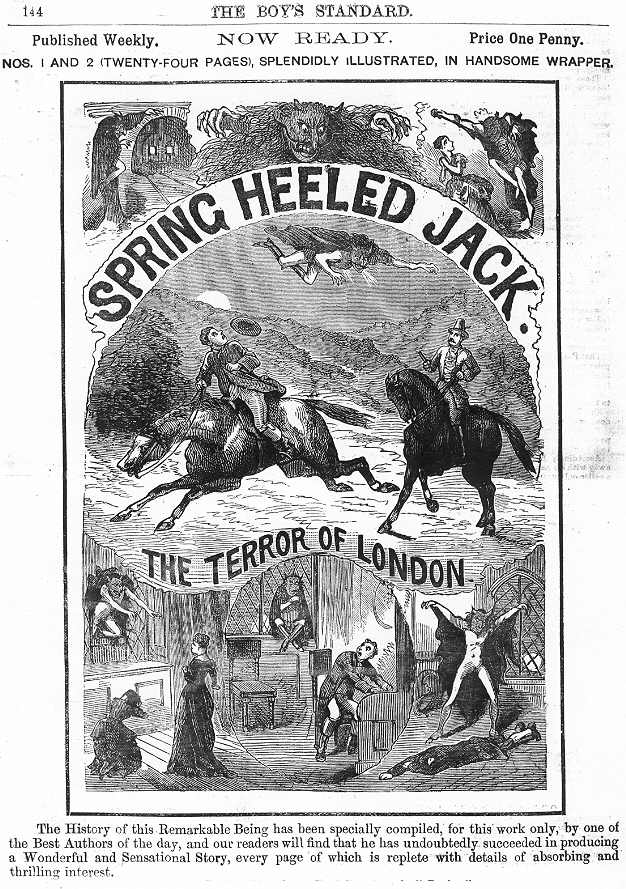
The eponymous Jack was supposedly a demonic figure that made incredible leaps, breathed flame, and terrorised the population. He was immediately seized on by the twin pillars of sensational fiction, the melodrama theatre and the penny dreadful.
 

In the ‘dreadful’, Jack Dacre is a young man dispossessed of his rightful inheritance by his villainous cousin. He assumes the identity of Spring Heeled Jack to rob and terrorise the blackguard, and finally to bring him to justice.

A description of his costume:

His dress was most striking.

It consisted of a tight-fitting garment, which covered him from his neck to his feet.

This garment was of a blood-red colour.

One foot was encased in a high-heeled, pointed shoe, while the other was hidden in a peculiar affair, something like a cow’s hoof, in imitation, no doubt, of the “cloven hoof” of Satan.  It was generally supposed that the “springing” mechanism was contained in that hoof.

He wore a very small black cap on his head, in which was fastened one bright crimson feather.

The upper part of his face was covered with black domino.

When not in action the whole was concealed by an enormous black cloak, with one hood, and which literally covered him from head to foot.

He did not always confine himself to this dress though, for sometimes he would place the head of an animal, constructed out of paper and plaster, over his own, and make changes in his attire.

Still, the above was his favourite costume, and our readers may imagine it was a most effective one for Jack’s purpose.

– from Spring Heeled Jack: the Terror of London, The Boy’s Standard Weekly

Hmm… an origin story (complete with revenge and justice motivation.)  Super power– the ability to leap extraordinary distances. A striking costume with mask and cape. A secret identity. A sidekick (a sailor unfortunately named Ned Chump.) Daring escapes, lashings of violence, justice triumphant in the end. All in serialised pamphlets aimed at adolescents.

Sure sounds like a superhero comic, doesn’t it? And Spring-Heeled Jack anticipates, in many ways, Spider-Man. Both costumed adolescents taken for adults, leaping prodigiously from building to building, hounded by the authorities though secretly fighting for justice…

Of course, not all serials were sensational or aimed at juveniles; Charles Dickens’ serials enthralled all ages and all classes, as published in his magazines Household Words and All the Year Round.  And across the Channel, France produced perhaps the greatest adventure serial novelist of all time: Alexandre Dumas.

Monte Cristo: superman


Alexandre Dumas

 
In 1800, the French newspaper Le Journal des Débats added  to its main political section  a supplement covering arts and science, and called it a “feuilleton” (“little sheet”).  The innovation was much copied all over Europe, and, of course, survives to this day.

Novelists such as Honoré de Balzac and Georges Sand started serialising their upcoming books in the papers. However, the latter were still expensive and thus catered to middle-class tastes in literature.

This would change in 1836, with the launch of La Presse;  it sold at half-price compared to its rivals, in fact at a loss. The idea was to maximise circulation and make a profit on paid advertising (a business model that served newspapers well until very recent years.)

By necessity the papers in this new paradigm had to cast their nets as wide as possible in quest of readership, including the newly-enfranchised working classes. They found a spectacularly successful way to build reader loyalty: the serialised novel, or “roman feuilleton”.

These drew upon every resource of suspense, sentimentality, and melodrama to keep the reader panting for the next installment; a recipe later adopted by film, radio and television serials, as well as comic strips and comic books.

The first breakout blockbuster was doubtless Eugène Sue‘s Les Mystères de Paris, serialised in 1842 and 1843. This sensationalist novel was read by millions worldwide. Its hero, Prince Rodolphe de Gerolstein, succors the wretched and humbles the mighty; Umberto Eco singles him out as a proto- superman, and as the undoubted inspiration for the hero of a classic that enthralls even today, whether in book or film or theatre play: The Count of Monte Cristo.

Alexandre Dumas (1802 — 1870) was a writer of astounding industry; the author of 136 books, several of which top the thousand-page mark. Yet despite much hackwork, the vigor and élan of his storytelling have preserved his name to the present day; who has not heard of The Three Musketeers or The Man in the Iron Mask?
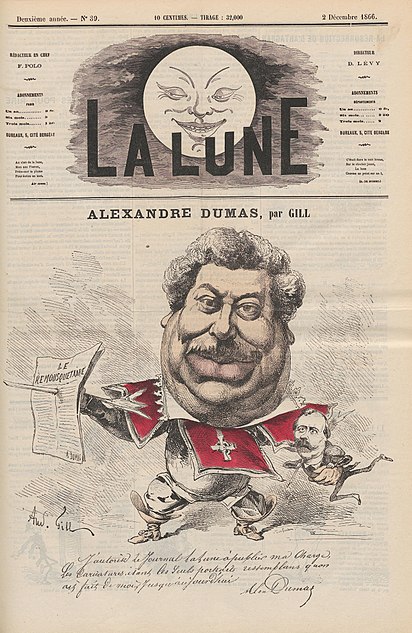
Dumas was a regular fiction factory, and routinely employed ghosts to help him — the most notable of whom was Auguste Maquet. Together, they produced The Count of Monte Cristo, perhaps Dumas’ most celebrated novel, serialised from 1844 to 1846.

The Count is a sprawling epic hinging on that most primal wellspring of human action: revenge.

Edmond Dantès is a young French  sailor about to take command of his first ship and to marry his fiancée. But a cabal of villainous men forge a letter that seems to prove him a conspirator against the Crown, and he is thrown into a prison cell where he languishes for fourteen years. He escapes by taking the place of his friend and cellmate’s corpse, and is thrown into the sea.

His friend had indicated to him the secret location of a fabulous treasure in a grotto on the Mediterranean island of Monte Cristo.

The island of Monte Cristo

 
After securing this limitless wealth, Dantes finds out that his enemies have all, over the ensuing years, risen to the summits of power and riches. He vows revenge; Edmond Dantès has died, and is reincarnated as the mysterious, supremely wealthy and powerful Count of Monte Cristo.  He makes his way to Paris, and contrives to bring about the ruin, madness, or death of his foes.

Monte Cristo, however, sees himself not as an avenger, but as an implacable agent of divine providence sent to dispense justice among the throngs of humanity above which he has risen. His mastery is complete; nothing can stand in his way; his will is that of the superhuman– of the superman:

“You may, therefore, comprehend, that being of no country, asking no protection from any government, acknowledging no man as my brother, not one of the scruples that arrest the powerful, or the obstacles which paralyze the weak, paralyzes or arrests me. I have only two adversaries — I will not say two conquerors, for with perseverance I subdue even them, — they are time and distance. There is a third, and the most terrible — that is my condition as a mortal being. This alone can stop me in my onward career, before I have attained the goal at which I aim, for all the rest I have reduced to mathematical terms. What men call the chances of fate — namely, ruin, change, circumstances — I have fully anticipated, and if any of these should overtake me, yet it will not overwhelm me. ” –Monte Cristo, chapter 48

Small wonder Antonio Gramsci maintained that  Fascists and other worshippers of the superman took their template, not from Nietzsche, but from Dumas! As quoted in Umberto Eco’s Il superuomo di massa, Gramsci points out that “the serial novel replaces (and at the same time favorises) the imagination of the man of the people, it is a true waking dream[…] long reveries on the idea of revenge, of punishing the guilty for inflicted hurts […]“  And today, the bullied kid identifies with Batman beating up thugs that stand as proxies for his tormentors.

To be fair to Monte Cristo, the superman in question comes to doubt more and more the validity of his exalted state and supposedly divine mission; the turning point comes when he beholds that his vengeful machinations have brought about the death of an innocent. Here is the climax of his final confrontation with his odious enemy Villefort:

“There! Edmond Dantès”, said he, showing the corpse of his wife and the body of his son, “there! Look! Are you well avenged…?”

Monte Cristo paled at this horrible sight; he understood that he had just overstepped the rights of vengeance; he understood that he could no longer say:

“God is for me and with me.”

And indeed,  Monte Cristo ends by forgiving his last foe standing, the banker Danglars,after tormenting him for days. Forgiveness? Supermen should be made of sterner stuff. Nietzsche would have turned away in disgust.
 

art by Alex Blum

 
How does Monte Cristo relate to the modern superhero, as Umberto Eco suggested?

He has a traumatic origin story, from which he emerges transformed into a superior being;  he has a superpower– and a pretty realistic one– limitless wealth ; a master of disguise, he adopts several secret identities; he worksoutside the law to bring about justice to evildoers.

And, most importantly, he is a fantasy projection with which the reader identifies, the imaginary righter of his own perceived wrongs.

Nonetheless, his final remorse and doubts set him apart from the American superman, who seldom if ever feels such wimpish emotions.

Another reason why the superhero never really took off in old, conflicted Europe– which yet had much to contribute to its mythology…

Art by John Buscema and Ernie Chan


Next: Supermen of Science — Verne and  Edison
 

xkcd: On Time and Twinkies

The world of comics may seem like a pint-sized planet but news still takes some time to travel from one point to another. Often (and almost paradoxically) the more popular a comic, the less likely its fulsome embrace by that monastic order of adjudicators and explainers known as the comics critics circle. We’ve seen this quite recently with the release of Alison Bechdel’s Are You My Mother? where the bulk of interviews and articles relating to the comic were formulated by the mainstream press. One could put this down to the utter insignificance of the comics press when it comes to marketing non-genre adult targeted material.

Another comic which has fallen by the wayside in terms of notice is Randall Munroe’s immensely popular xkcd— a comic which seems to have engendered even less discussion among dedicated comics critics then the much reviled efforts of Scott Adams and Cathy Guisewite; this despite being one of the most popular websites in America (it ranks in the top 1000 U.S. websites). This meant that I had to find out about Munroe’s long running serial, “Time”, from a mainstream site after it was completed.

The exact substance of “Time”  is amply explained by the xkcd Time Wiki, a fan-created encyclopedia with a level of detail I normally associate with popular computer games.

A nice discussion of all things “Time” has been written by Jeffrey O. Gustafson at The Comic Pusher. Gustafson lays out the mechanics of the panel changes quite succinctly:

 “…it began to change, incrementally, every half hour at first, then every hour. Some panels would feature a small change from the previous one, showing a small fraction of time passing; others contained dialog and events and changes in scenery indicative of minutes or hours passing. Every hour, a new panel would be published over the old one, and this would go on, every hour without stopping… for four months. Time finished last week, after 3099 frames. That is a comic in 3099 panels, with each panel published every hour for 123 days.”

“Time” was serialized over a period of 4 months from March to July 2013. If one desires even more detail concerning the panel transitions (down to ellipses and ephemeral subtitles), one need only read the One True Comic section of the wiki mentioned above which is meticulous and clearly self-mocking in its comprehensiveness.

xkcd time 01

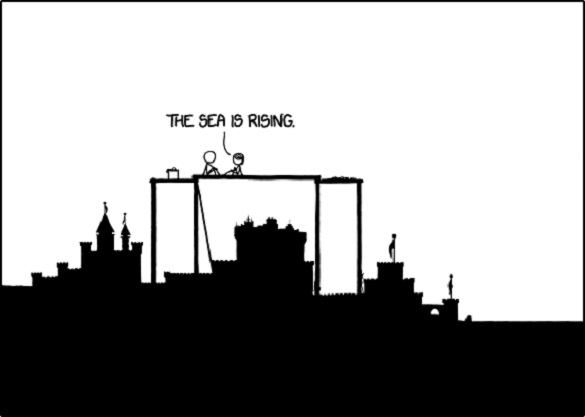
In short, “Time” begins with two individuals building a sandcastle of immense proportions. Upon completing their project, they set off on a journey through a strange wilderness in search of answers to the rising tide of water beside their construction, eventually reaching an actual castle built by a mysterious race with “all” the answers to their questions. Informed of the impending fate of their community, they return to the sandcastle, board a veritable ark (constructed from the remnants of their sandcastle) with their friends and relatives, and soon reach dry land where the story ends.

A synopsis like this would suggest concerns about climate change, a chronicle of the cyclical nature of history, and a retelling of the ur-myth of the universal flood—brought in patch work fashion to us by the Mesopotamians, the Jews, and various Mesoamerican cultures etc.—which has since been scientifically put down to episodes of catastrophic localized flooding. A simple survey of articles published on “Time” would however quickly disabuse the reader of such notions. For Munroe’s avid readers have found many other avenues of research, whether they be the accurate chronological placement of the story through a review of the precession and fates of the constellations, the translation of the “Beanish” language used by the mysterious race of answer givers,  faunalogical studies of the environment, modern day allusions to theoretical engineering feats like Atlantropa, and so on so forth.

As Gustafson explains in his summary of some of Munroe’s revelations in Wired magazine:

 “… the travelers live at the base of the Mediterranean basin. Some geological calamity has caused it to dry out, and it is suddenly, quickly, violently flooding back. This is something that actually happened five million years ago, the Zanclean flood. Except the flood the travelers are encountering isn’t happening in the distant past, but the far future. As revealed in the night sky Munroe meticulously displayed, this journey takes place in April of 13291 CE.”

“Time” is a story stripped down to its most basic elements, forfeiting characterization and even engaging dialogue both of which remain largely functional throughout. This can be seen as a counterpart to the abolition of facial expression in his xkcd strips as a whole and the artist’s moderate reliance on body language. What remains are ideas, environment, plot, and mystery—a narrative soup meant to evoke the beauty of a mathematical equation or in this instance a complicated puzzle. One might even call it a kind of unyielding hard science fiction where the science is not a mere adornment to humanistic concerns but transformed into points of intense focus. If seen as a  game, it presents its participants with no obvious demands for a solution or even access to restricted modes of direct interaction. Instead, it harnesses the power of the biological web in its absolute faith that everything can and will be taken apart and put back together again. The net community is transformed into a classroom where your fellow readers are your teachers and where every mistake in analysis is not a moment for reproof but another avenue of study. In certain ways, it brings to mind the video games of old, created in an era of stunted computing power, where exploration of graphic miracles—the creation of an “entire” world—was the be all and end all; where entering a virtual library and being able to open a book was such a thrill and the lure of movement in detailed three dimensional space in games like Myst precipitated the sale of a million box sets.

xkcd time 2

The emotions and characterizations in “Time” are so sparse that the comic takes on the tone of parable or a fable, one crafted in such broad strokes that it invites all forms of interpretation—autobiographical, scientific, historical and, somewhat improbably, religious. It’s only counterpart in comics might be the interactive comic books of Jason Shiga . Yet beneath the mathematical cunning and distance of Shiga’s best stories often lay a core of emotional loss and meaning. No such mitigating factors are evinced by the author of “Time”—which progresses unrelentingly, its protagonists like ants in the grand scheme of things. The stick figures of xkcd absolve the reader of any need to engage his/her emotions in the frivolous act of fictional narration.  I imagine that many of Munroe’s readers will suggest that his figure work conveys a lot of deft emotional touches and his abbreviated dialogue the ennui of a generation twisting and turning in a Beckettian gyre. But this has more to do with his readers’ total investment in the product.

As in all intellectual communities, an element of elitism cannot be far behind. If some film fascists suggest that the only true and correct experience of a vintage movie is on a large screen in a darkened theater, then some true connoisseurs of “Time” might insist (as opposed to the more congenial wiki) that an essential part of “Time” is its methodical pacing—the mental patience, the drawn out cogitation and experience of waiting generated through the act of following the progress of the characters over the course of four months; an experience of time and narrative unavailable to the person watching the Youtube presentation of the story or even those clicking through the stills 1-2 seconds at a time (at Geekwagon)—all this being the equivalent of watching a Bela Tarr movie with your finger firmly pressed on the fast forward button.

In this light, “Time” can be seen as a self-conscious study of the effects of serialization where the the reader’s engagement during the process of serialization is as much a part of the artistic experience as the viewing of the comic; the once indistinct intellectual consequences of reading a long and involved serial like Gasoline Alley or Love and Rockets now compressed and brought to the fore, the essential and fugitive moments not only experienced over days, months, and years but now also over seconds, minutes, and hours. I haven’t bothered checking but one presumes there have been calculations made as to how the duration and pace of serialization corresponds to the duration of travel by the figures in the story.

Still this deliberate act of sluggish serialization seems far from his reader’s minds, and a comics critic like Gustafson seems more concerned that people are labeling “Time” a kind of drawn out animation with little relation to the form and accumulated experience of comics:

“I see the comic described as a slowly drawn out animation, that the experience of reading Time as it was being published was one of a very long, very slowly playing cartoon being displayed one frame per hour over four months. But this is emphatically not the case with Time. With a cartoon…each frame of the work represents a set fraction of time that when played back gives the sensation of movement. By necessity, every frame is transitional and inhabits an identical sliver of time. But Time does not do this. There are certainly transitional panels in Time that take less time to read, but there are just as many unique, illustrative narrative panels that must take more time to read. If it was animation, the panels with dialog or significant events would happen across multiple frames, but they don’t. They happen, without fail, in one frame, one panel.

…Comics are defined by their nature of the reader defining the temporality of the fiction, both the pace at which it is read and how the story plays back in the mind. Munroe dictated the pace of Time‘s consumption at first—like an elaborate live art installation—but now the reader is back in charge of the time of Time.”

That last argument of Gustafson’s seems to do harm to his idea that “Time” should be seen primarily as a comic. By his own definition (which is by no mean inarguable), the initial release of “Time” conforms to a kind of slow animation with frame replacing frame, and the pacing controlled entirely by Munroe. It is only following  its first enactment, that “Time” begins to take on the shape of a comic. In any case, the comics sphere hardly seems in a rush to grasp “Time” with both hands, definitional crisis or not.

One might ask why this most popular of web comics seems of so little interest to people who have been enmeshed in the form for decades. Perhaps it is a sign of old age—a precursor to obsolescence—the critics of the Epoch of Paper failing to accede to or embrace this new era of passionate, cold-blooded impersonality.

In fact, xkcd seems of primary interest to people with only a cursory interest in the comics form. Its popularity has led to its share of avid detractors and affectionate side swipes ladling life and tender connections into the autistic aloneness of the strip. Yet virtually every article I’ve read about “Time” has boiled down to information—links to where to see it, links to discussions, and an almost a priori belief in its worth and merit. The Economist, for example, lets us know that the strip is beloved by “geeks and teachers alike” and that “readers of Mr. Munroe’s strips are clever dicks” (said affectionately and admiringly). Tellingly, it begins by comparing “Time” to a science and engineering project,  the Long Now Foundation’s 10,000 year clock.

To criticize “Time” would seem to be as worthwhile as criticizing a Twinkie. You might want to dissect a Twinkie, copy a Twinkie, study the cultural history of the Twinkie, make jokes about its place in the annals of law, and enunciate its status in American society but few would question its value—which for all intents and purposes can be summarized in the word, “Mmmm!”

This is not to deny “Time” the status of art. Lord knows, being a Twinkie (or even a lump of shit) hasn’t been a barrier to being art for a few decades. In fact, it’s not hard to see a future where a comic like Watchmen will be dismissed as a bloated, flatulent mess—a kind of in-bred salon art—when compared to the technological simplicity of “Time”; a comic where form, function, and viewership are completely in sync with this age of information and technology: outsourcing emotion to its readers, fostering communality, creating a journey and puzzle without end like the ethereal substance which hosts it and this article you are reading.


Elephant Man

Sgt. Bales

What makes a loving husband and father-of-two go on a shooting rampage, murdering sixteen people in their homes, most of them women and children? I don’t know, but Army Staff Sgt. Robert Bales pleaded guilty of it in June. He dodged the death penalty with a life sentence, but his August 19th hearing will determine whether he can ever earn parole.

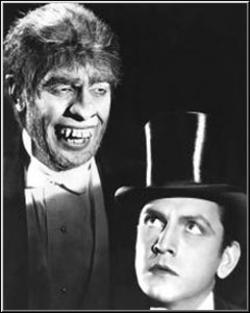
Dr. Jekyll couldn’t recreate the monstrous serum that released his Mr. Hyde. The same is true of Sgt. Bales, but we know some of the ingredients: contraband alcohol, snorted valium, steroids, and the anti-malarial drug mefloquine which can induce such side effects as hallucinations and psychotic behavior. Bales also suffered PTSD and a traumatic brain injury from multiple deployments.

When asked by a judge why he massacred the Afghan civilians, he answered: “Sir, as far as why — I’ve asked that question a million times since then. There’s not a good reason in this world for why I did the horrible things I did.” He acknowledged that he “formed the intent” of killing each victim, but he didn’t remember also burning their bodies. When pressed, he said, “It’s the only thing that makes sense, sir.”

Sgt. Bales sounds like a confused observer of his own actions. Which he is. We all are.

“Like a rider on the back of an elephant,” argues psychologist Jonathan Haidt, “the conscious, reasoning part of the mind has only limited control of what the elephant does.” Mostly we just sit on top and watch what happens, recording the bumping and jostling of our emotions and actions. We’re not steering the elephant. We just pretend we are. “Then, when faced with a social demand for a verbal justification,” Haidt says, “one becomes a lawyer trying to build a case, rather than a judge searching for the truth.”

“I thought I was doing the right thing,” Bales said after his arrest. The elephant always does the right thing, and it’s our job to prove it—to ourselves and everyone else. The counter evidence was too great for Bales’ lawyer to challenge in court, but Haidt calls us all “intuitive lawyers” defending our elephant-sized intuitions.

I picture a blind lawyer, Daredevil’s alter ego Matt Murdock, arguing why his vigilante-by-night job doesn’t make his legal career complete hypocrisy. There are a range of available justifications (failure of enforcement, police corruption, court incompetence), but none of them are the actual reason he runs around in a skintight unitard with little devil horns beating up bad guys. That’s just something his elephant does.

This sounds like a weirder form of double identity than most superheroes face, but two of Hollywood’s biggest, Batman and Wolverine, encode the same human-animal duality. Comic books stock a zoo of animal men, including, most obviously, Animal Man, and continuing down the alphabetized cages: Ant-Man, Badger, Beast, Black Canary, Black Panther, Blue Beetle, Cat, Catman, Catwoman, Chameleon, Cheetah, Crow, Green Hornet, Hawkman, Hellcat, Howard the Duck, Lizard, Man-Bat, Man-Thing, Man-Wolf, Nite Owl, Penguin, Scorpion, Sabretooth, Toad, Tigris, Vulture, Wasp, and Yellowjacket.

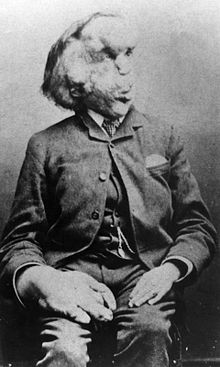
To the best of my memory and search engine abilities, there is no Elephant Man. Not unless you go back to 1884, when the deformed and destitute Joseph Merrick assumed that freak show moniker. Victorians ate him up. Even the Princess of Wales (a queen of animals?) stopped by his bedside to ogle. Advertised as “Half-a-Man and Half-an-Elephant,” Merrick believed his secret origin was the fairground elephant that frightened his pregnant mother. His doctor called him “the most disgusting ” and “degraded or perverted version of a human being” he’d ever seen.

Which explains his ticket sales. Victorians were busy being disgusted by all manner of animal men. H. G. Wells wouldn’t get around to populating Doctor Moreau’s island of half-men for another decade, but Robert Louis Stevenson began his vivisection of humanity’s animal side with his 1882 play, Deacon Brodie, or The Double Life. Professor Brodie of my English department assures me she’s only related to the real-life Deacon by marriage. Even so, you might not trust her with the keys to your home lest her inner elephant feels an atavistic urge to pillage. Deacon William Brodie was an upstanding member of his Edinburgh community until they hung him 1788 for robbing by night the homes he woodworked by day.

Stevenson took four years to expand the two-faced Deacon into The Strange Case of Dr Jekyll and Mr Hyde. The doctor is the ultimate, elephant-straddling lawyer. Jekyll has no control over what his inner Hyde does. Drink, rob, rape, murder, he’s a stampede of animal urges, and when he dies it is with a “dismal screech, as of mere animal terror.”

Victorians were screeching with terror too. Not just of Hyde, but of all such criminal degenerates hiding among their fellow Jekylls. Evolution, they believed, might be slipping backwards into the animal mud which humans had once stood so divinely above. Wasn’t Joseph Merrick’s elephantine deformities evidence enough?

220px-Joseph_Merrick_carte_de_visite_photo,_c._1889

So who will save us from these animal men? Well, oddly enough, other animal men will. Superheroes aren’t like the rest of us. Being “super” means you’re only half-human to begin with. Bruce Wayne would just be another lazy socialite, but instead of abdicating control of his inner beast, he yokes it for his own moral mission. Bat-Man is a Jekyll-controlled Hyde. Beating up degenerates keeps Bruce from degenerating into one of them.

Wolverine has to battle himself to keep his berserker rage under control too. It’s a duality we all experience. Do you just make excuses for your elephant or do you try to seize its reins? It’s scary enough admitting the elephant exists. We aren’t so different from the Victorians. Instead of Darwin skinning our animal side, we have psychologists like Haidt poking their non-rationalist sticks through our cage bars. Who wouldn’t snarl when told their moral reasoning is just ad hoc rationalizations for emotional reflexes? Who wants to work as hard as a self-cage superhero, when it’s so much easier watching from your animal’s free-ranging back?

Perhaps Sgt. Bales is just a degraded version of a human being. Maybe he doesn’t deserve life, let alone parole in twenty years (he’ll be 68). He lost his inner battle against his berserker rage. He was a mere animal when he butchered those families. He needs to be caged. I would like to believe that makes him unique, that he’s a throwback from our animal past. I would like to think other human beings, if placed in the same crucible of environment and chemical horror, would not commit the same atrocity. I want to believe I could never sit before a judge, with my lawyerly hands folded in front of me, and have to say:

“It’s the only thing that makes sense, sir.”

dr-jekyll-and-mr-hyde-auditions.3859750.40

Utilitarian Review 8/17/13

On HU

I took a week off here for the most part, but we did have one piece:

Chris Gavaler on Elysium.

Utilitarians Everywhere

I got to write about feral hippies and the new Horse’s Ha record at the Chicago Reader.

At the Atlantic I wrote about:

Geek girls and the Spectacular Now.

the fact that feminist comic books are really popular.

At Esquire I listed ten female superhero movies I’d like to see.

At Splice Today I wrote about:

Indonesia and genocide and why we shouldn’t be trusting our government to spy on us.

the seizure I had over the weekend, and why health care is so expensive.

Other Links

Interview with Mikki Kendall and Flavia Dzodan at the Hairpin about feminism and race and Hugo Schwyzer.

Jaimie Utt on Hugo Schwyzer and being a feminist guy.

Madison Moore on feeling sorry for Lady Gaga.

Subashini on awkwardness and gender.
 

homepage_large.b019f2b8

Matt Damon for President 2154

Matt Damon for Obama

“He broke up with me,” Matt Damon said about President Obama. “There are a lot of things that I really question, the legality of the drone strikes, and these NSA revelations. Jimmy Carter came out and said ‘we don’t live in a democracy.’ That’s a little intense when an ex-president says that, so he’s got some explaining to do, particularly for a constitutional law professor.”

It’s not the kind of publicity soundbite you expect from a Hollywood star the weekend his latest $100-million-budget, hope-to-be blockbuster opens. But then Elysium is fed up with the President too. His name is Patel in the movie, and his right arm is right winger Jodie Foster. Allow illegals a path to citizenship? She’d rather gun them down. Give the poor universal healthcare? She’d rather gun them down. Sure, the brown-skinned President scolds and threatens his renegade Security director, but it’s Ms. Foster and her Tea Party of drones and psychopaths keeping the 1% afloat. The gated community of Elysium orbits high above the slumlands of allegorical Earth.

Damon and his running mate, director Neill Blomkamp, deny the film is overly political. It’s mostly about boys with guns blowing each other up in new and interesting ways, same as any summer blockbuster. But the Damon-Blomkamp ticket does make some big campaign pledges:

Had enough of the Affordable Healthcare Act? We’ve got giant robotships filled with cure-anything Med-Pods, and we’re flying them down to a parking lot near you.

Annoyed with the immigration reform bills flailing around in Congress? Tap a key on your laptop and the entire population of the planet are instant citizens.

Sick of greedy CEOs exploiting employees? We’ll shoot down their private jets and pirate their brains.

Worried about the psychopaths running the drone program? We’ll slit their throats and explode their bodies in sprays of CGI blood.

Tired of lawless hoodlums looting your neighborhood? We’ll drill cybernetic exoskeletons into their skulls until they grow self-sacrificing hearts of gold.

It’s an ambitious agenda, but they promise it all not in their first hundred days in office, but in five. Because that’s all the radiated working class has left. Damon and Blomkamp even guarantee term limits. Once all that legislation is downloaded, you drop dead. No second term sequels.

Which is how Damon feels about Obama. He was a big supporter back in 2008, but now it’s conservatives playing the actor’s soundbites. Some of them must be buying his tickets too. Elysium earned $30 million its opening weekend. That’s not a landslide victory, but it’s respectable enough that the film should pull a profit once it hits foreign markets. That’s right, people outside the U.S. are going to see it. That’s how Pacific Rim rocketed out of the red too. America isn’t the exclusive pot of gold it used to be.

Elysium isn’t everything I’d want in a politically allegorical star-driven scifi action flick, but it’s a decent compromise for such a messy genre. The same is true of Obama. No, he’s not everything I want in a President, but he’s decent, and his genre is way way messier. Damon heard Jimmy Carter say last month that “America has no functioning democracy at this moment.” He meant because of NSA surveillance, something former President George Bush said he supports. If you’re the current resident of the White House, you probably don’t want either of them agreeing with you.

I don’t know if the history books of 2154 are going to agree with Damon or not. Probably the 44th President of the United States will get very mixed but ultimately if grudgingly positive reviews. Elysium will be long forgotten. Even in the shorter term, its plot is too simple, its villains too one-dimensional, its women and children too obviously in hero-motivating peril, for the film to be memorable.

But it’s not trying for memorable. It’s just a quick dip in Hollywood’s orbiting paradise before we plunge back into the grit of August. Forget democracy. All America wants at this moment is a theater with a functioning air conditioner.

elysium-firstposter-full2

Utilitarian Review 8/10/13

News

We’re going to take a week off to recharge here at HU. So we’ll be back around the 17th or thereabouts with new content. I may highlight featured archives posts throughout the week depending on how peppy I’m feeling.
 
On HU,

Featured Archive Post: Derik Badman on comics and poetry.

I argue that The Spy Who Came In From the Cole is not very good.

Walidah Imarisha with an excerpt from a short story that is going to be included in the sci-fi and social justice anthology Octavia’s Brood.

Chris Gavaler on Wolverine and superheroes never growing old.

Alex Buchet with the first part of a series on the prehistory of the superhero — in this one discussing Enlightenment notions of individuality.

I talk about Dan Clowes, the Death Ray, and superhero parodies.

Isaac Butler on “The Last of Us”, the Watchmen of video games.

Patrick Carland provides an introduction to Russian animation.
 
Utilitarians Everywhere

Kind of a crazy week for the freelancing.

I was interviewed on Weekend Edition about Johnny Cash’s Ring of Fire.

At Slate XX I wrote about how it’s in my interest as a guy to be a feminist.

One of my drawings was annexed by a hedge fund manager.

At the Atlantic I wrote about:

—how my son is unaccountably a thespian.

—why, unlike Hillary Chute, I don’t necessarily want comics to be poetry.

At Splice Today I wrote about:

—Why Walter Becker’s 1st solo album was better than Steely Dan compatriot Donald Fagen’s overrated Nightfly.

Feminists, transwomen, and gendered discrimination against men.

I wrote a piece on social media rules for teachers at the Loyola Center for Digital Ethics.

At the Goodman Project I wrote about Trayvon Martin and misandry.

Other Links

Selena Kitt on wanting to be a slut.

Mary Beth Williams on why men shouldn’t be scared of feminists.

Alyssa Rosenberg with a great reported piece on sexism in comics (HT: Isaac Butler)

Zack Beauchamp on scientism and ethics.

Why a black girl should be Wonder Woman.

Katie Ryder on white music fans being afraid of difference.
 

0000038849_500

Russian Animation

Oftentimes, there is an unfortunate dichotomy, an almost absolute divide, in animation discussions between “American” and “Japanese” styles and modes of production, as if these are the only two countries on earth. As it happens, animation is an art form with more than a century of history, and from the very earliest times some of the world’s most creative, experimental and criminally underlooked animation has come out of Russia. From the earliest days, when Ladislas Starevich’s stop-motion animations with dead insects at once fascinated and unnerved audiences worldwide, Russian and Soviet animators have used their craft for visual and artistic experimentation rarely seen elsewhere, utilizing everything from puppetry to Disney-inspired cel animation to paintings on glass to create stories that are in turns comical, abstract, tragic and life-affirming. While Russian and Soviet animation has an enormously complex and varied history (much of which can be learned from the excellent documentary film Magia Russica, released by Yonathan & Masha Films in 2004) it remains almost completely unknown outside its country of origin, except by cartoon buffs such as your dear author. So rather than launch into a specific analysis of any one stream, movement, or aesthetic style, I wish only to recommend a few exemplary works produced in the Russian tradition, works of art that deserve appreciation, enjoyment, and yes, critical appraisement as much as any work in any place. The world of Russian animation encapsulates countless facets of ideology, history, memory and emotion, and if I can convince others to become part of a discussion about it, then all the better.

Cheburashka

The cute, precocious Cheburashka is perhaps the closest thing the USSR ever had to a Mickey Mouse (although Tove Jannson’s Moomins is probably a more accurate analogy), and his antics and adventures have delighted generations of Russian children. Alongside his closest friend Gena Crocodile and forever harangued by the mischievous Old Lady Shapoklyak, Cheburashka grew from a kid’s book written in 1966 by Eduard Upensky and starred in 4 stop-motions films produced in the 70s and 80s, all of which remain popular today. The Cheburashka films have a light, unhurried feel, as well as a great deal of philosophical and introspective discourse for ostensible kid’s films. Cheburashka remains popular, and has even gained international attention as the Russian Olympics mascot throughout the past decade. Meticulously crafted and lovingly written, Cheburashka is timeless and sincere in a way few films, animated or not, even attempt to be.

Nu, Pogodi!

If Cherabushka was the Soviet equivalent to Mickey Mouse, then Nu, Pogodi! was its Looney Tunes. Produced throughout the 70s, 80s and up to 2006, Nu, Pogodi! chronicled the misadventures of a wolf named Volk as he tried (and of course, failed) to catch a hare named Zayats in a variety of outlandish and hilarious situations. Like the best Looney Tunes cartoons, Nu, Pogodi!’s relies on almost no dialogue and prefers to use the dynamism and creativity of its own characters to convey a strange, fantastical world where animals stretch and squash, gravity doesn’t always apply, and nothing is ever fatal. And like those cartoons, it is the predator, the wolf, the coyote, the hunter, who ends up earning the lion’s share of our sympathies. Sure, he’s a crazed killer bent on getting his due, but he’s such a screw-up! He’s just tryin’ to get by! And more than 30 years since their first escapades, I still hope Volk catches that rabbit someday (or something equivalent, the guy really deserves to catch a break).


The Old Man and the Sea

The 1999 adaptation of Hemingway’s classic novel, besides being a beautiful and emotional film, is a must-see if only for one reason: its stunningly original medium of production. To create the films gorgeously detailed painting style of animation, director Aleksandr Petrov utilized more than 29,000 panes of glass painted with pastels, a technique few at the time had mastered and even fewer today. Sacrificing smaller design details in favor of smooth compositions, the film truly looks like a painting in motion, something at once unbelievable, magical, and unmistakably a labor of love.

Tale of Tales

Of all the Russian animators, Yuriy Norshteyn is the only one who can make a real claim towards international recognition. If you aren’t exasperated with my hackneyed analogies yet, you could even call him the Miyazaki of Russia: in 1984, the Los Angeles Olympics Art Festival declared by vote Tale of Tales, a short, abstract film about a little wolf looking for a home, to be the greatest animated film, of any country, ever made. Beginning with a woman whispering a poem to a child suckling at her breast, Tales tackles the big themes, showing war, jealousy, growing up, selfishness, folly and love through its transient and silent imagery. A bison and a little girl play jump rope, a poet searches for inspiration, a bitter couple argue in a snowy park, a wolf wanders about through the skeleton of an abandoned house. Memories come and go, things live, breathe and die, and by the end, you don’t feel as if you fully understand what happened, but you feel better for having seen it, more alive, more human. Nostalgic, delicate and beautiful as an unsullied snow, Tale of Tales is about, Norshteyn’s own words, “the simple concepts that give you the strength to live.” Tale of Tales is like a happy memory. You can see it, you can feel it, but trying to touch it, to make it real only blurs the image. It is a drop of the past, helping you remember to live in the present.

Hedgehog in the Fog

Although I’m personally more partial to Tales, it seems unfair to mention one of Norshteyn’s masterpieces without mentioning the other. Like Tales, Hedgehog in the Fog is deeply allegorical, telling the story of a little Hedgehog who goes to watch the stars with his dear friend the bear cub, only to find himself lost in the shadowy world of an immense fog. Following him is a sinister eagle-owl who represents the danger of the fog; silent and scary, the eagle-owl remains on the periphery of the hedgehog’s vision, an unspeakable fear that cannot be shaken off. And yet, the hedgehog remains curious; he willingly explores the fog, meeting a friendly dog, a beautiful white horse, and a whispering catfish before finding his bear cub friend and the warmth and comfort therein. The fog is impenetrable and treacherous, beautiful and imposing; nothing is certain about it. And yet, the hedgehog presses forward, knowing that even if he does not know where the fog ends and begins, somewhere is his friend, with a warm cup of tea, kind words, and a place to watch the stars. Rated the top animated film of all time in the 2003 Tokyo Animation Festival and praised by Hayao Miyazaki himself, Hedgehog in the Fog is, like Tales, deceptively simple; even with its heavy allusion and symbolism, it is the word of someone exploring the human condition, of the human seeking their place in a fog they cannot grasp, and finding it in the warmth and care of others. It is a gentle reminder to take of ourselves, and of one another, and of the world around us. Even in the fog, with danger nearby and the unknown all around, there is always some reason to push forward, something to discover, somebody to love.