Alien Narratives

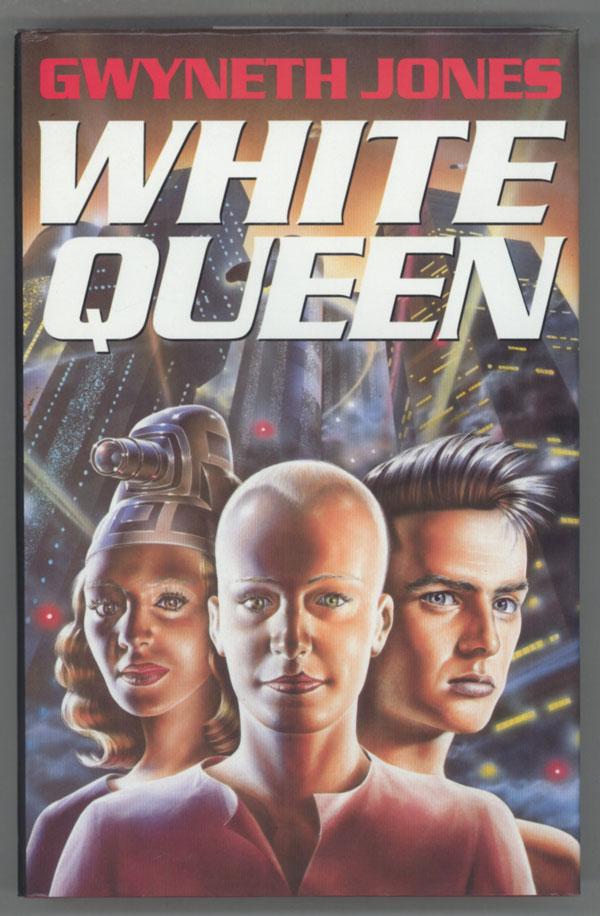
139906In Gwyneth Jones’ White Queen, a near future earth is invaded by a handful of aliens, called Aleutians. The Aleutians look almost exactly like humans. This results in confusion. On the one hand, the Aleutians themselves — who all share a kind of genetic consciousness with each other and their ancestors and their tools — assume that humans, too, are part of the one collective, and so are beings exactly themselves. On the other hand, the humans assume that the Aleutians are radically different from themselves — super-powered conqueror-saviors.

In Decoding Gender in Science Fiction, Brian Attebery argues that this split is indicative of, and thematizes, two of science-fictions strongest tendencies. On the one hand, science-fiction projects the self onto the cosmos — it turns space and time, future and past, into human metaphor. At the same time, science-fiction is built out of separating the self and the other, human and alien. The genre is therefore both obsessively totalizing and obsessively binary.

What Attebery does not say, but which seems clear upon reading White Queen, is that the misunderstanding between Aleutian and humans is deliberately replicated in the experience of reader and text. Attebery’s description of the book, his isolating of its metaphors and themes, is very lucid — but reading the book is anything but. Rather, both Aleutians and humans remain, throughout the course of the novel, a mystery, or a riddle, or often a joke. Both Aleutian and human society come into focus to some extent — you realize that Agnes, the first alien we see, is not actually a girl, for example; you learn more or less the nature of Johnny Guglioli’s disease. But is the Aleutian homeworld a ship behind the moon? Does that question even make any sense? Why in the last pages of the book does the human diplomat Ellen but on fake breasts and buttocks when she last meets with Agnes (now named Clavel) and why does he take that as a reprimand? What does happen to Braemar and Johnny after their first faster than light trip? Did they even go on a faster than light trip? What is the deal with the alien’s sanitary pads? And so on and on; like the aliens, or the humans, the book seems to tell you things only to emphasize its unknowability.

Eve Sedgwick argues that realist novels function as a kind of bargain of knowledge and power. The author reveals the world to the reader; in exchange for the reader’s belief in the authors knowledge, the reader is granted the same omniscience, the same sense of knowing. If that’s the case in realist fiction, it seems even more the case in sci-fi. You enter Jones’ novel knowing nothing; your map of the world is useless and even, in terms of the aliens, worse than useless. But as you read you know…and even the not-knowing is a kind of guarantor of knowing, the way that the photograph cut off by the frame is a guarantor or earnest that the rest of the world must be there. The Aleutians are more real because they are strange and you can’t know them; which is to say your not-knowing ensures the worth of what you know. The totalizing experience of the fiction is made more total because of the bifurcated strangeness; or, if you prefer, the bifurcated strangeness is enabled by the illusion of totality.

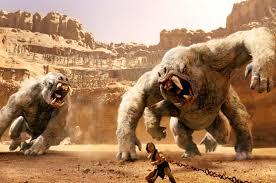
You can see this mechanism at work, too, in stories with what you might call meta-frames. The film John Carter is one; the hero flies across the cosmos to another body and another world of adventure, leaving behind only a diary to be read by his mousy relation. Octavia Butler’s Kindred is another; a black woman in the 1970s inexplicably finds herself falling backwards in time to the early 1800s, called back to involuntarily help her white slave-owning ancestor. In both these cases, the protagonist’s journey enacts both the immersive experience and the alienating strangeness of narrative; the sense of exhilarating, horrified disconnection (as when John Carter discovers his jumping ability on Mars), and the sense of exhilarated, horrified belonging. (as when Dana realizes she is beginning to think of the slave plantation as home.)

It’s perhaps telling that one of the last things Jones tells us about the aliens in White Queen is that we don’t know how they read.

Whatever the Aleutian did to serve as “reading,” it didn’t work like the human version. Perhaps his eyes sent out little mote to reconstruct, chemically, the ur-hieroglyphics behind the letters: something mind-boggling like that. Their physiology, especially the neurological part, was a bizarre mystery.

The joke (and Jones is almost always joking) perhaps being that human neurology is, also, pretty much a bizarre mystery — in describing their unlikeness to us, she is describing their likeness — and doing it even as we, Aleutians and non, read and understand, and don’t understand our understanding (or, for that matter, our not understanding.)

Not understanding the Aleutians reading is very similar to the way that the humans do not understand the Aleutian telepathy — a telepathy which Jones suggests may be more like non-verbal cues, or plot devices, or watching a silent movie, than like actually reading thoughts. Perhaps, too, as I’ve suggested, telepathy might be like reading, or any other entertainment delivery system, where another’s thoughts become your thoughts in a sharing of the minds. Such sharing can be a radical, totalizing sameness, or a radical recognition of difference and alienation. The two consciousnesses become one, or the unified one recognizes its own internal difference. The alien is recognized as the self, and/or the self is recognized as alienated. Every fiction is an Aleutian, the us that is and isn’t.

A Suicide Pact: Means and Ends in V for Vendetta and The Rebel

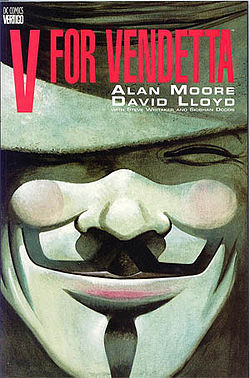
250px-V_for_vendettaxV for Vendetta, despite its pulp adventure plot and its stark propaganda, is not a morally simple book.  The baddies, the fascists, are depicted as complex human beings with motives of their own, and sometimes even a kind of decency. V’s nemesis, Eric Finch, for example, is described in the text as “a policeman with an honest soul.”  The hero, V, on the other hand, engages in any number of cruel and despicable acts — from systematic and serial murder, to the deliberate manufacturing of food shortages by sabotage, to torturing his young protégé, Evey Hammond, for the sake of producing a kind of conversion experience.

Isaac Butler, in his essay “V for Vile,” enumerates these and other various sins, both political and moral, at some length — writing, at times, not so much about the book as against it.  In the comments to that post, others, such as Mike Hunter, counter that the character V may be reprehensible but the book implicitly condemns him and his actions.  He notes, for instance, that V describes himself in the first chapter as “the villain” and is elsewhere identified with “the devil.”  Such a defense, however, risks converting V for Vendetta  from an anarchist book to an anti-anarchist book, one that can comfort timid liberals by equally condemning both political extremes.  That reading not only undercuts Alan Moore’s stated intention (which may not be that important), it also ignores the story’s pervasive atmosphere of moral ambiguity, renders the ending arbitrary, and worst of all, prevents us from grappling with the genuine philosophical problems that the book poses.

Chief among these problems is, what may be the largest question in political philosophy since the time of Machiavelli, that of unjustifiable means.  A great deal of evil has been done on the theory that some good will result, but looking back over history, it seems hard to defend the idea that the overall results have been good.  And yet — what if evil means are the only ones available?  More precisely, what if the means that might achieve our ends also contradict them?

In The Rebel, Albert Camus explains the paradox:

“If rebellion exists, it is because falsehood, injustice, and violence are part of the rebel’s condition.  He cannot, therefore, absolutely claim not to kill or lie, without renouncing his rebellion and accepting, once and for all, evil and murder.  But no more can he agree to kill and lie, since the inverse reasoning which would justify murder and violence would also destroy the reasons for his insurrection.”

One kind of solution, among the many that Camus considers, is that of the Russian terrorists who stand “face to face with their contradictions, which they could resolve only in the double sacrifice of their innocence and their life.”  These martyr/assassins

“were incapable of justifying what they nevertheless found necessary, and conceived the idea of offering themselves as a justification. . . .  A life is paid for by another life, and from these two sacrifices springs the promise of a value. . . . Therefore they do not value any idea above human life, though they kill for the sake of ideas.  To be precise, they live on the plane of their idea.  They justify it, finally, by incarnating it to the point of death.”

V is a terrorist of this mold.  And so he plans his own murder — at the hands of the police detective Finch — just as meticulously as he planned his campaign of sabotage and assassination.  V does, as Camus suggests, incarnate his idea to the point of death, but only so that the idea may survive: “Did you think to kill me?  There’s no flesh or blood within this cloak to kill.  There’s only an idea. Ideas are bulletproof.”

The idea of Anarchy does live on as, in a sense, V himself lives on — but in a new form, and in the person of Evey Hammond.  Evey takes on the role of V, the mask and cloak, but her mission and her methods are different.  She reflects:  “I will not lead them, but I’ll help them build.  Help them create where I’ll not help them kill.”

Evey’s new direction — her move away from violence — is only a renunciation of V’s methods, not of his vision, or even his plan.  It is, in fact, the culmination of the latter.  Earlier in the book, V himself acknowledged:

“Anarchy wears two faces, both creator and destroyer.  The destroyers topple empires; make a canvas of clean rubble where creators can then build a better world.  Rubble, once achieved, makes further ruins’ means irrelevant.

Away with our explosives, then!  Away with our destroyers!  They have no place within our better world.  But let us raise a toast to all our bombers, all our bastards, most unlovely and most unforgivable.  Let’s drink to their health. . . then meet with them no more.”

V’s dilemma, awful as it is, is that the methods that bring the new world into being stand in contradiction to the world they help create. Camus spells it out:  “The terrorists no doubt wanted first of all to destroy — to make absolutism totter under the shock of exploding bombs.  But by their death, at any rate, they aimed at re-creating a community founded on love and justice. . . .”  Unfortunately, people who employ such methods may themselves be unsuited to live in the world they have helped to win. As  Evey reflects, echoing V’s own words: “The age of killers is no more.  They have no place within our better world.”  The answer lies in V’s death.  He must die so a new world can be born, a world where he is not needed and would not be welcomed.

V is vindicated, paradoxically, because he is condemned.  V, the murderer, accepts his own murder in turn.  And Evey — now, pointedly, “Eve” — becomes a new V, creator rather than destroyer.  Violence is justified by the renunciation of violence.  It is that renunciation that qualifies Evey for the new society, that justifies her efforts to build it.  But V’s renunciation of violence is his suicide.

Camus’ solution to this dilemma — or rather, his resignation to it — was altogether more pragmatic, and more forgiving:

“Thus the rebel can never find peace. . . .  The value that supports him is never given to him once and for all; he must fight to uphold it, unceasingly. . . .  His only virtue will lie in never yielding to the impulse to allow himself to be engulfed in the shadows that surround him and in obstinately dragging the chains of evil, with which he is bound, toward the light of good.”

Camus, lyrically, leaves us with an image of the human condition:  a solitary figure, bound in chains, surrounded by darkness, struggling toward freedom.  As with his final view of Sisyphus — “The struggle itself toward the heights is enough to fill a man’s heart.  One must imagine Sisyphus happy.” — the image of the rebel is, perhaps, an optimistic one.  For it suggests that we can resist the shadows, that the chains that bind us do not deform us with their weight, that we can recognize the light and do not grow blind in the darkness.

Camus suggests that struggle is possible, even where innocence is not, that we can assert our dignity even when we have not yet won our freedom.  It is an ideal of heroism, not one of purity.


Bio

Kristian Williams is the author, most recently, of Hurt: Notes on Torture in a Modern Democracy (Microcosm, 2012).


Twihard

tsbd2_TC_ZAFRINA_ss_RGB_FIN

Twilight: Breaking Dawn Part 2
Director – Bill Condon
Starring – Rob Pattinson
Kristen Stewart
Taylor Lautner
Michael Sheen
Dakota Fanning

I should start this post by noting that, prior to Breaking Dawn Part 2, I had never seen a Twilight movie or read any of the books. What little I know about Twilight comes from a handful of online articles, blogs, and pestering my girlfriend with questions about who everyone is what the hell they’re doing. But despite my ignorance, or maybe because of it, I enjoyed the hell out of this movie.

Twilight: Breaking Dawn Part 2 is, of course, the last movie in the incredibly popular Twilight series. I doubt a synopsis is necessary since everyone reading this blog probably knows more about Twilight than I ever will. So I’ll briefly note that the movie resolved the cliffhanger at the end of Breaking Dawn Part 1 (Bella Swan survived childbirth and is now a vampire, she and Edward Cullen had a baby daughter named Renesmee) and it ended with the Volturi (the bad vampires) agreeing to leave the Cullens alone. Everyone lived happily ever after, or at least until Stephanie Meyer needs more money.

If I judged the film according to the usual measures used by movie reviewers I would have to give it a negative review. I’ll concede that some of my confusion with the plot may be due to my lack of background knowledge, but characters behaved in ways that are inexplicable under any circumstances. For example, if vampires can run across continents at super-speed, why do the Cullens drive everywhere? Why does Bella drive her damn Volvo all the way to Seattle to meet Bunk from “The Wire” when that conversation could have been handled over the phone? And why does Edward just seem to resign himself to the idea that Jacob will be banging his daughter in the near future (and I get the whole imprinting thing, maybe it works in the books, but it’s damn creepy on the screen)? Doesn’t Edward hate Jacob, and if so why does he let the guy hang around his house?

The long middle section of the film was a ripoff of the sequence in “Seven Samurai” where the hero assembled a team of badasses. There’s nothing wrong with ripping off Kurosawa, but there’s not much of a payoff. The collection of badasses actually don’t get much to do and half of them don’t even have speaking roles. The only amusing thing about them was the film’s shameless reliance on ethnic stereotypes. The Amazonian vampire women were particularly ridiculous. I assume they were suppose to come from a primitive tribe in the jungle, but the filmmakers defined “primitive” to mean dressed like rejects from a mid-80’s music video. I started humming “Hungry Like the Wolf” whenever they were on screen.

And the acting by the leads was atrocious. Kristen Stewart and Rob Pattinson are not novices: they’ve acted in four previous Twilight movies and plenty of other films on the side. So I was floored by just how bad they were. Pattinson fluctuated between looking bored and looking constipated. Stewart wasn’t much better, and she delivered nearly every line without conviction or emotional tone. And her narration was even worse! She was so disinterested in her lines she might as well have been reading an instruction manual for assembling furniture. And their romantic chemistry was about as exciting as watching someone assemble furniture.

The special effects looked second-rate too. I could go on and on about the werewolves, but the worse example of CGI was the digital face layered on the baby. It was so fake and poorly done that she looked like a monster. Baby Renesmee was far creepier than any of the vampires or werewolves.

so Breaking Dawn Part 2 is a bad movie in most respects, though that hardly matters to most Twihards. And to be honest, I enjoyed the movie far more than I thought I would. In fact, I’m pretty sure I enjoyed it more than my girlfriend did, and she’s read every book. Some of the entertainment value comes from the badness itself, which turned serious scenes into unintentionally hilarious moments. My favorite example was when Jacob decided to reveal his werewolf nature to Bella’s father, Charlie.* Rather than explain what he’s about to do, thereby giving Charlie some mental preparation, Jacob started stripping in front of Charlie while saying (something along the lines of) “The world is not what you think it is!” And poor Charlie reacted as if he was about to have a gay surprise in the woods. I’m not sure if the scene is in the book, if it is perhaps it’s less homoerotic on the page, but on the screen it was a laugh-out-loud moment.

But I have to give the filmmakers some credit, as there are plenty of scenes in the film that could only have been intended as comedy. There is no other explanation for Bella’s response when she learned that Jacob had given her daughter the nickname Nessie. I refuse to believe that the line “You nicknamed my daughter after the Loch Ness Monster!” was intended as anything other than comedy gold. Intentionality aside, that scene should be stored in the AFI vault because that is the greatest line in film history. Michael Sheen’s reaction when he first met Renesmee was almost as fantastic, particularly when he unleashed this incredible sound that resembled a girlish squeal mixed with a giggle. It was probably an improvised moment, but kudos to the filmmakers for leaving it in.

The battle scene was surprisingly cool as well. The entire battle was a dream sequence/possible future that never occurred, and everyone who died in the battle was still alive at the end of the movie (except for Maggie Grace). It was gratuitous violence that added nothing to the plot and shamelessly pandered to the worst instincts of the audience. And I’m okay with that. After sitting through more than an hour of what passes for acting in this movie, a sudden burst of psycho violence was a welcome change of pace. And how can I hate a movie with such a high character-to-decapitation ratio? Dakota Fanning had her head bitten off by a giant dog! Alice kicked insane amounts of ass and that one Volturi got half his head ripped off starting from the cheeks (I don’t remember his name, but he’s the one who yelled “Artifice!” which was the second greatest/craziest line in the movie). Even Bella and Edward were awesome when they tag teamed Aro. Though as much as I enjoyed the battle, I have to admit that the level of violence was shocking for a PG-13 movie. Apparently, if there’s no blood spurt then on-screen decapitations are perfectly appropriate as tween entertainment. As for the lack of pumping blood, is that from the novels or is it an innovation by the filmmakers?

Twilight: Breaking Dawn Part 2 is either the greatest bad movie of 2012 or just a shitty movie with 3 or 4 brilliant moments. I’m tempted to watch the earlier films just to see if they’re equally terrible/awesome, though I’ve been warned that they’re not as fun. Or maybe I should just swallow my pride and read the damn novels. What say you commenters, are they worth it?

______________
* This was the moment when I decided that I was with Team Edward. Edward may be dull as dirt, but Jacob is an obnoxious meddler. And the pedophile vibe doesn’t exactly help matters.

Jack Kirby and the Visual Logic of Superheroes

Stan the Man

Part 1: What Is A Fight Scene?

Fighting is to superhero comics what fucking is to pornography, or singing to musicals: the raison d’etre, the sine qua non, the whole kit and kaboodle. It’s why skeevy guys creep around in trenchcoats with a box of tissues, bottle of lube, and a very special life-sized doll named Candy; or why other people watch porn or musicals.

All three genres demand that character, motivation, theme, incident and conflict be expressed in distinctive forms. In musicals, it’s song; in porn, it’s, well duh; and in superhero comics, intra- and inter-personal conflict above all else must be expressed and resolved through physical conflict. In other words: the fight scene.

Few cartoonists have understood this more than Jack Kirby, whose superhero comics, especially from the 1960s and onwards, are positively drenched with fight scenes. We can see this by comparing Kirby’s 1960s work for Marvel with some roughly contemporaneous superhero comics published by Marvel’s chief competitor, DC. Take, for instance, the Superman comics produced by Curt Swan, Kurt Schaffenberger, Wayne Boring and others, under the tyrannical editorship of Mort Weisinger. There are vanishingly few fight scenes in these comics; Superman himself rarely gets to punch anything, which makes a certain kind of sense — since he is, after all, essentially invulnerable and nearly omnipotent, how could he possibly get into a fight that lasted more than three panels?

Panel one: bank robbers running out of Metropolis First.

Panel two: Superman swooping down to punch them into submission.

Panel three: Metropolis’ streetsweepers and janitors scrubbing splatters of brain and flesh off the street.(1)

It’s surely no coincidence that, of Superman’s cast of recurring villains, only a handful are memorable, and of those, two are defined entirely by their intellect — evil scientist genius Lex Luthor and evil alien genius Brainiac (!).

By contrast, the superpowers of many of Kirby’s chief 1960s characters are  desultory, a thin excuse to motivate fighting, fighting, and more fighting. Consider: Thor is a strong guy with a hammer that he uses to beat the crap out of people. Captain America is just a normal guy (more or less), with a shield that he uses to beat the crap out of people (2). The Hulk is a strong guy with a, well, he just uses his own fists to beat the crap out of people. The  Hulk’s whole power just is beating the crap out of people.

But we can say a little more about the visual logic of superhero comics than just “there is one”, and we can do so by thinking about the structure of a fight scene as abstractly and generally as possible. For what, exactly, is a fight scene? A scene with a fight, of course, but what does that actually mean? At the most abstract level, we can conceptualise a fight scene — in the narrow genre of superheroes, or any other kind of comic — as a sequence of aggressive or defensive actions and their effects — more precisely, a fight scene is

a sequence of events caused by the aggressive and defensive (and other) actions of two or more combatants

This needs some unpacking, so I’ll take you through it, in reverse order.

of two or more combatants
250px-Brave_bold_28

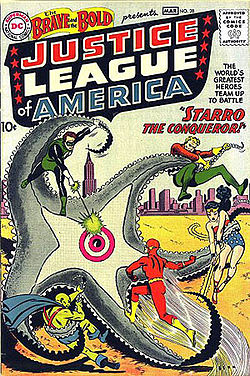
the Justice League battle Starro the giant starfish, from Brave and Bold #28 by Mike Sekowsky


The participants in a fight scene can be people, but they can also be animals, robots, zombies or anything else that can act — that can take action of one kind or another. In the simplest case, we have just two participants fighting, but superhero fight scenes — particularly so-called “team books” like The Avengers or Justice League of America — routinely feature three or more combatants. Where there are more than two participants, they can be distributed in any number of ways; that is to say, it could be one versus two, one versus three, two versus two, two versus one versus one… In principle there is no upper limit to how many combatants can participate in a fight scene, but in practice there are vague limits imposed by constraints like the size of a page, the quality of reproduction in printing, and the reader’s (and the artist’s!) patience.

events caused by the aggressive and defensive (and other) actions

In a fight scene, at least one participant is trying to damage, somehow or other, at least one other participant, who may be trying to damage the other in turn, or to flee, or merely to avoid damage, or to do any number of other things (but usually one of those three — fight back, flee, or avoid damage). At each stage, what happens depends on the actions of both combatants — what each of them is doing.

When somebody is trying to damage somebody else, let’s label the respective parties Attacker and Victim. In a fight scene, the Attacker makes an attack on the Victim — that is, Attacker takes some kind of aggressive action against Victim, such as throwing a punch, shooting a gun, firing a laser… The Victim also does something — dodges, projects a force-field, just stands there… What happens to Victim depends both on what Attacker has tried to do and what Victim tries to do (where doing nothing counts as a kind of doing something).

If Victim tries to dodge, then Attacker’s kick might miss. If Victim throws up her shield in time, Attacker’s laser might bounce off. If Victim does nothing to defend himself (perhaps he doesn’t know he is under attack, or perhaps he tries to retaliate without trying to avoid Attacker’s attack), then the attack might make contact. But even when an attack “lands”, what  that actually means will depend, again, on the nature of Attacker’s attack and on what Victim is like. If Attacker has fired a bullet that hits Victim, it will have very different effects depending on whether or not Victim is wearing, say, a Kevlar vest.

a sequence

Fight scenes typically involve more than one thing happening — Batman punches the Joker, who then squirts back with acid from his trick flower, which Batman dodges while kicking out at the Joker, who topples… This is the prototypical kind of fight scene, in which two participants alternate between the roles of Attacker and Victim. First A attacks B, then B attacks A, then…

In principle, each action taken by Attacker and Victim could be depicted in their own panel, but usually an artist will collapse the panels (3) to one of four patterns:

1) Attack-Effect Dyad. Two panels, the first showing Attacker’s attack, and the second showing Victim’s action and the attack’s effect on him — e.g. panel one shows Attacker firing a gun at Victim, and panel two shows Victim successfully jumping out of the way so that the bullet whizzes past.

2) Attack Monad. One panel showing Attacker’s attack, with the resulting effect left off-panel, to be inferred by the reader as following this panel  — e.g. we see Attacker firing a gun at Victim, who may or may not be shown (as yet unaffected by the attack) in the same panel.

3) Effect Monad. One panel showing the effect on Victim, with the initiating attack by the Attacker left off-panel, to be inferred by the reader as occurring before this panel — e.g. we see the Victim successfully dodging the bullet, which we infer to have been fired by Attacker immediately beforehand.

4) Attack-Effect Monad. One panel showing both Attacker’s and Victim’s actions, and the resulting effect on Victim — e.g. we see Attacker’s punch making contact with Victim within a single panel.

Naturally, an artist can use any combination of these patterns over the course of a fight scene, sometimes using one pattern and sometimes another. I’d guess — but I don’t have any figures to back this up — that the most common pattern, at least in American comics, is the Attack-Effect Monad, especially with fight scenes involving direct melee between combatants. Most fight scenes simply don’t parse action finely enough to differentiate between the moment when Attacker throws (say) her fist out in front of her at Victim and the moment when her fist actually makes contact with Victim. Instead, the easiest solution for most fight scenes is just to show everything all together.

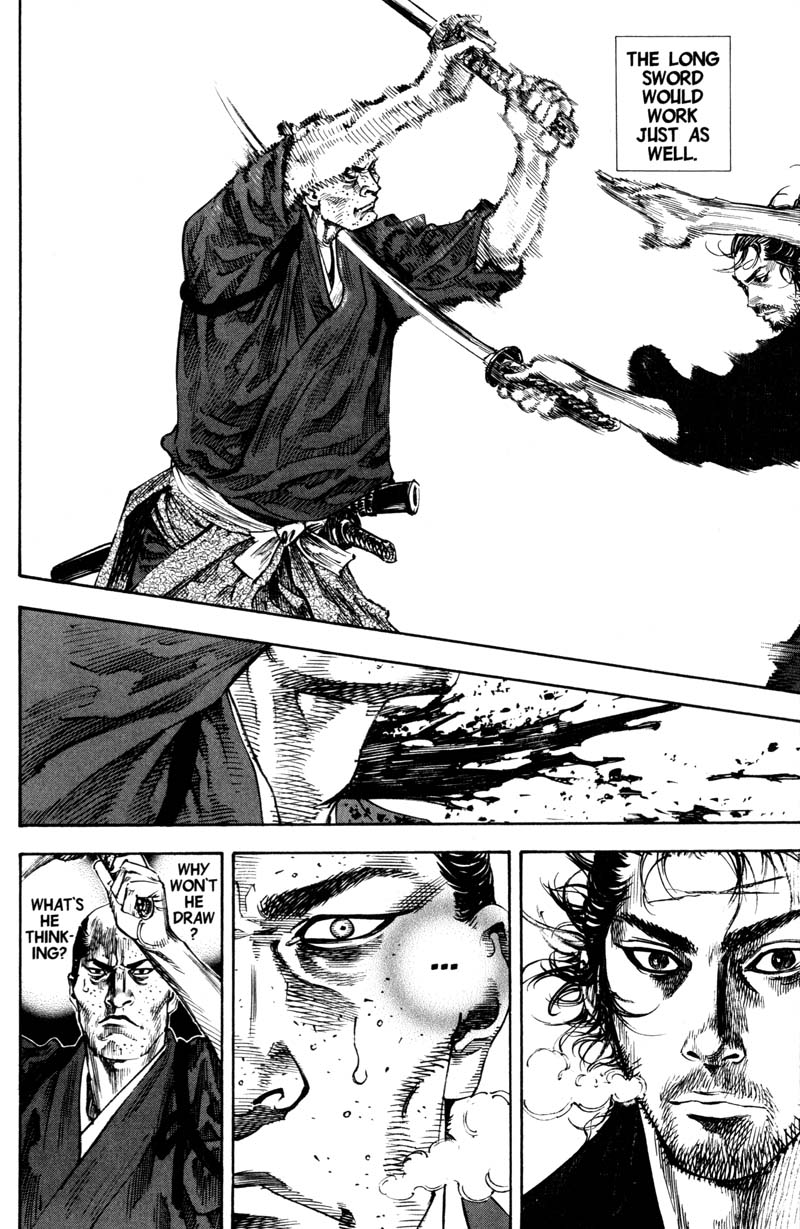
As with the number of participants, there is no upper limit to how long a fight scene can take. The Cerebus volume Reads has a remarkable fight sequence lasting for dozens of pages; Takehiko Inoue’s samurai manga Vagabond notoriously teases fight scenes out for hundreds of pages (although, to be fair, much of that does not involve actual fighting so much as flashbacks or other representations of the combatants’ streams of thought).
vagabond-04

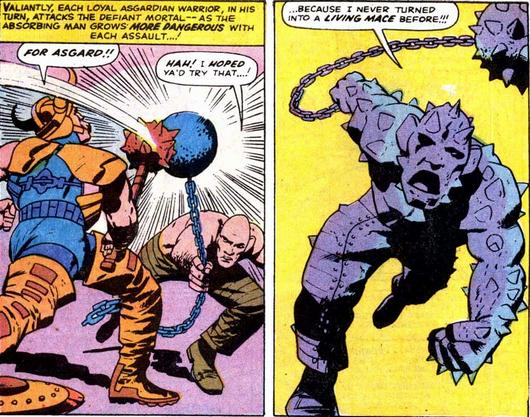
Kirby’s fight scenes can sprawl as long as an entire issue of twenty pages or more, although usually there will be some interruptions, such as a crosscut to a separate scene elsewhere. A fine example is the fight between Thor and the Absorbing Man in the main stories of  Journey Into Mystery #121-#123. The entire sixteen pages of #121’s main story is given over to the fight, with a brief interruption in panels 3-6 on page 5 and panels 1-2 on page 6, in which we cut to Asgard and Loki (who has orchestrated the fight). The fight then continues in #122 from page 1 to the second-last panel of page 3, where we cut again to Loki who magically transports the Absorbing Man to Asgard. There the Absorbing Man fights basically the whole of Asgard, and eventually Thor again, until roughly page 10 of #123 (4).
JIM122_AbsorbingMan

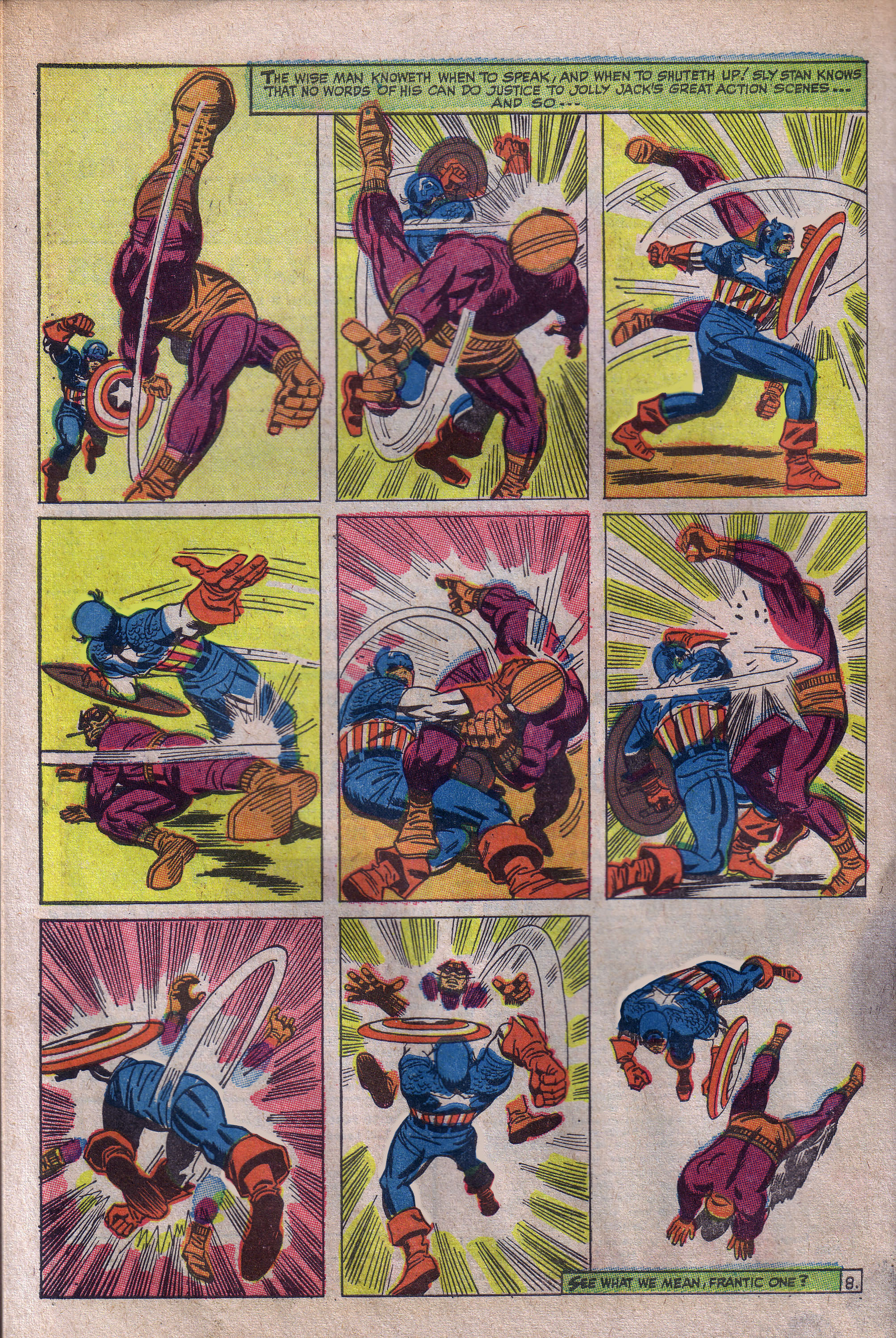
As an illustration of this formal structure, let’s do a quick close-read of another Kirby fight scene, and specifically a single, famous page from Tales of Suspense #85, inked by Frank Giacoia and lettered by Sam Rosen, with two captions by Stan Lee. (The comic doesn’t credit a colourist, and the listing at comics.org leaves it unknown). In this sequence we see a fight scene between Captain America and Batroc the Leaper (or, to give him the pantomime-French title favoured by Stan Lee and his later epigones, Batroc zee Leapair), which breaks down as follows:
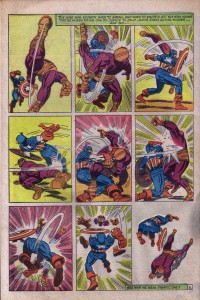
cap v batroc

Panel 1: First panel in an Attack-Effect Dyad. Batroc and Captain America are, each of them, both Attacker and Victim.

Panel 2: Second panel in the Attack-Effect Dyad, showing the effects of their respective attacks in panel 1. Again, each character is playing the role of both Attacker and Victim.

Panel 3: Attack-Effect Monad. Captain America is still Attacker but no longer Victim, while Batroc is now just Victim. We see Captain America’s attack and its effect on Batroc.

Panel 4: Attack-Effect Monad. Roles are reversed, with Batroc now Attacker and Captain America Victim.

Panel 5: Attack-Effect Monad. Roles reversed again, Captain America attacking and striking Batroc.

Panels 6-8: As with panel 5.

Panel 9: A breather — no attacks.

So I think this is a helpful way to think about the formal structure of a fight scene, in any genre: it’s a sequence of events caused by the aggressive and defensive (and other) actions of two or more combatants. But  I really don’t know anything about proper comics theory, so please let me know in comments whether I’ve reinvented the wheel with my formal description of a fight scene above. If anything, I’ve probably reinvented the wheel, only this time it’s square and doesn’t turn very well…

In Part 2 of this essay, I’m going to talk about how this structure constrains the imaginative space of superhero comics, using Kirby’s The X-Men as an especially vivid case-study. So, come back next time, true believer, for more hot fucking action the Marvel Way. Excelsior!

ENDNOTES

(1) Although this scene doesn’t occur in any actual Superman comic, it does occur in roughly 98% of post-Watchmen superhero revisionist comics.

(2) Well, Captain America was actually created by Kirby and Joe Simon in 1941. But the 1960s revival was Kirby’s third-longest work in that decade, after Fantastic Four and Thor, so he certainly counts as one of Kirby’s chief characters of that decade.

(3) Just for the sake of convenience, I’m assuming that fight scenes are drawn in a standard panel lay-out, with one moment per panel. Things are a little more complicated when you have panels showing more than one moment in the same space, or ill-defined panels, but the basic idea is the same.

(4) I say “roughly” because it’s debatable whether the fight proper ends there, or three pages later when we see the final result of Odin’s magically expelling both Loki and the Absorbing Man into space. Debatable, but not really debate-worthy, you know?

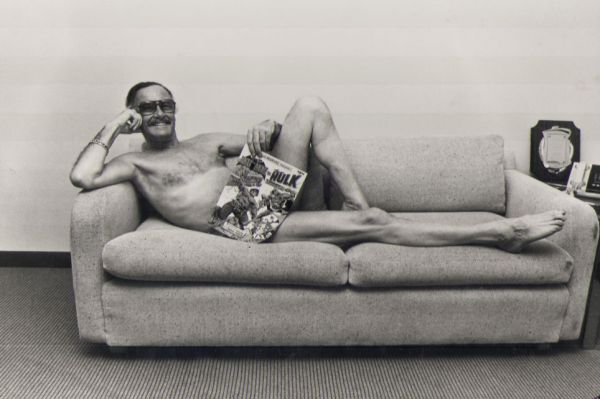
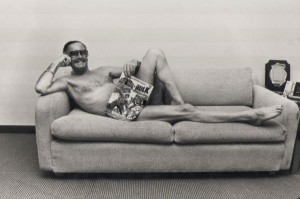
IMAGE ATTRIBUTION: Stan Lee centerfold from Sean Howe’s tumblr for his book on Marvel. Captain America v. Batroc, credits as above; I took the image from Eddie Quixote’s Campbell’s post “The Literaries”. [Other images grabbed by Noah, who is less careful about documenting these things — so blame him, not Jones.]

Superpowered Sex Offender

fermata

“I have the power to drop into the Fold,” Arno Strine tells us on the first page of his autobiography. All he has to do is push “my glasses up on my nose Clark Kentishly,” and “I am alive and ambulatory and thinking and looking, while the rest of the world is stopped.”

It’s an unusual superpower, one possibly due to his being born with a knot in his umbilical cord which required him “to form a loop and then pass right through it.” Also his job transcribing taped dictation, “starting and stopping so many thousands and thousands of modest human sentences-in-progress with my foot-pedal,” may have honed his time-pausing powers.

Being “a thirty-five year old male temp who has achieved nothing in his life” is a pretty lackluster existence for one of the most powerful human beings on the planet. But like so many who maintain alter egos, Arno wants to keep his superpowered life “a secret, and as a result it has swallowed up large chunks of my personality.” What superhero can’t relate?

Aside from a couple more intentionally bogus origin stories, Arno does purport to being “guided by a will greater than my own” and even theorizes “the reason I have been chose over any other contemporary human to receive and develop this chronanistic ability (if there is indeed some supernatural temp agency doing the choosing) is maybe that I can be trusted with it.”

And for the most part, Arno really is a trustworthy guy. “Fear” is his “least favorite emotion,” and he wants “to be responsible for creating as little of it as possible.” He doesn’t even like using his powers against his own would-be muggers, and as penance he spends an afternoon “performing acts of lite altruism,” including “collecting concealed handguns off anyone who looked under thirty” and disposing of them (forty-four in all) in newly poured cement.

“I have never deliberately caused anyone anguish,” Arno reports. He literally wouldn’t hurt a “grub” or want to cause “trouble for any living thing.”Or, for that matter, a non-living thing such as the bookstore paperback he purchases because he wrote in it while in the Fold. Other would-be Fold-users might enrich themselves as spies and thieves, but he can’t bring himself to steal a dollar from a cash register. He sincerely wishes to do no harm to anyone. “The last thing in the world I want,” he tells us, “is to be seen as a threat.”

So what’s this swell guy’s one and only downside?

He’s a rapist.

Or, to be fair, he’s something that doesn’t have a name. Because what do you call a man who while in the Fold, undresses women, gropes them, and, in at least one case, ejaculates on their unaware bodies?

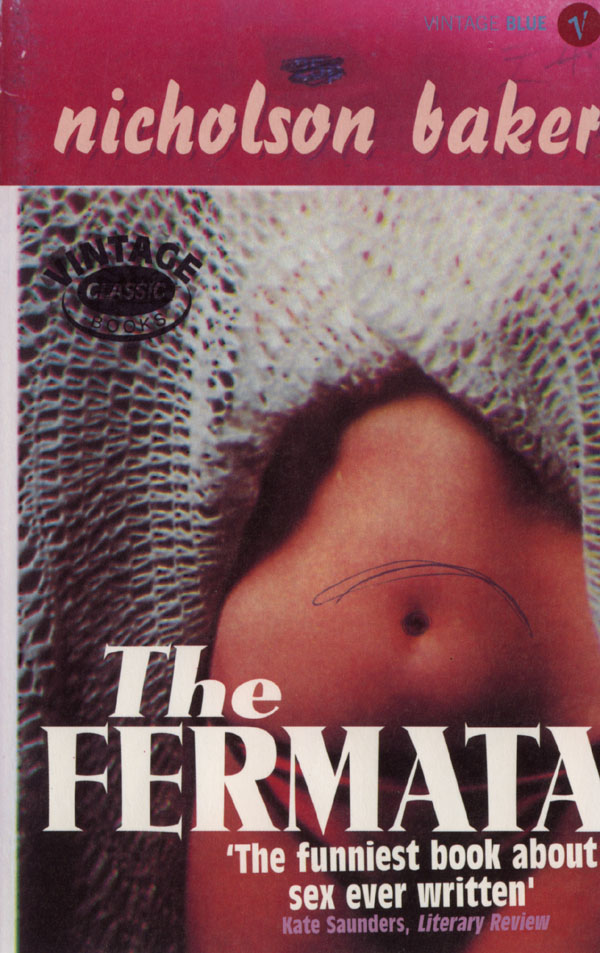
It was not, by the way, a supernatural temp agency who bestowed Arno’s “time-perversion” powers. It was Nicholson Baker. Arno doesn’t live in a comic book or, more plausibly, a Penthouse comic strip.  He’s the narrator of Baker’s 1994 novel, The Fermata. (That’s just two years before the collapsing Marvel Comics finally filed for bankruptcy protection after farming its pantheon to temps, and so a fitting backdrop for such a morally bankrupt novel.)

Which is not to say The Fermata (another term for the Fold) is a bad novel. Baker is an excellent writer (my wife teaches his Lovecraft homage to gothic potatoes), and when not falling victim to the contrivances of their pornographic plots, Arno and his fellow characters are rendered with stylistic brilliance.

But, unlike Oscar Wilde, I do believe art can also be judged in moral terms. All art is propaganda, and The Fermata advocates for a way of thinking that gets a lot of women raped.

University of Rochester Professor Steven Landsburg recently blogged in response to the rape conviction of two high school football players in Steubenville, Ohio: “As long as I’m safely unconscious and therefore shielded from the costs of an assault, why shouldn’t the rest of the world (or more specifically my attackers) be allowed to reap the benefits?” Landsburg notes that the “Steubenville rape victim, according to all the accounts I’ve read, was not even aware that she’d been sexually assaulted until she learned about it from the Internet some days later.” Since there was “no direct physical harm – no injury, no pregnancy, no disease transmission,” Landsburg asks,  “Ought the law discourage such acts of rape? Should they be illegal?”

Students of Rochester have answered with a resounding YES!  They are protesting outside Professor Landsburg’s classroom and petitioning the administration to censure and/or fire him.

According to national statistics, at least 1 in 4 women are sexually assaulted while at college. My school’s rate probably isn’t much higher. Though when the women in questions are the ones sitting in my literature classes, the statistic isn’t abstract.

Their male assaulters sit in front of me too. They seem like good guys. In fact, they are good guys—friendly, bright, engaged, funny, sincere, all-around well-intentioned young gentlemen who on occasion will rape their fellow classmates.

By rape I mean, for the most part, render unconscious and sexually penetrate. A behavior which, amazingly, horrifically, unfathomably, they do not register as morally repulsive. Somehow many of these young men do not realize that sex with an unconscious body is not sex. They do not understand that sex without consent is rape. Or, more accurately, they do not wish to understand.

Which brings us back to Arno.

Basically the Fold is a super-roofie. One he’s employed on “hundreds” of women. Arno’s ex-girlfriend likened his behavior (or would-be behavior, since Rhody thought he was only divulging a fantasy—which was reason enough for her to dump him) to necrophilia. She found it, and so him, “repellent,” deserving to be “criminally prosecuted.” And Arno knows it’s true. He “would condemn in the strongest terms anyone else who did what I have done.” In fact, “when I try to imagine defending my actions verbally I find that they are indefensible, and I don’t want to know that.”

And yet he spends some 300 pages detailing those exploits, acknowledging the “self-deception” that allows him to commit them. Basically he’s a tidy pervert, meticulously cleaning up afterwards, restoring every fold of clothing to its precise position, so the female wearer is in no way aware of or troubled by the events she did not witness. And his concern seems genuine. We have every reason to believe him when he declares: “I want above all for women not to cry.”

This is a kind of duality outside most superhero tales. I don’t know how Nicholson Baker would render the self-deluding mindset of a W&L rapist, but the mental gymnastics of willed ignorance must approach the superhuman. And on the moral scale, Arno is a step up: “I could never get interested in a woman who was passed out drunk, or was sedated, in a coma, or dead.” His victims don’t wake up hungover. They don’t suffer from disturbing half-memories and chunks of lost time. They never suspect a thing.

In Arno’s defense, he never ogles women when not in the Fold because he would never wants to make anyone uncomfortable. His moral duality is also nothing like the security guard who proudly shows Arno photos of his wife and kids while describing how he would use the Fold to drag a “mint chick” into an alley, turning time on and off so he can feel her fighting as he’s “hammering the shit out of her.”

“But that’s rape,” says Arno.

“Right.”

Baker, if you haven’t noticed, is toying with us.  And I don’t object to the moral puzzle of his conscientious sex offender narrator. I don’t even object that Arno goes unpunished and forgiven. I like forgiveness. Arno finds his in Joyce, a woman he dates only after admitting to her that he ogled and fondled her unaware body. She’s pissed at first, but deals with it. (Note that Baker does not have Arno attempt a confession/apology with the woman with whom he rubbed naked anuses before ejaculating into her face.)

No, I’m pissed at Baker because he allows Arno to go unredeemed. Unlike Nabakov’s Humbert Humbert, Arno doesn’t even know he needs redemption. And neither does his new girlfriend. Joyce, it turns out, is a like-minded sex offender, who (when Arno accidentally transfers his powers to her) carries on his legacy, exposing and groping at will.

A reader—say, for example, one of my well-intentioned sex offender students—might set the novel down thinking he’s just read an oddly literary, essentially harmless bout of erotica. I’m told Frat house TVs here spin porn 24/7, so Arno’s Fold adventures may seem comparatively quaint. And since Joyce and Baker let Arno off the hook, that lost male reader might think he’s off the hook too—even though, like Arno, he must know he’s not.

What kinds of damage does unexamined guilt inflict on a psyche? What new kinds of damage will a guilt-Folded rapist continue to inflict on victims while trying desperately “not to know”?

These are moral puzzles Nicholson Baker  didn’t find time to ask.

Professor Landsburg, however, is rethinking (and/or massively clarifying) his own moral puzzle.

He recently wrote that “some readers might have thought [my original post] was an argument for rape. It wasn’t; it was an argument against,” specifically the legal idea that “You can do anything you want as long as you’re not causing anybody direct physical harm,” because that reasoning would “allow you to rape an unconscious victim if there were no physical consequences. That seems grotesque, so this rule seems wrong.” The reason he mentioned rape at all, he explains, “is because rape is particularly bad, so we can be quite sure we don’t want to adopt a rule that might allow it, even in the extreme hypothetical case with no physical damage. In other words, it’s mentioned because it’s horrible.”

Thank you, Professor.


New Yorker Cartoonist Recycles Gag: No One Notices, Cares

A cartoon grabbed my attention while I was perusing the recent issue of the New Yorker.

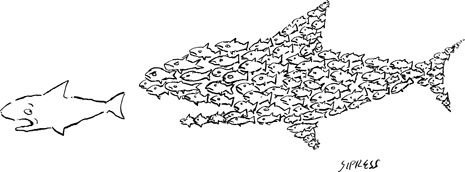
sipress_fish


courtesy of The New Yorker– you can find it’s cartoon bank entry here


I thought I’d seen this before. The concept itself is pretty generic, but… hadn’t this already been a New Yorker cartoon?

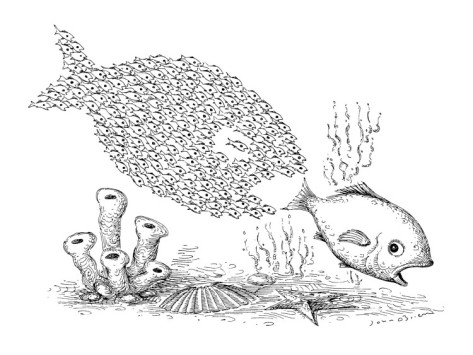
obrien_fish_2

courtesy of The New Yorker– you can find its cartoon bank entry here

I would have been too young to have seen O’brien’s original cartoon, as it was published October 28, 1991. There’s a chance I’ve caught a reprinting of it. More likely, I’m as used to the concept as everyone else, demonstrated by the variety of “small fish eat big fish”  images uncovered on a google image search.

While not ubiquitous,  I’d say that the small-fish-forming-into-bigger-fish-and-chasing-predator is an established visual metaphor. It’s interesting to see that the small-fish-forming rarely occurs without the chasing/eating of the bigger fish (can they eat the bigger fish?) The pressure to group together is always a retaliation to predation. Additionally, while the motif has a satisfying punch line, it doesn’t seem like its primary function is to be funny. Typing in “organize fish,” brings up a decent amount of these cartoons with an anti-capitalist bent, where the concept is put across motivationally or strategically. Most of the fish images look like infographics, and a quick survey reveals their sources to be editorial blogs or stock-photo sites, (perhaps most revealing.)

Perhaps the New Yorker cartoon editor should have paid attention to the fact that this image isn’t very funny. Alternatively, he or she might have liked the fact that the cartoon’s commentary outweighs it’s laugh-factor, even though its message is more hopeful than truthful. Finally, the editor might have approved it because it just seemed like something the New Yorker would publish, which is actually the case.

Comparing the cartoons, I prefer the O’brien image. O’brien’s execution of the little fish is more whimsical, and he doesn’t require plankton or sea-monkeys to fill out the fins. The remorseless ambiguity of the predator’s expression is nice– perhaps he looks surprised, but fish look that way all the time. O’brien’s rendering of the sea-floor makes his cartoon less conceptually clean, but as money managers and Occupiers convert the idea into a truism, a slogan, I prefer it messy and maximalist. His use of stipling reminds me of an old scientific etching. I wish he had pushed that more aggressively– rather than an inspirational ‘au contraire,’ the drawing would have illustrated the absurdity of this metaphor happening in nature. But that’s not really that funny or interesting either. Oh well.

Utilitarian Review 4/5/13

News
 
The cartoonist Fred died this week. Take a minute to check out Domingos Isabelinho’s post looking at his work.

Th eweek of the 15th we’re going to start a comics and music roundtable. If you’ve got a post you’d like to write on that theme, let me know. You can email me at myname at gmail.

On HU

A brief post on comics that work in a gallery and those that don’t.

For Easter, a post on death metal and bluegrass gospel.

Featured Archive Post Fabrice Neaud on Aritophane’s Conte Dominaque. trans. by Derik Badman, intro by Domingos Isabelinho.

Jacob Canfield on the problems with animation adaptations of comics — particularly Axe Cop, Calvin and Hobbes, and Achewood.

Sarah Shoker on Harry Potter and multiculturalism.

I talk about comics vs. fashion editorials.

Domingos Isabelinho on the the blind man and the elephant, if the elephant was Jack Kirby.

Chris Gavaler on Clark Kent and the passive voice.

The Incredible String Band wants to know what music you listened to this week.
 
Utilitarians Everywhere

At Reason I review Peter Eichstadt’s new book about the mess that is Afghanistan.

At the Atlantic I talk about

Waldorf education and not sweating the gnomes.

hook up culture and my college experiences. Humiliating, though not quite in the way you may be expecting.

teaching kids to apologize.

—the Atlanta teachers scandal and how cheating is caused by high-stakes testing.

At Splice Today I write about:

— the awesomeness of fIREHOSE.

class and changing ideas of marriage.
 
Other Links
 
Sharon Marcus on comparative sapphism.

This Week’s Reading

Finished Octavia Butler’s Kindred; read around in Brian Attebery’s “Decoding Gender in Science Fiction”, and (on his recommndation) started Gwyneth Jones’ White Queen.

I also saw John Carter, the film, this week. Which was an entirely adequate sci-fi space opera. Not sure why people hated it so much?
 

images