Anne Bronte Also Likes Assholes

brontessm

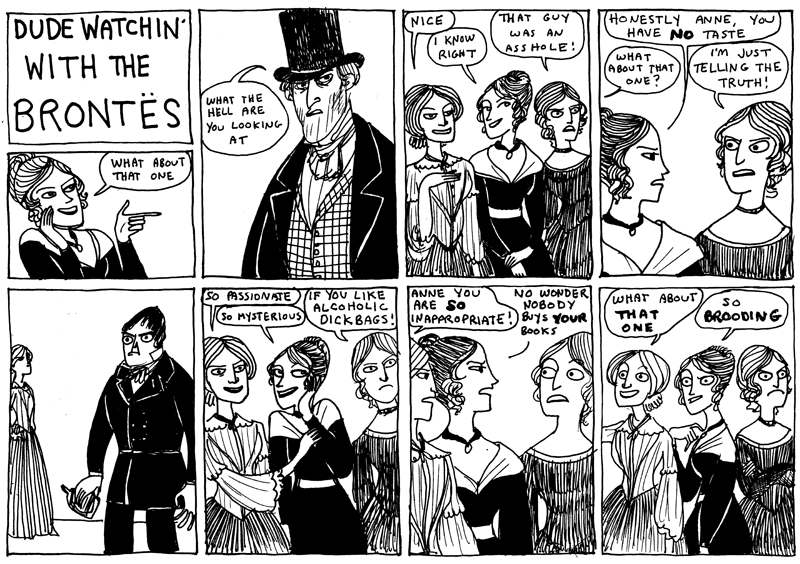
I think the above cartoon by Kate Beaton is the first piece of Anne Bronte criticism I ever saw. At the time, I hadn’t read any of Anne’s novels, but the cartoon certainly made me think I should.

Well, I finally have…and as it turns out, I’m not sure I entirely agree with Beaton. The cartoon is obviously focused on The Tenant of Wildfell Hall, which is centered around the abusive marriage of Helen and Arthur Huntingdon.

Certainly, in comparison to the brutish protagonists of Jane Eyre or Wuthering Heights, Arthur is much less romanticized — or really not romanticized at all. He is not brooding or exciting, but (as Anne says in the cartoon) an asshole dickbag, whose good looks and charm conceal wells of selfishness and cruelty. He’s a drunkard, a cad, and an adulterer, who treats his wife with indifference and contempt (leaving her alone for months at a time so he can carouse in London) and then terrorizing her when she protests. He deliberately tries to get his young child to drink and curse to amuse himself and his friends. His low point comes when he discovers that Helen is planning to leave him and support herself by painting; he storms into her room, takes all her money, and destroys her painting materials.

Much of the novel, then, is a harrowing description of a domestic tyrant, and an unflinching portrait of the powerlessness of married women at the time. Helen has no rights to divorce her husband, even though he is basically parading his mistresses in front of her; she can’t take the child away from him, though he is deliberately, and basically out of spite, attempting to corrupt him. Moreover, her early attempts to reform her husband founder precisely on the disproportion of their power; she has no means under law or custom to influence him; she can’t even make him stay in the same house with her, or make decent efforts to conceal his adultery. The romantic notion that a good woman can save a bad man (very much in play in Jane Eyre, for example) is shown to be not so much spiritually as logistically impossible given the status of women at the time.

So far as Arthur Huntingdon is concerned, then, so good. But, unfortunately, the book feels compelled to present us with another suitor for Helen. And so we get Gilbert Markham, the epistolary narrator of much of the novel. Markham is a gentleman farmer, and the most eligible young bachelor in the neighborhood into which Helen moves after escaping from her husband. She and Gilbert quickly strike up a relationship, which eventually ends in married bliss after Huntingdon obligingly drinks himself to death.

And again, this is unfortunate because, contra Beaton, Gilbert is kind of an asshole. Oh, he’s vastly superior to Huntingdon; he’s not a drunkard or a monster. But that’s a pretty low bar. Without Huntingdon for comparison…well, he doesn’t come off so well. He’s conceited, petulant, and selfish; he toys with the affection of a neighboring clergyman’s daughter, and then tosses her aside when he decides that Helen is more interesting — and when said clergyman’s daughter is upset and resentful, he blames it on the failings in her character and essentially accuses her of being a shallow designing flirt.

Nor is his treatment of Helen much better. He sneaks onto her property and oversees her embracing another man, Frederick Lawrence. Rather than asking her to explain the situation, he rushes off and refuses to speak to her. He also loses his temper and a few days later assaults Lawrence, seriously injuring him and confining him to his bed for several days.

So, to sum up, Gilbert is a jilt, a sneak, and a thug, petulant, cruel, and thoughtless. And yet, he’s supposed to be the good guy!

Of course, Gilbert’s courtship of an sympathy with Helen, and his discovery that Lawrence is Helen’s brother and that in assaulting him he behaved like a total poltroon — all those things are supposed to make him a better, less impulsive, more caring person, and a fit husband for Helen. But that’s not a contradiction to the assholes-are-cool-so-marry-one narrative. Rather, it’s the same narrative over again. You’ve got your infantile ass with anger management issues, and instead of saying, you know, I don’t really want to marry an infantile ass with anger management issues, you end up saying, hey! It’s a fixer upper! Awesome!

There’s at least one other fixer uppers in the book too — one of Huntingdon’s carousing buddies ends up being transformed into a doting husband through the power of his wife’s love (with a little nudge from Helen.) One might be an accident, but two starts to look like carelessness. It’s great that there are some levels of brutality and drunkenness that Anne is willing to be repulsed by…but I think Beaton goes a little too far when she ask rhetorically:

Anne why are you writing books about how alcoholic losers ruin people’s lives? Don’t you see that romanticizing douchey behavior is the proper literary convention in this family! Honestly.

Anne’s perfectly capable of romanticizing douchey behavior. She’s perhaps tweaking the family literary convention, but she’s not rejecting them. If you want a guy who treats women with respect, you need to read Jane Austen or E.M. Forster or maybe watch Say Anything. With the Bronte’s, the best you can hope for is a slightly smaller asshole.
Attempting to Answer the Questions Darkest America Doesn’t


images
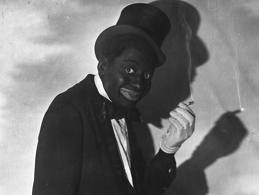
Bert Williams in blackface.

 
Let me say up front that I really liked Darkest America: Black Minstrelsy from Slavery to Hip-Hop by Yuval Taylor and Jake Austen. It does one very important things you don’t often find in books about American minstrelsy (I’m looking at you, Love & Theft)—it describes what a minstrel show was like in clear and engaging language that conveys some of the charm of the art form without making you feel like you’re drowning in boring overly-academic prose. For that alone, it’s worth reading.

There’s also this really, really nice moment where Taylor and Austen describe Flournoy Miller and Johnny Lee, both black comedians, doing a blackface comedy routine in the movie Stormy Weather. Then they give a whole paragraph to the history of the routine, which Miller had been doing since at least the Twenties. And then the paragraph ends in this: “By the estimation of black comedy historian Mel Watkins, it was as familiar to black audiences as Abbot and Costello’s ‘Who’s on First?’ was to white audiences.” (p. 292) This bit of contextualizing is so amazing—you get the bit (or a bit of the bit), the bit’s history, and then a sense of the bit’s reach.

But I don’t think that Taylor and Austen ever quite satisfactorily address why blackface minstrelsy was so popular among black people—both performers and audiences. They brush up against it in the chapter on the Zulu parade in New Orleans, when they say, “Zulu history has been largely whitewashed, scrubbed clean of its origins in caricature, parody, and stereotype. Instead, blacks paint their faces out of respect for a tradition that, like the rest of the black minstrel tradition, has always been focused on entertaining its audience. For the Zulus, as for many black and white minstrels in the nineteenth century and earlier, blackface simply stands for a very good time.” (p. 106-107).

Tradition and pleasure are strong motivating factors and I wish Taylor and Austen had wrestled more with the implications of this insight. We like a lot of things because they’re familiar and because we find their familiarity pleasurable. I kept waiting for them to make this explicit—black people didn’t/don’t enjoy black blackface minstrelsy or its popular culture descendants because (or only because) they recognize some truth of who they are on stage; it’s pleasurable because they recognize the performance.

Or let’s look at it it from a slightly different angle. In 1993, Alan Jackson took “Mercury Blues” to Number 2 on Billboard’s country chart. It’s a cover of K. C. Douglas’s 1949 song, which is sometimes called “Mercury Blues” and sometimes called “Mercury Boogie.” “Mercury Blues” contains a line, which, in Alan Jackson’s version goes, “gal I love, stole her from a friend, he got lucky stole her back again” and in Douglas’s version goes, “girl I love I stole from a friend, the fool got lucky stole her back again.” But the line also lives in other songs. In Robert Johnson’s “Come on in My Kitchen” (1936) it goes, “the woman I love, took from my best friend, some joker got lucky, stole her back again.” Back in ’31, Skip James, in “Devil Got My Woman,” sings “The woman I love took off for my best friend, but he got lucky, stole her back again.” But it goes back further to at least Ida Cox’s “Worried Mama Blues” back in 1923—“I stole my man from my best friend, I stole my man from my best friend. But she got lucky and stole him back again.”

There’s a real power in recognition. When I learned about this repeated verse, I felt as if some great secret history of America had been revealed to me in a lightning flash, as if I had learned a way pop culture connects through time. It pleases me to recognize those same words in all those very different songs and I trust that at least some of you will be delighted to recognize them too. And it’s not because all of us have experience passing a loved one back and forth with our best friend. We take pleasure in recognizing the familiar bits. Of course, this kind of recognition of familiar bits can also be disturbing. When you know Walt Disney took inspiration from The Jazz Singer when he made “Steamboat Willie,” how do you ever look at Mickey Mouse’s white gloves the same way again?

So, when J.J. Walker makes his entrance, or later, Flavor Flav, isn’t there a delight in recognition—not of that type in the community, but of that type in entertainment?

Which brings me to the thing that I think Taylor and Austen fundamentally misunderstand. It’s up there in the Zulu quote, but they also state it explicitly on the third page of the book, “The minstrel tradition, as practice by whites in blackface, was a fundamentally racist undertaking, neutering a race’s identity by limiting it to a demeaning stereotype. But what Chappelle and other contemporary performers draw upon is the more complicated history of black minstrelsy.”All this is true. But, it misses an important and complicating component of white minstrelsy—a lot of white minstrel performers thought they loved black culture (I say “thought they” because any kind of black culture white men could have observed in the 1800s would have been carefully performed by those black men, because of the incredible danger the black men would have been in had it been misinterpreted).

In Love & Theft: Blackface Minstrelsy and the American Working Class, Eric Lott says that, for these white minstrels, “To wear or even enjoy blackface was literally, for a time, to become black, to inherit the cool, virility, humility, abandon or gaité de coeur that were the prime components of white ideologies of black manhood.” (p. 52) (I don’t want to get sidetracked from my point, but I also feel like it’s important to state explicitly how terrible this belief of white men—that they could know black men through mimicking them—was for black men. It is at the heart of why white men could justify all the terrible things they did to black men. White men believed they knew the secret motivations of black men, because some of the white men, white men believed, had literally been black men briefly through imitation.) And this is the hard thing to accept, but the only thing that makes sense of minstrelsy, both black and white: it is racist and demeaning AND it is about a deep fantasy of how awesome it is to be black. Those things are both true, and, in fact, in a racist society like ours, you rarely have an admission of the latter without the former firmly in play.

Once you get that, the power and attraction of blackface minstrelsy—not just the components of the minstrels show, but the actual wearing of blackface makeup—for black people is obvious. If every single thing in the broader popular culture is either explicitly racist or does not mention black people at all (and is therefore implicitly racist), of course the racist art form premised on white people finding so much value in black culture (even if the value they find is not what black people would have called valuable themselves) is going to be incredibly popular with black people. And is it so hard to imagine the appeal of standing on a stage dressed as the object of desire of people who systemically hate you?

But as easy as it is to see the appeal, it’s also then easy to understand why the most egregiously racist components of black minstrelsy fell out of favor as black people gained control of their own representations in popular culture. After all, it is racist and relies on demeaning stereotypes. Of course, when other, less problematic, representations of black people became available, people preferred them.

Still, for a time, it was incredibly popular, both because the bits were funny, the songs beloved, and the insult of blackface muted by the twisted confession of envy that it represented. Yes, it was racist, but what popular culture wasn’t? Blackface was demeaning, but in the hands of black artists, it was also more than that. Black performers in blackface recognized that the culture portrayed by performers in blackface was black culture (or a fantasy of it)—which meant that culture had value, was something worth looking at, even to the very white people who, when they weren’t sitting in the audience, were denying that black people had any worth.

It’s little wonder, then, that its remnants linger on. Blackface minstrelsy was the popular culture for most people for at least half our country’s existence —where our comedy came from, where we heard and learned our favorite songs, and where a type of fundamental “American” sound in music was codified (including banjos and later the Blues)—and there’s still a lot of cultural resonance. And it’s little wonder that those remnants continue to be a source of controversy and pain—because it was racist and demeaning. That’s the legacy of blackface minstrelsy—a source of great pleasure that still resonates in our time AND a source of great pain, which we are still grappling with.

Imperialism and Pop Culture — Peter Suderman Interviews Me

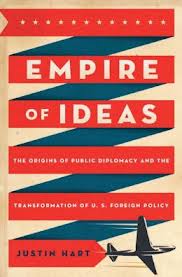
imagesI recently had an article in the print edition of Reason on Justin Hart’s Empire of Idea, a book about America’s efforts to influence world opinion. Peter Suderman interview me for a profile to run beside the article…but of course, I was over verbose, so most of my responses got cut. Peter, though, has kindly gave me permission to run the whole thing here instead.

Peter Suderman: What makes America so susceptible to foreign policy blunders?

NB: I think America’s tendency to stumble into foreign policy quagmires probably has a lot to do with the fact that we’re just everywhere. We’ve got a finger in every pie (and/or a foot on every neck, if you want to be more confrontational about it.) I think there’s just a
very strong ideological commitment to leading the world/solving all the world’s problems, which is partially expressed through spending tons and tons and tons of money on weapons — and once you’ve got all those weapons, there’s a huge incentive to use them, which reinforces the ideology, and you buy more weapons, and on and on and on.

PS: Do you think there’s a disconnect between U.S. policy/government elites and less-well-connected citizens when it comes to foreign policy? Or are they basically in sync?

NB: There are obviously a lot of Americans, of all walks of life, who enjoy the image of the United States as a superpower, and who identify with the US projection of power. On the other hand, there’s also a substantial number of folks who want us to be doing less. Obama won the Democratic primary basically as the less-imperialism candidate. But then, of course, in office, he’s projected force as enthusiastically, if thank God less incompetently, than his predecessor. So…I’d say that elites are more unified in their support for imperial adventures. Those adventures draw at least occasional substantial opposition from the public, but that opposition seems difficult to translate into elite action (except in cases of transparent policy failure, like Iraq).

PS: You’ve written an awful lot about pop-culture. Does pop-culture contribute in important ways to how America sees itself in the world? Are there particularly relevant, insightful pop culture portrayals of America’s foreign policy outlook?

NB: I think pop culture both reflects and can contribute to how America sees itself, or what America does. I guess the most obvious recent example of that is 24, which became a touchstone for pro-torture arguments.

I think Alan Moore and Dave Gibbons’ comic Watchmen is an extremely insightful look at America’s foreign policy. It was written in the 80s, obviously, but it’s still really relevant, I think. It’s about the allure of power and of saving others, about the utilitarian calculus of sacrifice that goes along with it, and about the way that that utilitarian calculus ultimately founders on the fact that no power is ever enough power, and that, however many bombs you have, the future really isn’t under your control. Ozymadnias’ piles and piles of dead bodies are meant to be a sacrifice on the altar of the new future — but the book strongly suggests that they are, really, just piles and piles of dead bodies. The fact that it’s the liberal one-worlder who turns out to be the mass murderer while the right-wing fascist nutball is repulsed by the violence is a nice reminder that imperialism can be centrist as well as extremist .

PS: What do you think America could have done to avoid being linked with
European colonialism? Or was that linkage inevitable?

NB: America has long had an isolationist strain; it seems at least possible that that could have had more of an influence than it did. Counterfactuals are hard to figure, though.

Reason ran a photo of me with the article as well…but looking at it again, I don’t think I can bear to reprint it. It’s just hard to avoid looking willfully smug in author photos, I guess. So if you want to see my shame, you’ll just have to pick up that issue of Reason.

Black Bolt Speaks

black-bolt-self-restraint

 
How long can you go without talking?

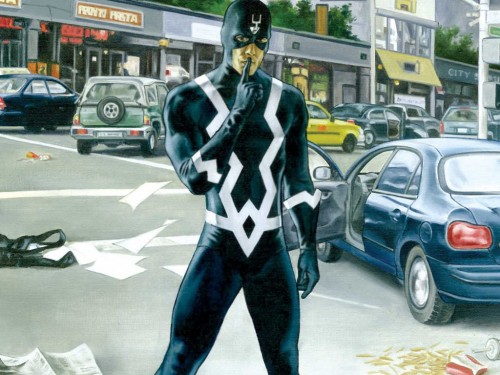
It doesn’t sound like much of a superpower, but Black Bolt holds the record in comic books. Stan Lee and Jack Kirby created him back in 1965 (Fantastic Four #45), and aside from a few mountain-splitting whispers, the guy has barely parted his lips.

For Supreme Court Justices, the verbal self-restraint prize goes to Clearance Thomas.
 

120406_clarence_thomas_ap_328

 
“One of the abiding mysteries at the Supreme Court,” writes Adam Liptak for The New York Times, “is why Justice Clarence Thomas has failed to say a word in almost seven years of arguments.” Theories include self-consciousness (Thomas was teased about his Georgia accent growing up), intimidation (he didn’t speak in his Yale law school classes either), and courtesy (to his fellow Justices whose noise level he likens to Family Feud).

Black Bolt is less of a mystery. My wife gave me Men and Cartoons for Christmas, so I’ll invite Jonathan Lethem to the lectern:

Black Bolt wasn’t a villain or a hero. Black Bolt was part of an outcast band of mutant characters known as the Inhumans, the noblest among them. He was their leader, but he never spoke. His only demonstrated power was flight, but the whole point of Black Bolt was the power he restrained himself from using: speech. The sound of his voice was cataclysmic, an unusual weapon, like an atomic bomb. If Black Bolt ever uttered a syllable the world would crack in two.


black-bolt

 
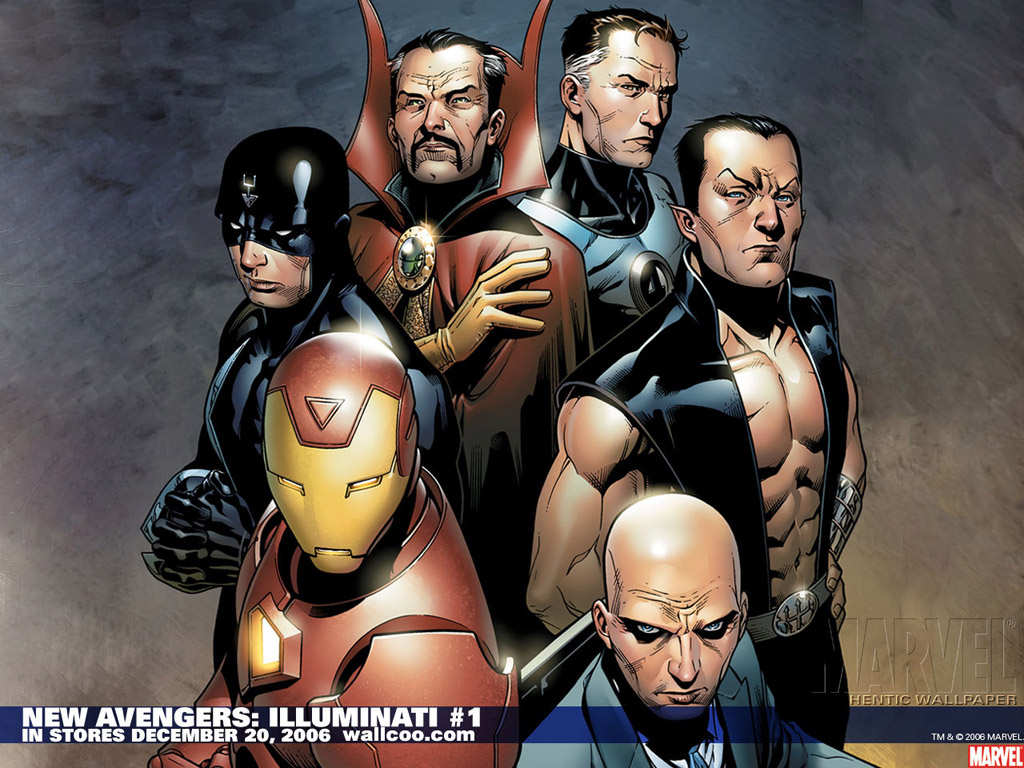
Black Bolt grew up in a sound-proof chamber, not rural Georgia, but he is also a member of the Illuminati, the closest thing in the Marvel universe to the Supreme Court. Thomas shares his bench with eight Justices; Black Bolt only five (Reed Richards, Dr. Strange, Professor X, Tony Stark, and Namor), but both supergroups are the endpoint of an ultimate check-and-balance system.

They always get the last word.
 

153150-marvel-new-avengers-illuminati-1-marvel-comics


img-supremecourt_163138262973-jpg_item_large-jpg

Black Bolt even passes judgment on U.S. legislation. He rejected the Superhuman Registration Act (AKA the Patriot Act) in 2006 (also the year Thomas last spoke in court) and refused to get involved in the ensuing “Civil War,” monitoring it from afar instead. As Lethem explains, “Black Bolt was leader in absentia much of the time—he had a tendency to exile himself from the scene, to wander distant mountain tops contemplating . . . What? His curse? The things he would say if he could safely speak?”

Aside from a few whispered remarks audible only to Breyer and Scalia seated beside him, Thomas has gone seven years without a single word. Until this winter. During a discussion of the qualifications of a Harvard-trained defense attorney, the Black Bolt of the Supreme Court leaned forward and said into his microphone:

“Well — he did not — .”

The earth did not split in two.

But opinion did. Some witnesses say he was making a joke, a reference to whether a degree from Harvard could be considered proof of incompetence. Or was he referring to his own alma mater, Yale? Either way, court transcripts indicate laughter followed. Seven years of silence and then a one-liner. But if it was just a joke, why did the lawyer at the lectern try to refute his point? Whatever that point may have been? And since the broader issue was the minimum qualifications for a death penalty defense lawyer, who exactly was laughing?

When Black Bolt breaks his vow of silence, the results are usually much louder. Remember when he used his voice to free the Inhuman’s city of Attilan from the Negative Zone? Or stunned Spider-Man’s alien Venom costume after it merged with Thor, allowing Black Cat to kill it in revenge for Peter Parker’s death? (Though, okay, that’s from What If?, so technically it never happened.)

We never know exactly what Black Bolt says in his super-speeches. Maybe he just likes to crack jokes. If so, no microphone can record them. But the last time Thomas deployed his nation-splitting voice, every network in the country televised it.

Remember how he pronounced the L-bomb, declaring his 1991 confirmation hearing a “high-tech lynching,” and categorically denied Anita Hill’s allegations of sexual harassment? Remember the joke he cracked to her about the pubic hair on his Coke can? Now THAT was funny.

Of course the Senate confirmed him, so technically that didn’t happen either.

So let’s hear it for judicious self-restraint.Like Black Bolt, the Justice understands his own destructive vocal power and so has learned to hold his super-tongue. If he stays on schedule, we won’t hear another joke till 2020.

‘Nuff said.
 

black-bolts-says-shhhh-500x375

Utilitarian Review 3/8/13

News

Tom Spurgeon reports that Kim Thompson has been diagnosed with cancer. I had my first online troll battle (via email) with Kim way back when. I hope he beats this thing and is around for many more. You can find the address to send well wishes at the link.
 
On HU

Featured Archive Post: Jog on Alan Moore and his collaborators.

Me on Darkest America, a book about the black blackface tradition.

Me on Nate Silver and the morality of prediction.

Alex Buchet on the cartoons of bandleader Xavier Cugat.

Kailyn Kent on gallery art and comic book splash pages.

We started organizing our upcoming music roundtable.

I argue that film Boromir is better than book Boromir.

Domingos Isabelinho on Jochen Gernet. Watch Betty and Veronica race to the war!

Jacob Canfield on poetry about the Legion of Super-Heroes.

Our Friday music sharing post, featuring Brooke Valentin’s The Thrill of the Chase.

 
Utilitarians Everywhere

At the Atlantic:

— I talk about Julia Stiles’ YouTube series Blue, and the obsession with the secret lives of prostitutes.

— I review the Suuns new album — indie rock for the state fair.

— I review the documentary It’s a Girl, about sex selective abortion in China and India.

At Splice

— I argue that if you’re not going to moderate comments, you should just get rid of them.

— I review Tweet’s lovely new ep.

images

 
Other Links

Slate on Shirley Jackson.

C.T. May on Isaac Hayes and the alternative minimum tax.

Felix Salmon tells internet freelancers to abandon all hope.

Molly Westerman on how her son fell in love with a girly book series.

The Producer of the film It’s a Girl responds to my review.
 
This Week’s Reading

I finished Anne Bronte’s Tenant of Wildfell Hall (which was a bit disappointing.) Read Christine Yano’s Pink Globalization about Hello Kitty’s global reach for a review. Started Stephenie Meyer’s The Host, also hopefully for a review.
 

Monthly Stumblings # 20: Jochen Gerner

Panorama du feu (a view of fire) by Jochen Gerner

Jochen Gerner was a founding member of the OuBaPo (Ouvroir de Bande Dessinée Potentiele – or, the Workshop for Potential Comics, best represented in the US by Matt Madden, Jason Little and Tom Hart). Modeled after the OuLiPo (Ouvroir de Literature Potentielle – workshop for potential literature) created by Raymond Queneau, the OuBaPo aimed to explore new ground for comics using, paradoxically, constraints as a creative motor. The OuBaPo published four books to date (the last one in 2004) all by the dominating force behind the project, Jean-Christophe Menu and L’Association publishing house. Even if engaged in other projects the work of Jochen Gerner is never very far from OuBaPian creative processes.

1


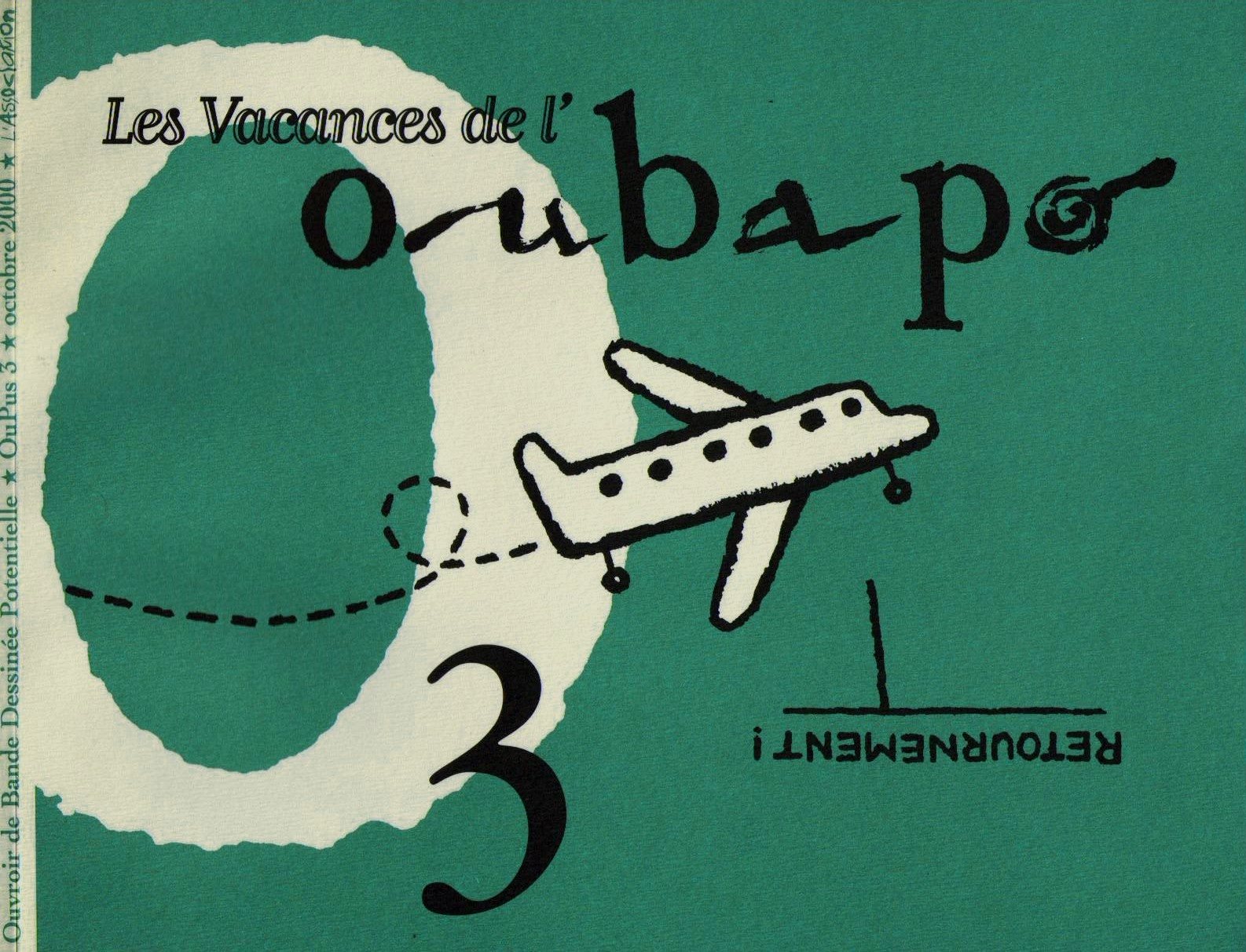
Les Vacances de l’OuBaPo (the vacations of the OuBaPo), Oupus 3, L’Association, October 2000, illustration by Jochen Gerner.

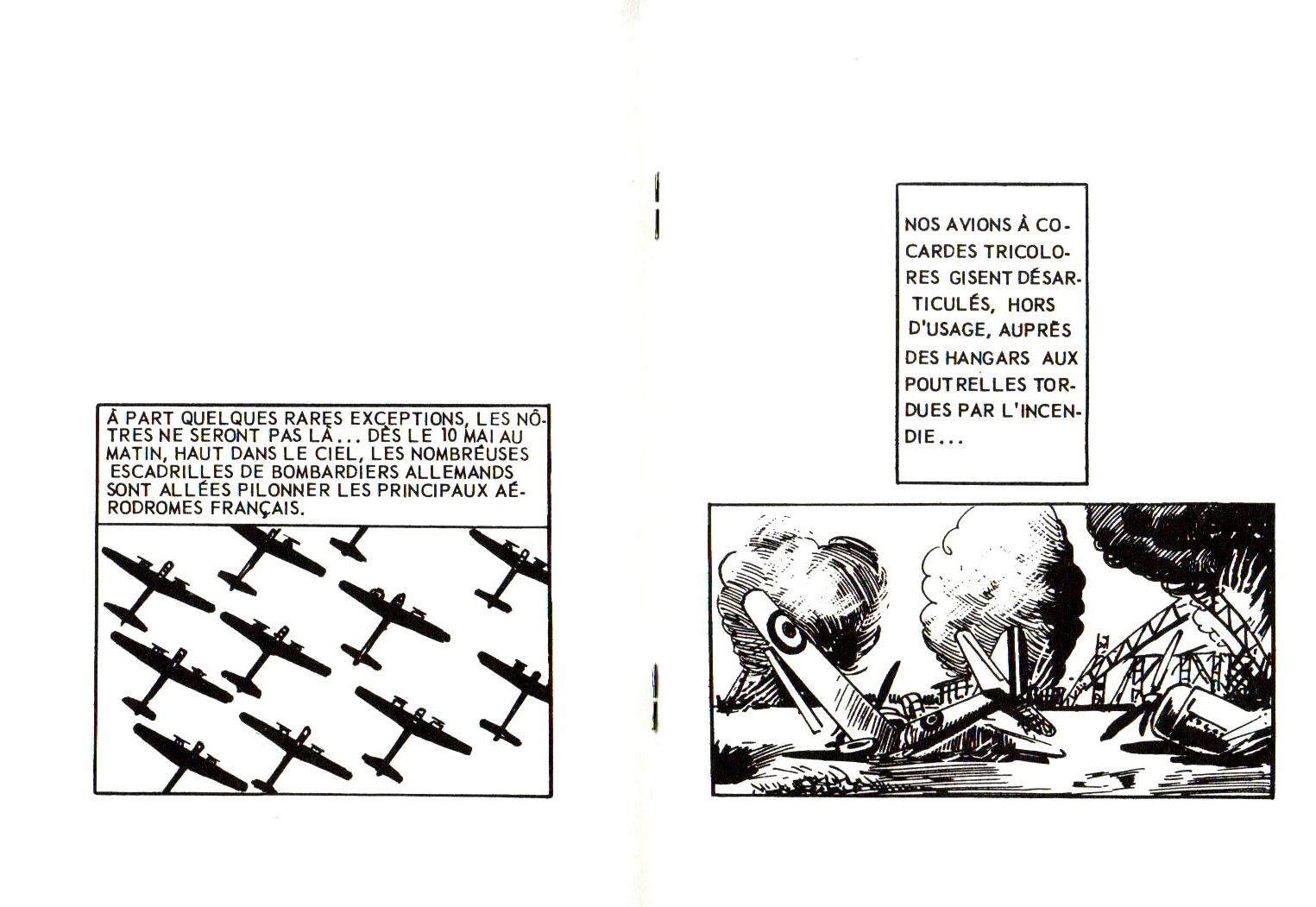
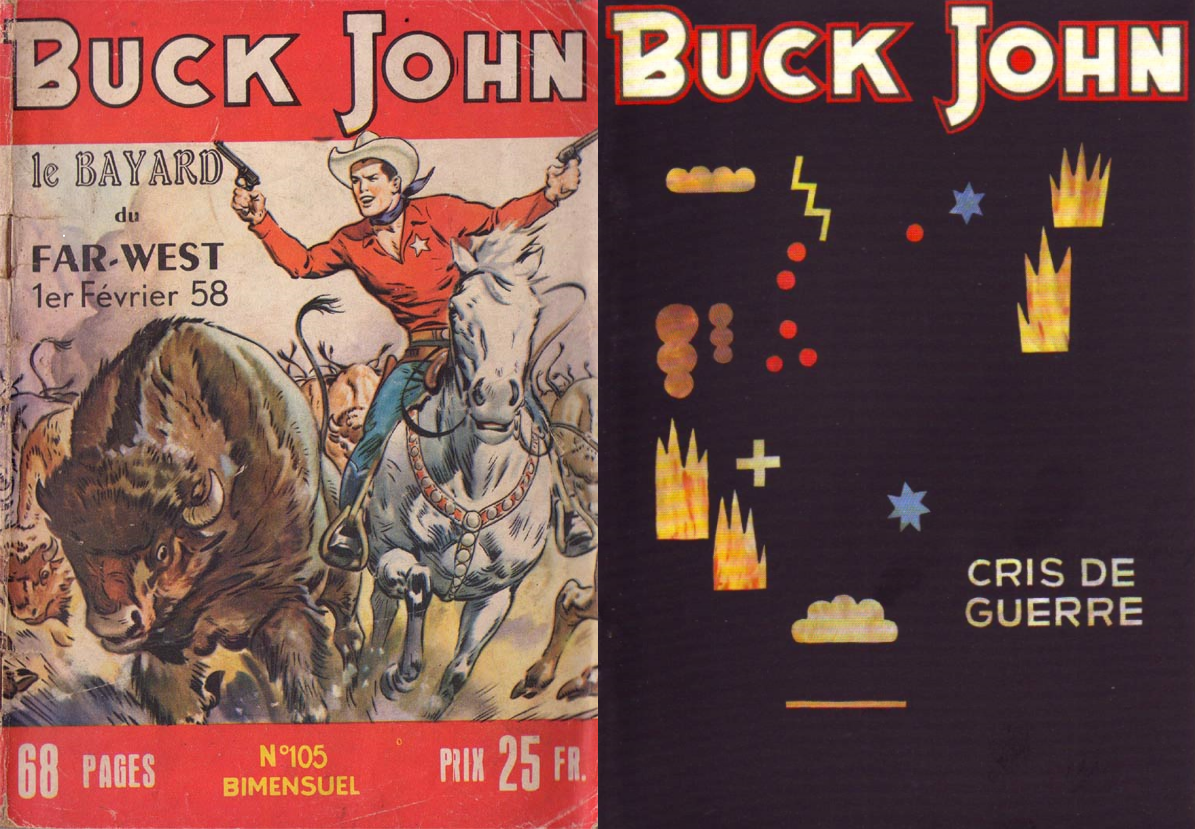
Jochen Gerner views himself as a draftsman who does comics among other things. Represented in France by Anne Barrault Panorama du Feu was part of Jochen Gerner’s second exhibition at said art gallery in 2009 (the first one happened in 2006). The theme of the exhibition was the four elements: earth, air, water, fire. A year later L’Association published Panorama du feu (the “fire” part of the exhibition, of course) in a cardboard box, surrounded by a paper ribbon with the word “Guerre” (war) written on it, containing fifty-one booklets numbered from zero to fifty. Each booklet is the reworking of what’s called in France the “petits formats” (the little formats), cheap, mass art comics imported mainly from the UK (published there by Fleetway) and sold in newsstands from the 1950s (or even earlier) until their decline in sales during the 1980s and disappearance in the early 1990s. The genres included in Panorama du feu are War, of course, but also Western, Espionage, and even a Tarzan look-alike produced in Italy, Akim. In each of these eight page booklets (cover and back cover included; booklet number zero has twelve pages with an introduction by Antoine Sausverd) Jochen Gerner used two creative strategies: (1) the cover was blacked-out with India ink leaving a title formed by expressions found in the book and the name of the collection plus explosions and signs (circles, crosses) in (not so) negative space; (2) the interior retained some didactic essays, advertisements and other paratexts published in the original comic books, plus what Thierry Groensteen called “reduction” in Oupus 1 (L’Association, January 1997): the stories were reduced to four, five or six panels (one per page).

In Panorama du feu Jochen Gerner chose visual rhymes (airplanes or trucks in all the panels, for instance). He also favored more abstract images and close-ups.

1b


Airplanes (in perfect order and in chaos) in booklet # 40 of Panorama du feu, L’Association, September 2010: visual rhymes.

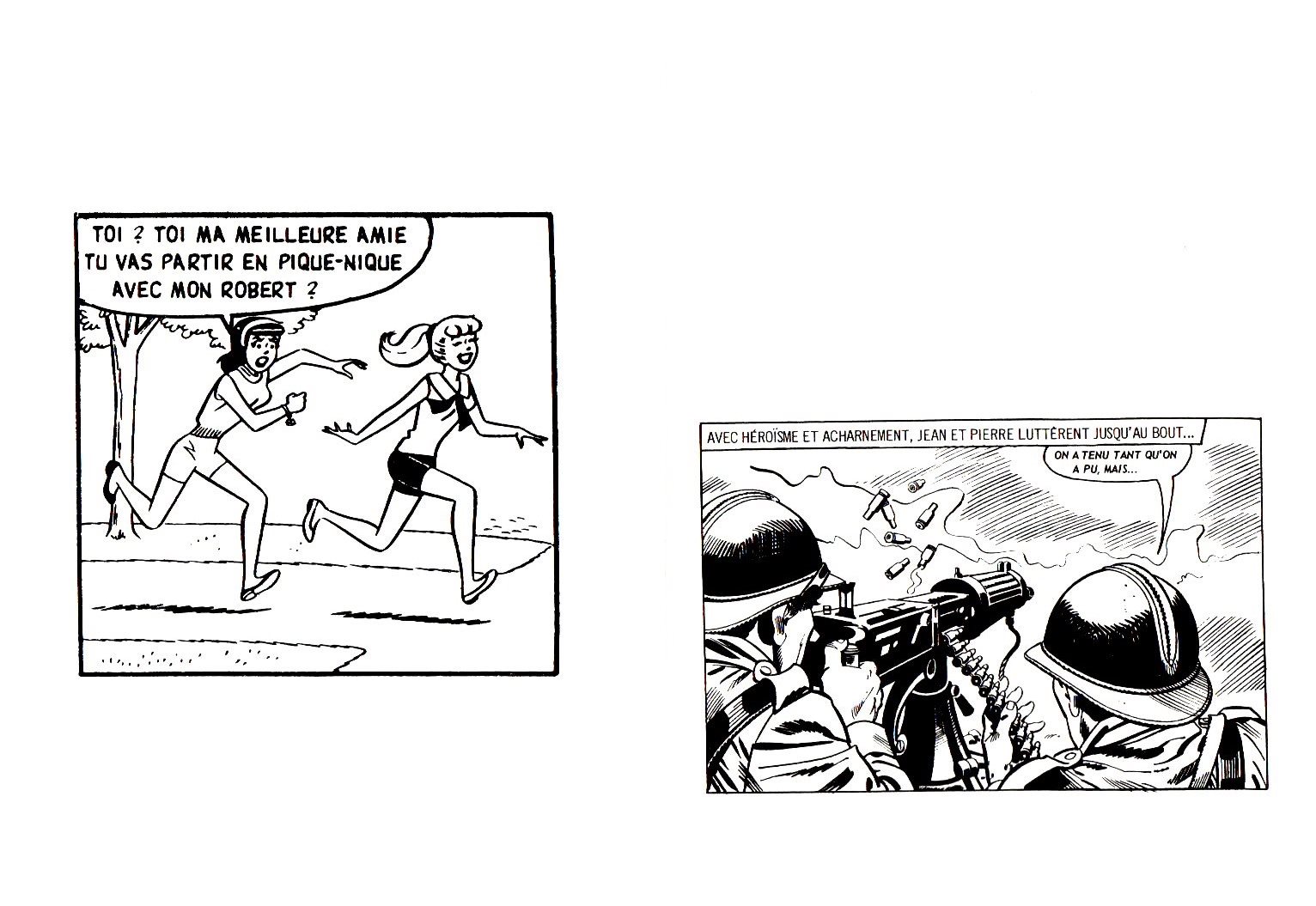
Besides being a non-conceptual reflexion (as Jochen Gerner stressed, saying that his is not a theoretical approach) on violent representations in petit format comics during the Cold War, what I find fascinating in the comic book reductions performed by Jochen Gerner is the contrast between said supposedly entertaining violence and a clear intention to be didactic including in the books many scientific essays. Below there’s an unexpected encounter between something as frivolous as Bettie and Veronica (Archie is here called Robert, by the way) and yet another image of violence. By mixing didacticism and comicality with the violence of war, the violent message was somewhat undermined or, at least, balanced by a variety of things, advertisements included.

Given the fact that Jochen Gerner reduced whole stories to a few panels it’s no surprise that many make little sense letting the reader with the strange sensation that something incomprehensible is going on (cf. below: infra-narrativity).

1c


Betty and Veronica run to join the French war effort during WWII? booklet # 33 of Panorama du feu, L’Association, September 2010: comicality undermines seriousness.

2


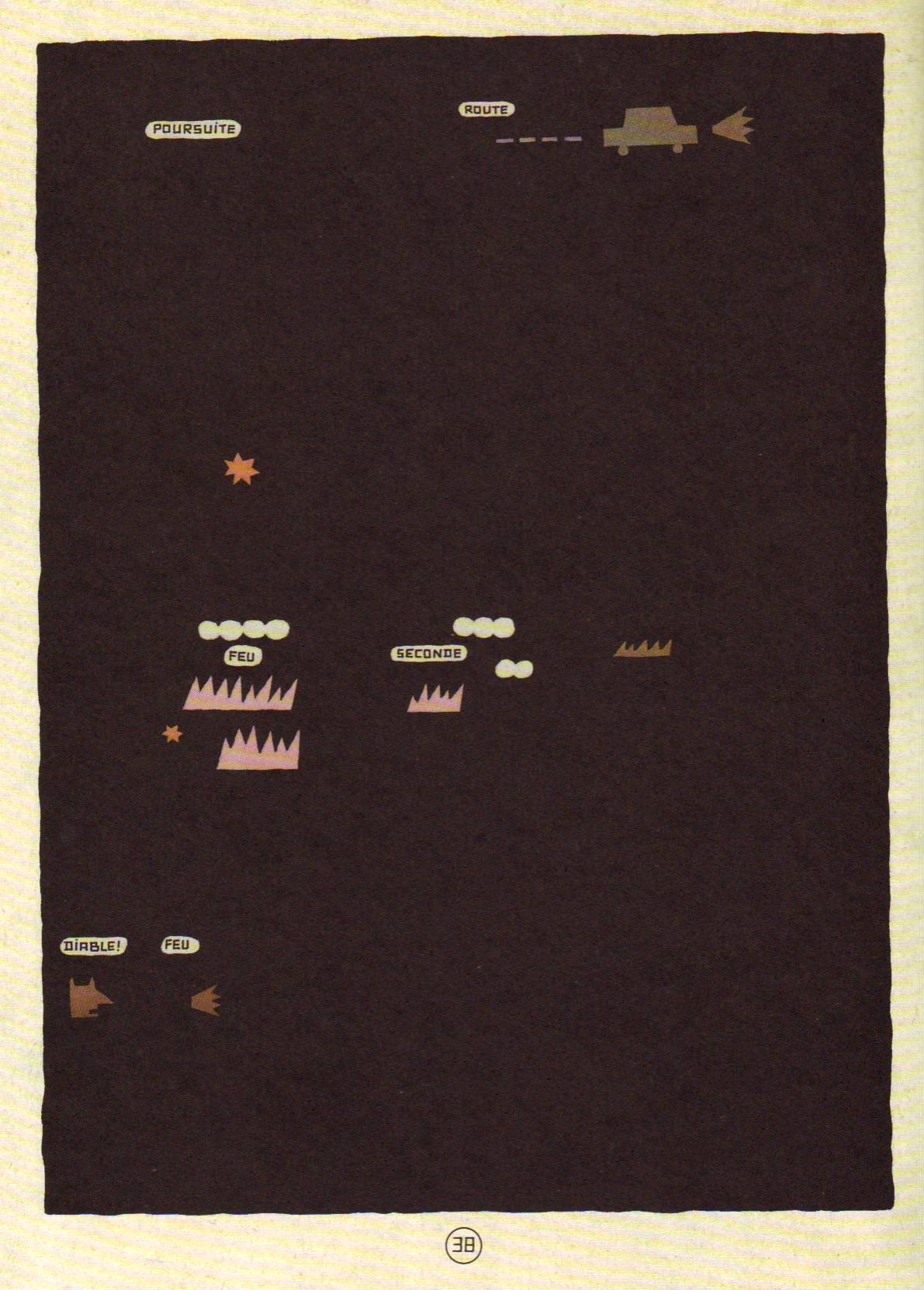
Page 38 of TNT en Amérique by Jochen Gerner, L’Ampoule, 2002.

The blacking-out of covers and interior pages (as seen above: a détournement of Hergé’s Tintin en Amérique Tintin in America -, 1946 version) has its roots seven years before. In the above page the word “feu” (fire) appears (twice) and pictographs representing flames and smoke (plus a car and the words “poursuite” – “chase” -, and “route” – “road”) are similar to the covers in Panorama du feu. A look below at Hergé’s page blacked-out by Jochen Gerner in TNT en Amérique helps us to reach interesting conclusions:

3


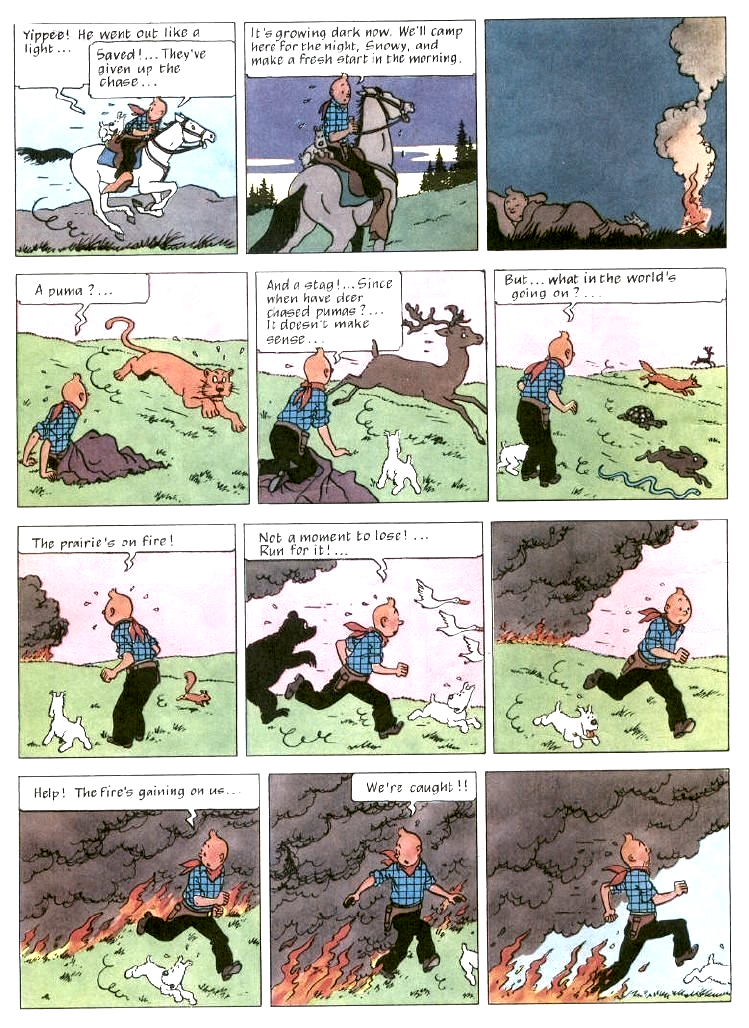
Page 38 of Tintin in America as published in 1973 by Methuen (originally published in black and white in 1931 /32 and reworked by Hergé in 1946).

Diegetically two things happen in this Tintin page: Tintin escapes a persecution and flees a fire. In the tradition of creating suspense at the end of every odd page Tintin is almost caught by the flames in the last panel. The persecution (by the baddies) is represented in TNT en Amérique by a car and the words “chase” and “road.” In spite of Tintin riding a horse (the stereotype of the American cowboy imposes itself to a formulaic narrative) Jochen Gerner used a car pictogram to update the story. The animals on tiers two and three are almost ignored (the “almost” goes to the star pictograph, a symbol of trouble – emanata would have been more effective, maybe, but who am I to question Jochen Gerner’s choices?, maybe he sees emanata as too blunt a sign?). Most of the attention goes to the fire with an ironic devil chasing the hero: can he be a villain destined to burn in hell’s eternal flames in spite of his virtuous persona?

The general conclusion that we may extract from the TNT en Amérique example is that the two creative tactics described above (blacking-out and reduction) have the exact same result of reducing the deturned story to a skeleton.

4


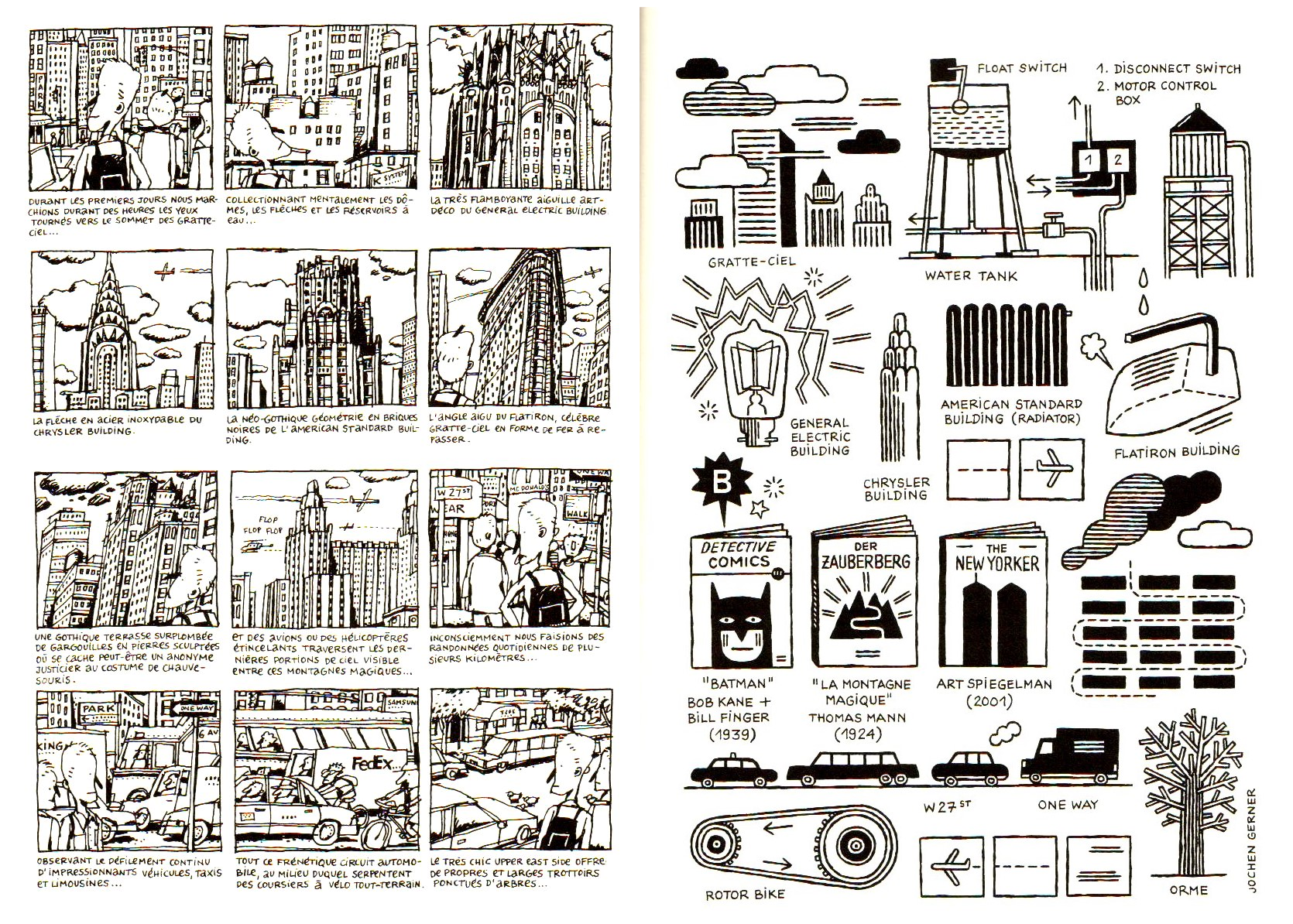
On the left: page from Courts-circuits géographiques (geographical short-circuits), L’Association, 1997; on the right, the same page as reworked for XX/MMX, L’Association, 2010.

The image above shows, on the left, a page of Jochen Gerner’s autobiographical book Courts-circuits géographiques; the image on the right shows the same page reworked for publication in XX/MMX (an anthology commemorating L’Association’s 20th anniversary). As Jean-Christophe Menu noticed in his thesis La bande dessinée et son double (comics and their double, L’Association, 2011), the evolution from representational (even if caricatural) to ideographical is clear, but even the older page shows a tendency to what Thierry Groensteen called, in Bande dessinée récit et modernité (comics, narrative and modernity, Futuropolis, 1988) “the inventory” (a subset of his concept of the infra-narrative).

5


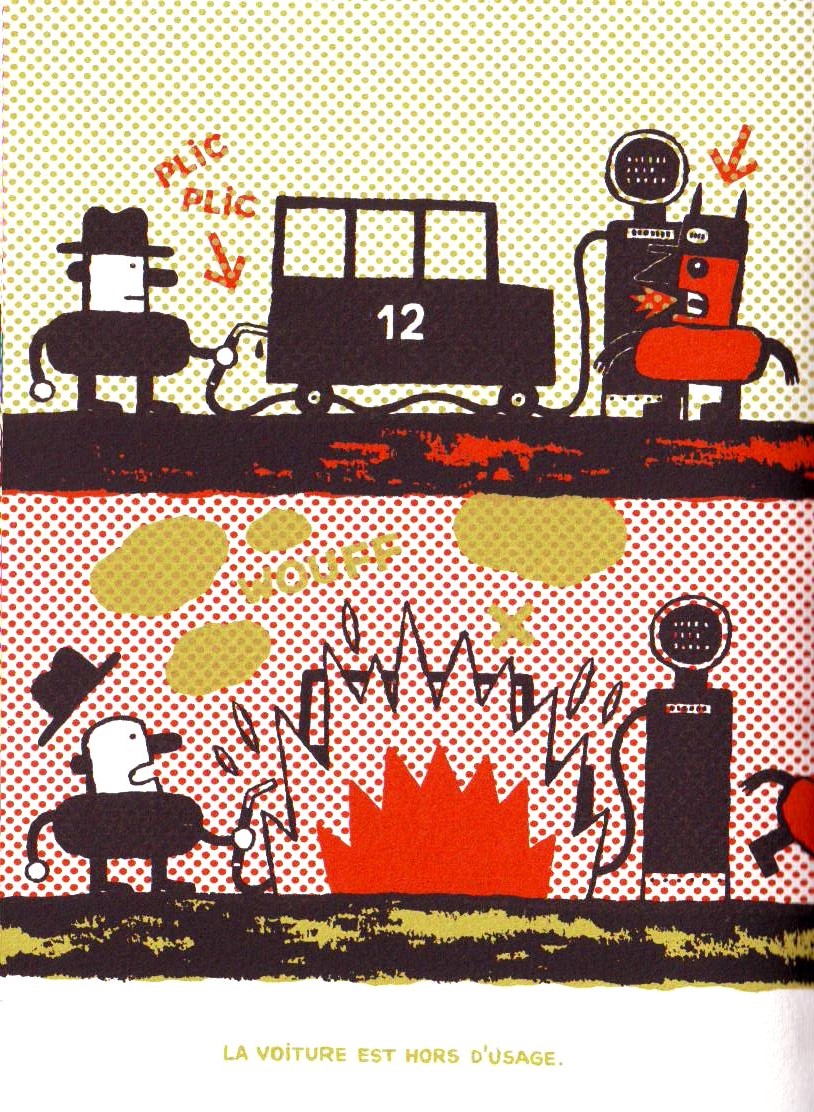
Malus by Jochen Gerner, Drozophile, 2002. A boon to a Ben-Day fetishist like me.

In Malus, as seen above, a silk-screened comic, Jochen Gerner illustrated real traffic disasters reported in newspapers. A creative tension is caused by the caricatural and schematic drawings depicting tragic events. A distance is created by the inadequate relation between form and content, or, to be more precise, the content isn’t exactly what one would expect given the source material. An ironic Dadaistic distance pervades all of Jochen Gerner’s work, but Malus is the height of this propensity. It shows Gerner’s tendency to explore – and short-circuit; cf. the Betty and Veronica example above – violent undercurrents in the mediasphere. TNT en Amérique lays bare, by reduction, how violent Hergé’s stories really are (TNT being, obviously, a reduction of Tintin’s name and an explosive). The same happens in Panorama du feu.

6


Left: Buck John # 105 (Buck Jones, I guess), Imperia, February, 1958; right: a deturned by black-out Buck John comic (not necessarily # 105, of course), Panorama du feu, L’Association, September 2010.

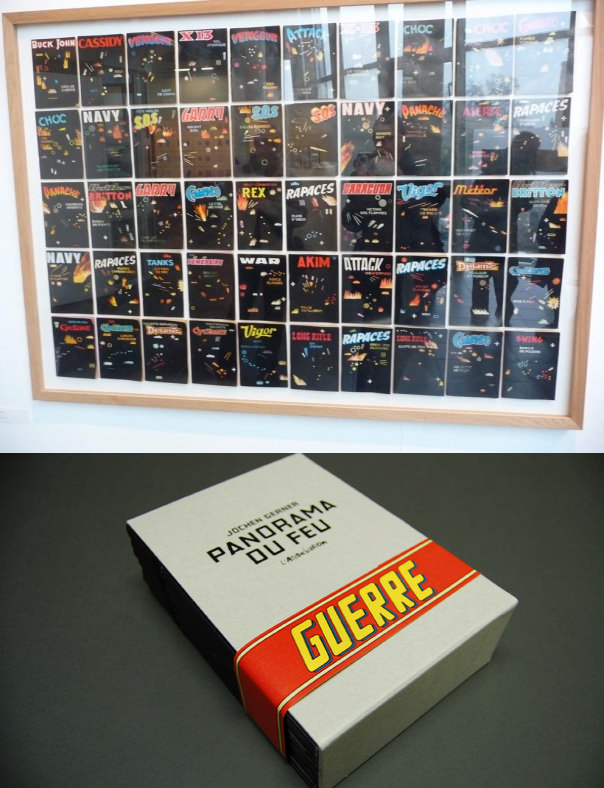
As we can see below Panorama du feu is a dual object corresponding to its two lives in 2009 (in an art gallery) and 2010 (as a series of fifty one comic books):

7


Up: Panorama du feu as exhibited in Anne Barrault’s gallery, September 2009; down: Panorama du feu as a box containing fifty one booklets, L’Association, September 2010.

In 2009 the fifty books were, as Jochen Gerner put it, like a giant battle ground as seen on a big control panel. Seeing the deturned covers behind glass encased comics come to mind. The act of reading is out of the question. On the other hand L’Association’s edition does almost the opposite, readers have access to the booklets’ content, but the ensemble is lost. Can these two forms of presentation be reconciled? I don’t think so, but one of the best solutions, I think, involved Jochen Gerner. I’m talking about Salons de lecture (Reading Rooms), an exhibition at the La Kunsthalle in Mulhouse:

8


Salons de lecture, La Kunsthalle, Mulhouse, February 3 – April 3, 2011.

In Salons de lecture readers /viewers were invited to sit and read, as we can see above. As I said, reading and viewing can’t be reconciled, but I like this Duchampian solution: it’s a visual arts exhibition because the La Kunsthalle is a place where contemporary art is shown. Plus: there’s the design with different colors for the six rooms available.

Here’s Jochen Gerner’s opinion:

Simply to place the boards adjacent to each other in a linear fashion is like trying to reproduce the phenomenon of reading a book. This can’t be right. But the exhibition Reading Rooms plays effectively with the principle of the book on a flat surface. The effect in this exhibition is almost that of a wall placed horizontally on trestles. The exhibition design and the graphic systems used to mark the placement of the books, plus the captions printed on the table propel these books into another dimension.