DWYCK: What’s the Story?

celimene_street_t

The discussion fostered by cartoonist Eddie Campbell’s essay on comics and how they work, entitled “The Literaries,” published last month at TCJ.com, has been alternately fascinating and frustrating. Characteristically for the comics community, blogosphere reactions were divided roughly into two camps: fanboys cheering him for tracing a line in the sand against the naysayers who would hold comics to higher standards, and those same naysayers, saying, well, nay to the most superficial parts of his piece without noticing the beam in their own eye.

Campbell’s polemic was voiced in part against Ng Suat Tong’s touchstone essay “EC Comics and the Chimera of Memory” published in The Comics Journal in 2003, and recently republished here. At the time, the essay was a brilliant corrective to fanboy orthodoxy, helping usher in a more mature approach to comics criticism that refused to isolate comics from the wider cultural field, but rather attempted to judge an acknowledged comics classic by the yardstick of major achievements in other media. Unsurprisingly, the work of Kurtzman, Feldstein, Craig, Krigstein, Wood, Ingels, Williamson, Davis, Elder, et. al. seemed less than great when compared to Aristophanes, Anne Frank, Goya, Giotto, Citizen Kane, Van Gogh, The Romance of Three Kingdoms, Catch-22, and La Grande Illusion.

Suat’s essay, which followed in the tradition staked out by Gary Groth at The Comics Journal through the previous decade-and-half, was a highly illuminating exercise, and a prophetic one in that a large part of serious comics criticism since then has been preoccupied to the point of obsession with making similar comparisons. For obvious historical reasons, comics aficionados have been affected by status anxiety since at least Gilbert Seldes, and comics fandom has been plagued by it to the point of insularity. And the particular tendency at play here has been on the rise in the last decade as comics have experienced increased cultural and institutional acceptance.

Let us leave the fanboys aside and concentrate on the critics. I will forego discussing Suat’s querulous and ungenerous riposte, which only does his original piece disservice and focus on Robert Stanley Martin’s trenchant critique instead. Denying Campbell almost the entirety of his argument, Robert insists that he and others writing from similar perspectives do indeed take comics seriously as a visual medium, calling Campbell’s assertion of a literary bias a “straw man.” He further unapologetically insists upon focusing primarily on story in any comic that tells one, taking into consideration visuals only “as a means to an end which happens to be that story’s realization.” In Robert’s caricature of Campbell, the latter considers story “irrelevant”, preferring to focus instead on details of design, execution, or detail—on “flash.” He understandably asserts that this straw man (sorry Robert, but it is what it is) should not “be taken the least bit seriously.”

OK, Campbell’s piece is not rigorously argued and one can point to inconsistencies, but Robert nevertheless seems to be missing the point. Campbell does not dismiss ‘story’ (as I will forthwith call it, for reasons about to become clear) as an integral element to comics, but rather extends the concept of story to the images themselves:
 

…the art is to be found in the story the cartoonist tells in his graphic strokes, his deployment of the whole panoply of cartoon effects and ways of seeing and representing. In the work of an exceptional artist there can be a whole other story happening.
 
celimene_shop_t

Campbell’s point is not just basic to criticism of visual art, but also reflects a perspective so commonplace that it has become a truism, namely that the value of a story lies as much in how it is told as what it tells. Leaving aside the problematic discussion of form and content and the eagerness with which many comics critics want to separate them, this is at the crux of Campbell’s argument and is exemplified well in his Billie Holiday analogy: it is her performance of a song like “Who Wants Love”, rather than the words themselves that make it a great song when she sings it.

In his response to Campbell, Noah Berlatsky seems to agree with this basic premise, but uses that song as an example of how Campbell is so overeager to separate comics from literature that he overlooks the ways in which her performance is precisely that. This is not a discussion I want to engage at length here—Robert and Noah are clearly right that comics can be seen as a form of literature, and especially that attempting to segregate the form leads to insularity, but I do not see how such an endeavor is implied by Campbell’s argument. He merely warns against insisting too assiduously that comics be measured against, and according to the logic of, whatever standard one might posit from a wider cultural field. If you ask for The Romance of Three Kingdoms when reading Two-Fisted Tales you are bound to be disappointed, as Suat rightly pointed out in his original piece, but more importantly you are liable to miss out on whatever genuine artistic value is offered by Kurtzman and his collaborators, whether their efforts compare favorably to those of Luo Guanzhong in the final tally or not.

A great work of literature, or other work of art, might be a fine aesthetic ideal to keep in mind when criticizing comics, but formally and conceptually it can blinker you to how comics work if you insist on its priority. Of course you can compare comics with works in other media, but hopefully we can all agree that they work in the distinct ways and in the distinct tradition that make them comics, and that paying attention to these help us understand and appreciate them better than if we apply the logic of a different art form to them more or less wholesale. Campbell oversells his argument when he calls comparisons with other media ‘irrelevant criteria’, but his basic point—that we should try paying closer attention to how comics work and what they do—is a good one.
celimene_attic_t

But is it one we need to be reminded of? As we have seen, Robert insists that Campbell’s identification of a literary bias is wrong, but is it? Let us take a look at Suat’s EC piece: in more than 5,000 words discussing plot, character, theme, and ideology—i.e. ‘story’—comments on the visuals of the EC comics are relegated to a few laudatory adjectives. They never really become part of the argument, even as they pertain to ‘story’ elements. More confusingly, Suat argues in one place (discussing Krigstein and Feldstein’s “Master Race”) that form and content can and should be separated: “a feeble story, no matter how masterfully executed, should not be excused on the basis of mere thematic maturity”, but almost immediately follows this by saying it can not: “style and content cannot be divorced in what is clearly a narrative story.” Which one is it?

Or we could look at Robert’s extended body of comics reviews. One understands why he so emphatically describes the visual aspects of comics as “means to an end.” While perceptive and often expansive when it comes to the ‘story’ aspects of the comics, he generally relegates visuals to a few, adjective-laden sentences, good on declaration but less on explanation or analysis. His critique of E. C. Segar is particularly telling: Popeye’s high points for him are the anomalous moments of satire in certain stories, which as I have discussed elsewhere seems to me a perfect illustration of how evaluating cartooning by its literary ‘content’ may blind one to its more obvious qualities—in Segar’s case the kinetic humor, absurdist wit, and visual originality of his cartooning.

Noah, for his part, is less wedded to high culture frameworks of evaluation. Nevertheless, his response to Campbell carries intimations of the literary bias at issue here. Despite his attentive visual analysis, his final take on the Kirby-Lee Captain America page is a classic example of reading rather than looking. To him, the page is a self-reflexive performance by the authors—its anti-literary turn a celebration of Kirby’s ‘Ab-Ex’ flexing of drawing chops. Where does Noah get this idea? Well, the obvious place would be the caption at the top of the page, written by Lee, which presents it as such.

This is a misunderstanding of Kirby’s work. Reading the story in question attentively, or really reading any of the prime sixties Marvel material, it should be clear that there is a tension between image and text, a tension that precisely has to do with Kirby and Lee’s working method, as Campbell also notes. Lee is indeed a self-reflexive writer who is all about performance (sometimes delightfully so), but such terms hardly describe Kirby’s artistic sensibility. Invariably earnest, he was never a showoff and the Campbellian story he tells, beyond the ‘story’ of Captain America versus Batroc, is one of pain and perseverance, of the human condition. Literary or not, it is a story very much at odds with Lee’s writing and one that reveals itself only if one pays attention to his cartooning instead of reading its labeling.

Similarly revealing is Noah’s analysis of Holiday’s performance of “Who Needs Love.” He describes it as great because of her ironic distance to the banal lyrics, which enables her to imbue them with greater meaning that their hack writer ever imagined. This might be right in a sense, but the process seems to me much simpler: Holiday recognizes that clichés contain truth and is able to bring out this truth in a performance that is necessarily unironic. The anxiety of academically schooled critics around cliché tends to lead them into contorted and unnecessary arguments such as Noah’s when faced with it. This seems to a major reason why those products of popular culture that have genuine aesthetic value—in casu certain comics—tend to fare badly when subjected to the kind of scrutiny taught at the academy. In this context Campbell’s fairly straightforward point is worth listening to.

But how can one deny the precedence of more straightforwardly literary ‘story’ told in these comics, as Campbell is accused of doing here? And should one do so? Not necessarily, but on the other hand I see no reason to give it absolute priority. The ‘story’ is obviously an important part of the vast majority of comics and critical engagement with it can yield important insights, as it indeed often does in the writings of Suat, Robert, and Noah. My problem with the discourse as presented, however, is with the apparent—and in Robert’s case outright—denial that other approaches might be equally fruitful. That the drawings are always a means to an end, that the non-literary parts of these comics are outweighed in importance by the literary ones.

This appears generally to be less of a problem with criticism of comics of obvious literary ambition, such as those by Campbell himself,* and more with traditional genre comics. The context of these works is mass culture and as such tends toward the sub-literary. There is no question that a lot of this material is disposable, but fastidious comparison with works predominantly understood in terms of high art seems to me a blunt instrument remarkably unsuited to understanding what qualities some of it might possess. It also encourages a bizarre hierarchy of comics genres in which an unobjectionably well-crafted comic created in a high literary context, such as Fun Home, is automatically better than one created to entertain young readers, such as Astérix. Where Persepolis by its very conception is superior to Polly and Her Pals. A prescriptive and unenlightening view of art stuck in the elitist framework of high modernism. It has long since been shown how dogmatically elitist approaches to genre literature are problematic, so there is little reason to import them directly into comics criticism.
celimene_night_t

Ultimately modernist elitism is unable to explain why certain comics (or works in other media) telling simplistic ‘stories’ and offering cheap thrills endure while most others do not, in any way other than by referring to their level of craft or (*shudder*) their pandering. Some might find this adequate, and it is doubtless true in many cases, but it still fails to explain adequately why certain comics despite their flimsy premise present so powerful, original, and enduring a vision.

Robert very perceptively associates efforts to identify such qualities in genre comics with auteur theory. His take on it is negative, and auteur theory has of course been deconstructed as often happens to theories without strict methodologies, but it might yet prove useful in the present context. It seems to me that Robert’s characterization of at least its American iteration is biased and reductive: if the ideal indeed was to eschew ‘story’ at all costs, its usefulness would obviously be limited. I am willing to be corrected, but that is not how auteur theory was taught to me. In any case, it seems to me absurd to suggest that the filmmakers championed by the French auteur critics—from Vigo and Renoir to Hawks and Hitchcock—worked to subvert their screenplays, as Robert suggests. The majority of them were expert storytellers.

As I understand it, auteur theory rather emphasizes how a sufficiently original or otherwise powerful creative vision inexorably emerges in any work that the creator is involved in, regardless of the constraints, commercial or otherwise, under which it is created. Such a perspective seems to me eminently suited to comics, perhaps even more so than to film because comics are created by fewer people, often a single person. Of course there is the danger of lazy criticism of the kind Robert berates, where Jack Kirby is compared to Homer, but such dangers abound with every method.

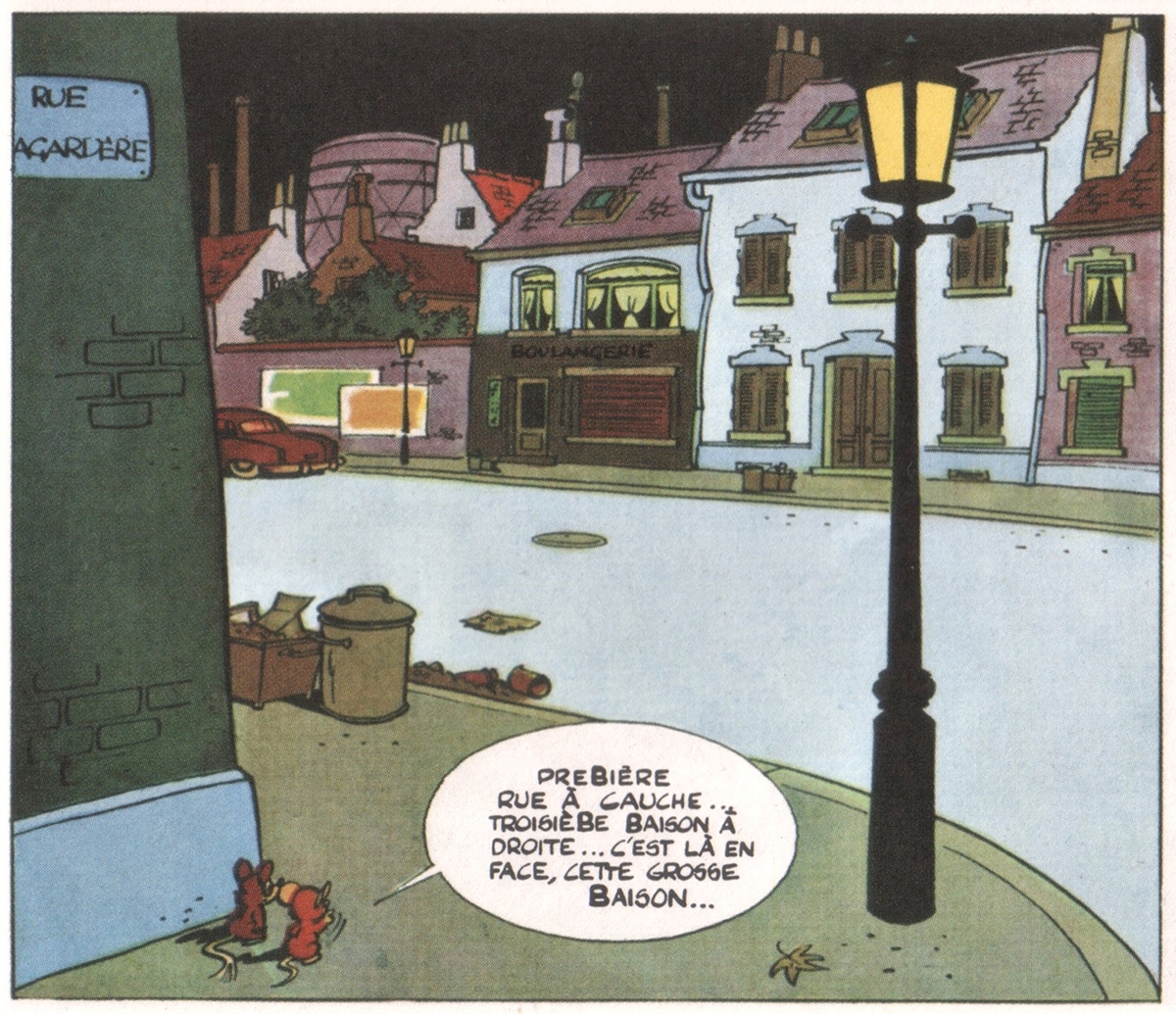
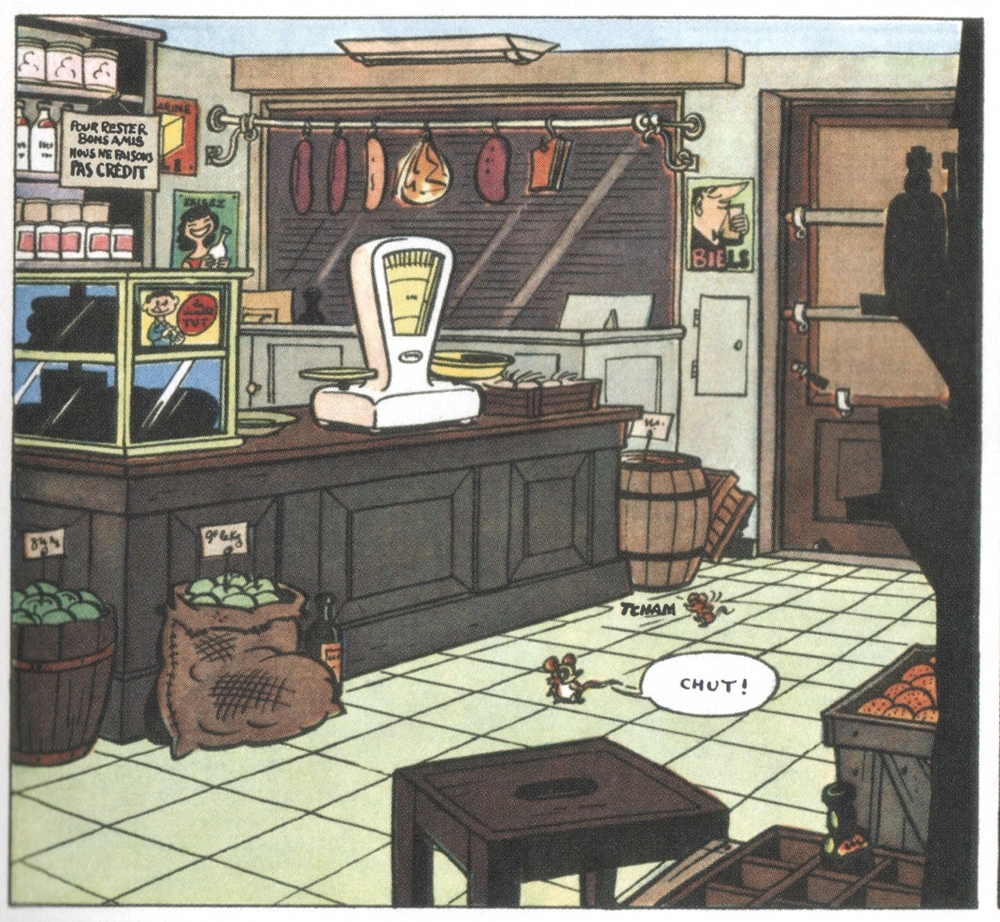
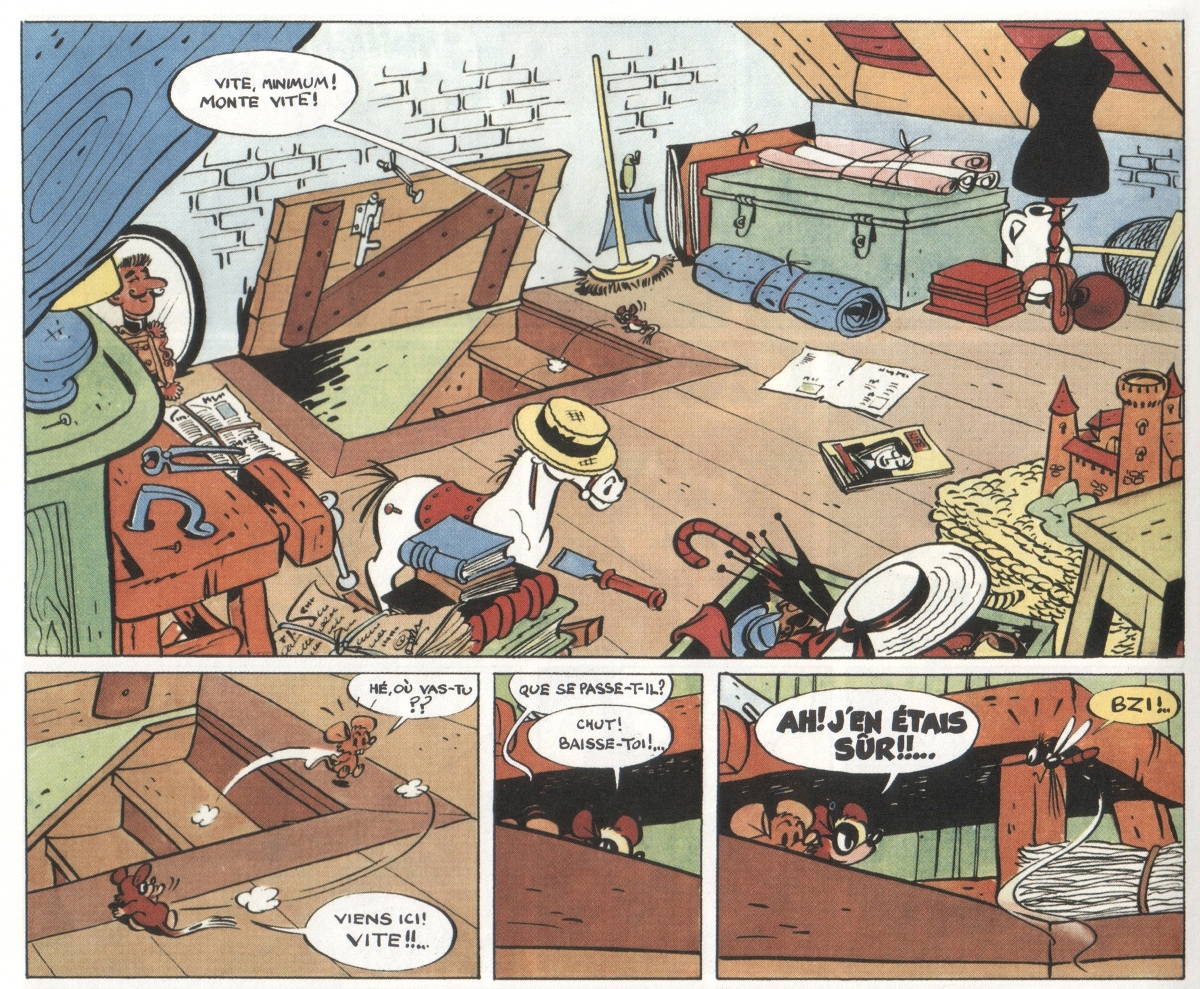
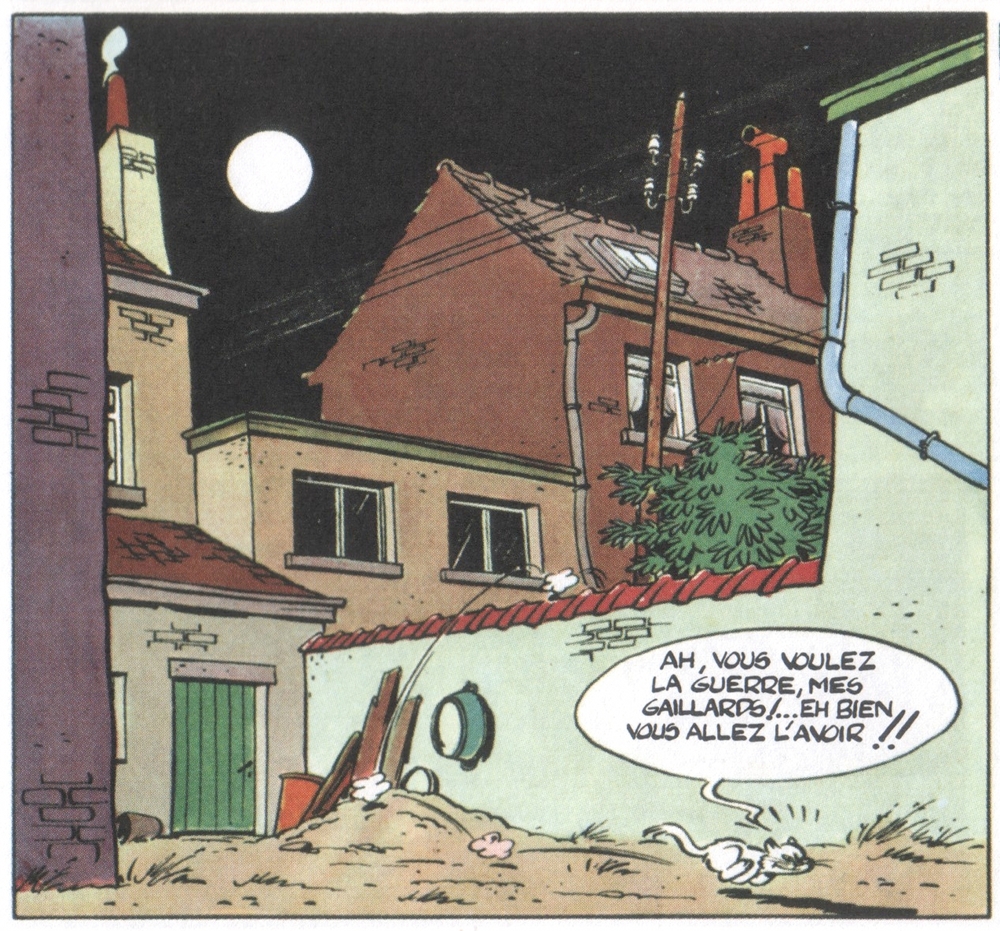
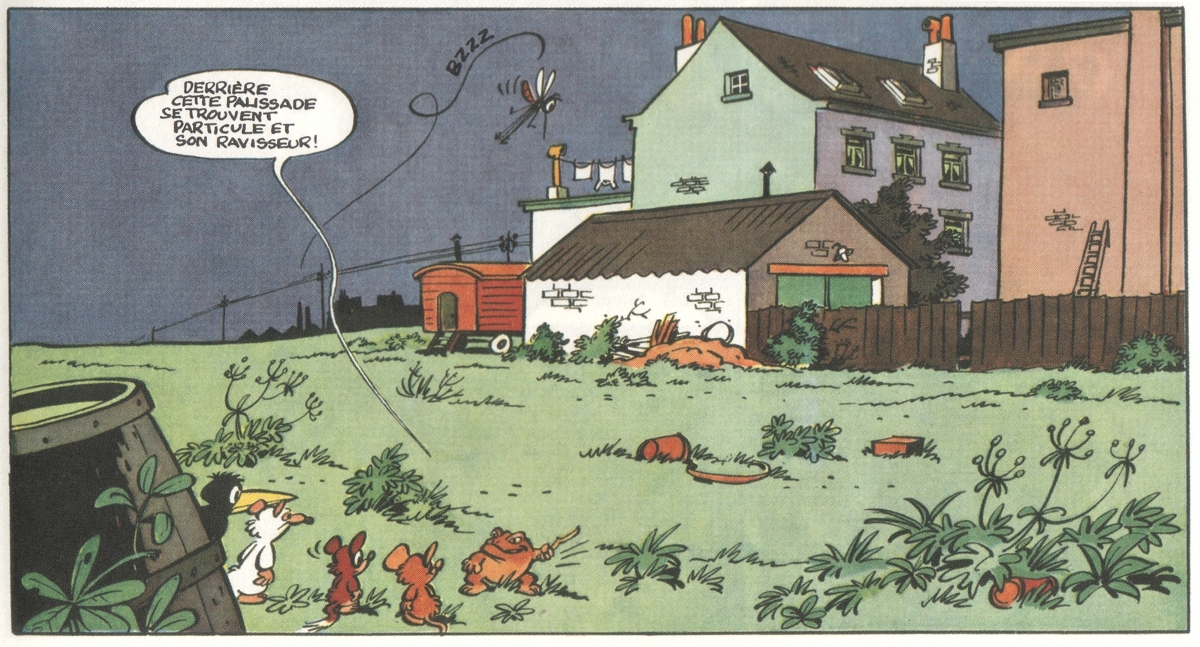
I realize now that I was probably working on principles akin to auteur theory in my attempts on this site to explain why I find Tintin and Popeye to be fascinating works of art. But let me offer another example, and get to the images you have been looking at while reading. As this whole ‘literaries’ debacle was unfolding last month, I was reading for the first time since childhood Raymond Macherot’s third Chlorophylle story, Pas de Salami pour Célimène (‘No Salami for Célimène’, 1955). For those unfamiliar with it, Chlorophylle was a funny animal series aimed at kids originally published in Le Journal de Tintin. Basically an adventure series, it situates its protagonists, the Dormouse Chlorophylle and his friend Minimum (whom I suppose is a field vole), in scenarios fraught with danger and mystery. Macherot was an environmentalist before the fact and all-round progressive who incorporated into his comics elements of social and political satire, but he generally kept things fairly simple, if always entertaining.

Where the first two Chlorophylle books take place in the countryside and feature the struggle by a ragtag group of small animals against an incursion of rats—a clear parallel to the Nazis—Pas de Salami substitutes an urban setting to tell what is basically a detective story. Chlorophylle and Minimum are Holmes and Watson investigating the disappearance of salami from the local butcher shop, as well as the connected disappearance of a mouse child. Their primary antagonist is a femme fatale-type cat, the Célimène of the title (appropriately named after the elusive love interest of Alceste in Molière’s Le Misanthrope). It turns out that she runs an extortion racket, kidnapping mice to force their loved ones to steal food for her. But it also becomes evident that the culprit our heroes seek is not her, but somebody in their own ranks.

I remembered nothing of this plot, and even less of the supporting cast, when I sat down to reread the book. What I did remember from childhood readings was the mood and setting of the story. The deserted streets and interiors of the city at night, against which the story plays out; the empty shop floors and dusty attics; the dimly lit sidewalks and overgrown back lots. While the ‘story’ as such is fine and carries several surprises as well as interesting character moments, it is to me in the evocation of this environment, this city belonging to somebody else (the humans), that the true power and beauty of the comic resides. It is what had stayed with me since childhood and it is what resonated upon reacquainting myself with it.

I am not talking about just world-building here, although that can be an important element, but rather the kind of story told in ‘graphic strokes and by deployment of the whole panoply of cartoon effects and ways of seeing and representing’ that Campbell talks about. It is a story that only resonates further when one learns that Macherot drew it just after moving for work reasons from the countryside to Brussels, where he never felt at ease. Such behind the scenes knowledge is unnecessary, however, to experience its poetry of detail and sense of alienation. Other comics could give you much the same ‘story’, but only this one could give you that. It may not be Proust, but it is certainly a worthy work of art.

The critic R. Fiore calls such an understanding ‘the experience of comics.’ Campbell references Fiore’s capsule summation of the idea in a comments thread somewhere, but the Fiore himself clarifies it further in a recent comics review:

The Experience of Comics is a notion I half-baked some time ago to account for why comics strips can have a far greater aesthetic impact than their subject matter would imply. For example, at least five of those ten greatest newspaper comics strips cited above [in the review] hardly ever expressed an idea that wasn’t trite, absurd or patently false. The outlandish coincidences of Dick Tracy, the utter escapism of Wash Tubbs, the cracker barrel philosophy of Little Orphan Annie, these are elements that in prose would not have gotten past the lowliest hack pulp editor. What sustains this substance is the experience of inhabiting the subjective world the cartoonist creates. The writer of poetry or prose however vivid his imagery must depend on the reader’s internal image of the things he describes. The cartoonist doesn’t merely describe a tree, he determines what trees look like. And so with every person and object in the cartoonist’s world. While a painter also creates a subjective world, a painting or drawing is not a narrative. Where a painting or drawing begins and ends in one image, by implication one comic strip panel could follow another into infinity. If the cartoonist’s subjective world is vivid enough all the narrative really has to do is be engaging enough to draw the reader into it. This is why bad writing will defeat even the most accomplished comic art. Rather than drawing you into the comic strip, bad writing pushes you out.

As Fiore implies, all handcrafted images do this to a certain extent—albeit not always sequentially—so there is really little reason to give it a separate name. And the logic can be extended to photographic and digital images too, albeit with modifications. When you have images, there are non-literary forces at play and ignoring them or regarding them merely as a means to a literary end is reductive. And even though fandom has long fetishized drawing, it remains a critical blind spot.
celimene_lot_t

* An example is Robert’s excellent essay on Eddie Campbell’s work, in which he integrates a perceptive analysis of Campbell’s narrative drawing. I may be wrong, but reading it seems to me as if the questions elicited by Campbell’s literary ambition prompted similar questions of the visuals. His discussion of Campbell’s debt to Henry Miller for example, for example, explains how Campbell’s drawings visualize the associative nature of Miller’s prose. Since we’re in critical mode here, I suppose I would argue that Robert takes less notice of how Campbell’s impressionistic tenor roots his meandering wit as a writer in cognitive realism, evoking like few cartoonists the visuality of memory. But that’s just building on an stimulating analysis.

Monsters, Kids, and Hillbillies

omni140lgcv

 
Various Artists
The World Is a Monster
Omni Recording Corporation

The World Is a Monster is a compilation of Columbia records post-war hillbilly and honky tonk. The tracklist eschews hitmakers for lesser-known artists — and in doing so, demonstrates fairly clearly why the lesser-knowns were lesser known. With one or two exceptions, nobody here comes anywhere near the consistent genius of Columbia’s biggest star, Lefty Frizzell. Indeed, compared to Lefty Frizzell’s easy swing and brilliantly laconic phrasing, an unassuming, declarative singer like Johnny Bond sounds exactly like the also-ran he is, while even a decent Hank Williams impersonator like Frankie Miller seems decidedly unnecessary.

Just because Lefty’s not around, though, doesn’t mean this set isn’t worth getting. On the contrary, the lack of first-rate singers leaves the compiler free to concentrate on that second-rate genre for second-stringers, the novelty song. Virtually every track here is a delightfully transparent gimmick. Undoubtedly the highlight is, “Ugly and Slouchy,” the Maddox Brothers deranged, cackling, red-hot proto-rockabilly ode to homely women (“There’ll never be no fear of them wolves hangin’ round.”)

Unassaible as that peak is, though, there are plenty of worthwhile challengers. Neal Jones’ “I’m Playing It Cool” stomps its way through Dear John letters, gambling losses, and stolen property with an off-key yodeling attack that would have made even Ernest Tubb wince appreciatively. Jimmy Dickens (probably the biggest name in the set) faces a similar gauntlet of troubles in “Me and My Big Loud Mouth,” while Jimmy Murphy’s “Here Kitty Kitty” is a double-entendre hillbilly jump blues with some tasty harmonica. And then there’s George Morgan’s “A Shot in the Dark,” with the electric guitar miming the “Peeew!” of Cupid’s arrow, and the cowbell ringing to emphasize the “Bullseye!” My seven-year old loves that one because he gets to mime the pistol shots.

My son’s enthusiasm is fairly telling, I think . In a lot of ways, novelty records are children’s music. And it’s that children’s music which eventually conquered all with the advent of rockabilly and a whole genre devoted to manically bouncy goofiness. There are some other traditions here too — Carl Smith with the convincing weeper, “There’s a Bottle Where She Used to Be;” Jack Rhodes with his cheerfully menacing “Eternity,”; Freedie Hart with his tragi-ballad “The Wall.” But listening to this you can easily hear distant echoes of Elvis or Carl Perkins or Buddy Holly or Chuck Berry. The world may be a monster, but the kiddies are going to inherit it.
__________
This first appeared on Madeloud way back when.

Perverse Iron Frechman

This piece first ran on Comixology.
______________

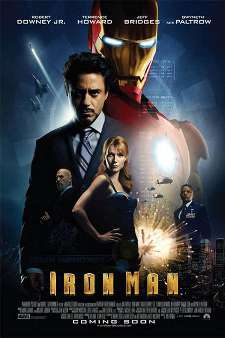
iron_man_posterI’m the last person in explored space to see the first Iron Man movie. I watched it this month and am pleased to report that it hasn’t dated a moment. We’re still wandering around Afghanistan haplessly blowing and being blown up; arms traders are still sexy/cool; bad boys with hearts of plutonium still get the girl; Gwyneth Paltrow is still frighteningly thin and brittle, with little flecks of poisonous spittle flicking out from behind her girl-next-door façade. Also, random Westernized foreigners with doctorate degrees are always happy to sacrifice themselves for the callow American so that said callow Americans can continue to be callow but with a mission; black guys are sidekicks; male womanizers are rakishly hot/forgivably flawed, but women who open their legs are trashy bitch sluts. Also Americans save all the brown people. Or maybe kill them. It’s hard to tell.

You probably know that though. After all the film is two years old. And superheroes are, what, going on 80? There’s been some finessing of the template, of course. Semi-socialist Superman beat up crooked industrial robber barons on behalf of the working man. In the post-Marvel age of superhero realism and relevance, Iron Man beats up crooked industrial robber barons on behalf of crooked industrial robber barons who have had a change of heart. But the main point is truth, justice, the American Way, and uber-violence on behalf of peace. The gods are us and we like to hit things — but in a good cause.

It’s not just sanctimonious Americans who find this sort of thing appealing, though. Perverse Frenchmen want to be superheroes too. Or at least that’s what I’ve gleaned recently from reading some of the poems of Georges Bataille. Bataille, like Robert Downey, Jr.’s Tony Stark aka Iron Man, is obsessed with sex and pleasure — surely Stark, for example, would appreciate a poem titled “I Place My Cock…” Like Strark, too, Bataille dreams of being more than human:

the glory of man
no matter how great
is to desire another glory

I am
the world is with me
pushed outside the possible

I am only the laughter
and the infantile night
where the immensity falls

I am the dead man
the blind man
the airless shadow

like rivers in the sea
in me noise and light
lose themselves endlessly

I am the father
and the tomb
of the sky

the excess of darkness
is the flash of the star
the cold of the grave is a die

rolled by death
and the depths of the heavens jubilate
for the night which falls within me.
(from “The Tomb,” trans. Mark Spitzer)

The poem almost makes more sense if you decide it’s about Iron Man than if you don’t. Even all the talk about death — “I am the dead man/the blind man/the airless shadow” — fits, since Stark is essentially a walking corpse, his heart powered by the same technology that runs his suit. His weakness is his strength as he pushes outside the possible, in a hyperbolic apotheosis of noise, light, and self-dramatization.

In another poem Bataille declares, “I fill the sky with my presence.” And that does seem to be the point for ecstatic modernity, whether pop dreck or snooty highbrow philosophizing. Presumably it’s Nietzsche’s fault that God is dead and all we’re left with is the will to power of arms traders and self-proclaimed radicals. Or maybe Jung’s right and it’s just a mythopoetical heroic something — though it seems telling that we’ve only recently decided that we require one hysterically hyperbolic hero with a thousand faces rather than making do with all the dinky little heroes with one face each.

In any case, theirs is undoubtedly a thin poignancy in the desperation on display. It’s not enough to be Robert Downey, Jr., not enough to be Robert Downey, Jr. and a genius — you’ve got to be Robert Downey, Jr. and a genius and have enough fire-power at your fingertips to make Afghanistan right. Or, if you’re Bataille, it’s not enough to fuse romantically with nature, you have to actually fuck nature to death and tramp on her corpse before stabbing yourself in the eyes with Christ’s nails. When Paltrow, as Stark’s assistant Pepper Potts finds her boss fooling around with his armor, Stark laughs it off by commenting wryly that it’s not the most embarrassing thing she’s ever caught him doing — but I’m not so sure about that.

Tom Crippen had an article in The Comics Journal sometime back in which he referred to Superman as Siegel and Schuster’s “big dumb dream.” That dream is alive and well, but I’m not so sure it was Siegel’s and Schuster’s, or at least not theirs exclusively. Superheroes are just one, somewhat popular way to wrap the world around man or man around the world like some clunkily gaudy suit of CGI armor. As Bataille says, “the universe is within me as it is within itself/nothing separates us anymore/I bump against it in myself.” You can hear the dry “thunk” of his head on the inside of the helmet before he powers up and goes off to deface some idols or beat up some bad guys, whichever comes first.

Utilitarian Review 3/16/13

On HU

Featured Archive Post: Qiana Whitted on Blues Comics.

Chris Gavaler on the silence of Black Bolt and the silence of Clarence Thomas.

Peter Suderman interviews me briefly about imperialism and pop culture.

Betsy Phillips on Jake Austen and Yuval Taylor’s Darkest America, about the black tradition of blackface minstrelsy.

Michael Arthur interviews the artist Corinne Halbert about basements, lust and foxes.

I argue that Anne Bronte also liked assholes.

Vom Marlowe on Yun Kouga’s Loveless #10.

Jog on Akshay Kumar and subversive Bollywood.

Friday music sharing post featuring psychy Stones vs. grungy Stones.
 
Utilitarians Everywhere

I talk about the ethics of mashups at the Center for Digital Ethics.

At the Atlantic

— I talk about Stephenie Meyer’s the Host and the invasion of the lovey-dovey body snatchers.

—I argue that Stephenie Meyer is a feminist, just like she says.

—I argue that we’re in a good place when even not very insightful political hacks like Rob Portman support gay marriage.

At Splice I discuss research suggesting that C-sections are often performed without medical reason.

And also at Splice I got to talk about my favorite Pink Floyd album.

You can now read my article on Junji Ito in Italian.
 
Other Links

David Brothers on Spider-Man turning fifty.

Chris Orr argues with me about rom coms (there’s some back and forth in comments too.)

Very satisfying takedown of Bob Woodward.

As a freelancer who writes for the Atlantic, this hurts. (HT Caro)
 
This Week’s Reading

I finished Stephenie Meyer’s The Host, read Kathryn Tanner’s “The Economy of Grace” about applying theology to economic matters, read the 1983-84 Peanuts volume.
 

images

The Most Popular Movie Column in the Entire World #3 – Scenes from the Life of an Accidental Progressive

Six miles away from my office is a theater that plays Bollywood movies simultaneously with their Indian release. This is one of them.

***

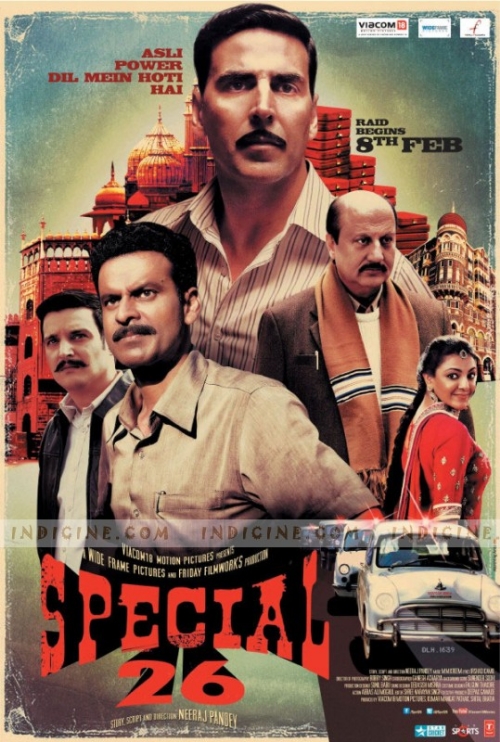
Special 26
Directed by Neeraj Pandey, 2013

SpecialPoster_zps329b7617

***

*SPOILERS THROUGHOUT*

***

WHAT CAN WE GUESS THE FILM IS ABOUT FROM THE UNSUBTITLED TRAILER?

One initially expects the picture is about a revolution in chroma key backdrops overtaking India’s newsreaders, but this is quickly proven superficial. Some variation on “TRUE INCIDENTS” awaits, dear children, with the authoritative voice of Akshay Kumar barking “raid dalni” while clacking fonts assure us that shit will imminently get at least as real as Zero Dark Thirty. At least. Look at Anupam Kher slap that guy. I swear to god, I walk out of every Bollywood movie wanting to slap as many people as conceivably possible; no other world cinema tradition has so *totally sold* the virile crack of flesh on cheek. Mmm! Anyway, it looks like the Central Bureau of Investigation is raiding the hell out of major dudes, except REAL IS FAKE and vice versa, leading to at least one broadly satirical(?) speech on the value of patriotism delivered by a top-ish Hindi movie star in a crisp professional shirt. Action! And a little dancing!

***

WHAT IS THE HISTORY BEHIND THIS PICTURE?

Once upon a time, there was a boy from Punjab who grew up in the markets of Chandni Chowk and went to school in Delhi and Bombay, and then, apropos of apparently nothing beyond personal desire, relocated in his late teens to Bangkok to study martial arts, at which time he supported himself as a waiter and a chef. Upon returning to India as a martial arts instructor, he unexpectedly broke into modeling, and then, by chance, the cinema. “I’ve been linked with every heroine I’ve acted with,” he would later say, but this was only fitting: a gadabout reputation for a Bollywood outsider, a strapping naïf who would take what he wanted, when he wanted it, and saunter away whistling to the next big thing.

AkshayWelcome

Most Bollywood heroes have legends, and this is the legend of Akshay Kumar, born Rajiv Hari Om Bhatia, active since 1991, and limited only — so the stereotype went — by his own whimsical ambitions. He would score lead roles, sometimes, and big hits, sometimes, but in the ’90s he was mainly associated with the B-grade arena of action pictures just a little ways past the vogue for those. He even had his own signature series of films: Khiladi, or “Player,” which did not hew strictly to action or suspense over the course of its eight feature-length installments, but that was where it always returned. Where Kumar, who did a little of everything, always returned. He was a ‘classic’ Bollywood workhorse, at one point appearing in a dozen feature films in one year, which by that time was very much not the behavior of a ‘major’ star.

Still, there are occasional benefits to prolificacy. In 2007, sixteen years into his career — having spent much of the decade oscillating between dubious action and romantic comedy with dips into outright drama — Kumar unexpectedly saw each and every one of his four releases hit hard, with three of them grossing over Rs 100 crore.

Suddenly, he could no longer be ignored as a periphery leading man, and gradually — be it through artistic desire or a sense that he could branch out into different areas of potential income — his risks became higher-profile.

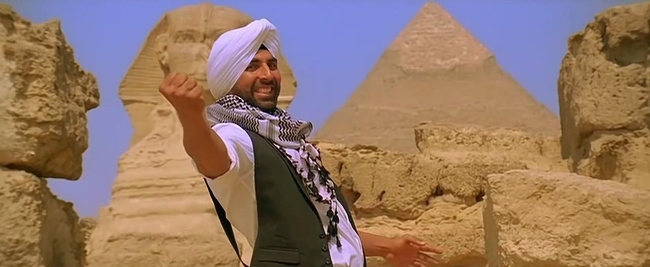
AkshayEgypt_zps74cefca3

In 2008, Kumar and his wife founded Hari Om Entertainment, a production company. Their first project, Singh is Kinng, betrayed a global outlook, with footage mostly shot in Australia, a plot remade from an ’80s Jackie Chan vehicle, and a closing credits cameo appearance by American rapper Snoop Dog. It was a financial success. The next year, Kumar seemed to double down with Chandni Chowk to China, an ambitious India/U.S. co-production with an autobiographical slant to its script. You’ve probably not heard of it, despite Warner Brothers ensuring distribution in North America; like all Bollywood/Hollywood team-ups, it seemed fated as marginalia on both sides of the globe. Interestingly, despite the seemingly personal nature of the project, Kumar managed to keep Hari Om out of the mess, though his brand nonetheless suffered; by the end of 2009 he had also co-starred in Blue, the most expensive film in Bollywood history (as of then), which also under-performed.

This prompted a particular type of conversation about Kumar, one which continues to this day: is he really a movie star? He *is* to some degree, of course — he’s the lead actor in an awful lot of movies — but his reliability as a ‘draw’ is more comparable to a Matt Damon or a George Clooney (the reduced ‘stars’ of high-concept, branding-mad America) than the Hero is Everything ethos still in strong effect in Hindi pop cinema.

The temptation, then, is to hypothesize Kumar as the potential herald of a less star-focused Bollywood, though a connoisseur might simply dub him a minor presence in the constellations. My own first encounter with his work came similarly troubled, through 2010’s wretched Action Replayy, an utterly risible fusion of Back to the Future and The Taming of the Shrew that nonetheless startled me by how completely fucking serious Kumar seemed to be taking the Crispin Glover role of a nerdy, put-upon dad, waves of shame and resentment all but jumping from his face for the first two reels of the picture. “What the hell is this guy doing?” I thought. “He’s not a terrific actor or anything, but he’s taking this dumb shit so… seriously.”

AkshayTees

By the end of that year, my feelings had evolved in a typically perverse manner. Ask anyone — anyone — what they made of Kumar’s Christmas 2010 co-production, the notorious Tees Maar Khan, and they will instantly claim a career low for its leading man, and potentially the whole of 21st century Hindi film. It was moronic, it was insulting, it was ugly, and, worst of all, it was quite lucrative, due to intense hype, incessant advertising and a massively front-loaded opening weekend, nimbly avoiding the word of mouth that would eventually win the film a 2.5 rating on the IMDB, one of the lowest from Bollywood-acclimated users.

I rather like Tees Maar Khan. It’s the bitterest movie in the entire world, and damn fascinating as a moment capture. Directed by Farah Khan — an acclaimed dance choreographer, media personality and probably the only woman in India who could realistically call herself a superstar filmmaker — and written & edited by her husband, industry gadfly Shirish Kunder, the film is uniquely positioned as a peek into a private world of politics, resentments, and general beefs.

Adapted from Vittorio De Sica’s 1966 Peter Sellers outing After the Fox, the plot finds Kumar as a legendary con man, who, cognizant of the bottomless hunger Indian cinema types have for Western approval, poses as M. Night Shyamalan’s lighter-skinned brother and hooks up with a pretentious film hero driven Oscar-crazy in the wake of Slumdog Millionaire. An absolutely vicious parody of megastar social crusader and ‘quality’ Bollywood icon Aamir Khan (with more than a dollop of Shah Rukh Khan plopped on top), the delusional actor is more than willing to participate in BIG-TIME HOLLYWOOD PROJECT — amusingly pitched as a paean to Indian suffering, i.e. the only way to get Americans to acknowledge anybody outside of the first world — which is actually just an excuse for ‘director’ Kumar to rob a train right under the noses of ignorant, starry-eyed village folk.

The true objective, of course, is to broadcast Khan’s & Kunder’s unflagging sneer at everything in show business that irritates them, including but not limited to Hollywood influence, cultural tourism, bucolic ‘patriotism’ and the current crop of heroines — poor Katrina Kaif seems to have been cast as the female lead specifically so Khan can make fun of her; despite being a romantic interest, Kumar never shows her the slightest affection outside of the obligatory song sequences, which is a bit of parody all its own — not to mention critics, audiences, and indeed, the very notion of cinema ‘art.’ To Khan, through her onscreen avatar, film direction is revealed as a con game, useful primarily for facilitating a properly modern Indian lifestyle — rightly separated from the laughable grotesquery of dirt-eating village life but proudly self-reliant and anti-American in its urbanity — with the happy accident of people sometimes finding themselves entertained in the process of being used, the stupid fuckers.

Taken in this way, Tees Maar Khan is a genuinely radical (if gigantically obnoxious) work of thematics, totally unafraid of seeming shrill or hysterical or any of the other gendered insults you can throw at a woman behind the camera. Employing an ultra-high camp mise-en-scène recalling late ’90s Old Navy commercials, its soundtrack prone to screeching “TEEES MAAR KHAAAN” at every instance of on-camera mugging, the film all but dares you to hate it, to get up and walk away from its brazen irritations; such provocation is a very rare thing in eager-to-please Bollywood, especially coming from as otherwise easygoing and cosmopolitan a guy as Akshay Kumar, who must have felt weird as hell seeing the results. He nonetheless teamed with Khan & Kunder again for a 2012 directorial project by the latter, an eccentric children’s film titled Joker that proved so unpleasant a process Kumar abandoned promotions for his own co-production and left it to die a dog’s death in theaters.

AkshayOMG

Yet given the latitude of perspective, it’s easy to see why Kumar would click with the surface attributes of such filmmaking. His style of delivery hews toward the very broad and loud, to the point where anything resembling a subdued performance inspires a Jim Carrey-like overcompensating toast to fresh-blazed subtleties. He is also that special kind of macho male whose classical masculinity is so little in doubt he’s become fond and unafraid of strutting around in pink and incorporating effeminate, almost coquettish overtures into his presentation.

You can see why a Farah Khan would find him camp as fuck, though Kumar’s tiny resistance to heteronormative standards may betray a deeper sympathy; while Tees Maar Khan adopted the I Now Pronounce You Chuck and Larry approach of cracking gay jokes as a means of normalizing homosexual relationships, one of the songs in Kumar’s 2011 Canada-set co-production Thank You matter-of-factly depicts one man slinging his arm over another, flowers in hand, while the star producer gazes on in approval. Similarly, the skin color jokes of Tees Maar Khan are refracted in Kumar’s 2012 neo-masala romp Khiladi 786, which posits Kumar’s hero cop and a brown(er)-face doppelganger brother as scions of a wildly mixed-race family, the earthy harmony of which is stereotypically but earnestly emphasized.

Perhaps most startlingly, Kumar has recently set up a second production house, Grazing Goat Pictures, for the purposes of exploring ‘quality’ films. Its virgin feature effort was 2012’s OMG – Oh My God!, an adaptation of a popular stage play Kumar credited with inspiring a profound change in his religious practice. A riff of sorts on the 1977 George Burns starrer Oh, God!, the film maintains the pose of a light comedy, but also directly tackles the industry of diverse religion in India in an unusually thorough manner. More than anything else, it’s been the critical and popular success of this film that has threatened to completely revise Kumar’s reputation – suddenly, he is “mass” and “class” alike, and uniquely equipped to push Hindi pop movies into less-comfortable places. Or so is the wish.

***

WHAT HAPPENS BEFORE THE INTERVAL?

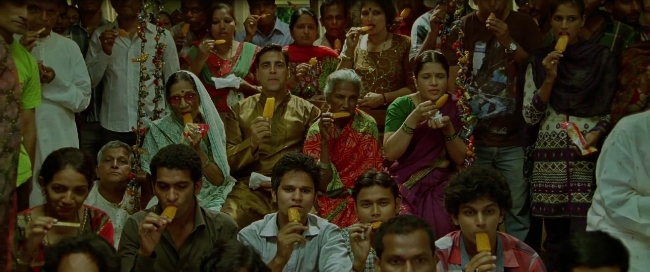
Immediately, we are confronted with a most patriotic illusion, as a serious young woman delivers a speech detailing the idealistic motive behind her applying for a job with India’s Central Bureau of Investigation (“CBI”). Visible on the margins are her interviewers — Akshay Kumar and veteran character actor Anupam Kher — who, if you have done any research whatsoever prior to seeing the film, are evidently not real CBI officers, though they maintain classically straight faces throughout the process. Soon, we are seeing footage of an authentic 1980s Republic Day parade; this is both to establish the time period of the film, as well as writer/director Neeraj Pandey’s satiric theme. Unique from India’s Independence Day (which celebrates liberation from British rule), Republic Day commemorates the adoption of India’s first Constitution, thus placing its focus on the stability of a federal apparatus that still employs the CBI as its primary criminal investigation body.

Naturally, it’s all bullshit. Particularly since the 1970s — a great era of social entertainments pitting angry young men like Amitabh Bachchan up against an uncaring society toxic with corrupt administration, self-serving capitalism and ruined idealism — ‘adult’-oriented Bollywood films have been massively skeptical of the efficacy of business and law enforcement powers; rare is the public works official not hungry for kickbacks, or the titan of industry not sleeping on black money, or the policeman not toadying for regional dictators. If there’s elections that aren’t rigged, I haven’t seen ’em. Even the brazenly reactionary neo-masala wave, escapist as it is, typically frames its swaggering, mustached hero cops as aberrations: forces that defy the will of the majority and the laughable ruse that is the ‘rule of law’ to bring immediate, popular justice to the displaced and needy.

SpecialSpeech

Pandey is working loosely from a true story in Special 26 — a 1987 incident in which fake CBI officers robbed a Bombay jeweler under the auspices of an official raid — but his deployment of a ‘period’ setting also (inexactly) evokes an older era of Hindi film for its gloss of righteous criticism. Indeed, for the first fifteen or so minutes of his film, Pandey strings the less studied viewer along by presenting Kumar & Kher and their gang of loveable cronies as *actual* CBI officers, prepping for and carrying out a tax raid on a local politician. Basically — in movie terms! — that means CBI officials get to burst in on somebody’s home or place of business on suspicion of tax evasion, literally tearing apart the walls searching for money the suspect has inevitably stashed in huge clumps somewhere on their property. “You will be cursed!” shouts a woman as the men move a religious icon from its place of rest, complacent as everything else in a shit society.

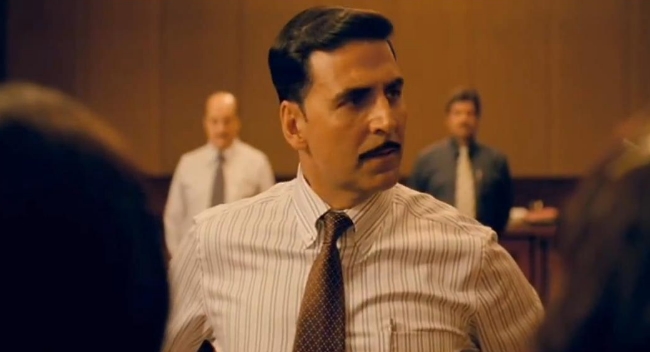
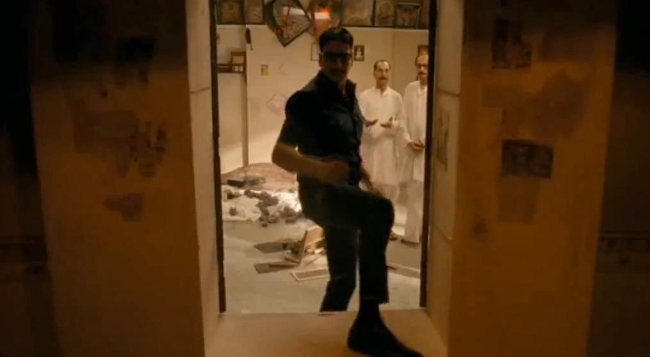
It’s all quite exciting; Pandey hails from the world of television commercials and documentary film, having only made his theatrical feature debut in 2008 with A Wednesday!, a Hollywood-sleek hour-and-forty-minute tour of a day in the life of a police commissioner (Kher again) who must negotiate a mysterious terrorist threat. Special 26 is his sophomore feature, likewise effective at caffinating legal procedure – witness Akshay Kumar, clad in a crisp, Rick Santorum-worthy sweater vest ensemble, wriggling his ‘stache while knocking on walls, cracking the dirty politician’s private property like it’s a bank safe! And what a slap Anupam Kher delivers when the suspect hazards a bribe!

Perhaps the seasoned viewer can’t possibly believe such upstanding civil servants could really exist; when Kher delivers a snappy catch phrase to a goggle-eyed young policeman about the importance of Heart, it’s a self-evidently filmi moment, dreamed up on the fly by a man who has doubtlessly crafted his con man persona from long hours in the theater, all the better to fool higher-paying rubes. Perhaps this charade of idealism is merely Pandey’s shaggy dog way of setting up a joke, the punchline arriving when Akshay Kumar — handsome here like a old American matinee idol — tears off his facial hair as the team makes its getaway.

SpecialKher

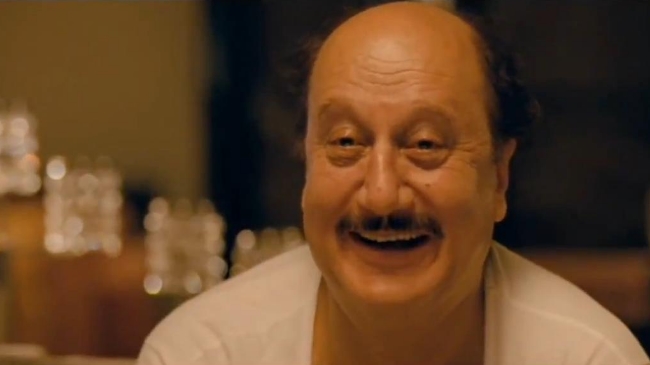
But Special 26 is also cognizant of audience expectations on a less confrontational level. At two hours and twenty-three minutes, this is a far longer film than A Wednesday!, and Pandey spends much of the first half detailing the circumstances that have led Kumar & Kher into their situation. The latter is not a stern authority figure at all, but a comical neurotic — such an ability to convincingly switch between ‘funny’ and ‘serious’ personae has made Kher one of the very few Bollywood lifers to occasionally pop up in English-language films, such as David O. Russell’s The Silver Linings Playbook — who needs a lot of extra money to support his gigantic family, while Kumar is just a roguish romantic who hopes to earn enough scratch to spirit his girlfriend away from her unhappily looming arranged marriage.

As we eventually discover, Kumar was once a CBI prospect who was rejected for service due to his lack of skill with English (a neutral, ‘universal’ language); as a result, his obsessive knowledge of federal procedure empowers him to throw India’s would-be national outlook back in its rotten, corrupt face… anyone prominent can be targeted for a fake raid, after all, because everyone is corrupt. If director Pandey notices that such all-devouring cynicism is just as much a movie device as goody platitudes, he doesn’t let on, perhaps embracing this cooler brand of artifice in the same manner a masala director might crank out the fights and dances.

There are dances in here, though. Ha ha.

SpecialDance

You’ll notice I didn’t identify the girlfriend just above. Sadly, that’s because actress Kajal Aggarwal (mostly of Telugu and Tamil ‘south’ film) is saddled with one of the most thankless, do-nothing roles in recent memory, stranded amidst a romantic subplot that eats up an extraordinary amount of screen time without accomplishing anything beyond the most banal platitudes. Obviously, such problems are not unique to Bollywood. Were this a Hollywood film, I’d theorize that some studio executive had delivered a note reading “MAKE AKSHAY SYMPATHETIC, XOXO” but it seems likely here that the romance takes up so much space to facilitate adequate song tie-in monies for somebody’s corporate partner somewhere. I don’t mind when a Hindi action movie breaks into song and dance — you just buy into that possibility coming in — but the music of Special 23, set to ‘missing you‘ montages and the like, works at direct cross-purposes with the suspenseful, relentless, immersive pace Pandey obviously seeks to build. A ‘traditional’ Bollywood movie is so often a work of vignettes – a modular evening of courses. This is like eating a piece of a steak, and then waiting a while for the second piece to be brought out, and then the next, and the next.

But then, that is the balance when you seek to go big. Akshay Kumar may be a modest progressive, but knowing that he *can* pull off such things carries with it the burden of popular expectations that facilitate that very freedom, particularly when he’s not in control of the production. The public expects a sympathetic, heroic figure, and Special 26 is altogether eager to play up Kumar’s movie star reputation as much as his offbeat tendencies. The result is really a hybrid film, but not something that benefits from hybridization: so eager to provide a slick, straightforward work of suspense and critique, Pandey winds up seeming less sure with the songs or the romance than any of the ’70s and ’80s social picture forebears he plays at emulating. Like Kumar, he is man slightly astride his transitional age.

***

WHAT HAPPENS AFTER THE INTERVAL?

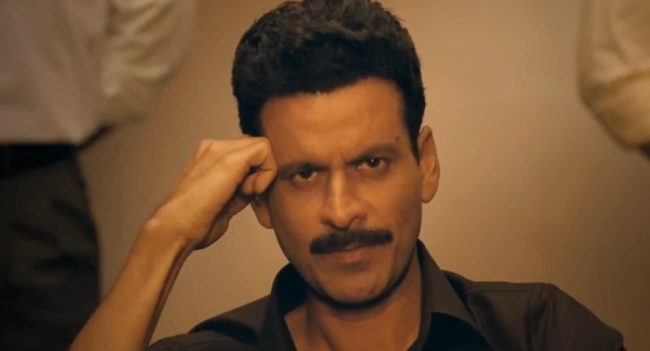
The second half of the film primarily concerns the climatic jewelry heist, as well as a cat-and-mouse game played between Kumar/Kher and and actual CBI investigator played by the always-excellent Manoj Bajpai, whom nobody will call a traditional movie star, though he embodies a more intense tradition than Akshay Kumar.

SpecialManoj

A television actor who made his film debut in 1994 via future (and temporary) Oscar semi-darling Shekhar Kapur’s Bandit Queen, Bajpai rose to prominence in 1998’s Satya, one of the landmark works of contemporary alternative Hindi pop cinema – not exactly the ‘parallel cinema’ of art film, but a distinctly vérité, rough-hewed, criminally-focused brand of urban fiction. The director of the film was Ram Gopal Varma, a prickly, erratic, sometimes rather goofy figure deserving of more attention than I can afford right now, though it’s sufficient for these purposes to note that he’s often sought new and potentially unpleasant ways to produce ostensibly popular films, including recent forays into (unwatchable) microbudget filming and (slightly underrated) consumer-grade digital photography, recently given way to large-format tragic docudrama.

Even more pertinent, though, is the co-writer of Satya, one Anurag Kashyap – more than anyone else, Kashyap embodies the present counter-mainstream in Bollywood, perhaps because his films often strike an explicitly critical stance against the Hindi film norm. His 2007 feature directorial debut, Black Friday, despite its stance as (another) tragic docudrama, was both a sensitive investigation of the heroic/villainous police dichotomy and an avowed cinematographic influence on Slumdog Millionare, while his 2009 Dev.D mined intriguing veins of misogyny and self-abuse from the beloved, oft-filmed Bengali novel Devdas.

Bajpai reunited with Kashyap for his most recent directorial pursuit, 2012’s weird, beguiling, tiring, indulgent, and undeniably 5 1/2 hour-long Gangs of Wasseypur. Eventually split into two films for ease of release, the project was a shoot-for-the-moon attempt at a century-spanning, multi-generational crime saga comparable to The Godfather and its sequels; while the results frankly suggest less of a novelistic immersion than a filmmaker simply unwilling to edit much of anything, Gangs of Wasseypur nonetheless boasts a commanding, impulsive performance by Bajpai (and an equally good Nawazuddin Siddiqui), and an all-time high for the agony of influence active in Kashyap’s cinema, climaxing in an agonizingly long, unbroken shot of a wounded man crawling through a house in flight from assassins, the soundtrack humming his very favorite cheesy Bollywood romance song to give him strength, to fortify his misguided character, to affirm his misspent life.

SpecialKick

Where Kashyap is agonized, Pandey is content. He establishes Bajpai a bit prior to the interval, in an extended chase scene that serves mainly to give him something ‘active’ to do in a screenplay that might otherwise leave the audience unstimulated for a millisecond. Egged on by the aforementioned goggle-eyed (now seemingly humiliated) young policeman from the prior raid, Bajpai muscles his way into the jewelry plot, which centers around Kumar & Kher recruiting a cadre of underemployed dumbass civilians to serve as an unwitting backing army in the raid. They are not quite the “Special 26” of the title, however, as Kumar & Kher are (of course!) playing a long con, and (of course!) the goggle-eyed cop was a deep-cover plant, in on the scheme the whole while, and (of course!) our anti-heroes have prepared for every eventually, ultimately using the real CBI as an inadvertent decoy while the real raid goes down with triumphant slow motion punctuation at a different locale.

Yet where does this leave us? One might assume that Pandey is making a point about capitalism — there’s a classically cheesy humanizing moment near the end where Kumar mails Bajpai back some money he snatched from him earlier, ’cause he don’t steal shit from honest working men — but the only real success his heroes enjoy is their entry into a more relaxed social strata. Indeed, they mostly take advantage of their fellow proles in the process, without a lot of regret, if never exactly to their material detriment. Maybe Kumar hasn’t wandered so far from Tees Maar Khan after all. Maybe this is all nothing more than a writer/director applying all sorts of domestic mainstream gloss to his foreign mainstream influences, and happily cashing in – Special 26 is already the second-highest grosser of 2013, standing at about Rs. 65 crore, having done enormously well for an ‘small’ film.

Still, there is a weird ambiguity at the end of the picture, as the frustrated Bajpai suddenly receives a new lead on the whereabouts of the thieves, just before the end credits. Did censorship concerns prompt a crime (sorta) doesn’t pay (maybe) denouement? Or did Pandey mean to suggest that, having become rich in place where rich equals corrupt, his heroes will inevitably become corrupt as well, and require toppling? Endless conflicts like that can power endless, profitable, probably banal fictions, though the success of this one again inspires hope for another small line of credit extended to Akshay Kumar, another possibility for another small step for this Bollywood outsider, wormed goodly inward and now slowly navigating his way out.

Yun Kouga: Loveless 10

I’ve been reading Loveless for years.  It’s a semi-fantasy series about cat boys/cat girls.  In the Loveless world, everyone has cat ears and tails until they lose their virginity.  We’re up to ten volumes, so it’s going to be hard to summarize.  The main story is about a troubled young boy, Ritsuka, who has lost all his memories.  He lives with his very abusive mother; in the past, Ritsuka’s beloved older brother Seimei would protect him, but Seimei died in a fiery pile of flames and ashes.

The main external plot is about the mystery of Seimei’s death, the school Seimei attended, and the secret magic system of fighters and sacrifices (it’s a special way to have a magical duel–each couple has one fighter and one sacrifice).

The main internal (character) plot is about the variously broken individuals coming together to become less broken via friendship and affection.

Spoilers follow


When Ritsuka moves to a new school, a college student named Soubi meets him outside the grounds.  Soubi says he is a gift from Seimei.  Soubi wears bandages around his neck, and eventually asks Ritsuka to pierce his ear with an earring.  It’s all very mysterious and kind of weird.

I will say upfront that when I got into this manga, I thought Ritsuka was in high school, but he’s actually a sixth grader.  I am terrible at reading ages in manga, and while adults are sometimes pictured taller, it can be hard (for me at least) to tell who is what age.  There are a whole bunch of schools and students and teachers and administrators and graduates and so on.  It’s a long, complicated manga.  Apologies in advance if I get character age details wrong.

In volumes 1 through 7, the story covers Ritsuka’s background (troubled childhood, love of Seimei, Seimei’s good side), Seimei’s death, and Ristuka’s arrival at a new school.  Ritsuka is obsessed with philosophy and also believes he is a parasite in his own body, because he has lost his early memories.  The ‘real’ Ritsuka is the one in the past, the one who had Seimei, the one his mother cared about.  That old Ritsuka liked different food and behaved differently.  Ritsuka is waiting for that old Ritsuka to return.  It’s both touching and sad.

Fortunately, he meets a girl named Yuiko, who isn’t very smart, but is very kind.  She befriends him, and as they spend time together, Ritsuka defends her just as she defends him.  Ritsuka’s young teacher (who still has her ears) also does her best for Ritsuka, despite disapproval from other teachers who think she shouldn’t bother to get involved or who think Ritsuka is creepy.

Soubi also befriends Ritsuka, in his own weird way.

However, as soon as Soubi enters Ritsuka’s life, these weird duels begin.  Random couples challenge Ritsuka/Soubi to battle.  It’s all quite odd and mysterious, but eventually you find out that the fighting pairs are all taught at a special school.  Several different teachers at the school have different methods of preparing fighters.  Soubi’s teacher abused him horribly to teach him to tolerate pain and be the best fighter.  Another teacher invents/creates a couple who are called ‘zeros’.  The zeros feel no pain, so they can accidentally hurt themselves.  One of the zeros poked his own eye out.  Seimei has left Ritsuka some information about this stuff on a locked special file on his computer, but it’s all very vague.  There’s a video game and a big challenge and sometimes people trade over fighters or sacrifices, and each pair has a name (Bloodless, Loveless, etc).  In this world, words have incredible power.

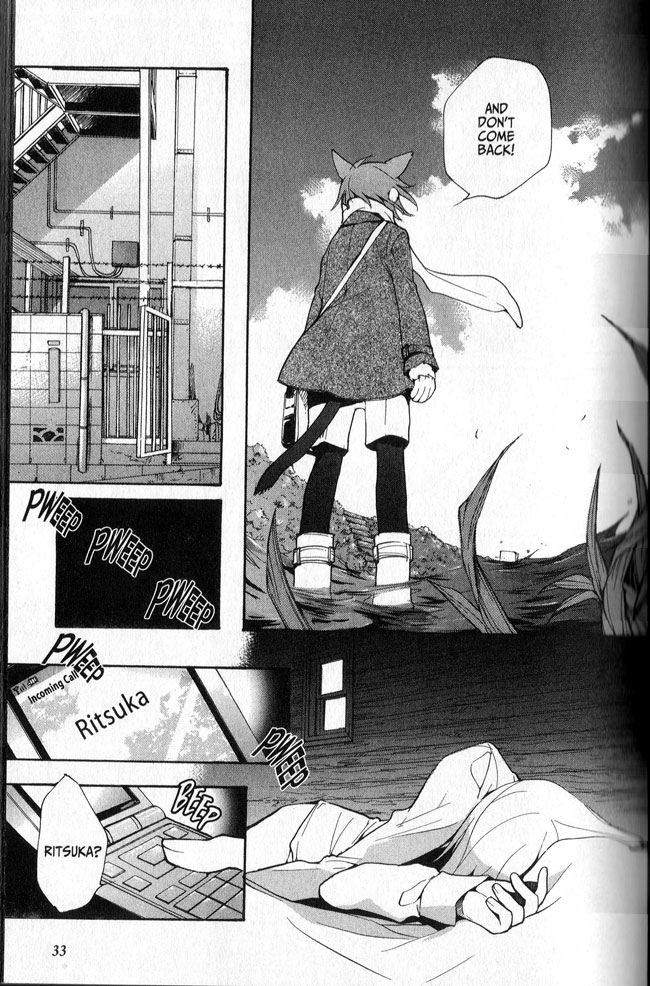
Which brings us to volume 8.  In volume 8, Seimei invades the special fighting school.  He removes the eyes of the abusive-to-Soubi teacher and leaves a message scrawled in blood.  “Ritsuka I’m Back.”

Classy!

Ritsuka, Soubi, and Soubi’s friend Kio all go to the weird school to find things out.  Unfortunately, not only is Seimei back, he also appears to be evil (what with the poking out people’s eyes and all).  Ritsuka, who still loves Seimei, isn’t so sure about the evil part.

Seimei and his new fighter kidnap Kio and basically cause a big ole ruckus.

And this is the point where the manga went on hiatus, Tokyopop succumbed to bankruptcy, and the entirety of Loveless fandom screamed in combined frustration.

Fortunately for us all, the artist did eventually return, Viz took over the licensing, and my world was righted.  Huzzah!

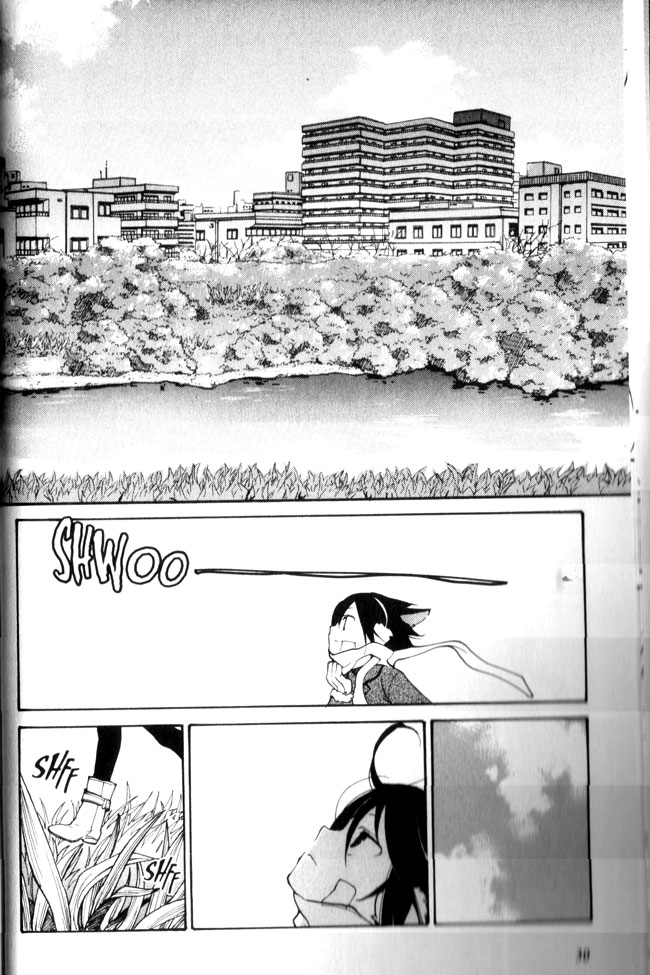
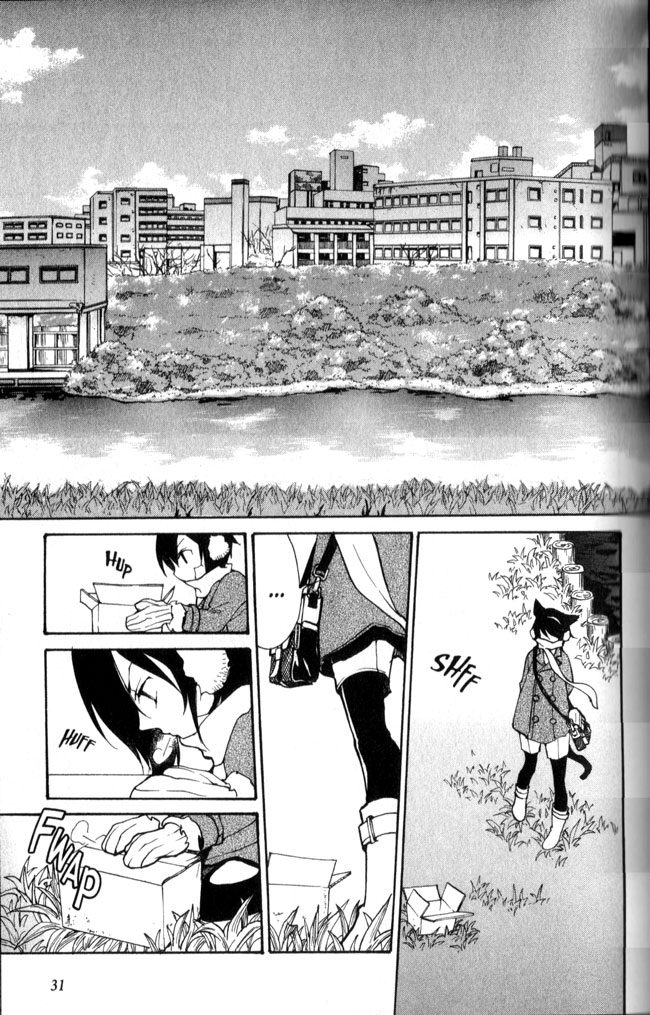
I greedily read volume 9, which is, in many ways, the culmination of several emotional storylines.  I won’t recount the various pitched battles, but in short, all of the teachers give Ritsuka advice for battles.  Ritsuka has always been suspicious of words, but here, he finally comes to understand that the advice and words are an attempt to give him strength.  The art in that passage is particularly poignant.  Soubi and Ritsuka do engage in battle, and they triumph–not against Seimei, but against his allies.  Volume 9 ends with a breath of relief–Ritsuka and Soubi trade Seimei’s fighter (who they took prisoner) for Kio, and they release Kio from his prison.

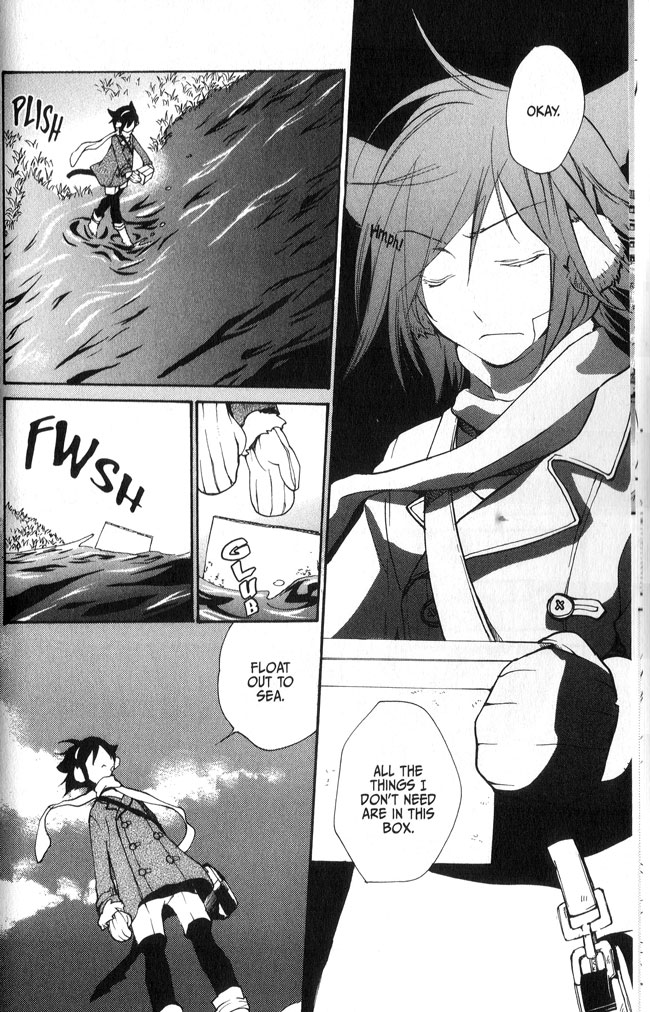
Overall, the art of Volume 9 is beautiful.  Moving, strong, with rich backgrounds at some points and expressive minimalist ink-line-only panels in others.  It does have some confusing passages, but I’m not sure whether that’s the fault of the manga or Viz’s choppy translation.  For a manga that cares so much about words, a good translation is essential.

Which brings us to the most recent volume.

10 is much quieter, the aftermath of the battle, the picking up of the pieces.

The passages in Vol 10 are mostly quiet, thoughtful, beautiful.  Here, Ritsuka deals with his past:

Past1

Past1.5

Past


Past2


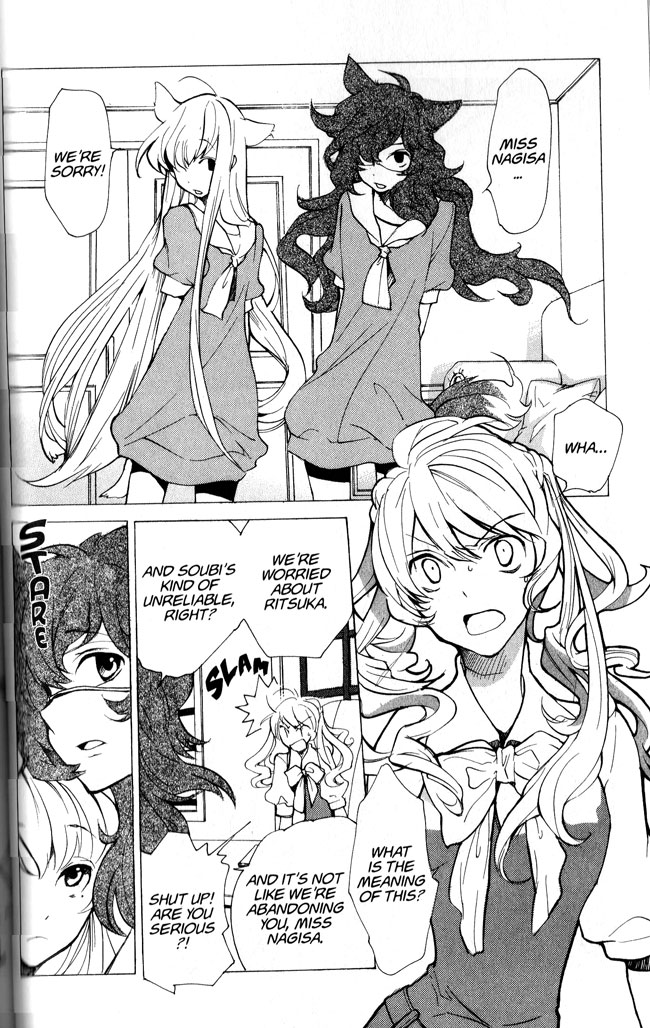
The irritating, puzzling, unable-to-feel-pain Zeros decide to come stay with Soubi so that they can protect Ritsuka.  Soubi worries that this is a plot by the Zeros’s teacher, but it turns out that they have decided to do this on their own–they like Ritsuka and they’re worried about him.  It’s a surprise to everyone, since their teacher basically created them.  Don’t they look like major trouble-makers?

TroubleMakers

Naturally, when they show up in Ritsuka’s class, they cause exactly as much trouble as one would expect–taunting people, bullying others, hugging Ritsuka until his ears stick out.  But Ritsuka handles them.

This volume is full of such small moments.

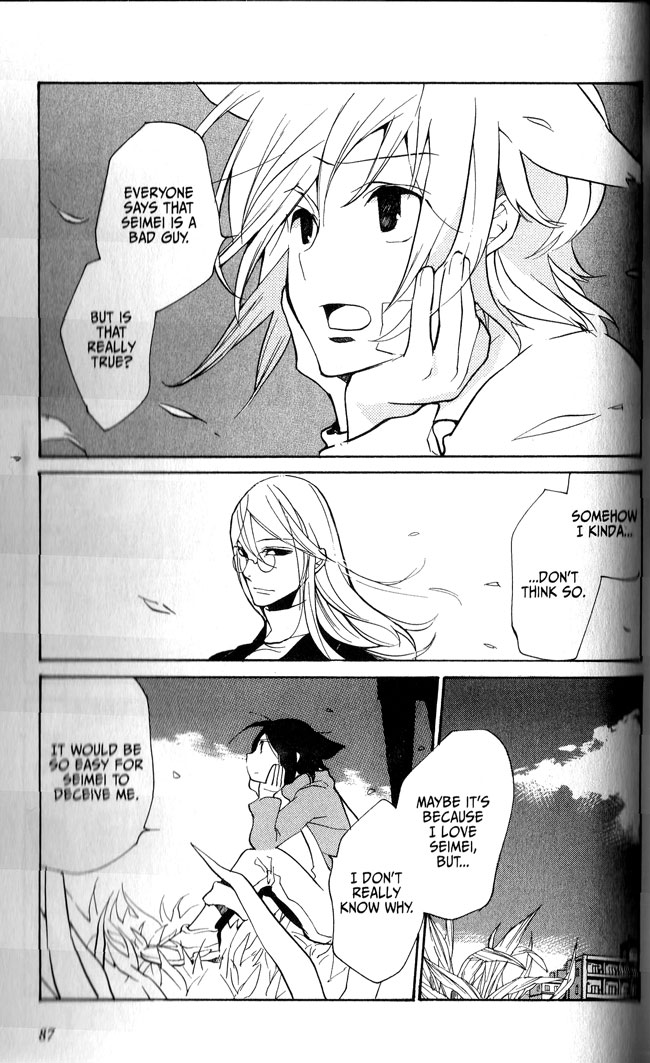
Here is another beautiful, painful passage:

HillSoubi1 HillSoubi2

Aren’t the faceless figures great?  I love Ritsuka’s body language as he sits there, trying to figure out a world that is difficult and confusing.

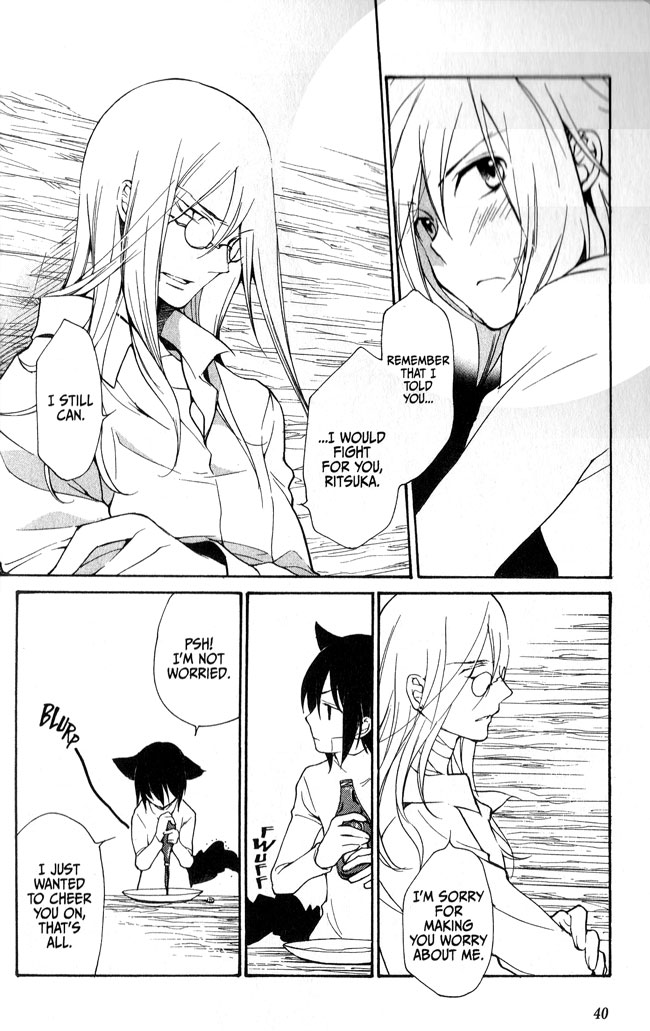
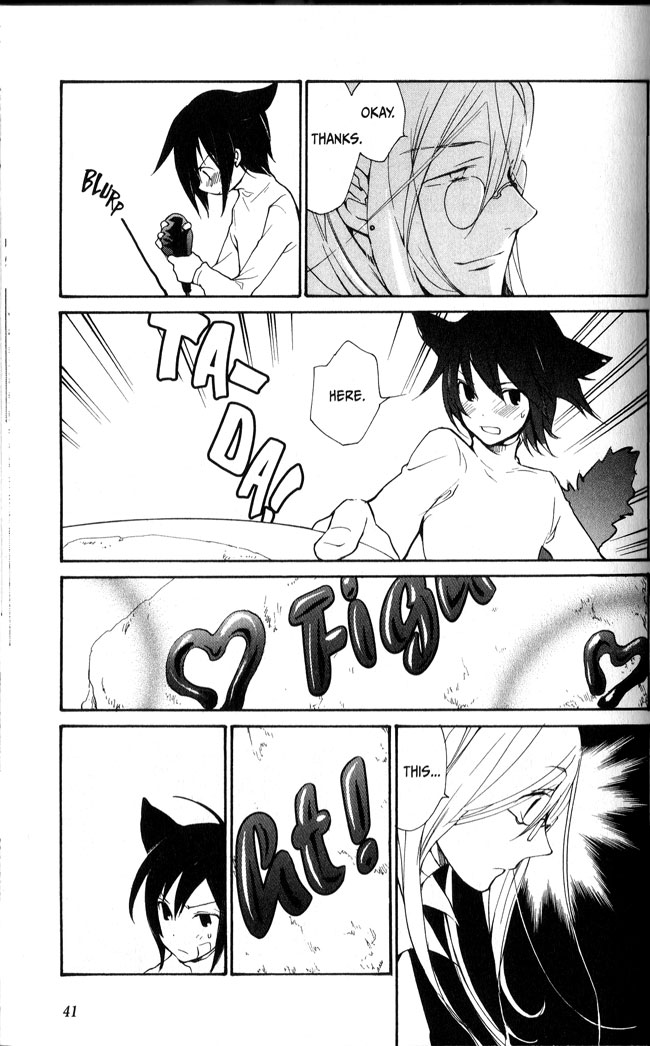
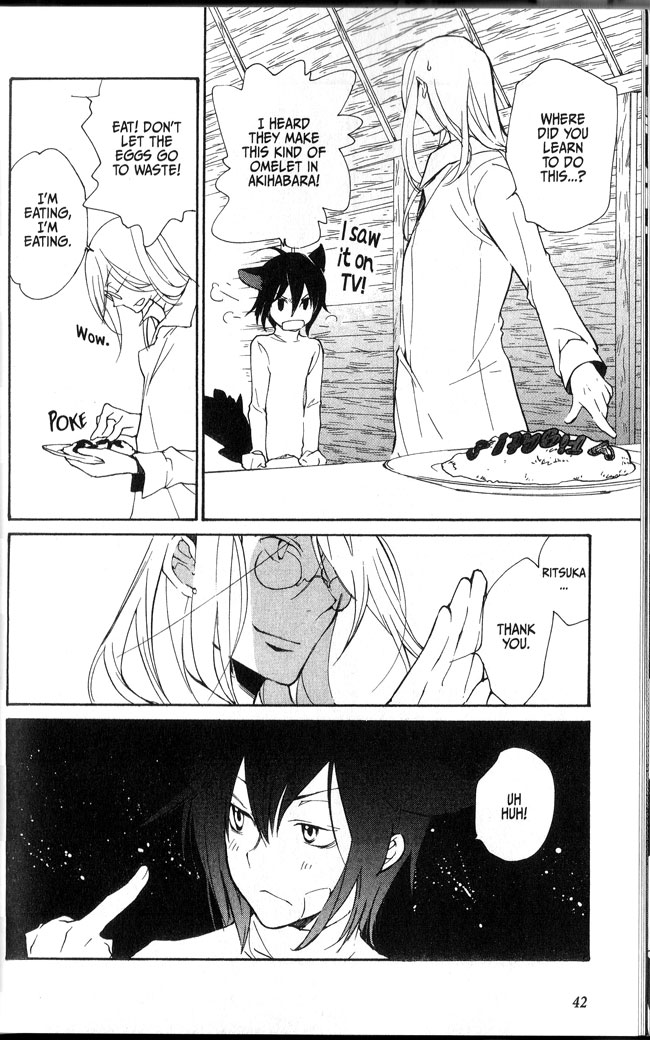
I especially enjoyed the way that Ritsuka, who had until recently been ambivalent about Soubi, decides to make dinner for Soubi.  (In previous volumes, Soubi cooks for Ritsuka.)

RitsuCooks1 RitsuCooks2 RitsuCooks3

I love how Ritsuka’s tail puffs out just like an angry cat’s.  Heh.

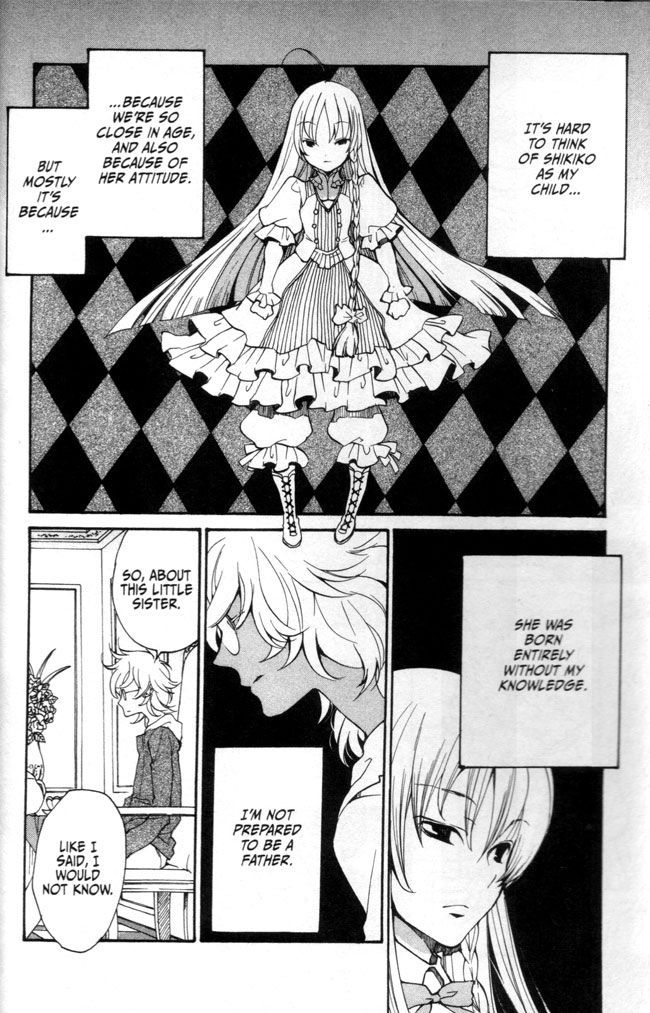
Overall, this is a great volume.  Towards the end, another pair shows up to move the external plot along, so the pacing is quite good.  My one complaint is that the opening of this volume details a completely random section about Kio.  Until now, Kio has been like Yuiko–a normal person, a foil for all the nutty magic stuff.  Kio is an art student who befriends Soubi because he feels sorry for him.  Kio wears lots of earrings, likes candy, jokes around, is kind.  In the very end of the last volume, Kio sees someone who looks just like him, except female.

In the start of this volume, Kio goes off on an adventure of his own.  Unfortunately, I felt nothing but bafflement and frustration.  Kio shows up at a great house where he says he was raised, and he meets a young girl in loli dress who is, apparently, his daughter (?!?).  A daughter who was born without his awareness or consent, and who, as soon as she was born, meant he was kicked out of his ancestral home, because only women can live there.  It was like being dropped in Angel Sanctuary–who are these people?  Is that Sir Not Appearing In This Manga?  Help, I’m lost.

LovelessLOLWHUT

His mother is crazy, there’s a maid with a ruffled cap, it’s all just–I don’t know, man.  I was enjoying Kio for who he already is.  I hate to say it, but not everyone needs a secret identity.

It’s possible I’m just getting cranky in my old age, or maybe the manga will take this development in an interesting direction.  It’s not enough to stop my overall enjoyment of the story.

For those who are interested, Viz is rereleasing the earlier episodes of Loveless in 2-in-1 volumes for a nice price.