Discovering (and Subsequently Abandoning) Your Inner Butt

(Note: Please excuse the regrettable patched scans)

As someone who has worked on adventurous gritty lo-fi publications that are both free and priced, my experience is that, after some period of time of unsold boxes sitting around in your basement, the priced publications will become free. Which is why the recent revival of Chicago’s free Lumpen magazine is both an exciting development and an astute choice, and why a full-color comics issue is even more astutely exciting. The recent local success of collective celebrations of sequential creativity like Trubble Club and Brain Frame, and free-comics forebears Skeleton News and The Land Line, make it a great time for a newspaper and an art show glorifying the bipolar neurotic introspective banality and frantic psychedelic randomness of the underground aesthetic.

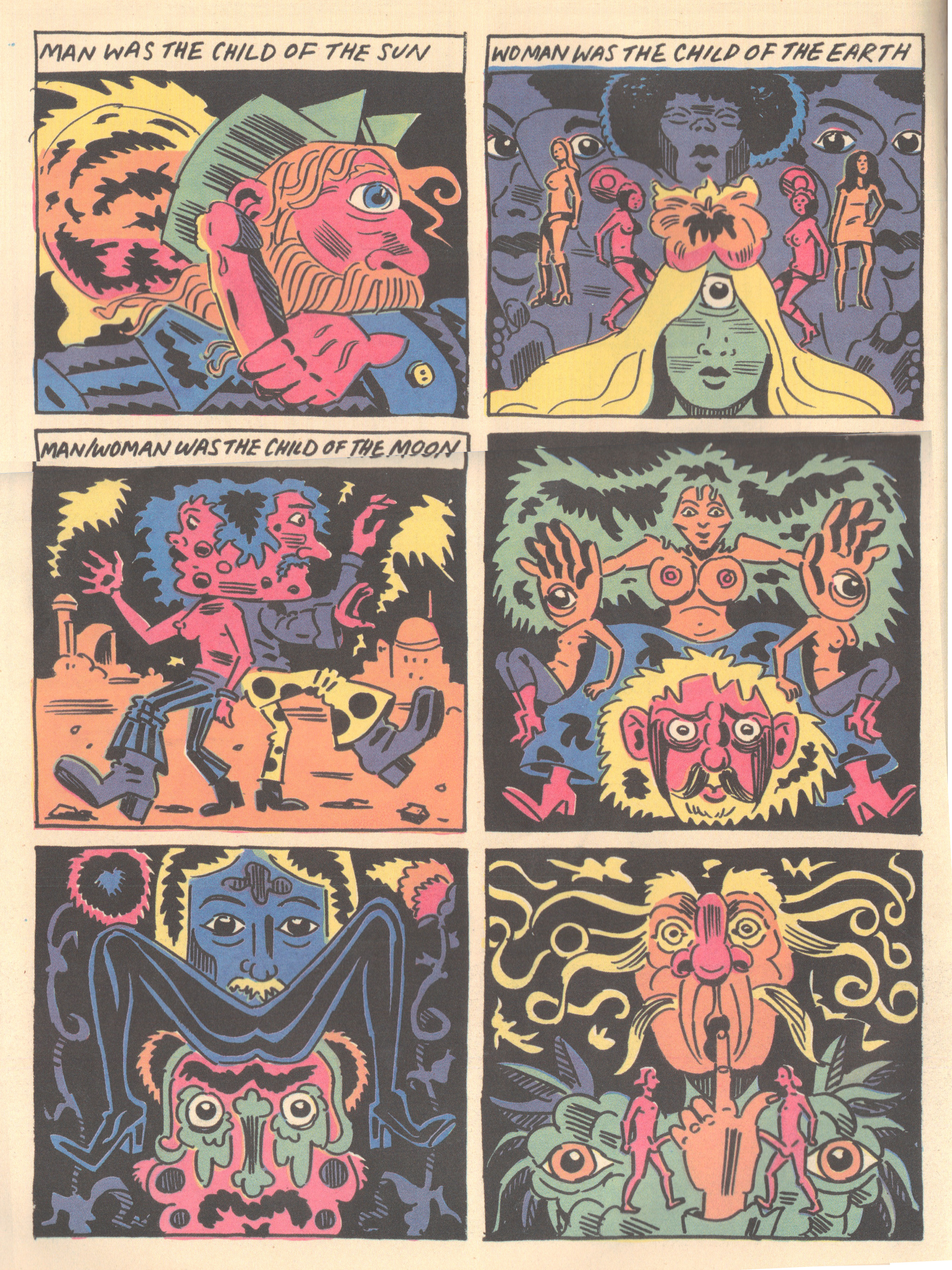
My preference, without question, is for the trippy-manic end of the spectrum, which is well-represented in this issue and exhibition. The perverse results of combining images with narratives (not that it’s a new thing) results in confusingly coded explosions of energy, from the Choju-Giga Scrolls to Little Nemo to Superman to Jack Kirby. Speaking of whom, Anya Davidson manages to carve out a unique niche in the collection with a page of vivid, klunky yonic-symmetrical panels of gendered monstrosity that borrow from equal parts Kirby and Gary Panter. While opting for a more spare and bold design sensibility than either of those two, Davidson’s simple meditation on difference is lent some creepy weight by the smudgy nonspecificity of a bygone comics era.
 

davidson
Anya Davidson

 
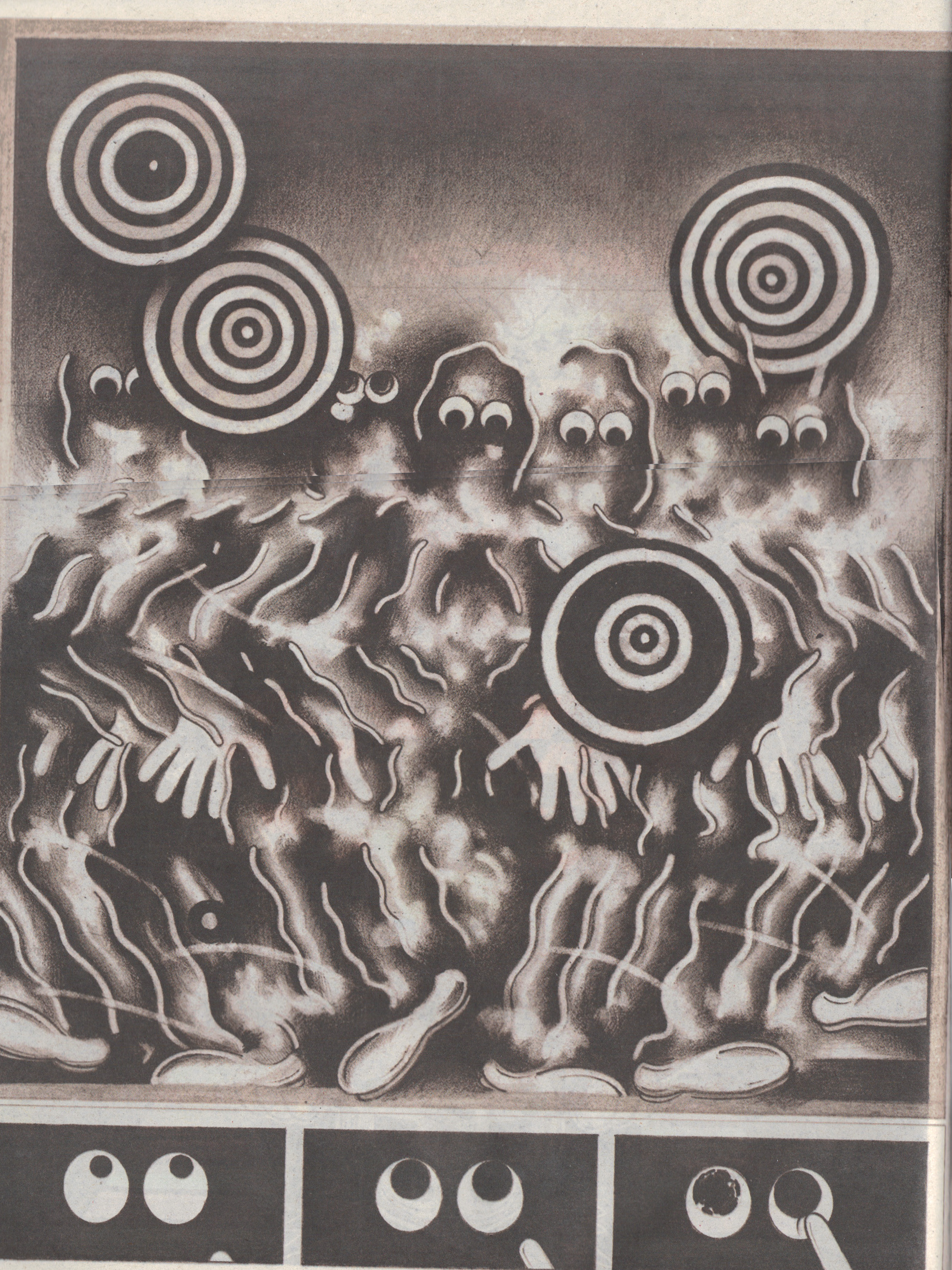
Along with Marian Runk’s and Keith Herzik’s dazzling contributions, the least narrative work in the collection might be Ryan Travis Christian’s hallucinogenic splash-page monochrome miasma of ghosts and pinwheels, supplemented by three panels of lysergically widening pupils being approached by a finger. The piece, like much of Christian’s work, reads like a disorganized scrapbook of Dumbo’s alcoholic nightmare, if it were a syncopated tale of undead minstrel vengeance conceived by Max Fleischer, director of the early shape-shifting Popeye and Betty Boop cartoons.
 

christian
Ryan Travis Christian

 
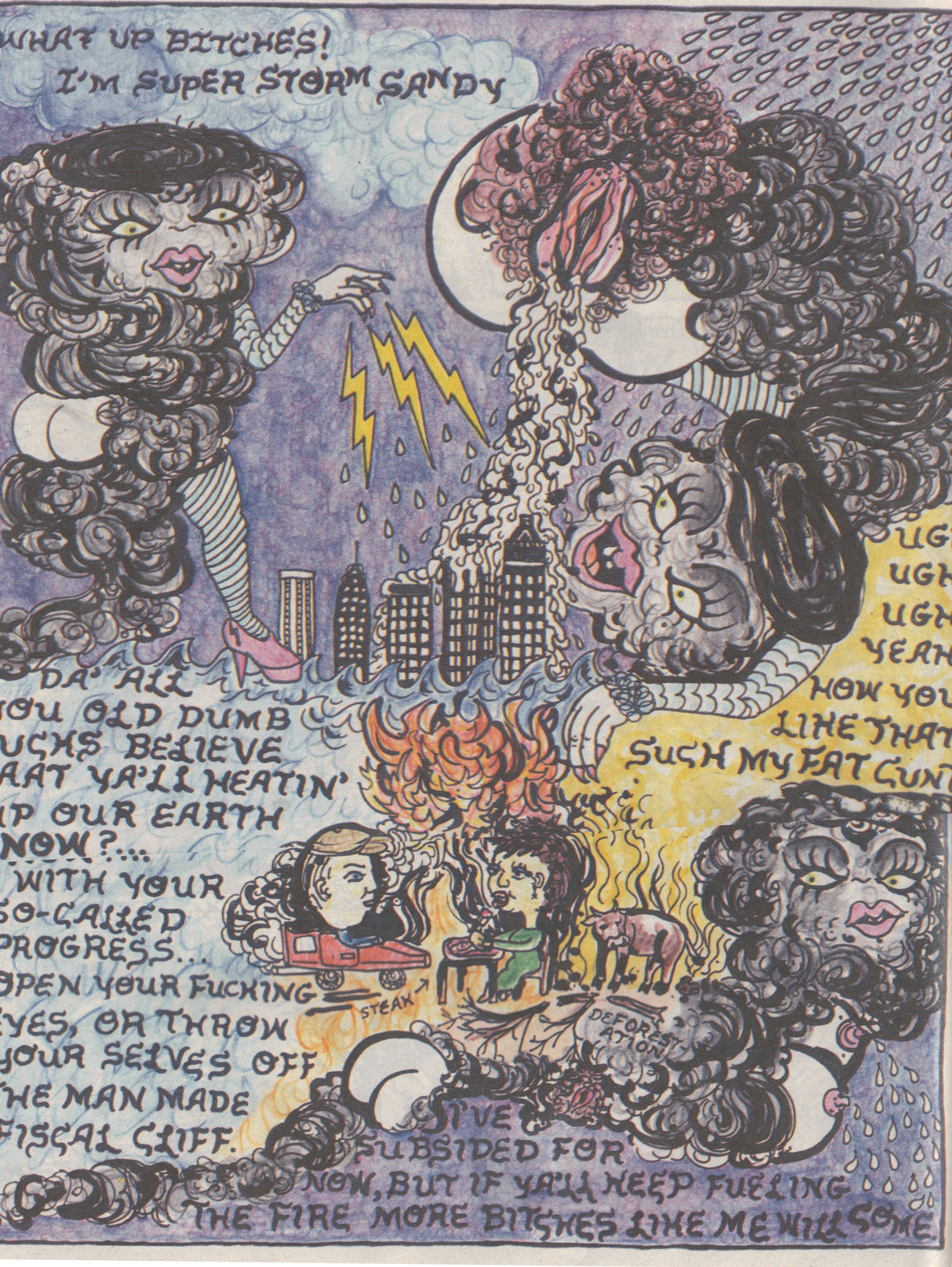
The polemic standout of the show was Coughs’ co-founder Carrie Vinarsky’s tribute to Super Storm Sandy, a scribbly stripper-cyclone hurling obscenities simultaneously at her human victims and progenitors like Lindsay Lohan on a bender and armed with crayons, while her giant vagina rains down mayhem on hapless Manhattan.

vinarsky
Carrie Vinarsky

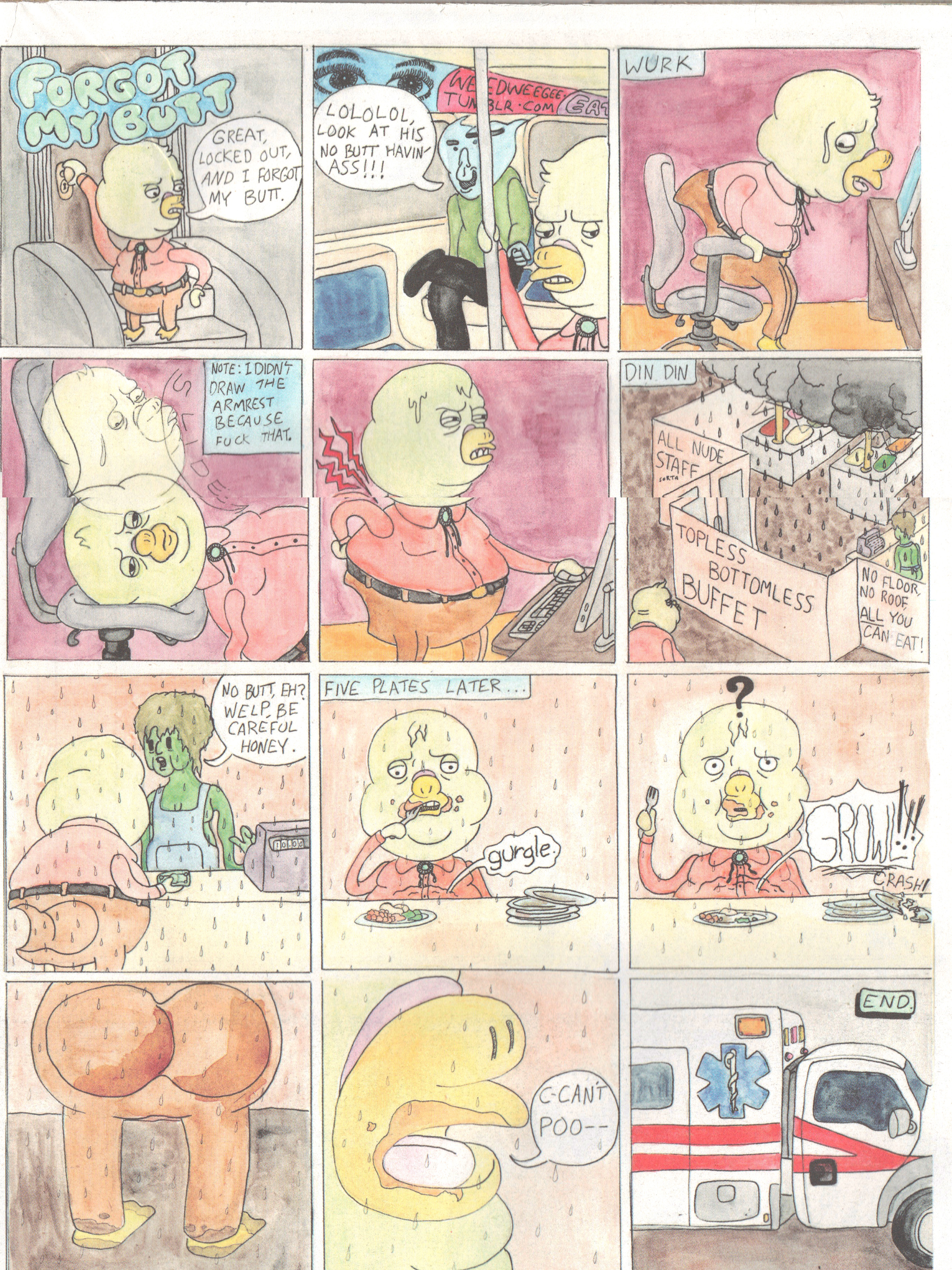
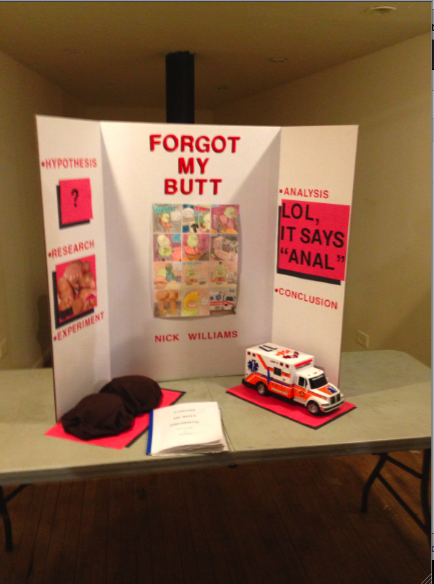
But perhaps the most memorable comic is, ironically, an ode to forgetting. In particular, to forgetting one’s own butt. Not satisfied with merely creating a poignant pastel vignette on the trauma of bottomlessness, Nick Williams also put together an incredible little half-assed (as ‘twere) science-fair display for the exhibition on the rigorous process of controlled testing that led to the groundbreaking butt-forgetting result. Sort of a Paper Rad knockoff of a Vonnegut ripoff of Kafka, this delightful fable implicitly mocks any appreciation of its genius. Which is quite refreshing, given underground comics’ knee-jerk reference for faux-Beckett-esque existential wankery.

williams
Nick Williams

In all, all free publications, but in particular this free publication, provide one of the few tangible artifacts of a time of universal and ubiquitous dissolution of aesthetic hierarchies (or even preferences), and the Lumpen comics issue is also an entertaining and visually appealing recyclable echo of coffee-table compendia a la Kramer’s Ergot. The future of analog picture-making techniques and physical formats are, I hope, not tied to the nostalgic conservatism of literary authenticity fetishism, but moving more and more into nonsensical eye candy and anti-poetic spouting. These are what images do best.

Picture 1

Voices From the Archive: Matt Thorn on Jack Kirby

Translator and manga scholar Matt Thorn replied to some of my thoughts on Jack Kirby a while back. I thought I’d reprint his comments here (I’ve added some markers just to make it clear who’s speaking.

[Noah:] He [Jack Kirby] draws awesome monsters, though. Which is no small thing, and which I really appreciate about him.

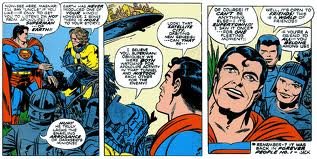
Matt Thorn:What you said. Kirby was much, much better (IMHO) at drawing the ugly and grotesque than at drawing the beautiful, which is probably why D.C. took the embarrassing step of having someone re-draw Kirby’s Superman. I prefer Kirby’s take, but the whole thing about Superman is that he’s all shiny and handsome and sparkly, right? Kirby’s Superman looks like a college wrestler with a chip on his shoulder. Which is very cool, but, yeah, not the image of Superman D.C. wants to convey (then or now). The Thing is probably the character that is most iconically Kirby in my mind. Grotesque, and yet sympathetic, and somehow just very cool, in a very anti-Superman kind of way.

[Noah:] Haney’s not subtle, and the quality varies obviously. But he’s way more attuned to a world outside his skull than Kirby is.

[Matt Thorn:] Noah, I think you nailed it there. Kirby seems unable to successfully step outside of the world inside his own skull. His half-hearted attempt to write “groovy slang” illustrates that he didn’t know much about or really care much about the world outside his skull, at least not after WWII. And that is of course fine. As others have noted above, many great artists are enormously successful at being what I controversially characterized as “self-indulgent,” and what Mike more generously characterized as doing work that is “personally meaningful to them.” Whether you see it as a feature or a bug, I think it’s fair to say that Kirby’s worlds are more or less self-contained, and while they may speak to “the human condition” at large, he was never one whose work really reflected the world outside his door.

Which, AGAIN, is PERFECTLY OKAY.


images-1

You’re No Lightnin’ Hopkins

This first ran on Splice Today.
____________

Years ago, when I was thoroughly obsessed with country, I was chatting with a similarly besmitten friend about the music’s roots. “Thank god for the blues,” he said. “If country had stayed just Irish music, I wouldn’t be able to stand the stuff.”

I think my friend probably spoke for a lot of roots music enthusiasts there. Not that Irish music is especially loathed. It’s more just ignored, or at most nodded to. Blues is earthy and driven and has, moreover, become so embedded in jazz and rock and R &B that is seems like it, all by itself, is the cornerstone of American music.

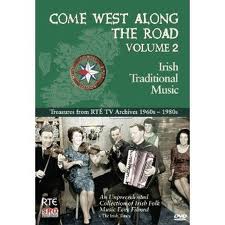
Irish music, on the other hand is just…not cool. You can see just how uncool in Come West Along the Road Volume 2, a DVD collection of traditional music performances taken from RTE, the Irish national broadcasting corporation. Taken mostly from the 60s, 70s, and 80s, most of the songs appear to have been videotaped directly from a wide variety of church basements…but that’s public television for you. Even public television can’t account for the McCaffrey Dancers exhibition dance from 1965, though. Put aside that they appear to be in a church basement. Put aside that the steady “plink/plink” of the piano is rivaled in dowdiness only by the dance itself, which consists of 12 well-scrubbed adolescents holding their bodies rigid while skipping here and there and here and there like neutered candy stripers. Put aside all that. And when you have done so, consider that the girls spend much time coyly holding hands with the girls and the boys coyly holding hands with the boys. Oh, yes, and the boys are wearing dresses. You just wouldn’t catch Howlin’ Wolf doing that, you know?

Irish music is, by most measures, and without too much argument, more fey than Howlin’ Wolf. Of course, most things are more fey than Howlin’ Wolf, but of those fey things that are feyer than Howlin’ Wolf, few are as thoroughly fey as Irish music. And when it’s not fey, it’s got a frightening glee club wholesomeness. Bobby and Peggy Clancy in a 1965 version of “Mrs. McGrath,” for example, seem like they’ve walked out of some remorseless folk-music parody, what with Bobby’s foot perched on a stoop, his aggressive collar sticking crisply from his modest sweater, and Peggy’s earnest toothiness. “A ring-dung-dah!” they sing with lilting, lobotomized cheer, “Oh Ted McGraw, were you drunk or blind/ when you left your two fine legs behind?”

There’s a tendency, or perhaps a temptation, to look at the feyness and the blank wholesomeness and chalk it all up (as it were) to whiteness. If the blues comes out of the black experience of suffering, then this music comes out of the white experience of never feeling much of anything; just chattering on obliviously through life worrying about whether the pants are pressed or whether those darn collars sticking out of the sweater right.

Except…well, in the first place, the Irish aren’t white. They became white when they came to the U.S., but back home they’re not conquering Europeans; they’re the people the Europeans conquered. Sweepstakes in suffering are always kind of pointless, and lord knows there are enough brutalized minorities in every part of the earth to go round, but as histories of bitter oppression go, the Irish’s is surely as impressive as anyone’s.

So when I watch this DVD, I’m essentially blinded by my own whiteness. What I see is people participating in the ridiculous denatured spectacle of soullessness; the bland feyness of not having any roots. That’s what ethnic Americans (such as my Jewish self) get in exchange for skin privilege; it’s the price of the ticket, as James Baldwin says. You give up your klezmer soul and you get to be a white American with all the benefits, such as they are.

But the musicians here haven’t done that. The authenticity markers are all wrong from my perspective, but that’s just because my perspective is screwed up. In most ways that matter, the music here is in fact quite close to blues. It’s a music that comes out of a community identity, forging joy out of hardship. “Oh Ted McGraw, were you drunk or blind/ when you left your two fine legs behind?” Ted’s Mom isn’t heartless. She’s just had bad luck before and is tough enough to take it with a smile.

Despite the relatively low profile of Irish music, white Americans have always fetishized oppressed white people, from Riverdance to Schindler’s List— that fetishization consisting precisely in pretending that said oppressed white people are, in fact, white like us. Maybe some similar self-delusion is why I’m so taken with this DVD…or maybe it’s just the music itself. Unlike my friend, I’ve never been super into blues, but Irish music really sends me. The wailing drone, repeated and repeated with slight variations — it’s just some of the most lovely music on earth.

On this disc, I think my favorite tune may be a short Irish song, Casadh Cam na Feadarnai, performed by Triona Ni Dhomhnaill on keyboards and vocal and Liam Rowsome on fiddle. There’s certainly a melody, but all the instruments — the fiddle, the electric piano, even the Gaelic syllables — seem more focused on percussion, the rhythms running around and over each other. The notation says it’s a song about a hag, and it does sound old and evil, a song to throw kids into pots by.

Or maybe the highlight is Martin Reidy’s unaccompanied version of “The Gal I Left Behind Me.” Reidy looks about 110. His ears are set so far back on his head they look ready to fall off, and he appears to have lost all his teeth. Every time he takes a breath his lips comes together with a wet pop. He sings sitting in what looks like (you guessed it) a church basement, on a bench, with two women beside him…one of whom, alternately perplexed and proud, may well be his granddaughter.

If so, she’s got every right to be proud; he gives a sterling ballad performance, his quaver adding poignancy to the high lonesome keening. That high lonesome is a sound I adore in American music too; it’s been passed on to singers like Almeda Riddle, Sara Carter, Kitty Wells, Emmylou Harris and (rather to my sorrow) Alison Krauss. Bob Dylan picked it up too, and Neil Young and that good British folkie Rober Plant and through him Axel Rose. It’s the music I grew up with, like blues, even if, like blues, it’s not my music really. But then maybe in another sense any music you love is yours.
 

images

Utilitarian Review 1/26/13

On HU

Featured Archive Post: Nadim Damluji on the tiny number of Chinese comics creators.

I talk about Kill Bill and Quentin Tarantino, Humanist.

Voices from the Archive: Trina Robbins on Marvel’s hapless efforts to sell Barbie comics.

I talk about the Johnny Cash’s work with Rick Rubin.

My nine-year-old explained the appeal of Lee/Ditko Dr. Strange. (with fan art!)

Subdee on the economics of Django Unchained. (This, incidentally, completed our Django Unchained roundtable.

Kailyn Kent on the ironies of Jason Lutes’ Berlin.

Michael Arthur provides a NSFW explanation of the furry subculture.

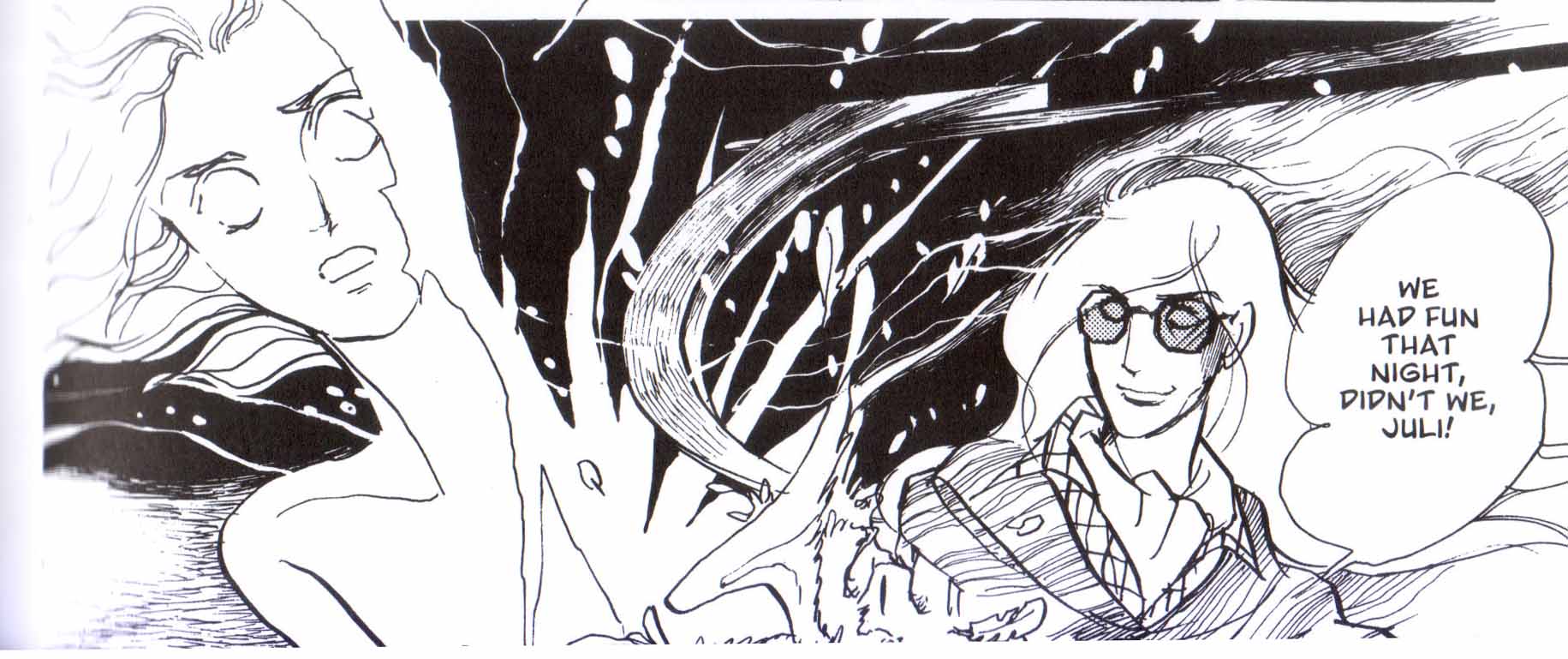
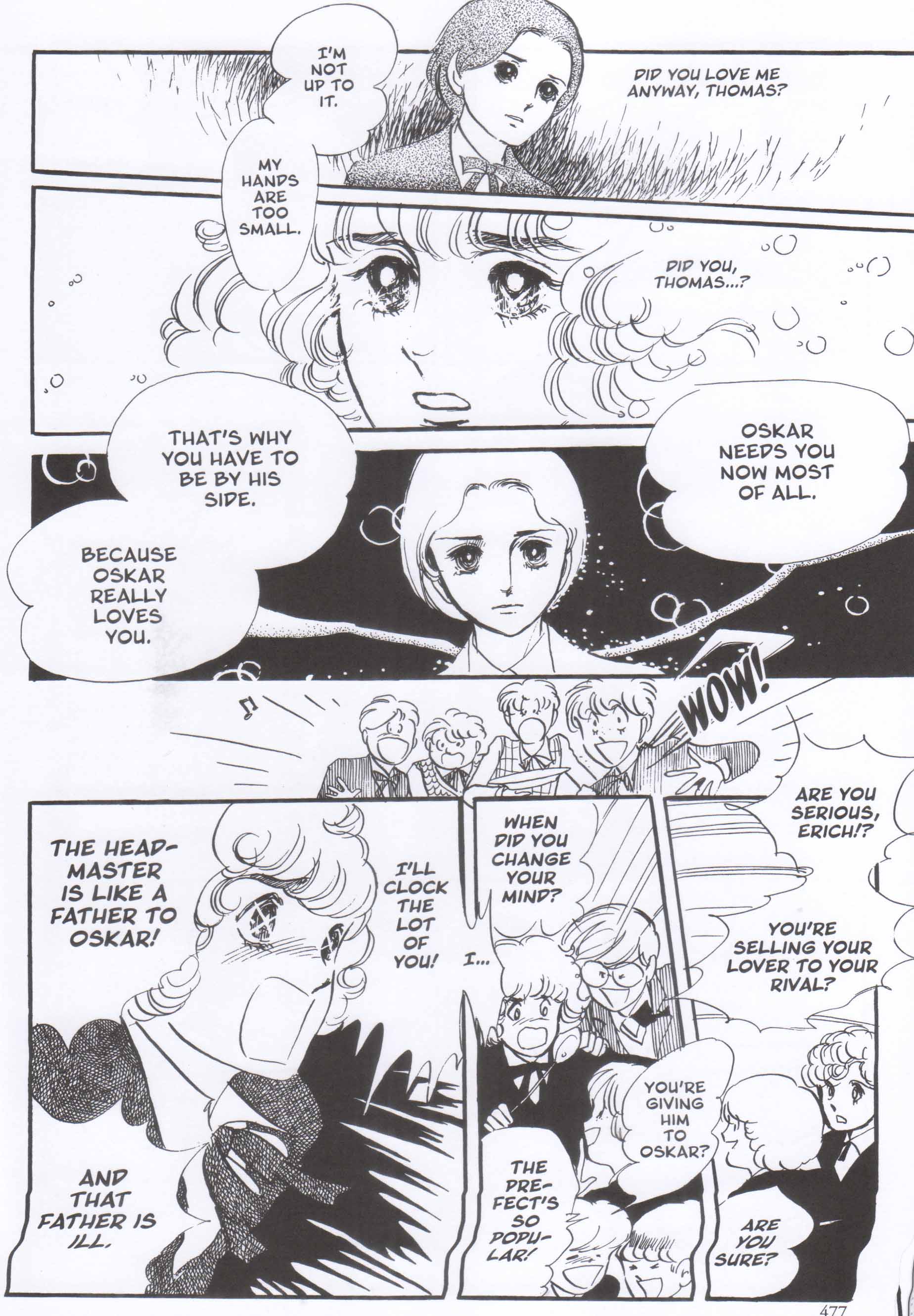
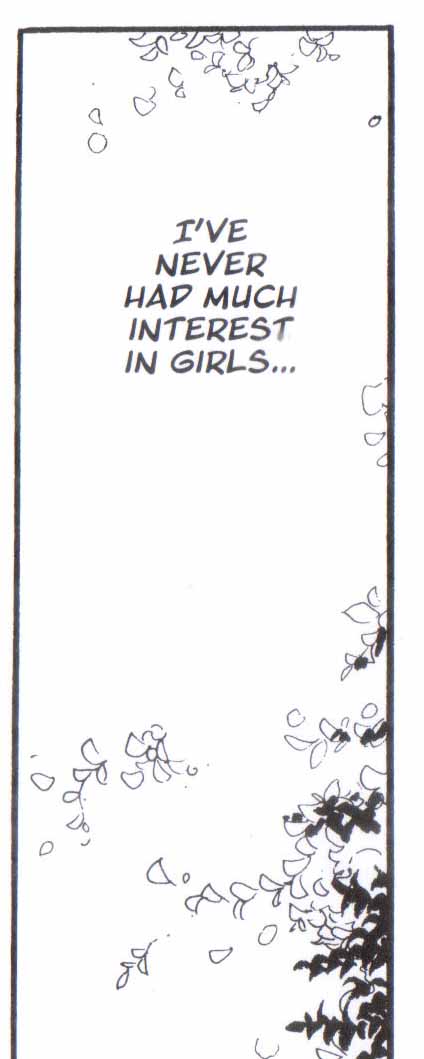
Ng Suat Tong with the case against Moto Hagio’s Heart of Thomas.
 
Utilitarians Everywhere

At the Atlantic I argue that the fake geek girl meme means maybe we need to get rid of geeks.

At the Atlantic I argue that the 50 Shades of Grey Movie will be better than the film (though still bad.)

At the Atlantic I make the feminist argument against women in combat.

At Splice Today I write about the mixed blessing of discovering the Republicans are not completely insane.
 
Other Links

Melinda Beasi and Michelle Smith on Heart of Thomas.

Erica Friedman on manga’s bumpy move towards digital.

Brian Cremins on comics and nostalgia.

Calista Brill on when it might be time for hopeful comics creators to give up.

The American Conservative on how even Texas is sick of testing.

The Literary canon based on academic articles.

The Atlantic on sex and sexual assault at military academies.

Mary Elizabeth Williams on why you can think fetuses are alive and still be pro-choice.
 
This Week’s Reading

Still reading Fellowship of the Ring to my son. I reread E.M. Forster’s Room With a View; rereading Jane Austen’s Sense and Sensibility. Also read Alex Woolfson and Winona Nelson’s Artifice for a possible review.
 

images

Heart of Thomas, Heart of Tedium

[Those looking for background details and a synopsis of The Heart of Thomas can do no better than to read Jason Thompson’s review.]

Heart of Thomas_0001

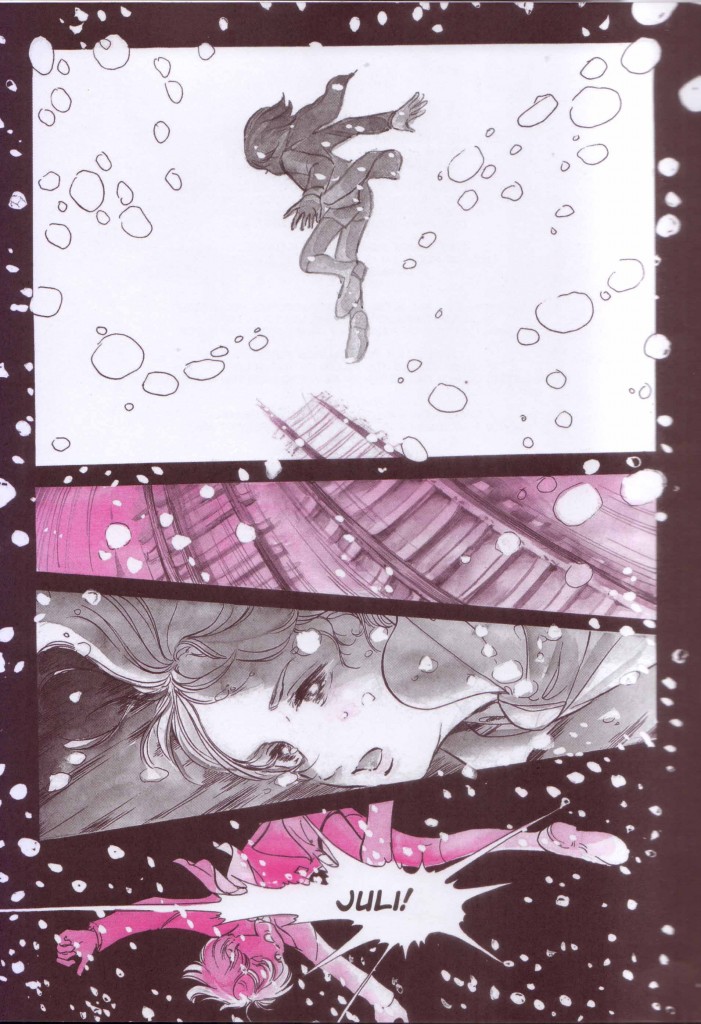
In the opening pages of The Heart of Thomas, the eponymous object of desire and remembrance, Thomas Werner, leaps from a railway bridge to his death.

But who is he? This intangible ghost of doomed naivete crushed by the morass of faithlessness and abandon which has inundated the boarding school which he attends. Perhaps, a metaphor for innocence lost, reborn in the form of his more resilient lookalike, Erich Fruhling—a boy who soon becomes an indelible memory of that life carelessly thrown away; a soul on the path of transmigration in an alien and barbaric Christian world of torment.

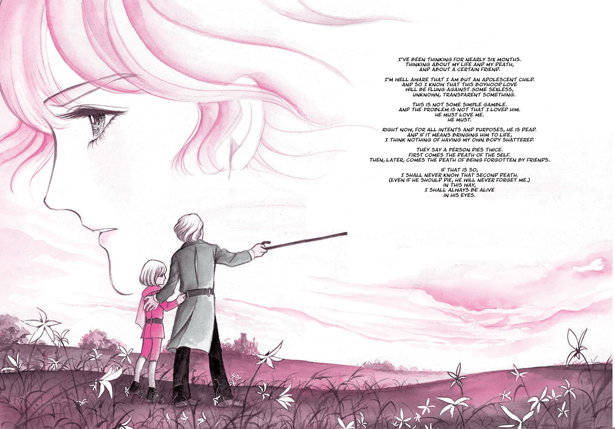
Of course, Thomas’ body isn’t subjected to any tragic or tangible mangling despite the suggestion that “his face was crushed.” Death in Hagio’s world is as chaste as the heated embraces and kisses which reach a crescendo towards the closing chapters of the manga. Even Goethe’s Werther (no first name, similar last name) had the presence of mind to die slowly and painfully 12 hours after shooting himself in the head. Mortality is nothing more than a stylized leap into an endless stream of romantic possibilities in Hagio’s manga. Thomas’ suicide is performed out of love for a senior student by the name of Juli, a distant and correct individual who like all suffering, misunderstood heroes, conceals hidden depths of anguish. The appearance of Thomas’ lookalike, Erich, quite early in the tale—strolling past Thomas’ grave as it were—presents Juli and his classmates with a second chance. He is nothing less than an angelic being. Even the school master seems enraptured by this unspoilt youth—like Hadrian lusting after Antinous. One might almost call it a process of deification. And as with his historical counterpart, Erich is subject to both adoration and recriminations. As Hagio asserts at the start of her story:

“They say a person dies twice. First comes the death of the self. Then, later, comes the death of being forgotten by friends. If that is so, I shall never know that second death. (Even if he should die, he will never forget me.) In this way, I shall always be alive in his eyes.”

Heart of Thomas_0007

These lines define the authoress’ purpose. The Heart of Thomas rests on a physical manifestation of this remembrance, as florid as a grief stricken emperor’s commerorations of his lover—as if memory had the power to evoke a second incarnation or avatar. Still others might see everything which follows Thomas’suicide as the fantasy of a collapsed mind, the tangled memories and imaginings of a dying brain hoping for a happy corrective to a tragically short life. Certainly, that Germany of the mid-twentieth century imagined by Hagio has no anchor in on our reality. It is an alien planet both to the Japanese and European reader alike—a dream which has no interest in the tradition of Mann, Grass, and Boll but rather adheres to the hysterical breathing, coincidence, and fainting spells of wish fulfillment and hallucination. If these young male students had breasts, they would be ripping their bodices from their angular bodies

In one early episode, Juli suffers one of his recurrent fainting spells, a neurotic turn resulting from an earlier psychological trauma. It is perhaps the only time you will see an individual getting mouth to mouth resuscitation while he is having a “fit”. The fraudulence of this medical act suggest it’s placement—if it isn’t clear already—for erotic effect. The penis is verboten but a number of alternatives are grasped with both hands. A teacher’s attempt to stroke Erich with his cane is nothing less than a metaphor for the sexual tensions within the school. When the reigning queens of that exclusive institution arrange to converse with and touch Erich at a tawdry but chaste tea session, he barely manages to fend off their ministrations. This high tea of the mildly depraved is a kind of half-baked, elementary school version of the Hellfire Club where “Do what thou wilt” shall be the whole of the law.

Heart of Thomas_0003

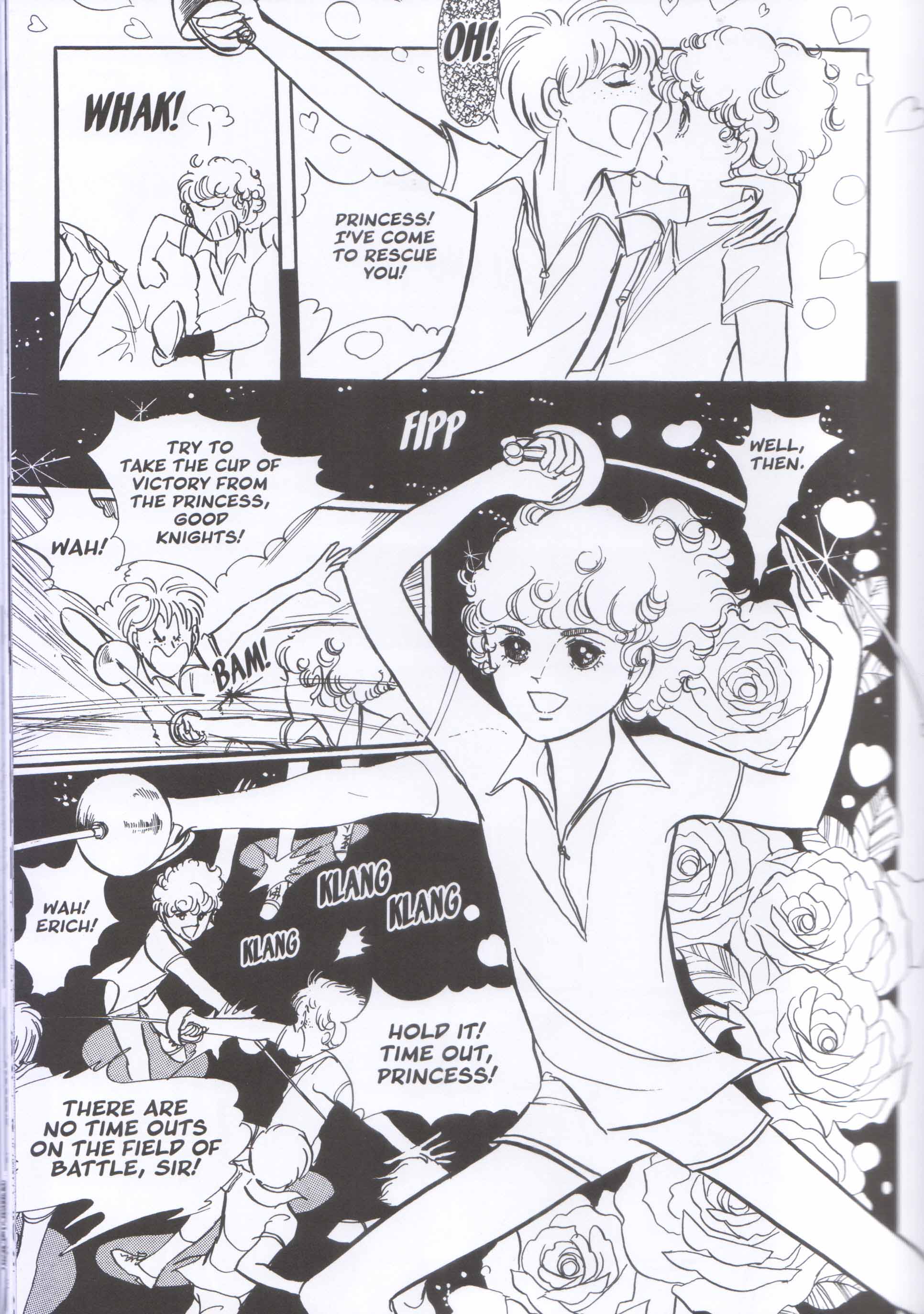
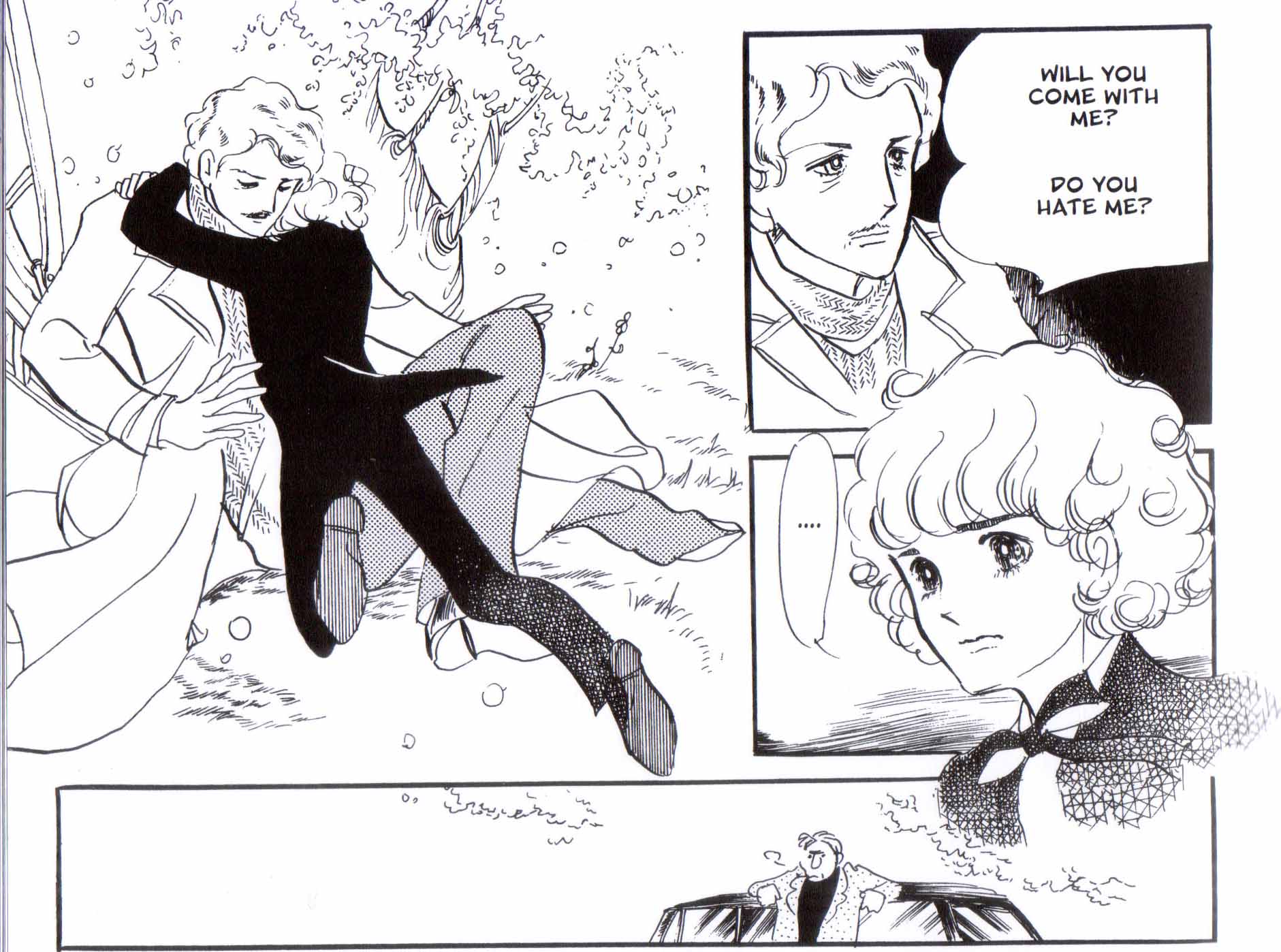
There is the pesudo-coitus—between Juli and Erich—of grasping with sharp objects: first in the fencing room and then, somewhat less subtly, in the bedroom with a pair of scissors. Later, Erich recounts a tale where he indulges in the predominantly male practice of autoerotic asphyxiation. These recurrent acts of strangulation are brought on by the sight of his mother kissing her lover—his mental torment (and patent mommy issues) relieved only by the death of his mother and a profession of fatherly love by his mother’s lover.

Heart of Thomas_0004

This incessant intermingling of pain, death, and love is Hagio’s idée fixe; and the purity of male love the panacea for all depicted ailments. The only exception to this gloss on idealized homosexuality (a fanciful and hopeful template for a paradigmatic relationship between the sexes) is Juli’s physical and likely sexual abuse at the hands of another student named, Siegfried—that swaggering, heroic betrayer of  Wagner’s Ring cycle here seen as lascivious, preening monster with an appetite for sadism and young boys.

Heart of Thomas_0005

Erich’s allusion to a meeting between Beethoven and Goethe suggests the essence of the relationship at the center of Hagio’s manga. Here is an excerpt from a Gramophone article concerning Goethe’s feelings after that fateful meeting:

“Shortly afterwards Goethe penned a more qualified verdict to his musical guru Carl Zelter: ‘His [Beethoven’s] talent astounded me; nevertheless, he unfortunately has an utterly untamed personality, not completely wrong in thinking the world detestable, but hardly making it more pleasant for himself or others by his attitude.’”

Erich is of course Beethoven in our boarding school equation. Juli’s rejection of his “untamed” sensuality—forged and broken through terror by Siegfried—is the root of all his troubles. When Juli tells Erich, “I am going to kill you,” it is not merely a prediction based upon his earlier role in the death of Thomas Werner but a sign of Juli’s repressed sexuality—a disease which manifests itself in the weird science of mild attacks of “anemia” which have no basis in medicine.

The reader’s mileage with respect to Hagio’s subtle eroticism will vary depending on his/her passion for the artist’s figure work and for characters with brittle foreheads in need of warm towels. Not that these aspects aren’t apparent to Hagio. There is, for example, that moment of epiphany when one of the characters complains that his fellow students feel that he has “a girl’s face;” an otherwise unremarkable statement except for the fact that just about everyone in that boarding school looks like a pre-pubescent (i.e. breast-less) girl. To be sure, readers of The Heart of Thomas should always assume that every woman in Hagio’s work is actually a man until proven otherwise. This isn’t a problem so much as a feature of the genre, the attractiveness of slightly feminine men (or in this case feminized yet adequately virile men) being the entire point. To imagine the alternative—consider going to an action movie in which nobody dies and no violence is performed. It just wouldn’t do.

Noah in his article at The Atlantic offers little in the comics’ defense except for the standard, “Well, it’s meant to be crap and succeeds admirably at it.” Not his actual words of course, but here they are for those so inclined:

“In a lot of ways, The Heart of Thomas is an Orientalist harem fantasy in reverse. Instead of a Westerner thinking about veiled maidens on cushions in some distant palace, the Japanese Hagio fantasizes about beautiful boys in an exotic Europe.

The genre of boys’ love, in other words, allows Hagio and her readers to place themselves in a position of power and aggrandizement that is rare for women—as the distanced, masterful position, letting his (or her) eyes roam across variegated objects of desire….Thus, the prurient fan-service which is usually doled out only to men is here explicitly taken up by women, who get to watch more exotic male bodies than you can shake a spectacle at.”

And on Juli’s emotional (and likely physical) rape:

“Instead, Juli’s rape emphasizes the universality of what is often presented as a particularly female experience. Similarly, Juli’s shame, his self-loathing, and his tortured effort to allow himself to love and be loved, are all character traits or struggles which are often stereotyped as feminine. The fact that Juli is male seems, then, not an aspect of otherness, but rather a way to underline his similarity to Hagio and her audience. If readers can with Siegfried experience distance as mastery, with Juli they experience an empathic collapse of distance so powerful it erases gender altogether…The boys’ love genre, then, freed Hagio and her audience to cross and recross boundaries of identity, sexuality, and gender.”

As Noah periodically ejaculates on this blog, this is a case where the criticism is of far more interest than the text; a situation where purpose is more interesting than result, intention far better than the delivery, and (presumed) effect more fascinating than the actual reading experience. And if, as Noah claims, Hagio is an “aesthete”, this does little to explain the inadequate metaphors, and the banal structure and prose which litters the narrative. The romance here is as invigorating as ice on genitals. Certainly, nothing works so well to preserve mood than a comic chorus commenting on every loving decision and every act of forbearance. At every turn, the manga engenders not so much an “empathic collapse” but a complete nullification of empathy.

Heart of Thomas_0006

The tacked on and thoroughly mangled Christian metaphors (angels without wings; Judas and Christ; a cursory mention of justification) serve only to highlight Hagio’s poor grasp of European culture and religion in general. Even worse is the “shocking” revelation (of abuse) which is anything but. I let out a mental gasp of incredulity when the a plot twist near the close of the comic had Juli threatening to retire to a seminary; a time honored old chestnut seen in both modern and period Asian dramas since time immemorial where women have retired to nunneries for one reason or another. The immense superficiality and unadorned derivativeness of The Heart of Thomas suggests that whatever dividends one might gain from it are largely skin deep. It is nothing less than a time capsule of high camp.

Heart of Thomas_0002


Apart for the tangy taste of forbidden fruit, is the love of one man for another any different than the much more familiar sight of a man and a woman pining for each other? As both the novel and film adaptation of Christopher Isherwood’s A Single Man suggests, the mere unfamiliarity of that object of affection is no hindrance to empathy.  But just as truly great heterosexual romances remain in short supply in the medium (I’d be hard pressed to name more than a handful in manga and anime), so too does this rule apply to gay love in comics. Yet, to demand these standards of The Heart of Thomas is almost certainly a mistake for the comic in question was originally created for the enjoyment of women and has as much to do with the day to day issues of romance and gay love as the women in traditional harem manga have to do with flesh and blood females. Any resemblance to the gay liberation movement of the late twentieth century is simply good fortune if not purely coincidental. Some will say that the manga deserves praise because of its daring sexuality for its time—it is nothing less a seminal work in the boy’s love genre—but such a statement would be a demeaning admission that the comic is merely of historical interest.

The main inspiration for the manga at hand was apparently the film adaptation of Roger Peyrefitte’s Les amitiés particulières (novel published 1943, and film adaptation,1964). The similarities between the film and the manga are certainly striking.

There is the setting and sexual orientation of the protagonists as well as their relative ages. The lovers at the center of the film also struggle with ideas of purity and impurity (“It wasn’t his purity I loved.”) to the extent of expunging their sins of romantic (homosexual) love at confession. As with the final note left by Thomas, the letters between the young lovers act as erotic talismans. In the film, the letters are linked to the legend of St. Tarcisius—a young boy who defended the Blessed Sacrament with his life. These pieces of paper become nothing less than the body and blood of Christ to the lovers (they are certainly held in higher regard). Then there is the younger lover’s (Alexandre) suicide by jumping from a railway bridge (in this case, while traveling on a train) and the confusion of accident and suicide made more pressing in the film than in the comic because of the intransigent Catholicism which hangs heavy over the events.

While the love affair depicted in the film is not entirely convincing, it is certainly far more effective than anything found in Hagio’s comic. Peyrefitte’s work is restrained and classical in approach, and altogether more serious and real,  especially in the interaction of the boys and a liberal minded priest named, Trennes. The priestly test commanded by Father Lauzon of the older lover (Georges; Juli’s counterpart) is nothing less than an act of temptation on the part of Satan. Hagio, of course, takes an alternative route. One might call it a disavowal of authenticity in setting, conversation, religion, and, perhaps, even sexuality—all of these becoming as putty and playthings in the authoress’ hand. A perfectly acceptable approach except for the decisive failure in delivery and communion.

The Heart of Thomas is in certain ways a sequel to the film, a fitful re-imagining of everything that could have been, but the final page of this book presents itself as a consummate evocation of my state of mind as I flipped through its pages.

Heart of Thomas

The work was not clever enough, not brazen enough, not idiotic enough, and simply insufficiently well wrought  to provide me with even a moment’s pleasure. It was, in short, interminable.


City of Irony: Jason Lute’s Berlin Book One

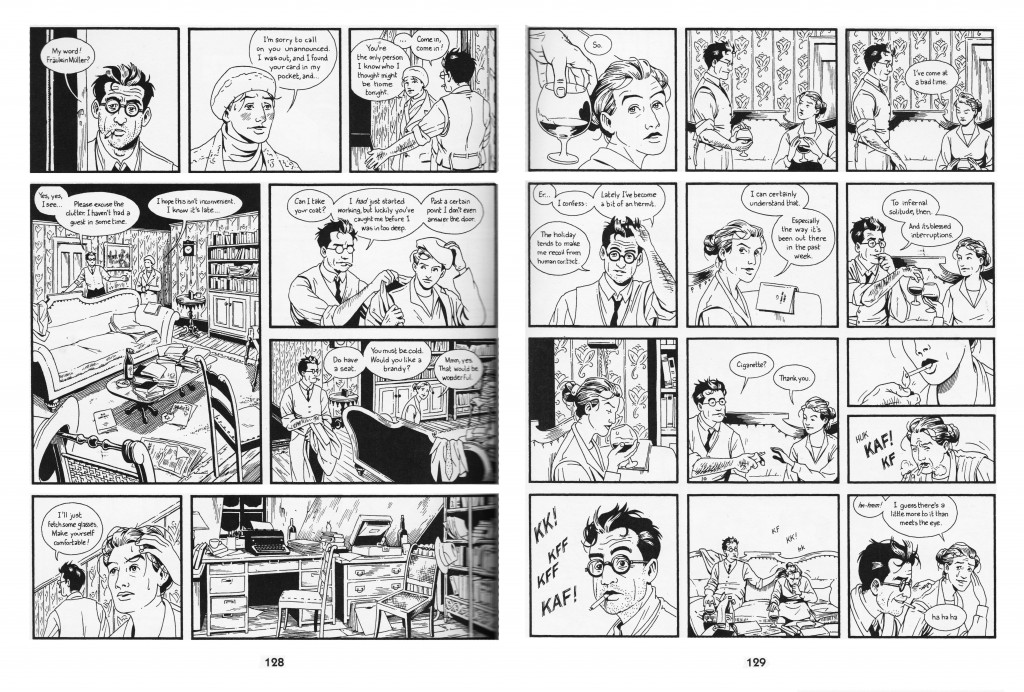
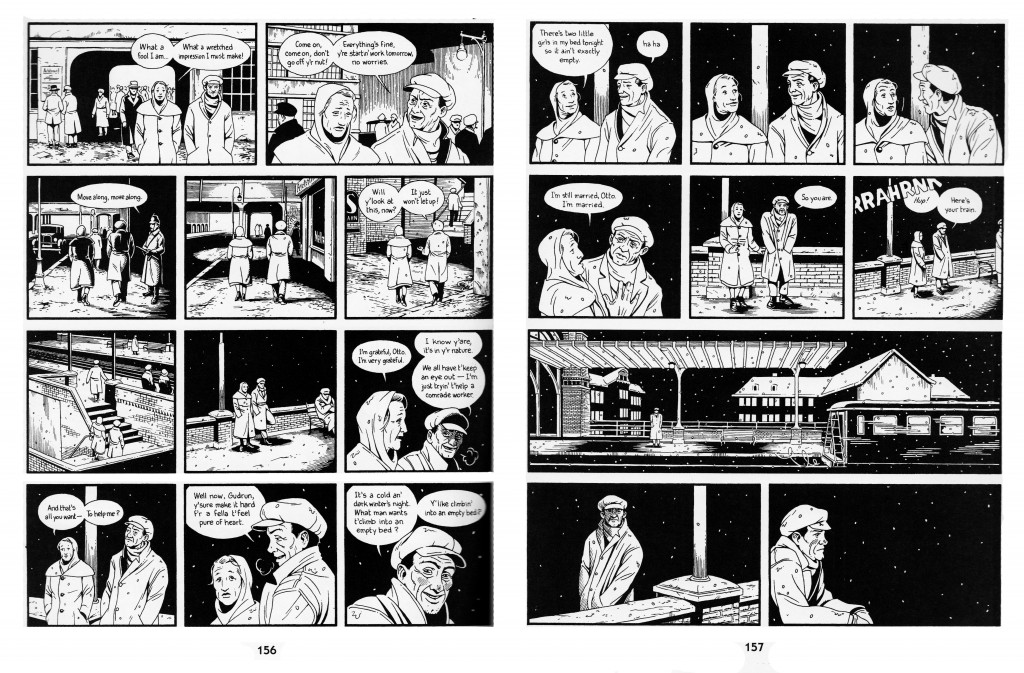
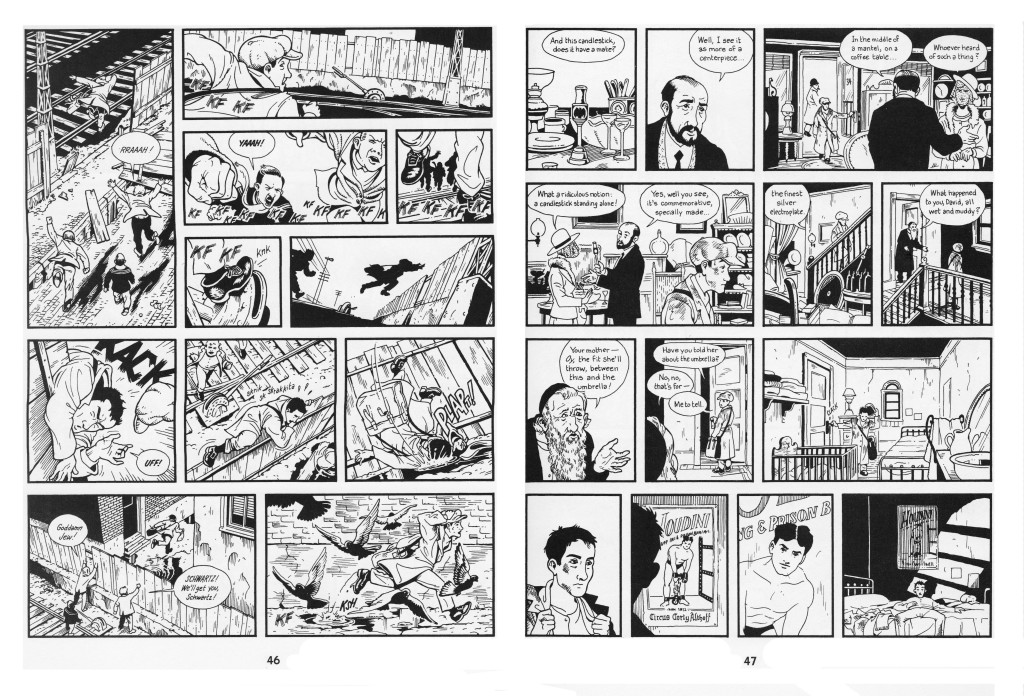
Jason Lutes’ Berlin: City of Stones is illustrated within an inch of its life. Painstakingly researched and precisely drawn, its pictures work overtime to breathe life into history and the fictional persons of its sprawling, yet relatively schematic narrative. The story opens with the arrival of Marthe Muller, an upper class, unmarried woman, who plans to take art classes in Berlin and escape the spectre of an arranged marriage. On the train, she encounters Kurt Severing, a jaded journalist who is struck by her innocence and her self-taught drawing skill, (and presumably how these inform each other.) The book orbits around their transforming relationship, while hopping through the private lives, memories and dreams of disparate citizens scattered throughout the city. Sometimes these characters are revisited, sometimes not. Some lives intertwine in mundane coincidences, others in large fateful clashes, like the violently suppressed Communist march on May Day 1929.

City of Stones attempts a faithful visual portrayal of post WWI Berlin in all its tumult, but misses the mark in spirit. Lutes rewards his characters for their impartiality, ignorance and doubt, and punishes those who embrace the frenzy of ideologies that was its zeitgeist. Marthe drops out of art school, declaring, “there’s a lot for me to learn, but I don’t want to know any of it… I can’t reconcile these things with what I see…. more what I feel. But for me [seeing and feeling] are not so far apart,” and this is treated like a heroic act. Her unfamiliarity with the figures of Trotsky and Stalin, while fascists and communists battle around her, is treated by Kurt as both revelatory and charming. But rather than remain two perspectives among many, Marthe and Kurt’s diaries become the book’s most authoritative voices, giving City of Stones its title and articulating its major themes. The only major character seduced by the communists, a weary and sensitive mother, is shot to death during the march that closes the book, while her husband is progressively vilified as a Nazi.  Oftentimes, Lutes’ breathtaking mastery of expression and body language is of more interest than the stock protagonists themselves. 

berlinmartheandkurt

More powerful than the characters is Lutes’ recreation of the city in ink. When people walk, they pass through the city, individual block by individual block. Figures are rarely shown apart from their environment, which is rendered with startling specificity and care. Lutes makes good on his characters’ claims that the city envelops them; he often drafts the foreground and background with equal line-weight, which feels like a deliberate philosophical decision.

berlin_train

 On one hand, Lutes’ treatment of Berlin celebrates a crucial freedom the comic medium affords its creators; aside from time and training, everything is as equally ‘expensive’ to draw. Lutes is able to realize visuals that would have required a mammoth budget and manpower in any other medium. City of Stones is also less ‘comic-y’ than many books, as it doesn’t immediately participate in the ‘genre’ of comics or its concerns. (However, the romantic union of a drawer and a writer, and their self-exile from art-school and the rest of Berlin, suggests that City of Stones could secretly be about comics after all.)  Lutes doesn’t push the envelope on what comics can do, although he achieves some great effects, often in pursuit of cinematic pacing. It begs the question whether Lutes draws comics in order make something similar to film, while retaining ultimate control. This also leaves him with the responsibility to know and accurately represent the story world he has chosen, which in the case of Berlin, exists outside of Lutes. This ‘auterism’ is far from a bad thing: imagine the variety and ambition of comics produced, if more creators made comics for this reason. Its fair to assume many already do.

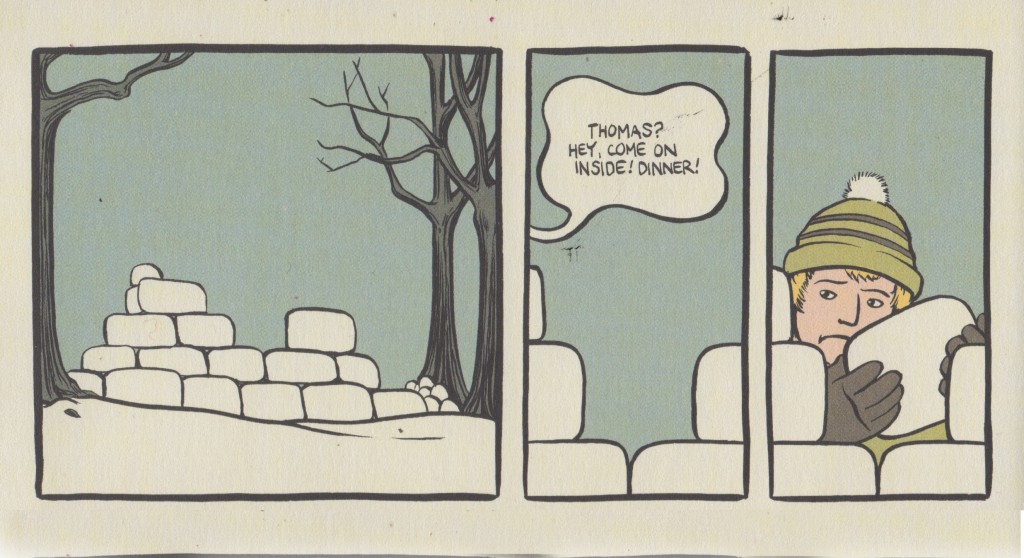
Yet Lutes’ choice neglects, or even rejects, another freedom of comics– the ability to select what is represented. While a camera necessarily records all it can within range, a cartoonist can obliviate a background, stylize its objects, and can render objects into icons or types. Comics resembles memory, where only the essential elements are remembered, or rendered. The act of rendering itself makes what is drawn relevant to the ‘telling.’ For example, in Paul Hornschmeier’s book Mother Come Home, a child builds a snowfort out of flat, immaculate snowbricks.

snowfort

Hornschemeier doesn’t describe the snowbricks, (crumbling, melting or made in various sizes,) and he barely describes the fort or the activity of building it, in favor of simply depicting the concept of ‘making a snowfort.’ Compared to speed lines, sweat bubbles, and the hundreds of symbols that have been developed in diverse comics traditions, this is a very minor shorthand– Hornschemeier is telling the reader that the child is making a snowfort, without going into detail of what that experience is like. This is left up to the reader, should he or she choose to dwell on it.

Alternatively, this freedom of selection resembles prose writing, where the  descriptions add to the fabric, effect and significance of the story, and where a gratuity of description is not appreciated. City of Stones avoids seeming overindulgent because the drawings don’t have to be actively read. They can be visually absorbed (or passed over, unnoticed). At these times, the comic acts more like a film than like a novel. Lutes commits himself to draw like a camera. There’s a tragic nobility here;  as a ‘rememberer’ of his narrative, it’s as if Lutes is trying to restore or break through to  the world outside of the plot, while working in a medium where this is impossible. By choosing a historical period, Lutes appears to reach for a place independent of his imagination, or the reader’s. Yet the more he reaches and renders, the less room he leaves for his reader to imagine a world outside of Lutes– or late 20s Berlin via Lutes. The act of reading switches over from an active reading to a passive reading, where his audience is not responsible for assembling a sense of the world themselves. This is facilitated by Lute’s tight reign over the pacing.

berlinhoudini

This core irony is joined by two others. While City of Stones frequently criticizes the cult of “New Objectivity” which beset post-WWI Germany, Lutes works to draw as objectively and as similarly to a camera as possible. Lutes draws with anatomical and perspectival precision, yet he heroicizes a character who refuses to learn to draw this way. Judging only from the first volume, it’s up in the air as to whether Lutes crafted Berlin so as to criticize this visual oppression, to showcase its inescapability, or to capitilize on it.

This review was written without reference to Lute’s interviews or other writing about Lutes, and without reading the following issues or second compilation of Berlin, which the New York Public Library has so far not made readily available. Its possible that the story’s development will make some of these critiques pointless– perhaps Marthe will get a massive comeuppance for her solipsism. More likely she will lose her innocence. The most tantalizing thread is whether Kurt’s noble political non-commitment will spill over into an ambivalence about Marthe, something City of Stones confronts with subtlety and bite. If only more of the narrative threads carried this sense of mystery. The reader watches so many characters think and do so many private things, in such specific streets and houses, yet the book never achieves real, raw intimacy. Perhaps Lutes tries to show too much for a book that is ironic at its core. Which would be a sad conclusion, because his quest to truly, earnestly represent Berlin is the book’s most remarkable quality.


Django: Back to Basics

628x471

 
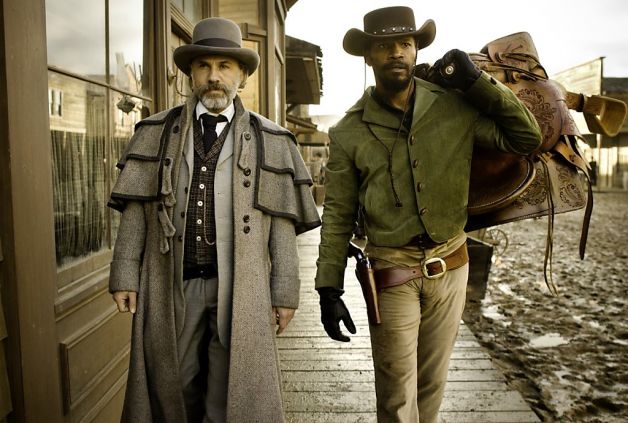
Coming in at the tail end of the Django Unchained roundtable, it transpires that I’ve already shared a lot of my thoughts about Django in comments. In this post, then, I’ll mainly be expanding on those ideas + quoting excessively from David Graeber’s doorstop work of economic anthropology, Debt: The First 5,000 Years.

First, I want bring up some ideas about slavery, morality, and legal systems that Graeber talks about and that I think Tarantino illustrates in Django in a smart way. In Debt, Graeber starts by looking at what he calls “human economies” – that is, economies where people are the main unit of account, and money is only used to smooth over social relationships. In these societies, “social currency” was used for weddings and funerals, to settle disputes, and to acquire wives. However, even in societies that recognized slavery and brideprice, this money was not actually used to buy people. And certainly, the same money that was part and parcel of deals between people was not also used to buy things. Graeber argues that two factors enable chattel slavery, a system in which people are equated with things: one, the removal of the slave-to-be from “the web of mutual obligations” that defines him as a human being. And two, violence.

Already, this is looking like a promising lens for the analysis of a Tarantino movie!

In Graeber’s account of traditional societies, slaves are people who have been removed from their context, so that they no longer have mothers, fathers, siblings, and so on to protect them. Only after this removal has been accomplished can they be bought, sold, or killed, because this is when “the only relation they had was to their owners”.

Looking at things this way, the logic of Samuel Jackson’s character Stephen becomes clear. As Noah pointed out, he really doesn’t have anyone else besides Candi. While Noah saw this de-contextualization as a weakness of the character – what real person doesn’t have relatives? – I think it’s an important point. Stephen is an edge case that shows the way the system works more clearly.

It’s pretty clear in Django that slavery is a dehumanizing institution that actively seeks to prevent slaves from forming connections to each other. Think about the extraordinary force used to separate Django and his wife Hilde: when it’s discovered that they have run away together, they are beaten and sold separately. Hilde is then additionally punished by being branded, which forces her out of the role of the house slave and into the role of comfort girl, a prostitute for every low-level foreman and fighting slave on the estate. Forget about marriage: for the sin of calling herself a married woman, Hilde is to be denied even the right to choose her own sexual partners.

Schultz’ actions in the movie take on even more meaning against this background of depersonalization. As the new owner of Django, Schultz is lenient and tolerant, allowing Django to choose his own dress, to exact his own revenge, and to carry a gun. However, all these are acts of charity as long as Schultz owns Django in the eyes of the law. The movie completely understands this point, because what does Schultz do as soon as he frees Django? He offers him a deal: Django’s help over the winter in exchange for Schultz’ help rescuing Hilde. This offer is symbolically important because as long as Django is a slave, he has no power to agree to deals. That’s because only people can make deals, and Django, as a slave, is not a person. By offering Django a deal, Schultz is acknowledging that he is a person and not a thing; in some sense he is acknowledging that the two of them, as fellow human beings, are in some way equals before God.

So that’s kinship networks and personhood. What about violence? Graeber observes that most of us don’t like to think about violence. Tarantino, clearly, is an exception: his work is largely an exploration of the charisma of violence, of individuals with personal charisma (who are almost invariably violent), and of the power of filmic violence to evoke a visceral response in the audience. Think about that however you like; but if Tarantino is going to work through the power and appeal of violence, one of the best “good” uses for his skills as a filmmaker is in an exploration of a society in which violence plays a crucial, obvious role.

To remove people from their networks of mutual obligation requires enormous force. They have to be taken as prisoners of war, or forcibly abducted, or sentenced to punishment for a crime, or sold by someone who has the “right” to be so under what are frequently desperate circumstances. After sale, they have to be transported somewhere else. According to Graeber, a common theme of the laws (Islamic and Roman) of the period is that people become slaves in situations in which they otherwise would have died. They are, in some sense, living dead.

Furthermore, once African people have been forcibly ripped from their contexts and transported to the New World, a system of enormous violence is required to keep them as slaves. This is the violence Tarantino shows directed against black slaves as a matter of course in Django – the brutal beatings given to runaways, the sadistic punishments by foremen, the laws prohibiting black men from riding horses, and the mobs that form to uphold those laws – in contrast to the more cathartic or cartoon violence he shows directed against the people upholding the slave system.

Schultz’ introduction to the audience takes on another meaning when examined in this way. It establishes a kind of moral rightness to the character that would not have been present if he had simply bought Django at the market. Of course, Schultz could have done this: he could have followed the slave-trader brothers until they arrived at their destination and then purchased Django in front of witnesses. He could even have killed them afterward. But wouldn’t we have resented him if he did it that way? He would have been involved in the whole dirty business of buying and selling slaves. Instead, Schultz goes back to first principles and takes a war captive. We can understand the logic of a man of honor who saves someone who otherwise would have died (if only from his own gun).

Concepts of honor and violence are, of course, entwined. On the one hand, violent men are invariably obsessed with honor. On the other hand, honor is “something that exists in the eyes of others. To be able to recover it… a slave must necessarily adopt the rules and standards of the society that surrounds him, and this means that, in practice at least, he cannot absolutely reject the institutions that deprived him of his honor in the first place” (emphasis mine). Graeber is speaking about The Interesting Narrative of the Life of Oladudah Equiano: or, Gustavas Vassa, the African, here, by the way – probably the inspiration for MT Anderson’s great YA novel series The Astonishing Life of Octavian Nothing.

Tarantino, while perhaps not obsessed with ideas of patriarchal honor having to do with control over women, is obsessed with “cool” – with the personal honor codes of violent people. He’s put in a tricky situation in this movie, where he needs his protagonists to be cool and honorable, but is shooting an historical movie at a time when they could not, in practice, both reject the system and remain honorably within it. “In practice” becomes the key phrase, here. Because Quentin Tarantino is filming a movie and not directing an historical event, he has other value systems besides the society his characters operate in at his disposal.

Django and Schultz don’t need society’s approval because they have their own audience. Sometimes their audience exists within the movie: when Schultz frees the slaves in the woods, he has an audience of surprised and shocked black men; when Django turns the tables on the slavers bringing him to the mines, he has an audience of black men in the transport wagon; at the final shootout at the mansion, all the house slaves are on hand. Just as important as the on-screen audience is, however, of course, the audience in the movie theater.

This is a crucial point. It’s important in a Tarantino movie for the audience to side with the “heroes” on screen, however questionable, and to cheer at the end. He uses filmmaker’s tricks to achieve that end – makes the heroes competent and the villains incompetent or crazy, uses close-up reaction shots, slowly escalates the violence. They are tricks, but they are fairly transparent tricks. There’s very little in the way of misdirection: it’s not as if the audience does not realize that they are being led to think a certain way.

And anyway, is this identification automatic, even for an audience in the 21st century confronted with a major star like Jamie Foxx in an obviously heroic role – as both a Western and a Blaxploitation hero? I don’t think this hurdle is at all easy for some members of the audience. I remember having trouble with Kevin Boyle’s historical novel Arc of Justice, about racial violence in Detroit, an obsessively footnoted work of historical fiction that is not even fictional. The moment of realization – oh, if I just identify with the clear victims in this situation, I can forget about trying to justify the unjustifiable – was a huge relief, and I remember it vividly. While hopefully everyone has either had, or never had to have, that moment, I can’t fault Tarantino for taking so much care to keep his entire audience on board.

Anyway, is it a sin for a movie to be a movie? I know this is a sticking point for lots of people – the unsettling collision between historic violence and genre tropes – but personally I find it to be a strength. Or, quoting myself again: “In Django, it’s not just violence per se that’s the subject, but depictions of violence, or filmic violence. Filmic violence can be funnier than real violence, but because it’s funny, it can also be more affecting – you remember the unpleasant things along with the funny things instead of throwing the whole movie out of your brain the second it’s over (because, no matter how much you want to be a Good and Serious person, it’s too upsetting to keep thinking about).”

But getting back to honor: the ability to strip others of their dignity becomes, for the master, the foundation of his honor. Those with “surplus dignity” surround themselves with slaves not out of any kind of economic necessity, but for reasons of status. DiCaprio’s Southern gentlemen is exactly one such man of honor. I think his character is a great subversion of previous portrayals of “Southern gentlemen” like Clark Gable’s Rhett Butler in Gone With the Wind. It’s not that some bad apples ruined the system for the respectable plantation owners, Tarantino is saying. Rather, it’s that those who are the most entrenched within the system, and the most active in upholding its abuses, are, by the logic of the system, the most respectable. In other words, Candi is what a respectable southern gentlemen looks like: a sadist surrounded by “things” (people) over which he has ultimate power, who stages displays of that power for his own glorification; but who is however unnaturally obsessed with the virtue of his (full-blood white) relation.

It’s exactly Candi’s status as one of these “surplus dignity” owners which requires Schultz and Django’s elaborate deception (in addition to other, character based explanations). Calvin Candi is rich and masterful. He doesn’t need the extra $300 for Hilde.

So far all of this might seem a little basic, or simplistic, even. Everything I have discussed has been theoretical, with little in the way of nuanced psychology or a complex moral worldview. This is not to say that there is no complexity in Django. For me, personally though, the strength of the movie lies in the way that these conceptual points about what it means to be enslaved – about what a slave society must be like – are presented without explicit comment, in the way the characters relate to each other and in the events shown on screen – in wordless reaction shots, rather than in speeches.

One final theoretical note, then, to close out the post. Graber discusses how “freedom” as a concept developed alongside slavery; as well as how personal (Roman) property law developed in response to people-as-things. The concept of freedom, the ability to do whatever you want with yourself (except for the things you can’t do), follows on from the concept of slavery, the ability to do whatever you like with your human property. Here’s the quote:

“Freedom is the natural faculty to do whatever one wishes that is not prevented by force or law. Slavery is an institution according to the law of nations whereby one person becomes the absolute private property of another, contrary to nature.”

Contrary to nature! You gotta love details like this. Theories of phrenology espoused by Calvin Candi, the whole (once)science of racial inferiority, clearly must have developed to fix this otherwise beautiful theoretical framing.

It does point toward an important question, though. If the main distinguishing feature of freedom is that one is not a slave, what does it mean to “own” yourself and to “own” your freedom? How can the same person be both the master, and the slave?

According to Graeber, it’s this question that necessitates the division of the self into two selves: a mind which “owns” the body, over which it has absolute power. It’s a division Tarantino supports in his movie, to an extent. Put simply, it’s a big problem for Tarantino that he only has one hero in his movie. What is he saying about all the other black bodies – that lacking Django’s luck and skill with a gun, they simply accepted their fate?

Here, again, the reaction shots are important. The reaction of Schultz, the bartender, the saloon mistress, to two black brothers made to fight to the death is hate and disgust (and queasiness, in Schultz’ case). The reaction of Candi’s other slaves to Django, a free black slaver, is hate and disgust (and confusion, on the part of the head maid). The reaction of Stephen, on the other hand, to the sight of a free black man on a horse, is hate… and resentment.

It’s been mentioned before that Stephen is the movie’s final villain because he is Django’s doppelganger. They contrast each other in nearly every way: Django fights for his connection with his wife, while Stephen’s only connection is with his master; Django is young and fit, while Stephen is old and has a bad leg; Foxx plays Django with restrained dignity while Jackson plays Stephen as loud comic relief. At the same time, though, they are bound together: first as the two largest black roles, played by the two biggest black stars. But secondly, because they are both given these closeups where they show the “wrong” reaction, even if Foxx’s Django is playing a role at the time.

It’s that moment of doubt, as well as all the other indignities up until that point, that forces the movie’s explosive conclusion. Of course, Django has to strike against the entire system, because the entire system is responsible for what he and every other enslaved person has suffered. But also, this is a scene of putting right: the better ending than the one where he pretended, even for a moment, that he liked or was indifferent to what he’d seen.

We can’t always act, the movie says. But we can always wish, fantasize, about the way we would like to act. When we are able to counteract the violence and indifference of the unjust society we live in, and bring about a reality that accords with our wishes, we are heroes. But even when we are not able to change anything about our external reality, the simple act of wishing and fantasizing itself has power.