Quentin Tarantino’s Slave on the Road; or, Josiah Henson Unchained

The entire Django Unchained roundtable is here.
_____________
 

Antebellum fugitive slaves were criminals according to the laws of their day. Their labor, their bodies, and any future that they might imagine belonged to the estates of the people who held the bill of sale. And so when enslaved black men and women wrote the stories of their escape in order to advocate for abolition, they took special care in persuading readers not only that the laws they had broken were unjust, but also that they had the moral strength to manage the freedom they had “stolen.” This is why when a Maryland slave named Josiah Henson, having been deceived by the master who vowed to manumit him, raised an axe above the head of his owner’s sleeping son, Henson stopped short of landing the fatal blow. In The Life of Josiah Henson, Formerly a Slave, Now an Inhabitant of Canada (1849), he explains:

It was self-defence, — it was preventing others from murdering me, — it was justifiable, it was even praiseworthy. But now, all at once, the truth burst upon me that it was a crime. […] I was about to lose the fruit of all my efforts at self-improvement, the character I had acquired, and the peace of mind which had never deserted me. […] I shrunk back, laid down the axe, crept up on deck again, and thanked God, as I have done every day since, that I had not committed murder. (42-43)

Scenes such as this constitute a fairly common trope in the slave narrative genre, one that literary critic Raymond Hedin described as the slave on the road. These moments, however accurately conveyed, were deployed in abolitionist narratives to refute the notion that without constant supervision, black people would succumb to so-called baser instincts that could turn “a pleasant-tempered fellow, into a savage, morose, dangerous slave” (Henson 41). Fugitive slaves responded by calling attention to the times in which they were out of the watchful eyes of their masters, or in a situation in which a white person was particularly vulnerable – in these instances, the enslaved would demonstrate their self-control and virtuous character by adhering to a higher standard of behavior. Henson, the man whom Harriet Beecher Stowe once tried to credit as one of the inspirations for Uncle Tom’s Cabin, presented himself as a man who held to an especially strict moral code. Nevertheless, it is unlikely that Henson would have been able to free himself or his family if he hadn’t eventually broken the law.

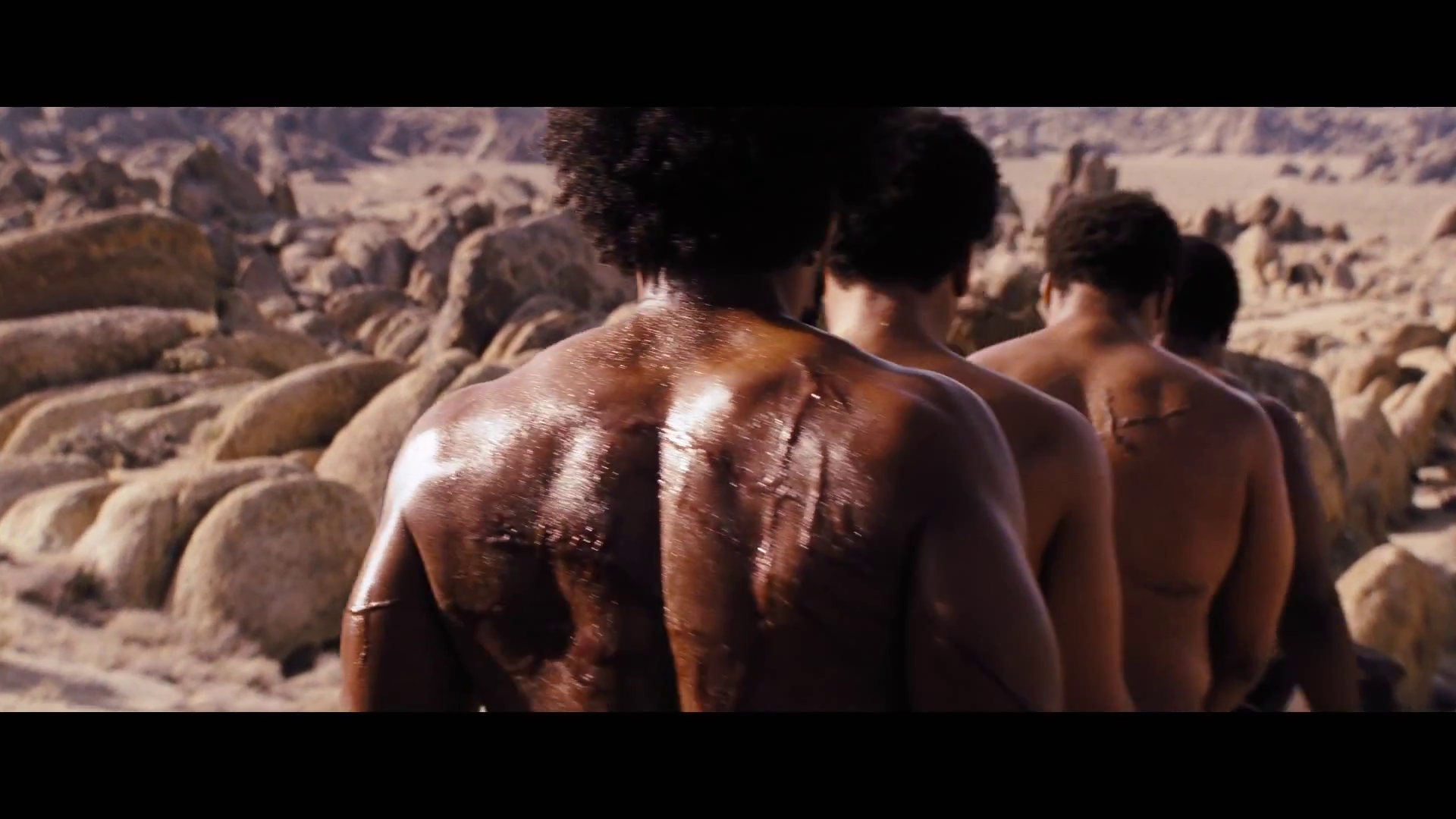
I thought about Josiah Henson when I watched the opening scene of Quentin Tarantino’s film, Django Unchained. The white bounty hunter, Dr. King Schultz, has forcibly purchased (rescued?) Django after a shoot out with the Speck brothers, the two slave traders transporting him. With one of the brothers killed and another trapped under his horse, Schultz turns to the small group of enslaved black men that had been chained to Django just minutes before and tosses them the keys to their leg irons:

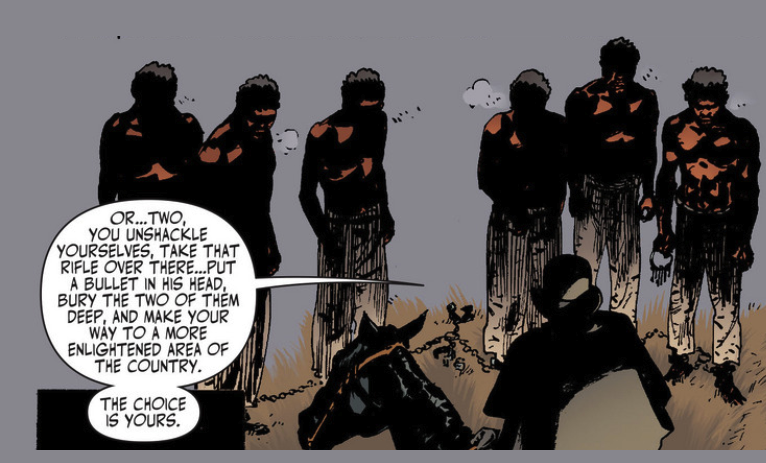
SCHULTZ: “So as I see it, when it comes to the subject of what to do next, you gentlemen have two choices. One, once I’m gone, you lift that beast off the remaining Speck, then carry him to the nearest town. Which would be at least thirty-seven miles back the way you came. Or…two, you unshackle yourselves, take that rifle over there…put a bullet in his head, bury the two of them deep, and make your way to a more enlightened area of the country. The choice is yours.”

Hearing this, the slave trader under the horse curses the approaching group of newly freed men and then begs for his life as they stand over him in silence. When the rifle shot sounds, a sudden spray of blood and flesh explodes from his head and the scene ends.

“The choice is yours.” With the bounty hunter’s words, Tarantino’s film enters into a larger conversation about race, representation, and the negotiations of moral responsibility that has as much to do with affirming Henson’s decision to set aside his axe as it does with celebrating a kind of vengeful catharsis that is without consequence. The film reminds us that in the slave’s narrative, honor was also a bounty to be hunted; the accounts of Frederick Douglass, Harriet Jacobs, Henry Bibb, and others were strategic and deliberative “fictions of factual representation,” as scholar William Andrews put it, even if they were not as brutally self-serving as Django.

In other words, Django Unchained may be a Blaxploitation Western film (by way of Oscar Michaeux as Brian persuasively argues), but it is also reimagines the slave on the road narrative in a way that favors a highly individualistic sense of honor and responsiveness over collective survival. “Each man to his own Canada,” to quote Raven Quickskill, Ishamel Reed’s fugitive slave-poet. I actually found the postmodern satire in Django Unchained to be as satisfyingly irreverent as Reed’s novels, yet Schultz’s “two choices” – made explicit here and implied repeatedly throughout the film – pose a more interesting question for me about exactly what need Tarantino’s revenge fantasy is meant to satisfy.

(Of this opening scene, it is worth noting that Vertigo’s comic book adaptation of Django Unchained does not end in the same fashion. It closes with the group of black men in deliberation, unlocked chains at their feet, while the Speck brother’s wide blue eyes await their decision. Much of the film’s bloodshed is minimized in the first issue of the serial that is based on Tarantino’s original screenplay with art by R.M. Guéra and Jason Latour. Whether or not the rest of the story will take the same visual risks as a comic like Kyle Baker’s Nat Turner remains to be seen.)

django_comic1

But we can only go so far with an apples-to-apples comparison of Django and Nat Turner, or Josiah Henson for that matter. Django expresses qualms during his work with Schultz about killing a man in front of his child, while in a different context he maintains his grim disguise when one of Calvin Candie’s “Mandingo” fighters is torn apart by dogs. In the early scenes if Django appears to act recklessly or in anger, his white partner’s arrest warrants are there to protect him from the repercussions of these emotions. Still Django never forgets that he is on the road – or that his humanity is commodified by the color of his skin – and in return for his resolve, he and Broomhilda live to see her master’s house burn to the ground.  Of course, it may sound too good to be true (and one of the more useful reviews of the film assures us that it is) and what happens after the credits roll is unclear to say the least. But as with the cultural analysis of texts like William Styron’s The Confessions of Nat Turner or Alice Walker’s The Color Purple, I am curious about what Django’s choices reveal about us and the moment in which we live.

I wonder, for instance, what to make of the fact that this controversial, and now Oscar-nominated, blockbuster film comes at the close of President Obama’s first term in office. Once praised for his even-tempered composure and open-mindedness, Barack Obama’s cool disposition has been relentlessly scrutinized for the past four years, notably during his intense presidential campaign in 2008, in the aftermath of the BP oil spill (“One time, go off!” pleaded Spike Lee), and more recently during his debates with Mitt Romney in 2012. Progressives cringe as members of Congress and the press pool cut him off or when an attention-seeking politician jabs a finger in his face – “Have you thought about getting angrier?” Keith Olbermann once asked. But as Ta-Nehisi Coates astutely notes,
 

 …Politicized rage has marked the opposition to Obama. But the rules of our racial politics require that Obama never respond in like fashion. So frightening is the prospect of black rage given voice and power that when Obama was a freshman senator, he was asked, on national television, to denounce the rage of Harry Belafonte. This fear continued with demands that he keep his distance from Louis Farrakhan and culminated with Reverend Wright and a presidency that must never betray any sign of rage toward its white opposition. Thus the myth of “twice as good” that makes Barack Obama possible also smothers him. It holds that African Americans—­enslaved, tortured, raped, discriminated against, and subjected to the most lethal homegrown terrorist movement in American history—feel no anger toward their tormentors.

 
Every insult and public outrage is now accompanied by pleas for President Obama to get angrier, drop the Spock routine and act on his emotion; in other words, to make a different choice. Not to overstate the similarities (and I’m sure I’m not the only one to make this connection), but Tarantino’s film seems crafted to elicit the same urge from his audience as Django’s makes his labyrinthine journey into “Candieland.” When Broomhilda’s bill of sale has been transferred and Django stands at the brink of a precarious future that, however fragile, is his own – it is the bounty hunter who decides what comes next. Schultz, after repeatedly advising caution to keep Django in control, is the one who ultimately determines that the collective cost of allowing the slave master to live is too high. Authorized, then, by this impetuous act and driven by the fear of losing his wife, Django steps onto the road and becomes the “dangerous slave” whose Canada is a plantation house splattered with blood.

I enjoyed the film. Though as I watched, I must admit that I found myself wishing that Django had been the one to confront Candie first. None of the carnage that follows means much without his agency in that moment. The fact that he doesn’t pull the trigger says a lot, I think, about the choices that continue to guide our understanding of race, power, and moral responsibility on the road today.

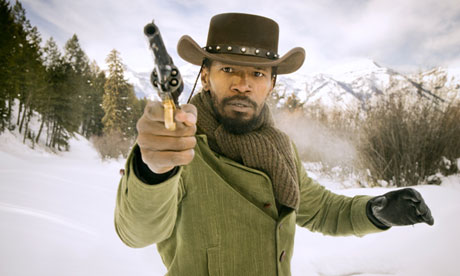
Jamie Fox in Django Unchained

Monthly Stumblings # 19: Fred

Le petit cirque (the little circus) by Fred.

Fred is the nom de plume and the nom the pinceau of Frédéric Othon Theodore Aristidès. You may have heard about him because of Pilote magazine and his most famous series, “Philemon” (or Philemon if we are talking about the albums). Before that though, Fred had a career behind him as a single-panel gag cartoonist and an absurdist comics artist in the pages of several magazines (the Mad inspired Hara-Kiri especially). It was in said mag that Fred published (from issue # 38, April 1964, until issue # 64, June 1966) his masterpiece “Le petit cirque” (or Le petit cirque if we’re talking about the 1973, 1997 and 2012 album editions). The series, in short episodes of two pages each (with the exception of the first three pages), was also reprinted in Pilote magazine (it appeared in twenty eight issues from # 701, April 1973, until # 741, January 1974).

In 2012 an important retrospective of Fred’s work, Le petit cirque included, was shown at the Angoulême comics convention in France (at the Hôtel Saint-Simon, to be exact). To celebrate the occasion Dargaud published a new remastered edition of Le petit cirque directly shot from the existing original art (which means that pages # 8, 9, 26, 27, 36, 37 – three episodes – didn’t receive the same treatment as the rest of the book; there’s no discernible difference between those pages and all the others though; the editors didn’t explain why this is so). Now I’m waiting for a new edition of Le journal de Jules Renard Lu Par Fred (Jules Renard’s journal read by Fred) with the original page layouts recovered. I hope that someone at Flammarion reads my appeal.

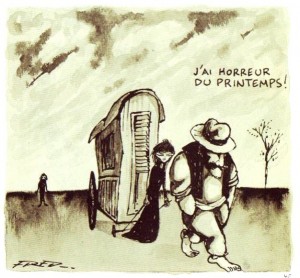
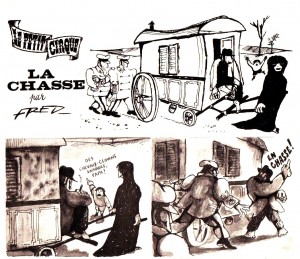
1

Panel from page 53 of the 1997 edition of Le petit cirque by Fred.

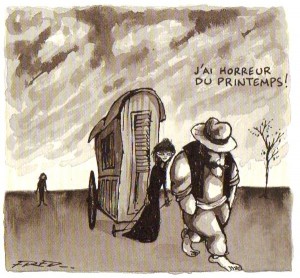
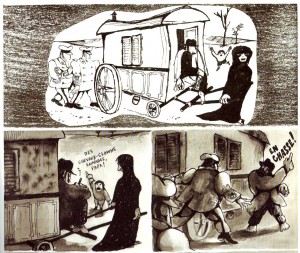
2

The same panel as above from page 51 of the 2012 edition.

Fred himself said, remembering the series’ first album edition in 1973:

I was pleasantly surprised that time! When we took the pages out of the portfolio to print the album, we realized that the original art had yellowed. Time yellows everything, even the mementos hidden in the bottom of a suitcase. Gray had become sepia which added a melancholia of sorts. I love those atmospheres.

As we can see above the 1997 edition reproduced the sepia tones. The lines are far from crisp though and many wash details were lost to resurface in the 2012 edition only. The latter’s matte paper retains some of the beige flavor that pleased Fred. Since Le petit cirque is a comics masterpiece I would say that this edition is one of last year’s most important comics related events. Unfortunately it passed virtually unnoticed.

3

The first two tiers of the first page of the series as it appeared in Hara-Kiri # 38, April 1964.

4

The same tiers published in the albums (in this case, the 2012 edition). As we can see the logo and the episode titles, when they existed, disappeared.

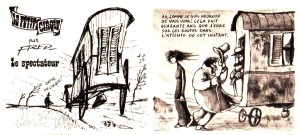
5

The first two panels of episode two (three in the albums) as published originally in Hara-Kiri # 39, May 1964.

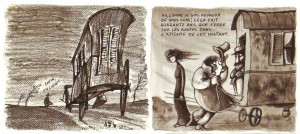
6

The same panels as published in the 2012 album edition. The logo and episode title were removed, a paper and pencil texture was added (notice the glue smears captured by the photogravure).

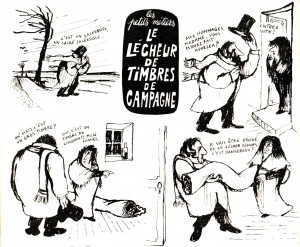
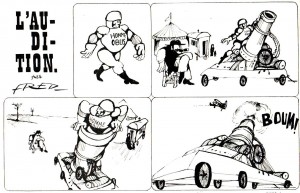
We can find the prehistory of Le petit cirque in a couple of circus related cartoon gags, but we can also find it in a series of strange, imaginative professions created by Fred for Hara-Kiri: the knitter of savage balls; the bearded seller of cotton candy (barbe à papa); the representative of holes; the countryside licker of stamps; the celery grinder; the mirror fixer… In one of his “little jobs” Fred created the human time bomb. That’s where the little circus really started: it was destined to be the album’s second episode.

7

The little jobs: the countryside licker of stamps. Notice the Fredian twiggy tree and the wind.  Hara-Kiri # 23, December 1962.

8

The first half of “L’audition”‘s first page (the audition) with the human cannonball (the human time bomb appears in the page’s second half), Hara-Kiri # 37, March 1964. The little circus before the little circus: it is right there in the second panel.

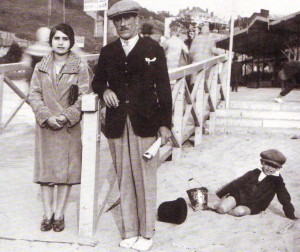
But we may find the true origins of the little circus not only in time, but also in space, in what Fred calls Constantinople (aka Istanbul). Both of Fred’s parents were Greek living in Turkey when WWI raged on and the war between the two countries was declared in 1919. They both emigrated to meet each other in Paris where Fred was born in 1931.

Fred, again:

It was the first time that I did something solid and everything happened naturally, the ideas, the emotions. Maybe because it’s the story of people without roots, like my parents. After leaving Constantinople they traveled a lot too and it was my father who inspired me to create Léopold. […] The Carmen of Le petit cirque is dark-haired and thin while my mother had brown hair and was rather plumpish, but she inspired me nonetheless.

9

The family that inspired Le petit cirque: from left to right: Eleni (Carmen), Yanis (Léopold), and little Fred (who, in the album, has no name); Trouville, 1930s.

Fred’s iconography is very personal and explains the strange poetical power of Le petit cirque: the wind, the leafless trees, the circus, the peasants, the authorities, the mirror, the landscape, the city, etc… Apart from that what’s great about Le petit cirque is its rhetorical complexity.

10

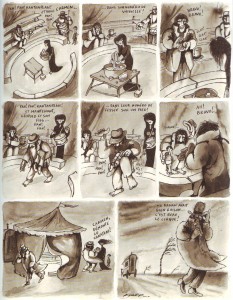
Le petit cirque, page 11 of the 2012 edition.

The above page gives the readers one of the keys to read Le petit cirque: the rhetorical reversal of the situations (the daily life of a patriarchal Mediterranean family is shown as circus acts). Another key is what I called, in Monthly Stumblings # 16, the interpenetration rhetorical mode: two distant spaces meet in a third space where both may co-exist at the same time (more about that later). The last panel shows Fred’s leafless trees with the wind blowing strongly from left to right expelling both the reader – the author too in a nostalgic statement about his childhood? – and the character out of the page (the sudden change of point of view from panel five to panel six shows that it’s time to leave already). The overall atmosphere is scrawny and uncomfortable. The vanishing point in the last panel focus Carmen pulling the circus caravan (Fred explained the metaphor: “the caravan symbolizes the family and the head of the family is the wife”; needless to say that this doesn’t convince me at all…). Notice how the horizon line gets lower and lower until we see a towering caravan getting out of reach. On pages 58 and 59 outraged peasants want to argue with Léopold and Carmen, but are overwhelmed when they find out that the caravan, despite its modest exterior appearance, is in reality a palace (not unlike Snoopy’s doghouse). This, of course, is an hyperbole showing Fred’s huge respect for his creatures.

11

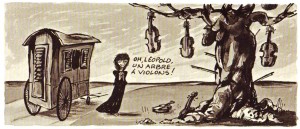
Carmen discovers the violin tree in page 36 of the 2012 edition.

The violin tree is just one of the interpenetrations that I mentioned above. Others link circus people with animals (a clown is a rooster, etc…). The violin tree is the hope and the means to fulfill one’s dreams. The problem is that Léopold, after picking one of the violins from the tree, breaks a string interrupting the process: the family is doomed never to improve their situation no matter how hard they try.

12

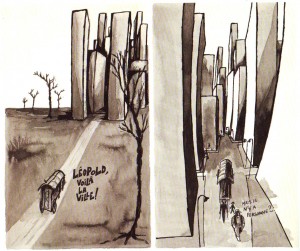
The first two panels of page 18 of Le petit cirque‘s 2012 edition. To the circus family the city is a menacing, blocky, empty space. Fritz Lang’s expressionist Metropolis isn’t far; an hyperbole, again.

13

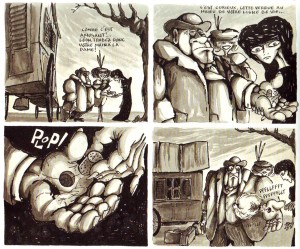
Le petit cirque: second and third tiers of page 48 of the 2012 edition.

In the image above Carmen deflates an overblown bourgeois. The stereotype is a bit blunt, to say the least, but there’s an interesting catch in the sequence: the relation between iconic and verbal expression. Fred puts an idea usually uttered in words (“she deflated him”) into drawings. Something that isn’t that usual in comics. The same thing happens in the rooster/clown interpenetration mentioned above: the clown is visually a clown; we only know that it is in reality a rooster because of what the characters say about him.

I could go on doing close readings of all the episodes of Le petit cirque (like the one in which Léopold and Carmen offer a wheelchair to their son and break his leg in order for him to enjoy his present – which he does, of course), but the above is enough, I guess…

In conclusion: the circus family wanders aimlessly in an inhospitable landscape, is harassed and hated by almost everybody else and they suffer setback after setback, but they continue their journey because they have to, winning a few small victories along the way… We only get to the sense of it all though after decoding the logic of the book which is the nonlinear, oblique logic of dreams.

14

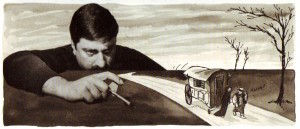
Fred sets his little creatures in motion; second tier of Le petit cirque’s 2012’s edition’s last page. Another narrative device: self-referentiality.

Kent State — The Movie

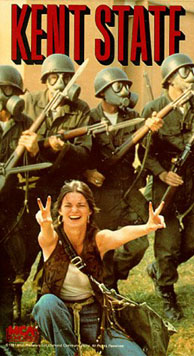
In 1981, NBC aired Kent State, a two-hour dramatization of the May 4th shooting at Kent State University. Although it won an Emmy for Outstanding Directing in a Limited Series or a Special, the film is out of print; the easiest way to see it is to watch the poor-quality copy uploaded to the Internet by the film’s own historical consultant.
 

nbc_kentstate

 
Two years later, four communications professors at Kent State published the results of their study of the film’s effect on faculty, staff, and students. The faculty and staff they surveyed had been present at the university in 1970, but the students had not. The study asked whether viewers perceived docudramas as fact or fiction, and the authors seem to have been surprised by their results:

The students presently at Kent State can scarcely be said to represent a completely uninformed audience. There are symbolic reminders of the event on campus and, far from being forgotten, there is a commemorative ceremony held annually which receives media coverage. For these reasons it would be logical to assume that Kent State students are an informed and therefore critical audience, lacking only firsthand knowledge. Yet, the students used in this study found the Kent State docudrama to be highly believable despite their critical advantage over a completely nai?ve audience. One student said that the film “made the events real.”

This is the perfect simulacrum. People who park their cars on the blacktop where bodies fell require a re-presentation of those deaths, performed ten years after the fact, on a different campus, by no one who was there, in order to be moved.

I watched Kent State, partly as research for my own work but mostly out of curiosity. As a film, it’s just not very good, which may be fortunate; if it functioned effectively as entertainment, if it were skillful and engaging, it might be more obscene than it is.

In the classic sense of obscenity, it exploits the sex lives, real and imagined, of the dead students; Allison Krause lounges in her boyfriend’s shirt and nothing else, sorority girls fall into Bill Schroeder’s lap. Historical consultant J. Gregory Payne wrote about the development of the project, “According to my NBC informants, network programmers felt the screenplay was too political. Apparently the NBC executives preferred a more human focus and had considered developing a romantic theme between some of the principal characters.”

More obscene, to me, is the leaden dialogue. Sandy Scheuer (Talia Balsam) tells another student, “I care about helping people, and my family, and my friends, and grilled cheese sandwiches.” What would be a tolerable, though clumsy, bit of shorthand if it were used to mark the boundaries of a fictional character seems like an injustice when it recreates someone who was real and is dead. It’s not that I believe real people should never be the subject of fiction—I am an eager audience for art that plays with history; but most of the time the historical figures concerned have already left behind a substantial record of their presence in the world. Shakespeare in Love does nothing to diminish Shakespeare while King Lear is still in print, and it matters very little whether the Siegfried Sassoon who appears in Regeneration is strictly accurate when anyone can read Memoirs of a Fox-Hunting Man and know Sassoon as he wished to be known. However, the students of May 4, who were all between nineteen and twenty when they died, are unable to speak for themselves now. Bill Schroeder was a nice kid, an athlete, a Stones fan; he had little time to be anything else.

Worst of the movie’s sins is the contrived dramatic irony that loads almost every line the four students speak: “Big stuff happens and it’s never where you are,” says Jeff Miller (Keith Gordon). It makes the deaths seem prefigured, when the twin tragedies of Kent State were that no one—save the members of Black United Students, who did not attend the Monday demonstration—expected that the Guard would carry live ammunition, and that no one expected Miller, Krause, Scheuer and Schroeder to be the ones to die. The screenplay’s sense of irony brings a false order to the workings of chaos.

The film, though it offers color, motion and sound, is less alive than black-and-white photographs of Allison Krause laughing or Bill Schroeder playing basketball—except for two scenes, both of which get an assist from pop culture contemporary to the shooting. The first is the National Guard rolling into Kent as Crosby, Stills, Nash & Young’s “Ohio” plays; the second is a young Guardsman resting in a troop transport and playing the Grateful Dead’s “Uncle John’s Band” on an acoustic guitar.

The Dead started playing “Uncle John’s Band” live in late 1969, and released it on Workingman’s Dead in June 1970. It is a fantasy of unification, buoyed by three voices in close harmony. By this time the band had been through a traumatic experience at the Altamont speedway: “It was like a nice afternoon in hell,” Jerry Garcia said later. Along with the Byrds’ Sweetheart of the Rodeo, Dylan’s John Wesley Harding, the first two albums by the Band and the work of Gram Parsons, Workingman’s Dead was part of the country rock movement, an attempt to return to the womb of American folk culture. Coming as it did mostly from people who had only a few years earlier attempted to set themselves apart from America in the most dramatic way, this movement could be called a retreat. Considering that they were required to rebuild by hand the America in which they hoped to find a place, you could also call it courageous.

On record “Uncle John’s Band” fulfills itself: the three voices ask for a homecoming and create one as they reach for the chorus. In Kent State, there is only one voice, a small one, and one tinny guitar. The singer is fresh-faced and young, innocent-looking; now he calls softly for a joining of hands, but in less than twenty-four hours he’ll be looking out at the students from behind a gas mask and a gun. Without harmony the song’s requests—Will you come with me? Won’t you come with me?—lose strength and falter, too fragile for their circumstances. People bring pop culture into their lives and invest it with meaning, whether or not it is strong enough to hold up the weight. The night before I wrote this essay, I learned that my father had cancer. I sat in my studio the next day, under his army jacket, and watched the rain fall on Broad Street while “Uncle John’s Band” played, and then I hid my face in my hands.

God damn, well, I declare—have you seen the like?

A more startling intersection between pop and power occurs two scenes earlier. The ROTC building has just caught fire, an event the film does not depict accurately; it shows a group of students lighting the building, then cheering as it burns, when in fact, as my father and many other eyewitnesses have recalled, the students made multiple attempts over the course of roughly twenty minutes to set fire to the building but failed, and had long since wandered away when it exploded into flames.

As the building burns, Professor Glenn Frank (Michael Higgins) says to Professor Ted Arnold (John Getz), “I look at that old pile of burning junk, and all I can see is my old man. And his old man before him, and the grandchildren I don’t have yet. And I wonder what the hell on this earth really matters.” Frank was a real person, a geology professor who saved students’ lives on May 4 by standing between them and the Guard, but this is no real human language; the words assume the shape of profundity but contain nothing. They back away from the building. An assembled crowd of students claps anemically and sings, “Come on baby, light my fire.” The words fade away but the clapping continues. Then it gives way to a low rumble; students and professors turn their heads, there are shots of headlights and huge wheels, and then, as the film cuts to a Dutch-angled shot of a troop transport approaching on the road, we hear the riff that opens “Ohio.”

This is a story my father told me: Gary Lazaroff, one of his college friends, worked at Cleveland’s Gund Arena in the mid-‘70s, and when CSNY passed through on their reunion tour, one of them told him how “Ohio” came to be written. On the fourth of May, Crosby, Stills and Nash were in the process of sobering up from their previous evening’s high when Neil Young appeared. Earlier in the day, he had heard the news from Kent, and had gone out and walked the streets alone, weeping.

I grew up with the song. My father had the So Far LP, and he used to play it every year on the fourth, until the turntable broke and the speakers stopped working. Long before I found out what it meant, it was the sound of a wound, something unresolved, that riff like clenched teeth. At the end of each verse the voices marked out every syllable in the name of the place where I lived: O-hi-o.

The shot goes on for a full minute, as the first transport drives toward us and out of the frame, followed by another, and another, and another. The glare from their headlights blurs the Guardsmen’s faces; astride their Jeeps they look mass-produced. The vehicles seem oversized, out of scale, the embodied will and power of the state. This scene cracks the film’s fac?ade of artificial realism; real life doesn’t have nondiegetic sound, and “Ohio” wasn’t recorded until thirteen days after the Guard arrived in Kent. The effect is conspicuously cinematic, yet nothing else in the film feels as “real.” “In a world that really has been turned on its head,” Guy Debord once wrote, “truth is a moment of falsehood.”

In the end Kent State offered neither a sufficiently comforting myth nor a pleasurable enough spectacle to consume the events that inspired it, as Gone With the Wind and Birth of a Nation consumed Reconstruction. It produced no image more powerful than John Filo’s photograph of Mary Vecchio with her arms outstretched, and no real lasting effect. The damage it did was minimal. It might even have done some good: if a few channel-surfers happened to learn Sandy Scheuer’s name, if Allison Krause became, for a moment, “real” to a student in the Kent State communications program, that doesn’t make up for the years they should have lived, but it’s better, arguably, than being forgotten.

Still, I hate Kent State, for its inaccuracies, its obscenities and its failures; I hate to look at it and yet I want to. I want to confuse the simulacrum with reality, because I know the simulacrum isn’t bound by reality’s rules. The film does not depict the classroom where Bill Schroeder and Dave Wirick sat side by side that Monday morning, but as the students assemble on the Commons I begin to look for my father in the crowds. Again and again I’m drawn in by the promise of fiction—the hope that, this time, the invisible storyteller might change the story.

Snowball’s Chance in Hell: Django Unchained

The entire Django Unchained roundtable is here.
__________________
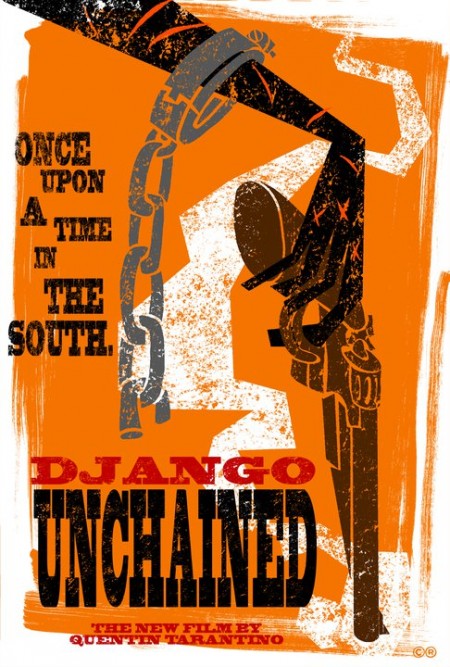
Django Unchained poster

Along with Inglourious BasterdsDjango Unchained forms something of a diptych for Tarantino insofar as both are revenge fantasies set in two of history’s greatest atrocities: the Holocaust and American chattel slavery. In the interview he gave at the screening I saw last week, he certainly thinks of them that way. But before either film could begin to be written, one crucial difference in their respective historical situations delimited the possibilities of fantasy: one can fantasize about the end of the Holocaust by killing the highest members of the Nazi party, whereas there is no easily imagined personalized end to slavery through a few targeted acts of vengeance. Thus, the use of explosives against the Nazis seems a tactical act, a logical means of warfare. The use of bombs against slavery would border on what we call terrorism these days, or “irrationally” violent outbursts against a society (targeting civilians who can’t do anything to change the way things are, or think of the portrayal of the Watts riots, for example: why did they destroy property?). Slavery was a deeply structural violence, an ontological domination of a people that didn’t obtain in the instance of the Holocaust. Any heroic narrative set in the slave-built Southern economy is going to have a major hurdle to overcome: there is no real end in sight, the villain remains like the renewable heads of a hydra, nor is there a place to go where the hero’s limited victory will be recognized, much less celebrated (excepting the audience who might applaud at the film’s end). As Frantz Fanon famously wrote in Black Skin, White Masks:

The Jewishness of the Jew, however, can go unnoticed. He is not integrally what he is. We can but hope and wait. His acts and behavior are the determining factor. He is a white man, and apart from some debatable features, he can pass undetected. […] Of course the Jews have been tormented — what am I saying? They have been hunted, exterminated, and cremated, but these are just minor episodes in the family history. The Jew is not liked as soon as he has been detected. But with me things take on a new face. I’m not given a second chance. I am overdetermined from the outside. I am a slave not to the “idea” others have of me, but to my appearance.

I arrive slowly in the world; sudden emergences are no longer my habit. I crawl along. The white gaze, the only valid one, is already dissecting me. I am fixed. Once their microtones are sharpened, the Whites objectively cut sections of my reality. I have been betrayed. I sense, I see in this white gaze that it’s the arrival not of a new man, but of a new type of man, a new species. A Negro, in fact! [p. 95]

That provides an alternative to the film’s plantation owner Calvin Candie’s theory as to why slaves don’t rise up and kill their masters. He posits phrenology, that the black skull is built to encase a servile brain. (Odd how the guy doesn’t know words like ‘panache’ while being up to date on phrenology, but I digress ….) Instead of racist science: the slaves had little chance of escape — only a minority could get to border countries and the free states would return them without proof of freedman status (even freedmen had trouble fighting against a legal challenge to their status). More fundamentally and universally, there was little possibility for or hope of fundamentally destroying the system of white power that, as Fanon described, defined them on every level of “civil” society (including free states and the minds of many, if not most, abolitionists). Blackness was placed on the outside, no place, as mere alterity to whiteness. It was not purely coincidence that liberalism, the philosophy of liberty, developed alongside chattel slavery. Slavery gave dialectical meaning to liberty by providing the liberals with something to negate (e.g., the American colonies would not be the slaves to the English any longer). (I highly recommend Domenico Losurdo’s Liberalism: A Counter-History, which provides a mountain of evidence for liberalism’s primary theorists either outwardly supporting or giving backhanded defense to slavery on such grounds.) In Frank B. Wilderson’s terms, blacks experienced a structural suffering that is not analogous to the social oppression so many other groups have been under throughout history. For hundreds of years, they were denied ontological status, relegated to non-being. blackness constituted as a comparison to whiteness — i.e., what it meant not to be white or a subject and, by extension, what it meant not to be free.

Any imagined heroic solution cutting through the Gordian knot of cultural accretion that was slavery would’ve had to involve a consensus towards revolutionary-styled destruction, a restructuring of fundamental principles, namely a zero-sum ending to the civil war that begins 2 years after the film’s beginning. That Django’s final solution to Candie’s plantation wasn’t actually applied to the Confederacy itself resulted in another century of racial oppression that reverberated up through the 1960s reaction to the Democrat-driven Civil Rights Bill as the Southern states became Republican (the Democrats no longer being the anti-Black party). Thus, the moral contradiction at the heart of Django Unchained‘s narrative: by providing a fantasy of Django’s triumph and cathartic escape from the slave system, it supports the lie of Candie’s scientistic racial theory. That is, besides servility and cowardice, why didn’t the other slaves rise up the way Django does? Instead, I suggest a super-slave could no more put an end to slavery by destroying a personal target than Superman can punch out poverty. Success would be determined by the upswell of violence inspired by the hero’s symbolic actions against the corrupt system. Structural suffering isn’t something that can be solved or coherently fantasized about solving within the heroic-revenge generic story arc without turning the hero into a terrorist, which tends not to be most people’s ideal (unless a fan of Georges Sorel, like maybe Frank Miller). Unfortunately, Tarantino tries.
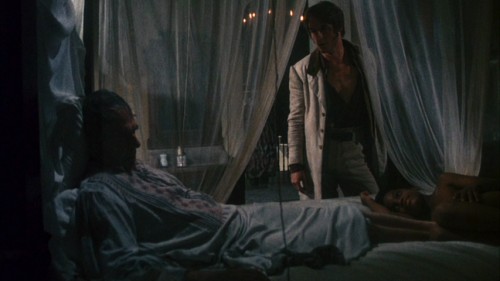
James Mason in Mandingo

But first, what the film does right: I’m not sure any image in Django Unchained is any more perfectly ridiculous and depraved concerning reified blackness than James Mason’s rheumatic plantation owner placing his feet on a slave boy’s stomach in Mandingo with the superstitious belief that the pain will be absorbed from white to black. Nevertheless, there’s plenty of chains, whipping, dog mauling, infantilization, banal use of epithets and cannibalistic black-on-black violence to convey the slave economy’s dehumanizing processes. Together, these images provide the movie’s answer to an ensemble of questions that Wilderson refers to as descriptive: “what does it mean to suffer?” [p. 126] The ensemble addresses the ontology of black as slave, the structural condition of black suffering as fungibility and accumulation. True, like a superhero, Django is never in much danger of experiencing realistic trauma, but neither was Clint Eastwood’s Man with No Name. This is a fantasy, after all, and a comedic one to boot, so the audience doesn’t expect an onscreen castration of the titular hero no matter how close the knife gets. It also isn’t that important if Mandingo fighting actually occurred. As a phantasmagoric image of the black body as cannibalized remainder, black subjectivity having been commodified as pure exchange value, it remains effective. A bored son of privilege not requiring the economic appreciation of a good black buck, Candie uses the Mandingo slaves as a leisurely expression of his absolute sovereignty. Like a rich kid wrecking his BMW, he can always get another:

The relation between pleasure and the possession of slave property, in both the figurative and literal sense, can be explained in part by the fungibility of the slave — that is, the joy made possible by virtue of the replaceabilty and interchangeability endemic to the commodity — and by the extensive capacities of property — that is, the augmentation of the master subject through his embodiment in external objects and persons. Put differently, the fungibility of the commodity makes the captive body an abstract and empty vessel vulnerable to the projection of others’ feelings, ideas, desires, and values; and, as property, the dispossessed body of the enslaved is the surrogate for the master’s body since it guarantees his disembodied universality and acts as the sign of his power and dominion. [p. 21, Saidiya Hartman]

So despite its being a comedic fantasy, Django Unchained‘s horrific imagery conveys both bodily and ontological suffering under slavery. In fact, it takes a similar approach to blaxploitational horror (e.g., Ganja & HessBlacula), identifying the spectactor with what is typically the Monster/Other in Hollywood films to estrange normative positions: here, it’s Django, a black man as Slave, and Dr. King Schultz, a German traveler as Foreigner/Alien. (Mandingo, for example, is a tragedy about the plantation owning family and the Germans were almost completely alien in Inglourious Basterds, namely the enemy.) Tarantino is careful to acknowledge their differing ontological positions: Schultz doesn’t approve of slavery, but he’s still willing to use Django’s slave status to get what he wants, regardless of the latter’s desire. To paraphrase Fanon, whiteness can change with ideas, blackness is overdetermined by appearance.

It isn’t until later, after having been given his freedom, that Django reveals his goal to his erstwhile master, that is, to free his wife, Broomhilda (who we’ll soon learn is the property of the aforementioned Candie). At this point in the story, the two heroes’ relationship is, in the final analysis, characterized by an economic quid-pro-quo arrangement, not the developing friendship, which still needs the recognition of Django’s subjectivity. So Schultz will help rescue Broomhilda if Django will help out with the bounty hunting during a busy season just as he was freed for helping to locate the Brittle Brothers. The friendship becomes primary when Schultz gives up the majority of bounty he’s earned over the past year to pay for Broomhilda’s freedom. Although done under duress — Candie’s threat of bashing in her head with a hammer — the doctor clearly doesn’t think twice about the exchange: only the money is truly replaceable. With Schultz, a nonracist foreigner, we can see how the temptation of white power was entangled with the supposedly amorality of capitalist exchange. He resists the former by accepting failure at the latter.

The moral setup is actually more complicated than Schultz’s development, though (which would’ve made the movie little more than another black tale about white awakening). On the way to the Candieland plantation, posing as a wealthy dilettante wanting to invest in Mandingo fighting with Django as his black slaver cum counselor, Schultz witnesses the way Candie deals with slaves who have lost their value. A fighter named D’Artagnan (after The Three Musketeers‘ protagonist) tried to escape because he felt too worn down to fight any more. Schultz loses his nerve, breaks character to save the slave from the dogs by offering to reimburse Candie. To repair the damage to their pretense, Django doesn’t flinch, saying this “pickaninny” ain’t worth buying, that Candie could do whatever he wants with his “property.” As Django explains, Schulz just ain’t as used to Americans. The foreigner looks as if he’s trying not to vomit, while the former slave returns a steely-eyed stare back at Candie as the hounds tear the decrepit fighter apart. This scene is pivotal as it shows just how desensitized to the spectacle of slavery Django is (his ability through habituation to suppress a horror too great for the white outsider) and how far he’s willing to go to get his wife back: D’Artagnan’s life for hers. Similarly, throughout the trip, as part of his act, he’s shown to be harsher on the slaves in chains than any of the real slavers in order to keep Candie “intrigued.” For the time being, he’s committed himself to the system of slavery, going beyond what it demands of him, in order to save the one person he truly loves. In his willingness to go through hell, Schultz compares him to the German myth of Siegfried. In other words, he must treat all slaves as fungible to rescue Broomhilda. Only she is seen as an irreplaceable subject.
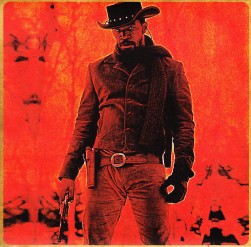
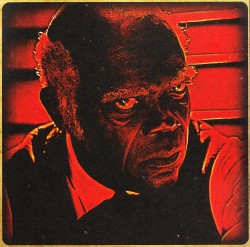
Jamie Foxx as DjangoSamuel Jackson as Stephen

In the next scene, arriving at Candieland, we’re introduced to Django’s mirrored antagonist, the “Uncle Tom” character of Stephen, which is where the film’s main problems lie. As Django had previously explained, the house negro is the lowest of the low, with the only thing lower being the black slaver. However, there’s one role he omitted: the white slaver as the representative of slavery itself. The reason Django remains sympathetic even after sentencing another black man to a brutal death is because of the enculturation to abject horror that’s forced on any survivor of such totalizing oppression. It wasn’t as if slaves could appeal to OSHA about the unjust treatment of one of their fellow slaves. Whistleblowing during slavery had no meaning, since the law enforced injustice. The “whistleblower” risked his own life for no possibility of justice. Thus, one had to learn to live with the violence. This habituation to depravity is what allows Django to stay focused on his goal. He can’t rescue every slave he comes across any more than all the slaves could’ve just fled to Canada to live a just life, equal to whites, because the manifold problems of slavery are structural, not just personal. If he had let Schultz save D’Artagnan, then it would’ve been more likely that Broomhilda’s life was being traded for a slave he had never met. This is not some utilitarian “greatest good” rationale being arrived at by the slave, but a forced choice being made for him by the white power structure in which he can do little more than survive. A lesson from Hitchcock’s Lifeboat: if one can’t save everyone in a lifeboat, then be willing to push some off the side and get used to the sounds of drowning. That, and it’s better to not save a spot for complete strangers.

Why, then, if the audience can still sympathize with a flawed hero who has to do some bad things because of an immoral system that doesn’t permit him a rational, disinterested reflection on the universal good, are we presented with Stephen, a potentially complex character, in such a simplistic, caricatured villain role? He’s revealed not as another slave who’s doing what he can to survive, any possibility of self-assertion narrowly circumscribed under the gaze of white power, but rather the maniacal evil genius behind the entire Candie clan. Consider: (1) He’s the first person shown to torture Broomhilda and it’s Candie who stops it. (2) Candie doesn’t figure out the con Django and Schultz are pulling, but Stephen does. He reveals it while sipping brandy in the library, holding the snifter like a Bond villain, and calling his “master” by his first name, Calvin. (3) After Candie’s death, it’s Stephen who gets all his master’s henchmen to stop firing while he negotiates Django’s surrender. Billy Crash has a gun pointed at Broomhilda’s head, but he doesn’t fire after Django throws down his gun because Stephen said she would live. Why would Crash care what one slave promised another? (4) Furthermore, he doesn’t castrate Django, because Stephen has convinced Lara Lee (Calvin’s sister) and the rest of the gang that breaking rocks at the mines is a much worse fate. (5) And, finally, if Stephen’s total control isn’t obvious enough, after everyone else has been killed, this antebellum Wormtongue throws down his cane and stands up straight to reveal his lameness an act. Whereas Django had to play tougher than he was, Stephen played weaker. They’re inverted images of each other: the former lied to protect someone from power, the latter to gain power (or, more sympathetically, to protect himself from power).

The reason for the appearance of a mustache-twirling cliched role (despite some admittedly funny, witty lines and a great performance by Sam Jackson) is, as I suggested above, the heroic-revenge generic structure. It requires a personalized villain of sorts, not a structural evil with which even “good” citizens are complicit. And what’s more personalized than the evil doppelgänger? For once, genre constraints have gotten the better of Tarantino. Thus, the film is an abysmal failure at addressing the other ensemble of questions Wilderson delineates, the prescriptive: “How does one become free of suffering? [Those] questions concerning the turning of the gratuitous violence that structures and positions the Black against not just the police but civil society writ large.” [p. 126] By giving the story a revenge motive, Tarantino reduced the suffering to a personal level, a subjective violence that one person might do to another — kill the oppressor, stop the oppression. This is a “failure,” because it applies a subjective resolution to a structural problem that was fundamentally the negation of subjectivity; “abysmal” because it achieved the biggest cathartic thrill with the killing of a black slave instead of any number of plantation owners in the film. If Tarantino had to make it all about subjective revenge, then why ignore the most narratively plausible candidate, Old Man Carrucan, the malicious old bastard who had treated Broomhilda and Django so cruelly and then sold them to separate owners out of spite after they attempted to run away? But it’s not even Candie who has the last, big face off against Django; it’s Stephen. Django mows down every trace of whiteness in the final (majestically rendered) gunfight, saving the fate of “snowball” for the big finale. Evidently, the house negro is more evil than the master.

Tarantino has expressed in the past (on Charlie Rose) a keen interest in what I’d call the terrorist as symbolic hero, namely in his desire to do a biopic on the radical abolitionist John Brown, one of the director’s favorite historical Americans. With a self-described holy purpose, Brown sliced open the heads of pro-slavery activists along the Pottawatomie Creek, who hadn’t actually killed anyone themselves, was willing to go on a suicide mission at Harper’s Ferry in an attempt to inspire a mass uprising against slavery and, once caught, refused any possible chance to avoid hanging for a chance at martyrdom. As James McPherson tells it, “Democrats and conservatives denounced Brown as a lunatic and murderer” and the Republicans did their best to dissociate their abolitionism from Brown’s techniques. [p. 35] In other words, he was no more popularly recognized as a hero in the nineteenth century than terrorists are today. At least, among whites; blacks have mostly called him a hero (except pacifists like Martin Luther King, Jr.). Why not use this white abolitionist’s revolutionary violence as a model for Django’s own? It’s not like sympathetic terrorism as entertainment isn’t fairly popular these days: Che, Carlos, United Red Army, and, in a way, Homeland. Instead, each vengeful kill that Django makes is shown to be related to a personal act of violence against him or his. There is no killing of pro-slavery people who aren’t themselves shown to commit subjective violence. Each person acts as an individual and another reacts, ignoring the dangerous question of structural responsibility expressed by Malcolm X: “if you [whites] are for me — when I say me I mean us, our people — then you have to be willing to do as old John Brown did.” [p. 38]

Hartman’s Scenes of Subjection provides a plausible analysis of what’s going on here. She argues that in abolitionist literature, melodramas and eyewitness accounts from whites, there was an empathic tendency that attempted to make the horrors of slavery palpable to whites by projecting whiteness into the place of the black body in pain. This effectively erased the black person doing the suffering, making it a performance for white affect, and not unrelated to the way slaves had to perform for masters as if they accepted, even enjoyed, their subjugation. As she writes in the quote above, “the captive body [was] an abstract and empty vessel vulnerable to the projection of others’ feelings, ideas, desires, and values.” Thus, black suffering was narrated through the master’s discourse even for abolitionists. Let’s face it, other than avowed racists, what contemporary white people would fancy themselves as pro-slavery in a historical melodrama? Dreams of terrorism are probably more likely, despite the damn good chance that slavery sympathizer is what we would’ve been in such times. So, instead of a critical reflection of Django’s narrative, complicating his own generically derived existence as black performativity (cf. blaxploitation), Stephen is treated as little more than a blackface projection for white fantasy. As Tarantino has stated over and over in interviews, he clearly wants his audience to take sides, cheer at the ending — not, I conclude, reflect on the problematic that the house negro presents. Django is the oppressed that white folk would like to be in such a situation, fighting for freedom (just as they would now, of course), with Stephen’s freely working for subjugation the negation that gives such freedom meaning — as if chattel slavery and its concomitant subjugation of black identity were a choice made by the subjugated! This is, once again, Candie’s theory, only without the biological determinism. And when the film has audiences cheering Stephen’s downfall, one should recall the earlier scene of Mandingo fighting, in which one man’s death is reduced to spectacle for Candie and his guests.

~~~~~~~~~~~~~~~~~~~~~~~~~~~~~~~~~~~~~
Poster from here.
Fanon, Frantz (1952/2008), “The Lived Experience of the Black Man,” Chapter 5 in Black Skin, White Masks. Translated by Richard Philcox. [An older translation can be read here.]
Hartman, Saidiya V. (1997), “Innocent Amusements: The Stage of Sufferance,” Chapter 1 in Scenes of Subjection: Terror, Slavery, and Self-Making in Nineteenth-Century America.
McPherson, James M. (2007), “Escape and Revolt in Black and White,” Chapter 2 in This Mighty Scourge: Perspectives on the Civil War.
Wilderson III, Frank B. (2010), “The Ruse of Analogy” and “Cinematic Unrest: Bush Mama and the Black Liberation Army,” Chapters 1 and 4 in Red, White & Black: Cinema and the Structure of U.S. Antagonisms.

 

What Americans Know

vlcsnap-2012-06-07-23h16m13s170

 
I finally saw Django Unchained, which I think is probably one of Tarantino’s weaker efforts — down there with the Kill Bill films. It’s certainly well made, and there are lots of interesting moments and ideas, but its handling of the Western genre strikes me as much less knowing, and much less thematized, than the handling of Holocaust films/war films in Inglourious Basterds. As Alyssa says, the handling of gender is pretty rote (certainly less intelligent than in Jackie Brown). And as I think I’ve seen a bunch of people say, the portrayal of Django as exceptional is really problematic, insofar as it flirts with endorsing the phrenological racist narrative that Calvin Candie (DiCaprio) propounds, in which most of the slaves are slaves because they’re not sufficiently bad ass to overthrow their masters. As subdee has mentioned in comments, the film does very much show the constant, horrific violence that propped up the slave system, so it’s possible to critique the idea of black submissiveness from within the film…but still. A little more focus on the pervasiveness of black resistance could have gone at least a little way to balance the Uncle Tom caricature of Stephen, no matter how ably played by Samuel Jackson. As it is, the film’s focus on hyperbolic violence makes it seem like only one man in ten thousand could fight back effectively — when the truth is, I think, that slavery was kept in place by violence of all levels, and so there was resistance at all levels. The film can’t really imagine, for instance, Frederick Douglass physical struggle with his overseer, in which no one died and no one was freed, but white people weren’t quite able to work their will either.

Still, despite its failings, as I said, there were definitely things about the film I liked. One was the shift in the relationship between the German Dr. Schulz (Christoph Waltz) and Django over the course of the film. In the first part of the movie, where Schulz frees Django from slavery and then trains him as a bounty hunter, Shculz is clearly the senior partner — the one who knows the ropes, and the one who better understands, and is more comfortable with, the violence of bounty hunting. Towards the end of the film, though, when the scene shifts to the Southern plantation where Django’s wife is held, it’s Django who leads the way — and Django who understands the reality of life. When Candie has a slave torn apart by dogs, for example, Schulz is horrified and almost blows their cover — but Dango has seen it before, and keeps his cool. As he tells Candie, Schulz “isn’t used to Americans.” Schulz may be white, but he doesn’t understand white violence the way Django does.

The sequence made me remember James Baldwin’s discussion of Lady Sings The blues in his great essay, The Devil Finds Work. The film is loosely based on Billie Holiday’s autobiography. In one scene, supposedly the inspiration for the song Strange Fruit, Holiday (as Baldwin describes it) is on tour in the south when she sees black mourners and a black body hanging from a tree. The Ku Klux Klan appears, and Holiday starts to shriek at them, endangering herself as her white band members attempt to hide her. The band and Billie then escape, but the trauma caused Holiday to take her first shot of heroin.

Baldwin then comments:

The incident is not in the book: for the very good reason, certainly that black people in this country are schooled in adversity long before white people are. Blacks perceive danger far more swiftly, and however odd this may sound, then attempt to protect their white comrade from his white brothes: they know their white comrade’s brothers far better than the comrade does. One fo the necessities of being black, and knowing it, is to accept the hard discipline of learning to avoid useless anger, and needless loss of life: every mother and his mother’s mother’s brother is needed.

Again, where Lady Sings the Blues fails, Django Unchained succeeds. Django’s experiences as a black man mean that he understands white violence in a way that even the bounty hunter does not.

I especially like the almost certainly intentional irony that it is the German who is horrified by Southern racism and Southern atrocities. (Waltz, of course, played a ruthless Nazi in Tarantino’s last film.) It would be possible, I suppose to see this as hypocritical…but Schulz is a sufficiently sympathetic character that I don’t think it quite reads that way. Or if it does, it points, perhaps, to the way that it’s always easier to see the mote in someone else’s eye — always easier to be shocked by someone else’s atrocities than by your own. And, though I doubt this is intentional, it can perhaps also be seen as suggesting a link between America’s treatment of its minorities and Germany’s treatment of its Jews. Hitler’s concentration camps and extermination policies were inspired in part by America’s treatment of the Indians — giving historical weight to Tarantino’s vision of decadent Americans teaching atrocity to innocent Europeans, like some sort of inverse, bloody Henry James novel.

That’s why, for all its flaws, I still like Django Unchained. America just doesn’t make that many films in which America is defined by slavery, and in which being American is defined by slavery. What Django knows about the US isn’t the only thing that is, or can be known about this country — but still, it’s worth keeping it in mind.
_____________
Our entire Django Unchained roundtable is here.

A Minaj for Everyone

A version of this essay first ran at The Chicago Reader.
__________________

minaj_magnum

“I’m a bad bitch,” Nicki Minaj declares on “I’m the Best”, the opening track of her debut album Pink Friday.  It’s a claim she’s made before – and the only difference here is that she doesn’t seem to mean it.  Just a year and a half ago on “Itty Bitty Piggy” from her mix tape Beam Me Up Scotty she came across as a potty-mouthed cackling machine-gun, declaring her badness and her bitchiness in a deranged rhythmic repetitive sing-song that made you believe in both and really not want to meet her in a dark alley.   In comparison, “I’m the Best” sounds like — well, like a rapper looking to go pop by eschewing weirdness for rote R&B backing and rotely inspirational lyrics.  “I’m fighting for the girls who never thought they could win.”  That’s a long, sad trip away from the profane nuttiness of: “If you see a itty bitty piggy in the market/give that bitch a quarter and a car/tell her park it /I don’t fuck with pigs like a salaam alaikum/, I put em in a field, I’ll let Oscar Myer bake em.”

I wish “I’m the Best” was an aberration.  But alas Pink Fridayis filled nigh to bursting with blandness.  You know those swelling, earnest, I-have-overcome bullshit tracks that even decent rappers often put at the end of their CDs where you can conveniently skip over them?  Imagine you had a whole album full of that, and you’ve got a general idea of what Minaj has perpetrated.  The Rihanna collaboration “Fly” sounds like a song called “Fly”; the Natasha Bedingfield collaboration “Last Chance” sounds like a Natasha Bedingfield collaboration.  Just so you won’t blame the R&B songstresses, though, Minaj proves that she can suck all on her loneseome with dross like “Here I Am,” where  she actually says, in all earnestness, “I’m a woman, hear me roar.”   So what’s next — is she going to declare that Lil’ Wayne is the wind beneath her wings?

Quoting Helen Reddy with a straight face on a hip-hop album seems like a good indication that you have lost your way in a fairly spectacular manner.   If you were so inclined, you could see this as a desperate and misguided effort to reach a mainstream audience.   And it clearly is that.

But at the same time, the albums’ rudderlessness seems like part and parcel of Minaj’s  persona.   Switching from Barbie cuteness to rasta declamation to faux British accents to sped up tourettes, Minaj’s flow has always been about spastic incoherence. It’s no accident that perhaps her most acclaimed performance is deliberately and gloriously bipolar. In her verse on Kanye West’s “Monster,” she switches back and forth between a flirtatious little girl coo and a fierce, ranting growl, using the alternation to create an escalating momentum so massive it makes the other rappers on the track, from Jay-Z to Rick Ross, sound positively precious.

As “Monster” makes clear, Minaj has flirted throughout her career with the standard hip hop roles for women: sex kitten and ball breaker.  That flirtation, though, always tends to be oddly, and in some ways refreshingly, half-hearted.  Minaj may don preposterous ass-accentuating outfits in her “Massive Attack” video, or giant castrating claws in Ludacris’ “My Chick Is Bad,” but for the most part it’s remarkable how little she seems to care either about teasing cocks or cutting them off.   Instead, her focus is almost always on, as she invariably says, “bitches.”   One of  the decent tracks on Pink Friday, “Did It On’em,” is fairly typical, as she threatens her peers with explicit machismo.  “All these bitches is my sons…If I had a dick I would pull it out and piss on ‘em.”

The other side of wishing you had a dick to piss on ‘em is, of course, wishing you had a dick to do something else to them.  Minaj is famously semi-closeted. Her most explicit statements of lust on record have almost invariably involved, not men, but other women.  The exception that proves the rule is perhaps Christina Aguilera’s “Woohoo,” where two not-all-that-straight women serenade each other about the pleasures of cunnilingus (“Lick, lick, like a lolly.”) Or, on the other tongue, there’s Usher’s “Little Freak”, and Gucci Mane’s “Girls Kissing Girls,” in both of which Minaj hornily anticipates a (ahem) ménage, offering to hook her brothers up.

Pink Friday doesn’t have anything that hot and heavy — and no wonder.  Minaj may enjoy lasciviously contemplating your “kitty cat” and asking if she can “touch her,” but she’s careful to rhyme the whole thing with “Usher.” Lesbianism is only OK packaged for male consumption. Minaj wants girls . . . but it ain’t no fun if the homeys can’t have none.

In short, Minaj can’t be a sex bomb and a bad ass; she can’t be a castrator and one of the boys; she can’t be dyke and have a career.  She’s got no place to go — which isn’t always a bad thing.  Her see-sawing between identities is surely a large part of her appeal and her genius.  What other female rapper has claimed to be Monica Lewinsky, Barbie, and Freddie from Nightmare on Elm Street?  Minaj ‘s refusal to stay in the hip hop box labeled “women” has allowed her to be silly, unpredictable, and fierce in a way that few rappers of any gender have managed.

But sometimes freedom can be a trap too.  A debut is where you show the world who you are, and for Minaj that’s death.  You can see the problem most clearly, perhaps, on the album’s best track — “Roman’s Revenge” with Eminem.  Swizz Beatz drops the two rappers into a factory full of hammering synths, and Eminem proceeds to tear that shit apart, bouncing from S&M to pissed off Happy Meals to bondage water sports, his brain spewing tangled knots of filthy punchlines so fast that lesser mortals don’t even have time to be knocked on their ass.  “So I tied her arms and legs to the bed, set up the camera and pissed twice on her.  Look!  Two peas in a tripod.”

Like most rappers, Minaj doesn’t have Eminem’s skills, but she doesn’t get blown away either.  From her first stuttering transgender declaration, “I am not Jasmine, I am Aladdin!”  she spits insults and threats, references Eli Manning, and generally sounding lean, mean, and nuts.

The only thing is…well, Eminem is up in there getting a blow job and pissing on women, you know?  And in response Minaj…starts sneering at bitches again.  There’s a general consensus that she’s calling out Lil’ Kim in particular, and fair enough.  But can you imagine Minaj cutting off a guy’s bits and Slim Shady saying, “ayup”, and then going after some random third party?  Indeed, you have to wonder if he’s glancing sideways at Minaj when he snaps (ostensibly again to Kim), “look who’s back again, bitch/keep acting as if you have the same passion I have/yeah right, still hungry, my ass.”

The point isn’t that Minaj has to fight for the rights of women everywhere.  But it Is to suggest that, even at her most feral  there are places she won’t, or can’t, go.  “I feel like people always wanna define me and I don’t wanna be defined,” Minaj said in a Vibe Magazine interview. (in a Vibe Magazine interview).  Unfortunately, on Pink Friday, that fear of being defined seems to have made her unwilling to say anything of interest at all. At some point, if you’re not going to stand for something, you might as well sit down.

Utilitarian Review 1/5/13

On HU

Featured Archive post: me on Edie Fake’s amazing Gaylord Phoeix.

I talk about me, Bart Beaty, and the eternal circle of citation.

Brian Cremins on Tarantino, Oscar Micheaux, and black cowboys in the Western genre (with a pretty long comments thread.)

The 2012 Utilitarian Year in Review.

Jacob Canfield on Stokoe vs. Druillet.

Bert Stabler on Edie Fake’s one person show, memory and queerness.

America loves me because I’m a Jew.

Ng Suat Tong provides the list of 4th quarter nominations for the Best Online Comics Criticism awards.
 
Utilitarians Everywhere

At the Atlantic I talk about Moto Hagio’s Heart of Thomas, boys’ love, and cross-gender identification.

At the Atlantic I review Laina Dawes’ book about her experiences as a black woman metalhead.

At Splice I talk about Carlene Carter’s wonderful and hardly remembered album Little Love Letters.

At Splice I argue that both Republicans and Democrats are craven, albeit in somewhat different ways.
 
Other Links

Jason Bailey with a really nice piece on Spike Lee’s career.

Alyssa Rosenber on gender in Django Unchained and Lincoln.

 
This Week’s Reading

Reread Moto Hagio’s The Heart of Thomas for a review. Read Walter Benn Michaels’ Our America, which was fantastic. Started the last 50 Shades of Grey book, which may actually be worse than the other two, if such a thing is possible. Also started Alisa Valdes’ The Feminist and the Cowboy, which is pretty bad, but better than 50 Shades of Grey.
 

banner_moto hagio