Best Online Comics Criticism 2012 – 4th Quarter Nominations

(A call for nominations and submissions.)

This is the final list of nominations for 2012. The judges are now deliberating on the nominations and we should have the list of articles with the highest number of votes by the end of January.

Reiteration: Readers should feel free to submit their nominations in the comments section of this article. Alternatively I can be reached at suattong at gmail dot com. Web editors should feel free to submit work from their own sites. I will screen these recommendations and select those which I feel are the best fit for the list. There will be no automatic inclusions based on these public submissions. Only articles published online for the first time between January 2012 and December 2012 will be considered.

Cartoon-Utopia-cover1

Jenna Brager on Madeleine L’Engle and Hope Larson’s A Wrinkle in Time.

Jacob Canfield – “Subversion, Satire, and Shut the Fuck Up: Deflection and Lazy Thinking in Comics Critcism”.

Brian Cremins – Captain Marvel, The Master, and the Feminine Embrace.

Michael Dirda – “A Duckburg Holiday”. I don’t think Michael Dirda does that many comics reviews so I’m including it here more as a formality. It’s probably more competent than great.

Elisabeth El Refaie – “Visual authentication strategies in autobiographical comics”.

Emma (of Get Me Some Action Comics) on Sex in The Walking Dead.

Glen David Gold – “The Lure of the Oeuthre: On Charles Portis and Flannery O’Connor”.

Nicholas Labarre on Paul Karasik and David Mazzucchelli’s City of Glass.

David Large – Palimpsests and Intertexts: The Unwritten.

Peter Tieryas Liu On Chris Hedges and Joe Sacco’s Days of Destuction, Days of Revolt.

Adrielle Mitchell – “Is Comics Scholarship Ekphrasis?”

Andrei Molotiu – “Abstract Comics and Systems Theory”

Rick Moody – “Fugue for Centrifuges: On Chris Ware’s Building Stories” (Nominated by a jury member)

Jason Thompson on The Heart of Thomas.

Gabriel Winslow-Yost on the works of Chris Ware.


The Comics Journal

Craig Fischer – “The Lives of Insects: On Photography and Comics”

Katie Haegele on Ron Regé, Jr.’s The Cartoon Utopia.

Nicole Rudick on Frank Santoro’s Pompeii

A selection of Building Stories Essays by Martha Kuhlman, Katherine Roeder, Daniel Worden, David Ball, Matt Godbey, Margaret Fink, Georgiana Banta, Joanna Davis-Mcelligatt, Shawn Gilmore, Peter Sattler, Paul Karasik, and Craig Fischer.

The individual essays are linked to here for the judges to peruse. Since this process is only selecting individual pieces of comics criticism, the roundtable as a whole is not eligible for consideration.


Also see:
First Quarter Nominations

Second Quarter Nominations

Third Quarter Nominations


Jews and America

This article first appeared on Splice Today.
_______________

I was trying to get my son and his car pool friends into my car to go home when I was accosted in the middle of the street by a guy in a beard and antiquated black hat. “Hello!” he said. “You look Jewish! Are you Jewish?”

My flagrant nose had betrayed me; there was no point in denying it. I admitted that I was indeed Jewish. Nominally.

He took that “nominally” with good cheer. “Once a Jew, always a Jew!” he said, and handed me a card promoting some sort of Jewish goings-on, which I promptly threw away.

Chucking the card was a natural rejection of marketing such as we all perform daily (hourly?) under capitalism. But it was also, in its way, an exercise of empowerment. America lets Jews — even Jews with noses like mine — hold our identities very lightly.

But it wasn’t always that way. Even in the first part of the 1900s, not being a Jew was a lot harder than chucking a piece of advertising. My dad’s father, Manny, was heavily involved in the Jewish Community Center and an ardent Zionist; cultural Judaism shaped his life. My mom’s father, Milton, on the other hand, changed his name from Weinberger to Winters to avoid prejudice, and even converted to Christian Science for a while. Judaism was something he worked to escape.

Anti-semitism hasn’t vanished, of course. In middle school I had bullies push pennies at me in the lunch room — because Jews are greedy, get it? On my blog, I had one particularly unpleasant troll who would make occasional Jew-baiting remarks. And I suspect that the cultural association of Jewish appearance with nerdiness had something to do with my conviction through most of my school years that I was fairly unattractive (my wife — who likes skinny guys and big noses — insists I was wrong, bless her).

But a couple of incidents and a mildly negative self-image is pretty small beer compared to the history of anti-Semitism. I haven’t had to work to assimilate, like Milton did. For the most part, and without any effort on my part, people see me as white, not Jewish. I married a shiksa, and, while her Appalachian extended family was initially a little confused (“Jewish? Does that mean he’s black?”), her parents certainly couldn’t have cared less. Perhaps in part because acceptance has come so easy, I haven’t felt a need to join Jewish organizations or even be a part of a Jewish community the way Manny did. My half-goyim son went to the JCC camp in Hyde Park — but so do lots of other non-Jews, black and white. The one etiolated remnant of my cultural heritage that remains is that I call my son (and sometimes my wife) “bubaleh”— Yiddish for baby. That’s what my dad always called my mom.

Again, anti-semitism was still a major force in the lives of my grandparents. Yes, things have changed radically for African-Americans and women over the same time period — but racism and sexism are still a big deal in our culture. Anti-Semitism? Despite what the concern trolls at TNR may tell you, not so much. How’d that happen?

I think it mostly happened because of World War II. The United States’ modern image of its own virtue, and of its prominent place in the world, was forged in large part by its fight against Hitler The Nazis were defined (and not without reason) as the epitome of evil. And that evil was largely confirmed by the Holocaust. America’s self-image, in other words, is indelibly linked to its courageous opposition to murdering Jews. You can flirt with other prejudices — against women, against blacks, against Hispanics, against Muslims, against gays. But anti-Semitism is universally reviled on both left and right. That’s not to say that it doesn’t pop up on occasion — whether in Occupy Wall Street or the Tea Party. But it’s virtually always a political liability — something disavowed as quickly as possible.

Six million dead is, of course, a high price to pay for the marginalization of anti-Semitism in America. Moreover, I find it unnerving that my country’s decent treatment of me is supposed to guarantee its virtue. This is especially nauseating in regard to Israel. There are various reasons for US Middle East policy, from weird evangelical millenarianism to Jewish lobbying groups to the post 9/11 anti-Muslim consensus. But I think a central reason for our support of whatever stupid thing the Israelis want to do is that America’s vision of itself as world savior is tied so closely to its vision of itself as my savior. America loves Jews like me — and since it loves Jews like me, it has the right and the responsibility to go bomb all other people everywhere forever, in the name of justice and anti-anti-Semitism, hallelujah.

America really did pick the right side in World War II. To look at the Holocaust and say, “this is really wrong” didn’t require a ton of moral insight, but is still better than the alternative. Moreover, I very much appreciate the fact that I’m allowed to be just as Jewish as I’d like and no more. My country’s done right by me. I just wish it wasn’t quite so smug about it — and that it didn’t end up being an excuse to do less right by so many others.
 

200px-Herzl_retouched


A Theatre Within, Open To All

Edie Fake, “Memory Palaces,” at Thomas Robertello,
27 N Morgan St, Chicago, Illinois 60607
January 4 to March 28, 2013
Opening: January 4, 6-8 PM
 

BlazingStarWEB

Blazing Star

 
Dame Frances Yates, renowned scholar of English proto-science alchemy and mysticism, recounts the history of an architecture-based “art of memory” handed down from Simonides of Ceos to Greek and Roman orators, through Thomas Aquinas and Dominican monks, to Renaissance Italians Giulio Camillo and Giordano Bruno, to eventually influence the logical method of Descartes and the monadic metaphysics of Leibniz during the Enlightenment. Explicating Bruno, Yates says that, “(i)n ‘your primordial nature,’ the archetypal images exist in a confused chaos; the magic memory draws them out of chaos and restores their order, gives back to man his divine powers.” The utilization of spatial structures as tools to link mortal minds back to eternal ideals, and thereby strive for self-perfection, seems a relevant technique to consider in contemplating the icons of local queer historicity lovingly executed in gouache and ballpoint pen on paper by Edie Fake.
 

SnakePitWEB

The Snake Pit

 
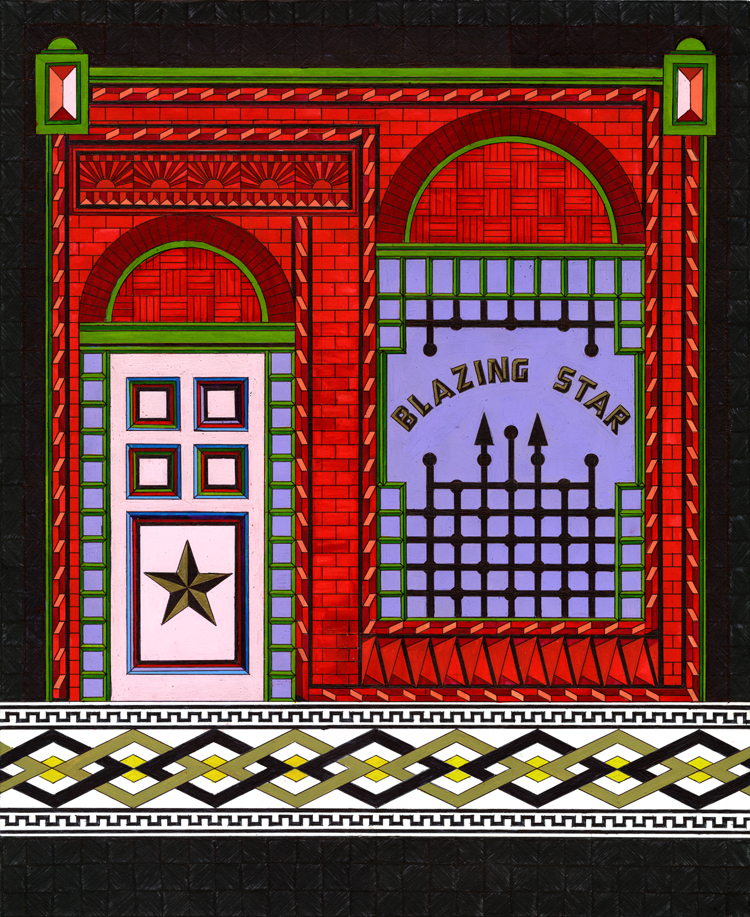
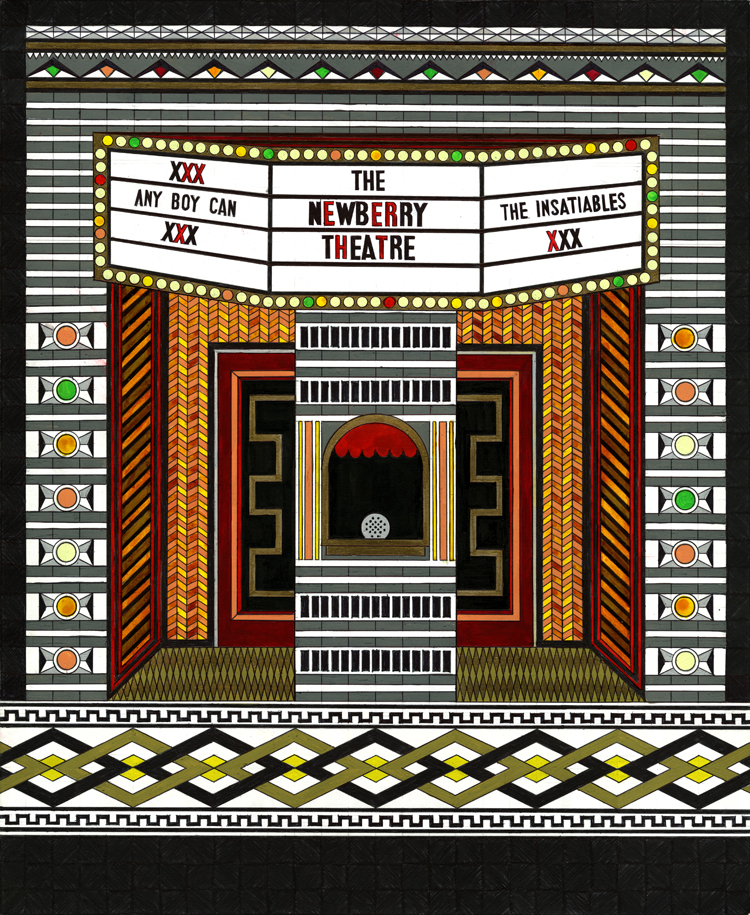
Now-vanished local gay bars and clubs (La Mere Vipere, The Snake Pit, Club LaRay), a theatre and an art space (Newberry Theatre, Nightgowns), an underground abortion clinic (JANE), and radical newspapers (Blazing Star, Killer Dyke), as well as some invented venues (Night Baths, Shapes), are rendered by Fake as stunning graphic facades, comprised of precise and vibrating patterns, that simultaneously call to mind mausoleums, temples, and rococo storefronts. He draws “gateways” as well, remembrances of departed artists and friends Mark Aguhar, Nick Djandji, Dara Greenwald, Flo McGarrell and Dylan Williams. “The buildings in my drawings are not about nostalgia for a lost time,” he says; “iinstead, they are about re-awakening the impulse to create physical space for queer voices, lives and politics.” Fake sees the series, when hung on a wall together, as a “cohesive neighborhood” that includes, through aspirational memory, the individuals and spaces necessary for a self-sustaining queer community.
 

NewberryTheatreWEB

Newberry Theater

 
Despite their communitarian aspirations, Fake’s facades, in their stylistic idiosyncracy, belong to a history of “psychedelic” visionary architecture, from Giovanni Piranesi to A.G. Rizzoli, Archigram, and Bodys Isek Kingelez, a course that opposes, disregards, or seeks to overturn or subvert the efficiency, vastness, frugality, and brutal rationality of industrial-age utopian structures, both literal and figurative. In evoking this former (and older) lineage, in which the approach to space consists not of a harmonizing of uses but of attempts at earthly perfection, Edie Fake carries the torch for a revolutionary dream more fantastic than engineered, an aesthetic gospel of a promised land remembered in stolen moments of prophetic togetherness by a people who live in exile in their own city, in every city.
 

ShapesWEB

Shapes


GatewayDaraWEB

Gateway Dara

 
This post first appeared on Gaper’s Block.

2012 Utilitarian Year in Review

Numbers

I was pretty sure that 2011 was going to be HU’s biggest year ever. As readers may remember, Sean Michael Robinson and Joy DeLyria had a massive internet viral hit with a post about the Wire as a Victorian novel, and it just seemed unlikely that we’d ever reach that level of popularity again.

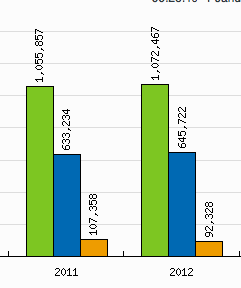
It’s true that we haven’t had a post that big. But nonetheless, the blog grew on average this year — and that average growth was enough to put us over the 630K odd unique hits from 2011. Not by a ton (as you can see from the graph below) — but still, it was a pleasant surprise.

Picture 1

News, or Olds

On the technical end, the big change this year was that we managed to move our archive over from the old blogspot address, so that all five years of our archives are now in one place (which is here — where you are at the moment.)

In other news, that post by Sean Michael Robinson and Joy DeLyria which I mentioned turned into a book on the Victorian edition of the Wire.

Also, James Romberger’s collaboration with Wallace Stevens was named one of the notable comics of 2012.

And finally, all my blogging on the Marston/Peter Wonder Woman has turned into a book project; it should be forthcoming from Rutgers UP goodness knows when (the ms is finished, but academic publishing takes a bit.)

Comings and Goings

We had a number of folks leave us over the course of this year, including Erica Friedman, Caroline Small, and Nadim Damluji. We were very sorry to see all of them go…and hope we’ll see them back again for guest posts at least occasionally during the new year.

There have also been a number of new additions to the HU roster.

Michael Arthur has started a monthly column on comics and furries.

Jacob Canfield is also writing monthly on more or less whatever he wants.

Kailyn Kent is writing monthly on comics and art.

Subdee i is writing monthly on manga and web comics and other things.

Jog with a monthly column on first run Bollywood cinema.

And Isaac Butler and Jones, One of the Jones Boys have joined as contributing writers, posting occasionally, i.e., whenever I can nag them into it.

So with the numbers out of the way, here’s a quick review of some of the highlights of the past year, in roughly chronological order.

James Romberger with brief takes on numerous comics throughout the year.

Domingos Isabelinho on Carl Barks.

Me on sound effects in Tiny Titans.

Tom Gill on Tsuge’s Incident at Nishibeta Village.

Andrei Molotiu on the fascination of Frank Miller’s Holy Terror.

Katherine Wirick on Rorschach as victim of abuse (tying in to a series of posts in which everybody sneers at Before Watchmen.)

Sean Michael Robinson with a massive Gerhard interview.

Ng Suat Tong on Flash Gordon, Umberto Eco, and sadomasochism.

Monika Bartyzel on Xander Harris, passive-aggressive sexist ass.

Nate Atkinson on having Moebius in his living room.

A knock-down drag out Locas roundtable.

Michael Arthur on the mysterious joys of kpop.

Robert Stanley Martin on the eras of Crumb.

Me on Stanley Hauerwas and America’s worship of war.

Alex Buchet on the Avengers film.

A roundtable celebration of the last Marston/Peter Wonder Woman comic.

A series of posts from Phillip Troutman’s comics criticism class.

Ng Suat Tong on comics adaptations of Lovecraft.

Erica Friedman on Sukeban Deka, girl gangs, and giant snakes.

Marguerite Van Cook on comics and the postmodern sublime.

Isaac Butler on Election vs. the Wire in a brutal cage match of gritty despair.

Subdee on Homestuck as metatext of doom.

Kailyn Kent on comics and the age of mechanical reproduction.

Matthias Wivel on Degas as comics.

Darryl Ayo on reading and rereading comics.

Jaime Green on how Clybourne Park is lying to you.

James Romberger on Marie Severin.

Ryan Holmberg on abstract comics.

Derik Badman on comics poetry.

Our massive fifth anniversary roundtable of hate.

Kristian Williams on Mad Max, Watchmen, and the Girl with the Dragon Tattoo.

Russ Maheras on the greatest Lee/Ditko Spider-Man story.

Richard Cook on the hackery of Cloud Atlas.

Jacob Canfield on Johnny Ryan and Benjamin Marra.

Kailyn Kent on Chris Ware’s Building Stories.

Vom Marlowe on a web comic about knitting.

Robert Stanley Martin on the Superman case and best legal outcomes for comics creators.

Sarah Horrocks on science-fiction and horror comics.

Me on Junji Ito’s Tomie comics and the terror of the female.

Kinukitty on the Wilson sisters and Heart.

A bunch of posts on Bart Beaty’s recent book Comics vs. Art.

Matthew Brady on Emily Carroll.

So, again, it’s been a lovely year. Coming up we’ve got a small Twilight roundtable, a massive series on Marvel history, announcements of our annual Best Online Comics Criticism results…and we’ve been tossing around the idea of a Philip K. Dick roundtable or a Spielberg roundtable, maybe. If you’ve got something you’d like us to cover, please let us know — or, you know, if you have a favorite HU post I missed, feel free to mention it in comments. In the meantime, thanks to all our contributors, commenters, and readers for making 2012 so successful. We’re looking forward to 2013.