Best Essays I Wrote In 2013

I thought I’d list 10 or so of the non-HU essays I wrote this year I was happiest with. So here goes, in no particular order.

At the Atlantic I wrote about rape and rape fantasy and Nancy Friday’s Secret Garden. I think this is my favorite thing I wrote this year.

At Slate I wrote about 7 Miles A Second by David Wojnarowicz, James Romberger, and Marguerite Van Cook, in which I talked about the way the book links marginal pulp trash and marginal sexual identities.

At Public Books I contributed to a great 50 Shades of Grey roundtable,in which I argued that the novel fetishizes incompetence.

At Salon I had a long two part piece on Orson Scott Card’s defense of genocide, first in Ender’s Game, then in Speaker for the Dead.

At the Chicago Reader I had a kind of diptych about comics in the gallery. First on the MCA’s anxious and mediocre Dan Clowes show, then on the quietly glorious MCA Lilli Carré” show.

At Reason I wrote about the history of school reform failure,as discussed in Jal Mehta’s great book The Allure of Order.

At the Atlantic I had a piece about not having sex in college and being a virgin for a really long time. And sort of as a follow-up to that I had a piece about how the male gaze gets men at Splice Today.

I had two pieces at the Atlantic on 12 Years a Slave, one on the way it refuses to make slavery about masculinity, and one about slave narratives and truth, or the lack thereof.

At Wired I wrote about the music bargain bin and mysterious Japanese fusion.

And I wrote about different versions of I Can’t Make You Love Me at Splice Today.

Droll Hunting

This first appeared on Splice Today.
___________
 

large_the-troll-hunter-3

 
Imagine if crossed the Blair Witch Project with This Is Spinal Tap. Now set it in Norway with trolls — and you’ve got Trollhunter.

You may be asking yourself, do we need another Blair Witch knock-off? Do we need another Spinal Tap knockoff? Even together? Even in Norway? And the answer to all of your questions would be no. No, not really. Like the trolls it purports to document, the film’s existence is both superfluous and kind of ridiculous.

That’s not to say that the film is bad, exactly. Just that there’s something oddly mysterious in its unmotivated lumbering.

It’s possible something crucial has been lost in the translation from the Norwegian. Or, alternately, Trollhunter may suffer from excess of appetite. The eponymous government troll hunter Hans (Otto Jesperson), in one of his many quirky troll anecdotes, discusses a troll he saw who was so dumb it tried to eat its own tail. The movie itself seems to miss the mark in a similar way. It tries to be comedy; tries to be horror; staggers back and forth a little and then, getting into the swing of it, settles for just roaring a lot and knocking things over.

(Spoilers follow, if you care about that sort of thing.)

The dilemma is perhaps best summed up during what’s probably supposed to be an emotional highpoint; the death of one of the teenaged main characters three-quarters of the way through the film. The protagonists and Hans are trapped in a cave with marauding trolls. The doomed kid (the cameraman), in a panic, frantically rubs disgusting troll stink all over himself, hoping to hide his scent. Unfortunately, though, he is, as it turns out, a Christian, which means that the trolls can smell him. Shortly thereafter, he’s eaten, leaving his companions to wail at the uncaring heavens, “Why didn’t he just say he was a Christian!”

So that’s the joke, and it’s moderately funny in a ha-ha-we’re-all-atheists-here kind of way. It could almost be a really low-key Monty Python sketch — except that up to this moment, the dead character has been treated as an actual person, rather than a goofy gag line. Not that there’s a ton of character development or anything, but for purposes of the previous horror-movie-running-away-and-screaming, there’s been at least some effort to pretend that what happens to this guy matters. And then, all of a sudden, he’s just thrown away. And then you see everyone else grieve for a minute or so…and then they stop, and get a replacement cameraperson (who’s a Muslim, so trolls probably can’t smell her — only Christians, not Muslims. Get it?) The whole thing just ends up being not just crass, but unbelievable. This kid just died; there’s no investigation? No explanation to the police? The other teenagers don’t stop and say, you know, our friend just died; screw the trolls, I’m headed home?

Instead, on they go, trundling from set piece to dry-humored set piece. Hans dresses in armor to fight a troll; Hans explains that the trolls’ extra heads are just growths designed to impress other males and attract females; Hans talks about the trauma of killing troll infants; a veterinarian explains the improbable biology of trolls turning to stone when sunrise hits them. It’s amusing enough, and the trolls themselves, as special effects, are goofily effective. Over the entire film, though, the archness becomes tedious. The Last Exorcism, with its hand-held camera horror, was not a great movie, but it cared about its main character, about its genre, and about the story it had to tell. This Is Spinal Tap was a goof, but it clearly had great affection for the hapless band it parodied. Trollhunter, in comparison, has no real characters, no real story, no real point —just extended snickering and occasional enjoyable special effects.

In a way, it almost makes you hope for the inevitable English-language remake. If somebody cares about the thing enough to purchase the rights, maybe they’ll care enough to give the film some kind of direction. Laughing at the trolls is all right in limited doses, but if this is going to work, someone out there needs to love them a little as well.

Utilitarian Review 1/4/14

On HU

Featured Archive Post: Matt Seneca interviews CF.

Me on romance definitions, Pamela Regis, and the defensive crouch.

Chris Gavaler on real life superheroes and vigilantes.

A list of some highlights from 2013 at HU.

Brian Cremins for PPP on Otto Binder and Joe Orland’s “I, Robot” as protest.

Kaily Kent on the underrated achievement of Jillian and Mariko Tamaki’s Skim.
 
Utilitarians Everywhere

At the Atlantic I talked about Sankofa and the need for more slavery films.

At Splice I reviewed the two albums from my that I hadn’t managed to write about yet. Those are:

— Guy Clark’s My Favorite Picture of You.

—Jeri Jeri’s 800% Ndagga.
 
Other Links

Can’s remember if I linked this before, but worth doing again; Tom Spurgeon has a long interview with Brian Cremins.

In praise of snark as an alternative to smarm.

Someone else noticed that the Pajama Boy discussion was linked to anti-semitism.

From a bit back; science blogging has some of the same problems with sexual harassment that comics do it looks like.

Ami Angelwings talks about dealing with transphobia on OK cupid.

Man is this Wax Audio Metallica vs. Herbie Hancock mashup amazing.
 
mark-ernestus-presents-jeri-jeri-800-ndagga-colectivo-futuro-1024x1024

Uncharted Territory: Skim, by Jillian and Mariko Tamaki


For years I have recommended Skim, by Mariko and Jillian Tamaki, as one of my favorite comics. While beautifully illustrated and competently told, I’ve been hard-pressed to explain why I love this book so deeply. I often fall back on biographical justifications— I was once a teenager who romantically pursued someone significantly older, and its rare for me to find a book that accurately captures this experience. I’m tired of this explanation, as it does a disservice to Skim, which is an exceptional work on its own terms. I’m going to try to articulate, here and now, why Skim is a comic I keep coming back to, and shows much more promise for the medium than I see it accorded.

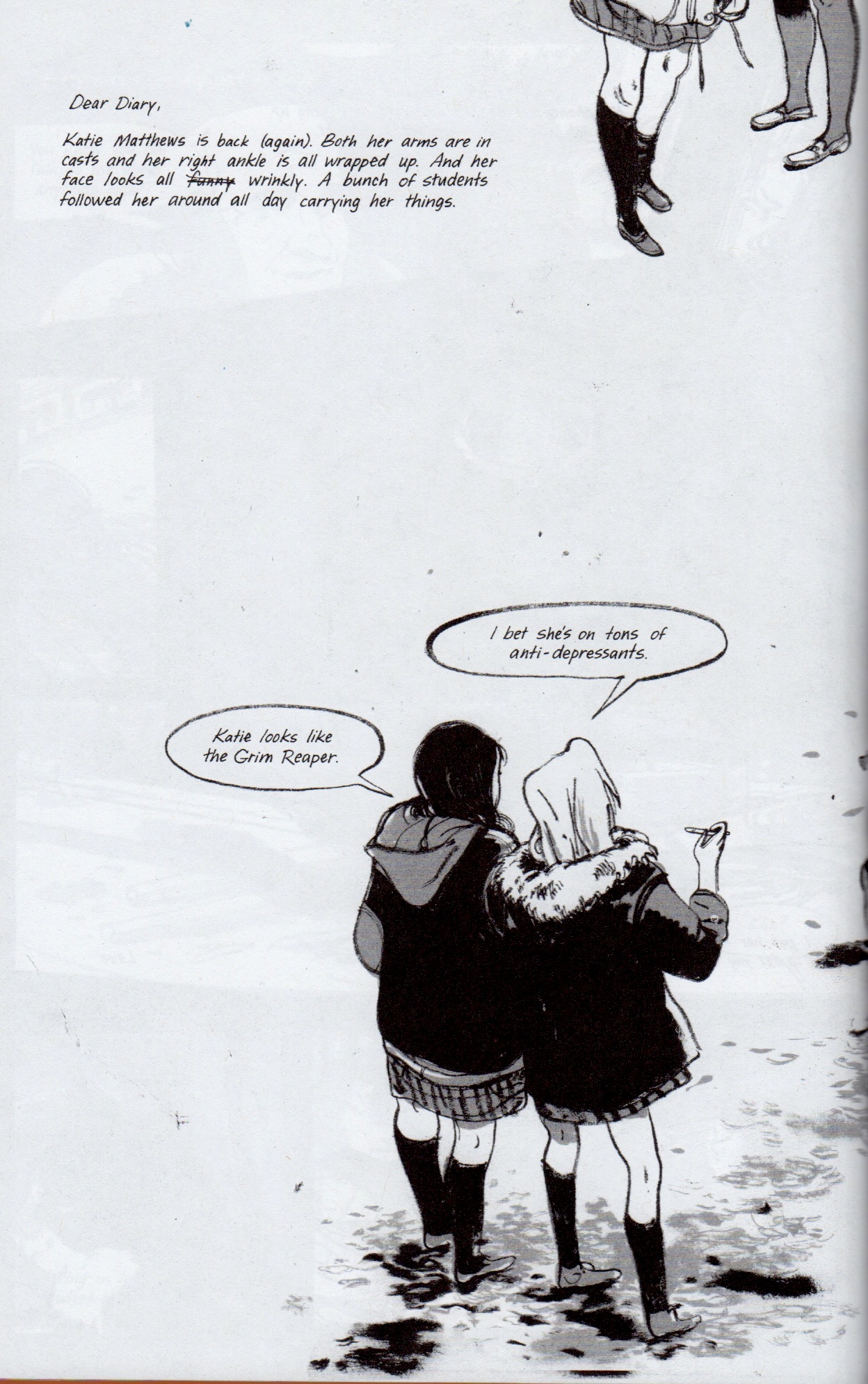
Skim is told from the perspective of a high school junior, Kimberly Keiko Cameron, nicknamed Skim because she is not. Skim chronicles of the fall semester of several young women, who navigate an all-girls Catholic school fixated on the suicide of a local boy. As counselors and students perpetuate an indulgent cycle of hysteria and healing, Kim and Lisa, two best friends, lampoon the faculty and student-body. As they grow apart, Kim falls in love with the young, maverick teacher Ms. Archer. Ms. Archer crosses the line, realizes her mistake, and immediately begins to withdraw from Kim and the school. Meanwhile, Katie, the well-loved ex-girlfriend of the local boy, becomes caught in the hurricane-eye of the school’s morbidity, and eventually enters onto Kim’s horizon.

Skim spread 1

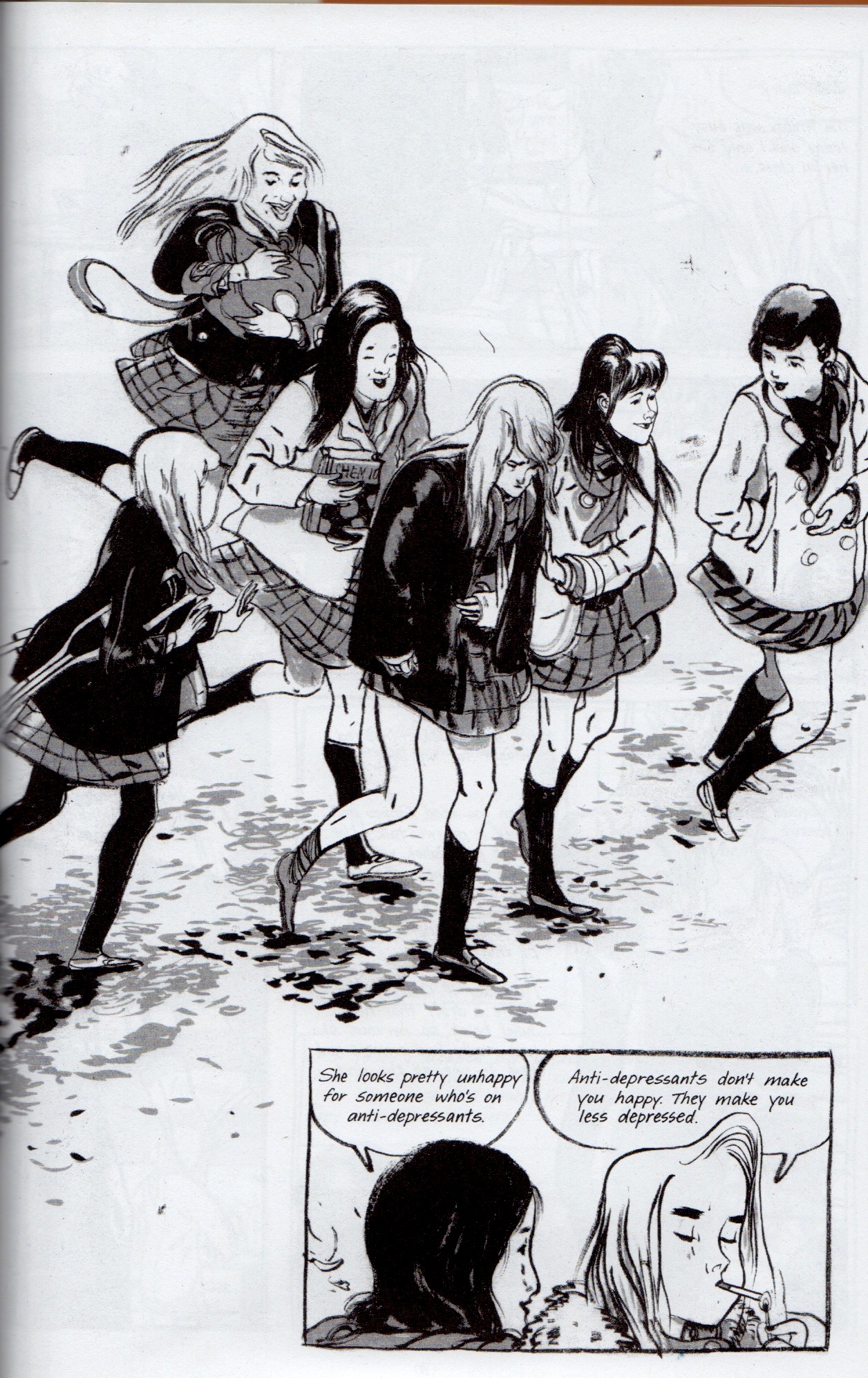
Skim spread 2

 Skim is darkly comic, though it hits the usual targets—small towns, personal religion, high school, high school girls.  Kim and Lisa visit a Wiccan circle that turns out to be an Alcoholics Anonymous recovery group. Kim receives a kitschy mug from her father’s girlfriend, adorned with a ludicrously ignorant slogan. A group of self-absorbed ‘popular’ girls form a club called ‘Girls Celebrate Life!.’ Etc. etc. Smartly, Kim and Lisa are not cast as the sole bastions of truth. Lisa spouts punk cliché after punk cliché, and while Kim knows better, she can only respond with clichés in turn. There’s comedy to be mined in the pathetic graspings of a group of hypocrites and posers, sure. Remarkably, Skim’s cynicism plays second fiddle to a sense of grace. Dark humor drops like stones through the surface of the narrative—the story is actually formed by the rippled answer to these plunks, a visual whisper that the world is much bigger, stranger and more beautiful and than these ironies suggest. Lingering hands, a telephone pole, or footprints in the snow somehow always get the final say.

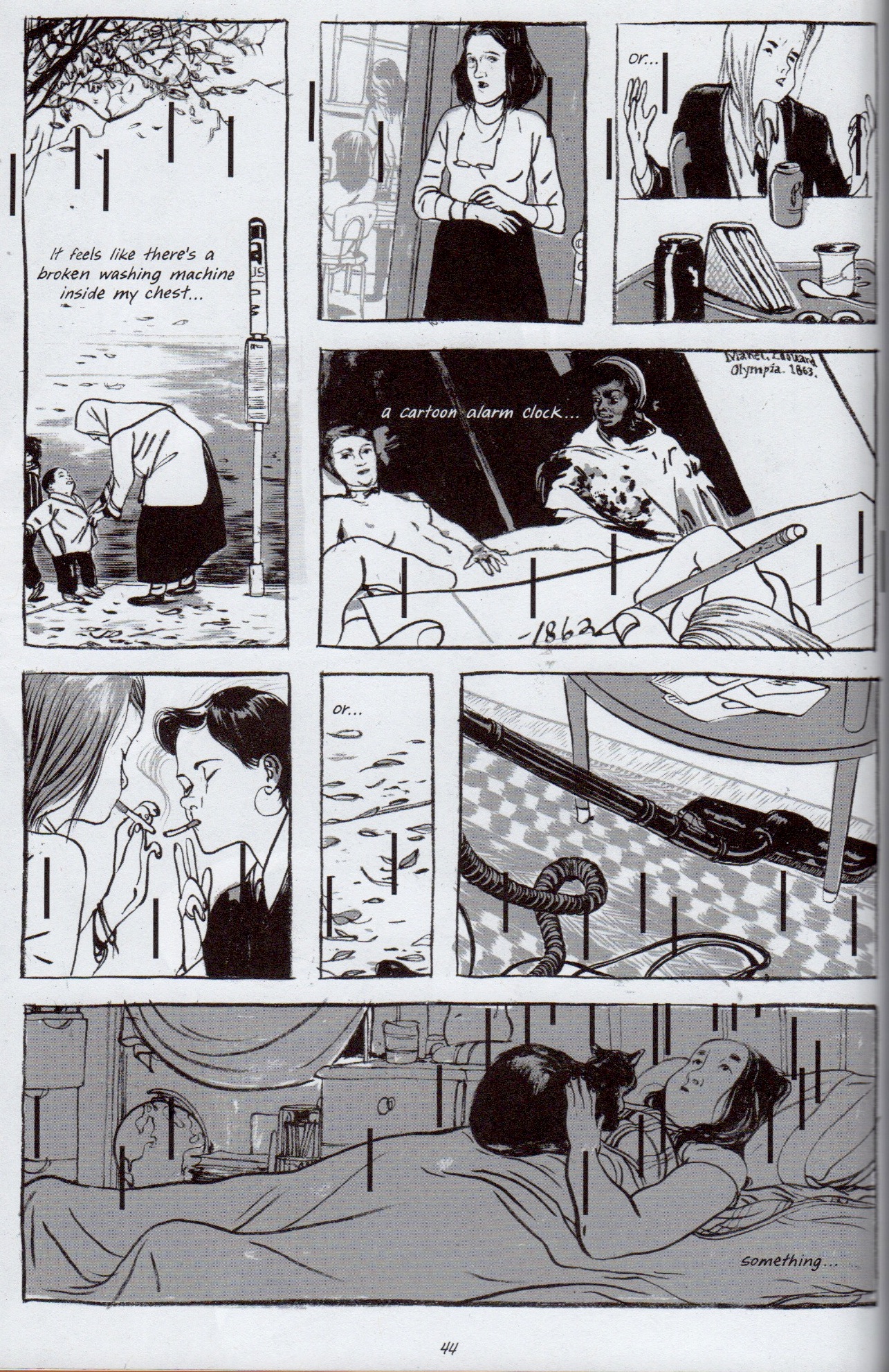
Skim thump thump

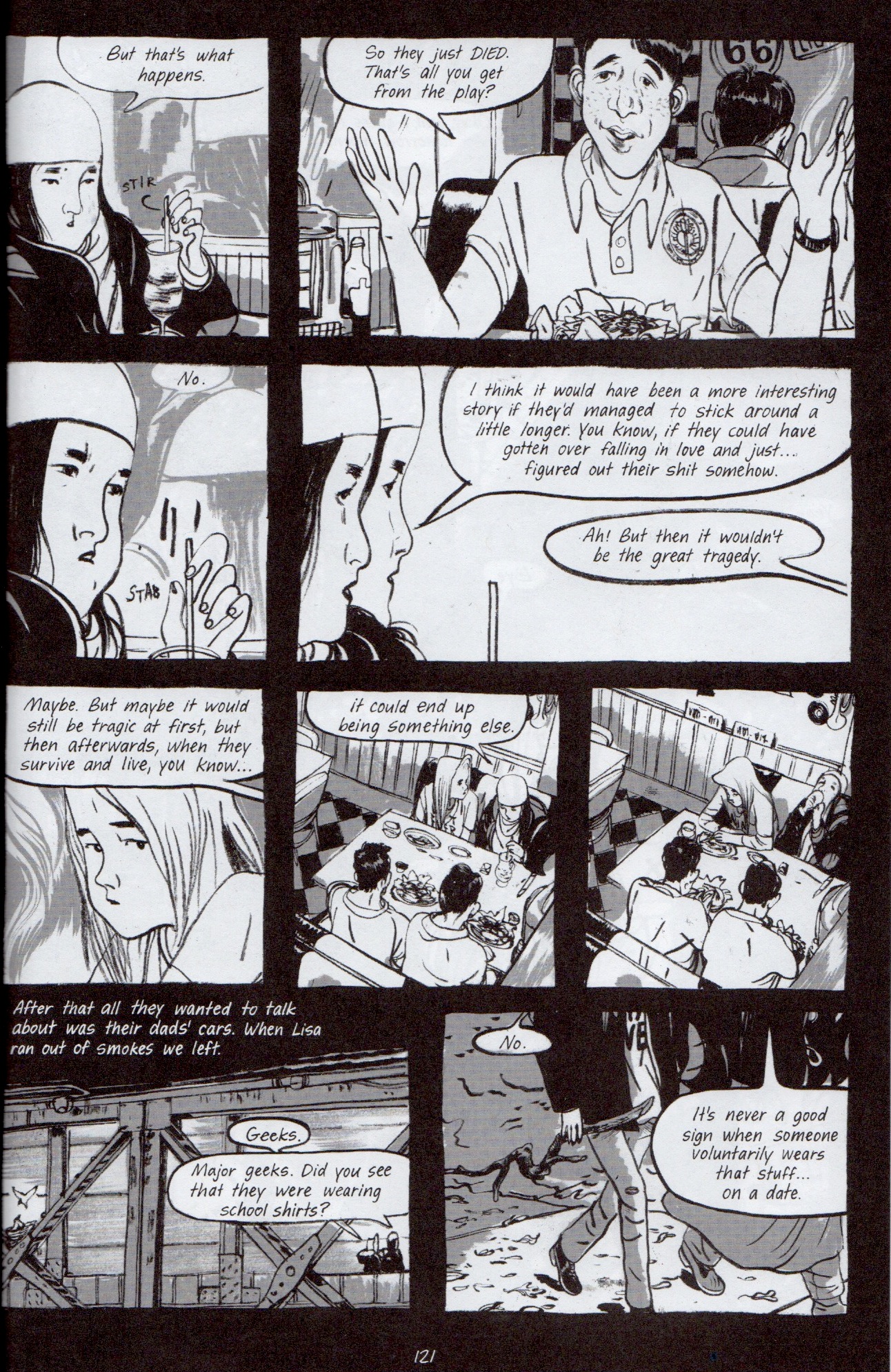
Skim’s attention to its story-world both accentuates and minimizes the scope of Kim’s depression– if there is a world outside black comedy, this world also continues after tragedy. Kim is observant enough to know that she’ll recover from her loss, but she’s lonely. She simply wishes this recovery was more important than the tragedy everyone seems hungry to witness, as she vocalizes below:

Skim Romeo and Juliet

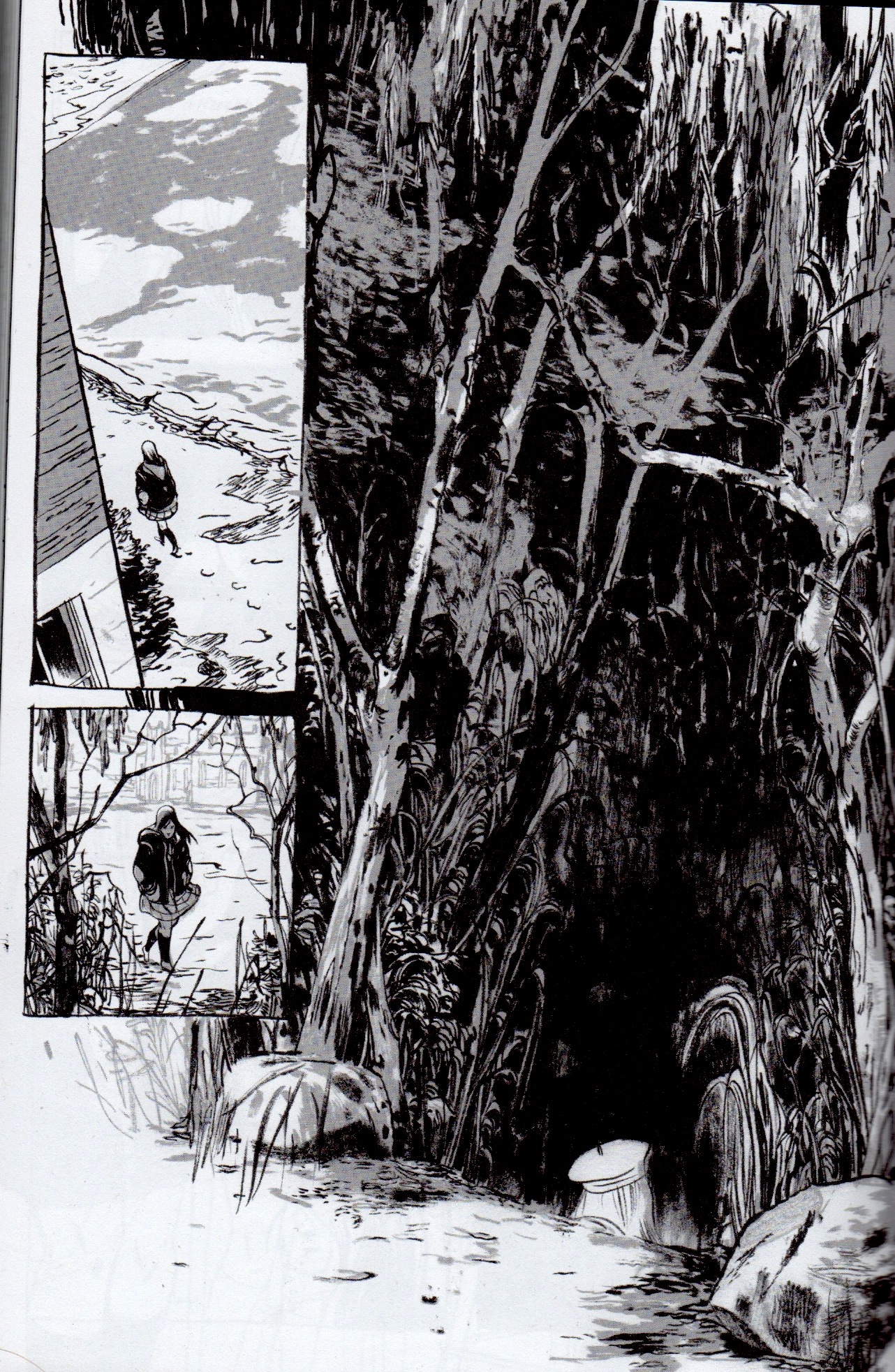
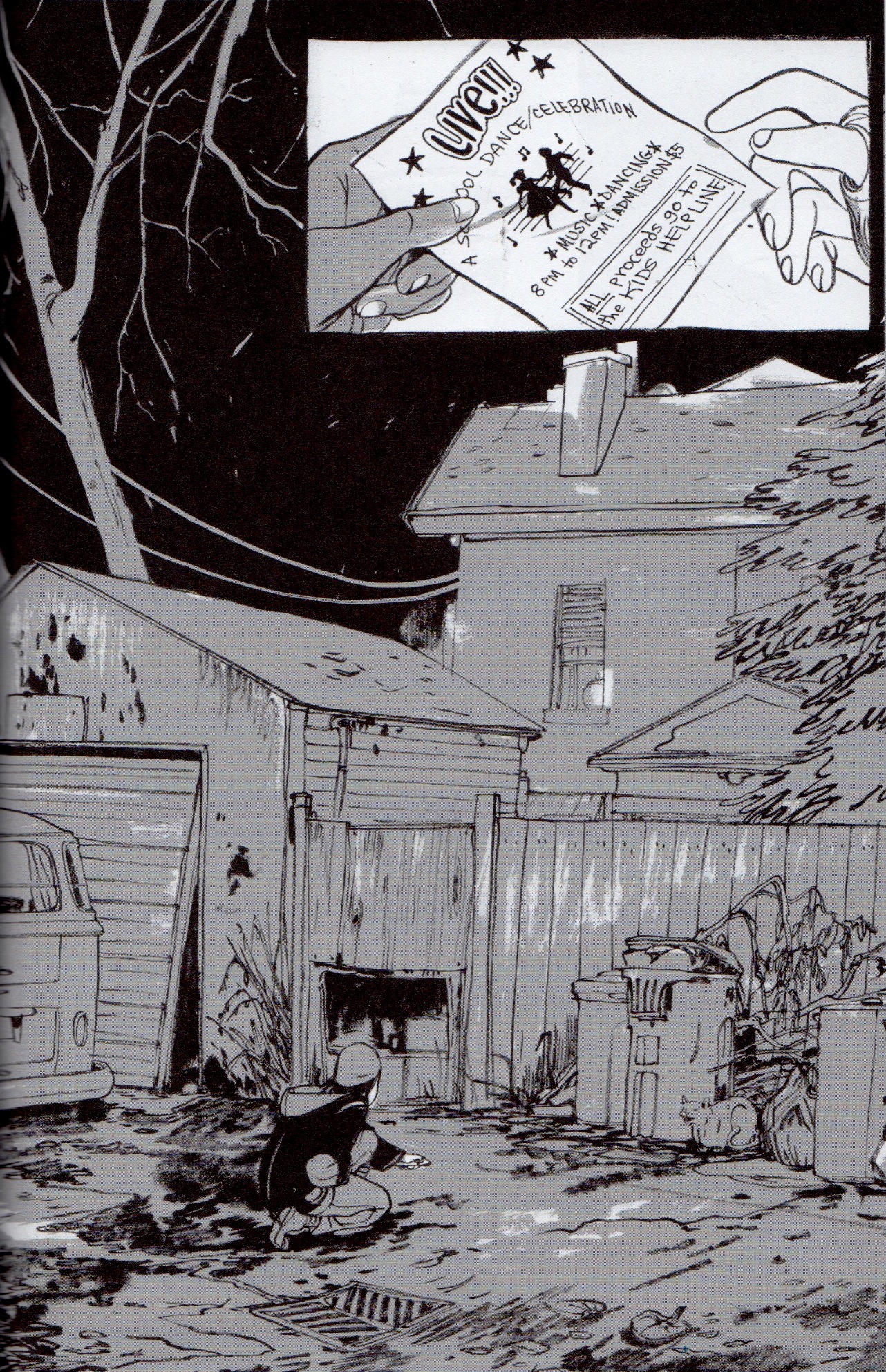
Kim’s yearning for that “something else,” describes Skim’s particular kind of storytelling. The book passes by the iconic moments of adolescence in favor of their lingering aftertaste– the doubt following confident pratter, the assurance found in being abandoned. Its humor can be a bit manufactured, but its nocturnes are feral and strange. Skim‘s characters find their true colors at night. When Ms. Archer quits teaching, Kim follows her at her house after school, where she is reluctantly welcomed inside each time. She quietly absorbs a family photograph, the clutter, the way Ms. Archer lifts her cat with one hand. A heady mood leaks from every dirty teacup and grey corner, leaden with hard decisions. Skim includes  its environment and telling gestures, occasionally at the expense of the conversation they lead to.  Most importantly, we hear Kim’s voice immediately after each incident reeling from or reconciling what happened. I appreciate that Skim judges this moment spent walking home as worthwhile, or even more valuable, than the confrontation itself. This is where Kim slips into uncharted territory. Similarly, Katie and Kim see each other fully one late night, escaping prom. Kim suffers insomnia, which leaves her both exhausted and exalted.

Skim could have easily been a much narrower story without its sinewy brush-work, and the nuance of its characters’ performances. It’s laudable that Mariko Tamaki, the writer, doesn’t overreach her character’s limited voices. Kim’s speech above is about as articulate as anyone gets. It’s an awkward but honest testament for the story. I also appreciate Jillian Tamaki’s figure drawing, which is at times grossly loose, pinched and contorted– tiny misshapen hands and swollen legs abound. They capture the sensual topsy-turvy of confused vision. Skim is a pretty book, but not a stunning one, for the best. If the book had been heart-stoppingly beautiful, the panels might have crystallized the moments, rather than letting them flow into a magpie’s nest of dirty lines, black pools, and wintry negative space.

Skim’s perspective is similarly messy, and inconsistently shifts between diary entries and third-person. The clumsy steps back and forth nevertheless give breathing space.  Jillian and Mariko cover several complex transformations over three months. High school dramas often take the symbolic course of autumn to spring. What kind of personal-growth narrative starts in fall and ends in winter? Perhaps its a mistake to classify Skim as a ‘personal-growth’ narrative at all. While the characters seem to be better people by the end, no one acts any differently. Lisa is carried away in love. Ms. Archer flies off for somewhere new. On the final page, Kim goes off to meet Katie. She approaches a woodland very similar to the one which she and Ms. Archer frequented. Only the top of Katie’s head is visible, dressed in its little cap. She’s more a ghost, or a pale echo of Ms. Archer’s body pages before, than a person. Its ambiguous as to whether Kim’s budding friendship with Katie has begun to slide into something else. It’s possible they are all about to repeat the same intimate miscalculations.

Skim final page

 I admire Skim for its brave vulnerability, its tone and message, and also for its independence as a comic work. It doesn’t traffic in wish-fulfillment, overt camp, nor nostalgia– surprising for a comic book about high school. It is self-deprecating without secretly being self-congratulatory, a la Art Spiegelman. It isn’t distracted by its ‘comic-ness.’  It is not epic, nor controversial. It is not drawn in an iconic way. It is also completely about young women, and quite short.  Frankly, there isn’t much cultural currency to be gained by reading Skim, discussing it, or recommending it. American girlhood is undervalued and easily reduced.  Skim is a relatively unambitious book, but this isn’t a bad thing. Unpackaged from the neurotic cultural agendas that reinforce comic’s masculine, canon-mongering, Skim treats comics as a legitimate medium fit for a self-contained story. It doesn’t talk about being a comic, or push the boundaries of the medium for their own sake.  It doesn’t need to prove that ‘comics aren’t for kids anymore.’ It simply tells an adult story. This resistance to being impressive or fantastical, combined with its ‘young adult’ high school setting, deplorably positions it outside the conversation of contemporary comics.

Skim’s comic treatment does justice to, and perhaps deepens, an excellent story. At the end of the day, I believe comics would be more widely attended to if they did just this.

Skim stray cat


Is Otto Binder and Joe Orlando’s “I, Robot” a Protest Novel?

cremins1

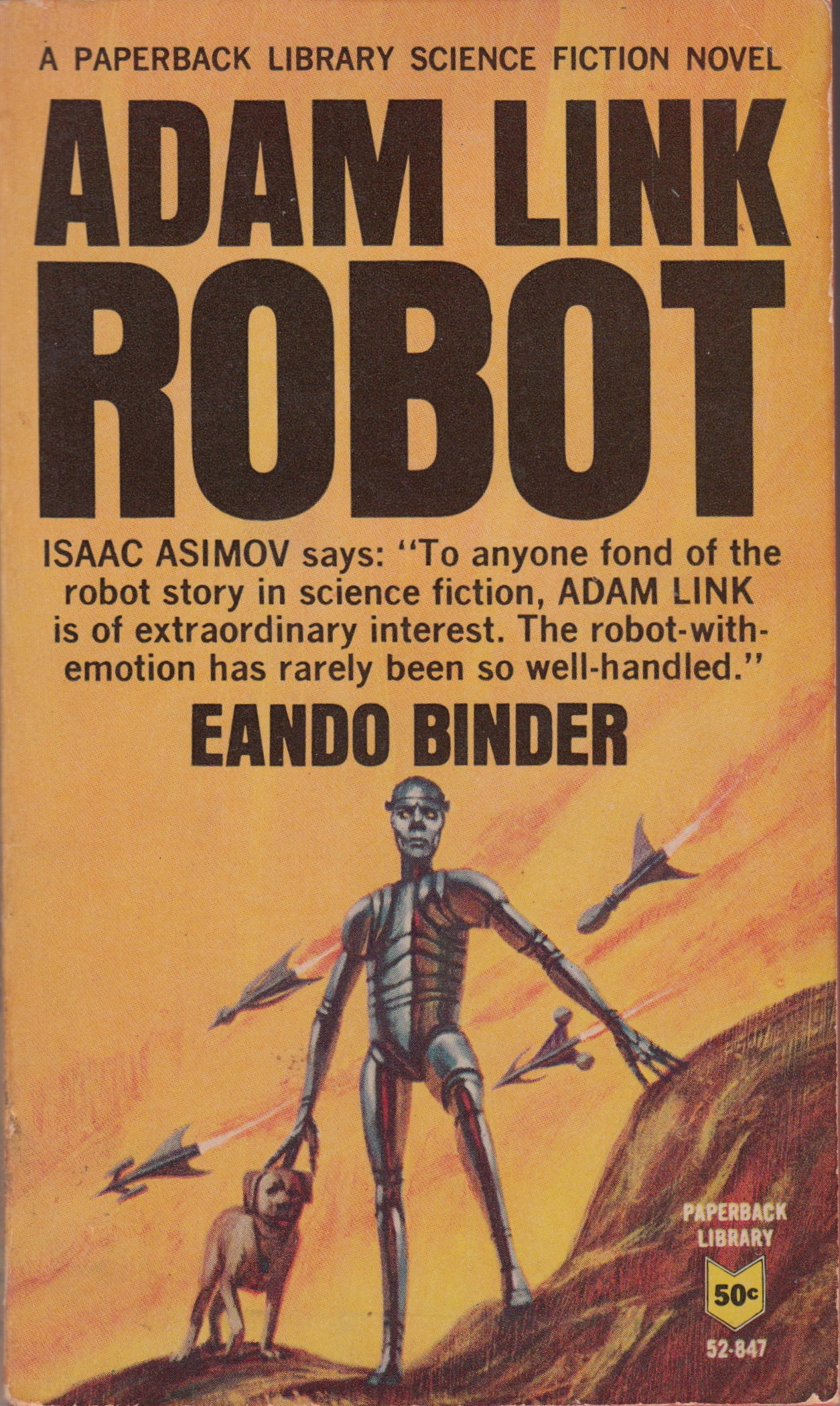
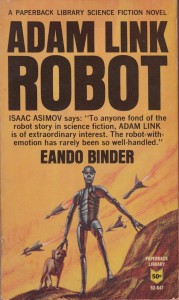
The cover of the 1965 Paperback Library novel Adam Link—Robot,
which collects Otto Binder’s Adam Link stories from the late 1930s and 1940s.

As I watched and enjoyed the new Spike Jonze science fiction film Her, I began to wonder, What would Otto Binder think of this? Although best known to comic book readers and scholars as the writer of Captain Marvel and Superman, Binder began his career as a science fiction writer, first in collaboration with his older brother Earl. The pair began publishing under the pen name Eando Binder (Earl and Otto) in the early 1930s. By the time “I, Robot,” the first in a popular series of adventures featuring the artificial man Adam Link, appeared in the January 1939 issue of Amazing Stories, Otto was writing on his own, but retained the Eando Binder byline.

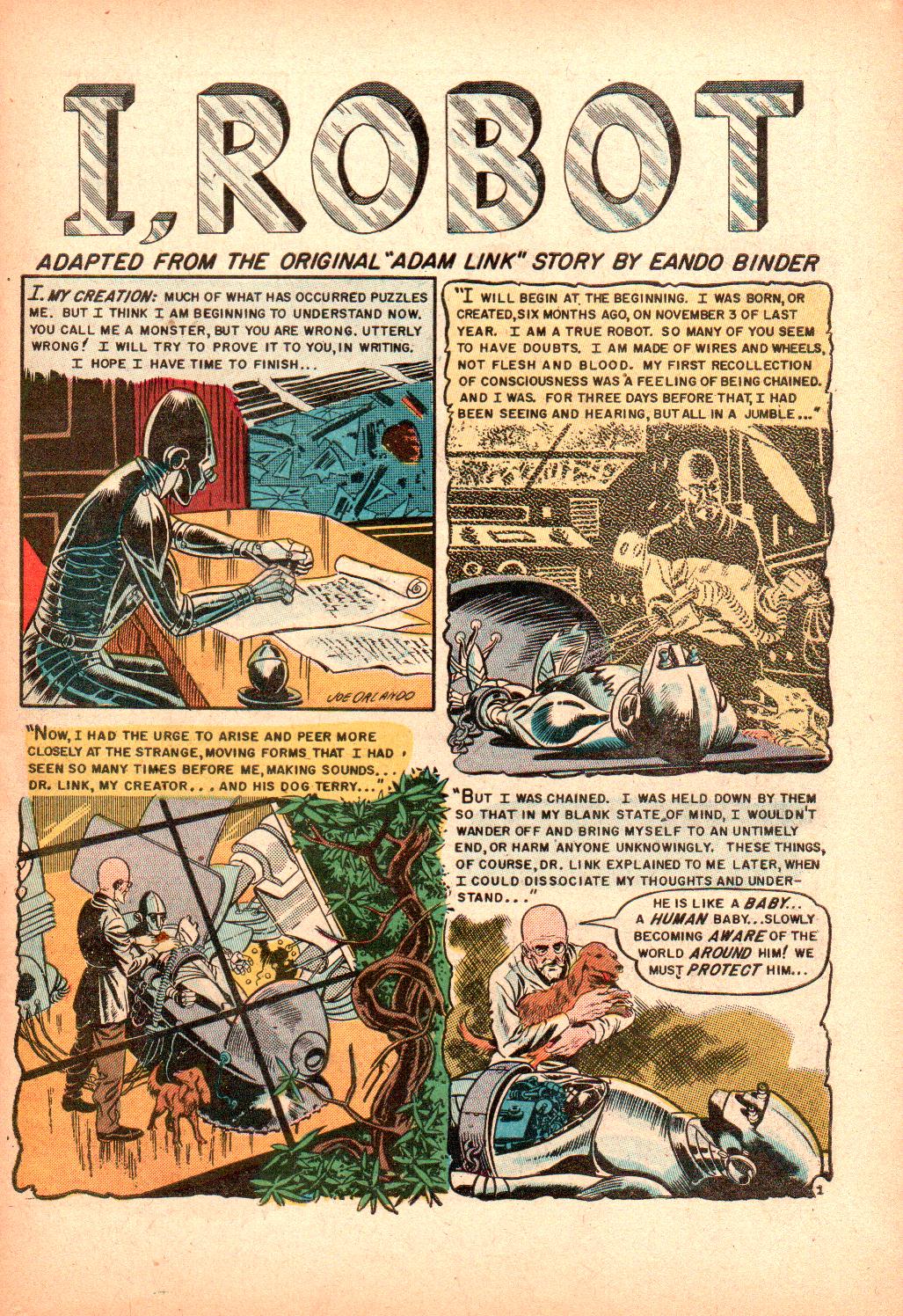
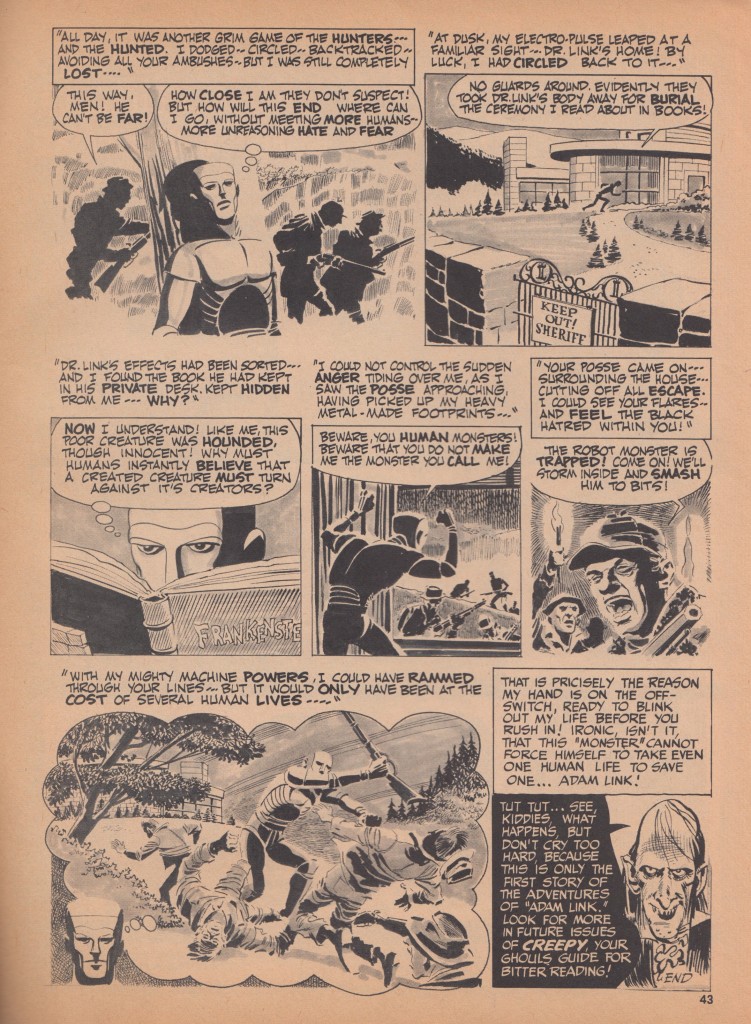
In science fiction circles, Otto Binder’s best-known work remains the Adam Link series, which served as the inspiration for Isaac Asimov and for countless other writers exploring the idea of artificial intelligence. Over the course of his comic book career, Binder adapted some of the Adam Link stories for EC Comics in the 1950s and again for Warren Publishing’s Creepy in the 1960s. When Qiana invited me to contribute another guest post for Pencil Panel Page, I began to think again about her December 2011 essay “Can an EC Comic Make ‘You’ Black?” and what it might tell us about Otto Binder and Joe Orlando’s adaptation of “I, Robot” from Weird Science-Fantasy Number 27 (dated Jan.-Feb. 1955). In the EC version of “I, Robot,” Binder’s use of the second-person you places the reader in a complex position: as we read the story, do we identify with the hero, Adam Link, or with the violent mob threatening to destroy him?
 cremins2

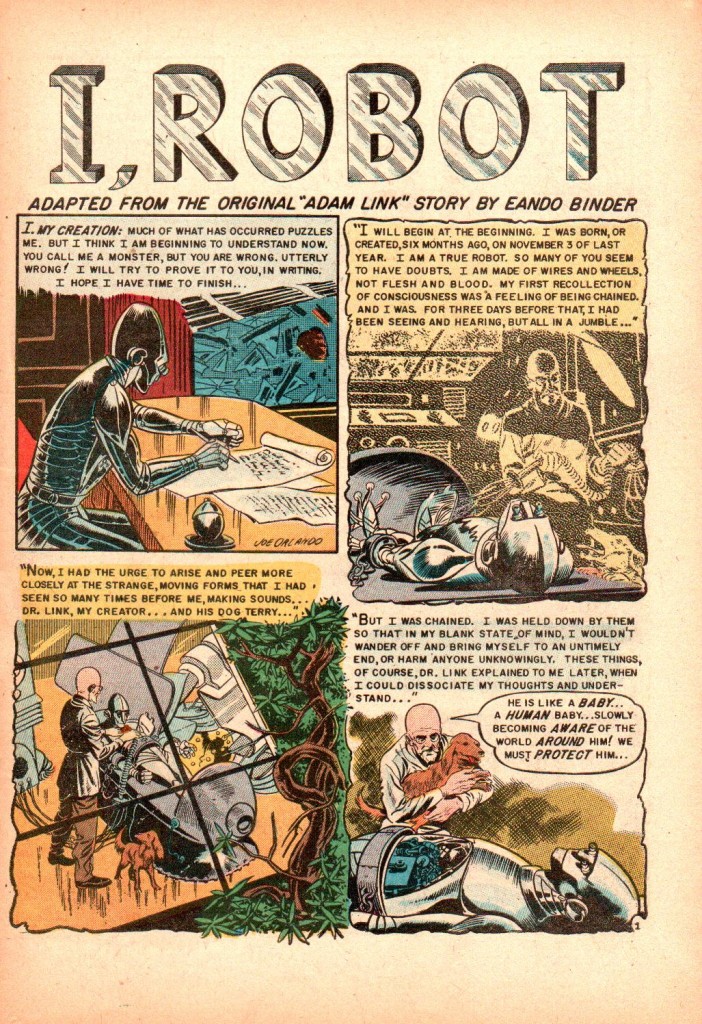
The first page of Otto Binder and Joe Orlando’s adaptation
of “I, Robot” for EC’s Weird Science-Fantasy Number 27 (Jan.-Feb. 1955). Colors by Marie Severin.

In a letter to science fiction fan and editor Sam Moskowitz dated October 4, 1952, Binder discusses the scripts he’s been producing for EC Comics. He explains that he’s “gotten into the groove on thinking of [science fiction] plots for them, even if they are more simplified and corny than what would go into a pulp.” Binder then appears to reconsider his summary of EC’s science fiction and fantasy comics and adds the following parenthetical comment:

(But a suggestion….pick up a copy of WEIRD FANTASY or WEIRD SCIENCE comics sometime and read them….the comics are not too far behind the pulps in well-plotted stories, believe it or not!)

In the early 1950s, after over a decade as a prolific comic book scripter, Binder was hoping to return to the science fiction market and was looking to Moskowitz, to whom he later left the bulk of his personal and professional correspondence, for advice and support. As Bill Schelly notes in his excellent biography Words of Wonder: The Life and Times of Otto Binder, the writer had to make some adjustments to his style when he began working for EC: “Binder’s job, as he saw it, was to emulate the writing style of Al Feldstein, who always put lots of lengthy captions into the scripts. This wasn’t Binder’s normal inclination, but he did his best.” As a freelance writer, Binder survived by adapting himself and his style to suit the requirements of his publisher and of his audience. As he explained in the letter to Moskowitz, “Now I have no prima-donna qualms about accepting ideas from an editor….it doesn’t violate my lone-wolf sensibilities. In fact, in the comics, editor and writer often whip up ideas between them.”

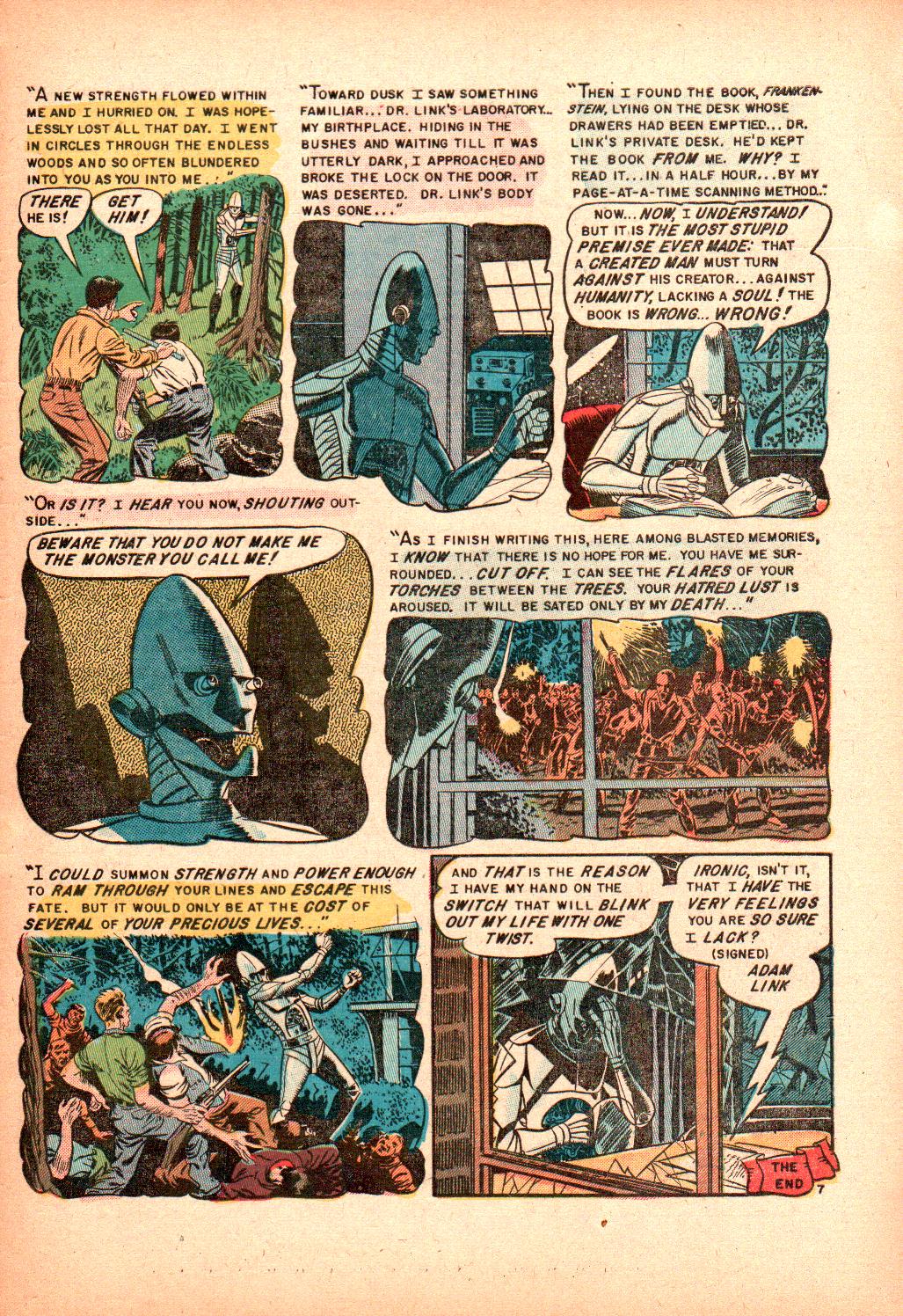
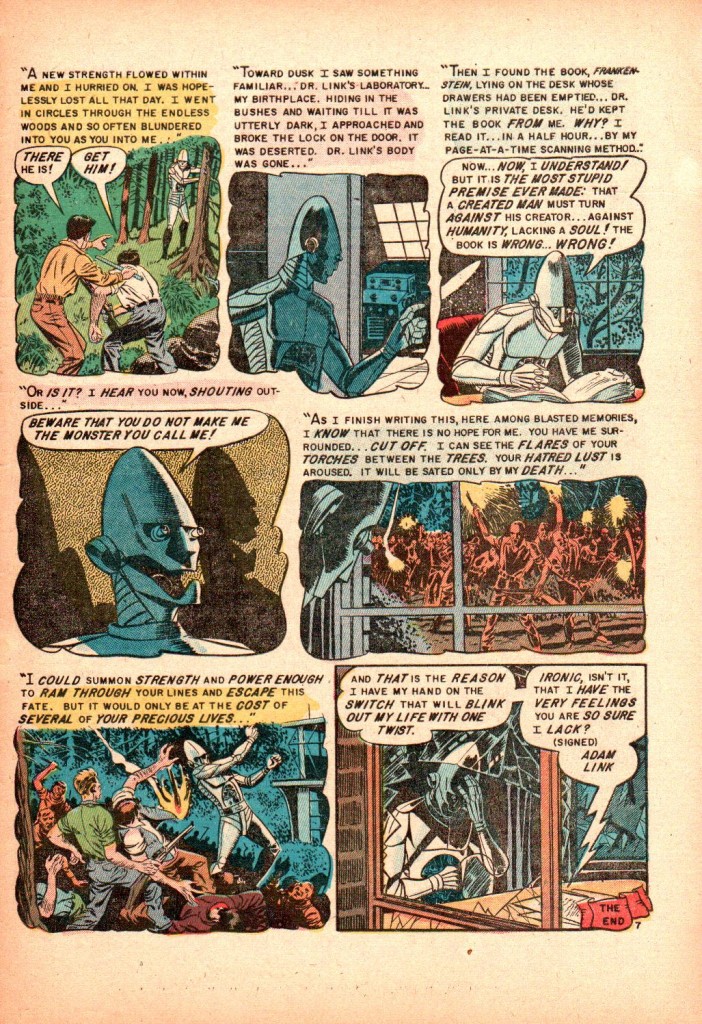
While in both the EC adaptation of “I, Robot” and in the 1939 original, Binder employs first person point-of-view as Adam Link tells the story of his creation, by the end of the Weird Science-Fantasy version, Binder shifts to the second-person as the robot addresses his tormentors—and, by extension, those of us reading the story. On the final page of the 1955 “I, Robot,” Adam Link, wrongly accused of murdering his creator and surrounded by an angry mob, exclaims, “Beware that you do not make me the monster you call me!” In his journal, he writes, “As I finish writing this, here among blasted memories, I know that there is no hope for me. You have me surrounded…cut off. I can see the flares of your torches between the trees. Your hatred lust is aroused. It will be sated only by my death…”
cremins3

The final page of the 1955 EC Comics adaptation of “I, Robot.”

Those two panels in the center of the page pose an interesting challenge for the reader: first, Orlando and colorist Marie Severin ask us to identify with Adam Link, whose long, cylindrical forehead and mechanical jaw cast distorted shadows on the yellow wall behind him. He is, for a moment, almost human, as he makes a plea not to be turned into a monster by humanity’s hatred and violence. The text that appears over the panel, however, tells us, “I hear you now, shouting outside…” While we might sympathize with the protagonist, especially after the loss of his dog Terry on the previous page (in the original story, as the mob fires on Adam, a stray bullet kills the dog), we also, for a moment, inhabit the role of the aggressor.

The next panel is even more fascinating. We share Adam Link’s point-of-view as we stare out a window at the men, most of them carrying a rifle or a torch or both. Just two panels earlier, we saw Adam Link before that same window, reading his creator’s copy of Frankenstein. Now, however, the scene has changed, and we stare with horror at the grotesque figures that approach Dr. Link’s laboratory. Again, the text box disrupts our sense of identification with the robot: he addresses us directly. We are part of the mob. As we stare out the window, we are looking not at a display of “hatred lust” and impending “death” but at ourselves, and our petty hatreds and small-minded prejudices.

“I, Robot” inverts Qiana’s original question and seems to ask, Can this EC comic transform you, the reader, into a lustful, bloodthirsty, bigoted villain? Or have Otto Binder and Joe Orlando merely held a mirror up to EC’s audience, one they hope will challenge readers to reflect more deeply on issues beyond the fantastic realm of the comic itself?

Binder addresses these issues in another EC adaptation of one of his earlier science fiction stories, “The Teacher from Mars,” also drawn by Joe Orlando and colored by Marie Severin for Weird Science-Fantasy Number 24 (dated June 1954). As Schelly points out in Words of Wonder, Binder selected “The Teacher from Mars,” first published in Thrilling Wonder Stories in 1941, for Leo Margulies and Oscar J. Friend’s 1949 collection My Best Science Fiction Story, which includes stories from Isaac Asimov, Robert Bloch, and Harry Kuttner. In his introduction, Binder explains that “the story,” in which human students abuse and terrorize their Martian teacher, “was a good medium for showing the evils of discrimination and intolerance. Sadly enough,” he continues,

we have not yet eliminated those degrading influences on our world. The Martian in this story is the symbol of all such reasonless antagonism between “races.” Not that I wrote the story solely for that reason. It just happened to strike me as the best “human interest” approach. The “moral” was incidental.

In most of his work, from the Captain Marvel stories of the 1940s through his Superman narratives in the 1950s and even his scripts for Gold Key’s Mighty Samson in the 1960s, Binder again and again sought to explore what he refers to as the “‘human interest’ approach.” As Bill Schelly has argued in his comments on “The Teacher from Mars,” “Though Binder denied that the anti-discrimination sentiments in the story were his main reason for writing it, they are there nonetheless.” Therefore, is the “moral” really “incidental” in “I, Robot” or “The Teacher from Mars”? And what does Joe Orlando’s work bring to these comic book versions of Binder’s original short stories?
cremins4

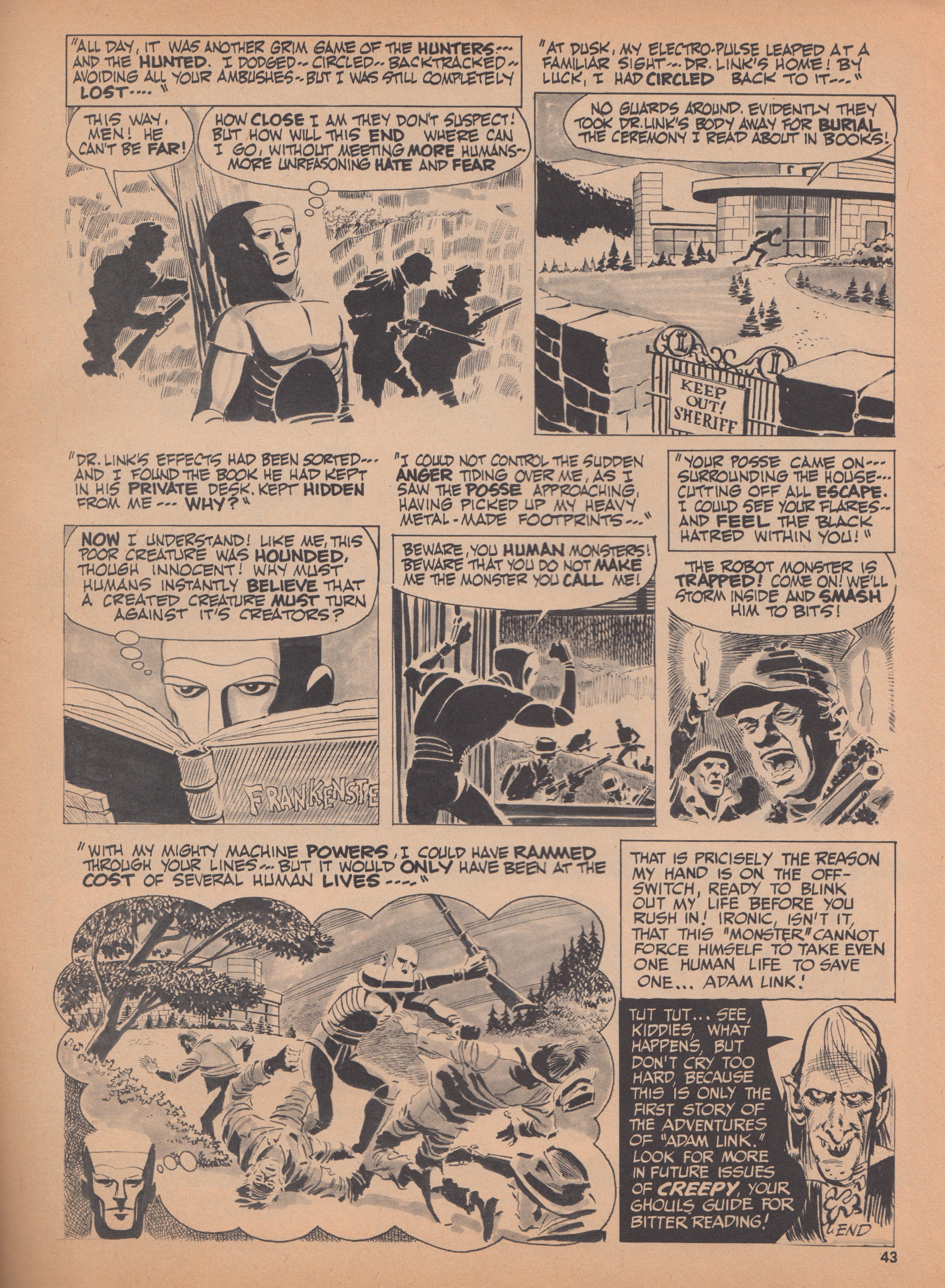
The final page of Binder and Orlando’s adaptation of “I, Robot” for Warren Publishing’s Creepy
No. 2, 1965 (page 43).

 
The EC version of “I, Robot” raises interesting questions, not only about adaptions of prose works into comic book form, but also about the moral imagination of creators like Binder and artist Joe Orlando. The complexity of the point-of-view in Adam Link’s narrative might be read in light of a passage from James Baldwin’s essay “Everybody’s Protest Novel”:

The failure of the protest novel lies in its rejection of life, the human being, the denial of his beauty, dread, power, in its insistence that it is his categorization alone which is real and which cannot be transcended.

How might Baldwin’s critique of Uncle Tom’s Cabin and the “protest novel”—a work of fiction that sets out to raise consciousness and fight social injustices—help us to read the many versions of Binder’s “I, Robot”?

One possible answer is this: because the story of Adam Link is a very obvious fiction, one built, as Binder himself admitted in the January 1939 issue of Amazing Stories, on Mary Shelley’s Frankenstein, it makes clear its status as a work of the imagination—that is, as a text (you can read more of Binder’s introduction to the original “I, Robot” in Schelly’s biography). “I, Robot” makes no claims to realism or verisimilitude. It might be read simply as an engaging adventure, or as a moral lesson on our jealousy, hatred, and ignorance. But we might also place the multiple versions of Binder’s story in dialogue with each other as well as with other texts from the era in which they first appeared. The January, 1939 issue of Amazing Stories, for example, appeared just a few months before the first publication of James Thurber’s “The Secret Life of Walter Mitty,” another relic of the period that continues to fascinate American audiences in the form of Ben Stiller’s new film. As we explore the shape and the dimension of the society in which Binder lived, we have an opportunity to investigate how his America shaped our own. And as we read this comic book from 1955, Adam Link continues to address us, even now, as, in the closing lines, he remarks, “Ironic, isn’t it, that I have the very feelings you are so sure I lack?”

Last week, after we saw Her at the Landmark on the corner of Clark and Diversey in Otto Binder’s old hometown of Chicago, I wondered, What would Binder have thought of this 21st-century story of the love between a middle-aged man and his operating system? And what does Binder’s “I, Robot” in all its forms—from the original story to the later EC Comics and Creepy versions to the novel Adam Link—Robot Binder published in 1965—ask of us as modern readers and as comics scholars?


References and Further Reading

Baldwin, James. “Everybody’s Protest Novel” in Notes of a Native Son. Boston: Beacon Press, 1984.

Binder, Eando. Adam Link—Robot. New York: Paperback Library, Inc. 1965.

Binder, Otto. Letter to Sam Moskowitz. October 4, 1952. Courtesy of the Otto Binder Collection, Cushing Library, Texas A&M University.

Binder, Otto. “The Teacher from Mars” in Leo Margulies and Oscar J. Friend, My Best Science Fiction Story. New York: Pocket Books, 1954. 18-36.

Schelly, Bill. Words of Wonder: The Life and Times of Otto Binder. Seattle: Hamster Press, 2003.

You can also read Noah’s discussion of Her and its relationship to Philip K. Dick’s Do Androids Dream of Electric Sheep? at Salon. Qiana’s paper at the 2013 Dartmouth College Illustration, Comics, and Animation Conference, “Science Fictions of Race in EC’s ‘Judgment Day,’” was another inspiration for this post.


Utilitarian Year in Review — 2013

Happy new year! Nostalgia for 2013 starts now, so here’s a list of some of the highlights from the last year at HU.
_________

Our roundtable on Django, Unchained, started in 2012, but most of it was this year.

Domingos Isabelinho on Fred.

A Twilight roundtable.

Brian Cremins reflets on found art and the Comics Buyer’s Guide.

I talk about gender in the comics of Derik Badman and Lilli Carré

Attack of the Literaries, a roundtable on comics, literariness, and Eddie Campbell

James Romberger interviews Tom Kaczynski

Robert Jones Jr. explains why he’s giving up superhero comics.

RM Rhodes on Ted White’s year editing Heavy Metal

I did a number of posts on Imperialism and Science Fiction

Kailyn Kent on splash pages.

Aishwarya Subramanian on Timpa, an Indian comic strongly influenced by Herge.

Sarah Shoker on Harry Potter, race, and British multiculturalism.

Me on comics vs. fashion editorials.

A massive comics and music roundtable.

Jog on Bollywood sci-fi spectaculars.

Michael Arthur on Madoka

William Leung on the overwhelming awfulness of Before Watchmen.

Kailyn Kent on comics and deskilling.

Me on how homosexuality will make your comic real.

Jog defends After Earth.

The best post ever on the internet if you want it to be.

Jones One of the Jones Boys on the 8 greatest superheroes you never heard of.

Jacob Canfield on consistency from panel to panel.

Patrick Carland on neoliberalism in the Hunger Games and Battle Royale.

Isaac Butler on video games and narrative.

Alex Buchet’s 8 part prehistory of the superhero.

Me on violence and comics conventions in We3, Spy vs. Spy, and Martyrs.

Patrick Carland on Russian animation.

Subdee on Attack on Titan and Pacific Rim.

Ng Suat Tong on Dan Clowes’ Justin M. Damiano

Osvaldo Oyola on queer silence and the Killing Joke.

Vom Marlowe on censorship at Goodreads.

Our Indie Comics vs. Context roundtable.

Robert Stanley Martin on Jim Shooter’s interactions with Tony Isabella, Steve Englehart, and Gerry Conway.

Chris Gavaler on Carrie White and Jean Grey.

Bert Stabler destroys Art Spiegelman, Scott McCloud, and others.

Ng Suat Tong on how even comics critics don’t care about comics criticism.

Chris Gavaler on Thor vs. the Dark World of DC.

Ng Suat Tong questions whether Michael DeForge is the greatest comics artist of his generation.

Kristian Williams on Watchmen, Fail Safe, and Eichmann in Jerusalem.

The blog PencilPanelPage joined HU, and kicked off with a roundtable on Krazy Kat.

Mahendra Singh on Art Spiegelman’s draftsmanship.

Jacob Canfield on Benjamin Urkowitz’s Real Rap

A statement of purpose of sorts for HU.

Emily Thomas explains why the Nao of Brown’s take on mental illness is not helpful.

Pam Rosenthal on romance, lit fic, and Jo Baker’s Longbourn.

Orion Martin asks, what if the X-Men were black?