Best Women Comic Creators

Kelly Thompson is running a poll to find the greatest female comics creators. You should go vote if you haven’t.

Here’s my list fwiw, from most best to slightly less best (they’re all writer/artists.)

1.Ariel Schrag
2.Edie Fake
3.Ai Yazawa
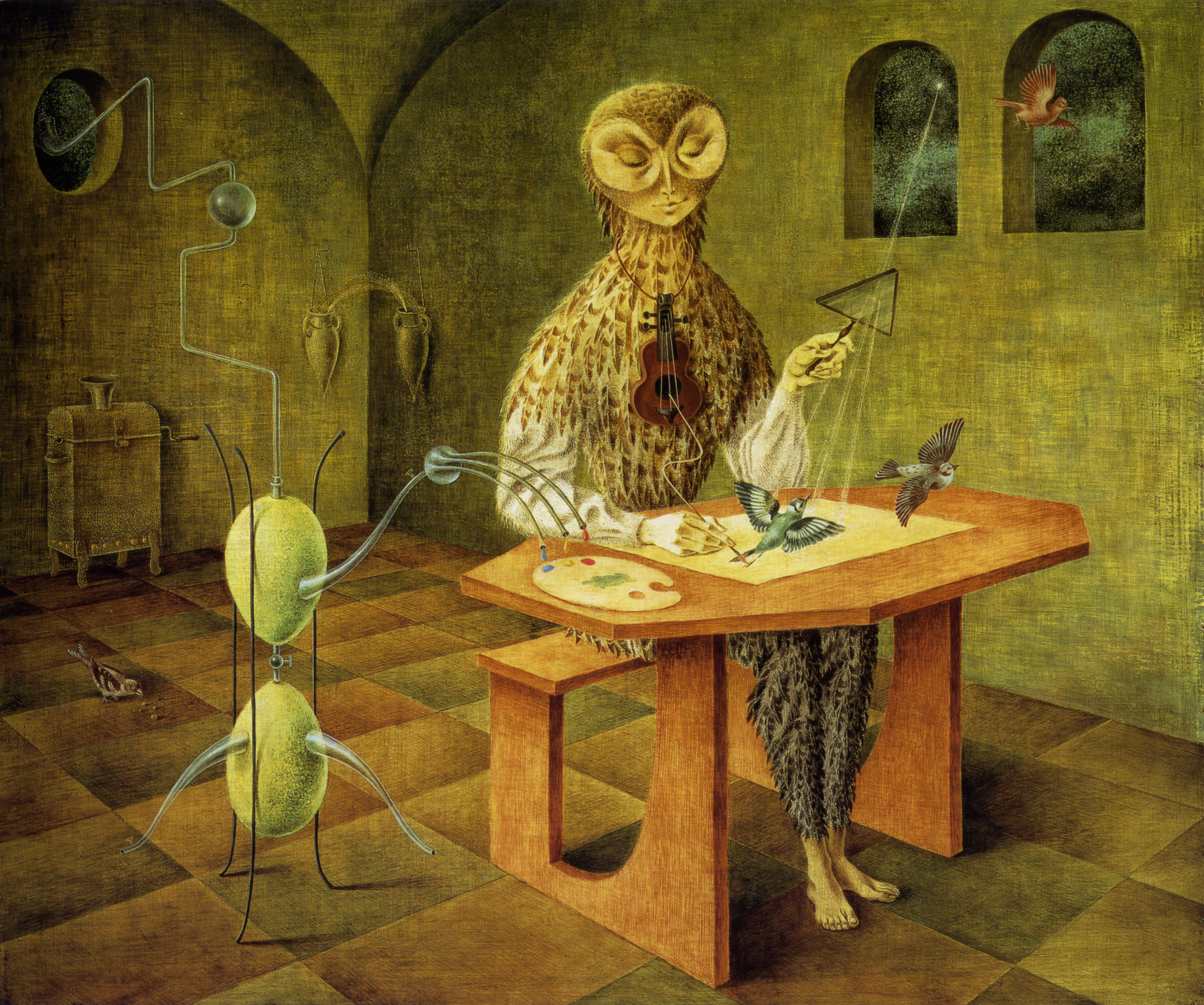
4.Remedios Varo
5.Lilli Carré
6.Moto Hagio
7.Tove Jansson
8.Rumiko Takahashi
9.Kara Walker
10.Marley

I tried not to think about this too, too much, since I tend to think these lists are pretty arbitrary anyway. Edie Fake uses the pronoun he, but he’s told me he identifies as a woman, so I think it makes sense to include him. Remdios Varo and Kara Walker aren’t usually thought of as comics people, but I think they’re work can both be seen in the tradition of cartooning. Lilli Carré’s most amazing work in comics is arguably in the gallery setting as well. Marley isn’t much known, but I adore it…and I think my essay about her may be the one Comixology column I haven’t brought over to HU? Maybe I’ll post it here tomorrow.

None of these are superhero creators or webcomics folks, so I doubt any of them will make the final CBR list (except maybe Rumiko Takahashi?), which I think will be tilted to capes and a Kate Beaton or two. I suspect Gail Simone will top the writers list…not sure who would win the artists? Amanda Connor maybe?

Folks might be interested in the list of female comics artists who made HU’s all time greatest list a few years back. Feel free to list your picks below if you’re so moved (but vote in the real poll too!)
 

Remedios_Varo_(388484001)

Where Angels Fear to Tread: Constantine, Promethea, and the Fool

Part One: Constantine

1969 ends with a surprise—the seventies.

In its last three pages, Alan Moore and Kevin O’Neill’s Century: 1969 suddenly departs from the eponymous year and drops us, without warning, a decade further on.  The bright, LSD Technicolor has washed out of London, replaced with a heroin gray that never even fades to black, but only to darker and sootier grays.  The place seems desolate, desperate, depressed, a throwback to the Ingsoc years, but without a Big Brother to blame.  The Basement, a “Beat Club,” “where the Rutles first played London, apparently,” is now Debasement, a seedy punk bar where at closing time they probably don’t bother to sweep up the broken glass.  The sixties, so hopeful at the peak, seemed to promise the world.  The seventies promised nothing, and delivered.  Nihilism is all the rage.

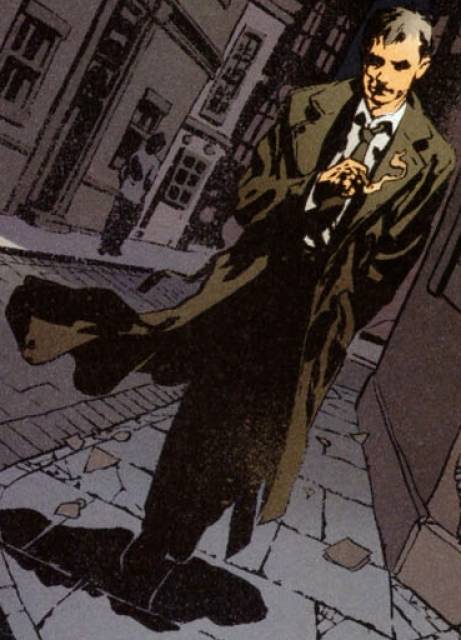
Another change as well:  There’s an old man, who looks like a young man.  Or is he a young man, who looks old beyond his years?  He sits alone, slumped at a table, dejected.  He has short, slightly spiky hair—more Richard Hell than Billy Idol—and he hasn’t shaved in a couple of days.  He wears a suit that was probably pretty sharp when he put it on, but now looks like he slept in it—and, over that, a dingy trench coat.  We know he is Allan Quartermain, but there at the end, I would swear he is John Constantine.

He may well be both.

We’ve seen this trick before.  Warren Ellis and John Cassaday’s Planetary, chapter seven (“To be in England, in the Summertime”), begins by announcing the death of a Constantine stand-in named John Carter.  “Who’s John Carter?” Elijah Snow asks.

“Old friend of ours,” Jakita says.  “Had serious connections in the occult underground.  Real player in the eighties.”

“The word,” the Drummer cuts in, “. . . is scumbag.”

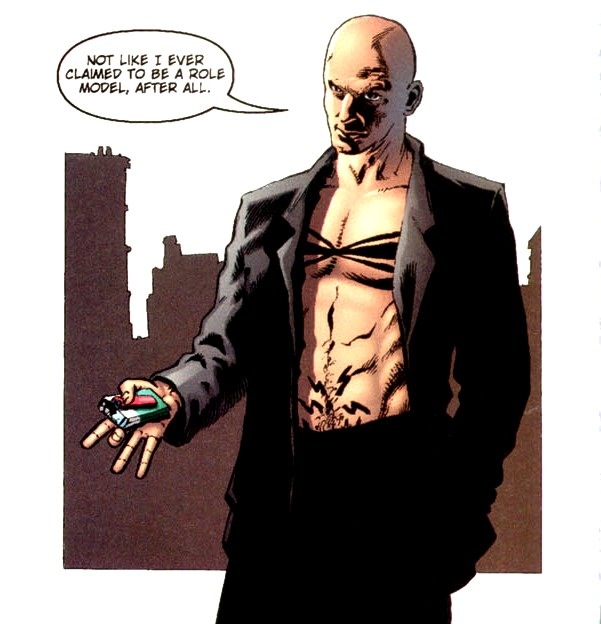
We turn the page and we see him, in Jakita’s memory, slightly unkempt hair, cynical expression, trench coat.  He is lighting a cigarette.  By the end, we learn that Carter/Constantine is not really dead.  He shows up, head shaved, the moon forming a halo behind him.  When he takes off the trench coat, we see that he’s wearing a black sports jacket and no shirt underneath.  Large, bold, black tattoos adorn his chest.  Suddenly Jack Carter isn’t John Constantine anymore; he’s Spider Jerusalem instead.

“The eighties are long over,” he says.  “Time to move on.  Time to be someone else.”

He walks away, into the darkness, leaving behind the smallest drift of smoke, twisting like a question mark.

Both of these stories are, in their way, stories about stories.  The League of Extraordinary Gentlemen began by assembling a Victorian superhero team—Quatermain, Wilhelmina Murray, Captain Nemo, Mr. Hyde, the Invisible Man—and filling their world with fictions borrowed from other fictions.  Subsequent volumes in the series have followed the key characters as the years progressed and they grew old—or, in some cases, thanks to a Fountain of Youth, did not.  Moore, then, does what he does best, simultaneously deploying adventure story tropes and commenting upon them.

Ellis does something similar in Planetary, where a team of “mystery archaeologists” tries to uncover “the secret history of the twentieth century,” and thus encounters alternate-world versions of superheroes, movie monsters, pulp adventurers, mad scientists, and other pop-culture figures.  Here, too, the stories are critiqued even as they are told.

Moore borrowed Quatermain, but invented Constantine; Ellis borrowed Constantine, but invented Jerusalem.  The transition—Quatermain, Constantine, Jerusalem—is interesting in several respects.  For one thing, it is broadly in keeping with important aspects of each’s character’s story.

Allan Quartermain, whom Alan Moore once dismissed as “just another white imperialist out to exploit the natives” becomes, in the League‘s story, something more and something else.  When we first find him he is a heroin addict, old and pathetic, strung out, filthy, and waiting to die.  It takes a woman in danger to bring him back to his old self.  And yet he doesn’t remain his old self.  He grows tender, broadens, changes.  He comes to respect Miss Murray as an equal, then to love her, then to love, also, the androgynous and immortal Orlando.  He travels to a magic pool and comes back a young man, posing as his own son.  He is no longer the “old” Quartermain at all.  Alan Moore thus reinvents Allan Quatermain.  And Allan Quatermain reinvents himself.
1873271-jack_4

Constantine, as a kind of magical con artist, lives by his wits.  He is constantly adapting, constantly improvising.  The central conflict of Hellblazer is that of the individual, a mere human, confronting powers much greater than himself—heaven, hell, and Margaret Thatcher.  The question the series poses, taken as a whole, is how much of a bastard can one be and remain a decent sort of guy?  Or, at times: How much of a bastard does one have to be?  Of course, the temptation—for John and for his writers—is always to push it too far.  The challenge for the writer is to stay true to the character; the challenge for John Constantine is to stay true to himself.
Jack_Carter_Planetary_004

Transmetropolitan poses many of the same questions, the same challenges.  Spider Jerusalem is a rogue journalist, a cyberpunk Hunter S. Thompson, determined to tell the truth and consequences be damned.  The story he’s pursuing, or a crucial part of it, concerns the persecution of the “Transient” community, a rather cultish group who alters their genetics to become part alien.  In other words, Transmetropolitan is about the relationship between integrity and autonomy, and in particular the defense of the second being required for the preservation of the first.

A theme uniting the two transitions—Quartermain to Constantine, Constantine to Jerusalem—is the idea that heroic characters are expressions of the cultural needs of their eras.  Thus Jakita’s explanation for the “faintly ridiculous” appearance of the Vertigo heroes:  “They’re eighties people.”  And furthermore, they’re English:  “England was a scary place.  No wonder it produced a scary culture.”  Thus, also, Alan Moore’s observation in his introduction to The Dark Knight Returns:  “[H]eroes are starting to become rather a problem.  They aren’t what they used to be. . . or rather they are, and therein lies the heart of the difficulty.”  He goes on to explain:  “The world about us has changed and is continually changing at an ever-accelerating pace.  So have we.”  However, despite advances in technical knowledge and social conscience, “comic books have largely had to plod along with the same old muscle-bound oafs spouting the same old muscle-bound platitudes while attempting to dismember each other.”  Changing times, he says, demand “new themes, new insights, new dramatic situations.”  Our heroes have to change.

The personal tension in 1969—between Mina, Allan, and Orlando—largely hinges on their different approaches to adapting to the new times.  Mina is somewhat desperately trying to adopt the most up-to-date dress and slang, an affectation that her teammates find ridiculous.  It’s easier for Allan, at least on the surface, as men’s fashions are more stable (witness the iconic trench coat) and the culture is more forgiving to men as they age—not that he ages, exactly.  But Mina, perhaps because of her earlier, less idyllic experiences with immortals, has picked up on something deeper.  She fears obsolescence, becoming “fossilised as a Victorian freak” in a world that will grow increasingly alien.  For Orlando it is different.  Orlando is always changing—names, sexes, allegiances; even her history is subject to revision—and Orlando is never changing.  He, or she, is a constant throughout history, always present where the drama unfolds, cynical and self-centered past the point of narcissism.  Whatever tragedy he may witness, we can be sure that he will be counted among the survivors.  Fashions change, ideas changes, and Orlando will take them up, or not, as it suits her.  His very mercurial nature is a kind of constancy; whatever else happens, Orlando will adapt and survive.  There is a stable center beneath the shifting appearances, the momentary attachments.  And so, in the  shadows and grime of the seventies, as they discuss Mina’s disappearance and the end of their League, it is naturally Orlando who gets up and leaves.  Quatermain remains, unsure what else he could do.


Part Two: The Fool

In Books of Magic, Neil Gaiman and Paul Johnson present Constantine as an archetype drawn from the Tarot.  Dressed as the Fool, he mocks, and riddles, and provokes.
RWS_Tarot_00_Fool

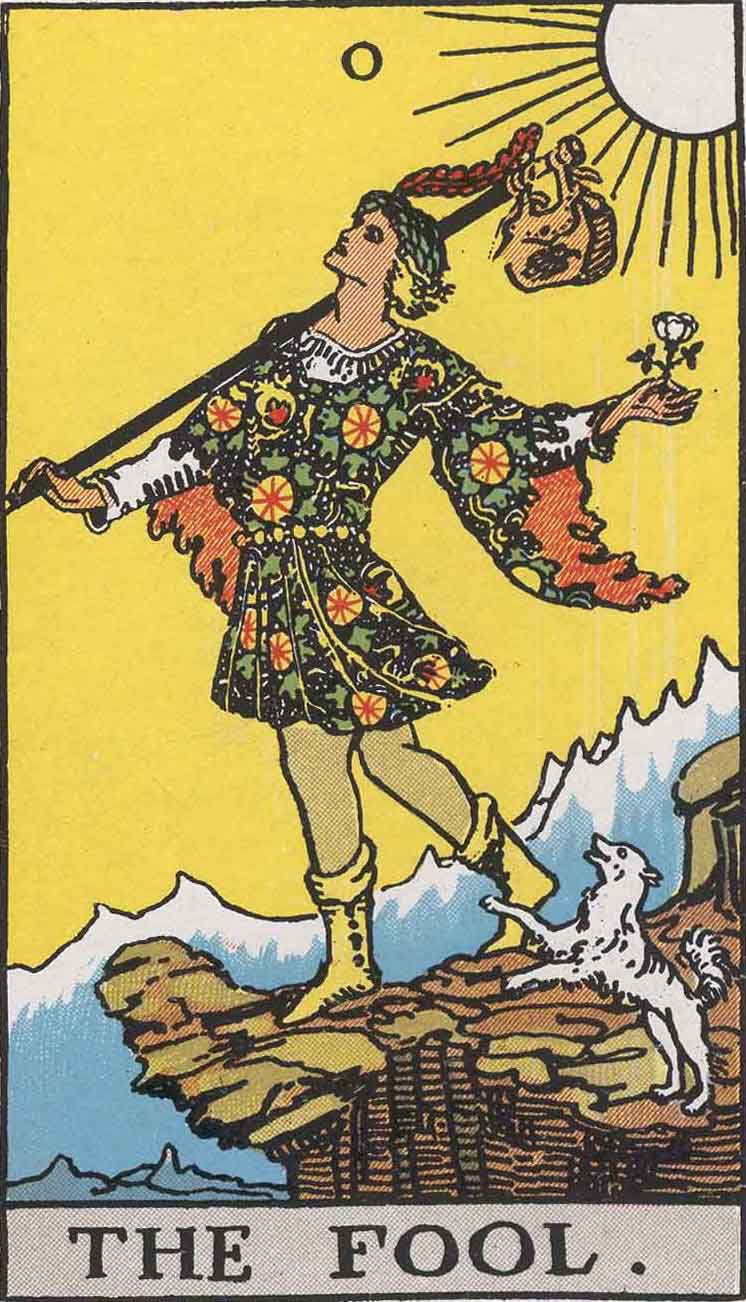
The occultist Arthur Edward Waite wrote of the Fool:

“With light step, as if earth and its trammels had little power to restrain him, a young man in gorgeous vestments pauses at the brink of a precipice among the great heights of the world; he surveys the blue distance before him – its expanse of sky rather than the prospect below. . . .  The edge which opens on the depth has no terror; it is as if angels were waiting to uphold him, if it came about that he leaped from the height.  His countenance is full of intelligence and expectant dream. . . .  He is the spirit in search of experience.”

Johannes Fiebig and Evelin Bürger add that the card’s number, Zero, “indicated a very personal bottom line, the self, the starting point from which everything else flows.  This is the beginning and the end of that which makes you a unique person.”  They advise: “You must have the courage to face the future, even if you cannot predict or determine the future in advance.  You must have the courage to walk your own path and to be open, even if your back isn’t covered, and even if conventional wisdom and common sense suggest otherwise.”
p2fool

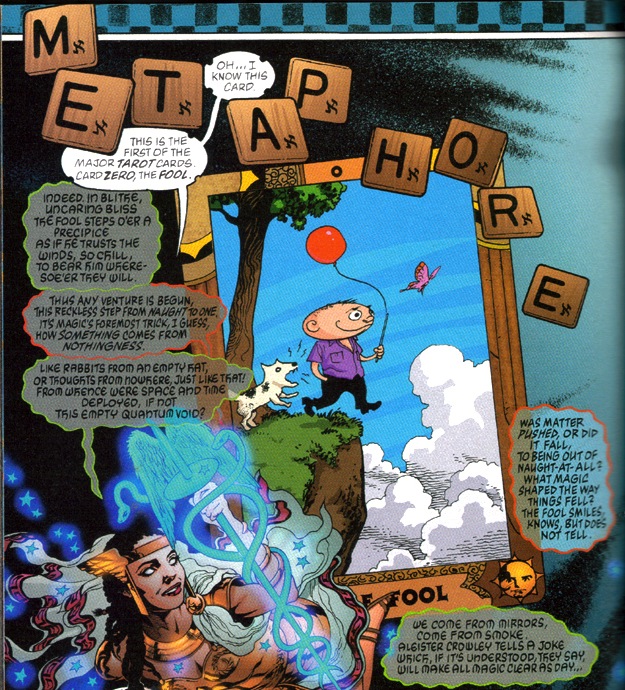
In Promethea, Alan Moore, Constantine’s creator and a practicing magician himself, describes the Fool in verse:

“Indeed in blithe, uncaring bliss

The Fool steps o’er a precipice

As if he trusts the winds, so chill,

To bear him wheresoe’er they will.


Thus any venture is begun,

This reckless step from naught to one.

It’s magic’s foremost trick, I guess,

How something comes from nothingness.”

In some depictions, the Fool is accompanied by a bird (perhaps representing freedom) or a butterfly (transformation).  Moore’s Promethea and Gaiman’s Books of Magic—stories of quests, in which a novice is introduced into the world of magic—both show the butterfly in their versions, or in the first case, a Promethea moth.  Moore’s Fool seems to be following it over the edge.

Gaiman has made use of the Fool before.  In the Sandman series, Destruction, who has long ago abdicated his responsibilities, decides he cannot stay in the home he has made for himself since abandoning his realm.

“What will you do now?” Dream asks.

“I will make the most of what I’ve got. I shall live out my days doing what I have to do, one day at a time.  Life, like time, is a journey through darkness.”

A few pages later, Dream inquires again, “You are going now?”

“Yes.”

“Where?”

“Oh, out there, somewhere.  Up, out.”

We see him, carrying a stick with a bundle knotted at the end, walking up into space, until he is as small and as bright as a star.  It is the Fool, stepping over the edge at last, and rising rather than falling.
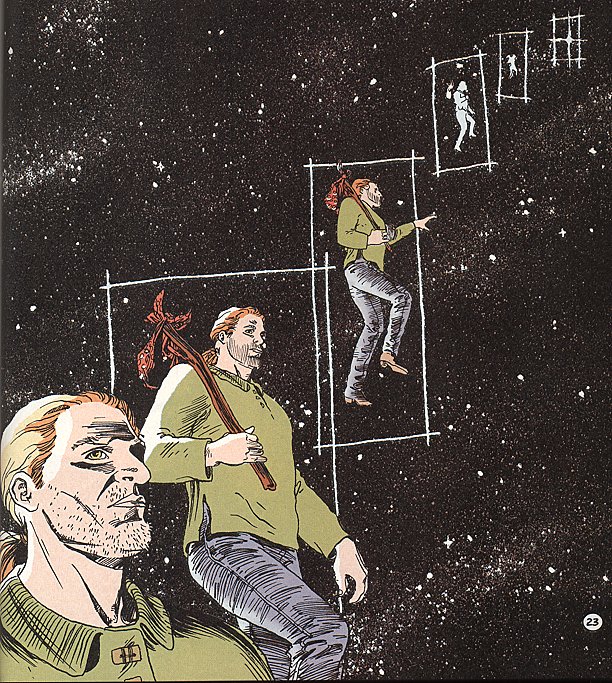
destruction6

Destruction, like the Fool, has a dog for a companion. “Barnabas can be a bit of a pain,” Destruction says, “and he has no poetry in his soul, but he means well.”  In the Tarot, the dog represents caution, prudence, and common sense; he sounds a warning as the Fool approaches the cliff.  It is fitting that Destruction, or the man who was once Destruction, when he steps into the sky, leaves the dog behind, on firm ground.

The theme of transformation—”time to be someone else”—is in fact the moral of Neil Gaiman’s Sandman series:  “One must change or die.”  Destruction decides to change; Morpheus, to die.

Constantine’s greatest trick was probably surviving for as long as he did.  He is after all, just a working-class bloke with a habit of getting in over his head.  If he could be said to have powers at all, they would consist chiefly of arrogance, recklessness, a certain rakish charm, and a large measure of pure blind luck, along with knowing a little of magic and a lot of people.  It is, in fact, precisely the same qualities that get him into trouble and get him out of it.

As William Blake wrote in his “Proverbs of Hell”:

“A fool who would persist in his folly becomes wise.

Folly is the cloak of knavery.”

The Fool is a knave by another name.  “Not John,” Constantine’s end-of-everything doppelganger tells Tim Hunter, “But Jack . . .   Jack Fool. . . .  A Jack-a-Napes when I tell riddles and merry tales; Jack Pudding, when I play my pranks. . . .”  And the jack in a deck of cards is sometimes also called the knave.

This knave, cloaked in folly, knows more than he says.  Moore writes:

“What magic shaped the way things fell?

The Fool smiles, knows, but does not tell.”

When young Tim Hunter asks the Constantine-Fool, “I’m meant to be learning about magic.  What have you got to tell me?”  The reply is a feint of ignorance:  “Me, good sir?  What do I know of magic?  Why, nothing, my masters.  Nothing at all.”  But as he speaks, as he tells them he has nothing to say, he is at the same moment creating and then juggling balls of white flame—literally playing with fire.  Is he brazenly lying, or is he hinting at a deeper truth—that there is daring but no wisdom, that magic is a question of will rather than knowledge?  Is it skill or is it luck?  Constantine’s brand of magical bluffing suggests that the two often amount to much the same thing.  The only trick is not losing your nerve until you see it through to the end, whatever that may be.


Part Three:  Promethea

In Snakes and Ladders, Alan Moore tells of seeing John Constantine in a sandwich shop: “He looks at me.  He nods, and smiles, and walks away.”  (He smiles, knows, and does not tell.)

“Years later,” Moore continues,”in another place, he steps out from the dark and speaks to me.  He whispers:  ‘I’ll tell you the ultimate secret of magic.'”  We see him, cigarette in hand, and a slight, mischievous smile.  Moore leans toward him, listening.

“‘Any cunt could do it’,” Constantine says.

The casual manner is a pose.  Constantine promises to tell us a secret—or more, the secret—then seems not to, but actually does.  It’s not just showmanship, it’s illustrative.  It is itself a part of the secret—the smiling, knowing, telling, not telling.  (“What do I know of magic?  Why, nothing….  Nothing at all.“)  It’s a coded language, a teasing performance full of double meanings.  The profanity is part of it as well.  “[The] profane and scared are both one,” Moore writes.  Cunt, you understand:  Is it literal or metaphorical?  And what is the difference?

Moore’s Promethea is another story of an artist conjuring a fictional character into reality.  A young student, Sophie Bangs, is researching a mythical figure who recurs in stories throughout the history of literature.  What she discovers is that

“Promethea was a real little girl who lived in 5th century Roman Egypt.  Her father was a hermetic scholar. . . sort of like a magician.  A Christian mob killed him. . . But the gods intervened, taking his daughter into their world of myth and fiction, The Immateria.  Promethea became a living story, growing up in the realm that all dreams and stories come from.  Sometimes, she’d wander into the imagination of mortals. . . .  Some of them, taken over by this powerful living idea, even physically became Promethea. . . .  See, anyone with imagination and enough enthusiasm for the character can bring her through from the Immateria, by thinking themselves or others into the role.”

Sophie becomes the latest incarnation of Promethea, leading her—and therefore, also, the reader—on a instructive quest to learn about magic, or at least the basics of Alan Moore’s theory of it.  Some of what she learns helps to elucidate the meaning of Constantine’s secret.

The magician Jack Faust instructs her:  “The vessel between woman’s thighs is the cup’s highest aspect.  The chalice.  The grail of divine compassion.”  Later, they have sex, and he continues:

“Magicians,  irrespective of their gender, are male.  Their symbol is the wand, the male member, because they are that which seeks to penetrate the mystery.  But once they succeed—then they become magic. They become the mystery, become that which is penetrated. They become female.”

This is all rather literal in the story.  Writers and artists, their pens and pencils serving as their wands, approach a woman who is not only mythic but myth itself, who is imaginary and who represents imagination.  Those who are most successful, at least one man included, then actually become her.

Later, Sophie encounters a female Aleister Crowley, who reiterates Faust’s point: “Here, magicians become magic itself.  The penetrator becomes the penetrated.  Male becomes female.”

Sex is magic, magic is creation.  Magic is about transformation, change.  But it is also about unity, and the unity of opposites in particular—illusion and reality, male and female, virgin and whore, sacred and profane.  Something doesn’t just come from nothing: the emptiness contains everything within it already.  Zero means nothing, but it is also the number of infinite potential.  Transformation is also a revelation, and the revelation transforms.  Magic is a system, a system of meanings, perhaps of essences—but it is an unstable system, a destabilizing system.  That is why it is transgressive.  That is why it is dangerous.

And in a sense it is dangerous whether it exists or not.  Magic may not be real in the way that toothbrushes and parking meters are.  But stories are real; symbols are real.  They may only exist in the mind, or in the culture, but they have real effects.  Tampering with the symbols, Moore argues repeatedly, changes consciousness, changes the meaning of things.  If this idea is even remotely correct—and for these purposes it makes no difference whether we conceive of the process as “magic,” as Moore does, or simply as “art”—then the project of re-imagining our heroes takes on new importance, and greater urgency.  It’s not just about having better comics, but about finding new ways of seeing the world, and new ways of being in it.  Changing ideas changes the world.  It’s just a matter of imagination, and having the nerve to take the first step.

When Sophie next encounters Crowley he is dressed as the Fool, sitting at the bottom of an ornate staircase reaching to the heavens.  At the top, he tells her, one can “behold the vision of God, face to face.” Crowley, the gloomy Fool, waits uncertainly, despondently.  “I’ve always been sitting undecidedly here,” he says.  But also, he says, “I’ve always been there,” up above.  “You go ahead,” he tells Sophie. “Good luck with God.”

God turns out to be the moment of creation:  “Something from nothing.  One from none. . . .  Always here. Always now. . . .  One perfect moment, when everything happens.”  Implicit in that moment is the unity of all Being.  “All one.  All God. . . .  We are each other.  And we are God. . . .  And God is one.  And one is next to nothing.”  There, in that bliss of oneness and that barely-there heaven, along with everything else, is (again) the Fool—the familiar image this time, the one taken from the Tarot.  Satchel over his shoulder, dog barking behind him, his next step will take him over the ledge.  Perhaps there is some slight resemblance to Crowley.

And from that ultimate height, one finds another edge.  Looking down one sees the universe, arrayed like the Kabbalah.  Sophie steps over, and falls back into our world.

 

How to Fix Your Time Machine

12 monkeys 2

Dear Syfy Channel,
 
As much as I’m enjoying your new 12 Monkeys series, it’s also really annoying. This is not entirely your fault. Time travel is typically a mess in films and TV shows. Why, for instance, does Cole’s time travel chair lean him backwards like an astronaut, and yet when he appears and disappears in the past, he’s in a standing position? And why does he not return to the same moment in time that he left? I realize the answer is story convenience—sometimes it’s fun to have things happen while he’s “gone”—but couldn’t the doctor spout some techno-babble explaining how the machine somehow locks the two time periods in sync? Otherwise the past is less a “when” and more like a “where,” a place that exists simultaneously with “now” and so moves forward at a parallel rate.
 

il_fullxfull.370781364_1cqe

 
Cole’s mission is also a variation on Back to the Future and so suffers from a range of Michael-J.-Fox-fading-from-the-family-photo problems. For instance, when he loops back to a moment he’s already visited and alters it so this time his past self is accidentally shot in the arm, why does he experience the injury simultaneously with his past self? And why does the injury then turn into a sutured scar? At what point in time was the wound bandaged? Is the current Cole now a different Cole, the Cole who was injured in the past, and so then was the previous not-shot-in-the-arm Cole erased? If so, the new Cole wouldn’t even know something had been altered, because in fact “his” timeline hasn’t been altered, and so he would remember and have anticipated being shot—in which case, wouldn’t he take some precaution “now” to avoid it happening “again.” His whole mission is about altering past events, so there are no cosmic taboos like the kind the writers of Doctor Who keep having to invent, those inexplicably “fixed” points in time that make the plot work at the expense of everything else.
 

maxresdefault

 
I realize this sort of internal consistency is not the top priority when writing action-oriented entertainment. The top priority for writers of action-oriented entertainment is to be entertaining. There is no correlation between a well-tempered time machine and high ratings. Though I would not be surprised if TV and film producers imagine the correlation is inverse, that the more time writers spend tinkering with the nuts and bolts of their nerdy plot devices, the less entertaining the show will be.  And to a certain degree this is true, since sinking all of your effort into any one story element at the expense of the billion other story elements needed to make a story good is a great way to make a story very bad. Though at the other end of the spectrum, a story that ignores too many of those reality-securing nuts and bolts is going to score pretty high on viewers’ This-Is-Stupid meter. So most time-travel tales bounce around the middle, cutting corners while keeping the majority of their viewers’ frontal lobes intact.

But how about a time-travel story that’s both entertaining and makes sense? I realize “makes sense” is an oxymoron when talking about the impossible, but all I’m asking for is the appearance of plausibility. If that sounds like a pointless constraint on the creative process, remember that writers thrive on constraints—or as Robert Frost put it: “Writing free verse is like playing tennis with the net down.” 12 Monkeys could use a few nets.

So here’s one example of a plausible time machine. Begin by taking the traveler out of time travel. Start simpler. Think of it first as a “time phone.” Your machine sends and receives signals from the future. This is where a TV producer hangs up, because a show about people talking on phones sounds really boring, but the constraints create new possibilities. What if the future end of the phone is a robot? And if this end of the phone isn’t a phone but a Wii, then instead of a cartoon in a 2-D landscape, your avatar is a remote control android physically interacting with people in the future.

That nuts-and-bolt net also manufactures some potential plot tensions. Since anyone can throw on video goggles and Wii gloves, anyone can “travel” in time—but to the folks in the other time destination, “anyone” always looks exactly the same. You can never know for sure who is remote controlling the android—the good guys or the bad guys. This is great news for Orphan Black actress Tatiana Maslany since who else could play so many parts within a part? But if Maslany is busy, I nominate Enver Gjokaj based on his brilliant stint on the not-so-brilliant Dollhouse (he’s pretty good on Agent Carter too.)

Meanwhile, the folks working the Wii, they first have to build the android before they can dial the future with the blind hope that they (or future generations depending on how far into the future you’re dialing) will have maintained it. Since the Wii controls can exist in the future too, future people can also dial backwards in time, beginning at the moment the android is first switched on. So while the inventors are visiting the unknown future, the unknown future is visiting them.

If that doesn’t give a team of writers material for a season or two, you can always throw in an apocalypse—a worldwide plague, a rise of the machines and/or apes, a dysfunctional family in need of an emotional reboot. Maybe Michael J. Fox can use Matrix technology to active an Arnold robot and prevent his parents from being zombified before he’s born so he can overthrow the Morlocks after he grows up to be Bruce Willis?
 

KONICA MINOLTA DIGITAL CAMERA

Chasing Utopia

cap1

 
It’s been a whirlwind week or two here at the Hooded Utilitarian for discussing race in comics. Building on  earlier treatises about Black Panther’s exercises in assimilation narratives, Black Lightning’s equivocation on race and the X-Men turning black Noah Berlatsky asserted that the original Milestone Static comics kind of suck. J. Lamb argued that the superhero genre is fundamentally white supremacist, which makes most all black superhero characters generally useless.

As a black comics fan, this is abjectly depressing.

Everyone knows that black comic heroes hardly register as competition against white heroes for popularity. They barely exist. The fact that having one non-white costumed character on the big-screen is typically seen as an enormous boon for diversity is pretty demoralizing. When you add this to the fact that, as J Lamb wrote, non-white heroes function “within a paradigm defined by Western perspectives on violence and ideal beauty, in an industry dependent on White male consumer support .” I’m left feeling outright bamboozled.

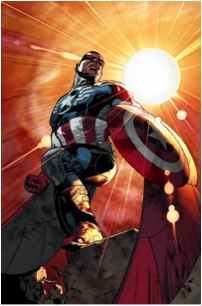
The truth wouldn’t sting so much if these essays were written some time last year, but they just reaffirm what I had concluded after reading All-New Captain America #1. One of the most banal, vapid comics I’ve ever read, All-New Captain America#1 truly underlined the utter fecklessness of the black super hero. We have Sam Wilson, the first African American super hero in the role of Captain America with all of the variant covers and implied importance that the role suggests, adorned in the American flag boasting a triumphant reach to the utopic mountaintop, published within twelve days of the announcement that Darren Wilson would not be indicted for shooting Michael Brown. The book’s lack of self-examination makes the juxtaposition painfully jarring.

It isn’t as though I had ambitious hopes for the new Black Cap book. But I honestly thought the idea of a black Captain America would mandate a minimal degree of content, especially with books like TRUTH in Marvel Comics’ rearview. In this series, we’re presented with pages of wintry, hoary dialogue where Sam Wilson briefly recalls the death of his parents whilst dodging gunfire for no reason. He battles Hydra and fights Batroc, the French stereotype in a typical superheroic battle that is requisite for a Captain America comic, I suppose. However the concept of a black Captain America and what that means to him or anyone is completely passed over for an adventure typical for white Steve Rogers. The issue eschews moments of reflection from Sam, opting instead to toss in empty critiques of America’s obesity problem and government corruption. Remarks by the villains on how Sam’s nothing more than a sidekick are carefully worded; the reader can infer racial bias if he or she feels like it, or ignore it if the idea of a villain being racist is too upsetting or unpleasant.

Exploring the importance of Sam’s new role should be a no-brainer. Why else was an irrelevant Joe Quesada ushered back onto the Colbert Report to promote the book? Comic readers understand diversity is often an empty gesture in comics, but this is “Captain America”. I had no real fantasies about Sam talking about systematic racism or making birther jokes, but that the book literally says nothing about how the figure representing America as its premiere superhero is now black reveals how ruefully optimistic I was when expecting comments on the black super hero’s existence from a white writer.
 

cap2

 
The disappointment isn’t just mine. Writer and Public Speaker Joseph Illidge wrote about the first issue of All-New Cap on his weekly column for Comic Book Resources, “The Mission”. When reading it, you get the sense that he’s holding back a deeper sense of disappointment than he’s letting on. Lines like “I’m not going to make this a polemic on non-Black writers writing Black characters, because the dialogue on that subject may very well be reaching its golden years. That said, I would have preferred a Black writer handling this book.” Reading that, I can’t help but see an image of eyes clenched shut and a setback induced sigh.

He mentions the HBO series “The Wire” and says how it was a show where white writers presented black characters with a strong sense of authenticity. Illidge labels “The Wire” as an exception, and reiterates that white writers will almost always miss out on the nuances of the black experience. In the 50+ to 75+ years of Marvel Comics’ history the company has been generally viewed as the more diverse universe when compared to DC. Surely at some point, in all that time, one of those characters managed a convincing portrayal of the black experience.

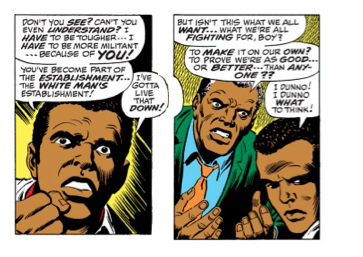
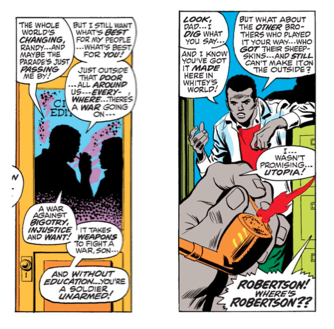
As J Lamb wrote, black heroes can only do so much within the confines of the white establishment they exist in. Luke Cage may get his origin story from wrongful imprisonment and Tuskegee-inspired experimentations, but he won’t spend his super hero career warring on the treatment of black people by white authority. But it’s with relief that I recall a series of issues during Stan Lee and John Romita’s run of The Amazing Spider-Man where the sole black supporting characters Joe Robertson and his son Randy interact with each other in ways which feel honest and timeless.
 

Screen Shot 2015-03-03 at 10.52.10 PM

 
In Amazing Spider-Man issues #68-#70, Randy gets involved with campus protesters who want the school Exhibition Hall to be used as a low-rent dorm for students. It leads into a number of scenes where Joe and Randy try to convince each other what’s right for a black man to do in the modern world of 1969. Quotes from Robbie like “A protest is one thing! But, the damage you caused..!” resonate sharply with the critics of the Ferguson protestors. The same goes for Randy’s comments about militarism, which mirror protestor Barry Perkins comments about feeling triumphant while fighting back against the police during the Ferguson protests.

A few issues on, in #73, the creators include a scene in which Joe and Randy discuss college. Randy protests his social placement, exclaiming “What’s the point bein’ a success in Whitey’s World? Why must we play by his rules?” Joe (or Robbie as he’s often called) maintains that by only educating one’s self can one truly bring about societal change. Randy, looking out at the reader, asks his father to explain why, if that’s true, educated black men in America haven’t prospered. Robbie has no response — he’s interrupted by J. Jonah Jameson bursting into the room ranting about Spider-Man. As in Static #4, where Holocaust’s grievances with racial inequality evaporate the minute he tries to kill a white child in cold blood, the discussion on racial inequity is silenced when the white guy (and, thematically, the white hero) enter the room.
 

Screen Shot 2015-03-03 at 10.52.36 PM

 
But whatever it’s limitations, the fact remains that the two black characters in this comic are having a realistic discussion about racial injustice and how to deal with it. Randy isn’t presented as a hothead who doesn’t know any better (there was another character named Josh for that during the Campus protest arc), and Joe isn’t shown as a stodgy relic of the old guard. Education is said to be key to enlightenment, but Randy questions the very system providing the education. The scene is interrupted by a white man, but it has no easy answers for a white audience.

But the Robertsons aren’t super heroes.

So what’s the point? If black super heroes can’t engage in this type of discussion in any meaningful way, what does it matter that black supporting characters do?

If the super hero genre has been inherently, historically white, it’s all the more important to note those moments when white creators and black creators attempt to relay the black experience. It’s also important to note where they go wrong and to examine how, despite their efforts, superheroes continue to present a narrative of whiteness. The few successes can perhaps serve as a template for the future, so we don’t have another All-New Captain America to suffer through. Those few scene with Joe and Randy suggest that meaningful diversity is possible in a superhero comic, however unattainable the whole of the genre appears to make it.

Is Iggy Azalea the Female Vanilla Ice?

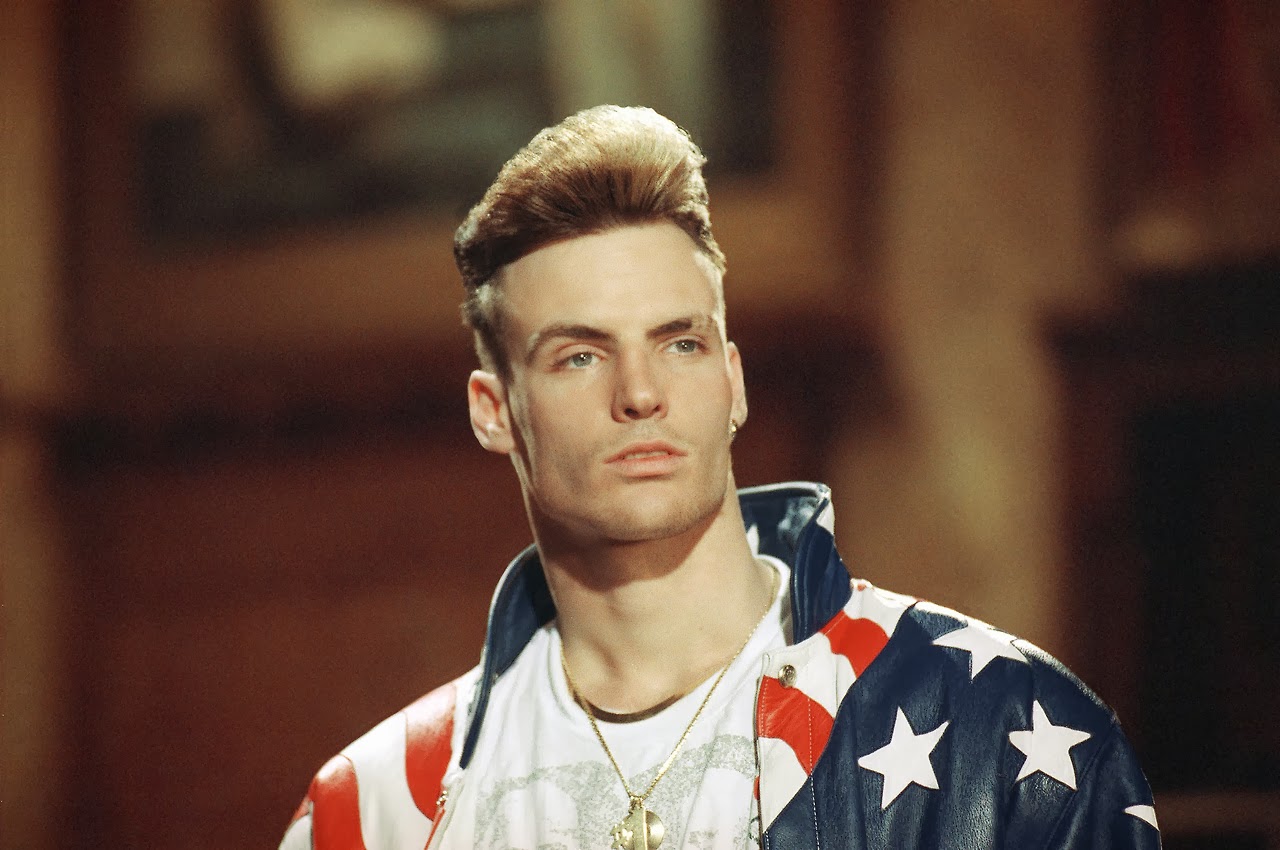
Rap singer Vanilla Ice in 1991. (AP Photo)

 
Iggy Azalea and Vanilla Ice are both white rappers who were marketed like pop stars while also trying to tell us they were hardcore rappers. They’ve both achieved incredible levels of success only to be hampered by questions of artistic credibility. In Ice’s case, those questions ended his career. In Azalea’s case, I think it’s a real possibility that we may see history repeat itself.

In the past year, Azalea had two singles simultaneously at numbers one and two on Billboards Hot 100, and her debut album, the New Classic, hit number three on the Billboard 200 album chart and number one on the Rap Album chart. She’s also faced a backlash that has repeatedly called her credibility into question. Some of it is certainly understandable: she’s not only the first white woman to hit it big in hip-hop, but also an Australian, compounding her outsider status. One of the biggest questions hanging over her is the very sound of her voice. In interviews, her natural speaking voice doesn’t have a particularly heavy Aussie accent, probably the result of her living in the US for eight years. But it is discernable enough to make her “rap voice” all the more questionable. The harshest criticism is that she isn’t so much rapping as imitating black Americans.

One of the things that always made hip-hop interesting was that rapping was an extension of the spoken word art form, with the idea that one’s “rapping voice” would be consistent with one’s natural speaking voice. It also stands to reason that because rap and hip-hop were linked to poverty-stricken communities, the form’s performers and fans have had little patience for pretense or artifice. White performers like Beastie Boys and Eminem never pretended to be anything more than what they really are: crazy Jewish kids from Brooklyn who were too smart for their own good, and a mixed-up guy from a Detroit trailer park who found both solace and purpose in hip-hop.

On the other hand, even 20 years after Vanilla Ice’s pop career faded out, his true background remains shrouded in confusion. The biography put out by his record company appears to have been different from his actual life story, and there’s no way to know how much was written and released with his knowledge or consent. There are also questions about who actually wrote his biggest hit, “Ice Ice Baby.” Ice compounded the embarrassment when made when he denied that the main sample was taken from Queen and David Bowie’s “Under Pressure.” (For the record, it was, and he did end up having to share songwriting credit with Queen and Bowie, in addition to paying back royalties.)

Another problem for Ice was that his own self-image of being a hardcore rapper was decidedly different from the kid-friendly marketing campaign that was rolled out, complete with action figures. At that time, two of the biggest acts in rap were New Kids on the Block and MC Hammer. Ice was supposed to fill a gap between the two.

The end goal was to have Ice do for hip-hop what Elvis Presley had done for rock ‘n roll. But while segregated radio meant that early rock ‘n roll was still fairly obscure to Elvis’ fans, when Vanilla Ice broke, “Yo! MTV Raps” had already been on the air for a couple of seasons. While Vanilla Ice was being embraced by bubblegum pop fans, he was being derided as a fraud by hip-hop fans. At the same time, the Milli Vanilli lip sync scandal broke (taking C+C Music Factory, Black Box, and Technotronic down with them). The rise of gangsta rap and grunge was in part a response to the years of actual fraud perpetrated by these acts, which left music fans hungry for something far more genuine and authentic. A lot of acts perceived as pop were suddenly guilty by association, simply for sharing the same genre.

And no one was hit harder than Vanilla Ice. In 1990, his debut album, To the Extreme, was number one for sixteen weeks, selling 500,000 copies a day at its peak. A year later, his follow-up live album failed to crack the top twenty, and his movie debut, Cool As Ice, barely made more than $500,000 at the domestic box office, getting pulled from theatres less than a month after its release. In 1992, Ice was so detested that the white rap group, 3rd Bass, scored a hit just by having Henry Rollins lampoon him in their video for “Pop Goes the Weasel.”
 

Iggy-Azalea

Perhaps then, Iggy Azalea could be on a similar career trajectory. Like Ice, there seems to be little genuine sense of who she is. A description of her hometown of Mullibimby reads similar to the bohemian arts haven of Taos, New Mexico. Azalea herself has talked about her humble background, and has said that she and her mother worked as house-keepers in the vacation homes of Mullibimby’s more affluent residences. When Azalea moved to Miami as a teenager, she went to work as a hotel chambermaid.

Aside from her song, “Work,” there’s little indication of the effect of her background on her as an artist. Frankly, she spends most of the song judging women who exchange oral sex for designer shoes. Perhaps her real crime isn’t being an Australian woman trying to sound black, but that she’s cultivated a mean girl persona to sound black. While trash talk is practically its own sub-genre, she lacks cleverness, and sounds like she’s punching down in order to build herself up.

So, is Iggy Azalea the female Vanilla Ice? In terms of marketing, absolutely yes. They were both sold to pop audiences rather than rap audiences. While Ice eventually said in an episode of Behind the Music that he sold out, Azalea doesn’t strike me as having any morals to compromise. As for actual talent, one of the things Ice had going for him was that he was a good dancer. He did also show some real promise as a rapper, and if he’d been in more of a position to hone his craft like Eminem, instead of being thrown onstage as a kind of rapping New Kid on the Black, he might have developed some genuine artistry.

For her part, in a recent radio appearance, Azalea was asked to freestyle, and she balked. If you can’t freestyle, you’re not a rapper—race and gender are irrelevant. This should end her career, but it probably won’t.

When I wrote that Rock is Dead, I didn’t put enough emphasis on the fact that the under-30 audience sees rock as old people music, the way my generation (Generation X, I suppose) saw jazz as our grandparents music. For young people today, music is electronic dance music, R&B, and hip-hop, all with a great deal of overlap. Younger music fans aren’t plagued by the same questions of authenticity in regard to race and genre because they learned music appreciation from the Disney Channel and Nickelodeon. Also, Auto-tune has made it easier to sell attractive people who can barely carry a tune; I don’t see another Milli Vanilli-type scandal on the horizon.

So Azalea’s career trajectory may not parallel Ice’s, but that isn’t because she’s more authentic or talented. It’s just because the audience is willing to put up with less authenticity for longer. The public turned on Ice, but we’ll probably just get bored of Iggy.

We Like Liars That Seem Likable

A great deal has been said and written about the lying our public figures do, recently. After the “misremembering war events” scandal that brought Brian Williams down, Bill O’Reilly has been subjected to scrutiny over his claims of witnessing combat during the Falklands War. This past week, Secretary of the VA Bob McDonald has been criticized for claiming to a homeless man to have been in Special Forces – he was not. Chris Kyle, of course, is remembered as a hero by many, despite having a demonstrable record of lying about events (much of this occurred post-moral injury, when Kyle was suffering from PTSD). Hillary Clinton lied about being shot at by snipers and is polling stronger than any other potential Democratic candidate for President in 2016. Army veteran (who should goddamn know better) and Democratic Senator Richard Blumenthal lied about serving in Vietnam. Republican Congresswoman and military veteran (who should also know better) Joni Ernst has received criticism over calling herself a “combat veteran” using a very broad definition of “combat.”

People lie. There seems to be a fairly broad consensus along the political spectrum that politicians lie a great deal – whether you believe that “your” people lie less or less harmfully probably goes a ways toward establishing how one votes in an election (having become fairly disillusioned, I recently registered Independent, abandoning the Democratic Party). This explains why a state populated primarily by Democrats would elect Richard Blumenthal over his Republican rival, despite his – well – lying about combat. This explains why Democrats are happy to forgive Hillary for lying about being in combat (misremembering is not something that happens when you’ve been under sniper fire once), and why Republicans think that Joni Ernst should be given the benefit of the doubt for her admittedly less egregious (but still fairly stupid) description of having been in combat, when she was posted to Kuwait, quite far from combat. In this case, her description of herself as a combat veteran is less annoying than her repeated and ongoing defense of that untruth.

I should also point out that most combat veterans, myself included, don’t feel that combat experience gives one special insight about life that one would covet, save that combat is a situation to be avoided at all costs. When one considers that politicians who experienced combat throughout history continued to encourage or abet warfare, it’s impossible to conclude that there’s any real utility to combat as a morally didactic lesson, save potentially on an individual level.

It’s slightly different with journalism, in that, technically, in order to call oneself a journalist it’s important that one adhere to certain unwritten but widely-obeyed rules: don’t get involved in a story, don’t plagiarize, don’t lie. O’Reilly has already said he’s not a journalist, and has no credibility with people who aren’t a certain type of conservative – this seems to have insulated him from the brunt of the fury that resulted in Brian Williams’ demise.

And that’s fascinating! Williams, by defining himself as a journalist, made himself more vulnerable to truth-criticisms from people that watch his program than O’Reilly. (For the record, I was fine with him continuing as an anchor – anyone who thinks journalists, who are human, don’t directly or indirectly lie [routinely] should be banned from ever voting)

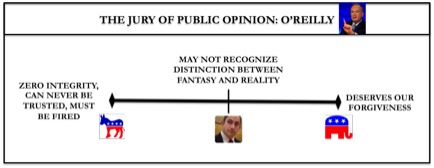
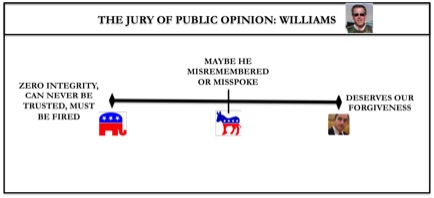
I wanted to compare how various public figures seem to be judged on their military lies, so I threw together a basic chart and mapped public perceptions of journalists and other truth-tellers onto it.

What I found was… well, not shocking at all, really. O’Reilly’s posse sticks up for him and he won’t be fired despite having lied I’ve put myself on the spectrum (right in the middle there) because if one is going to make a claim about a thing, well, have the sack to tell others where you fall.)
 

o'reilly

 
And Williams, who has a more discerning audience that is willing to entertain shades of gray, suffers by comparison:
 

william

 
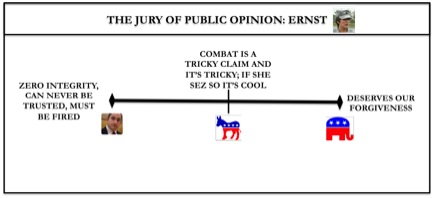
And just to see how that works out with politicians – there’s the Republican case of Joni Ernst, who has claimed (playing off a credulous public’s unfamiliarity with battle and sympathetic media) that she was in combat because she was in a combat zone. Which is exactly like me saying I got the shit kicked out of me once at a bar because there were a group of guys at the end of bar muttering and looking over at me and I was really worried about getting the shit kicked out of me. Someone who had once gotten a severe ass-whipping would probably take issue with my claim, as I do hers. Let’s see if she’s going to be fired or held to account or not (remembering that this is a question of whether or not someone’s worthy of the trust, confidence, and respect of the public):
 

ernst

 
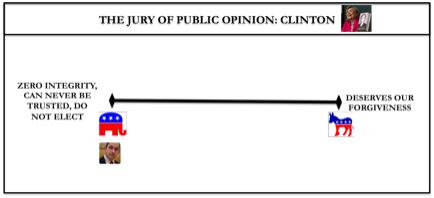
Looks like Ernst is gonna be okay – the Republicans have her back (not surprisingly), and the Democrats / media don’t feel like evaluating her claims on their merits, and calling a liar a liar. Of course, if they did that with Ernst, they’d have to do that with Hillary Clinton, the putative fundraising frontrunner for 2016, and – don’t forget – maybe our first female president. What does it matter if she happened to lie about – well, anything?
 

clinton

 
I’m also down on Clinton because of that “we need to go into Iraq” thing she did, which if anyone remembers, was basically responsible for all the horrors we see in the Middle East today – a place that used to be filled with sensible dictators who were amenable to bribes and arms deals and could be relied on to limit their war crimes to 25,000 or 30,000 dead every decade – a tiny fraction of the dead since we became involved over there. But it looks like she’s going to walk, too.

In conclusion, the lies that get told to us by our political leadership don’t seem to matter as much as the lies that are told by people who call themselves “journalists,” which may or may not involve abiding by a set of agreed-upon rules to tell stories in a certain way. And while “liberals” or “progressives” tend to evaluate journalists and people outside their group more generously than “conservatives,” both groups are equally bad at applying rigorous scrutiny to their politicians.

So it goes.

Misandry Everywhere

I’ve written a fair bit here and there about misandry and discrimination, prejudice, and violence directed against men. It seemed like it would be useful to have all the links collected in one place…so here they are, in roughly chronological order. I think this is everything, but if you see something I’ve missed, let me know.

Misandry and the Trayvon Martin Case

Misogyny Hurts Men Too

When Men Experience Sexism

On stereotypes of men in Orange Is the New Black

An interview with genocide scholar Adam Jones, who does a lot of work on violence against men.

What Hollywood Needs Is Fewer Strong Male Characters

On Andrea Dworkin, hating men, and the patriarchy.

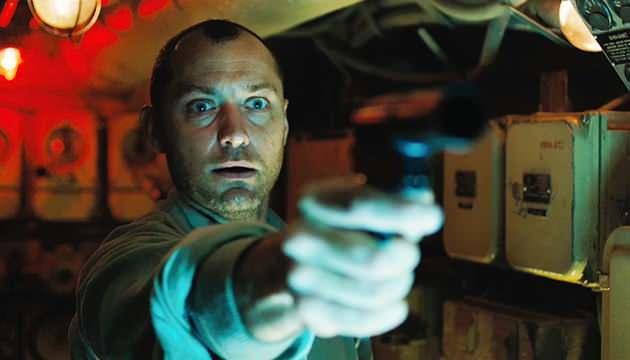
On the film Black Sea and the disposability of working-class men.
 

45b2fba2bd0e5a6899d730316b13bfc4fd2e2b51