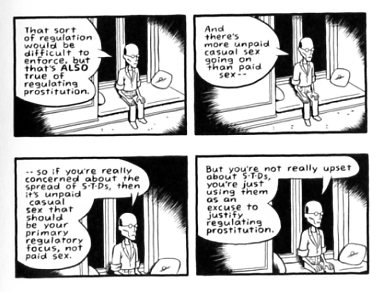
Slowly Paying For It: God and the Machine

In his discussion earlier today, Matthias Wivel argues that Chester Brown’s Paying For It includes an implied sacred component. Pointing to the use of distant views and the wormhole effect Brown uses in many panels, especially those depicting sex, Matthias argues that Brown presents a God’s-eye view of his own life, universalizing and consecrating his own experiences.

many scenes are viewed from above, from a kind of “God’s eye-perspective.” The peepshow aesthetic of the tiny two-by-three paneling seems to be for the benefit of an omniscient viewer, who at times loses interest and lets the eye wander, decentering the compositions. Chester walks, talks, and fucks under the scrutiny of a dispassionate oculus, darkening around the edges. It is almost as if he is inviting a higher judgment to balance out his own.

Sex scenes are privileged by even greater distance. They are uniformly denoted by a throbbing glow in the dark, blocking out the surroundings (this is worked to hilarious effect in chapter 2—the sequence where Chester keeps stopping, with the banal details of the surrounding room appearing each time). A necessary way of avoiding the interference that overly graphic renditions would create, this approach lends universalism to these scenes, threading them through the narrative as its central, ‘sacred’ constituent.

Brown’s cartooning has struck me as invoking this kind of higher order since at least, and unsurprisingly, his 1990s Gospel adaptations, which routinely employed a similarly elevated perspective, pared-down panel compositions, and suggestive framing to great effect.

It’s an interesting argument…but one that I’m afraid I don’t find especially convincing. I certainly agree that Brown is using a distancing mechanism. But I don’t think that distancing mechanism needs to imply a God or a sacralization. On the contrary, it seems to me that the eye you see through when you look at Brown having sex is not the eye of God, but the eye of porn. It does not provide a deeper insight, or a spiritual glow. On the contrary, the distancing turns Brown and his partners into rutting meat dolls, robbed of inner life or soul (you can’t, notably, see their eyes.) The distancing is not a means of handing control over to a larger power; it’s a way of enforcing control; of nailing human emotions and interactions down like butterflies in a sample case. It’s the expression not of spiritual insight, but of sadistic gaze.

I think this has some interesting implications for Matthias’ other arguments. He suggests that some critics of Paying For It (especially me) have focused on the polemic and failed to respond to the formal successes of Brown’s work. Those formal successes are (in a nice reversal) precisely the spiritual successes; they are the ineffable which give life to the comic. Or, as Matthias says, “[Brown’s] power to imbue any scene with an ineffable sense of meaning is one of his great gifts as a cartoonist, a gift few critics have attempted to critique or explicate, and which Spurgeon addressed sensitively in his review.”

What Matthias doesn’t seem to consider is the possibility that critics haven’t attempted to explicate or critique this gift in reference to Paying for It because the gift isn’t there. Brown’s grids, his simplified figures, the often mechanical stillness of his figures, the cadaverous death’s head of his self-portrait…it’s not, to me, suggestive, or spiritual, or ineffable. It’s ugly, routinized, and intentionally flat, almost desperate in its eschewal of beauty or resonance.

I do agree with what I take to be Matthias’s position that the blankness of the art has a thematic meaning. The art’s frozen distance undercuts Brown’s polemic, calling into question his claim that prostituted sex is joyful or spiritual.

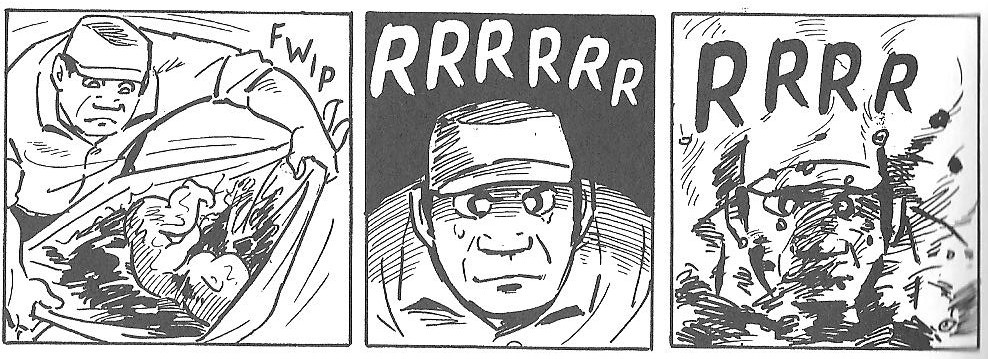
The problem for me is that I don’t have much desire to see ugly, boring truths depicted in ugly, boring art. I’m not that interested in Chester Brown per se, so watching him work out his fairly transparent control issues by systematically draining his art of life and joy doesn’t appeal to me that much. Matthias sees this as a lack of sensitivity to the formal achievement…but surely it could also be simply a different evaluation of that achievement. Matthias sees God in the interstices of Brown’s routinized panels, and declares that those who don’t see Him are insufficiently attuned to the spiritual. Perhaps. But still, I look at Paying for It and what I see is the machine clanking and pistoning, grinding out hollow banality because hollow banality is what libertarians and autobio comics alike use to keep the ineffable at bay.

Hating America First

This first ran on Splice Today
____________

It appears there’s a chance our Congressional representatives will decide en masse that financial apocalypse is preferable to a possible primary challenge. What this would mean exactly is unclear; I guess the first consequence would be a stock market nosedive. Longer term, presumably, it would involve a downgrading of U.S. debt, which means we’d have to live within our means, which would result in a sudden and vicious fall in our quality of life. Unemployment would skyrocket, production would grind to a halt—we’d be looking at a massive contraction of the economy that would make FDR sit up in his grave and say, “We have nothing to fear but…HOLY SHIT!”

Obviously, this would be bad, and nobody but nobody wants this to happen… not even the wind-me-up-and-I-drool-great-gobs-of-stupid animatronic joke that is Michele Bachmann. If the Dow plunges to 3000, I lose my retirement savings, my kid can’t go to college, and quite possibly my freelancing income will dry up. My wife could lose her job. We wouldn’t be able to make our mortgage payments… though maybe that wouldn’t matter so much if all the banks holding the mortgages collapsed. So we’d have a place to stay at least. But, yes, I would prefer overall to have a retirement and a job and to send my kid to college and just generally for things to continue as they are with my fairly affluent lifestyle in the Greatest Nation on Earth, thank you very much.

And yet. Affluence, Greatest-Nation-On-Earthing, strutting about the globe with my kid’s college fund and my new Prius… is it really all good? Or could there be some upside to financial apocalypse?

If the US did default, as I said, it would mean a huge drop in standards of living, definitely in America, most likely throughout the entire globe. China’s economic boom, fueled in large part by US debt, would come to a screeching halt. People everywhere would buy less and make less. Using fewer resources would be a major boon for the planet. We’re probably too far along at this point to actually do anything about curtailing global warming, but still, it’s hard to believe that the assembled frogs, whales, and plant life wouldn’t appreciate a reduction in emissions, plastic crap, and deforestation. If humans regress to the Stone Age, the only things on the planet that’ll really be upset are humans and, possibly, stones. (Okay, Siamese cats and little lap dogs too. But that’s it.)

The other major benefit of the U.S. buying less of everything is that it would mean, logically, that the US would buy fewer guns. In 2010, the U.S. accounted for 43 percent of the world’s defense spending. It’s a familiar statistic, but its consequences remain staggering. Because of that vast outlay—because, in short, our standard of living is so high that we can’t figure out what to do with our money—we are currently fighting at least three wars, and have troops everywhere on the globe, from Germany to Korea to god knows where else. If a Muslim terrorist shakes hands with a drug dealer in the wilds of Northwest Upper Slabovia, we have the will and the excess capacity to bomb a wedding party somewhere nearby. If a client state defies us by egregiously oppressing its neighbors, we can speak to them sternly and, with a grave shake of the head, send them only twice as many missiles as they asked for.

It’s almost certainly true that the world would be less peaceful if America wasn’t playing global policeman. And, of course, if our standard of living goes down, everybody else’s will too. Still, despite all the good we do outside of bombing wedding parties and arming oppressors, there must be a moment or two when folks in the rest of the world look over at us, sitting on our nuclear stockpiles, and wonder, if only for an instant, how things might be different if we had something to worry us other than our neighbor’s business.

The U.S. isn’t going to collapse because of this debt ceiling nonsense. If we did, it would be bad for me, you, and the vast majority of people on earth. Getting punched in the face would hurt. But that doesn’t mean we don’t deserve to be punched in the face.

Utilitarian Review 7/9/11

On HU

Tom Gill with follow up comments on his essay on Tatsume and Tsuge.

This week’s featured archive post: Ng Suat Tong on Chester Brown’s gospel adaptations.

Richard Cook provides a fourth of july Uncle Sam gallery.

Michael Arthur on Shimura Takako’s Wandering Son.

I posted a metal, blues, cock and rock music mix download.

I talked about my disappointment with Jack Kirby’s Jimmy Olsen stories, prompting an interesting comment thread including Matt Thorn, Domingos Isabelinho, Matthias Wivel, Jeet Heer, Jones, Johnny Bacardi, and lots of other folks.

Domingos Isabelinho discussed Andrea Bruno and the crisis of capitalism in Europe.

Robet Stanley Martin talked about Henry Miller and surrealism.

Utilitarians Everywhere

At Comixology I talk about Rogue, critic Susan Kirtley, and Jacques Lacan.

At Splice Today I review Dolly Parton’s new album.

Also at Splice I talks about the upsides of an apocalyptic collapse of America’s economy.

Other Links

Terry Eagleton on the difficulty of being secular.

C.T. May on The Hangover II

Alyssa Rosenberg on Luther, the Wire, and Stringer Bell in love.

Bursting With Boredom

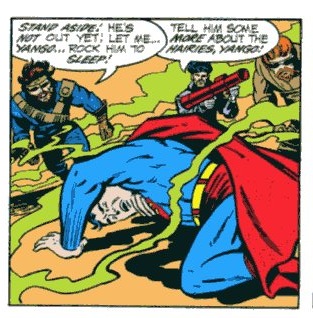
Superman…unconscious?!

Kirby fans often note that his comics are bursting with ideas. And, after reading DC’s two volume 2003 collections of Kirby’s run on Jimmy Olsen, I can’t deny it. Lots and lots of stuff happens in these stories. There’s secret underground hippie biker lost realms, secret government clone projects, green Jimmy Olsen clones, scrappy fighting kids, miniature clones of scrappy fighting kids, gratuitous Scottish accents, extradimensional evil, extradimensional good, alternate versions of Don Rickles, tiny worlds populated by even tinier monster movie rejects,groovy hippie pads, loch ness monsters, evil tycoons, evil mad scientists, and and lord knows what else. Just about every page has enough plot points to keep a typical contemporary comic happy for a year.

And yet. All those ideas, all that frantic creativity — you read one page and it’s charming; you read two pages and it’s impressive — you read a whole comics worth, though, and it starts to get wearisome. Kirby’s stereo has one volume, and that volume is everything plus the kitchen sink plus a four-armed monster and an atomic explosion. Occasionally he throws in schticky banter, not so much as a break from the noise as to make you wish the noise would come back and the banterers would shut the fuck up. And then (mercifully or not) the plot’s back, racing, racing, racing to nowhere in particular.

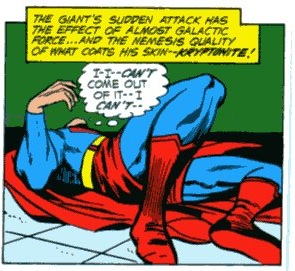
Superman…unconscious?!

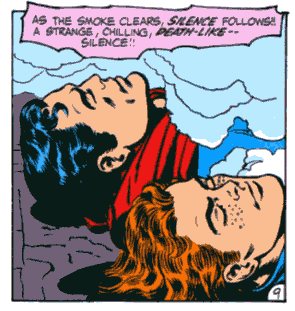
Because, the sad truth is that, for all of Kirby’s ideas, not a one of them goes anywhere or builds to anything or does anything except sit there saying, “Ayup! Here’s an idea!” The result is that, for all the wild rushing and hand waving (literally with the four-armed monster(!!!!)) these books are incredibly, deafeningly tedious and repetitive. Protagonists are beset by antagonist, protagonists are knocked unconscious/otherwise immobilized; protagonists come back and beat antagonists (or occasionally realize that antagonists are good guys.) Repeat. Repeat. Repeat. It goes on and on, remorselessly, through more than 300 pages. Plot development, characterization, a point of any kind — forget it. Fight, setback, victory, fight, setback, victory. Epic.

Superman and Jimmy Olsen…unconscious?!

People often talk about the cosmic scale of Kirby’s comics. Maybe that’s true in some of his other work, but here the cosmic touches look suspiciously like the stupidest kind of fantasy/sci-fi cliches. Evil vs. good; dark vs. light. You can tell the bad guys because they say, “We’re bad guys!” and blow things up, whereas the good guys say “We’re good guys!” and blow things up. Also the good guys banter and the bad guys rant. The ranting is more fun than the banter, but not sufficiently more fun for me to care enough to root for one side or the other.

Marston/Peter were devoted to feminism and fetish; they had a ideological backdrop which informed and gave resonance to their nutty ideas. Bob Haney had a bizarrely idiosyncratic grasp on genre and the holes in genre which made his ideas stumble and bump against each other in a series of pratfalls which were both unexpected and meaningful. But Kirby, at least in the Jimmy Olsen series, has no ideological commitments to speak of, and when he uses genre — as in his use of vampires or werewolves — it’s carefully compartmentalized. The vampires and werewolves are from another world; Jimmy and Supes fight them and eventually help them, but they never really themselves end up in a horror story. Instead they fight, experience setbacks, and then attain victory.

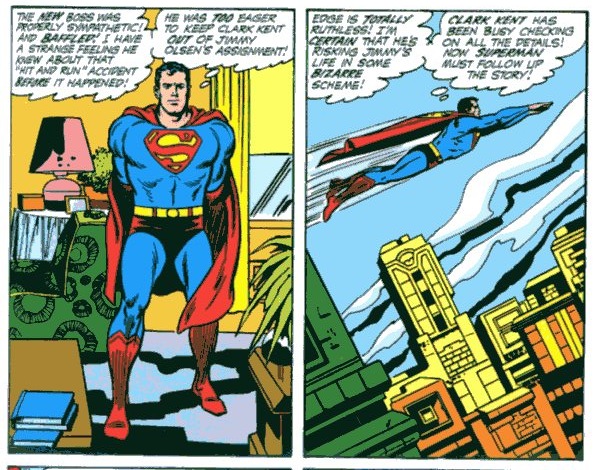
I know what I’m really supposed to like in Kirby is the art. I’ve never really fallen in love with his work, but there are definitely moments here I enjoy. Here for intance:

In the left panel, everything’s blocky and off, even Superman himself. The pose, with arms behind him, makes his silhouette seem off; and even the S on his chest seems squashed and askew. In the right panel, the cityscape is tilted and odd; it looks like a lego city built on an incline. Both images have an odd, lumpiness — a material forcefulness that is not so much contradicted by, as built upon, their imperfections.

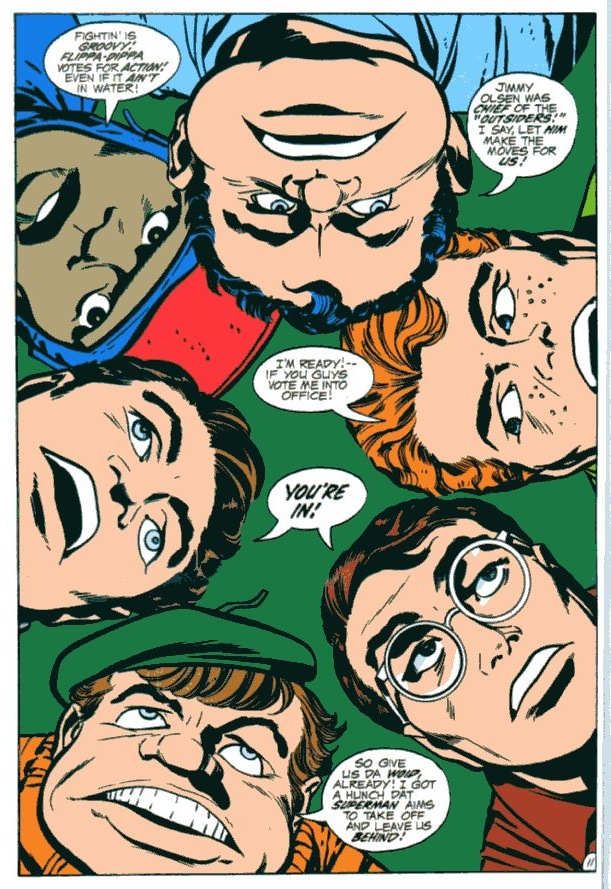
And, of course, this is hard to resist:

In this power-packed issue — we look up the newsboy legions’ noses!

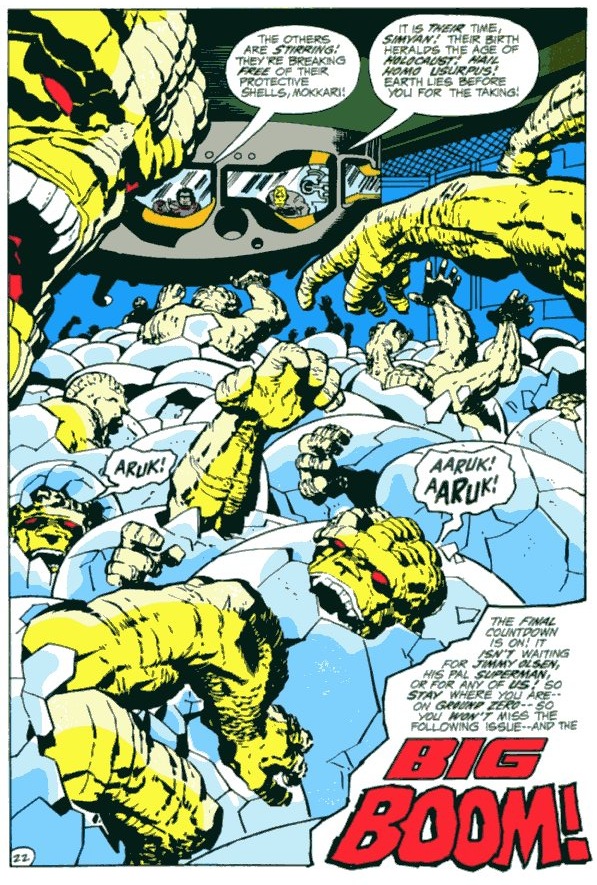
So, yes, I can appreciate that to some extent. And maybe the real way to enjoy these issues is not to read them at all, but just to flip through looking for those goofy Kirby monsters or enjoyably odd perspectives. But I did unfortunately read the thing…and having done so, I”m afraid Kirby’s art, enjoyable as it often is, doesn’t repay me for the couple of hours flushed down the drain. The power of the art, indeed, starts to veer towards self-parody; it seems to be relentlessly trying to convince you that something interesting is happening, to make up for the utter lack, not of ideas per se, but of ideas that have any meaning or consequence. Kirby ends up sounding like one of his typical monstrous creations, screaming “Aaruk! Aaruk!” It’s loud and has an initial novelty, but it doesn’t exactly fill me with admiration for the critter’s volcanic creativity.

Music For Middle-Brow Snobs: Aero Zeppelin

Metal, blues, cock, and rock. Download Aero Zeppelin here.

1. Driving South — Jimi Hendrix
2. Movin’ Out — Aerosmith
3. Francene — ZZ Top
4. Sharp-Dressed Man — ZZ Top
5. D.O.A. — Van Halen
6. Iron Fist — Sodom
7. Ace of Spades — Motorhead
8. Territory —Sepultura
9. T.V. Eye — Stooges
10. Helpless — Metallica
11. Aero Zeppelin — Nirvana
12. Wearing and Tearing — Led Zeppelin
13. Can Do — Journey

Tom Gill on Tsuge and Tatsume

Tom Gill has posted a lengthy comment on his essay about Tsuge and Tatsume and fetuses in the sewer from a bit back. I thought I’d reprint it here just to make sure it doesn’t get lost in the internets.

To all the readers who commented on my paper “Fetuses in the Sewer: A comparative study of classic 1960s manga by Tatsumi Yoshihiro and Tsuge Yoshiharu.”

First, many thanks for taking the trouble to read my paper and comment on it; and apologies for taking a very long time to get round to responding. I moved back to Japan from England in April and all my manga and stuff were on a ship for two months, and then there was the Great Tohoku Disaster as an added distraction. Anyway, let me respond now as best I can.

Several people asked how come Tsuge does not get translated into English more. I have heard the following theories, some here at HU, others from friends:

1. Some say the work is too challenging to interest mainstream publishers. Indeed, it is does make more demands on the reader that Tatsumi’s punch-in-the-face approach. Who’s to say whether it would sell?
2. Some say Tsuge has usually refused to allow his work to be translated because of bad experiences in the past. It probably did not help that The Comics Journal got his name wrong on the front cover of their 2005 special issue on Manga Masters. Calling him “Yoshihiro” (that being Tatsumi’s name) may have made it a teeny bit worse.
3. Someone here on HU said that Tsuge does not like the damage done to the flow of the visual narrative when manga get “flipped” when translated into English, though as Ian S pointed out, he has had a substantial chunk of work translated into French.
4. Yet another rumour has it that Tsuge promised the translation rights to some long lost friend in America who has never made use of them.

If anyone knows the truth of the matter, please do share.

Noah Berlatsky says: Here the representation and the reality are both in flux and swimming around each other.
— A very astute comment, and one that speaks to other Tsuge comics too. One reason why people have such a hard time responding to his famous work Neiji-shiki (Screw Style) is because they want to decode it, to refer symbols to reality when in fact neither is solid enough to allow such a reading. My main objection to Masashi Shimizu’s Freudian commentaries on Tsuge is that he thinks such a systematic decoding is possible, which sometimes leads him into far-fetched assertions.

Noah Berlatsky says: I was thinking about Anne Allison’s book Permitted and Prohibited Desires…
– Yes, it is interesting to speculate that the “absent father” may be hovering off-stage in these productions. Theories emphasizing Japan’s uniqueness are deeply unfashionable these days, which may explain why Shimizu never references Kosawa Heisaku (Anne Allison’s principle reference for alternative non-Oedipal development in Japan), or Doi Takeo, another absent father theorist well-known outside Japan, preferring to follow a relentlessly orthodox Freudian line in his analyses. In my paper on Tsuge’s ‘The Incident at Nishibeta Village’, recently published in IJOCA (spring 2011) I describe how Shimizu makes a large boulder stand in for a father figure in one of these forced interpretations.

Anyway…it seems like that might link up somehow with the fascination with fetuses you’re talking about here. It’s more direct with Tatsumi; the flip side of his misogyny is disempowerment fantasies; identifying with the fetus as revenge against the all-powerful feminine and as a capitulation to it. The bleak vision seems less like a look at the dark realities of life than an excuse to crawl back into the womb.

– Identifying with the fetus? A lot of horrible things are done to fetuses in Tatsumi’s comics. And also there are moments of tenderness – the window-cleaner carrying his daughter’s baby on his back in The Washer, for instance. I think a careful look at the role of fetuses/babies in these Tatsumi works shows that he is not quite as blunt and predictable as some readers seem to think.

>> Tsuge it’s harder to pin down…he’s more playing with the notion of returning to the womb than he is in thrall to it, perhaps?

– I think you are probably on target there.

>> As you say, the salamander seems like both sperm and fetus. If it’s pushing the fetus out to be born, it could also be in some sense the mother, or associated with the mother. A sperm dreaming it’s a mother, maybe? Or at least dreaming it’s gone back to the womb…though a womb reimagined as post-apocalyptic eden, too.

— With Tsuge, all is possible.

Maybe that makes sense of the womb/freedom symbolism you’re seeing in the water? That is, if the Oedipal relationship is reimagined so that mothers are actually the lawgivers, then it makes sense to think of the womb as not just safety but freedom.

— I don’t really get this.

ryanholmberg says:
Tom, I enjoyed your piece. Nice to read a baseline analysis of Tsuge and Tatsumi’s heavy-handed symbolism.

— I think you are rather unfair to both authors to call their symbolism heavy-handed.

>> There’s an interview between Tsuge and Tatsumi in Garo in 1971 that you should read. There Tatsumi more or less admits that Tsuge’s Garo work is what inspired Tatsumi’s circa 1970 stuff.

— Any chance of a photocopy?

>> The knocking-off is painfully obvious in some cases, and the work you have analyzed is not even the most extreme. Tatsumi produced some interesting things in the 50s, but most of his 60s material is just plain junk. Were it not for Tsuge, Tatsumi would probably have disappeared.

— I would not call Tatsumi’s 60s work plain junk. I much enjoyed reading these works. They are page turners. Then again, I also enjoy listening to loud, repetitive punk rock music. For me, Tatsumi is Johnny Rotten to Tsuge’s Roger Waters. That said, there does some to be fairly obvious ripping-off going on here. I am beginning to wonder if Adrian Tomine ever reads the postings here, and if so, whether he is going to jump in and launch a spirited defence of Tatsumi.

>> A couple corrections: Tsuge was not plucked out of oblivion by Nagai in 1965. He had already been making comics for close to a decade and was well-known in the kashihon circuit and even published work in mass-print magazines.

— I do of course know that Tsuge had already published a lot of stuff, Ryan, but is it not also true that Tsuge’s career was fairly moribund by 1965, and that Nagai heard he was struggling, wanted to help, couldn’t find anyone who knew of his whereabouts, and finally had to find him by putting a notice in Garo asking him to come forward and make himself known? Such at least is the legend… I’ve read it several times.

>> You also write that both artists wrote plenty of gangster yarns, ghost stories, and samurai bloodbaths in the 50s. I have not read everything by either of these artists, but from what I have I would to say that this incorrect. Tatsumi wrote very very few pieces set in the premodern period, and the one that I have seen was most certainly not a samurai bloodbath, but rather a ghost story set in the Edo era.

– You are probably right about Tatsumi. I wrote rather casually there, I must confess.

>> Tsuge also to my knowledge did not write that many gangster pieces (that was more a Gekiga Studio thing). He did write a number of samurai swashbucklers in the 50s, but the bloody samurai pieces didn’t come until around 1960, after Shirato Sanpei’s Ninja bugeicho made dismembered and splattered blood a prerequisite for the genre. Now that most of Tsuge’s pre-Garo work is in bunko (paperback), it should be easy to check this.

— Tsuge’s 1950s samurai bloodbaths include ‘Namida no Adauchi’ (The Tears of Revenge, 1955, 128pp.), ‘Sen’un no Kanata’ (Beyond the Clouds of War, 1955, 144 pp.), ‘Norawareta Katana’ (The Cursed Sword, 1958, 12pp.), leading into a series of four stories derived from the life and legend of swordsman Miyamoto Musashi in 1960. OK, that’s not strictly the 50s. His gangster yarns include ‘Hannin wa Dare da?’ (Who is the Criminal?, 1957, 40pp.), ‘Akatsuki no Hijousen’ (The Dawn Emergency Line, 1957, 66pp.), ‘San’nin no Toubousha’(Three Escapees, 1958,48pp), ‘Oyabun’ (The Boss), 1958, 20pp..
On the matter of bloodiness, I think you perhaps exaggerate Shirato Sanpei’s originality here. Tagawa Suiho has plenty of heads and limbs flying around the place in his 1930s Norakuro comics, for instance; Shirato’s contribution is more in the brilliant penmanship than the old ultraviolence itself, no?

ryanholmberg says:
I agree with Noah that if one is going to pursue some sort of psychoanalytical frame for Tsuge, you have to deal with the general absence of fathers. The wrench-carrying suit in Nejishiki could be read as a father figure, but otherwise they are pretty absent from Tsuge`s work, no? And when they do appear, they seem to be background color and not allegorical symbols.

— I think that in this Garo period, Tsuge typically has a male protagonist trying to come to terms with women, represented by actual women/girls he encounters on his travels, or by a feminized landscape, such as that of the Marsh (Numa). It is an obsession, and doesn’t seem to leave much room for fathers – or indeed for mothers, save as attenuated symbolic wombs like the one the salamander has found himself in.

>> Second, I think the Ibuse Masuji short story (which non-Japanese readers can read in Ibuse`s Salamander anthology) deserves more than a footnote, regardless of what Tsuge says about it himself. There is obviously more than a passing resemblance, and it is certainly more important than Western existentialist writing.

— You are right about this, though I wondered whether Hooded Utilitarian readers had enough interest in Japanese literature to warrant a full discussion. Tsuge freely admits borrowing from Ibuse – it is a famous story, a cameo literary classic, and by using the same title for his own work, Tsuge invites comparison. The offhand comment I mentioned him making about the Ibuse story in conversation with Gondo is typical of his sometimes infuriating reluctance to seriously grapple with his influences. I would make the following observations:

1. Tsuge has certainly borrowed the basic idea of the salamander as an existential figure from Ibuse’s story (first written around 1919; published in 1929). Both salamanders are literally in a hole, and forced by their predicament to reflect on the meaning of life. Even the way Tsuge’s salamander talks – or thinks out loud – sometimes recalls Ibuse’s salamander. Both are reflective, lugubrious voices, moody and sometimes capable of humour.
2. But this is creative adaptation, not plagiarism. Ibuse’s salamander is trapped in a very small cave, where Tsuge’s is relatively free, to wonder through the high-ceilinged labyrinth of a massive system of sewers. And where Ibuse’s salamander goes through a series of moods over a period of two years, we see Tsuge’s in a fleeting moment of his existence. His reflections make it clear that he has made a distinct progress, from disgust at his fetid environment to acceptance and even pleasure at the chance encounters that come his way. The final frame, in which he swims off into an ethereal light, is far from the image of permanent entrapment in Ibuse’s yarn. Whether that light signifies death/rebirth/enlightenment or what, it is probably better than just being stuck in a cave. So Tsuge’s salamander enjoys a lot more freedom of movement than Ibuse’s.
3. On the other hand, Ibuse’s salamander is considerably less isolated than Tsuge’s. He has a series of encounters with other animals – some killifish, a shrimp, then a frog. Tsuge’s salamander is completely alone – all the other animals we see are dead, except possibly for one water-rat glimpsed in a single frame. Hence the nightmarish, post-apocalyptic atmosphere of Tsuge’s piece. Ibuse’s salamander, though trapped, is at least in a familiar natural world. Outside his cave is a bright pool teeming with life. Who knows what lies outside the sewer inhabited by Tsuge’s salamander?
4. Both salamanders show a malicious streak, Ibuse’s trapping a frog to share his confinement, Tsuge’s head-butting the fetus he encounters. Despite his brutal behavior towards the frog, who is dying of starvation by the end of the story, Ibuse’s salamander is finally forgiven by the frog, and the story fades out ends on a note of quiet resignation. At least they have each other. In Tsuge, the fetus is not so much bullied as discarded, being too alien to the salamander’s experience to be understood. Again, there’s a deep isolation here that we do not find in the Ibuse story. Going back to Noah’s comment about use of metaphor, if Tsuge’s story is a metaphor for the human condition, then the arrival of a real human, albeit an unborn/still-born fetus, is a gross intrusion by the signified upon the world of the signifier. This may help to explain the deeply unsettling atmosphere of the Tsuge story.
5. Ibuse’s story is told through several voices: that of the salamander, those of the shrimp and the frog, and an authorial voice which invites the reader to laugh at or sympathise with the salamander. Tsuge has boiled the narrative down to a single interior monologue as the solitary salamander ruminates in solitude. The absence of authorial voice or other characters leaves the story more intense and focused than Ibuse’s.

In short, I think the interplay between these two salamanders adds a fascinating further layer of complexity and density to this little 7-page vignette for those who are familiar with the Ibuse story.

>> This isn`t the only story Tsuge borrowed liberally from.

— Tell me more!

>> Also, I feel like an artist can get that “existential” feel from anywhere, from life as much as from books. Probably a better track of interpretation would be to go back to the beginning of your essay and try to explain this through demographic or historical context.

— I don’t quite follow. Please tell me more.

>> I will probably post a related piece about Numa on TCJ sometime in the summer, so I will leave my thoughts for now at that.

— I look forward to seeing that piece.

>>e reason I made the comment last week about what sorts of genres who was working in in the 50s was because I think it’s important to see how both Tatsumi and Tsuge started in a detective-thriller mode. However they diverged in the early and mid 60s, I think their re-convergence in the late 60s is in part a return to those 50s origins.

— Thanks for the clarification.

Ryan Holmberg has responded here.

I’ve closed comments on this post. If you have a response, please put it on the original post.

Utilitarian Review 7/2/11

News

Polling ended in our Best Comics Poll. Robert Stanley Martin explains what happens next.

On HU

Our Featured Archive post this week was Caroline Small’s discussion of autobiography and Aline Kominsky Crumb.

I talked about Twin Peaks, the Wire, Stalker, and the truth.

Stephanie Folse continued her Elfquest reread with issues 8 and 9.

I reviewed the Cartoon Introduction to Economics.

I discussed Lock Stock and Two Smoking Barrels, True Romance, Green Lantern, and the luck of the assholes.

I reviewed the classic Heny/Aparo Batman/Deadman team up,one of my favorite comics ever.

Kinukitty reviewed Steven Tyler’s memoir.

Erica Friedman told the creators what to do and what not to do with the live action version of Noir.

Utilitarians Everywhere

At Splice Today I talked about race, the South, and a new compilation of Delta Swamp Rock.

Also at Splice I talk about Beyonce’s latest disappointing album.

At Comixology I talk about superhero tropes and the ultraviolent Japanese exploitation film Machine Girl.

Other Links

A discussion of why there aren’t more women in comics.

Tucker Stone has a lovely Comics of the Weak this time out.

Also, Factual Opinion movie review this week: Bad Teacher and Jog on Green Lantern

Old but good Jason Thompson on Japan, Inc.

Melinda Beasi talks about talking about josei manga.

And more Jason Thompson — this one’s his Uzumaki review.

Sean Michael Robinson reviews Onward Towards Our Noble Deaths.

Alyssa Rosenberg on why Frank Miller and terrorism are not Jack Kirby and WW II.

An escort reviews Paying for It. (Hat tip: Sean Michael Robinson.)

Shaenon Garrity on how to get more women in comics.