Today is the ABSOLUTELY LAST CHANCE TO CONTRIBUTE TO OUR BEST COMICS POLL. THIS IS IT! WHAT ARE YOU WAITING FOR! CLICK THAT LINK AND SEND US YOUR LIST! IT’S THE CHANCE OF A LIFETIME! FREE BUNNIES IN SUPERSUITS WITH EVERY SUBMISSION! DO IT! DO IT NOW!
Ahem. Sorry. Excitement got the better of me.
Anyway, to get you in the selecting-best-of-things mood, I thought I’d reprint this short essay from Craig Fischer’s zine project to benefit Team Cul de Sac and Parkinson’s disease research. The zine includes lots of your favorite comics writers ( Jeet Heer! Robert Stanley Martin! Shaenon Garrity! Caroline Small!) writing about their favorite comics. I picked Bob Haney and Jim Aparo’s Brave and Bold #104 featuring Batman and Deadman. Here’s what I said.
__________________ Everybody loves Batman the avenging demon of the twilight, kicking Kryptonian superballs with spiked kryptonite Bat Boots while simultaneously grinding Liam Neeson’s Ras Al’Nose against the inflated manliness of Styrofoam pecs. Me though, I prefer Batman the incompetent patsy and bumbling stooge circa Brave and Bold #104. Written by Bob Haney and drawn by Jim Aparo, this is a stylish noir where Batman is framed at dramatic, improbable angles failing to infiltrate a bridge club and/or successfully allowing everyone around him to be murdered. Deadman’s thrown into the mix so that the great Bat can cluelessly betray him and ruin his — well, not life exactly, but you know what I mean. This is superheroes the way they were meant to be; as woozy police hacks fucking up everything they touch, wandering off panel after the “happy ending” with a concerned glance at their underwear and a cloud of flies rising from the corpses in their wake. Plus, there’s a cameo by God who comes off about as cynically incompetent as Batman himself., randomly tricking Deadman into shooting his lover for no explicable reason. The universe makes no sense, and the guy with the bat ears fighting crime is exactly as ridiculous as he looks, a danger to himself and others. Bob Haney: he had a bleak vision.
________________
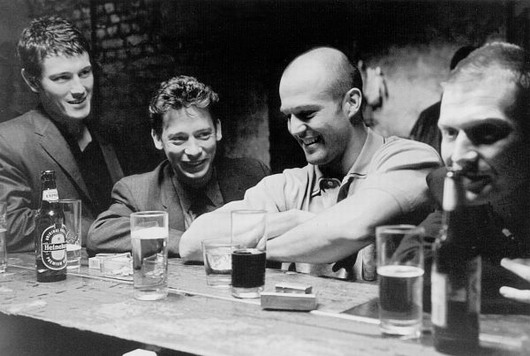
Both Lock, Stock and Two Smoking Barrels (1998) and True Romance (1993) end in flamboyant, modern deus ex machinas. By “modern” I mean that there’s no god cranked down on a wince. Instead, salvation is attained through the entirely materialist force of dumb luck, also known as the scriptwriters finger on the scales. In Lock, Stock, director Guy Ritchie’s four bumbling lads stumble into wealth when about a billion other tougher, badder, smarter armed factions all happen to conveniently shoot each other, leaving our heroes as the only ones standing. In True Romance, director Tony Scott and writer Quentin Tarantino’s bumbling couple stumble into wealth when about a billion other tougher, badder, smarter armed factions all happen to conveniently shoot each other, leaving our heroes as the only ones standing.
In both films, the unlikely denoument is intended to be a tour de force; you’re supposed to admire the intricate mechanism of the plot just as, perhaps, the ancient Greeks admired that intricate mechanism which dropped the God onto the proscenium. And by that measure, at least, both films succeed; their narratives are energetically and pleasingly tangled. A plethora of bit characters — Christopher Walken and Dennis Hopper in True Romance, Vinnie Jones and Lenny McLean in Lock, Stock — roll about amidst the strands like profane kittens ingratiatingly farting. It’s maybe a little too cute, but overall not a bad way to kill a couple of hours.
In both films, though, one thing rankled. I was meant to like these people. As a viewer, I’m supposed to be rooting that Guy Ritchie’s four bozos don’t have their fingers chopped off, and that Sting (playing a sympathetically tough working-class dad to one of said four bozos) doesn’t lose his sympathetically tough working-class bar. I’m supposed to cheer because Christian Slater’s movie-star-tough-guy dreams all more or less come true rather than ending in a hail of bullets and a pool of his own blood. Plus he gets to bang Patricia Arquette for all eternity, or thereabouts. Yay!
Unfortunately, there’s been a slight miscalculation — that being that there’s nothing remotely likable about any of these characters. Guy Ritchie tries rather desperately to distinguish his four young boneheads one from the other or, indeed, from anyone, by giving hiply incongruous voice over tidbits about each one. It’s nice to see him try, but the main effect is not to make you like the characters, but rather to make you wonder why the so enthusiastically declaimed personality quirks don’t actually figure into the film anywhere else. For example, Eddie (is his name Eddie? oh, who the fuck cares) is supposed to be incredibly good at reading people — but he never reads anyone that I can tell. He just pals around with his pals and fucks up and gets into trouble and then gets out by screwing other people over and then gets really drunk, which is supposed to be endearing. He’s not even an irritating loser; he’s a hollow trope posing as an irritating loser.
Christian Slater (is his name Vince in the film? again, I refuse to care) is a bit more complicated. He’s a comic store clerk and an exploitation film freak — he tries to pick up a girl by asking her to a Sonny Chiba marathon; on his first date with Arquette (Alabama; I remember her name) he reads to her from some Spider-Man comics. He’s a nerd and a geek; eccentric and kind of sweet.
Supposedly. I think it may have worked in Tarantino’s original script. However, thanks to the direction by Tony Scott and a flat, unmotivated performance by Slater, the geek eccentricity never coheres. Instead, Slater quickly moves from loving fictional violent heroics to engaging in successful violent heroics himself — shooting pimps, stealing cocaine, screwing a movie star, and generally behaving like a movie star himself. Tarantino’s writing undercuts the heroism — Slater leaves his driver’s license at the scene where he killed the pimp, and his stupidity causes the death of his own father. But Scott and Slater are too dense to hear what Tarantino’s telling them; neither Slater nor the film ever realize that what’s interesting about Vince (or whoever) is not that he’s the star of the film, but that he isn’t.
For Tarantino, I think, Slater’s a fuck-up trying to be the hero he’s seen on film and failing. That’s a sympathetic and interesting character…and you’d have cared when he died, as he did in Tarantino’s original script. But the Slater we get instead is just another tough guy whose mistakes are never brought home to him, both in the sense that he doesn’t ever get to integrate them into his character and in the sense that he doesn’t suffer from them. Patricia Arquette is a more charismatic actor by far, and she is able to capture more of the vulnerability in Tarantino’s script even as she beats a mafia boss to death. But the happy ending, and the general drift of the direction, undoes her as well — her individuality is crafted in the teeth of the rest of the film, and the storybook happy ending cheerfully undoes her efforts, turning her into the beneficiary/victim of yet another Hollywood romance.
The protagonists in both these films, then, are heroes not because of anything they do or anything they are, but just because they’re there. They’re the young white guys on the marquee; God (or the director) loves them, and the world is organized for their benefit. There’s a depressing verity to that; the world really is in many ways organized for the benefit of young, stupid, boring white guys, especially if they’re attractive movie stars. But having that driven home in as gratuitous a fashion as possible is not quite the happy ending that the directors seem to think it should be.
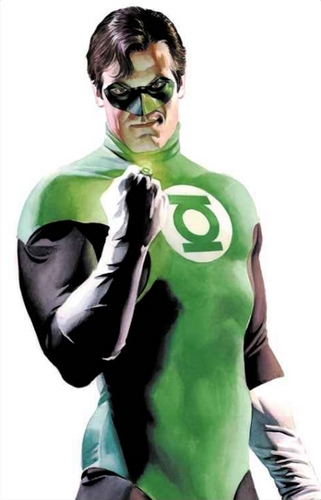
________________ I was thinking about these films in relation to the new Green Lantern movie — which I blissfully haven’t seen, though I’ve read Jog’s review, which is undoubtedly more entertaining as well as more informative. Anyway…I was thinking that a superhero’s real power isn’t super strength or super speed or a magic wishing ring, but unearned luck courtesy of some overinvested creator. In Lock, Stock and True Romance, the luck is backloaded; it comes in at the end after lots of plot manipulation. In superhero stories, it’s frontloaded — being bitten by a radioactive spider gives you amazing strength rather than cancer; having a shelf-full of chemicals fall on you gives you superspeed rather than chemical burns; you’re chosen out of everyone on earth because you’re a showboating dipshit, etc. etc. But backloaded or frontloaded, the power of luck works the same — providing both the mechanism for victory and the supposed justification of it. Hal Jordan is the hero because he’s chosen to have the ring, and he’s chosen to have the ring because he’s the hero. The logic is, appropriately, perfectly circular.
Superheroes are generally seen as power fantasies…and obviously, they are that. But Lock, Stock and True Romance suggest another possibility too…which is that the power fantasies are closer to real life than might be altogether comfortable. Those (mostly) Western (mostly) white (mostly) guys who generally get to be superheroes…in real life, they really can wave their hands and destroy large portions of Afghanistan, just like Iron Man. They really can display some mystic green and bury themselves in ephemeral glowing toys. The fantasy isn’t the power so much as the adulation — the assurance that the luck is earned and that the whole world loves to be grist for the remorseless grinding of someone else’s plot.
The Cartoon Introduction to Economics, Volume 1: Microeconomics
Grady Klein and Yoram Bauman; Hill and Wang; ,224 pp., $17.95; B&W, Softcover; ISBN:978-0809094813
“…nobody, except under threat of torture, can read a school book,” George Bernard Shaw commented. “The reason is that a school book is not a work of art.”
Comics were for many years not considered art either … but in general because they were too easy to read, not too hard. Historically, comics have been sneered at for their excessive accessibility — a trait which makes it difficult (though as recent art-comix trends show, not impossible) for them to attain the rarefied level of obfuscation required for highbrow modernist cred.
The same qualities which doomed them to generations of academic disdain, however, make comics perfect for conveying basic information without sending long-suffering students into a stupor. Scott McCloud figured this out years ago, with the result that, despite their pedestrian insights and hideous design, his books have become staples in introductory college courses nationwide.
Artist Grady Klein and economist Yoram Bauman have taken McCloud’s insights, applied them to material that is not (unlike McCloud’s) actively idiotic, and come up with a thoroughly readable book that explains microeconomics clearly, and even charmingly. Bauman (who has spent time teaching in high schools as well as colleges) and Klein do an excellent job of using analogies to explain the abstract concepts of economics, whether demonstrating Pareto efficiencies by dividing cake, or illustrating elasticities with the use of a torture rack.
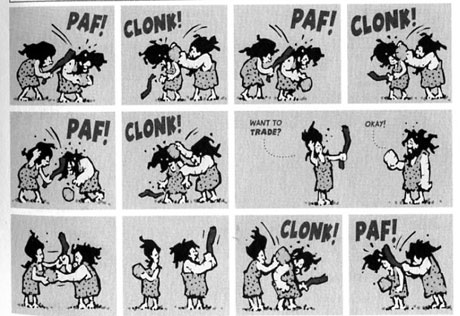
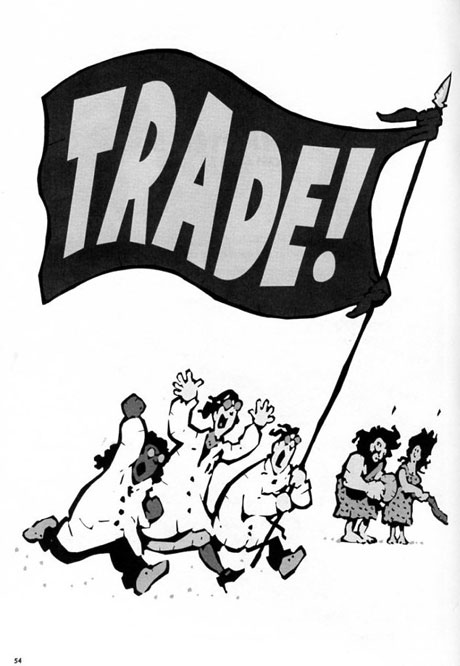
The creators are also, in the best traditions of comics, willing to throw in the odd gratuitous joke for pure amusement value:
And, again as per comics tradition, they even engage in some gentle satire. For example, in a series of running gags, the creators cheerfully suggest that a fair bit of economics is simply coating the obvious with a patina of scientific pretension.
But though the book is enjoyable to page through, it’s not exactly a delight to look at. Klein is a better illustrator than Scott McCloud, but that doesn’t mean his drawing is attractive. His characters have a thick, generic, formless quality that suggests clip art, and his layout and design skills are solidly so-so. It’s easy enough to figure out where your eyes are supposed to go on the page, but that’s the most you can say for the layout. His occasional full-page splashes are notable mainly for their lameness; this, for example, is an impressively ineffective use of white space:
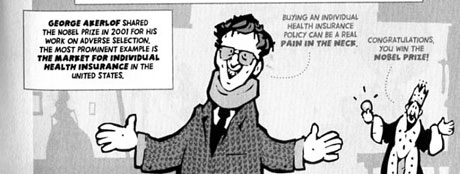
Bauman too, has his limitations. While he’s willing to poke fun at economists on occasion, his skepticism has definite limits. There’s no sense in his work of the contested historical or cultural place of economics as a discipline. Thus, the Nobel Prize is mentioned, but not the fact that there is, in fact, no Nobel Prize in economics — the “extra” faux Nobel was added by bankers, because bankers really like economics. Similarly, Fidel Castro and Che Guevara pop up as stereotypical figures of fun, but communism, with it’s generalized assault on the ideological place of economics, is never mentioned.
An economics textbook, of course, is meant to teach you economics; it’s not intended question its own premises. But, whether that’s a failure of Bauman or of the textbook genre, the result is a chirpy platitudinous boosterism, with the last pages of the book assuring the reader that economics can offer “creative and powerful solutions” to problems like climate change.
So is this book a work of art? I would say that it is — though not a great one. Whatever its weaknesses, it was clearly created by particular people to be read by particular other people, rather than, as is the case with most textbooks, created by committee to be read by no one. As a longtime professional educator (God help me), I’d certainly recommend it for high school or first-year college classes, where even mediocre art would be a vast improvement over the general bill of fare.
______________________
This review first ran online at The Comics Journal.
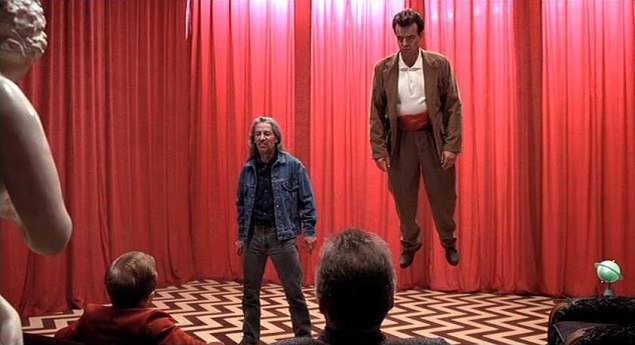
Considering they’re both serial TV dramas, Twin Peaks and the Wire couldn’t have much less in common. Twin Peaks explores the quirky surrealism of a small town; the Wire looks at the intricate realism of a city. Creator David Lynch uses the improvisational rhythm of dreams; creator David Simon relies on the layered narrative of investigative reporting. And where the Wire is one of the most multi-racial shows ever to appear on television, Twin Peaks is, insistently, not.
Yet, on closer inspection, the two shows had in common. In particular, both Twin Peaks and the Wire are obsessed with the real.
In part, this obsession is a function of genre. For all their differences, both shows are at heart police shows, and both are built around investigations and the ferreting out of secrets. In both, the techniques and expertise of the protagonists are leant to the viewer, who is enabled to approach nearer and nearer to a provocatively concealed heart of corruption. The famous scene in the Wire, where McNulty and Bunk deduce how a murder was committed while communicating solely by using the word “fuck” is analogous, in its flamboyant hermeticism, to the scene in Twin Peaks where Dale Cooper identifies likely suspects by referencing Tibet and throwing stones at bottles.
Whether through a triumph of earthy procedure or through semi-mystical intuition, the results are the same — the knowing expert shines light into the heart of darkness.
“Heart of darkness” has racial connotations of course — and that’s apropos for both shows. The connection between race and reality is most obvious in the Wire, a show immersed in the vibrancy, and despair of Baltimore’s African-American community. Omar’s transcendent cool, Kima’s understated integrity, D’angelo’s tragedy, and Snoop’s brutality are all manifestations of intertwined authenticity and blackness. The white characters, too, draw their grit in large part from the show’s integration. Thus Entertainment Weekly praises McNulty for his funk, which it links to his “easy rapport with his African-American work partners.”
Race at first appears to be almost entirely absent from Twin Peaks…but the absence speaks loudly. The show is set in the perfect American small town, with people who are all friendly, all decent, all blessed with movie star good looks, and, oh yes, (with the exception of a stereotypically untrustworthy Asian woman and a stereotypically spiritual Native American) virtually all white.
That whiteness — the trusting small town, the blonde homecoming queen cheerleader — is part and parcel of the perfection. And as the town’s secrets are revealed, it is not just the perfection, but the whiteness, which is shown to be a facade above a swirling pit of jealousy, greed, and deformation. Laura Palmer, that blonde homecoming queen, is addicted to cocaine just like all those black junkies on the Wire. Her father, Leland, is, in the depths of his twisted soul, not white at all, but rather the demonic spirit BOB played by Native American actor Frank Silva.
Moreover, the whiteness in Twin Peaks is undercut and doubled by its own queerness. The show is an extended meditation on the campiness of whiteness; the perfect exterior concealing melodrama and lust. When Laura’s best friend Donna wears her friend’s sunglasses, she turns into a teen femme fatale, exterior transforming interior. More pointedly, after Laura’s death, her murderer/rapist father, Leland, begins to compulsively dance to show tunes, his dark sexual secret finding expression through his response to stereotypically gay cultural responsiveness.
The truth in Twin Peaks is ultimately Freudian; the revelation of the ogre father and the primal scene. In the prequel, Fire Walk With Me, we learn that Leland has been raping her daughter since she was 12; in the series itself, another father almost sleeps with his daughter. In The Wire, on the other hand, the revelations are less psychological and more pragmatic, focusing on the overwhelming, crushing, and corrupting power of institutions.
There are many other cop shows built around investigation, of course. But where something like Bones or the Mentalist lets the knowing detective tie up the truth in a pretty bow at the end of (at least most) episodes, the Wire and Twin Peaks treat truth as an overwhelming excess, which expertise can provisionally master but not contain. The resulting tragedy is is in many ways the guarantor of the reality. The real does not have a happy ending. The Wire concludes by establishing that life in Baltimore will go on as before; while some individual characters may escape to provisionally bright futures, the city as a whole is no closer to escaping its pathologies than it was at the beginning of the series. Twin Peaks effectively ends with the death of Leland and the escape of BOB. The culprit is dead, but his spirit lives on…and to the extent that the series abandoned that grim insight in its later part, it became virtually unwatchable (or, at least, I couldn’t watch it.)
I love both Twin Peaks and The Wire. I think they both deserve their reputations as the greatest television show ever. I do wonder though how much that reputation is about their mutual obsessions with the real. Television has often been seen as uniquely irrelevant bone-headed escapism. The Wire and Twin Peaks both, in quite different ways, present themselves as windows onto unpleasant truths. They’re serious because they show us what is, and provide no escape. Laura’s ascent to heaven in Fire Walk With Me seems more a dream to emphasize the tragedy than an actual cause for optimism, while McNulty’s final attainment of peace seems like an instance of accepting what he can’t change rather than a broader assertion of hope. Evil is fixed; experts know but can’t save us, or even themselves. It’s a grim vision so critically embraced that one starts to wonder if it could be, at times, self-fulfilling.
_________________
Coincidentally, I just watched Tarkovsky’s film Stalker, which has a very different take on the real. Stalker is ostensibly a science fiction tale set in the Zone, a mysterious, dangerous realm where your deepest wish may be granted. Tarkovsky, though, makes no use of special effects of any kind, and so the Zone appears as simply any other piece of countryside. The three men wandering through it, casting nervous glances this way and that, seem like children playing a not-very-convincing game of make-believe — a sensation only emphasized by Tarkovsky’s long takes and excruciatingly slow pacing. The camera frames a long shot of a field, the men in the distance move across it…and still move across it…and still move across it…giving your attention a chance to wander to the trees, and the sky, and then back and yep, the men are still crossing the field…and you’ve got plenty of time to think about how silly the actors must have felt, and wonder whether they were thinking about their motivation, or how silly the script is, or just about whether they were ever going to get to stop walking across the field and go to the bathroom, for the love of God.
Eventually the guide (Stalker) leads his two followers (Writer and Professor) to the wish-granting center of the Zone, called the Room. But at the last minute both of the followers, perhaps fed up with the transparently ersatz nature of the whole endeavor, refuse to participate in the silliness anymore and balk at going in. One of the film’s last scenes shows Stalker back in his beautifully grungy hovel, lying down into his bed as if reclining in an Old Master painting, bewailing the intelligentia’s lack of faith. “Can people like that believe in anything!” he moans. “And nobody believes! Not just those two. Nobody!” After comforting him, his long-suffering wife breaks the fourth wall and directly addresses the camera, insisting that despite all her troubles, she has never regretted her life with the Stalker. “It’s better to have a bitter happiness” she says, “than a gray, dull life.”
On the one hand, Stalker is like the Wire; it fetishizes grit. The first part of the film, before the protagonists make it into The Zone, is set in an urban landscape which is run down even by the standards of the Wire’s Baltimore. On the other hand, Stalker shares characteristics with Twin Peaks. Both fetishize a secret, dangerous realm just out of sight.
But where the Wire and Twin Peaks figure the physical and spiritual as truths for genre to reveal, in Stalker both function more as consciously framed tropes. The Stalker’s hovel is so ravishingly shot and carefully composed that it becomes a quotation about grit rather than a direct apprehension of it. The intimations of otherworldliness in the Zone are so stubbornly unrealized that they become quotations about surrealism rather than an actual apprehension of subterranean dangers.
Stalker loves these genre references, but not because they show reality. Rather, it loves them as genre — as the imaginary. And if there’s a real in Stalker, it’s not in these pulp gestures, but in the process of film itself; the shots of grassland or a wall or a face held so long that narrative drains away, and you’re left looking at grassland or a wall or a face. The real is not the end result of a process of meaning, but the beginning of a process in which meaning must be added. The wall can be poverty; the grassland can be an ominous psychological truth; but the viewer must make it so. Art does not strip away to an essence, but adds to a blank. The Wire is worthwhile not because it is true to Simon’s Baltimore experience, but because of the energy of its narrative entanglements; the energetic metaphoricity of D’Angelo at the chess board or the profaner-than-life dreamed-of universal signification of “fuck”. Twin Peaks is profound not because it shows the real corruption of small town America, but because of its hollow flamboyance, haunted by specters of irony and dread. The shows are great not because they’re real, but because they’re imagined.
The very last scene of Tarkovsky’s film shows the Stalker’s crippled child sitting at a table, staring at glasses, and apparently moving them (slowwwwly) with her mind. After she stops, we hear a train pass, and the glasses shake. The telekinesis is, of course, just a special effect…and it emphasizes the fact that the train shaking the house is probably a special effect too. Tarkovsky seems to be almost taunting us, daring us to accept the shaking but not the telekinesis — or rather, to accept both. For Stalker, film is not about gaining expertise and seeking truth. It’s a way to practice faith.
Contrary to Noah Berlatsky’s reading of the second panel in his “Crumbface” essay (click here), I don’t feel any of it is gratuitous. It’s a pointed rebuke that did not flatter its ostensible targets. Telling Joplin that’s she’s engaging in a “Mammy” routine, as well as identifying her audience in part with an Al Jolson figure, is not something that would be calculated to endear Crumb to either. And given the avowedly anti-racist liberal politics of the San Francisco counterculture scene that Joplin and her early audiences belonged to, Crumb also pointed the way for their political enemies to cluck at them for hypocrisy. It didn’t cause offense because Joplin and her audience were sophisticated enough to both recognize and at least tacitly acknowledge the failing Crumb was highlighting.
It’s a thoughtful defense. I’m still not convinced though.
First, Robert says that Joplin and her fans would not have found Crumb’s satire of their black appropriations comfortable.
Interestingly, Crumb’s original intention was for this art to run on the back cover and a portrait of Joplin to run on the front. But Joplin loved the the comic strip art so much, (she was an avid underground comics fan, especially the work of Crumb, and already at that point in her escalating career, had the power to hire her own cover artist), she decided to run it on the front.
That certainly doesn’t sound like Crumb’s satire made Joplin at all uncomfortable. I haven’t been able to find anything online suggesting that fans were put off either. Maybe Joplin’s just kind of dumb of course…or maybe, as Robert suggested, she was self-aware enough to find a pointed reference to her black roots amusing. Still, if satire doesn’t cause its targets even the least discomfort — if they in fact want to put it on the cover of their product — does it make sense to call it satire?
More important than intention or audience reaction, though, is the image itself. And I don’t think that image sustains a claim of satire.
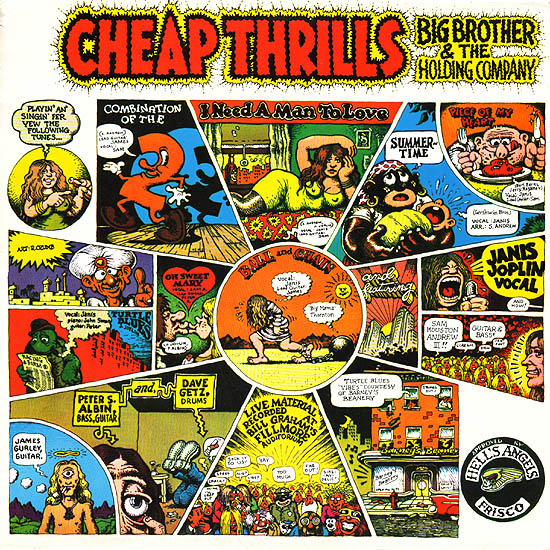
Look at the rest of the album cover; the images other than the blackface caricatures. None of those images is satirical, or pointed. Instead, they’re silly and/or sexy and/or energetic. Many of them rely on goofy puns (“Piece of My Heart”, “Combination of the Two”) The center top image shows a woman (probably meant to be Joplin) in a sultry pose with prominent nipples clearly visible through her top. On the left hand side, there’s a drawing of a goofy, stereotypical Indian with traditional headdress. On the bottom, there’s a caricature which seems to conflate Jesus and Eastern mysticism.
Robert argues that the blackface caricatures are different. Instead of an expression of high-spirited high-times and easy irreverence, he argues, the blackface caricatures are a critique. In them, Crumb is showing Joplin’s connection to and reliance on a black musical tradition, and linking her to earlier white performers who relied on that tradition, like Al Jolson.
But, as an alternate reading…couldn’t Crumb just be more or less thoughtlessly using blackface iconography because it’s funny and energetic? Couldn’t the images just be examples of high-spirited high-times, and of Crumb’s irreverent refusal to bow to the 60s equivalent of political correctness? Couldn’t his use of blackface be like his use of prominent nipples or his use of a sacrilegious Jesus caricature? That is, couldn’t the blackface caricatures be used because they are fun, and because they are (at least somewhat) shocking, rather than because they skewer Joplin and her fans?
Intent is hard to parse, of course. But I think if you’re going to argue for satire, you need to explain what Crumb has done to distinguish between blackface-as-critique and blackface-as-nostalgic-scandalous-good-times. If the cover can be read as fun good times, and the blackface can be easily incorporated into the idea of fun good times, and Joplin and her fans embraced it, presumably as an icon of fun good times, it’s really not clear to me why I should give Crumb credit for making a pointed political statement. On the contrary, it seems to me that he’s using blackface like he’s using nipples and silly puns — as a cheap thrill. And, as I said before (to Jeet Heer’s annoyance)using blackface as a cheap thrill still makes Crumb, to my mind, kind of a shithead.
I have to say too…even if Robert is right, and it’s a satirical take, I still find it pretty dumb. As I note in that Comixology article, “Summertime” is one of the great interracial collaborations in American song. Written by George Gershwin about the black experience, it was based on Eastern European folk melodies and adopted by many of the greatest American performers of various races. It’s a song whose history challenges the usual narrative of white appropriation of black music. George Gershwin didn’t don blackface to become a pretend black person; he collaborated with black people over decades in order to interpret an American experience through an American art that was neither white nor black.
The usual narrative of blackface appropriation— applied to Elvis, or Janis Joplin, or whoever — is itself part of our racist past. It assumes that blacks are the authentic creators of music, the magical Negroes, to whom whites must go to draw upon true musical genius. And I think you can actually see Crumb’s cover as plugging directly into this; his use of black caricatures does not so much critique Joplin’s music as light-heartedly validate it. The caricature in the center bottom panel, the black man digging Joplin’s music, is not a sneer at Joplin — it’s a goofy thumb’s up. See! Whoohoo! Even black people dig this music! Similarly, the shouting baby, all gusto and throat, is not a critique, but a funky wink. Joplin gets her lungs from that true source. And that true source is a stereotypical black mammy.
American music is, and has always been, both black and white, with performers of every race borrowing and learning from each other. The reason blackface is racist is not because white performers were inspired by blacks, but because they gilded their black influences with invidious racist stereotypes. Crumb’s use of blackface caricature is, therefore, neither fun nor, even in the most generous interpretation, insightful. It perpetuates simplistic images of black people and of race in the U.S. The Cheap Thrills cover is an ongoing testament to Crumb’s great illustration and design skills, and to the extremely limited intelligence with which he often employs them.
____________
Update: This post is part of an ongoing roundtable on R. Crumb and race.
1. Cry Me a River — Julie London
2. Falling — Julee Cruise
3. Crying — Roy Orbison
4. I Miss You So — The Orioles
5. Blue Velvet — Gene Pitney
6. He Cried — The Shangri-Las
7. I’m Me — The Paris Sisters
8. She’s Got You — Patsy Cline
9. Hope There’s Someone — Antony and the Johnsons
10. Salvador Nao Inerte — Virginia Rodriguez
11. Rising Moons — The Horse’s Ha
12. The Owl of Love (featuring Shara Worden) —The Clogs
13. Meadowlark — Fleet Foxes
14. All My Sorrows — Lindsey Buckingham
15. ‘Till I Die — Beach Boys
16. Rockin’ Back Inside My Heart — Julee Cruise
17. It’s My Party — The Paris Sisters

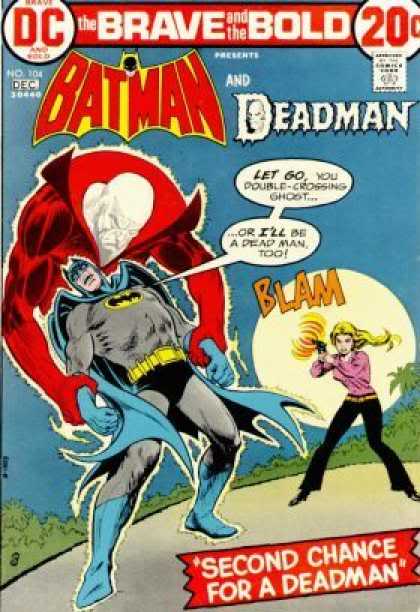 Everybody loves Batman the avenging demon of the twilight, kicking Kryptonian superballs with spiked kryptonite Bat Boots while simultaneously grinding Liam Neeson’s Ras Al’Nose against the inflated manliness of Styrofoam pecs. Me though, I prefer Batman the incompetent patsy and bumbling stooge circa Brave and Bold #104. Written by Bob Haney and drawn by Jim Aparo, this is a stylish noir where Batman is framed at dramatic, improbable angles failing to infiltrate a bridge club and/or successfully allowing everyone around him to be murdered. Deadman’s thrown into the mix so that the great Bat can cluelessly betray him and ruin his — well, not life exactly, but you know what I mean. This is superheroes the way they were meant to be; as woozy police hacks fucking up everything they touch, wandering off panel after the “happy ending” with a concerned glance at their underwear and a cloud of flies rising from the corpses in their wake. Plus, there’s a cameo by God who comes off about as cynically incompetent as Batman himself., randomly tricking Deadman into shooting his lover for no explicable reason. The universe makes no sense, and the guy with the bat ears fighting crime is exactly as ridiculous as he looks, a danger to himself and others. Bob Haney: he had a bleak vision.