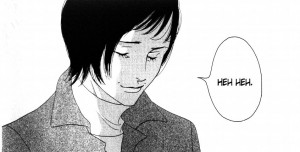
A little while ago I reprinted some drawings from a 2002 zine I made in which I illustrated Wallace Stevens’ 13 Ways of Looking at a Blackbird. A bunch of people (okay, two people) expressed interest in seeing the whole thing…so here it is. (Click pages below to move through the zine.)
Author Archives: Noah Berlatsky
Departure
I’m sorry to say that I’ve asked Alex Buchet to leave the blog. (Alex asked me to specify that it was my choice, rather than a mutual decision.)
Alex has been a hugely enthusiastic, knowledgeable and thoughtful contributor to HU over the past year. You can read his column, Strange Windows, here.
I am very sorry I wasn’t able to better resolve our differences, and I wish him the best of luck in all his future endeavors.
I’ve thought it best to close comments on this post.
Utilitarian Review 5/6/11
On HU
Erica Friedman talked about the Girl Prince in Yuri manga.
Alex Buchet discusses children’s book illustrator Benjamin Rabier.
I talked about Starship Troopers and Osama Bin Laden.
Richard Cook provided a history of Storm in comic book covers.
I talked about manga, Celine Dion, Mickey Mouse, Alain Badiou, and globalization.
Anja Flower talks about Edward Gorey, surrealism, and queerness.
And we’ve had a long discussion about prostitution and legalization and gay marriage and other things if you missed it.
Utilitarians Everywhere
At Splice Today I review Steve Earle’s latest.
I also review Emmylou Harris’ most recent album.
Other Links
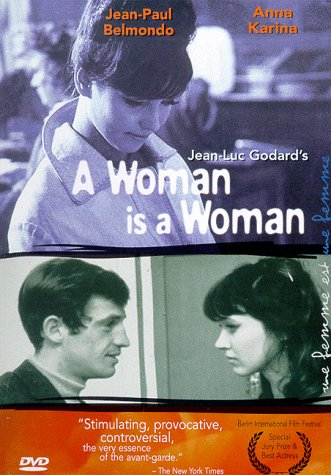
Robert Stanley Martin reviews Godard’s A Woman Is a Woman; Ludovic Debeurme’s Lucille; and Godard’s Le Petit Soldat.
Shaenon Garrity on webcomics; and on the marginal notes of manga-ka.
Nina Stone on brightest day.
One For All and All For One
 I was recently reading an essay by sociologist and comics scholar Casey Brienza about the rise of American manga titled “Books Not Comics: Publishing Fields, Globalization, and Japanese Manga in the United States” (first published in Publishing Research Quarterly.) Most of the essay is an interesting discussion of the format rejiggering by Tokyopop which triggered the manga boom in the U.S. However, at the very end, she broadens her net a bit to focus on the implications of globalization in general.
This is the great tragedy of globalization. Although globalization has changed the world in which we live dramatically, there are places within our interior worlds that even those outward changes cannot penetrate. There is an irreducible distance between different people and different cultures that globalization cannot bridge. Much of manga’s “cultural odor,” to borrow a term from Iwabuchi, is preserved intact on the level of content. But as the manga field migrates into the book field, and manga became just another category of books, like cookbooks, science fiction, or biographies, actors throughout the field will slowly lose their ability to detect that odor at all. Therefore, even though we may all be looking at exactly the same pictures and reading exactly the same prose, there is no positive guarantee that, when we do so, we are seeing anything else besides our own, forever-separate selves reflected back at us.
For Brienza, cultural imports do not change the importer; instead, they themselves are altered. Manga doesn’t make America more Japanese; instead, America simply swallows manga and turns it into plain old bland American books.
In Let’s Talk About Love: A Journey to the Center of Taste, Carl Wilson observes the same phenomena of cultural adaptation…but he sees it as a positive, not a negative. In discussing Celine Dion’s global appeal, he notes that she has to be marketed carefully and specifically to each global region. Instead of creating a one world of Dion, she has to change herself to fit each niche. Wilson writes:
Now a successful artist has to figuratively become local by fulfilling entertainment conventions in other parts of the world. It is less homogenization than hybridization of cultures. As Jan Nederveen Pieterse of the Institute of Social Studies in the Hague writes, “How do we come to terms with phenomena such as Thai boxing by Moroccan girls in Amsterdam, Asian rap in London, Irish bagels, Chinese tacos and Mardi Gras Indians in the United States…? Cultural experiences, past or present, have not been simply moving in the direction of cultural uniformity and standardization.” He suggests what we’re witnessing is a “creolisation of global culture.” It does not follow that creolization will take a standard form. Localism is ignored, as Celine’s marketers know, at peril. Likewise the global hegemony model presumes there won’t be reciprocal cultural influence on the West, but the counterevidence is all around us: Asian video-game music, for example, is arguably among the most pervasive influences on young pop musicians now. And as Pieterse points out, with the exception of isolated indigenous groups, civilization and hybridization have been synonymous for centuries.
 Canadian singer Celine Dion and Japanese signer Juna Ito
So where Brienza laments the hybridization and adaptation of borrowed cultural objects, Wilson celebrates it. Where Brienza experiences a loss of manga’s unique cultural smell, Wilson argues for the joyful blending which results in Asian video game music taking on an altogether new odor in an American context.
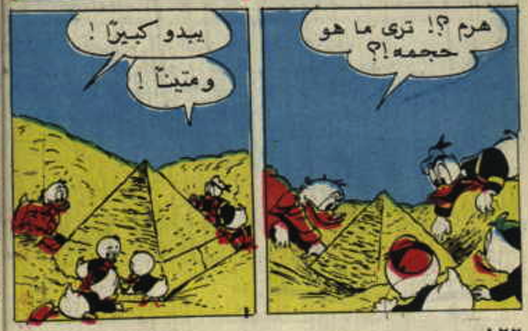
As a final take on globalization, here’s Nadim Damluji’s essay about Mickey Mouse in Egypt, written a while back on HU. Nadim discusses an Uncle Scrooge story about Egypt which was reprinted in an Egyptian comic.
The Western ducks discover a historical landmark that the Disney Arabs were incapable of finding on their own and what naturally follows their act of discovery in a foreign land is their immediate sense of ownership (Christopher Columbus much?). Furthermore, we as readers are lead to believe that the pyramids do not possess inherent value for their historical and cultural significance, but only for their ability to hold potential treasure. You see, without this treasure it wouldn’t have been worth digging out the pyramid, not worth hiring the cheap Arab labor. Lastly, we see the popular trope of Pharaonic culture being used as shorthand for all of Egyptian culture. In other words, traveling to Egypt for the Ducks is traveling into the past, not into a different contemporary culture.
Ultimately, I believe the real harm of this story is that it was tucked within the pages of a comic’s magazine that had Mickey wishing young readers Happy Ramadan or celebrating Mawlad on the cover. Mickey was localized insomuch as he could help Disney sell more comics globally, extending their commercial reach deep in to an emerging comic’s market. To be an avid Miki fans means to be an avid internalizer of the importance of capitalism and hence a way of seeing the world that makes certain countries first and others third. Mickey Mouse certainly has a big place in the history of Arab comics, but I believe it is a history whose depth we must challenge and whose psychological harm may be immeasurable.
Against Wilson’s joyful vision of hybridization, Nadim sees the same old hegemony. And where Brienza mourns the fact that cultural objects don’t change people, Nadim mourns the fact that they do. For Brienza, manga is altered so much that it loses its foreign flavor; for Nadim, Uncle Scrooge is given just enough foreign spice so that Egyptian readers can be poisoned by it.
So is globalization bad because it does not make us more alike? Is it good because it does not make us more alike? Is it bad because it does make us more alike? Or (as a possible fourth position) is it good because it makes us more alike?
Or, to put it another way, is the world better if people are more alike or less alike? And how does globalization affect that?
Philosopher Alain Badiou argues that these are the wrong questions. In his book Saint Paul: The Foundation of Universalism, Badiou insists that, in terms of the movement of global capital (both economic and, presumably, cultural), homogeneity and diversity are not in opposition. They’re the same thing. Wonderful hybridized Arab Mickey and sneaky Mickey hegemon are not opposed — they work together.
Our world is in no way as “complex” as those who wish to ensure its perpeturation claim. It is even, in its broad outline, perfectly simple.
On the one hand, there is an extension of the automatisms of capital, fulfilling one of Marx’s inspired predictions: the world finally configured, but as a market, as a world-market. This configuration imposes the rule of an abstract homogenization…. For capitalist monetary abstraction is certainly a singularity, but a singularity that has no consideration for any singularity whatsoever: singularity as indifferent to the persistent infinity of existence as it is to the evental becoming of truths.
On the other side, there is a process of fragmentation into closed identitities, and the culturalist and relativist ideology that accompanies fragmentation.
Both processes are perfectly intertwined. For each identification (the creation or cobbling together of identity) creates a figure that provides a material for its investment by the market. There is nothing more captive, so far as commercial investment is concerned, nothing more amenable to the invention of new figures of monetary homogeneity, than a community and its territory of territories…. What inexhaustible potential for mercantile investments in this upsurge — taking the form of communities demanding recognition and so-called cultural singularities — of women, homosexuals, the disabled, Arabs. And these infinite combinations of predicative traits, what a godsend! Black homosexuals, disabled Serbs, Catholic pedophiles, moderate Muslims, married priests, ecologist yuppies, the submissive unemployed, prematurely aged youth! Each time, a social image authorized new products, specialized magazines, improved shopping malls… (All italics are Badiou’s; ellipses are mine.)
So, for Badiou, Celine singing first in Spanish then in Japanese is not a sign that hegemony has been defeated. It’s simply the flip side of the universalism of capitalism; the reduction of every individual soul to a marketing demographic. Similarly,a truly Egyptian Mickey Mouse (or truly Muslim superheroes) would not resist the logic of Western hegemony; it would simply reinscribe the identity of “Arab” on which (with all other identities) Western hegemony depends. The world is one giant bland glob, but not because, as Brienza would have it, we our trapped in our own national identities. Rather, it’s because all identities are the same identity. The lack of smell when you read manga is not a product of Americanization. Rather, the lack of smell is the result of the fact that an identity based on reading manga, whether Americanized or not, is an identity that it entirely permeable by the market.
So if, for Badiou, homogeneity and heterogeneity are the same thing, what exactly is the alternative? Well, among other things, I think he’d probably like us to ignore “culture” all together (he has acid things to say about the flattening of “art” into “culture.”) But more than that, he argues for the primacy of the Event.
The Event for Badiou is something like a miracle and something like a paradigm shift; Paul’s revelation on the rode to Damascus is his exemplar. Subjects do not experience or create the Event, rather they are created by it, and remain subjects to the extent they keep faith with it. Childbirth makes you a mother; having your mother shot makes you Batman. The Event, and your continued investment in the event, is who you are.
In the wake of the Event,individual differences are neither obliterated nor homogenized. Rather, they are accepted without being fetishized or even especially emphasized. So, for example, in Twilight, whether a vampire is white or black, male or female, is unimportant, not because those differences vanish, but because the vampire’s subjectivity is created by the Event of the transformation.
 Neither Jew nor Greek, neither male nor female in vampirism.
Similarly, Badiou points out that for Paul whether Christians were circumcised or uncircumcised made no difference. Thus, Badiou argues, for Paul, Christianity was not a sectarian identity among many, but an insistently universal human subjectivity, available to all through faith in the Resurrection, rather than through coercion or insistent self-demarcation. (Badiou, presumably, hates the Inquisition and Christian pop about equally.)
Badiou’s formulation raises perhaps as many questions as it answers. As just one example —how can you tell a sectarian identity from a universal one? Aren’t the vampires in Twilight themselves essentially a subculture? Isn’t Christianity an identity? Moreover, Badiou bases his whole thinking on idea that the Event constitutes Truth — but his paradigmatic Event is the Resurrection, which (as an atheist) he insists is false. So how exactly do you tell if the Event is true? And if Christianity was not universal because it was true, why was it universal?
Still, arguing with Badiou is, I think, a helpful corrective to arguments about globalization, which can slip rather quickly into disputes about the ideal purchasable cultural product. For Badiou, such managerial fiddling at the marketing margins is a depressing simulacrum of utopian thinking. If we’re going to dream, why not imagine a world where our souls aren’t for sale — where, as Bert Stabler said in a recent comment, “everyone can create shared institutions that aren’t niche markets or normality factories.”
The Brain Is…Afraid!

I just saw Paul Verhoeven’s Starship Troopers. It’s an uncannily prescient movie. Released in 1997, it imagines a quasi-fascist future in which the earth is militarized to fight the bugs — a race of giant insectoids. The war really kicks into high gear after the bugs launch an asteroid from space and destroy one of the earth’s major cities, Buenos Aires. (As a television announcement says: “Out of the ashes of Buenos Aires comes first sorrow…then anger. The only good bug is a dead bug!”)
One of the best parts of the film is the very end. The humans had always assumed that the bugs had only rudimentary intelligence. But while this is true for the most part, it turns out that there are a few “brain bugs” — giant gelatinous larvae-looking things, which can suck out human brains the better to understand the enemy, doncha know. Our heroes are drafted for a suicide mission to bring one of the brain bugs back, dead or alive. They succeed, of course — and it only takes them about a year, as opposed to ten for us (though to be fair, they’ve gone farther down the road of authoritarianism, and so are of course more efficient.)
Anyway, all the troops get together and they haul the giant larval brain bug out of its dank cave in the mountains, and then the creepily psychic military intelligence guy (played by Neil Patrick Harris, believe it or not) walks down to confront it, stylishly dressed in Nazi-chic full dresscoat.
“What’s it thinking corporal?” his superior officer asks him.
He walks up to it and puts his hand gently on the side of its head, not too far from its vagina-like mouth. There is a long pause.

“It’s afraid,” he says softly. And then louder. “It’s afraid!”
And all the grunts explode into cheers! Happy ending! Terrified, captured, evil sentient lifeform can now be systematically tortured to death! Huzzah!
(I can’t embed the clip for some reason, but you can watch it here.)
The best part of the conclusion is that capturing the bug does not, of course, end the war. This is a fascist fantasy, after all. As Nietzsche says,
Ye shall love peace as a means to new war, and the short peace more than the long. You I advise not to work, but to fight. You I advise not to peace but to victory…. Ye say it is the good cause which halloweth even war? I say unto you: it is the good war which halloweth every cause. War and courage have done more great things than charity.
The happy ending to a war is more war, more courage. Victory doesn’t mean truce; it means everybody gets promoted and you get to torture the enemy and discover new and better ways to grind him (and her!) into ever finer bits of ichor. The last we see of the brain bug (in a scene that I think is excised form that Youtube bit) some faceless tech is sticking a phallic laser drill into that suggestively formed mouth, and a giant “CENSORED” sign appears on the screen, the better to allow us to imagine the stimulating shenanigans.
And what do those shenanigans stimulate us to do? “We have the ships…we have the weapons! We need soldiers!” the movie blares in its closing moments. And that surely applies even more to us. After all, the Starship Troopers are only fighting one war. We’ve got three going (if Afghanistan/Pakistan is one, and not counting Yemen because it is secret.) There will be much more heroism to come, and many more brains to kill. To paraphrase the last words emblazoned on the screen, we’ll keep fighting…and we’ll win!
Utilitarian Review 4/9/11

News
First, I wanted to welcome Nadim Damluji, who is going to start a monthly column here called “Can the Subaltern Draw?” You can read Nadim’s bio here. His first column was posted earlier today.
Second — last week I took the weekend off…and it was such a relief that I think I’m going to make it a regular thing. I may post something small every so often, but in general we’ll just run Monday to Friday from now on.
On HU
I think I may go back to doing a weekly roundup of posts. We’ll see how it goes…but anyway, this week:
James Romberger interviewed Gene Colan.
I posted a downloadable contemporary R&B mix.
Stephanie Folse continued her Elfquest re-read.
I posted a story about Philip K. Dick through history.
Pam Newton discussed corruption, or the lack therof, in the Wire.
I talked about Tom Spurgeon’s review of Chester Brown’s Paying For It.
Melinda Beasi and Michelle Smith discussed the manga series Please Save My Earth.
I reviewed Fumi Yoshinaga’s All My Darling Daughters.
And Nadim Damluji talked about the Arab Superman.
Utilitarians Everywhere
At Splice Today I have a bunch of articles.
Terry Eagleton and my son on Karl Marx.
French black metal band Blut Aus Nord and Christian liturgy.
Gender lessons from spaghetti westerns.
Links
What teachers can’t do.
Joy and Sean have their own twitter focused on Ogden’s Victorian wire.
Sean Michael Robinson on the Tokyopop licensing issues.
Craig Fischer organized this charitable comics criticism zine to which I’m contributing.
Somewhat over-carbonated, but basically solid article on Chris Ware and modernity.
Robert Stanley Martin on Godard.
Knowing, Forgiving, and Loving Are All Different Things
I sort of felt like the essays I wrote for tcj online got kind of lost in that site’s giant scroll…so I thought I’d reprint some of them here. This one is on Fumi Yushinaga’s All My Darling Daughters.
____________________________
Fumi Yoshinaga is not at her best in the short story form. In longer series, her weakness for glib psychoanalyzing can be overwhelmed by her virtues: sublime nonsense in Antique Bakery; a matchless feel for character interaction and development in Ooku.
In All My Darling Daughters, though, the tales get clipped off with pat endings and pat-er moralizing before Yoshinaga can plumb either nonsensical heights or emotional depths. The second story in this collection is perhaps the most painful example. A college teacher semi-reluctantly acquiesces to a series of blowjobs from a homely, obsessed student with serious self-esteem issues. He feels more and more guilty — but when he tries to turn their relationship into something less exploitative…she dumps him because he’s too nice! Isn’t that a goofy, unexpected plot twist? Yoshinaga seems to think so anyway. In fact, she’s so enamored of the clever reversal that she neglects to put actual people in the story. The scant efforts at individuation (the girl has big breasts! the guy has — oh, wait. He doesn’t have any distinguishing characteristics at all) serve only to emphasize the extent to which these aren’t people so much as gears grinding together in the service of a soft-core clockwork sentimentality.
That’s the story which really left a bad taste in my mouth, but a couple of the others also seemed vacuous and manipulated. In one, three childhood friends largely fail to fulfill their dreams; in another, a radiantly kind and generous woman loves the whole world so much she has trouble loving one man in particular, and so she…well, I won’t spoil the twist ending. Who am I to deprive you of the full weight of a thudding cliché?
For much of this book, in short, Yoshinaga seems to be on autopilot; writing throw-away plots for characters she hasn’t thought about. Which is a shame since, when she is engaged, she remains one of my favorite manga-kas. She becomes a different creator altogether when she’s dealing with the Yukiko and her mother Mari, who are featured in the first and last story and have walk-on parts in the rest.
The first tale, in which Mari decides to marry a much younger man and Yukiko decides as a consequence to leave home, is constructed, not around a single irony or reversal, but instead through a series of quiet moments and incomplete but shimmering revelations. The last of these is somewhat overdetermined — but it’s rescued by the story’s final page, in which Yukiko sits on the floor, her head bent forward, while her mother spoons against her in a comforting hug.
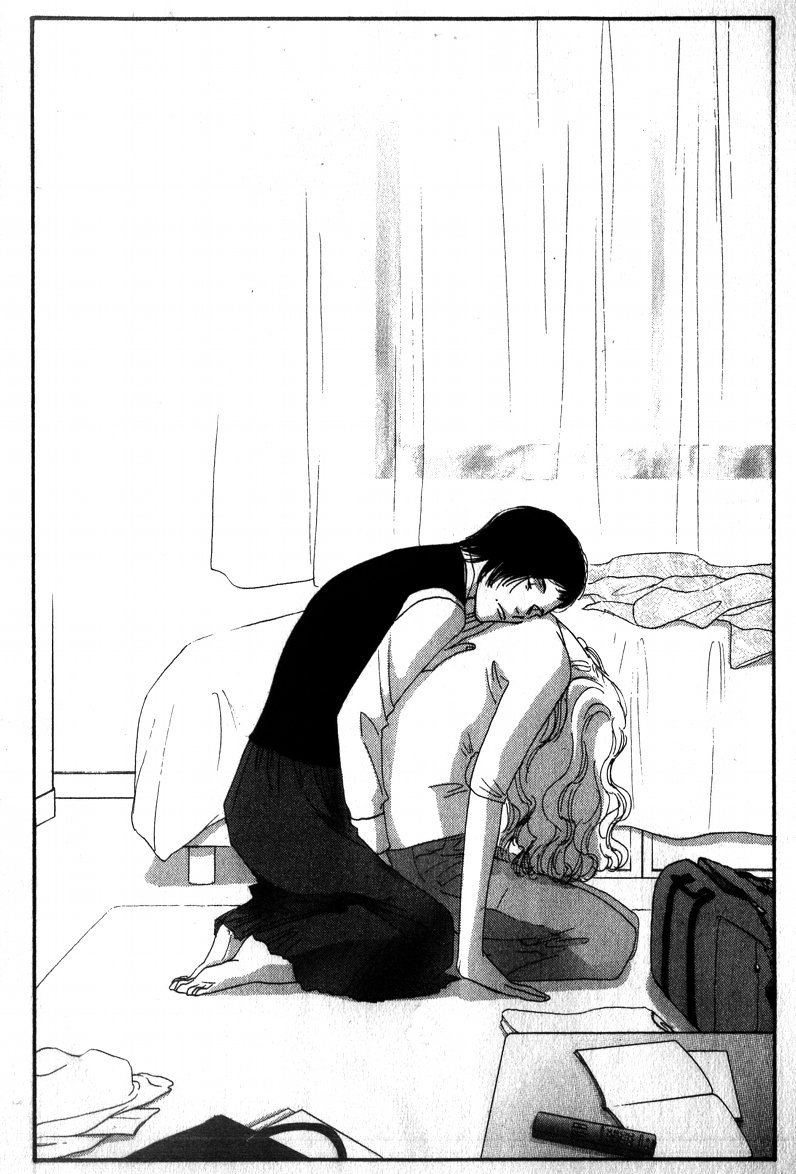 Yoshinaga uses her spare lines and mastery of body design to great effect — the curtains and bed in the image seem almost to fade into nothing, concentrating the eye on the kneeling figures. Yukiko is in pale colors; Mari, on the other hand, is in a dark shirt and dark pants. Cupped together, Mari seems like an anchor — and also, with her newly cut hair, like a boy or a man. The position is itself almost sexual — an intimation echoed in the immediately preceding scene, which hinges on jealousy and reads like a break-up as much as a mother/daughter parting. Mari’s hand rests under her own head and against Yukiko’s spine; it’s a virtually hidden, but very intimate and tactile detail. Mari’s expression is relaxed and unreadable; she looks like she’s asleep. The picture is both eloquent and mysterious; you can see the love between the two women, but the exact components of that love — its sensuality, its history, who has needed to lean on who, and when, and how — remain private.
If Yoshinaga sometimes seems indecently eager to wrap up character and narrative in a neat package, at her best she does the opposite. As Mari’s young husband says of Mari in the final chapter of the book, “knowing the history doesn’t mean her issues will disappear. Knowing, forgiving, and loving are all different things.” There is no key to Yukiko or Mari, no twist ending that will tell us who they are. In the book’s final panel, Mari laughs unexpectedly, and not only is it not entirely clear what she finds funny, we never see how Yukiko reacts. There’s a dignity in that; a sense, perhaps, that you need some measure of not knowing, if not for forgiveness, at least for love.