Don’t Harsh on My Genocidal Fantasies!

I posted a piece over at Splice Today earlier this week about Priest, in which I pointed out that it’s a giant racist piece of crap. And, on cue, commenters have gone ape shit. Check this one out, for example:

If we can’t make a movie with a fictional being or group being the bad guy without being called racist we’re all doomed.

There’s much more along those lines. Click over if you can stomach it.

Robert Stanley Martin on Paying For It

Robert Stanley Martin wrote about the harshest piece I think I’ve seen on Chester Brown’s Paying For It in our comments. It seemed wrong to let it languish there, so I have given it it’s own post.

It’s three parts, actually. Here’s the first.

This book really makes me embarrassed for the comics world. If Chester Brown wants to make a creepy, crackpotted spectacle of himself, I suppose that’s his business. But did everybody have to go whole-hog to identify themselves, and by extension, the field with this thing? Judging from the comics-media sites, it’s the book of the year so far. It’s Chester Brown week over at TCJ, for pity’s sake.

Anja Flower then asked Robert what was so embarrassing about prostitution, anyway. Robert responded:

I don’t consider the discussion of prostitution and its prospective decriminalization embarrassing. I don’t think it’s particularly worthwhile, except as an intellectual exercise. The reason is that with, for lack of a better term, morals laws, I don’t believe they get changed unless people feel that one is or could be unfairly deprived of something. Obscenity laws began being undermined by people not feeling it was appropriate to legally deny them the opportunity to read writers like Joyce, Lawrence, and Henry Miller. Laws barring gay marriage in the U.S. are now taking a beating that I expect will end in their repeal. Homosexuality is increasingly acceptable in our society, people are more likely to have social relationships with people who are openly gay, and people are seeing that gay partnerships are in practice identical to heterosexual marriage. They increasingly don’t think its appropriate for gay couples not to have the legal prerogatives of straight ones.

I don’t think that’s going to happen with prostitution because I don’t see the stigma of being on either end of the transaction going away. I think lax enforcement of the laws is probably the most that can be hoped for.

What I find embarrassing relates to North American comics and their community of artists and readers.

North American comics are invariably unconscious allegories of male potency anxiety that stink up the field like a miasma. (The comic-book efforts that have broken through to success in bookstores–where the customers for memoir and fiction material are overwhelmingly female–either eschew this altogether or interrogate it with such sophistication that people are able to get past the ick factor.) What Chester Brown has produced is an intellectually pretentious acting-out of his fantasies of himself as a porno stud.

Brown has demonstrated exhibitionist tendencies in his work almost from the beginning. A minor example was an autobiographical piece that featured an extended sequence of him picking his nose and eating the half-dried mucus. The major one is The Playboy, a memoir of his experience with pornography that featured several bluntly explicit scenes of him masturbating. Brown obviously has a compulsion to publicly show himself engaging in activities that most people would just as soon stay private. Paying for It is his latest venture with this tendency.

What the comics community has never been able to get through its head is how repellent mpa material largely is to people in the outside world, who at best just consider it adolescent. Show Paying for It to a halfway reasonable person outside the comics world, and they’re going to see a rather pathetic crank flaunting his emotional shortcomings and grody personal behavior, which he then tries to portray as virtues. Any other field would marginalize this, such as the literary community did with Mailer’s misogyny. But not the comics field. The message of “Hey, everybody! Isn’t being a socially stunted dweeb who’s into hookers and wants everyone to share the joy fun and cool!” blares like a civil-defense alarm from tcj.com and other comics-press mainstays. The field has had more (much, much more) than its share of embarrassing spectacles, but the reception accorded this book just takes the cake.

And finally this.

Let me add that in general I hold Chester Brown in very high regard as an artist.

Ed the Happy Clown, which I read during its initial serialization, was my entry into alternative comics. It set a standard for cartoon surrealism that all subsequent works in that mode must be measured against, and none have yet to meet. I Never Liked You is an outstanding memoir of adolescence. I’m putting together a list of my top-ten all-time favorite/best/most worthwhile comics for another project, and one or both will likely make the final ten.

As for his other major efforts, what I’ve seen of Underwater shows it to be an interesting and admirable misfire. I have yet to read Louis Riel, but by all accounts it’s a strong piece of historical fiction, and I look forward to reading it. And his Gospel adaptations show just how tepid Crumb’s Genesis effort is by comparison.

I want to add that I think he’s a nice person. I encountered him once at a Barnes & Noble signing with Seth and Adrian Tomine in New York a few years back. He’s a friendly–if very reserved–fellow face-to-face.

However, we all have our unfortunate sides, and Paying for It is the worst aspects of Chester Brown’s work writ large.

_______________________
Other posts in what’s turning into a slowly evolving roundtable on Paying for It here.

Saccharine Lowbrow Jouissance

This review first appeared on tcj.com.
____________________

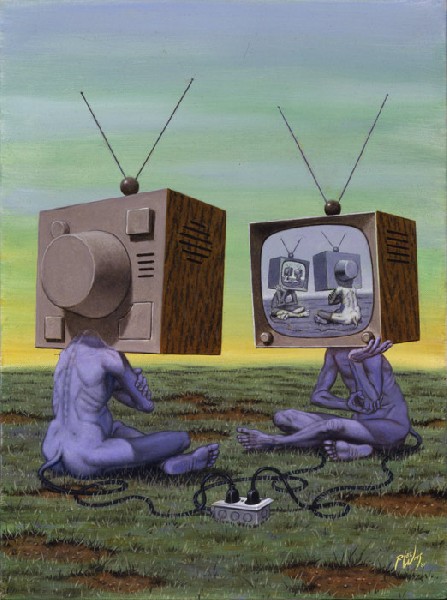
A lot of lowbrow art, from Robert Williams on down, leaves me cold. The slickness can be off-putting, and the kitschy cultural references get old fast. But really, the main problem is simply the glibness. The surreal juxtaposition of a crying whale and a television set with wings or whatever — it all seems like it’s been bunged together with about as much thought as I put into inventing that crying whale and that television set with wings. Advertising and garage sale art and outsider art all can be genuinely weird, but that’s because there’s an earnest animating spirit, whether utilitarian goal (sell Fruit Loops!) or genuine obsession. Lowbrow, though, seems motivated either by shallow irony or simple boredom.I mean, Robert Williams’ official site (http://www.robtwilliamsstudio.com/) currently features a painting of two blue humanoids with giant television sets for heads staring at each other — and on the television screen, there are two more television sets watching each other! And it’s called “Symbiotic Mediocrity.” Because, like, we’re all just watching one another watch one another in this brave new media landscape, you know? Deep, man.

As is the way with lowbrow artists, Junko Mizuno is fascinated with cultural detritus: cute hippo figurines, saccharine cheesecake, adorable anthropoid fuzzballs. What separates Mizuno from her peers, though is (a) intelligence, and (b) genuine strangeness. As an example, Pelu, the main character in her most recent graphic novel, Fluffy Little Gigolo Pelu, is a small furry puffball; he lives on the planet Princess Kotobuki, which is populated by nude, human-appearing females. The women all have two little creatures like Pelu inside their bellies; when these females get old enough, the furry creatures inside them mate, producing a baby that falls from between the “human” females’ legs. Pelu’s host female, however, was eaten by a carnivorous space hippo before Pelu and his companion fuzzball could mate. Pelu was rescued from his host’s carcass by another woman, who raised him as her child. Eventually Pelu discovers who and what he is, and decides to go to earth to find a mate to replace the one he lost when he was an infant.

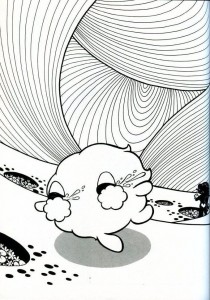
That narrative pretty much sums up Mizuno’s obsessions: sex, death, romance, kawaii, and the way they merge into a single melting rainbow of uncanniness. No wonder, then, that her artwork looks a little as if Aubrey Beardsley and Osama Tezuka got together to build a Barbie doll out of sugar cubes. One two-page spread toward the beginning of the volume, for example, shows several nude female silhouettes cuddling amorphous infant blobs against a sky of swirling patterns. In the foreground, Pelu runs weeping between pits of stylized flowers. The women with their babies look almost demonic in their maternal happiness, while Pelu’s tears squirt from his eyes in a manner which, given the nude girls in the background, rather queasily evokes other bodily fluids.
Like Williams’ blue staring televisions, the image here seems overdetermined. Unlike Williams’ image, though, the result isn’t didactic or smug. Instead, it feels queasily overripe, laden with too much meaning and emotion for comfort. Mizuno concentrates on surfaces not because they’re flat, but because of the infantile pleasure that lingers implicitly in every touch. Little Fluffy Gigolo Pelu is a story about a land not so different from ours, in which polymorphous perversion has crawled out of the nursery to swallow the world.

Marx For Dummies

We’ve been talking about communism here and there on the blog, so I thought it was a good time to reprint this. It first ran on Splice Today.
____________________

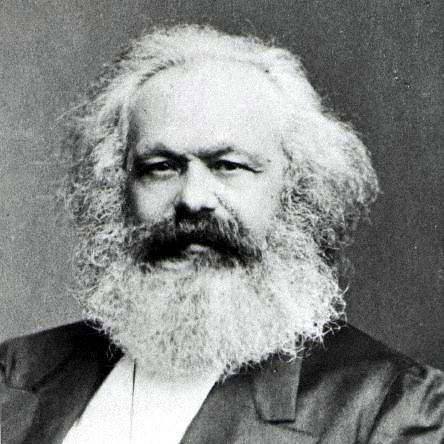
My seven-year-old saw me reading Terry Eagleton’s new book, Why Marx Was Right. Said son has just started reading himself (he loves Jeff Smith’s Bone) and has become perhaps overly inquisitive about any books in reach.

“What’s that?” he demanded. “What’s it about?”

I resorted to that phrase well known to fathers everywhere. “Um….”

What is it about?”

So what the hey, I figured. I’ve explained dinosaurs and gravity and sex. I can explain Marxism. “It’s about somebody named Karl Marx,” I said. “It’s talking about why he was right.”

“Right about what?”

“About not liking capitalism. He didn’t like capitalism.” Blank stare. “Do you know what capitalism is?”

“No.”

“Okay, you know how everybody buys and sells everything?”

“Yeah?”

“That’s capitalism. And Marx didn’t like it.”

An expression halfway between incredulity and boredom. “Why didn’t he like it?”

“Well, with the system where everybody buys and sells and tries to make as much money as they can, you end up with some people who have a lot of money who own the factories, and then some people have only a little money and work in the factories. And Marx thought that was unfair. He said that the people who work in the factories should own the factories.”

“Oh.” Pause for consideration. “That makes sense.”

“Yes,” I said. “But some people really don’t like that idea.”

Then his eyes lit up. “The factory owners don’t like it, I bet!”

So there you have it. Marx’s ideas are intuitive enough that even a seven-year old can understand them. Terry Eagleton would approve.

Why Marx Was Right isn’t quite aimed at the Under 8s, but it is (in a fine old Marxist tradition) a populist polemic. As Eagleton notes, Marx has taken a beating in the last quarter century or so. The Soviet Union has collapsed, China has embraced the almighty yen, and hordes of post-everythingists have laid siege to the university, taunting the academic Marxists for culpable white maleness and general untrendy belief in revolution, sweat, and the physical universe.

Eagleton, however, is undaunted. Marx, he insists, has been buried neither by the corpses of Pol Pot nor by the tomes of cultural studies professors. And certainly neither post-structuralism nor Stalin can boast many apologists with as felicitous a prose style as Eagleton. The books breezes through ten common objections to Marxism, with Eagleton acidly and efficiently dispatching each in turn. To the charge that Marx is a utopian, Eagleton observes:

A virulent form of utopianism has indeed afflicted the modern age, but its name is not Marxism. It is the crazed notion that a single global system known as the free market can impose itself on the most diverse cultures and economies and cure all their ills. The purveyors of this totalitarian fantasy are not to be found hiding scar-faced and sinisterly soft-spoken in underground bunkers like James Bond villains. They are to be seen dining at upmarket Washington restaurants and strolling on Sussex estates.

To the claim that Marx is a simplistic materialist, Eagleton responds in part:

For Marx, our thought takes shape in the process of working on the world, and this is a material necessity determined by our bodily needs. One might claim, then, that thinking itself is a material necessity. Thinking and our bodily drives are closely related…. Consciousness is the result of an interaction between ourselves and our material surroundings.

And so on throughout the book; Marx was a democrat, not a totalitarian; an individualist not a collectivist; a believer in reform and, when that failed, in a revolution that was as little violent as possible. Marxism was feminist before feminism; post-colonialist before post-colonialism, and pro-ecology before most ecologists had befouled their washable diapers.

For those, like me, who haven’t read a lot of Marx, the book is a welcome corrective that goes down surprisingly easily. Sometimes, indeed, too easily. There’s a sense throughout that Eagleton isn’t really engaging Marx’s strongest critics. Instead, the book prefers to incinerate a series of straw men. Thus, Eagleton mentions that Edward Said was anti-Marxist, but he doesn’t quote him, preferring instead to knock down more generalized postcolonialist arguments. Similarly, Eagleton breezily dismisses pacifism with a would-you-use-violence-to-prevent-children-being-shot scenario; some vague references to (never specifically named) just war theory, and a blanket declaration that “In any strict sense of the word, pacifism is grossly immoral.” If you didn’t know anything about debates around pacifism, this might seem like a knockdown effort on Eagleton’s part. Otherwise…well, let’s be kind and say that Eagleton’s discussion is not nearly as convincing as he seems to think it is.

The fact that Eagleton is weak on the thing I happen to know about could just be a coincidence. Somehow I doubt it though. He’s popularizing — which means that this book is less Why Marx Was Right than it is Everything You Thought You Knew About Marx Was Wrong. As such, it’s not likely to bring the revolution, but it might get some undergrads and/or aging reviewers to check out Das Kapital. Who knows? It might even sway the odd seven-year-old.

Utilitarian Review 5/13/11

News

As I mentioned earlier in the week, Alex Buchet has sadly ended his column on HU.

After a brief departure, Domingos Isabelinho has returned, and will once more be writing his column Monthly Stumblings We’re glad to have him back!

Also, I’m very pleased to announce that Marguerite Van Cook is going to start a monthly column focused on comics and the sublime.

And finally, Sean Michael Robinson and Joy DeLyria are publishing an entire book of H.B. Ogden’s The Wire. Congrats to them both!

On HU

Matthias Wivel discussed Dominique Goblet’s autobiographical graphic novel Faire semblant c’est mentir.

Robert Stanley Martin talked about the comics canon and whether we have to accept it.

I posted my old zine in which I illustrated Wallace Stevens’ 13 Ways of Looking at a Blackbird.

I reviewed Chester Brown’s Paying For It.

I posted a dreampop download.

And Robert Stanley Martin had some further thoughts on the canon and why comics critics should do better.

Oh…and for our featured archive post this week, Kinukitty talks Kiss lyrics.

Utilitarians Everywhere

At Splice Today I reviewed the new Fleet Foxes album.

Also at Splice, I talked about the new J. Lo album.

At Comixology I talked about Wonder Woman’s costume.

Other Links

Ariel Schrag has the best Lady Gaga illustration.

Matthias Wivel has a skeptical take on Dan Clowes’ Mister Wonderful.

And I can’t remember if I linked this, but Nina Stone on Brightest Day is still funny.

Music For Middle-Brow Snobs: Dream Pop Dream

Downloadable dreampop goodness here.

1. Flikr of Ur Eyes — Swarms
2. Everyday — Ivy
3. Never Do That Again — Ivy
4. Boxer — Lovers
5. Drink Drank Drunk — A Sunny Day in Glasgow
6. Untogether — Lush
7. Strawberries — Asobi Seksu (remix by Ulrich Schnauss)
8. Love Fade — Tamaryn
9. Chinese Letter — The High Violets
10. Can’t Be Sure — The Sundays
11. Just Call Me Joe — Sinead O’Connor
12. Candle Song — Mojave 3
13. To Ohio — Emmylou Harris and the Low Anthem
14. Shadow Boxing — Damon & Naomi

Love Among the Androids

A much-shortened version of this review ran last week in the Chicago Reader. I also had an essay here a little bit ago about some other reactions to the book.
_____________________________

It’s because I do see sex as sacred and potentially spiritual that I believe in commercializing it and making this potentially holy experience more easily available to all.

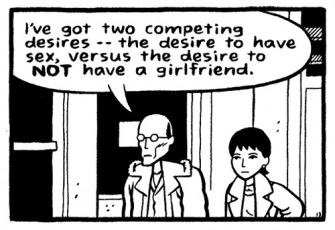
That’s Chester Brown , writing in the lengthy appendices to Paying For It, his graphic memoir about his experiences as a john. The quote is odd not so much for what it says as for what it doesn’t. Specifically, throughout the book Brown sets himself firmly against the ideas of romantic love and marriage, and touts sex-as-commercial-experience not just as a reasonable arrangement for him, but as the best arrangement for everybody. What, then, exactly, is the sacred nature of sex for Brown? Or, to put it another way, if the sacredness of sex isn’t about love, what’s it about?

In some ways, you could see Brown’s entire book as an answer to this question. The narrative starts as he and his girlfriend, Sook-Yin, go through an amicable break-up, and he realizes he doesn’t want to have a romantic relationship ever again. In fact, he decides that romantic relationships are actively bad. “…being in a romantic relationship brings up all [Sook-yin’s] insecurities,” he notes. “It does that for everyone — me too.”
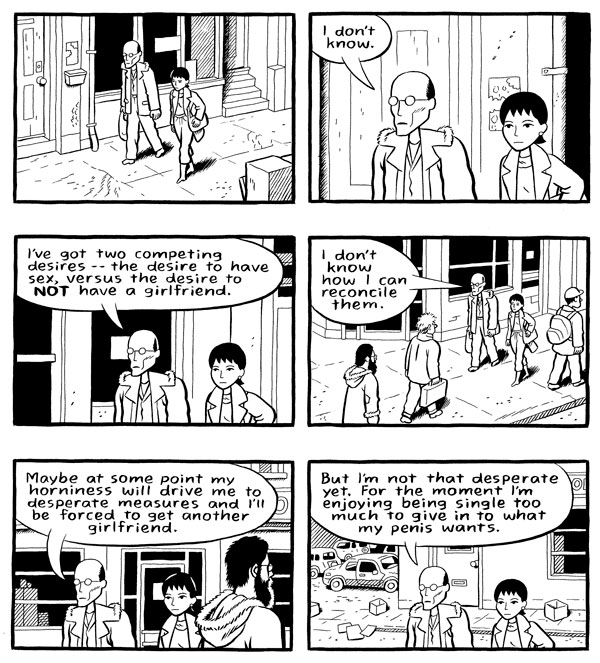
Convinced of the evils of romance, yet not willing to give up on having sex, Brown eventually decides to get some the old fashioned way — by paying for it. As he learns the ins and outs of being a john (how to find an escort, when to tip, where to look for reviews online) he also becomes a more and more adamant proponent of legalization. The graphic novel alternates between Brown’s encounters with different “whores” (as he sometimes calls them) and his arguments with friends, family, and the prostitutes themselves about the morality of prostitution.

These arguments, continued in the appendices and notes, are by and large quite convincing. Admittedly, I’m biased — I thought criminalizing sex-work was a bad idea before I started reading the book. Even so, Brown pushed hard against my already-very-liberal opinions. He argues forcefully that prostitution should be not only legalized, but completely unregulated. In the appendix, for example, he points out that legal prostitutes in Nevada often aren’t allowed to leave the brothel without permission, and are sometimes forced to buy condoms and even food from the brothel-owner at exorbitant prices. These women, then, are much more exploited than they would be if they weren’t regulated, or even than they would be if they were just working illegally. Brown is also compelling when he insists that prostitutes should not be subject to mandatory health testing. “Medical treatment,” he says to his friend, the cartoonist Seth, “should always be voluntary. It should never be forced on anyone.”

But while Brown’s words make a strong case for the dignity and necessity of legalized prostitution, his comic itself is, seemingly unintentionally, more ambivalent. This is most noticeable in the portrayal of the prostitutes themselves. Brown, of course, uses fake names for all of them. He also, as he notes in the foreword, deliberately removes any reference to their real lives — boyfriends, children, childhoods, families. “I wish I had the freedom to include that material…,” Brown says, “it would have brought the women to life a full human beings and made this a better book.”
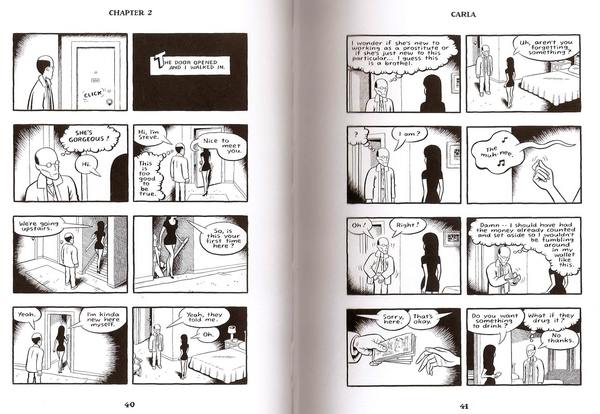
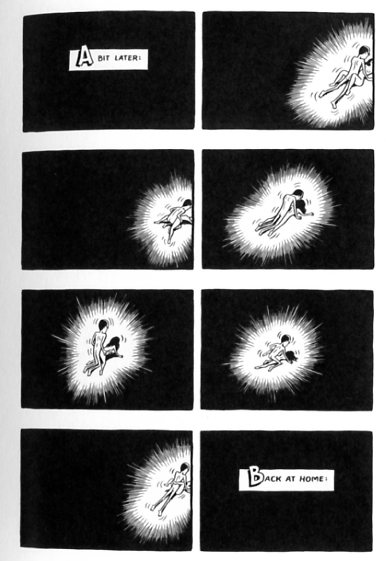
That’s no doubt true. But one could argue that, despite his protests to the contrary, Brown actually goes out of his way to dehumanize the women he sleeps with. Specifically, he never shows their faces. Presumably, this is meant to protect their anonymity — but he’s drawing them. He could change their faces, just as he made them all brunettes. By showing us only the backs of their heads, he turns them all into expressionless ciphers. His trysts with them seem like ritualized encounters with dolls. This is even more the case since Brown rarely varies layout or style; his comics are series of small squares, often with minimal backgrounds. His representations of sex, similarly, have a regimented similarity; he and the woman are placed against a black background, fucking with the joyless, repetitive deliberation of wind-up dolls.
Brown’s depiction of himself is even more disturbing. A thin man, he draws himself as a death’s head, his glasses staring blank and pupilless. And then words start to robotically issue from that cadaverous skull, reasoned arguments grinding forth like the granite lid scraping across a tomb. “Romantic….love…is…evil…*click* marriage…is…evil…*click* there…is…only…money…and…desire…click*”
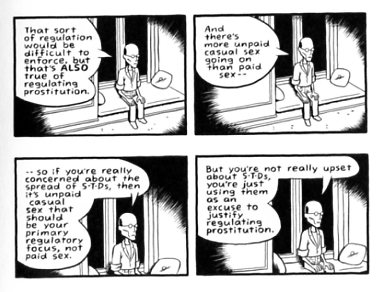
Brown has, in short, turned himself into an uncanny libertarian caricature. And it is this libertarianism — along with its forefather, enlightenment utilitarianism — which forms the basis for his dislike of romantic love. Romantic love, he argues, “causes more misery than happiness.” It is wrong because its calculus is wrong; instead of maximizing joy, it interferes with the cheerful autonomous operation of the individual. Brown touts his own long-term, monogamous relationship with a prostitute named Denise precisely because it is entirely based on his own desire, rather than on potentially traumatizing reciprocity. “I’m having sex with Denise because I want to, not because I made a marriage vow to her or because she’d get jealous because I saw someone else.”

And this, I think, is why Brown sees sex as sacred. It’s because sex, especially paid sex, is divorced utterly from commitment or community. As a libertarian, he worships the individual, and sex is the ultimate expression of the individual autonomously pursuing pleasure. Brown even argues that prostitution, once legalized, should not be taxed. The government and, indeed, society has no place in the bedroom. Sex is sacred because it is private.

The irony here is that Brown thinks that he’s somehow challenging the basis of romantic love. The truth, though, is that he is merely carrying that logic of romance through to its conclusion.

In the 1978 essay, Sex and Politics: Bertrand Russell and ‘Human Sexuality,’ theologian Stanley Hauerwas notes that

marriage can be sustained only so long as it is clear what purposes it serves in the community which created it in the first place. With the loss of such a community sanction, we are left with the bare assumption that marriage is a voluntary instituion motivated by the need for interpersonal intimacy.

Romantic love, as Hauerwas says, is already an ideology of autonomous atomization. It assumes that you marry for love, and that love is an ideal because it is personally fulfilling. Brown does not dispute the liberal, capitalist goal of personal fulfillment; he just argues that liberal, capitalist fulfillment is ideally maximized by the market.

That’s a logical position, obviously. Indeed, its so logical it starts to verge on madness. If everyone is an entirely independent desiring subject in theory, then in practice everyone is an object, reduced, like Brown’s prostitutes, to blank toys manipulated for everyone else’s mechanical satisfaction. That’s true whether we’re trying to maximize our individuality through romantic love or through the sacred orgasms of capital. If we want a less soul-crushing sexual ethic, we may need to consider the possibility that sex is about other people, and possibly about God. In the meantime, I guess, like Chester Brown, we can look forward to life as happy, fulfilled, free-spending skulls.
______________________

Addendum: I didn’t have space for this in the initial review, but I did want to highlight what I think is one of the most interesting interchanges in the book. Brown is talking post-coitally to a prostitute named Edith. Brown explains to her that he no longer believes in romantic love, which is why he visits prostitutes. He outlines the arguments I’ve already discussed, emphasizing especially that people change over time, and that it’s not fair to either partner to be tied down to a romantic relationship when both will eventually change.

The end of the conversation is as follows:

Edith:Yes, but you can try to continue to understand your partner. And if you love him or her you’d be willing to make that effort.

Brown: Yeah, effort. Romantic love is work. Call me lazy, but I don’t want to do the work.

Edith: If I met the right guy, I’d be happy to do the work. It takes work to get anything worthwhile in life.

What’s interesting here is that Edith gets the last word, her dialogue floating above Brown’s inevitably expressionless stare. Brown never makes any attempt to refute her — not in the narrative, not in the notes (which don’t mention this exchange at all.)
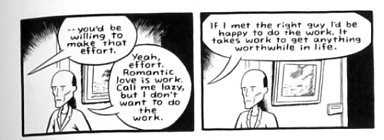
I suspect the back and forth with Seth will get more attention for various reasons (it’s longer, it’s Seth.) But this is the moment in the book where Brown comes closest to letting someone get the better of him. Edith’s argument — that relationships are about work, and that that is in fact what makes them worthwhile — is a fine thumbnail paraphrase of Hauerwas’ position, and Brown, apparently, has no response to it.

There’s a nice irony, too, in the fact that Edith, who is extolling the virtue of work, is in fact working as she speaks. The sequence get at the class divide between Brown (artsy middle-class hipster with disposable income) and the women he’s seeing, and raises the question — largely unexamined in the book — of privilege.

I don’t think that Brown is actually endorsing Edith’s position. The rest of the book makes it quite clear that yes, he really does think prostitution is the ideal way to conduct sexual relations. Even when he admits that he is in love with Denise, he does so by arguing that paid sex is the ideal expression of, and venue for, that love. Still, he’s to be commended for giving someone else a chance to put forward a contrary view; that you get, not what you pay for, but what you work for.
______________
Update: Naomi Fry’s review at tcj.com posted today touches on some of the same issues discussed here.