Utilitarian Review 8/28/10

TCJ.com Kerfuffle

This week on the TCJ.com mainpage Caroline Small, Ng Suat Tong and I participated in a roundtable on the Best American Comics Criticism anthology edited by Ben Schwartz. Jeet Heer, Brian Doherty, and Ben Schwartz himself also participated. In comments other critics joined in, including Rob Clough, Ken Parille, Robert Stanley Martin, and Kent Worcester. So check it out if you haven’t already.

Oh, and there’s a comment thread on the roundtable here as well which includes a discussion of French language and Japanese comics criticism.

On HU

Domingos Isabelinho discussed Dominique Goblet’s and Nikita Fossoul’s Chronographie.

Kinukitty talked about European fashion magazines, Dave Mustaine, and Makoto Tateno’s Yokan Premonition.

In a guest post, teacher and artist Sean Michael Robinson explained that it’s a good thing for art teachers when students are into anime and manga.

JR Brown wrote an extensive article about the history of the pretty boy in Japanese art.

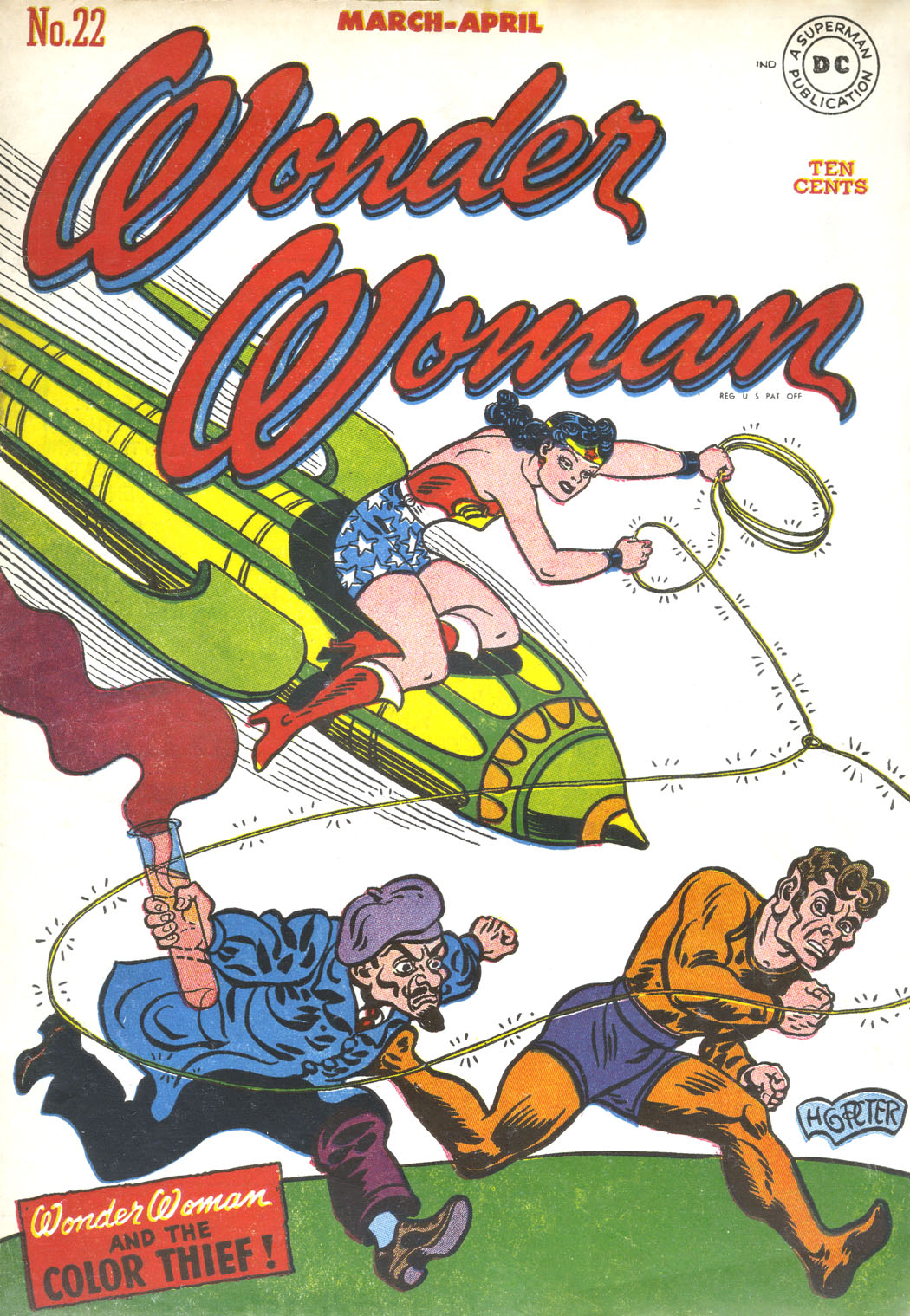
I reviewed Issue #22 of the Marston/Peter run on Wonder Woman.

Vom Marlowe talked about gender issues in the young adult prose series Percy Jackson and the Olympians.

And a music download of Beatlesesque pop.

Utilitarians Everywhere

Caroline Small is going to be on the Critic’s Roundtable panel at SPX, along with many other illustrious folks. (Via Robot6.)

Critics’ Panel: How We Judge
3:00 | Brookside Conference Room
The accessibility of online publishing alongside traditional media has enabled a diversity of critical voices who are addressing the broad spectrum of comics being published today. A diverse group of critics will discuss the disparate bases for their own critical opinions, and the extent to which they regard different kinds of work in different ways. Join moderator Bill Kartalopoulos for a discussion with Johanna Draper Carlson (Comics Worth Reading), Gary Groth (The Comics Journal), Tim Hodler (Comics Comics), Chris Mautner (Robot 6), Joe McCulloch (Jog the Blog/Comics Comics), Ken Parille (Blog Flume), and Caroline Small (The Hooded Utilitarian).

At the Chicago Reader I review JimCollins’ Bring on the Books for Everybody.

In The Gift of Death, Derrida concludes that literature is an empty, parasitic untheology, constantly seeking forgiveness for its meaninglessness. Ever the tenured radical, he sees this revelation as an affront to the academic establishment. But cultural studies is a more callow establishment than Derrida anticipated, and members like Collins don’t have a problem with emptiness. On the contrary, Collins is “delighted” just to find that literary fiction “forms part of the cultural mixes” that modern cultural consumers “assemble with such gusto to articulate who they are, and what is crucially important to them.” The content of their identities and concerns is utterly beside the point. Are they Nazis? Misogynists? Drooling idiots? As long as they embrace it with gusto, who cares? The point of literature is to make a statement regardless of what’s said. By the same token, Collins is aware that, say, The Oprah Show is witheringly stupid and the movie version of The English Patient is an apologia for imperialism—but he can’t bring himself to take the next step, which would be admitting that some of the detritus of popular culture deserves to be scorned.

On Splice Today I talk about the new film The Last Exorcism in light of the criticism of James Baldwin.

For Baldwin, the bed floating, the fluid spitting, and special-effects gouting, were all part of a willful disavowal. The little girl with the deep voice uttering curses is an innocent possessed by the devil…but Baldwin argues that the upper-middle-class milieu in which she sits and writhes is anything but innocent, and that the movie is therefore an example of (in various senses) bad faith. Baldwin notes that at the end of the film, the “demon-racked little girl murderess kisses the Holy Father, and she remembers nothing.” This convenient amnesia is, for Baldwin, emblematic of America’s penchant for forgetting what they have done, to whom, and for what ends.

At Madeloud I have some recommendations for sexadelic lounge music. Groovy!

Other Links

R. Fiore was inspired by our Popeye roundtable to write a really entertaining appraisal of the Fleischer Popeye cartoons.
Bound to Blog: Wonder Woman #22

As I said in our last installment, Wonder Woman #21 was great. Marston died in May 1947, but you’d never know he was on his deathbed when #21 came out in January/February of that year. One of the high points of the series, it shows Marston enthusiastically grappling with and even more enthusiastically fetishizing the latest, most up-to-date technology of atomic power. Most people would stop adding kinks to their repertoire when they were dying, but Marston is not the sort to let a little thing like cancer get his libido down. It’s an inspiration to us all, I tell you.

But that was 21. In #22, things are…well, they’re not so great. In fact, I strongly suspect that the very, very ill Marston did not have complete creative control over this issue. Marston had sometimes worked with collaborators before, I think — his sons were supposed to have given him story ideas at least — and certainly he’s had less than stellar issues before. But this is the first one that actually starts to look in spots like hackwork.

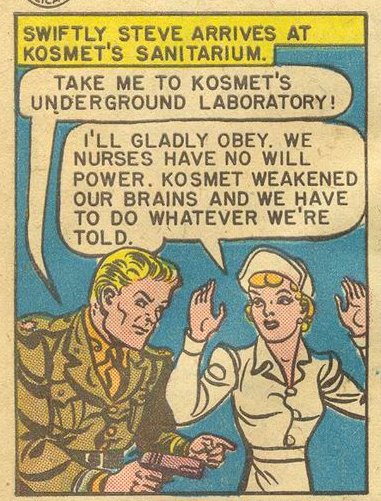
Among other problems, this is the first issue since the second or third that isn’t a single long story; instead, it’s split up into three shorter tales. The initial one of these is definitely the worst; I’d wager something of moderate value that somebody ghosted large chunks of it. Wonder Woman goes to Hollywood, where a evil mastermind is stealing the color from the faces of actresses and then forcing them to pay to have their color restored. So basically, instead of Wonder Woman saving the world, she’s helping a handful of vain actors deal with cosmetic surgery. The low stakes and the stereotypical focus on appearance is a painful forshadowing of the crappy Silver Age Robert Kanigher scripts to come…and just to drive that point home there’s a completely pointless sequence where WW is taken by the police and thrown in prison, a typical Silver Age twist which here (as in the future) serves to generate some vague suspense in a plot that is basically going nowhere. Towards the second half of the story things start to come alive a little as the Holiday girls and then Wonder Woman are tied up and the evil scientist reveals that he has a brain control ray which he uses to make a bunch of nurses his slaves (not sure I’ve seen the nurse fetish from Marston before?).

And of course WW is almost placed in his thrall too, but Steve comes in in the nick of time and rescues her…and again, having Steve as the deux ex machina just is not Marston in prime form.

The second and third stories are somewhat better — or at least more characteristic. Number two involves the Saturnians again (remember them from way back in issue 10?) They use hypnotism to prevent people from seeing them, and there’s some sort of electrical bonds which makes WW all weak and kitteny and then they can tie her up. Not really covering any new ground, but it’s okay for that.

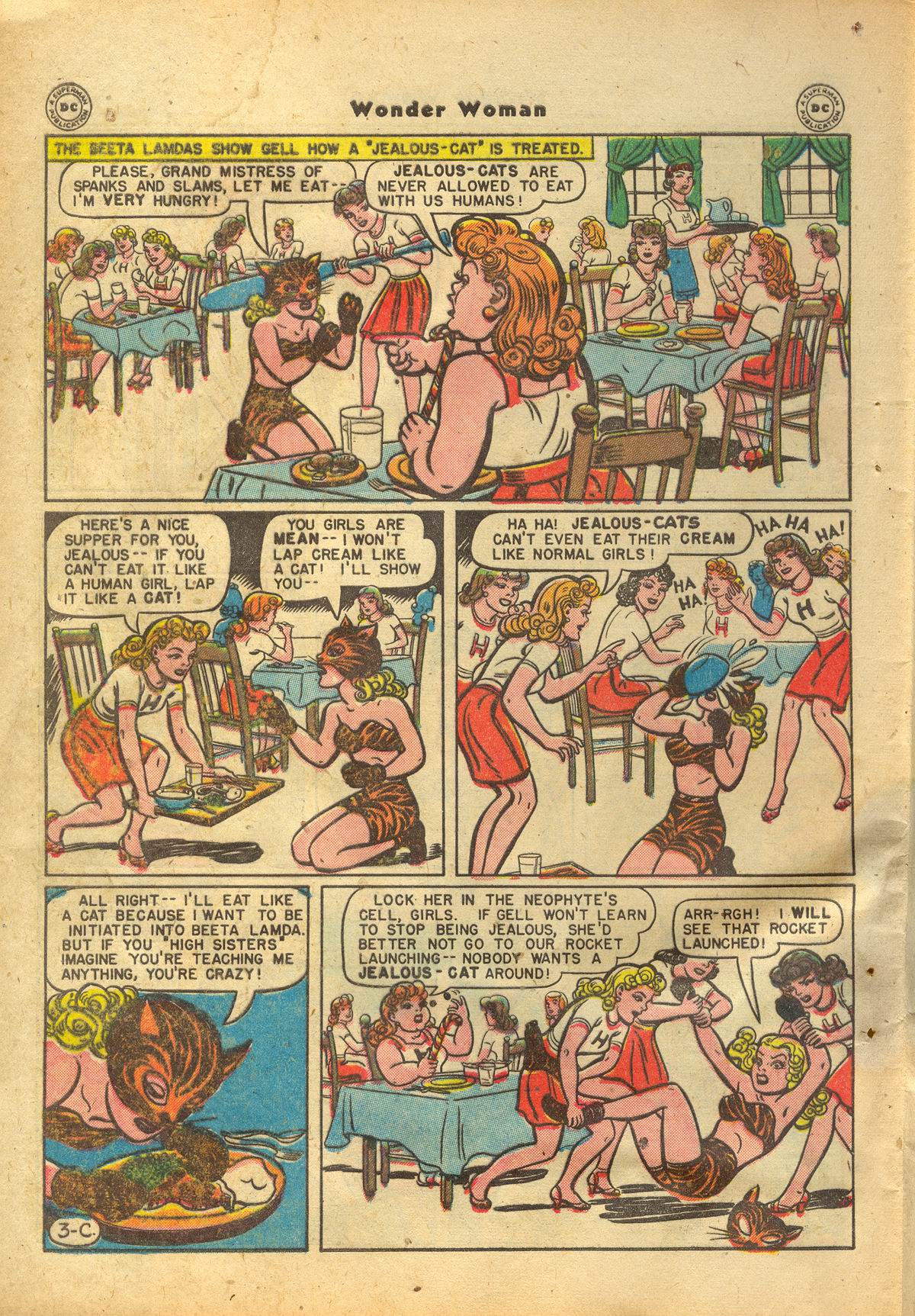
Three has the most potential; one of the Holiday sorority girls, Gel, is jealous…and her jealousy almost destroys the planet Venus! Before it does, though, she’s punished by…well see for yourself:

That’s the stuff! The jealousy theme is pretty interesting too; it’s come up before in Marston, specifically in #6 in the battle with the Cheetah. In some ways this is actually more successful. In #6, the Cheetah’s resentment of the stuck-up Amazons and their compulsive condescension seemed a lot more sympathetic than I think Marston wanted, whereas in this one, Gel’s jealousy of her fellow students seems pettier and less rationally motivated. (Not that Gel isn’t somewhat sympathetic too.)

It’s also interesting to think about why jealousy seems important to Marston. In my post about the Cheetah, I said that it seemed to be about self-esteem — that is, woman should feel good about themselves and not inferior to anyone. But I also wonder if there’s a sense in which Marston finds jealousy especially problematic because it’s a primary source of conflict between women. Or to look at it another way; the flip side of female-female friendships or female-female desire can be jealousy — wanting to be somebody else instead of wanting to be with them (as friends or…well, you know.) On the one hand, then, jealousy is the acid that dissolves the bonds of sisterly love. On the other hand, it’s a kind of extension of that love twisted into desire. Which means that, for Marston, jealousy is exciting and fetishized — which is why jealous Gel gets placed so quickly in the cat suit. Her punishment is stimulating, but so is her rebellion.

Though not as stimulating as they might be alas. The splash page to this story promises that Gel will bring jealousy to Venus, and I had visions of her somehow spreading jealousy throughout the perfect Venusian society through some sort of ray or serum or other weirdness — which sounded pretty great. But in the end she just shows up and frees some prisoners and causes a garden variety ruckus…and then it all resolves in two really fast pages, as if everyone just ran out of script. Which is maybe what happened; Marston may just have gotten too sick to finish the thing (or they could be using an earlier ms that he abandoned or never completed.)

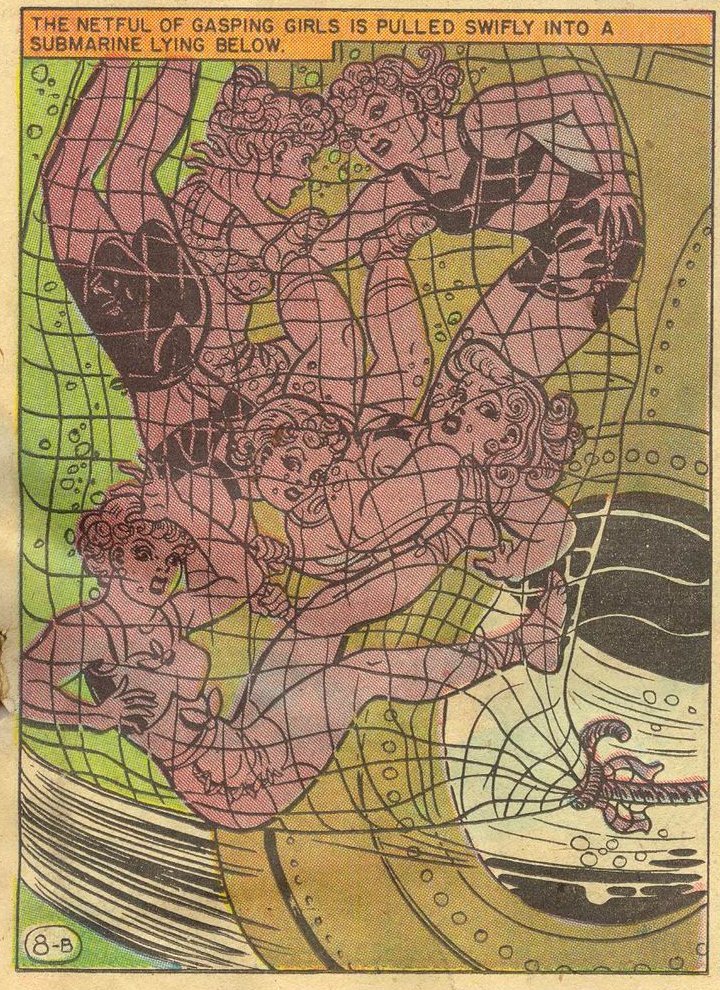
Along those lines, perhaps the most interesting or revealing thing about this issue is that the art isn’t very good. Not that it’s terrible; Peter still has some nice set pieces, like this weird and funny undersea clump of Holiday girls:

But in general, compared to much of the remarkably adventurous art in this run, this issue is both tame and bland. The layouts are fairly boring, and Peter makes little effort to unify pages visually (using colors, shapes, or themes as he does in many other issues.) The wordless sequences which the duo have been experimenting with are also abandoned. Costuming is less detailed, and layout and rendering are all less imaginative throughout. Peter is still Peter, and the art is still fun to look at, but he seems to have lost much of the visual spark that pushed him from being a very good illustrator to (in my mind) one of the all time greats.

So what was that visual spark? I can’t know for sure, obviously, but I really wonder if it wasn’t Marston. I’ve noted before that when Marston’s scripts aren’t so great, the art also seems to falter. Here I’m pretty sure that Marston was side-lined — and sure enough, the art suffers badly. Which makes you wonder…was it Marston who was specifying those wordless sequences? Was he involved closely in layout? How specific were his scripts?

I suppose it’s possible that Peter was just more inspired when he had good material. But the fact that so much of his more interesting stylistic choices disappear here where Marston seems out of the loop — it just makes me think that Marston (who, as I’ve mentioned before, actually hired and paid Peter himself) may have had substantial direct input into the art. How I would love to get my hands on one of his scripts….
__________________

So…there are in theory 6 more Marston/Peter WW issues left. I know that #28 is very good…but now I’m more than a little worried that the next five are going to be a slog. Marston was supposed to have been writing scripts on his death bed, so it’s possible that he generated some more first class material. We’ll see, I suppose….

Comics Criticism Roundtable on TCJ.com

I just wanted to let readers know that Suat, Caro and I are all contributing to a roundtable over at TCJ.com on the book Best American Comics Criticism edited by Ben Schwartz. Ben himself is also participating, as are Jeet Heer and Brian Doherty. I think the roundtable will be running for several days, so check back throughout the week.

Utilitarian Review 8/20/10

On HU

We started off the week with Andrew Farago’s discussion of Popeye in multiple media.

Matthias Wivel examined Breugel, Rembrandt, and Crumb’s Genesis.

Ng Suat Tong discussed The Playwright by Daren White and Eddie Campbell.

Caroline Small discussed Ivan Bilibin’s illustrations for Russian folktales.

Robert Stanley Martin argued that Popeye shouldn’t be canonical.

I analyzed one of Rembrandt’s Biblical illustrations.

Peter Sattler criticized the insufficient literalness of R. Crumb’s Genesis.

And we have an index of the entire Genesis roundtable.

And here’s a doom metal mix if that sort of thing appeals.

Utilitarians Everywhere
At Madeloud I discuss some of the best releases by the Japanese psych-rock collective Ghost.

And also at Madeloud I contributed an appreciation of the Bangles reunion record to this discussion of counterintuitively good albums.

Slow-Rolling Genesis Index

We’ve been writing about R. Crumb’s Book of Genesis on and off here at HU for the past month. I think we’re finally done (hear that co-bloggers? Stop it!), but I thought it might be helpful to provide a convenient index of the roundtable. So here it is:
________________

The entire roundtable is here.

Ng Suat Tong begins the roundtable by comparing R. Crumb’s Book of Genesis to the Biblical images of other great artists.

Ken Parille, writing at his own site, defends Crumb’s Genesis.

Ng Suat Tong responds to Ken Parille’s post.

Ken Parille at his own site, talks about pastoral and presence in Crumb’s Genesis.

Alan Choate defends Crumb’s Genesis.

Ng Suat Tong replies to Alan Choate.

Alan Choate continues his defense of Crumb’s Genesis.

Ng Suat Tong responds to Alan Choate’s further comments.

Noah Berlatsky talks about Crumb, Kierkegaard, and floating bearded heads.

Caroline Small compares Crumb’s Genesis to Biblical illustrations by Howard Finster and Basil Wolverton.

Matthias Wivel discusses Crumb, Rembrandt, Breughel, and cartooning as exegesis.

In a slight detour, Noah Berlatsky discusses a Rembrandt illustration from Genesis that Matthias highlighted.

Peter Sattler argues that Crumb’s treatment of Genesis is not sufficiently literal.
______________

In addition to the posts, the discussion has generated a lot of comments. Besides the writers above, interesting points have been made by

Jeet Heer

Steven Grant (and also here)

EricB.

Robert Stanley Martin

Ed Sizemore

________

Thanks so much to Suat for starting this, to all our other posters, and for everyone who took time to comment…and of course to read it.

Rembrandt Chatting

Last week Matthias Wivel discussed Crumb’s Genesis in relation to the work of Rembrandt and Breughel. Matthias argued in particular that Rembrandt’s engagement with Biblical themes

is clearly more sophisticated, dedicated and emotionally complex than Crumb’s Genesis, but it is nevertheless instructive to compare the two, because of the intersection of their methods and goals.

Like Bruegel and Rembrandt, Crumb is a humanist (in the modern as opposed to the renaissance sense of the word), observant of human behavior and—as his richly varied sketchbooks demonstrate—clearly attentive to the world around him….

Matthias discusses at some length what he finds valuable in Crumb’s Genesis…and I’ve talked about my own reservations about the book elsewhere as well. In fact, I talked about them so much that I have more or less pissed everyone off, so I thought perhaps I’d give it a rest for a post. But I love that Rembrandt illustration that Matthias introduced me to in his essay, so I thought for a change I’d talk briefly about what I find so striking about the image.

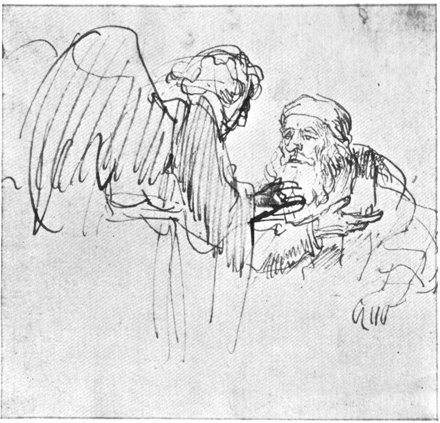
In the first place, the thing that gets me initially isn’t exactly the fact that it’s attentive to the world. On the contrary, it’s the quickness of the sketch; the way you can almost see Rembrandt’s hand scribbling forms out of nothing. It’s only secondarily that Abraham’s face leaps out with its half-quizzical, half-stricken expression…that face being the only thing in the drawing (besides perhaps the angel’s right hand) which seems finished. The drawing seems to have happened so quickly that you almost wonder if Abraham is reacting to the angel’s words or to the shock of materializing. It’s as if he’s just been suddenly and surprisingly beamed onto the planet.

The angel is even sketchier than Abraham — his one wing is actually transparent, and through it we see the other, which is little more than a child’s scribble. His left hand is a misshapen paw; you get the sense that if we could see his face, it would be little more than an indistinct mass (maybe *that’s* why Abraham looks distrubed!)

Of course, we can’t actually see the angel’s face, because Rembrandt has positioned us behind his shoulder. The angel is doubly obscured; he’s half-formed with his perhaps nonexistent features in shadow. We can’t see the angel and we can’t see what Rembrandt sees in the angel. The composition, the technique, and the insistent focus on the process of creation all seem to emphasize the mystery that Abraham confronts. Because of all of that, this drawing does not seem to me to be humanist — or not solely humanist. Instead, it sets a powerfully imagined human against a perhaps even more powerfully imagined something else, which is presented as both a reality (that incongruously solid right hand) and a question.

Matthias in his essay argued that visuals are potentially more ambiguous than words, and I certainly feel here that the drawing is about its own spaces. Who made the face of Abraham? What is the face of God? Where are we in this picture, and what would we see if the angel turned towards us? And perhaps most insistently (if this is showing us the moment after the interrupted sacrifice) where is Isaac? What is he doing, what does he feel? Presumably he’s just outside the sketch, swallowed in the blankness the picture comes out of and goes into. The sacrifice is as unknowable as God himself — perhaps because, in a Christian context, the sacrifice and God are the same.

It’s possible that I’ve completely muddled what’s happening here — I’m neither a Biblical scholar nor a Rembrandt scholar, and my ignorance is sufficient that I’m not (as I indicated) even positive that this is supposed to represent the post-sacrificial moment. (Hopefully Matthias will let me know where I’ve gone astray.) But I feel like Rembrandt’s drawing is, as Matthias says, a visual exegesis — that it demands a conversation. Abraham is preparing to talk to us, as well as to his creator. It’s not a comic, so there aren’t any words, but the picture speaks.

______

Update: This is part of a roundtable on Crumb’s Genesis. The whole discussion is here.

Utilitarian Review 8/13/10

On HU

This has been a chaotic week for me, and so things are a little out of sync. Thanks to both our readers and guest posters for bearing with us. And thanks to Caro for keeping the trains running on time.

This week has mostly been devoted to our Popeye roundtable. There are going to be a couple more posts in the roundtable next week by Andrew Farago and Robert Stanley Martin.

Sunday incidentally will also see the delayed but much anticipated post in our series on Crumb’s Genesis by Matthias Wivel.

Utilitarians Everywhere

I have a post on Splice Today about my enthusiasm for the Bangles

That’s the point of pop music in some sense, though; it’s addictive. Not like heroin that’ll land you in prison with the cool kids, but like sucking down a bagful of jelly bellies and then feeling sick and ridiculous before going out and buying another one. And part of the addictiveness and the ridiculousness is, really, that it’s jelly bellies; they’re right out there. Everyone can do it. It’s not a subculture you can call your own; it’s pop—it belongs to everyone. The Bangles don’t give you any cred. Everybody loved them and that was the point, and now everybody’s moved on and if you still love them you’re either remembering your youth or (like me) you’re subject to a meaningless and harmless idiosyncrasy. The ingratiating hooks are there to be ingratiating. What else could they be for?

Also at Splice I have a short essay about E. Nesbit’s wonderful Book of Dragons.

At Comixology I writer about the Oprah comic book.

With comics, I’m never taken aback by lousy quality. After all, most things are lousy — maybe comics are a little worse than everything else, but not enough to squawk about. But the marketing confusion in even comics that have no point other than their marketing: I can never get over that. Why churn out this horrible Oprah Winfrey piece of dreck if not to make money? And how can you make money if you don’t even know who you’re trying to sell to? I mean, I bought this in a direct market store. What are they doing even selling it through the direct market? What venue could they find where folks would be less likely to pick this up?

Other Links

Tucker’s Comics of the Weak this week is one of his all time all times, I think.

And Tucker and David Brothers are blogging their way through some interesting looking Black Panther stories. Good week on the Factual Opinion!