Phooey From Me To You: Masters of American Television

I organized this roundtable as an excuse to look at some of the E.C. Segar Popeye strips. I’d never read them, and many people love them, obviously, so I figured this was a good chance to catch up. After reading a couple of reviews, I tried the Plunder Island volume, often mentioned as the highpoint of the series.

And after reading through the Plunder Island strips, I can say with some assurance that, man, this is not for me. Though I enjoyed the energy of the drawing, and the Sea Hag and Goon provided some evocatively creepy moments early on, the limited range of the humor, and its empty-headedness, quickly becomes numbing. Wimpy is lazy, Wimpy eats a lot, Popeye is noble, defends the underdog, and always wins. It’s like Garfield meets Superman. And, you know, I don’t hate Garfield or Superman…but I’ve read enough of both to last me the rest of my life. Honestly, I couldn’t even finish the book. I got distracted by Kierkegaard, and then by Derrida — and when you’re procrastinating by reading Derrida, you know you really, really don’t want to be reading what you’re supposed to.

If I had read the whole book, I’d probably be really thoroughly irritated and be spitting piss and vinegar (that metaphor isn’t exactly right…but onward.) As it is, though, I don’t have much resentment built up. Popeye isn’t at all pretentious — punch, eat, mangled English, laff. I don’t find it that funny, but I can’t get mad at it either. As I said, I even appreciate the art in a generalized way (cute cows!) If people like this, I’ve got no beef (as it were.)

While I’m not that interested in the content of Popeye, the strip does raise some interesting issues. Specifically — well, as I said, this is a very unpretentious strip, which relies almost entirely on the most basic kind of repetitive gastronomic and pugnacious humor. Whatever the drawing’s charm, there’s none of the sweeping formal adventurousness of Little Nemo here. I guess you could compare it to Buster Keaton or Charlie Chaplain…but it seems to have at least as much in common with sitcoms; the same zany characters performing the same zany routines week after week in a timeless round of entertaining tedium.

Comics is often compared to film and literature and visual art, but it’s much less frequently linked to television. There are certainly many parallels between TV and comicdom, whether in method of delivery (they’re both among the few contemporary art forms that are serialized as a matter of course), or in material for adaptation (Buffy in one direction, Smallville in the other), or in creator overlap (Brian K. Vaughn, Joss Whedon, Dave Johnson.) But nobody wants to make a big deal out of it since nobody but nobody wants to be linked to television, a medium which has gone more than half a century without ever attaining even a morsel of aesthetic credibility.

People do wax enthusiastic about individual shows, of course, whether it be the Wire or Mad Men or Battlestar Galactica. But that enthusiasm is perpetrated with an amazing lack of ambition or anxiety. When people say that Lost is awesome, they rarely do so by saying “Lost is awesome — and worthy to be compared to the achievement of the Coen Brothers!” People love Joss Whedon, but nobody says he’s Quentin Tarantino, much less Orson Welles. Similarly, there’s virtually no effort that I’ve ever seen to solidify television’s bona-fides through canon formation. I’m sure someone has made a list of the best 100 television shows (here’s one, for example) but such lists don’t get tons of press and tend to be presented as much as personal preference as “this is what all educated people must be familiar with.”

Even the criteria for creating such a canon seems almost completely untheorized. What are the aesthetics of great television? What would a great television show look like? What issues would it address? How would a canonical television show distinguish itself from film, or from video art? Could great television be video art? Could there be a gallery show of television video art, the way there are gallery shows of comic art? What would that be like? What would be chosen?

Of course, some people will probably argue that there couldn’t be such an exhibit because television is a wasteland and the whole medium should be dropped in a well or eaten by bears. (Domingos, I’m looking at you.) But…I don’t know. I look at Popeye, which has good visual aesthetics and competent jokes and has been firmly placed in the comics canon, and I think — television could do that.

The classic Sesame Street animations are brilliant and weird; I don’t see how they’re aesthetically any less accomplished than E. C. Segar’s drawings, and they’re certainly more conceptually adventurous. The Batman TV series is visually bizarre; those giant freeze cones, the slanted villain hideout with the girl in the cage in the background — it seems infinitely more inventive than many of the comic book sources, and the dialogue and plotting is so arch it’s a wonder everyone’s eyebrows don’t just fall off. The Abbott and Costello routine does nothing in particular with visuals, but the escalating insanity of the dialogue seems, at least to me, much more manic and witty than the Popeye strips.

My point here isn’t that these are all superior to Popeye and therefore deserve to be treated as canonical culture. Nor is it that television in general should be seen as a (potentially) serious art form. Rather, I’m just saying that what is and isn’t considered art is really arbitrary. Comics critics have spent a lot of energy for the past decades trying to get comics accepted as high art. They’ve had definite (if not unqualified) success, and now even frankly pulp, unpretentious works like Popeye can be put up in galleries, given lavish reissues, and hailed as canonical examples of the form. And, of course, the critical zeitgeist has created room for more explicitly highbrow work by everyone from Chris Ware to Lilli Carre.

At some point, you do wonder, though…what if comics had taken television’s route? No anxiety, no ambition, no real critical battles over whether it could be high art or whether that would be a good idea. Would that have been categorically worse? The anxiety is certainly a spur…but it can be a cage as well. In any case, I don’t think I do comics in general any harm by saying, you know, it doesn’t really matter that much whether Popeye is or is not great art.

_________________
For a more enthusiastic take on (among other things) Popeye’s relation to artsy-fartsy comics, read Shaenon Garrity’s appreciation.

This is part of a roundtable on Popeye. All posts in the series can be read here.

Utilitarian Review 8/7/10

On HU

Erica Friedman started the week by asking a bunch of creators and cartoonists why they made art.

For his first official column, Alex Buchet looked at some inaccuracies in Harvey Kurtzman’s war comics.

This is a delightful con wrap up by Kristy Valenti. The comments are even funnier.

Richard Cook continues his look at the Silver Age Flash.

I made fun of R. Crumb’s Genesis, particularly his floating bearded heads.

Vom Marlowe looked at the illustrated children’s book series Billy and Blaze.

Caroline Small compared Crumb’s Genesis to work by Howard Finster and Basil Wolverton.

I reprint an old essay about war in literature.

And here’s a random download mix with Thai music, funk, ZZ Top, and maypole dancing.

Utilitarians Everywhere

At Splice Today I reviewed Kelis’ new album.

Flesh Tone isn’t horrible. It’s just anonymous—which is perhaps even more depressing. Kelis’ distinctive, not-quite-ready-for-primetime voice is processed into bland submission, and the Neptunes’ unique production is replaced with third-drawer dance-floor dreck. The lyrical nuttiness of Kaleidoscope is entirely gone; instead we’re left with groaners like “Just like the sky on the 4th of July/you make me high.” The low point is probably “Song for the Baby,” the cheery sentiments and perky beat of which put Kelis dangerously close to Amy Grant territory. There’s a bitter irony too in “Scream,” where Kelis insists, “You’ve won the right to scream and shout.” Unlike on Kaleidoscope, Kelis does not in fact scream. She barely whimpers.

Also on Splice, I talk about Kierkegaard, Abraham, puritanism, and aesthetics.

This shouldn’t be particularly surprising. If there’s one tendency in Protestantism that’s stronger than the loathing of aesthetics, it’s the veneration of the same. The Bible, after all, is a series of tales. Kierkegaard sneers at aesthetics because he takes them so seriously. The problem with stories is not that they’re stories, but rather that they’re not the one story. It’s because he loves the tale of Abraham so elaborately that Kierkegaard denigrates other narratives as sentimental balderdash. Sci-fi jelly creatures attacking—that doesn’t have the terror, the sorrow, the human interest and moral power of Abraham walking to the mountain to slay his son. Away, then, with the jelly creatures! Puritan philistines are just particularly foul-tempered critics; their iconoclasm is just one long bad review.

Other Links

Roland Kelts is writing some interesting stuff about the fate of manga in the U.S. over at tcj.com.

And in my continuing pursuit of blog amity: Jeet Heer’s piece on Harvey Pekar is balanced and thoughtful.

Caro put me onto this really pretty great Newsweek article about Lily Renée

Derik Badman has a thoughtful assessment of Ben Schwartz’s Best American Comics Criticism.

Bombs in NeverNeverland

I wrote this almost twenty years ago for a course on representations of war when I was a junior in college. It touches on some issues raised in the comments section of Alex Buchet’s recent post on war comics, so I thought I’d resurrect it. I think I still agree with the main points, though the prose would probably be a trifle less earnest if I wrote it now. But, for better or worse, here it is.
_____________________________

“All children, except one, grow up,” writes J.M. Barrie at the beginning of Peter Pan. In many ways, the fictional constructions of war created by Tennyson, Kipling, Remarque, and Zola, appear to be attempting to deny this insight; appear to be attempting to suggest that war provides a return to an idyllic youth and innocence which allows the men who participate in it to escape from the mores and constrictions of adult society and return to an idealized childhood in which manners and restraint are cast away and replaced by simplicity and exuberant enthusiasm. War, for these authors, is an arena in which adventures can occur; in which heroism and enthusiasm triumph over the stodgy grind of day to day life. One can almost hear the cavalry in Tennyson’s “The Charge of the Light Brigade” declaring, with Peter Pan, “I’m youth, I’m joy” as they thunder towards the artillery guns, can almost hear Peter’s cocky self-assurance in Kipling’s breezy assumption that “of course” the British forces broke the “Fuzzy-Wuzzies”. The soldiers of which Kipling, Tennyson, Remarque and Zola speak have no fear, they have no doubts. They live, like children, in their own world with their own rules, in their own “NeverNeverland” separated entirely and forcibly from the reach and understanding of adult society.

Yet, despite this separation, the soldier is not ostracized, not attacked or unaccepted by the society which he seemingly rejects. He is not, in fact, a threat to civilized society, but is rather a delightful dream, an idea with great appeal both to the emotions and to the imaginations of people of the time, as the popularity of Charles Gordon demonstrates. Thus Kipling’s “Tommy” is a man (or, perhaps more correctly, a boy) who should be admired and loved even though he does not really fit the mores and norms of society, even though, as Kipling puts it, his “conduck isn’t all your fancy paints”. It is, in fact, Tommy’s separation from fine society which make him an attractive figure; his very simplicity, the very fact that he does not want luxuries but only wishes to be treated “rational”, composes his glamour. Tommy does not want “better food”, but only to be accepted by society without having to conform to its rules. He wants (and appears to receive from Kipling) to be given the freedom not to conform and to be admired for his very possession of that freedom; wants, like Peter Pan, to receive unconditional affection and yet to never have his mind cleaned.

It should, of course, be impossible to be at one and the same time independent and dependent, impossible to be heroic for the sake of the sympathy and admiration which that heroism brings. Only if one is capable of a total lack of self-reflection and self-awareness is this contradiction resolvable; it is only through his total naivety that Peter Pan is able to both expect admiration and receive it. Through war, Kipling, Tennyson, Zola and Remarque appear to suggest, through becoming a soldier, this simplicity can be (re)gained, this idealized childhood can be (re)found. Soldiers, like children, are, for these authors, not concerned with whether what they do is correct or incorrect, they do not agonize–they simply are. The soldiers whom Zola describes are “Like children and savages, their only instinct…to eat and sleep in this rush towards the unknown with no tomorrow”, Remarque’s Paul notes that “The national feeling of the tommy resolves itself into this–here he is.” The soldier is unthinking; in fact, thought is his enemy, his destroyer. The self-reflection which connotes adulthood, the loss of innocence and unselfconsciousness, results, in these fictions, in age and death. When the soldier begins to think, as Lapoulle does after killing Pache, he is destroyed. As Remarque’s Paul says, “we [the soldiers] are in a good humour because otherwise we should go to pieces.”

Remarque, of course, is contending that it is the horror of war, not of adulthood, which makes this jollity necessary; that to think about war would cause madness, insanity. But in many ways Remarque’s novel makes a statement not that war is too awful to think about, but that it is, in fact, aging which is the greatest horror. It is for this reason that the older men in the War are not as tragic as the men of Paul’s generation, for the older men have no youth to lose. For Remarque, the tragedy of the war is a loss of childhood, is the fact that through the war, Paul discovers death and sexual initiation (“the curse of a soldier” as Kipling writes), fear and vulnerability. Yet all of these discoveries are, in fact, not unique to wartime; as Paul himself realizes, they are instead the necessary adjuncts of adult life, the manifestations of a superficial society which delivers coffins punctually before a battle and places you under the arbitrary control of a postmaster. The war is the extension of civilian societies cruelties and artificialities, stupidities and absurdities. But even as it is so, the war also provides a means of escape, a strategy of resistance, a means whereby youth can be retained through “the finest thing that arose out of the war-comradeship.” Through this camaraderie, the trappings and foolishness of civilization, the unnecessary clutter of the school room, can be shrugged off and subsumed in the contentment of a good meal tasted among good friends. Paul relishes the experience of sitting with his comrades on their makeshift toilets not in spite of the primitiveness of the facilities, but because of it. Remarque views culture and civilization with suspicion, and finds in war a way to sidestep them, to return to the idyllic childhood which Zola describes the young intellectual Maurice finding in the arms of the simple peasant Jean when “Maurice

…let himself be carried away like a child. No woman’s arms had ever held him as close and warm as this…Was this not the brotherhood of the earliest days of the world, friendship before there was any culture or class, the friendship of two men united and become as one in their common need of help in the face of the threat of hostile nature?

Through his relationship with Jean, Maurice regains infancy; he is tended too, sheltered, cared for. War in The Debacle provides Maurice with a way to return to simplicity, with a means of becoming both noble and tragic. He becomes one of the “poor boys, poor boys” to whom his sister refers; he becomes innocent. In its creation of an arena in which life becomes more simple and true, war also, then, absolves of guilt even as it confers naivete. The soldier makes a sacrifice for crimes he did not commit. Like the men of the Charge of the Light Brigade, he goes unquestioningly to his death, following orders to the last. The betrayal of the soldier by civilians and generals is made all the more poignant because the soldier has done nothing wrong; has, in fact, placed his whole trust and hope upon civilian assurances of glory and easy victory. The betrayal is, in fact, like the betrayal which Peter Pan experiences at Hook’s treachery on the rock in the lagoon, the betrayal of a child’s total trust by a parent’s unfairness, after which, Barrie writes the child “will never afterwards be quite the same boy.”

It is this betrayal which Paul feels has robbed him of his youth when he says that, “I am young, I am twenty years old yet I…see how peoples are set against one another, and in silence, unknowingly, foolishly, obediently, innocently slay one another. [italics mine]” Remarque claims, then, both that the soldiers have lost their innocence, and that they retain it. Remarque says that their parents have failed them, and yet he still conceptualizes them as children. They have discovered that the world is unfair, and yet Remarque, through Paul, still perceives them as innocent. Paul repeats over and over that his generation is lost, it is useless, it is old and destroyed, but he never once decides to stop fighting, and even pushes Himmelstoss forward when the former drill master falters. Self-consciously martyred, Paul cannot solve, but can only revel in his troubles, just as Mr. Darling revels in his sojourn in the kennel.

Mr. Darling is, of course, not really comparable to Paul. He is not as young, nor in as much distress; he was not in the trenches of the First World War. Yet, in a deeper sense, Mr. Darling is very much like Paul, very much like Maurice, very much, for that matter, like Charles Gordon. He is a man who wishes more than anything to be admired, as Paul and Maurice did when they joined their respective armies, but who, through that very wishing, has condemned himself to an unadmirable existence. He is a conceited fool, a whining incompetent, a desperately contemptible figure when placed beside the apogee of unconscious grace and youthful innocence which is Peter Pan. And yet, while no one would want to be Mr. Darling, no one can wish to be Peter Pan either, because the very wishing dooms the attempt. One either has “good form” or does not have it. To have good form is to be young, unconscious, free. But “All children, except one, grow up.” And that one, as Barrie surely knew better than anyone else, was not real.

This is, I think, Barrie’s central insight, is the reason that Peter Pan , if it does not really oppose war, offers a way to oppose war that none of the other pieces of literature we have studied manage to suggest. For if, in fact, childhood is unattainable, if simplicity is gone, then the attempt to recapture that simplicity and childhood through war is not only misguided, but is actually dangerous, futile, and pitiful. Barrie loved children, he loved childhood. But he knew that he was not a child, and that he could not become one by travelling to some foreign field with a rifle and a battalion of comrades. Childhood games played by adults are not touching or cute; they are pitiful and even terrible. When Mr. Darling pours the medicine into Nanna’s bowl, he does not appeal to the reader in the same way that Peter does when he plays the game of question and answer with the pirates. Similarly, Peter’s comment that “to die will be an awfully big adventure” is charming and witty only when uttered by Peter’s naive voice. Kipling’s effort to capture what appears to be a similar sentiment sounds incredibly cold-hearted and callous, advising as it does that a soldier wounded on the field of battle and facing imminent mutilation ought to “Jest roll to your rifle an’ blow out your brains.” On the other hand, the French mutineer’s letter telling his sweetheart that, “I love you, and I don’t want to die”, is touchingly painful, and would be just as out of place in Peter Pan as would Kipling’s injunction. Real horror (though apparently Kipling, whose brain may itself be scrambled in some anomalous fashion, does not know it is real horror), and real fear are not part of the world which Barrie describes.

This is, of course, because Barrie’s world is not real. NeverNeverland is named so for the obvious reason. Tennyson, Zola, Kipling, and Remarque, in attempting to locate it within the context of reality, in attempting to suggest that NeverNeverland is obtainable within a historical rather than an imaginary framework, trap themselves within the very mundane existence that they wish to escape. In trying to escape adulthood, in trying to leave behind their responsibilities, they succeed only in making Mr. Darlings of themselves, only in placing themselves in a continuum where they refuse to face their problems because they wish so badly to transcend them. Tennyson cannot feel outrage or shock at the death of the Light Brigade, Zola can create only shallow caricatures in the place of real characters, Remarque can not move past self-pity and gruesome imagery to register any deep and meaningful moral objection to the carnage he witnessed, and Kipling appears to have buried any decent human compassion at all beneath a glut of imperialist fervor. Each is left romanticizing stupidity and horror in the hope that in doing so they can rediscover the childhood that they have lost.

Barrie offers no alternative to this quest. He, too, cannot turn from childhood, cannot stop seeking Peter Pan. But he knows, as Tennyson, Kipling, Zola, and even Remarque do not seem to, that the quest is futile, knows that Wendy and John and Michael and the Lost Boys must grow up eventually, must take up a mundane existence no matter how boring or dull it appears. And once it is recognized that war is not a return to some idealized NeverNeverland of childhood, then perhaps a convincing opposition to it can begin to be formulated.

R. Crumb vs. Kierkegaard — Battle of the Floating Heads!

Langlois’ formulation is the denial of time: an idea of history not as something past, things having happened and remembered, but something entirely now, aggregated all together, present – meaning both presence and in the present tense. — Caroline Small

There was once a man; he had learned as a child that beautiful tale of how God tried Abraham, how he withstood the test, kept his faith and for the second time received a son against every expectation. When he became older he read the same story with even greater admiration, for life had divdied what had been united in the child’s pious simplicity. The older he became the more often his thoughts turned to that tale, his enthusiasm became stronger and stronger, and yet less and less could he understand it. Finally it put everything else out of his mind; his soul had but one wish, actually to see Abraham, and one longing, to have been witness to those events. — Kierkegaard, Fear and Trembling

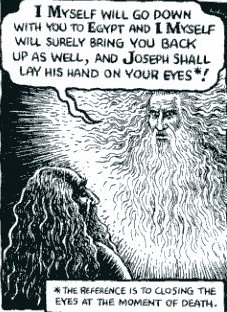
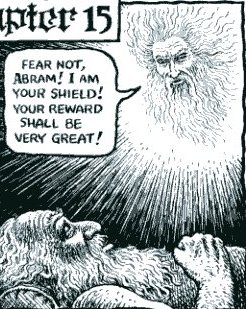
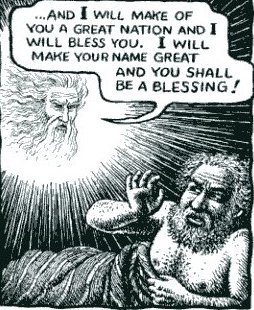
R. Crumb’s illustrated Book of Genesis does precisely what Caroline Small and Kierkegaard ask of art and of faith. In Crumb’s literal reading, with its physicality, and its playful touches of cartoonishness, the Bible is transformed from a fusty, inaccessible monument to boredom and bewildering begats into “something new,” a text that makes the familiar alien, or, at least, more familiar. In giving flesh to the Biblical narrative, Crumb allows us to do what Kierkegaard, tragically lacking the technology of sequential pictograms, could not. We can “actually…see Abraham” drawn before us, and watch the flickers of agony, hope, love, and relief flow across his comfortingly craggy patriarchal visage, as if he were Patrick Stewart reacting with satisfying aplomb to the Romulan menace.

Moreover, Crumb penetrates to a truth that Caro and Kierkegaard fail, each in their own way, to understand. Making something new is best done, not through imaginative engagement, but through rote drudgery. Clichés are our deepest selves; to present them with minimal comment or inquiry is therefore the artist’s highest calling.

Pesky floating bearded heads — didn’t I spray for those?

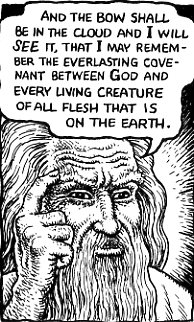
You can tell I am remembering because I am pointing to my head!

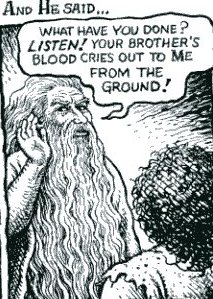
You can tell I am listening because I am cupping my ear!

Why do we see God as a bearded patriarch? Crumb cunningly investigates and undermines this image through his steadfast refusal to investigate or undermine it. Deftly deploying the poverty of his visual imagination as well as a deep spiritual engagement, Crumb shows us a God daring in His vacuousness; a children’s book deity who pantomimes and points in case the kiddies can’t parse the text, yet who thoughtfully problematizes His own superficiality not through any actual ideas or initiative, but rather through the very fact of being in a big honking coffee table book by R. Crumb.

Crumb’s insistence on transcribing every word of Genesis without bowdlerization or omission again makes history new by bringing into focus many aspects of the narrative previously glossed over by Christian and secular readers alike. For example, Crumb shows us that women in the past had nipples. He also demonstrates that Adam had a penis, even if nobody else in particular did, (Update: Robert in comments points out that at least one other person in the book has a penis too.) and that when people are anxious, little sweat drops fly off of them.

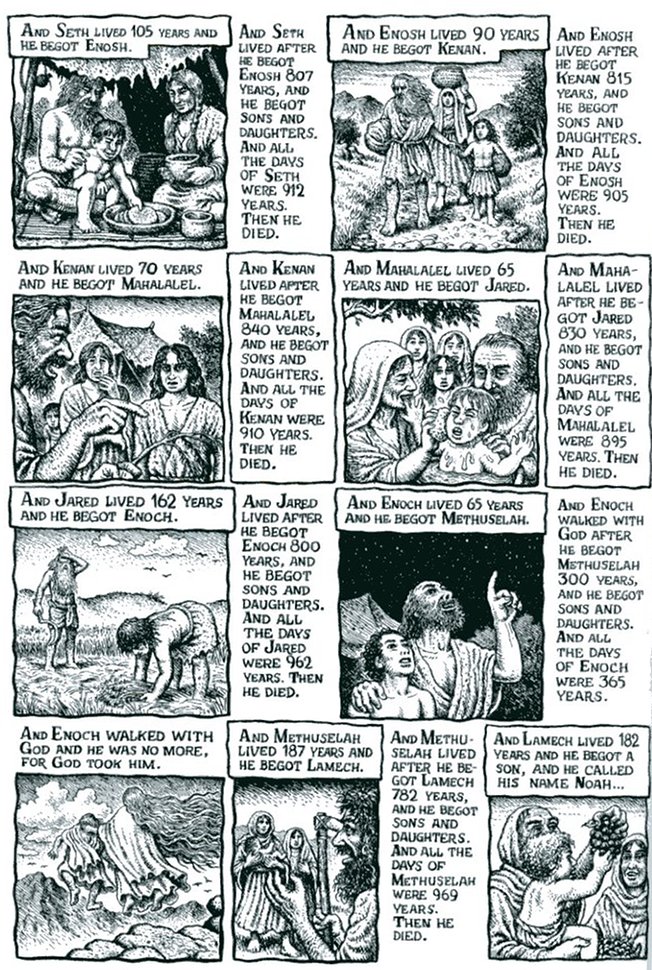
And, of course, he provides visual referents for the begats.

Another artist, less versed in the transcendentally validating power of banality, might have attempted to visually integrate the passage’s obsessions with patriarchy, seed, age, and death. One can imagine Chris Ware, for example, creating a single intricate image of lineage, or Johnny Ryan (channelling the younger Crumb) treating the text as an opportunity to create an extended daisy chain of sentient semen. Far better Crumb’s vision — a series of small disconnected drawings of more or less random scenes of life, recalling a light television montage that gets up on its hind legs to say, “Humanity! How heartwarming!” Time passes, life passes, Crumb draws, and the strings swell. Crumb has commented in interviews on the strangeness of the Biblical narrative; what better way to emphasize that strangeness than to turn it into a drab sentimental parable?

Ng Suat Tong started this Genesis discussion off by comparing Crumb’s visuals to the efforts of great artists of the past. Of course, it is not really cricket to put Crumb next to artists like Blake since Crumb draws lots of pictures on a page, thus obviously quantitatively overwhelming painters who only drew one at a time. Similarly, it seems unfair to place Crumb beside mere authors since mathematically: pictures + words> words. Still, I think it’s worth looking at this passage by Kierkegaard to show exactly what Biblical exegesis has been missing up to this moment.

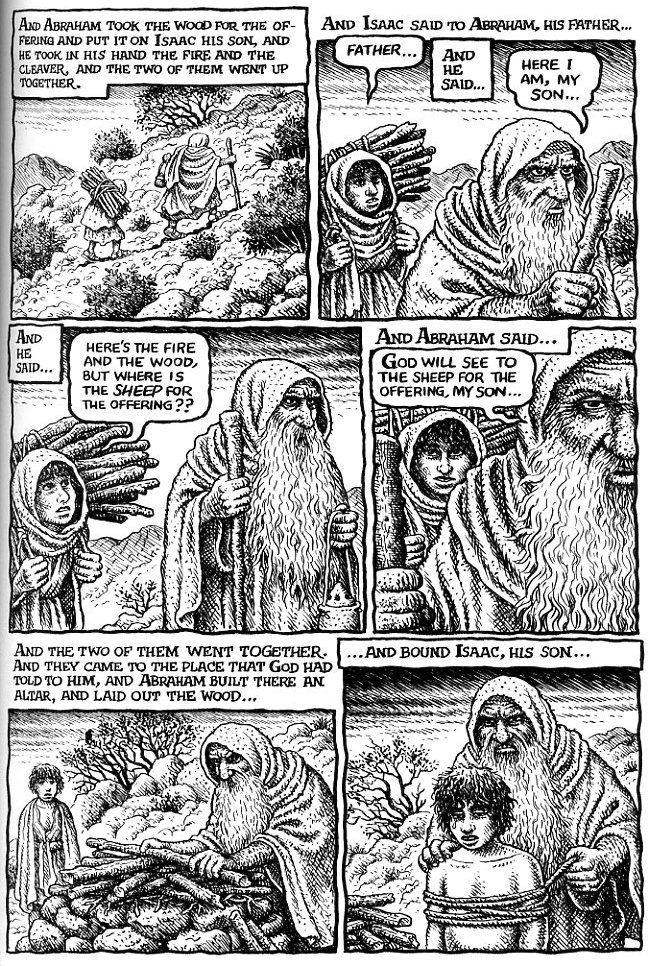
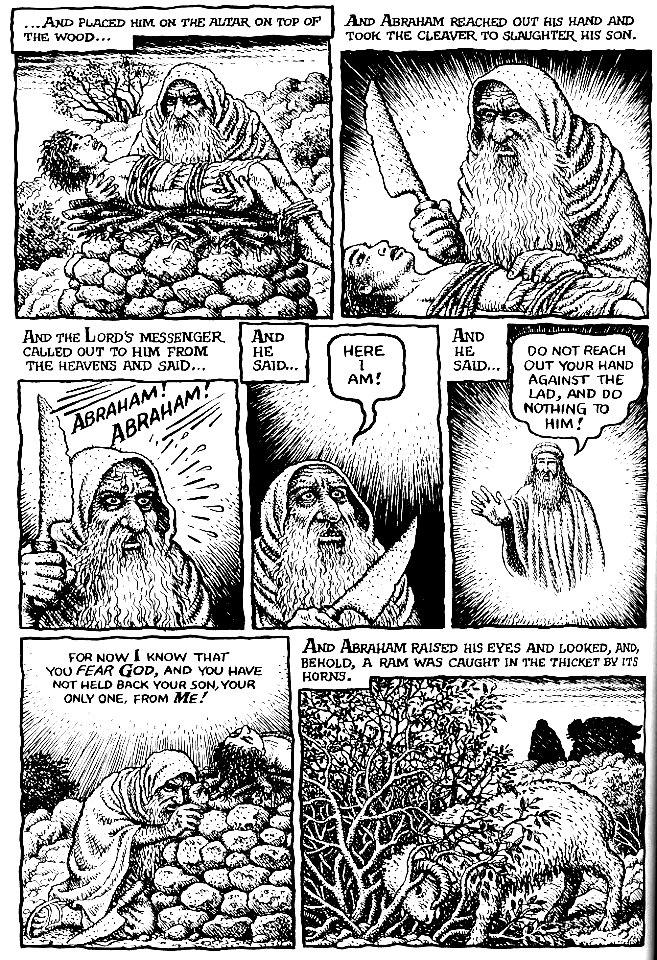
It was early morning. Abraham rose in good time, had the asses saddled and left his tent, taking Isaac with him, but Sarah watched them from the window as they went down the valley until she could see them no more. They rode in silence for three days; on the morning of the fourth Abraham still said not a word, but raised his eyes and saw afar the mountain in Moriah. He left the lads behind and went on alone up the mountain with Isaac beside him. But Abraham said to himself” “I won’t conceal from Isaac where this way is leading him.” He stood still, laid his hand on Isaac’s head to give him his blessing, and Isaac bent down to receive it. And Abraham’s expression was fatherly, his gaze gentle, his speech encouraging. But Isaac could not understand him, his soul could not be uplifted; he clung to Abraham’s knees, pleaded at his feet, begged for his young life, for his fair promise; he called to mind the joy in Abraham’s house, reminded him of the sorrow and loneliness. Then Abraham lifted the boy up and walked with him, taking him by the hand, and his words were full of comfort and exhortation. But Isaac could not understand him. Then he turned away from Isaac for a moment, but when Isaac saw his face for a second time it was changed, his gaze was wild, his mien one of horror. He caught Isaac by the chest, threw him to the ground and said: “Foolish boy,, do you believe I am your father? I am an idolater. Do you believe this is God’s command? No, it is my own desire.” Then Isaac trembled and in his anguish cried” “God in heaven have mercy on me, God of Abraham have mercy on me; if I have no father on earth, then be Thou my father!” But below his breath Abraham said to himself: “Lord in heaven I thank Thee; it is after all better that he believe I am a monster than that he lose faith in Thee.”

Kierkegaard uses the story as the occasion for an inquiry into faith and love between God and man, father and son. He does this by treating the story as his own; it is a coat that he can put on, adjust, take in or let out. For him, reverence involves dispensing with reverence; to understand the story of Abraham as it is, he has to defile it with his own imagination.

Crumb, on the other hand, treats the story as an inquiry into the story. It is his job to clothe the text, not to have the text clothe him. You can see him doing his best to provide a striking garment; Abraham looks grimly determined here, sweatily panicked there, movingly relieved in the center panel of the second page (perhaps the strongest single image in the book, despite the yep-there-it-is-again light from heaven.) But this is gilding, not defilement. Kierkegaard fucks with Genesis and ends up begatting a new creation; Crumb puts a few ribbons of varying construction in the text’s hair and sends it on its way.

And, surely, this is the great contribution of comics to Biblical criticism and to art. Without much of a tradition of accomplishment, sequential pictographs are perfectly situated for the aesthetic task of the future — namely to rehash what has gone before as doggedly and unimaginatively as possible. Perhaps Caro was wrong after all; the best way to deny time is not to recast the past as present, but the present as past. Nothing has happened, no one has spoken, neither God nor our ancestors have taught us anything, and so the most lackluster retread deserves the most heartfelt hosannahs. If defilement is reverence, then reverence is the truest defilement —both of the Bible and of art, which are cast together, through the power of Crumb’s genius, out of the flawed garden of giving a shit and into the absolute purity of irrelevance.

_____________________

For a less gratuitously mean-spirited take on R. Crumb’s Genesis, I’d urge folks to read the heartfelt and thoughtful defenses by Alan Choate andKen Parille. The entire ongoing back and forth about Genesis on this blog can be found here.

Utilitarian Review 7/31/10

Announcement!

Alex Buchet, who wrote a lovely series on Tintin and racism last month, is going to be joining us as a regular columnist. His column will be called “Strange Windows” and will run the first Monday of every month except when it runs at sometime different because our scheduling is wiggy. In any case, we’re very glad to add Alex (who resides in Paris) to our multinational cast, and look forward to his first column (on Harvey Kurtzman’s war comics) which will run later this week.

On HU

Last week on HU began with Domingos Isabelinho’s discussion of the boys’ comics of Argentinian comics writer Héctor Germán Oesterheld.

Ng Suat Tong looked at whether or not the interviews of Gil Kane could qualify as criticism.

Richard Cook continued his look at Silver Age Flash comics.

As part of our slow-rolling roundtable on R. Crumb’s Genesis, Alan Choate offers a lengthy defense of the book (to enthusiastic plaudits form Jeet Heer, Matthias Wivel, and others in comments.)

Also, at his own site, Ken Parille discusses some further thoughts on Genesis.

And Ng Suat Tong offers a brief reply to Alan.

Vom Marlowe finds a mainstream comic that does not suck and there is much rejoicing.

And Caro talks about what comics can learn from film archivist Henri Langlois.

Also, because you demanded it an evil metal download!

Utilitarians Everywhere

At Splice Today I discuss the new Angelina Jolie vehicle Salt.

Perhaps this ties in to the most unexpected result of having a female protagonist: it seems to have completely drained all the sex from the film. The film is amazingly circumspect; Jolie is dressed sensibly throughout, and even at times (as when she disguises herself as a man) more than sensibly. There are no sex scenes, and barely even any romance—there’s one mildly intense kiss with her husband, but that spy-thriller staple, the seduction of the enemy, is nowhere to be seen. Perhaps part of the problem is the old double-standard; men can seduce lots of women and that makes them rakish; if Jolie were falling opportunistically in bed with the enemy in order to manipulate them, her character would be far less sympathetic. So instead the film opts to make her traumatized, humorless, and almost neutered; she might as well be in some sort of earnest movie of the week weeper.

Other Links

What the rest of the world thinks of Comic Con.

Utilitarian Review 7/24/10

On HU

This week started out with Suat’s reply to Ken Parille’s discussion of R. Crumb’s Genesis.

Then commenter/guest blogger Alan Choate replied to Suat.

And Suat replied to Alan. (Alan is planning a guest post for next week as well.)

Also this week, I talked about Gary Groth, Victorian dresses, and comics criticism. A huge comments thread resulted.

Kinukitty complained about the lack of sex in Otodama.

Richard Cook complained about the excess of nostalgia in Flash Rebirth.

I discussed Marston/Peter’s original Wonder Woman 21 in terms of doll stories and atomic silliness.

And Caroline Small posted a gallery of images from John Vassos’ Ultimo.

Also, this thread about elitism and standards and aesthetics and ethics just kept going, with Domingos Isabelinho, Matthias Wivel and Charles Reece weighing in.

Utilitarians Everywhere

I look at some crappy super-hero comics at Splice Today.

Marvel has ret-conned and alt-universed Spider-Man so many times it’s a wonder poor Peter Parker has enough brain cells left to pull his red tights out of the way when his nether web spinner incontinently dribbles. In theory this story is about an exact duplicate who’s replaced our favorite web-slinger, but I prefer to think that it’s just the same old Peter bashed one time too many in the head by the latest creative team and trying desperately to recover.

I’ve got a short note about Peanuts in Shaenon Garrity’s discussion of comics that make people happy.

At Madeloud I review the latest blackened doom slab from Ruins of Beverast.

At the Chicago Reader I have a brief blurb about an exhibit on good design.

I haven’t managed to read this yet, but Matthias Wivel has a massive discussion about Renaissance drawing at his site.

Other Links
I liked David Hadju’s take on Harvey Pekar, though it would have been nice if it had been a little longer.

In the interest of inter-blog amity, I thought I would point out that this piece by Tim Hodler raised some interesting questions.

Alan Choate on R. Crumb’s Genesis, Part 1

Alan Choate left a long series of comments on Suat’s discussion of R. Crumb’s Genesis. Alan is actually going to post some additional thoughts on the blog here next week, so in preparation for that I thought I’d move his initial discussion into a post where it would be more easy to access.

The discussion of Genesis has turned into a kind of slow motion roundtable, so I thought I’d put it under one rubric. You can read all of Suat’s discussions and Alan’s (and maybe others if they pitch in!) Under the header Slow-Rolling Genesis.

So here are Alan Choate’s original comments.
_________________________________________

Hi, Suat. I want to answer your review at some length because I have a lot of problems with it. I see numerous errors, a casual reading of the book, and some shaky assumptions supporting the whole thing. You make a number of dismissive remarks in the review and the comments that strike me as haughty, unfair, and wildly off-base. The biggest problem is that you’re falling readily into a basic error for a critic: refusing to assess a work on its own terms.

I should add immediately that I have an indirect entanglement with this (as they say.) You mention my suggestion “…made in all seriousness” in the comments to Heer’s post that Robert Alter, in his review for the New Republic, “would feel threatened (the words used are ‘nervousness’ and ‘professional jealousy’) by Crumb’s awful biblical scholarship,“ calling it ”laughable if not symptomatic of a deranged comics provincialism.“ It’s not right for me to get after you for saying things I find arrogant without apologizing for that. ”Professional jealousy“ was way too strong, and I take it back.

What I said was that Alter seemed nervous about the use of his translation- he spoke of his ”entanglement“ in the project, and the man’s job is choosing words- and may have nursed what I did call a professional jealousy between one exegete and another. I found Alter gracious and full of biblical insights, saw that he made a good effort to engage Crumb, but my reason for saying that was that he treated the adaptation as a failure because it couldn’t be regarded as definitive. I thought he was basically telling us why we should still read the Bible (preferably with his notes), and didn’t seem to grasp that Crumb was suggesting possible interpretations in much the same way he did, though his commentary did have the advantage of being able to list several at once. I‘d never say ”Crumb’s awful biblical scholarship“ was threatening to him, rather the rampant popularity that defenders of the canon ascribe to comics, and the notion that youngsters who read it might assume they’d read Genesis itself because the comic book has every word.

I am honestly not bothered by being called a ”deranged provincial“- feel free to look at me that way- and I hope it will be apparent that my issue is with other things you’ve said. According to you, Crumb did not ”read closely and with an intent to understand,“ his adaptation was ”stripped of emotional and mental investment,“ it suffered from ”artistic lassitude“, ”awful biblical scholarship,“ and an ”almost anti-intellectual approach“. You even pull ”half-digested pabulum“ out of the Comics Journal grab-bag. (Could it also be pernicious, odious, fatuous, and supererogatory?) ”Those with a serious interest in the original text and the rich tradition of biblical illustration“ can only find the book a ”well-crafted curiosity,“ and it ”might be of greatest use to readers whose minds are in a more formative state.“

This is strong stuff. I want to examine it by looking at the same parts you do and I’ll try to build into an overall assessment of your approach. I hope to also answer not just your review but a certain strain of commentary I’ve seen about the book.

The creation and fall of man are ”the two most famous chapters in Genesis… these factors will make the ascertainment of the extent of Crumb’s achievements in The Book of Genesis that much easier.“

This convenience is significant. My unscholarly sense is that visual adaptations of Genesis tend to fall back on the Garden of Eden and the Flood, with the second rank including the Tower of Babel (one famous image), Sodom and Gomorrah (fiery rain and pillar of salt), the sacrifice of Isaac, and Jacob’s ladder. Creations have been done but seem a bit vague for most artists; I think I should be able to call a famous Cain and Abel to mind, but can’t. Much of Genesis, as with the rest of the Old Testament or Hebrew Bible, is unfamiliar in visual art or dramatization, and parts may never have been depicted. (Anybody can scrape up examples with an image search, but let’s play fair; you know what I mean.) Jesus and Mary have been the stars of Western art, and the Hebrew Bible is recalled in a sprinkling of highlights.

A comprehensive visual dramatization of Genesis is unprecedented. This is a major part of this project’s reason for being. As Crumb says, “they gloss over it. When you’re a kid, they don’t inform you that Lot has sex with his daughters. Or that Judah slept with his daughter-in-law. Those parts are just glossed over. In illustrating everything and every word, everything is brought equally to the surface. The stories about incest have the same importance as the more famous stories of Noah and the Flood or the Tower of Babel or Adam and Eve or whatever. I think that’s the most significant thing about making a comic book out of Genesis. Everything is illuminated.”

There are other virtues to the adaptation, which will hopefully emerge in my examination and will be discussed as I wrap up. But the glaring obviousness of this one makes me wonder how seriously you’re taking this when you say things like ”there seems little point in retreading ground your artistic betters have fully exploited half a millennium ago.“

Your choice to focus on the Garden of Eden is itself interesting, since it’s highly atypical. It is the only part shorn of costume, tools, man-made structures, and any human culture at all. The characters are ideal ”types“. Visually, the rest of the book is astonishing in its quotidian detail, and one can find new delights on any page even after multiple readings, but the relentlessly straight-on layouts and total commitment to a credible milieu for the patriarchs create a rigorous visual style that could be considered as much a demand on the audience as classic art-house cinema. You can dismiss it as boring (for devil’s advocacy, here’s Johnny Ryan), but there’s also a seriousness to it.

By contrast, the Garden of Eden scenes are playful and fanciful. You point out this lightness, comparing the moment when Adam and Eve cuddle next to God and the woodland creatures to Disney. And you’re not wrong. (Though this is right before a startling tonal and narrative shift when it to a different version of man’s creation, this one primal and stark, right on the same page- a bold feature that I’ve never seen in an adaptation.) But your handling suggests that the tone of these parts is consistent with the rest of the book. You even point to the Adam and Eve scenes to answer Ken Parille’s description of the book’s aesthetic, without any hint of their difference:

”Crumb’s illustrations assume a sort of perfection of human form and behavior as far as Adam and Eve are concerned. I presume that this is one example of the “beautiful” materiality of The Book of Genesis which Ken mentions in the excerpt above. There is certainly a degree of exaggeration and a filtering through the artist’s eye but this is not a particularly earthy version of Eden… There is very little of that grimy commonness which we see in the Gospel adaptations of Pasolini or Chester Brown.“

You write of Crumb’s drawing of the creation of Adam,

“His solution was not an uncommon one during the Italian Renaissance, here made fresh by showing the stages in this act, in particular the breath of life given to Adam (the word “breathed” or “blew” here suggesting the intimacy of a kiss). Crumb’s adaptation is also notable for showing Adam in his clay-like state, a reminder of the Egyptian (see The Hymn of Khnum and Hekat) and Mesopotamian (see Enki & Ninmah, and Bel) myths which carry the same motif.

“As articulated in his short commentary found at the end of The Book of Genesis, Crumb is particularly interested in these ancient tales of creation and periodically inserts them while neglecting to emphasize the many internal consistencies, dilemmas and word plays in the Biblical narrative. Thus, for example, the “dirt of the ground” is linked to pagan tradition and not to a play on the words “man” (adam) and “ground” (adama) where “man is related to the ‘ground’ by his very constitution (Genesis 3:19), making him perfectly suited for the task of working the ‘ground,’ which is required for cultivation…his origins also become his destiny” (Kenneth A. Matthews).“

Where do you see a pagan tradition being inserted? The text specifies that God blows life’s breath into the man’s nostrils. Adam’s constitution from the ground is vividly illustrated. It could be reminiscent of Mesopotamian or Egyptian motifs but Crumb never mentions this in his notes, and the Bible does say “the Lord formed the man from the dirt of the ground.” It’s not clear what suggests to you that the artist is unaware of the link between man and ground or his destiny to work it, or what kind of signal you were hoping Crumb would send.

But you miss the way Crumb does emphasize Adam’s name and connection to the ground after these three panels. You’re not much impressed with the high-volume dressing down Crumb has God give Adam and Eve: “The entirety of God’s judgments from Genesis 3:14 to 19 are depicted without comment or analysis. The artist’s hand here is as distant as a machine-operated drafting tool.” But surely you noticed God’s jabbing finger. He does it a lot in that scene. The action through the Creation has been led by what God does with his hands- always with open palms, arranging things, introducing people to each other and their habitat. The only time until now that he pointed was to identify the forbidden tree. The only other pointing was Adam’s, naming the animals. Now God points at him: “To Adam he said… Cursed be the ground because of you!… By the sweat of your brow you shall eat bread, till you return to the ground, for from there you were taken! For DUST you are, and to DUST you shall return!” (Crumb’s emphasis.)

It’s easy to miss, but until now Adam has been “the man.” This is where he is named- named earth, or dust. Crumb has associated pointing with forbidding, punishment, and naming. For the expulsion from the Garden, God sends “him”- not “them“- “forth to till the ground from which he had been taken,” and Adam is shown carrying a tool. They’re in new, uncomfortable clothes, distressed, and getting ready for a life of work. On the next page we meet Cain, “a tiller of the soil”- who is constantly shown flushed and sweating. Crumb is recalling God’s line that “by the sweat of your brow you shall eat bread.” Cain’s offering to God is “from the fruit of the soil”- unspecific, but Crumb shows it as a basket of grain. (Jacob is also shown pounding down what might be grain or flour with his mother- is Crumb using Esau’s skill in hunting to set up a parallel?) The meaning of all this would take us into Biblical analysis, but Crumb has helped guide us to these issues.

“The stated “literalness” of Crumb’s adaptation as well as its generally bland imagery will lull many readers into the false impression that Genesis intends a deep consideration of centuries old biblical scholarship. It doesn’t, an important point which I will address in more detail later.“

It gives me the impression that he intended to consider the Bible. I don’t see how later scholarship is suggested, and surely Crumb wasn’t surprised to read these lines on the inside front cover: ”Using clues from the text and peeling away the theological and scholarly interpretations that have often obscured the Bible’s most dramatic stories, Crumb fleshes out a parade of biblical originals.“ This is an important point which I will address in more detail later.

I pointed out some interesting things in Crumb’s depiction of God in the comments section over at Blogflumer, and defended it as the kind of subtle commentary and exploration of the text that people are claiming he doesn’t make. To address some of your points here:

You claim that this line in Crumb’s notes: “after closely reading the beginning of the Creation, I suddenly imagined an ancient man standing on the shore of a sea, and gazing out at the horizon, and seeing only water meeting the sky”- is “an explication of his choice to so portray the Almighty.” It’s not. Crumb’s “ancient man” is not God, but to a man of ancient times trying to figure out his world. Crumb is describing the Hebrew vision of the universe (diagrammed here) and speculating about how they might have come up with it.

You say “one glaring problem” with Crumb’s traditional image of God is that “it conjures up all kinds of unflattering comparisons to his artistic forebears.” But I don’t find the examples you cite so unflattering; painters generally seem a bit uneasy with God the Father, which probably reflects a sense that the Almighty is not really like that, and the need to use the figure to tell the story.

“It also conveys an all too facile understanding of Adam being made in the “image of God” (imago dei), whether this is rooted in the theories and debates surrounding the terms “likeness” and “image” (e.g. in the writings of Irenaeus and Thomas Aquinas), the existential and relational readings of Karl Barth or the functional readings which altogether dispense with the idea that the “image” must consist of non-corporeal features [I think you mean “corporeal”] (i.e. the “image of god” as seen in man’s dominion over the earth and animals). This is but one indication that Crumb’s journey through Genesis was more personal and instinctive than cerebral.“

I must confess I didn’t reread my Irenaeus, Aquinas, or Barth for this, but could it be that their efforts to expand the meaning of “image” and “likeness” had more to do with a desire to reconcile their own idea of God with an ancient text than it did with determining the original meaning of the words? Whether or not you agree with Crumb’s references to the description of God walking in the Garden or sitting under the Terebinths of Mamre, or his assessment that “the God of Genesis is severe and patriarchal… he’s older than the oldest patriarch,” are they evidence of a “personal and instinctive” rather than cerebral approach?

You see his patriarchal vision of God as influenced by “the capricious Mesopotamian gods the artist is so enamored of” (lovely wording), but there’s nothing in his statement to suggest that, although the view that the Hebrew’s God had its roots in such figures is that of historians and Robert Alter. (Many Christians don’t have a problem with the notion that humanity had an evolving idea of God.)

However, there is a sense in which his choice is personal, as he’s said this God resembles his father and came to him in a dream. (From the Paris Review: “He was warning me about something… about some destructive force that was getting stronger… he was enlisting me to be one of the people to protect this reality from that force. When I was trying to figure out how to draw God I remembered that image, which I could only look at for a split second, it was painful to look at this face, it was so severe and anguished… I tried to [give him that face in Genesis]. It doesn’t quite capture it. That was my reference point. All the way through I would go back and rework the face, I kept whiting it out and redoing it, to try and get it right.” This actually resembles the last appearance of God in the book, to Jacob in a dream- see if you agree.) But can you reconcile that with your claim that Crumb had no emotional investment?

Finally, can we admit that Crumb could plausibly have had an interest in using this figure, with his unusual physical presence that I’ve described elsewhere, to startle us and make us consider our own concept of God, and what the concept, and the idea of having encounters with him, might have meant for these people at the time? Or is “deconstructive” a credit we only give to dystopian superhero comics?

You write,

“Crumb’s almost anti-intellectual approach to Genesis continues to pose difficulties throughout the rest of these two chapters.

“While few would question the rigor with which the tree of the knowledge of good and evil is drawn, it remains at best only a fruit bearing tree. One might view the central image of the tree of life (many branched, filled with knots and ramrod straight) as a representation of the masculine ideal and the tree of knowledge in the background as the curvaceous and deadly feminine, but there is little beyond this to recommend it.”

Let’s look at the illustration more closely. It’s arresting. The tree of life centrally and powerfully dominates the composition, with a “ramrod straight” trunk, as you say, until it reaches a mass of exposed branches, each vivid and separately delineated- so clear, in fact, because they are bare of foliage. The leaves only appear around the outer edge, like a brush. This is such an unrealistic effect that it’s obviously deliberate.

So why do you think Crumb did it? To me, the image suggests a genealogical table. By contrast, the tree of knowledge of good and evil squats in the corner, visible but less differentiated from the dark woods. It’s low, undulating and twisty, with a negligible trunk and branches that cover one another before they’re cloaked with a huge mass of leaves. What might that say about “knowledge of good and evil”? We don’t have to treat this like an English class, but surely he wants to make us consider the issue. Is “only a fruit-bearing tree” fair? (You suggest it’s a contrast of masculine and feminine, but that might be a mistake to see in an artist who’s stated his intention to bring out the buried evidence of a matriarchy that lived on equal footing with the patriarchy [shown in his repeated drawings of Adam & Eve standing together with God behind them]- although I agree the trunk for the tree of life is phallic.)

Another interesting feature is that only the tree of knowledge of good and evil has fruit. Like so many details, this is founded in the text. God commands Adam, “From every fruit of the garden you may surely eat. But from the tree of knowledge, good and evil, you shall not…” There is no prohibition against eating from the tree of life. There is also no reference to its having fruit. God says, “Now that the human has become like one of us, knowing good and evil, he may reach out and take as well from the tree of life and live forever.”

A less attentive artist would simply have drawn the tree of life with fruit, but Crumb has addressed a textual problem. If God didn’t want them to eat from the tree of life, why didn’t he forbid it? Why did he tell them they could eat from every fruit in the garden but that of the tree of knowledge? Another telling detail is that the tree of knowledge is quite low, with fruit that’s easy to grab. But whatever the humans might take from the tree of life, they’d have a hard time, because the branches are so far off the ground. God never prohibits them from eating from the tree of life, although he fears it after they take from the tree of knowledge. Did it not occur to him because they wouldn’t have been able to?

His answer doesn’t quite solve the problem, is not the only possible one, and may just address a meaningless oversight of the writers. But Crumb caught it and attempted to make a coherent story the story from the words (something you repeatedly claim he doesn’t do.) The reader can accept or reject this explanation as he pleases; after all, every word is right there, and I think that’s important to Crumb’s method of exegesis. (It’s not the clamping down on possibilities Alter describes.) Crumb offers a possible answer while calling attention to the problem- I’d never noticed it.

Back to you: “What we don’t find in these illustrations is any evidence of the speculative richness the idea of the tree of knowledge has evoked through the ages; be they the ideas concerning sexual awareness proposed by Ibn Ezra, the capacity for moral discrimination, the granting of paramount knowledge or the bestowal of a divine wisdom.”

But Crumb did not set out to address the speculations of Ibn Ezra and the ages, he set out to explore the original text. You appear determined not to perceive this.

“All that we find in The Book of Genesis is a personal mythology influenced in sections by the somewhat discredited theories of Savina Teubal (which I should add is still preferable to the alternative of unthinking transcription…“

I could have done with less Teubal myself, but I think I’m showing how Crumb’s work is hardly “unthinking transcription”. “Personal mythology” is wildly inappropriate given Crumb’s minute fidelity to the text.

“In much the same vein, the encounter with the serpent in Genesis chapter 3 is reduced to a flaccid conversation with a walking reptile. Adam is absent throughout this version of events, though the presence of the plural form of “you” in 3:1-5 suggests he is with Eve but not deceived like she is.“

I’m no expert, and certainly the kind of beginner you concede might like the book, but couldn’t the serpent’s plural address refer to God’s having given them a command that applies to them both? (“Though God said you shall not eat from any tree of the garden-”) I can easily imagine a conversation with a lone Eve where he addresses her this way. If Adam was present, why does God tell him, “Because you listened to the voice of your wife and ate from the tree…” If he was there to hear the serpent, wouldn’t he have been listening to his voice? Likewise, he defends himself by saying “the woman gave me from the tree”, and the story describes her giving it rather than his taking it from the tree. In any case, it all starts with “The serpent said to the woman…” There are many suggestions that Adam is not present, and we’d need a Hebrew scholar to settle the one that might.

“Crumb sticks to his vow of straight illustration, refusing to explore the reasons for Adam’s acquiescence despite his absence from the serpent’s exchange with Eve in this account.”

True, he could have shown Eve caressing and tempting him, although that would have been more in line with later portrayals. Instead the panel is as direct as the line. What I like about it is that the ease with which Adam breaks the prohibition (“Oh, OK”) leaves Adam looking rather childlike, which I think is appropriate. It’s like two kids in the backyard; you run to answer the phone and when you get back they’re playing with a broken bottle.