Muck-Encrusted Comments

The Swamp Thing roundtable has shambled along a bit longer than I expected, and we’re still not necessarily done. But while we’re waiting for a last post I thought I’d pull some passing thought-bubbles from the muck:

Andrei Molotiu:

if issue 20 is damage control, it’s excellent damage control, taking a narrative that had rolled up around itself and tripped on its own loose ends many times, and resolving it elegantly within one issue. Furthermore, the art (especially the use of extradiegetic elements in the frames) does things that may be at least as, if not more, interesting as anywhere else in the run. Overall, though, I think it’s more interesting to think of it–and of the entire series too–as Moore working, in a nearly Oulipian style, with a complex set of constraints: what can I do with this ridiculous, gothic backstory I’ve inherited? What can I do with the purple prose that Pasko has used to set the tone of the series? What can I do with the complex panel arrangements that by now were already a trademark of the run? This actually challenges Moore (almost never again will he work with such complex panel shapes, as it is much easier for him, as writer, to control the art if he works with a set grid), and I do think he creates the most successful work of his career. Left by himself, in total control of the stories he can tell, he ends up falling in the same rut (and that is true of “From Hell” much more than of SOST). Yes, the American Gothic stories are the weakest of the run, but I disagree about the earlier stories. And if you simply use to judge them a measuring stick of taking individual stories and setting them up against comparable sci fi or horror pieces, you are really missing the forest for the trees. Again, reading the entire run as, first of all, a conscious taking on of constraints, looking at the specific troping that Moore engages in (it’s always amazing to me, for example, that nobody ever mentions the totally obvious “Master and Margarita” reference, which is not only cute in a limited way, but connects the larger themes of the two works), and looking simultaneously at the wider ark and at individual details, pages where Moore really shows his artistry, seems to me the much more appropriate way to go.

Charles Reece:

I like your S&M analysis, Noah. I think that’s why Swamp Thing doesn’t much work as a horror comic. I’m thinking of Silence of the Lambs versus Hannibal. The latter is actually something of a superhero tale, because the audience identifies with the superpowered Lecter.

If there’s any place where the art really contributes something extra to Moore’s story, it’s in creating whatever sense of horror the book possesses. But I’m one of those horror fans who believes movies do it best. Language, particularly the purple colored, is always too abstract for the genre, and ultimately a distraction from the emotive core. Horror is perceptual, the less said, the better. We can be morally outraged by reading a description of a rape, of course, but seeing it (say, in Irreversible) is on a whole other level, regardless of how well-written the description might be. Language alone allows for more of a sense of control than being submerged in sound and vision. Does that mean language is sadistic and perception is masochistic?

And EricB:

I would say that feminism is usually part of his project–but that there are different kinds of feminism and they don’t always get along. His “second wave” feminism–appreciation of, and celebration of, stereotypically feminine “values,” may lead to a lot of stereotyping (as you note here). He’s a self-conscious valuer of “feminine” principles—but this means defining some kind of “essential” version of gender, which is less comfortable for both first wave and third wave feminist thinkers. It can also come across as somewhat condescending coming from a man. Balloon-breasted castrating hawk ladies are not the high point of the series in terms of its representation of gender. I’m not sure it means Moore isn’t being “thoughtful” necessarily though– Strange’s idiotic blasting away at Swampy is clearly a critique of “typically masculine” behavior–The problem here is often in how the “typically” bleeds a bit too much into the “stereotypically.”

The immensely overwritten, but still kind of fascinating, “loving the alien” issue is more self-conscious in its manipulation of overly familiar tropes. There, the “mother” is machine, not Earth, is rapist, not potential victim–and Swampy (the man) has to take the stereotypically feminine position as rape victim–as “nature” being tilled by industry. It’s all a bit on the obvious side, I guess–except for its reversal of genders–”she” becomes the machine-like industrial rapist, and “he” becomes the “earthy” mother figure–even though neither of them, strictly speaking, is gendered at all (at least not in any traditional human way)–since one is a swamp monster, without functioning reproductive parts–and the other is a planet/machine.
Swampy himself vacillates between being a “feminine” “mother earth” figure–and a masculine foil to Abby.

So though we’re not quite gone, I’ll take this opportunity to thank all who read, participated and commented, and especially to our guest posters Jog and EricB (also known as my brother.) It’s been great fun — and not quite done yet!
Muck-Encrusted Mockery of a Phallus

In his post, Eric argued that Moore’s Swamp Thing is feminist, both because it presents Abby as a strong, heroic figure and because it critiques Swamp Thing’s own abusive use of patriarchal power.

I agree with Eric that power and gender are both important themes in the Swamp Thing series. I’m less certain that Moore always manages to be especially thoughtful about them, though. It seems to me, on the contrary, that in the marriage between Moore and his tropes, it’s as often the green, lumpy pulp that wears the jeans in the relationship as it is the feminism.

Having brutally murdered that innocent metaphor…I thought I’d look back at the same issues I discussed in my first post — the two-part story in which Swamp Thing goes to Rann.

This story is built around doubled couples: Swamp Thing, in exile from earth and Abby, is mirrored by Adam Strange, who is in a constant vacillating exile from Rann and his wife, Alanna. In both of these pairings, the male/female roles are apportioned in familiar manner. Swamp Thing and Adam are the seekers, questing across space, engaging in feats of daring-do, in order to return to hearth and home embodied by Abby/Alanna. Female means stability and civilization; male means adventure and rough virility. Moore is careful to tell us that the people of Rann are hairless, and that they see Adam as a kind of atavistic hairy monster. Alanna, then, is a (literally) smooth, perfect, (literal) princess in a tower; a fairy tale dream — just as Abby is referred to as a “Hans Anderson princess” at the very end of Moore’s run on the series.

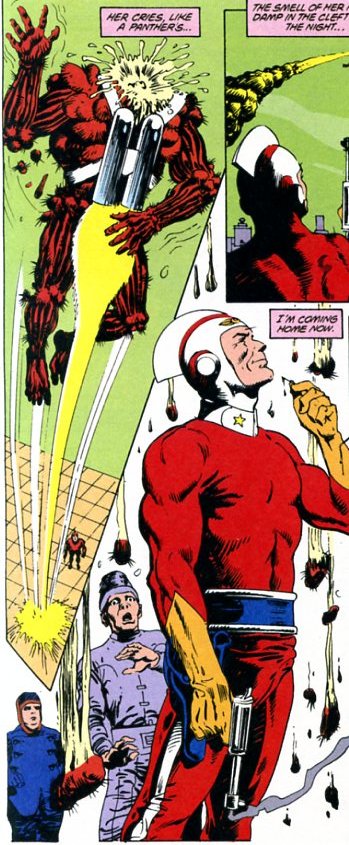
Moore, moreover, links his males questing nobly for the womb explicitly to phalluses and sperm. There’s one sequence where Swamp Thing gets transformed into a bulbous member spouting suggestive liquid…and look at that caption.

“Her cries like a panther’s” indeed.

Of course, that same page we’ve got Adam with that ridiculous headgear holding his smoking gun at crotch level. After that, it’s almost (ahem) anti-climactic when Swampy uses his powers to refertilize Rann…or when we learn that Adam has been brought to Rann because the “fierce vitality” of his sperm is needed to impregnate Alanna on a world where all the men are apparently sterile.

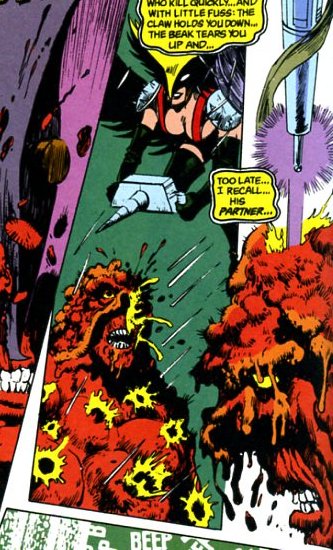
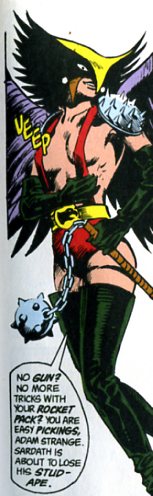
The person talking all up in Adam’s fierce virility is not his wife, but rather Keela Roo, a Thanagarian hawk warrior. Keela Roo is a very different kind of feminine. Instead of waiting at home in a castle, she sallies forth in spikes and skin and fetish boots. She wears a big flamboyant headress that stands in stark contrast to her male-subordinates unadorned helmet. She is, in short, a dominatrix and a castrating bitch; vital, animal, sexy, and unhealthily virile. Here, for example, she goes after Swampy by inserting her big phallic weapon into his split and oozing orifice.

As is generally the case in these pulp narratives, the dark queen is scary, but she’s also attractive — not least because she actually has a personality. Abby doesn’t exist (in these issues) except as a name and a desire. Alanna never speaks in English, and though her Rannian dialect isn’t entirely opaque,and though we do get to see her desire for Adam, keeping her voice from the reader effectively makes her seem distant, exotic, mysterious, soft-spoken, and unattainable. The princess in the tower again.

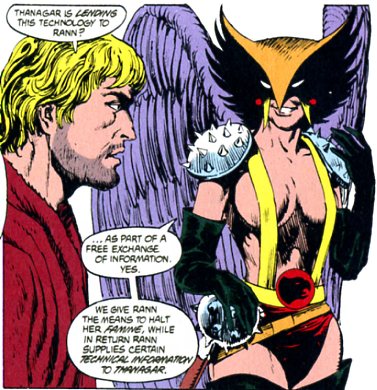
Keela Roo, on the other hand, has a universal translator thingee — she wants you to know what she thinks. Language is something she has mastered, and she uses it seductively. Several scenes between her and Adam have a not-very-subliminal sexual subtext. Here she is wearing that preposterous outfit while Adam talks to her in his bathrobe:

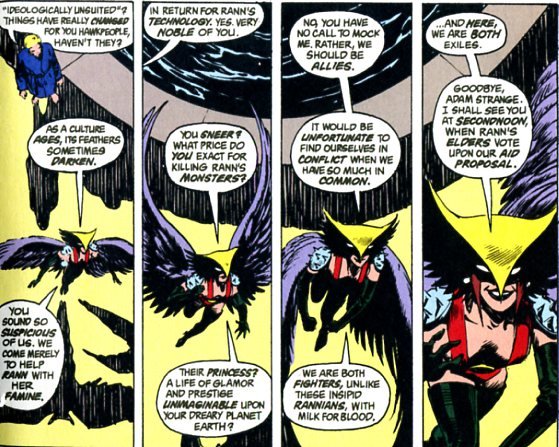
And this next sequence is a brazen come on (with Adam in a bathrobe again. Doesn’t he ever get dressed?)

That “aid proposal” seems very like a euphemism for another kind of proposal, especially as we’re getting a shot down her cleavage.

Keela Roo tells Adam, “We are both fighters,” and she’s right of course. The problem is that she’s the wrong kind of fighter. She’s a twisted fighter, a perverted fighter — in short, a cross-dressing, feminine kind of fighter, when the right kind of fighter is a male fighter.
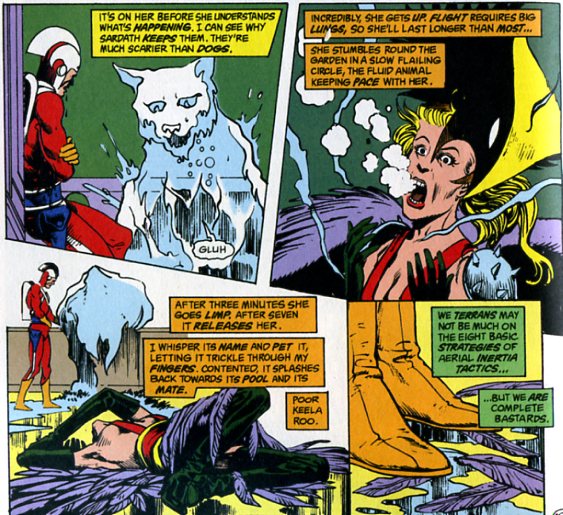
Thus, poetic justice demands that Keela Roo be killed, not in equal combat, but by domesticity itself. In battle, she manages to kick Adam Strange’s ass, but he fools her by leading her to his home, where his household guardian water creatures disposes of her. She is, then, not merely defeated, but humiliated — her fetish mask is torn from her, stripping her faux masculinity and leaving her as just a woman after all.

In the final twist of the knife, the creature who disposes of her is itself feminine (taking the form of a cat); a liquid female personification of hearth and home, which makes short work of that other woman Adam has been dallying with so that he and Alanna can be reunited again.

The point here isn’t that Moore is an irredeemable sexist, or even that this story’s handling of gender is particularly offensive. Rather, the point is that Moore, here and elsewhere, is using tried and true genre ideas (male quests; adventure vs. home.) And his main means for dealing with those concerns are received pulp tropes or DC comics ideas. Alanna is a princess not because Alan Moore made her one, but because some old DC writer steeped in Edgar Rice Burroughs and Flash Gordon made her one; the hawk woman is dressed like that because some pulp dc writer steeped in pulp cheesecake figured why the hell not.

Moore takes these ideas and runs with them…but though he runs pretty far, he doesn’t necessarily run to a different planet. In space opera, good women are beautiful paragons who sit at home being good and nurturing; bad women are aggressive and dominant and get killed off despite (or because of) their appeal. And that’s the way it is in Moore’s space opera as well.

Eric argues that at the end of the series, Moore undermines standard pulp narratives about revenge, domestic bliss and male power. But to me at least, reading back through some of these stories, Moore’s use of pulp in Swamp Thing seems less like undermining and more like assiduously and inventively cultivating.
__________________

You can read the whole Swamp Thing roundtable here.

Jog’s massive concluding Swamp Thing blowout post will be up tomorrow.

Utilitarian Review 4/18/10

On HU

This week was mostly devoted to our Swamp Thing roundtable which isn’t done yet! Jog’s got another post and I’ve got another post. Swamp Thing — he shambles on.

Also, I suggested that comics journalists might maybe want to get over themselves a little bit..

Utilitarians Everywhere

As Splice Today I talk about Zen ink drawings and why art is corrupt:

As it is, the painting seems to be a deliberate effort to unenlighten. A viewer can’t help but turn the Bhodhidharma from nothing—abstract lines on paper— into something; the Bhodhidharma, who is not there and then, despite his own parable, is. When the emperor asks, “Who stands before me?” the response “I don’t know” is not a statement of ignorance, but the declaration of a name. Similarly, the calligraphic message here twists back on itself. You cannot read, “not know” without knowing; the words inevitably convey the message that the wrong message has been conveyed. And even the broken strokes; do they really suggest a presence that is more ghostly than real? On the contrary, the gaps in the line serve instead to emphasize the hand of the artist; looking at this image, Jiun’s brush seems like the stiffest, most solid thing in the universe—more solid by far than the centuries he’s dragged it across. More solid, too, than the person looking at the image, who, along with the emperor, is less an individual than a dumb, appreciative foil—a blank, sympathetic page upon which the seer inscribes his own outline.

I have a conversation about Kant and evil over at Bert Stabler’s blog:

Bert: According to Zizek, the sublime thing in Kant’s Law is that it makes the individual responsible for her own decisions, since the Law does not give specific instructions– which addresses your idea of the Law being in one’s heart. But paradoxically (surprise!), that’s what takes the responsibility out of the person’s hands, since they’re acting in the name of this nameless, faceless injunction, in which all desire and pleasure is pathological, and pleasure comes from and desire reaches toward humiliation (punishment).

At Madeloud I interview artist and musician Matt Steinke of the band Octant.

Steinke: I have been making drum robots since I graduated from college in 1997. They seem glamorous when you talk about them, and they are often more complex than they appear and sound, but technically speaking, they are mechanical drum machines – acoustic electronically-controlled musical instruments. I have a mechanical toy piano, a mechanical bass guitar-like instrument, and a mechanically bowed zither. I use guitars that I have modified or customized, a toy guitar, a toy accordion, a music box that has magnetic pickups, and my sampler theremin watch. I also now have a homemade harmonium.

And I’m still posting stealth downloads for a friend or two if anyone is interested. Death Metal is here. And a folksy/country one is here.

Other Links

Shaenon Garrity had a couple of good articles this week, including this essay wondering where all the porn comics went and this hysterical cartoon version of Ken Smith’s philosophy.

Russ Smith at Splice Today has an acid take on Hank Williams’ belated Pulitzer.

And posts like this are why I continue to really like Andrew Sullivan.

Comics Journalism for Dummies

A while back Michael Dean wrote a now semi-infamous essay in The Comics Journal where he declared that there was no comics journalism on the web — just link farms, commentary, and event coverage. I thought the essay was quite entertaining — a fine example of Comics Journal snark and industry bashing.

I couldn’t help wondering though — presume Michael was correct, and there was no comics journalism on the web. Why should anyone care? Do we really need investigative journalism aimed at comics? Investigative journalism can be great when it exposes injustice, or provides the public with vital information: Seymour Hersch’s reporting at the New Yorker, or Andrew Sullivan’s twitter-aggregating from the Iranian protests seem like cases in point. But…you know, comics is a relatively minor entertainment subculture. In a world of limited resources and limited time, wouldn’t it be better for someone with a real talent for investigative journalism to do something — almost anything — else?

I was thinking about this again in light of a panel I was on last night at C2E2, organized by Heidi McDonald of the Beat. Other participants were Brigid Alverson of Robot 6 and mangablog, Johanna Draper Carlson of Comics Worth Reading, Ron Richards of iFanboy
Lucas Siegel of Newsarama, Rick Marshall of MTV, and a very funny and sweet young guy named Caleb, whose affiliation I sadly missed. [Update: It’s Caleb Goellner from Comics Alliance.]

Anyway, I’m not going to give an extensive recap because — well, I’m not a journalist, and I didn’t take notes. But I can report that, perhaps inevitably, there was a fair amount of talk about what boiled down to professionalism. Brigid talked about the importance of “not being an asshole”. (Brigid is to be fair, coming from a background as a political reporter.) Rick worried some about the implications of making deals to get exclusive info; several people expressed frustration that some folks think they can just start up a blog and get online and expect to be taken seriously.

So, what the hell, let’s look at the top stories at the moment on some of these sites.

IFanboy currently has an exclusive Fear PC Game Download.

Newsarama has a reported interview with Brian Bendis from C2E2 puffing some new series which I refuse to remember the title of for even a second.

Heidi’s reports on news stories from C2E2, said news stories mostly involving new comics series and Diamond speculating about changing its release day from Wed to Thursday.

Robot 6 has a news roundup that’s largely the same as Heidi’s, almost as if they were attending the same convention.

At Comics Worth Reading Ed Sizemore has a brief review of Yotsuba book 8.

And at mangablog there’s a review by Melinda Beasi of You’re So Cool.

Now, there’s nothing wrong with any of that. Personally, the only things I have any interest at all in reading are the reviews by Ed Sizemore and Melinda Beasi, but that’s me. Lots of people want what these sites have to offer, and that’s cool. Download that video game, speculate about diamond, anticipate some new series…it’s all good, if that’s your poison.

But while there’s nothing to be ashamed of in providing such services, I would submit that there’s nothing to be especially proud of either. Being a stenographer for Brian Bendis? Showing up at a panel and duly providing marketing services afterwards? Offering free samples? Even, you know, providing a short well-written review of a popular title…this is not rocket science. It’s not curing cancer. It’s not even a vital, unpleasant task like picking up the garbage or digging coal. It takes time and enthusiasm and maybe some level of professionalism, but lots of jobs that are really quite important require those things as well, big whoop. These stories, in short, define “trivial.”

I tried to make this argument on the panel more or less (I am less eloquent in person than in print, as Johanna kindly noted afterwards), and lots of folks disagreed with me. Johanna said that when people talk about how it’s all “just comics” (my phrase) it’s generally an excuse for their own low standards. Rick said that people make their living at comics, so it can’t just be dismissed. Lucas talked about how important comics are to people.

To which I can only reply, whatever. Sure, people care about comics. Sure, it’s better to do a good job than a bad one in some sense, even if your job is inconsequential. And yes, people make their living at comics. None of this changes the fact that what we’re doing as comics bloggers and journalists and news aggregators is really pretty meaningless in even the not-so-grand scheme of things. It’s for fun.

People care about fun a lot. They make their living off fun. And they draw lines in the sand delineating their little bit of fun and, not coincidentally, their little bit of lucre. Somebody on the panel I think actually talked about how some blogs undermine everyone’s reputation. I mean, come on. You’re basically providing a stream of marketing copy for a long list of crappy products based around nostalgia and indifferently-executed sex and violence. What sort of reputation are you defending?

I don’t exempt myself here; HU is a labor of love, and I’m very pleased that there’s an audience for it. Hell, I’ve worked hard for virtually no money to build an audience for it. I’ve been able to do that in large part because blogging has almost no barriers to entry. That same fact — the there are no barriers to entry — means that there are lots and lots of blogs out there that I don’t care about, that don’t seem to me very good, or that irritate me for one reason or another. And, you know, my solution to that in general is that I don’t read them.

But neither do I wag my finger at them and accuse them of failing to rise to professional standards or whatever (unless I have some vested interest in having them improve, of course.) Because to accuse random little blogs x, y, and z of failing to rise to professional standards would be (a) condescending and (b) kind of embarrassing for me. Even the biggest Poobah in comicsdom is a pretty penny-ante Poobah. To rear up on your back legs and start hectoring and/or kicking at those two steps below you on the child-size step ladder of success — you might as well just podcast your insecurities to the world.

___________________
For me the most fascinating exchange of the evening actually occurred after the panel, when Johanna explained how she makes money from her site. It’s too bad the question of how to make money off blogging wasn’t thrown open to everyone; I at least would have been curious to hear some of the nuts and bolts of how people are managing to make a living (or not make a living, in my case.)

In any event, many thanks to Heidi for inviting me. It was nice to be a real-live pundit briefly, to meet some folks for the first time, and to see Brigid and Johanna and lovely and talented Matthew Brady, who came out to watch. We’ll see if I’ve managed to convince everyone involved never to invite me again!

Muck-Encrusted Mockery of a Roundtable: Clever Is As Clever Does

Reading Richard’s last post I was reminded just how clever Moore was to put his vampires in the water. First of all, it allowed for some incredible visuals…and second it’s just a really smart idea. Vampires don’t need to breathe…so a pond would be a perfect place for them to form a community. Why didn’t somebody else think of that first? (Maybe they did…but even if that’s the case, Moore’s clever for lifting it. (Update: …and he lifted it from Marty Pasko’s earlier Swamp Thing story, according to Alex Buchet in comments — which makes it maybe a little more obvious a lift than I was thinking. Sort of invalidating the whole point of this post. But oh well…that’s blogging for you. Update to the update: no, apparently the idea of having vampires in the lake was Moore. Carry on then.))

One of the things about Moore that’s very unusual for horror writers and for certain kinds of pulp writers is how carefully he thinks things through. He’s got all these ideas about how stuff fits together — if you start here, then that means this, which means you get to that. Steven King, for example, doesn’t do that. His stories make no sense — or they sometimes make sense, but you definitely get the feeling that he’s making it up as he goes along (in Salem’s Lot, for instance, the vampires are sort of solid, sort of not — it just depends on what the story calls for.) Neither do Lovecraft’s, really — it’s all unnameable this and unmentionable that and you know he doesn’t care whether the Yog-shoggoth works or not so long as he can work in a Poe reference. Moore really does care about the mechanics, though — which can end up really badly when he tries to deal with gender anxiety (which Lovecraft, for example, manages to do a lot smarter by being a lot less aware/explicit about what he’s doing). But it can also give you a tour de force like the Anatomy lesson, where everything you think you know about the character gets turned inside out.

Basically, Moore seems like a very deductive writer — which seems like perhaps not the best fit for horror, which tends to work best when it deals with subconscious inklings and anxieties rather than with ratiocination. Moore really hit his stride when he moved towards works which had a greater focus on ideas rather than on the half-formed dream world of horror.

Though those vampire issues are still scary. And the monkey-king was pretty bad ass…. Moore could do horror if he put his mind to it, even if it did work against his strengths in some ways.

Update: The whole swamp thing roundtable is here.

Muck Encrusted Mockery of a Roundtable: I…Won’t…Stop…Talking

Suat notes acidly that any discussion of Swamp Thing is likely to be mired in nostalgia. I think we’ve actually got a couple of folks on the roundtable reading them for the first time…but Suat’s certainly got me pegged. In high school, I read and reread and rereread all the issues of Alan Moore’s run on more times than I can probably count. However, when we went off to college, it was my brother who got most of the issues (I got Watchmen) and, since I knew them so well already, I never did get the trades. As a result, it’s probably been 15 years since I’ve read last part of Moore’s run; issues #57 to #64, from way back in 1987.

So…contra Suat, are they as good as I remember? Well…no and yes. It’s certainly true that, as Suat suggests, they’re, massively, massively overwritten. I think as a kid I just skipped over most of the giant glaring gobs of text boxes. As an adult I’m more conscientious, or stupid, or some combination of both, and I actually tried to read them all — and, yeah, that really doesn’t benefit anyone. I think the interminable, tortuous extended metaphor comparing the emergency care ward of a hospital to a forest is probably the absolute low point of this volume— “in casualty reception, poppies grow upon gauze, first blooms of a catastrophic spring…a chloroform-scented breeze moves through the formaldehyde trees…” yeah, yeah, we get it already, you’re a poet, now would you mind shutting the fuck up?

The painful thing is that one or two of the images might actually work — “his body’s the grave of his mind” is nice; the idea of the EEG screen as “steep green hills”. But Moore’s entranced with the fertility of his own pomp; why stop with one sharp image when you can carry the thing through from too much to toweringly tedious to self-parodic and beyond. Moore’s road to hell is paved, not with good intentions, but with loose-bowelled facility. Rereading this, it becomes clear that Promethea’s self-absorbed cleverness isn’t a decadent falling off, but an unfortunate potential that Moore indulged, to some extent, throughout his career.

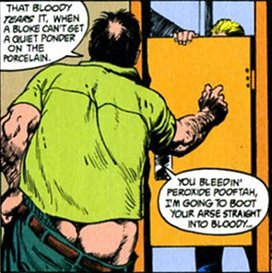
Still…Moore’s language certainly has an upside as well. He lets his sentences take over and run amok because he loves them; his self-indulgence is really in a lot of ways an indulgence of words, which he likes to stroke, and cuddle and giggle with in the back of the car seat. The first (two-part) story in this volume, for example, opens with a pound and a half of completely gratuitous Aussie dialogue, tossed in, it feels like, just because Moore couldn’t resist once the idea had popped into his head.

“bleedin’ peroxie pooftah” “ponder on the porcelain” — that’s enough goofy alliteration to make Bob Haney blush.

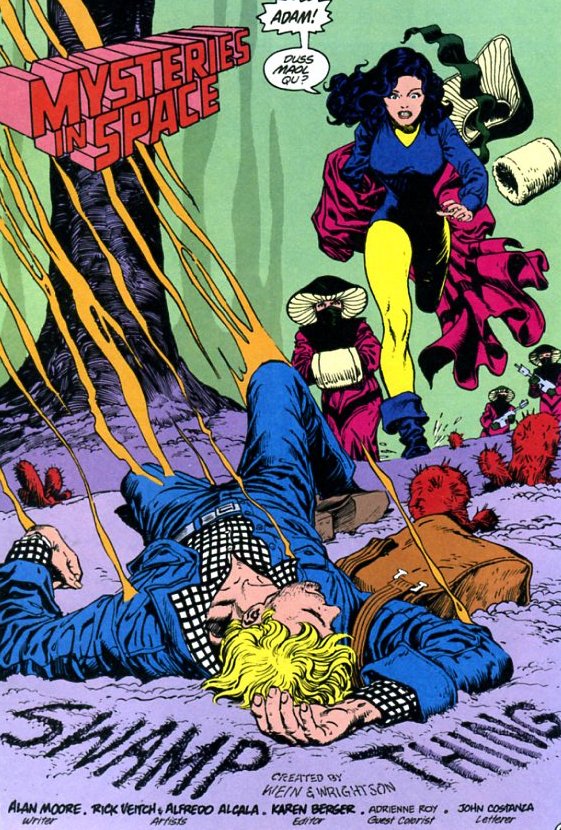
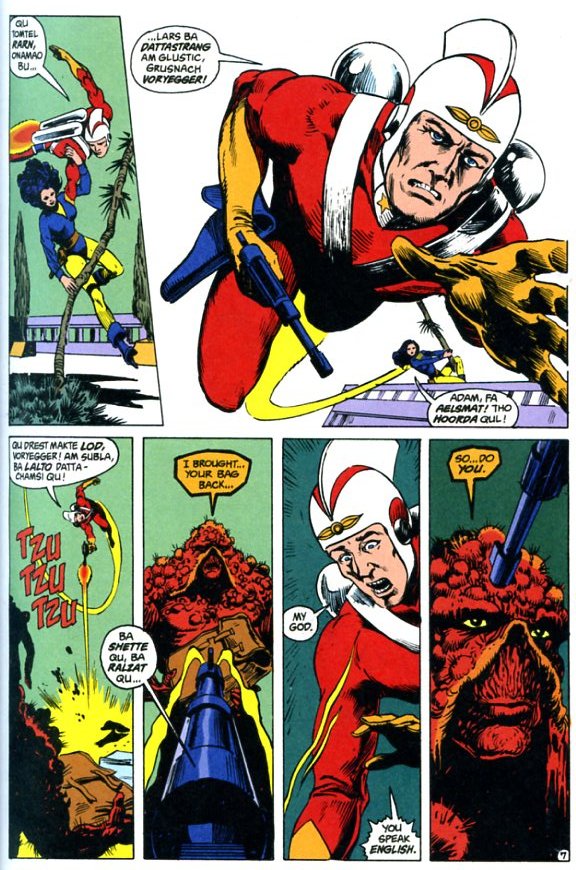
Once he gets started, of course, Moore just can’t stop…which is why, a couple of pages later, he just goes ahead and literally invents his own language:

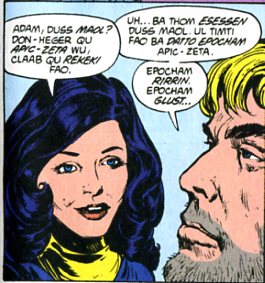
When you first look at this, it feels like a tour de force. Moore doesn’t just throw in a few words of dialogue; he keeps going for page after page in a consistent, invented language. You can understand just enough of it to tell that the language does work; Moore actually knows what these people are saying — and you could figure it out too, if you had just a little more information.

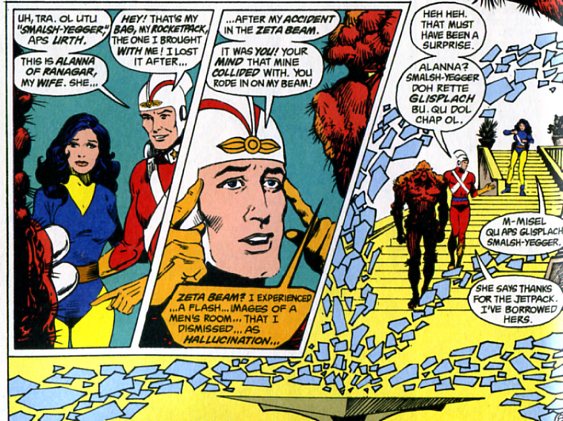
That’s Adam Strange talking to his wife Alanna. For those not in the know, these are both old, old dc space opera characters. Adam Strange is this random earth guy who gets hit by a “zeta beam” which transfers him across billions of light years to Rann, where he becomes a hero. But the beam wears off over time, so he’s always getting dumped back on earth, and having to run all over the planet to find the next zeta beam (they come with some frequency) to zap him off to the stars again.

Anyway, in Moore’s story Adam knocked up against swamp thing (whose consciousness has been forced off earth — long story) in the zeta beam and was injured, and has now recovered. That’s where we are with the panel above. And after a reread or two, you can translate that first sentence at least; Alanna is saying, “Adam, what happened?” And Adam I think answers, “Uh…I’m not sure exactly what happened,” or something like that. I especially like the “Uh…” there — I think Adam is pausing in order to shift into thinking in another language — these are the first words he’s spoken that aren’t in English (he says his wife’s name a couple panels up, but that doesn’t really count.)

So, again, the effect initially is dazzling. But…think about it a second, and the whole thing seems more than a little ridiculous. This isn’t Tolkein spending a lifetime or thereabouts creating another tongue. This is Alan Moore pulling a language out of his ass…and that’s exactly what it looks like. It’s not Japanese, !Kung speech, or even German. Really, it’s not another language at all; barely more alien than the Aussie dialect we started with. It’s really just a kind of code. Moore seems to have written out his text and then substituted made-up words on a more or less one to one basis. In some sense, even more embarrassing than just having all your spacepeople talk English. Why try at all if you’re going to do a half-assed job?

And the answer to that, as Moore shows, is that sometimes, if the job is big enough, or original enough, or cool enough, it is in fact worth doing a half-assed job just to see where you end up. The language is nonsense — but then, this is a pulp space story, which means the whole thing is nonesense. After all, we’re in the middle of trackless space; why on earth (as it were) does everybody look human?

Besides, and what is the main point, having these silly out-of-place humans speak in silly out-of-place code allows Moore to do some things that he couldn’t have gotten any other way.

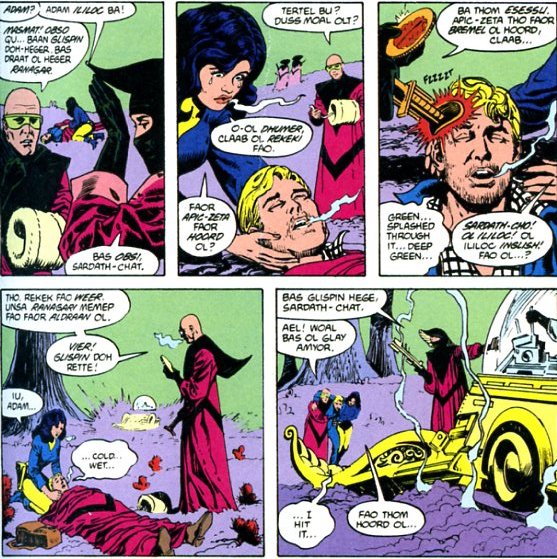
I think this page just brilliantly evokes the strangeness…not of another world or planet, necessarily, but of being far away, in a different culture. The best touch is that, after a couple panels of alien speech, Moore has Adam speak in English. Because at first you’re trying to figure out the alien dialogue, the moment when Adam talks “normal” comes as a small shock. For a second you get to see him, oddly, as the alien, the one out of place. It reminds me of a scene in C.S. Lewis’ space trilogy where Ransome, after spending some months with aliens, sees a bizarre creature and then a second later realizes that it’s himself in a mirror — he’s had the “privilege” (I think he uses that word) of seeing himself as the Malacandrians see him.

The way Moore uses his “language” in the sequence below is great too:

Again, the juxtaposition of the Rannian and English is basically the whole point of the page. “You speak English!” “So..do…you.” It’s such a hyperbolic ex-pat moment…and again, there’s that weird disjunction as you go from trying to follow the Rannian dialogue to realizing that everybody is suddenly speaking English. And then Moore switches the character’s positions, as Adam and Swamp Thing talk to each other, and Alanna is the odd one out:

I find that whole bit really charming. In the first place, I like the ex-pat camaraderie; Adam Strange wouldn’t necessarily have palled around with Swamp Thing on earth, but here they are infinite miles away, and suddenly (once they’ve stopped killing each other) they’re friends.

The other thing that’s hard to resist about the use of the Rannian language here is how much faith Moore puts, not so much in his reader, as in himself and in the comics form. Moore isn’t a high modernist here; he’s not Joyce or even Joanna Russ — he’s telling a pulp adventure story and he wants his audience to follow a pulp adventure story. But he’s still willing to write large swathes of his narrative in untranslated code, because he just thinks he’s bad ass enough to do it. And…hey, presto, he can.

Again, one of the best parts is that you can almost parse what they’re saying, even though, thanks to the clarity of the drawing and the clarity of the pulp tropes, you don’t really need to. In fact, one of the things the comic allows you to do that you might not be able to do as easily in a movie is teach yourself the language. The ability to stop and go back and reread means that you can recapitulate Adam’s immersion in Rann, and learn the language just as he did. Cross-cultural understanding becomes a kind of puzzle (though certainly an artificially easy one.)

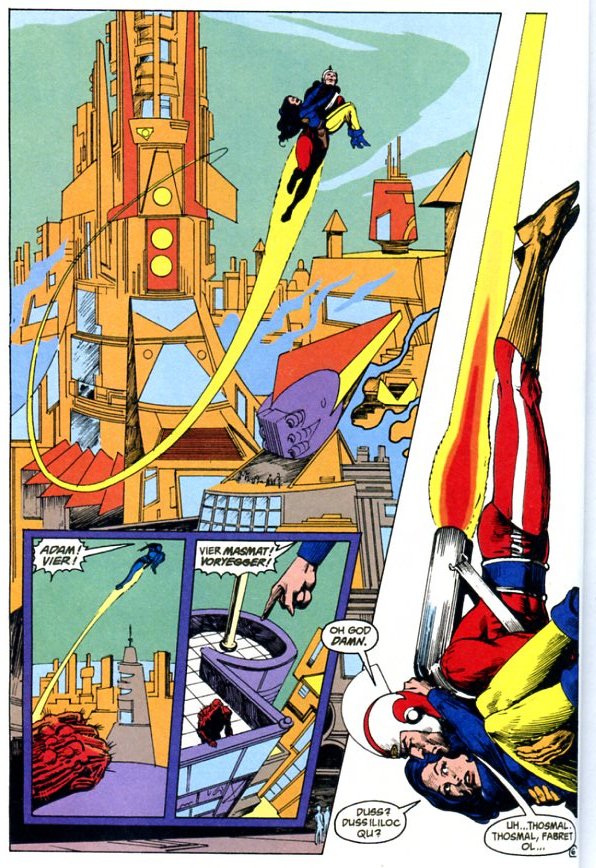
I go back and forth on how much I like Rick Veitch and Alfredo Alcala…they don’t tend to send me, but they are certainly professional, and fully up to conveying action and even nuances of emotion without the help of dialogue:

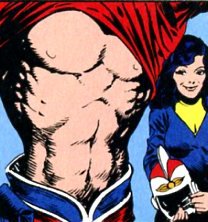
That may be my favorite panel in the comic; it’s total cheesecake for girls, and Alanna’s half-proud, half-I’m-going-to-get-that-shortly expression is just priceless. It’s a pretty great thing to have in a comic aimed primarily at guys; you get to look at the main character form the perspective of his wife. It’s analagous (and somewhat deliberately so, I think) to seeing yourself as the alien sees you — the distance Moore talks about in the story is not just of place, but of gender and love.

That’s Swamp Thing’s narrative too; his separation from earth, like Adam’s sporadic separation from Rann, is more about being removed from his wife than about being away from a particular place. Language is wrapped up in love and identity; when Swamp Thing finds Adam Strange’s bag on Rann and sees the word “Seattle,” we know that part of the impact is that the word to him reads “Abby.” Words are how we know each each other…and yet, at the same time, as Alanna’s expression above tells us, theyr’e kind of not, or at least not solely. That’s a very appropriate ambivalence for comics to have, it seems like — to see words as the metaphor for our lives and loves while simultaneously drawing a bubble around them.

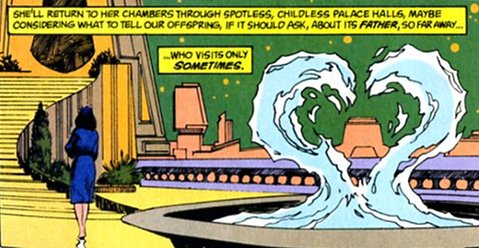
In that vein, the last panel has some of Moore’s loveliest writing (as Adam contemplates his inevitably distant relationship with his newly conceived child) and its most doofy symbolism (as Alanna’s water pets form the shape of a heart.)

It’s certainly heavy-handed — but so is caring for your wife or for your kid, or, possibly, for your own chattering. Moore’s too in love with his own imagination to worry about looking dumb, which means that Swamp Thing is filled with dumbness, but also with love. It’s not a bad trade-off.

__________________

You can read the entire roundtable thus far here.

For another take on the final volume in the Swamp Thing series, you can check out Robert Stanley Martin’s review.

Muck-Encrusted Mockery of a Roundtable

Just to give readers a heads up: we’re going to have a roundtable on Alan Moore’s Swamp Thing run starting tomorrow. We’ll have guest posts by Joe McCulloch and comics scholar (and my brother) Eric Berlatsky, as well as contributions from the usual utilitarians. So check back in throughout the week.