Empire of Bland

Howard Zinn, Mike Konopacki, Paul Buhle
A People’s History of American Empire: A Graphic Adaptation
Metropolitan Books

I decided to review A People’s History of American Empire to answer one burning question: could Zinn possibly be as boring a writer as I remembered?

With some assurance, I can now say that the answer to this question is, decidedly, yes. Mike Konopacki and Paul Buhle have created a graphic adaptation of Zinn’s People’s History of the United States by shortening the text to cover only the last 150 years or so, and then rendering the whole into the easy-reader medium of comics, Nonetheless, the book is an interminable experience : a brutal slog through waist-high drifts of names, dates, and facts, all leading to the same arid exhortations. This volume is, in fact, a perfect mirror image of those deadly texts you were forced to read in school. Like them, A People’s History treats history not as a discipline or a study, or even as a story, but rather as a didactic, infallible bludgeon. The only difference is that where, say, Thomas Bailey tells you over and over that America was great, Zinn tells you over and over that it isn’t. American Empire even pulls out some of the same gimmicks with which textbooks attempt to disguise their irredeemable blandness — little factoids placed off to the side with a cutesy “Zinnformation” light-bulb logo attached, pseudo-first-person-accounts by random historical figures (Mark Twain, C.I.A. Iraq agent Donald Wilber) etc. etc. Even the cartoon format itself comes across as the grape flavoring on the kaopectate. What precisely, do indifferently drawn images of Zinn in front of a lecture hall add to either our historical knowledge or our enjoyment? Admittedly, American Empire is a good bit shorter than the honking, back-breaking tomes we dole out to high-school kids. Nonetheless, it fulfills the main requirement of the genre — try as I might, and despite being paid to do so, I discovered that, like any good textbook, this one was completely unfinishable.

The problem is not that I disagree with Zinn’s politics. On the contrary, I’m a pretty entrenched member of the blame-America-first crowd. I think, like Zinn, that imperialism is a blight and that, for many decades now, the United States has been its most enthusiastic and poisonous promulgator. But even for those who hate their country, unrelenting tales of U.S. perfidy and viciousness quickly become wearisome. Once you’ve seen one C.I.A.-backed slaughter of innocent civilians, you’ve kind of seen them all. It’s a horrible thing to say, but the atrocities in Zinn’s books, as in those of that other progressive superstar Noam Chomsky, quickly become, not so much numbing, as simply dull. When we’re jetting from Wounded Knee to Vietnam to Selma to Mexico to Iraq to Nicaragua and on and on, it’s hard to keep the names of the victims straight, much less care about their plight.

Crafting snoozeworthy material out of burning monks and butchered children is no easy task. Zinn does it the way textbook writers usually do — by being a lousy writer and a worse historian. The thing is, history isn’t a list of facts and dates. It’s a method for studying the past that relies on careful use of sources, weighing of evidence, and arguments. This last is especially important — there is always more than one way of looking at any particular event, and the push and pull of competing interpretations is what gives the past it’s interest and depth. Zinn has an all-purpose explanation for everything bad that’s ever happened —corporations did it. I don’t deny that there’s truth there, but it’s not the only truth, and reiterating it with such pat conviction goes a long way towards making it false. The boredom this book engenders is a defensive reaction; when one is being lied to so assiduously, one tends to instinctively recoil.

Here’s one example. In Zinn’s discussion of Hiroshima, he insists that the U.S. dropped the bomb as “a warning to the Soviet Union to stay out of Japan.” Hiroshima was, in other words, an imperial act — the first move in the American Cold War push for global domination. This is a fairly typical leftist theory, but I’ve never really bought it. Looking back from the post-Cold War world, it’s easy to believe that Russia was the focus of U.S. policy. At the time, however, Truman was probably thinking a whole lot more about Japan — the nation against which we were, after all, at war. That war had been incredibly costly; victory had by no means been assured, and there was every reason to believe that a land battle for the Japanese home islands would be horrific. Virtually every combatant nation in the war — including, most certainly, the Japanese — had already shown itself willing to kill civilians with impunity. The atomic bomb wasn’t really all that much of an escalation from, say, the firebombing of Dresden. Based on my own reading, Truman seems to have used the atom bomb because it was there, because we were at war, and because, when you’re at war, you use the weapons you’ve got. This tells you something about the logical outcome of warfare and about the consequences of power. But it tells you little about imperialism or capitalism per se. It’s a parable about Moloch, not Mammon.

Zinn’s account is flat not because he doesn’t agree with me, but because he doesn’t confront any opposition at all. Other than sneering at Truman’s palpably absurd contention that he tried to avoid killing civilians, Zinn never engages with the many, many scholars who have argued over the years about the rights and wrongs of the Hiroshima decision. Without these other voices, it’s difficult to see what’s at stake. The result is blinkered history, which wanders around bumping into trees while nattering on about the forest. In discussing the Cuban revolution, the decidedly un-militaristic Zinn is thus able to denigrate the idea of civilian control of the armed forces without appearing to even realize what he’s doing. In discussing U.S. China policy, he blithely identifies Mao as “a wartime ally against fascism” without ever raising the thorny question of whether it would really have been a great idea for the U.S. to back the man who became one of the most successful mass murderers in history. Part of the trouble here is that Zinn is trying to cover so much material so quickly that he can’t really stop to think about anything. But this is just another way of saying that his whole textbook-project is intellectually, and, as a consequence, morally, bankrupt. History without thought is an abomination. It should be driven from the earth, the classrooms where it is perpetrated should be razed to dust, and the ground where they stood salted.

The central evil of Zinn’s book stems, it seems to me, precisely from his inability to listen to what the other side has to say. Zinn tells us over and over that imperialism is driven by capital’s search for new markets, and by it’s desire to deflect unrest at home. But his commitment to this canard, and his general breakneck pace, prevents him from taking seriously what imperialists themselves actually contend they are about. From Rudyard Kipling to Christopher Hitchens, the rationale for empire has remained remarkably similar. We’re over there, not to exploit the little brown people, but to help them, for they are degraded and suffering. The argument for imperialism is, in other words, a progressive argument, built on exactly the kind of empathy for innocent pain, and on the same sort of outrage against oppression, in which Zinn himself traffics. This is why, when the father of investigative journalism, Bartoleme de las Casas protested Spanish atrocities in the new world, he helped his career a great deal, and the Indians precious little. The conscience of imperialism is still part of imperialism, and the ostentatious wringing of the left hand is a fine way to distract attention from the atrocities committed with the right. The opposite of empire, rhetorically, is not one-world socialism, but the brand of isolationism in vogue among über-nationalist nutcases like the John Birch Society. It’s not an accident that the most effective anti-imperialist ideology currently going is militant Islam.

The point here is adamantly not that Zinn is a hypocrite. On the contrary, American Empire includes several snippets from its author’s biography, and he seems like an interesting, dedicated, and even noble fellow — one of the few tenured radicals who has actually put his life and career on the line for the cause. He lost his job at Spelman because of his involvement in the anti-segregation movement; he risked indictment by helping Daniel Ellsberg hide the Pentagon Papers. But being a great activist isn’t the same as being a great thinker, and while Zinn may be the first, he is not the second. His exhortation at the end is fairly standard non-denominational humanist jeremiad — “to live now as we think human beings should live, in defiance of the worst of everything around us, is a marvelous victory.” Maybe. But George W. Bush probably thought something much like that when he bravely defied the opinion of the world and toppled that horrible dictator, Saddam Hussein. Good intentions aren’t going to overthrow imperialism; good intentions are what imperialism thrives on. If you want to end empire, you tend to need nationalism and religion and — unless you’re lucky enough to find a Gandhi — really remarkable quantities of blood. Zinn has no interest in struggling with the unpleasant ramifications of this. As a result, for all its facts and all its good-heartedness, A People’s History is about neither the United States, nor about Empire, but about, precisely, nothing.

Utilitarian Review 1/31/10

On HU

I started out the week by reviewing the Mike Sekowsky run on Wonder Woman.

The discussion of whether or not manga critics are too nice continued with some snark by m. of coffeeandink and a long, long comments thread.

Kinukitty reviews the yaoi Sense and Sexuality.

Suat talked about problems with Town of Evening Calm, Country of Cherry Blossoms. There’s a long comment thread as well, with Kate Dacey, Jog, Derik Badman, Bill Randall and others commenting.

Vom Marlowe reviews a good white ink.

Utilitarians Elsewhere

At the Chicago Reader I reviewed Garry Wills’ new book Bomb Power.

There’s no doubt that the bomb and nuclear fears are regularly marshaled in defense of unlimited executive power. And Wills makes a good case that the Manhattan Project provided institutional impetus for, and training in, federal secrecy. But his claim that the bomb “caused a violent break in our whole government” is less persuasive.

He argues, for instance, that our foreign policy following World War II was in large part predicated on our need for missile bases—a claim I don’t see any reason to dispute. But in the course of that argument he also states that the need for bases “began a long history of friendly relations with dictators.” This neatly elides America’s extended, inglorious prebomb encouragement of tyrannies abroad, starting with our support for the slave-holding regime in 18th-century Haiti and finding perhaps its most spectacular expression in our brutal and extended battle against a popular insurgency in the Philippines in the early 1900s.

At metropulse I review a number of recent Thai luk thung release.

Luk thung is often characterized as Thai country music, which is both accurate and misleading. It’s accurate in that, yes, luk thung is mostly created and consumed by folks from rural backgrounds, and its lyrics reflect their concerns—the love left at home, the joys of rural cooking, the shock of moving to the city and discovering that your new urban flame is a he rather than a she, etc.

It’s misleading, though, in that luk thung doesn’t sound anything like country music. It sounds like film music exotica. Also garage rock. And like J-pop and Bollywood and AM radio balladry. And like hip-hop. In other words, and very much unlike American country, luk thung is almost pathologically omnivorous.

Bert Stabler and I discuss Inglorious Bastards and Zizek and other things.

At tcj.com I review two crappy manga: Biomega and Ikigami.

At Madeloud I review Drudkh’s fantastic first album, Forgotten Legends.

Breaking News: Manga Critics Not Nice!

During our xxxholic roundtable last week, Suat intimated that manga critics were too nice. M. at coffeeandink, in a post titled: “Summary of some recent comments in a discussion of manga, refutes him thus:

GUY #1: Manga critics are much too nice and praise substandard work. Naturally, I feel no need to provide any evidence of this contention. Maybe it is because of all the girls.

GUY #2: Yeah, I don’t like any manga. Even when it’s good, it’s made for girls. No, wait, I do like one manga — it is by a man, and about stereotypical guy stuff. Since it is male, it is gender-neutral, unlike yaoi or shojo, which people only seem to like for political reasons. My reasons for liking things are completely apolitical and entirely justified by intellectual arguments. When women write in detail about relationships, it’s just not aimed at me. When men write in detail about relationships, it shows complex emotional realism.

Also, why don’t you ever talk about boys’ comics?

GUY #2: Once again, I must assert that people are lying about their opinions of manga for political reasons, without evidence or example, and my list of all male great comics artists is completely without political bias. Also, I am going to cite Osamu Tezuka as a great comics artist, even though his career and oeuvre actually contradict everything else I’ve been claiming about audience and identification.

GUY #2: Wait, I haven’t named enough great male comics artists yet.

I am going to continue to assume that girls’ comics = comics about romance is such an obvious statement that it will inform all my thinking and yet never need to be clearly stated.

GUY #1: Whether situations are realistic, how intellectual they are, and how deeply invested the reader becomes in the story are totally objective metrics that are completely independent of all individual tastes and socio-cultural influences.

GUY #3: The problem is an age bias, not just a gender bias. To prove this, for the rest of this comment, I will only talk about comics written by men.

I would submit that this is truly high class snark, and not even a little bit nice.

I had a back and forth discussion with m that I thought I’d reproduce here, at least in part.

Me: I did want to point out though, that, whatever their failings, Suat and Matthias, were both very open to dialogue, and unfailingly polite when contradicted (as, indeed, were people like Melinda and VM with whom they were arguing.)

m: …comments like Suat and Matthias’ are why I basically gave up on looking at comics or manga blogs not specifically recommended by friends. You characterize Suat and Matthias as “very open to dialogue, and unfailingly polite when contradicted,” and indeed they seemed respectful of the people to whom they were directly speaking. But their comments are not open, polite, or respectful; their comments are extremely sexist. By this I don’t mean that they hate women or spoke with any malice or ill intent; I mean that their comments treated men’s responses and men’s experiences as the default and characterized women’s responses and experiences as deviations from the normal, special exceptions, and less meaningful or authoritative than men’s experiences.

They are hardly the worst cases of this I’ve seen, particularly in the comics blogosphere, but I’m not sure you understand the weariness that comes from encountering this over and over and over again–even in cases, such as this one, where these voices are not in the majority. Ultimately, it was a lot less painful and exhausting for me to stick to a different set of blogs and communities, where the readers and writers did not by default consider women’s writing or women’s reading less significant or less interesting than men’s.

Me: I’ve engaged in a number of irritating interactions with mainstream and arts comics readers on behalf of shojo and manga, so I have some sense of how wearying it is to have the same argument over and over — though, obviously, not being a woman, I’m probably not as personally infuriated. In any case, I certainly understand the impulse not to want to engage with that sort of thing. You certainly have no responsibility to tell people they’re wrong on the internet. I wish I was less prone to do that myself, honestly.

Nonetheless, for me — and I’m coming from a slightly different place, as I said — I think it’s worthwhile to try to have people from different kinds of communities talk to each other. That’s going to entail some (though not necessarily equal, alas) frustration for everyone. But I think the results can also be worthwhile — and seemed to me to be so in this case, where the back and forth was fascinating, and brought up a number of really interesting points (I thought Shaenon and Kristy in particular were fascinating on why they felt manga was worthwhile and/or different from Western comics.)

Along those lines, I think its useful to make some distinctions at least. I think calling Matthias’ and Suat’s comments “extremely sexist” is a bit harsh. It’s not hard to find extreme sexism on the web or in life, alas, but does this really qualify? Neither Suat nor Matthias dismisses women’s writing out of hand; in fact, both have read a fair bit of shojo and acknowledge some of its virtues, despite their reservations. Neither categorically dismisses either women’s writing or romance — in fact, elsewhere in comments, Suat basically says his problem with xxxholic isn’t that it is romance, but that it didn’t move him to tears. Both Matthias and Suat express an eagerness to read more by women critics and to think about these issues in greater depth. Suat linked to Melinda Beasi at the end of his original post; Matthias pressed VM for links (and she linked you, among others.)

I just feel like both Matthias and Suat were very much trying to meet their interlocutors halfway — as indeed, were folks like Melinda and Shaenon and VM. I think that’s worth something, and worth respecting, even if, at the end of the day, my own views are much closer to yours than to theirs.

You can read the whole thing, along with some interesting comments from other folks, at M.’s page here.

Wonder Woman Must Change!

Denny O’Neil, Mike Sekowsky, others
Diana Prince: Wonder Woman vol. 1-4
DC Comics
$19.99 each

Photobucket

Wonder Woman is virtually impossible to write well. The problem isn’t that the concept is dumb — on the contrary, the difficulty is that it’s not dumb enough. Most superheroes are artistic nonentities. Superman, Batman, Spider-Man, Wolverine — they’re defined by their powers and their backstory and maybe by one or two dabs of easily reproduced personality (Batman’s grim; Spider-Man’s down on his luck, Wolverine’s mean.) You can put them in different narratives because they aren’t integrated into any narrative. They aren’t the product of a coherent individual aesthetic in the first place, so imposing a different vision on them isn’t especially hard.

Wonder Woman’s different. Her creator, William Moulton Marston (with the help of his wife, Elizabeth Holloway Marston, and their lover, Olive Byrne) created the character to fulfill very specific political and sexual fantasies. Marston wanted to create a strong icon of femininity, so girls would be inspired to embrace feminine virtues, like love and… submissiveness. The result was Wonder Woman, a powerful heroine of justice who would preach about female empowerment in one panel, bash a bad guy in the second, and find herself trussed up like a turkey in the third. Harry G. Peter rendered Marston’s inspirational, fetishistic fantasies in one of the most distinctive styles of the golden age; his stiff figures, active lines, frilly imagery, and distinctive stylization gave Wonder Woman an outsider-art look somewhere between Fletcher Hanks and Henry Darger.

Together Moulton and Peter created a comic that had self-conscious ideological and aesthetic content. They set out, quite deliberately, to reconcile and explore binaries involving fetish and feminism, submission and strength, peace and violence, masculinity and femininity. Those contradictions, and the passion with which they were handled, give the early Wonder Woman stories an energetic, absurd sublimity like very little else in super-hero comics. But those same factors have made it extremely difficult for anyone else to use the character. Just as the most obvious example: how do you present Wonder Woman as an icon of strong womanhood when her costume is a ridiculous swim suit tricked out with fairly explicit bondage iconography (the rope, the metal bracelets)? Or, as another for instance, if Wonder Woman’s mission is supposed to be to bring peace and love to man’s world, how do you make that work with the fact that she spends most of her time hitting people? Moulton had specific answers to these questions because he was a crank and, I would contend, because he was a great artist. But if you’re not both a crank and a great artist, and you try to write Wonder Woman, you’re pretty much screwed. Which is why, while lots of people have written great Batman stories or Superman stories, I have yet to see a great Wonder Woman story written by anyone other than William Moulton Marston.

The one possible exception to that is “Wonder Woman’s Rival,” by Denny O’Neil and Mike Sekowsky. Initially published in Wonder Woman #178 way back in 1968, it’s the first story O’Neil and Sekowsky worked on, and thus the first entry in DC’s four volume “Diana Prince: Wonder Woman” reprint series.

Those four volumes are, by the by, utterly lacking in any contextual material; there’s no introduction, no commentary, no nothing. But, from what I’ve been able to determine from other sources, it seems that in the late ‘60s Wonder Woman was not selling especially well. DC was therefore open to letting Mike Sekowsky, the new editor and artist on the title, take some chances with the character. As a result, O’Neil and Sekowsky clearly feel liberated from any need to treat Wonder Woman with reverence or even respect, and the result is exhilarating. O’Neil turns in a script which is positively mean-spirited in its desecration of the Wonder Woman mythology. Steve Trevor, upright military man, is portrayed as a slimy, brutish, insecure Neanderthal. One particularly ludicrous scene shows him adopting hippie lingo to pick up some anonymous and much younger girl. Later, when he’s arrested on false murder charges, he behaves like a whiny baby-man, sneering at Wonder Woman when she, obviously heart-broken, is forced to testify against him. Meanwhile, Wonder Woman herself is depicted as deeply, weirdly insecure; “I’m not a woman, but a freak,” she cries after Steve has rejected her.

This is the last thing Moulton would have had the character say, obviously; for him, Wonder Woman was a paragon, not an aberration. But I think the outburst pretty clearly captures O’Neil and Sekowsky’s position; they want nothing to do with this nightmarishly outré heroine, nor with her ridiculous costume, nor with her unworkable mythos. Instead, they want to groove, baby. In an antithesis to Wonder Woman’s usual World War II honor-and-military associations, O’Neil sends the plot cavorting through hippie hang-outs, and sprinkles it with wannabe up-to-the-minute patois like “the fuzz frowns on chicks cruising in this pad solo” and “Yeah, man! We need some hens for a party!” Sekowsky, too, seems to be having the time of his life; the art is relentlessly modern retro-chic, with over-saturated psychedelic colors and bold, off-center constructivist layouts. The high-point is a full-page makeover sequence, where Diana Prince, preparing to infiltrate the burn-out underworld, goes on a shopping spree to get that happening look. Sekowsky uncorks everything he’s got: full-bore kaleidoscope effects, fabulous fonts, and dramatic patterned clothes. “Wow!” Diana declares when she’s done. “I…I’m gorgeous! I should have done this ages ago!” I guess, in O’Neil/Sekowsky’s world, Diana always secretly thought that the stars made her ass look big.

Photobucket

The comic is a mess, continuity-wise; Wonder Woman seems to completely forget that she even has a magic lasso when she’s interrogating people, for example. But that’s part of the charm; O’Neil and Sekowsky seem, not only not to care about the character, but to actually be contemptuous of her and her milieu. “Wonder Woman must change…!” Wonder Woman herself mutters at the end, and you get the sense that O’Neil and Sekowsky really believe it. They. Want. To. Do. Something. Else! They’re going to be modern, they’re going to be hip, they’re going to be different, and no stupid canon left to them by some decade-dead crank is going to stand in their way.

Alas, while a barbaric yawp is certainly good fun, it’s hard to build on it for the long term. O’Neil and Sekowsky are great when they’re gleefully leaping about on Marston’s corpse. As soon as they try to create something of their own, though, things quickly go to hell.

In issue #179, O’Neil, in the space of about three pages, strips Diana of her powers and sends Paradise Island into another dimension. Shortly thereafter, he shoots Steve Trevor, putting him safely out of the way in a hospital bed, where he is quickly and summarily forgotten (you never even learn if he recovers or not.) So far, so good. Wonder Woman is now Diana, a non-super civilian, struggling to adjust to her new humanity.

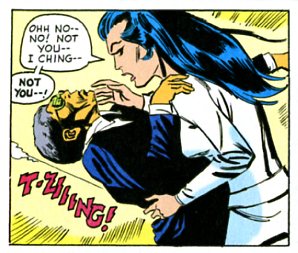
But then O’Neil introduces I Ching (groan) a blind (groan) martial arts master (groan) who trains Diana in his techniques while spouting (you guessed it) wise parables that appear to have been lifted directly from fortune cookies. Diana and her attendant master/racial stereotype then head off to battle Dr. Cyber, a typical evil genius whose sole distinguishing characteristic appears to be that she is a woman. Along the way, Diana encounters and semi-falls for a disreputable private detective named Tim who is just about as familiar as I Ching, though less viscerally offensive.

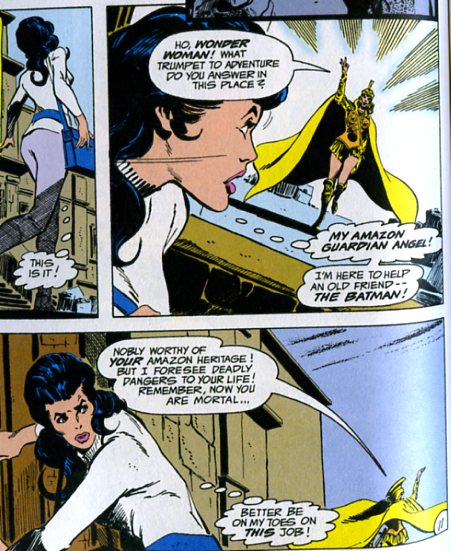
Sekowsky took over the writing chores himself with #182, zapping Wonder Woman back to Paradise Island for a sword-and-sandal battle royale. As the title staggers on, there are a few other one-shot exercises — a fantasy adventure, a ghost story, a couple of street-level helping-the-colorful-neighbors-with-their inner-city problems stories — interspersed with further campaigns against the inevitable Dr. Cyber. The different genres allow for some playful stories: one comic has an entertaining battle with a witch summoned by some neighborhood kids; another, by the irrepressible Bob Haney and Jim Aparo, features the bizarre appearance of a pint-sized “Amazon guardian angel” with whom Diana communes in a Gotham alley.

For the most part though, there’s little effort to experiment, either for thrills or laughs. Instead the four collected volumes read suspiciously like hack-work, created by folks who aren’t paying too much attention for an audience that they distantly hope isn’t paying too much attention either. Nobody, for example, ever bothers to give Diana a personality. Sekowsky supposedly based her wardrobe on that of Diana Riggs in The Avengers…but it wasn’t the clothes that made Mrs. Peel, but the wit and sophistication. Diana has neither of these, nor, indeed, any consistent character at all. There is one interesting issue where she’s presented as advocating torture; a vicious Diana Prince might have been kind of fun. But the trope is dropped, and Diana drifts back to the blandly heroic default.

Not that it’s all bad. A Rober Kanigher-penned Superman/Wonder Woman team-up, where Wonder Woman and Lois Lane vie for Superman’s love, has the requisite Superman-is-such-a-dick Silver Age appeal — plus you get to watch Supes and WW dance together at a space-age hippie shindig (Supes sets the floor on fire — darn super powers.) Sekowsky’s Wonder Woman/Batman team-up seems to reignite his creative juices somewhat, with Bruce Wayne alternately leering over Diana and worrying about his male ego (“I can’t let a woman and a blind man rescue me!”) Throughout the run, too, Sekowsky’s art remains enjoyable; he has a gift for pretty female faces, and the fact that Diana stays in civies gives him a chance to design a plethora of outfits for her. But even he never really regains the dynamism of that first issue, with its hippie coloring and in-your-face modernism.

Sekowsky eventually got moved off the title; Denny O’Neil came back for a bit, and finally sci-fi master Samuel R. Delaney showed up for two issues. In the first of these, Fafhrd and the Grey Mouser make a cameo because, apparently, Delaney wanted to prove that he could be boring with a whole range of other’s copyrighted properties. In the second story, Diana has her consciousness raised by a women’s lib group. I guess this last was somewhat controversial, and seeing Wonder Woman utter the words “for the most part, I don’t even like women!” is definitely jarring. But the whole thing’s so stupid anyway it’s hard to get too exercised about it. To say Delaney was phoning it in here is a disservice to telecommunications technology. The scripts read more like he leaned out the window and casually hawked them out between brushing his teeth and shaving.

The final story in volume 4 is the predictable reboot. Robert Kanigher, who’d written Wonder Woman stories through much of the fifties and sixties, came back to write another, while Don Heck supplied some strikingly awkward and ugly art. I Ching gets shot by a sniper, which is a lot less satisfying than you’d think it would be. Diana gets amnesia, Paradise Island is inexplicably back from its dimension- hopping, Wonder Woman regains her “special outfit.” It’s all so rote it’s hard to see why they even bothered; obviously continuity doesn’t really matter, so why even pretend to have a transition issue? Couldn’t you just put her back in the swimsuit without any explanation at all? Who would care?

I guess maybe somebody would have. Gloria Steinem cared that Wonder Woman had lost her powers, apparently; she’s supposed to have been the one responsible for getting DC to go back to the original, powered-up, scantily-clad version of the heroine. Soon thereafter WW was once more regularly appearing in tied-up bondage poses on her covers, something Sekowsky had kept to a minimum. A return to submissive cheesecake probably wasn’t exactly the outcome Steinem had hoped for, but you fool with Marston’s character at your own risk. O’Neil and Sekowsky had the right idea in trying to get as far from the original version as possible…even if, unfortunately, that was the only idea they had.
____________________

This essay first appeared in the Comics Journal.

Update: This is the latest in a series on post-Marston takes on Wonder Woman. The rest of the series can be read at our old blogspot address here.

Utilitarian Review 1/23/10

On HU

This week was devoted to a roundtable on Clamp’s xxxHolic. Guest posts, lots of comments, and pretty scans abound if you missed it.

Also, this week’s music download is here.

Last week’s doom metal playlist is here.

Utilitarians Everywhere

On Madeloud I review Hamsoken’s Foul Harvest.

On tcj.com I review a collection of James Bond comic strips.

On Metropulse I review a collection of 60s Cambodian pop.

Other Links

Marc Singer has a balanced essay about using Scott McCloud’s Understanding Comics in a classroom setting.

Music For Middle-Brow Snobs: Bleeps From Outer Space

1. Ros Sereysothea — Shave Your Beard (Electric Cambodia)
2. Arareeya Bussaba — Katah Kor Jai (Katah Kor Jai)
3. Ouijai DanEsan — Yai Chim (Pua Pee Der Nong)
4. Johnny Cash — W-O-M-A-N (Rockabilly Blues)
5. Gospel Writers —Same Man (Fire In My Bones)
6. Rev. John Wilkins —Let the Redeemed Say So (Fire In My Bones)
7. Boyd Rivers — Fire Shed In My bones (Fire In My Bones)
8. Betty Davis — 70s Blues (They Say I’m Different)
9. Lady Gaga — Teeth (Fame Monster)
10. Quarta 330 —Bleeps From outer Space (5: Five Years of Hyperdub)
11. Ikonika — Please (5: Five Years of Hyperdub)
12. A Sunny Day in Glasgow — Miss My Friends (Ashes Grammar)
13. A Sunny Day in Glasgow —Starting at a Disadvantage (Ashes Grammar)
14. Rotary Connection — A-Muse (Black Gold)
15. Lee Ann Womack — Painless (There’s More Where That Came From)

Download Bleeps From Outer Space.

Contentious Manga Criticism

Since Suat made a plea for contentious manga criticism I thought I’d point him (and maybe others) to some possible weekend reading.

At our old address, me, Bill Randall, Tom Crippen, and Miriam Libicki participated in roundtables on YKK and Helter Skelter. Both include harshly negative assessments, name-calling, hair-pulling, and small arms fire. Or at least some subset of those things. Watch especially for the “comics journal will eat its own” guest spot by Dirk Deppey.