xxxholic Roundtable Round Up

I thought I’d end the xxxholic roundtable by highlighting some of the more interesting comments it generated, both here and on other sites.

Starting off, Kristy Valenti had a longish and thoughtful defense of the series.

I personally enjoy xxxHolic very much. The first few volumes made it as an honorable mention, paired with Petshop of Horrors, on my 2006 TCJ best of lists: at the time, I praised their low-key, late-night cable horror-anthology feel (something that the critics in this roundtable have also identified, as a fault) and wrote, “these are not significant works by any means, but they are good reads and an interesting study in rhythm and narrative structure.”

I find this rhythm to be key to xxxHolic (I realize that a strong argument can be made that if it doesn’t grab you from the beginning, it’s not worth your time, but xxxHolic, in particular, is quite the slow-burn: as Melinda pointed out, it founders a bit for a while, and shifts gears, but then it begins to build to the show-stopping, stunningly drawn Vol. 12 (though no, the philosophical and existential themes in Vol. 12, and of the work overall, are not particularly novel or complex (one’s ability to affect one’s own destiny, how even our tiniest actions affect ourselves and others, hence the butterfly motif (which: not new)); but I appreciated the getting there. My patience was rewarded).

There’s a certain coldness, or distance, about the work which is tonally in concert, considering that it’s concerned with the supernatural and the inhuman. Equally, my attachment to xxxHolic isn’t particularly sentimental: it’s the only thing I’ve ever read from Clamp that I liked, and I don’t particularly even care for the characters (well, Yuko is entertaining), even 13 or so volumes in. I also wasn’t able to stomach Tsubasa.

That’s why I find it somewhat perverse to review only the first three volumes of this series (or for the majority of the critics to have only read the first three volumes). I realize it’s from a practical standpoint, and I realize that a strong argument can be made that if it doesn’t grab you from the beginning, it’s not worth your time, but I do hope that one forthcoming roundtable participant has read the series to date and will look at the first three volumes in retrospect.

Narratively, xxxHolic is a genre work in which I derive pleasure, as a reader, from seeing the ways in which genre conventions are or are not fulfilled, side-swiped, or discarded in favor of other genres. (Suat explains that there much better works in this genre; I submit that it’s no accident that I followed xxxHolic for as long as I have because I can get it for free at the public library.) And I confess that, after having my eyes assaulted by hundreds of hideous comics with absolutely zero literary or artistic merit, sometimes I find it aesthetically soothing to look at lovely art for art’s sake.

Matthias Wivel had several interesting comments discussing his lack of interest in manga. For example:

I wonder too about the blandness of most manga criticism, but my focus was clearly narrower: it basically concerned what I can’t help but see as an idealisation amongst certain critics of shojo and yaoi especially, simply because, it seems, they’re different from American comics.

Inspired by this enthusiasm, I’ve tried to read a bit of it, and definitely recognise the mastery of, say, Ai Yazawa, but at the same time it’s not only clearly targeted at a completely different audience than me to an extent where I can’t sustain even my intellectual enthusiasm for it, but it also only goes so far.

What I’ve read — and perhaps it’s not a sufficient amount — has been rather formulaic, even if driven by a different (and initially fresh-seeming) cultural coding than the one that makes a lot of American and European comics so instantly dull.

At the same time, like Suat, I find much more to think about, much greater emotional resonance when I read a comic by Dan Clowes or, say, Yoshiharu Tsuge. A comic not only more clearly directed to me, but one invested by much more careful attention to emotional reality.

This prompted a reply from Vom Marlowe:

“A comic not only more clearly directed to me, but one invested by much more careful attention to emotional reality.”

I think that says more about your perception of emotional reality than it does about the comics.

I hate to point out the elephant in the room, but you know, what a lot of this boils down to is that Matthias and Suat are arguing that girls comics aren’t getting criticized hard enough, that if they were held to the same standard as the lit comics, more critics would be saying the comics suck.

This is the same argument that is leveled against romance novels all the time. There’s a reason that almost all deep-level romance novel criticism takes place in female-dominated, frequently locked realms. That’s because if you do it in the “mainstream” the criticism tends to boil down to: Girl stuff (like, say, romance itself) is icky (or emotionally shallow). I hear that enough already, and I’m really not interested in hearing it again. If I thought romances were emotionally shallow, I wouldn’t be reading them. Arguing that they’re worth reading is EXHAUSTING.

I’ll just say that I actually read a LOT of good, thoughtful, fierce criticism of shojo, and most of it is in locked spaces where the boys aren’t allowed.

Pallas provided a really sharp assessment of the differences between Japanese and American comic art:

This is so subjective. Its kind of apples and oranges. Clamp’s art suits the stories they do- I think if they were assigned Captain America: the Return #1 to draw, it would be a disaster.

I think that many American comics tend to have more complex character designs and more complex backgrounds- certainly, the use of color alone adds a lot of complexity. I get the impression the ideal in American art is closer to realism than the ideal in a lot of manga.

I think there’s a number of shoujo with very muddled storytelling- some shoujo creators try to do action oriented material but fail at it, because the minimalism that can work for emotional storyline doesn’t necessarily work for an adventure. (Are Clamp fight scenes ever engaging? I remember absurd proportions in Tsubasa fight scenes ticked me off. Actually, I’ve barely read Sailor Moon, but I got the impression it would fall into the muddled fight scene category.)

I think that you can argue that American comics are far more “plot” oriented while manga is more “emotion” oriented.

Its interesting that I think Takahashi it at least somewhat impressed with the art in American comics:

Question: Do you read American comics?

Takahashi: There are a number of titles that I collect. One of them is, of course, Spider-Man.

Question: Using Spider-Man as a reference, what do you think are the differences between manga and American comics?

Takahashi: Hmmm… In a certain sense, the quality, the art of American comics is very high. I think the element of storytelling through images is strong with American comics. Japanese manga are really… manga can be created even without drawing any action into them. Even boring everyday things, such as portraying that it’s a really hot day or that something is really hungry- even just that is enough for manga. I guess it’s a difference of how people see the world, what people think makes a story. I believe that’s where the difference lies.

And Shaenon Garrity chimed in:

Argh…I have so many nerdy, nerdy thoughts on this subject. To me, American comics, even most “art” or “literary” comics, are very external and plot-oriented in their storytelling. This is even true of comics that go in for a lot of visual experimentation; Acme Novelty Library, for instance, never gets inside the characters’ heads in a visual/visceral way, and in fact all its brilliant formal tricks seem designed as distancing mechanisms, like the comic-book equivalent of a Stanley Kubrick film.

Which is a perfectly legitimate approach, of course, but one of the things that draws me to manga is that even the most formulaic genre work is so internal and character/emotion-oriented. By comparison, manga makes American comics look dry, disengaged, and emotionally stunted. I guess a lot of American comics readers see the emotional intensity of manga as silly or shallow or embarrassing, but my reaction is the opposite; to me, American comics are shallow and silly for shying away from any deep depiction of the characters’ internal lives.

Look at the Takahashi quote above: she comes from a comics tradition where a character being hot or hungry can be depicted in a visually rich, exciting way. To me, that’s interesting and worthwhile, and a “genre story” that successfully captures such moments is possibly more interesting than a “literary” work that stays safely confined to the cerebral level.

Elsewhere on the interwebs, David Welsh responded to the accusation that manga critics are too nice. And Bill Randall, in response to the same discussion, posted his decidedly not nice review of Yoshihiro Tatsumi’s Good-Bye.

There’s lots more of interest in comments; among others, Melinda Beasi (whose own lengthy discussion of xxxholic on her own site is here) chimes in frequently. Thanks again to Kate Dacey and Adam Stephanides for their guest posts, as well as to all the commenters and readers. Again, if you missed it, you can read the entire roundtable here.

Update: Melinda Beasi provides some more thoughts on the roundtable and on manga reviewing.

Update 2: Coffee and Ink weighs in with a scathing assessment of the roundtable.
xxxholic Roundtable: xxxPorn

This is the latest post in a roundtable on Clamp’s xxxholic.
______________________

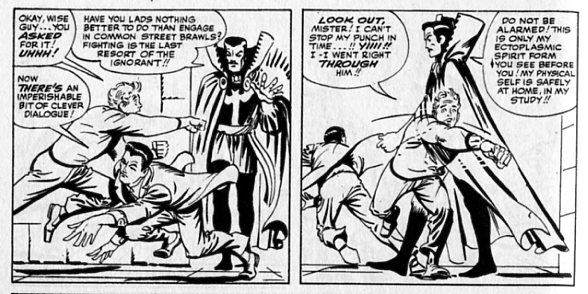
That’s a sequence from the Lee/Ditko Spider-Man Annual #1. I first saw it when I was 8 or so, and it’s stuck with me to this day. Not that I especially loved it or hated it — it’s obviously a fairly bland and pointless sequence.

That very blandness, though, was what arrested me. I couldn’t figure out why I was reading this. Okay, there’s a Spider-Man story…and then Dr. Strange shows up, and walks through four panels — and then he leaves. At other points in the story, Thor passes through in a similar way, as do the Avengers, as do the Fantastic Four. I think I knew even back then who all these characters were, but having them used in this way, for background cameos, left my eight-year old self completely non-plussed. What was the point? Was I supposed to enjoy this? How come?

Of course, I get it now. Dr. Strange walked through so that they could put “Special Guest Stars: Thor! the Avengers! Dr. Strange!” or some such on the cover. It’s a bait and switch.

Or is it? Not exactly, I don’t think. It certainly is a marketing gimmick, but the gimmick isn’t a cheat. Yes Dr. Strange is promised, and you barely get Dr. Strange at all. But I don’t think that’s likely to have been a disappointment to the readers. Rather, the very gratuitousness of the cameo — the fact that Dr. Strange doesn’t do anything and really has no reason for being there — is the point of the whole exercise. He’s trotted out so Marvel loyalists can basically say, “Hey! I know Dr. Strange! There he is! Right in the same world as Spider-Man! Whoo hoo!” The exercise is validated by the little frisson of pleasure you get from catching an allusion. If Dr. Strange were actually part of the plot, if Lee and Ditko had to explain what he was doing there and why he was involved, he wouldn’t work nearly as well as fan-service. He’s an extra bonus for true-believers — the crossover equivalent of a panty shot. The cutesy crassness isn’t a bug; it’s a feature. You pander to let your audience know you’re pandering. It’s a way of saying, hey, plot, theme, character…who cares? The point is that I know you’re reading, you reader you, and I’m looking out for you. Kawaii lecteur,—mon semblable,—mon frère!

This kind of crossover porn has largely been replaced in American superhero comics by continuity porn — an altogether more depressing line of country. But at least for the first three volumes I read, xxxholic keeps things old school: the series is filled with allusions to other Clamp titles, but those allusions are all deliberately and even egregiously shallow. A glimpse of Cardcaptor Sakura’s staff shows up here; a purchase is made from Legal Drug there, little fuzzy bunny things show up from some other Clamp series there.

Even when Clamp flirts with continuity (as when characters from the simultaneously serialized Tsubasa pop in for an inter-dimensional walk-on) it’s very circumspect. Obviously, Clamp would like you to go buy Tsubasa as well as xxxholic, but they’re not going to be pushy about it. Instead, they’re going to be cute:

Yes, the little bunnies are a kind of dimensional vortex; you feed a useful item to the black bunny in xxxholic, it pops out of the mouth of the white bunny in Tsubasa. Watch bunnies ingest and egest from multiple angles when you collect them all!

There’s a kind of brilliance in that; the Dr. Strange cameo is cutesy in a somewhat sublimated, nudge-nudge way . So why not just drag that out in the open and have the container be as cutesy as the content? Clamp is better at being Stan Lee than Stan Lee ever was, in some sense. The clubby Marvel in-group of true believers could never attain the insular hothouse fervor of the fan-fic doujinshi circles that spawned Clamp.

I can admire that about Clamp. There’s something almost awe-inspiring in the way they combine the blatant enthusiasms of the amateur with the absolute polish of a professional. They give their audience what they want, and they do it without the audible grinding of gears you always got from those old Marvel comics. When Dr. Strange trots across the page, you can see Stan behind him pushing; the whole thing smells of greasepaint and pasteboard. In Clamp, on the other hand, the crossovers slide across the page so sinuously that if you’re not in the know you’ll never see them. Kinukitty, for example, had to point out the Legal Drug reference to me.

Even though I’m impressed with the craft, though, I have to say that, overall, I still agree with my eight year old self. I mean, yes, I enjoy hearing a familiar sample in a hip hop song, and I liked some of League of Extraordinary Gentleman. But there’s more happening in hip hop or Alan Moore than just dog whistles and secret handshakes. I don’t really open a comic to see Dr. Strange trotted out clumsily, or Legal Drug trotted out subtly. I don’t really want to be nudged by the writer and told that he or she knows these characters too, and isn’t that great. I don’t go to art to be inducted into a club — or, I don’t know, maybe this is just the wrong sort of club for me. In any case, the crossover porn in xxxholic had more or less the opposite effect on me from what was intended. Instead of convincing me want to go out and read the other Clamp series referenced, it made me want to avoid them all, even those, like Cardcaptor Sakura, that I had already read and enjoyed.
______________________

I also wanted to respond to Suat, who, along with Matthias Wivel in comments wondered why critics in general, and me in particular, weren’t harder on mainstream Japanese comics and more appreciative of American literary comics. Suat suggested the leniency might be attributable to some kind of Japanophiliac “cultural forbearance”; Matthias countered with the theory that it was a species of hipster contrarianism. (Update: Altered somewhat for clarity.)

Of course, my last mainstream manga review wasn’t lenient at all. In fact, it was so unlenient it prompted Suat to intimate that my perspective might actually be racist.

But the real point, I think, is that there’s a tendency when you don’t agree with someone on aesthetics to assume that they’re putting you on. Oh, you can’t possibly like Mariah Carey more than Dirty Projectors, you’re just saying that to be contrary. This despite the fact that Mariah Carey actually has a bigger audience than the Dirty Projectors overall, and therefore you might reasonably conclude that liking her more is the default position, and liking the Dirty Projectors the contrarian one….but I digress.

Anyway, I explain at some length starting here some of the reasons that I find shojo more appealing than American literary comics. Also, just on a basic level, I tend to be more impressed with the craft in manga than with that in American comics, though obviously there’s a lot of individual variation. Japanese illustration is an amazing tradition, richer in many ways than the Western one, and it shows.

Despite all that, though, I still don’t like xxxholic much.

Utilitarian Review 1/16/10

Best Comics Criticism 2009

The big news about the blog this week was Suat’s announcement of the Best Online Comics Criticism of the year.

All the judges beside Suat weighed in with discussions of the list and of their own choices. And those judges were me, Tucker Stone, Frank Santoro and Matthias Wivel.

In other reactions around the web, Johanna Draper Carlson pointed out there could have been more women and manga critics on the list. Melinda Beasi responded by putting up a list of her favorite female manga critics. And David Welsh picked some of his favorite criticism of the year.

Finally, Brigid Alverson notes that she was supposed to be involved in the judging but had to drop out at the last minute due to work and family pressure. She also provides a look at her picks for best criticism of the year.

On HU

Also this week on HU:

Kinukitty reviewed Age Called Blue.

Richard Cook reviewed Sayuki.

Vom Marlowe reviewed Godchild.

I sneered in passing at The Dirty Projectors and Michael Chabon.

And last but not least, this week’s free music download features early doom metal.

Utilitarians Everywhere

At Splice Today I review a newish graphic biography of Johnny Cash.

The exercise does affirm Cash’s power as a storyteller, mainly through contrast. Kleist is a pretty good artist—his drawing of a young Johnny standing at the microphone, head cocked, preparing to deliver “Big River” is lean and striking. But the effort to show the narrative itself is determinedly bland: Images of the mooning swain and his traveling lover lack the lonesome sparseness of the sung original, not to mention its barely contained, self-parodying humor. The pictures seem generic, taken out of any Twainesque riverboat setting, where the original reveled in its specificity as Cash’s deep baritone caressed each place name and ventrioloquized voice. It’s like Kleist decided to draw the sequence without ever stopping to wonder what made the song worthwhile in the first place, with the predictable result that he gets the general framework and leaves out the soul.

And I have another discussion of Zizek with Bert Stabler over at his blog.

Bert: It’s been occurring to me that Jesus defined modern social relations– defining a private sphere apart from state interference, rejecting traditional value systems and extended and even nuclear family relations in favor of abstract inner pursuits, extolling radically egalitarian values, dying for his principles. He despised work and ownership. And, strangely, he was completely the ideal for which our civilization continues to strive. He was a humanist, without the solipsism, nihilism, and hubris.

On tcj.com I have a review of Lilli Carre’s illustrated version of Hans Christian Anderson’s The Fir Tree.

At Metropulse I review the really strikingly bad new Vampire Weekend album.

And finally, Tom Spurgeon has the final wrap up of his massive end-of-decade interview series in which I participated.

Music for Middle-Brow Snobs: Proto-DOOM

Mostly early doom metal with maybe a ringer or two.

1. Dirty Rotten Imbeciles— No Sense (Dirty Rotten LP)
2. Iron Maiden — Hallowed Be Thy Name (The Number of the Beast)
3. Pentagram — Starlady (First Daze Here)
4. Witchfinder General— Death Penalty (Death Penalty)
5. Uriah Heep — Time to Live (Salisbury)
6. Clear Blue Sky — Veil of the Vixen (Downer-Rock Genocide)
7. Saint Vitus — The End of the End (Born Too Late)
8. Black Sabbath — Into the Void (Master of Reality)
9. The Trouble — Revelation (Life or Death) (Psalm 9)
10. Candlemass — Mourner’s Lament (Nightfall)

Download proto-DOOM.

Hey, You’ve Got Your Feminism In My Michael Chabon! Barf.

Shaenon Garrity has a post about the comics-related aspects of Michael Chabon’s Kavalier and Clay. She points out that the main characters in the novel invented every comics innovation worth inventing because they were just that cool, according to Chabon. Then she notes:

Also, just to put on my irritable-feminist hat for the day, I’ve noticed a tendency in fiction where these superhuman feats of intellect and inspiration are only considered plausible in male characters. While Joe and Sammy come up with every brilliant innovation in the history of American comic books, their lady Rosa Saks gets to be… the second-best artist of romance comics. Sure, in real life there weren’t many women during that period drawing great comic books, but neither were there any men who simultaneously combined all the best qualities of Siegel and Shuster, Jack Kirby, Stan Lee, Steve Ditko, and Will Eisner in their prime. Why must our ridiculous wish-fulfillment fantasy characters be confined to fanfiction.net?

I sympathize with the feminist critique. But I think you might want to be careful what you wish for. After all, Kavalier and Clay is in fact aimed at recuperating and/or glorifying a (arguably) minority group already. And speaking as a POJ (Person of Jew), I have to say that the gratuitous, oleaginous ethnic boosting in which Chabon engages is so viscerally nauseating that I fervently wish he’d just ignored my people altogether. Oh…oh, their so…ethnic! And their pasts are so colorful! Their genius…it is so distinctively Jewish — and therefore so American! How I love my country and the cute little mensches who inhabit it!

My point is, having Michael Chabon take up your cause is just not necessarily the thing for which to wish. You’re better off with the fan-fic folk taking care of your wish-fulfillment fantasies, Shaenon. They write better.

Noah’s Picks for Best Online Comics Criticism, 2009

Suat has already posted the official selections for best online comics criticism of the year.

To create the final list, each of the judges submitted ten selections. Two judges (Tucker Stone and Frank Santoro have already posted and talked a little about their ten picks. (Matthias Wivel hasn’t weighed in, but may get to it yet. (Update: Ah, there’s Matthias’s piece.)

So in this post I’m going to give the list I submitted to Suat. I’ve arranged it in increasing order of bestness from 10 to 1.

When Suat asked me to act as one of the judges for this project, I initially declined on the reasonable grounds that I don’t necessarily read a ton of comics criticism. I changed my mind on the more half-assed grounds that what the hell — but it remains the case that I am, I’d be willing to bet, far less versed in comics criticism than my fellow judges.

Nonetheless, my choices are, of course, right, and, to the extent that anyone else disagrees with me, they are wrong. So here we go.

Honorable Mentions

If I had more than ten slots, I would have loved to include Shaenon Garrity’s Acme Library #19 koan, Steven Grant’s discussion of why there aren’t more black supervillains, and Jog’s epic discussion of smurfs.

If I were able to vote for my fellow judges, I would have loved to include this amazing piece where Tucker Stone pretends to be Michel Houllebecq. I was also very taken with Matthias Wivel’s review of Kramer’s 7, and with Suat’s discussion of the contribution of artists to super-hero comics.

__________________________

10. Matt Thorn — “On Translation”

As a scholar and a widely respected translator, Thorn’s take on the limitations of current manga translating is riveting. He manages to be both measured and acerbic, a devastating combination — and he also provides some fascinatingly specific examples of translation difficulties and decisions. As is often the case on the Internets, the piece is as worthwhile for the discussion it sparked as for what it initially said. Numerous translators and fans weigh in on the comments thread, with Thorn elaborating thoughtfully on his points. Elsewhere the essay sparked great responses from Simon Jones and Shaenon Garrity.

9. Juan Artega — “The 5 Creepiest Sex Scenes in Comics”

This is what it says on the tin; a Cracked magazine charticle providing a narrative overview, with first-rate snark, of some of the great moments in comics history. Ms. Marvel being turned into the incestuous brain-washed sex slave of her own son and some random bird-guy from the third-rate super-team the Wanderers impregnating a dinosaur are two of the highlights. This is the sort of piece that would provoke Gary Groth to run foaming into the streets shrieking, “See? See? Online comics criticism is shallow trash! I will write a sharp 150,000 word piece attacking it and praising Pauline Kael, thereby bringing capitalism to its knees!” So, you know, as a Marxist, I had to vote for it.

8. Nina Stone — “The Virgin Read: You Need More Janet Jackson in Your Life, Power Girl.”

Nina Stone isn’t a longtime comics reader, but her loving husband (that’s Tucker) is, and he convinced her to write a column about comics from the perspective of someone who doesn’t know or care much about them. The result has been some of the sharpest comics commentary going, focusing mostly on the mediocrity of the mainstream, but occasionally at other outcroppings of comicsdom as well. Nina’s take on Chris Ware, for example, is as perceptive an evaluation of his work as I’ve seen.

Still, despite the greatness that is the Ware review, I pledge my heart to the Power Girl review I’ve selected here. It’s a lovely meditation on men and women and feminism, and whether you can change other people and whether it even makes sense to want to.

Also, it contains the immortal line “Go fly your Power Girl boobies around the world fighting evil.”

7. Robert Stanley Martin — “Comics Review: Chris Claremont & Frank Miller, Wolverine.”

Robert Stanley Martin is a thoughtful, informed, and perceptive critic — but even I have trouble holding that against him when he’s such a fine writer. His take on the Wolverine mini-series begins with a brilliant discussion of alienated characters in the Marvel Universe; how central they are, how they work, and how they really, really don’t. His view of Claremont as a lesser, stumbling Ditko was one of those “oh my god it’s so true!” moments, and his appeciation of the many virtues, as well as the several flaws, of the Claremont/Miller series couldn’t be much more spot on. His review of Alan Moore’s What Ever Happened to the Man of Tomorrow? is also highly recommended.

6. Dirk Deppey — “The Man Who Couldn’t Shoot Straight”

I originally wanted to include Dirk’s skewering of super-hero decadence, but on further consideration I think the hive-mind was right — “The Man Who Couldn’t Shoot Straight,” which made the final list, is really the Deppey piece to pick from this year.

“The Man Who Couldn’t Shoot Straight” is an evisceration of former DC boss Paul Levitz, and a celebration of his firing. It’s a masterful prosecutor’s brief, as well as a lovely example of sustained, sneering contempt. The only thing that ever disappoints me about Dirk’s longer critiques is that there aren’t more of them. I know he’s invaluable as a link-blogger, and HU probably wouldn’t even exist without him, but I can’t help feeling that his talents are a little wasted in pointing to other people writing on comics when he could instead be writing better pieces than anyone himself. I especially miss his actual comics criticism, which is even better, and even rarer, than his industry commentary.

5. Jason Thompson — “Moe: The Cult of the Child”

Jason Thompson wears his vast knowledge of manga extremely lightly. This piece is a case in point; Thompson takes 1000 words or so to provide a thumbnail historical, literary, and moral analysis of manga’s obsession with prepubescent girls. Discussing pedophilia without resorting to exploitation or outrage is an accomplishment in itself; doing it with the grace, humor, and perceptiveness that Thompson manages here is a quiet tour de force.

4.Craig Fischer — “Deep Tezuka”

This is probably the most academic selection on my list — and it pretty much sums up everything that can go right in academic criticism. Fischer uses film theorists (most notably Andre Bazin) and film concepts (“deep focus” — the framing device in movies such as Citizen Kane where everything on screen is in focus) to contrast the experience of viewing a film with that of reading comics in general and Tezuka in particular. The theory background here doesn’t obfuscate, but instead brings into focus (appropriately enough!). Fischer skips lightly through a barrage of cultural and theoretical links, touching on everything from Dan Clowes’ grandmother to the off-color clouds in the Lion King to the film “Best Years of Our Lives,” and on and on and on. It’s dazzling; a real demonstration, not just of knowledge, but of a love of knowledge, and of art.

I’d also highly recommend Fischer’s discussion of repression, anxiety, and hands in the work of Steve Ditko.

3.Tom Crippen — “Age of Geeks”

Tom Crippen blogged at HU for most of 2009. I asked him to join because I love his writing, and working with him regularly only increased my respect for it. He was actually working on “Age of Geeks” through a good portion of the time he was at HU, and little dribs and drabs about it would pop up in offhand remarks here and there. The final result is worth the wait; it’s one of Tom’s absolute best, I think.

It’s also, as it happens, the piece of all of those on the list that I in large part disagree with. I don’t agree that Alan Moore is at core a geek (I think he’s a crank, which is somewhat different.) I don’t agree that geekery is necessarily the ideal metaphor for late capitalism, in part because I don’t entirely agree with Tom’s definition of geekdom (I think it’s more arbitrarily determined — which is why baseball fans and rap fans, for example, don’t really count.) I don’t agree that Moore’s geekery prevented him from treating his characters with respect or fully examining the human condition: on the contrary, I think his willingness *not* to fully explain why Sally loved the Comedian is in many ways the *most* respectful choice he could have made. I don’t believe that Moore’s sentimentality is excessive or forced; I don’t think From Hell is overall a failure.

Those disagreements don’t make me think less of the piece, though. On the contrary. Just looking at that list above you can see how much thought and how many ideas Tom put in here. Even if I don’t entirely acquiesce to the thesis, the idea of geekery as central to modernity, as Tom explains it, isn’t something I had come across before. It set me back; I had to argue with it and figure out if I agreed or not. Similarly, his take on why the Sally/Comedian explanation didn’t work wasn’t something I’d thought through; responding to it in my head actually helped me figure out why I liked Moore’s handling of it so much.

And even if I disagreed on many of the big points, the individual details and insights are just a joy. The image of modern mankind as legs on a caterpillar; the comparison of William Gull and Bruce Banner; the fat tear rolling down Alan Moore’s face; the on point takedown of Watchmen the movie; the brilliant insight about Veidt’s super-power being information processing…the whole thing just bristles with ideas from front to back. It reminds me how much I miss having Tom on the blog to disagree with.

For Tom in a somewhat different mode, you can check out his review of Dykes to Watch Out For at tcj.com.

2. Robert Alter — “Scripture Picture”

This is the only review of American art comics on this list. I noted recently that participating in this best of effort left me feeling that comics criticism of genre work and manga was overall in a healthier state than comics criticism of art comics. This is the exception that proves the rule.

As a Biblical translator, Alter’s knowledge of the Bible is incredible, and following his exegesis is one of the great pleasures of reading his review. He’s also a very fine writer, in a somewhat formal vein, and his descriptions of the Biblical text and of Crumb’s imagery are vivid, thoughtful, and often humorous. This, for example:

In a very different sex scene, when Lot’s two daughters, imagining after the devastation of Sodom that there is no man left for them on earth, get their father drunk so that he can be led to impregnate them, Crumb provides contrasting variations on the sexual act: the elder daughter is shown in the missionary position, evidently enjoying herself, while in another frame the younger daughter bestrides her besotted father, who is still clutching a wineskin, her face turned to one side in an enigmatic expression that might reflect dismay, or an inner distancing from the act, or a kind of solipsistic concentration on it.

I love “bestrides her besotted father.” Plus, I’ll be damned if that isn’t all one sentence. That’s some old-school prose style, that is.

In addition to knowledge and style, though, Alter is graced with a third virtue — lack of reverence. It’s not just that he’s willing to suggest that, in some ways, Crumb is not Lord High Poobah Over All (though don’t get me wrong — I appreciated that a good deal) It’s also that he’s willing to suggest that *comics*, as a medium, may have certain limits.

The point of Alter’s esay, ultimately, is that the ambiguity of the Biblical narrative is simply not something that can be represented through sequential pictographs. This assertion caused a howl of protest from the usual quarters. Tim Hodler argued vociferously that, contra Alter, comics could indeed express ambiguity — an entirely reasonable dissent which was rather undermined by the tone of aggrieved schoolmarmish disappointment in his peers which accompanied it. Tim seemed viscerally irritated that critics “who should know better” might entertain the idea that comics couldn’t do just absolutely everything. Team Comix, Team Comix, — why have you forsaken me! (Update: Tim says, with some justice, that he didn’t say what I said he said. You can read some back and forth in comments.)

I can’t speak for the rest of the team of course. But for myself, I can say, I don’t really need comics to do everything. Comics are a really young art form, developed in a commercial, modern milieu, long after the Bible was written. And given that, it seems to me that, perhaps, form does matter — not just in that you can get to the same place in different ways, but in the sense that you really, truly, can’t necessarily get to the same place at all. This is the point of Craig Fischer’s essay about film vs. comics discussed above. It’s also implicit in a recent essay by Bill Randall, where he notes that comics are uniquely suited to representing fragmentation — and therefore, perhaps, one might argue, less suited to representing the kinds of great, unifying narratives represented by the Bible.

Alter, in short, is willing to talk about what comics can’t do. That willingness to focus on limitations rather than accomplishments is, it seems to me, really important in a critic — and it seems to me too often absent from writing about art comics, where there’s still often, among some critics, a certain level of defensiveness — of trying to prove that comics are serious, already. Which is a shame since, as Alter shows, there’s absolutely no reason that an essay about Crumb’s Genesis can’t be just as good as one about Power Girl or Tezuka or Watchmen.

1. Bill Randall — “Bring the Noise”

I mentioned one of Bill Randall’s essays just above there, and this is that essay. As with Tom, I was lucky enough to get Bill to blog with me on HU for a time. I’ve actually gotten to know him better since he left the blog, and I feel pretty lucky for that too. He’s an incredibly smart and funny observer of comics, and, also, you know, of all that stuff out there that isn’t comics but which still might be important to somebody, I guess.

“Bring the Noise,” which appeared in issue 300 of the Comics Journal, and which is now online at tcj.com, is effectively Bill’s farewell to comics criticism, at least in the short form and at least for a while. It’s a history lesson, a memoir, and a speculation about the potential and the limitations of cross-cultural influence. As with all of Bill’s work, the writing is lovely, and works almost more as poetry than prose — not because the language is flowery, but because the connections it makes are as much about memory, intuition, and rhythms as they are about logic. The way he uses declaratives and often leaves the connections between his insights implicit rather than explicit is almost Emersonian; ideas shimmer through the text, free to form different sparkly patterns. It can be off-putting at first for those like me who are more prosaically minded, but once you get into the rhythm it’s addictive. For example, this paragraph:

One of the main reasons it still makes sense to pay Japan the attention it, as a country long stagnant in politics and economy, no longer deserves, is that it offers a model for contemporary life. What has long been a comfortable place to live has taken to extremes, as with, say, the hikikomori, broken students who avoid the outside world entirely. In some ways Japan seems like a Petri dish for the extremes of urban alienation. And it produces fascinating subcultures. A city like Tokyo has a place for everything as long as it stays where it belongs and doesn’t ruffle any feathers. I find some of the most interesting artists working now speak to some small niche in a minor key. Previously, it was the grand narratives from hugely popular artists. These works addressed a time when worldwide conflict was a living memory and everyone felt its effects. Then Japan became middle-class and fantasies replaced a comfortable, mildly unsatisfying life. Now, everyone’s frittering away in their own individual holes on their own individual things. So group life becomes termite life and each subculture gets its own voice.

I love those last two sentences; the repetition of “individual”, the repetition of “life,” the jump from “holes” to the quick metaphor of “termite,” the way the careful, relatively short sentences of the whole paragraph mirror the sense of individual cultures carefully cocooning. Each time I return to this essay, my respect and affection for it grows.

I can’t find the link, but I’m pretty sure I remember that Bill once mentioned that he’d feel like comics criticism was actually art when a piece made him cry, as film criticism had on occasion. I can’t say this essay made me cry. It’s still beautiful, though.