Break to Gobble

Most of your utilitarian bloggers are going to be taking off this week, so things will be a bit quiet around here — though there will still be content of some sort, never fear.

Shortly after the holiday I’m told we may be moving over to our new location at TCJ.com. I’ll pass along more details when they’re available….

Utilitarian Review 11/21/09

On HU

I started this week off with a post on how superdickery has changed through the ages.

Richard wrote about mediocre French mainstream title Spin Angels.

Suat wrote about living with Walt Kelly original art.

Kinukitty wrote about the somewhat squicky yaoi title Two of Hearts.

Vom Marlowe discussed the mediocrity which is X-Men.

And this week’s music download features lots of gospel and thai music.

Last week’s droney mix can still be found at the link.

Utilitarians Elsewhere

Bill and Tom have moved off HU, of course, but I thought I’d mention that they both have great articles in the most recent, and last, Comics Journal, #300, available in a store near you hopefully.

Tom argues that Alan Moore has fallen prey to his own rampant geekery.

Alan Moore is a product of that time, maybe its best. If you want some recycled pop fantasy, I think you’re better off with “Whatever Happened to the Man of Tomorrow?” than you are with Star Wars. In fact I’d say his big titles of the 1980s, Watchmen most of all, are the only examples I’ve come across of really fine, substantial works devoted to recycling other-reality entertainment staples. But something went wrong. His Watchmen became Watchmen the movie, which is bad enough. What’s worse is that Moore wrote Lost Girls and League of Extraordinary Gentlemen and — well, just about every comic he’s turned out since 1989 or so. If I had to think of reasons to say why Alan Moore was great, I’d have a hard time finding anything from his comics work of the past 20 years. There’s issue 12 of Promethea, but then there’s the rest of Promethea. There’s From Hell, but no, not really. He hasn’t stopped being a genius; only a genius could fail in the way he does, with such energy and ambition, such amazing fireworks. But when I put one of his comics down, I have to remind myself to pick it back up. I think his post-’89 comics are stunted. No matter how big he tries to be, he winds up being small.

Bill, meanwhile, argues for the uniqueness — and probable transience — of the anime/manga invasion of the U.S.

In 2000, you could name the people and companies working to bring manga to the West on one hand, maybe two. Now keeping up with just the English-language commentators has become a full-time job. A few of the writers, like Jason Thompson, Xavier Guilbert and the chaps at Same Hat! Same Hat!, deserve careful reading. Most of the rest barely need a skim. Which is not necessarily a criticism if you have 3,000 people writing about the same book, what are the odds most of them will say the same things?

What happens instead is that they say the same thing in different places. There is no one essential place to read about manga in English. Instead, the trickle of information from 30-plus years ago became a healthy flow. Then, as with everything in the current age, the forces behind it pool into isolated spots. Each one hosts a dialogue or a tribal area or even an intellectual prison; each speaks to a particular subjectivity. One could tip the pen to Postmodernism, were that movement not first passé and second ironic. Manga and its fans have favored bald emotions, putting them closer to New Sincerity, or the Reconstructivists, or whatever the movement after pomo ends up being called. It seems less like forward progress through the history of ideas than an atomization.

Meanwhile, on the Internets, I have an essay about the new Twilight movies over at Reason.

If Edward represents agelessness as a perfect fantasy, Jacob Black represents aging as a horror-film disaster. As you almost certainly know from advance publicity (and if you don’t, here comes the spoiler,) Jacob discovers partway through the film that he’s a werewolf. Lycanthropy, as it turns out, is adolescence on steroids. Jacob loses control of his emotions, grows hair where he shouldn’t, starts hanging out with the wrong crowd, and begins thinking so loudly that all his friends can hear him.

In choosing between Jacob and Edward, Bella is choosing between growing up, with all its dangers and messy unpredictability, and staying a faery child, forever young and lifeless. In the end (here’s another spoiler), without much of a fight, she opts for immortality. Thus, the Twilight series isn’t so much a coming-of-age story as a refusing-to-come-of-age story.

And finally I have a brief review of the new Leona Lewis album over at Metropulse.

Other Links

Matthew Brady pointed me to this unpublished black and white Wonder Woman story with art by Harry Peter and script possibly by William Marston. It’s a treat.

And your Thai luk thung/morlum video of the week, sung by Siriporn Umpaipong.

And what the hey, here’s another one by Ajareeya Bussaba. Adorable caterpillars.

Music For Middle-Brow Snobs: How Far Am I From Thailand?

Gospel, thai, and some other stuff….

1. Five Blind Boys of Mississippi — How Far Am I From Canaan? (Five Blind Boys of Mississippi 1947-1951)
2. Soul Stirrers — I’m a Soldier (Kings of the Gospel Highway)
3. Spirit of Memphis Quartet — Jesus Jesus (Kings of the Gospel Highway)
4. Swan Silvertones — Working on a Building (Kings of the Gospel Highway)
5. Sensational Nightingales — Sinner Man (When Gospel Was Gospel)
6. Marion Williams — Traveling Shoes (When Gospel Was Gospel)
7. Marion Williams — Sit Down Servant (Gospel Soul of Marion Williams)
8. Thomas A. Dorsey with Sallie Martin — I’ll Tell It Wherever I Go (Precious Lord)
9. J. Robert Bradley — The Day Is Past and Gone (All God’s Sons and Daughters)
10. June Christy — Shadow Woman (Ballads for Night People)
11. Pamela Bowden — Ao Kwam Kom Kuen Pai Ting Mae Kong (The Bitterness of Leaving Mae Kong) (Kaew Ta Duang Jai)
12. Pamela Bowden — Nong Chum Wan Nee Pee Chum Wann Na (Kaew Ta Duang Jai)
13.Mangpor Chonticha — Mai Dai Am Chan Rork (I Can’t Get) (Mae Krua Hua Kai)
14. Mangpor Chonticha — Pee Lhuang Yah Luang Nong (Mae Krua Hua Kai)
15. Mazzy Star — Blue Flower (She Hangs Brightly)
16. Gene Loves Jezebel — Dream a Big Dream (VII)
17.Teenage Filmstars — You Mystify Me (Buy Our Record, Support Our Sickness)
18. Teenage Filmstars — Jeepers Creepers (Buy Our Record, Support Our Sickness)

Download How Far Am I From Thailand?

And if you missed it, you can download last week’s droney mix here.

The Superdick in the Closet

A couple of weeks ago I posted a series of discussions about the way in which super-hero comics tend to be structured around homosocial desire and the closet. You can read the whole series here.

Just to resummarize quickly: the basic argument is that a character like Superman is a male power fantasy. That fits in with Freud and the Oedipal conflict. Clark Kent can be seen as the “child” who imagines himself supplanting the Father/lawgiver/god. You can also take this one step away from Freud and argue (via the theories of Eve Sedgwick) that what we’re talking about here is not, or not solely, an internal psychological desire, but rather a cultural/social formulation. Men turn away from femininity in order to identify with patriarchal power; or, to see it another way, to be patriarchal requires the denigration or hiding of weakness. That’s the closet; Clark Kent is living a lie, pretending to be powerful in order to be powerful, when his truth is actually a weak, wimpy child. And, again, the closet is powered by male-male desires and fantasies, making it homoerotic (though, as I argue at some length, it’s actually a straight person’s homoerotic fantasy — we’re talking about how straight men bond or interact with the patriarchy in particular, and arguing that that interaction is structured by ideas about, and within, gayness.)

Okay, so that’s basically where we left things. In the last few posts, I was mostly interested in pointing out similarities in the way this basic blueprint was used across different kinds of comics, from Superman and Batman through Spider-Man and Hulk and on to the work of folks like Chris Ware and Dave Sim. But, of course, there are differences too from case to case, and it’s interesting to look at some of those, and how they work.

So first, I’ve been thinking a little about the differences between some of the early heroes of the 30s and 40s and the later iconic Marvel heroes. Generally, I think, the argument is that Marvel heroes were different because they were more realistic; they faced everyday problems, made mistakes and so forth.

I wonder how true that is exactly, though. The fact is, none of the Marvel characters are all that realistic. Peter has girl troubles, sure, and he gets bullied — but Clark Kent had girl troubles, and he got bullied too. And Peter’s a genius inventor. And he’s drawn to look like he’s 40 even though he’s only like — what? 16?

Anyway, the point is, I don’t think the change had all that much to do with verisimilitude. We’re still in the world of preposterous fantasy, after all, with cosmic rays and gamma rays and super strength and defeating your enemies by punching them in the face. The difference, it seems to me, has more to do with anxiety. The Oedipal split is always somewhat agonized and anxious; the superfather for Freud is also the super-castrating ogre. And in those early Superman stories, Clark is despised and castrated; there’s a definite feeling of loathing.

However, the loathing is in these directed mostly towards the castrated, not the castrator. The problem, the thing to be ridiculed, is powerlessness, not power.

Over time, though, the faith in that image of absolute power started to waver. In the 50s and 60s there was a lot of more-or-less playful experimentation with the idea of superman as evil father. Thus, the aptly (and Freudianly) named Superman is a Dick website.

Here’s a particularly apropos picture:
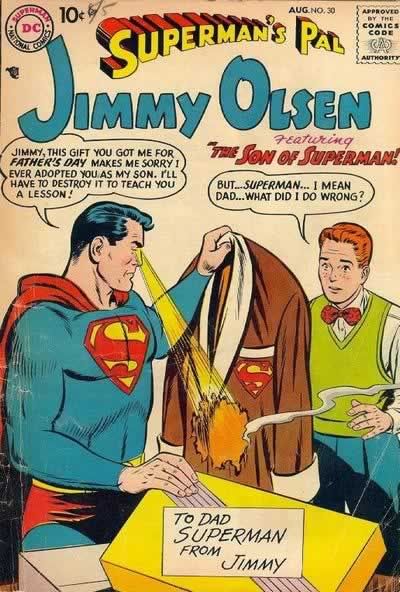
I don’t know that I can really add anything to that.

Of course, the stories here always resolved by showing that Superman was acting for everyone’s good; he may have looked like the evil father, but he’s still really the good father; patriarchy is still to be trusted, power is still great, and all the boys still want that super dick.

Marvel’s innovation was not that it gave us stories that were different in kind from Superman’s kid, Jimmy Olsen. Rather, the difference was that it was able to take exactly this story and treat it as tragedy rather than farce. The problems most Marvel super-heroes face is precisely that of the superdick. That is, they aren’t beset by normal, everyday problems — they’re beset by the Thing — the monster phallus itself. Peter Parker’s mega-problems (the death of his uncle in particular) stem from being Spider-Man; which is why, when he loses his powers, he’s acutely relieved. The early Marvel comics loved to portray super-powers as a crippling curse, a disaster. The Hulk is maybe the purest example; the uber-masculine ogre who hates and wants to destroy his weaker self. You couldn’t really come up with a more lurid Oedipal castration fantasy.

The Marvel stories, then, are about mistrust of patriarchal authority; they insistently question whether the great gay bargain — exchanging individual weakness for patriarchal strength at the cost of always hiding your weakness — is really worth it. In this, they’re not unlike exploitation films, which are from roughly the same time period and which were also obsessed, in various ways, with authority and changing ideas about masculinity and femininity.

But where exploitation films could, and did, revel in the perverse pleasures of fucking with authority, Marvel comics never (for various reasons) went there. As with Superman as Superdick, the stories always ultimately ended up affirming the worth of power as power. Peter Parker is relieved to lose his powers…but then his Aunt and girlfriend are captured, and he realizes how much he Needs to Be a Man and grasp the superdick in order to save them. And even though he’s an ogre, The Hulk, somehow, always ends up being a force for good (and eventually became childlike himself, neatly undercutting the evil-ogre-father aspect of the character, which was much more prominent in the first issues.) Moreover, Stan was hardly above indulging in some Superman style superdickery himself; Professor X and other father figures are always running the X-Men through this or that idiotic test for their own good. “Yes, my X-Men, I gutted Ice Man and used his bloody remains to lubricate the gears of my Cerebro computer, then let you think he was dead for weeks. But! The experience has made you stronger as a team! And Cerebro is working really well now! And besides, before I brutally murdered him, I created a perfect robot duplicate, whose powers work better and who doesn’t engage in annoying pranks. Say hello to you new teammate: Ice-Bot!”

Having just written that super-hero parody, I have to say…it’s interesting how much super-hero parody revolves around superdickery. Chris Ware’s Superman, for example, is essentially a brutal sadist destroying everyone who contradicts him; Johnny Ryan has a superman/god character who works in a similar way. And then there’s Kate Beaton’s bad-ass Wonder Woman. And a lot of the humor in Mini-Marvels is based on the kid heroes behaving like megaomaniacal uber-fathers (Reed Richards cheerfully sending the Hulk off into space for example.) And, of course, that’s the whole point of Marvel Zombies too, with the heroes turned into evil ogres and at last wholeheartedly embracing their inner superdickery.

In fact, the genius of the early Marvel comics is not that they undercut (as it were) the superdick, but rather that they reconsecrate it by more fully acknowledging its dickishness. Males (and especially adolescent males, the ones reading these comics) are always ambivalent about sadism and patriarchal power, both because the sadism and patriarchal power is likely as not to be directed against them (“go to your room!” go off to war!”) and because, you know, who wants to be always about to become the ogre raping and murdering their own loved ones? That very guilt and fear, however, function as a lever and a spur. Peter Parker kills his father….and his life is thereafter defined by the guilt that demands he himself become a monster/father to take Uncle Ben’s place. The Hulk, in his later incarnations, is not just the destructive phallus, but the wounded child as destructive phallus; the fantasy, both terrifying and fascinating, is to become the ogre-father while still an infant, eternally both torturing oneself and satisfyingly wreaking instant vengeance, on oneself and others, for the torture. Marvel figured out that you don’t need to deny the anxiety and guilt attendant upon the power fantasy; rather, you can harness them to make the green monster grow.

So a couple more comments about this.

— I think that, as others have pointed out, power fantasies (or superdickery) is really central to the super-hero genre. And I think that what that means in part is that the super-hero genre is — not always, or everywhere, but quite centrally nonetheless — sadistic. It’s about identifying with power — either for good, or for ill. It’s about being the beneficent god or the evil ogre father, or both at once. To the extent that you do identify with weakness, it’s generally as a prelude to releasing your inner hulk, or going out to websling, or whatever.

—This is a big part of why superheroics and horror (as opposed to goth) don’t mix especially well. You can certainly have gore in something like Blackest Night, because gore and violence fit perfectly well with sadism; you can be the ravening ogre father chomping on bones, hooray! And, yes, sadism does have a place in horror too — thus torture-porn — and to that extent it does make some sense to think of Blackest Night or Marvel Zombies as some kind of horror crossover. But the central mode of horror really is not sadism; it’s masochism. It’s about being the devoured child, not the devouring father — in horror, while you may cheer for the ogre at various points, you never actually are the ogre; you’re the victim, which is where the fear comes from. The whole point of Shivers or the Thing or the Living Dead movies is that the characters are consumed; they are destroyed, and then eaten up or filled up by the Other (which is pretty explicitly the phallus, in Shivers and the Thing, especially.)

But super-hero comics never do that; even when the super-heroes are evil, they have a recognizable personality, and are the stars with which you (more or less) identify. The two genres, super-heroes and horror, are simply diametrically opposed; they are committed to opposite goals. Super-hero comics are fun because they empower; horror is fun because it disempowers. You can’t do both at once. (Alan Moore’s Swamp Thing is an exception that tests the rule, perhaps…I found the Swamp Thing vampire story at least fairly scary. But Moore accomplished that by keeping Swamp Thing himself off screen for most of the story while various civilians are terrorized and slaughtered. When Swamp Thing did show up to do battle with a giant frog/lizard/vampire thing, the horror quickly dissipated.)

—Masochism is central to the way that exploitation films, such as horror, express their distrust of the status quo. Not that horror films are actually revolutionary, per se, or that I Spit on Your Grave is going to overthrow the patriarchy or anything. But, effectual or not, a film like Last House on the Left really expresses a visceral distaste for patriarchal authority. It sneers at good dads and bad dads alike, and at the war they perpetrated, and at the whole concept of justice and truth. And again, it does this through masochism — through identifying with victims and getting pleasure/excitement/terror through fantasies of disempowerment rather than through fantasies of empowerment.

Super-hero comics on the other hand, have a lot of trouble making that kind of perverse identification with the disempowered. This is the case even with parodies like Marvel Zombies or Ted Rall’s Fantabulaman or even Chris Ware’s Superman/Jimmy Corrigan strips, where there’s generally a kind of contempt for Jimmy’s weakness which echoes the distaste for Clark Kent or Peter Parker. In all these parodies, the focus is largely on the evil father doing the ogrish evil; the victims are much less personified or even visualized. Even if you have your tongue in your cheek while admiring the superdick, you’re still kind of admiring the superdick.

Grant Morrison’s mainstream work provides an even clearer example. In his Justice League and X-Men runs, he often has his villains launch fairly damning critiques of the heroes as egotistical, self-satisfied, godlike assholes. But then he always kind of takes it back; the heroes waltz on and show that they’re noble and good and they save the world and you’re supposed to be all enthusiastic, I guess. Obviously, Morrison identifies with the critique to some extent, but there isn’t any way in a super-hero comic to let it have the last word, or to have it be the point (as it is, to some extent at least, in the Invisibles.)

Another example is Greg Rucka’s Hiketeia. Rucka puts a certain amount of effort into making the story masochistic. The cover features Wonder Woman stepping on Batman’s head, and the plot is a rape-revenge, in which a young girl slaughters her sister’s killers, taking the knife to patriarchal notions of justice and fairness. Men get beat down by storng women. However…in the first place, this is a Wonder Woman comic, and a lot of the emotional oomph comes from watching her beat the tar out of Batman — you identify with her, which is sadistic rather than masochistic. Secondly, the story ends up being not about the girl and her revenge at all, but instead about the tragic rift that the girl’s rape-revenge creates between Wonder Woman and Batman; a rift the girl, rather inexplicably, sacrifices herself to heal. It’s like she hears all the genre rules yelling at her that she’s supposed to be the one getting castrated, not doing the castrating, and she finally acquiesces — perhaps just because she can’t stand being written by Greg Rucka any longer.

Again, Watchmen is perhaps an exception of sorts here, where the role of all-powerful father is both questioned and in various ways deflated. But it took Moore a number of false starts before he got there (Miracleman and V for Vendetta try to mount an anti-establishment critique via super-hero, but ultimately, I’d argue, end up defeated by the genre conventions.)

The point here isn’t that stories supporting status quo are necessarily bad. Dark Knight is pretty unabashed in its worship of the superdick, and it’s great. And, as the Dark Knight kind of suggests, the status quo has numerous benefits (stable currency and revolutionaries not stringing up me and mine from flagpoles = good.) It is interesting, though, the extent to which the superhero genre’s bias towards and fascination with the superdick makes it difficult for authors to tell certain kinds of stories (horror, anti-status-quo) even when they’re clearly trying to do so.
_______________________

Well, that was about twice as long as I thought it would be. I still want to discuss the question of whether Wonder Woman can be the superdick…but I think we’ll have to leave that for another day.

Utilitarian Review 11/14/09

On HU

This week started out with my review of Young Schulz, a collection of Charles Schulz’s comics featuring young adults at church.

Kinukitty reviewed Way to Heaven which is not as good as the rock band Angel.

I reviewed a handful of mahwa and manga, including Click, Bizenghast, and a collection of Hiroki Endo’s short stories.

Vom Marlowe reviewed the electronic art program Corel Painter and its official magazine.

I insisted that superheroes aren’t dead, despite the best efforts of Marvel and D.C.

And finally this week’s droney music mix is available for down load. Also, in case you missed it, you can still get the discoey mix from last week.

Utilitarians Elsewhere

A bunch of stuff this week, starting with:

Something completely different over at Splice Today, where I attempt to get in touch with my long denied genetic destiny as an NPR confessional essayist.

As a child, I was told that I mumbled. And, as kids will, I believed it—and went on believing it well after I had left home. In fact, I don’t think I fully realized this deception until well into adulthood. I was 28, I think; my parents had come into Chicago to visit and we were having dinner in a restaurant with a cousin and my wife-to-be. My cousin showed up late, bearing a relatively spectacular bit of news: My grandmother had caught her eye on a car door and was in the hospital. My mom sat up straighter in her chair, lifted her chin, and with that east-coast Jewish nasal edge that sounds like a jackhammer pulled across a blackboard, bellowed out, “Holy Fuck!”

Over at comixology I discuss ukiyo-e prints and Satoshi Kitamura’s children book “When Sheep Cannot Sleep.”

Kitamura’s book reads like a Japanese print series in a number of ways, from his off-center compositions, to his subtle use of blank space, to his lovely color palette, all the way to his clever, intentionally humorous use of visual puzzles. You’re always wondering from page to page what you’re supposed to be counting and where it is, just as in Yoshitoshi’s series you’re always looking for (and not always finding) the moon.

On Madeloud I discuss a number of unusual christian albums, including the Violent Femmes’ Hallowed Ground.

Anenoidal weirdo Gordan Gano played up his adolescent angst and played down his religious inclinations on most Violent Femmes releases — except for his second effort, 1984’s aggressively bizarre Hallowed Ground. Starting off with a plunking tale of child murder and ending with a joyful plea for watery apocalypse, the album recasts the fire and brimstone of old timey country as manic, off-kilter stagger: it’s Christianity as bi-polar disorder. Nowhere is this clearer than on “Black Girls,” a concupiscent vaudeville-meets-free-jazz paean to interracial affection, featuring a guest-spot from John Zorn’s Horns of Dilemma and the immortal lines “You know I love the lord of hosts/father son and the holy ghost/ I was so pleased to learn that he’s inside me/ In my time of trouble he will hide me….I dig the black girls!” Just like the squeaking saxophones and the bluegrass banjo, the cheerful lust and earnest faith exist side by side — angular, dissonant, incongruous, and perfect.

Bert Stabler has posted some more email conversations between the two of us, this time about Slavoj Zizek and God. Here’s me snarking at Zizek:

Aha! Just got to Zizek on the resurrection; it’s apparently a metaphor for the way an inspirational example lives on in a community of radical believers. “I may die, but what I stood for will inspire you…and so I live on!”

Which seems like really weak tea. Zizek goes to a lot of effort to read the death of God literally…and then we’re supposed to take the resurrection as not just a metaphor, but a cliched metaphor? Joan Baez on Joe Hill is the meaning of the resurrection? I mean, I like Joan Baez, and labor organizing is cool, but…why are we talking about Christ at all then if this is the point, exactly? And if this is indeed the point, why aren’t you out there organizing rather than having a debate about God?

Finally, over at the Knoxville MetropulseI review the recent release by Belgian psychedelic weirdos Sylvester Anfang.

Other Links

This is a great Wonder Woman cartoon by Kate Beaton.

Absolutely gorgeous Beardsley-like opium illustratons by Attila Sassy. I don’t say this enough, but thanks to Dirk for the link.

Ariel Schrag has a statement about a middle school pulling her anthology about middle school kids, Stuck in the Middle, off its shelves.

And your Thai pop video of the week, featuring Mangpor Chonticha:

Music For Middle-Brow Snobs: Little Red Drone

Mostly droning and buzzing.

1. Robert Wyatt — Little Red Riding Hood Hit the Road (Rock Bottom)
2. Terry Riley — Anthem of the Trinity (Shri Camel)
3. Mazzy Star — So Tonight That I Might See (So Tonight That I Might See)
4. Teenage Filmstars — Lapse (Rocket Charms)
5. Suishou No Fune — The Storm of Light/Cherry (Shining Star- Live)
6. Nihill — Aard (Grond)

Download Little Red Drone.

And if you missed it, last weeks discoey mix is here.

Ain’t Dead Yet

Steven Grant (who guest blogged here last week) declares the super-hero dead dead dead:

it’s patently clear to anyone studying market history that the fans are disinterested too. They don’t buy new superheroes. They don’t want them. Maybe it’s economics, maybe they’ve been burned too many times to come back for what might be more, maybe they’re waiting for Something Truly Different and don’t feel like spending more on what are basically variations on themes they already buy, but reasons don’t much matter. They do not buy them, and haven’t for a long, long time.

So even logical ways of introducing new superheroes are right out the window. Theoretically (and ignoring all issues of creator rights for the moment) the best way to intro a character would be in an existing top character’s book. Let the readers get to know the new superhero that way, then spin him into his own book. That should work. It doesn’t, even with characters readers respond well to, like The Silver Surfer….

The superhero genre may not be the Titanic, no icebergs in sight, but everyone’s still just rearranging deck chairs now. That’s how the companies want it, because they’re no longer marketing creations. They’re peddling brands. Branding is everything now, and it’s almost always more profitable to cash in on a long-established brand than to create, develop and market a new one. The superhero as brand name might be with us until the end of time, now, but the superhero as expression of genuine creativity is pretty much dead.

Steven’s argument is fun both because it’s so devastatingly true…and because it’s completely wrong. Yes, yes, Marvel and D.C. and the handful of smaller comics companies peddling traditional super-heroes are so creatively bankrupt that you wonder how it’s possible that the “creatively” doesn’t just disappear from that formulation. Neither of them has had any success introducing new characters in forever, and it’s equally clear that the don’t have any idea what to do with the ones they’ve got other than continue an unending soap-opera playing to fewer and fewer true-believers. That’s absolutely right.

But the reason it’s right isn’t because nobody likes super-heroes. People love super-heroes. Here, for example, is a partial list of some of the most successful super-heroes introduced in the past twenty odd years.

Ben 10

Sailor Moon

Captain Underpants

Buffy the Vampire Slayer

Edward (from Twilight)

Neo (from the Matrix)

all those folks on Heroes

You get the idea. The concept of a character with some combination of unusual powers and abilities and/or a secret identity and/or a costume, maybe, is hardly dead. On the contrary, it’s been essential to some of the most successful media properties of the last couple of decades

So the question then becomes, not why are super-heroes unpopular, but why are the super-heroes parlayed by Marvel and DC so darn unpopular? Why can everybody and their idiot cousin create successful super-heroes except for the companies that spend all their time, 24-7, writing about super-heroes?

Well, when you look at the successful super-heroes above, you notice a couple of things:

1. Almost all of them are genre blends. That is, they’re super-heroes and something else — fantasy in Sailor Moon, sci-fi in Ben 10, satire in Captain Underpants, goth horror in Buffy and Twilight. That doesn’t make them less about super-heroes — pulp genres cross-hybridize all the time (detective and romance, for example, mix so often it’s become positively indecent.) But what it does do is make them more creative. Steven says:

Don’t forget, the original context of the superhero was a poverty-stricken America heading into World War II. Superheroes were basically a big pep talk, later a big jingoistic pep talk as the country went to war. The earliest superheroes, cats like Superman and Batman, were hardly law-abiding citizens, but the ’30s weren’t a great time for staunch belief in the law. The notion that anyone could stand against presumed widespread corruption, could stand for a higher, nobler morality, that was heady stuff, especially at a time when whole nations seemed to be going nuts. Didn’t last long; before long, and once war was declared, superheroes were mostly chatting up the policeman as Our Friend and how all good Americans should follow the rules, take their vitamins, say their prayers, collect tin and aluminum and buy war bonds and that was a message the time was ready for, but it was no coincidence that the end of the war was almost an end of the superhero. It was the end of any semblance of relevance for the superhero.

And yes, sure, there’s something to that: superheroes started in a certain time and place, and they had to change to continue to be relevant. But…that’s how genres work. Tolkien started modern epic fantasy as a response to WW II. When WWII was over, fantasy was less relevant…so folks like Ursula K. Le Guin came along and did something else with it that made it speak to changing gender roles and race and other stuff that made sense to the people of the time. That’s how genres work; they’re not carved in stone. You pick them up and do something new with them that’s grounded in tradition but makes sense for a different time and place.

And that’s what folks do with super-heroes too. Buffy shows how to use super-hero stories to talk about contemporary high-school and girls coming of age. Captain Underpants shows how to use super-hero stories to talk (or at least snicker) about contemporary elementary schools. The Matrix uses super-heroes to talk (dumbly but popularly) about modern paranoia around technology, among other issues.

The only ones who can’t figure out how to gracefully use super-heroes to talk about anything that matters is the big two. And maybe, you know, that does in fact have something to do with the fact that they’re using the same damn heroes from 40 to 70 years ago. Though, on the other hand, Smallville manages to update Superman effectively, and the Batman cartoons are fine…. I don’t know. Maybe, on second thought, DC and Marvel are just catastrophically stupid.

2. The other thing about all of the most popular super-heroes is that they come complete with their own worlds. That is, the super-heroes aren’t just random folks who happened to gain super-powers and then go off to fight random evil stuff. Rather, the super-hero’s powers, their missions, and their enemies are all part of a single story and a single world. One of the most satisfying parts of Twilight is the geekily thorough way in which Stephanie Meyer apportions powers and weaknesses to her vampires and werewolves and such, and then has those powers drive the plot in particular ways (there are always incredibly intricate plans to stop the mind-reading Edward from picking up thoughts he shouldn’t hear, for example.) I don’t know much about Ben 10, but I do know that his powers and the DNAliens he fights are all tied together in a single backstory.

All of which suggests that people do like reading super-hero stories…but they most of all like reading stories. Folks are willing to suspend their disbelief if you give them a reason to — but DC and Marvel don’t even bother. Their titles just assume, pretty much, that all these various randomly powered, disconnected super-folk are running around, fighting similarly disconnected super-villains. In some ways, the lust for crossover that we’ve seen in recent years is an effort to get around this — to provide the narrative and the rationale that most people reading a story naturally want. But it’s too much of a mess, and mired in too much backstory, to actually be all that interesting to anyone beyond the small core of true believers.

________________________

On the one hand, you might argue I guess that Steven’s tendency not to see the super-heroes all around him is of a piece with the status quo among the big two; that is, if they could only start to think about super-hero stories in different ways, maybe they wouldn’t be so perpetually shitty. Perhaps they could finally start telling stories somebody cared about, and maybe even come up with some new heroes that were different from the old heroes in ways which would allow them to appeal to a broader audience.

But really, I think that’s too harsh on Steven and not sufficiently harsh on DC and Marvel. The truth is, DC and Marvel seem pretty thoroughly irredeemable. Steven was right; they’re creatively D.O.A. They’re going nowhere and changing nothing, and the chances of either of them ever coming up with an exciting, marketable new concepts is roughly the same as the chances of a monkey crawling out of my butt and handing me a power ring. So, yeah, I think it’s important to recognize that super-heroes are still popular, but not because doing so will help DC and Marvel. On the contrary, I think it’s important because, until you realize that super-heroes are doing just fine, you can’t really understand how truly lame Marvel and DC are.