Manga! Manga! Manga!

Youngran Lee
Click 1-2
NetComics
B&W/softcover
ISBN# 978-1-60009-202-2

Click is a comic about a transexual and his/her heartache. If it were American, that would make it an alternative comic, probably with some sort of feminist agenda. Instead, it’s a Korean comic in shoujo style — which means its romance for girls, with its eyes on a mass market audience and its heart in a soap opera narrative.

Gender-bending is standard in shoujo. Still — and especially for an American audience — *Click* takes the trope to a bizarre extreme. Our hero, Joonha Lee, is a dreamboat guy — until one day he turns into a dreamboat girl. His comically detached parents explain that a chromosome shift runs in the family, and, after several desperate trips to the bathroom, Joonha accepts his fate.

And yes, that’s all the explanation we get. The rest is all unrequited love and teen angst. Oh, and did I mention the unrequited love? Everyone, male or female, falls for Joonha, including deceptively deep playboy Taehyun, Taehyun’s ex-girlfriend Yoomi, and all the girls in two separate high schools. Meanwhile, Joonha herself pines romantically for Heewon, a girl he once had a crush on, and for Jinhoo, his best (male) friend growing up. His tragic transformation separates him from both of them, resulting in many longing looks from dewy, close-up eyes. Forget love triangles, we’re talking love tesseracts here.

None of this, of course, has anything to do with the experience of actual transsexuals. Nor does it have much to do with the series’ ostensible message of gender-blind empowerment for all (“What does it matter whether you’re a girl or a guy? What’s important is how you live your life.”) Instead, Lee, like many shoujo creators, is simply (or not-so-simply) fascinated and, indeed, titillated by gender slippage. It’s not just Joonha whose sex is ambiguous; virtually all the characters are drawn as glamorously languorous ectomorphs, posed angularly beneath their seductively swirling hair.

And yet, the more androgynous the trappings, the more decidedly female the core. The story is a haze of floating crushes which obscure and then obliterate genital reality. It evokes the hot-house emotional atmosphere of a stereotypically feminine pre-adolescence — the powerful affections involved with, but not quite synonymous with, gender identity — and presents it as gay utopia. The whole thing is completely ridiculous, and more than a little brilliant. I’d recommend it for girls, of course, but also for boys — and, indeed, for everyone else as well.

__________________________

M. Alice LeGrow
Bizenghast vols 1-2
Tokyopop
B&W/softcover
$9.99 each

Western efforts to imitate manga tend to range from middling to execrable, so when I first saw Bizenghast, I was thrilled. Others have figured out the psychic connection between shoujo and goth, but creator M. Alice Legrow actually has the chops to render the detailed filigree and sumptuous outfits which are crucial to both genres. Moreover, she’s a smart writer, with a quick sense of humor and a knack for character interaction. Dinah and Vincent are types we’ve seen before — young, earnest, beautiful, and burdened with melodramatic backstory and Victorian wardrobes. But they’re rendered with enough love that they can occasionally surprise you — as when Vincent glances up Dinah’s skirt and blushes for all he’s worth, or when Dinah traps a human-headed spider under a glass and then coldly and unconcernedly watches it asphyxiate.

Alas, for all its virtues, the series doesn’t bear up under close inspection. LeGrow has a good feel for horror tropes, and I could see Bizenghast really working as a psychological chiller. But instead of exploring the inside of Dinah’s head or the interior of her ghost-infested house, LeGrow gets enmeshed in a truly tedious plot. Dinah and Vincent discover an old graveyard and must come back every night to free various trapped spirits, for reasons which are about as unconvincing as you might imagine. After releasing a certain number of these ghosts, the pair are rewarded with a “cute” mascot named Edaniel, who appears, hideously enough, to be voiced by Billy Crystal.

Both the video-game narrative and the totem animal are staples of shoujo fantasy series like Cardcaptor Sakura. But LeGrow’s imitations lack the breathless conviction and intricacy of the originals. In fact, the free-one-spirit-a-night routine becomes so, well, routine that LeGrow appears to be boring herself — some adventures are shown only in truncated form, and some are skipped over altogether . LeGrow does manage a few creepy moments by playing against shoujo expectations: my favorite is probably the scene in which the cuddly Edaniel takes human form and aggressively attempts to make out with a disgusted and freaked-out Dinah. But more often LeGrow’s efforts to add psychological weight and urgency are undermined by the repetitive structure. For instance, LeGrow, like many fantasy writers, is fascinated by the breaking of taboos. In well-told stories (like the movie Pan’s Labyrinth) breaking a taboo is the terrifying emotional center of the tale — a moment that encapsulates the arbitrary relationship between magic and death. But when Vincent gives the guardian silver instead of gold, nothing happens except that he has to go on yet another brief, lame quest.

These failings aren’t the fault of the shoujo genre itself, which is perfectly capable of producing moving, complicated narratives. The problem instead is that LeGrow’s hand with the shoujo is a lot less sure than her hand with the goth. I have no doubt that in a few years, we will see many, many excellent shoujo titles produced by Western writers. Bizenghast is a harbinger of a glorious future — but it’s also a sign that we haven’t quite gotten there yet.

_____________________

Hiroki Endo
Tanpenshu
Dark Horse
230 pages/B&W
ISBN 10:1-59307-637-1
ISBN 13: 978-1-59307-637-5

This collection of three short stories is my first exposure to Hiroki Endo’s work…but reading it, I had a sinking sense of familiarity. I mean, philosophizing gangster spiritually saved by innocent girl; sexually conflicted high-school student revealed as violent powder-keg; teen ensemble reveling in bittersweet profundity — haven’t I seen these movies somewhere?

It would be one thing if the genre exercises were rendered with insight, or even enthusiasm. But Endo’s story-telling style is flat almost to the exclusion of affect; characterization is reduced to perfunctory, Freudian backstory and the mouthing of quasi-Buddhist aphorisms. The exception is“For Those of Us Who Don’t Believe in God,” in which a group of university drama students engage in witty sit-com banter. The inevitable tragic revelations are delivered with clunky ineptitude, but at least a couple of the interactions here do seem sweet and unforced — one male-male kiss, punctuated by bystanders chanting “yaoi, yaoi, yaoi”, made me laugh out loud. Unfortunately, the serial-killer-behind-bars-confronts-victim dialogue in the play the students perform is such unconscionably derivative piffle that it rather ruins the whole. Here’s a breaking bulletin from Dark Adolescent Pessimism 101: “…words like ‘God’ don’t save us from anything. When we die, that’s it.” Maybe this sort of thing is all the translator’s fault, but I kind of doubt it.

Though I’ve had enough of Endo’s writing to last me for the duration, I’d be happy to see more of his art. His layout and composition skills are strictly okay, but his drafting is first rate, and when he gives himself something interesting to draw — like the alternately silhouetted and subtly-detailed crows in “The Crows, The Girl, and the Yakuza,”,— the results are gorgeous. The shoujo set-pieces in “Because You’re Definitely a Cute Girl” are less involving —aping full-bore romanticism, even ironically, probably isn’t a good idea for a creator this detached. On the other hand, the play the students perform in the third story allows for some nice uses of space and pattern — a two-page spread of a spot-lit chain-link fence is especially arresting. To be fair, if I saw this level of skill and professionalism in a mainstream — or even alternative — American comic, I’d be pretty thrilled. But I expect more from manga.

_______________

All of these reviews ran at one point or another in the Comics Journal.
You’re a Decent Church-Going Adolescent, Charlie Brown

Charles Schulz
Schulz’s Youth

The publishing world is doing right by Charles Schulz; virtually everything the man did is making its way back into print. So now, alongside Fantagraphics’ steady reissue of all the Peanuts strips, we also have available a wealth of side-projects. That includes this series of cartoons which Schulz drew in the ‘50s and early ‘60s for Youth, a magazine aimed at religious teens in the Church of God (Anderson) movement, with which Schulz himself was affiliated.

The content of the strips doesn’t seem especially promising — I mean, cartoons about church socials and god-fearing teenagers? That sounds pretty dull even by the unexacting standards of The Lockhorns or Marmaduke. But Schulz is an expert at finding the point where the bland meets the loopy. And besides, he clearly has a real, albeit wry, love for the world of the faithful, in which cosmic themes and mundane concerns wander confusedly about each other until their heads conk together. “The topic before the panel tonight is ‘What do you think it was that was bugging ol’pharoah?’” declares one puzzled-but-earnest-looking youth. “My girl and I have a religious problem, Mom. She says Ah-Men and I say Ay-Men,” explains another. A third tells a young woman, “Last night, just before I went to sleep, I prayed that if I asked you for a date, you’d accept… Sort of puts you on the spot, doesn’t it?” A fourth stands up clutching a notebook and, as the characters around him stare forward with blankly bemused expressions, declares “The minutes of the last meeting were read and accepted. Isn’t that wonderful? That sort of gets me right here!”

That last is a perfect Schulz non-joke — the funny bit isn’t so much a punchline as an aphasiac misfiring of neurons. But for all its genius, the timing feels a bit off. In his Peanuts strips, Schulz was working towards perfecting an idiosyncratic mastery of comic flow — obscure, methodically unfolding in-jokes delayed from panel-to-panel; offhand, mistimed punchlines followed by flat expressions of exasperation; space-slapstick-space-space. Schulz tries to cram this effortlessly wrong-footed approach into a single panel, but it doesn’t quite work. What he ends up with instead are really long captions, which take a moment — or sometimes several moments — too long to detonate. And not in a good way.

Still, there’s no cloud that doesn’t have its pot of silver lining, as Linus might say. At the time he was working on these cartoons in the ‘50s, Schulz had not simplified his drawing as much as he would in later years. The larger format, and the use of full-sized people instead of children gave him a chance to really strut his stuff, and he enjoys it fully. You can almost feel his delight in some of the scenes which feature six year-olds being instructed by teenagers. The adolescent’s whole body is folded at the waist and knees; if the teacher stood up, he’d be (a) about twice times the height of an actual adult human and (b) completely unable to fit in the panel. The kids, of course, all have enormous heads and quizzical expressions. It’s a look at what would have happened if one of those off-camera adults in Peanuts had ever been squashed down to fit in the strip.

As this suggests, many of the best moments here rely on playing with scale in a way that was more or less impossible in Schulz’s regular feature. Everywhere lanky teenagers stretch up to the ceiling or drape out across furniture in a rush of long, fluid pen lines — in one gag a diminutive mother is forced to hurdle her sons’ surreally extended appendages in order to get from one side of the living room to the other. In another panel elegant enough to make Hank Ketcham jealous, a teen lies on his back with his legs extended way, way up in the air. He’s talking on the phone, and the gracefully curving cord contrasts with the slightly wavy motion lines extending from the boy’s shoe, which has fallen off his foot. “Could you hold the line for just a moment?” he asks. “I think I’m about to be hit on the head with my own shoe.” Or there’s the one with the over-sized African mask which seems about to swallow its wearer’s entire torso (as far as I can tell, from the gag, the mask is there entirely because Schulz felt like drawing it.) Or, my absolute favorite, a picture of a teen shouting off into the distance “Okay! All set for the wieners!” Beside him, and dwarfing him, is an illustration of an absurdly gargantuan, semi-stylized fire, set against a quietly spectacular night-time background of slanting brush strokes and blots(.

Toward the back of the book is a separate group of cartoons, again with a church theme, but this time featuring children. It’s from 1965, when Schulz was at the height of his powers, and the problems he had working in single-panel strips have largely evaporated. The art is pared back, and a couple of the captions still drag a bit. But, for the most part, the writing has the whimsical, absurdist economy of Charlie Brown’s best gags. Indeed, the panels are almost indistinguishable from Schulz’s more famous work. You can easily see Linus extending his hand and walking across a room declaring, “Hi! I’ve just been told that I am one of God’s children…who are you?” or Sally furrowing her brow in frustration as she exclaims “Just when I was getting strong enough to be able to defend myself, they start telling me about sharing!” Nobody writes cynical/sweet fuddy-duddy koans like Schulz. Someday, no doubt, we’ll get a book of his margin doodles, and they’ll be great too.

__________
This review first ran in the Comics Journal.

Utilitarian Review 11/7/09

On HU

Most Utilitarian energy this week was spent Black and White and Startlingly Offensive All Over our roundtable on race. Extra thanks to Steven Grant for his guest contribution.

Also of roundtable-related interest, Supergirl artist Jamal Igle stopped by in comments (he’s got a couple of comments, so scroll down.)

Almost buried in all the roundtable activity, I had a brief post explaining why Jeet Heer is wrong, wrong, wrong about what should be done with the Comics Journal.

And finally this week’s mix, featuring disco and Amerie and Thai pop is available for download.

Off HU

Bert Stabler has posted an email conversation between the two of us about Slavoj Zizek, self-identity, and the gender of god. If abstruse, confusingly formatted philosophical discourse is your cup of tea, this just might be your divine non-tea aporia/emporia. Here’s a bit from Bert:

You’e right, it’s definitely all about love– love cannot be easily dissociated from sin. It’s almost the only reason to keep a transcendent God– so that there’s some magic wall that keeps His fecundity and violence from being similar to our own. That magic wall became the death of Christ– it’s almost as if what died on the cross was not only the certainty of a transcendent dimension, but also the banal self-identiity of the tangible world. Take that, equivocal/univocal/paradoxical academic philosophers!

My review of John Ronson’s book Men Who Stare At Goats (now a major motion picture, as they say) is online at Splice Today.

But is evil less evil just because it’s ridiculous? One of the most diabolical scenes in the book doesn’t occur in a torture chamber or in a warzone, but in a friendly interview with Christopher Cerf, a longtime writer of Sesame Street songs like “Put Down the Ducky.” Some of Cerf’s jingles seem to have been used in interrogations, and he and music supervisor Danny Epstein joke and riff on the idiocy of the military (“Put Down the Ducky” could be used to interrogate members of the Ba’ath Party, they suggest) and the possibility of collecting royalties from the government. As Ronson notes, though, “The conversation seemed to be shifting uneasily between satire and a genuine desire to make some money.” Cerf and Epstein, in short, think the government is ridiculous and the war on terror a joke, but their humor has no moral edge. They don’t care that their songs, intended for children, are being used to torture human beings; on the contrary, they’d like to turn a profit on that torture. Their laughter is what James Baldwin called “the laughter of those who consider themselves at a safe remove from all the wretched, for whom the pain of the living is not real.”

I have an interview with 33 1/3 series editor David Barker over at Madeloud.

My mixed review of Sokai Stilhed’s latest album is up on Madeloud as well.

A review of Amerie’s new album is at Metropulse.

And a brief review of Stephen Asma’s book On Monsters is at the Chicago Reader.

Other Links

Nina Stone’s review of Gotham Sirens, complete with sticky mess is pretty fabulous.

It was nice to see Robert Stanley Martin giving Lilli Carre some props. She should be more appreciated.

I kind of doubt I’d actually like this Captain America comic all that much, but Sean Collins’ enthusiastic review of it is entertaining.

Similarly I’m still not that big a fan of J.H. Williams, but Jog’s heartfelt appreciation of him is hard to deny as a labor of love.

Rich Watson begs for DC to take simple steps to make JLA suck less.

And finally, I’m sure no one cares and that it just shows my own poor fashion sense, but I think Rihanna looks great, damn it.

Music For Middle-Brow Snobs: Electric Building Look Young Love

Disco, Amerie, and a little Thai pop.

1. Pamela Bowden — Ma tum hai ruk tummai (How to Make Love) (E Nang Dance)
2. Amerie — Tell Me You Love Me (In Love and War)
3. Amerie — Heard ‘Em All (In Love and War)
4. Amerie — Dangerous (In Love and War)
5. Amerie — Higher (In Love and War)
6. Ultramagnetic MCs — Ego Trippin’ (Critical Breakdown)
7. A Taste of Honey — You (Anthology)
8. First Choice — The Player (Philly Golden Classics)
9. Chic — My Feet Keep Dancing (Risque)
10. Universal Robot Band — Dance and Shake Your Tambourine (Master of the Masterpiece vol. 2 — The Best of Patrick Adams)
11. The Kids — Hupendi Muziki Wangu? (You Don’t Like My Music?) (Horse Meat Disco)
12. Pamela Bowden — Sao Earn ror ruk (Electric Building Look Young Love) (E-nang Dance)

Download Electric Building Look Young Love.

And last week’s download if you missed it is here.

I Demand More Patriotic Comics, Damn It (Black and White and Startlingly Offensive All Over)

We’ve had a lot of interesting comments on the race and comics roundtable, some of which point in similar directions — so rather than going through and saying the same thing over and over, I thought I’d try to hit some main points in this post.

So to start with, I thought I’d address a point Uland brought up:

lso, we live in a Western Republic, founded by Europeans and still majority European ( not for long, I know). That entertainment and art follow, I don’t think we should be surprised by.

It’s not like we’re willing to go to Ireland and demand that they adapt the way they tell stories to make Eastern European immigrants feel more culturally powerful than they are.

This is more or less, I think, a variation on Pat Buchanan’s, “Traditional Americans Are Losing Their Nation, (though without the apocalyptic vision and the implicit clal to arms that makes Buchanan’s stance here truly execrable.) Basically, the argument is that we, as a nation, are white; that’s our cultural heritage, our true American European self, and so it’s natural to focus on that. Other traditions, or people, are extraneous to who we really are.

Andrew Sullivan had a fine rebuttal of this position:

From its very beginning, after all, America was a profoundly black country as well.
This took a while for an Englishman to grasp upon arriving here, because it’s so easy to carry with you all the subconscious cultural baggage you grew up with. England, after all, is deeply Anglo-Saxon. It makes some sense to refer to England’s roots and ethnic identity as white, its language as English, its inheritance as a deep mixture of Northern European peoples – the Angles and the Saxons and the Normans and the Celts. And superficially, English-speaking white Americans might seem in the same cultural boat as white English people, dealing with a relatively new multiculturalism in an increasingly diverse and multi-racial society. And at first blush, you almost sink into that lazy and stupid assumption, especially if you arrive in Boston, as I did, and carried all the usual European prejudices, as I did.
The English, lulled by their marination in American pop culture from infancy, and beguiled by the same language, can live out their days in this country never actually noting that it is an alien land – stranger than you might have ever imagined, crueler than you realized, but somehow also more inspiring than you ever thought possible. This is the America I am trying to make my home, after 25 years. It is not the America of Pat Buchanan’s or John Derbyshire’s fantasies.
It struck me almost at once, if only in the music I heard all around me – and then in so many other linguistic, cultural, rhetorical, spiritual ways: white Americans do not realize how black they are. Even their whiteness is partly scavenged from the fear of – and attraction to – its opposite. Even something as stereotypically white as American Catholicism, I discovered to my amazement, was also black from the very start. (Yes, those Maryland slaves. If you’ve never been to a Gospel Mass in an ancient black Catholic parish, try it some time.)

And it’s not just that America’s black. America’s also Amerindian. And, of course, and very much so when you’re talking about comics, Jewish. In short, America is it’s own culture — and what’s most distinctly American about it is its syncretism. There’s nobody more American, as just one example, than Rosa Parks. Hers is a tale of the plucky salt of the earth overcoming the unjust vagaries of the fascist state. What’s more American than that?

So the plea for comics to stop being so unutterably, lamely pale isn’t a plea for them to be less American. It’s a suggestion that they be *more* American.

So why does it matter if comics are more American. Who cares? Uland puts it this way:

I know black comic fans. They’re nerds, just like a lot of white fans. I think to suggest to them that they require a black superhero, or a black creator to feel some kind of connection to that material is pretty insulting, and it’s just not evident. You can’t say that if comics were more minority friendly, more minorities would be involved. By that logic, white people, as a rule would be far more interested in comics than they are. They’re not. Comics are for children, slightly fucked up adults, or slightly pretentious fucked up adults.

Ed Howard comes at it from a different place, but arrives at a similar conclusion:

Modern superhero comics, with few enough exceptions, are pretty dismal affairs that don’t really address anything of substance, and where any kind of risk-taking or experimentation is pretty soundly discouraged, for all sorts of economic reasons. Why should race be any different? I mean, if we’re talking about Supergirl, as the last post in this roundtable did, doesn’t a book like that have broader limitations and failings than just the failure to represent ethnic diversity properly? It’s rearranging the deck chairs on the Titanic.

For both Uland and Ed, comics are essentially debased and irrelevant. Talking about race is therefore pointless, because only a select few fucked up individuals are going to read them anyway.

But…if everyone agrees that mainstream comics are an (ahem) ghetto of mediocrity…how did that happen? Why are they like that?

Let’s take a brief detour, and talk about another extremely white genre — country music. It’s not a secret especially why country is largely white. It’s because of systematic racism and segregation in the early part of the 20th century, when the genre was formed — and of the split between hillbilly and race records which was explicitly segregationist. It’s persisted because of genre coherence, white populism, and (I presume) black alienation because of white populism. It isn’t about dictats handed down from on high, necessarily, but it is about racism, and a history of racism.

Now, even though country was born out of segregation, it wasn’t actually European. It’s roots were as much in the blues and jazz as in Irish or European folk song, and even it’s instrumentation and vocal styles (from the banjo to Jimmie Rodgers) were integrated. And that’s where a lot of the genre’s energy came from; form a mixing of white and black styles which produced western swing and bluegrass and hillbilly boogie and rockabilly. After rock took over most of the syncretic energy of white pop, though, country kind of flailed, turning more and more to nostalgia, unable to assimilate the changes in black music (like rap) that were leading the way for pop. And as a result you got a lot of really shitty music (country is kind of trying in various ways now to make peace with black pop, and I think country radio is more listenable at the moment than it’s been in some time.)

The point of all that, I’d argue, at least, is that comics aren’t so insular that any discussion of race is irrelevant. Rather, they’re insular because they have, for a really long time now, more or less deliberately cut themselves off from vast swathes of audience and inspiration.

Steven Grant in his contribution to the roundtable says:

white male heroes must be heroic at all times. I never got that pressure when writing minority or female characters; they were “allowed” (mainly by lower editorial expectations, I think) to make more human decisions for more human reasons. It wasn’t that editors were either specifically racist or felt those characters should have greater emotional latitude.

Steven’s point is that expectation are lower for non-white characters, which is no doubt true. But I wonder if part of what he was experiencing was also just the kind of opening up of possibilities you can get when you start having conversations or interactions with other folks. Writing about somebody who is not all white all the time isn’t a big step, but it is a step towards the kind of cultural interplay that gave us bluegrass, and jazz, and fusion, and graffitti, and blaxploitation, and manga, and, for that matter, in many ways, Superman. That’s where the most exciting American creative endeavors have come from, always.

In this sense, Uland is precisely and staggeringly wrong when he claims that if people liked their own culture best, then there would be more white people reading comics. On the contrary, white Americans don’t read comics because *it’s not their culture.* It’s too white; it’s too boring; it’s too irrelevant and male and stodgy. White Americans, like all Americans, prefer things like, oh, say, pop music or rap music — art that mixes and matches influences and perspectives in exciting ways; that uses that mixing as a spur to the imagination.

In short, comics appeal to nobody and are irrelevant because they appeal to nobody, and are irrelevant. They sit there staring at their navels, and, as a result, the only folks who want to engage with them are people who want to sit around staring at their navels. This isn’t a problem for the culture at large — it’s not a “oh, no, comics are racist — it’s unjust!” On the contrary, it’s a problem *for comics.* When Vom Marlowe talks about being turned off by the blinding paleness of mainstream comics, she’s not talking as a member of the PC police, spoiling everyone’s fun. She’s talking as *a potential fan*, someone who has an interest in the medium and who feels excluded because the world she lives in and cares about and likes to interact with is being gratuitously ignored. And you know what? Most people feel like that, which is why comics are continuing their ongoing downward spiral into ever more pointlessly insular clusterfuckery.

Groth’s Mouthpiece

Jeet Heer over at Comics Comics explains what he hopes will happen with the revamped comics journal:

In terms of the print magazine, my strong sense is that the Comics Journal has always been strongest when Gary Groth has been most involved with it: his interviews with cartoonists have always set the gold standard in terms of being informed by the deepest research and asking the most searching questions. I’m thinking here of the classic and memorable conversations Groth has had with Chaykin, Crumb, Gil Kane, Jules Feiffer and many other creators. Now Groth is of course a very busy many with many broths to attend to, so the amount of time he gives to the Journal has wavered. But with two issues a year to put out, he should be able to reshape the magazine into something more closely resembling his own sensibility.

The Journal has often been accused of being just a mouthpiece for Groth’s opinions. To my mind, it’s regrettable that the Journal hasn’t often enough been Grothian enough.

In general, it’s a good rule of thumb that I’m going to violently disagree with everything that comes out of Jeet Heer’s keyboard. And, yep, that’s the case with this as well. The big things Heer pulls out as great moments in the past few years of TCJ are Gary’s massive interviews with the Deitch family, the roundtable on the controversial Schulz biography, and Gary’s long, long, long essay on Hunter S. Thompson . Basically, Heer likes to see Gary (and the Journal) indulging at length in his interest/passion for stuff most associated with the 60s.

I don’t have any problem with Gary doing that sort of thing; it’s his magazine, it’s what he loves, good on him. But…to look at the Journal, and say the best thing that could happen to it is for it to be more focused on that particular era, and more tied into Gary’s particular obsessions — I mean, basically you’re saying you want it to be more stodgy, more reverent, and more predictable. (And yes, despite his very entertaining and combative prose style, Gary can be both reverent and predictable in a number of ways.)

I think Heer wants a Journal that focuses on things that look like high art, treats them seriously (if not solemnly), and generally carries on the banner of “comics are art — no really” ad infinitum. The thing is, that battle has been won, more or less… and honestly, unless you’ve got some very particular axes to grind, it was never all that interesting a battle to begin with. For me, I’ve been happiest with the Journal when it pursued other visions — Tom Crippen working out why super-heroes matter and why they don’t, for example, or Dirk’s marvelous shojo issue. The larger, bi-annual approach seems like an opportunity to go further down that road…I’d love, for example, to see what Kristy Valenti or Bill Randall would do if given carte blanche with an issue. Gary will always be the Journal, in some sense, but one of the things he’s done right over the years, in my view, is to have the courage and the generosity to let other folks pursue their own idiosyncratic ideas and interests with his ink and his press.

Update: Heer continues to say things I disagree with. In comments he suggests

“it’s harder to write an appreciative essay than a negative one. “

People love to say this. I guess it may be true for Heer. It’s not the case for me. The review that I struggled with the most for the Journal was probably Lost Girls, which was negative. On the other hand, my positive review of Schulz’s Youth was pretty easy. It just depends on the book…and maybe the phase of the moon, I don’t know.

I think what Heer actually means is that positive reviews are more virtuous. I don’t agree with that either, but it’s a viewpoint, I guess.

Bound to Blog: Wonder Woman #19 (Black and White and Startlingly Offensive All Over)

This is the first in a roundtable on race in comics titled Black and White and Startlingly Offensive All Over. It’s also the latest in a series of posts on the Marston/Peter run on Wonder Woman.

___________________________________

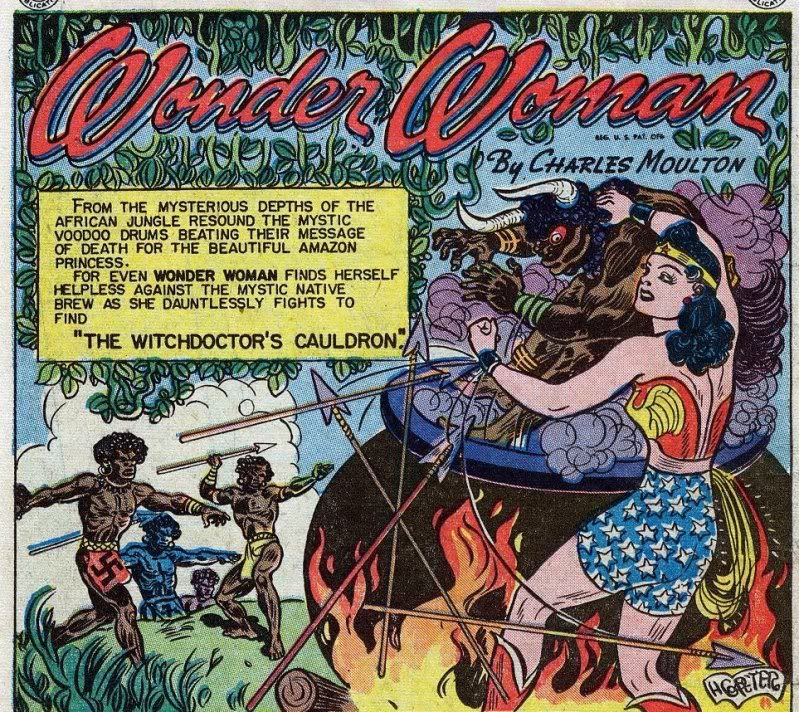
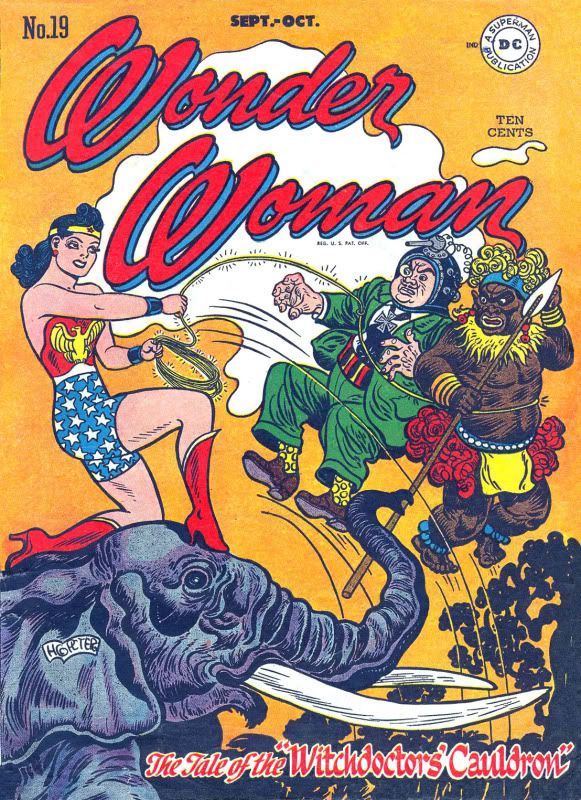
William Marston indulges in the occasional vicious asian or Jewish stereotype during his run on Wonder Woman. He doesn’t, however, tend to have many black characters. Wonder Woman 19, therefore, is something of a departure. But, as is their way, Marston and Peter make the most of it. Practically every comics creator from Herge to McCay to Crumb, has retailed offensive black stereotypes. But how many of them have done this?

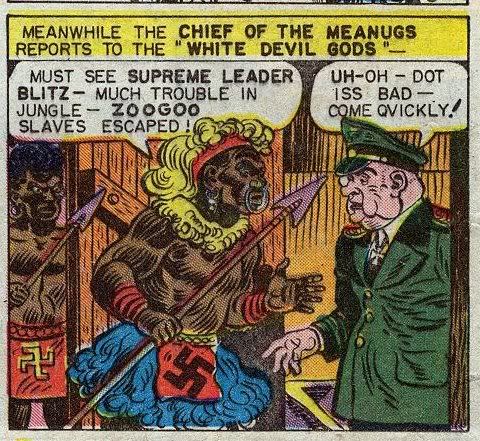
No, you’re not seeing things. Those are primitive African natives with swastika’s on their loincloths. The Nazis have allied with some evil natives, y’see, and the natives have, as a gesture of subservience, placed the Nazi symbol on their persons to demonstrate that they hold to the ideals of Hitler, including, presumably, the genocidal cleansing of both themselves and their entire continent. Really, it’s a kind of genius; the stereotypical, gibberish-spouting, African native has to be one of the most viscerally offensive images our quaint pictographs offer. You might think that there wasn’t really any way to take that and make it decidedly more vile. But I think Marston and Peter have managed it. Way to go, fellas.

I guess I could, at this point, go through the entire issue pointing out some of the more egregious incidents of racism — but I’m not sure there’s really a point, exactly. Marston and Peter buy every stereotype you’d imagine they’d buy. The natives think white people are gods; they have rhythm (Etta and the Holiday girls distract the natives by playing band music, because Africans can’t resist dancing when they hear indifferently-played college march tunes.) And, of course Africans are superstititious — WW mocks them for believing in voodoo, as opposed to in, I don’t know, invisible planes, (and, of course, voodoo is a syncretic New World phenomena, not based in Africa at all — though I guess maybe that’s pretty far down on the list of things to complain about at this point). In short, while Marston’s wackiness does shine through in certain ways (the swastika’s on the loincloths; his resolute refusal to sideline his slavery fetish no matter how hideously inappropriate it is in this particular context), he spends relatively less time on his own crackpottery and relatively more on the familiar crackpottery of racial prejudice.

In fact, in some ways the most surprising thing about this issue is not that Marston is a big old racist, but rather the extent to which he has to, or is willing to, compromise his own vision in order to accommodate that racism. As I’ve mentioned a time or two, Marston isn’t shy about indulging his obsessions. One of his standard plots/fantasy scenarios involves societies of more-or-less subhuman men paired with parallel societies of beautiful/enslaved women. I’m thinking particularly of the mole men (from Wonder Woman 4) and the Seal Men (from Wonder Woman 13).

Photobucket

marston wonder woman

In both of these stories, Marston uses the split between animalistic men/lovely women to work through his fetishes and his feminism. The bestial men enslave and dominate the women (which is fun, obviously); then the women turn the tables, conquer the men, dominate them, and make them fully human (because men can only reach their full potential when they’re ruled by women.) It’s a narrative near and dear to Marston’s kinky, kooky heart..

This issue of Wonder Woman initially seems like a perfect forum for him to break out those old tropes one more time. After all, the African men here are explicitly portrayed as animalistic:

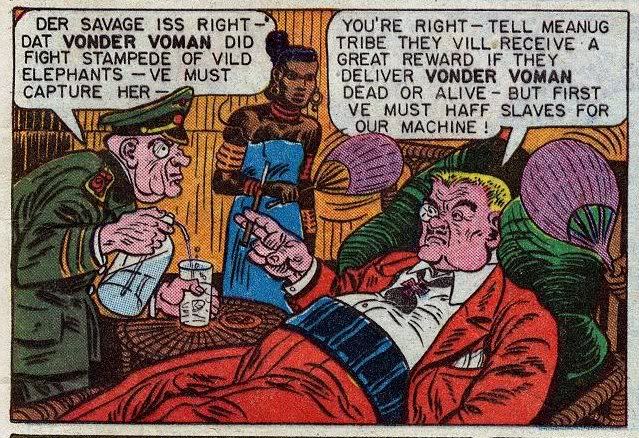
Moreover, they are portrayed as almost exclusively male. When women are shown in the background, as here

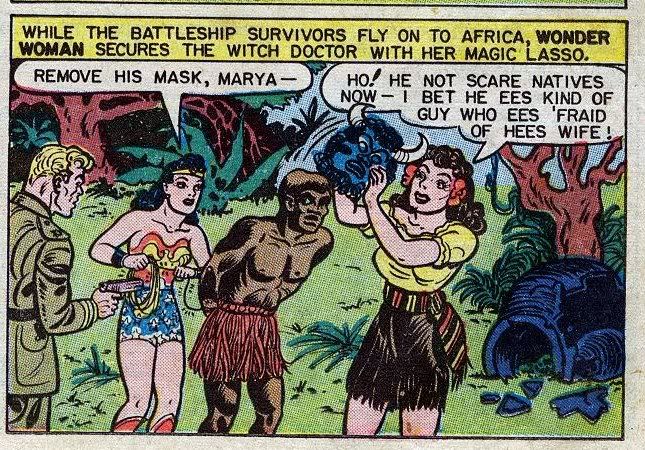
they fit the standard Marston/Peter formula you’d expect; that is, they look more human and appealing than they’re bestial mates. There is even one panel where Marston toys with the idea of giving these women a more prominent (and dominant) role:

This comment denigrates the chief in some sense (suggesting he’s in thrall to his wife.) But within Marston’s framework, men are *supposed to* be dominated by their wives. In the normal course of a Marston story, this would be the moment to bring out that wife, and have her influence transform and save her mate, turning him not only into a good man, but into a human being.

But while that can work for Mole Men and Seal Men, it can’t work for Africans. Marston is chary about portraying African women with good reason. Women for him are always superior; Africans are, and have to remain, inferior. A major role for an African women in a Marston comic is, therefore, literally unthinkable — in the sense that he doesn’t seem to be able to think it. Not only his feminism, but his interest in gender politics seems to buckle under the pressure of his racism.

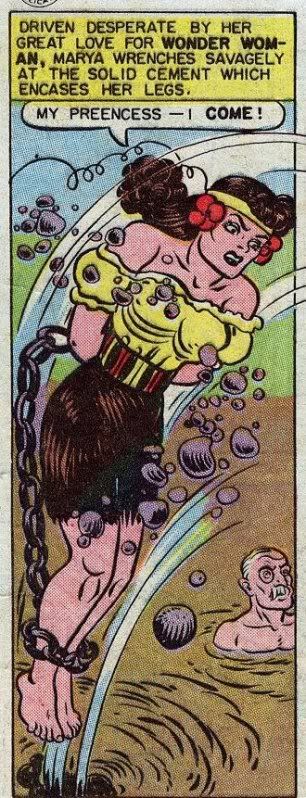
It’s perhaps interesting in this regard that WW #19 includes one of Marston’s most explicit elucidations of romantic female friendship. For most of the adventure, Wonder Woman is aided by Marya, a giant Mexican woman who idolizes WW, referring to her as “My preencess!” Trina Robbins summarizes this relationship nicely in her essay Wonder Woman: Lesbian or Dyke?

Another story deals with Marya, a beautiful eight foot tall “Mexican mountain girl,” who definitely has a crush on Wonder Woman. She calls Wonder Woman “brave princess” and “beautiful princess.” When the two women are captured in nets, Wonder Woman, ungraciously considering only her dumb blond “boyfriend,” Steve Trevor, tells her, “I’m sorry for you, Marya, but at least we’ve saved Steve…” Marya, with the selflessness of true love, replies, “I care not what happen to me if I help save your friend, Preencess!” Finally, Marya is encased in cement up to her chest. But when the amazon princess is about to be killed, “Driven desperate by her great love for Wonder Woman, Marya wrenches savagely at the solid cement which encases her legs.” Leaping from the cement she shouts, “My preencess — I come!” Finally, Wonder Woman freed and the villains vanquished, Wonder Woman declares, “The credit goes to the biggest girl and the bravest — my little friend Marya!” Marya kneels at the amazon’s feet, clutching her hand rapturously, saying, “Oh Preencess!”

Female-female relationships (bordering on, or more than bordering on, lesbianism) are important throughout Marston. But it seems telling that one of the most explicit appears in, and takes so much space in, this particular issue. It’s interesting too that Marya is essentially a white Latina marked as racially different (her size, her accent) and yet also as white (the “natives” call her white repeatedly.) It’s as if Marston started, say, the Seal Men story, suddenly realized he couldn’t run variations on his women-dominating-men fetish, and so instead backed-and-filled in order to run variations on his lesbian fetish.

The thing about the lesbian fetish, at least as represented here, is that it doesn’t have any political or social implications. The WW/Marya story is of personal friendship and love; in this case Marston doesn’t connect his fetishes to broader social ideals the way he does in the Seal Men and Mole Men stories. Marston can’t think of African women having power; therefore, though he can imagine individual examples of sisterhood, he can’t, in this particular comic, imagine a collective feminist movement. Marston’s racism, in other words, actually and actively gets in the way of his feminism. Reading this, I was reminded of the fate of numerous civil rights struggles after Reconstruction failed — basically, when the U.S. abandoned its commitment to equality for black people, it also abandoned its faith in social justice generally, with the result that women’s rights, for example, were set back for generations. This comic maybe provides an insight into why that might have been; to the extent that you don’t believe in equality, it becomes difficult to imagine, or to work for, equality.

_______________

Update: Again, the rest of the roundtable on race is here.