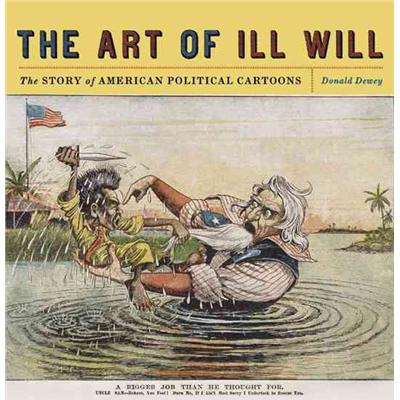
Two and a Half Centuries of Failure

Donald Dewey
The Art of Ill Will
New York University Press
251 pp/b&w
hardcover
978-0-8417-1985-5

I suppose the title should have warned me, but even so, the sourness of Donald Dewey’s *The Art of Ill Will* rather took me aback. I guess I had assumed that you wouldn’t edit a sizable monograph on the political cartoon unless you actually liked political cartoons. My mistake.

Far be it form me, though, to condemn Dewey for his dyspepsia. On the contrary, his 75-page introduction (more than a quarter of the book!) seems to me to be just about on target. Over the course of a detailed historical overview, he makes the case that editorial cartoons occupy an almost impossible cultural position, trying simultaneously to be propaganda, popular entertainment, and art. As propaganda, there is little evidence that they’ve ever succeeded on anything but the most limited terms: even in the 19th century, it’s hard to tell whether Thomas Nast actually had that much of an influence on anyone’s voting habits. As entertainment, editorial cartoons have been in decline for generations; as Dewey points out, political junkies these days turn to blogs or John Stewart for their laughs, not to cartoonists. And as art…well, Dewey points out “cartooning has never been expected to be ahead of the curve artistically, to pioneer an aesthetic vision.” In fact, after reading this book, one is led to the conclusion that the only thing editorial cartoons have been able to do consistently, reliably, and well, is to disseminate and popularize vile ethnic caricatures. From happy darkies carrying watermelons to slant-eyed duplicitous Japs, from oily Catholic priests to oily Muslim clerics, if its stereotype and prejudice you’re after, editorial cartoons know no peer.

Of course, there are plenty of great editorial cartoons, and Dewey reproduces a number of them. I was struck, in particular, by the work of Joseph Keppler, a contemporary of Nast’s whose drafting skills are, if anything, even more astounding than those of his more famous rival. I’d seen Keppler’s “The Modern Colossus of (Rail)Roads” before, but it’s still amazing; an almost photographic realism combined with a Little Nemoesque mastery of scale. I was glad to see several examples of Theodore (Dr. Seuss) Geisel’s work included as well; his giant Hitler water-snake is as fancifully endearing as any Grinch or Floobooberbabooberbub. I wish there’d been more examples of Oliver Harrington’s work; I’d (embarrassingly) never heard of him before, but the one picture included here, of a mob lynching a school bus, is rendered with absurd tactile viciousness — it’s a lovely choice for one of the few color reproductions. And I’m always happy to see anything by Robert Minor and Art Young (though, unfortunately, the cartoons Dewey chose for the later are far from being his best work.)

Despite such standouts, though, the overall effect of paging through the gallery here is more irritation than wonder. As just one example, a cartoon labeled “The Providential Detection”, showing Jefferson, an eagle, and several bales of mail, is almost completely charmless: stiff, ugly, and boring, its incompetent without any of the *brio* or imagination that you sometimes see in the work of untrained artists. Of course, when this cartoon was published in the 1800s, the U.S. was a cultural backwater, so it’s not a big surprise to see third-rate work. More modern entries, unfortunately, don’t have that excuse. Ted Rall’s meandering Terror Widows cartoon is an inevitable low point: I actually had to look at it twice to reassure myself that, no, the reproduction isn’t messed up, he just actually draws that badly. Gary Trudeau (who Dewey unaccountably praises for his distinctive graphics) is represented by several cartoons, including one of his trademark “lets draw the White House over and over because I’m just that damn lazy” efforts. And numerous Jules Feiffer cartoons display all the smug, feeble irony of a M.A.S.H. rerun; the man is the Alan Alda of political cartooning.

Feiffer’s numbing glibness is an extreme example of his profession’s cardinal weakness. When political polemic reaches the level of art, it tends to do so because the polemicist has thought things through. People like Hogarth or Bosch, or Bernard Shaw, or Mencken each had a vision of society which was nuanced and consistent, and which gave their verbal jabs depth and resonance. Shaw actually believed in socialism; Bosch actually believed in Christianity; Mencken actually believed in art. Most political cartoonists on the other hand, try to generate opinions without believing in anything in particular. They’re like decapitated chickens chasing after their own heads not because they hope to find any ideas there, but just for lack of anything better to do. As a result, you get a lot of scrabbling and spurting, but not a whole lot of insight — which in practice means a lot of pretentious gag cartoons with unusually obvious punch-lines. “The Americans sure whipped the British in the War of 1812!” “Jerry Falwell sure is slimy!” “They execute a lot of people in Texas!” How cutting.

Dewey’s presentation doesn’t help matters any. To every single cartoon he has appended a short note, explaining the meaning. For example, beside a picture which contrasts tony landlords leaving church with images of slum dwellers, we find this:

“Taylor’s “Our Religious Landlords and Their Rookery Tenants* (1895) mocked the hypocrisy of New York landlords who found an hour for piety every Sunday in between week-long indifference to the misery of their slum tenants.”

Admittedly, many of the cartoons are dated enough to require some sort of annotation. But Dewey’s indiscriminate and obsessive limning painfully emphasizes the fact that a dull joke is not improved by exegesis. At moments, Dewey himself seems to feel the futility of the whole exercise. In at least two cartoons (one by Paul Conrad, one by Bill Mauldin) , he drops the original caption entirely, rendering the putative joke incomprehensible. It’s as if Dewey said to himself, “Aw, hell, who really wants to look at this stuff anyway?”

No doubt the dropped captions were an accident. But still, the slip seems Freudian. *The Art of Ill Will* isn’t really all that interested in the cartoons; it’s built around the author’s Introduction, not around the pictures themselves. The book is a thesis, meant to provide information and raise interesting questions. It’s only because it’s marketed and priced as a coffee-table art book that it seems disappointing. Visually, Syd Hoff’s out of print 1976 *Editorial and Political Cartooning* is tons more enjoyable, simply because Hoff approached the work as a fanboy, reproducing the work of the artists he most admired, and ignoring everybody else. Dewey’s view of the medium’s achievements and weaknesses is probably closer to the truth— but, alas, as every editorial cartoonist should know, the truth isn’t very pretty.

______________

This essay first appeared in the Comics Journal.
 

Music For Middle-Brow Snobs: The Fool

Cheesy contemporary country and other tales of heartbreak:

1. Mariah Carey — Betcha Gon Know (Memoir of an Imperfect Angel)
2. Lee Ann Womack — The Fool (Lee Ann Womack)
3. Miranda Lambert — Greyhound Bound for Nowhere (Kerosene)
4. George Strait — She Told Me So (It Just Comes Natural)
5. Bonnie Raitt — I Can’t Make You Love Me (Luck of the Draw)
6. Emmylou Harris — Lovin’ You Again (Cowgirl’s Prayer)
7. Merle Haggard — Learning to Live With Myself (The Bluegrass Sessions)
8. Kieran White — Hummingbirds (Wayfaring Strangers: Lonesome Heroes)
9. John Villemonte — I Am the Moonlight (Wayfaring Strangers: Lonesome Heroes)
10. Pearls Before Swine — Morning Song (One Nation Underground/Balaclava)
11. ????? — Rashomon (????)
12. Sokai Stilhed — Howl (Second)
13. Arthur Rubinstein — Chopin: Mazurka #47 in A Minor, Op. 68/2, CT 97 (Chopin: 51 Mazurkas)
14. Brandy — Almost Doesn’t Count (Never Say Never)

Download: The Fool.

And if you missed it, last weeks download is here,

Utilitarian Review 10/9/09

Hoods Here

This week was devoted for the most part to our bande desinee roundtable. Special thanks to Derik Badman for his special guest contribution. Please check out his own blog, won’t you?

Despite my ongoing struggles with mediafire, I did post a mix last week, including Sonic Youth, experimental chinese music, Michio Kurihara, the inevitable Chopin, and other dreamy drony things. Download it now before mediafire makes it disappear in their mysterious way.

Hoods There

Bunch of stuff this week. First, I have an article about why Bob Wills is country and not jazz over at Splice Today.

The point here isn’t that Wills was ripping off Count Basie like Elvis ripped off Jackie Wilson. Rather, that “ripping off” doesn’t really do justice to the pervasive way in which race and marketing have affected American music. Because the fact is that Bob Wills is different from Count Basie. He used different instruments, he played different songs, he didn’t use the same musicians. (Segregation meant he couldn’t have, even if he wanted to.) Those differences could have been less important than the similarities, but, because of history and marketing and race, they weren’t. Similarly, Elvis is different from Jackie Wilson, and contemporary R&B is different from contemporary country. How music gets labeled affects who listens to it, who loves it, who uses it, and, thus, what it is.

My interview with Andee at the amazing San Francisco record store Aquarius Records is online at Madeloud. Here’s an excerpt, including a little bit that didn’t make the published version:

Me: Looking at these lists online, you sort of get the feeling that the store itself must be gigantic. How big is the store? How many records do you have in stock at one time?

Andee: That’s funny. It really does. And I sometimes feel bad when someone finally gets to visit, having come all the way from Japan or the UK, I feel like we should apologize for how small the store is, but almost always, people dig it. It’s small-ISH, but there’s tons of records, cds, plants in the windows, posters and flyers, and crap all over the walls, doors and posts and windows have been painted by artists, there are video games (a Tron, a Rastan and a Joust, and we usually have a Ghosts And Goblins, but that one’s broken), there’s good music playing, it’s just really comfortable and worn and home-y, the way a record store should be. I love places like Amoeba and Virgin and Tower, but that’s a whole different vibe, places like aQuarius are more inviting to just hang out, browse, shoot the shit with whoever is working, play some Joust. I like it like that. As for how many records we have in the store, only a fraction of what’s on the website. we’re usually full to capacity, but the cool thing about visiting is, there’s always plenty of stuff that is NOT on the site, maybe stuff we haven’t reviewed yet, stuff that we were only able to get a few copies, not enough to post on the site, some stuff that just won’t make it on the site, for whatever reason, not to mention TONS of awesome used stuff, and new arrivals and more…..

Also Splice Today has reprinted my review of Julia Cameron’s The Artist’s Way, which ran some years back in the Baffler. (I think it was my first published essay, actually.) And I have a review of a Tommy Cash reissue at Metropulse.

Hoods Everywh…Oh, Wait, Those Aren’t Hoods

A note on this website points out that the deevolutionizer in this issue of Wonder Woman apparently inspired Devo. Who knew?

Diana Kingston-Gabai explains that crossovers still suck.

This is a great fucking essay by Terry Eagleton about what atheists are stupid and god is great, even if he isn’t real.

And so the very act of attempting to close history down has sprung it open again. Both at home and globally, economic liberalism rides roughshod over peoples and communities, and in the process triggers just the kind of violent social and cultural backlash that liberalism is least capable of handling. In this sense, too, terrorism highlights certain contradictions endemic to liberal capitalism. We have seen already that pluralistic liberal societies do not so much hold beliefs as believe that people should be allowed freely to hold beliefs. The summum bonum is to leave believers to get on with it unmolested. Such a purely formal or procedural approach to belief necessitates keeping entrenched faiths or identities at a certain ironic arm’s length.

Yet this value—liberal society’s long, unruly, eternally inconclusive argument—also brings vulnerability. A tight national consensus, desirable in the face of external attack, is hard to pull off in liberal democracies, and not least when they turn multicultural. Lukewarmness about belief is likely to prove a handicap when one is confronted with a full-bloodedly metaphysical enemy. The very pluralism you view as an index of your spiritual strength may have a debilitating effect on your political authority, especially against zealots who regard pluralism as a form of intellectual cowardice. The idea, touted in particular by some Americans, that Islamic radicals are envious of Western freedoms is about as convincing as the suggestion that they are secretly hankering to sit in cafés smoking dope and reading Gilles Deleuze.

This is actually the last chapter of Eagleton’s latest book, “Reason, Faith and Revolution,” which is amazing. Best purchase on Amazon I’ve made in a good long while. If you want to check it out, it’s here.

Zombie: A Mindless Affair

I’m going to be in an art show on October 23. Here are the details:

Zombie: A Mindless Affair
Curated by: Edra Soto

Also Project Wall Space:Irene Perez
ZOMBIE ARTISTS:
C Through Outfit (Erik Brown, Catie Olsen, Carl Warnik and Dawn Reed)
Deborah Boardman
Nate Lee
Jason Mena
Mindy Rose Schwartz
Amanda Browder
Derek Chan
Christopher Simkins
Christopher Smith
Ann Toebbe
Harold Mendez
Paul Nudd
Noah Berlatsky
Vladimir Kharitonsky
Dan Peters
Gretel Garcia
Susannah Kite Strang
Rachel Hewitt
Corinne Halbert
Bert Stabler
Beatriz Monteavaro
Miguel Cortez
Edra Soto
Candace Briceno
Death by Design Co. (Teena McClelland and Michelle Maynard)
The Wiener Girls (Sydney Croskery and Katey Rafanello)
Betsy Odum
Jen Thomas and Bobby Lively
Chris Hammes
Andrea Jablonski
Jeff Libersher

ABOUT: Zombie: A Mindless Affair

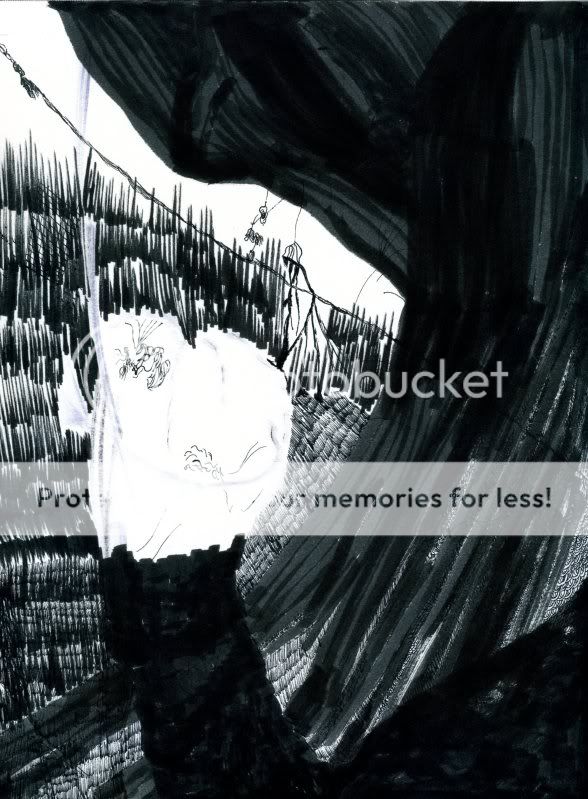
Celebrations that invite us to observe a historical occurrence are still strongly practiced in contemporary culture. Halloween, as celebrated is America, profoundly depicts the strongest features from gothic and horror literature, film, TV, and graphic arts. Among the repertoire of traditional characters, the zombie distinguishes itself for possessing the biology and behavior of a normal human being, yet lacks consciousness. This exhibition uses the vernacular of the mythological zombie as a starting point to engage in ideas of death, mindlessness and symbolisms for the occult and inexplicable. The term zombie also intends to address issues referring to the mindless self in a social spectrum: leading and following; acts of automatism and fanatic behaviors.

From 6:30-7:00pm on opening night:
Join author Scott Kenemore, artist Mindy Rose Schuartz and collaborators Teena McClelland and Michelle Maynard from Death by Design Co. in conversation. They will talk about the darkness that enlightens their work. Screening of the film made by Death by Design Co. immediately after the conversation. Moderated by Edra Soto

Opening Friday October 23 from 6pm-10pm
October 23 – November 21, 2009

ANTENA
1765 S. Laflin St.
Chicago IL 60608
www.antenapilsen.com
antenapilsen (at) gmail.com
_______

And, hey, here’s the piece I’m showing for those not in the Chicago area (it’s better in person…no, really! Trust me!)

Sequential Surrender Monkey: The Case Against Tin Tin

1. Slapstick

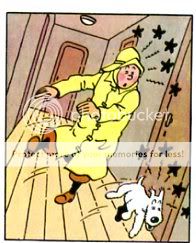
Rereading Tin Tin, what struck me most was just how French it is (or how Belgian, I guess.) Everything’s just so darn greasepaint-precious. “Ooooh hooo hooo…the cursing captain…he fall down and bump ze head! Oh stop — the Thompson Twins, they’re hats, they are pulled down over their eyes so only ze bristley mustachios are showing! Oh, ze little doggie, he is drunk!” In Asterix, the physical humor is explosive and go-for-broke; when you hit the roman soldier, he rockets out of his sandals in a riot of motion lines and explosive puffs; when he lands in the next panels on his head, you get to watch his toes violently twitching. In Tin Tin, on the other hand, the slapstick almost seems to be in quotes, like you’re watching mimes. Motion lines are little curlicues, and the bashed tend to look startled and dizzy rather than actually bashed about. If Asterix is analogous to Bugs Bunny, Tin Tin is Disney; skilled, tasteful, and kind of boring.

2. Characterization

A Wikipedia entry on Tin Tin compares Herge’s characters to Dickens’. It’s not a comparison that serves Herge well. Dickens did use caricature, but those caricatures are multi-layered, encompassing both biting satire and a knowing humanism. In Bleak House, for example, Richard Carstone’s rationalizations around money are both funny and tragic, and feed naturally into his gradual embitterment. Or there’s this passage from the same novel:

“There has been only one child in the Smallweed family for several generations. Little old men and women there have been, but no child, until Mr. Smallweed’s grandmother, now living, became weak in her intellect and fell (for the first time) into a childish state. With such infantine graces as a total want of observation, memory, understanding, and interest, and an eternal disposition to fall asleep over the fire and into it, Mr. Smallweed’s grandmother has undoubtedly brightened the family.”

The Smallweeds here are a very particular kind of stultified; enlivened by the one senile figure in their midst. The joke comes out of that specific contrast.

Herge’s caricature’s on the other hand, seem much more broad and tired. Captain Haddock is a sailor who curses and drinks too much. Professor Calculus is an absent-minded (and deaf) professor. The Thompson twins are bumbling cops. Those are the jokes, and they were pretty old, I have no doubt, even 50 years ago when Herge was writing these. Not that they’re handled poorly or that they aren’t often funny or surprising…but overall, and especially if you read a bunch of them in a row, they start to feel decidedly thin. The truth is that Herge’s penchant for racist caricature and easy anti-semitism wasn’t an accident; virtually all his characters are based around easy stereotypes and fusty gags; it’s just that making fun of sailors looks more innocuous these days than ridiculing the stupidity of black people or the avarice of Jews. Fagin is offensive as well, of course, but he’s also got enough depth and texture that you feel that there’s something to him beyond the anti-semitism…or at least that the anti-semitism is somewhat textured. But when Herge uses a stereotype, as he almost always does, the stereotype is pretty much all there is happening.

3. Art

Herge’s obviously a very skilled illustrator, with an amazing facility and capacity for rendering detail. And in the abstract, I can certainly appreciate a complicated tour de force like this:

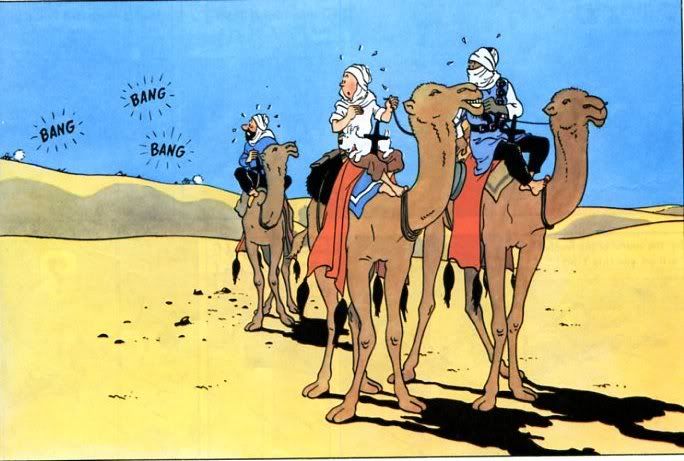
But in terms of visceral appeal, though, his art just doesn’t do that much for me. The cleanness and perfection of it, the evennness of the lines; it almost seems produced by machine. For example, compare Herge’s camels:

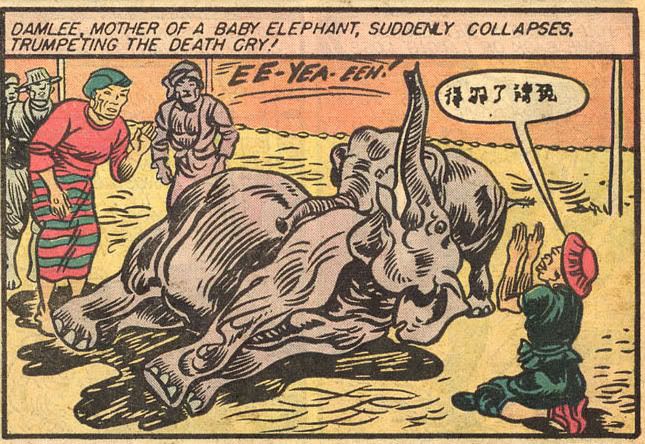
with Harry G. Peter’s elephants.

Herge’s drawing is much more correct anatomically, but it’s also much less fun to look at. The camels are too smooth; they have the same weight as everything else. They might as well be boxes, for all the character they have. The bits of personality — the one camels’ smile, the other camel’s knowing look — actually comes across as irritatingly smug. Again, it feels Disneyfied to me — a lack of personality gilded with cutesiness.

4. Layout

Given his status as one of the great figures in comics, it’s amazing how little interest Herge seems to have in the page as an aesthetic unit. He does vary panel sizes to accommodate action, and so he can fit big objects like planes:

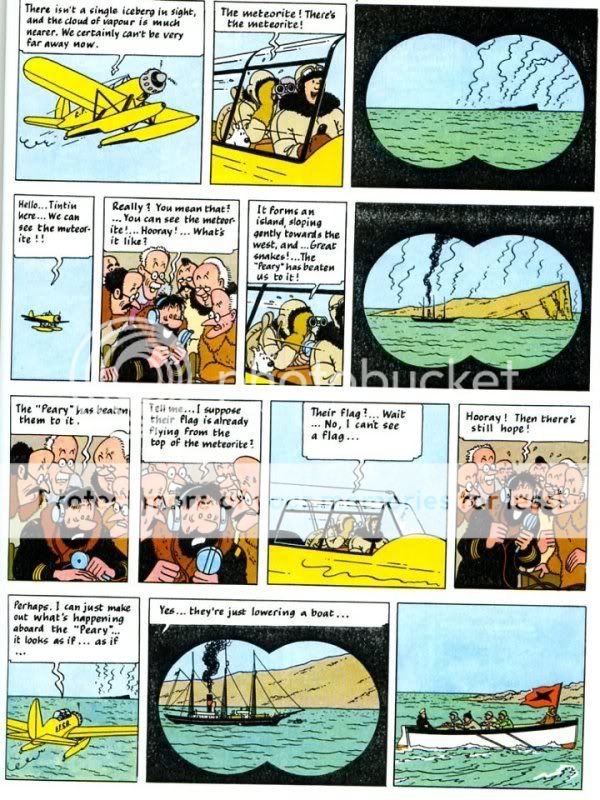
And he will use bigger splash panels for effect, as with the camel image above. But in terms of unifying an entire page….he just doesn’t bother. Look at this for example:

The most striking visual motif on the page is the binocular frame. It’s used in three panels…but that’s pretty much all that can be said for it. Those three images aren’t balanced out in any particular way that I can see; they’re just placed on the page at the point where they logically occur in the narrative.

You really see this in the use of text as well, which sometimes just overwhelms the pictures.

That’s gratuitous as well; that text is just restating things you already know. It’s off-putting, ugly, and unnecessary. I don’t think it’s laziness, — Herge is never less than entirely professional and meticulous, and writing out all those words was probably actually a fairly irritating task. But it does suggest that he doesn’t have much of an eye for, or interest in, design.

_____________________

Overall, then, Herge’s perfectionism and professionalism, which are impressive in small doses, become irritating and burdensome the more you realize that that’s all he has to offer. I remember being a bit bored by them as a kid, and as an adult…I’m maybe even more bored by them. The plots bop along, and there are still some excellent gags: the Thompson twins bizarre affliction — whereby their hair grows excessively fast and changes myriad hues, is visually spectacular and completely ridiculous. And I had forgotten how weird and disturbing some of the dream sequences are. Tin Tin turning into a giant bottle of wine with his head as the cork which Captain Haddock tries to twist out; the weird fever dream of a prophet grasping a picture of a giant spider — such moments come close to thematizing the oppressively flat unreality of Herge’s world. Mostly, though, that flat unreality isn’t disturbing or affecting. It’s just flat.

_______________

You can read the entire roundtable here.

Music For Middle-Brow Snobs: A Yoke of Oxen

Psychy droniness and such.

1. Fathmount — A Yoke of Oxen (Anthology of Experimental Chinese Music)
2. Michio Kurihara — The Wind’s Twelve Quarters (Sunset Notes)
3. Mariah Carey — H.A.T.E.U. (Memoir of an Imperfect Angel)
4. Magic Hour — Jonathan and Charles (Will They Turn You On Or Will They Turn on You)
5. Sonic Youth — The Diamond Sea (Washing Machine)
6. Nadja — No Cure for the Lonely (When I See the Sun Always Shines on TV)
7. Burmese — Lady Killer (A Mere Shadow and Reminiscence of Humanity)
8. Li Jianhong — Sod (Anthology of Experimental Chinese Music)
9. Artur Rubinstein — Chopin: Mazurka #26 in C Sharp Minor (Chopin: 51 Mazurkas)

Download: A Yoke of Oxen.

And if you missed it you can get last week’s thrash mix here.

Update: At least one person has said the download isn’t working. If you’re having trouble as well (or, for that matter, if you’re not), please leave a comment to let me know.